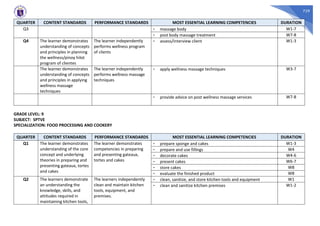
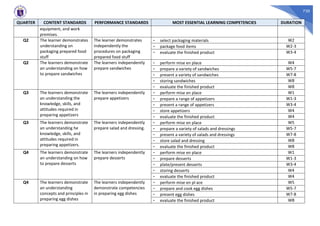
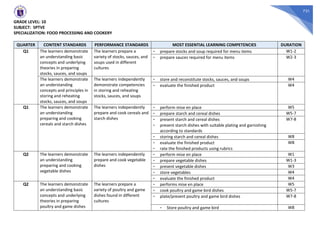
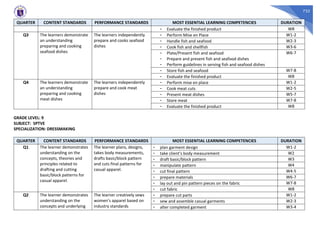
1
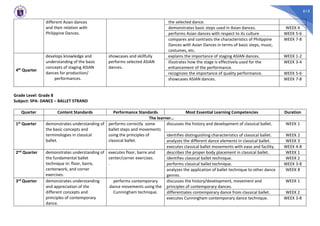
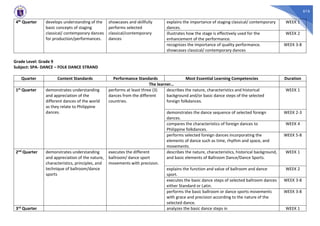
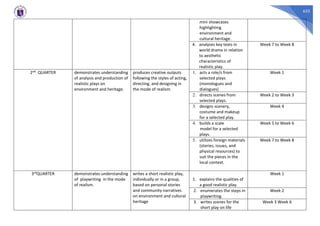
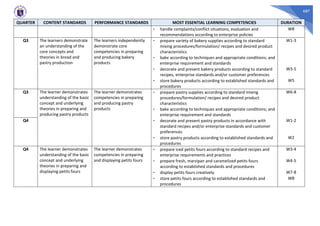
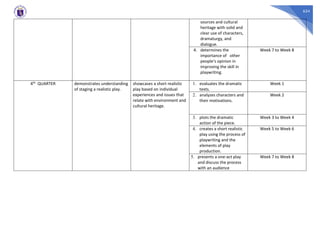
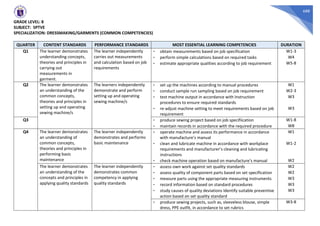
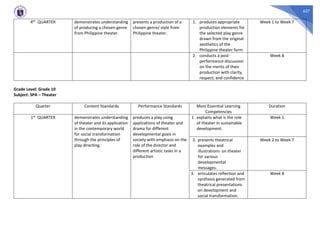
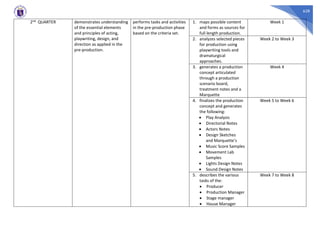
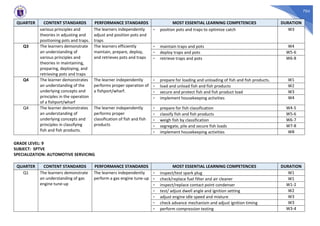
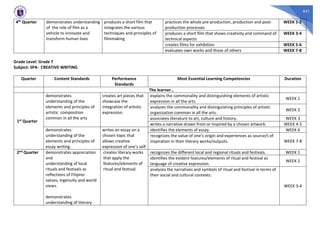
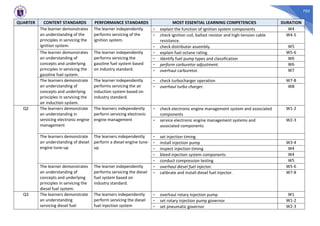
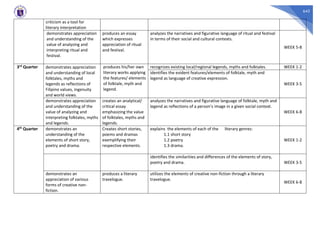
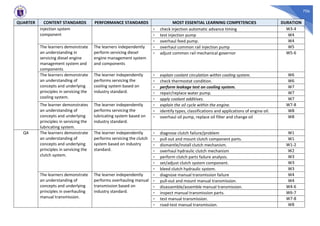
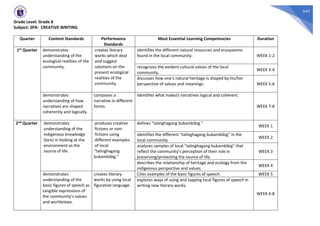
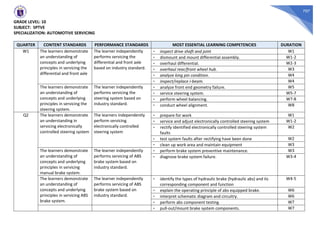
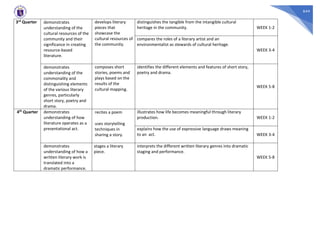
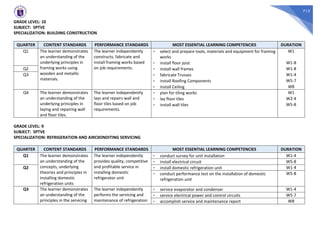
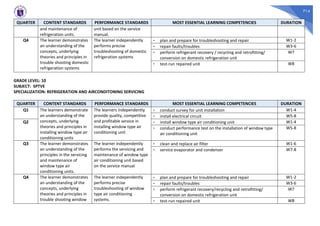
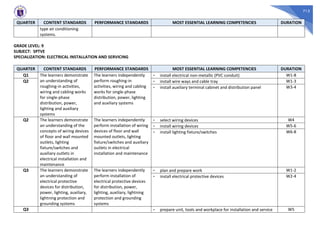
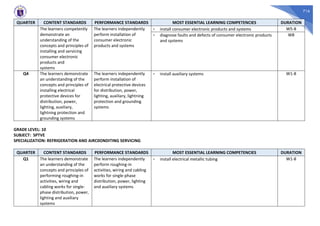
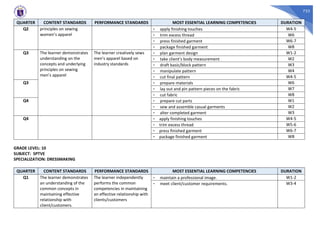
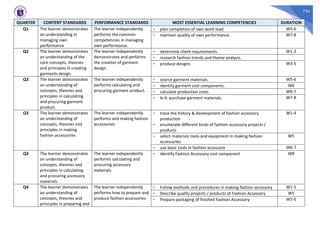
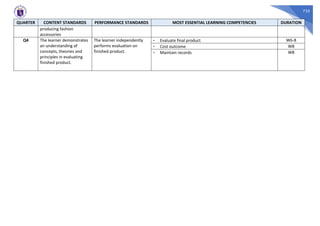
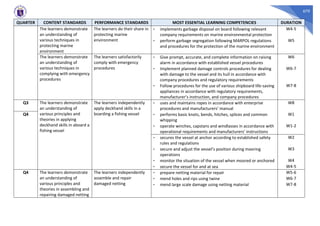
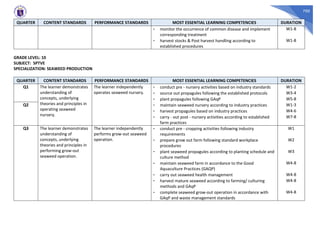
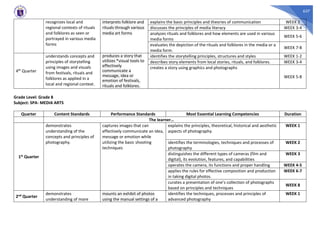
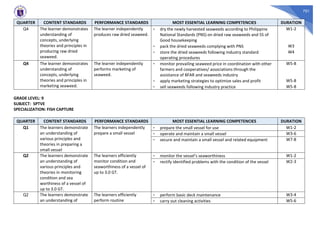
595
596
GUIDING OUR TEACHERS: A Briefer on the Use of the Special Program in the Arts ( SPA) MELCs
About the Process
In light of the COVID-19 pandemic and the consequent shortened academic year, the Department of Education, through the Bureau of Curriculum Development-
Special Curricular Programs Division, has produced a list of the most essential learning competencies (MELCs). MELCs was produced to ensure that grade level
standards, along with its content and performance standards are still attained despite the changes in learning delivery modes brought by the COVID-19
pandemic.
In the process of identifying the MELCs, the ENDURANCE criterion was used as the sole determiner. Endurance is defined as the learning competency that
remains with learners long after a test is completed (Reeves, 2002) or is useful beyond a single test or unit of study (Many and Horrell, 2014) which is
applicable to real-life situations e.g. social participation and integration.
Guided by the requirement that a learning competency (LC) be useful in lifelong learning, the group of specialists in-charge of the Special Program in the Arts
curriculum recognizes the role of the program in developing excellent young artists in any field of arts towards the promotion of Filipino culture and heritage
preservation. The identified MELCs are those that can be learned in any mode of delivery, either face-to-face, online or homebased learning.
Example:
SPA-Dance G7 Q1: The learner identifies the nature and characteristics of each dance form/genre
The example above provides students with knowledge of content specific words learned from the Physical Education component of MAPEH. MELCs are also
significantly less than the original number of LCs in the curriculum because of certain factors. First, some LCs may be subsumed by other competencies.
Example:
SPA-Dance (G7 Q1): Differentiates dance forms/genre
SPA-Dance (G7 Q1): Identifies the nature and characteristics of each dance form/genre
The second factor considered in determining the MELCs is the LCs ability to be administered in different learning modalities especially during the pandemic.
Consider the example below:
Example:
SPA-Visual Arts (G7 Q4): Converts photographs into computer graphics or cartoons
648
Guiding our Teachers: A Briefer on Using the Special Program for Sports (SPS) MELCs
About the Process
Due to the COVID-19 pandemic which shortened the number of school days for SY 2020-2021, the Department of Education’s (DepEd) Bureau of
Curriculum Development (BCD) came up with a list of Most Essential Learning Competencies (MELCs) from the Curriculum Guides of the Special Program in
Sports (SPS), anchored on the identified content and performance standards thereof. In the process of identifying the MELCs, the ENDURANCE criterion was
used as the sole determiner. Endurance is defined as the learning competency that remains with learners long after a test is completed (Reeves, 2002) or is
useful beyond a single test or unit of study (Many and Horrell, 2014) which is applicable to real-life situations e.g. social participation and integration.
Specifically, SPS learners who are athletes shall be able to improve their fitness levels, recognize and prevent injuries, analyze movements patterns, design
nutritional plan for athletes and recognize the effects of doping on athletic performance, and apply psychosocial behavioral skills. Therefore, the MELCs
identified are those that will further elevate the SPS to a higher degree of social relevance by improving the skills and talents of athletes.
Example 1:
Grade 8 Q4-Psychosocial/Behavioral Skills: Practice cooperation, clear communication, and positive social interaction to enhance teamwork.
This is an example of an enduring competency where the skills learned are applied in the other courses of the SPS which is important in life and is likewise
retained even after learners finished the program.
Example 2:
Grade 7 Q4-Sports Nutrition: Explain the importance of nutrition to athletic performance
This competency can be applied both in Sports Nutrition and in other SPS courses.
Example 3:
G7 Q2- Exercise Physiology and Methods of Conditioning: Explain the principles of exercise training
The competency is essential in order for learning to be successful in particular to the course of Exercise Physiology and Methods of Conditioning.
These are samples of the MELCs identified in the SPS. However, teachers must carefully monitor the progress of their learners relative to the standard
competencies and intervene or remediate if learners are having a hard time learning them.
660
GUIDING OUR TEACHERS: A Briefer on Using the Special Program in Technical- Vocational Education ( SPTVE) MELCs
The Process
The national emergencies, such as the health pandemic, has significantly disrupted the established systems and processes of the country. In education where
face to face mode of teaching-learning is the most popular and widely used, with social distancing as a new normal, the school calendar, learning activities need
to be adjusted accordingly in order to ensure basic quality education.
In response to this, the Bureau of Curriculum Development – Special Curricular Programs Division (BCD-SCPD) has identified the Most Essential Learning
Competencies (MELCs) for the Special Program in Technical Vocational Education. This SPTVE MELCs set the competency standards for various specializations.
By using MELCs, the face to face interaction between teachers and learners can be regulated,and therefore different learning delivery modes, such as online
learning, media based learning, and blended learning can be explored depending on the community context or location of the school.
The SPTVE MELCs maintain the SPTVE’s commitment to expand and intensify technical and vocational education and ensure that the techvoc learners acquire
the necessary knowledge and the 21st century skills. To achieve this, the MELCs are embedded in the four (4) major areas: Industrial Arts, Agriculture and Fishery
Arts, Information and Communications Technology, and Home Economics.
The Process of identifying the SPTVE MELCs:
In identifying the MELCs, the ENDURANCE criterion was used as the sole determiner. Endurance is defined as the learning competency that remains with
learners long after a test is completed (Reeves, 2002) or is useful beyond a single test or unit of study (Many and Horrell, 2014) which is applicable to real-life
situations, e.g., social participation and integration.
The identified SPTVE MELCs feature these characteristics:
1. broad stroke competencies which needs to be unpacked by the teachers.
2. aligned to the content and performance standards of the curriculum that are based on minimum industry requirements and occupational health and safety
standards.
3. do not replace the existing curriculum of the special curricular prgoram but these are lifted for use only in this particular school year 2020-2021
For SPTVE specializations, including exploratory and mandatory subjects, the SPTVE MELCs shall be adopted by the SPTVE-implementing schools. On the other
hand, the core academic subjects, such as, English, Science, Math, Filipino, Araling Panlipunan, MAPEH, its corresponding MELCs provided for all subjects across
grade levels will be adopted.
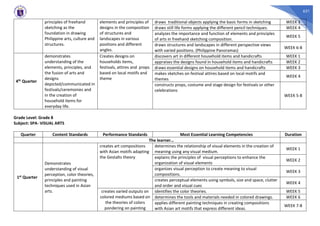
597
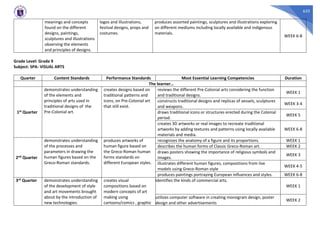
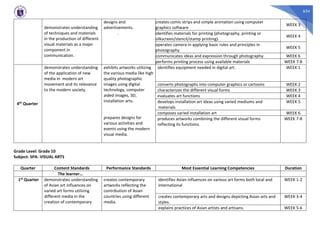
Learners with or without computers have the choice to convert photographs into digital art or cartoon style drawing (caricature)
How to Use the MELCs
Given the nature of the MELCs, the teacher is advised to find suitable activities and performance output for the achievement of certain competencies. It is also
recommended that the teacher consider available resources in the community.
The teacher may include more or less than those identified depending on the needs of the learners. Teachers are given the leeway to formulate learning
objectives deemed necessary for their students’ artistic development as long as they adhere to the existing curriculum standards prescribed by the Department
of Education.
649
How to Use the MELCs
The MELCs for SPS represent the standard competencies that will be assessed whether the learners have demonstrated mastery. Given the nature of the
MELCs, the teacher is advised to re-teach certain competencies needed for their achievement. The curriculum is spiral, hence, the course for Quarter 1 is
Biomechanics and Movement Patterns, Quarter 2 is Exercise Physiology and Methods of conditioning, Quarter 3 is Sports Injuries, Quarter 4 is Sports Nutrition
while Psychosocial or Behavioral skills are integrated during practicum sessions. It is also recommended that the teacher unpack the MELCs into more specific
learning competencies as as provided in the original curriculum guides for SPS.
Examples:
GRADE LEVEL /QUARTER/COURSE TITLE MELCS SUB-COMPETENCIES
G8/Q1/Biomechanics and Movement
Patterns
Performs and evaluates one’s balance,
agility, speed and power using different
methods of testing
• Differentiates the quality and quantity of measuring human
motion.
• Evaluates the movements applied for motion, resistance,
momentum and friction.
G7/Q3/Sports Injury Create creative presentation in recognizing,
evaluating and preventing acute and
chronic injuries
• Compares the effects of acute injury from chronic injury
• Prepares creative presentation on how to recognize, evaluate
and prevent acute and chronic injury.
G8/Q4/Sports Nutrition Evaluate meal planning for endurance and
power sports
• Develops awareness in meal planning for endurance and power
sports
• Recognizes the importance of different nutrients and their
recommendations for endurance and power sports
• Distinguishes facts from myths of nutrient intake for endurance
and power sports
• Formulates personal goals and nutritional strategy for adequate
nutrition
• Demonstrates ability to make informed choices as a consumer
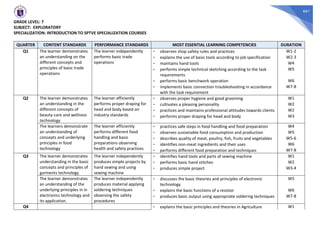
661
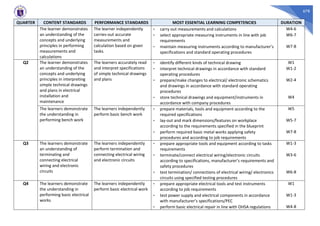
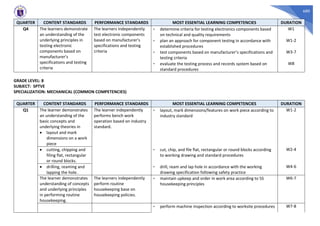
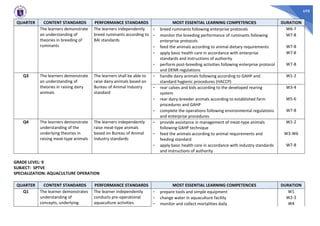
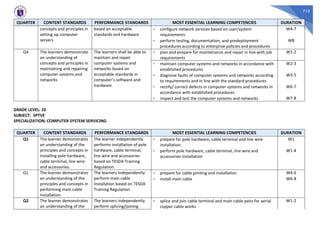
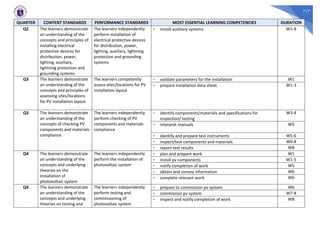
GRADE LEVEL: 7
SUBJECT: EXPLORATORY
SPECIALIZATION: INTRODUCTION TO SPTVE SPECIALIZATION COURSES
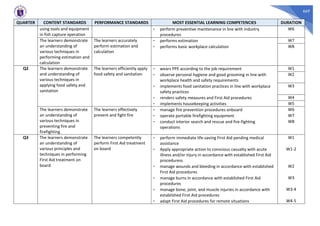
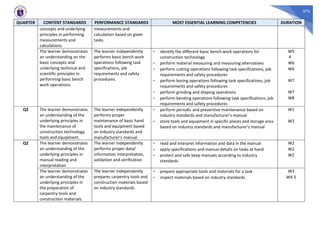
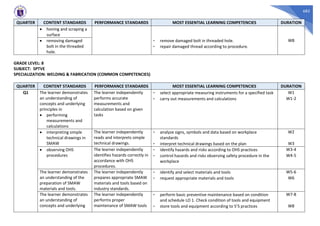
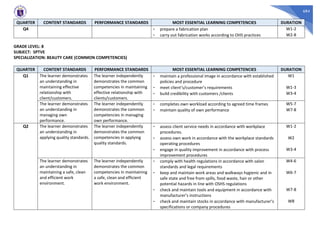
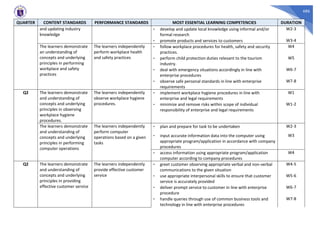
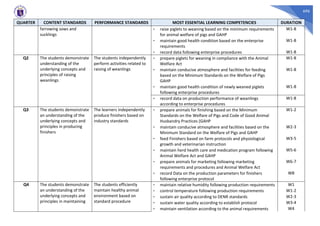
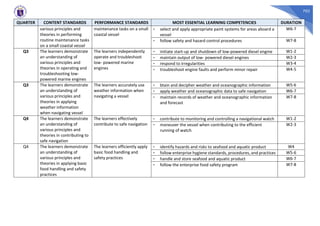
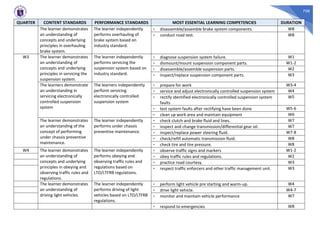
QUARTER CONTENT STANDARDS PERFORMANCE STANDARDS MOST ESSENTIAL LEARNING COMPETENCIES DURATION
Q1 The learner demonstrates
an understanding on the
different concepts and
principles of basic trade
operations
The learner independently
performs basic trade
operations
- observes shop safety rules and practices W1-2
- explains the use of basic tools according to job specification W2-3
- maintains hand tools W4
- performs simple technical sketching according to the task
requirements
W5
- performs basic benchwork operation W6
- implements basic connection troubleshooting in accordance
with the task requirement
W7-8
Q2 The learner demonstrates
an understanding in the
different concepts of
beauty-care and wellness
technology
The learner efficiently
performs proper draping for
head and body based on
industry standards
- observes proper hygiene and good grooming W1
- cultivates a pleasing personality W2
- practices and maintains professional attitudes towards clients W2
- performs proper draping for head and body W3
The learners demonstrate
an understanding of
concepts and underlying
principles in food
technology
The learner efficiently
performs different food
handling and basic
preparations observing
health and safety practices
- practices safe steps in food handling and food preparation W4
- observes sustainable food consumption and production W5
- describes quality of meat, poultry, fish, fruits and vegetables W5-6
- identifies non-meat ingredients and their uses W6
- performs different food preparation and techniques W7-8
Q3 The learner demonstrates
understanding in the basic
concepts and principles of
garments technology
The learner independently
produces simple projects by
hand sewing and using
sewing machine
- identifies hand tools and parts of sewing machine W1
- performs basic hand stitches W2
- produces simple project W3-4
The learner demonstrates
an understanding of the
underlying principles in in
electronics technology and
its application.
The learner independently
produces material applying
soldering techniques
observing the safety
procedures
- discusses the basic theories and principles of electronic
technology
W5
- explains the basic functions of a resistor W6
- produces basic output using appropriate soldering techniques W7-8
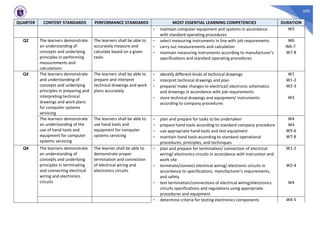
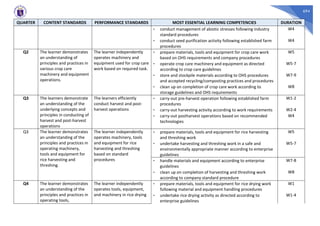
Q4 - explains the basic principles and theories in Agriculture W1
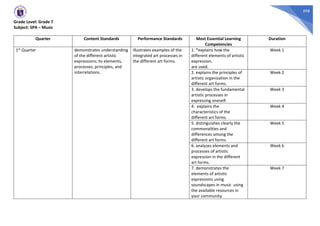
598
Grade Level: Grade 7
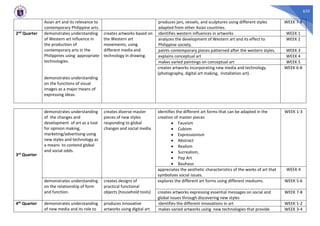
Subject: SPA – Music
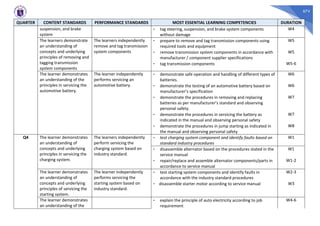
Quarter Content Standards Performance Standards Most Essential Learning
Competencies
Duration
1st Quarter demonstrates understanding
of the different artistic
expressions; its elements,
processes, principles, and
interrelations.
illustrates examples of the
integrated art processes in
the different art forms.
1. *explains how the
different elements of artistic
expression.
are used.
Week 1
2. explains the principles of
artistic organization in the
different art forms.
Week 2
3. develops the fundamental
artistic processes in
expressing oneself.
Week 3
4. explains the
characteristics of the
different art forms.
Week 4
5. distinguishes clearly the
commonalities and
differences among the
different art forms.
Week 5
6. analyzes elements and
processes of artistic
expression in the different
art forms.
Week 6
7. demonstrates the
elements of artistic
expressions using
soundscapes in music using
the available resources in
your community.
Week 7
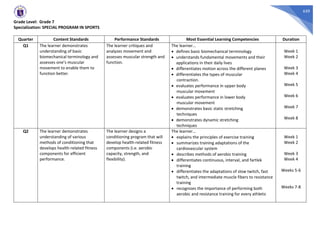
650
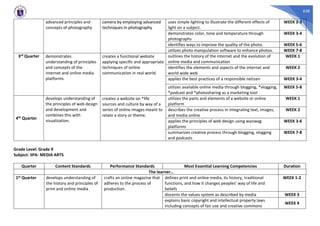
Grade Level: Grade 7
Specialization: SPECIAL PROGRAM IN SPORTS
Quarter Content Standards Performance Standards Most Essential Learning Competencies Duration
Q1 The learner demonstrates
understanding of basic
biomechanical terminology and
assesses one’s muscular
movement to enable them to
function better.
The learner critiques and
analyzes movement and
assesses muscular strength and
function.
The learner…
• defines basic biomechanical terminology
• understands fundamental movements and their
applications in their daily lives
• differentiates motion across the different planes
• differentiates the types of muscular
contraction.
• evaluates performance in upper body
muscular movement
• evaluates performance in lower body
muscular movement
• demonstrates basic static stretching
techniques
• demonstrates dynamic stretching
techniques
Week 1
Week 2
Week 3
Week 4
Week 5
Week 6
Week 7
Week 8
Q2 The learner demonstrates
understanding of various
methods of conditioning that
develops health-related fitness
components for efficient
performance.
The learner designs a
conditioning program that will
develop health-related fitness
components (i.e. aerobic
capacity, strength, and
flexibility).
The learner…
• explains the principles of exercise training
• summarizes training adaptations of the
cardiovascular system
• describes methods of aerobic training
• differentiates continuous, interval, and fartlek
training
• differentiates the adaptations of slow twitch, fast
twitch, and intermediate muscle fibers to resistance
training
• recognizes the importance of performing both
aerobic and resistance training for every athletic
Week 1
Week 2
Week 3
Week 4
Weeks 5-6
Weeks 7-8
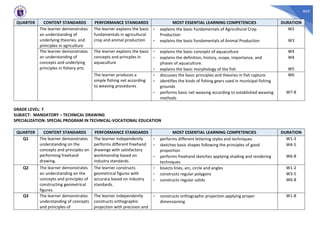
662
QUARTER CONTENT STANDARDS PERFORMANCE STANDARDS MOST ESSENTIAL LEARNING COMPETENCIES DURATION
The learner demonstrates
an understanding of
underlying theories, and
principles in agriculture
The learner explains the basic
fundamentals in agricultural
crop and animal production
- explains the basic fundamentals of Agricultural Crop
Production
W2
- explains the basic fundamentals of Animal Production W3
The learner demonstrates
an understanding of
concepts and underlying
principles in fishery arts
The learner explains the basic
concepts and princples in
aquaculture
- explains the basic concepts of aquaculture W4
- explains the definition, history, scope, importance, and
phases of aquaculture.
W4
- explains the basic morphology of the fish W5
The learner produces a
simple fishing net according
to weaving procedures
- discusses the basic principles and theories in fish capture
- identifies the kinds of fishing gears used in municipal fishing
grounds
W6
- performs basic net weaving according to established weaving
methods
W7-8
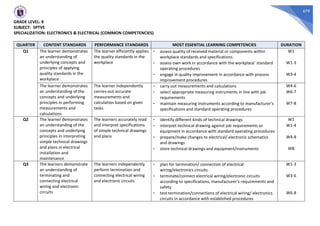
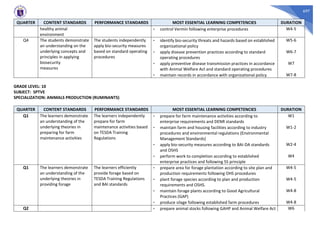
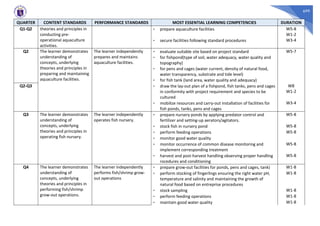
GRADE LEVEL: 7
SUBJECT: MANDATORY – TECHNICAL DRAWING
SPECIALIZATION: SPECIAL PROGRAM IN TECHNICAL-VOCATIONAL EDUCATION
QUARTER CONTENT STANDARDS PERFORMANCE STANDARDS MOST ESSENTIAL LEARNING COMPETENCIES DURATION
Q1 The learner demonstrates
understanding on the
concepts and principles on
performing freehand
drawing.
The learner independently
performs different freehand
drawings with satisfactory
workmanship based on
industry standards.
- performs different lettering styles and techniques W1-3
- sketches basic shapes following the principles of good
proportion
W4-5
- performs freehand sketches applying shading and rendering
techniques
W6-8
Q2 The learner demonstrates
an understanding on the
concepts and principles of
constructing geometrical
figures.
The learner constructs
geometrical figures with
accuracy based on industry
standards.
- bisects lines, arc, circle and angles W1-2
- constructs regular polygons W3-5
- constructs regular solids W6-8
Q3 The learner demonstrates
understanding of concepts
and principles of
The learner independently
constructs orthographic
projection with precision and
- constructs orthographic projection applying proper
dimensioning
W1-8
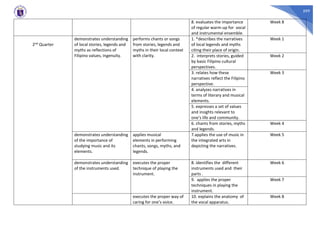
599
8. evaluates the importance
of regular warm-up for vocal
and instrumental ensemble.
Week 8
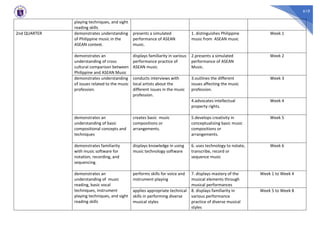
2nd Quarter
demonstrates understanding
of local stories, legends and
myths as reflections of
Filipino values, ingenuity.
performs chants or songs
from stories, legends and
myths in their local context
with clarity.
1. *describes the narratives
of local legends and myths
citing their place of origin.
Week 1
2. interprets stories, guided
by basic Filipino cultural
perspectives.
Week 2
3. relates how these
narratives reflect the Filipino
perspective.
Week 3
4. analyzes narratives in
terms of literary and musical
elements.
5. expresses a set of values
and insights relevant to
one’s life and community.
6. chants from stories, myths
and legends.
Week 4
demonstrates understanding
of the importance of
studying music and its
elements.
applies musical
elements in performing
chants, songs, myths, and
legends.
7.applies the use of music in
the integrated arts in
depicting the narratives.
Week 5
demonstrates understanding
of the instruments used.
executes the proper
technique of playing the
instrument.
8. identifies the different
instruments used and their
parts .
Week 6
9. applies the proper
techniques in playing the
instrument.
Week 7
executes the proper way of
caring for one’s voice.
10. explains the anatomy of
the vocal apparatus.
Week 8
651
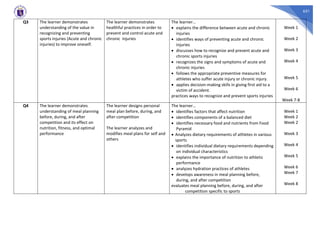
Q3 The learner demonstrates
understanding of the value in
recognizing and preventing
sports injuries (Acute and chronic
injuries) to improve oneself.
The learner demonstrates
healthful practices in order to
prevent and control acute and
chronic injuries
The learner…
• explains the difference between acute and chronic
injuries
• identifies ways of preventing acute and chronic
injuries
• discusses how to recognize and prevent acute and
chronic sports injuries
• recognizes the signs and symptoms of acute and
chronic injuries
• follows the appropriate preventive measures for
athletes who suffer acute injury or chronic injury.
• applies decision-making skills in giving first aid to a
victim of accident.
practices ways to recognize and prevent sports injuries
Week 1
Week 2
Week 3
Week 4
Week 5
Week 6
Week 7-8
Q4 The learner demonstrates
understanding of meal planning
before, during, and after
competition and its effect on
nutrition, fitness, and optimal
performance
The learner designs personal
meal plan before, during, and
after competition
The learner analyzes and
modifies meal plans for self and
others
The learner…
• identifies factors that affect nutrition
• identifies components of a balanced diet
• identifies necessary food and nutrients from Food
Pyramid
• Analyzes dietary requirements of athletes in various
sports
• identifies individual dietary requirements depending
on individual characteristics
• explains the importance of nutrition to athletic
performance
• analyzes hydration practices of athletes
• develops awareness in meal planning before,
during, and after competition
evaluates meal planning before, during, and after
competition specific to sports
Week 1
Week 2
Week 2
Week 3
Week 4
Week 5
Week 6
Week 7
Week 8
663
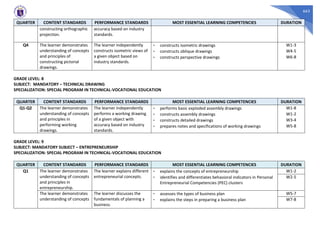
QUARTER CONTENT STANDARDS PERFORMANCE STANDARDS MOST ESSENTIAL LEARNING COMPETENCIES DURATION
constructing orthographic
projection.
accuracy based on industry
standards.
Q4 The learner demonstrates
understanding of concepts
and principles of
constructing pictorial
drawings.
The learner independently
constructs isometric views of
a given object based on
industry standards.
- constructs isometric drawings W1-3
- constructs oblique drawings W4-5
- constructs perspective drawings W6-8
GRADE LEVEL: 8
SUBJECT: MANDATORY – TECHNICAL DRAWING
SPECIALIZATION: SPECIAL PROGRAM IN TECHNICAL-VOCATIONAL EDUCATION
QUARTER CONTENT STANDARDS PERFORMANCE STANDARDS MOST ESSENTIAL LEARNING COMPETENCIES DURATION
Q1-Q2 The learner demonstrates
understanding of concepts
and principles in
performing working
drawings.
The learner independently
performs a working drawing
of a given object with
accuracy based on industry
standards.
- performs basic exploded assembly drawings W1-8
- constructs assembly drawings W1-2
- constructs detailed drawings W3-4
- prepares notes and specifications of working drawings W5-8
GRADE LEVEL: 9
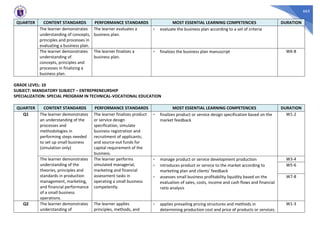
SUBJECT: MANDATORY SUBJECT – ENTREPRENEURSHIP
SPECIALIZATION: SPECIAL PROGRAM IN TECHNICAL-VOCATIONAL EDUCATION
QUARTER CONTENT STANDARDS PERFORMANCE STANDARDS MOST ESSENTIAL LEARNING COMPETENCIES DURATION
Q1 The learner demonstrates
understanding of concepts
and principles in
entrepreneurship.
The learner explains different
entrepreneurial concepts.
- explains the concepts of entrepreneurship W1-2
- identifies and differentiates behavioral indicators in Personal
Entrepreneurial Competencies (PEC) clusters
W2-5
The learner demonstrates
understanding of concepts
The learner discusses the
fundamentals of planning a
business.
- assesses the types of business plan W5-7
- explains the steps in preparing a business plan W7-8
600
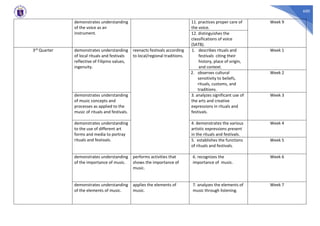
demonstrates understanding
of the voice as an
instrument.
11. practices proper care of
the voice.
Week 9
12. distinguishes the
classifications of voice
(SATB).
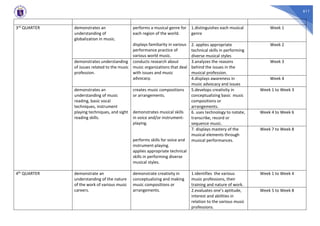
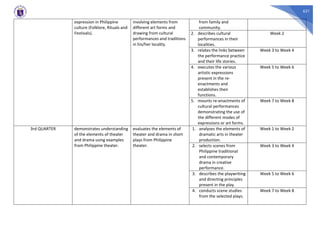
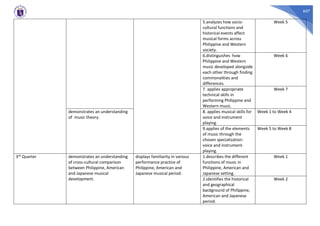
3rd Quarter demonstrates understanding
of local rituals and festivals
reflective of Filipino values,
ingenuity.
reenacts festivals according
to local/regional traditions.
1. describes rituals and
festivals citing their
history, place of origin,
and context.
Week 1
2. observes cultural
sensitivity to beliefs,
rituals, customs, and
traditions.
Week 2
demonstrates understanding
of music concepts and
processes as applied to the
music of rituals and festivals.
3. analyzes significant use of
the arts and creative
expressions in rituals and
festivals.
Week 3
demonstrates understanding
to the use of different art
forms and media to portray
rituals and festivals.
4. demonstrates the various
artistic expressions present
in the rituals and festivals.
Week 4
5. establishes the functions
of rituals and festivals.
Week 5
demonstrates understanding
of the importance of music.
performs activities that
shows the importance of
music.
6. recognizes the
importance of music.
Week 6
demonstrates understanding
of the elements of music.
applies the elements of
music.
7. analyzes the elements of
music through listening.
Week 7
652
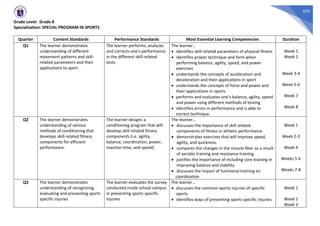
Grade Level: Grade 8
Specialization: SPECIAL PROGRAM IN SPORTS
Quarter Content Standards Performance Standards Most Essential Learning Competencies Duration
Q1 The learner demonstrates
understanding of different
movement patterns and skill-
related parameters and their
applications to sport.
The learner performs, analyzes
and corrects one’s performance
in the different skill-related
tests.
The learner…
• identifies skill-related parameters of physical fitness
• identifies proper technique and form when
performing balance, agility, speed, and power
exercises
• understands the concepts of acceleration and
deceleration and their applications in sport
• understands the concepts of force and power and
their applications in sports
• performs and evaluates one’s balance, agility, speed
and power using different methods of testing
• identifies errors in performance and is able to
correct technique.
Week 1
Week 2
Week 3-4
Week 5-6
Week 7
Week 8
Q2 The learner demonstrates
understanding of various
methods of conditioning that
develops skill-related fitness
components for efficient
performance.
The learner designs a
conditioning program that will
develop skill-related fitness
components (i.e. agility,
balance, coordination, power,
reaction time, and speed).
The learner…
• discusses the importance of skill related
components of fitness in athletic performance
• demonstrates exercises that will improve speed,
agility, and quickness.
• compares the changes in the muscle fiber as a result
of aerobic training and resistance training
• justifies the importance of including core training in
improving balance and stability
• discusses the impact of functional training on
coordination
Week 1
Week 2-3
Week 4
Weeks 5-6
Weeks 7-8
Q3 The learner demonstrates
understanding of recognizing,
evaluating and preventing sports
specific injuries
The learner evaluates the survey
conducted inside school campus
in preventing sports specific
injuries
The learner…
• discusses the common sports injuries of specific
sports
• identifies ways of preventing sports specific injuries
Week 1
Week 2
Week 3
664
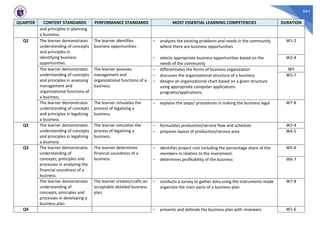
QUARTER CONTENT STANDARDS PERFORMANCE STANDARDS MOST ESSENTIAL LEARNING COMPETENCIES DURATION
and principles in planning
a business.
Q2 The learner demonstrates
understanding of concepts
and principles in
identifying business
opportunities.
The learner identifies
business opportunities.
- analyzes the existing problems and needs in the community
where there are business opportunities
W1-2
- selects appropriate business opportunities based on the
needs of the community
W2-4
The learner demonstrates
understanding of concepts
and principles in assessing
management and
organizational functions of
a business.
The learner assesses
management and
organizational functions of a
business.
- differentiates the forms of business organization W5
- discusses the organizational structure of a business
- designs an organizational chart based on a given structure
using appropriate computer applications
programs/applications.
W5-7
The learner demonstrates
understanding of concepts
and principles in legalizing
a business.
The learner simulates the
process of legalizing a
business.
- explains the steps/ procedures in making the business legal W7-8
Q3 The learner demonstrates
understanding of concepts
and principles in legalizing
a business.
The learner simulates the
process of legalizing a
business.
- formulates production/service flow and schedule W1-4
- prepares layout of production/service area W4-5
Q3 The learner demonstrates
understanding of
concepts, principles and
processes in analyzing the
financial soundness of a
business.
The learner determines
financial soundness of a
business.
- identifies project cost including the percentage share of the
members in relation to the investment.
W5-6
- determines profitability of the business W6-7
The learner demonstrates
understanding of
concepts, principles and
processes in developing a
business plan.
The learner creates/crafts an
acceptable detailed business
plan.
- conducts a survey to gather data using the instruments made
organizes the main parts of a business plan
W7-8
Q4 - presents and defends the business plan with reviewers W1-6
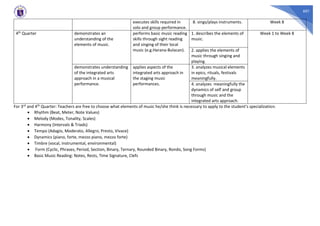
601
executes skills required in
solo and group performance.
8. sings/plays instruments. Week 8
4th Quarter demonstrates an
understanding of the
elements of music.
performs basic music reading
skills through sight reading
and singing of their local
music (e.g.Harana-Bulacan).
1. describes the elements of
music.
Week 1 to Week 8
2. applies the elements of
music through singing and
playing.
demonstrates understanding
of the integrated arts
approach in a musical
performance.
applies aspects of the
integrated arts approach in
the staging music
performances.
3. analyzes musical elements
in epics, rituals, festivals
meaningfully.
4. analyzes meaningfully the
dynamics of self and group
through music and the
integrated arts approach.
For 3rd and 4th Quarter: Teachers are free to choose what elements of music he/she think is necessary to apply to the student’s specialization.
• Rhythm (Beat, Meter, Note Values)
• Melody (Modes, Tonality, Scales)
• Harmony (Intervals & Triads)
• Tempo (Adagio, Moderato, Allegro, Presto, Vivace)
• Dynamics (piano, forte, mezzo piano, mezzo forte)
• Timbre (vocal, instrumental, environmental)
• Form (Cyclic, Phrases, Period, Section, Binary, Ternary, Rounded Binary, Rondo, Song Forms)
• Basic Music Reading: Notes, Rests, Time Signature, Clefs
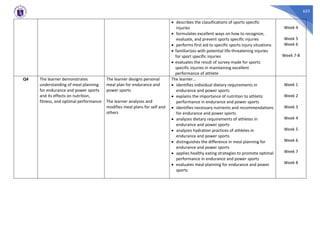
653
• describes the classifications of sports specific
injuries
• formulates excellent ways on how to recognize,
evaluate, and prevent sports specific injuries
• performs first aid to specific sports injury situations
• familiarizes with potential life-threatening injuries
for sport specific injuries
• evaluates the result of survey made for sports
specific injuries in maintaining excellent
performance of athlete
Week 4
Week 5
Week 6
Week 7-8
Q4 The learner demonstrates
understanding of meal planning
for endurance and power sports
and its effects on nutrition,
fitness, and optimal performance
The learner designs personal
meal plan for endurance and
power sports
The learner analyzes and
modifies meal plans for self and
others
The learner…
• identifies individual dietary requirements in
endurance and power sports
• explains the importance of nutrition to athletic
performance in endurance and power sports
• identifies necessary nutrients and recommendations
for endurance and power sports
• analyzes dietary requirements of athletes in
endurance and power sports
• analyzes hydration practices of athletes in
endurance and power sports
• distinguishes the difference in meal planning for
endurance and power sports
• applies healthy eating strategies to promote optimal
performance in endurance and power sports
• evaluates meal planning for endurance and power
sports
Week 1
Week 2
Week 3
Week 4
Week 5
Week 6
Week 7
Week 8
665
QUARTER CONTENT STANDARDS PERFORMANCE STANDARDS MOST ESSENTIAL LEARNING COMPETENCIES DURATION
The learner demonstrates
understanding of concepts,
principles and processes in
evaluating a business plan.
The learner evaluates a
business plan.
- evaluate the business plan according to a set of criteria
The learner demonstrates
understanding of
concepts, principles and
processes in finalizing a
business plan.
The learner finalizes a
business plan.
- finalizes the business plan manuscript W6-8
GRADE LEVEL: 10
SUBJECT: MANDATORY SUBJECT – ENTREPRENEURSHIP
SPECIALIZATION: SPECIAL PROGRAM IN TECHNICAL-VOCATIONAL EDUCATION
QUARTER CONTENT STANDARDS PERFORMANCE STANDARDS MOST ESSENTIAL LEARNING COMPETENCIES DURATION
Q1 The learner demonstrates
an understanding of the
processes and
methodologies in
performing steps needed
to set up small business
(simulation only)
The learner finalizes product
or service design
specification, simulate
business registration and
recruitment of applicants;
and source-out funds for
capital requirement of the
business.
- finalizes product or service design specification based on the
market feedback
W1-2
The learner demonstrates
understanding of the
theories, principles and
standards in production
management, marketing,
and financial performance
of a small business
operations.
The learner performs
simulated managerial,
marketing and financial
assessment tasks in
operating a small business
competently.
- manage product or service development production W3-4
- introduces product or service to the market according to
marketing plan and clients’ feedback
W5-6
- assesses small business profitability liquidity based on the
evaluation of sales, costs, income and cash flows and financial
ratio analysis
W7-8
Q2 The learner demonstrates
understanding of
The learner applies
principles, methods, and
- applies prevailing pricing structures and methods in
determining production cost and price of products or services.
W1-3
602
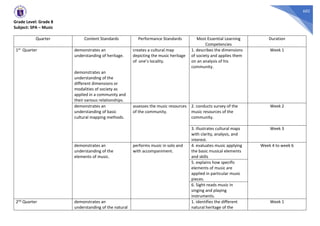
Grade Level: Grade 8
Subject: SPA – Music
Quarter Content Standards Performance Standards Most Essential Learning
Competencies
Duration
1st Quarter demonstrates an
understanding of heritage.
demonstrates an
understanding of the
different dimensions or
modalities of society as
applied in a community and
their various relationships.
creates a cultural map
depicting the music heritage
of one’s locality.
1. describes the dimensions
of society and applies them
on an analysis of his
community.
Week 1
demonstrates an
understanding of basic
cultural mapping methods.
assesses the music resources
of the community.
2. conducts survey of the
music resources of the
community.
Week 2
3. illustrates cultural maps
with clarity, analysis, and
interest.
Week 3
demonstrates an
understanding of the
elements of music.
performs music in solo and
with accompaniment.
4. evaluates music applying
the basic musical elements
and skills
Week 4 to week 6
5. explains how specific
elements of music are
applied in particular music
pieces.
6. Sight-reads music in
singing and playing
instruments.
2nd Quarter demonstrates an
understanding of the natural
1. identifies the different
natural heritage of the
Week 1
654
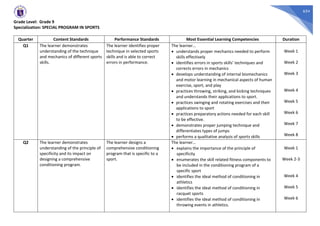
Grade Level: Grade 9
Specialization: SPECIAL PROGRAM IN SPORTS
Quarter Content Standards Performance Standards Most Essential Learning Competencies Duration
Q1 The learner demonstrates
understanding of the technique
and mechanics of different sports
skills.
The learner identifies proper
technique in selected sports
skills and is able to correct
errors in performance.
The learner…
• understands proper mechanics needed to perform
skills effectively
• identifies errors in sports skills’ techniques and
corrects errors in mechanics
• develops understanding of internal biomechanics
and motor learning in mechanical aspects of human
exercise, sport, and play
• practices throwing, striking, and kicking techniques
and understands their applications to sport.
• practices swinging and rotating exercises and their
applications to sport
• practices preparatory actions needed for each skill
to be effective.
• demonstrates proper jumping technique and
differentiates types of jumps
• performs a qualitative analysis of sports skills
Week 1
Week 2
Week 3
Week 4
Week 5
Week 6
Week 7
Week 8
Q2 The learner demonstrates
understanding of the principle of
specificity and its impact on
designing a comprehensive
conditioning program.
The learner designs a
comprehensive conditioning
program that is specific to a
sport.
The learner…
• explains the importance of the principle of
specificity
• enumerates the skill related fitness components to
be included in the conditioning program of a
specific sport
• identifies the ideal method of conditioning in
athletics
• identifies the ideal method of conditioning in
racquet sports
• identifies the ideal method of conditioning in
throwing events in athletics.
Week 1
Week 2-3
Week 4
Week 5
Week 6
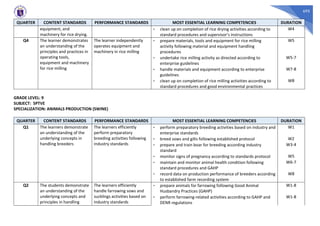
666
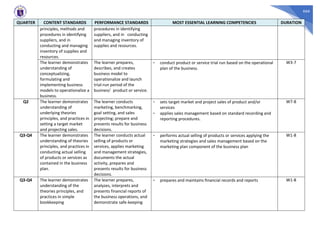
QUARTER CONTENT STANDARDS PERFORMANCE STANDARDS MOST ESSENTIAL LEARNING COMPETENCIES DURATION
principles, methods and
procedures in identifying
suppliers, and in
conducting and managing
inventory of supplies and
resources.
procedures in identifying
suppliers, and in conducting
and managing inventory of
supplies and resources.
The learner demonstrates
understanding of
conceptualizing,
formulating and
implementing business
models to operationalize a
business.
The learner prepares,
describes, and creates
business model to
operationalize and launch
trial-run period of the
business’ product or service.
- conduct product or service trial run based on the operational
plan of the business.
W3-7
Q2 The learner demonstrates
understanding of
underlying theories
principles, and practices in
setting a target market
and projecting sales.
The learner conducts
marketing, benchmarking,
goal setting, and sales
projecting; prepare and
presents results for business
decisions.
- sets target market and project sales of product and/or
services
- applies sales management based on standard recording and
reporting procedures.
W7-8
Q3-Q4 The learner demonstrates
understanding of theories
principles, and practices in
conducting actual selling
of products or services as
contained in the business
plan.
The learner conducts actual
selling of products or
services, applies marketing
and management strategies,
documents the actual
activity, prepares and
presents results for business
decisions.
- performs actual selling of products or services applying the
marketing strategies and sales management based on the
marketing plan component of the business plan
W1-8
Q3-Q4 The learner demonstrates
understanding of the
theories principles, and
practices in simple
bookkeeping
The learner prepares,
analyzes, interprets and
presents financial reports of
the business operations, and
demonstrate safe-keeping
- prepares and maintains financial records and reports W1-8
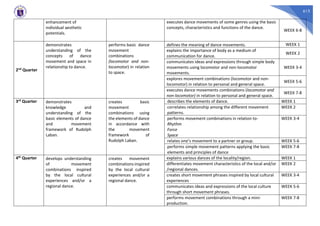
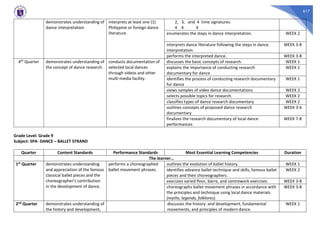
603
heritage of his/her
community and its different
ecosystems.
creates maps on the natural
heritage of his/her
community.
community and gives its
significance.
2. conducts an inventory of
the natural heritage of the
community , ecosystems and
give their significance.
Week 2
3. illustrates the varied
ecosystems in his/her
community through a
natural heritage map or
visual collage.
Week 3
demonstrates understanding
of the relationship of music
elements to the earth.
performs music with an
ecological content.
4.creates soundscapes of
human and ecological
situations.
Week 4
5. create a fusion of earth
music through
improvisation.
Week 5
demonstrates understanding
of the elements of music
through ensemble playing
and group singing.
demonstrates understanding
of the various methods and
techniques of singing and
instrument-playing.
performs music in solo and
with accompaniment.
6. applies the elements of
music in voice and
instrument.
Week 6 to Week 8
7. demonstrates aural skills.
8. reads music for ensemble
playing and singing.
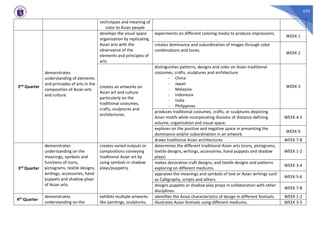
3rd Quarter demonstrates an
understanding of the cultural
resources of his/her
community, its different
types, and significance.
creates a map of the tangible
and intangible cultural
resources of their
community.
1. classifies the tangible and
intangible cultural resources
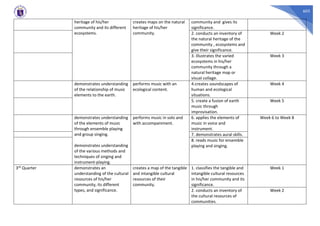
in his/her community and its
significance.
Week 1
2. conducts an inventory of
the cultural resources of
communities.
Week 2
655
• Identifies the ideal method for conditioning in
specialized sports. Week 7-8
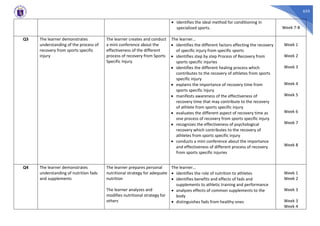
Q3 The learner demonstrates
understanding of the process of
recovery from sports specific
injury
The learner creates and conduct
a mini conference about the
effectiveness of the different
process of recovery from Sports
Specific Injury
The learner…
• identifies the different factors affecting the recovery
of specific injury from specific sports
• identifies step by step Process of Recovery from
sports specific injuries
• identifies the different healing process which
contributes to the recovery of athletes from sports
specific injury
• explains the importance of recovery time from
sports specific injury
• manifests awareness of the effectiveness of
recovery time that may contribute to the recovery
of athlete from sports specific injury
• evaluates the different aspect of recovery time as
one process of recovery from sports specific injury
• recognizes the effectiveness of psychological
recovery which contributes to the recovery of
athletes from sports specific injury
• conducts a mini conference about the importance
and effectiveness of different process of recovery
from sports specific injuries
Week 1
Week 2
Week 3
Week 4
Week 5
Week 6
Week 7
Week 8
Q4 The learner demonstrates
understanding of nutrition fads
and supplements
The learner prepares personal
nutritional strategy for adequate
nutrition
The learner analyzes and
modifies nutritional strategy for
others
The learner…
• identifies the role of nutrition to athletes
• identifies benefits and effects of fads and
supplements to athletic training and performance
• analyzes effects of common supplements to the
body
• distinguishes fads from healthy ones
Week 1
Week 2
Week 3
Week 3
Week 4
667
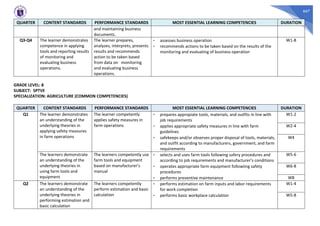
QUARTER CONTENT STANDARDS PERFORMANCE STANDARDS MOST ESSENTIAL LEARNING COMPETENCIES DURATION
and maintaining business
documents.
Q3-Q4 The learner demonstrates
competence in applying
tools and reporting results
of monitoring and
evaluating business
operations.
The learner prepares,
analyzes, interprets, presents
results and recommends
action to be taken based
from data on monitoring
and evaluating business
operations.
- assesses business operation
- recommends actions to be taken based on the results of the
monitoring and evaluating of business operation
W1-8
GRADE LEVEL: 8
SUBJECT: SPTVE
SPECIALIZATION: AGRICULTURE (COMMON COMPETENCIES)
QUARTER CONTENT STANDARDS PERFORMANCE STANDARDS MOST ESSENTIAL LEARNING COMPETENCIES DURATION
Q1 The learner demonstrates
an understanding of the
underlying theories in
applying safety measures
in farm operations
The learner competently
applies safety measures in
farm operations
- prepares appropiate tools, materials, and outfits in line with
job requirements
W1-2
- applies appropriate safety measures in line with farm
guidelines
W2-4
- safekeeps and/or observes proper disposal of tools, materials,
and outfit according to manufacturers, government, and farm
requirements
W4
The learners demonstrate
an understanding of the
underlying theories in
using farm tools and
equipment
The learners competently use
farm tools and equipment
based on manufacturer’s
manual
- selects and uses farm tools following safery procedures and
according to job requirements and manufacturer’s conditions
W5-6
- operates appropriate farm equipment followiing safety
procedures
W6-8
- performs preventive maintenance W8
Q2 The learners demonstrate
an understanding of the
underlying theories in
performing estimation and
basic calculation
The learners competently
perform estimation and basic
calculation
- performs estimation on farm inputs and labor requirements
for work completion
W1-4
- performs basic workplace calculation W5-8
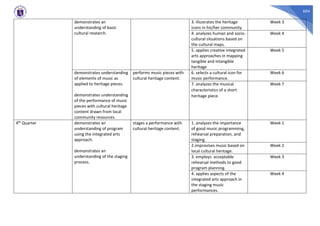
604
demonstrates an
understanding of basic
cultural research.
3. illustrates the heritage
icons in his/her community.
Week 3
4. analyzes human and socio-
cultural situations based on
the cultural maps.
Week 4
5. applies creative integrated
arts approaches in mapping
tangible and intangible
heritage
Week 5
demonstrates understanding
of elements of music as
applied to heritage pieces.
demonstrates understanding
of the performance of music
pieces with cultural heritage
content drawn from local
community resources.
performs music pieces with
cultural heritage content.
6. selects a cultural icon for
music performance.
Week 6
7. analyzes the musical
characteristics of a short
heritage piece.
Week 7
4th Quarter demonstrates an
understanding of program
using the integrated arts
approach.
demonstrates an
understanding of the staging
process.
stages a performance with
cultural heritage content.
1. analyzes the importance
of good music programming,
rehearsal preparation, and
staging.
Week 1
2.improvises music based on
local cultural heritage.
Week 2
3. employs acceptable
rehearsal methods to good
program planning.
Week 3
4. applies aspects of the
integrated arts approach in
the staging music
performances.
Week 4
656
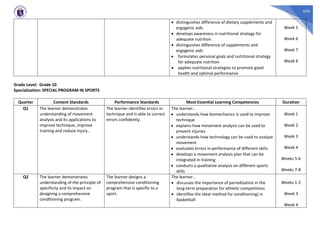
• distinguishes difference of dietary supplements and
ergogenic aids
• develops awareness in nutritional strategy for
adequate nutrition
• distinguishes difference of supplements and
ergogenic aids
• formulates personal goals and nutritional strategy
for adequate nutrition
• applies nutritional strategies to promote good
health and optimal performance
Week 5
Week 6
Week 7
Week 8
Grade Level: Grade 10
Specialization: SPECIAL PROGRAM IN SPORTS
Quarter Content Standards Performance Standards Most Essential Learning Competencies Duration
Q1 The learner demonstrates
understanding of movement
analysis and its applications to
improve technique, improve
training and reduce injury..
The learner identifies errors in
technique and is able to correct
errors confidently.
The learner…
• understands how biomechanics is used to improve
technique
• explains how movement analysis can be used to
prevent injuries
• understands how technology can be used to analyze
movement
• evaluates errors in performance of different skills
• develops a movement analysis plan that can be
integrated in training
• conducts a qualitative analysis on different sports
skills
Week 1
Week 2
Week 3
Week 4
Weeks 5-6
Weeks 7-8
Q2 The learner demonstrates
understanding of the principle of
specificity and its impact on
designing a comprehensive
conditioning program.
The learner designs a
comprehensive conditioning
program that is specific to a
sport.
The learner…
• discusses the importance of periodization in the
long-term preparation for athletic competitions
• identifies the ideal method for conditioning) in
basketball
Weeks 1-2
Week 3
Week 4
668
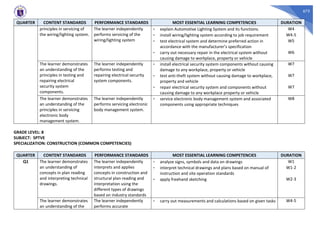
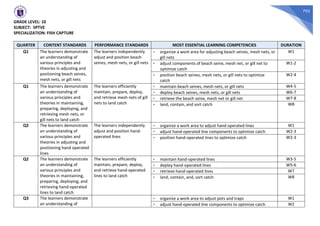
QUARTER CONTENT STANDARDS PERFORMANCE STANDARDS MOST ESSENTIAL LEARNING COMPETENCIES DURATION
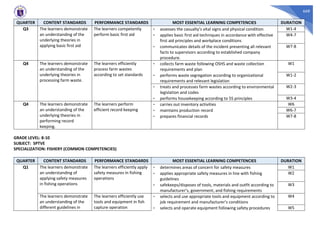
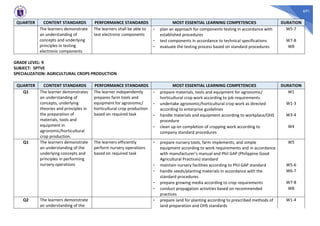
Q3 The learners demonstrate
an understanding of the
underlying theories in
applying basic first aid
The learners competently
perform basic first aid
- assesses the casualty’s vital signs and physical condition. W1-4
- applies basic first aid techniques in accordance with effective
first aid principles and workplace conditions
W4-7
- communicates details of the incident presenting all relevant
facts to supervisors according to established company
procedure.
W7-8
Q4 The learners demonstrate
an understanding of the
underlying theories in
processing farm waste.
The learners efficiently
process farm wastes
according to set standards
- collects farm waste following OSHS and waste collection
requirements and plan
W1
- performs waste segregation according to organizational
requirements and relevant legislation
W1-2
- treats and processes farm wastes according to environmental
legislation and codes
W2-3
- performs housekeeping according to 5S principles W3-4
Q4 The learners demonstrate
an understanding of the
underlying theories in
performing record
keeping.
The learners perform
efficient record keeping
- carries out inventory activities W6
- maintains production record W6-7
- prepares financial records W7-8
GRADE LEVEL: 8-10
SUBJECT: SPTVE
SPECIALIZATION: FISHERY (COMMON COMPETENCIES)
QUARTER CONTENT STANDARDS PERFORMANCE STANDARDS MOST ESSENTIAL LEARNING COMPETENCIES DURATION
Q1 The learners demonstrate
an understanding of
applying safety measures
in fishing operations
The learners efficiently apply
safety measures in fishing
operations
- determines areas of concern for safety measures W1
- applies appropriate safety measures in line with fishing
guidelines
W2
- safekeeps/disposes of tools, materials and outfit according to
manufacturer’s, government, and fishing requirements
W3
The learners demonstrate
an understanding of the
different guidelines in
The learners efficiently use
tools and equipment in fish
capture operation
- selects and use appropriate tools and equipment according to
job requirement and manufacturer’s conditions
W4
- selects and operate equipment following safety procedures W5
605
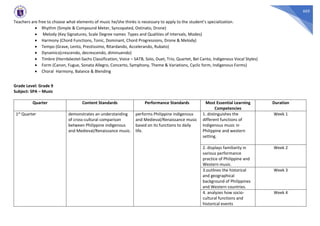
Teachers are free to choose what elements of music he/she thinks is necessary to apply to the student’s specialization.
• Rhythm (Simple & Compound Meter, Syncopated, Ostinato, Drone)
• Melody (Key Signatures, Scale Degree names Types and Qualities of Intervals, Modes)
• Harmony (Chord Functions, Tonic, Dominant, Chord Progressions, Drone & Melody)
• Tempo (Grave, Lento, Prestissimo, Ritardando, Accelerando, Rubato)
• Dynamics(crescendo, decrescendo, diminuendo)
• Timbre (Hornböestel-Sachs Classification, Voice – SATB, Solo, Duet, Trio, Quartet, Bel Canto, Indigenous Vocal Styles)
• Form (Canon, Fugue, Sonata Allegro, Concerto, Symphony, Theme & Variations, Cyclic form, Indigenous Forms)
• Choral Harmony, Balance & Blending
Grade Level: Grade 9
Subject: SPA – Music
Quarter Content Standards Performance Standards Most Essential Learning
Competencies
Duration
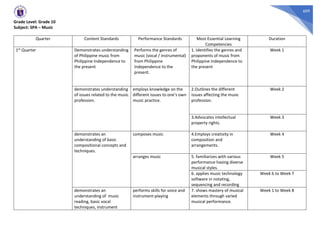
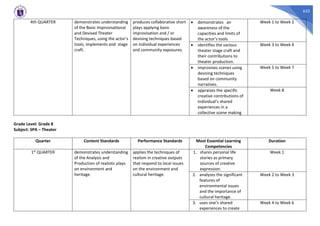
1st Quarter demonstrates an understanding
of cross-cultural comparison
between Philippine indigenous
and Medieval/Renaissance music.
performs Philippine indigenous
and Medieval/Renaissance music
based on its functions to daily
life.
1. distinguishes the
different functions of
Indigenous music in
Philippine and western
setting.
Week 1
2. displays familiarity in
various performance
practice of Philippine and
Western music.
Week 2
3.outlines the historical
and geographical
background of Philippines
and Western countries.
Week 3
4. analyzes how socio-
cultural functions and
historical events
Week 4
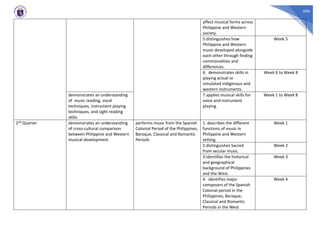
657
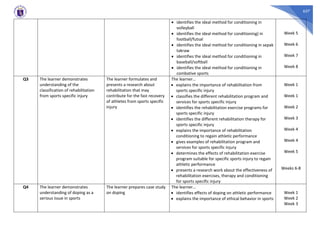
• identifies the ideal method for conditioning in
volleyball
• identifies the ideal method for conditioning) in
football/futsal
• identifies the ideal method for conditioning in sepak
takraw
• identifies the ideal method for conditioning in
baseball/softball
• identifies the ideal method for conditioning in
combative sports
Week 5
Week 6
Week 7
Week 8
Q3 The learner demonstrates
understanding of the
classification of rehabilitation
from sports specific injury
The learner formulates and
presents a research about
rehabilitation that may
contribute for the fast recovery
of athletes from sports specific
injury
The learner…
• explains the importance of rehabilitation from
sports specific injury
• classifies the different rehabilitation program and
services for sports specific injury
• identifies the rehabilitation exercise programs for
sports specific injury
• identifies the different rehabilitation therapy for
sports specific injury
• explains the importance of rehabilitation
conditioning to regain athletic performance
• gives examples of rehabilitation program and
services for sports specific injury
• determines the effects of rehabilitation exercise
program suitable for specific sports injury to regain
athletic performance
• presents a research work about the effectiveness of
rehabilitation exercises, therapy and conditioning
for sports specific injury
Week 1
Week 1
Week 2
Week 3
Week 4
Week 4
Week 5
Weeks 6-8
Q4 The learner demonstrates
understanding of doping as a
serious issue in sports
The learner prepares case study
on doping
The learner…
• identifies effects of doping on athletic performance
• explains the importance of ethical behavior in sports
Week 1
Week 2
Week 3
669
QUARTER CONTENT STANDARDS PERFORMANCE STANDARDS MOST ESSENTIAL LEARNING COMPETENCIES DURATION
using tools and equipment
in fish capture operation
- perform preventive maintenance in line with industry
procedures
W6
The learners demonstrate
an understanding of
various techniques in
performing estimation and
calculation
The learners accurately
perform estimation and
calculation
- performs estimation W7
- performs basic workplace calculation W8
Q2 The learners demonstrate
and understanding of
various techniques in
applying food safety and
sanitation
The learners efficiently apply
food safety and sanitation
- wears PPE according to the job requirement W1
- observe personal hygiene and good grooming in line with
workplace health and safety requirements
W2
- implements food sanitation practices in line with workplace
safety practices
W3
- renders safety measures and First Aid procedures W4
- implements housekeeping activities W5
The learners demonstrate
an understanding of
various techniques in
preventing fire and
firefighting
The learners effectively
prevent and fight fire
- manage fire prevention procedures onboard W6
- operate portable firefighting equipment W7
- conduct interior search and rescue and fire-fighting
operations
W8
Q3 The learners demonstrate
an understanding of
various principles and
techniques in performing
First Aid treatment on
board
The learners competently
perform First Aid treatment
on board
- perform immediate life-saving First Aid pending medical
assistance
W1
- Apply appropriate action to conscious casualty with acute
illness and/or injury in accordance with established First Aid
proceduress
W1-2
- manage wounds and bleeding in accordance with established
First Aid procedures
W2
- manage burns in accordance with established First Aid
procedures
W3
- manage bone, joint, and muscle injuries in accordance with
established First Aid procedures
W3-4
- adapt First Aid procedures for remote situations W4-5
606
affect musical forms across
Philippine and Western
society.
5.distinguishes how
Philippine and Western
music developed alongside
each other through finding
commonalities and
differences.
Week 5
6. demonstrates skills in
playing actual or
simulated indigenous and
western instruments.
Week 6 to Week 8
demonstrates an understanding
of music reading, vocal
techniques, instrument playing
techniques, and sight reading
skills
7.applies musical skills for
voice and instrument
playing.
Week 1 to Week 8
2nd Quarter demonstrates an understanding
of cross-cultural comparison
between Philippine and Western
musical development.
performs music from the Spanish
Colonial Period of the Philippines,
Baroque, Classical and Romantic
Periods
1. describes the different
functions of music in
Philippine and Western
setting.
Week 1
2.distinguishes Sacred
from secular music.
Week 2
3.identifies the historical
and geographical
background of Philippines
and the West.
Week 3
4. identifies major
composers of the Spanish
Colonial period in the
Philippines, Baroque,
Classical and Romantic
Periods in the West
Week 4
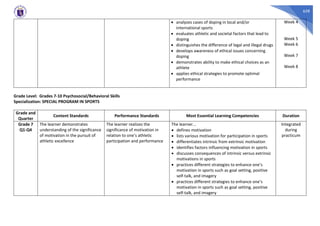
658
• analyzes cases of doping in local and/or
international sports
• evaluates athletic and societal factors that lead to
doping
• distinguishes the difference of legal and illegal drugs
• develops awareness of ethical issues concerning
doping
• demonstrates ability to make ethical choices as an
athlete
• applies ethical strategies to promote optimal
performance
Week 4
Week 5
Week 6
Week 7
Week 8
Grade Level: Grades 7-10 Psychosocial/Behavioral Skills
Specialization: SPECIAL PROGRAM IN SPORTS
Grade and
Quarter
Content Standards Performance Standards Most Essential Learning Competencies Duration
Grade 7
Q1-Q4
The learner demonstrates
understanding of the significance
of motivation in the pursuit of
athletic excellence
The learner realizes the
significance of motivation in
relation to one’s athletic
participation and performance
The learner...
• defines motivation
• lists various motivation for participation in sports
• differentiates intrinsic from extrinsic motivation
• identifies factors influencing motivation in sports
• discusses consequences of intrinsic versus extrinsic
motivations in sports
• practices different strategies to enhance one’s
motivation in sports such as goal setting, positive
self-talk, and imagery
• practices different strategies to enhance one’s
motivation in sports such as goal setting, positive
self-talk, and imagery
Integrated
during
practicum
670
QUARTER CONTENT STANDARDS PERFORMANCE STANDARDS MOST ESSENTIAL LEARNING COMPETENCIES DURATION
The learners demonstrate
an understanding of
various techniques in
protecting marine
environment
The learners do their share in
protecting marine
environment
- implements garbage disposal on board following relevant
company requirements on marine environmental protection
W4-5
- perform garbage segregation following MARPOL regulations
and procedures for the protection of the marine environment
W5
The learners demonstrate
an understanding of
various techniques in
complying with emergency
procedures
The learners satisfactorily
comply with emergency
procedures
- Give prompt, accurate, and complete information on raising
alarm in accordance with established vessel procedures
W6
- Implement planned damage controls procedures for dealing
with damage to the vessel and its hull in accordance with
company procedures and regulatory requirements
W6-7
- Follow procedures for the use of various shipboard life-saving
appliances in accordance with regulatory requirements,
manufacturer’s instruction, and company procedures
W7-8
Q3 The learners demonstrate
an understanding of
various principles and
theories in applying
deckhand skills in aboard a
fishing vessel
The learners independently
apply deckhand skills in a
boarding a fishing vessel
- uses and maintains ropes in accordance with enterprise
procedures and manufacturers’ manual
W8
Q4 - performs basic knots, bends, hitches, splices and common
whipping
W1
- operate winches, capstans and windlasses in accordance with
operational requirements and manufacturers’ instructions
W1-2
- secures the vessel at anchor according to established safety
rules and regulations
W2
- secure and adjust the vessel’s position during mooring
operations
W3
- monitor the situation of the vessel when moored or anchored W4
- secure the vessel for and at sea W4-5
Q4 The learners demonstrate
an understanding of
various principles and
theories in assembling and
repairing damaged netting
The learners independently
assemble and repair
damaged netting
- prepare netting material for repair W5-6
- mend holes and rips using twine W6-7
- mend large scale damage using netting material W7-8
607
5.analyzes how socio-
cultural functions and
historical events affect
musical forms across
Philippine and Western
society.
Week 5
6.distinguishes how
Philippine and Western
music developed alongside
each other through finding
commonalities and
differences.
Week 6
7. applies appropriate
technical skills in
performing Philippine and
Western music.
Week 7
demonstrates an understanding
of music theory.
8. applies musical skills for
voice and instrument
playing.
Week 1 to Week 4
9.applies of the elements
of music through the
chosen specialization:
voice and instrument-
playing.
Week 5 to Week 8
3rd Quarter demonstrates an understanding
of cross-cultural comparison
between Philippine, American
and Japanese musical
development.
displays familiarity in various
performance practice of
Philippine, American and
Japanese musical period.
1.describes the different
functions of music in
Philippine, American and
Japanese setting.
Week 1
2.identifies the historical
and geographical
background of Philippine,
American and Japanese
period.
Week 2
659
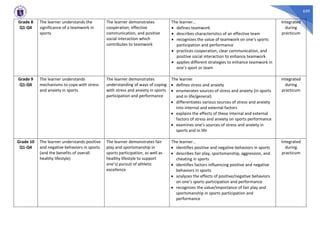
Grade 8
Q1-Q4
The learner understands the
significance of a teamwork in
sports
The learner demonstrates
cooperation, effective
communication, and positive
social interaction which
contributes to teamwork
The learner…
• defines teamwork
• describes characteristics of an effective team
• recognizes the value of teamwork on one’s sports
participation and performance
• practices cooperation, clear communication, and
positive social interaction to enhance teamwork
• applies different strategies to enhance teamwork in
one’s sport or team
Integrated
during
practicum
Grade 9
Q1-Q4
The learner understands
mechanisms to cope with stress
and anxiety in sports
The learner demonstrates
understanding of ways of coping
with stress and anxiety in sports
participation and performance
The learner
• defines stress and anxiety
• enumerates sources of stress and anxiety (in sports
and in life/general)
• differentiates various sources of stress and anxiety
into internal and external factors
• explains the effects of these internal and external
factors of stress and anxiety on sports performance
• examines one’s sources of stress and anxiety in
sports and in life
Integrated
during
practicum
Grade 10
Q1-Q4
The learner understands positive
and negative behaviors in sports
(and the benefits of overall
healthy lifestyle)
The learner demonstrates fair
play and sportsmanship in
sports participation, as well as
healthy lifestyle to support
one’s) pursuit of athletic
excellence
The learner…
• identifies positive and negative behaviors in sports
• describes fair play, sportsmanship, aggression, and
cheating in sports
• identifies factors influencing positive and negative
behaviors in sports
• analyzes the effects of positive/negative behaviors
on one’s sports participation and performance
• recognizes the value/importance of fair play and
sportsmanship in sports participation and
performance
Integrated
during
practicum
671
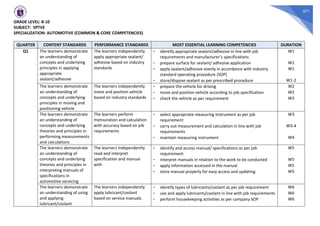
GRADE LEVEL: 8-10
SUBJECT: SPTVE
SPECIALIZATION: AUTOMOTIVE (COMMON & CORE COMPETENCIES)
QUARTER CONTENT STANDARDS PERFORMANCE STANDARDS MOST ESSENTIAL LEARNING COMPETENCIES DURATION
Q1 The learners demonstrate
an understanding of
concepts and underlying
principles in applying
appropriate
sealant/adhesive
The learners independently
apply appropriate sealant/
adhesive based on industry
standards
- identify appropriate sealant/adhesive in line with job
requirements and manufacturer’s specifications
W1
- prepare surface for sealant/ adhesive application W1
- apply sealant/adhesive evenly in accordance with industry
standard operating procedure (SOP)
W1
- store/dispose sealant as per prescribed procedure W1-2
The learners demonstrate
an understanding of
concepts and underlying
principles in moving and
positioning vehicle
The learners independently
move and position vehicle
based on industry standards
- prepare the vehicle for driving W2
- move and position vehicle according to job specification W2
- check the vehicle as per requirement W3
The learners demonstrate
an understanding of
concepts and underlying
theories and principles in
performing measurements
and calculations
The learners perform
mensuration and calculation
with accuracy based on job
requirements
- select appropriate measuring Instrument as per job
requirement
W3
- carry out measurement and calculation in line with job
requirements
W3-4
- maintain measuring instrument W4
The learners demonstrate
an understanding of
concepts and underlying
theories and principles in
interpreting manuals of
specifications in
automotive servicing
The learners independently
read and interpret
specification and manual
with
- identify and access manual/ specifications as per job
requirement
W5
- interpret manuals in relation to the work to be conducted W5
- apply information accessed in the manual W5
- store manual properly for easy access and updating W5
The learners demonstrate
an understanding of using
and applying
lubricant/coolant
The learners independently
apply lubricant/coolant
based on service manuals
- identify types of lubricants/coolant as per job requirement W6
- use and apply lubricants/coolant in line with job requirements W6
- perform housekeeping activities as per company SOP W6
608
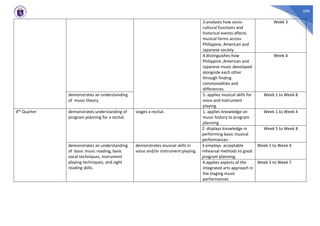
3.analyzes how socio-
cultural functions and
historical events affects
musical forms across
Philippine, American and
Japanese society.
Week 3
4.distinguishes how
Philippine ,American and
Japanese music developed
alongside each other
through finding
commonalities and
differences.
Week 4
demonstrates an understanding
of music theory.
5. applies musical skills for
voice and instrument
playing.
Week 1 to Week 8
4th Quarter demonstrates understanding of
program planning for a recital.
stages a recital. 1. applies knowledge on
music history to program
planning.
Week 1 to Week 4
2. displays knowledge in
performing basic musical
performances .
Week 5 to Week 8
demonstrates an understanding
of basic music reading, basic
vocal techniques, instrument
playing techniques, and sight
reading skills.
demonstrates musical skills in
voice and/or instrument-playing.
3.employs acceptable
rehearsal methods to good
program planning.
Week 1 to Week 4
4.applies aspects of the
integrated arts approach in
the staging music
performances
Week 5 to Week 7
672
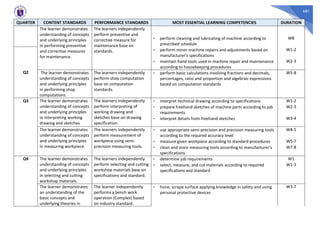
QUARTER CONTENT STANDARDS PERFORMANCE STANDARDS MOST ESSENTIAL LEARNING COMPETENCIES DURATION
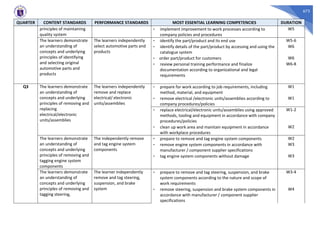
The learners demonstrate
an understanding of
concepts and underlying
principles in performing
shop maintenance
The learners independently
perform shop maintenance in
accordance with OHS
(occupational health and
safety) procedures
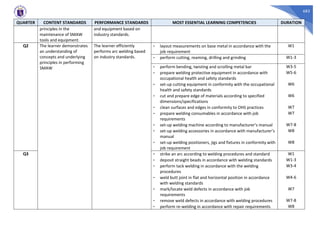
- inspect and clean tools, equipment and work area as per
workshop cleaning requirements
W7
- store/arrange tools and shop equipment. W7
- dispose of waste and used lubricants in accordance with SOP
and environmental regulations
W7
- report damaged tools/equipment W8
The learners demonstrate
an understanding of
concepts and underlying
principles of preparing job
estimate/costing
The learners independently
perform job
estimating/costing
- identify the nature and scope of work in line with SOP W8
- prepare and present estimate/costing in line with job
requirements
W8
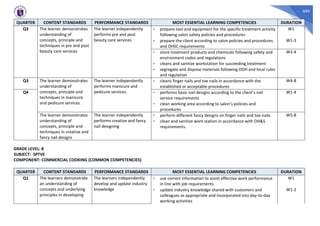
Q2 The learners demonstrate
an understanding of
concepts and underlying
principles of
interpreting/drawing
technical drawings
The learners independently
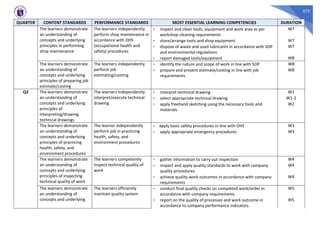
interpret/execute technical
drawing
- interpret technical drawing W1
- select appropriate technical drawing W1-2
- apply freehand sketching using the necessary tools and
materials
W2
The learners demonstrate
an understanding of
concepts and underlying
principles of practicing
health, safety, and
environment procedures
The learner independently
perform job in practicing
health, safety, and
environment procedures
- apply basic safety procedures in line with OHS W3
- apply appropriate emergency procedures W3
The learners demonstrate
an understanding of
concepts and underlying
principles of inspecting
technical quality of work
The learners competently
inspect technical quality of
work
- gather information to carry out inspection W4
- inspect and apply quality standards to work with company
quality procedures
W4
- achieve quality work outcomes in accordance with company
requirements
W4
The learners demonstrate
an understanding of
concepts and underlying
The learners efficiently
maintain quality system
- conduct final quality checks on completed work/order in
accordance with company requirements
W5
- report on the quality of processes and work outcome in
accordance to company performance indicators
W5
609
Grade Level: Grade 10
Subject: SPA – Music
Quarter Content Standards Performance Standards Most Essential Learning
Competencies
Duration
1st Quarter Demonstrates understanding
of Philippine music from
Philippine Independence to
the present
Performs the genres of
music (vocal / instrumental)
from Philippine
Independence to the
present.
1. Identifies the genres and
proponents of music from
Philippine Independence to
the present
Week 1
demonstrates understanding
of issues related to the music
profession.
employs knowledge on the
different issues to one’s own
music practice.
2.Outlines the different
issues affecting the music
profession.
Week 2
3.Advocates intellectual
property rights.
Week 3
demonstrates an
understanding of basic
compositional concepts and
techniques.
composes music 4.Employs creativity in
composition and
arrangements.
Week 4
arranges music 5. familiarizes with various
performance having diverse
musical styles.
Week 5
6. applies music technology
software in notating,
sequencing and recording
Week 6 to Week 7
demonstrates an
understanding of music
reading, basic vocal
techniques, instrument
performs skills for voice and
instrument-playing
7. shows mastery of musical
elements through varied
musical performance.
Week 1 to Week 8
673
QUARTER CONTENT STANDARDS PERFORMANCE STANDARDS MOST ESSENTIAL LEARNING COMPETENCIES DURATION
principles of maintaining
quality system
- implement improvement to work processes according to
company policies and procedures
W5
The learners demonstrate
an understanding of
concepts and underlying
principles of identifying
and selecting original
automotive parts and
products
The learners independently
select automotive parts and
products
- identify the part/product and its end use W5-6
- identify details of the part/product by accessing and using the
catalogue system
W6
- order part/product for customers W6
- review personal training performance and finalize
documentation according to organizational and legal
requirements
W6-8
Q3 The learners demonstrate
an understanding of
concepts and underlying
principles of removing and
replacing
electrical/electronic
units/assemblies
The learners independently
remove and replace
electrical/ electronic
units/assemblies
- prepare for work according to job requirements, including
method, material, and equipment
W1
- remove electrical /electronic units/assemblies according to
company procedures/policies
W1
- replace electrical/electronic units/assemblies using approved
methods, tooling and equipment in accordance with company
procedures/policies
W1-2
- clean up work area and maintain equipment in accordance
with workplace procedures
W2
The learners demonstrate
an understanding of
concepts and underlying
principles of removing and
tagging engine system
components
The independently remove
and tag engine system
components
- prepare to remove and tag engine system components W2
- remove engine system components in accordance with
manufacturer / component supplier specifications
W3
- tag engine system components without damage W3
The learners demonstrate
an understanding of
concepts and underlying
principles of removing and
tagging steering,
The learner independently
remove and tag steering,
suspension, and brake
system
- prepare to remove and tag steering, suspension, and brake
system components according to the nature and scope of
work requirements
W3-4
- remove steering, suspension and brake system components in
accordance with manufacturer / component supplier
specifications
W4
610
playing techniques, and sight
reading skills
2nd QUARTER demonstrates understanding
of Philippine music in the
ASEAN context.
presents a simulated
performance of ASEAN
music.
1. distinguishes Philippine
music from ASEAN music
Week 1
demonstrates an
understanding of cross
cultural comparison between
Philippine and ASEAN Music
displays familiarity in various
performance practice of
ASEAN music.
2.presents a simulated
performance of ASEAN
Music.
Week 2
demonstrates understanding
of issues related to the music
profession.
conducts interviews with
local artists about the
different issues in the music
profession.
3.outlines the different
issues affecting the music
profession.
Week 3
4.advocates intellectual
property rights.
Week 4
demonstrates an
understanding of basic
compositional concepts and
techniques
creates basic music
compositions or
arrangements.
5.develops creativity in
conceptualizing basic music
compositions or
arrangements.
Week 5
demonstrates familiarity
with music software for
notation, recording, and
sequencing.
displays knowledge in using
music technology software
6. uses technology to notate,
transcribe, record or
sequence music
Week 6
demonstrates an
understanding of music
reading, basic vocal
techniques, instrument
playing techniques, and sight
reading skills
performs skills for voice and
instrument-playing
7. displays mastery of the
musical elements through
musical performances
Week 1 to Week 4
applies appropriate technical
skills in performing diverse
musical styles
8. displays familiarity in
various performance
practice of diverse musical
styles
Week 5 to Week 8
674
QUARTER CONTENT STANDARDS PERFORMANCE STANDARDS MOST ESSENTIAL LEARNING COMPETENCIES DURATION
suspension, and brake
system
- tag steering, suspension, and brake system components
without damage
W4
The learners demonstrate
an understanding of
concepts and underlying
principles of removing and
tagging transmission
system components
The learners independently
remove and tag transmission
system components
- prepare to remove and tag transmission components using
required tools and equipment
W5
- remove transmission system components in accordance with
manufacturer / component supplier specifications
W5
- tag transmission components W5-6
The learner demonstrates
an understanding of the
principles in servicing the
automotive battery.
The learner independently
performs servicing an
automotive battery.
- demonstrate safe operation and handling of different types of
batteries.
W6
- demonstrate the testing of an automotive battery based on
manufacturer’s specification
W6
- demonstrate the procedures in removing and replacing
batteries as per manufacturer’s standard and observing
personal safety.
W7
- demonstrate the procedures in servicing the battery as
indicated in the manual and observing personal safety
W7
- demonstrate the procedures in jump starting as indicated in
the manual and observing personal safety
W8
Q4 The learner demonstrates
an understanding of
concepts and underlying
principles in servicing the
charging system.
The learners independently
perform servicing the
charging system based on
industry standard.
- test charging system component and identify faults based on
standard industry procedures
W1
- disassemble alternator based on the procedures stated in the
service manual
W1
- repair/replace and assemble alternator components/parts in
accordance to service manual
W1-2
The learner demonstrates
an understanding of
concepts and underlying
principles of servicing the
starting system.
The learner independently
performs servicing the
starting system based on
industry standard.
- test starting system components and identify faults in
accordance with the industry standard procedures
W2-3
- disassemble starter motor according to service manual W3
The learner demonstrates
an understanding of the
- explain the principle of auto electricity according to job
requirement
W4-6
611
3rd QUARTER demonstrates an
understanding of
globalization in music.
performs a musical genre for
each region of the world.
displays familiarity in various
performance practice of
various world music.
1.distinguishes each musical
genre
Week 1
2. applies appropriate
technical skills in performing
diverse musical styles
Week 2
demonstrates understanding
of issues related to the music
profession.
conducts research about
music organizations that deal
with issues and music
advocacy.
3.analyzes the reasons
behind the issues in the
musical profession.
Week 3
4.displays awareness in
music advocacy and issues
Week 4
demonstrates an
understanding of music
reading, basic vocal
techniques, instrument
playing techniques, and sight
reading skills.
creates music compositions
or arrangements.
demonstrates musical skills
in voice and/or instrument-
playing.
performs skills for voice and
instrument-playing.
applies appropriate technical
skills in performing diverse
musical styles.
5.develops creativity in
conceptualizing basic music
compositions or
arrangements.
Week 1 to Week 3
6. uses technology to notate,
transcribe, record or
sequence music.
Week 4 to Week 6
7. displays mastery of the
musical elements through
musical performances.
Week 7 to Week 8
4th QUARTER demonstrate an
understanding of the nature
of the work of various music
careers.
demonstrate creativity in
conceptualizing and making
music compositions or
arrangements.
1.identifies the various
music professions, their
training and nature of work.
Week 1 to Week 4
2.evaluates one’s aptitude,
interest and abilities in
relation to the various music
professions.
Week 5 to Week 8
675
QUARTER CONTENT STANDARDS PERFORMANCE STANDARDS MOST ESSENTIAL LEARNING COMPETENCIES DURATION
principles in servicing of
the wiring/lighting system.
The learner independently
performs servicing of the
wiring/lighting system
- explain Automotive Lighting System and its functions. W4
- install wiring/lighting system according to job requirement W4-5
- test electrical system and determine preferred action in
accordance with the manufacturer’s specification
W5
- carry out necessary repair in the electrical system without
causing damage to workplace, property or vehicle
W6
The learner demonstrates
an understanding of the
principles in testing and
repairing electrical
security system
components.
The learner independently
performs testing and
repairing electrical security
system components.
- install electrical security system components without causing
damage to any workplace, property or vehicle
W7
- test anti-theft system without causing damage to workplace,
property and vehicle
W7
- repair electrical security system and components without
causing damage to any workplace property or vehicle
W7
The learner demonstrates
an understanding of the
principles in servicing
electronic body
management system.
The learner independently
performs servicing electronic
body management system.
- service electronic body management system and associated
components using appropriate techniques
W8
GRADE LEVEL: 8
SUBJECT: SPTVE
SPECIALIZATION: CONSTRUCTION (COMMON COMPETENCIES)
QUARTER CONTENT STANDARDS PERFORMANCE STANDARDS MOST ESSENTIAL LEARNING COMPETENCIES DURATION
Q1 The learner demonstrates
an understanding of
concepts in plan reading
and interpreting technical
drawings.
The learner independently
interprets and applies
concepts in construction and
structural plan reading and
interpretation using the
different types of drawings
based on industry standards
- analyze signs, symbols and data on drawings W1
- interpret technical drawings and plans based on manual of
instruction and site operation standards
W1-2
- apply freehand sketching W2-3
The learner demonstrates
an understanding of the
The learner independently
performs accurate
- carry out measurements and calculations based on given tasks W4-5
612
demonstrates basic musical
skills in voice and/or
instrument-playing.
demonstrates an
understanding of program
planning, rehearsal
preparation, and staging
using the integrated arts
approach.
employs acceptable
rehearsal methods
applicable to good program
planning.
3. displays familiarity in
various performance
practice of diverse musical
styles.
Week 1 to Week 4
demonstrates an
understanding of music
reading, basic vocal
techniques, instrument
playing techniques, and sight
reading skills.
performs skills for voice and
instrument-playing .
4. displays mastery of the
musical elements through
musical performances.
Week 5 to Week 8
uses technology to
document music
performances.
applies appropriate technical
skills in performing diverse
musical styles.
Grade Level: Grade 7
Subject: SPA- DANCE – FOLK DANCE & BALLET STRAND
Quarter Content Standards Performance Standards Most Essential Learning Competencies Duration
The learner…
1st Quarter
demonstrates
understanding of the
basic concepts,
characteristics and
functions of dance,
movement
vocabularies,
forms/genres and its
relationships for the
exhibits skills on the
different dance
forms/genres.
defines dance
• As an emotional
expression.
• As an artistic expression.
WEEK 1
discusses the functions of dance. WEEK 2
identifies the nature and characteristics of each dance
form/genre
WEEK 3-4
explains the relationships of the different dance
forms/genres.
WEEK 5
676
QUARTER CONTENT STANDARDS PERFORMANCE STANDARDS MOST ESSENTIAL LEARNING COMPETENCIES DURATION
concepts and underlying
principles in performing
measurements and
calculations.
measurements and
calculation based on given
tasks.
The learner demonstrates
an understanding on the
basic concepts and
underlying technical and
scientific principles in
performing basic bench
work operations.
The learner independently
performs basic bench work
operations following task
specifications, job
requirements and safety
procedures.
- identify the different basic bench work operations for
construction technology
W5
4
- perform material measuring and measuring alternatives W6
- perform cutting operations following task specifications, job
requirements and safety procedures
W6
- perform boring operations following task specifications, job
requirements and safety procedures
W7
- perform grinding and shaping operations W7
- perform bending operations following task specifications, job
requirements and safety procedures
W8
Q2 The learner demonstrates
an understanding of the
underlying principles in
the maintenance of
construction technology
tools and equipment.
The learner independently
performs proper
maintenance of basic hand
tools and equipment based
on industry standards and
manufacturer’s manual
- perform periodic and preventive maintenance based on
industry standards and manufacturer’s manual
W1
- store tools and equipment in specific places and storage area
based on industry standards and manufacturer’s manual
W2
Q2 The learner demonstrates
an understanding of the
underlying principles in
manual reading and
interpretation
The learner independently
performs proper data/
information interpretation,
validation and verification
- read and interpret information and data in the manual W2
- apply specifications and manual details on tasks at hand W2
- protect and safe keep manuals according to industry
standards
W2
The learner demonstrates
an understanding of the
underlying principles in
the preparation of
carpentry tools and
construction materials.
The learner independently
prepares carpentry tools and
construction materials based
on industry standards.
- prepare appropriate tools and materials for a task W3
- inspect materials based on industry standards W4-5
613
enhancement of
individual aesthetic
potentials.
executes dance movements of some genres using the basic
concepts, characteristics and functions of the dance.
WEEK 6-8
2nd Quarter
demonstrates
understanding of the
concepts of dance
movement and space in
relationship to dance.
performs basic dance
movement
combinations
(locomotor and non-
locomotor) in relation
to space.
defines the meaning of dance movements. WEEK 1
explains the importance of body as a medium of
communication for dance.
WEEK 2
communicates ideas and expressions through simple body
movements using locomotor and non-locomotor
movements.
WEEK 3-4
explores movement combinations (locomotor and non-
locomotor) in relation to personal and general space.
WEEK 5-6
executes dance movements combinations (locomotor and
non-locomotor) in relation to personal and general space.
WEEK 7-8
3rd Quarter demonstrates
knowledge and
understanding of the
basic elements of dance
and movement
framework of Rudolph
Laban.
creates basic
movement
combinations using
the elements of dance
in accordance with
the movement
framework of
Rudolph Laban.
describes the elements of dance. WEEK 1
correlates relationship among the different movement
patterns.
WEEK 2
performs movement combinations in relation to-
Rhythm
Force
Space
WEEK 3-4
relates one’s movement to a partner or group. WEEK 5-6
performs simple movement patterns applying the basic
elements and principles of dance
WEEK 7-8
4th Quarter develops understanding
of movement
combinations inspired
by the local cultural
experiences and/or a
regional dance.
creates movement
combinations inspired
by the local cultural
experiences and/or a
regional dance.
explains various dances of the locality/region. WEEK 1
differentiates movement characteristics of the local and/or
/regional dances.
WEEK 2
creates short movement phrases inspired by local cultural
experiences
WEEK 3-4
communicates ideas and expressions of the local culture
through short movement phrases.
WEEK 5-6
performs movement combinations through a mini-
production.
WEEK 7-8
677
QUARTER CONTENT STANDARDS PERFORMANCE STANDARDS MOST ESSENTIAL LEARNING COMPETENCIES DURATION
The learner demonstrates
an understanding in
staking out building lines.
The independently stakes out
building lines in carpentry
based on construction
standards
- prepare tools, equipment and materials for staking out
building lines
W5
- stake out and set batter boards according to according to job
requirements
W5-7
- fix building lines W7-8
Q3 The learner demonstrates
an understanding of the
underlying principles in
preparing masonry
materials.
The learner independently
prepares masonry materials
according to workplace
practices.
- select appropriate tools, equipment and materials needed in
hauling and mixing according to the job requirement
W1
- haul materials based on standard operating procedure W1
- mix mortar/concrete according to workplace practices W1
The learner demonstrates
an understanding of the
concepts and underlying
principles in performing
basic masonry works.
The learner independently
performs basic masonry
works based on job
description.
- perform reinforcement bar fabrication and installation based
on job requirement
W2-5
- erect and dismantle scaffoldings (1.8 m and below) in
accordance with safety practices
W5-8
- perform fabrication, installation and stripping of formworks in
accordance with safety practices
W1-6
- perform excavation and basic filling/compaction observing
safety precautions
W7-8
Q4 - perform concreting work W1-7
- perform housekeeping W8
GRADE LEVEL: 8
SUBJECT: SPTVE
SPECIALIZATION: DOMRAC (COMMON COMPETENCIES)
QUARTER CONTENT STANDARDS PERFORMANCE STANDARDS MOST ESSENTIAL LEARNING COMPETENCIES DURATION
Q1 The learner demonstrates
an understanding of
underlying concepts and
principles of applying
quality standards in the
workplace
The learner efficiently applies
the quality standards in the
workplace
- assess quality of materials or components in accordance with
workplace procedures
W1
- assess own work in accordance with the workplace’ standard
operating procedures
W1-3
- engage in quality improvement service to ensure customer
satisfaction
W3-4
614
Grade Level: Grade 8
Subject: SPA- DANCE – FOLK DANCE STRAND
Quarter Content Standards Performance Standards Most Essential Learning Competencies Duration
The learner…
1st Quarter
demonstrates
knowledge,
understanding and
appreciation of the
significant historical
context of
local/regional/ national
dances.
performs skillfully selected
local/ regional /national
dances from Luzon, Visayas
and Mindanao, based on
dance literature.
executes the correct technique of the fundamental
positions of hands and feet.
WEEK 1-2
executes the different hand /arm movements in folkdance. WEEK 1-2
explains different terminologies, the nature and
characteristics, historical background and basic dance steps
of selected Philippine folkdances.
WEEK 3
performs basic dance steps in
2, 3, 4 time signatures used in the dances
4 4 4
WEEK 4
demonstrates dance sequence of the selected dances. WEEK 5-6
incorporates the elements of dance such as time, rhythm
and space and movements in local dances
WEEK 5-6
promotes the preservation of local dances through
performance.
WEEK 7-8
recognizes National Artists in Dance and their contributions
to the development of Philippine dances
WEEK 7-8
2nd Quarter
develops understanding
of the basic concepts of
staging Philippine
Folkdances for
productions and/or
performances.
showcases and skillfully
performs selected local and
national dances.
describes the parts, types, and functions of stage. WEEK 1
defines dance staging WEEK 2
explains the importance of staging Philippine folkdance
(local/national).
WEEK 3
illustrates how the stage is effectively used for the
enhancement of performance.
WEEK 4
enumerates the process on how to stage a folkdance. WEEK 5
recognizes the importance of quality performance. WEEK 6
showcases the Philippine dances through a mini-recital. WEEK 7-8
3rd Quarter
demonstrates
knowledge,
understanding and
appreciation of the
performs at least 3 Asian
dances based on published
dance literature.
describes the nature and characteristics of Asian dances. WEEK 1
discusses the origin/location of Asian folk dance through
its costume/music.
WEEK 2
gives the meaning of dance movements and gestures of WEEK 3
678
QUARTER CONTENT STANDARDS PERFORMANCE STANDARDS MOST ESSENTIAL LEARNING COMPETENCIES DURATION
The learner demonstrates
an understanding of the
concepts and underlying
principles in performing
measurements and
calculations
The learner independently
carries-out accurate
measurements and
calculation based on given
tasks.
- carry out measurements and calculations W4-6
- select appropriate measuring instruments in line with job
requirements
W6-7
- maintain measuring instruments according to manufacturer’s
specifications and standard operating procedures
W7-8
Q2 The learner demonstrates
an understanding of the
concepts and underlying
principles in interpreting
simple technical drawings
and plans in electrical
installation and
maintenance
The learners accurately read
and interpret specifications
of simple technical drawings
and plans
- identify different kinds of technical drawing W1
- interpret technical drawings in accordance with standard
operating procedures
W1-2
- prepare/make changes to electrical/ electronic schematics
and drawings in accordance with standard operating
procedures
W2-4
- store technical drawings and equipment/instruments in
accordance with company procedures
W4
The learners demonstrate
the understanding in
performing bench work
The learners independently
perform basic bench work
- prepare materials, tools and equipment according to the
required specifications
W5
- lay-out and mark dimensions/features on workplace
according to the requirements specified in the blueprint
W5-7
- perform required basic metal works applying safety
procedures and according to job requirements
W7-8
Q3 The learners demonstrate
an understanding of
terminating and
connecting electrical
wiring and electronic
circuits
The learners independently
perform termination and
connecting electrical wiring
and electronic circuits
- prepare appropriate tools and equipment according to tasks
requirements
W1-3
- terminate/connect electrical wiring/electronic circuits
according to specifications, manufacturer’s requirements and
safety procedures
W3-6
- test termination/ connections of electrical wiring/ electronics
circuits using specified testing procedures
W6-8
Q4 The learners demonstrate
the understanding in
performing basic electrical
works
The learners independently
perform basic electrical work
- prepare appropriate electrical tools and test instruments
according to job requirements
W1
- test power supply and electrical components in accordance
with manufacturer’s specifications/PEC
W1-3
- perform basic electrical repair in line with OHSA regulations W4-8
615
different Asian dances
and their relation with
Philippine Dances.
the selected dance.
demonstrates basic steps used in Asian dances. WEEK 4
performs Asian dances with respect to its culture WEEK 5-6
compares and contrasts the characteristics of Philippine
Dances with Asian Dances in terms of basic steps, music,
costumes, etc.
WEEK 7-8
4th Quarter
develops knowledge and
understanding of the basic
concepts of staging ASIAN
dances for production/
performances.
showcases and skillfully
performs selected ASIAN
dances.
explains the importance of staging ASIAN dances. WEEK 1-2
illustrates how the stage is effectively used for the
enhancement of the performance.
WEEK 3-4
recognizes the importance of quality performance. WEEK 5-6
showcases ASIAN dances. WEEK 7-8
Grade Level: Grade 8
Subject: SPA- DANCE – BALLET STRAND
Quarter Content Standards Performance Standards Most Essential Learning Competencies Duration
The learner…
1st Quarter demonstrates understanding of
the basic concepts and
terminologies in classical
ballet.
performs correctly some
ballet steps and movements
using the principles of
classical ballet.
discusses the history and development of classical ballet. WEEK 1
identifies distinguishing characteristics of classical ballet. WEEK 2
analyzes the different dance elements in classical ballet. WEEK 3
executes classical ballet movements with ease and facility. WEEK 4-8
2nd Quarter demonstrates understanding of
the fundamental ballet
technique in: floor, barre,
centerwork, and corner
exercises.
executes floor, barre and
center/corner exercises.
.
describes the proper body placement in classical ballet. WEEK 1
identifies classical ballet technique. WEEK 2
performs classical ballet technique. WEEK 3-8
analyzes the application of ballet technique to other dance
genres.
WEEK 8
3rd Quarter demonstrates understanding
and appreciation of the
different concepts and
principles of contemporary
dance.
performs contemporary
dance movements using the
Cunningham technique.
discusses the history/development, movement and
principles of contemporary dances.
WEEK 1
differentiates contemporary dance from classical ballet. WEEK 2
executes Cunningham contemporary dance technique. WEEK 3-8
679
GRADE LEVEL: 8
SUBJECT: SPTVE
SPECIALIZATION: ELECTRONICS & ELECTRICAL (COMMON COMPETENCIES)
QUARTER CONTENT STANDARDS PERFORMANCE STANDARDS MOST ESSENTIAL LEARNING COMPETENCIES DURATION
Q1 The learner demonstrates
an understanding of
underlying concepts and
principles of applying
quality standards in the
workplace
The learner efficiently applies
the quality standards in the
workplace
- assess quality of received material or components within
workplace standards and specifications
W1
- assess own work in accordance with the workplace’ standard
operating procedures
W1-3
- engage in quality improvement in accordance with process
improvement procedures
W3-4
The learner demonstrates
an understanding of the
concepts and underlying
principles in performing
measurements and
calculations
The learner independently
carries-out accurate
measurements and
calculation based on given
tasks.
- carry out measurements and calculations W4-6
- select appropriate measuring instruments in line with job
requirements
W6-7
- maintain measuring instruments according to manufacturer’s
specifications and standard operating procedures
W7-8
Q2 The learner demonstrates
an understanding of the
concepts and underlying
principles in interpreting
simple technical drawings
and plans in electrical
installation and
maintenance
The learners accurately read
and interpret specifications
of simple technical drawings
and plans
- identify different kinds of technical drawings W1
- interpret technical drawing against job requirements or
equipment in accordance with standard operating procedures
W1-4
- prepare/make changes to electrical/ electronic schematics
and drawings
W4-8
- store technical drawings and equipment/instruments W8
Q3 The learners demonstrate
an understanding of
terminating and
connecting electrical
wiring and electronic
circuits
The learners independently
perform termination and
connecting electrical wiring
and electronic circuits
- plan for termination/ connection of electrical
wiring/electronics circuits
W1-3
- terminate/connect electrical wiring/electronic circuits
according to specifications, manufacturer’s requirements and
safety
W3-6
- test termination/connections of electrical wiring/ electronics
circuits in accordance with established procedures
W6-8
616
4th Quarter develops understanding of the
basic concepts of staging
classical/ contemporary dances
for production/performances.
showcases and skillfully
performs selected
classical/contemporary
dances
explains the importance of staging classical/ contemporary
dances.
WEEK 1
illustrates how the stage is effectively used for the
enhancement of the performance.
WEEK 2
recognizes the importance of quality performance.
showcases classical/ contemporary dances
WEEK 3-8
Grade Level: Grade 9
Subject: SPA- DANCE – FOLK DANCE STRAND
Quarter Content Standards Performance Standards Most Essential Learning Competencies Duration
The learner…
1st Quarter demonstrates understanding
and appreciation of the
different dances of the world
as they relate to Philippine
dances.
performs at least three (3)
dances from the different
countries.
describes the nature, characteristics and historical
background and/or basic dance steps of the selected
foreign folkdances.
WEEK 1
demonstrates the dance sequence of selected foreign
dances.
WEEK 2-3
compares the characteristics of foreign dances to
Philippine folkdances.
WEEK 4
performs selected foreign dances incorporating the
elements of dance such as time, rhythm and space, and
movements.
WEEK 5-8
2nd Quarter demonstrates understanding
and appreciation of the nature,
characteristics, principles, and
technique of ballroom/dance
sports
executes the different
ballroom/ dance sport
movements with precision.
describes the nature, characteristics, historical background,
and basic elements of Ballroom Dance/Dance Sports.
WEEK 1
explains the function and value of ballroom and dance
sport.
WEEK 2
executes the basic dance steps of selected ballroom dances
either Standard or Latin.
WEEK 3-8
performs the basic ballroom or dance sports movements
with grace and precision according to the nature of the
selected dance.
WEEK 3-8
3rd Quarter analyzes the basic dance steps in WEEK 1
680
QUARTER CONTENT STANDARDS PERFORMANCE STANDARDS MOST ESSENTIAL LEARNING COMPETENCIES DURATION
Q4 The learners demonstrate
an understanding of the
underlying principles in
testing electronic
components based on
manufacturer’s
specifications and testing
criteria
The learners independently
test electronic components
based on manufacturer’s
specifications and testing
criteria
- determine criteria for testing electronics components based
on technical and quality requirements
W1
- plan an approach for component testing in accordance with
established procedures
W1-2
- test components based on manufacturer’s specifications and
testing criteria
W3-7
- evaluate the testing process and records system based on
standard procedures
W8
GRADE LEVEL: 8
SUBJECT: SPTVE
SPECIALIZATION: MECHANICAL (COMMON COMPETENCIES)
QUARTER CONTENT STANDARDS PERFORMANCE STANDARDS MOST ESSENTIAL LEARNING COMPETENCIES DURATION
Q1 The learner demonstrates
an understanding of the
basic concepts and
underlying theories in
• layout and mark
dimensions on a work
piece
The learner independently
performs bench work
operation based on industry
standard.
- layout, mark dimensions/features on work piece according to
industry standard
W1-2
• cutting, chipping and
filing flat, rectangular
or round blocks.
- cut, chip, and file flat, rectangular or round blocks according
to working drawing and standard procedures
W2-4
• drilling, reaming and
lapping the hole.
- drill, ream and lap hole in accordance with the working
drawing specification following safety practice
W4-6
The learner demonstrates
understanding of concepts
and underlying principles
in performing routine
housekeeping.
The learners independently
perform routine
housekeeping base on
housekeeping policies.
- maintain upkeep and order in work area according to 5S
housekeeping principles
W6-7
- perform machine inspection according to worksite procedures W7-8
617
demonstrates understanding of
dance interpretation
interprets at least one (1)
Philippine or foreign dance
literature.
2, 3, and 4 time signatures.
4 4 4
enumerates the steps in dance interpretation. WEEK 2
interprets dance literature following the steps in dance
interpretation.
WEEK 3-8
performs the interpreted dance. WEEK 3-8
4th Quarter demonstrates understanding of
the concept of dance research.
conducts documentation of
selected local dances
through videos and other
multi-media facility.
discusses the basic concepts of research. WEEK 1
explains the importance of conducting research
documentary for dance
WEEK 1
identifies the process of conducting research documentary
for dance
WEEK 1
views samples of video dance documentations WEEK 2
selects possible topics for research. WEEK 2
classifies types of dance research documentary WEEK 2
outlines concepts of proposed dance research
documentary
WEEK 3-6
finalizes the research documentary of local dance
performances
WEEK 7-8
Grade Level: Grade 9
Subject: SPA- DANCE – BALLET STRAND
Quarter Content Standards Performance Standards Most Essential Learning Competencies Duration
The learner…
1st Quarter demonstrates understanding
and appreciation of the famous
classical ballet pieces and the
choreographer’s contribution
in the development of dance.
performs a choreographed
ballet movement phrases.
outlines the evolution of ballet history. WEEK 1
identifies advance ballet technique and skills, famous ballet
pieces and their choreographers.
WEEK 2
executes varied floor, barre, and centrework exercises. WEEK 3-8
choreographs ballet movement phrases in accordance with
the principles and technique using local dance materials
(myths, legends, folklores).
WEEK 3-8
2nd Quarter demonstrates understanding of
the history and development,
discusses the history and development, fundamental
movements, and principles of modern dance.
WEEK 1
681
QUARTER CONTENT STANDARDS PERFORMANCE STANDARDS MOST ESSENTIAL LEARNING COMPETENCIES DURATION
The learner demonstrates
understanding of concepts
and underlying principles
in performing preventive
and corrective measures
for maintenance.
The learners independently
perform preventive and
corrective measure for
maintenance base on
standards.
- perform cleaning and lubricating of machine according to
prescribed schedule
W8
Q2
- perform minor machine repairs and adjustments based on
manufacturer’s specifications
W1-2
- maintain hand tools used in machine repair and maintenance
according to housekeeping procedures
W2-3
The learner demonstrates
understanding of concepts
and underlying principles
in performing shop
computations.
The learners independently
perform shop computation
base on computation
standards.
- perform basic calculations involving fractions and decimals,
percentages, ratio and proportion and algebraic expressions
based on computation standards
W5-8
Q3 The learner demonstrates
understanding of concepts
and underlying principles
in interpreting working
drawing and sketches.
The learners independently
perform interpreting of
working drawing and
sketches base on drawing
specification.
- interpret technical drawing according to specifications W1-2
- prepare freehand sketches of machine parts according to job
requirements
W2-3
- interpret details from freehand sketches W3-4
The learner demonstrates
understanding of concepts
and underlying principles
in measuring workpiece.
The learners independently
perform measurement of
workpiece using semi-
precision measuring tools.
- use appropriate semi-precision and precision measuring tools
according to the required accuracy level
W4-5
- measure given workpiece according to standard procedures W5-7
- clean and store measuring tools according to manufacturer’s
specifications.
W7-8
Q4 The learner demonstrates
understanding of concepts
and underlying principles
in selecting and cutting
workshop materials.
The learners independently
perform selecting and cutting
workshop materials base on
specifications and standard.
- determine job requirements W1
- select, measure, and cut materials according to required
specifications and standard
W1-3
The learner demonstrates
an understanding of the
basic concepts and
underlying theories in
The learner independently
performs a bench work
operation (Complex) based
on industry standard.
- hone, scrape surface applying knowledge in safety and using
personal protective devices
W3-7
618
fundamental movements, and
technique of modern dance.
creates dance pieces utilizing
the modern dance
technique.
explains the function and value of modern dance. WEEK 1
explores dance literature to improvise dance movements
in modern dance compositions.
WEEK 2-8
creates modern dance pieces based from the different
proponents utilizing local dance materials (myths, legends,
folklores).
WEEK 2-8
performs the created modern dance pieces based from the
different proponents.
WEEK 2-8
evaluates the application of modern dance techniques
through a performance showcase.
WEEK 7-8
3rd Quarter demonstrates understanding of
concepts-building and/or idea-
generation in creating simple
dances as material for dance
production
creates a collaborative ballet
dance composition
according to a “thematic
concepts.”
discusses choreographic process in ballet production. WEEK 1
analyzes different choreographic technique in the
improvisation of a dance composition.
WEEK 2
applies choreographic technique in movement exploration. WEEK 2-8
composes dance movements into a ballet piece according
to the thematic concepts.
WEEK 2-8
explains the importance of quality dance performances
and productions.
WEEK 7-8
4th Quarter demonstrates understanding of
the concept of dance research
and documentation.
conducts research and
documentation of ballet
productions/ performances
through videos and other
multi-media facility.
discusses the basic concepts and importance of dance
researches.
WEEK 1
identifies the process of conducting research documentary
for dance.
WEEK 1
classifies types of dance research documentaries WEEK 2
lists down possible topics for research. WEEK 2
views samples of video dance documentations. WEEK 2
outlines concepts of proposed dance research
documentary.
WEEK 3-6
finalizes the dance research documentary for ballet
performances.
WEEK 7-8
682
QUARTER CONTENT STANDARDS PERFORMANCE STANDARDS MOST ESSENTIAL LEARNING COMPETENCIES DURATION
• honing and scraping a
surface
• removing damaged
bolt in the threaded
hole.
- remove damaged bolt in threaded hole.
- repair damaged thread according to procedure.
W8
GRADE LEVEL: 8
SUBJECT: SPTVE
SPECIALIZATION: WELDING & FABRICATION (COMMON COMPETENCIES)
QUARTER CONTENT STANDARDS PERFORMANCE STANDARDS MOST ESSENTIAL LEARNING COMPETENCIES DURATION
Q1 The learner demonstrates
an understanding of
concepts and underlying
principles in
• performing
measurements and
calculations
The learner independently
performs accurate
measurements and
calculation based on given
tasks
- select appropriate measuring instruments for a specified task W1
- carry out measurements and calculations W1-2
• interpreting simple
technical drawings in
SMAW
The learner independently
reads and interprets simple
technical drawings.
- analyze signs, symbols and data based on workplace
standards
W2
- interpret technical drawings based on the plan W3
• observing OHS
procedures
The learner independently
identifies hazards correctly in
accordance with OHS
procedures.
- identify hazards and risks according to OHS practices W3-4
- control hazards and risks observing safety procedure in the
workplace
W4-5
The learner demonstrates
an understanding of the
preparation of SMAW
materials and tools.
The learner independently
prepares appropriate SMAW
materials and tools based on
industry standards.
- identify and select materials and tools W5-6
- request appropriate materials and tools W6
The learner demonstrates
an understanding of
concepts and underlying
The learner independently
performs proper
maintenance of SMAW tools
- perform basic preventive maintenance based on condition
and schedule LO 1. Check condition of tools and equipment
W7-8
- store tools and equipment according to 5’S practices W8
619
Grade Level: Grade 10
Subject: SPA- DANCE – FOLK DANCE & BALLET STRAND
Quarter Content Standards Performance Standards Most Essential Learning Competencies Duration
The learner…
1st Quarter Demonstrates understanding
of the concepts in mounting
dance productions.
prepares a design in
mounting a dance
production.
defines the meaning of production and its components. WEEK 1-2
enumerates the elements of production design. WEEK 2-3
analyzes the relationship among the production
components/ elements for the enhancement of
production.
WEEK 4-8
2nd Quarter develops understanding of
production planning and
designs for ballet and
folkdance productions.
creates a plan for the ballet
and folkdance production.
recognizes the importance of effective planning in
mounting dance productions.
WEEK 1-2
formulates standards for production planning and design. WEEK 3-4
analyzes the importance of planning the repertoire,
production design, budget, production staff, and rehearsal
schedule.
WEEK 3-4
identifies the roles of production staff in the production. WEEK 5-6
determines rehearsal schedule. WEEK 7-8
3rd Quarter develops understanding of
conducting systematic
rehearsal processes for a
quality performance.
organizes appropriate
production rehearsal for the
dance production.
organizes dance rehearsals for quality and artistic dance
production.
WEEK 1-7
observes performance etiquette during dance rehearsals. WEEK 1-8
practices the do’s and don’ts during dance rehearsals and
performances
WEEK 1-7
recognizes the importance of quality rehearsals. WEEK 1-8
4th Quarter develops understanding of
quality dance production.
develops understanding of
quality dance production.
shows artistic excellence as a result of dance trainings and
exposure.
WEEK 1-8
demonstrates dances applying the elements, principles,
and technique through a dance production.
WEEK 1-8
formulates performance standards and criteria for
evaluation.
WEEK 5-6
critiques the whole production through a set of criteria. WEEK 7-8
gives suggestions and recommendations as basis for
improvement of future performances.
WEEK 8
683
QUARTER CONTENT STANDARDS PERFORMANCE STANDARDS MOST ESSENTIAL LEARNING COMPETENCIES DURATION
principles in the
maintenance of SMAW
tools and equipment.
and equipment based on
industry standards.
Q2 The learner demonstrates
an understanding of
concepts and underlying
principles in performing
SMAW
The learner efficiently
performs arc welding based
on industry standards.
- layout measurements on base metal in accordance with the
job requirement
W1
- perform cutting, reaming, drilling and grinding W1-3
- perform bending, twisting and scrolling metal bar W3-5
- prepare welding protective equipment in accordance with
occupational health and safety standards
W5-6
- set-up cutting equipment in conformity with the occupational
health and safety standards
W6
- cut and prepare edge of materials according to specified
dimensions/specifications
W6
- clean surfaces and edges in conformity to OHS practices W7
- prepare welding consumables in accordance with job
requirements
W7
- set-up welding machine according to manufacturer’s manual W7-8
- set-up welding accessories in accordance with manufacturer’s
manual
W8
- set-up welding positioners, jigs and fixtures in conformity with
job requirement
W8
Q3 - strike an arc according to welding procedures and standard W1
- deposit straight beads in accordance with welding standards W1-3
- perform tack welding in accordance with the welding
procedures
W3-4
- weld butt joint in flat and horizontal position in accordance
with welding standards
W4-6
- mark/locate weld defects in accordance with job
requirements
W7
- remove weld defects in accordance with welding procedures W7-8
- perform re-welding in accordance with repair requirements W8
620
utilizes evaluation results for the improvement of future
performances.
WEEK 8
Grade Level: Grade 7
Subject: SPA – Theater
Quarter Content Standards Performance Standards Most Essential Learning
Competencies
Duration
1st QUARTER demonstrates understanding
of the language of artistic
expression in all the art
forms and principles of
artistic organization common
in the arts.
performs creative pieces
using body movements and
vocal improvisations in the
integrated arts process that
exhibit understanding of the
different elements of artistic
expressions and principles of
organization.
1. translates his personal
experiences to creative
expression.
Week 1 to Week 2
2. evaluates the level of
meanings inherent in
shared stories.
Week 3
3. utilizes the body and the
voice as tools for
exploring the principles
of artistic organization.
Week 4 to Week 5
4. utilizes the elements of
artistic expression and
the principles of artistic
organization common to
all the arts through
creative release and
exploration exercises.
Week 6 to Week 7
5. gives importance to one’s
background / orientation
in the creative
expression.
Week 8
2nd QUARTER demonstrates understanding
of the language of creative
produces creative outputs
using the integrated process
1. enumerates local forms
of cultural performance
Week 1
684
QUARTER CONTENT STANDARDS PERFORMANCE STANDARDS MOST ESSENTIAL LEARNING COMPETENCIES DURATION
Q4 - prepare a fabrication plan W1-2
- carry out fabrication works according to OHS practices W2-8
GRADE LEVEL: 8
SUBJECT: SPTVE
SPECIALIZATION: BEAUTY CARE (COMMON COMPETENCIES)
QUARTER CONTENT STANDARDS PERFORMANCE STANDARDS MOST ESSENTIAL LEARNING COMPETENCIES DURATION
Q1 The learner demonstrates
an understanding in
maintaining effective
relationship with
client/customers.
The learner independently
demonstrates the common
competencies in maintaining
effective relationship with
clients/customers.
- maintain a professional image in accordance with established
policies and procedure
W1
- meet client’s/customer’s requirements W1-3
- build credibility with customers /clients W3-4
The learner demonstrates
an understanding in
managing own
performance.
The learner independently
demonstrates the common
competencies in managing
own performance.
- completes own workload according to agreed time frames W5-7
- maintain quality of own performance W7-8
Q2 The learner demonstrates
an understanding in
applying quality standards.
The learner independently
demonstrates the common
competencies in applying
quality standards.
- assess client service needs in accordance with workplace
procedures.
W1-2
- assess own work in accordance with the workplace standards
operating procedures
W2
- engage in quality improvement in accordance with process
improvement procedures
W3-4
The learner demonstrates
an understanding in
maintaining a safe, clean
and efficient work
environment.
The learner independently
demonstrates the common
competencies in maintaining
a safe, clean and efficient
work environment.
- comply with health regulations in accordance with salon
standards and legal requirements
W4-6
- keep and maintain work areas and walkways hygienic and in
safe state and free from spills, food waste, hair or other
potential hazards in line with OSHS regulations
W6-7
- check and maintain tools and equipment in accordance with
manufacturer’s instructions
W7-8
- check and maintain stocks in accordance with manufacturer’s
specifications or company procedures
W8
621
expression in Philippine
culture (Folklore, Rituals and
Festivals).
involving elements from
different art forms and
drawing from cultural
performances and traditions
in his/her locality.
from family and
community.
2. describes cultural
performances in their
localities.
Week 2
3. relates the links between
the performance practice
and their life stories.
Week 3 to Week 4
4. executes the various
artistic expressions
present in the re-
enactments and
establishes their
functions.
Week 5 to Week 6
5. mounts re-enactments of
cultural performances
demonstrating the use of
the different modes of
expressions or art forms.
Week 7 to Week 8
3rd QUARTER demonstrates understanding
of the elements of theater
and drama using examples
from Philippine theater.
evaluates the elements of
theater and drama in short
plays from Philippine
theater.
1. analyses the elements of
dramatic arts in theater
production.
Week 1 to Week 2
2. selects scenes from
Philippine traditional
and contemporary
drama in creative
performance.
Week 3 to Week 4
3. describes the playwriting
and directing principles
present in the play.
Week 5 to Week 6
4. conducts scene studies
from the selected plays.
Week 7 to Week 8
685
QUARTER CONTENT STANDARDS PERFORMANCE STANDARDS MOST ESSENTIAL LEARNING COMPETENCIES DURATION
Q3 The learner demonstrates
understanding of
concepts, principle and
techniques in pre and post
beauty care services
The learner independently
performs pre and post
beauty care services
- prepare tool and equipment for the specific treatment activity
following salon safety policies and procedures
W1
- prepare the client according to salon policies and procedures
and OHSC requirements
W1-3
- store treatment products and chemicals following safety and
environment codes and regulations
- cleans and sanitize workstation for succeeding treatment
- segregate and dispose materials following DOH and local rules
and regulation
W3-4
Q3 The learner demonstrates
understanding of
concepts, principle and
techniques in manicure
and pedicure services.
The learner independently
performs manicure and
pedicure services.
- cleans finger nails and toe nails in accordance with the
established or acceptable procedures
W4-8
Q4 - performs basic nail designs according to the client’s nail
service requirements
- clean working area according to salon’s policies and
procedures
W1-4
The learner demonstrates
understanding of
concepts, principle and
techniques in creative and
fancy nail designs
The learner independently
performs creative and fancy
nail designing
- perform different fancy designs on finger nails and toe nails
- clean and sanitize work station in accordance with OH&S
requirements.
W5-8
GRADE LEVEL: 8
SUBJECT: SPTVE
COMPONENT: COMMERCIAL COOKING (COMMON COMPETENCIES)
QUARTER CONTENT STANDARDS PERFORMANCE STANDARDS MOST ESSENTIAL LEARNING COMPETENCIES DURATION
Q1 The learners demonstrate
an understanding of
concepts and underlying
principles in developing
The learners independently
develop and update industry
knowledge
- use correct information to assist effective work performance
in line with job requirements
W1
- update industry knowledge shared with customers and
colleagues as appropriate and incorporated into day-to-day
working activities
W1-2
622
4th QUARTER demonstrates understanding
of the Basic Improvisational
and Devised Theater
Techniques, using the actor’s
tools, implements and stage
craft.
produces collaborative short
plays applying basic
improvisation and / or
devising techniques based
on individual experiences
and community exposures.
• demonstrates an
awareness of the
capacities and limits of
the actor’s tools.
Week 1 to Week 2
• identifies the various
theater stage craft and
their contributions to
theater production.
Week 3 to Week 4
• improvises scenes using
devising techniques
based on community
narratives.
Week 5 to Week 7
• appraises the specific
creative contributions of
individual’s shared
experiences in a
collective scene making
Week 8
Grade Level: Grade 8
Subject: SPA – Theater
Quarter Content Standards Performance Standards Most Essential Learning
Competencies
Duration
1st QUARTER demonstrates understanding
of the Analysis and
Production of realistic plays
on environment and
heritage.
applies the techniques of
realism in creative outputs
that respond to local issues
on the environment and
cultural heritage.
1. shares personal life
stories as primary
sources of creative
expression.
Week 1
2. analyzes the significant
features of
environmental issues
and the importance of
cultural heritage.
Week 2 to Week 3
3. uses one’s shared
experiences to create
Week 4 to Week 6
686
QUARTER CONTENT STANDARDS PERFORMANCE STANDARDS MOST ESSENTIAL LEARNING COMPETENCIES DURATION
and updating industry
knowledge
- develop and update local knowledge using informal and/or
formal research
W2-3
- promote products and services to customers W3-4
The learners demonstrate
an understanding of
concepts and underlying
principles in performing
workplace and safety
practices
The learners independently
perform workplace health
and safety practices
- follow workplace procedures for health, safety and security
practices.
W4
- perform child protection duties relevant to the tourism
industry.
W5
- deal with emergency situations accordingly in line with
enterprise procedures
W6-7
- observe safe personal standards in line with enterprise
requirements
W7-8
Q2 The learners demonstrate
and understanding of
concepts and underlying
principles in observing
workplace hygiene
procedures.
The learners independently
observe workplace hygiene
procedures.
- implement workplace hygiene procedures in line with
enterprise and legal requirements
W1
- minimize and remove risks within scope of individual
responsibility of enterprise and legal requirements
W1-2
The learners demonstrate
and understanding of
concepts and underlying
principles in performing
computer operations
The learners independently
perform computer
operations based on a given
tasks
- plan and prepare for task to be undertaken W2-3
- input accurate information data into the computer using
appropriate program/application in accordance with company
procedures
W3
- access information using appropriate program/application
computer according to company procedures
W4
Q2 The learners demonstrate
and understanding of
concepts and underlying
principles in providing
effective customer service
The learners independently
provide effective customer
service
- greet customer observing appropriate verbal and non-verbal
communications to the given situation
W4-5
- use appropriate interpersonal skills to ensure that customer
service is accurately provided
W5-6
- deliver prompt service to customer in line with enterprise
procedure
W6-7
- handle queries through use of common business tools and
technology in line with enterprise procedures
W7-8
623
mini showcases
highlighting
environment and
cultural heritage.
4. analyzes key texts in
world drama in relation
to aesthetic
characteristics of
realistic play.
Week 7 to Week 8
2nd QUARTER demonstrates understanding
of analysis and production of
realistic plays on
environment and heritage.
produces creative outputs
following the styles of acting,
directing, and designing in
the mode of realism.
1. acts a role/s from
selected plays
(monologues and
dialogues)
Week 1
2. directs scenes from
selected plays.
Week 2 to Week 3
3. designs scenery,
costume and makeup
for a selected play.
Week 4
4. builds a scale
model for a selected
plays.
Week 5 to Week 6
5. utilizes foreign materials
(stories, issues, and
physical resources) to
suit the pieces in the
local context.
Week 7 to Week 8
3rdQUARTER demonstrates understanding
of playwriting in the mode
of realism.
writes a short realistic play,
individually or in a group,
based on personal stories
and community narratives
on environment and cultural
heritage
1. explains the qualities of
a good realistic play.
Week 1
2. enumerates the steps in
playwriting.
Week 2
3. writes scenes for the
short play on life
Week 3 Week 6
687
QUARTER CONTENT STANDARDS PERFORMANCE STANDARDS MOST ESSENTIAL LEARNING COMPETENCIES DURATION
- handle complaints/conflict situations, evaluation and
recommendations according to enterprise policies
W8
Q3 The learners demonstrate
an understanding of the
core concepts and
theories in bread and
pastry production
The learners independently
demonstrate core
competencies in preparing
and producing bakery
products
- prepare variety of bakery supplies according to standard
mixing procedures/formulation/ recipes and desired product
characteristics
- bake according to techniques and appropriate conditions; and
enterprise requirement and standards
W1-3
- decorate and present bakery products according to standard
recipes, enterprise standards and/or customer preferences
W3-5
- store bakery products according to established standards and
procedures
W5
Q3 The learner demonstrates
understanding of the basic
concept and underlying
theories in preparing and
producing pastry products
The learner demonstrates
competencies in preparing
and producing pastry
products
- prepare pastry supplies according to standard mixing
procedures/formulation/ recipes and desired product
characteristics
- bake according to techniques and appropriate conditions; and
enterprise requirement and standards
W6-8
Q4 - decorate and present pastry products in accordance with
standard recipes and/or enterprise standards and customer
preferences
W1-2
- store pastry products according to established standards and
procedures
W2
Q4 The learner demonstrates
understanding of the basic
concept and underlying
theories in preparing and
displaying petits fours
The learner demonstrates
competencies in preparing
and displaying petits fours
- prepare iced petits fours according to standard recipes and
enterprise requirements and practices
W3-4
- prepare fresh, marzipan and caramelized petits fours
according to established standards and procedures
W4-5
- display petits fours creatively W7-8
- store petits fours according to established standards and
procedures
W8
624
sources and cultural
heritage with solid and
clear use of characters,
dramaturgy, and
dialogue.
4. determines the
importance of other
people’s opinion in
improving the skill in
playwriting.
Week 7 to Week 8
4th QUARTER demonstrates understanding
of staging a realistic play.
showcases a short realistic
play based on individual
experiences and issues that
relate with environment and
cultural heritage.
1. evaluates the dramatic
texts.
Week 1
2. analyzes characters and
their motivations.
Week 2
3. plots the dramatic
action of the piece.
Week 3 to Week 4
4. creates a short realistic
play using the process of
playwriting and the
elements of play
production.
Week 5 to Week 6
5. presents a one-act play
and discuss the process
with an audience
Week 7 to Week 8
688
GRADE LEVEL: 8
SUBJECT: SPTVE
SPECIALIZATION: DRESSMAKING/GARMENTS (COMMON COMPETENCIES)
QUARTER CONTENT STANDARDS PERFORMANCE STANDARDS MOST ESSENTIAL LEARNING COMPETENCIES DURATION
Q1 The learner demonstrates
understanding concepts,
theories and principles in
carrying out
measurements in
garment.
The learner independently
carries out measurements
and calculation based on job
requirements
- obtain measurements based on job specification W1-3
- perform simple calculations based on required tasks W4
- estimate appropriate qualities according to job requirement W5-8
Q2 The learner demonstrates
an understanding of the
common concepts,
theories and principles in
setting up and operating
sewing machine/s
The learners independently
demonstrate and perform
setting up and operating
sewing machine/s
- set up the machines according to manual procedures W1
- conduct sample run sampling based on job requirement W2-3
- test machine output in accordance with Instruction
procedures to ensure required standards
W3
- re-adjust machine setting to meet requirements based on job
requirement
W3
Q3 - produce sewing project based on job specifiication W1-8
- maintain records in accordance with the required procedure W8
Q4 The learner demonstrates
an understanding of
common concepts,
theories and principles in
performing basic
maintenance
The learner independently
demonstrates and performs
basic maintenance
- operate machine and assess its performance in accordance
with manufacture’s manual
W1
- clean and lubricate machine in accordance with workplace
requirements and manufacturer’s cleaning and lubricating
instructions
W1-2
- check machine operation based on manufacture’s manual W2
The learner demonstrates
an understanding of the
concepts and principles in
applying quality standards
The learner independently
demonstrates common
competency in applying
quality standards
- assess own work against set quality standards W2
- assess quality of component parts based on set specification W2
- measure parts using the appropriate measuring instruments W3
- record information based on standard procedures W3
- study causes of quality deviations Identify suitable preventive
action based on set quality standard
W3
- produce sewing projects, such as, sleeveless blouse, simple
dress, PPE outfit, in accordance to set rubrics
W3-8
625
Grade Level: Grade 9
Subject: SPA – Theater
Quarter Content Standards Performance Standards Most Essential Learning
Competencies
Duration
1st QUARTER demonstrates understanding
on the significance of
Philippine Theater as part of
cultural heritage.
presents a research paper on
the circumstances of the
emergence and development
of a theater practice,
worldviews, changes in the
manner of production and
audience reception over a
period of time
1. describes specific
Philippine theater forms,
its qualities, sources, and
influences in a historical
timeline.
Week 1 to Week 2
2. enumerates local theater
icons , their biographies,
works and significance to
the community.
Week 3 to Week 4
3. describes the world view
on Filipino image based
on the forms of the
Philippine theater in
different periods
Week 5
4. explains the factors
which establish theater
as a cultural process and
product.
Week 6
5. reports the significance
of the local theater assets
of his community
following the standards
of basic NCCA Cultural
Mapping principles and
mechanics
Week 7 to Week 8
2nd QUARTER demonstrates understanding
on the Image of Filipino and
Philippine Society in Local
theater.
performs an impersonation
of a chosen national/local
icon based on study
conducted
1. utilizes various modes of
research in studying
assigned Philippine
theater forms.
Week 1 to Week 2
689
GRADE LEVEL: 8
SUBJECT: SPTVE
SPECIALIZATION: ICT (COMMON COMPETENCIES)
QUARTER CONTENT STANDARDS PERFORMANCE STANDARDS MOST ESSENTIAL LEARNING COMPETENCIES DURATION
Q1 The learners demonstrate
an understanding of
concepts and underlying
principles in applying
quality standard and
maintenance in Computer
Systems Servicing and
Telecom OSP and
Subscriber Line Installation
(Copper Cable/POTS and
DSL)
The learners shall be able to
apply quality standards and
maintenance in Computer
Systems Servicing and
Telecom OSP and Subscriber
Line Installation (Copper
Cable/POTS and DSL)
- assess quality of received materials in accordance with
workplace procedures
W1
- assess own work in accordance with workplace procedures W1-2
- perform quality maintenance for received materials in
accordance with workplace standards and specifications
W2-3
- engage in quality improvement to ensure customer
satisfaction
W3
The learners demonstrate
and understanding of
concepts and underlying
principles in operating a
personal computer
The learners shall be able to
operate a personal computer
- starts the computer by accessiing and navigating the
operating system features and functions
W3-5
- arrange and customize desktop display/ GUI settings W5
- work with files and folders (or directories) W6
- work with user application programs W6-7
- print information or document on the installed printer W7-8
- shut down computer W8
Q2 The learners demonstrate
and understanding of
concepts and underlying
principles in performing
computer operations
The learners shall be able to
perform computer
operations based on a given
tasks
- plan and prepare task to be undertaken following client-
specific guidelines and procedures
W1
- input data into computer using appropriate
program/application in accordance with company procedures
W1-2
- access information using computer based on job
requirements
W2-3
- produce output/ data using computer system in accordance
with standard operating procedures
W3-4
- use basic functions of a www- browser to locate information W4
626
2. enumerates the basic
themes and conventions
of the forms.
Week 3
3. analyzes the changes of
the forms through
various historical periods.
Week 4
4. describes the changes of
forms and world view per
period.
Week 5
5. conducts a research on
national/ local theater
icons, life works,
practices, and
organization and their
contribution to Philippine
theater .
Week 6 to Week 7
6. presents the result of
creative research reports
on the icons, practices,
and organizations.
Week 8
3rd QUARTER demonstrates understanding
of the Image of Individual
and Society in Non-
Philippine Theater Practice
(Asian, European, American
Theater)
mounts creative showcase
inspired by various non-
Philippine theater practices
1. Identifies the
characteristics of
different performance
practices.
Week 1 to Week 2
2. analyzes some of the
performance practices in
non-Philippine theater.
Week 3
3. compares the different
non- Philippine theater
performance practices.
Week 4 to Week 5
4. designs a plan for a
creative showcase of the
various theater practices.
Week 6 to Week 7
690
QUARTER CONTENT STANDARDS PERFORMANCE STANDARDS MOST ESSENTIAL LEARNING COMPETENCIES DURATION
- maintain computer equipment and systems in accordance
with standard operating procedures
W5
Q2 The learners demonstrate
an understanding of
concepts and underlying
principles in performing
measurements and
calculations
The learners shall be able to
accurately measure and
calculate based on a given
tasks
- select measuring instruments in line with job requirements W6
- carry out measurements and calculation W6-7
- maintain measuring instruments according to manufacturer’s
specifications and standard operating procedures
W7-8
Q3 The learners demonstrate
and understanding of
concepts and underlying
principles in preparing and
interpreting technical
drawings and work plans
for computer systems
servicing
The learners shall be able to
prepare and interpret
technical drawings and work
plans accurately
- identify different kinds of technical drawings W1
- interpret technical drawings and plan W1-2
- prepare/ make changes to electrical/ electronic schematics
and drawings in accordance with job requirements
W2-3
- store technical drawings and equipment/ instruments
according to company procedures
W3
The learners demonstrate
an understanding of the
use of hand tools and
equipment for computer
systems servicing
The learners shall be able to
use hand tools and
equipment for computer
systems servicing
- plan and prepare for tasks to be undertaken W4
- prepare hand tools according to standard company procedure W4
- use appropriate hand tools and test equipment W5-6
- maintain hand tools according to standard operational
procedures, principles, and techniques
W7-8
Q4 The learners demonstrate
an understanding of
concepts and underlying
principles in terminating
and connecting electrical
wiring and electronics
circuits
The learner shall be able to
demonstrate proper
termination and connection
of electrical wiring and
electronics circuits
- plan and prepare for termination/ connection of electrical
wiring/ electronics circuits in accordance with instruction and
work site
W1-2
- terminate/connect electrical wiring/ electronic circuits in
accordance to specifications, manufacturer’s requirements,
and safety
W2-4
- test termination/connections of electrical wiring/electronics
circuits specifications and regulations using appropriate
procedures and equipment
W4
- determine criteria for testing electronics components W4-5
627
4th QUARTER demonstrates understanding
of producing a chosen genre
from Philippine theater.
presents a production of a
chosen genre/ style from
Philippine theater.
1. produces appropriate
production elements for
the selected play genre
drawn from the original
aesthetics of the
Philippine theater form
Week 1 to Week 7
2. conducts a post-
performance discussion
on the merits of their
production with clarity,
respect, and confidence
Week 8
Grade Level: Grade 10
Subject: SPA – Theater
Quarter Content Standards Performance Standards Most Essential Learning
Competencies
Duration
1st QUARTER demonstrates understanding
of theater and its application
in the contemporary world
for social transformation
through the principles of
play directing.
produces a play using
applications of theater and
drama for different
developmental goals in
society with emphasis on the
role of the director and
different artistic tasks in a
production
1. explains what is the role
of theater in sustainable
development.
Week 1
2. presents theatrical
examples and
illustrations on theater
for various
developmental
messages.
Week 2 to Week 7
3. articulates reflection and
synthesis generated from
theatrical presentations
on development and
social transformation.
Week 8
691
QUARTER CONTENT STANDARDS PERFORMANCE STANDARDS MOST ESSENTIAL LEARNING COMPETENCIES DURATION
The learners demonstrate
an understanding of
concepts and underlying
principles in testing
electronic components
The learners shall be able to
test electronic components
- plan an approach for components testing in accordance with
established procedures
W5-7
- test components in accordance to technical specifications W7-8
- evaluate the testing process based on standard procedures W8
GRADE LEVEL: 9
SUBJECT: SPTVE
SPECIALIZATION: AGRICULTURAL CROPS PRODUCTION
QUARTER CONTENT STANDARDS PERFORMANCE STANDARDS MOST ESSENTIAL LEARNING COMPETENCIES DURATION
Q1 The learner demonstrates
an understanding of
concepts, underlying
theories and principles in
the preparation of
materials, tools and
equipment in
agronomic/horticultural
crop production.
The learner independently
prepares farm tools and
equipment for agronomic/
horticultural crop production
based on required task
- prepare materials, tools and equipment for agronomic/
horticultural crop work according to job requirements
W1
- undertake agronomic/horticultural crop work as directed
according to enterprise guidelines
W1-3
- handle materials and equipment according to workplace/OHS
procedure
W3-4
- clean up on completion of cropping work according to
company standard procedures
W4
Q1 The learners demonstrate
an understanding of the
underlying concepts and
principles in performing
nursery operations
The learners efficiently
perform nursery operations
based on required task
- prepare nursery tools, farm implements, and simple
equipment according to work requirements and in accordance
with manufacturer’s manual and Phil GAP (Philippine Good
Agricultural Practices) standard
W5
- maintain nursery facilities according to Phil GAP standard W5-6
- handle seeds/planting materials in accordance with the
standard procedures
W6-7
- prepare growing media according to crop requirements W7-8
- conduct propagation activities based on recommended
practices
W8
Q2 The learners demonstrate
an understanding of the
- prepare land for planting according to prescribed methods of
land preparation and OHS standards
W1-4
628
2nd QUARTER demonstrates understanding
of the essential elements
and principles of acting,
playwriting, design, and
direction as applied in the
pre-production.
performs tasks and activities
in the pre-production phase
based on the criteria set.
1. maps possible content
and forms as sources for
full length production.
Week 1
2. analyzes selected pieces
for production using
playwriting tools and
dramaturgical
approaches.
Week 2 to Week 3
3. generates a production
concept articulated
through a production
scenario board,
treatment notes and a
Marquette
Week 4
4. finalizes the production
concept and generates
the following:
• Play Analysis
• Directorial Notes
• Actors Notes
• Design Sketches
and Marquette’s
• Music Score Samples
• Movement Lab
Samples
• Lights Design Notes
• Sound Design Notes
Week 5 to Week 6
5. describes the various
tasks of the:
• Producer
• Production Manager
• Stage manager
• House Manager
Week 7 to Week 8
692
QUARTER CONTENT STANDARDS PERFORMANCE STANDARDS MOST ESSENTIAL LEARNING COMPETENCIES DURATION
underlying concepts and
principles in performing
planting crops
The learners independently
plant crops based on
standard procedures
- conduct field lay-out according to the recommended planting
system
W4-5
- dig holes and pply basal fertilizer based on recommended
amount
W5-7
- perform direct seeding according to recommended practices
for a particular crop
W7-8
Q3 The learners demonstrate
an understanding of the
underlying concepts and
principles in caring and
maintaining crops
The learners efficiently
perform crop maintenance
based on standard
procedures
- apply pest control measure according to specific pest control
measure and OHS procedures
W1-2
- apply fertilizer based on crop requirements following safety
procedures according to OSHS
W2-4
- water crops following the prescribed method and schedule W4-5
- perform pruning following safety procedures according to
OSHS and PNS: PAES 101
W5-7
- perform physical growth-enhancing practices based on crop
requirement
W7-8
Q4 The learners demonstrate
an understanding of the
underlying concepts and
principles in carrying out
harvest and postharvest
operations
The learners carry out
harvest and postharvest
operations based on
standard procedures
- perform pre-harvest operations W1-2
- perform harvesting activity based on maturity indices and
characteristics affecting harvest quality while observing Phil
GAP principles
W2-5
- perform post-harvest operation based on standard
procedures
W5-7
- monitor storage pest and diseases W7-8
GRADE LEVEL: 10
SUBJECT: SPTVE
SPECIALIZATION: AGRICULTURAL CROPS PRODUCTION
QUARTER CONTENT STANDARDS PERFORMANCE STANDARDS MOST ESSENTIAL LEARNING COMPETENCIES DURATION
Q1 The learners demonstrate
an understanding of the
underlying concepts and
The learners independently
conduct variety and seed
selection based on standard
procedures
- conduct site characterization to established classification W1
- select suitable variety based on site characterization W1
- select quality seed acording to established procedures W1
629
• Stage Crew
• Marketing and
Promotions
3rd QUARTER demonstrates understanding
of the principles and
processes of play
production.
produces a full length play
on developmental messages
as thesis production with
emphasis on the key
behavior of a member of a
well- knit ensemble of
performers.
1. performs tasks during
rehearsals: (actor,
director, artistic or
management staff).
Week 1 to Week 6
2. executes the tasks of the
various roles related to
thesis production:
a.Stage Management
b. Technical
c.Production
Management
d. Managing the
Performance Event
e.Mobile Theater
Management
Week 7 to Week 8
4th QUARTER demonstrates understanding
of the process of evaluating
production projects,
audience feedback
produces the final
production book
that may serve as a resource
for future endeavors.
1. explains the importance of
consolidating materials
from the play production
book.
Week 1
2. assesses the production
process.
Week 2 to Week 3
3. explains the importance
of audience feedback
Week 4 to Week 5
demonstrates understanding
of possible career
opportunities in theater
industry.
appraises various theater
applications in different
creative professions/career
paths
4. conducts research on the
various Philippine
creative industries that
integrate aspects of the
theatrical arts.
Week 6 to Week 7
693
QUARTER CONTENT STANDARDS PERFORMANCE STANDARDS MOST ESSENTIAL LEARNING COMPETENCIES DURATION
principles in conducting
variety and seed selection
Q1 The learners demonstrate
an understanding of the
underlying concepts and
principles in performing
land preparation
The learners efficiently
perform land preparation
based on standard
procedures
- perform pre-tillage operations following work requirement W1
- conduct tillage operation according to standard tillage
practices
W2
- perform post-tillage operations following standard industry
procedures
W2-3
Q1 The learner demonstrates
an understanding of the
principles and practices
associated with the
preparation of rice land
machinery and
equipment.
The learner operates farm
tools, machineries and
equipment in rice land
preparation
- prepare materials, tools and operate machine and equipment
for rice land preparation based on OHS requirements and
established practices
W3
- perform post-operation activities according to environmental
regulations and established practices
W4
Q1 The learners demonstrate
an understanding of the
underlying concepts and
principles in carrying crop
establishment
The learners efficiently carry-
out crop establishment
- germinate seed following industry standards W4-6
- conduct Direct Seeding Operation following industry
recommendation
W6-7
- establish crop for transplanting following industry standards W8
Q2 The learner demonstrates
an understanding of the
principles and practices in
operating rice crop
establishment machinery
and equipment.
The learner independently
operates rice crop
establishment machinery and
equipment based on
required task.
- operate rice crop establishment machinery and equipment as
directed in accordance with standard practice and work
requirements
W1
- handle materials, tools, machinery and equipment according
to enterprise guidelines
W1-2
- clean up on completion of work according to company
standard procedures
W2
Q2 The learners demonstrate
an understanding of the
underlying concepts and
principles in managing
crop growth
The learners efficiently
manage crop growth based
on standard procedures
- conduct nutrient management based on soil analysis and crop
requirement
W2
- perform water management based on established farm
practices
W3
- carry-out pest management based on industry standard
procedures
W3-4
630
5. analyzes strengths
weaknesses threats and
opportunities of possible
career paths available in
the creative professions.
Week 8
Grade Level: Grade 7
Subject: SPA- VISUAL ARTS
Quarter Content Standards Performance Standards Most Essential Learning Competencies Duration
The learner…
1st Quarter
demonstrates
understanding of Pre-
historic arts used by early
Filipinos to transmit ideas.
creates artworks using
Philippine pre-historic
subjects in the context of
the present Visual arts.
explores the different pre-historic arts specifically the traditional
arts and designs.
WEEK 1
understands the way principles of arts work together to create an
artwork.
WEEK 2
identifies the characteristics of elements and principles of art. WEEK 3
produces a catalogue of art and designs determining the purpose
and meaning of early traditional arts and symbols.
WEEK 4-5
demonstrates
understanding of the
prominent features of
Philippine arts.
analyzes the way some Filipino artist put principles of arts
together.
WEEK 6
draws varied compositions applying the elements and principles
of arts highlighting the diverse cultural traditions in the locality.
WEEK 7-8
2nd Quarter
demonstrates
understanding of tools,
sources and techniques in
traditional artifacts
production and its
significance in the local
culture.
creates 2D and 3D
artworks/items or replica
of artifacts like clay
modeling, wire sculptures,
pottery and wood
sculptures that are
meaningful and functional,
using varied colors.
recognizes the different traditional artifacts. WEEK 1
identifies the functions and meanings of each of the traditional
artifacts.
WEEK 2-4
determines the tools and techniques needed in production of
replicas of artifacts.
WEEK 4-5
assembles 3D artworks or mock-up of artifacts that are functional
using varied materials and mediums.
points out the elements and principles of arts used in each
artifacts.
WEEK 6-8
3rd Quarter
demonstrates
understanding the basic
creates varied artworks in
pencil rendering using
identifies the tools and materials in freehand sketching WEEK 1
practices the different pencil techniques. WEEK 2
694
QUARTER CONTENT STANDARDS PERFORMANCE STANDARDS MOST ESSENTIAL LEARNING COMPETENCIES DURATION
- conduct management of abiotic stresses following industry
standard procedures
W4
- conduct seed purification activity following established farm
procedures
W4
Q2 The learner demonstrates
an understanding of
principles and practices in
various crop care
machinery and equipment
operations.
The learner independently
operates machinery and
equipment used for crop care
work based on required task.
- prepare materials, tools and equipment for crop care work
based on OHS requirements and company procedures
W5
- operate crop care machinery and equipment as directed
according to crop care guidelines
W5-7
- store and stockpile materials according to OHS procedures
and accepted recycling/composting practices and procedures
W7-9
- clean up on completion of crop care work according to
storage guidelines and OHS requirements
W8
Q3 The learners demonstrate
an understanding of the
underlying concepts and
principles in conducting of
harvest and post-harvest
operations
The learners efficiently
conduct harvest and post-
harvest operations
- carry-out pre-harvest operation following established farm
procedures
W1-2
- carry-out harvesting activity according to work requirements W2-4
- carry-out postharvest operations based on recommended
technologies
W4
Q3 The learner demonstrates
an understanding of the
principles and practices in
operating machinery,
tools and equipment for
rice harvesting and
threshing.
The learner independently
operates machinery, tools
and equipment for rice
harvesting and threshing
based on standard
procedures
- prepare materials, tools and equipment for rice harvesting
and threshing work
W5
- undertake harvesting and threshing work in a safe and
environmentally appropriate manner according to enterprise
guidelines
W5-7
- handle materials and equipment according to enterprise
guidelines
W7-8
- clean up on completion of harvesting and threshing work
according to company standard procedure
W8
Q4 The learner demonstrates
an understanding of the
principles and practices in
operating tools,
The learner independently
operates tools, equipment,
and machinery in rice drying
- prepare materials, tools and equipment for rice drying work
following material and equipment handling procedures
W1
- undertake rice drying activity as directed according to
enterprise guidelines
W1-4
631
principles of freehand
sketching as the
foundation in drawing
Philippine arts, culture and
structures.
elements and principles of
designs in the composition
of structures and
landscapes in various
positions and different
angles.
draws traditional objects applying the basic forms in sketching WEEK 3
draws still life forms applying the different pencil techniques. WEEK 4
analyzes the importance and function of elements and principles
of arts in freehand sketching composition.
WEEK 5
draws structures and landscapes in different perspective views
with varied positions. (Philippine Panoramas)
WEEK 6-8
4th Quarter
demonstrates
understanding of the
elements, principles, and
the fusion of arts and
designs
depicted/communicated in
festivals/ceremonies and
in the creation of
household items for
everyday life.
Creates designs on
households items,
festivals, attires and props
based on local motifs and
theme
discovers art in different household items and handicrafts WEEK 1
appraises the designs found in household items and handicrafts WEEK 2
draws essential designs on household items and handicrafts WEEK 3
makes sketches on festival attires based on local motifs and
themes
WEEK 4
constructs props, costume and stage design for festivals or other
celebrations
WEEK 5-8
Grade Level: Grade 8
Subject: SPA- VISUAL ARTS
Quarter Content Standards Performance Standards Most Essential Learning Competencies Duration
The learner…
1st Quarter
Demonstrates
understanding of visual
perception, color theories,
principles and painting
techniques used in Asian
arts.
creates art compositions
with Asian motifs adapting
the Gestalts theory
determines the relationship of visual elements in the creation of
meaning using any visual medium.
WEEK 1
explains the principles of visual perceptions to enhance the
organization of visual elements
WEEK 2
organizes visual perception to create meaning to visual
compositions.
WEEK 3
creates perceptual elements using symbols, size and space, clutter
and order and visual cues
WEEK 4
creates varied outputs on
colored mediums based on
the theories of colors
pondering on painting
identifies the color theories. WEEK 5
determines the tools and materials needed in colored drawings. WEEK 6
applies different painting techniques in creating compositions
with Asian art motifs that express different ideas.
WEEK 7-8
695
QUARTER CONTENT STANDARDS PERFORMANCE STANDARDS MOST ESSENTIAL LEARNING COMPETENCIES DURATION
equipment, and
machinery for rice drying.
- clean up on completion of rice drying activities according to
standard procedures and supervisor’s instructions
W4
Q4 The learner demonstrates
an understanding of the
principles and practices in
operating tools,
equipment and machinery
for rice milling
The learner independently
operates equipment and
machinery in rice milling
- prepare materials, tools and equipment for rice milling
activity following material and equipment handling
procedures
W5
- undertake rice milling activity as directed according to
enterprise guidelines
W5-7
- handle materials and equipment according to enterprise
guidelines
W7-8
- clean up on completion of rice milling activities according to
standard procedures and good environmental practices
W8
GRADE LEVEL: 9
SUBJECT: SPTVE
SPECIALIZATION: ANIMALS PRODUCTION (SWINE)
QUARTER CONTENT STANDARDS PERFORMANCE STANDARDS MOST ESSENTIAL LEARNING COMPETENCIES DURATION
Q1 The learners demonstrate
an understanding of the
underlying concepts in
handling breeders
The learners efficiently
perform preparatory
breeding activities following
industry standards
- perform preparatory breeding activities based on industry and
enterprise standards
W1
- breed sows and gilts following established protocol W2
- prepare and train boar for breeding according industry
standard
W3-4
- monitor signs of pregnancy according to standards protocol W5
- maintain and monitor animal health condition following
standard procedures and GAHP
W6-7
- record data on production performance of breeders according
to established farm recording system
W8
Q2 The students demonstrate
an understanding of the
underlying concepts and
principles in handling
The learners efficiently
handle farrowing sows and
sucklings activities based on
industry standards
- prepare animals for farrowing following Good Animal
Husbandry Practices (GAHP)
W1-8
- perform farrowing-related activities according to GAHP and
DENR regulations
W1-8
632
techniques and meaning of
color to Asian people
2nd Quarter
demonstrates
understanding of elements
and principles of arts in the
composition of Asian arts
and culture.
develops the visual space
organization by replicating
Asian arts with the
observance of the
elements and principles of
arts
experiments on different coloring media to produce impressions.
.
WEEK 1
creates dominance and subordination of images through color
combinations and tones.
WEEK 2
creates an artworks on
Asian art and culture
particularly on the
traditional costumes,
crafts, sculptures and
architectures.
distinguishes patterns, designs and color on Asian traditional
costumes, crafts, sculptures and architecture
- China
- Japan
- Malaysia
- Indonesia
- India
- Philippines
WEEK 3
produces traditional costumes, crafts, or sculptures depicting
Asian motifs while incorporating illusions of distance defining
volume, organization and visual space.
WEEK 4-5
explores on the positive and negative space in presenting the
dominance and/or subordination in an artwork.
WEEK 6
draws traditional Asian architectures WEEK 7-8
3rd Quarter
demonstrates
understanding on the
meanings, symbols and
functions of icons,
pictograms, textile designs,
writings, accessories, hand
puppets and shadow plays
of Asian arts.
creates varied outputs or
compositions conveying
traditional Asian art by
using symbols in shadow
plays/puppetry.
determines the different traditional Asian arts (icons, pictograms,
textile designs, writings, accessories, hand puppets and shadow
plays)
WEEK 1-2
makes decorative craft designs, and textile designs and patterns
exploring on different mediums.
WEEK 3-4
appraises the meanings and symbols of text or Asian writings such
as Calligraphy, scripts and others.
WEEK 5-6
designs puppets or shadow play props in collaboration with other
disciplines.
WEEK 7-8
4th Quarter
demonstrates
understanding on the
exhibits multiple artworks
like paintings, sculptures,
identifies the Asian characteristics of design in different festivals. WEEK 1-2
Illustrates Asian festivals using different mediums. WEEK 3-5
696
QUARTER CONTENT STANDARDS PERFORMANCE STANDARDS MOST ESSENTIAL LEARNING COMPETENCIES DURATION
farrowing sows and
sucklings
- raise piglets to weaning based on the minimum requirements
for animal welfare of pigs and GAHP
W1-8
- maintain good health condition based on the enterprise
requirements
W1-8
- record data following enterprise procedures W1-8
Q2 The students demonstrate
understanding of the
underlying concepts and
principles of raising
weanlings
The students independently
perform activities related to
raising of weanlings
- prepare piglets for weaning in compliance with the Animal
Welfare Act
W1-8
- maintain conducive atmosphere and facilities for feeding
based on the Minimum Standards on the Welfare of Pigs
GAHP
W1-8
- maintain good health condition of newly weaned piglets
following enterprise procedures
W1-8
- record data on production performance of weanlings
according to enterprise procedures
W1-8
Q3 The students demonstrate
an understanding of the
underlying concepts and
principles in producing
finishers
The learners independently
produce finishers based on
industry standards
- prepare animals for finishing based on the Minimum
Standards on the Welfare of Pigs and Code of Good Animal
Husbandry Practices (GAHP
W1-2
- maintain conducive atmosphere and facilities based on the
Minimum Standard on the Welfare of Pigs and GAHP
W2-3
- feed Finishers based on farm protocols and physiological
growth and veterinarian instruction
W3-5
- maintain herd health care and medication program following
Animal Welfare Act and GAHP
W5-6
- prepare animals for marketing following marketing
requirements and procedures and Animal Welfare Act
W6-7
- record Data on the production parameters for finishers
following enterprise protocol
W8
Q4 The students demonstrate
an understanding of the
underlying concepts and
principles in maintaining
The students efficiently
maintain healthy animal
environment based on
standard procedure
- maintain relative humidity following production requirements W1
- control temperature following production requirements W1-2
- sustain air quality according to DENR standards W2-3
- sustain water quality according to establish protocol W3-4
- maintain ventilation according to the animal requirements W4
633
meanings and concepts
found on the different
designs, paintings,
sculptures and illustrations
observing the elements
and principles of designs.
logos and illustrations,
festival designs, props and
costumes.
produces assorted paintings, sculptures and illustrations exploring
on different mediums including locally available and indigenous
materials.
WEEK 6-8
Grade Level: Grade 9
Subject: SPA- VISUAL ARTS
Quarter Content Standards Performance Standards Most Essential Learning Competencies Duration
The learner…
1st Quarter
demonstrates understanding
of the elements and
principles of arts used in
traditional designs of the
Pre-Colonial art.
creates designs based on
traditional patterns and
icons, on Pre-Colonial art
that still exist.
reviews the different Pre-Colonial arts considering the function
and traditional designs.
WEEK 1
constructs traditional designs and replicas of vessels, sculptures
and weapons.
WEEK 3-4
draws traditional icons or structures erected during the Colonial
period.
WEEK 5
creates 3D artworks or real images to recreate traditional
artworks by adding textures and patterns using locally available
materials and media.
WEEK 6-8
2nd Quarter
demonstrates understanding
of the processes and
parameters in drawing the
human figures based on the
Greco-Roman standards.
produces artworks of
human figure based on
the Greco-Roman human
forms standards on
different European styles.
recognizes the anatomy of a figure and its proportions. WEEK 1
describes the human forms of Classic Greco-Roman art. WEEK 2
draws posters showing the importance of religious symbols and
images.
WEEK 3
illustrates different human figures, compositions from live
models using Greco-Roman style
WEEK 4-5
produces paintings portraying European influences and styles. WEEK 6-8
3rd Quarter demonstrates understanding
of the development of style
and art movements brought
about by the introduction of
new technologies.
creates visual
compositions based on
modern concepts of art
making using
cartoons/comics , graphic
identifies the kinds of commercial arts.
WEEK 1
utilizes computer software in creating monogram design, poster
design and other advertisements
WEEK 2
697
QUARTER CONTENT STANDARDS PERFORMANCE STANDARDS MOST ESSENTIAL LEARNING COMPETENCIES DURATION
healthy animal
environment
- control Vermin following enterprise procedures W4-5
Q4 The students demonstrate
an understanding on the
underlying concepts and
principles in applying
biosecurity
measures
The students independently
apply bio-security measures
based on standard operating
procedures
- identify bio-security threats and hazards based on established
organizational policy
W5-6
- apply disease prevention practices according to standard
operating procedures
W6-7
- apply preventive disease transmission practices in accordance
with Animal Welfare Act and standard operating procedures
W7
- maintain records in accordance with organizational policy W7-8
GRADE LEVEL: 10
SUBJECT: SPTVE
SPECIALIZATION: ANIMALS PRODUCTION (RUMINANTS)
QUARTER CONTENT STANDARDS PERFORMANCE STANDARDS MOST ESSENTIAL LEARNING COMPETENCIES DURATION
Q1 The learners demonstrate
an understanding of the
underlying theories in
preparing for farm
maintenance activities
The learners independently
prepare for farm
maintenance activities based
on TESDA Training
Regulations
- prepare for farm maintenance activities according to
enterprise requirements and DENR standards
W1
- maintain farm and housing facilities according to industry
procedures and environmental regulations (Environmental
Management Standards)
W1-2
- apply bio-security measures according to BAI-DA standards
and OSHS
W2-4
- perform work to completion according to established
enterprise practices and following 5S principle
W4
Q1 The learners demonstrate
an understanding of the
underlying theories in
providing forage
The learners efficiently
provide forage based on
TESDA Training Regulations
and BAI standards
- prepare area for forage plantation according to site plan and
production requirements following OHS procedures
W4-5
- plant forage species according to plan and production
requirements and OSHS.
W4-5
- maintain forage plants according to Good Agricultural
Practices (GAP)
W4-8
- produce silage following established farm procedures W4-8
Q2 - prepare animal stocks following GAHP and Animal Welfare Act W6
634
demonstrates understanding
of techniques and materials
in the production of different
visual materials as a major
component in
communication.
designs and
advertisements.
.
creates comic strips and simple animation using computer
graphics software
WEEK 3
identifies materials for printing (photography, printing or
silkscreen/stencil/stamp printing).
WEEK 4
operates camera in applying basic rules and principles in
photography
WEEK 5
communicates ideas and expression through photography. WEEK 6
performs printing process using available materials WEEK 7-8
4th Quarter
demonstrates understanding
of the application of new
media in modern art
movement and its relevance
to the modern society.
exhibits artworks utilizing
the various media like high
quality photographic
images using digital
technology, computer
aided images, 3D,
installation arts.
prepares designs for
various activities and
events using the modern
visual media.
identifies equipment needed in digital art. WEEK 1
converts photographs into computer graphics or cartoons WEEK 2
characterizes the different visual forms WEEK 3
evaluates art functions WEEK 4
develops installation art ideas using varied mediums and
materials
WEEK 5
composes varied installation art WEEK 6
produces artworks combining the different visual forms
reflecting its functions.
WEEK 7-8
Grade Level: Grade 10
Subject: SPA- VISUAL ARTS
Quarter Content Standards Performance Standards Most Essential Learning Competencies Duration
The learner…
1st Quarter demonstrates understanding
of Asian art influences on
varied art forms utilizing
different media in the
creation of contemporary
creates contemporary
artworks reflecting the
contribution of Asian
countries using different
media.
identifies Asian influences on various art forms both local and
international
WEEK 1-2
creates contemporary arts and designs depicting Asian arts and
styles.
WEEK 3-4
explains practices of Asian artists and artisans. WEEK 5-6
698
QUARTER CONTENT STANDARDS PERFORMANCE STANDARDS MOST ESSENTIAL LEARNING COMPETENCIES DURATION
The learners demonstrate
an understanding of
theories in breeding of
ruminants
The learners independently
breed ruminants according to
BAI standards
- breed ruminants following enterprise protocols W6-7
- monitor the breeding performance of ruminants following
enterprise protocols
W7-8
- feed the animals according to animal dietary requirements W7-8
- apply basic health care in accordance with enterprise
standards and instructions of authority
W7-8
- perform post-breeding activities following enterprise protocol
and DENR regulations
W7-8
Q3 The learners demonstrate
an understanding of
theories in raising dairy
animals
The learners shall be able to
raise dairy animals based on
Bureau of Animal Industry
standard
- handle dairy animals following according to GAHP and
standard hygienic procedures (HACCP)
W1-2
- rear calves and kids according to the developed rearing
system
W3-4
- rear dairy-breeder animals according to established farm
procedures and GAHP
W5-6
- complete the operations following environmental regulations
and enterprise procedures
W7-8
Q4 The learners demonstrate
understanding of the
underlying theories in
raising meat-type animals
The learners independently
raise meat-type animals
based on Bureau of Animal
Industry standards
- provide assistance in management of meat-type animals
following GAHP technique
W1-2
- feed the animals according to animal requirements and
feeding standard
W3-W6
- apply basic health care in accordance with industry standards
and instructions of authority
W7-8
GRADE LEVEL: 9
SUBJECT: SPTVE
SPECIALIZATION: AQUACULTURE OPERATION
QUARTER CONTENT STANDARDS PERFORMANCE STANDARDS MOST ESSENTIAL LEARNING COMPETENCIES DURATION
Q1 The learner demonstrates
understanding of
concepts, underlying
The learner independently
conducts pre-operational
aquaculture activities.
- prepare tools and simple equipment W1
- change water in aquaculture facility W2-3
- monitor and collect mortalities daily W4
635
Asian art and its relevance to
contemporary Philippine arts.
produces jars, vessels, and sculptures using different styles
adapted from other Asian countries.
WEEK 7-8
2nd Quarter demonstrates understanding
of Western art influence in
the production of
contemporary arts in the
Philippines using appropriate
technologies.
demonstrates understanding
on the functions of visual
images as a major means of
expressing ideas.
creates artworks based on
the Western art
movements, using
different media and
technology in drawing.
identifies western influences in artworks WEEK 1
analyzes the development of Western art and its effect to
Philippine society.
WEEK 2
paints contemporary pieces patterned after the western styles. WEEK 3
explains conceptual art WEEK 4
makes varied paintings on conceptual art WEEK 5
creates artworks incorporating new media and technology
(photography, digital art making, installation art).
WEEK 6-8
3rd Quarter
demonstrates understanding
of the changes and
development of art as a tool
for opinion making,
marketing/advertising using
new styles and technology as
a means to contend global
and social odds.
creates diverse master
pieces of new styles
responding to global
changes and social media
identifies the different art forms that can be adapted in the
creation of master pieces
• Fauvism
• Cubism
• Expressionism
• Abstract
• Realism
• Surrealism,
• Pop Art
• Bauhaus
WEEK 1-3
appreciates the aesthetic characteristics of the works of art that
symbolizes social issues.
WEEK 4
demonstrates understanding
on the relationship of form
and function.
creates designs of
practical functional
objects (household tools)
explores the different art forms using different mediums. WEEK 5-6
creates artworks expressing essential messages on social and
global issues through discovering new styles
WEEK 7-8
4th Quarter demonstrates understanding
of new media and its role to
produces innovative
artworks using digital art
identifies the different innovations in art WEEK 1-2
makes varied artworks using new technologies that provide WEEK 3-4
699
QUARTER CONTENT STANDARDS PERFORMANCE STANDARDS MOST ESSENTIAL LEARNING COMPETENCIES DURATION
Q1-Q2 theories and principles in
conducting pre-
operational aquaculture
activities.
- prepare aquaculture facilities W5-8
W1-2
- secure facilities following standard procedures W3-4
Q2 The learner demonstrates
understanding of
concepts, underlying
theories and principles in
preparing and maintaining
aquaculture facilities.
The learner independently
prepares and maintains
aquaculture facilities.
- evaluate suitable site based on project standard
- for fishpond(type of soil, water adequacy, water quality and
topography)
- for pens and cages (water current, density of natural food,
water transparency, substrate and tide level)
- for fish tank (land area, water quality and adequacy)
W5-7
Q2-Q3 - draw the lay-out plan of a fishpond, fish tanks, pens and cages
in conformity with project requirement and species to be
cultured
W8
W1-2
- mobilize resources and carry-out installation of facilities for
fish ponds, tanks, pens and cages
W3-4
Q3 The learner demonstrates
understanding of
concepts, underlying
theories and principles in
operating fish nursery.
The learner independently
operates fish nursery.
- prepare nursery ponds by applying predator control and
fertilizer and setting-up aerators/agitators.
W5-8
- stock fish in nursery pond W5-8
- perform feeding operations W5-8
- monitor good water quality
- monitor occurrence of common disease monitoring and
implement corresponding treatment
W5-8
- harvest and post-harvest handling observing proper handling
rocedures and conditioning
W5-8
Q4 The learner demonstrates
understanding of
concepts, underlying
theories and principles in
performing fish/shrimp
grow-out operations.
The learner independently
performs fish/shrimp grow-
out operations
- prepare grow-out facilities for ponds, pens and cages, tank) W1-8
- perform stocking of fingerlings ensuring the right water pH,
temperature and salinity and maintaining the growth of
natural food based on entreprise procedures
W1-8
- stock sampling W1-8
- perform feeding operations W1-8
- maintain good water quality W1-8
636
industrialization and the
techniques and processes in
creating design concepts in
different components of
technology and development.
in publications, fashion
design, video art, and
product design that
promote or give
information about the
Philippine society.
communication and information
-digital art (creative software)
-animated designs/ads
-illustrated publications
creates fashion designs reflecting status and condition of the
country.
WEEK 5-6
Introduces innovations in the production of local products and
crafts.
WEEK 7-8
Grade Level: Grade 7
Subject: SPA- MEDIA ARTS
Quarter Content Standards Performance
Standards
Most Essential Learning Competencies Duration
The learner…
1st Quarter
demonstrates
understanding of Art as
portrayed by Filipino artists
in their works through
visual communication.
creates *electronic
visual presentations
showing appreciation
of art works of the
Filipino artists as
reflective of the
Filipino culture.
defines the meaning of Art, elements, principles, its significance and
uses.
WEEK 1
relates popular works of Filipino artists with current events and
realities.
WEEK 2-3
recognizes the six art disciplines. WEEK 4
develops a meaningful interpretation of the art disciplines and the
artists’ popular works. WEEK 5-8
2nd Quarter
demonstrates
understanding of the
Philippine festival culture
and concepts of visual
communication through still
(photos, paintings, etc.) and
moving images (film,
animation, presentations,
etc.).
creates various visual
communication
projects based on
one’s local socio-
cultural contexts (e.g.
local customs, rituals,
festivals, etc.).
discusses the origin and evolution of Philippine festivals.
WEEK 1
explains how images, sound, and text are used to communicate the
message of festivals.
WEEK 2
relates the significance of festivals in their lives WEEK 3
combines images and text to create artistic visual presentations WEEK 4-6
incorporates sound to enhance the presentation of visual
communication projects. WEEK 7-8
3rd Quarter identifies the *different forms of media WEEK 1
700
QUARTER CONTENT STANDARDS PERFORMANCE STANDARDS MOST ESSENTIAL LEARNING COMPETENCIES DURATION
- monitor the occurrence of common disease and implement
corresponding treatment
W1-8
- harvest stocks & Post harvest handling according to
established procedures
W1-8
GRADE LEVEL: 10
SUBJECT: SPTVE
SPECIALIZATION: SEAWEED PRODUCTION
QUARTER CONTENT STANDARDS PERFORMANCE STANDARDS MOST ESSENTIAL LEARNING COMPETENCIES DURATION
Q1 The learner demonstrates
understanding of
concepts, underlying
theories and principles in
operating seaweed
nursery.
The learner independently
operates seaweed nursery.
- conduct pre - nursery activities based on industry standards W1-2
- source out propagules following the established protocols W3-4
- plant propagules following GAqP W5-8
Q2 - maintain seaweed nursery according to industry practices W1-3
- harvest propagules based on industry practices W4-6
- carry - out post - nursery activities according to established
farm practices
W7-8
Q3 The learner demonstrates
understanding of
concepts, underlying
theories and principles in
performing grow-out
seaweed operation.
The learner independently
performs grow-out seaweed
operation.
- conduct pre - cropping activities following industry
requirements
W1
- prepare grow out farm following standard workplace
procedures
W2
- plant seaweed propagules according to planting schedule and
culture method
W3
- maintain seaweed farm in accordance to the Good
Aquaculture Practices (GAQP)
W4-8
- carry out seaweed health management W4-8
- harvest mature seaweed according to farming/ culturing
methods and GAqP
W4-8
- complete seaweed grow-out operation in accordance with
GAqP and waste management standards
W4-8
637
recognizes local and
regional contexts of rituals
and folklores as seen or
portrayed in various media
forms
interprets folklore and
rituals through various
media art forms
explains the basic principles and theories of communication WEEK 2
discusses the principles of media literacy WEEK 3-4
analyzes rituals and folklores and how elements are used in various
media forms
WEEK 5-6
evaluates the depiction of the rituals and folklores in the media or a
media form.
WEEK 7-8
4th Quarter
understands concepts and
principles of storytelling
using images and visuals
from festivals, rituals and
folklores as applied in a
local and regional context.
produces a story that
utilizes *visual tools to
effectively
communicate a
message, idea or
emotion of festivals,
rituals and folklores.
identifies the storytelling principles, structures and styles WEEK 1-2
describes story elements from local stories, rituals, and folklores. WEEK 3-4
creates a story using graphics and photographs
WEEK 5-8
Grade Level: Grade 8
Subject: SPA- MEDIA ARTS
Quarter Content Standards Performance Standards Most Essential Learning Competencies Duration
The learner…
1st Quarter
demonstrates
understanding of the
concepts and principles of
photography.
captures images that can
effectively communicate an idea,
message or emotion while
utilizing the basic shooting
techniques
explains the principles, theoretical, historical and aesthetic
aspects of photography.
WEEK 1
identifies the terminologies, techniques and processes of
photography
WEEK 2
distinguishes the different types of cameras (film and
digital), its evolution, features, and capabilities
WEEK 3
operates the camera, its functions and proper handling WEEK 4-5
applies the rules for effective composition and production
in taking digital photos.
WEEK 6-7
curates a presentation of one’s collection of photographs
based on principles and techniques
WEEK 8
2nd Quarter
demonstrates
understanding of more
mounts an exhibit of photos
using the manual settings of a
identifies the techniques, processes and principles of
advanced photography
WEEK 1
701
QUARTER CONTENT STANDARDS PERFORMANCE STANDARDS MOST ESSENTIAL LEARNING COMPETENCIES DURATION
Q4 The learner demonstrates
understanding of
concepts, underlying
theories and principles in
producing raw dried
seaweed.
The learner independently
produces raw dried seaweed.
- dry the newly harvested seaweeds according to Philippine
National Standards (PNS) on dried raw seaweeds and 5S of
Good housekeeping
W1-2
- pack the dried seaweeds complying with PNS W3
- store the dried seaweeds following industry standard
operating procedures
W4
Q4 The learner demonstrates
understanding of
concepts, underlying
theories and principles in
marketing seaweed.
The learner independently
performs marketing of
seaweed.
- monitor prevailing seaweed price in coordination with other
farmers and cooperatives/ associations through the
assistance of BFAR and seaweeds industry
W5-8
- apply marketing strategies to optimize sales and profit W5-8
- sell seaweeds following industry practice W5-8
GRADE LEVEL: 9
SUBJECT: SPTVE
SPECIALIZATION: FISH CAPTURE
QUARTER CONTENT STANDARDS PERFORMANCE STANDARDS MOST ESSENTIAL LEARNING COMPETENCIES DURATION
Q1 The learners demonstrate
an understanding of
various principles and
theories in preparing a
small vessel
The learners independently
prepare a small vessel
- prepare the small vessel for use W1-2
- operate and maintain a small vessel W3-6
- secure and maintain a small vessel and related equipment W7-8
Q2 The learners demonstrate
an understanding of
various principles and
theories in monitoring
condition and sea
worthiness of a vessel of
up to 3.0 GT.
The learners efficiently
monitor condition and
seaworthiness of a vessel of
up to 3.0 GT.
- monitor the vessel’s seaworthiness W1-2
- rectify identified problems with the condition of the vessel W2-3
Q2 The learners demonstrate
an understanding of
The learners efficiently
perform routine
- perform basic deck maintenance W3-4
- carry out cleaning activities W5-6
638
advanced principles and
concepts of photography
camera by employing advanced
techniques in photography
uses simple lighting to illustrate the different effects of
light on a subject.
WEEK 2-3
demonstrates color, tone and temperature through
photographs
WEEK 3-4
identifies ways to improve the quality of the photo. WEEK 5-6
utilizes photo manipulation software to enhance photos. WEEK 7-8
3rd Quarter demonstrates
understanding of principles
and concepts of the
internet and online media
platforms
creates a functional website
applying specific and appropriate
techniques of online
communication in real world.
outlines the history of the internet and the evolution of
online media and communication
WEEK 1
identifies the elements and aspects of the internet and
world wide web
WEEK 2
applies the best practices of a responsible netizen WEEK 3-4
utilizes available online media through blogging, *vlogging,
*podcast and *photosharing as a marketing tool
WEEK 5-8
4th Quarter
develops understanding of
the principles of web design
and development and
combines this with
visualization.
creates a website on *life
sources and culture by way of a
series of online images meant to
relate a story or theme.
utilizes the parts and elements of a website or online
platform
WEEK 1
describes the creative process in integrating text, images,
and media online
WEEK 2
applies the principles of web design using wysiwyg
platforms
WEEK 3-6
summarizes creative process through blogging, vlogging
and podcasts
WEEK 7-8
Grade Level: Grade 9
Subject: SPA- MEDIA ARTS
Quarter Content Standards Performance Standards Most Essential Learning Competencies Duration
The learner…
1st Quarter develops understanding of
the history and principles of
print and online media
crafts an online magazine that
adheres to the process of
production.
defines print and online media, its history, traditional
functions, and how it changes peoples’ way of life and
beliefs
WEEK 1-2
discerns the values system as described by media WEEK 3
explains basic copyright and intellectual property laws
including concepts of fair use and creative commons
WEEK 4
702
QUARTER CONTENT STANDARDS PERFORMANCE STANDARDS MOST ESSENTIAL LEARNING COMPETENCIES DURATION
various principles and
theories in performing
routine maintenance tasks
on a small coastal vessel
maintenance tasks on a small
coastal vessel
- select and apply appropriate paint systems for areas aboard a
vessel
W6-7
- follow safety and hazard control procedures W7-8
Q3 The learners demonstrate
an understanding of
various principles and
theories in operating and
troubleshooting low-
powered marine engines
The learners independently
operate and troubleshoot
low- powered marine
engines
- initiate start-up and shutdown of low-powered diesel engine W1-2
- maintain output of low- powered diesel engines W2-3
- respond to irregularities W3-4
- troubleshoot engine faults and perform minor repair W4-5
Q3 The learners demonstrate
an understanding of
various principles and
theories in applying
weather information
when navigating vessel
The learners accurately use
weather information when
navigating a vessel
- btain and decipher weather and oceanographic information W5-6
- apply weather and oceanographic data to safe navigation W6-7
- maintain records of weather and oceanographic information
and forecast
W7-8
Q4 The learners demonstrate
an understanding of
various principles and
theories in contributing to
safe navigation
The learners effectively
contribute to safe navigation
- contribute to monitoring and controlling a navigational watch W1-2
- maneuver the vessel when contributing to the efficient
running of watch
W2-3
Q4 The learners demonstrate
an understanding of
various principles and
theories in applying basic
food handling and safety
practices
The learners efficiently apply
basic food handling and
safety practices
- identify hazards and risks to seafood and aquatic product W4
- follow enterprise hygiene standards, procedures, and practices W5-6
- handle and store seafood and aquatic product W6-7
- follow the enterprise food safety program W7-8
639
identifies the typographic considerations for various types
of printed materials and medium
WEEK 5
explains the different layout principles and color theory of
graphics in print media
WEEK 6
develops a material promoting local and cultural heritage
sites or icons
WEEK 7-8
2nd Quarter develops understanding of
the history and principles of
radio broadcasting
interprets principles of
broadcasting into actual
recordings and various forms
of radio programs for
broadcasting
discusses the history of radio, its characteristics, and
elements of sound
WEEK 1
explains the laws in media and ethics in radio WEEK 2
relates the basic principles in writing for radio WEEK 2
writes script for a radio drama and news items WEEK 3-4
demonstrates the proper modulation and enunciation in
radio
WEEK 5
demonstrates the proper way in conducting an interview WEEK 6
explains the programming procedure in campus radio and
radio broadcasting
WEEK 7
produces different forms of radio production outputs WEEK 8
3rd Quarter demonstrates
understanding of the history
and principles of television
broadcasting.
produces a “Live”
*Telemagazine that features a
variety of topics
discusses the evolution of television WEEK 1
discusses the Broadcast Code of the Philippines, television
practices and censorship.
WEEK 2
evaluates the portrayal of culture and impact of television
in the society
WEEK 3
demonstrates public speaking techniques WEEK 4
writes relevant TV scripts based on broadcasting standards. WEEK 5
discusses the business of television such as advertising,
block time and sponsors
WEEK 6
produces technical quality TV production. WEEK 7-8
4th Quarter develops understanding of
the modern communication
technologies that led to the
convergence of media
formats.
develops an online portal
containing links, graphics,
articles, and rich media using
an online webpage editor
explains the Philippine Cybercrime Law and forms of
exploitations such as cyber bullying and pornography in the
online world
WEEK 1
presents examples of intellectual property infringement
and plagiarism
WEEK 2
translates relevant issues concerning new media through
blogs.
WEEK 3
703
GRADE LEVEL: 10
SUBJECT: SPTVE
SPECIALIZATION: FISH CAPTURE
QUARTER CONTENT STANDARDS PERFORMANCE STANDARDS MOST ESSENTIAL LEARNING COMPETENCIES DURATION
Q1 The learners demonstrate
an understanding of
various principles and
theories in adjusting and
positioning beach seines,
mesh nets, or gill nets
The learners independently
adjust and position beach
seines, mesh nets, or gill nets
- organize a work area for adjusting beach seines, mesh nets, or
gill nets
W1
- adjust components of beach seine, mesh net, or gill net to
optimize catch
W1-2
- position beach seines, mesh nets, or gill nets to optimize
catch
W2-4
Q1 The learners demonstrate
an understanding of
various principles and
theories in maintaining,
preparing, deploying, and
retrieving mesh nets, or
gill nets to land catch
The learners efficiently
maintain, prepare, deploy,
and retrieve mesh nets of gill
nets to land catch
- maintain beach seines, mesh nets, or gill nets W4-5
- deploy beach seines, mesh nets, or gill nets W6-7
- retrieve the beach seine, mesh net or gill net W7-8
- land, contain, and sort catch W8
Q2 The learners demonstrate
an understanding of
various principles and
theories in adjusting and
positioning hand operated
lines
The learners independently
adjust and position hand-
operated lines
- organize a work area to adjust hand operated lines W1
- adjust hand-operated line components to optimize catch W2-3
- position hand-operated lines to optimize catch W2-3
Q2 The learners demonstrate
an understanding of
various principles and
theories in maintaining,
preparing, deploying, and
retrieving hand-operated
lines to land catch
The learners efficiently
maintain, prepare, deploy,
and retrieve hand-operated
lines to land catch
- maintain hand-operated lines W3-5
- deploy hand-operated lines W5-6
- retrieve hand-operated lines W7
- land, contain, and, sort catch W8
Q3 The learners demonstrate
an understanding of
- organize a work area to adjust pots and traps W1
- adjust hand-operated line components to optimize catch W2
640
utilizes different online media platforms for different
purposes
WEEK 4
applies the principles of new media literacy through various
media platforms
WEEK 5
explains the principles in online writing WEEK 6
produces a webpage with Integrated images, graphics, and
video
WEEK 7-8
Grade Level: Grade 10
Subject: SPA- MEDIA ARTS
Quarter Content Standards Performance Standards Most Essential Learning Competencies Duration
The learner…
1st Quarter demonstrates understanding
of film history and cinema
and comprehends the
principles and concepts as
they are applied in the form.
illustrates the distinct
qualities, aspects, and
performance of the cinematic
arts and culture as evident in
the film media.
identifies key figures in Philippine cinema and their
significant works or contributions
WEEK 1
outlines the history of global and local cinema WEEK 2
analyzes mainstream and independent Filipino films WEEK 3
compiles significant works and masterpieces in
Philippine cinema and broadcast arts
WEEK 4-5
identifies cinematic technique using cinematic language WEEK 6
evaluates film as art and form of entertainment WEEK 7-8
2nd Quarter recognizes a story and
understands the genre,
messages, and emotions
conveyed.
relates the characteristics,
factors and performance of
the Western arts with the
narratives of a film.
evaluates films, film genres and the directors' styles WEEK 1-2
outlines basic film sequence treatment of his own story. WEEK 3-4
writes basic screenplay WEEK 5
utilizes the basic shots and composition of cinematography WEEK 6-8
operates the basic equipment for film/video production WEEK 6-8
3rd Quarter relates arts perspectives to
issues of the contemporary
world as documented in
films.
creates an insightful and
engaging nonfiction film
project on contemporary
reality and society.
develops a critical eye for non-fiction works of media WEEK 1-2
identifies famous Philippine documentaries WEEK 3-4
systematizes shooting processes and research aspects of
the documentary
WEEK 5-6
creates a series of short film/video exercises that show
knowledge of documentaries, filming techniques, sound
and editing
WEEK 7-8
704
QUARTER CONTENT STANDARDS PERFORMANCE STANDARDS MOST ESSENTIAL LEARNING COMPETENCIES DURATION
various principles and
theories in adjusting and
positioning pots and traps.
The learners independently
adjust and position pots and
traps
- position pots and traps to optimize catch W3
Q3 The learners demonstrate
an understanding of
various principles and
theories in maintaining,
preparing, deploying, and
retrieving pots and traps
The learners efficiently
maintain, prepare, deploy,
and retrieves pots and traps
- maintain traps and pots W4
- deploy traps and pots W5-6
- retrieve traps and pots W6-8
Q4 The learner demonstrates
an understanding of the
underlying concepts and
principles in the operation
of a fishport/wharf
The learner independently
performs proper operation of
a fishport/wharf.
- prepare for loading and unloading of fish and fish products. W1
- load and unload fish and fish products W2
- secure and protect fish and fish product load W3
- implement housekeeping activities W4
Q4 The learner demonstrates
an understanding of
underlying concepts and
principles in classifying
fish and fish products.
The learner independently
performs proper
classification of fish and fish
products
- prepare for fish classification W4-5
- classify fish and fish products W5-6
- weigh fish by classification W6-7
- segregate, pile and secure fish loads W7-8
- implement housekeeping activities W8
GRADE LEVEL: 9
SUBJECT: SPTVE
SPECIALIZATION: AUTOMOTIVE SERVICING
QUARTER CONTENT STANDARDS PERFORMANCE STANDARDS MOST ESSENTIAL LEARNING COMPETENCIES DURATION
Q1 The learners demonstrate
an understanding of gas
engine tune-up
The learners independently
perform a gas engine tune-up
- inspect/test spark plug W1
- check/replace fuel filter and air cleaner W1
- inspect/replace contact point condenser W1-2
- test/ adjust dwell angle and ignition setting W2
- adjust engine idle speed and mixture W3
- check advance mechanism and adjust ignition timing W3
- perform compression testing W3-4
641
4th Quarter demonstrates understanding
of the role of film as a
vehicle to innovate and
transform human lives
produces a short film that
integrates the various
techniques and principles of
filmmaking
practices the whole pre-production, production and post-
production processes
WEEK 1-2
produces a short film that shows creativity and command of
technical aspects
WEEK 3-4
creates films for exhibition WEEK 5-6
evaluates own works and those of others WEEK 7-8
Grade Level: Grade 7
Subject: SPA- CREATIVE WRITING
Quarter Content Standards Performance
Standards
Most Essential Learning Competencies Duration
The learner…
1st Quarter
demonstrates
understanding of the
elements and principles of
artistic composition
common in all the arts
creates art pieces that
showcase the
integration of artistic
expression.
explains the commonality and distinguishing elements of artistic
expression in all the arts.
WEEK 1
analyzes the commonality and distinguishing principles of artistic
organization common in all the arts.
WEEK 2
associates literature to art, culture and history. WEEK 3
writes a narrative drawn from or inspired by a chosen artwork. WEEK 4-5
demonstrates
understanding of the
elements and principles of
essay writing.
writes an essay on a
chosen topic that
allows creative
expression of one’s self
identifies the elements of essay. WEEK 6
recognizes the value of one’s origin and experiences as source/s of
inspiration in their literary works/outputs. WEEK 7-8
2nd Quarter demonstrates appreciation
and
understanding of local
rituals and festivals as
reflections of Filipino
values, ingenuity and world
views.
demonstrates
understanding of literary
creates literary works
that apply the
features/elements of
ritual and festival.
recognizes the different local and regional rituals and festivals. WEEK 1
identifies the evident features/elements of ritual and festival as
language of creative expression.
WEEK 2
analyzes the narratives and symbols of ritual and festival in terms of
their social and cultural contexts.
WEEK 3-4
705
QUARTER CONTENT STANDARDS PERFORMANCE STANDARDS MOST ESSENTIAL LEARNING COMPETENCIES DURATION
The learner demonstrates
an understanding of the
principles in servicing the
ignition system.
The learner independently
performs servicing of the
ignition system.
- explain the function of ignition system components W4
- check ignition coil, ballast resistor and high-tension cable
resistance.
W4-5
- check distributor assembly. W5
The learner demonstrates
an understanding of
concepts and underlying
principles in servicing the
gasoline fuel system.
The learner independently
performs servicing the
gasoline fuel system based
on industry standard.
- explain fuel octane rating. W5-6
- identify fuel pump types and classification W6
- perform carburetor adjustment. W6
- overhaul carburetor. W7
The learners demonstrate
an understanding of
concepts and underlying
principles in servicing the
air induction system.
The learner independently
performs servicing the air
induction system based on
industry standard.
- check turbocharger operation W7-8
- overhaul turbo charger. W8
Q2 The learners demonstrate
an understanding in
servicing electronic engine
management
The learners independently
perform servicing electronic
engine management
- check electronic engine management system and associated
components
W1-2
- service electronic engine management systems and
associated components
W2-3
The learners demonstrate
an understanding of diesel
engine tune-up
The learners independently
perform a diesel engine tune-
up
- set injection timing
- install injection pump W3-4
- inspect injection timing W4
- bleed injection system components W4
- conduct compression testing W5
The learner demonstrates
an understanding of
concepts and underlying
principles in servicing the
diesel fuel system.
The learner independently
performs servicing the diesel
fuel system based on
industry standard.
- overhaul diesel fuel injector. W5-6
- calibrate and install diesel fuel injector. W7-8
Q3 The learners demonstrate
an understanding
servicing diesel fuel
The learners independently
perform servicing the diesel
fuel injection system
- overhaul rotary injection pump W1
- set rotary injection pump governor W1-2
- set pneumatic governor W2-3
642
criticism as a tool for
literary interpretation
demonstrates appreciation
and understanding of the
value of analyzing and
interpreting ritual and
festival.
produces an essay
which expresses
appreciation of ritual
and festival.
analyzes the narratives and figurative language of ritual and festival
in terms of their social and cultural contexts.
WEEK 5-8
3rd Quarter • demonstrates appreciation
and understanding of local
folktales, myths and
legends as reflections of
Filipino values, ingenuity
and world views.
produces his/her own
literary works applying
the features/ elements
of folktale, myth and
legend.
recognizes existing local/regional legends, myths and folktales. WEEK 1-2
identifies the evident features/elements of folktale, myth and
legend as language of creative expression.
WEEK 3-5
demonstrates appreciation
and understanding of the
value of analyzing and
interpreting folktales, myths
and legends.
creates an analytical/
critical essay
emphasizing the value
of folktales, myths and
legends.
analyzes the narratives and figurative language of folktale, myth and
legend as reflections of a person’s image in a given social context.
WEEK 6-8
4th Quarter demonstrates an
understanding of the
elements of short story,
poetry and drama.
Creates short stories,
poems and dramas
exemplifying their
respective elements.
explains the elements of each of the literary genres:
1.1 short story
1.2 poetry
1.3 drama.
WEEK 1-2
identifies the similarities and differences of the elements of story,
poetry and drama. WEEK 3-5
demonstrates an
appreciation of various
forms of creative non-
fiction.
produces a literary
travelogue.
utilizes the elements of creative non-fiction through a literary
travelogue.
WEEK 6-8
706
QUARTER CONTENT STANDARDS PERFORMANCE STANDARDS MOST ESSENTIAL LEARNING COMPETENCIES DURATION
injection system
component
- check injection automatic advance timing W3-4
- test injection pump W4
- overhaul feed pump. W4
The learners demonstrate
an understanding in
servicing diesel engine
management system and
components
The learners independently
perform servicing diesel
engine management system
and components
- overhaul common rail injection pump W5
- adjust common rail mechanical governor W5-6
The learners demonstrate
an understanding of
concepts and underlying
principles in servicing the
cooling system.
The learner independently
performs servicing the
cooling system based on
industry standard.
- explain coolant circulation within cooling system. W6
- check thermostat condition. W6
- perform leakage test on cooling system. W7
- repair/replace water pump. W7
- apply coolant additives. W7
The learner demonstrates
an understanding of
concepts and underlying
principles in servicing the
lubricating system.
The learner independently
performs servicing the
lubricating system based on
industry standard.
- explain the oil cycle within the engine. W7-8
- identify types, classifications and applications of engine oil. W8
- overhaul oil pump, replace oil filter and change oil W8
Q4 The learners demonstrate
an understanding of
concepts and underlying
principles in servicing the
clutch system.
The learner independently
performs servicing the clutch
system based on industry
standard.
- diagnose clutch failure/problem W1
- pull out and mount clutch component parts. W1
- dismantle/install clutch mechanism. W1-2
- overhaul hydraulic clutch mechanism W2
- perform clutch parts failure analysis. W3
- set/adjust clutch system component. W3
- bleed clutch hydraulic system. W3
The learners demonstrate
an understanding of
concepts and underlying
principles in overhauling
manual transmission.
The learner independently
performs overhauling manual
transmission based on
industry standard.
- diagnose manual transmission failure W4
- pull-out and mount manual transmission. W4
- disassemble/assemble manual transmission. W4-6
- inspect manual transmission parts. W6-7
- test manual transmission. W7-8
- road-test manual transmission. W8
643
Grade Level: Grade 8
Subject: SPA- CREATIVE WRITING
Quarter Content Standards Performance
Standards
Most Essential Learning Competencies Duration
1st Quarter demonstrates
understanding of the
ecological realities of the
community.
creates literary
works which deal
and suggest
solutions on the
present ecological
realities of the
community.
identifies the different natural resources and ecosystems
found in the local community. WEEK 1-2
recognizes the evident cultural values of the local
community.
WEEK 3-4
discusses how one’s natural heritage is shaped by his/her
perspective of values and meanings. WEEK 5-6
demonstrates
understanding of how
narratives are shaped
coherently and logically.
composes a
narrative in different
forms.
identifies what make/s narratives logical and coherent.
WEEK 7-8
2nd Quarter demonstrates
understanding of the
indigenous knowledge
(lore) in looking at the
environment as the
source of life.
produces creative
fictions or non-
fictions using
different examples
of local
“talinghagang
bukambibig.”
defines “talinghagang bukambibig.”
WEEK 1
identifies the different “talinghagang bukambibig” in the
local community.
WEEK 2
analyzes samples of local “talinghagang bukambibig” that
reflect the community’s perception of their role in
preserving/protecting the source of life.
WEEK 3
describes the relationship of heritage and ecology from the
indigenous perspective and values.
WEEK 4
demonstrates
understanding of the
basic figures of speech as
tangible expressions of
the community’s values
and worldviews.
creates literary
works by using local
figurative language.
Cites examples of the basic figures of speech. WEEK 5
explores ways of using and tapping local figures of speech in
writing new literary works.
WEEK 6-8
707
GRADE LEVEL: 10
SUBJECT: SPTVE
SPECIALIZATION: AUTOMOTIVE SERVICING
QUARTER CONTENT STANDARDS PERFORMANCE STANDARDS MOST ESSENTIAL LEARNING COMPETENCIES DURATION
W1 The learners demonstrate
an understanding of
concepts and underlying
principles in servicing the
differential and front axle
The learner independently
performs servicing the
differential and front axle
based on industry standard.
- inspect drive shaft and joint W1
- dismount and mount differential assembly. W1-2
- overhaul differential. W2-3
- overhaul rear/front wheel hub. W3
- analyze king pin condition. W4
- inspect/replace i-beam. W4
The learners demonstrate
an understanding of
concepts and underlying
principles in servicing the
steering system.
The learner independently
performs servicing the
steering system based on
industry standard.
- analyze front end geometry failure. W5
- service steering system. W5-7
- perform wheel balancing. W7-8
- conduct wheel alignment. W8
Q2 The learners demonstrate
an understanding in
servicing electronically
controlled steering system
The learners independently
perform servicing
electronically controlled
steering system
- prepare for work W1
- service and adjust electronically controlled steering system W1-2
- rectify identified electronically controlled steering system
faults
W2
- test system faults after rectifying have been done W2
- clean up work area and maintain equipment W3
The learners demonstrate
an understanding of
concepts and underlying
principles in servicing
manual brake system.
The learner independently
performs servicing of ABS
brake system based on
industry standard.
- perform brake system preventive maintenance. W3
- diagnose brake system failure. W3-4
The learners demonstrate
an understanding of
concepts and underlying
principles in servicing ABS
brake system.
The learner independently
performs servicing of ABS
brake system based on
industry standard.
- identify the types of hydraulic brake (hydraulic abs) and its
corresponding component and function
W4-5
- explain the operating principle of abs equipped brake. W6
- interpret schematic diagram and circuitry. W6
- perform abs component testing. W7
- pull-out/mount brake system components. W7
644
3rd Quarter• demonstrates
understanding of the
cultural resources of the
community and their
significance in creating
resource-based
literature.
develops literary
pieces that
showcase the
cultural resources of
the community.
distinguishes the tangible from the intangible cultural
heritage in the community. WEEK 1-2
compares the roles of a literary artist and an
environmentalist as stewards of cultural heritage.
WEEK 3-4
• demonstrates
understanding of the
commonality and
distinguishing elements
of the various literary
genres, particularly
short story, poetry and
drama.
composes short
stories, poems and
plays based on the
results of the
cultural mapping.
identifies the different elements and features of short story,
poetry and drama.
WEEK 5-8
4th Quarter demonstrates
understanding of how
literature operates as a
presentational act.
• recites a poem
• uses storytelling
techniques in
sharing a story.
illustrates how life becomes meaningful through literary
production. WEEK 1-2
explains how the use of expressive language draws meaning
to an act. WEEK 3-4
demonstrates
understanding of how a
written literary work is
translated into a
dramatic performance.
stages a literary
piece.
interprets the different written literary genres into dramatic
staging and performance.
WEEK 5-8
708
QUARTER CONTENT STANDARDS PERFORMANCE STANDARDS MOST ESSENTIAL LEARNING COMPETENCIES DURATION
The learner demonstrates
an understanding of
concepts and underlying
principles in overhauling
brake system.
The learner independently
performs overhauling of
brake system based on
industry standard.
- disassemble/assemble brake system components. W8
- conduct road test. W8
W3 The learner demonstrates
an understanding of
concepts and underlying
principles in servicing the
suspension system.
The learner independently
performs servicing the
suspension system based on
industry standard.
- diagnose suspension system failure. W1
- dismount/mount suspension component parts. W1-2
- disassemble/assemble suspension parts. W2
- inspect/replace suspension component parts. W3
The learners demonstrate
an understanding in
servicing electronically
controlled suspension
system
The learners independently
perform servicing
electronically controlled
suspension system
- prepare for work W3-4
- service and adjust electronically controlled suspension system W4
- rectify identified electronically controlled suspension system
faults
W5
- test system faults after rectifying have been done W5-6
- clean up work area and maintain equipment W6
The learner demonstrates
an understanding of the
concept of performing
under chassis preventive
maintenance.
The learner independently
performs under chassis
preventive maintenance.
- check clutch and brake fluid and lines. W7
- inspect and change transmission/differential gear oil. W7
- inspect/replace power steering fluid. W7-8
- check/refill automatic transmission fluid. W8
- check tire and tire pressure. W8
W4 The learner demonstrates
an understanding of
concepts and underlying
principles in obeying and
observing traffic rules and
regulations.
The learner independently
performs obeying and
observing traffic rules and
regulations based on
LTO/LTFRB regulations.
- observe traffic signs and markers W1-2
- obey traffic rules and regulations. W2
- practice road courtesy. W3
- respect traffic enforcers and other traffic management unit. W3
The learner demonstrates
an understanding of
driving light vehicles.
The learner independently
performs driving of light
vehicles based on LTO/LTFRB
regulations.
- perform light vehicle pre starting and warm-up. W4
- drive light vehicle. W4-7
- monitor and maintain vehicle performance W7
- respond to emergencies W8
645
Grade Level: Grade 9
Subject: SPA- CREATIVE WRITING
Quarter Content Standards Performance
Standards
Most Essential Learning Competencies Duration
The learner…
1st Quarter demonstrates how
literature re-interprets
different notions and
interpretations of major
events in the community.
composes short
stories, poems and
plays based on his/her
own interpretations of
major events in the
community.
describes the emergence and development of literary practices in
the Philippines.
WEEK 1
trans-creates literary works from short story to poem or vice versa.
WEEK 2-8
2nd Quarter demonstrates
understanding of the
fundamentals of Filipino
images conveyed by
indigenous, traditional and
historical literature.
creates short stories,
poems and plays based
on and using the
indigenous, traditional
and historical literature
and approaches.
describes how the indigenous, traditional and historical Philippine
literature re-interprets and translates into Filipino images
WEEK 1
trans-creates literary works from short story/ poem into drama, or
vice versa.
WEEK 2-8
3rd Quarter demonstrates appreciation
of the major literary works
in the world.
produces short stories,
poems and plays using
the structures of the
literary works in the
foreign country of
his/her choice.
writes literary works patterned after foreign literature.
WEEK 1-4
demonstrates
understanding of the
translation and
popularization of non-
Philippine literature.
Transforms literary
works written in
English into local
language/dialect.
translates excerpts of foreign literary works into local
language/dialect.
WEEK 5-8
709
QUARTER CONTENT STANDARDS PERFORMANCE STANDARDS MOST ESSENTIAL LEARNING COMPETENCIES DURATION
The learner demonstrates
an understanding of
concepts and underlying
principles in implementing
and coordinating accident-
emergency procedures.
The learner independently
performs implementation
and coordination of accident-
emergency procedures based
on standard emergency-
medical procedures.
- arrange follow-up support and assistance. W8
GRADE LEVEL: 9
SUBJECT: SPTVE
SPECIALIZATION: COMPUTER SYSTEM SERVICING
QUARTER CONTENT STANDARDS PERFORMANCE STANDARDS MOST ESSENTIAL LEARNING COMPETENCIES DURATION
Q1 The learners demonstrate
an understanding of
concepts and principles in
installing configuring
computer systems
The learners shall be able to
install and configure
computer systems based on
established procedures and
system requirements
- assemble computer hardware in accordance with established
procedures and system requirements
W1-3
- prepare installer in accordance with software utilization guide
and end user agreement
W3-4
- install operating system and drivers for peripherals/ devices in
accordance with established installation procedures and to
comply with end-user requirements
W4-6
- install application software in accordance with manufacturer’s
recommendations and requirements
W6-8
Q2 The learners demonstrate
an understanding of
concepts and principles in
setting up computer
networks
The learners shall be able to
set up computer networks
based established
procedures and system
requirements for hardware
- install network cables in accordance with established
procedures and system requirements
W1-3
- set network configuration in accordance with operating
systems network configuration guides
W3-5
- set router/Wi-fi/wireless access point/repeater configuration
in accordance with manufacturer’s instructions, network
design, and end-user preferences
W5-7
- inspect and test the configured computer networks to
conform to the manufacturer’s instructions/manual
W7-8
Q3 The learners demonstrate
an understanding of
The learners shall be able to
set up computer servers
- set up user access in accordance with Network operating
system features
W1-3
646
4th Quarter demonstrates
understanding of how a
written work is trans-
created into different
genres.
performs poetry
reading and
storytelling using
materials formerly
crafted using another
literary genre.
trans-creates selected literary works into different genres. WEEK 1-4
creates his/her original literary works.
WEEK 5-8
Grade Level: Grade 10
Subject: SPA- CREATIVE WRITING
Quarter Content Standards Performance
Standards
Most Essential Learning Competencies Duration
The learner…
1st Quarter demonstrates
understanding of the
influences of Western
literature on Philippine
literary practices
produces literary works
inspired by Western
literature.
writes literary works based on Western literature.
WEEK 1-4
demonstrates
understanding of the
development of Philippine
literary works in English.
researches on the
development of
Western literature and
its impact on Philippine
nationhood.
conducts a research on the distinct features of Western literature.
WEEK 5-8
2nd Quarter
demonstrates
understanding of the digital
media technology in the
development of Philippine
literature vis-a-vis the
modern society
composes short
stories, poems and
plays using
conventional writing
with the aid of digital
production.
produces literary works combined with digital technology.
WEEK 1-3
710
QUARTER CONTENT STANDARDS PERFORMANCE STANDARDS MOST ESSENTIAL LEARNING COMPETENCIES DURATION
concepts and principles in
setting up computer
servers
based on acceptable
standards and hardware
- configure network services based on user/system
requirements
W4-7
- perform testing, documentation, and predeployment
procedures according to enterprise policies and procedures
W8
Q4 The learners demonstrate
an understanding of
concepts and principles in
maintaining and repairing
computer systems and
networks
The learners shall be able to
maintain and repair
computer systems and
networks based on
acceptable standards in
computer’s software and
hardware
- plan and prepare for maintenance and repair in line with job
requirements
W1-2
- maintain computer systems and networks in accordance with
established procedures
W2-3
- diagnose faults of computer systems and networks according
to requirements and in line with the standard procedures
W3-5
- rectify/ correct defects in computer systems and networks in
accordance with established procedures
W6-7
- inspect and test the computer systems and networks W7-8
GRADE LEVEL: 10
SUBJECT: SPTVE
SPECIALIZATION: COMPUTER SYSTEM SERVICING
QUARTER CONTENT STANDARDS PERFORMANCE STANDARDS MOST ESSENTIAL LEARNING COMPETENCIES DURATION
Q1 The learner demonstrates
an understanding of the
principles and concepts in
installing pole hardware,
cable terminal, line wire
and accessories.
The learner independently
performs installation of pole
hardware, cable terminal,
line wire and accessories
based on TESDA Training
Regulation.
- prepare for pole hardware, cable terminal and line wire
installation.
W1
- perform pole hardware, cable terminal, line wire and
accessories installation
W1-4
Q1 The learner demonstrates
an understanding of the
principles and concepts in
performing main cable
installation.
The learners independently
perform main cable
installation based on TESDA
Training Regulation.
- prepare for cable jointing and installation W4-6
- install main cable W6-8
Q2 The learner demonstrates
an understanding of the
The learners independently
perform splicing/joining
- splice and join cable terminal and main cable pairs for aerial
copper cable works
W1-2
647
2nd Quarter
demonstrates
understanding of the
production of a masterpiece
which combines a literary
genre with another art
discipline.
develops literary works
using the combination
of local/traditional and
digital-based literary
styles.
publishes his/her creative outputs thru digital technology.
WEEK 4-6
demonstrates
understanding of how to
tap digital technology in the
production and
popularization of Philippine
literature.
documents effects of digitalization of literary productions to social
relationship and creative communication.
WEEK 7-8
3rd Quarter demonstrates
understanding of ethical
practices in the production
of literature for social
transformation.
creates literary works
that spur social
transformation.
compiles literary works that show experiences and/or issues
concerning ethical practices (e.g. “An Enemy of the People,” an issue
of corruption in various forms).
WEEK 1-2
utilizes interdisciplinary Philippine style/genre in producing literary
works for social change. WEEK 3-4
writes literary outputs that convey developmental goals of the
society. WEEK 5-8
4th Quarter demonstrates
understanding of the
different aspects of artistic
and managerial tasks in the
publication and
performance of literary
works.
launches publication
and/or exhibit of
his/her literary works.
executes the identified tasks and activities in the pre-publication
and production phases.
WEEK 1-8
711
QUARTER CONTENT STANDARDS PERFORMANCE STANDARDS MOST ESSENTIAL LEARNING COMPETENCIES DURATION
principles and concepts in
performing
splicing/joining cable
terminal to main aerial
and/or underground
copper cable splice.
cable terminal to main aerial
and/or underground copper
cable splice based on TESDA
Training Regulation.
- splice and join straight and branch cable pairs for
underground copper cable works
W2-3
- install cable closure W3-4
- install cable support W5-6
Q2 The learner demonstrates
an understanding of the
principles and concepts in
performing basic
troubleshooting and
correction of cable fault
and error.
The learner independently
performs basic
troubleshooting and
correction of cable fault and
error based on TESDA
Training Regulation.
- prepare for cable fault and error troubleshooting W6-7
- test and correct cable faults and errors W7-8
- wrap up job W8
Q3 The learner demonstrates
an understanding of the
principles and concepts in
installing POTS subscriber
line.
The learner independently
performs installing POTS
subscriber line based on
TESDA Training Regulation.
- prepare distribution point to customer premises installation. W1
- layout and install drop wire and house attachment W2-4
- install telephone set and accessories W5-7
- wrap up job W8
Q4 The learner demonstrates
an understanding of the
principles and concepts in
installing Digital
Subscriber Line (DSL).
The learners independently
perform installing Digital
Subscriber Line (DSL) based
on TESDA Training
Regulation.
- prepare for DSL modem installation W1
- perform installation of DSL modem W2-7
- wrap up job W8
GRADE LEVEL: 10
SUBJECT: SPTVE
SPECIALIZATION: BUILDING CONSTRUCTION
QUARTER CONTENT STANDARDS PERFORMANCE STANDARDS MOST ESSENTIAL LEARNING COMPETENCIES DURATION
Q1 The learner demonstrates
an understanding of the
concepts and underlying
The learner independently
lays brick/block for structure
based on job requirements.
- prepare for laying brick/block for structure W1
- lay-out/establish brick/block structure location W1-2
- perform laying brick/block for structure W2-8
712
QUARTER CONTENT STANDARDS PERFORMANCE STANDARDS MOST ESSENTIAL LEARNING COMPETENCIES DURATION
Q2 principles in laying
brick/block for structure.
- complete laying of brick/block for structure W1-5
Q2 The learner demonstrates
an understanding of the
concepts and underlying
principles in laying-out
pipe line and creating
cavity for pipelines for
waterline and electrical
conduits.
The learner independently
lays-out and prepared cavity
for pipelines for waterlines
and electrical conduits based
on job requirements.
- lay-out pipeline cavity for waterlines and electrical conduits W6
- make cavity works for pipeline of waterlines and electrical
conduits
W7-8
Q3 The learner demonstrates
an understanding of the
underlying principles of
preparing pipes and
conduits for waterlines,
waste water and electrical
conduits preparatory for
plastering and flooring
processes
The learner independently
prepares pipes and conduits
for waterlines, waste water
and electrical conduits
preparatory for plastering
and plastering processes
- prepare for plumbing works W1
- fix pipes and electrical conduits W2-3
Q3 The learner demonstrates
an understanding of the
underlying principles of
installing pre-cast
balusters and handrail.
The learner independently
installs pre-cast balusters and
handrail based on job
requirements.
- prepare for installing pre-cast balusters and handrails W4
- perform pre-cast baluster and handrail installation W5-7
- complete installation of pre-cast baluster and handrail W8
Q4 The learner demonstrates
an understanding of the
underlying principles in
plastering wall surface.
The learner independently
plasters wall surfaces based
on job requirements.
- prepare concrete/masonry surfaces for plastering W1
- prepare for plastering concrete W2-3
- perform plastering work W4-8
713
GRADE LEVEL: 10
SUBJECT: SPTVE
SPECIALIZATION: BUILDING CONSTRUCTION
QUARTER CONTENT STANDARDS PERFORMANCE STANDARDS MOST ESSENTIAL LEARNING COMPETENCIES DURATION
Q1 The learner demonstrates
an understanding of the
underlying principles in
framing works using
wooden and metallic
materials.
The learner independently
constructs, fabricate and
install framing works based
on job requirements.
- select and prepare tools, materials and equipment for framing
works
W1
- install floor joist W1-8
Q2 - install wall frames W1-8
Q3 - fabricate Trusses W1-4
- install Roofing Components W5-7
- install Ceiling W8
Q4 The learner demonstrates
an understanding of the
underlying principles in
laying and repairing wall
and floor tiles.
The learner independently
lays and repairs wall and
floor tiles based on job
requirements.
- plan for tiling works W1
- lay floor tiles W2-4
- install wall tiles W5-8
GRADE LEVEL: 9
SUBJECT: SPTVE
SPECIALIZATION: REFRIGERATION AND AIRC0ONDITING SERVICING
QUARTER CONTENT STANDARDS PERFORMANCE STANDARDS MOST ESSENTIAL LEARNING COMPETENCIES DURATION
Q1 The learner demonstrates
an understanding of the
concepts, underlying
theories and principles in
installing domestic
refrigeration units
The learner independently
provides quality, competitive
and profitable service in
installing domestic
refrigerator unit
- conduct survey for unit installation W1-4
- install electrical circuit W5-8
Q2 - install domestic refrigeration unit W1-4
- conduct performance test on the installation of domestic
refrigeration unit
W5-8
Q3 The learner demonstrates
an understanding of the
principles in the servicing
The learner independently
performs the servicing and
maintenance of refrigeration
- service evaporator and condenser W1-4
- service electrical power and control circuits W5-7
- accomplish service and maintenance report W8
714
QUARTER CONTENT STANDARDS PERFORMANCE STANDARDS MOST ESSENTIAL LEARNING COMPETENCIES DURATION
and maintenance of
refrigeration units.
unit based on the service
manual.
Q4 The learner demonstrates
an understanding of the
concepts, underlying
theories and principles in
trouble shooting domestic
refrigeration systems
The learner independently
performs precise
troubleshooting of domestic
refrigeration systems
- plan and prepare for troubleshooting and repair W1-2
- repair faults/troubles W3-6
- perform refrigerant recovery / recycling and retrofitting/
conversion on domestic refrigeration unit
W7
- test-run repaired unit W8
GRADE LEVEL: 10
SUBJECT: SPTVE
SPECIALIZATION: REFRIGERATION AND AIRCONDITONING SERVICING
QUARTER CONTENT STANDARDS PERFORMANCE STANDARDS MOST ESSENTIAL LEARNING COMPETENCIES DURATION
Q1 The learners demonstrate
an understanding of the
concepts, underlying
theories and principles in
installing window type air
conditioning units
The learners independently
provide quality, competitive
and profitable service in
installing window type air
conditioning unit
- conduct survey for unit installation W1-4
- install electrical circuit W5-8
Q2 - install window type air conditioning unit W1-4
- conduct performance test on the installation of window type
air conditioning unit
W5-8
Q3 The learner demonstrates
an understanding of the
principles in the servicing
and maintenance of
window type air
conditioning units.
The learner independently
performs the servicing and
maintenance of window type
air conditioning unit based
on the service manual
- clean and replace air filter W1-6
- service evaporator and condenser W7-8
Q4 The learner demonstrates
an understanding of the
concepts, underlying
theories and principles in
trouble shooting window
The learner independently
performs precise
troubleshooting of window
type air conditioning
systems.
- plan and prepare for troubleshooting and repair W1-2
- repair faults/troubles W3-6
- perform refrigerant recovery/recycling and retrofitting/
conversion on domestic refrigeration unit
W7
- test-run repaired unit W8
715
QUARTER CONTENT STANDARDS PERFORMANCE STANDARDS MOST ESSENTIAL LEARNING COMPETENCIES DURATION
type air conditioning
systems.
GRADE LEVEL: 9
SUBJECT: SPTVE
SPECIALIZATION: ELECTRICAL INSTALLATION AND SERVICING
QUARTER CONTENT STANDARDS PERFORMANCE STANDARDS MOST ESSENTIAL LEARNING COMPETENCIES DURATION
Q1 The learners demonstrate
an understanding of
roughing-in activities,
wiring and cabling works
for single-phase
distribution, power,
lighting and auxiliary
systems
The learners independently
perform roughing-in
activities, wiring and cabling
works for single-phase
distribution, power, lighting
and auxiliary systems
- install electrical non-metallic (PVC conduit) W1-8
Q2 - install wire ways and cable tray W1-3
- install auxiliary terminal cabinet and distribution panel W3-4
Q2 The learners demonstrate
an understanding of the
concepts of wiring devices
of floor and wall mounted
outlets, lighting
fixture/switches and
auxiliary outlets in
electrical installation and
maintenance
The learners independently
perform installation of wiring
devices of floor and wall
mounted outlets, lighting
fixture/switches and auxiliary
outlets in electrical
installation and maintenance
- select wiring devices W4
- install wiring devices W5-6
- install lighting fixture/switches W6-8
Q3 The learners demonstrate
an understanding of
electrical protective
devices for distribution,
power, lighting, auxiliary,
lightning protection and
grounding systems
The learners independently
perform installation of
electrical protective devices
for distribution, power,
lighting, auxiliary, lightning
protection and grounding
systems
- plan and prepare work W1-2
- install electrical protective devices W2-4
Q3 - prepare unit, tools and workplace for installation and service W5
716
QUARTER CONTENT STANDARDS PERFORMANCE STANDARDS MOST ESSENTIAL LEARNING COMPETENCIES DURATION
The learners competently
demonstrate an
understanding of the
concepts and principles of
installing and servicing
consumer electronic
products and
systems
The learners independently
perform installation of
consumer electronic
products and systems
- install consumer electronic products and systems W5-8
- diagnose faults and defects of consumer electronic products
and systems
W8
Q4 The learners demonstrate
an understanding of the
concepts and principles of
installing electrical
protective devices for
distribution, power,
lighting, auxiliary,
lightning protection and
grounding systems
The learners independently
perform installation of
electrical protective devices
for distribution, power,
lighting, auxiliary, lightning
protection and grounding
systems
- install auxiliary systems W1-8
GRADE LEVEL: 10
SUBJECT: SPTVE
SPECIALIZATION: REFRIGERATION AND AIRC0ONDITING SERVICING
QUARTER CONTENT STANDARDS PERFORMANCE STANDARDS MOST ESSENTIAL LEARNING COMPETENCIES DURATION
Q1 The learners demonstrate
an understanding of the
concepts and principles of
performing roughing-in
activities, wiring and
cabling works for single-
phase distribution, power,
lighting and auxiliary
systems
The learners independently
perform roughing-in
activities, wiring and cabling
works for single-phase
distribution, power, lighting
and auxiliary systems
- install electrical metallic tubing W1-8
717
QUARTER CONTENT STANDARDS PERFORMANCE STANDARDS MOST ESSENTIAL LEARNING COMPETENCIES DURATION
Q2 The learners demonstrate
an understanding of the
concepts and principles of
installing electrical
protective devices for
distribution, power,
lighting, auxiliary,
lightning protection and
grounding systems
The learners independently
perform installation of
electrical protective devices
for distribution, power,
lighting, auxiliary, lightning
protection and grounding
systems
- install auxiliary systems W1-8
Q3 The learners demonstrate
an understanding of the
concepts and principles of
assessing sites/locations
for PV installation layout
The learners competently
assess sites/locations for PV
installation layout
- validate parameters for the installation W1
- prepare installation data sheet W1-3
Q3 The learners demonstrate
an understanding of the
concepts of checking PV
components and materials
compliance
The learners independently
perform checking of PV
components and materials
compliance
- identify components/materials and specifications for
inspection/ testing
W3-4
- interpret manuals W5
- identify and prepare test instruments W5-6
- inspect/test components and materials W6-8
- report test results W8
Q4 The learners demonstrate
an understanding of the
concepts and underlying
theories on the
installation of
photovoltaic system
The learners independently
perform the installation of
photovoltaic system
- plan and prepare work W1
- install pv components W1-5
- notify completion of work W5
- obtain and convey information W6
- complete relevant work W6
Q4 The learners demonstrate
an understanding of the
concepts and underlying
theories on testing and
The learners independently
perform testing and
commissioning of
photovoltaic system
- prepare to commission pv system W6
- commission pv system W7-8
- inspect and notify completion of work W8
718
QUARTER CONTENT STANDARDS PERFORMANCE STANDARDS MOST ESSENTIAL LEARNING COMPETENCIES DURATION
commissioning of
photovoltaic system
GRADE LEVEL: 9
SUBJECT: SPTVE
SPECIALIZATION: ELECTRONICS SERVICING
QUARTER CONTENT STANDARDS PERFORMANCE STANDARDS MOST ESSENTIAL LEARNING COMPETENCIES DURATION
Q1 The learners demonstrate
an understanding of
concepts and underlying
principles in assembling
electronic products based
on task requirement and
acceptable procedures
and standards
The learners independently
assemble electronic products
based on task/ requirements
and acceptable procedures
and standards
- prepare to assemble electronics product W1
- prepare/make PCB modules W1-2
- mount and solder electronic components W2-3
- perform electronic products assembly W3-6
- test and inspect assembled electronic products W6-7
Q1 The learners demonstrate
an understanding of
concepts and underlying
principles in assembling
electronic products based
on task requirement and
acceptable procedures
and standards
The learner efficiently applies
the knowledge, skills, and
attitude required to
undertake commissioning of
consumer electronic product
system associated basic
circuits, components to
comply with pre-determined
parameters and standards
- plan and prepare consumer electronic products and systems
for commissioning
W7
- commission consumer electronic products and system W7
- inspect and document completion of work W8
Q2 The learners demonstrate
an understanding of
concepts and underlying
principles in servicing
consumer electronic
products and systems
based on client’s
The learners independently
provide servicing to
consumer electronic
products and systems
(appliance with electric
motors) based on client’s
requirements and as per
standard procedure
- prepare unit, tools, and workplace for installation and service W1
- install consumer electronic products and systems W1-2
- diagnose faults and defects of consumer electronic products
and systems
W2-4
- maintain/repair consumer electronic products W4-7
- reassemble and test repaired consumer electronic product W7-8
719
QUARTER CONTENT STANDARDS PERFORMANCE STANDARDS MOST ESSENTIAL LEARNING COMPETENCIES DURATION
requirements and as per
standard procedure
Q3 The learners demonstrate
an understanding of
concepts and underlying
principles in servicing
consumer electronic
products and systems
based on client’s
requirements and as per
standard procedure
The learners independently
provide servicing to
consumer electronic
products and systems
(appliance with heating
components) based on
client’s requirements and as
per standard procedure
- prepare unit, tools, and workplace for installation and service W1
- install consumer electronic products and systems W1-2
- diagnose faults and defects of consumer electronic products
and systems
W2-4
- maintain/repair consumer electronic products W4-7
- reassemble and test repaired consumer electronic product W7-8
Q4 The learners demonstrate
an understanding of
concepts and underlying
principles in servicing
consumer electronic
products and systems
based on client’s
requirements and as per
standard procedure
The learners competently
provide servicing to
consumer electronic
products and systems
(rechargeable and electronic-
controlled lighting units and
charging system) based on
client’s requirements and as
per standard procedure
- prepare unit, tools, and workplace for installation and service W1
- install consumer electronic products and systems W1-2
- diagnose faults and defects of consumer electronic products
and systems
W2-4
- maintain/repair consumer electronic products W4-7
- reassemble and test repaired consumer electronic product W7-8
GRADE LEVEL: 10
SUBJECT: SPTVE
SPECIALIZATION: ELECTRONICS SERVICING
QUARTER CONTENT STANDARDS PERFORMANCE STANDARDS MOST ESSENTIAL LEARNING COMPETENCIES DURATION
Q1 The learners demonstrate
an understanding of
concepts and underlying
principles in servicing
consumer electronic
The learners competently
provide servicing to
consumer electronic
products and systems
(rechargeable and electronic-
- prepare unit, tools, and workplace for installation and service W1
- install consumer electronic products and systems W1-2
- diagnose faults and defects of consumer electronic products
and systems
W2-4
- maintain/repair consumer electronic products W4-7
720
QUARTER CONTENT STANDARDS PERFORMANCE STANDARDS MOST ESSENTIAL LEARNING COMPETENCIES DURATION
products and systems
based on client’s
requirements and as per
standard procedure
controlled lighting units and
charging system) service
based on client’s
requirements and as per
standard procedure
- reassemble and test repaired consumer electronic product W7-8
Q2 The learner demonstrates
an understanding of
concepts and underlying
principles in servicing
consumer electronic
products and systems
based on client’s
requirements and as per
standard procedure
The learners competently
provide servicing to home
security equipment and solar
powered management
system based on client’s
requirements and as per
standard procedure
- prepare unit, tools, and workplace for installation and service W1
- install consumer electronic products and systems W1-2
- diagnose faults and defects of consumer electronic products
and systems
W2-6
- maintain/repair consumer electronic products W6-7
- reassemble and test repaired consumer electronic product W7-8
Q3 The learners demonstrate
an understanding of
concepts and underlying
principles in servicing
consumer electronic
products and systems
based on customer
description and standard
procedures
The learners competently
provide servicing to
consumer electronic
products and systems (audio
products and systems) based
on customer description and
standard procedures
- prepare unit, tools, and workplace for installation and service W1
- install consumer electronic products and systems W1-2
- diagnose faults and defects of consumer electronic products
and systems
W2-5
- maintain/repair consumer electronic products W6-7
- re-assemble and test repaired consumer electronic product W7-8
Q4 The learners demonstrate
an understanding of
concepts and underlying
principles in servicing
consumer electronic
products and systems
based on customers
description and standard
procedures
The learners competently
provide servicing to
consumer electronic
products and systems (audio-
video products and systems)
based on customers
description and standard
procedures
- prepare unit, tools, and workplace for installation and service W1
- install consumer electronic products and systems W1-2
- diagnose faults and defects of consumer electronic products
and systems
W2-5
- maintain/repair consumer electronic products W6-7
- reassemble and test repaired consumer electronic product W7-8
721
QUARTER CONTENT STANDARDS PERFORMANCE STANDARDS MOST ESSENTIAL LEARNING COMPETENCIES DURATION
Q4 The learners demonstrate
an understanding of
concepts and underlying
principles in servicing
industrial electronics
modules, products, and
systems based on
customer’s description
and standard procedures
The learners competently
provide servicing to industrial
electronic modules, products
and systems (sensors, input
devices, actuators, output
devices, optoelectronics
equipment and devices)
based on customer’s
description and standard
procedures
- prepare units, tools, and workplace for installation/servicing W1
- install industrial electronic modules/products/system W1-2
- diagnose faults and defects of industrial electronic
modules/products/systems
W3-6
- maintain/repair industrial electronic products W6-7
GRADE LEVEL: 9
SUBJECT: SPTVE
SPECIALIZATION: FURNITURE MAKING
QUARTER CONTENT STANDARDS PERFORMANCE STANDARDS MOST ESSENTIAL LEARNING COMPETENCIES DURATION
Q1 The learners demonstrate
understanding of
underlying principles in
operating woodworking
machine/s
The learners shall be able to
operate woodworking
machine/s based on industry
standards
- determine job requirements W1-4
- prepare materials and tools W4
Q1-Q2 - set up woodworking machine W5-8
W1-8
- perform woodworking machine operation W1-8
- perform workplace organization W1-8
Q3 The learners demonstrate
an understanding of the
underlying principles in
applying quality standards
of a furniture product/s
The learners shall be able to
apply quality standards on
raw or finished furniture
products, components, and
finishing materials based on
job requirements
- assess quality of received materials or components W1-3
- assess own work W3-5
- engage in quality improvement W6-8
Q4 The learners demonstrate
an understanding of the
underlying principles in
The learners shall be able to
prepare surface for final
coating
- prepare materials, tools, and equipment W1-8
- prepare surface W1-8
- perform good housekeeping W1-8
722
QUARTER CONTENT STANDARDS PERFORMANCE STANDARDS MOST ESSENTIAL LEARNING COMPETENCIES DURATION
preparing surface for final
coating
GRADE LEVEL: 10
SUBJECT: SPTVE
SPECIALIZATION: FURNITURE MAKING
QUARTER CONTENT STANDARDS PERFORMANCE STANDARDS MOST ESSENTIAL LEARNING COMPETENCIES DURATION
Q1 The learners demonstrate
an understanding of the
underlying principles in
applying final coating
using spray gun system
The learners shall be able to
apply final coating using
spray gun system
- prepare materials, tools, and equipment W1-4
- apply surface coating W4-7
- perform good housekeeping W7-8
Q1 The learners demonstrate
an understanding of the
concepts and underlying
principles in performing
basic preventive
maintenance on spray
equipment and booth
The learners shall be able to
perform basic preventive
maintenance on spray
equipment and booth
- identify defects W8
Q2 - perform basic preventive maintenance servicing W1-4
- prepare maintenance report W4-5
Q2 The learners demonstrate
an understanding of the
concepts and underlying
principles in performing
simple welding operation
The learners shall be able to
perform simple welding
operation
- perform simple welding operations W5-8
Q2 The learners demonstrate
an understanding of the
concepts and underlying
principles in performing
drilling and countersinking
operation
The learners shall be able to
perform drilling and
countersinking operation
- perform drilling and countersinking operation W8
723
QUARTER CONTENT STANDARDS PERFORMANCE STANDARDS MOST ESSENTIAL LEARNING COMPETENCIES DURATION
Q3 The learners demonstrate
an understanding of the
concepts and underlying
principles in performing
disc grinding operation
The learners shall be able to
perform disc grinding
operations
- perform disc grinding operation W1
Q3 The learners demonstrate
an understanding of the
concepts and underlying
principles in assembling
with bolts and nuts and
other metal fasteners
The learners shall be able to
assemble with bolts and nuts
and other metal fasteners
- perform assembling with bots and nuts and other metal
fasteners
W1-2
Q3-4 The learners demonstrate
an understanding of the
concepts and underlying
principles in constructing
furniture product using
wood
The learners shall be able to
construct furniture product
using wood
- perform in the constructing furniture product using wood W2-8
W1
Q4 The learners demonstrate
an understanding of the
concepts and underlying
principles in constructing
furniture product using
different materials e.g.
metal, bamboo, plastic
etc.
The learners shall be able to
construct furniture product
using different materials e.g.
metal, bamboo, plastic etc.
- perform in the constructing furniture product using wood W1-8
GRADE LEVEL: 9
SUBJECT: SPTVE
SPECIALIZATION: MACHINING
QUARTER CONTENT STANDARDS PERFORMANCE STANDARDS MOST ESSENTIAL LEARNING COMPETENCIES DURATION
Q1 The learners demonstrate
an understanding of the
The learners independently
perform turning work piece
- determine job requirements W1-4
724
QUARTER CONTENT STANDARDS PERFORMANCE STANDARDS MOST ESSENTIAL LEARNING COMPETENCIES DURATION
basic concepts and under-
lying theories in
determining job
requirements.
(basic) based on industry
standard.
The learner demonstrates
an understanding of the
basic concepts and
underlying theories in
setting up a work piece.
- set up work piece W5-8
Q2 The learner demonstrates
an understanding of the
basic concepts and
underlying theories in
performing turning
operation, checking and
measuring a work piece.
- perform turning operations W1-8
Q3 The learner demonstrates
an understanding of the
basic concepts and
underlying theories in
setting up a work piece.
The learner independently
performs grinding a work
piece (intermediate) based
on industry standards.
- set up a work piece W1-8
Q4 The learner demonstrates
an understanding of the
basic concepts and
underlying theories in
performing turning
operations.
- perform turning operations W1-8
725
GRADE LEVEL: 10
SUBJECT: SPTVE
SPECIALIZATION: MACHINING
QUARTER CONTENT STANDARDS PERFORMANCE STANDARDS MOST ESSENTIAL LEARNING COMPETENCIES DURATION
Q1 The learner demonstrates
understanding of concepts
and underlying principles
in milling work pieces.
The learner must be able to
perform milling work pieces
based on job requirements.
- determine job requirements W1-2
- set up workpiece W3-5
- perform basic milling operations W6-8
Q2 The learner demonstrates
an understanding of the
basic concepts and
underlying theories in
setting up work piece.
The learner independently
performs milling work piece
(intermediate) based on
industry standards.
- set up work piece W1-2
The learner demonstrates
an understanding of the
basic concepts and
underlying theories in
performing milling
operations and checking
work piece measurement.
- perform milling operations and check work piece W3-8
Q3 The learner demonstrates
an understanding of the
basic concepts and
underlying theories in
setting up a work piece
and machine accessories.
The learner independently
performs grinding work piece
(basic) based on industry
standard.
- set up work piece and machine accessories W1-2
The learner demonstrates
an understanding of the
basic concepts and
underlying theories in
performing grinding
operations and measuring
a work piece
- perform grinding operation W3-8
726
QUARTER CONTENT STANDARDS PERFORMANCE STANDARDS MOST ESSENTIAL LEARNING COMPETENCIES DURATION
Q4 The learner demonstrates
an understanding of the
basic concepts and
underlying theories in
selecting wheels and
accessories.
The learner independently
performs grinding a work
piece (complex) based on
industry standard.
- select wheels and accessories W1-2
- perform grinding operations W3-8
GRADE LEVEL: 9
SUBJECT: SPTVE
SPECIALIZATION: SHIELDED METAL ARC WELDING
QUARTER CONTENT STANDARDS PERFORMANCE STANDARDS MOST ESSENTIAL LEARNING COMPETENCIES DURATION
Q1 The learner demonstrates
an understanding of the
basic concepts and
underlying theories in
performing fillet welding
on carbon steel plates
The learner independently
performs fillet welding on
carbon plates based on
industry standard.
- weld carbon steel plates in flat position (1F) W1-2
- weld carbon steel plates in horizontal position (2F) W3-5
- weld carbon steel plates in vertical position (3F) W6-8
Q2 - weld carbon steel plates in overhead position (4F) W1-3
Q2 The learner demonstrates
an understanding of the
basic concepts and
underlying theories in
performing groove
welding on carbon steel
plates
The learner independently
performs groove welding on
carbon plates based on
industry standard.
- weld carbon steel plates in flat position (1G) W4-5
- weld carbon steel plates in horizontal position (2G) W6-8
Q3 - weld carbon steel plates in vertical position (3G) W1-4
- weld carbon steel plates in overhead position (4G) W5-8
Q4 The learner demonstrates
an understanding of the
basic concepts and
underlying theories in
performing fabrication
works
The learner independently
performs fabrication works
based on industry standards
- prepare a fabrication plan W1-2
- carry out fabrication works W2-8
727
GRADE LEVEL: 10
SUBJECT: SPTVE
SPECIALIZATION: WELDING
QUARTER CONTENT STANDARDS PERFORMANCE STANDARDS MOST ESSENTIAL LEARNING COMPETENCIES DURATION
Q1 The learner demonstrates
an understanding of the
basic concepts and
underlying principles in
developing a pattern for
90 degrees elobow pipe
The learner independently
develops a pattern for 90
degrees elbow pipe based on
industry standards
- develop pattern for 2-piece 90 degrees elbow pipe W1
- develop pattern for 3-piece 90 degrees elbow pipe W1-2
The learner demonstrates
an understanding of the
basic concepts and
underlying principles in
developing a pattern for
45 degrees elobow pipe
The learner independently
develops a pattern for 45
degrees elbow pipe based on
industry standards
- develop pattern for 2-piece 45 degrees elbow pipe W3-4
The learner demonstrates
an understanding of the
basic concepts and
underlying principles in
developing a pattern for
60 degrees elobow pipe
The learner independently
develops a pattern for 60
degrees elbow pipe based on
industry standards
- develop pattern for 2-piece 60 degrees elbow pipe W5-6
The learner demonstrates
an understanding of the
basic concepts and
underlying principles in
welding carbon steel pipe
The learner independently
performs welding carbon
steel pipe based on industry
standards
- weld carbon steel pipe in flat position (1G) W7-8
Q2 - weld carbon steel pipe in horizontal position (2g) W1-4
Q2-3 - weld carbon steel pipe in vertical position (5G) W5-8
W1-2
- weld carbon steel pipe in inclined 45 degrees position (6G) W3-8
Q4 - prepare a planf ro fabrication works W1
- carry out fabrication works W1-4
728
GRADE LEVEL: 9
SUBJECT: SPTVE
SPECIALIZATION: BEAUTY CARE AND WELLNESS
QUARTER CONTENT STANDARDS PERFORMANCE STANDARDS MOST ESSENTIAL LEARNING COMPETENCIES DURATION
Q1 The learner demonstrates
understanding of concepts
and principles in hand spa.
The learner independently
performs hand spa.
- prepare client for hand spa W1-3
- apply hand treatment according to manufacturer’s instruction W3-7
- perform post hand activity according to ohsc W7-8
Q2 The learner demonstrates
understanding of concepts
and principles in foot spa.
The learner independently
performs foot spa.
- prepare client according to salon procedures W1-2
- apply foot spa following safety procedures W2-8
- perform post foot spa activity following salon procedure W8
Q3 The learner demonstrates
understanding of concepts
and principles in facial
treatment/cleansing
The learner independently
performs facial
treatment/cleansing
- assess client needs W1
- perform cleansing and actual treatment of the face W1-8
- perform post treatment activity W8
Q4 The learner demonstrates
understanding of concepts
and principles in facial
makeup
The learner independently
performs facial makeup
- prepare client W1
- perform application of make-up W1-8
GRADE LEVEL: 10
SUBJECT: SPTVE
SPECIALIZATION: BEAUTY CARE AND WELLNESS
QUARTER CONTENT STANDARDS PERFORMANCE STANDARDS MOST ESSENTIAL LEARNING COMPETENCIES DURATION
Q1 The learner demonstrates
understanding of concepts
and principles in
temporary hair removal
The learner independently
performs temporary hair
removal
- prepare client W1
- perform shaving and tweezing W1-5
- perform cold waxing W5-8
Q2 The learner demonstrates
understanding of concepts
and principles in body
scrub
The learner independently
performs body scrub and
massage
- prepare client prior to body scrub W1-2
- scrub body surface W2-6
- perform final checking and polish output W6-7
- prepare client prior to body massage W7-8
729
QUARTER CONTENT STANDARDS PERFORMANCE STANDARDS MOST ESSENTIAL LEARNING COMPETENCIES DURATION
Q3 - massage body W1-7
- post body massage treatment W7-8
Q4 The learner demonstrates
understanding of concepts
and principles in planning
the wellness/pinoy hilot
program of clientes
The learner independently
performs wellness program
of clients
- assess/interview client W1-3
The learner demonstrates
understanding of concepts
and principles in applying
wellness massage
techniques
The learner independently
performs wellness massage
techniques
- apply wellness massage techniques W3-7
- provide advice on post wellness massage services W7-8
GRADE LEVEL: 9
SUBJECT: SPTVE
SPECIALIZATION: FOOD PROCESSING AND COOKERY
QUARTER CONTENT STANDARDS PERFORMANCE STANDARDS MOST ESSENTIAL LEARNING COMPETENCIES DURATION
Q1 The learner demonstrates
understanding of the core
concept and underlying
theories in preparing and
presenting gateaux, tortes
and cakes
The learner demonstrates
competencies in preparing
and presenting gateaux,
tortes and cakes
- prepare sponge and cakes W1-3
- prepare and use fillings W4
- decorate cakes W4-6
- present cakes W6-7
- store cakes W8
- evaluate the finished product W8
Q2 The learners demonstrate
an understanding the
knowledge, skills, and
attitudes required in
maintaining kitchen tools,
The learners independently
clean and maintain kitchen
tools, equipment, and
premises.
- clean, sanitize, and store kitchen tools and equipment W1
- clean and sanitize kitchen premises W1-2
730
QUARTER CONTENT STANDARDS PERFORMANCE STANDARDS MOST ESSENTIAL LEARNING COMPETENCIES DURATION
equipment, and work
premises.
Q2 The learner demonstrates
understanding on
packaging prepared food
stuff
The learner demonstrates
independently the
procedures on packaging
prepared food stuff
- select packaging materials W2
- package food items W2-3
- evaluate the finished product W3-4
Q2 The learners demonstrate
an understanding on how
to prepare sandwiches
The learners independently
prepare sandwiches
- perform mise en place W4
- prepare a variety of sandwiches W5-7
- present a variety of sandwiches W7-8
- storing sandwiches W8
- evaluate the finished product W8
Q3 The learners demonstrate
an understanding the
knowledge, skills, and
attitudes required in
preparing appetizers
The learners independently
prepare appetizers
- perform mise en place W1
- prepare a range of appetizers W1-3
- present a range of appetizers W3-4
- store appetizers W4
- evaluate the finished product W4
Q3 The learners demonstrate
an understanding he
knowledge, skills, and
attitudes required in
preparing appetizers.
The learners independently
prepare salad and dressing.
- perform mise en place W5
- prepare a variety of salads and dressings W5-7
- present a variety of salads and dressings W7-8
- store salad and dressing W8
- evaluate the finished product W8
Q4 The learners demonstrate
an understanding on how
to prepare desserts
The learners independently
prepare desserts
- perform mise en place W1
- prepare desserts W1-3
- plate/present desserts W3-4
- storing desserts W4
- evaluate the finished product W4
Q4 The learners demonstrate
an understanding
concepts and principles in
preparing egg dishes
The learners independently
demonstrate competencies
in preparing egg dishes
- perform mise en pl ace W5
- prepare and cook egg dishes W5-7
- present egg dishes W7-8
- evaluate the finished product W8
731
GRADE LEVEL: 10
SUBJECT: SPTVE
SPECIALIZATION: FOOD PROCESSING AND COOKERY
QUARTER CONTENT STANDARDS PERFORMANCE STANDARDS MOST ESSENTIAL LEARNING COMPETENCIES DURATION
Q1 The learners demonstrate
an understanding basic
concepts and underlying
theories in preparing
stocks, sauces, and soups
The learners prepare a
variety of stocks, sauces, and
soups used in different
cultures
- prepare stocks and soup required for menu items W1-2
- prepare sauces required for menu items W2-3
The learners demonstrate
an understanding
concepts and principles in
storing and reheating
stocks, sauces, and soups
The learners independently
demonstrate competencies
in storing and reheating
stocks, sauces, and soups
- store and reconstitute stocks, sauces, and soups W4
- evaluate the finished product W4
Q1 The learners demonstrate
an understanding
preparing and cooking
cereals and starch dishes
The learners independently
prepare and cook cereals and
starch dishes
- perform mise en place W5
- prepare starch and cereal dishes W5-7
- present starch and cereal dishes
- present starch dishes with suitable plating and garnishing
according to standards
W7-8
- storing starch and cereal dishes W8
- evaluate the finished product
- rate the finished products using rubrics
W8
Q2 The learners demonstrate
an understanding
preparing and cooking
vegetable dishes
The learners independently
prepare and cook vegetable
dishes
- perform mise en place W1
- prepare vegetable dishes W1-3
- present vegetable dishes W3
- store vegetables W4
- evaluate the finished product W4
Q2 The learners demonstrate
an understanding basic
concepts and underlying
theories in preparing
poultry and game dishes
The learners prepare a
variety of poultry and game
dishes found in different
cultures
- performs mise en place W5
- cook poultry and game bird dishes W5-7
- plate/present poultry and game bird dishes W7-8
- Store poultry and game bird W8
732
QUARTER CONTENT STANDARDS PERFORMANCE STANDARDS MOST ESSENTIAL LEARNING COMPETENCIES DURATION
- Evaluate the finished product W8
Q3 The learners demonstrate
an understanding
preparing and cooking
seafood dishes
The learners independently
prepare and cooks seafood
dishes
- Perform Mise en Place W1-2
- Handle fish and seafood W2-3
- Cook fish and shellfish W3-6
- Plate/Present fish and seafood
- Prepare and present fish and seafood dishes
- Perform guidelines in serving fish and seafood dishes
W6-7
- Store fish and seafood W7-8
- Evaluate the finished product W8
Q4 The learners demonstrate
an understanding
preparing and cooking
meat dishes
The learners independently
prepare and cook meat
dishes
- Perform mise en place W1-2
- Cook meat cuts W2-5
- Present meat dishes W5-7
- Store meat W7-8
- Evaluate the finished product W8
GRADE LEVEL: 9
SUBJECT: SPTVE
SPECIALIZATION: DRESSMAKING
QUARTER CONTENT STANDARDS PERFORMANCE STANDARDS MOST ESSENTIAL LEARNING COMPETENCIES DURATION
Q1 The learner demonstrates
understanding on the
concepts, theories and
principles related to
drafting and cutting
basic/block patterns for
casual apparel.
The learner plans, designs,
takes body measurements,
drafts basic/block pattern
and cuts final patterns for
casual apparel.
- plan garment design W1-2
- take client’s body measurement W2
- draft basic/block pattern W3
- manipulate pattern W4
- cut final pattern W4-5
- prepare materials W6-7
- lay out and pin pattern pieces on the fabric W7-8
- cut fabric W8
Q2 The learner demonstrates
understanding on the
concepts and underlying
The learner creatively sews
women’s apparel based on
industry standards
- prepare cut parts W1-2
- sew and assemble casual garments W2-3
- alter completed garment W3-4
733
QUARTER CONTENT STANDARDS PERFORMANCE STANDARDS MOST ESSENTIAL LEARNING COMPETENCIES DURATION
Q2 principles on sewing
women’s apparel
- apply finishing touches W4-5
- trim excess thread W6
- press finished garment W6-7
- package finished garment W8
Q3 The learner demonstrates
understanding on the
concepts and underlying
principles on sewing
men’s apparel
The learner creatively sews
men’s apparel based on
industry standards
- plan garment design W1-2
- take client’s body measurement W2
- draft basic/block pattern W3
- manipulate pattern W4
- cut final pattern W4-5
Q3 - prepare materials W6
- lay out and pin pattern pieces on the fabric W7
- cut fabric W8
Q4 - prepare cut parts W1
- sew and assemble casual garments W2
- alter completed garment W3
Q4 - apply finishing touches W4-5
- trim excess thread W5-6
- press finished garment W6-7
- package finished garment W8
GRADE LEVEL: 10
SUBJECT: SPTVE
SPECIALIZATION: DRESSMAKING
QUARTER CONTENT STANDARDS PERFORMANCE STANDARDS MOST ESSENTIAL LEARNING COMPETENCIES DURATION
Q1 The learner demonstrates
an understanding of the
common concepts in
maintaining effective
relationship with
client/customers.
The learner independently
performs the common
competencies in maintaining
an effective relationship with
clients/customers
- maintain a professional image. W1-2
- meet client/customer requirements. W3-4
734
QUARTER CONTENT STANDARDS PERFORMANCE STANDARDS MOST ESSENTIAL LEARNING COMPETENCIES DURATION
Q1 The learner demonstrates
an understanding in
managing own
performance
The learner independently
performs the common
competencies in managing
own performance.
- plan completion of own work load. W5-6
- maintain quality of own performance. W7-8
Q2 The learner demonstrates
an understanding of the
core concepts, theories
and principles in creating
garments design.
The learner independently
demonstrates and performs
the creation of garment
design.
- determine client requirements. W1-2
- research fashion trends and theme analysis.
- produce designs. W3-5
Q3 The learner demonstrates
an understanding of
concepts, theories and
principles in calculating
and procuring garment
product.
The learner independently
performs calculating and
procuring garment product.
- source garment materials. W5-6
- identify garment cost components. W6
- calculate production costs. W6-7
- lo 4. purchase garment materials. W7-8
Q3 The learner demonstrates
an understanding of
concepts, theories and
principles in making
fashion accessories
The learner independently
performs and making fashion
accessories
- trace the history & development of fashion accessory
production
- enumerate different kinds of fashion accessory projects /
products
W1-4
- select materials tools and equipment in making fashion
accessories
W5
- use basic tools in fashion accessory W6-7
Q3 The learner demonstrates
an understanding of
concepts, theories and
principles in calculating
and procuring accessory
materials
The learner independently
performs calculating and
procuring accessory
materials
- Identify Fashion Accessory cost component W8
Q4 The learner demonstrates
an understanding of
concepts, theories and
principles in preparing and
The learner independently
performs how to prepare and
produce fashion accessories
- Follow methods and procedures in making fashion accessory W1-5
- Describe quality projects / products of Fashion Accessory W5
- Prepare packaging of finished Fashion Accessory W5-6
735
QUARTER CONTENT STANDARDS PERFORMANCE STANDARDS MOST ESSENTIAL LEARNING COMPETENCIES DURATION
producing fashion
accessories
Q4 The learner demonstrates
an understanding of
concepts, theories and
principles in evaluating
finished product.
The learner independently
performs evaluation on
finished product.
- Evaluate final product W6-8
- Cost outcome W8
- Maintain records W8
MORE FREE FILES AT: depedk12.com

SPECIAL PROGRAMS - Most-Essential-Learning-Competencies-Matrix.pdf

  • 1.
  • 2.
  • 3.
    596 GUIDING OUR TEACHERS:A Briefer on the Use of the Special Program in the Arts ( SPA) MELCs About the Process In light of the COVID-19 pandemic and the consequent shortened academic year, the Department of Education, through the Bureau of Curriculum Development- Special Curricular Programs Division, has produced a list of the most essential learning competencies (MELCs). MELCs was produced to ensure that grade level standards, along with its content and performance standards are still attained despite the changes in learning delivery modes brought by the COVID-19 pandemic. In the process of identifying the MELCs, the ENDURANCE criterion was used as the sole determiner. Endurance is defined as the learning competency that remains with learners long after a test is completed (Reeves, 2002) or is useful beyond a single test or unit of study (Many and Horrell, 2014) which is applicable to real-life situations e.g. social participation and integration. Guided by the requirement that a learning competency (LC) be useful in lifelong learning, the group of specialists in-charge of the Special Program in the Arts curriculum recognizes the role of the program in developing excellent young artists in any field of arts towards the promotion of Filipino culture and heritage preservation. The identified MELCs are those that can be learned in any mode of delivery, either face-to-face, online or homebased learning. Example: SPA-Dance G7 Q1: The learner identifies the nature and characteristics of each dance form/genre The example above provides students with knowledge of content specific words learned from the Physical Education component of MAPEH. MELCs are also significantly less than the original number of LCs in the curriculum because of certain factors. First, some LCs may be subsumed by other competencies. Example: SPA-Dance (G7 Q1): Differentiates dance forms/genre SPA-Dance (G7 Q1): Identifies the nature and characteristics of each dance form/genre The second factor considered in determining the MELCs is the LCs ability to be administered in different learning modalities especially during the pandemic. Consider the example below: Example: SPA-Visual Arts (G7 Q4): Converts photographs into computer graphics or cartoons
  • 4.
    648 Guiding our Teachers:A Briefer on Using the Special Program for Sports (SPS) MELCs About the Process Due to the COVID-19 pandemic which shortened the number of school days for SY 2020-2021, the Department of Education’s (DepEd) Bureau of Curriculum Development (BCD) came up with a list of Most Essential Learning Competencies (MELCs) from the Curriculum Guides of the Special Program in Sports (SPS), anchored on the identified content and performance standards thereof. In the process of identifying the MELCs, the ENDURANCE criterion was used as the sole determiner. Endurance is defined as the learning competency that remains with learners long after a test is completed (Reeves, 2002) or is useful beyond a single test or unit of study (Many and Horrell, 2014) which is applicable to real-life situations e.g. social participation and integration. Specifically, SPS learners who are athletes shall be able to improve their fitness levels, recognize and prevent injuries, analyze movements patterns, design nutritional plan for athletes and recognize the effects of doping on athletic performance, and apply psychosocial behavioral skills. Therefore, the MELCs identified are those that will further elevate the SPS to a higher degree of social relevance by improving the skills and talents of athletes. Example 1: Grade 8 Q4-Psychosocial/Behavioral Skills: Practice cooperation, clear communication, and positive social interaction to enhance teamwork. This is an example of an enduring competency where the skills learned are applied in the other courses of the SPS which is important in life and is likewise retained even after learners finished the program. Example 2: Grade 7 Q4-Sports Nutrition: Explain the importance of nutrition to athletic performance This competency can be applied both in Sports Nutrition and in other SPS courses. Example 3: G7 Q2- Exercise Physiology and Methods of Conditioning: Explain the principles of exercise training The competency is essential in order for learning to be successful in particular to the course of Exercise Physiology and Methods of Conditioning. These are samples of the MELCs identified in the SPS. However, teachers must carefully monitor the progress of their learners relative to the standard competencies and intervene or remediate if learners are having a hard time learning them.
  • 5.
    660 GUIDING OUR TEACHERS:A Briefer on Using the Special Program in Technical- Vocational Education ( SPTVE) MELCs The Process The national emergencies, such as the health pandemic, has significantly disrupted the established systems and processes of the country. In education where face to face mode of teaching-learning is the most popular and widely used, with social distancing as a new normal, the school calendar, learning activities need to be adjusted accordingly in order to ensure basic quality education. In response to this, the Bureau of Curriculum Development – Special Curricular Programs Division (BCD-SCPD) has identified the Most Essential Learning Competencies (MELCs) for the Special Program in Technical Vocational Education. This SPTVE MELCs set the competency standards for various specializations. By using MELCs, the face to face interaction between teachers and learners can be regulated,and therefore different learning delivery modes, such as online learning, media based learning, and blended learning can be explored depending on the community context or location of the school. The SPTVE MELCs maintain the SPTVE’s commitment to expand and intensify technical and vocational education and ensure that the techvoc learners acquire the necessary knowledge and the 21st century skills. To achieve this, the MELCs are embedded in the four (4) major areas: Industrial Arts, Agriculture and Fishery Arts, Information and Communications Technology, and Home Economics. The Process of identifying the SPTVE MELCs: In identifying the MELCs, the ENDURANCE criterion was used as the sole determiner. Endurance is defined as the learning competency that remains with learners long after a test is completed (Reeves, 2002) or is useful beyond a single test or unit of study (Many and Horrell, 2014) which is applicable to real-life situations, e.g., social participation and integration. The identified SPTVE MELCs feature these characteristics: 1. broad stroke competencies which needs to be unpacked by the teachers. 2. aligned to the content and performance standards of the curriculum that are based on minimum industry requirements and occupational health and safety standards. 3. do not replace the existing curriculum of the special curricular prgoram but these are lifted for use only in this particular school year 2020-2021 For SPTVE specializations, including exploratory and mandatory subjects, the SPTVE MELCs shall be adopted by the SPTVE-implementing schools. On the other hand, the core academic subjects, such as, English, Science, Math, Filipino, Araling Panlipunan, MAPEH, its corresponding MELCs provided for all subjects across grade levels will be adopted.
  • 6.
    597 Learners with orwithout computers have the choice to convert photographs into digital art or cartoon style drawing (caricature) How to Use the MELCs Given the nature of the MELCs, the teacher is advised to find suitable activities and performance output for the achievement of certain competencies. It is also recommended that the teacher consider available resources in the community. The teacher may include more or less than those identified depending on the needs of the learners. Teachers are given the leeway to formulate learning objectives deemed necessary for their students’ artistic development as long as they adhere to the existing curriculum standards prescribed by the Department of Education.
  • 7.
    649 How to Usethe MELCs The MELCs for SPS represent the standard competencies that will be assessed whether the learners have demonstrated mastery. Given the nature of the MELCs, the teacher is advised to re-teach certain competencies needed for their achievement. The curriculum is spiral, hence, the course for Quarter 1 is Biomechanics and Movement Patterns, Quarter 2 is Exercise Physiology and Methods of conditioning, Quarter 3 is Sports Injuries, Quarter 4 is Sports Nutrition while Psychosocial or Behavioral skills are integrated during practicum sessions. It is also recommended that the teacher unpack the MELCs into more specific learning competencies as as provided in the original curriculum guides for SPS. Examples: GRADE LEVEL /QUARTER/COURSE TITLE MELCS SUB-COMPETENCIES G8/Q1/Biomechanics and Movement Patterns Performs and evaluates one’s balance, agility, speed and power using different methods of testing • Differentiates the quality and quantity of measuring human motion. • Evaluates the movements applied for motion, resistance, momentum and friction. G7/Q3/Sports Injury Create creative presentation in recognizing, evaluating and preventing acute and chronic injuries • Compares the effects of acute injury from chronic injury • Prepares creative presentation on how to recognize, evaluate and prevent acute and chronic injury. G8/Q4/Sports Nutrition Evaluate meal planning for endurance and power sports • Develops awareness in meal planning for endurance and power sports • Recognizes the importance of different nutrients and their recommendations for endurance and power sports • Distinguishes facts from myths of nutrient intake for endurance and power sports • Formulates personal goals and nutritional strategy for adequate nutrition • Demonstrates ability to make informed choices as a consumer
  • 8.
    661 GRADE LEVEL: 7 SUBJECT:EXPLORATORY SPECIALIZATION: INTRODUCTION TO SPTVE SPECIALIZATION COURSES QUARTER CONTENT STANDARDS PERFORMANCE STANDARDS MOST ESSENTIAL LEARNING COMPETENCIES DURATION Q1 The learner demonstrates an understanding on the different concepts and principles of basic trade operations The learner independently performs basic trade operations - observes shop safety rules and practices W1-2 - explains the use of basic tools according to job specification W2-3 - maintains hand tools W4 - performs simple technical sketching according to the task requirements W5 - performs basic benchwork operation W6 - implements basic connection troubleshooting in accordance with the task requirement W7-8 Q2 The learner demonstrates an understanding in the different concepts of beauty-care and wellness technology The learner efficiently performs proper draping for head and body based on industry standards - observes proper hygiene and good grooming W1 - cultivates a pleasing personality W2 - practices and maintains professional attitudes towards clients W2 - performs proper draping for head and body W3 The learners demonstrate an understanding of concepts and underlying principles in food technology The learner efficiently performs different food handling and basic preparations observing health and safety practices - practices safe steps in food handling and food preparation W4 - observes sustainable food consumption and production W5 - describes quality of meat, poultry, fish, fruits and vegetables W5-6 - identifies non-meat ingredients and their uses W6 - performs different food preparation and techniques W7-8 Q3 The learner demonstrates understanding in the basic concepts and principles of garments technology The learner independently produces simple projects by hand sewing and using sewing machine - identifies hand tools and parts of sewing machine W1 - performs basic hand stitches W2 - produces simple project W3-4 The learner demonstrates an understanding of the underlying principles in in electronics technology and its application. The learner independently produces material applying soldering techniques observing the safety procedures - discusses the basic theories and principles of electronic technology W5 - explains the basic functions of a resistor W6 - produces basic output using appropriate soldering techniques W7-8 Q4 - explains the basic principles and theories in Agriculture W1
  • 9.
    598 Grade Level: Grade7 Subject: SPA – Music Quarter Content Standards Performance Standards Most Essential Learning Competencies Duration 1st Quarter demonstrates understanding of the different artistic expressions; its elements, processes, principles, and interrelations. illustrates examples of the integrated art processes in the different art forms. 1. *explains how the different elements of artistic expression. are used. Week 1 2. explains the principles of artistic organization in the different art forms. Week 2 3. develops the fundamental artistic processes in expressing oneself. Week 3 4. explains the characteristics of the different art forms. Week 4 5. distinguishes clearly the commonalities and differences among the different art forms. Week 5 6. analyzes elements and processes of artistic expression in the different art forms. Week 6 7. demonstrates the elements of artistic expressions using soundscapes in music using the available resources in your community. Week 7
  • 10.
    650 Grade Level: Grade7 Specialization: SPECIAL PROGRAM IN SPORTS Quarter Content Standards Performance Standards Most Essential Learning Competencies Duration Q1 The learner demonstrates understanding of basic biomechanical terminology and assesses one’s muscular movement to enable them to function better. The learner critiques and analyzes movement and assesses muscular strength and function. The learner… • defines basic biomechanical terminology • understands fundamental movements and their applications in their daily lives • differentiates motion across the different planes • differentiates the types of muscular contraction. • evaluates performance in upper body muscular movement • evaluates performance in lower body muscular movement • demonstrates basic static stretching techniques • demonstrates dynamic stretching techniques Week 1 Week 2 Week 3 Week 4 Week 5 Week 6 Week 7 Week 8 Q2 The learner demonstrates understanding of various methods of conditioning that develops health-related fitness components for efficient performance. The learner designs a conditioning program that will develop health-related fitness components (i.e. aerobic capacity, strength, and flexibility). The learner… • explains the principles of exercise training • summarizes training adaptations of the cardiovascular system • describes methods of aerobic training • differentiates continuous, interval, and fartlek training • differentiates the adaptations of slow twitch, fast twitch, and intermediate muscle fibers to resistance training • recognizes the importance of performing both aerobic and resistance training for every athletic Week 1 Week 2 Week 3 Week 4 Weeks 5-6 Weeks 7-8
  • 11.
    662 QUARTER CONTENT STANDARDSPERFORMANCE STANDARDS MOST ESSENTIAL LEARNING COMPETENCIES DURATION The learner demonstrates an understanding of underlying theories, and principles in agriculture The learner explains the basic fundamentals in agricultural crop and animal production - explains the basic fundamentals of Agricultural Crop Production W2 - explains the basic fundamentals of Animal Production W3 The learner demonstrates an understanding of concepts and underlying principles in fishery arts The learner explains the basic concepts and princples in aquaculture - explains the basic concepts of aquaculture W4 - explains the definition, history, scope, importance, and phases of aquaculture. W4 - explains the basic morphology of the fish W5 The learner produces a simple fishing net according to weaving procedures - discusses the basic principles and theories in fish capture - identifies the kinds of fishing gears used in municipal fishing grounds W6 - performs basic net weaving according to established weaving methods W7-8 GRADE LEVEL: 7 SUBJECT: MANDATORY – TECHNICAL DRAWING SPECIALIZATION: SPECIAL PROGRAM IN TECHNICAL-VOCATIONAL EDUCATION QUARTER CONTENT STANDARDS PERFORMANCE STANDARDS MOST ESSENTIAL LEARNING COMPETENCIES DURATION Q1 The learner demonstrates understanding on the concepts and principles on performing freehand drawing. The learner independently performs different freehand drawings with satisfactory workmanship based on industry standards. - performs different lettering styles and techniques W1-3 - sketches basic shapes following the principles of good proportion W4-5 - performs freehand sketches applying shading and rendering techniques W6-8 Q2 The learner demonstrates an understanding on the concepts and principles of constructing geometrical figures. The learner constructs geometrical figures with accuracy based on industry standards. - bisects lines, arc, circle and angles W1-2 - constructs regular polygons W3-5 - constructs regular solids W6-8 Q3 The learner demonstrates understanding of concepts and principles of The learner independently constructs orthographic projection with precision and - constructs orthographic projection applying proper dimensioning W1-8
  • 12.
    599 8. evaluates theimportance of regular warm-up for vocal and instrumental ensemble. Week 8 2nd Quarter demonstrates understanding of local stories, legends and myths as reflections of Filipino values, ingenuity. performs chants or songs from stories, legends and myths in their local context with clarity. 1. *describes the narratives of local legends and myths citing their place of origin. Week 1 2. interprets stories, guided by basic Filipino cultural perspectives. Week 2 3. relates how these narratives reflect the Filipino perspective. Week 3 4. analyzes narratives in terms of literary and musical elements. 5. expresses a set of values and insights relevant to one’s life and community. 6. chants from stories, myths and legends. Week 4 demonstrates understanding of the importance of studying music and its elements. applies musical elements in performing chants, songs, myths, and legends. 7.applies the use of music in the integrated arts in depicting the narratives. Week 5 demonstrates understanding of the instruments used. executes the proper technique of playing the instrument. 8. identifies the different instruments used and their parts . Week 6 9. applies the proper techniques in playing the instrument. Week 7 executes the proper way of caring for one’s voice. 10. explains the anatomy of the vocal apparatus. Week 8
  • 13.
    651 Q3 The learnerdemonstrates understanding of the value in recognizing and preventing sports injuries (Acute and chronic injuries) to improve oneself. The learner demonstrates healthful practices in order to prevent and control acute and chronic injuries The learner… • explains the difference between acute and chronic injuries • identifies ways of preventing acute and chronic injuries • discusses how to recognize and prevent acute and chronic sports injuries • recognizes the signs and symptoms of acute and chronic injuries • follows the appropriate preventive measures for athletes who suffer acute injury or chronic injury. • applies decision-making skills in giving first aid to a victim of accident. practices ways to recognize and prevent sports injuries Week 1 Week 2 Week 3 Week 4 Week 5 Week 6 Week 7-8 Q4 The learner demonstrates understanding of meal planning before, during, and after competition and its effect on nutrition, fitness, and optimal performance The learner designs personal meal plan before, during, and after competition The learner analyzes and modifies meal plans for self and others The learner… • identifies factors that affect nutrition • identifies components of a balanced diet • identifies necessary food and nutrients from Food Pyramid • Analyzes dietary requirements of athletes in various sports • identifies individual dietary requirements depending on individual characteristics • explains the importance of nutrition to athletic performance • analyzes hydration practices of athletes • develops awareness in meal planning before, during, and after competition evaluates meal planning before, during, and after competition specific to sports Week 1 Week 2 Week 2 Week 3 Week 4 Week 5 Week 6 Week 7 Week 8
  • 14.
    663 QUARTER CONTENT STANDARDSPERFORMANCE STANDARDS MOST ESSENTIAL LEARNING COMPETENCIES DURATION constructing orthographic projection. accuracy based on industry standards. Q4 The learner demonstrates understanding of concepts and principles of constructing pictorial drawings. The learner independently constructs isometric views of a given object based on industry standards. - constructs isometric drawings W1-3 - constructs oblique drawings W4-5 - constructs perspective drawings W6-8 GRADE LEVEL: 8 SUBJECT: MANDATORY – TECHNICAL DRAWING SPECIALIZATION: SPECIAL PROGRAM IN TECHNICAL-VOCATIONAL EDUCATION QUARTER CONTENT STANDARDS PERFORMANCE STANDARDS MOST ESSENTIAL LEARNING COMPETENCIES DURATION Q1-Q2 The learner demonstrates understanding of concepts and principles in performing working drawings. The learner independently performs a working drawing of a given object with accuracy based on industry standards. - performs basic exploded assembly drawings W1-8 - constructs assembly drawings W1-2 - constructs detailed drawings W3-4 - prepares notes and specifications of working drawings W5-8 GRADE LEVEL: 9 SUBJECT: MANDATORY SUBJECT – ENTREPRENEURSHIP SPECIALIZATION: SPECIAL PROGRAM IN TECHNICAL-VOCATIONAL EDUCATION QUARTER CONTENT STANDARDS PERFORMANCE STANDARDS MOST ESSENTIAL LEARNING COMPETENCIES DURATION Q1 The learner demonstrates understanding of concepts and principles in entrepreneurship. The learner explains different entrepreneurial concepts. - explains the concepts of entrepreneurship W1-2 - identifies and differentiates behavioral indicators in Personal Entrepreneurial Competencies (PEC) clusters W2-5 The learner demonstrates understanding of concepts The learner discusses the fundamentals of planning a business. - assesses the types of business plan W5-7 - explains the steps in preparing a business plan W7-8
  • 15.
    600 demonstrates understanding of thevoice as an instrument. 11. practices proper care of the voice. Week 9 12. distinguishes the classifications of voice (SATB). 3rd Quarter demonstrates understanding of local rituals and festivals reflective of Filipino values, ingenuity. reenacts festivals according to local/regional traditions. 1. describes rituals and festivals citing their history, place of origin, and context. Week 1 2. observes cultural sensitivity to beliefs, rituals, customs, and traditions. Week 2 demonstrates understanding of music concepts and processes as applied to the music of rituals and festivals. 3. analyzes significant use of the arts and creative expressions in rituals and festivals. Week 3 demonstrates understanding to the use of different art forms and media to portray rituals and festivals. 4. demonstrates the various artistic expressions present in the rituals and festivals. Week 4 5. establishes the functions of rituals and festivals. Week 5 demonstrates understanding of the importance of music. performs activities that shows the importance of music. 6. recognizes the importance of music. Week 6 demonstrates understanding of the elements of music. applies the elements of music. 7. analyzes the elements of music through listening. Week 7
  • 16.
    652 Grade Level: Grade8 Specialization: SPECIAL PROGRAM IN SPORTS Quarter Content Standards Performance Standards Most Essential Learning Competencies Duration Q1 The learner demonstrates understanding of different movement patterns and skill- related parameters and their applications to sport. The learner performs, analyzes and corrects one’s performance in the different skill-related tests. The learner… • identifies skill-related parameters of physical fitness • identifies proper technique and form when performing balance, agility, speed, and power exercises • understands the concepts of acceleration and deceleration and their applications in sport • understands the concepts of force and power and their applications in sports • performs and evaluates one’s balance, agility, speed and power using different methods of testing • identifies errors in performance and is able to correct technique. Week 1 Week 2 Week 3-4 Week 5-6 Week 7 Week 8 Q2 The learner demonstrates understanding of various methods of conditioning that develops skill-related fitness components for efficient performance. The learner designs a conditioning program that will develop skill-related fitness components (i.e. agility, balance, coordination, power, reaction time, and speed). The learner… • discusses the importance of skill related components of fitness in athletic performance • demonstrates exercises that will improve speed, agility, and quickness. • compares the changes in the muscle fiber as a result of aerobic training and resistance training • justifies the importance of including core training in improving balance and stability • discusses the impact of functional training on coordination Week 1 Week 2-3 Week 4 Weeks 5-6 Weeks 7-8 Q3 The learner demonstrates understanding of recognizing, evaluating and preventing sports specific injuries The learner evaluates the survey conducted inside school campus in preventing sports specific injuries The learner… • discusses the common sports injuries of specific sports • identifies ways of preventing sports specific injuries Week 1 Week 2 Week 3
  • 17.
    664 QUARTER CONTENT STANDARDSPERFORMANCE STANDARDS MOST ESSENTIAL LEARNING COMPETENCIES DURATION and principles in planning a business. Q2 The learner demonstrates understanding of concepts and principles in identifying business opportunities. The learner identifies business opportunities. - analyzes the existing problems and needs in the community where there are business opportunities W1-2 - selects appropriate business opportunities based on the needs of the community W2-4 The learner demonstrates understanding of concepts and principles in assessing management and organizational functions of a business. The learner assesses management and organizational functions of a business. - differentiates the forms of business organization W5 - discusses the organizational structure of a business - designs an organizational chart based on a given structure using appropriate computer applications programs/applications. W5-7 The learner demonstrates understanding of concepts and principles in legalizing a business. The learner simulates the process of legalizing a business. - explains the steps/ procedures in making the business legal W7-8 Q3 The learner demonstrates understanding of concepts and principles in legalizing a business. The learner simulates the process of legalizing a business. - formulates production/service flow and schedule W1-4 - prepares layout of production/service area W4-5 Q3 The learner demonstrates understanding of concepts, principles and processes in analyzing the financial soundness of a business. The learner determines financial soundness of a business. - identifies project cost including the percentage share of the members in relation to the investment. W5-6 - determines profitability of the business W6-7 The learner demonstrates understanding of concepts, principles and processes in developing a business plan. The learner creates/crafts an acceptable detailed business plan. - conducts a survey to gather data using the instruments made organizes the main parts of a business plan W7-8 Q4 - presents and defends the business plan with reviewers W1-6
  • 18.
    601 executes skills requiredin solo and group performance. 8. sings/plays instruments. Week 8 4th Quarter demonstrates an understanding of the elements of music. performs basic music reading skills through sight reading and singing of their local music (e.g.Harana-Bulacan). 1. describes the elements of music. Week 1 to Week 8 2. applies the elements of music through singing and playing. demonstrates understanding of the integrated arts approach in a musical performance. applies aspects of the integrated arts approach in the staging music performances. 3. analyzes musical elements in epics, rituals, festivals meaningfully. 4. analyzes meaningfully the dynamics of self and group through music and the integrated arts approach. For 3rd and 4th Quarter: Teachers are free to choose what elements of music he/she think is necessary to apply to the student’s specialization. • Rhythm (Beat, Meter, Note Values) • Melody (Modes, Tonality, Scales) • Harmony (Intervals & Triads) • Tempo (Adagio, Moderato, Allegro, Presto, Vivace) • Dynamics (piano, forte, mezzo piano, mezzo forte) • Timbre (vocal, instrumental, environmental) • Form (Cyclic, Phrases, Period, Section, Binary, Ternary, Rounded Binary, Rondo, Song Forms) • Basic Music Reading: Notes, Rests, Time Signature, Clefs
  • 19.
    653 • describes theclassifications of sports specific injuries • formulates excellent ways on how to recognize, evaluate, and prevent sports specific injuries • performs first aid to specific sports injury situations • familiarizes with potential life-threatening injuries for sport specific injuries • evaluates the result of survey made for sports specific injuries in maintaining excellent performance of athlete Week 4 Week 5 Week 6 Week 7-8 Q4 The learner demonstrates understanding of meal planning for endurance and power sports and its effects on nutrition, fitness, and optimal performance The learner designs personal meal plan for endurance and power sports The learner analyzes and modifies meal plans for self and others The learner… • identifies individual dietary requirements in endurance and power sports • explains the importance of nutrition to athletic performance in endurance and power sports • identifies necessary nutrients and recommendations for endurance and power sports • analyzes dietary requirements of athletes in endurance and power sports • analyzes hydration practices of athletes in endurance and power sports • distinguishes the difference in meal planning for endurance and power sports • applies healthy eating strategies to promote optimal performance in endurance and power sports • evaluates meal planning for endurance and power sports Week 1 Week 2 Week 3 Week 4 Week 5 Week 6 Week 7 Week 8
  • 20.
    665 QUARTER CONTENT STANDARDSPERFORMANCE STANDARDS MOST ESSENTIAL LEARNING COMPETENCIES DURATION The learner demonstrates understanding of concepts, principles and processes in evaluating a business plan. The learner evaluates a business plan. - evaluate the business plan according to a set of criteria The learner demonstrates understanding of concepts, principles and processes in finalizing a business plan. The learner finalizes a business plan. - finalizes the business plan manuscript W6-8 GRADE LEVEL: 10 SUBJECT: MANDATORY SUBJECT – ENTREPRENEURSHIP SPECIALIZATION: SPECIAL PROGRAM IN TECHNICAL-VOCATIONAL EDUCATION QUARTER CONTENT STANDARDS PERFORMANCE STANDARDS MOST ESSENTIAL LEARNING COMPETENCIES DURATION Q1 The learner demonstrates an understanding of the processes and methodologies in performing steps needed to set up small business (simulation only) The learner finalizes product or service design specification, simulate business registration and recruitment of applicants; and source-out funds for capital requirement of the business. - finalizes product or service design specification based on the market feedback W1-2 The learner demonstrates understanding of the theories, principles and standards in production management, marketing, and financial performance of a small business operations. The learner performs simulated managerial, marketing and financial assessment tasks in operating a small business competently. - manage product or service development production W3-4 - introduces product or service to the market according to marketing plan and clients’ feedback W5-6 - assesses small business profitability liquidity based on the evaluation of sales, costs, income and cash flows and financial ratio analysis W7-8 Q2 The learner demonstrates understanding of The learner applies principles, methods, and - applies prevailing pricing structures and methods in determining production cost and price of products or services. W1-3
  • 21.
    602 Grade Level: Grade8 Subject: SPA – Music Quarter Content Standards Performance Standards Most Essential Learning Competencies Duration 1st Quarter demonstrates an understanding of heritage. demonstrates an understanding of the different dimensions or modalities of society as applied in a community and their various relationships. creates a cultural map depicting the music heritage of one’s locality. 1. describes the dimensions of society and applies them on an analysis of his community. Week 1 demonstrates an understanding of basic cultural mapping methods. assesses the music resources of the community. 2. conducts survey of the music resources of the community. Week 2 3. illustrates cultural maps with clarity, analysis, and interest. Week 3 demonstrates an understanding of the elements of music. performs music in solo and with accompaniment. 4. evaluates music applying the basic musical elements and skills Week 4 to week 6 5. explains how specific elements of music are applied in particular music pieces. 6. Sight-reads music in singing and playing instruments. 2nd Quarter demonstrates an understanding of the natural 1. identifies the different natural heritage of the Week 1
  • 22.
    654 Grade Level: Grade9 Specialization: SPECIAL PROGRAM IN SPORTS Quarter Content Standards Performance Standards Most Essential Learning Competencies Duration Q1 The learner demonstrates understanding of the technique and mechanics of different sports skills. The learner identifies proper technique in selected sports skills and is able to correct errors in performance. The learner… • understands proper mechanics needed to perform skills effectively • identifies errors in sports skills’ techniques and corrects errors in mechanics • develops understanding of internal biomechanics and motor learning in mechanical aspects of human exercise, sport, and play • practices throwing, striking, and kicking techniques and understands their applications to sport. • practices swinging and rotating exercises and their applications to sport • practices preparatory actions needed for each skill to be effective. • demonstrates proper jumping technique and differentiates types of jumps • performs a qualitative analysis of sports skills Week 1 Week 2 Week 3 Week 4 Week 5 Week 6 Week 7 Week 8 Q2 The learner demonstrates understanding of the principle of specificity and its impact on designing a comprehensive conditioning program. The learner designs a comprehensive conditioning program that is specific to a sport. The learner… • explains the importance of the principle of specificity • enumerates the skill related fitness components to be included in the conditioning program of a specific sport • identifies the ideal method of conditioning in athletics • identifies the ideal method of conditioning in racquet sports • identifies the ideal method of conditioning in throwing events in athletics. Week 1 Week 2-3 Week 4 Week 5 Week 6
  • 23.
    666 QUARTER CONTENT STANDARDSPERFORMANCE STANDARDS MOST ESSENTIAL LEARNING COMPETENCIES DURATION principles, methods and procedures in identifying suppliers, and in conducting and managing inventory of supplies and resources. procedures in identifying suppliers, and in conducting and managing inventory of supplies and resources. The learner demonstrates understanding of conceptualizing, formulating and implementing business models to operationalize a business. The learner prepares, describes, and creates business model to operationalize and launch trial-run period of the business’ product or service. - conduct product or service trial run based on the operational plan of the business. W3-7 Q2 The learner demonstrates understanding of underlying theories principles, and practices in setting a target market and projecting sales. The learner conducts marketing, benchmarking, goal setting, and sales projecting; prepare and presents results for business decisions. - sets target market and project sales of product and/or services - applies sales management based on standard recording and reporting procedures. W7-8 Q3-Q4 The learner demonstrates understanding of theories principles, and practices in conducting actual selling of products or services as contained in the business plan. The learner conducts actual selling of products or services, applies marketing and management strategies, documents the actual activity, prepares and presents results for business decisions. - performs actual selling of products or services applying the marketing strategies and sales management based on the marketing plan component of the business plan W1-8 Q3-Q4 The learner demonstrates understanding of the theories principles, and practices in simple bookkeeping The learner prepares, analyzes, interprets and presents financial reports of the business operations, and demonstrate safe-keeping - prepares and maintains financial records and reports W1-8
  • 24.
    603 heritage of his/her communityand its different ecosystems. creates maps on the natural heritage of his/her community. community and gives its significance. 2. conducts an inventory of the natural heritage of the community , ecosystems and give their significance. Week 2 3. illustrates the varied ecosystems in his/her community through a natural heritage map or visual collage. Week 3 demonstrates understanding of the relationship of music elements to the earth. performs music with an ecological content. 4.creates soundscapes of human and ecological situations. Week 4 5. create a fusion of earth music through improvisation. Week 5 demonstrates understanding of the elements of music through ensemble playing and group singing. demonstrates understanding of the various methods and techniques of singing and instrument-playing. performs music in solo and with accompaniment. 6. applies the elements of music in voice and instrument. Week 6 to Week 8 7. demonstrates aural skills. 8. reads music for ensemble playing and singing. 3rd Quarter demonstrates an understanding of the cultural resources of his/her community, its different types, and significance. creates a map of the tangible and intangible cultural resources of their community. 1. classifies the tangible and intangible cultural resources in his/her community and its significance. Week 1 2. conducts an inventory of the cultural resources of communities. Week 2
  • 25.
    655 • Identifies theideal method for conditioning in specialized sports. Week 7-8 Q3 The learner demonstrates understanding of the process of recovery from sports specific injury The learner creates and conduct a mini conference about the effectiveness of the different process of recovery from Sports Specific Injury The learner… • identifies the different factors affecting the recovery of specific injury from specific sports • identifies step by step Process of Recovery from sports specific injuries • identifies the different healing process which contributes to the recovery of athletes from sports specific injury • explains the importance of recovery time from sports specific injury • manifests awareness of the effectiveness of recovery time that may contribute to the recovery of athlete from sports specific injury • evaluates the different aspect of recovery time as one process of recovery from sports specific injury • recognizes the effectiveness of psychological recovery which contributes to the recovery of athletes from sports specific injury • conducts a mini conference about the importance and effectiveness of different process of recovery from sports specific injuries Week 1 Week 2 Week 3 Week 4 Week 5 Week 6 Week 7 Week 8 Q4 The learner demonstrates understanding of nutrition fads and supplements The learner prepares personal nutritional strategy for adequate nutrition The learner analyzes and modifies nutritional strategy for others The learner… • identifies the role of nutrition to athletes • identifies benefits and effects of fads and supplements to athletic training and performance • analyzes effects of common supplements to the body • distinguishes fads from healthy ones Week 1 Week 2 Week 3 Week 3 Week 4
  • 26.
    667 QUARTER CONTENT STANDARDSPERFORMANCE STANDARDS MOST ESSENTIAL LEARNING COMPETENCIES DURATION and maintaining business documents. Q3-Q4 The learner demonstrates competence in applying tools and reporting results of monitoring and evaluating business operations. The learner prepares, analyzes, interprets, presents results and recommends action to be taken based from data on monitoring and evaluating business operations. - assesses business operation - recommends actions to be taken based on the results of the monitoring and evaluating of business operation W1-8 GRADE LEVEL: 8 SUBJECT: SPTVE SPECIALIZATION: AGRICULTURE (COMMON COMPETENCIES) QUARTER CONTENT STANDARDS PERFORMANCE STANDARDS MOST ESSENTIAL LEARNING COMPETENCIES DURATION Q1 The learner demonstrates an understanding of the underlying theories in applying safety measures in farm operations The learner competently applies safety measures in farm operations - prepares appropiate tools, materials, and outfits in line with job requirements W1-2 - applies appropriate safety measures in line with farm guidelines W2-4 - safekeeps and/or observes proper disposal of tools, materials, and outfit according to manufacturers, government, and farm requirements W4 The learners demonstrate an understanding of the underlying theories in using farm tools and equipment The learners competently use farm tools and equipment based on manufacturer’s manual - selects and uses farm tools following safery procedures and according to job requirements and manufacturer’s conditions W5-6 - operates appropriate farm equipment followiing safety procedures W6-8 - performs preventive maintenance W8 Q2 The learners demonstrate an understanding of the underlying theories in performing estimation and basic calculation The learners competently perform estimation and basic calculation - performs estimation on farm inputs and labor requirements for work completion W1-4 - performs basic workplace calculation W5-8
  • 27.
    604 demonstrates an understanding ofbasic cultural research. 3. illustrates the heritage icons in his/her community. Week 3 4. analyzes human and socio- cultural situations based on the cultural maps. Week 4 5. applies creative integrated arts approaches in mapping tangible and intangible heritage Week 5 demonstrates understanding of elements of music as applied to heritage pieces. demonstrates understanding of the performance of music pieces with cultural heritage content drawn from local community resources. performs music pieces with cultural heritage content. 6. selects a cultural icon for music performance. Week 6 7. analyzes the musical characteristics of a short heritage piece. Week 7 4th Quarter demonstrates an understanding of program using the integrated arts approach. demonstrates an understanding of the staging process. stages a performance with cultural heritage content. 1. analyzes the importance of good music programming, rehearsal preparation, and staging. Week 1 2.improvises music based on local cultural heritage. Week 2 3. employs acceptable rehearsal methods to good program planning. Week 3 4. applies aspects of the integrated arts approach in the staging music performances. Week 4
  • 28.
    656 • distinguishes differenceof dietary supplements and ergogenic aids • develops awareness in nutritional strategy for adequate nutrition • distinguishes difference of supplements and ergogenic aids • formulates personal goals and nutritional strategy for adequate nutrition • applies nutritional strategies to promote good health and optimal performance Week 5 Week 6 Week 7 Week 8 Grade Level: Grade 10 Specialization: SPECIAL PROGRAM IN SPORTS Quarter Content Standards Performance Standards Most Essential Learning Competencies Duration Q1 The learner demonstrates understanding of movement analysis and its applications to improve technique, improve training and reduce injury.. The learner identifies errors in technique and is able to correct errors confidently. The learner… • understands how biomechanics is used to improve technique • explains how movement analysis can be used to prevent injuries • understands how technology can be used to analyze movement • evaluates errors in performance of different skills • develops a movement analysis plan that can be integrated in training • conducts a qualitative analysis on different sports skills Week 1 Week 2 Week 3 Week 4 Weeks 5-6 Weeks 7-8 Q2 The learner demonstrates understanding of the principle of specificity and its impact on designing a comprehensive conditioning program. The learner designs a comprehensive conditioning program that is specific to a sport. The learner… • discusses the importance of periodization in the long-term preparation for athletic competitions • identifies the ideal method for conditioning) in basketball Weeks 1-2 Week 3 Week 4
  • 29.
    668 QUARTER CONTENT STANDARDSPERFORMANCE STANDARDS MOST ESSENTIAL LEARNING COMPETENCIES DURATION Q3 The learners demonstrate an understanding of the underlying theories in applying basic first aid The learners competently perform basic first aid - assesses the casualty’s vital signs and physical condition. W1-4 - applies basic first aid techniques in accordance with effective first aid principles and workplace conditions W4-7 - communicates details of the incident presenting all relevant facts to supervisors according to established company procedure. W7-8 Q4 The learners demonstrate an understanding of the underlying theories in processing farm waste. The learners efficiently process farm wastes according to set standards - collects farm waste following OSHS and waste collection requirements and plan W1 - performs waste segregation according to organizational requirements and relevant legislation W1-2 - treats and processes farm wastes according to environmental legislation and codes W2-3 - performs housekeeping according to 5S principles W3-4 Q4 The learners demonstrate an understanding of the underlying theories in performing record keeping. The learners perform efficient record keeping - carries out inventory activities W6 - maintains production record W6-7 - prepares financial records W7-8 GRADE LEVEL: 8-10 SUBJECT: SPTVE SPECIALIZATION: FISHERY (COMMON COMPETENCIES) QUARTER CONTENT STANDARDS PERFORMANCE STANDARDS MOST ESSENTIAL LEARNING COMPETENCIES DURATION Q1 The learners demonstrate an understanding of applying safety measures in fishing operations The learners efficiently apply safety measures in fishing operations - determines areas of concern for safety measures W1 - applies appropriate safety measures in line with fishing guidelines W2 - safekeeps/disposes of tools, materials and outfit according to manufacturer’s, government, and fishing requirements W3 The learners demonstrate an understanding of the different guidelines in The learners efficiently use tools and equipment in fish capture operation - selects and use appropriate tools and equipment according to job requirement and manufacturer’s conditions W4 - selects and operate equipment following safety procedures W5
  • 30.
    605 Teachers are freeto choose what elements of music he/she thinks is necessary to apply to the student’s specialization. • Rhythm (Simple & Compound Meter, Syncopated, Ostinato, Drone) • Melody (Key Signatures, Scale Degree names Types and Qualities of Intervals, Modes) • Harmony (Chord Functions, Tonic, Dominant, Chord Progressions, Drone & Melody) • Tempo (Grave, Lento, Prestissimo, Ritardando, Accelerando, Rubato) • Dynamics(crescendo, decrescendo, diminuendo) • Timbre (Hornböestel-Sachs Classification, Voice – SATB, Solo, Duet, Trio, Quartet, Bel Canto, Indigenous Vocal Styles) • Form (Canon, Fugue, Sonata Allegro, Concerto, Symphony, Theme & Variations, Cyclic form, Indigenous Forms) • Choral Harmony, Balance & Blending Grade Level: Grade 9 Subject: SPA – Music Quarter Content Standards Performance Standards Most Essential Learning Competencies Duration 1st Quarter demonstrates an understanding of cross-cultural comparison between Philippine indigenous and Medieval/Renaissance music. performs Philippine indigenous and Medieval/Renaissance music based on its functions to daily life. 1. distinguishes the different functions of Indigenous music in Philippine and western setting. Week 1 2. displays familiarity in various performance practice of Philippine and Western music. Week 2 3.outlines the historical and geographical background of Philippines and Western countries. Week 3 4. analyzes how socio- cultural functions and historical events Week 4
  • 31.
    657 • identifies theideal method for conditioning in volleyball • identifies the ideal method for conditioning) in football/futsal • identifies the ideal method for conditioning in sepak takraw • identifies the ideal method for conditioning in baseball/softball • identifies the ideal method for conditioning in combative sports Week 5 Week 6 Week 7 Week 8 Q3 The learner demonstrates understanding of the classification of rehabilitation from sports specific injury The learner formulates and presents a research about rehabilitation that may contribute for the fast recovery of athletes from sports specific injury The learner… • explains the importance of rehabilitation from sports specific injury • classifies the different rehabilitation program and services for sports specific injury • identifies the rehabilitation exercise programs for sports specific injury • identifies the different rehabilitation therapy for sports specific injury • explains the importance of rehabilitation conditioning to regain athletic performance • gives examples of rehabilitation program and services for sports specific injury • determines the effects of rehabilitation exercise program suitable for specific sports injury to regain athletic performance • presents a research work about the effectiveness of rehabilitation exercises, therapy and conditioning for sports specific injury Week 1 Week 1 Week 2 Week 3 Week 4 Week 4 Week 5 Weeks 6-8 Q4 The learner demonstrates understanding of doping as a serious issue in sports The learner prepares case study on doping The learner… • identifies effects of doping on athletic performance • explains the importance of ethical behavior in sports Week 1 Week 2 Week 3
  • 32.
    669 QUARTER CONTENT STANDARDSPERFORMANCE STANDARDS MOST ESSENTIAL LEARNING COMPETENCIES DURATION using tools and equipment in fish capture operation - perform preventive maintenance in line with industry procedures W6 The learners demonstrate an understanding of various techniques in performing estimation and calculation The learners accurately perform estimation and calculation - performs estimation W7 - performs basic workplace calculation W8 Q2 The learners demonstrate and understanding of various techniques in applying food safety and sanitation The learners efficiently apply food safety and sanitation - wears PPE according to the job requirement W1 - observe personal hygiene and good grooming in line with workplace health and safety requirements W2 - implements food sanitation practices in line with workplace safety practices W3 - renders safety measures and First Aid procedures W4 - implements housekeeping activities W5 The learners demonstrate an understanding of various techniques in preventing fire and firefighting The learners effectively prevent and fight fire - manage fire prevention procedures onboard W6 - operate portable firefighting equipment W7 - conduct interior search and rescue and fire-fighting operations W8 Q3 The learners demonstrate an understanding of various principles and techniques in performing First Aid treatment on board The learners competently perform First Aid treatment on board - perform immediate life-saving First Aid pending medical assistance W1 - Apply appropriate action to conscious casualty with acute illness and/or injury in accordance with established First Aid proceduress W1-2 - manage wounds and bleeding in accordance with established First Aid procedures W2 - manage burns in accordance with established First Aid procedures W3 - manage bone, joint, and muscle injuries in accordance with established First Aid procedures W3-4 - adapt First Aid procedures for remote situations W4-5
  • 33.
    606 affect musical formsacross Philippine and Western society. 5.distinguishes how Philippine and Western music developed alongside each other through finding commonalities and differences. Week 5 6. demonstrates skills in playing actual or simulated indigenous and western instruments. Week 6 to Week 8 demonstrates an understanding of music reading, vocal techniques, instrument playing techniques, and sight reading skills 7.applies musical skills for voice and instrument playing. Week 1 to Week 8 2nd Quarter demonstrates an understanding of cross-cultural comparison between Philippine and Western musical development. performs music from the Spanish Colonial Period of the Philippines, Baroque, Classical and Romantic Periods 1. describes the different functions of music in Philippine and Western setting. Week 1 2.distinguishes Sacred from secular music. Week 2 3.identifies the historical and geographical background of Philippines and the West. Week 3 4. identifies major composers of the Spanish Colonial period in the Philippines, Baroque, Classical and Romantic Periods in the West Week 4
  • 34.
    658 • analyzes casesof doping in local and/or international sports • evaluates athletic and societal factors that lead to doping • distinguishes the difference of legal and illegal drugs • develops awareness of ethical issues concerning doping • demonstrates ability to make ethical choices as an athlete • applies ethical strategies to promote optimal performance Week 4 Week 5 Week 6 Week 7 Week 8 Grade Level: Grades 7-10 Psychosocial/Behavioral Skills Specialization: SPECIAL PROGRAM IN SPORTS Grade and Quarter Content Standards Performance Standards Most Essential Learning Competencies Duration Grade 7 Q1-Q4 The learner demonstrates understanding of the significance of motivation in the pursuit of athletic excellence The learner realizes the significance of motivation in relation to one’s athletic participation and performance The learner... • defines motivation • lists various motivation for participation in sports • differentiates intrinsic from extrinsic motivation • identifies factors influencing motivation in sports • discusses consequences of intrinsic versus extrinsic motivations in sports • practices different strategies to enhance one’s motivation in sports such as goal setting, positive self-talk, and imagery • practices different strategies to enhance one’s motivation in sports such as goal setting, positive self-talk, and imagery Integrated during practicum
  • 35.
    670 QUARTER CONTENT STANDARDSPERFORMANCE STANDARDS MOST ESSENTIAL LEARNING COMPETENCIES DURATION The learners demonstrate an understanding of various techniques in protecting marine environment The learners do their share in protecting marine environment - implements garbage disposal on board following relevant company requirements on marine environmental protection W4-5 - perform garbage segregation following MARPOL regulations and procedures for the protection of the marine environment W5 The learners demonstrate an understanding of various techniques in complying with emergency procedures The learners satisfactorily comply with emergency procedures - Give prompt, accurate, and complete information on raising alarm in accordance with established vessel procedures W6 - Implement planned damage controls procedures for dealing with damage to the vessel and its hull in accordance with company procedures and regulatory requirements W6-7 - Follow procedures for the use of various shipboard life-saving appliances in accordance with regulatory requirements, manufacturer’s instruction, and company procedures W7-8 Q3 The learners demonstrate an understanding of various principles and theories in applying deckhand skills in aboard a fishing vessel The learners independently apply deckhand skills in a boarding a fishing vessel - uses and maintains ropes in accordance with enterprise procedures and manufacturers’ manual W8 Q4 - performs basic knots, bends, hitches, splices and common whipping W1 - operate winches, capstans and windlasses in accordance with operational requirements and manufacturers’ instructions W1-2 - secures the vessel at anchor according to established safety rules and regulations W2 - secure and adjust the vessel’s position during mooring operations W3 - monitor the situation of the vessel when moored or anchored W4 - secure the vessel for and at sea W4-5 Q4 The learners demonstrate an understanding of various principles and theories in assembling and repairing damaged netting The learners independently assemble and repair damaged netting - prepare netting material for repair W5-6 - mend holes and rips using twine W6-7 - mend large scale damage using netting material W7-8
  • 36.
    607 5.analyzes how socio- culturalfunctions and historical events affect musical forms across Philippine and Western society. Week 5 6.distinguishes how Philippine and Western music developed alongside each other through finding commonalities and differences. Week 6 7. applies appropriate technical skills in performing Philippine and Western music. Week 7 demonstrates an understanding of music theory. 8. applies musical skills for voice and instrument playing. Week 1 to Week 4 9.applies of the elements of music through the chosen specialization: voice and instrument- playing. Week 5 to Week 8 3rd Quarter demonstrates an understanding of cross-cultural comparison between Philippine, American and Japanese musical development. displays familiarity in various performance practice of Philippine, American and Japanese musical period. 1.describes the different functions of music in Philippine, American and Japanese setting. Week 1 2.identifies the historical and geographical background of Philippine, American and Japanese period. Week 2
  • 37.
    659 Grade 8 Q1-Q4 The learnerunderstands the significance of a teamwork in sports The learner demonstrates cooperation, effective communication, and positive social interaction which contributes to teamwork The learner… • defines teamwork • describes characteristics of an effective team • recognizes the value of teamwork on one’s sports participation and performance • practices cooperation, clear communication, and positive social interaction to enhance teamwork • applies different strategies to enhance teamwork in one’s sport or team Integrated during practicum Grade 9 Q1-Q4 The learner understands mechanisms to cope with stress and anxiety in sports The learner demonstrates understanding of ways of coping with stress and anxiety in sports participation and performance The learner • defines stress and anxiety • enumerates sources of stress and anxiety (in sports and in life/general) • differentiates various sources of stress and anxiety into internal and external factors • explains the effects of these internal and external factors of stress and anxiety on sports performance • examines one’s sources of stress and anxiety in sports and in life Integrated during practicum Grade 10 Q1-Q4 The learner understands positive and negative behaviors in sports (and the benefits of overall healthy lifestyle) The learner demonstrates fair play and sportsmanship in sports participation, as well as healthy lifestyle to support one’s) pursuit of athletic excellence The learner… • identifies positive and negative behaviors in sports • describes fair play, sportsmanship, aggression, and cheating in sports • identifies factors influencing positive and negative behaviors in sports • analyzes the effects of positive/negative behaviors on one’s sports participation and performance • recognizes the value/importance of fair play and sportsmanship in sports participation and performance Integrated during practicum
  • 38.
    671 GRADE LEVEL: 8-10 SUBJECT:SPTVE SPECIALIZATION: AUTOMOTIVE (COMMON & CORE COMPETENCIES) QUARTER CONTENT STANDARDS PERFORMANCE STANDARDS MOST ESSENTIAL LEARNING COMPETENCIES DURATION Q1 The learners demonstrate an understanding of concepts and underlying principles in applying appropriate sealant/adhesive The learners independently apply appropriate sealant/ adhesive based on industry standards - identify appropriate sealant/adhesive in line with job requirements and manufacturer’s specifications W1 - prepare surface for sealant/ adhesive application W1 - apply sealant/adhesive evenly in accordance with industry standard operating procedure (SOP) W1 - store/dispose sealant as per prescribed procedure W1-2 The learners demonstrate an understanding of concepts and underlying principles in moving and positioning vehicle The learners independently move and position vehicle based on industry standards - prepare the vehicle for driving W2 - move and position vehicle according to job specification W2 - check the vehicle as per requirement W3 The learners demonstrate an understanding of concepts and underlying theories and principles in performing measurements and calculations The learners perform mensuration and calculation with accuracy based on job requirements - select appropriate measuring Instrument as per job requirement W3 - carry out measurement and calculation in line with job requirements W3-4 - maintain measuring instrument W4 The learners demonstrate an understanding of concepts and underlying theories and principles in interpreting manuals of specifications in automotive servicing The learners independently read and interpret specification and manual with - identify and access manual/ specifications as per job requirement W5 - interpret manuals in relation to the work to be conducted W5 - apply information accessed in the manual W5 - store manual properly for easy access and updating W5 The learners demonstrate an understanding of using and applying lubricant/coolant The learners independently apply lubricant/coolant based on service manuals - identify types of lubricants/coolant as per job requirement W6 - use and apply lubricants/coolant in line with job requirements W6 - perform housekeeping activities as per company SOP W6
  • 39.
    608 3.analyzes how socio- culturalfunctions and historical events affects musical forms across Philippine, American and Japanese society. Week 3 4.distinguishes how Philippine ,American and Japanese music developed alongside each other through finding commonalities and differences. Week 4 demonstrates an understanding of music theory. 5. applies musical skills for voice and instrument playing. Week 1 to Week 8 4th Quarter demonstrates understanding of program planning for a recital. stages a recital. 1. applies knowledge on music history to program planning. Week 1 to Week 4 2. displays knowledge in performing basic musical performances . Week 5 to Week 8 demonstrates an understanding of basic music reading, basic vocal techniques, instrument playing techniques, and sight reading skills. demonstrates musical skills in voice and/or instrument-playing. 3.employs acceptable rehearsal methods to good program planning. Week 1 to Week 4 4.applies aspects of the integrated arts approach in the staging music performances Week 5 to Week 7
  • 40.
    672 QUARTER CONTENT STANDARDSPERFORMANCE STANDARDS MOST ESSENTIAL LEARNING COMPETENCIES DURATION The learners demonstrate an understanding of concepts and underlying principles in performing shop maintenance The learners independently perform shop maintenance in accordance with OHS (occupational health and safety) procedures - inspect and clean tools, equipment and work area as per workshop cleaning requirements W7 - store/arrange tools and shop equipment. W7 - dispose of waste and used lubricants in accordance with SOP and environmental regulations W7 - report damaged tools/equipment W8 The learners demonstrate an understanding of concepts and underlying principles of preparing job estimate/costing The learners independently perform job estimating/costing - identify the nature and scope of work in line with SOP W8 - prepare and present estimate/costing in line with job requirements W8 Q2 The learners demonstrate an understanding of concepts and underlying principles of interpreting/drawing technical drawings The learners independently interpret/execute technical drawing - interpret technical drawing W1 - select appropriate technical drawing W1-2 - apply freehand sketching using the necessary tools and materials W2 The learners demonstrate an understanding of concepts and underlying principles of practicing health, safety, and environment procedures The learner independently perform job in practicing health, safety, and environment procedures - apply basic safety procedures in line with OHS W3 - apply appropriate emergency procedures W3 The learners demonstrate an understanding of concepts and underlying principles of inspecting technical quality of work The learners competently inspect technical quality of work - gather information to carry out inspection W4 - inspect and apply quality standards to work with company quality procedures W4 - achieve quality work outcomes in accordance with company requirements W4 The learners demonstrate an understanding of concepts and underlying The learners efficiently maintain quality system - conduct final quality checks on completed work/order in accordance with company requirements W5 - report on the quality of processes and work outcome in accordance to company performance indicators W5
  • 41.
    609 Grade Level: Grade10 Subject: SPA – Music Quarter Content Standards Performance Standards Most Essential Learning Competencies Duration 1st Quarter Demonstrates understanding of Philippine music from Philippine Independence to the present Performs the genres of music (vocal / instrumental) from Philippine Independence to the present. 1. Identifies the genres and proponents of music from Philippine Independence to the present Week 1 demonstrates understanding of issues related to the music profession. employs knowledge on the different issues to one’s own music practice. 2.Outlines the different issues affecting the music profession. Week 2 3.Advocates intellectual property rights. Week 3 demonstrates an understanding of basic compositional concepts and techniques. composes music 4.Employs creativity in composition and arrangements. Week 4 arranges music 5. familiarizes with various performance having diverse musical styles. Week 5 6. applies music technology software in notating, sequencing and recording Week 6 to Week 7 demonstrates an understanding of music reading, basic vocal techniques, instrument performs skills for voice and instrument-playing 7. shows mastery of musical elements through varied musical performance. Week 1 to Week 8
  • 42.
    673 QUARTER CONTENT STANDARDSPERFORMANCE STANDARDS MOST ESSENTIAL LEARNING COMPETENCIES DURATION principles of maintaining quality system - implement improvement to work processes according to company policies and procedures W5 The learners demonstrate an understanding of concepts and underlying principles of identifying and selecting original automotive parts and products The learners independently select automotive parts and products - identify the part/product and its end use W5-6 - identify details of the part/product by accessing and using the catalogue system W6 - order part/product for customers W6 - review personal training performance and finalize documentation according to organizational and legal requirements W6-8 Q3 The learners demonstrate an understanding of concepts and underlying principles of removing and replacing electrical/electronic units/assemblies The learners independently remove and replace electrical/ electronic units/assemblies - prepare for work according to job requirements, including method, material, and equipment W1 - remove electrical /electronic units/assemblies according to company procedures/policies W1 - replace electrical/electronic units/assemblies using approved methods, tooling and equipment in accordance with company procedures/policies W1-2 - clean up work area and maintain equipment in accordance with workplace procedures W2 The learners demonstrate an understanding of concepts and underlying principles of removing and tagging engine system components The independently remove and tag engine system components - prepare to remove and tag engine system components W2 - remove engine system components in accordance with manufacturer / component supplier specifications W3 - tag engine system components without damage W3 The learners demonstrate an understanding of concepts and underlying principles of removing and tagging steering, The learner independently remove and tag steering, suspension, and brake system - prepare to remove and tag steering, suspension, and brake system components according to the nature and scope of work requirements W3-4 - remove steering, suspension and brake system components in accordance with manufacturer / component supplier specifications W4
  • 43.
    610 playing techniques, andsight reading skills 2nd QUARTER demonstrates understanding of Philippine music in the ASEAN context. presents a simulated performance of ASEAN music. 1. distinguishes Philippine music from ASEAN music Week 1 demonstrates an understanding of cross cultural comparison between Philippine and ASEAN Music displays familiarity in various performance practice of ASEAN music. 2.presents a simulated performance of ASEAN Music. Week 2 demonstrates understanding of issues related to the music profession. conducts interviews with local artists about the different issues in the music profession. 3.outlines the different issues affecting the music profession. Week 3 4.advocates intellectual property rights. Week 4 demonstrates an understanding of basic compositional concepts and techniques creates basic music compositions or arrangements. 5.develops creativity in conceptualizing basic music compositions or arrangements. Week 5 demonstrates familiarity with music software for notation, recording, and sequencing. displays knowledge in using music technology software 6. uses technology to notate, transcribe, record or sequence music Week 6 demonstrates an understanding of music reading, basic vocal techniques, instrument playing techniques, and sight reading skills performs skills for voice and instrument-playing 7. displays mastery of the musical elements through musical performances Week 1 to Week 4 applies appropriate technical skills in performing diverse musical styles 8. displays familiarity in various performance practice of diverse musical styles Week 5 to Week 8
  • 44.
    674 QUARTER CONTENT STANDARDSPERFORMANCE STANDARDS MOST ESSENTIAL LEARNING COMPETENCIES DURATION suspension, and brake system - tag steering, suspension, and brake system components without damage W4 The learners demonstrate an understanding of concepts and underlying principles of removing and tagging transmission system components The learners independently remove and tag transmission system components - prepare to remove and tag transmission components using required tools and equipment W5 - remove transmission system components in accordance with manufacturer / component supplier specifications W5 - tag transmission components W5-6 The learner demonstrates an understanding of the principles in servicing the automotive battery. The learner independently performs servicing an automotive battery. - demonstrate safe operation and handling of different types of batteries. W6 - demonstrate the testing of an automotive battery based on manufacturer’s specification W6 - demonstrate the procedures in removing and replacing batteries as per manufacturer’s standard and observing personal safety. W7 - demonstrate the procedures in servicing the battery as indicated in the manual and observing personal safety W7 - demonstrate the procedures in jump starting as indicated in the manual and observing personal safety W8 Q4 The learner demonstrates an understanding of concepts and underlying principles in servicing the charging system. The learners independently perform servicing the charging system based on industry standard. - test charging system component and identify faults based on standard industry procedures W1 - disassemble alternator based on the procedures stated in the service manual W1 - repair/replace and assemble alternator components/parts in accordance to service manual W1-2 The learner demonstrates an understanding of concepts and underlying principles of servicing the starting system. The learner independently performs servicing the starting system based on industry standard. - test starting system components and identify faults in accordance with the industry standard procedures W2-3 - disassemble starter motor according to service manual W3 The learner demonstrates an understanding of the - explain the principle of auto electricity according to job requirement W4-6
  • 45.
    611 3rd QUARTER demonstratesan understanding of globalization in music. performs a musical genre for each region of the world. displays familiarity in various performance practice of various world music. 1.distinguishes each musical genre Week 1 2. applies appropriate technical skills in performing diverse musical styles Week 2 demonstrates understanding of issues related to the music profession. conducts research about music organizations that deal with issues and music advocacy. 3.analyzes the reasons behind the issues in the musical profession. Week 3 4.displays awareness in music advocacy and issues Week 4 demonstrates an understanding of music reading, basic vocal techniques, instrument playing techniques, and sight reading skills. creates music compositions or arrangements. demonstrates musical skills in voice and/or instrument- playing. performs skills for voice and instrument-playing. applies appropriate technical skills in performing diverse musical styles. 5.develops creativity in conceptualizing basic music compositions or arrangements. Week 1 to Week 3 6. uses technology to notate, transcribe, record or sequence music. Week 4 to Week 6 7. displays mastery of the musical elements through musical performances. Week 7 to Week 8 4th QUARTER demonstrate an understanding of the nature of the work of various music careers. demonstrate creativity in conceptualizing and making music compositions or arrangements. 1.identifies the various music professions, their training and nature of work. Week 1 to Week 4 2.evaluates one’s aptitude, interest and abilities in relation to the various music professions. Week 5 to Week 8
  • 46.
    675 QUARTER CONTENT STANDARDSPERFORMANCE STANDARDS MOST ESSENTIAL LEARNING COMPETENCIES DURATION principles in servicing of the wiring/lighting system. The learner independently performs servicing of the wiring/lighting system - explain Automotive Lighting System and its functions. W4 - install wiring/lighting system according to job requirement W4-5 - test electrical system and determine preferred action in accordance with the manufacturer’s specification W5 - carry out necessary repair in the electrical system without causing damage to workplace, property or vehicle W6 The learner demonstrates an understanding of the principles in testing and repairing electrical security system components. The learner independently performs testing and repairing electrical security system components. - install electrical security system components without causing damage to any workplace, property or vehicle W7 - test anti-theft system without causing damage to workplace, property and vehicle W7 - repair electrical security system and components without causing damage to any workplace property or vehicle W7 The learner demonstrates an understanding of the principles in servicing electronic body management system. The learner independently performs servicing electronic body management system. - service electronic body management system and associated components using appropriate techniques W8 GRADE LEVEL: 8 SUBJECT: SPTVE SPECIALIZATION: CONSTRUCTION (COMMON COMPETENCIES) QUARTER CONTENT STANDARDS PERFORMANCE STANDARDS MOST ESSENTIAL LEARNING COMPETENCIES DURATION Q1 The learner demonstrates an understanding of concepts in plan reading and interpreting technical drawings. The learner independently interprets and applies concepts in construction and structural plan reading and interpretation using the different types of drawings based on industry standards - analyze signs, symbols and data on drawings W1 - interpret technical drawings and plans based on manual of instruction and site operation standards W1-2 - apply freehand sketching W2-3 The learner demonstrates an understanding of the The learner independently performs accurate - carry out measurements and calculations based on given tasks W4-5
  • 47.
    612 demonstrates basic musical skillsin voice and/or instrument-playing. demonstrates an understanding of program planning, rehearsal preparation, and staging using the integrated arts approach. employs acceptable rehearsal methods applicable to good program planning. 3. displays familiarity in various performance practice of diverse musical styles. Week 1 to Week 4 demonstrates an understanding of music reading, basic vocal techniques, instrument playing techniques, and sight reading skills. performs skills for voice and instrument-playing . 4. displays mastery of the musical elements through musical performances. Week 5 to Week 8 uses technology to document music performances. applies appropriate technical skills in performing diverse musical styles. Grade Level: Grade 7 Subject: SPA- DANCE – FOLK DANCE & BALLET STRAND Quarter Content Standards Performance Standards Most Essential Learning Competencies Duration The learner… 1st Quarter demonstrates understanding of the basic concepts, characteristics and functions of dance, movement vocabularies, forms/genres and its relationships for the exhibits skills on the different dance forms/genres. defines dance • As an emotional expression. • As an artistic expression. WEEK 1 discusses the functions of dance. WEEK 2 identifies the nature and characteristics of each dance form/genre WEEK 3-4 explains the relationships of the different dance forms/genres. WEEK 5
  • 48.
    676 QUARTER CONTENT STANDARDSPERFORMANCE STANDARDS MOST ESSENTIAL LEARNING COMPETENCIES DURATION concepts and underlying principles in performing measurements and calculations. measurements and calculation based on given tasks. The learner demonstrates an understanding on the basic concepts and underlying technical and scientific principles in performing basic bench work operations. The learner independently performs basic bench work operations following task specifications, job requirements and safety procedures. - identify the different basic bench work operations for construction technology W5 4 - perform material measuring and measuring alternatives W6 - perform cutting operations following task specifications, job requirements and safety procedures W6 - perform boring operations following task specifications, job requirements and safety procedures W7 - perform grinding and shaping operations W7 - perform bending operations following task specifications, job requirements and safety procedures W8 Q2 The learner demonstrates an understanding of the underlying principles in the maintenance of construction technology tools and equipment. The learner independently performs proper maintenance of basic hand tools and equipment based on industry standards and manufacturer’s manual - perform periodic and preventive maintenance based on industry standards and manufacturer’s manual W1 - store tools and equipment in specific places and storage area based on industry standards and manufacturer’s manual W2 Q2 The learner demonstrates an understanding of the underlying principles in manual reading and interpretation The learner independently performs proper data/ information interpretation, validation and verification - read and interpret information and data in the manual W2 - apply specifications and manual details on tasks at hand W2 - protect and safe keep manuals according to industry standards W2 The learner demonstrates an understanding of the underlying principles in the preparation of carpentry tools and construction materials. The learner independently prepares carpentry tools and construction materials based on industry standards. - prepare appropriate tools and materials for a task W3 - inspect materials based on industry standards W4-5
  • 49.
    613 enhancement of individual aesthetic potentials. executesdance movements of some genres using the basic concepts, characteristics and functions of the dance. WEEK 6-8 2nd Quarter demonstrates understanding of the concepts of dance movement and space in relationship to dance. performs basic dance movement combinations (locomotor and non- locomotor) in relation to space. defines the meaning of dance movements. WEEK 1 explains the importance of body as a medium of communication for dance. WEEK 2 communicates ideas and expressions through simple body movements using locomotor and non-locomotor movements. WEEK 3-4 explores movement combinations (locomotor and non- locomotor) in relation to personal and general space. WEEK 5-6 executes dance movements combinations (locomotor and non-locomotor) in relation to personal and general space. WEEK 7-8 3rd Quarter demonstrates knowledge and understanding of the basic elements of dance and movement framework of Rudolph Laban. creates basic movement combinations using the elements of dance in accordance with the movement framework of Rudolph Laban. describes the elements of dance. WEEK 1 correlates relationship among the different movement patterns. WEEK 2 performs movement combinations in relation to- Rhythm Force Space WEEK 3-4 relates one’s movement to a partner or group. WEEK 5-6 performs simple movement patterns applying the basic elements and principles of dance WEEK 7-8 4th Quarter develops understanding of movement combinations inspired by the local cultural experiences and/or a regional dance. creates movement combinations inspired by the local cultural experiences and/or a regional dance. explains various dances of the locality/region. WEEK 1 differentiates movement characteristics of the local and/or /regional dances. WEEK 2 creates short movement phrases inspired by local cultural experiences WEEK 3-4 communicates ideas and expressions of the local culture through short movement phrases. WEEK 5-6 performs movement combinations through a mini- production. WEEK 7-8
  • 50.
    677 QUARTER CONTENT STANDARDSPERFORMANCE STANDARDS MOST ESSENTIAL LEARNING COMPETENCIES DURATION The learner demonstrates an understanding in staking out building lines. The independently stakes out building lines in carpentry based on construction standards - prepare tools, equipment and materials for staking out building lines W5 - stake out and set batter boards according to according to job requirements W5-7 - fix building lines W7-8 Q3 The learner demonstrates an understanding of the underlying principles in preparing masonry materials. The learner independently prepares masonry materials according to workplace practices. - select appropriate tools, equipment and materials needed in hauling and mixing according to the job requirement W1 - haul materials based on standard operating procedure W1 - mix mortar/concrete according to workplace practices W1 The learner demonstrates an understanding of the concepts and underlying principles in performing basic masonry works. The learner independently performs basic masonry works based on job description. - perform reinforcement bar fabrication and installation based on job requirement W2-5 - erect and dismantle scaffoldings (1.8 m and below) in accordance with safety practices W5-8 - perform fabrication, installation and stripping of formworks in accordance with safety practices W1-6 - perform excavation and basic filling/compaction observing safety precautions W7-8 Q4 - perform concreting work W1-7 - perform housekeeping W8 GRADE LEVEL: 8 SUBJECT: SPTVE SPECIALIZATION: DOMRAC (COMMON COMPETENCIES) QUARTER CONTENT STANDARDS PERFORMANCE STANDARDS MOST ESSENTIAL LEARNING COMPETENCIES DURATION Q1 The learner demonstrates an understanding of underlying concepts and principles of applying quality standards in the workplace The learner efficiently applies the quality standards in the workplace - assess quality of materials or components in accordance with workplace procedures W1 - assess own work in accordance with the workplace’ standard operating procedures W1-3 - engage in quality improvement service to ensure customer satisfaction W3-4
  • 51.
    614 Grade Level: Grade8 Subject: SPA- DANCE – FOLK DANCE STRAND Quarter Content Standards Performance Standards Most Essential Learning Competencies Duration The learner… 1st Quarter demonstrates knowledge, understanding and appreciation of the significant historical context of local/regional/ national dances. performs skillfully selected local/ regional /national dances from Luzon, Visayas and Mindanao, based on dance literature. executes the correct technique of the fundamental positions of hands and feet. WEEK 1-2 executes the different hand /arm movements in folkdance. WEEK 1-2 explains different terminologies, the nature and characteristics, historical background and basic dance steps of selected Philippine folkdances. WEEK 3 performs basic dance steps in 2, 3, 4 time signatures used in the dances 4 4 4 WEEK 4 demonstrates dance sequence of the selected dances. WEEK 5-6 incorporates the elements of dance such as time, rhythm and space and movements in local dances WEEK 5-6 promotes the preservation of local dances through performance. WEEK 7-8 recognizes National Artists in Dance and their contributions to the development of Philippine dances WEEK 7-8 2nd Quarter develops understanding of the basic concepts of staging Philippine Folkdances for productions and/or performances. showcases and skillfully performs selected local and national dances. describes the parts, types, and functions of stage. WEEK 1 defines dance staging WEEK 2 explains the importance of staging Philippine folkdance (local/national). WEEK 3 illustrates how the stage is effectively used for the enhancement of performance. WEEK 4 enumerates the process on how to stage a folkdance. WEEK 5 recognizes the importance of quality performance. WEEK 6 showcases the Philippine dances through a mini-recital. WEEK 7-8 3rd Quarter demonstrates knowledge, understanding and appreciation of the performs at least 3 Asian dances based on published dance literature. describes the nature and characteristics of Asian dances. WEEK 1 discusses the origin/location of Asian folk dance through its costume/music. WEEK 2 gives the meaning of dance movements and gestures of WEEK 3
  • 52.
    678 QUARTER CONTENT STANDARDSPERFORMANCE STANDARDS MOST ESSENTIAL LEARNING COMPETENCIES DURATION The learner demonstrates an understanding of the concepts and underlying principles in performing measurements and calculations The learner independently carries-out accurate measurements and calculation based on given tasks. - carry out measurements and calculations W4-6 - select appropriate measuring instruments in line with job requirements W6-7 - maintain measuring instruments according to manufacturer’s specifications and standard operating procedures W7-8 Q2 The learner demonstrates an understanding of the concepts and underlying principles in interpreting simple technical drawings and plans in electrical installation and maintenance The learners accurately read and interpret specifications of simple technical drawings and plans - identify different kinds of technical drawing W1 - interpret technical drawings in accordance with standard operating procedures W1-2 - prepare/make changes to electrical/ electronic schematics and drawings in accordance with standard operating procedures W2-4 - store technical drawings and equipment/instruments in accordance with company procedures W4 The learners demonstrate the understanding in performing bench work The learners independently perform basic bench work - prepare materials, tools and equipment according to the required specifications W5 - lay-out and mark dimensions/features on workplace according to the requirements specified in the blueprint W5-7 - perform required basic metal works applying safety procedures and according to job requirements W7-8 Q3 The learners demonstrate an understanding of terminating and connecting electrical wiring and electronic circuits The learners independently perform termination and connecting electrical wiring and electronic circuits - prepare appropriate tools and equipment according to tasks requirements W1-3 - terminate/connect electrical wiring/electronic circuits according to specifications, manufacturer’s requirements and safety procedures W3-6 - test termination/ connections of electrical wiring/ electronics circuits using specified testing procedures W6-8 Q4 The learners demonstrate the understanding in performing basic electrical works The learners independently perform basic electrical work - prepare appropriate electrical tools and test instruments according to job requirements W1 - test power supply and electrical components in accordance with manufacturer’s specifications/PEC W1-3 - perform basic electrical repair in line with OHSA regulations W4-8
  • 53.
    615 different Asian dances andtheir relation with Philippine Dances. the selected dance. demonstrates basic steps used in Asian dances. WEEK 4 performs Asian dances with respect to its culture WEEK 5-6 compares and contrasts the characteristics of Philippine Dances with Asian Dances in terms of basic steps, music, costumes, etc. WEEK 7-8 4th Quarter develops knowledge and understanding of the basic concepts of staging ASIAN dances for production/ performances. showcases and skillfully performs selected ASIAN dances. explains the importance of staging ASIAN dances. WEEK 1-2 illustrates how the stage is effectively used for the enhancement of the performance. WEEK 3-4 recognizes the importance of quality performance. WEEK 5-6 showcases ASIAN dances. WEEK 7-8 Grade Level: Grade 8 Subject: SPA- DANCE – BALLET STRAND Quarter Content Standards Performance Standards Most Essential Learning Competencies Duration The learner… 1st Quarter demonstrates understanding of the basic concepts and terminologies in classical ballet. performs correctly some ballet steps and movements using the principles of classical ballet. discusses the history and development of classical ballet. WEEK 1 identifies distinguishing characteristics of classical ballet. WEEK 2 analyzes the different dance elements in classical ballet. WEEK 3 executes classical ballet movements with ease and facility. WEEK 4-8 2nd Quarter demonstrates understanding of the fundamental ballet technique in: floor, barre, centerwork, and corner exercises. executes floor, barre and center/corner exercises. . describes the proper body placement in classical ballet. WEEK 1 identifies classical ballet technique. WEEK 2 performs classical ballet technique. WEEK 3-8 analyzes the application of ballet technique to other dance genres. WEEK 8 3rd Quarter demonstrates understanding and appreciation of the different concepts and principles of contemporary dance. performs contemporary dance movements using the Cunningham technique. discusses the history/development, movement and principles of contemporary dances. WEEK 1 differentiates contemporary dance from classical ballet. WEEK 2 executes Cunningham contemporary dance technique. WEEK 3-8
  • 54.
    679 GRADE LEVEL: 8 SUBJECT:SPTVE SPECIALIZATION: ELECTRONICS & ELECTRICAL (COMMON COMPETENCIES) QUARTER CONTENT STANDARDS PERFORMANCE STANDARDS MOST ESSENTIAL LEARNING COMPETENCIES DURATION Q1 The learner demonstrates an understanding of underlying concepts and principles of applying quality standards in the workplace The learner efficiently applies the quality standards in the workplace - assess quality of received material or components within workplace standards and specifications W1 - assess own work in accordance with the workplace’ standard operating procedures W1-3 - engage in quality improvement in accordance with process improvement procedures W3-4 The learner demonstrates an understanding of the concepts and underlying principles in performing measurements and calculations The learner independently carries-out accurate measurements and calculation based on given tasks. - carry out measurements and calculations W4-6 - select appropriate measuring instruments in line with job requirements W6-7 - maintain measuring instruments according to manufacturer’s specifications and standard operating procedures W7-8 Q2 The learner demonstrates an understanding of the concepts and underlying principles in interpreting simple technical drawings and plans in electrical installation and maintenance The learners accurately read and interpret specifications of simple technical drawings and plans - identify different kinds of technical drawings W1 - interpret technical drawing against job requirements or equipment in accordance with standard operating procedures W1-4 - prepare/make changes to electrical/ electronic schematics and drawings W4-8 - store technical drawings and equipment/instruments W8 Q3 The learners demonstrate an understanding of terminating and connecting electrical wiring and electronic circuits The learners independently perform termination and connecting electrical wiring and electronic circuits - plan for termination/ connection of electrical wiring/electronics circuits W1-3 - terminate/connect electrical wiring/electronic circuits according to specifications, manufacturer’s requirements and safety W3-6 - test termination/connections of electrical wiring/ electronics circuits in accordance with established procedures W6-8
  • 55.
    616 4th Quarter developsunderstanding of the basic concepts of staging classical/ contemporary dances for production/performances. showcases and skillfully performs selected classical/contemporary dances explains the importance of staging classical/ contemporary dances. WEEK 1 illustrates how the stage is effectively used for the enhancement of the performance. WEEK 2 recognizes the importance of quality performance. showcases classical/ contemporary dances WEEK 3-8 Grade Level: Grade 9 Subject: SPA- DANCE – FOLK DANCE STRAND Quarter Content Standards Performance Standards Most Essential Learning Competencies Duration The learner… 1st Quarter demonstrates understanding and appreciation of the different dances of the world as they relate to Philippine dances. performs at least three (3) dances from the different countries. describes the nature, characteristics and historical background and/or basic dance steps of the selected foreign folkdances. WEEK 1 demonstrates the dance sequence of selected foreign dances. WEEK 2-3 compares the characteristics of foreign dances to Philippine folkdances. WEEK 4 performs selected foreign dances incorporating the elements of dance such as time, rhythm and space, and movements. WEEK 5-8 2nd Quarter demonstrates understanding and appreciation of the nature, characteristics, principles, and technique of ballroom/dance sports executes the different ballroom/ dance sport movements with precision. describes the nature, characteristics, historical background, and basic elements of Ballroom Dance/Dance Sports. WEEK 1 explains the function and value of ballroom and dance sport. WEEK 2 executes the basic dance steps of selected ballroom dances either Standard or Latin. WEEK 3-8 performs the basic ballroom or dance sports movements with grace and precision according to the nature of the selected dance. WEEK 3-8 3rd Quarter analyzes the basic dance steps in WEEK 1
  • 56.
    680 QUARTER CONTENT STANDARDSPERFORMANCE STANDARDS MOST ESSENTIAL LEARNING COMPETENCIES DURATION Q4 The learners demonstrate an understanding of the underlying principles in testing electronic components based on manufacturer’s specifications and testing criteria The learners independently test electronic components based on manufacturer’s specifications and testing criteria - determine criteria for testing electronics components based on technical and quality requirements W1 - plan an approach for component testing in accordance with established procedures W1-2 - test components based on manufacturer’s specifications and testing criteria W3-7 - evaluate the testing process and records system based on standard procedures W8 GRADE LEVEL: 8 SUBJECT: SPTVE SPECIALIZATION: MECHANICAL (COMMON COMPETENCIES) QUARTER CONTENT STANDARDS PERFORMANCE STANDARDS MOST ESSENTIAL LEARNING COMPETENCIES DURATION Q1 The learner demonstrates an understanding of the basic concepts and underlying theories in • layout and mark dimensions on a work piece The learner independently performs bench work operation based on industry standard. - layout, mark dimensions/features on work piece according to industry standard W1-2 • cutting, chipping and filing flat, rectangular or round blocks. - cut, chip, and file flat, rectangular or round blocks according to working drawing and standard procedures W2-4 • drilling, reaming and lapping the hole. - drill, ream and lap hole in accordance with the working drawing specification following safety practice W4-6 The learner demonstrates understanding of concepts and underlying principles in performing routine housekeeping. The learners independently perform routine housekeeping base on housekeeping policies. - maintain upkeep and order in work area according to 5S housekeeping principles W6-7 - perform machine inspection according to worksite procedures W7-8
  • 57.
    617 demonstrates understanding of danceinterpretation interprets at least one (1) Philippine or foreign dance literature. 2, 3, and 4 time signatures. 4 4 4 enumerates the steps in dance interpretation. WEEK 2 interprets dance literature following the steps in dance interpretation. WEEK 3-8 performs the interpreted dance. WEEK 3-8 4th Quarter demonstrates understanding of the concept of dance research. conducts documentation of selected local dances through videos and other multi-media facility. discusses the basic concepts of research. WEEK 1 explains the importance of conducting research documentary for dance WEEK 1 identifies the process of conducting research documentary for dance WEEK 1 views samples of video dance documentations WEEK 2 selects possible topics for research. WEEK 2 classifies types of dance research documentary WEEK 2 outlines concepts of proposed dance research documentary WEEK 3-6 finalizes the research documentary of local dance performances WEEK 7-8 Grade Level: Grade 9 Subject: SPA- DANCE – BALLET STRAND Quarter Content Standards Performance Standards Most Essential Learning Competencies Duration The learner… 1st Quarter demonstrates understanding and appreciation of the famous classical ballet pieces and the choreographer’s contribution in the development of dance. performs a choreographed ballet movement phrases. outlines the evolution of ballet history. WEEK 1 identifies advance ballet technique and skills, famous ballet pieces and their choreographers. WEEK 2 executes varied floor, barre, and centrework exercises. WEEK 3-8 choreographs ballet movement phrases in accordance with the principles and technique using local dance materials (myths, legends, folklores). WEEK 3-8 2nd Quarter demonstrates understanding of the history and development, discusses the history and development, fundamental movements, and principles of modern dance. WEEK 1
  • 58.
    681 QUARTER CONTENT STANDARDSPERFORMANCE STANDARDS MOST ESSENTIAL LEARNING COMPETENCIES DURATION The learner demonstrates understanding of concepts and underlying principles in performing preventive and corrective measures for maintenance. The learners independently perform preventive and corrective measure for maintenance base on standards. - perform cleaning and lubricating of machine according to prescribed schedule W8 Q2 - perform minor machine repairs and adjustments based on manufacturer’s specifications W1-2 - maintain hand tools used in machine repair and maintenance according to housekeeping procedures W2-3 The learner demonstrates understanding of concepts and underlying principles in performing shop computations. The learners independently perform shop computation base on computation standards. - perform basic calculations involving fractions and decimals, percentages, ratio and proportion and algebraic expressions based on computation standards W5-8 Q3 The learner demonstrates understanding of concepts and underlying principles in interpreting working drawing and sketches. The learners independently perform interpreting of working drawing and sketches base on drawing specification. - interpret technical drawing according to specifications W1-2 - prepare freehand sketches of machine parts according to job requirements W2-3 - interpret details from freehand sketches W3-4 The learner demonstrates understanding of concepts and underlying principles in measuring workpiece. The learners independently perform measurement of workpiece using semi- precision measuring tools. - use appropriate semi-precision and precision measuring tools according to the required accuracy level W4-5 - measure given workpiece according to standard procedures W5-7 - clean and store measuring tools according to manufacturer’s specifications. W7-8 Q4 The learner demonstrates understanding of concepts and underlying principles in selecting and cutting workshop materials. The learners independently perform selecting and cutting workshop materials base on specifications and standard. - determine job requirements W1 - select, measure, and cut materials according to required specifications and standard W1-3 The learner demonstrates an understanding of the basic concepts and underlying theories in The learner independently performs a bench work operation (Complex) based on industry standard. - hone, scrape surface applying knowledge in safety and using personal protective devices W3-7
  • 59.
    618 fundamental movements, and techniqueof modern dance. creates dance pieces utilizing the modern dance technique. explains the function and value of modern dance. WEEK 1 explores dance literature to improvise dance movements in modern dance compositions. WEEK 2-8 creates modern dance pieces based from the different proponents utilizing local dance materials (myths, legends, folklores). WEEK 2-8 performs the created modern dance pieces based from the different proponents. WEEK 2-8 evaluates the application of modern dance techniques through a performance showcase. WEEK 7-8 3rd Quarter demonstrates understanding of concepts-building and/or idea- generation in creating simple dances as material for dance production creates a collaborative ballet dance composition according to a “thematic concepts.” discusses choreographic process in ballet production. WEEK 1 analyzes different choreographic technique in the improvisation of a dance composition. WEEK 2 applies choreographic technique in movement exploration. WEEK 2-8 composes dance movements into a ballet piece according to the thematic concepts. WEEK 2-8 explains the importance of quality dance performances and productions. WEEK 7-8 4th Quarter demonstrates understanding of the concept of dance research and documentation. conducts research and documentation of ballet productions/ performances through videos and other multi-media facility. discusses the basic concepts and importance of dance researches. WEEK 1 identifies the process of conducting research documentary for dance. WEEK 1 classifies types of dance research documentaries WEEK 2 lists down possible topics for research. WEEK 2 views samples of video dance documentations. WEEK 2 outlines concepts of proposed dance research documentary. WEEK 3-6 finalizes the dance research documentary for ballet performances. WEEK 7-8
  • 60.
    682 QUARTER CONTENT STANDARDSPERFORMANCE STANDARDS MOST ESSENTIAL LEARNING COMPETENCIES DURATION • honing and scraping a surface • removing damaged bolt in the threaded hole. - remove damaged bolt in threaded hole. - repair damaged thread according to procedure. W8 GRADE LEVEL: 8 SUBJECT: SPTVE SPECIALIZATION: WELDING & FABRICATION (COMMON COMPETENCIES) QUARTER CONTENT STANDARDS PERFORMANCE STANDARDS MOST ESSENTIAL LEARNING COMPETENCIES DURATION Q1 The learner demonstrates an understanding of concepts and underlying principles in • performing measurements and calculations The learner independently performs accurate measurements and calculation based on given tasks - select appropriate measuring instruments for a specified task W1 - carry out measurements and calculations W1-2 • interpreting simple technical drawings in SMAW The learner independently reads and interprets simple technical drawings. - analyze signs, symbols and data based on workplace standards W2 - interpret technical drawings based on the plan W3 • observing OHS procedures The learner independently identifies hazards correctly in accordance with OHS procedures. - identify hazards and risks according to OHS practices W3-4 - control hazards and risks observing safety procedure in the workplace W4-5 The learner demonstrates an understanding of the preparation of SMAW materials and tools. The learner independently prepares appropriate SMAW materials and tools based on industry standards. - identify and select materials and tools W5-6 - request appropriate materials and tools W6 The learner demonstrates an understanding of concepts and underlying The learner independently performs proper maintenance of SMAW tools - perform basic preventive maintenance based on condition and schedule LO 1. Check condition of tools and equipment W7-8 - store tools and equipment according to 5’S practices W8
  • 61.
    619 Grade Level: Grade10 Subject: SPA- DANCE – FOLK DANCE & BALLET STRAND Quarter Content Standards Performance Standards Most Essential Learning Competencies Duration The learner… 1st Quarter Demonstrates understanding of the concepts in mounting dance productions. prepares a design in mounting a dance production. defines the meaning of production and its components. WEEK 1-2 enumerates the elements of production design. WEEK 2-3 analyzes the relationship among the production components/ elements for the enhancement of production. WEEK 4-8 2nd Quarter develops understanding of production planning and designs for ballet and folkdance productions. creates a plan for the ballet and folkdance production. recognizes the importance of effective planning in mounting dance productions. WEEK 1-2 formulates standards for production planning and design. WEEK 3-4 analyzes the importance of planning the repertoire, production design, budget, production staff, and rehearsal schedule. WEEK 3-4 identifies the roles of production staff in the production. WEEK 5-6 determines rehearsal schedule. WEEK 7-8 3rd Quarter develops understanding of conducting systematic rehearsal processes for a quality performance. organizes appropriate production rehearsal for the dance production. organizes dance rehearsals for quality and artistic dance production. WEEK 1-7 observes performance etiquette during dance rehearsals. WEEK 1-8 practices the do’s and don’ts during dance rehearsals and performances WEEK 1-7 recognizes the importance of quality rehearsals. WEEK 1-8 4th Quarter develops understanding of quality dance production. develops understanding of quality dance production. shows artistic excellence as a result of dance trainings and exposure. WEEK 1-8 demonstrates dances applying the elements, principles, and technique through a dance production. WEEK 1-8 formulates performance standards and criteria for evaluation. WEEK 5-6 critiques the whole production through a set of criteria. WEEK 7-8 gives suggestions and recommendations as basis for improvement of future performances. WEEK 8
  • 62.
    683 QUARTER CONTENT STANDARDSPERFORMANCE STANDARDS MOST ESSENTIAL LEARNING COMPETENCIES DURATION principles in the maintenance of SMAW tools and equipment. and equipment based on industry standards. Q2 The learner demonstrates an understanding of concepts and underlying principles in performing SMAW The learner efficiently performs arc welding based on industry standards. - layout measurements on base metal in accordance with the job requirement W1 - perform cutting, reaming, drilling and grinding W1-3 - perform bending, twisting and scrolling metal bar W3-5 - prepare welding protective equipment in accordance with occupational health and safety standards W5-6 - set-up cutting equipment in conformity with the occupational health and safety standards W6 - cut and prepare edge of materials according to specified dimensions/specifications W6 - clean surfaces and edges in conformity to OHS practices W7 - prepare welding consumables in accordance with job requirements W7 - set-up welding machine according to manufacturer’s manual W7-8 - set-up welding accessories in accordance with manufacturer’s manual W8 - set-up welding positioners, jigs and fixtures in conformity with job requirement W8 Q3 - strike an arc according to welding procedures and standard W1 - deposit straight beads in accordance with welding standards W1-3 - perform tack welding in accordance with the welding procedures W3-4 - weld butt joint in flat and horizontal position in accordance with welding standards W4-6 - mark/locate weld defects in accordance with job requirements W7 - remove weld defects in accordance with welding procedures W7-8 - perform re-welding in accordance with repair requirements W8
  • 63.
    620 utilizes evaluation resultsfor the improvement of future performances. WEEK 8 Grade Level: Grade 7 Subject: SPA – Theater Quarter Content Standards Performance Standards Most Essential Learning Competencies Duration 1st QUARTER demonstrates understanding of the language of artistic expression in all the art forms and principles of artistic organization common in the arts. performs creative pieces using body movements and vocal improvisations in the integrated arts process that exhibit understanding of the different elements of artistic expressions and principles of organization. 1. translates his personal experiences to creative expression. Week 1 to Week 2 2. evaluates the level of meanings inherent in shared stories. Week 3 3. utilizes the body and the voice as tools for exploring the principles of artistic organization. Week 4 to Week 5 4. utilizes the elements of artistic expression and the principles of artistic organization common to all the arts through creative release and exploration exercises. Week 6 to Week 7 5. gives importance to one’s background / orientation in the creative expression. Week 8 2nd QUARTER demonstrates understanding of the language of creative produces creative outputs using the integrated process 1. enumerates local forms of cultural performance Week 1
  • 64.
    684 QUARTER CONTENT STANDARDSPERFORMANCE STANDARDS MOST ESSENTIAL LEARNING COMPETENCIES DURATION Q4 - prepare a fabrication plan W1-2 - carry out fabrication works according to OHS practices W2-8 GRADE LEVEL: 8 SUBJECT: SPTVE SPECIALIZATION: BEAUTY CARE (COMMON COMPETENCIES) QUARTER CONTENT STANDARDS PERFORMANCE STANDARDS MOST ESSENTIAL LEARNING COMPETENCIES DURATION Q1 The learner demonstrates an understanding in maintaining effective relationship with client/customers. The learner independently demonstrates the common competencies in maintaining effective relationship with clients/customers. - maintain a professional image in accordance with established policies and procedure W1 - meet client’s/customer’s requirements W1-3 - build credibility with customers /clients W3-4 The learner demonstrates an understanding in managing own performance. The learner independently demonstrates the common competencies in managing own performance. - completes own workload according to agreed time frames W5-7 - maintain quality of own performance W7-8 Q2 The learner demonstrates an understanding in applying quality standards. The learner independently demonstrates the common competencies in applying quality standards. - assess client service needs in accordance with workplace procedures. W1-2 - assess own work in accordance with the workplace standards operating procedures W2 - engage in quality improvement in accordance with process improvement procedures W3-4 The learner demonstrates an understanding in maintaining a safe, clean and efficient work environment. The learner independently demonstrates the common competencies in maintaining a safe, clean and efficient work environment. - comply with health regulations in accordance with salon standards and legal requirements W4-6 - keep and maintain work areas and walkways hygienic and in safe state and free from spills, food waste, hair or other potential hazards in line with OSHS regulations W6-7 - check and maintain tools and equipment in accordance with manufacturer’s instructions W7-8 - check and maintain stocks in accordance with manufacturer’s specifications or company procedures W8
  • 65.
    621 expression in Philippine culture(Folklore, Rituals and Festivals). involving elements from different art forms and drawing from cultural performances and traditions in his/her locality. from family and community. 2. describes cultural performances in their localities. Week 2 3. relates the links between the performance practice and their life stories. Week 3 to Week 4 4. executes the various artistic expressions present in the re- enactments and establishes their functions. Week 5 to Week 6 5. mounts re-enactments of cultural performances demonstrating the use of the different modes of expressions or art forms. Week 7 to Week 8 3rd QUARTER demonstrates understanding of the elements of theater and drama using examples from Philippine theater. evaluates the elements of theater and drama in short plays from Philippine theater. 1. analyses the elements of dramatic arts in theater production. Week 1 to Week 2 2. selects scenes from Philippine traditional and contemporary drama in creative performance. Week 3 to Week 4 3. describes the playwriting and directing principles present in the play. Week 5 to Week 6 4. conducts scene studies from the selected plays. Week 7 to Week 8
  • 66.
    685 QUARTER CONTENT STANDARDSPERFORMANCE STANDARDS MOST ESSENTIAL LEARNING COMPETENCIES DURATION Q3 The learner demonstrates understanding of concepts, principle and techniques in pre and post beauty care services The learner independently performs pre and post beauty care services - prepare tool and equipment for the specific treatment activity following salon safety policies and procedures W1 - prepare the client according to salon policies and procedures and OHSC requirements W1-3 - store treatment products and chemicals following safety and environment codes and regulations - cleans and sanitize workstation for succeeding treatment - segregate and dispose materials following DOH and local rules and regulation W3-4 Q3 The learner demonstrates understanding of concepts, principle and techniques in manicure and pedicure services. The learner independently performs manicure and pedicure services. - cleans finger nails and toe nails in accordance with the established or acceptable procedures W4-8 Q4 - performs basic nail designs according to the client’s nail service requirements - clean working area according to salon’s policies and procedures W1-4 The learner demonstrates understanding of concepts, principle and techniques in creative and fancy nail designs The learner independently performs creative and fancy nail designing - perform different fancy designs on finger nails and toe nails - clean and sanitize work station in accordance with OH&S requirements. W5-8 GRADE LEVEL: 8 SUBJECT: SPTVE COMPONENT: COMMERCIAL COOKING (COMMON COMPETENCIES) QUARTER CONTENT STANDARDS PERFORMANCE STANDARDS MOST ESSENTIAL LEARNING COMPETENCIES DURATION Q1 The learners demonstrate an understanding of concepts and underlying principles in developing The learners independently develop and update industry knowledge - use correct information to assist effective work performance in line with job requirements W1 - update industry knowledge shared with customers and colleagues as appropriate and incorporated into day-to-day working activities W1-2
  • 67.
    622 4th QUARTER demonstratesunderstanding of the Basic Improvisational and Devised Theater Techniques, using the actor’s tools, implements and stage craft. produces collaborative short plays applying basic improvisation and / or devising techniques based on individual experiences and community exposures. • demonstrates an awareness of the capacities and limits of the actor’s tools. Week 1 to Week 2 • identifies the various theater stage craft and their contributions to theater production. Week 3 to Week 4 • improvises scenes using devising techniques based on community narratives. Week 5 to Week 7 • appraises the specific creative contributions of individual’s shared experiences in a collective scene making Week 8 Grade Level: Grade 8 Subject: SPA – Theater Quarter Content Standards Performance Standards Most Essential Learning Competencies Duration 1st QUARTER demonstrates understanding of the Analysis and Production of realistic plays on environment and heritage. applies the techniques of realism in creative outputs that respond to local issues on the environment and cultural heritage. 1. shares personal life stories as primary sources of creative expression. Week 1 2. analyzes the significant features of environmental issues and the importance of cultural heritage. Week 2 to Week 3 3. uses one’s shared experiences to create Week 4 to Week 6
  • 68.
    686 QUARTER CONTENT STANDARDSPERFORMANCE STANDARDS MOST ESSENTIAL LEARNING COMPETENCIES DURATION and updating industry knowledge - develop and update local knowledge using informal and/or formal research W2-3 - promote products and services to customers W3-4 The learners demonstrate an understanding of concepts and underlying principles in performing workplace and safety practices The learners independently perform workplace health and safety practices - follow workplace procedures for health, safety and security practices. W4 - perform child protection duties relevant to the tourism industry. W5 - deal with emergency situations accordingly in line with enterprise procedures W6-7 - observe safe personal standards in line with enterprise requirements W7-8 Q2 The learners demonstrate and understanding of concepts and underlying principles in observing workplace hygiene procedures. The learners independently observe workplace hygiene procedures. - implement workplace hygiene procedures in line with enterprise and legal requirements W1 - minimize and remove risks within scope of individual responsibility of enterprise and legal requirements W1-2 The learners demonstrate and understanding of concepts and underlying principles in performing computer operations The learners independently perform computer operations based on a given tasks - plan and prepare for task to be undertaken W2-3 - input accurate information data into the computer using appropriate program/application in accordance with company procedures W3 - access information using appropriate program/application computer according to company procedures W4 Q2 The learners demonstrate and understanding of concepts and underlying principles in providing effective customer service The learners independently provide effective customer service - greet customer observing appropriate verbal and non-verbal communications to the given situation W4-5 - use appropriate interpersonal skills to ensure that customer service is accurately provided W5-6 - deliver prompt service to customer in line with enterprise procedure W6-7 - handle queries through use of common business tools and technology in line with enterprise procedures W7-8
  • 69.
    623 mini showcases highlighting environment and culturalheritage. 4. analyzes key texts in world drama in relation to aesthetic characteristics of realistic play. Week 7 to Week 8 2nd QUARTER demonstrates understanding of analysis and production of realistic plays on environment and heritage. produces creative outputs following the styles of acting, directing, and designing in the mode of realism. 1. acts a role/s from selected plays (monologues and dialogues) Week 1 2. directs scenes from selected plays. Week 2 to Week 3 3. designs scenery, costume and makeup for a selected play. Week 4 4. builds a scale model for a selected plays. Week 5 to Week 6 5. utilizes foreign materials (stories, issues, and physical resources) to suit the pieces in the local context. Week 7 to Week 8 3rdQUARTER demonstrates understanding of playwriting in the mode of realism. writes a short realistic play, individually or in a group, based on personal stories and community narratives on environment and cultural heritage 1. explains the qualities of a good realistic play. Week 1 2. enumerates the steps in playwriting. Week 2 3. writes scenes for the short play on life Week 3 Week 6
  • 70.
    687 QUARTER CONTENT STANDARDSPERFORMANCE STANDARDS MOST ESSENTIAL LEARNING COMPETENCIES DURATION - handle complaints/conflict situations, evaluation and recommendations according to enterprise policies W8 Q3 The learners demonstrate an understanding of the core concepts and theories in bread and pastry production The learners independently demonstrate core competencies in preparing and producing bakery products - prepare variety of bakery supplies according to standard mixing procedures/formulation/ recipes and desired product characteristics - bake according to techniques and appropriate conditions; and enterprise requirement and standards W1-3 - decorate and present bakery products according to standard recipes, enterprise standards and/or customer preferences W3-5 - store bakery products according to established standards and procedures W5 Q3 The learner demonstrates understanding of the basic concept and underlying theories in preparing and producing pastry products The learner demonstrates competencies in preparing and producing pastry products - prepare pastry supplies according to standard mixing procedures/formulation/ recipes and desired product characteristics - bake according to techniques and appropriate conditions; and enterprise requirement and standards W6-8 Q4 - decorate and present pastry products in accordance with standard recipes and/or enterprise standards and customer preferences W1-2 - store pastry products according to established standards and procedures W2 Q4 The learner demonstrates understanding of the basic concept and underlying theories in preparing and displaying petits fours The learner demonstrates competencies in preparing and displaying petits fours - prepare iced petits fours according to standard recipes and enterprise requirements and practices W3-4 - prepare fresh, marzipan and caramelized petits fours according to established standards and procedures W4-5 - display petits fours creatively W7-8 - store petits fours according to established standards and procedures W8
  • 71.
    624 sources and cultural heritagewith solid and clear use of characters, dramaturgy, and dialogue. 4. determines the importance of other people’s opinion in improving the skill in playwriting. Week 7 to Week 8 4th QUARTER demonstrates understanding of staging a realistic play. showcases a short realistic play based on individual experiences and issues that relate with environment and cultural heritage. 1. evaluates the dramatic texts. Week 1 2. analyzes characters and their motivations. Week 2 3. plots the dramatic action of the piece. Week 3 to Week 4 4. creates a short realistic play using the process of playwriting and the elements of play production. Week 5 to Week 6 5. presents a one-act play and discuss the process with an audience Week 7 to Week 8
  • 72.
    688 GRADE LEVEL: 8 SUBJECT:SPTVE SPECIALIZATION: DRESSMAKING/GARMENTS (COMMON COMPETENCIES) QUARTER CONTENT STANDARDS PERFORMANCE STANDARDS MOST ESSENTIAL LEARNING COMPETENCIES DURATION Q1 The learner demonstrates understanding concepts, theories and principles in carrying out measurements in garment. The learner independently carries out measurements and calculation based on job requirements - obtain measurements based on job specification W1-3 - perform simple calculations based on required tasks W4 - estimate appropriate qualities according to job requirement W5-8 Q2 The learner demonstrates an understanding of the common concepts, theories and principles in setting up and operating sewing machine/s The learners independently demonstrate and perform setting up and operating sewing machine/s - set up the machines according to manual procedures W1 - conduct sample run sampling based on job requirement W2-3 - test machine output in accordance with Instruction procedures to ensure required standards W3 - re-adjust machine setting to meet requirements based on job requirement W3 Q3 - produce sewing project based on job specifiication W1-8 - maintain records in accordance with the required procedure W8 Q4 The learner demonstrates an understanding of common concepts, theories and principles in performing basic maintenance The learner independently demonstrates and performs basic maintenance - operate machine and assess its performance in accordance with manufacture’s manual W1 - clean and lubricate machine in accordance with workplace requirements and manufacturer’s cleaning and lubricating instructions W1-2 - check machine operation based on manufacture’s manual W2 The learner demonstrates an understanding of the concepts and principles in applying quality standards The learner independently demonstrates common competency in applying quality standards - assess own work against set quality standards W2 - assess quality of component parts based on set specification W2 - measure parts using the appropriate measuring instruments W3 - record information based on standard procedures W3 - study causes of quality deviations Identify suitable preventive action based on set quality standard W3 - produce sewing projects, such as, sleeveless blouse, simple dress, PPE outfit, in accordance to set rubrics W3-8
  • 73.
    625 Grade Level: Grade9 Subject: SPA – Theater Quarter Content Standards Performance Standards Most Essential Learning Competencies Duration 1st QUARTER demonstrates understanding on the significance of Philippine Theater as part of cultural heritage. presents a research paper on the circumstances of the emergence and development of a theater practice, worldviews, changes in the manner of production and audience reception over a period of time 1. describes specific Philippine theater forms, its qualities, sources, and influences in a historical timeline. Week 1 to Week 2 2. enumerates local theater icons , their biographies, works and significance to the community. Week 3 to Week 4 3. describes the world view on Filipino image based on the forms of the Philippine theater in different periods Week 5 4. explains the factors which establish theater as a cultural process and product. Week 6 5. reports the significance of the local theater assets of his community following the standards of basic NCCA Cultural Mapping principles and mechanics Week 7 to Week 8 2nd QUARTER demonstrates understanding on the Image of Filipino and Philippine Society in Local theater. performs an impersonation of a chosen national/local icon based on study conducted 1. utilizes various modes of research in studying assigned Philippine theater forms. Week 1 to Week 2
  • 74.
    689 GRADE LEVEL: 8 SUBJECT:SPTVE SPECIALIZATION: ICT (COMMON COMPETENCIES) QUARTER CONTENT STANDARDS PERFORMANCE STANDARDS MOST ESSENTIAL LEARNING COMPETENCIES DURATION Q1 The learners demonstrate an understanding of concepts and underlying principles in applying quality standard and maintenance in Computer Systems Servicing and Telecom OSP and Subscriber Line Installation (Copper Cable/POTS and DSL) The learners shall be able to apply quality standards and maintenance in Computer Systems Servicing and Telecom OSP and Subscriber Line Installation (Copper Cable/POTS and DSL) - assess quality of received materials in accordance with workplace procedures W1 - assess own work in accordance with workplace procedures W1-2 - perform quality maintenance for received materials in accordance with workplace standards and specifications W2-3 - engage in quality improvement to ensure customer satisfaction W3 The learners demonstrate and understanding of concepts and underlying principles in operating a personal computer The learners shall be able to operate a personal computer - starts the computer by accessiing and navigating the operating system features and functions W3-5 - arrange and customize desktop display/ GUI settings W5 - work with files and folders (or directories) W6 - work with user application programs W6-7 - print information or document on the installed printer W7-8 - shut down computer W8 Q2 The learners demonstrate and understanding of concepts and underlying principles in performing computer operations The learners shall be able to perform computer operations based on a given tasks - plan and prepare task to be undertaken following client- specific guidelines and procedures W1 - input data into computer using appropriate program/application in accordance with company procedures W1-2 - access information using computer based on job requirements W2-3 - produce output/ data using computer system in accordance with standard operating procedures W3-4 - use basic functions of a www- browser to locate information W4
  • 75.
    626 2. enumerates thebasic themes and conventions of the forms. Week 3 3. analyzes the changes of the forms through various historical periods. Week 4 4. describes the changes of forms and world view per period. Week 5 5. conducts a research on national/ local theater icons, life works, practices, and organization and their contribution to Philippine theater . Week 6 to Week 7 6. presents the result of creative research reports on the icons, practices, and organizations. Week 8 3rd QUARTER demonstrates understanding of the Image of Individual and Society in Non- Philippine Theater Practice (Asian, European, American Theater) mounts creative showcase inspired by various non- Philippine theater practices 1. Identifies the characteristics of different performance practices. Week 1 to Week 2 2. analyzes some of the performance practices in non-Philippine theater. Week 3 3. compares the different non- Philippine theater performance practices. Week 4 to Week 5 4. designs a plan for a creative showcase of the various theater practices. Week 6 to Week 7
  • 76.
    690 QUARTER CONTENT STANDARDSPERFORMANCE STANDARDS MOST ESSENTIAL LEARNING COMPETENCIES DURATION - maintain computer equipment and systems in accordance with standard operating procedures W5 Q2 The learners demonstrate an understanding of concepts and underlying principles in performing measurements and calculations The learners shall be able to accurately measure and calculate based on a given tasks - select measuring instruments in line with job requirements W6 - carry out measurements and calculation W6-7 - maintain measuring instruments according to manufacturer’s specifications and standard operating procedures W7-8 Q3 The learners demonstrate and understanding of concepts and underlying principles in preparing and interpreting technical drawings and work plans for computer systems servicing The learners shall be able to prepare and interpret technical drawings and work plans accurately - identify different kinds of technical drawings W1 - interpret technical drawings and plan W1-2 - prepare/ make changes to electrical/ electronic schematics and drawings in accordance with job requirements W2-3 - store technical drawings and equipment/ instruments according to company procedures W3 The learners demonstrate an understanding of the use of hand tools and equipment for computer systems servicing The learners shall be able to use hand tools and equipment for computer systems servicing - plan and prepare for tasks to be undertaken W4 - prepare hand tools according to standard company procedure W4 - use appropriate hand tools and test equipment W5-6 - maintain hand tools according to standard operational procedures, principles, and techniques W7-8 Q4 The learners demonstrate an understanding of concepts and underlying principles in terminating and connecting electrical wiring and electronics circuits The learner shall be able to demonstrate proper termination and connection of electrical wiring and electronics circuits - plan and prepare for termination/ connection of electrical wiring/ electronics circuits in accordance with instruction and work site W1-2 - terminate/connect electrical wiring/ electronic circuits in accordance to specifications, manufacturer’s requirements, and safety W2-4 - test termination/connections of electrical wiring/electronics circuits specifications and regulations using appropriate procedures and equipment W4 - determine criteria for testing electronics components W4-5
  • 77.
    627 4th QUARTER demonstratesunderstanding of producing a chosen genre from Philippine theater. presents a production of a chosen genre/ style from Philippine theater. 1. produces appropriate production elements for the selected play genre drawn from the original aesthetics of the Philippine theater form Week 1 to Week 7 2. conducts a post- performance discussion on the merits of their production with clarity, respect, and confidence Week 8 Grade Level: Grade 10 Subject: SPA – Theater Quarter Content Standards Performance Standards Most Essential Learning Competencies Duration 1st QUARTER demonstrates understanding of theater and its application in the contemporary world for social transformation through the principles of play directing. produces a play using applications of theater and drama for different developmental goals in society with emphasis on the role of the director and different artistic tasks in a production 1. explains what is the role of theater in sustainable development. Week 1 2. presents theatrical examples and illustrations on theater for various developmental messages. Week 2 to Week 7 3. articulates reflection and synthesis generated from theatrical presentations on development and social transformation. Week 8
  • 78.
    691 QUARTER CONTENT STANDARDSPERFORMANCE STANDARDS MOST ESSENTIAL LEARNING COMPETENCIES DURATION The learners demonstrate an understanding of concepts and underlying principles in testing electronic components The learners shall be able to test electronic components - plan an approach for components testing in accordance with established procedures W5-7 - test components in accordance to technical specifications W7-8 - evaluate the testing process based on standard procedures W8 GRADE LEVEL: 9 SUBJECT: SPTVE SPECIALIZATION: AGRICULTURAL CROPS PRODUCTION QUARTER CONTENT STANDARDS PERFORMANCE STANDARDS MOST ESSENTIAL LEARNING COMPETENCIES DURATION Q1 The learner demonstrates an understanding of concepts, underlying theories and principles in the preparation of materials, tools and equipment in agronomic/horticultural crop production. The learner independently prepares farm tools and equipment for agronomic/ horticultural crop production based on required task - prepare materials, tools and equipment for agronomic/ horticultural crop work according to job requirements W1 - undertake agronomic/horticultural crop work as directed according to enterprise guidelines W1-3 - handle materials and equipment according to workplace/OHS procedure W3-4 - clean up on completion of cropping work according to company standard procedures W4 Q1 The learners demonstrate an understanding of the underlying concepts and principles in performing nursery operations The learners efficiently perform nursery operations based on required task - prepare nursery tools, farm implements, and simple equipment according to work requirements and in accordance with manufacturer’s manual and Phil GAP (Philippine Good Agricultural Practices) standard W5 - maintain nursery facilities according to Phil GAP standard W5-6 - handle seeds/planting materials in accordance with the standard procedures W6-7 - prepare growing media according to crop requirements W7-8 - conduct propagation activities based on recommended practices W8 Q2 The learners demonstrate an understanding of the - prepare land for planting according to prescribed methods of land preparation and OHS standards W1-4
  • 79.
    628 2nd QUARTER demonstratesunderstanding of the essential elements and principles of acting, playwriting, design, and direction as applied in the pre-production. performs tasks and activities in the pre-production phase based on the criteria set. 1. maps possible content and forms as sources for full length production. Week 1 2. analyzes selected pieces for production using playwriting tools and dramaturgical approaches. Week 2 to Week 3 3. generates a production concept articulated through a production scenario board, treatment notes and a Marquette Week 4 4. finalizes the production concept and generates the following: • Play Analysis • Directorial Notes • Actors Notes • Design Sketches and Marquette’s • Music Score Samples • Movement Lab Samples • Lights Design Notes • Sound Design Notes Week 5 to Week 6 5. describes the various tasks of the: • Producer • Production Manager • Stage manager • House Manager Week 7 to Week 8
  • 80.
    692 QUARTER CONTENT STANDARDSPERFORMANCE STANDARDS MOST ESSENTIAL LEARNING COMPETENCIES DURATION underlying concepts and principles in performing planting crops The learners independently plant crops based on standard procedures - conduct field lay-out according to the recommended planting system W4-5 - dig holes and pply basal fertilizer based on recommended amount W5-7 - perform direct seeding according to recommended practices for a particular crop W7-8 Q3 The learners demonstrate an understanding of the underlying concepts and principles in caring and maintaining crops The learners efficiently perform crop maintenance based on standard procedures - apply pest control measure according to specific pest control measure and OHS procedures W1-2 - apply fertilizer based on crop requirements following safety procedures according to OSHS W2-4 - water crops following the prescribed method and schedule W4-5 - perform pruning following safety procedures according to OSHS and PNS: PAES 101 W5-7 - perform physical growth-enhancing practices based on crop requirement W7-8 Q4 The learners demonstrate an understanding of the underlying concepts and principles in carrying out harvest and postharvest operations The learners carry out harvest and postharvest operations based on standard procedures - perform pre-harvest operations W1-2 - perform harvesting activity based on maturity indices and characteristics affecting harvest quality while observing Phil GAP principles W2-5 - perform post-harvest operation based on standard procedures W5-7 - monitor storage pest and diseases W7-8 GRADE LEVEL: 10 SUBJECT: SPTVE SPECIALIZATION: AGRICULTURAL CROPS PRODUCTION QUARTER CONTENT STANDARDS PERFORMANCE STANDARDS MOST ESSENTIAL LEARNING COMPETENCIES DURATION Q1 The learners demonstrate an understanding of the underlying concepts and The learners independently conduct variety and seed selection based on standard procedures - conduct site characterization to established classification W1 - select suitable variety based on site characterization W1 - select quality seed acording to established procedures W1
  • 81.
    629 • Stage Crew •Marketing and Promotions 3rd QUARTER demonstrates understanding of the principles and processes of play production. produces a full length play on developmental messages as thesis production with emphasis on the key behavior of a member of a well- knit ensemble of performers. 1. performs tasks during rehearsals: (actor, director, artistic or management staff). Week 1 to Week 6 2. executes the tasks of the various roles related to thesis production: a.Stage Management b. Technical c.Production Management d. Managing the Performance Event e.Mobile Theater Management Week 7 to Week 8 4th QUARTER demonstrates understanding of the process of evaluating production projects, audience feedback produces the final production book that may serve as a resource for future endeavors. 1. explains the importance of consolidating materials from the play production book. Week 1 2. assesses the production process. Week 2 to Week 3 3. explains the importance of audience feedback Week 4 to Week 5 demonstrates understanding of possible career opportunities in theater industry. appraises various theater applications in different creative professions/career paths 4. conducts research on the various Philippine creative industries that integrate aspects of the theatrical arts. Week 6 to Week 7
  • 82.
    693 QUARTER CONTENT STANDARDSPERFORMANCE STANDARDS MOST ESSENTIAL LEARNING COMPETENCIES DURATION principles in conducting variety and seed selection Q1 The learners demonstrate an understanding of the underlying concepts and principles in performing land preparation The learners efficiently perform land preparation based on standard procedures - perform pre-tillage operations following work requirement W1 - conduct tillage operation according to standard tillage practices W2 - perform post-tillage operations following standard industry procedures W2-3 Q1 The learner demonstrates an understanding of the principles and practices associated with the preparation of rice land machinery and equipment. The learner operates farm tools, machineries and equipment in rice land preparation - prepare materials, tools and operate machine and equipment for rice land preparation based on OHS requirements and established practices W3 - perform post-operation activities according to environmental regulations and established practices W4 Q1 The learners demonstrate an understanding of the underlying concepts and principles in carrying crop establishment The learners efficiently carry- out crop establishment - germinate seed following industry standards W4-6 - conduct Direct Seeding Operation following industry recommendation W6-7 - establish crop for transplanting following industry standards W8 Q2 The learner demonstrates an understanding of the principles and practices in operating rice crop establishment machinery and equipment. The learner independently operates rice crop establishment machinery and equipment based on required task. - operate rice crop establishment machinery and equipment as directed in accordance with standard practice and work requirements W1 - handle materials, tools, machinery and equipment according to enterprise guidelines W1-2 - clean up on completion of work according to company standard procedures W2 Q2 The learners demonstrate an understanding of the underlying concepts and principles in managing crop growth The learners efficiently manage crop growth based on standard procedures - conduct nutrient management based on soil analysis and crop requirement W2 - perform water management based on established farm practices W3 - carry-out pest management based on industry standard procedures W3-4
  • 83.
    630 5. analyzes strengths weaknessesthreats and opportunities of possible career paths available in the creative professions. Week 8 Grade Level: Grade 7 Subject: SPA- VISUAL ARTS Quarter Content Standards Performance Standards Most Essential Learning Competencies Duration The learner… 1st Quarter demonstrates understanding of Pre- historic arts used by early Filipinos to transmit ideas. creates artworks using Philippine pre-historic subjects in the context of the present Visual arts. explores the different pre-historic arts specifically the traditional arts and designs. WEEK 1 understands the way principles of arts work together to create an artwork. WEEK 2 identifies the characteristics of elements and principles of art. WEEK 3 produces a catalogue of art and designs determining the purpose and meaning of early traditional arts and symbols. WEEK 4-5 demonstrates understanding of the prominent features of Philippine arts. analyzes the way some Filipino artist put principles of arts together. WEEK 6 draws varied compositions applying the elements and principles of arts highlighting the diverse cultural traditions in the locality. WEEK 7-8 2nd Quarter demonstrates understanding of tools, sources and techniques in traditional artifacts production and its significance in the local culture. creates 2D and 3D artworks/items or replica of artifacts like clay modeling, wire sculptures, pottery and wood sculptures that are meaningful and functional, using varied colors. recognizes the different traditional artifacts. WEEK 1 identifies the functions and meanings of each of the traditional artifacts. WEEK 2-4 determines the tools and techniques needed in production of replicas of artifacts. WEEK 4-5 assembles 3D artworks or mock-up of artifacts that are functional using varied materials and mediums. points out the elements and principles of arts used in each artifacts. WEEK 6-8 3rd Quarter demonstrates understanding the basic creates varied artworks in pencil rendering using identifies the tools and materials in freehand sketching WEEK 1 practices the different pencil techniques. WEEK 2
  • 84.
    694 QUARTER CONTENT STANDARDSPERFORMANCE STANDARDS MOST ESSENTIAL LEARNING COMPETENCIES DURATION - conduct management of abiotic stresses following industry standard procedures W4 - conduct seed purification activity following established farm procedures W4 Q2 The learner demonstrates an understanding of principles and practices in various crop care machinery and equipment operations. The learner independently operates machinery and equipment used for crop care work based on required task. - prepare materials, tools and equipment for crop care work based on OHS requirements and company procedures W5 - operate crop care machinery and equipment as directed according to crop care guidelines W5-7 - store and stockpile materials according to OHS procedures and accepted recycling/composting practices and procedures W7-9 - clean up on completion of crop care work according to storage guidelines and OHS requirements W8 Q3 The learners demonstrate an understanding of the underlying concepts and principles in conducting of harvest and post-harvest operations The learners efficiently conduct harvest and post- harvest operations - carry-out pre-harvest operation following established farm procedures W1-2 - carry-out harvesting activity according to work requirements W2-4 - carry-out postharvest operations based on recommended technologies W4 Q3 The learner demonstrates an understanding of the principles and practices in operating machinery, tools and equipment for rice harvesting and threshing. The learner independently operates machinery, tools and equipment for rice harvesting and threshing based on standard procedures - prepare materials, tools and equipment for rice harvesting and threshing work W5 - undertake harvesting and threshing work in a safe and environmentally appropriate manner according to enterprise guidelines W5-7 - handle materials and equipment according to enterprise guidelines W7-8 - clean up on completion of harvesting and threshing work according to company standard procedure W8 Q4 The learner demonstrates an understanding of the principles and practices in operating tools, The learner independently operates tools, equipment, and machinery in rice drying - prepare materials, tools and equipment for rice drying work following material and equipment handling procedures W1 - undertake rice drying activity as directed according to enterprise guidelines W1-4
  • 85.
    631 principles of freehand sketchingas the foundation in drawing Philippine arts, culture and structures. elements and principles of designs in the composition of structures and landscapes in various positions and different angles. draws traditional objects applying the basic forms in sketching WEEK 3 draws still life forms applying the different pencil techniques. WEEK 4 analyzes the importance and function of elements and principles of arts in freehand sketching composition. WEEK 5 draws structures and landscapes in different perspective views with varied positions. (Philippine Panoramas) WEEK 6-8 4th Quarter demonstrates understanding of the elements, principles, and the fusion of arts and designs depicted/communicated in festivals/ceremonies and in the creation of household items for everyday life. Creates designs on households items, festivals, attires and props based on local motifs and theme discovers art in different household items and handicrafts WEEK 1 appraises the designs found in household items and handicrafts WEEK 2 draws essential designs on household items and handicrafts WEEK 3 makes sketches on festival attires based on local motifs and themes WEEK 4 constructs props, costume and stage design for festivals or other celebrations WEEK 5-8 Grade Level: Grade 8 Subject: SPA- VISUAL ARTS Quarter Content Standards Performance Standards Most Essential Learning Competencies Duration The learner… 1st Quarter Demonstrates understanding of visual perception, color theories, principles and painting techniques used in Asian arts. creates art compositions with Asian motifs adapting the Gestalts theory determines the relationship of visual elements in the creation of meaning using any visual medium. WEEK 1 explains the principles of visual perceptions to enhance the organization of visual elements WEEK 2 organizes visual perception to create meaning to visual compositions. WEEK 3 creates perceptual elements using symbols, size and space, clutter and order and visual cues WEEK 4 creates varied outputs on colored mediums based on the theories of colors pondering on painting identifies the color theories. WEEK 5 determines the tools and materials needed in colored drawings. WEEK 6 applies different painting techniques in creating compositions with Asian art motifs that express different ideas. WEEK 7-8
  • 86.
    695 QUARTER CONTENT STANDARDSPERFORMANCE STANDARDS MOST ESSENTIAL LEARNING COMPETENCIES DURATION equipment, and machinery for rice drying. - clean up on completion of rice drying activities according to standard procedures and supervisor’s instructions W4 Q4 The learner demonstrates an understanding of the principles and practices in operating tools, equipment and machinery for rice milling The learner independently operates equipment and machinery in rice milling - prepare materials, tools and equipment for rice milling activity following material and equipment handling procedures W5 - undertake rice milling activity as directed according to enterprise guidelines W5-7 - handle materials and equipment according to enterprise guidelines W7-8 - clean up on completion of rice milling activities according to standard procedures and good environmental practices W8 GRADE LEVEL: 9 SUBJECT: SPTVE SPECIALIZATION: ANIMALS PRODUCTION (SWINE) QUARTER CONTENT STANDARDS PERFORMANCE STANDARDS MOST ESSENTIAL LEARNING COMPETENCIES DURATION Q1 The learners demonstrate an understanding of the underlying concepts in handling breeders The learners efficiently perform preparatory breeding activities following industry standards - perform preparatory breeding activities based on industry and enterprise standards W1 - breed sows and gilts following established protocol W2 - prepare and train boar for breeding according industry standard W3-4 - monitor signs of pregnancy according to standards protocol W5 - maintain and monitor animal health condition following standard procedures and GAHP W6-7 - record data on production performance of breeders according to established farm recording system W8 Q2 The students demonstrate an understanding of the underlying concepts and principles in handling The learners efficiently handle farrowing sows and sucklings activities based on industry standards - prepare animals for farrowing following Good Animal Husbandry Practices (GAHP) W1-8 - perform farrowing-related activities according to GAHP and DENR regulations W1-8
  • 87.
    632 techniques and meaningof color to Asian people 2nd Quarter demonstrates understanding of elements and principles of arts in the composition of Asian arts and culture. develops the visual space organization by replicating Asian arts with the observance of the elements and principles of arts experiments on different coloring media to produce impressions. . WEEK 1 creates dominance and subordination of images through color combinations and tones. WEEK 2 creates an artworks on Asian art and culture particularly on the traditional costumes, crafts, sculptures and architectures. distinguishes patterns, designs and color on Asian traditional costumes, crafts, sculptures and architecture - China - Japan - Malaysia - Indonesia - India - Philippines WEEK 3 produces traditional costumes, crafts, or sculptures depicting Asian motifs while incorporating illusions of distance defining volume, organization and visual space. WEEK 4-5 explores on the positive and negative space in presenting the dominance and/or subordination in an artwork. WEEK 6 draws traditional Asian architectures WEEK 7-8 3rd Quarter demonstrates understanding on the meanings, symbols and functions of icons, pictograms, textile designs, writings, accessories, hand puppets and shadow plays of Asian arts. creates varied outputs or compositions conveying traditional Asian art by using symbols in shadow plays/puppetry. determines the different traditional Asian arts (icons, pictograms, textile designs, writings, accessories, hand puppets and shadow plays) WEEK 1-2 makes decorative craft designs, and textile designs and patterns exploring on different mediums. WEEK 3-4 appraises the meanings and symbols of text or Asian writings such as Calligraphy, scripts and others. WEEK 5-6 designs puppets or shadow play props in collaboration with other disciplines. WEEK 7-8 4th Quarter demonstrates understanding on the exhibits multiple artworks like paintings, sculptures, identifies the Asian characteristics of design in different festivals. WEEK 1-2 Illustrates Asian festivals using different mediums. WEEK 3-5
  • 88.
    696 QUARTER CONTENT STANDARDSPERFORMANCE STANDARDS MOST ESSENTIAL LEARNING COMPETENCIES DURATION farrowing sows and sucklings - raise piglets to weaning based on the minimum requirements for animal welfare of pigs and GAHP W1-8 - maintain good health condition based on the enterprise requirements W1-8 - record data following enterprise procedures W1-8 Q2 The students demonstrate understanding of the underlying concepts and principles of raising weanlings The students independently perform activities related to raising of weanlings - prepare piglets for weaning in compliance with the Animal Welfare Act W1-8 - maintain conducive atmosphere and facilities for feeding based on the Minimum Standards on the Welfare of Pigs GAHP W1-8 - maintain good health condition of newly weaned piglets following enterprise procedures W1-8 - record data on production performance of weanlings according to enterprise procedures W1-8 Q3 The students demonstrate an understanding of the underlying concepts and principles in producing finishers The learners independently produce finishers based on industry standards - prepare animals for finishing based on the Minimum Standards on the Welfare of Pigs and Code of Good Animal Husbandry Practices (GAHP W1-2 - maintain conducive atmosphere and facilities based on the Minimum Standard on the Welfare of Pigs and GAHP W2-3 - feed Finishers based on farm protocols and physiological growth and veterinarian instruction W3-5 - maintain herd health care and medication program following Animal Welfare Act and GAHP W5-6 - prepare animals for marketing following marketing requirements and procedures and Animal Welfare Act W6-7 - record Data on the production parameters for finishers following enterprise protocol W8 Q4 The students demonstrate an understanding of the underlying concepts and principles in maintaining The students efficiently maintain healthy animal environment based on standard procedure - maintain relative humidity following production requirements W1 - control temperature following production requirements W1-2 - sustain air quality according to DENR standards W2-3 - sustain water quality according to establish protocol W3-4 - maintain ventilation according to the animal requirements W4
  • 89.
    633 meanings and concepts foundon the different designs, paintings, sculptures and illustrations observing the elements and principles of designs. logos and illustrations, festival designs, props and costumes. produces assorted paintings, sculptures and illustrations exploring on different mediums including locally available and indigenous materials. WEEK 6-8 Grade Level: Grade 9 Subject: SPA- VISUAL ARTS Quarter Content Standards Performance Standards Most Essential Learning Competencies Duration The learner… 1st Quarter demonstrates understanding of the elements and principles of arts used in traditional designs of the Pre-Colonial art. creates designs based on traditional patterns and icons, on Pre-Colonial art that still exist. reviews the different Pre-Colonial arts considering the function and traditional designs. WEEK 1 constructs traditional designs and replicas of vessels, sculptures and weapons. WEEK 3-4 draws traditional icons or structures erected during the Colonial period. WEEK 5 creates 3D artworks or real images to recreate traditional artworks by adding textures and patterns using locally available materials and media. WEEK 6-8 2nd Quarter demonstrates understanding of the processes and parameters in drawing the human figures based on the Greco-Roman standards. produces artworks of human figure based on the Greco-Roman human forms standards on different European styles. recognizes the anatomy of a figure and its proportions. WEEK 1 describes the human forms of Classic Greco-Roman art. WEEK 2 draws posters showing the importance of religious symbols and images. WEEK 3 illustrates different human figures, compositions from live models using Greco-Roman style WEEK 4-5 produces paintings portraying European influences and styles. WEEK 6-8 3rd Quarter demonstrates understanding of the development of style and art movements brought about by the introduction of new technologies. creates visual compositions based on modern concepts of art making using cartoons/comics , graphic identifies the kinds of commercial arts. WEEK 1 utilizes computer software in creating monogram design, poster design and other advertisements WEEK 2
  • 90.
    697 QUARTER CONTENT STANDARDSPERFORMANCE STANDARDS MOST ESSENTIAL LEARNING COMPETENCIES DURATION healthy animal environment - control Vermin following enterprise procedures W4-5 Q4 The students demonstrate an understanding on the underlying concepts and principles in applying biosecurity measures The students independently apply bio-security measures based on standard operating procedures - identify bio-security threats and hazards based on established organizational policy W5-6 - apply disease prevention practices according to standard operating procedures W6-7 - apply preventive disease transmission practices in accordance with Animal Welfare Act and standard operating procedures W7 - maintain records in accordance with organizational policy W7-8 GRADE LEVEL: 10 SUBJECT: SPTVE SPECIALIZATION: ANIMALS PRODUCTION (RUMINANTS) QUARTER CONTENT STANDARDS PERFORMANCE STANDARDS MOST ESSENTIAL LEARNING COMPETENCIES DURATION Q1 The learners demonstrate an understanding of the underlying theories in preparing for farm maintenance activities The learners independently prepare for farm maintenance activities based on TESDA Training Regulations - prepare for farm maintenance activities according to enterprise requirements and DENR standards W1 - maintain farm and housing facilities according to industry procedures and environmental regulations (Environmental Management Standards) W1-2 - apply bio-security measures according to BAI-DA standards and OSHS W2-4 - perform work to completion according to established enterprise practices and following 5S principle W4 Q1 The learners demonstrate an understanding of the underlying theories in providing forage The learners efficiently provide forage based on TESDA Training Regulations and BAI standards - prepare area for forage plantation according to site plan and production requirements following OHS procedures W4-5 - plant forage species according to plan and production requirements and OSHS. W4-5 - maintain forage plants according to Good Agricultural Practices (GAP) W4-8 - produce silage following established farm procedures W4-8 Q2 - prepare animal stocks following GAHP and Animal Welfare Act W6
  • 91.
    634 demonstrates understanding of techniquesand materials in the production of different visual materials as a major component in communication. designs and advertisements. . creates comic strips and simple animation using computer graphics software WEEK 3 identifies materials for printing (photography, printing or silkscreen/stencil/stamp printing). WEEK 4 operates camera in applying basic rules and principles in photography WEEK 5 communicates ideas and expression through photography. WEEK 6 performs printing process using available materials WEEK 7-8 4th Quarter demonstrates understanding of the application of new media in modern art movement and its relevance to the modern society. exhibits artworks utilizing the various media like high quality photographic images using digital technology, computer aided images, 3D, installation arts. prepares designs for various activities and events using the modern visual media. identifies equipment needed in digital art. WEEK 1 converts photographs into computer graphics or cartoons WEEK 2 characterizes the different visual forms WEEK 3 evaluates art functions WEEK 4 develops installation art ideas using varied mediums and materials WEEK 5 composes varied installation art WEEK 6 produces artworks combining the different visual forms reflecting its functions. WEEK 7-8 Grade Level: Grade 10 Subject: SPA- VISUAL ARTS Quarter Content Standards Performance Standards Most Essential Learning Competencies Duration The learner… 1st Quarter demonstrates understanding of Asian art influences on varied art forms utilizing different media in the creation of contemporary creates contemporary artworks reflecting the contribution of Asian countries using different media. identifies Asian influences on various art forms both local and international WEEK 1-2 creates contemporary arts and designs depicting Asian arts and styles. WEEK 3-4 explains practices of Asian artists and artisans. WEEK 5-6
  • 92.
    698 QUARTER CONTENT STANDARDSPERFORMANCE STANDARDS MOST ESSENTIAL LEARNING COMPETENCIES DURATION The learners demonstrate an understanding of theories in breeding of ruminants The learners independently breed ruminants according to BAI standards - breed ruminants following enterprise protocols W6-7 - monitor the breeding performance of ruminants following enterprise protocols W7-8 - feed the animals according to animal dietary requirements W7-8 - apply basic health care in accordance with enterprise standards and instructions of authority W7-8 - perform post-breeding activities following enterprise protocol and DENR regulations W7-8 Q3 The learners demonstrate an understanding of theories in raising dairy animals The learners shall be able to raise dairy animals based on Bureau of Animal Industry standard - handle dairy animals following according to GAHP and standard hygienic procedures (HACCP) W1-2 - rear calves and kids according to the developed rearing system W3-4 - rear dairy-breeder animals according to established farm procedures and GAHP W5-6 - complete the operations following environmental regulations and enterprise procedures W7-8 Q4 The learners demonstrate understanding of the underlying theories in raising meat-type animals The learners independently raise meat-type animals based on Bureau of Animal Industry standards - provide assistance in management of meat-type animals following GAHP technique W1-2 - feed the animals according to animal requirements and feeding standard W3-W6 - apply basic health care in accordance with industry standards and instructions of authority W7-8 GRADE LEVEL: 9 SUBJECT: SPTVE SPECIALIZATION: AQUACULTURE OPERATION QUARTER CONTENT STANDARDS PERFORMANCE STANDARDS MOST ESSENTIAL LEARNING COMPETENCIES DURATION Q1 The learner demonstrates understanding of concepts, underlying The learner independently conducts pre-operational aquaculture activities. - prepare tools and simple equipment W1 - change water in aquaculture facility W2-3 - monitor and collect mortalities daily W4
  • 93.
    635 Asian art andits relevance to contemporary Philippine arts. produces jars, vessels, and sculptures using different styles adapted from other Asian countries. WEEK 7-8 2nd Quarter demonstrates understanding of Western art influence in the production of contemporary arts in the Philippines using appropriate technologies. demonstrates understanding on the functions of visual images as a major means of expressing ideas. creates artworks based on the Western art movements, using different media and technology in drawing. identifies western influences in artworks WEEK 1 analyzes the development of Western art and its effect to Philippine society. WEEK 2 paints contemporary pieces patterned after the western styles. WEEK 3 explains conceptual art WEEK 4 makes varied paintings on conceptual art WEEK 5 creates artworks incorporating new media and technology (photography, digital art making, installation art). WEEK 6-8 3rd Quarter demonstrates understanding of the changes and development of art as a tool for opinion making, marketing/advertising using new styles and technology as a means to contend global and social odds. creates diverse master pieces of new styles responding to global changes and social media identifies the different art forms that can be adapted in the creation of master pieces • Fauvism • Cubism • Expressionism • Abstract • Realism • Surrealism, • Pop Art • Bauhaus WEEK 1-3 appreciates the aesthetic characteristics of the works of art that symbolizes social issues. WEEK 4 demonstrates understanding on the relationship of form and function. creates designs of practical functional objects (household tools) explores the different art forms using different mediums. WEEK 5-6 creates artworks expressing essential messages on social and global issues through discovering new styles WEEK 7-8 4th Quarter demonstrates understanding of new media and its role to produces innovative artworks using digital art identifies the different innovations in art WEEK 1-2 makes varied artworks using new technologies that provide WEEK 3-4
  • 94.
    699 QUARTER CONTENT STANDARDSPERFORMANCE STANDARDS MOST ESSENTIAL LEARNING COMPETENCIES DURATION Q1-Q2 theories and principles in conducting pre- operational aquaculture activities. - prepare aquaculture facilities W5-8 W1-2 - secure facilities following standard procedures W3-4 Q2 The learner demonstrates understanding of concepts, underlying theories and principles in preparing and maintaining aquaculture facilities. The learner independently prepares and maintains aquaculture facilities. - evaluate suitable site based on project standard - for fishpond(type of soil, water adequacy, water quality and topography) - for pens and cages (water current, density of natural food, water transparency, substrate and tide level) - for fish tank (land area, water quality and adequacy) W5-7 Q2-Q3 - draw the lay-out plan of a fishpond, fish tanks, pens and cages in conformity with project requirement and species to be cultured W8 W1-2 - mobilize resources and carry-out installation of facilities for fish ponds, tanks, pens and cages W3-4 Q3 The learner demonstrates understanding of concepts, underlying theories and principles in operating fish nursery. The learner independently operates fish nursery. - prepare nursery ponds by applying predator control and fertilizer and setting-up aerators/agitators. W5-8 - stock fish in nursery pond W5-8 - perform feeding operations W5-8 - monitor good water quality - monitor occurrence of common disease monitoring and implement corresponding treatment W5-8 - harvest and post-harvest handling observing proper handling rocedures and conditioning W5-8 Q4 The learner demonstrates understanding of concepts, underlying theories and principles in performing fish/shrimp grow-out operations. The learner independently performs fish/shrimp grow- out operations - prepare grow-out facilities for ponds, pens and cages, tank) W1-8 - perform stocking of fingerlings ensuring the right water pH, temperature and salinity and maintaining the growth of natural food based on entreprise procedures W1-8 - stock sampling W1-8 - perform feeding operations W1-8 - maintain good water quality W1-8
  • 95.
    636 industrialization and the techniquesand processes in creating design concepts in different components of technology and development. in publications, fashion design, video art, and product design that promote or give information about the Philippine society. communication and information -digital art (creative software) -animated designs/ads -illustrated publications creates fashion designs reflecting status and condition of the country. WEEK 5-6 Introduces innovations in the production of local products and crafts. WEEK 7-8 Grade Level: Grade 7 Subject: SPA- MEDIA ARTS Quarter Content Standards Performance Standards Most Essential Learning Competencies Duration The learner… 1st Quarter demonstrates understanding of Art as portrayed by Filipino artists in their works through visual communication. creates *electronic visual presentations showing appreciation of art works of the Filipino artists as reflective of the Filipino culture. defines the meaning of Art, elements, principles, its significance and uses. WEEK 1 relates popular works of Filipino artists with current events and realities. WEEK 2-3 recognizes the six art disciplines. WEEK 4 develops a meaningful interpretation of the art disciplines and the artists’ popular works. WEEK 5-8 2nd Quarter demonstrates understanding of the Philippine festival culture and concepts of visual communication through still (photos, paintings, etc.) and moving images (film, animation, presentations, etc.). creates various visual communication projects based on one’s local socio- cultural contexts (e.g. local customs, rituals, festivals, etc.). discusses the origin and evolution of Philippine festivals. WEEK 1 explains how images, sound, and text are used to communicate the message of festivals. WEEK 2 relates the significance of festivals in their lives WEEK 3 combines images and text to create artistic visual presentations WEEK 4-6 incorporates sound to enhance the presentation of visual communication projects. WEEK 7-8 3rd Quarter identifies the *different forms of media WEEK 1
  • 96.
    700 QUARTER CONTENT STANDARDSPERFORMANCE STANDARDS MOST ESSENTIAL LEARNING COMPETENCIES DURATION - monitor the occurrence of common disease and implement corresponding treatment W1-8 - harvest stocks & Post harvest handling according to established procedures W1-8 GRADE LEVEL: 10 SUBJECT: SPTVE SPECIALIZATION: SEAWEED PRODUCTION QUARTER CONTENT STANDARDS PERFORMANCE STANDARDS MOST ESSENTIAL LEARNING COMPETENCIES DURATION Q1 The learner demonstrates understanding of concepts, underlying theories and principles in operating seaweed nursery. The learner independently operates seaweed nursery. - conduct pre - nursery activities based on industry standards W1-2 - source out propagules following the established protocols W3-4 - plant propagules following GAqP W5-8 Q2 - maintain seaweed nursery according to industry practices W1-3 - harvest propagules based on industry practices W4-6 - carry - out post - nursery activities according to established farm practices W7-8 Q3 The learner demonstrates understanding of concepts, underlying theories and principles in performing grow-out seaweed operation. The learner independently performs grow-out seaweed operation. - conduct pre - cropping activities following industry requirements W1 - prepare grow out farm following standard workplace procedures W2 - plant seaweed propagules according to planting schedule and culture method W3 - maintain seaweed farm in accordance to the Good Aquaculture Practices (GAQP) W4-8 - carry out seaweed health management W4-8 - harvest mature seaweed according to farming/ culturing methods and GAqP W4-8 - complete seaweed grow-out operation in accordance with GAqP and waste management standards W4-8
  • 97.
    637 recognizes local and regionalcontexts of rituals and folklores as seen or portrayed in various media forms interprets folklore and rituals through various media art forms explains the basic principles and theories of communication WEEK 2 discusses the principles of media literacy WEEK 3-4 analyzes rituals and folklores and how elements are used in various media forms WEEK 5-6 evaluates the depiction of the rituals and folklores in the media or a media form. WEEK 7-8 4th Quarter understands concepts and principles of storytelling using images and visuals from festivals, rituals and folklores as applied in a local and regional context. produces a story that utilizes *visual tools to effectively communicate a message, idea or emotion of festivals, rituals and folklores. identifies the storytelling principles, structures and styles WEEK 1-2 describes story elements from local stories, rituals, and folklores. WEEK 3-4 creates a story using graphics and photographs WEEK 5-8 Grade Level: Grade 8 Subject: SPA- MEDIA ARTS Quarter Content Standards Performance Standards Most Essential Learning Competencies Duration The learner… 1st Quarter demonstrates understanding of the concepts and principles of photography. captures images that can effectively communicate an idea, message or emotion while utilizing the basic shooting techniques explains the principles, theoretical, historical and aesthetic aspects of photography. WEEK 1 identifies the terminologies, techniques and processes of photography WEEK 2 distinguishes the different types of cameras (film and digital), its evolution, features, and capabilities WEEK 3 operates the camera, its functions and proper handling WEEK 4-5 applies the rules for effective composition and production in taking digital photos. WEEK 6-7 curates a presentation of one’s collection of photographs based on principles and techniques WEEK 8 2nd Quarter demonstrates understanding of more mounts an exhibit of photos using the manual settings of a identifies the techniques, processes and principles of advanced photography WEEK 1
  • 98.
    701 QUARTER CONTENT STANDARDSPERFORMANCE STANDARDS MOST ESSENTIAL LEARNING COMPETENCIES DURATION Q4 The learner demonstrates understanding of concepts, underlying theories and principles in producing raw dried seaweed. The learner independently produces raw dried seaweed. - dry the newly harvested seaweeds according to Philippine National Standards (PNS) on dried raw seaweeds and 5S of Good housekeeping W1-2 - pack the dried seaweeds complying with PNS W3 - store the dried seaweeds following industry standard operating procedures W4 Q4 The learner demonstrates understanding of concepts, underlying theories and principles in marketing seaweed. The learner independently performs marketing of seaweed. - monitor prevailing seaweed price in coordination with other farmers and cooperatives/ associations through the assistance of BFAR and seaweeds industry W5-8 - apply marketing strategies to optimize sales and profit W5-8 - sell seaweeds following industry practice W5-8 GRADE LEVEL: 9 SUBJECT: SPTVE SPECIALIZATION: FISH CAPTURE QUARTER CONTENT STANDARDS PERFORMANCE STANDARDS MOST ESSENTIAL LEARNING COMPETENCIES DURATION Q1 The learners demonstrate an understanding of various principles and theories in preparing a small vessel The learners independently prepare a small vessel - prepare the small vessel for use W1-2 - operate and maintain a small vessel W3-6 - secure and maintain a small vessel and related equipment W7-8 Q2 The learners demonstrate an understanding of various principles and theories in monitoring condition and sea worthiness of a vessel of up to 3.0 GT. The learners efficiently monitor condition and seaworthiness of a vessel of up to 3.0 GT. - monitor the vessel’s seaworthiness W1-2 - rectify identified problems with the condition of the vessel W2-3 Q2 The learners demonstrate an understanding of The learners efficiently perform routine - perform basic deck maintenance W3-4 - carry out cleaning activities W5-6
  • 99.
    638 advanced principles and conceptsof photography camera by employing advanced techniques in photography uses simple lighting to illustrate the different effects of light on a subject. WEEK 2-3 demonstrates color, tone and temperature through photographs WEEK 3-4 identifies ways to improve the quality of the photo. WEEK 5-6 utilizes photo manipulation software to enhance photos. WEEK 7-8 3rd Quarter demonstrates understanding of principles and concepts of the internet and online media platforms creates a functional website applying specific and appropriate techniques of online communication in real world. outlines the history of the internet and the evolution of online media and communication WEEK 1 identifies the elements and aspects of the internet and world wide web WEEK 2 applies the best practices of a responsible netizen WEEK 3-4 utilizes available online media through blogging, *vlogging, *podcast and *photosharing as a marketing tool WEEK 5-8 4th Quarter develops understanding of the principles of web design and development and combines this with visualization. creates a website on *life sources and culture by way of a series of online images meant to relate a story or theme. utilizes the parts and elements of a website or online platform WEEK 1 describes the creative process in integrating text, images, and media online WEEK 2 applies the principles of web design using wysiwyg platforms WEEK 3-6 summarizes creative process through blogging, vlogging and podcasts WEEK 7-8 Grade Level: Grade 9 Subject: SPA- MEDIA ARTS Quarter Content Standards Performance Standards Most Essential Learning Competencies Duration The learner… 1st Quarter develops understanding of the history and principles of print and online media crafts an online magazine that adheres to the process of production. defines print and online media, its history, traditional functions, and how it changes peoples’ way of life and beliefs WEEK 1-2 discerns the values system as described by media WEEK 3 explains basic copyright and intellectual property laws including concepts of fair use and creative commons WEEK 4
  • 100.
    702 QUARTER CONTENT STANDARDSPERFORMANCE STANDARDS MOST ESSENTIAL LEARNING COMPETENCIES DURATION various principles and theories in performing routine maintenance tasks on a small coastal vessel maintenance tasks on a small coastal vessel - select and apply appropriate paint systems for areas aboard a vessel W6-7 - follow safety and hazard control procedures W7-8 Q3 The learners demonstrate an understanding of various principles and theories in operating and troubleshooting low- powered marine engines The learners independently operate and troubleshoot low- powered marine engines - initiate start-up and shutdown of low-powered diesel engine W1-2 - maintain output of low- powered diesel engines W2-3 - respond to irregularities W3-4 - troubleshoot engine faults and perform minor repair W4-5 Q3 The learners demonstrate an understanding of various principles and theories in applying weather information when navigating vessel The learners accurately use weather information when navigating a vessel - btain and decipher weather and oceanographic information W5-6 - apply weather and oceanographic data to safe navigation W6-7 - maintain records of weather and oceanographic information and forecast W7-8 Q4 The learners demonstrate an understanding of various principles and theories in contributing to safe navigation The learners effectively contribute to safe navigation - contribute to monitoring and controlling a navigational watch W1-2 - maneuver the vessel when contributing to the efficient running of watch W2-3 Q4 The learners demonstrate an understanding of various principles and theories in applying basic food handling and safety practices The learners efficiently apply basic food handling and safety practices - identify hazards and risks to seafood and aquatic product W4 - follow enterprise hygiene standards, procedures, and practices W5-6 - handle and store seafood and aquatic product W6-7 - follow the enterprise food safety program W7-8
  • 101.
    639 identifies the typographicconsiderations for various types of printed materials and medium WEEK 5 explains the different layout principles and color theory of graphics in print media WEEK 6 develops a material promoting local and cultural heritage sites or icons WEEK 7-8 2nd Quarter develops understanding of the history and principles of radio broadcasting interprets principles of broadcasting into actual recordings and various forms of radio programs for broadcasting discusses the history of radio, its characteristics, and elements of sound WEEK 1 explains the laws in media and ethics in radio WEEK 2 relates the basic principles in writing for radio WEEK 2 writes script for a radio drama and news items WEEK 3-4 demonstrates the proper modulation and enunciation in radio WEEK 5 demonstrates the proper way in conducting an interview WEEK 6 explains the programming procedure in campus radio and radio broadcasting WEEK 7 produces different forms of radio production outputs WEEK 8 3rd Quarter demonstrates understanding of the history and principles of television broadcasting. produces a “Live” *Telemagazine that features a variety of topics discusses the evolution of television WEEK 1 discusses the Broadcast Code of the Philippines, television practices and censorship. WEEK 2 evaluates the portrayal of culture and impact of television in the society WEEK 3 demonstrates public speaking techniques WEEK 4 writes relevant TV scripts based on broadcasting standards. WEEK 5 discusses the business of television such as advertising, block time and sponsors WEEK 6 produces technical quality TV production. WEEK 7-8 4th Quarter develops understanding of the modern communication technologies that led to the convergence of media formats. develops an online portal containing links, graphics, articles, and rich media using an online webpage editor explains the Philippine Cybercrime Law and forms of exploitations such as cyber bullying and pornography in the online world WEEK 1 presents examples of intellectual property infringement and plagiarism WEEK 2 translates relevant issues concerning new media through blogs. WEEK 3
  • 102.
    703 GRADE LEVEL: 10 SUBJECT:SPTVE SPECIALIZATION: FISH CAPTURE QUARTER CONTENT STANDARDS PERFORMANCE STANDARDS MOST ESSENTIAL LEARNING COMPETENCIES DURATION Q1 The learners demonstrate an understanding of various principles and theories in adjusting and positioning beach seines, mesh nets, or gill nets The learners independently adjust and position beach seines, mesh nets, or gill nets - organize a work area for adjusting beach seines, mesh nets, or gill nets W1 - adjust components of beach seine, mesh net, or gill net to optimize catch W1-2 - position beach seines, mesh nets, or gill nets to optimize catch W2-4 Q1 The learners demonstrate an understanding of various principles and theories in maintaining, preparing, deploying, and retrieving mesh nets, or gill nets to land catch The learners efficiently maintain, prepare, deploy, and retrieve mesh nets of gill nets to land catch - maintain beach seines, mesh nets, or gill nets W4-5 - deploy beach seines, mesh nets, or gill nets W6-7 - retrieve the beach seine, mesh net or gill net W7-8 - land, contain, and sort catch W8 Q2 The learners demonstrate an understanding of various principles and theories in adjusting and positioning hand operated lines The learners independently adjust and position hand- operated lines - organize a work area to adjust hand operated lines W1 - adjust hand-operated line components to optimize catch W2-3 - position hand-operated lines to optimize catch W2-3 Q2 The learners demonstrate an understanding of various principles and theories in maintaining, preparing, deploying, and retrieving hand-operated lines to land catch The learners efficiently maintain, prepare, deploy, and retrieve hand-operated lines to land catch - maintain hand-operated lines W3-5 - deploy hand-operated lines W5-6 - retrieve hand-operated lines W7 - land, contain, and, sort catch W8 Q3 The learners demonstrate an understanding of - organize a work area to adjust pots and traps W1 - adjust hand-operated line components to optimize catch W2
  • 103.
    640 utilizes different onlinemedia platforms for different purposes WEEK 4 applies the principles of new media literacy through various media platforms WEEK 5 explains the principles in online writing WEEK 6 produces a webpage with Integrated images, graphics, and video WEEK 7-8 Grade Level: Grade 10 Subject: SPA- MEDIA ARTS Quarter Content Standards Performance Standards Most Essential Learning Competencies Duration The learner… 1st Quarter demonstrates understanding of film history and cinema and comprehends the principles and concepts as they are applied in the form. illustrates the distinct qualities, aspects, and performance of the cinematic arts and culture as evident in the film media. identifies key figures in Philippine cinema and their significant works or contributions WEEK 1 outlines the history of global and local cinema WEEK 2 analyzes mainstream and independent Filipino films WEEK 3 compiles significant works and masterpieces in Philippine cinema and broadcast arts WEEK 4-5 identifies cinematic technique using cinematic language WEEK 6 evaluates film as art and form of entertainment WEEK 7-8 2nd Quarter recognizes a story and understands the genre, messages, and emotions conveyed. relates the characteristics, factors and performance of the Western arts with the narratives of a film. evaluates films, film genres and the directors' styles WEEK 1-2 outlines basic film sequence treatment of his own story. WEEK 3-4 writes basic screenplay WEEK 5 utilizes the basic shots and composition of cinematography WEEK 6-8 operates the basic equipment for film/video production WEEK 6-8 3rd Quarter relates arts perspectives to issues of the contemporary world as documented in films. creates an insightful and engaging nonfiction film project on contemporary reality and society. develops a critical eye for non-fiction works of media WEEK 1-2 identifies famous Philippine documentaries WEEK 3-4 systematizes shooting processes and research aspects of the documentary WEEK 5-6 creates a series of short film/video exercises that show knowledge of documentaries, filming techniques, sound and editing WEEK 7-8
  • 104.
    704 QUARTER CONTENT STANDARDSPERFORMANCE STANDARDS MOST ESSENTIAL LEARNING COMPETENCIES DURATION various principles and theories in adjusting and positioning pots and traps. The learners independently adjust and position pots and traps - position pots and traps to optimize catch W3 Q3 The learners demonstrate an understanding of various principles and theories in maintaining, preparing, deploying, and retrieving pots and traps The learners efficiently maintain, prepare, deploy, and retrieves pots and traps - maintain traps and pots W4 - deploy traps and pots W5-6 - retrieve traps and pots W6-8 Q4 The learner demonstrates an understanding of the underlying concepts and principles in the operation of a fishport/wharf The learner independently performs proper operation of a fishport/wharf. - prepare for loading and unloading of fish and fish products. W1 - load and unload fish and fish products W2 - secure and protect fish and fish product load W3 - implement housekeeping activities W4 Q4 The learner demonstrates an understanding of underlying concepts and principles in classifying fish and fish products. The learner independently performs proper classification of fish and fish products - prepare for fish classification W4-5 - classify fish and fish products W5-6 - weigh fish by classification W6-7 - segregate, pile and secure fish loads W7-8 - implement housekeeping activities W8 GRADE LEVEL: 9 SUBJECT: SPTVE SPECIALIZATION: AUTOMOTIVE SERVICING QUARTER CONTENT STANDARDS PERFORMANCE STANDARDS MOST ESSENTIAL LEARNING COMPETENCIES DURATION Q1 The learners demonstrate an understanding of gas engine tune-up The learners independently perform a gas engine tune-up - inspect/test spark plug W1 - check/replace fuel filter and air cleaner W1 - inspect/replace contact point condenser W1-2 - test/ adjust dwell angle and ignition setting W2 - adjust engine idle speed and mixture W3 - check advance mechanism and adjust ignition timing W3 - perform compression testing W3-4
  • 105.
    641 4th Quarter demonstratesunderstanding of the role of film as a vehicle to innovate and transform human lives produces a short film that integrates the various techniques and principles of filmmaking practices the whole pre-production, production and post- production processes WEEK 1-2 produces a short film that shows creativity and command of technical aspects WEEK 3-4 creates films for exhibition WEEK 5-6 evaluates own works and those of others WEEK 7-8 Grade Level: Grade 7 Subject: SPA- CREATIVE WRITING Quarter Content Standards Performance Standards Most Essential Learning Competencies Duration The learner… 1st Quarter demonstrates understanding of the elements and principles of artistic composition common in all the arts creates art pieces that showcase the integration of artistic expression. explains the commonality and distinguishing elements of artistic expression in all the arts. WEEK 1 analyzes the commonality and distinguishing principles of artistic organization common in all the arts. WEEK 2 associates literature to art, culture and history. WEEK 3 writes a narrative drawn from or inspired by a chosen artwork. WEEK 4-5 demonstrates understanding of the elements and principles of essay writing. writes an essay on a chosen topic that allows creative expression of one’s self identifies the elements of essay. WEEK 6 recognizes the value of one’s origin and experiences as source/s of inspiration in their literary works/outputs. WEEK 7-8 2nd Quarter demonstrates appreciation and understanding of local rituals and festivals as reflections of Filipino values, ingenuity and world views. demonstrates understanding of literary creates literary works that apply the features/elements of ritual and festival. recognizes the different local and regional rituals and festivals. WEEK 1 identifies the evident features/elements of ritual and festival as language of creative expression. WEEK 2 analyzes the narratives and symbols of ritual and festival in terms of their social and cultural contexts. WEEK 3-4
  • 106.
    705 QUARTER CONTENT STANDARDSPERFORMANCE STANDARDS MOST ESSENTIAL LEARNING COMPETENCIES DURATION The learner demonstrates an understanding of the principles in servicing the ignition system. The learner independently performs servicing of the ignition system. - explain the function of ignition system components W4 - check ignition coil, ballast resistor and high-tension cable resistance. W4-5 - check distributor assembly. W5 The learner demonstrates an understanding of concepts and underlying principles in servicing the gasoline fuel system. The learner independently performs servicing the gasoline fuel system based on industry standard. - explain fuel octane rating. W5-6 - identify fuel pump types and classification W6 - perform carburetor adjustment. W6 - overhaul carburetor. W7 The learners demonstrate an understanding of concepts and underlying principles in servicing the air induction system. The learner independently performs servicing the air induction system based on industry standard. - check turbocharger operation W7-8 - overhaul turbo charger. W8 Q2 The learners demonstrate an understanding in servicing electronic engine management The learners independently perform servicing electronic engine management - check electronic engine management system and associated components W1-2 - service electronic engine management systems and associated components W2-3 The learners demonstrate an understanding of diesel engine tune-up The learners independently perform a diesel engine tune- up - set injection timing - install injection pump W3-4 - inspect injection timing W4 - bleed injection system components W4 - conduct compression testing W5 The learner demonstrates an understanding of concepts and underlying principles in servicing the diesel fuel system. The learner independently performs servicing the diesel fuel system based on industry standard. - overhaul diesel fuel injector. W5-6 - calibrate and install diesel fuel injector. W7-8 Q3 The learners demonstrate an understanding servicing diesel fuel The learners independently perform servicing the diesel fuel injection system - overhaul rotary injection pump W1 - set rotary injection pump governor W1-2 - set pneumatic governor W2-3
  • 107.
    642 criticism as atool for literary interpretation demonstrates appreciation and understanding of the value of analyzing and interpreting ritual and festival. produces an essay which expresses appreciation of ritual and festival. analyzes the narratives and figurative language of ritual and festival in terms of their social and cultural contexts. WEEK 5-8 3rd Quarter • demonstrates appreciation and understanding of local folktales, myths and legends as reflections of Filipino values, ingenuity and world views. produces his/her own literary works applying the features/ elements of folktale, myth and legend. recognizes existing local/regional legends, myths and folktales. WEEK 1-2 identifies the evident features/elements of folktale, myth and legend as language of creative expression. WEEK 3-5 demonstrates appreciation and understanding of the value of analyzing and interpreting folktales, myths and legends. creates an analytical/ critical essay emphasizing the value of folktales, myths and legends. analyzes the narratives and figurative language of folktale, myth and legend as reflections of a person’s image in a given social context. WEEK 6-8 4th Quarter demonstrates an understanding of the elements of short story, poetry and drama. Creates short stories, poems and dramas exemplifying their respective elements. explains the elements of each of the literary genres: 1.1 short story 1.2 poetry 1.3 drama. WEEK 1-2 identifies the similarities and differences of the elements of story, poetry and drama. WEEK 3-5 demonstrates an appreciation of various forms of creative non- fiction. produces a literary travelogue. utilizes the elements of creative non-fiction through a literary travelogue. WEEK 6-8
  • 108.
    706 QUARTER CONTENT STANDARDSPERFORMANCE STANDARDS MOST ESSENTIAL LEARNING COMPETENCIES DURATION injection system component - check injection automatic advance timing W3-4 - test injection pump W4 - overhaul feed pump. W4 The learners demonstrate an understanding in servicing diesel engine management system and components The learners independently perform servicing diesel engine management system and components - overhaul common rail injection pump W5 - adjust common rail mechanical governor W5-6 The learners demonstrate an understanding of concepts and underlying principles in servicing the cooling system. The learner independently performs servicing the cooling system based on industry standard. - explain coolant circulation within cooling system. W6 - check thermostat condition. W6 - perform leakage test on cooling system. W7 - repair/replace water pump. W7 - apply coolant additives. W7 The learner demonstrates an understanding of concepts and underlying principles in servicing the lubricating system. The learner independently performs servicing the lubricating system based on industry standard. - explain the oil cycle within the engine. W7-8 - identify types, classifications and applications of engine oil. W8 - overhaul oil pump, replace oil filter and change oil W8 Q4 The learners demonstrate an understanding of concepts and underlying principles in servicing the clutch system. The learner independently performs servicing the clutch system based on industry standard. - diagnose clutch failure/problem W1 - pull out and mount clutch component parts. W1 - dismantle/install clutch mechanism. W1-2 - overhaul hydraulic clutch mechanism W2 - perform clutch parts failure analysis. W3 - set/adjust clutch system component. W3 - bleed clutch hydraulic system. W3 The learners demonstrate an understanding of concepts and underlying principles in overhauling manual transmission. The learner independently performs overhauling manual transmission based on industry standard. - diagnose manual transmission failure W4 - pull-out and mount manual transmission. W4 - disassemble/assemble manual transmission. W4-6 - inspect manual transmission parts. W6-7 - test manual transmission. W7-8 - road-test manual transmission. W8
  • 109.
    643 Grade Level: Grade8 Subject: SPA- CREATIVE WRITING Quarter Content Standards Performance Standards Most Essential Learning Competencies Duration 1st Quarter demonstrates understanding of the ecological realities of the community. creates literary works which deal and suggest solutions on the present ecological realities of the community. identifies the different natural resources and ecosystems found in the local community. WEEK 1-2 recognizes the evident cultural values of the local community. WEEK 3-4 discusses how one’s natural heritage is shaped by his/her perspective of values and meanings. WEEK 5-6 demonstrates understanding of how narratives are shaped coherently and logically. composes a narrative in different forms. identifies what make/s narratives logical and coherent. WEEK 7-8 2nd Quarter demonstrates understanding of the indigenous knowledge (lore) in looking at the environment as the source of life. produces creative fictions or non- fictions using different examples of local “talinghagang bukambibig.” defines “talinghagang bukambibig.” WEEK 1 identifies the different “talinghagang bukambibig” in the local community. WEEK 2 analyzes samples of local “talinghagang bukambibig” that reflect the community’s perception of their role in preserving/protecting the source of life. WEEK 3 describes the relationship of heritage and ecology from the indigenous perspective and values. WEEK 4 demonstrates understanding of the basic figures of speech as tangible expressions of the community’s values and worldviews. creates literary works by using local figurative language. Cites examples of the basic figures of speech. WEEK 5 explores ways of using and tapping local figures of speech in writing new literary works. WEEK 6-8
  • 110.
    707 GRADE LEVEL: 10 SUBJECT:SPTVE SPECIALIZATION: AUTOMOTIVE SERVICING QUARTER CONTENT STANDARDS PERFORMANCE STANDARDS MOST ESSENTIAL LEARNING COMPETENCIES DURATION W1 The learners demonstrate an understanding of concepts and underlying principles in servicing the differential and front axle The learner independently performs servicing the differential and front axle based on industry standard. - inspect drive shaft and joint W1 - dismount and mount differential assembly. W1-2 - overhaul differential. W2-3 - overhaul rear/front wheel hub. W3 - analyze king pin condition. W4 - inspect/replace i-beam. W4 The learners demonstrate an understanding of concepts and underlying principles in servicing the steering system. The learner independently performs servicing the steering system based on industry standard. - analyze front end geometry failure. W5 - service steering system. W5-7 - perform wheel balancing. W7-8 - conduct wheel alignment. W8 Q2 The learners demonstrate an understanding in servicing electronically controlled steering system The learners independently perform servicing electronically controlled steering system - prepare for work W1 - service and adjust electronically controlled steering system W1-2 - rectify identified electronically controlled steering system faults W2 - test system faults after rectifying have been done W2 - clean up work area and maintain equipment W3 The learners demonstrate an understanding of concepts and underlying principles in servicing manual brake system. The learner independently performs servicing of ABS brake system based on industry standard. - perform brake system preventive maintenance. W3 - diagnose brake system failure. W3-4 The learners demonstrate an understanding of concepts and underlying principles in servicing ABS brake system. The learner independently performs servicing of ABS brake system based on industry standard. - identify the types of hydraulic brake (hydraulic abs) and its corresponding component and function W4-5 - explain the operating principle of abs equipped brake. W6 - interpret schematic diagram and circuitry. W6 - perform abs component testing. W7 - pull-out/mount brake system components. W7
  • 111.
    644 3rd Quarter• demonstrates understandingof the cultural resources of the community and their significance in creating resource-based literature. develops literary pieces that showcase the cultural resources of the community. distinguishes the tangible from the intangible cultural heritage in the community. WEEK 1-2 compares the roles of a literary artist and an environmentalist as stewards of cultural heritage. WEEK 3-4 • demonstrates understanding of the commonality and distinguishing elements of the various literary genres, particularly short story, poetry and drama. composes short stories, poems and plays based on the results of the cultural mapping. identifies the different elements and features of short story, poetry and drama. WEEK 5-8 4th Quarter demonstrates understanding of how literature operates as a presentational act. • recites a poem • uses storytelling techniques in sharing a story. illustrates how life becomes meaningful through literary production. WEEK 1-2 explains how the use of expressive language draws meaning to an act. WEEK 3-4 demonstrates understanding of how a written literary work is translated into a dramatic performance. stages a literary piece. interprets the different written literary genres into dramatic staging and performance. WEEK 5-8
  • 112.
    708 QUARTER CONTENT STANDARDSPERFORMANCE STANDARDS MOST ESSENTIAL LEARNING COMPETENCIES DURATION The learner demonstrates an understanding of concepts and underlying principles in overhauling brake system. The learner independently performs overhauling of brake system based on industry standard. - disassemble/assemble brake system components. W8 - conduct road test. W8 W3 The learner demonstrates an understanding of concepts and underlying principles in servicing the suspension system. The learner independently performs servicing the suspension system based on industry standard. - diagnose suspension system failure. W1 - dismount/mount suspension component parts. W1-2 - disassemble/assemble suspension parts. W2 - inspect/replace suspension component parts. W3 The learners demonstrate an understanding in servicing electronically controlled suspension system The learners independently perform servicing electronically controlled suspension system - prepare for work W3-4 - service and adjust electronically controlled suspension system W4 - rectify identified electronically controlled suspension system faults W5 - test system faults after rectifying have been done W5-6 - clean up work area and maintain equipment W6 The learner demonstrates an understanding of the concept of performing under chassis preventive maintenance. The learner independently performs under chassis preventive maintenance. - check clutch and brake fluid and lines. W7 - inspect and change transmission/differential gear oil. W7 - inspect/replace power steering fluid. W7-8 - check/refill automatic transmission fluid. W8 - check tire and tire pressure. W8 W4 The learner demonstrates an understanding of concepts and underlying principles in obeying and observing traffic rules and regulations. The learner independently performs obeying and observing traffic rules and regulations based on LTO/LTFRB regulations. - observe traffic signs and markers W1-2 - obey traffic rules and regulations. W2 - practice road courtesy. W3 - respect traffic enforcers and other traffic management unit. W3 The learner demonstrates an understanding of driving light vehicles. The learner independently performs driving of light vehicles based on LTO/LTFRB regulations. - perform light vehicle pre starting and warm-up. W4 - drive light vehicle. W4-7 - monitor and maintain vehicle performance W7 - respond to emergencies W8
  • 113.
    645 Grade Level: Grade9 Subject: SPA- CREATIVE WRITING Quarter Content Standards Performance Standards Most Essential Learning Competencies Duration The learner… 1st Quarter demonstrates how literature re-interprets different notions and interpretations of major events in the community. composes short stories, poems and plays based on his/her own interpretations of major events in the community. describes the emergence and development of literary practices in the Philippines. WEEK 1 trans-creates literary works from short story to poem or vice versa. WEEK 2-8 2nd Quarter demonstrates understanding of the fundamentals of Filipino images conveyed by indigenous, traditional and historical literature. creates short stories, poems and plays based on and using the indigenous, traditional and historical literature and approaches. describes how the indigenous, traditional and historical Philippine literature re-interprets and translates into Filipino images WEEK 1 trans-creates literary works from short story/ poem into drama, or vice versa. WEEK 2-8 3rd Quarter demonstrates appreciation of the major literary works in the world. produces short stories, poems and plays using the structures of the literary works in the foreign country of his/her choice. writes literary works patterned after foreign literature. WEEK 1-4 demonstrates understanding of the translation and popularization of non- Philippine literature. Transforms literary works written in English into local language/dialect. translates excerpts of foreign literary works into local language/dialect. WEEK 5-8
  • 114.
    709 QUARTER CONTENT STANDARDSPERFORMANCE STANDARDS MOST ESSENTIAL LEARNING COMPETENCIES DURATION The learner demonstrates an understanding of concepts and underlying principles in implementing and coordinating accident- emergency procedures. The learner independently performs implementation and coordination of accident- emergency procedures based on standard emergency- medical procedures. - arrange follow-up support and assistance. W8 GRADE LEVEL: 9 SUBJECT: SPTVE SPECIALIZATION: COMPUTER SYSTEM SERVICING QUARTER CONTENT STANDARDS PERFORMANCE STANDARDS MOST ESSENTIAL LEARNING COMPETENCIES DURATION Q1 The learners demonstrate an understanding of concepts and principles in installing configuring computer systems The learners shall be able to install and configure computer systems based on established procedures and system requirements - assemble computer hardware in accordance with established procedures and system requirements W1-3 - prepare installer in accordance with software utilization guide and end user agreement W3-4 - install operating system and drivers for peripherals/ devices in accordance with established installation procedures and to comply with end-user requirements W4-6 - install application software in accordance with manufacturer’s recommendations and requirements W6-8 Q2 The learners demonstrate an understanding of concepts and principles in setting up computer networks The learners shall be able to set up computer networks based established procedures and system requirements for hardware - install network cables in accordance with established procedures and system requirements W1-3 - set network configuration in accordance with operating systems network configuration guides W3-5 - set router/Wi-fi/wireless access point/repeater configuration in accordance with manufacturer’s instructions, network design, and end-user preferences W5-7 - inspect and test the configured computer networks to conform to the manufacturer’s instructions/manual W7-8 Q3 The learners demonstrate an understanding of The learners shall be able to set up computer servers - set up user access in accordance with Network operating system features W1-3
  • 115.
    646 4th Quarter demonstrates understandingof how a written work is trans- created into different genres. performs poetry reading and storytelling using materials formerly crafted using another literary genre. trans-creates selected literary works into different genres. WEEK 1-4 creates his/her original literary works. WEEK 5-8 Grade Level: Grade 10 Subject: SPA- CREATIVE WRITING Quarter Content Standards Performance Standards Most Essential Learning Competencies Duration The learner… 1st Quarter demonstrates understanding of the influences of Western literature on Philippine literary practices produces literary works inspired by Western literature. writes literary works based on Western literature. WEEK 1-4 demonstrates understanding of the development of Philippine literary works in English. researches on the development of Western literature and its impact on Philippine nationhood. conducts a research on the distinct features of Western literature. WEEK 5-8 2nd Quarter demonstrates understanding of the digital media technology in the development of Philippine literature vis-a-vis the modern society composes short stories, poems and plays using conventional writing with the aid of digital production. produces literary works combined with digital technology. WEEK 1-3
  • 116.
    710 QUARTER CONTENT STANDARDSPERFORMANCE STANDARDS MOST ESSENTIAL LEARNING COMPETENCIES DURATION concepts and principles in setting up computer servers based on acceptable standards and hardware - configure network services based on user/system requirements W4-7 - perform testing, documentation, and predeployment procedures according to enterprise policies and procedures W8 Q4 The learners demonstrate an understanding of concepts and principles in maintaining and repairing computer systems and networks The learners shall be able to maintain and repair computer systems and networks based on acceptable standards in computer’s software and hardware - plan and prepare for maintenance and repair in line with job requirements W1-2 - maintain computer systems and networks in accordance with established procedures W2-3 - diagnose faults of computer systems and networks according to requirements and in line with the standard procedures W3-5 - rectify/ correct defects in computer systems and networks in accordance with established procedures W6-7 - inspect and test the computer systems and networks W7-8 GRADE LEVEL: 10 SUBJECT: SPTVE SPECIALIZATION: COMPUTER SYSTEM SERVICING QUARTER CONTENT STANDARDS PERFORMANCE STANDARDS MOST ESSENTIAL LEARNING COMPETENCIES DURATION Q1 The learner demonstrates an understanding of the principles and concepts in installing pole hardware, cable terminal, line wire and accessories. The learner independently performs installation of pole hardware, cable terminal, line wire and accessories based on TESDA Training Regulation. - prepare for pole hardware, cable terminal and line wire installation. W1 - perform pole hardware, cable terminal, line wire and accessories installation W1-4 Q1 The learner demonstrates an understanding of the principles and concepts in performing main cable installation. The learners independently perform main cable installation based on TESDA Training Regulation. - prepare for cable jointing and installation W4-6 - install main cable W6-8 Q2 The learner demonstrates an understanding of the The learners independently perform splicing/joining - splice and join cable terminal and main cable pairs for aerial copper cable works W1-2
  • 117.
    647 2nd Quarter demonstrates understanding ofthe production of a masterpiece which combines a literary genre with another art discipline. develops literary works using the combination of local/traditional and digital-based literary styles. publishes his/her creative outputs thru digital technology. WEEK 4-6 demonstrates understanding of how to tap digital technology in the production and popularization of Philippine literature. documents effects of digitalization of literary productions to social relationship and creative communication. WEEK 7-8 3rd Quarter demonstrates understanding of ethical practices in the production of literature for social transformation. creates literary works that spur social transformation. compiles literary works that show experiences and/or issues concerning ethical practices (e.g. “An Enemy of the People,” an issue of corruption in various forms). WEEK 1-2 utilizes interdisciplinary Philippine style/genre in producing literary works for social change. WEEK 3-4 writes literary outputs that convey developmental goals of the society. WEEK 5-8 4th Quarter demonstrates understanding of the different aspects of artistic and managerial tasks in the publication and performance of literary works. launches publication and/or exhibit of his/her literary works. executes the identified tasks and activities in the pre-publication and production phases. WEEK 1-8
  • 118.
    711 QUARTER CONTENT STANDARDSPERFORMANCE STANDARDS MOST ESSENTIAL LEARNING COMPETENCIES DURATION principles and concepts in performing splicing/joining cable terminal to main aerial and/or underground copper cable splice. cable terminal to main aerial and/or underground copper cable splice based on TESDA Training Regulation. - splice and join straight and branch cable pairs for underground copper cable works W2-3 - install cable closure W3-4 - install cable support W5-6 Q2 The learner demonstrates an understanding of the principles and concepts in performing basic troubleshooting and correction of cable fault and error. The learner independently performs basic troubleshooting and correction of cable fault and error based on TESDA Training Regulation. - prepare for cable fault and error troubleshooting W6-7 - test and correct cable faults and errors W7-8 - wrap up job W8 Q3 The learner demonstrates an understanding of the principles and concepts in installing POTS subscriber line. The learner independently performs installing POTS subscriber line based on TESDA Training Regulation. - prepare distribution point to customer premises installation. W1 - layout and install drop wire and house attachment W2-4 - install telephone set and accessories W5-7 - wrap up job W8 Q4 The learner demonstrates an understanding of the principles and concepts in installing Digital Subscriber Line (DSL). The learners independently perform installing Digital Subscriber Line (DSL) based on TESDA Training Regulation. - prepare for DSL modem installation W1 - perform installation of DSL modem W2-7 - wrap up job W8 GRADE LEVEL: 10 SUBJECT: SPTVE SPECIALIZATION: BUILDING CONSTRUCTION QUARTER CONTENT STANDARDS PERFORMANCE STANDARDS MOST ESSENTIAL LEARNING COMPETENCIES DURATION Q1 The learner demonstrates an understanding of the concepts and underlying The learner independently lays brick/block for structure based on job requirements. - prepare for laying brick/block for structure W1 - lay-out/establish brick/block structure location W1-2 - perform laying brick/block for structure W2-8
  • 119.
    712 QUARTER CONTENT STANDARDSPERFORMANCE STANDARDS MOST ESSENTIAL LEARNING COMPETENCIES DURATION Q2 principles in laying brick/block for structure. - complete laying of brick/block for structure W1-5 Q2 The learner demonstrates an understanding of the concepts and underlying principles in laying-out pipe line and creating cavity for pipelines for waterline and electrical conduits. The learner independently lays-out and prepared cavity for pipelines for waterlines and electrical conduits based on job requirements. - lay-out pipeline cavity for waterlines and electrical conduits W6 - make cavity works for pipeline of waterlines and electrical conduits W7-8 Q3 The learner demonstrates an understanding of the underlying principles of preparing pipes and conduits for waterlines, waste water and electrical conduits preparatory for plastering and flooring processes The learner independently prepares pipes and conduits for waterlines, waste water and electrical conduits preparatory for plastering and plastering processes - prepare for plumbing works W1 - fix pipes and electrical conduits W2-3 Q3 The learner demonstrates an understanding of the underlying principles of installing pre-cast balusters and handrail. The learner independently installs pre-cast balusters and handrail based on job requirements. - prepare for installing pre-cast balusters and handrails W4 - perform pre-cast baluster and handrail installation W5-7 - complete installation of pre-cast baluster and handrail W8 Q4 The learner demonstrates an understanding of the underlying principles in plastering wall surface. The learner independently plasters wall surfaces based on job requirements. - prepare concrete/masonry surfaces for plastering W1 - prepare for plastering concrete W2-3 - perform plastering work W4-8
  • 120.
    713 GRADE LEVEL: 10 SUBJECT:SPTVE SPECIALIZATION: BUILDING CONSTRUCTION QUARTER CONTENT STANDARDS PERFORMANCE STANDARDS MOST ESSENTIAL LEARNING COMPETENCIES DURATION Q1 The learner demonstrates an understanding of the underlying principles in framing works using wooden and metallic materials. The learner independently constructs, fabricate and install framing works based on job requirements. - select and prepare tools, materials and equipment for framing works W1 - install floor joist W1-8 Q2 - install wall frames W1-8 Q3 - fabricate Trusses W1-4 - install Roofing Components W5-7 - install Ceiling W8 Q4 The learner demonstrates an understanding of the underlying principles in laying and repairing wall and floor tiles. The learner independently lays and repairs wall and floor tiles based on job requirements. - plan for tiling works W1 - lay floor tiles W2-4 - install wall tiles W5-8 GRADE LEVEL: 9 SUBJECT: SPTVE SPECIALIZATION: REFRIGERATION AND AIRC0ONDITING SERVICING QUARTER CONTENT STANDARDS PERFORMANCE STANDARDS MOST ESSENTIAL LEARNING COMPETENCIES DURATION Q1 The learner demonstrates an understanding of the concepts, underlying theories and principles in installing domestic refrigeration units The learner independently provides quality, competitive and profitable service in installing domestic refrigerator unit - conduct survey for unit installation W1-4 - install electrical circuit W5-8 Q2 - install domestic refrigeration unit W1-4 - conduct performance test on the installation of domestic refrigeration unit W5-8 Q3 The learner demonstrates an understanding of the principles in the servicing The learner independently performs the servicing and maintenance of refrigeration - service evaporator and condenser W1-4 - service electrical power and control circuits W5-7 - accomplish service and maintenance report W8
  • 121.
    714 QUARTER CONTENT STANDARDSPERFORMANCE STANDARDS MOST ESSENTIAL LEARNING COMPETENCIES DURATION and maintenance of refrigeration units. unit based on the service manual. Q4 The learner demonstrates an understanding of the concepts, underlying theories and principles in trouble shooting domestic refrigeration systems The learner independently performs precise troubleshooting of domestic refrigeration systems - plan and prepare for troubleshooting and repair W1-2 - repair faults/troubles W3-6 - perform refrigerant recovery / recycling and retrofitting/ conversion on domestic refrigeration unit W7 - test-run repaired unit W8 GRADE LEVEL: 10 SUBJECT: SPTVE SPECIALIZATION: REFRIGERATION AND AIRCONDITONING SERVICING QUARTER CONTENT STANDARDS PERFORMANCE STANDARDS MOST ESSENTIAL LEARNING COMPETENCIES DURATION Q1 The learners demonstrate an understanding of the concepts, underlying theories and principles in installing window type air conditioning units The learners independently provide quality, competitive and profitable service in installing window type air conditioning unit - conduct survey for unit installation W1-4 - install electrical circuit W5-8 Q2 - install window type air conditioning unit W1-4 - conduct performance test on the installation of window type air conditioning unit W5-8 Q3 The learner demonstrates an understanding of the principles in the servicing and maintenance of window type air conditioning units. The learner independently performs the servicing and maintenance of window type air conditioning unit based on the service manual - clean and replace air filter W1-6 - service evaporator and condenser W7-8 Q4 The learner demonstrates an understanding of the concepts, underlying theories and principles in trouble shooting window The learner independently performs precise troubleshooting of window type air conditioning systems. - plan and prepare for troubleshooting and repair W1-2 - repair faults/troubles W3-6 - perform refrigerant recovery/recycling and retrofitting/ conversion on domestic refrigeration unit W7 - test-run repaired unit W8
  • 122.
    715 QUARTER CONTENT STANDARDSPERFORMANCE STANDARDS MOST ESSENTIAL LEARNING COMPETENCIES DURATION type air conditioning systems. GRADE LEVEL: 9 SUBJECT: SPTVE SPECIALIZATION: ELECTRICAL INSTALLATION AND SERVICING QUARTER CONTENT STANDARDS PERFORMANCE STANDARDS MOST ESSENTIAL LEARNING COMPETENCIES DURATION Q1 The learners demonstrate an understanding of roughing-in activities, wiring and cabling works for single-phase distribution, power, lighting and auxiliary systems The learners independently perform roughing-in activities, wiring and cabling works for single-phase distribution, power, lighting and auxiliary systems - install electrical non-metallic (PVC conduit) W1-8 Q2 - install wire ways and cable tray W1-3 - install auxiliary terminal cabinet and distribution panel W3-4 Q2 The learners demonstrate an understanding of the concepts of wiring devices of floor and wall mounted outlets, lighting fixture/switches and auxiliary outlets in electrical installation and maintenance The learners independently perform installation of wiring devices of floor and wall mounted outlets, lighting fixture/switches and auxiliary outlets in electrical installation and maintenance - select wiring devices W4 - install wiring devices W5-6 - install lighting fixture/switches W6-8 Q3 The learners demonstrate an understanding of electrical protective devices for distribution, power, lighting, auxiliary, lightning protection and grounding systems The learners independently perform installation of electrical protective devices for distribution, power, lighting, auxiliary, lightning protection and grounding systems - plan and prepare work W1-2 - install electrical protective devices W2-4 Q3 - prepare unit, tools and workplace for installation and service W5
  • 123.
    716 QUARTER CONTENT STANDARDSPERFORMANCE STANDARDS MOST ESSENTIAL LEARNING COMPETENCIES DURATION The learners competently demonstrate an understanding of the concepts and principles of installing and servicing consumer electronic products and systems The learners independently perform installation of consumer electronic products and systems - install consumer electronic products and systems W5-8 - diagnose faults and defects of consumer electronic products and systems W8 Q4 The learners demonstrate an understanding of the concepts and principles of installing electrical protective devices for distribution, power, lighting, auxiliary, lightning protection and grounding systems The learners independently perform installation of electrical protective devices for distribution, power, lighting, auxiliary, lightning protection and grounding systems - install auxiliary systems W1-8 GRADE LEVEL: 10 SUBJECT: SPTVE SPECIALIZATION: REFRIGERATION AND AIRC0ONDITING SERVICING QUARTER CONTENT STANDARDS PERFORMANCE STANDARDS MOST ESSENTIAL LEARNING COMPETENCIES DURATION Q1 The learners demonstrate an understanding of the concepts and principles of performing roughing-in activities, wiring and cabling works for single- phase distribution, power, lighting and auxiliary systems The learners independently perform roughing-in activities, wiring and cabling works for single-phase distribution, power, lighting and auxiliary systems - install electrical metallic tubing W1-8
  • 124.
    717 QUARTER CONTENT STANDARDSPERFORMANCE STANDARDS MOST ESSENTIAL LEARNING COMPETENCIES DURATION Q2 The learners demonstrate an understanding of the concepts and principles of installing electrical protective devices for distribution, power, lighting, auxiliary, lightning protection and grounding systems The learners independently perform installation of electrical protective devices for distribution, power, lighting, auxiliary, lightning protection and grounding systems - install auxiliary systems W1-8 Q3 The learners demonstrate an understanding of the concepts and principles of assessing sites/locations for PV installation layout The learners competently assess sites/locations for PV installation layout - validate parameters for the installation W1 - prepare installation data sheet W1-3 Q3 The learners demonstrate an understanding of the concepts of checking PV components and materials compliance The learners independently perform checking of PV components and materials compliance - identify components/materials and specifications for inspection/ testing W3-4 - interpret manuals W5 - identify and prepare test instruments W5-6 - inspect/test components and materials W6-8 - report test results W8 Q4 The learners demonstrate an understanding of the concepts and underlying theories on the installation of photovoltaic system The learners independently perform the installation of photovoltaic system - plan and prepare work W1 - install pv components W1-5 - notify completion of work W5 - obtain and convey information W6 - complete relevant work W6 Q4 The learners demonstrate an understanding of the concepts and underlying theories on testing and The learners independently perform testing and commissioning of photovoltaic system - prepare to commission pv system W6 - commission pv system W7-8 - inspect and notify completion of work W8
  • 125.
    718 QUARTER CONTENT STANDARDSPERFORMANCE STANDARDS MOST ESSENTIAL LEARNING COMPETENCIES DURATION commissioning of photovoltaic system GRADE LEVEL: 9 SUBJECT: SPTVE SPECIALIZATION: ELECTRONICS SERVICING QUARTER CONTENT STANDARDS PERFORMANCE STANDARDS MOST ESSENTIAL LEARNING COMPETENCIES DURATION Q1 The learners demonstrate an understanding of concepts and underlying principles in assembling electronic products based on task requirement and acceptable procedures and standards The learners independently assemble electronic products based on task/ requirements and acceptable procedures and standards - prepare to assemble electronics product W1 - prepare/make PCB modules W1-2 - mount and solder electronic components W2-3 - perform electronic products assembly W3-6 - test and inspect assembled electronic products W6-7 Q1 The learners demonstrate an understanding of concepts and underlying principles in assembling electronic products based on task requirement and acceptable procedures and standards The learner efficiently applies the knowledge, skills, and attitude required to undertake commissioning of consumer electronic product system associated basic circuits, components to comply with pre-determined parameters and standards - plan and prepare consumer electronic products and systems for commissioning W7 - commission consumer electronic products and system W7 - inspect and document completion of work W8 Q2 The learners demonstrate an understanding of concepts and underlying principles in servicing consumer electronic products and systems based on client’s The learners independently provide servicing to consumer electronic products and systems (appliance with electric motors) based on client’s requirements and as per standard procedure - prepare unit, tools, and workplace for installation and service W1 - install consumer electronic products and systems W1-2 - diagnose faults and defects of consumer electronic products and systems W2-4 - maintain/repair consumer electronic products W4-7 - reassemble and test repaired consumer electronic product W7-8
  • 126.
    719 QUARTER CONTENT STANDARDSPERFORMANCE STANDARDS MOST ESSENTIAL LEARNING COMPETENCIES DURATION requirements and as per standard procedure Q3 The learners demonstrate an understanding of concepts and underlying principles in servicing consumer electronic products and systems based on client’s requirements and as per standard procedure The learners independently provide servicing to consumer electronic products and systems (appliance with heating components) based on client’s requirements and as per standard procedure - prepare unit, tools, and workplace for installation and service W1 - install consumer electronic products and systems W1-2 - diagnose faults and defects of consumer electronic products and systems W2-4 - maintain/repair consumer electronic products W4-7 - reassemble and test repaired consumer electronic product W7-8 Q4 The learners demonstrate an understanding of concepts and underlying principles in servicing consumer electronic products and systems based on client’s requirements and as per standard procedure The learners competently provide servicing to consumer electronic products and systems (rechargeable and electronic- controlled lighting units and charging system) based on client’s requirements and as per standard procedure - prepare unit, tools, and workplace for installation and service W1 - install consumer electronic products and systems W1-2 - diagnose faults and defects of consumer electronic products and systems W2-4 - maintain/repair consumer electronic products W4-7 - reassemble and test repaired consumer electronic product W7-8 GRADE LEVEL: 10 SUBJECT: SPTVE SPECIALIZATION: ELECTRONICS SERVICING QUARTER CONTENT STANDARDS PERFORMANCE STANDARDS MOST ESSENTIAL LEARNING COMPETENCIES DURATION Q1 The learners demonstrate an understanding of concepts and underlying principles in servicing consumer electronic The learners competently provide servicing to consumer electronic products and systems (rechargeable and electronic- - prepare unit, tools, and workplace for installation and service W1 - install consumer electronic products and systems W1-2 - diagnose faults and defects of consumer electronic products and systems W2-4 - maintain/repair consumer electronic products W4-7
  • 127.
    720 QUARTER CONTENT STANDARDSPERFORMANCE STANDARDS MOST ESSENTIAL LEARNING COMPETENCIES DURATION products and systems based on client’s requirements and as per standard procedure controlled lighting units and charging system) service based on client’s requirements and as per standard procedure - reassemble and test repaired consumer electronic product W7-8 Q2 The learner demonstrates an understanding of concepts and underlying principles in servicing consumer electronic products and systems based on client’s requirements and as per standard procedure The learners competently provide servicing to home security equipment and solar powered management system based on client’s requirements and as per standard procedure - prepare unit, tools, and workplace for installation and service W1 - install consumer electronic products and systems W1-2 - diagnose faults and defects of consumer electronic products and systems W2-6 - maintain/repair consumer electronic products W6-7 - reassemble and test repaired consumer electronic product W7-8 Q3 The learners demonstrate an understanding of concepts and underlying principles in servicing consumer electronic products and systems based on customer description and standard procedures The learners competently provide servicing to consumer electronic products and systems (audio products and systems) based on customer description and standard procedures - prepare unit, tools, and workplace for installation and service W1 - install consumer electronic products and systems W1-2 - diagnose faults and defects of consumer electronic products and systems W2-5 - maintain/repair consumer electronic products W6-7 - re-assemble and test repaired consumer electronic product W7-8 Q4 The learners demonstrate an understanding of concepts and underlying principles in servicing consumer electronic products and systems based on customers description and standard procedures The learners competently provide servicing to consumer electronic products and systems (audio- video products and systems) based on customers description and standard procedures - prepare unit, tools, and workplace for installation and service W1 - install consumer electronic products and systems W1-2 - diagnose faults and defects of consumer electronic products and systems W2-5 - maintain/repair consumer electronic products W6-7 - reassemble and test repaired consumer electronic product W7-8
  • 128.
    721 QUARTER CONTENT STANDARDSPERFORMANCE STANDARDS MOST ESSENTIAL LEARNING COMPETENCIES DURATION Q4 The learners demonstrate an understanding of concepts and underlying principles in servicing industrial electronics modules, products, and systems based on customer’s description and standard procedures The learners competently provide servicing to industrial electronic modules, products and systems (sensors, input devices, actuators, output devices, optoelectronics equipment and devices) based on customer’s description and standard procedures - prepare units, tools, and workplace for installation/servicing W1 - install industrial electronic modules/products/system W1-2 - diagnose faults and defects of industrial electronic modules/products/systems W3-6 - maintain/repair industrial electronic products W6-7 GRADE LEVEL: 9 SUBJECT: SPTVE SPECIALIZATION: FURNITURE MAKING QUARTER CONTENT STANDARDS PERFORMANCE STANDARDS MOST ESSENTIAL LEARNING COMPETENCIES DURATION Q1 The learners demonstrate understanding of underlying principles in operating woodworking machine/s The learners shall be able to operate woodworking machine/s based on industry standards - determine job requirements W1-4 - prepare materials and tools W4 Q1-Q2 - set up woodworking machine W5-8 W1-8 - perform woodworking machine operation W1-8 - perform workplace organization W1-8 Q3 The learners demonstrate an understanding of the underlying principles in applying quality standards of a furniture product/s The learners shall be able to apply quality standards on raw or finished furniture products, components, and finishing materials based on job requirements - assess quality of received materials or components W1-3 - assess own work W3-5 - engage in quality improvement W6-8 Q4 The learners demonstrate an understanding of the underlying principles in The learners shall be able to prepare surface for final coating - prepare materials, tools, and equipment W1-8 - prepare surface W1-8 - perform good housekeeping W1-8
  • 129.
    722 QUARTER CONTENT STANDARDSPERFORMANCE STANDARDS MOST ESSENTIAL LEARNING COMPETENCIES DURATION preparing surface for final coating GRADE LEVEL: 10 SUBJECT: SPTVE SPECIALIZATION: FURNITURE MAKING QUARTER CONTENT STANDARDS PERFORMANCE STANDARDS MOST ESSENTIAL LEARNING COMPETENCIES DURATION Q1 The learners demonstrate an understanding of the underlying principles in applying final coating using spray gun system The learners shall be able to apply final coating using spray gun system - prepare materials, tools, and equipment W1-4 - apply surface coating W4-7 - perform good housekeeping W7-8 Q1 The learners demonstrate an understanding of the concepts and underlying principles in performing basic preventive maintenance on spray equipment and booth The learners shall be able to perform basic preventive maintenance on spray equipment and booth - identify defects W8 Q2 - perform basic preventive maintenance servicing W1-4 - prepare maintenance report W4-5 Q2 The learners demonstrate an understanding of the concepts and underlying principles in performing simple welding operation The learners shall be able to perform simple welding operation - perform simple welding operations W5-8 Q2 The learners demonstrate an understanding of the concepts and underlying principles in performing drilling and countersinking operation The learners shall be able to perform drilling and countersinking operation - perform drilling and countersinking operation W8
  • 130.
    723 QUARTER CONTENT STANDARDSPERFORMANCE STANDARDS MOST ESSENTIAL LEARNING COMPETENCIES DURATION Q3 The learners demonstrate an understanding of the concepts and underlying principles in performing disc grinding operation The learners shall be able to perform disc grinding operations - perform disc grinding operation W1 Q3 The learners demonstrate an understanding of the concepts and underlying principles in assembling with bolts and nuts and other metal fasteners The learners shall be able to assemble with bolts and nuts and other metal fasteners - perform assembling with bots and nuts and other metal fasteners W1-2 Q3-4 The learners demonstrate an understanding of the concepts and underlying principles in constructing furniture product using wood The learners shall be able to construct furniture product using wood - perform in the constructing furniture product using wood W2-8 W1 Q4 The learners demonstrate an understanding of the concepts and underlying principles in constructing furniture product using different materials e.g. metal, bamboo, plastic etc. The learners shall be able to construct furniture product using different materials e.g. metal, bamboo, plastic etc. - perform in the constructing furniture product using wood W1-8 GRADE LEVEL: 9 SUBJECT: SPTVE SPECIALIZATION: MACHINING QUARTER CONTENT STANDARDS PERFORMANCE STANDARDS MOST ESSENTIAL LEARNING COMPETENCIES DURATION Q1 The learners demonstrate an understanding of the The learners independently perform turning work piece - determine job requirements W1-4
  • 131.
    724 QUARTER CONTENT STANDARDSPERFORMANCE STANDARDS MOST ESSENTIAL LEARNING COMPETENCIES DURATION basic concepts and under- lying theories in determining job requirements. (basic) based on industry standard. The learner demonstrates an understanding of the basic concepts and underlying theories in setting up a work piece. - set up work piece W5-8 Q2 The learner demonstrates an understanding of the basic concepts and underlying theories in performing turning operation, checking and measuring a work piece. - perform turning operations W1-8 Q3 The learner demonstrates an understanding of the basic concepts and underlying theories in setting up a work piece. The learner independently performs grinding a work piece (intermediate) based on industry standards. - set up a work piece W1-8 Q4 The learner demonstrates an understanding of the basic concepts and underlying theories in performing turning operations. - perform turning operations W1-8
  • 132.
    725 GRADE LEVEL: 10 SUBJECT:SPTVE SPECIALIZATION: MACHINING QUARTER CONTENT STANDARDS PERFORMANCE STANDARDS MOST ESSENTIAL LEARNING COMPETENCIES DURATION Q1 The learner demonstrates understanding of concepts and underlying principles in milling work pieces. The learner must be able to perform milling work pieces based on job requirements. - determine job requirements W1-2 - set up workpiece W3-5 - perform basic milling operations W6-8 Q2 The learner demonstrates an understanding of the basic concepts and underlying theories in setting up work piece. The learner independently performs milling work piece (intermediate) based on industry standards. - set up work piece W1-2 The learner demonstrates an understanding of the basic concepts and underlying theories in performing milling operations and checking work piece measurement. - perform milling operations and check work piece W3-8 Q3 The learner demonstrates an understanding of the basic concepts and underlying theories in setting up a work piece and machine accessories. The learner independently performs grinding work piece (basic) based on industry standard. - set up work piece and machine accessories W1-2 The learner demonstrates an understanding of the basic concepts and underlying theories in performing grinding operations and measuring a work piece - perform grinding operation W3-8
  • 133.
    726 QUARTER CONTENT STANDARDSPERFORMANCE STANDARDS MOST ESSENTIAL LEARNING COMPETENCIES DURATION Q4 The learner demonstrates an understanding of the basic concepts and underlying theories in selecting wheels and accessories. The learner independently performs grinding a work piece (complex) based on industry standard. - select wheels and accessories W1-2 - perform grinding operations W3-8 GRADE LEVEL: 9 SUBJECT: SPTVE SPECIALIZATION: SHIELDED METAL ARC WELDING QUARTER CONTENT STANDARDS PERFORMANCE STANDARDS MOST ESSENTIAL LEARNING COMPETENCIES DURATION Q1 The learner demonstrates an understanding of the basic concepts and underlying theories in performing fillet welding on carbon steel plates The learner independently performs fillet welding on carbon plates based on industry standard. - weld carbon steel plates in flat position (1F) W1-2 - weld carbon steel plates in horizontal position (2F) W3-5 - weld carbon steel plates in vertical position (3F) W6-8 Q2 - weld carbon steel plates in overhead position (4F) W1-3 Q2 The learner demonstrates an understanding of the basic concepts and underlying theories in performing groove welding on carbon steel plates The learner independently performs groove welding on carbon plates based on industry standard. - weld carbon steel plates in flat position (1G) W4-5 - weld carbon steel plates in horizontal position (2G) W6-8 Q3 - weld carbon steel plates in vertical position (3G) W1-4 - weld carbon steel plates in overhead position (4G) W5-8 Q4 The learner demonstrates an understanding of the basic concepts and underlying theories in performing fabrication works The learner independently performs fabrication works based on industry standards - prepare a fabrication plan W1-2 - carry out fabrication works W2-8
  • 134.
    727 GRADE LEVEL: 10 SUBJECT:SPTVE SPECIALIZATION: WELDING QUARTER CONTENT STANDARDS PERFORMANCE STANDARDS MOST ESSENTIAL LEARNING COMPETENCIES DURATION Q1 The learner demonstrates an understanding of the basic concepts and underlying principles in developing a pattern for 90 degrees elobow pipe The learner independently develops a pattern for 90 degrees elbow pipe based on industry standards - develop pattern for 2-piece 90 degrees elbow pipe W1 - develop pattern for 3-piece 90 degrees elbow pipe W1-2 The learner demonstrates an understanding of the basic concepts and underlying principles in developing a pattern for 45 degrees elobow pipe The learner independently develops a pattern for 45 degrees elbow pipe based on industry standards - develop pattern for 2-piece 45 degrees elbow pipe W3-4 The learner demonstrates an understanding of the basic concepts and underlying principles in developing a pattern for 60 degrees elobow pipe The learner independently develops a pattern for 60 degrees elbow pipe based on industry standards - develop pattern for 2-piece 60 degrees elbow pipe W5-6 The learner demonstrates an understanding of the basic concepts and underlying principles in welding carbon steel pipe The learner independently performs welding carbon steel pipe based on industry standards - weld carbon steel pipe in flat position (1G) W7-8 Q2 - weld carbon steel pipe in horizontal position (2g) W1-4 Q2-3 - weld carbon steel pipe in vertical position (5G) W5-8 W1-2 - weld carbon steel pipe in inclined 45 degrees position (6G) W3-8 Q4 - prepare a planf ro fabrication works W1 - carry out fabrication works W1-4
  • 135.
    728 GRADE LEVEL: 9 SUBJECT:SPTVE SPECIALIZATION: BEAUTY CARE AND WELLNESS QUARTER CONTENT STANDARDS PERFORMANCE STANDARDS MOST ESSENTIAL LEARNING COMPETENCIES DURATION Q1 The learner demonstrates understanding of concepts and principles in hand spa. The learner independently performs hand spa. - prepare client for hand spa W1-3 - apply hand treatment according to manufacturer’s instruction W3-7 - perform post hand activity according to ohsc W7-8 Q2 The learner demonstrates understanding of concepts and principles in foot spa. The learner independently performs foot spa. - prepare client according to salon procedures W1-2 - apply foot spa following safety procedures W2-8 - perform post foot spa activity following salon procedure W8 Q3 The learner demonstrates understanding of concepts and principles in facial treatment/cleansing The learner independently performs facial treatment/cleansing - assess client needs W1 - perform cleansing and actual treatment of the face W1-8 - perform post treatment activity W8 Q4 The learner demonstrates understanding of concepts and principles in facial makeup The learner independently performs facial makeup - prepare client W1 - perform application of make-up W1-8 GRADE LEVEL: 10 SUBJECT: SPTVE SPECIALIZATION: BEAUTY CARE AND WELLNESS QUARTER CONTENT STANDARDS PERFORMANCE STANDARDS MOST ESSENTIAL LEARNING COMPETENCIES DURATION Q1 The learner demonstrates understanding of concepts and principles in temporary hair removal The learner independently performs temporary hair removal - prepare client W1 - perform shaving and tweezing W1-5 - perform cold waxing W5-8 Q2 The learner demonstrates understanding of concepts and principles in body scrub The learner independently performs body scrub and massage - prepare client prior to body scrub W1-2 - scrub body surface W2-6 - perform final checking and polish output W6-7 - prepare client prior to body massage W7-8
  • 136.
    729 QUARTER CONTENT STANDARDSPERFORMANCE STANDARDS MOST ESSENTIAL LEARNING COMPETENCIES DURATION Q3 - massage body W1-7 - post body massage treatment W7-8 Q4 The learner demonstrates understanding of concepts and principles in planning the wellness/pinoy hilot program of clientes The learner independently performs wellness program of clients - assess/interview client W1-3 The learner demonstrates understanding of concepts and principles in applying wellness massage techniques The learner independently performs wellness massage techniques - apply wellness massage techniques W3-7 - provide advice on post wellness massage services W7-8 GRADE LEVEL: 9 SUBJECT: SPTVE SPECIALIZATION: FOOD PROCESSING AND COOKERY QUARTER CONTENT STANDARDS PERFORMANCE STANDARDS MOST ESSENTIAL LEARNING COMPETENCIES DURATION Q1 The learner demonstrates understanding of the core concept and underlying theories in preparing and presenting gateaux, tortes and cakes The learner demonstrates competencies in preparing and presenting gateaux, tortes and cakes - prepare sponge and cakes W1-3 - prepare and use fillings W4 - decorate cakes W4-6 - present cakes W6-7 - store cakes W8 - evaluate the finished product W8 Q2 The learners demonstrate an understanding the knowledge, skills, and attitudes required in maintaining kitchen tools, The learners independently clean and maintain kitchen tools, equipment, and premises. - clean, sanitize, and store kitchen tools and equipment W1 - clean and sanitize kitchen premises W1-2
  • 137.
    730 QUARTER CONTENT STANDARDSPERFORMANCE STANDARDS MOST ESSENTIAL LEARNING COMPETENCIES DURATION equipment, and work premises. Q2 The learner demonstrates understanding on packaging prepared food stuff The learner demonstrates independently the procedures on packaging prepared food stuff - select packaging materials W2 - package food items W2-3 - evaluate the finished product W3-4 Q2 The learners demonstrate an understanding on how to prepare sandwiches The learners independently prepare sandwiches - perform mise en place W4 - prepare a variety of sandwiches W5-7 - present a variety of sandwiches W7-8 - storing sandwiches W8 - evaluate the finished product W8 Q3 The learners demonstrate an understanding the knowledge, skills, and attitudes required in preparing appetizers The learners independently prepare appetizers - perform mise en place W1 - prepare a range of appetizers W1-3 - present a range of appetizers W3-4 - store appetizers W4 - evaluate the finished product W4 Q3 The learners demonstrate an understanding he knowledge, skills, and attitudes required in preparing appetizers. The learners independently prepare salad and dressing. - perform mise en place W5 - prepare a variety of salads and dressings W5-7 - present a variety of salads and dressings W7-8 - store salad and dressing W8 - evaluate the finished product W8 Q4 The learners demonstrate an understanding on how to prepare desserts The learners independently prepare desserts - perform mise en place W1 - prepare desserts W1-3 - plate/present desserts W3-4 - storing desserts W4 - evaluate the finished product W4 Q4 The learners demonstrate an understanding concepts and principles in preparing egg dishes The learners independently demonstrate competencies in preparing egg dishes - perform mise en pl ace W5 - prepare and cook egg dishes W5-7 - present egg dishes W7-8 - evaluate the finished product W8
  • 138.
    731 GRADE LEVEL: 10 SUBJECT:SPTVE SPECIALIZATION: FOOD PROCESSING AND COOKERY QUARTER CONTENT STANDARDS PERFORMANCE STANDARDS MOST ESSENTIAL LEARNING COMPETENCIES DURATION Q1 The learners demonstrate an understanding basic concepts and underlying theories in preparing stocks, sauces, and soups The learners prepare a variety of stocks, sauces, and soups used in different cultures - prepare stocks and soup required for menu items W1-2 - prepare sauces required for menu items W2-3 The learners demonstrate an understanding concepts and principles in storing and reheating stocks, sauces, and soups The learners independently demonstrate competencies in storing and reheating stocks, sauces, and soups - store and reconstitute stocks, sauces, and soups W4 - evaluate the finished product W4 Q1 The learners demonstrate an understanding preparing and cooking cereals and starch dishes The learners independently prepare and cook cereals and starch dishes - perform mise en place W5 - prepare starch and cereal dishes W5-7 - present starch and cereal dishes - present starch dishes with suitable plating and garnishing according to standards W7-8 - storing starch and cereal dishes W8 - evaluate the finished product - rate the finished products using rubrics W8 Q2 The learners demonstrate an understanding preparing and cooking vegetable dishes The learners independently prepare and cook vegetable dishes - perform mise en place W1 - prepare vegetable dishes W1-3 - present vegetable dishes W3 - store vegetables W4 - evaluate the finished product W4 Q2 The learners demonstrate an understanding basic concepts and underlying theories in preparing poultry and game dishes The learners prepare a variety of poultry and game dishes found in different cultures - performs mise en place W5 - cook poultry and game bird dishes W5-7 - plate/present poultry and game bird dishes W7-8 - Store poultry and game bird W8
  • 139.
    732 QUARTER CONTENT STANDARDSPERFORMANCE STANDARDS MOST ESSENTIAL LEARNING COMPETENCIES DURATION - Evaluate the finished product W8 Q3 The learners demonstrate an understanding preparing and cooking seafood dishes The learners independently prepare and cooks seafood dishes - Perform Mise en Place W1-2 - Handle fish and seafood W2-3 - Cook fish and shellfish W3-6 - Plate/Present fish and seafood - Prepare and present fish and seafood dishes - Perform guidelines in serving fish and seafood dishes W6-7 - Store fish and seafood W7-8 - Evaluate the finished product W8 Q4 The learners demonstrate an understanding preparing and cooking meat dishes The learners independently prepare and cook meat dishes - Perform mise en place W1-2 - Cook meat cuts W2-5 - Present meat dishes W5-7 - Store meat W7-8 - Evaluate the finished product W8 GRADE LEVEL: 9 SUBJECT: SPTVE SPECIALIZATION: DRESSMAKING QUARTER CONTENT STANDARDS PERFORMANCE STANDARDS MOST ESSENTIAL LEARNING COMPETENCIES DURATION Q1 The learner demonstrates understanding on the concepts, theories and principles related to drafting and cutting basic/block patterns for casual apparel. The learner plans, designs, takes body measurements, drafts basic/block pattern and cuts final patterns for casual apparel. - plan garment design W1-2 - take client’s body measurement W2 - draft basic/block pattern W3 - manipulate pattern W4 - cut final pattern W4-5 - prepare materials W6-7 - lay out and pin pattern pieces on the fabric W7-8 - cut fabric W8 Q2 The learner demonstrates understanding on the concepts and underlying The learner creatively sews women’s apparel based on industry standards - prepare cut parts W1-2 - sew and assemble casual garments W2-3 - alter completed garment W3-4
  • 140.
    733 QUARTER CONTENT STANDARDSPERFORMANCE STANDARDS MOST ESSENTIAL LEARNING COMPETENCIES DURATION Q2 principles on sewing women’s apparel - apply finishing touches W4-5 - trim excess thread W6 - press finished garment W6-7 - package finished garment W8 Q3 The learner demonstrates understanding on the concepts and underlying principles on sewing men’s apparel The learner creatively sews men’s apparel based on industry standards - plan garment design W1-2 - take client’s body measurement W2 - draft basic/block pattern W3 - manipulate pattern W4 - cut final pattern W4-5 Q3 - prepare materials W6 - lay out and pin pattern pieces on the fabric W7 - cut fabric W8 Q4 - prepare cut parts W1 - sew and assemble casual garments W2 - alter completed garment W3 Q4 - apply finishing touches W4-5 - trim excess thread W5-6 - press finished garment W6-7 - package finished garment W8 GRADE LEVEL: 10 SUBJECT: SPTVE SPECIALIZATION: DRESSMAKING QUARTER CONTENT STANDARDS PERFORMANCE STANDARDS MOST ESSENTIAL LEARNING COMPETENCIES DURATION Q1 The learner demonstrates an understanding of the common concepts in maintaining effective relationship with client/customers. The learner independently performs the common competencies in maintaining an effective relationship with clients/customers - maintain a professional image. W1-2 - meet client/customer requirements. W3-4
  • 141.
    734 QUARTER CONTENT STANDARDSPERFORMANCE STANDARDS MOST ESSENTIAL LEARNING COMPETENCIES DURATION Q1 The learner demonstrates an understanding in managing own performance The learner independently performs the common competencies in managing own performance. - plan completion of own work load. W5-6 - maintain quality of own performance. W7-8 Q2 The learner demonstrates an understanding of the core concepts, theories and principles in creating garments design. The learner independently demonstrates and performs the creation of garment design. - determine client requirements. W1-2 - research fashion trends and theme analysis. - produce designs. W3-5 Q3 The learner demonstrates an understanding of concepts, theories and principles in calculating and procuring garment product. The learner independently performs calculating and procuring garment product. - source garment materials. W5-6 - identify garment cost components. W6 - calculate production costs. W6-7 - lo 4. purchase garment materials. W7-8 Q3 The learner demonstrates an understanding of concepts, theories and principles in making fashion accessories The learner independently performs and making fashion accessories - trace the history & development of fashion accessory production - enumerate different kinds of fashion accessory projects / products W1-4 - select materials tools and equipment in making fashion accessories W5 - use basic tools in fashion accessory W6-7 Q3 The learner demonstrates an understanding of concepts, theories and principles in calculating and procuring accessory materials The learner independently performs calculating and procuring accessory materials - Identify Fashion Accessory cost component W8 Q4 The learner demonstrates an understanding of concepts, theories and principles in preparing and The learner independently performs how to prepare and produce fashion accessories - Follow methods and procedures in making fashion accessory W1-5 - Describe quality projects / products of Fashion Accessory W5 - Prepare packaging of finished Fashion Accessory W5-6
  • 142.
    735 QUARTER CONTENT STANDARDSPERFORMANCE STANDARDS MOST ESSENTIAL LEARNING COMPETENCIES DURATION producing fashion accessories Q4 The learner demonstrates an understanding of concepts, theories and principles in evaluating finished product. The learner independently performs evaluation on finished product. - Evaluate final product W6-8 - Cost outcome W8 - Maintain records W8
  • 143.
    MORE FREE FILESAT: depedk12.com