Republic of the Philippines
Department of Education
DepEd Complex, Meralco Avenue
Pasig City
May 2016
K to 12 Curriculum Guide
PHYSICAL EDUCATION
(Grade 1 to Grade 10)
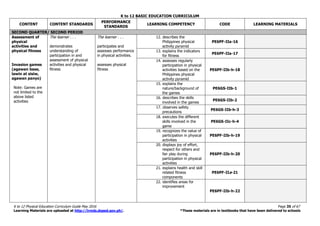
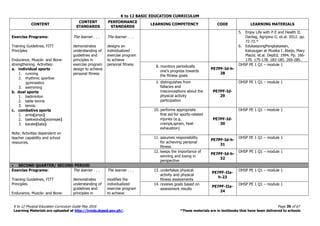
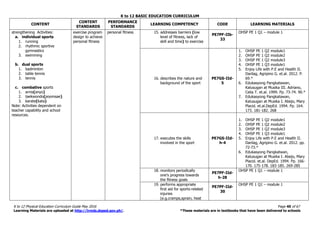
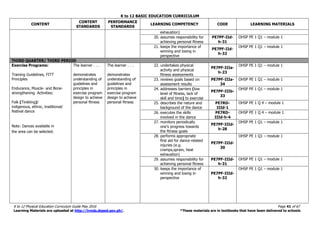
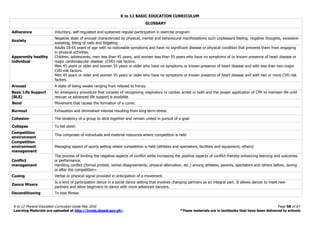
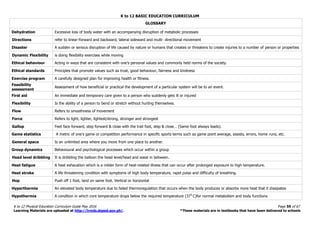
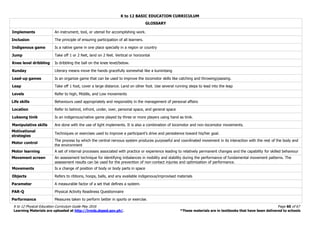
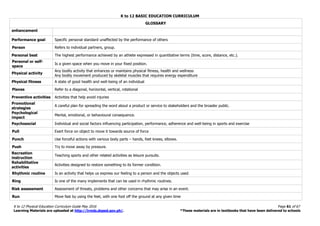
K to 12 BASIC EDUCATION CURRICULUM
K to 12 Physical Education Curriculum Guide May 2016 Page 2 of 67
Learning Materials are uploaded at http://lrmds.deped.gov.ph/. *These materials are in textbooks that have been delivered to schools
CURRICULAR FRAMEWORK
K to 12 Basic Education Program: An Overview
Essentially, the K to 12 curriculum proposed in 2011 seeks to develop 21st century skills among its learners. These include the cognitive skills of critical thinking,
problem-solving and creative thinking; the social or interpersonal skills of communication, collaboration, leadership and cross-cultural skills; self- management skills of self-
monitoring and self-direction, as well as task or project management skills, and personal characteristics which are part of ethics, civic responsibility and accountability.
The Curricular Philosophy of the K to 12 PE Curriculum
Fitness and movement education content is the core of the K to 12 PE Curriculum. It includes value, knowledge, skills and experiences in physical activity
participation in order to (1) achieve and maintain health-related fitness (HRF), as well as (2) optimize health. In particular, it hopes to instill an understanding of why HRF is
important so that the learner can translate HRF knowledge into action. Thus, self-management is an important skill. In addition, this curriculum recognizes the view that
fitness and healthy physical activity (PA) behaviors must take the family and other environmental settings (e.g. school, community and larger society) into consideration. This
curricular orientation is a paradigm shift from the previous sports-dominated PE curriculum aimed at athletic achievement.
Move to learn is the context of physical activity as the means for learning, while Learn to move embodies the learning of skills, and techniques and the acquisition of
understanding that are requisites to participation in a variety of physical activities that include exercise, games, sports, dance and recreation.
Learning Outcomes
The K to 12 PE Curriculum develops the students’ skills in accessing, synthesizing and evaluating information, making informed decisions, enhancing and advocating
their own and others’ fitness and health. The knowledge, understanding and skills underpin the competence, confidence and commitment required ofall students to live an
active life for fitness and health.
The K to 12 PE Curriculum prioritizes the following standards:
1. Habitual physical activity participation to achieve and maintain health-enhancing levels of fitness.
2. Competence in movement and motor skills requisite to various physical activity performances.
3. Valuing physical activities for enjoyment, challenge, social interaction and career opportunities.
4. Understanding various movement concepts, principles, strategies and tactics as they apply to the learning of physical activity.
K to 12 BASIC EDUCATION CURRICULUM
K to 12 Physical Education Curriculum Guide May 2016 Page 3 of 67
Learning Materials are uploaded at http://lrmds.deped.gov.ph/. *These materials are in textbooks that have been delivered to schools
Learning Approaches
Physical literacy is consists of movement, motor- and activity-specific skills. In the early grades the learners are taught the ‘what,’ ‘why’ and ‘how’ of the movement.
This progresses to an understanding of the ‘why’ of the movement which is achieved by developing more mature movement patterns and motor skills in a wide range and
variety of exercise, sports and dance activities to specifically enhance fitness parameters. The learners builds on these knowledge and skills in order to plan, set goals and
monitor their participation in physical activities (exercise, sports and dance) and constantly evaluate how well they have integrated this their personal lifestyle. This implies
the provision of ongoing and developmentally-appropriate activities so that the learners can practice, create, apply and evaluate the knowledge, understanding and skills
necessary to maintain and enhance their own as well as others’ fitness and health through participation in physical activities.
The curriculum also allows for an inclusive approach that understands and respects the diverse range of learners; thus, the program takes into account their needs,
strengths and abilities. This is to ensure that all learners have equivalent opportunities and choices in Physical Education.
The curriculum emphasizes knowing the ‘what’, ‘how’ and ‘why’ of movement. It focuses on developing the learners’ understanding of how the body responds,
adjusts and adapts to physical activities. This will equip the learner to become self-regulated and self-directed as a result of knowing what should be done and actually doing
it; is the learners are equally confident in influencing their peers, family, immediate community, and ultimately, society. These are all valuable 21st century skills which the K
to 12 PE Curriculum aspires for the learners to develop.
Learning Strands
The program has five learning strands:
1. Body management which includes body awareness, space awareness, qualities and relationships of movements and how these are used dynamically in various physical
activities.
2. Movement skills related to the fundamental movement patterns and motor skills that form the basis of all physical activities.
3. Games and sports consisting of simple, lead-up and indigenous games; as well as individual, dual and team sports in competitive and recreational settings.
4. Rhythms and dances include rhythmical movement patterns; the promotion and appreciation of Philippine folk dance, indigenous and traditional dances as well as other
dance forms.
5. Physical fitness includes assessment through fitness tests and records, interpreting, planning and implementing appropriate programs that support fitness and health goals.
The acquisition of physical literacy serves as the foundation for lifelong physical activity participation which is critical to maintaining and promoting health. Thus, the
health strand in the senior high school (SHS) is seamlessly integrated in the PE curriculum. This strand optimizes the learner’s potential for health and wellbeing and
contributes to building healthy, active communities. Thus, the course title, Health-optimizing PE or H.O.P.E.
K to 12 BASIC EDUCATION CURRICULUM
K to 12 Physical Education Curriculum Guide May 2016 Page 4 of 67
Learning Materials are uploaded at http://lrmds.deped.gov.ph/. *These materials are in textbooks that have been delivered to schools
.
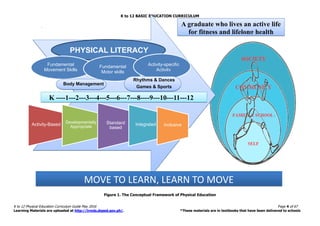
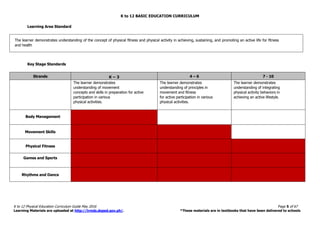
Figure 1. The Conceptual Framework of Physical Education
PHYSICAL LITERACY
Fundamental
Movement Skills
Fundamental
Motor skills
Activity-specific
Activity
Rhythms & Dances
Games & Sports
MOVE TO LEARN, LEARN TO MOVE
A graduate who lives an active life
for fitness and lifelong health
Body Management
K ----1---2---3---4---5---6---7---8----9---10---11---12
Activity-Based
Developmentally
Appropriate
Standard
based
Integrated Inclusive
K to 12 BASIC EDUCATION CURRICULUM
K to 12 Physical Education Curriculum Guide May 2016 Page 5 of 67
Learning Materials are uploaded at http://lrmds.deped.gov.ph/. *These materials are in textbooks that have been delivered to schools
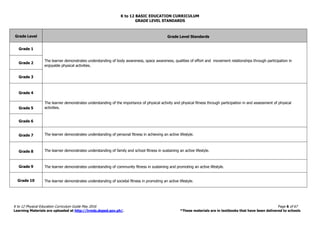
Learning Area Standard
The learner demonstrates understanding of the concept of physical fitness and physical activity in achieving, sustaining, and promoting an active life for fitness
and health
Key Stage Standards
Strands K – 3 4 – 6 7 - 10
The learner demonstrates
understanding of movement
concepts and skills in preparation for active
participation in various
physical activities.
The learner demonstrates
understanding of principles in
movement and fitness
for active participation in various
physical activities.
The learner demonstrates
understanding of integrating
physical activity behaviors in
achieving an active lifestyle.
Body Management
Movement Skills
Physical Fitness
Games and Sports
Rhythms and Dance
K to 12 BASIC EDUCATION CURRICULUM
K to 12 Physical Education Curriculum Guide May 2016 Page 6 of 67
Learning Materials are uploaded at http://lrmds.deped.gov.ph/. *These materials are in textbooks that have been delivered to schools
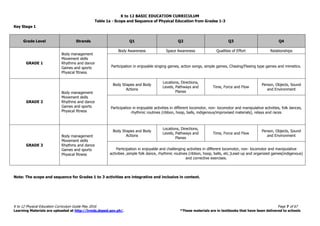
GRADE LEVEL STANDARDS
Grade Level Grade Level Standards
Grade 1
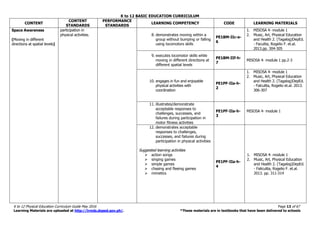
The learner demonstrates understanding of body awareness, space awareness, qualities of effort and movement relationships through participation in
enjoyable physical activities.
Grade 2
Grade 3
Grade 4
The learner demonstrates understanding of the importance of physical activity and physical fitness through participation in and assessment of physical
activities.
Grade 5
Grade 6
Grade 7 The learner demonstrates understanding of personal fitness in achieving an active lifestyle.
Grade 8 The learner demonstrates understanding of family and school fitness in sustaining an active lifestyle.
Grade 9 The learner demonstrates understanding of community fitness in sustaining and promoting an active lifestyle.
Grade 10 The learner demonstrates understanding of societal fitness in promoting an active lifestyle.
K to 12 BASIC EDUCATION CURRICULUM
K to 12 Physical Education Curriculum Guide May 2016 Page 7 of 67
Learning Materials are uploaded at http://lrmds.deped.gov.ph/. *These materials are in textbooks that have been delivered to schools
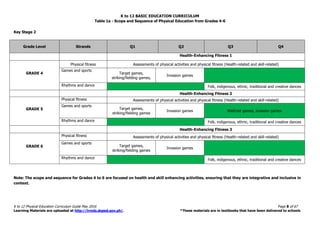
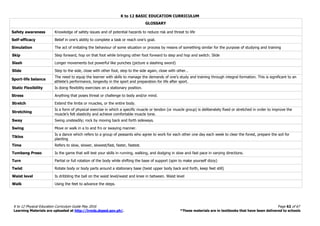
Table 1a - Scope and Sequence of Physical Education from Grades 1-3
Key Stage 1
Grade Level Strands Q1 Q2 Q3 Q4
GRADE 1
Body management
Movement skills
Rhythms and dance
Games and sports
Physical fitness
Body Awareness Space Awareness Qualities of Effort Relationships
Participation in enjoyable singing games, action songs, simple games, Chasing/Fleeing type games and mimetics.
GRADE 2
Body management
Movement skills
Rhythms and dance
Games and sports
Physical fitness
Body Shapes and Body
Actions
Locations, Directions,
Levels, Pathways and
Planes
Time, Force and Flow
Person, Objects, Sound
and Environment
Participation in enjoyable activities in different locomotor, non- locomotor and manipulative activities, folk dances,
rhythmic routines (ribbon, hoop, balls, indigenous/improvised materials), relays and races
GRADE 3
Body management
Movement skills
Rhythms and dance
Games and sports
Physical fitness
Body Shapes and Body
Actions
Locations, Directions,
Levels, Pathways and
Planes
Time, Force and Flow
Person, Objects, Sound
and Environment
Participation in enjoyable and challenging activities in different locomotor, non- locomotor and manipulative
activities ,simple folk dance, rhythmic routines (ribbon, hoop, balls, etc.)Lead-up and organized games(indigenous)
and corrective exercises.
Note: The scope and sequence for Grades 1 to 3 activities are integrative and inclusive in context.
K to 12 BASIC EDUCATION CURRICULUM
K to 12 Physical Education Curriculum Guide May 2016 Page 8 of 67
Learning Materials are uploaded at http://lrmds.deped.gov.ph/. *These materials are in textbooks that have been delivered to schools
Table 1a - Scope and Sequence of Physical Education from Grades 4-6
Key Stage 2
Grade Level Strands Q1 Q2 Q3 Q4
Health-Enhancing Fitness 1
GRADE 4
Physical fitness Assessments of physical activities and physical fitness (Health-related and skill-related)
Games and sports
Target games,
striking/fielding games,
Invasion games
Rhythms and dance Folk, indigenous, ethnic, traditional and creative dances
Health-Enhancing Fitness 2
GRADE 5
Physical fitness Assessments of physical activities and physical fitness (Health-related and skill-related)
Games and sports
Target games,
striking/fielding games
Invasion games Wall/net games, invasion games
Rhythms and dance Folk, indigenous, ethnic, traditional and creative dances
Health-Enhancing Fitness 3
GRADE 6
Physical fitness Assessments of physical activities and physical fitness (Health-related and skill-related)
Games and sports
Target games,
striking/fielding games
Invasion games
Rhythms and dance Folk, indigenous, ethnic, traditional and creative dances
Note: The scope and sequence for Grades 4 to 6 are focused on health and skill enhancing activities, ensuring that they are integrative and inclusive in
context.
K to 12 BASIC EDUCATION CURRICULUM
K to 12 Physical Education Curriculum Guide May 2016 Page 9 of 67
Learning Materials are uploaded at http://lrmds.deped.gov.ph/. *These materials are in textbooks that have been delivered to schools
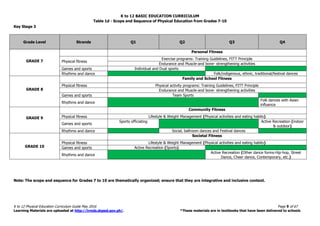
Table 1d - Scope and Sequence of Physical Education from Grades 7-10
Key Stage 3
Grade Level Strands Q1 Q2 Q3 Q4
GRADE 7
Personal Fitness
Physical fitness
Exercise programs: Training Guidelines, FITT Principle
Endurance and Muscle-and bone- strengthening activities
Games and sports Individual and Dual sports
Rhythms and dance Folk/indigenous, ethnic, traditional/festival dances
GRADE 8
Family and School Fitness
Physical fitness Physical activity programs: Training Guidelines, FITT Principle
Endurance and Muscle-and bone- strengthening activities
Games and sports Team Sports
Rhythms and dance
Folk dances with Asian
influence
GRADE 9
Community Fitness
Physical fitness Lifestyle & Weight Management (Physical activities and eating habits)
Games and sports
Sports officiating Active Recreation (indoor
& outdoor)
Rhythms and dance Social, ballroom dances and Festival dances
GRADE 10
Societal Fitness
Physical fitness Lifestyle & Weight Management (Physical activities and eating habits)
Games and sports Active Recreation (Sports)
Rhythms and dance
Active Recreation (Other dance forms-Hip-hop, Street
Dance, Cheer dance, Contemporary, etc.)
Note: The scope and sequence for Grades 7 to 10 are thematically organized; ensure that they are integrative and inclusive context.
K to 12 BASIC EDUCATION CURRICULUM
K to 12 Physical Education Curriculum Guide May 2016 Page 10 of 67
Learning Materials are uploaded at http://lrmds.deped.gov.ph/. *These materials are in textbooks that have been delivered to schools
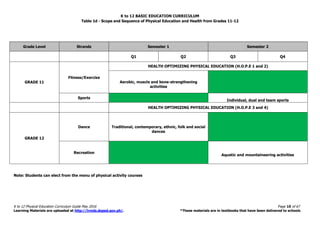
Table 1d - Scope and Sequence of Physical Education and Health from Grades 11-12
Grade Level Strands Semester 1 Semester 2
Q1 Q2 Q3 Q4
GRADE 11
Fitness/Exercise
HEALTH OPTIMIZING PHYSICAL EDUCATION (H.O.P.E 1 and 2)
Aerobic, muscle and bone-strengthening
activities
Sports
Individual, dual and team sports
HEALTH OPTIMIZING PHYSICAL EDUCATION (H.O.P.E 3 and 4)
GRADE 12
Dance Traditional, contemporary, ethnic, folk and social
dances
Recreation
Aquatic and mountaineering activities
Note: Students can elect from the menu of physical activity courses
K to 12 BASIC EDUCATION CURRICULUM
K to 12 Physical Education Curriculum Guide May 2016 Page 11 of 67
Learning Materials are uploaded at http://lrmds.deped.gov.ph/. *These materials are in textbooks that have been delivered to schools
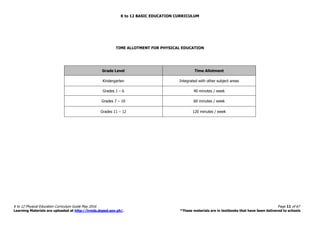
TIME ALLOTMENT FOR PHYSICAL EDUCATION
Grade Level Time Allotment
Kindergarten Integrated with other subject areas
Grades 1 – 6 40 minutes / week
Grades 7 – 10 60 minutes / week
Grades 11 – 12 120 minutes / week
K to 12 BASIC EDUCATION CURRICULUM
K to 12 Physical Education Curriculum Guide May 2016 Page 12 of 67
Learning Materials are uploaded at http://lrmds.deped.gov.ph/. *These materials are in textbooks that have been delivered to schools
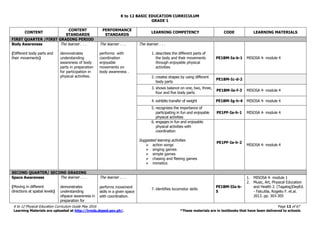
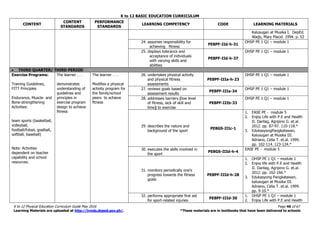
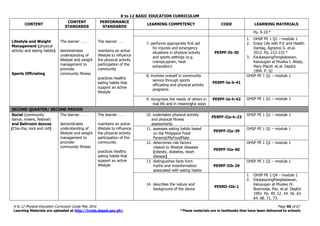
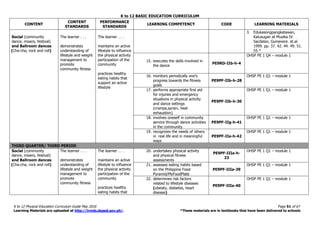
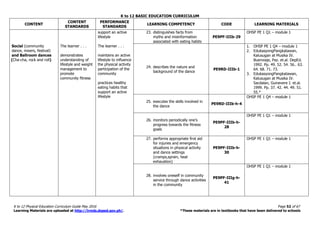
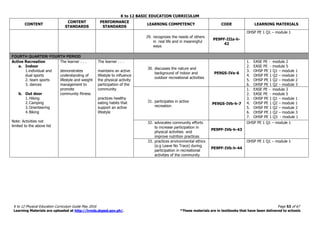
GRADE 1
CONTENT
CONTENT
STANDARDS
PERFORMANCE
STANDARDS
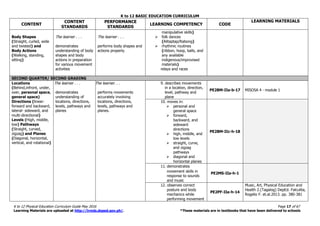
LEARNING COMPETENCY CODE LEARNING MATERIALS
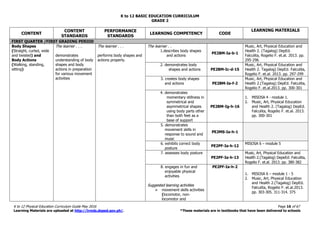
FIRST QUARTER /FIRST GRADING PERIOD
Body Awareness
(Different body parts and
their movements)
The learner . . .
demonstrates
understanding
awareness of body
parts in preparation
for participation in
physical activities.
The learner . . .
performs with
coordination
enjoyable
movements on
body awareness .
The learner . . .
1. describes the different parts of
the body and their movements
through enjoyable physical
activities
PE1BM-Ia-b-1 MISOSA 4- module 4
2. creates shapes by using different
body parts
PE1BM-Ic-d-2
3. shows balance on one, two, three,
four and five body parts
PE1BM-Ie-f-3 MISOSA 4- module 4
4. exhibits transfer of weight PE1BM-Ig-h-4 MISOSA 4- module 4
5. recognizes the importance of
participating in fun and enjoyable
physical activities
PE1PF-Ia-h-1 MISOSA 4- module 4
6. engages in fun and enjoyable
physical activities with
coordination
Suggested learning activities
 action songs
 singing games
 simple games
 chasing and fleeing games
 mimetics
PE1PF-Ia-h-2
MISOSA 4- module 4
SECOND QUARTER/ SECOND GRADING
Space Awareness
(Moving in different
directions at spatial levels)
The learner . . .
demonstrates
understanding
ofspace awareness in
preparation for
The learner . . .
performs movement
skills in a given space
with coordination.
7. identifies locomotor skills
PE1BM-IIa-b-
5
1. MISOSA 4- module 1
2. Music, Art, Physical Education
and Health 2. (Tagalog)DepEd.
- Falcutila, Rogelio F. et.al.
2013. pp. 303-305
K to 12 BASIC EDUCATION CURRICULUM
K to 12 Physical Education Curriculum Guide May 2016 Page 13 of 67
Learning Materials are uploaded at http://lrmds.deped.gov.ph/. *These materials are in textbooks that have been delivered to schools
CONTENT
CONTENT
STANDARDS
PERFORMANCE
STANDARDS
LEARNING COMPETENCY CODE LEARNING MATERIALS
Space Awareness
(Moving in different
directions at spatial levels)
participation in
physical activities. 8. demonstrates moving within a
group without bumping or falling
using locomotors skills
PE1BM-IIc-e-
6
1. MISOSA 4- module 1
2. Music, Art, Physical Education
and Health 2. (Tagalog)DepEd.
- Faculita, Rogelio F. et.al.
2013.pp. 304-305
9. executes locomotor skills while
moving in different directions at
different spatial levels
PE1BM-IIf-h-
7
MISOSA 4- module 1 pp.2-3
10. engages in fun and enjoyable
physical activities with
coordination
PE1PF-IIa-h-
2
1. MISOSA 4- module 1
2. Music, Art, Physical Education
and Health 2. (Tagalog)DepEd.
- Falculita, Rogelio et.al. 2013.
306-307
11. illustrates/demonstrate
acceptable responses to
challenges, successes, and
failures during participation in
motor fitness activities
PE1PF-IIa-h-
3
MISOSA 4- module 1
12. demonstrates acceptable
responses to challenges,
successes, and failures during
participation in physical activities
Suggested learning activities
 action songs
 singing games
 simple games
 chasing and fleeing games
 mimetics
PE1PF-IIa-h-
4
1. MISOSA 4- module 1
2. Music, Art, Physical Education
and Health 2. (Tagalog)DepEd.
- Faliculita, Rogelio F. et.al.
2013. pp. 311-314
K to 12 BASIC EDUCATION CURRICULUM
K to 12 Physical Education Curriculum Guide May 2016 Page 14 of 67
Learning Materials are uploaded at http://lrmds.deped.gov.ph/. *These materials are in textbooks that have been delivered to schools
CONTENT
CONTENT
STANDARDS
PERFORMANCE
STANDARDS
LEARNING COMPETENCY CODE LEARNING MATERIALS
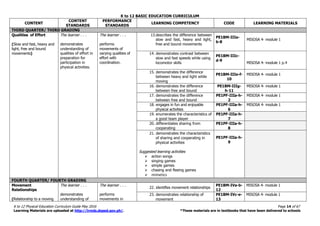
THIRD QUARTER/ THIRD GRADING
Qualities of Effort
(Slow and fast, heavy and
light, free and bound
movements)
The learner . . .
demonstrates
understanding of
qualities of effort in
preparation for
participation in
physical activities.
The learner . . .
performs
movements of
varying qualities of
effort with
coordination.
13.describes the difference between
slow and fast, heavy and light,
free and bound movements
PE1BM-IIIa-
b-8
MISOSA 4- module 1
14. demonstrates contrast between
slow and fast speeds while using
locomotor skills
PE1BM-IIIc-
d-9
MISOSA 4- module 1 p.4
15. demonstrates the difference
between heavy and light while
moving
PE1BM-IIIe-f-
10
MISOSA 4- module 1
16. demonstrates the difference
between free and bound
PE1BM-IIIg-
h-11
MISOSA 4- module 1
17. demonstrates the difference
between free and bound
PE1PF-IIIa-h-
2
MISOSA 4- module 1
18. engages in fun and enjoyable
physical activities
PE1PF-IIIa-h-
6
MISOSA 4- module 1
19. enumerates the characteristics of
a good team player
PE1PF-IIIa-h-
7
20. differentiates sharing from
cooperating
PE1PF-IIIa-h-
8
21. demonstrates the characteristics
of sharing and cooperating in
physical activities
Suggested learning activities
 action songs
 singing games
 simple games
 chasing and fleeing games
 mimetics
PE1PF-IIIa-h-
9
FOURTH QUARTER/ FOURTH GRADING
Movement
Relationships
(Relationship to a moving
The learner . . .
demonstrates
understanding of
The learner . . .
performs
movements in
22. identifies movement relationships
PE1BM-IVa-b-
12
MISOSA 4- module 1
23. demonstrates relationship of
movement
PE1BM-IVc-e-
13
MISOSA 4- module 1
K to 12 BASIC EDUCATION CURRICULUM
K to 12 Physical Education Curriculum Guide May 2016 Page 15 of 67
Learning Materials are uploaded at http://lrmds.deped.gov.ph/. *These materials are in textbooks that have been delivered to schools
CONTENT
CONTENT
STANDARDS
PERFORMANCE
STANDARDS
LEARNING COMPETENCY CODE LEARNING MATERIALS
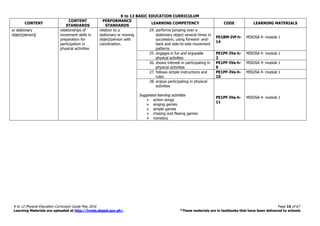
or stationary
object/person)
relationships of
movement skills in
preparation for
participation in
physical activities
relation to a
stationary or moving
object/person with
coordination.
24. performs jumping over a
stationary object several times in
succession, using forward- and-
back and side-to-side movement
patterns
PE1BM-IVf-h-
14
MISOSA 4- module 1
25. engages in fun and enjoyable
physical activities
PE1PF-IVa-h-
2
MISOSA 4- module 1
26. shows interest in participating in
physical activities
PE1PF-IVa-h-
9
MISOSA 4- module 1
27. follows simple instructions and
rules
PE1PF-IVa-h-
10
MISOSA 4- module 1
28. enjoys participating in physical
activities
Suggested learning activities
 action songs
 singing games
 simple games
 chasing and fleeing games
 mimetics
PE1PF-IVa-h-
11
MISOSA 4- module 1
K to 12 BASIC EDUCATION CURRICULUM
K to 12 Physical Education Curriculum Guide May 2016 Page 16 of 67
Learning Materials are uploaded at http://lrmds.deped.gov.ph/. *These materials are in textbooks that have been delivered to schools
GRADE 2
CONTENT
CONTENT
STANDARDS
PERFORMANCE
STANDARDS
LEARNING COMPETENCY CODE
LEARNING MATERIALS
FIRST QUARTER /FIRST GRADING PERIOD
Body Shapes
(Straight, curled, wide
and twisted) and
Body Actions
(Walking, standing,
sitting)
The learner . . .
demonstrates
understanding of body
shapes and body
actions in preparation
for various movement
activities
The learner . . .
performs body shapes and
actions properly.
The learner . .
1.describes body shapes
and actions
PE2BM-Ia-b-1
Music, Art, Physical Education and
Health 2. (Tagalog) DepEd.
Falculita, Rogelio F. et.al. 2013. pp.
295-296
2. demonstrates body
shapes and actions PE2BM-Ic-d-15
Music, Art, Physical Education and
Health 2. Tagalog) DepEd. Falculita,
Rogelio F. et.al. 2013. pp. 297-299
3. creates body shapes
and actions PE2BM-Ie-f-2
Music, Art, Physical Education and
Health 2.(Tagalog) DepEd. Falculita,
Rogelio F. et.al.2013. pp. 300-301
4. demonstrates
momentary stillness in
symmetrical and
asymmetrical shapes
using body parts other
than both feet as a
base of support
PE2BM-Ig-h-16
1. MISOSA 4 - module 1.
2. Music, Art, Physical Education
and Health 2. (Tagalog) DepEd.
Falculita, Rogelio F. et.al. 2013.
pp. 300-301
5. demonstrates
movement skills in
response to sound and
music
PE2MS-Ia-h-1
6. exhibits correct body
posture
PE2PF-Ia-h-12
MISOSA 6 – module 5
7. assesses body posture
PE2PF-Ia-h-13
Music, Art, Physical Education and
Health 2.(Tagalog) DepeEd. Falculita,
Rogelio F. et.al. 2013. pp. 380-382
8. engages in fun and
enjoyable physical
activities
Suggested learning activities
 movement skills activities
(locomotor, non-
locomotor and
PE2PF-Ia-h-2
1. MISOSA 6 – module 1 - 5
2. Music, Art, Physical Education
and Health 2.(Tagalog) DepEd.
Falculita, Rogelio F. et.al.2013.
pp. 303-305. 311-314. 375
K to 12 BASIC EDUCATION CURRICULUM
K to 12 Physical Education Curriculum Guide May 2016 Page 17 of 67
Learning Materials are uploaded at http://lrmds.deped.gov.ph/. *These materials are in textbooks that have been delivered to schools
CONTENT
CONTENT
STANDARDS
PERFORMANCE
STANDARDS
LEARNING COMPETENCY CODE
LEARNING MATERIALS
Body Shapes
(Straight, curled, wide
and twisted) and
Body Actions
(Walking, standing,
sitting)
The learner . . .
demonstrates
understanding of body
shapes and body
actions in preparation
for various movement
activities
The learner . . .
performs body shapes and
actions properly.
manipulative skills)
 folk dances
(Alitaptap/Rabong)
 rhythmic routines
(ribbon, hoop, balls, and
any available
indigenous/improvised
materials)
relays and races
SECOND QUARTER/ SECOND GRADING
Locations
(Behind,infront, under,
over, personal space,
general space)
Directions (linear-
forward and backward,
lateral- sideward, and
multi-directional)
Levels (High, middle,
low) Pathways
(Straight, curved,
zigzag) and Planes
(Diagonal, horizontal,
vertical, and rotational)
Th The learner . . .
demonstrates
understanding of
locations, directions,
levels, pathways and
planes
Th
ThThe learner. . .
performs movements
accurately involving
locations, directions,
levels, pathways and
planes.
9. describes movements
in a location, direction,
level, pathway and
plane
PE2BM-IIa-b-17 MISOSA 4 - module 1
10. moves in:
 personal and
general space
 forward,
backward, and
sideward
directions
 high, middle, and
low levels
 straight, curve,
and zigzag
pathways
 diagonal and
horizontal planes
PE2BM-IIc-h-18
11. demonstrates
movement skills in
response to sounds
and music
PE2MS-IIa-h-1
12. observes correct
posture and body
mechanics while
performing movement
PE2PF-IIa-h-14
Music, Art, Physical Education and
Health 2.(Tagalog) DepEd. Falculita,
Rogelio F. et.al.2013. pp. 380-381
K to 12 BASIC EDUCATION CURRICULUM
K to 12 Physical Education Curriculum Guide May 2016 Page 18 of 67
Learning Materials are uploaded at http://lrmds.deped.gov.ph/. *These materials are in textbooks that have been delivered to schools
CONTENT
CONTENT
STANDARDS
PERFORMANCE
STANDARDS
LEARNING COMPETENCY CODE
LEARNING MATERIALS
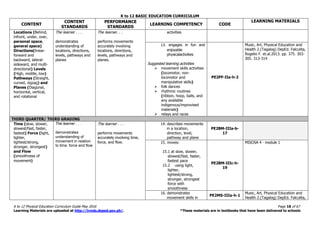
Locations (Behind,
infront, under, over,
personal space,
general space)
Directions(linear-
forward and
backward, lateral-
sideward, and multi-
directional) Levels
(High, middle, low)
Pathways (Straight,
curved, zigzag) and
Planes (Diagonal,
horizontal, vertical,
and rotational
The learner . . .
demonstrates
understanding of
locations, directions,
levels, pathways and
planes
The learner. . .
performs movements
accurately involving
locations, directions,
levels, pathways and
planes.
activities
13. engages in fun and
enjoyable
physicalactivities
Suggested learning activities
 movement skills activities
(locomotor, non-
locomotor and
manipulative skills)
 folk dances
 rhythmic routines
(ribbon, hoop, balls, and
any available
indigenous/improvised
materials)
 relays and races
PE2PF-IIa-h-2
Music, Art, Physical Education and
Health 2.(Tagalog) DepEd. Falculita,
Rogelio F. et.al.2013. pp. 375. 303-
305. 313-314
THIRD QUARTER/ THIRD GRADING
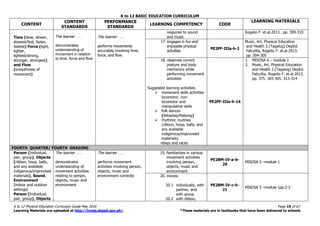
Time (slow, slower,
slowest/fast, faster,
fastest) Force (light,
lighter,
lightest/strong,
stronger, strongest)
and Flow
(smoothness of
movement)
The learner . . .
demonstrates
understanding of
movement in relation
to time, force and flow
The learner . . .
performs movements
accurately involving time,
force, and flow.
14. describes movements
in a location,
direction, level,
pathway and plane
PE2BM-IIIa-b-
17
15. moves:
15.1 at slow, slower,
slowest/fast, faster,
fastest pace
15.2 using light,
lighter,
lightest/strong,
stronger, strongest
force with
smoothness
PE2BM-IIIc-h-
19
MISOSA 4 - module 1
16. demonstrates
movement skills in
PE2MS-IIIa-h-1
Music, Art, Physical Education and
Health 2.(Tagalog) DepEd. Falculita,
K to 12 BASIC EDUCATION CURRICULUM
K to 12 Physical Education Curriculum Guide May 2016 Page 19 of 67
Learning Materials are uploaded at http://lrmds.deped.gov.ph/. *These materials are in textbooks that have been delivered to schools
CONTENT
CONTENT
STANDARDS
PERFORMANCE
STANDARDS
LEARNING COMPETENCY CODE
LEARNING MATERIALS
Time (slow, slower,
slowest/fast, faster,
fastest) Force (light,
lighter,
lightest/strong,
stronger, strongest)
and Flow
(smoothness of
movement)
The learner . . .
demonstrates
understanding of
movement in relation
to time, force and flow
The learner . . .
performs movements
accurately involving time,
force, and flow.
response to sound
and music
Rogelio F. et.al.2013.. pp. 309-310
17. engages in fun and
enjoyable physical
activities
PE2PF-IIIa-h-2
Music, Art, Physical Education
and Health 2.(Tagalog) DepEd.
Falculita, Rogelio F. et.al.2013.
pp. 304-305
18. observes correct
posture and body
mechanics while
performing movement
activities
Suggested learning activities
 movement skills activities
locomotor, non-
locomotor and
manipulative skills
 folk dances
(Alitaptap/Rabong)
 rhythmic routines
(ribbon, hoop, balls, and
any available
indigenous/improvised
materials)
relays and races
PE2PF-IIIa-h-14
1. MISOSA 6 – module 1
2. Music, Art, Physical Education
and Health 2.(Tagalog) DepEd.
Falculita, Rogelio F. et.al.2013.
pp. 375. 303-305. 313-314
FOURTH QUARTER/ FOURTH GRADING
Person (Individual,
pair, group), Objects
(ribbon, hoop, balls,
and any available
indigenous/improvised
materials), Sound,
Environment
(indoor and outdoor
settings)
Person (Individual,
pair, group), Objects
The learner . . .
demonstrates
understanding of
movement activities
relating to person,
objects, music and
environment
The learner . . .
performs movement
activities involving person,
objects, music and
environment correctly
19. familiarizes in various
movement activities
involving person,
objects, music and
environment
PE2BM-IV-a-b-
20
MISOSA 5 –module 1
20. moves:
20.1 individually, with
partner, and
with group
20.2 with ribbon,
PE2BM-IV-c-h-
21
MISOSA 5 –module 1pp.2-3
K to 12 BASIC EDUCATION CURRICULUM
K to 12 Physical Education Curriculum Guide May 2016 Page 20 of 67
Learning Materials are uploaded at http://lrmds.deped.gov.ph/. *These materials are in textbooks that have been delivered to schools
CONTENT
CONTENT
STANDARDS
PERFORMANCE
STANDARDS
LEARNING COMPETENCY CODE
LEARNING MATERIALS
(ribbon, hoop, balls,
and any available
indigenous/improvised
materials), Sound,
Environment
(indoor and outdoor
settings)
The learner . . .
demonstrates
understanding of
movement activities
relating to person,
objects, music and
environment
The learner . . .
performs movement
activities involving person,
objects, music and
environment correctly
hoop, balls, and
any available
indigenous/impr
ovised materials
20.3 with sound
20.4 in indoor and
outdoor settings
21. demonstrates
movement skills in
response to sound
PE2MS-IV-a-h-1
Music, Art, Physical Education and
Health 2.(Tagalog) DepEd. Falculita,
Rogelio F. et.al.2013. pp. 356-357
22. engages in fun and
enjoyable physical
activities
PE2PF-IV-a-h-2
Music, Art, Physical Education and
Health 2.(Tagalog) DepEd. Falculita,
Rogelio F. et.al.2013. pp.313-314
23. observes correct body
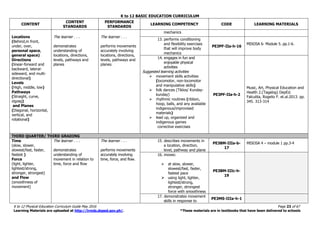
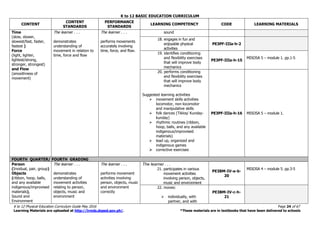
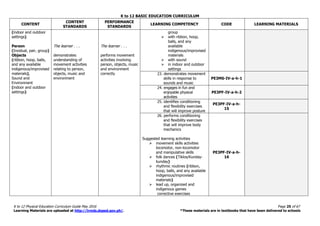
posture and body
mechanics while
performing movement
activities
Suggested learning activities
 movement skills activities
locomotor, non-locomotor
and manipulative skills
 folk dances
(Alitaptap/Rabong)
 rhythmic routines (ribbon,
hoop, balls, and any
available
indigenous/improvised
materials)
relays and races
PE2PF-IV-a-h-
14
MISOSA 6 –module 1pp.1-6
K to 12 BASIC EDUCATION CURRICULUM
K to 12 Physical Education Curriculum Guide May 2016 Page 21 of 67
Learning Materials are uploaded at http://lrmds.deped.gov.ph/. *These materials are in textbooks that have been delivered to schools
GRADE 3
CONTENT
CONTENT
STANDARDS
PERFORMANCE
STANDARDS
LEARNING COMPETENCY CODE LEARNING MATERIALS
FIRST QUARTER /FIRST GRADING PERIOD
Body Shapes
(Straight, curled, wide
and twisted) and
Body Actions
(Walking, standing,
sitting)
The learner . . .
demonstrates
understanding of body
shapes and body actions
in preparation for various
movement activities
The learner . . .
performs body shapes
and actions properly.
The learner . . .
1. describes body shapes
and actions PE3BM-Ia-b-1
Music, Art, Physical Education and
Health 2.(Tagalog) DepEd.
Falculita, Rogelio F. et.al.2013.
pp. 295-296
2. performs body shapes and
actions
PE3BM-Ic-d-15
Music, Art, Physical Education and
Health 2.(Tagalog) DepEd.
Falculita, Rogelio F. et.al.2013.
pp. 297-299
3. creates body shapes and
actions
PE3BM-Ie-f-2
Music, Art, Physical Education and
Health 2.(Tagalog) DepEd.
Falculita, Rogelio F. et.al.2013. pp.
300-301
4. demonstrates momentary
stillness in symmetrical
and asymmetrical shapes
using body parts other
than both feet as a base
of support
PE3BM-Ig-h-16
Music, Art, Physical Education and
Health 2.(Tagalog) DepEd.
Falculita, Rogelio F. et.al.2013. pp.
300-301
5. demonstrates movement
skills in response to
sounds and music
PE3MS-Ia-h-1
6. identifies conditioning and
flexibility exercises that
will improve posture
PE3PF-Ia-h-15
Music, Art, Physical Education and
Health 2.(Tagalog) DepEd.
Falculita, Rogelio F. et.al.2013. pp.
381-382
7. performs conditioning and
flexibility exercises that
will improve body posture
PE3PF-Ia-h-16
Music, Art, Physical Education and
Health 2.(Tagalog) DepEd.
Falculita, Rogelio F. et.al.2013. pp.
381-382
8. engages in fun and
enjoyable physical activities
Suggested learning activities
 movement skills activities
PE3PF-Ia-h-2
Music, Art, Physical Education and
Health 2.(Tagalog) DepEd.
Falculita, Rogelio F. et.al.2013.
pp. 303-305. 313-314
K to 12 BASIC EDUCATION CURRICULUM
K to 12 Physical Education Curriculum Guide May 2016 Page 22 of 67
Learning Materials are uploaded at http://lrmds.deped.gov.ph/. *These materials are in textbooks that have been delivered to schools
CONTENT
CONTENT
STANDARDS
PERFORMANCE
STANDARDS
LEARNING COMPETENCY CODE LEARNING MATERIALS
Body Shapes
(Straight, curled, wide
and twisted) and
Body Actions
(Walking, standing,
sitting)
The learner . . .
demonstrates
understanding of body
shapes and body actions
in preparation for various
movement activities
The learner . . .
performs body shapes
and actions properly.
(locomotor, non-locomotor
and manipulative skills)
 folk dances (Tiklos/Kunday-
kunday)
 rhythmic routines (ribbon,
hoop, balls, and any available
indigenous/improvised
materials)
 lead up, organized and
indigenous games
corrective exercises
SECOND QUARTER/ SECOND GRADING
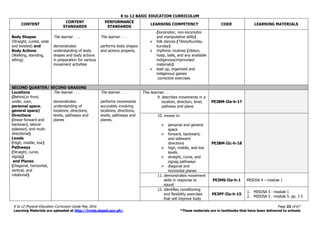
Locations
(Behind,in front,
under, over,
personal space,
general space)
Directions
(linear-forward and
backward, lateral-
sideward, and multi-
directional)
Levels
(High, middle, low)
Pathways
(Straight, curve,
zigzag)
and Planes
(Diagonal, horizontal,
vertical, and
rotational)
The learner . . .
demonstrates
understanding of
locations, directions,
levels, pathways and
planes
The learner . . .
performs movements
accurately involving
locations, directions,
levels, pathways and
planes.
The learner . . .
9. describes movements in a
location, direction, level,
pathway and plane
PE3BM-IIa-b-17
10. moves in:
 personal and general
space
 forward, backward,
and sideward
directions
 high, middle, and low
levels
 straight, curve, and
zigzag pathways
 diagonal and
horizontal planes
PE3BM-IIc-h-18
11. demonstrates movement
skills in response to
sound
PE3MS-IIa-h-1 MISOSA 4 – module 1
12. identifies conditioning
and flexibility exercises
that will improve body
PE3PF-IIa-h-15
1. MISOSA 5 - module 1
2. MISOSA 5 - module 5. pp. 1-5
K to 12 BASIC EDUCATION CURRICULUM
K to 12 Physical Education Curriculum Guide May 2016 Page 23 of 67
Learning Materials are uploaded at http://lrmds.deped.gov.ph/. *These materials are in textbooks that have been delivered to schools
CONTENT
CONTENT
STANDARDS
PERFORMANCE
STANDARDS
LEARNING COMPETENCY CODE LEARNING MATERIALS
Locations
(Behind,in front,
under, over,
personal space,
general space)
Directions
(linear-forward and
backward, lateral-
sideward, and multi-
directional)
Levels
(High, middle, low)
Pathways
(Straight, curve,
zigzag)
and Planes
(Diagonal, horizontal,
vertical, and
rotational)
The learner . . .
demonstrates
understanding of
locations, directions,
levels, pathways and
planes
The learner . . .
performs movements
accurately involving
locations, directions,
levels, pathways and
planes.
mechanics
13. performs conditioning
and flexibility exercises
that will improve body
mechanics
PE3PF-IIa-h-16
MISOSA 6- Module 5. pp.1-6.
14. engages in fun and
enjoyable physical
activities
Suggested learning activities
 movement skills activities
(locomotor, non-locomotor
and manipulative skills)
 folk dances (Tiklos/ Kunday-
kunday)
 rhythmic routines (ribbon,
hoop, balls, and any available
indigenous/improvised
materials)
 lead up, organized and
indigenous games
corrective exercises
PE3PF-IIa-h-2
Music, Art, Physical Education and
Health 2.(Tagalog) DepEd.
Falculita, Rogelio F. et.al.2013. pp.
345. 313-314
THIRD QUARTER/ THIRD GRADING
Time
(slow, slower,
slowest/fast, faster,
fastest )
Force
(light, lighter,
lightest/strong,
stronger, strongest)
and Flow
(smoothness of
movement)
The learner . . .
demonstrates
understanding of
movement in relation to
time, force and flow
The learner . . .
performs movements
accurately involving
time, force, and flow.
15. describes movements in
a location, direction,
level, pathway and plane
PE3BM-IIIa-b-
17
MISOSA 4 – module 1 pp.3-4
16. moves:
 at slow, slower,
slowest/fast, faster,
fastest pace
 using light, lighter,
lightest/strong,
stronger, strongest
force with smoothness
PE3BM-IIIc-h-
19
17. demonstrates movement
skills in response to
PE3MS-IIIa-h-1
K to 12 BASIC EDUCATION CURRICULUM
K to 12 Physical Education Curriculum Guide May 2016 Page 24 of 67
Learning Materials are uploaded at http://lrmds.deped.gov.ph/. *These materials are in textbooks that have been delivered to schools
CONTENT
CONTENT
STANDARDS
PERFORMANCE
STANDARDS
LEARNING COMPETENCY CODE LEARNING MATERIALS
Time
(slow, slower,
slowest/fast, faster,
fastest )
Force
(light, lighter,
lightest/strong,
stronger, strongest)
and Flow
(smoothness of
movement)
The learner . . .
demonstrates
understanding of
movement in relation to
time, force and flow
The learner . . .
performs movements
accurately involving
time, force, and flow.
sound
18. engages in fun and
enjoyable physical
activities
PE3PF-IIIa-h-2
19. identifies conditioning
and flexibility exercises
that will improve body
mechanics
PE3PF-IIIa-h-15
MISOSA 5 – module 1. pp.1-5
20. performs conditioning
and flexibility exercises
that will improve body
mechanics
Suggested learning activities
 movement skills activities
locomotor, non-locomotor
and manipulative skills
 folk dances (Tiklos/ Kunday-
kunday)
 rhythmic routines (ribbon,
hoop, balls, and any available
indigenous/improvised
materials)
 lead up, organized and
indigenous games
 corrective exercises
PE3PF-IIIa-h-16 MISOSA 5 – module 1.
FOURTH QUARTER/ FOURTH GRADING
Person
(Invidual, pair, group)
Objects
(ribbon, hoop, balls,
and any available
indigenous/improvised
materials),
Sound and
Environment
The learner . . .
demonstrates
understanding of
movement activities
relating to person,
objects, music and
environment
The learner . . .
performs movement
activities involving
person, objects, music
and environment
correctly
The learner . . .
21. participates in various
movement activities
involving person, objects,
music and environment
PE3BM-IV-a-b-
20
MISOSA 4 – module 5. pp.3-5
22. moves:
 individually, with
partner, and with
PE3BM-IV-c-h-
21
K to 12 BASIC EDUCATION CURRICULUM
K to 12 Physical Education Curriculum Guide May 2016 Page 25 of 67
Learning Materials are uploaded at http://lrmds.deped.gov.ph/. *These materials are in textbooks that have been delivered to schools
CONTENT
CONTENT
STANDARDS
PERFORMANCE
STANDARDS
LEARNING COMPETENCY CODE LEARNING MATERIALS
(indoor and outdoor
settings)
Person
(Invidual, pair, group)
Objects
(ribbon, hoop, balls,
and any available
indigenous/improvised
materials),
Sound and
Environment
(indoor and outdoor
settings)
The learner . . .
demonstrates
understanding of
movement activities
relating to person,
objects, music and
environment
The learner . . .
performs movement
activities involving
person, objects, music
and environment
correctly
group
 with ribbon, hoop,
balls, and any
available
indigenous/improvised
materials
 with sound
 in indoor and outdoor
settings
23. demonstrates movement
skills in response to
sounds and music
PE3MS-IV-a-h-1
24. engages in fun and
enjoyable physical
activities
PE3PF-IV-a-h-2
25. identifies conditioning
and flexibility exercises
that will improve posture
PE3PF-IV-a-h-
15
26. performs conditioning
and flexibility exercises
that will improve body
mechanics
Suggested learning activities
 movement skills activities
locomotor, non-locomotor
and manipulative skills
 folk dances (Tiklos/Kunday-
kunday)
 rhythmic routines (ribbon,
hoop, balls, and any available
indigenous/improvised
materials)
 lead up, organized and
indigenous games
corrective exercises
PE3PF-IV-a-h-
16
K to 12 BASIC EDUCATION CURRICULUM
K to 12 Physical Education Curriculum Guide May 2016 Page 26 of 67
Learning Materials are uploaded at http://lrmds.deped.gov.ph/. *These materials are in textbooks that have been delivered to schools
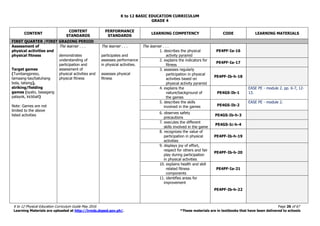
GRADE 4
CONTENT
CONTENT
STANDARDS
PERFORMANCE
STANDARDS
LEARNING COMPETENCY CODE LEARNING MATERIALS
FIRST QUARTER /FIRST GRADING PERIOD
Assessment of
physical activities and
physical fitness
Target games
(Tumbangpreso,
tamaang-tao/batuhang
bola, tatsing),
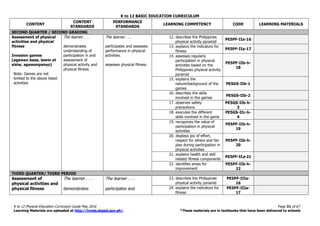
striking/fielding
games (syato, basagang
palayok, kickball)
Note: Games are not
limited to the above
listed activities
The learner . . .
demonstrates
understanding of
participation and
assessment of
physical activities and
physical fitness
The learner . . .
participates and
assesses performance
in physical activities.
assesses physical
fitness
The learner . . .
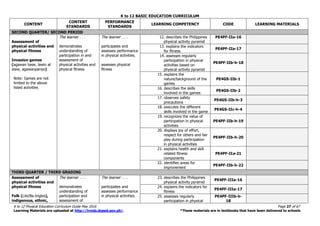
1. describes the physical
activity pyramid
PE4PF-Ia-16
2. explains the indicators for
fitness
PE4PF-Ia-17
3. assesses regularly
participation in physical
activities based on
physical activity pyramid
PE4PF-Ib-h-18
4. explains the
nature/background of
the games
PE4GS-Ib-1
EASE PE - module 2. pp. 6-7, 12-
13.
5. describes the skills
involved in the games PE4GS-Ib-2
EASE PE - module 2.
6. observes safety
precautions
PE4GS-Ib-h-3
7. executes the different
skills involved in the game
PE4GS-Ic-h-4
8. recognizes the value of
participation in physical
activities
PE4PF-Ib-h-19
9. displays joy of effort,
respect for others and fair
play during participation
in physical activities
PE4PF-Ib-h-20
10. explains health and skill
related fitness
components
PE4PF-Ia-21
11. identifies areas for
improvement
PE4PF-Ib-h-22
K to 12 BASIC EDUCATION CURRICULUM
K to 12 Physical Education Curriculum Guide May 2016 Page 27 of 67
Learning Materials are uploaded at http://lrmds.deped.gov.ph/. *These materials are in textbooks that have been delivered to schools
CONTENT
CONTENT
STANDARDS
PERFORMANCE
STANDARDS
LEARNING COMPETENCY CODE LEARNING MATERIALS
SECOND QUARTER/ SECOND PERIOD
Assessment of
physical activities and
physical fitness
Invasion games
(agawan base, lawin at
sisiw, agawanpanyo)
Note: Games are not
limited to the above
listed activities
The learner . . .
demonstrates
understanding of
participation in and
assessment of
physical activities and
physical fitness
The learner . . .
participates and
assesses performance
in physical activities.
assesses physical
fitness
12. describes the Philippines
physical activity pyramid
PE4PF-IIa-16
13. explains the indicators
for fitness
PE4PF-IIa-17
14. assesses regularly
participation in physical
activities based on
physical activity pyramid
PE4PF-IIb-h-18
15. explains the
nature/background of the
games
PE4GS-IIb-1
16. describes the skills
involved in the games
PE4GS-IIb-2
17. observes safety
precautions
PE4GS-IIb-h-3
18. executes the different
skills involved in the game
PE4GS-IIc-h-4
19. recognizes the value of
participation in physical
activities
PE4PF-IIb-h-19
20. displays joy of effort,
respect for others and fair
play during participation
in physical activities
PE4PF-IIb-h-20
21. explains health and skill
related fitness
components
PE4PF-IIa-21
22. identifies areas for
improvement
PE4PF-IIb-h-22
THIRD QUARTER / THIRD GRADING
Assessment of
physical activities and
physical fitness
Folk (Liki/Ba-Ingles),
indigenous, ethnic,
The learner . . .
demonstrates
understanding of
participation and
assessment of
The learner . . .
participates and
assesses performance
in physical activities.
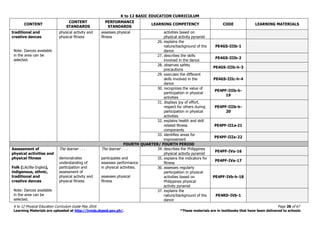
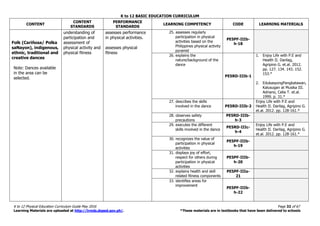
23. describes the Philippines
physical activity pyramid
PE4PF-IIIa-16
24. explains the indicators for
fitness
PE4PF-IIIa-17
25. assesses regularly
participation in physical
PE4PF-IIIb-h-
18
K to 12 BASIC EDUCATION CURRICULUM
K to 12 Physical Education Curriculum Guide May 2016 Page 28 of 67
Learning Materials are uploaded at http://lrmds.deped.gov.ph/. *These materials are in textbooks that have been delivered to schools
CONTENT
CONTENT
STANDARDS
PERFORMANCE
STANDARDS
LEARNING COMPETENCY CODE LEARNING MATERIALS
traditional and
creative dances
Note: Dances available
in the area can be
selected.
physical activity and
physical fitness
assesses physical
fitness
activities based on
physical activity pyramid
26. explains the
nature/background of the
dance
PE4GS-IIIb-1
27. describes the skills
involved in the dance
PE4GS-IIIb-2
28. observes safety
precautions
PE4GS-IIIb-h-3
29. executes the different
skills involved in the
dance
PE4GS-IIIc-h-4
30. recognizes the value of
participation in physical
activities
PE4PF-IIIb-h-
19
31. displays joy of effort,
respect for others during
participation in physical
activities
PE4PF-IIIb-h-
20
32. explains health and skill
related fitness
components
PE4PF-IIIa-21
33. identifies areas for
improvement
PE4PF-IIIa-22
FOURTH QUARTER/ FOURTH PERIOD
Assessment of
physical activities and
physical fitness
Folk (Liki/Ba-Ingles),
indigenous, ethnic,
traditional and
creative dances
Note: Dances available
in the area can be
selected.
The learner . . .
demonstrates
understanding of
participation and
assessment of
physical activity and
physical fitness
The learner . . .
participates and
assesses performance
in physical activities.
assesses physical
fitness
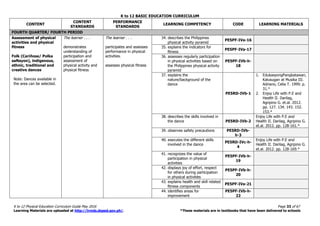
34. describes the Philippines
physical activity pyramid
PE4PF-IVa-16
35. explains the indicators for
fitness
PE4PF-IVa-17
36. assesses regularly
participation in physical
activities based on
Philippines physical
activity pyramid
PE4PF-IVb-h-18
37. explains the
nature/background of the
dance
PE4RD-IVb-1
K to 12 BASIC EDUCATION CURRICULUM
K to 12 Physical Education Curriculum Guide May 2016 Page 29 of 67
Learning Materials are uploaded at http://lrmds.deped.gov.ph/. *These materials are in textbooks that have been delivered to schools
CONTENT
CONTENT
STANDARDS
PERFORMANCE
STANDARDS
LEARNING COMPETENCY CODE LEARNING MATERIALS
Assessment of
physical activities and
physical fitness
Folk (Liki/Ba-Ingles),
indigenous, ethnic,
traditional and
creative dances
Note: Dances available
in the area can be
selected.
The learner . . .
demonstrates
understanding of
participation and
assessment of
physical activity and
physical fitness
The learner . . .
participates and
assesses performance
in physical activities.
assesses physical
fitness
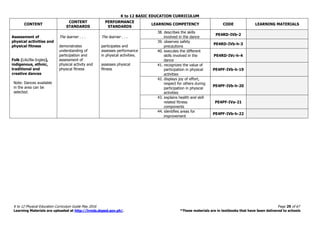
38. describes the skills
involved in the dance
PE4RD-IVb-2
39. observes safety
precautions
PE4RD-IVb-h-3
40. executes the different
skills involved in the
dance
PE4RD-IVc-h-4
41. recognizes the value of
participation in physical
activities
PE4PF-IVb-h-19
42. displays joy of effort,
respect for others during
participation in physical
activities
PE4PF-IVb-h-20
43. explains health and skill
related fitness
components
PE4PF-IVa-21
44. identifies areas for
improvement
PE4PF-IVb-h-22
K to 12 BASIC EDUCATION CURRICULUM
K to 12 Physical Education Curriculum Guide May 2016 Page 30 of 67
Learning Materials are uploaded at http://lrmds.deped.gov.ph/. *These materials are in textbooks that have been delivered to schools
GRADE 5
CONTENT
CONTENT
STANDARDS
PERFORMANCE
STANDARDS
LEARNING COMPETENCY CODE LEARNING MATERIALS
FIRST QUARTER /FIRST GRADING PERIOD
Assessment of physical
activity and physical
fitness
Target games
(Tumbangpreso,
tamaang-tao/batuhang
bola, tatsing),
striking/fielding games
(syato/,basagangpalayok,
kickball)
Note: Games are not
limited to the above listed
activities
The learner . . .
demonstrates
understanding of
participation and
assessment of
physical activity and
physical fitness
The learner . . .
participates and
assesses performance
in physical activities.
assesses physical
fitness
The learner . . .
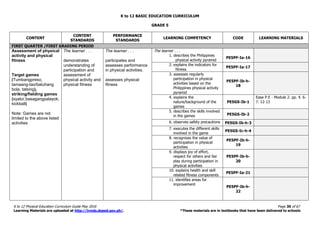
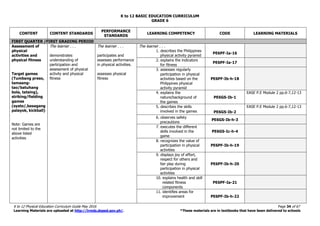
1. describes the Philippines
physical activity pyramid
PE5PF-Ia-16
2. explains the indicators for
fitness
PE5PF-Ia-17
3. assesses regularly
participation in physical
activities based on the
Philippines physical activity
pyramid
PE5PF-Ib-h-
18
4. explains the
nature/background of the
games
PE5GS-Ib-1
Ease P.E - Module 2. pp. 4. 6-
7. 12-13
5. describes the skills involved
in the games PE5GS-Ib-2
6. observes safety precautions PE5GS-Ib-h-3
7. executes the different skills
involved in the game
PE5GS-Ic-h-4
8. recognizes the value of
participation in physical
activities
PE5PF-Ib-h-
19
9. displays joy of effort,
respect for others and fair
play during participation in
physical activities
PE5PF-Ib-h-
20
10. explains health and skill
related fitness components
PE5PF-Ia-21
11. identifies areas for
improvement
PE5PF-Ib-h-
22
K to 12 BASIC EDUCATION CURRICULUM
K to 12 Physical Education Curriculum Guide May 2016 Page 31 of 67
Learning Materials are uploaded at http://lrmds.deped.gov.ph/. *These materials are in textbooks that have been delivered to schools
CONTENT
CONTENT
STANDARDS
PERFORMANCE
STANDARDS
LEARNING COMPETENCY CODE LEARNING MATERIALS
SECOND QUARTER / SECOND GRADING
Assessment of physical
activities and physical
fitness
Invasion games
(agawan base, lawin at
sisiw, agawanpanyo)
Note: Games are not
limited to the above listed
activities
The learner . . .
demonstrates
understanding of
participation in and
assessment of
physical activity and
physical fitness
The learner . . .
participates and assesses
performance in physical
activities.
assesses physical fitness
12. describes the Philippines
physical activity pyramid
PE5PF-IIa-16
13. explains the indicators for
fitness
PE5PF-IIa-17
14. assesses regularly
participation in physical
activities based on the
Philippines physical activity
pyramid
PE5PF-IIb-h-
18
15. explains the
nature/background of the
games
PE5GS-IIb-1
16. describes the skills
involved in the games
PE5GS-IIb-2
17. observes safety
precautions
PE5GS-IIb-h-
3
18. executes the different
skills involved in the game
PE5GS-IIc-h-
4
19. recognizes the value of
participation in physical
activities
PE5PF-IIb-h-
19
20. displays joy of effort,
respect for others and fair
play during participation in
physical activities
PE5PF-IIb-h-
20
21. explains health and skill
related fitness components
PE5PF-IIa-21
22. identifies areas for
improvement
PE5PF-IIb-h-
22
THIRD QUARTER/ THIRD PERIOD
Assessment of
physical activities and
physical fitness
The learner . . .
demonstrates
The learner . . .
participates and
23. describes the Philippines
physical activity pyramid
PE5PF-IIIa-
16
24. explains the indicators for
fitness
PE5PF-IIIa-
17
K to 12 BASIC EDUCATION CURRICULUM
K to 12 Physical Education Curriculum Guide May 2016 Page 32 of 67
Learning Materials are uploaded at http://lrmds.deped.gov.ph/. *These materials are in textbooks that have been delivered to schools
CONTENT
CONTENT
STANDARDS
PERFORMANCE
STANDARDS
LEARNING COMPETENCY CODE LEARNING MATERIALS
Folk (Cariñosa/ Polka
saNayon), indigenous,
ethnic, traditional and
creative dances
Note: Dances available
in the area can be
selected.
understanding of
participation and
assessment of
physical activity and
physical fitness
assesses performance
in physical activities.
assesses physical
fitness
25. assesses regularly
participation in physical
activities based on the
Philippines physical activity
pyramid
PE5PF-IIIb-
h-18
26. explains the
nature/background of the
dance
PE5RD-IIIb-1
1. Enjoy Life with P.E and
Health II. Darilag,
Agripino G. et.al. 2012.
pp. 127. 134. 143. 152.
153.*
2. EdukasyongPangkatawan,
Kalusugan at Musika III.
Adriano, Celia T. et.al.
1999. p. 31.*
27. describes the skills
involved in the dance PE5RD-IIIb-2
Enjoy Life with P.E and
Health II. Darilag, Agripino G.
et.al. 2012. pp. 128-161.*
28. observes safety
precautions
PE5RD-IIIb-
h-3
29. executes the different
skills involved in the dance
PE5RD-IIIc-
h-4
Enjoy Life with P.E and
Health II. Darilag, Agripino G.
et.al. 2012. pp. 128-161.*
30. recognizes the value of
participation in physical
activities
PE5PF-IIIb-
h-19
31. displays joy of effort,
respect for others during
participation in physical
activities
PE5PF-IIIb-
h-20
32. explains health and skill
related fitness components
PE5PF-IIIa-
21
33. identifies areas for
improvement
PE5PF-IIIb-
h-22
K to 12 BASIC EDUCATION CURRICULUM
K to 12 Physical Education Curriculum Guide May 2016 Page 33 of 67
Learning Materials are uploaded at http://lrmds.deped.gov.ph/. *These materials are in textbooks that have been delivered to schools
CONTENT
CONTENT
STANDARDS
PERFORMANCE
STANDARDS
LEARNING COMPETENCY CODE LEARNING MATERIALS
FOURTH QUARTER/ FOURTH PERIOD
Assessment of physical
activities and physical
fitness
Folk (Cariñosa/ Polka
saNayon), indigenous,
ethnic, traditional and
creative dances
Note: Dances available in
the area can be selected.
The learner . . .
demonstrates
understanding of
participation and
assessment of
physical activity and
physical fitness
The learner . . .
participates and assesses
performance in physical
activities.
assesses physical fitness
34. describes the Philippines
physical activity pyramid
PE5PF-IVa-16
35. explains the indicators for
fitness
PE5PF-IVa-17
36. assesses regularly participation
in physical activities based on
the Philippines physical activity
pyramid
PE5PF-IVb-h-
18
37. explains the
nature/background of the
dance
PE5RD-IVb-1
1. EdukasyongPangkatawan,
Kalusugan at Musika III.
Adriano, Celia T. 1999. p.
31.*
2. Enjoy Life with P.E and
Health II. Darilag,
Agripino G. et.al. 2012.
pp. 127. 134. 143. 152.
153.*
38. describes the skills involved in
the dance PE5RD-IVb-2
Enjoy Life with P.E and
Health II. Darilag, Agripino G.
et.al. 2012. pp. 128-161.*
39. observes safety precautions PE5RD-IVb-
h-3
40. executes the different skills
involved in the dance
PE5RD-IVc-h-
4
Enjoy Life with P.E and
Health II. Darilag, Agripino G.
et.al. 2012. pp. 128-169.*
41. recognizes the value of
participation in physical
activities
PE5PF-IVb-h-
19
42. displays joy of effort, respect
for others during participation
in physical activities
PE5PF-IVb-h-
20
43. explains health and skill related
fitness components
PE5PF-IVa-21
44. identifies areas for
improvement
PE5PF-IVb-h-
22
K to 12 BASIC EDUCATION CURRICULUM
K to 12 Physical Education Curriculum Guide May 2016 Page 34 of 67
Learning Materials are uploaded at http://lrmds.deped.gov.ph/. *These materials are in textbooks that have been delivered to schools
GRADE 6
CONTENT CONTENT STANDARDS
PERFORMANCE
STANDARDS
LEARNING COMPETENCY CODE LEARNING MATERIALS
FIRST QUARTER /FIRST GRADING PERIOD
Assessment of
physical
activities and
physical fitness
Target games
(Tumbang preso,
tamaang-
tao/batuhang
bola, tatsing),
striking/fielding
games
(syato/,basagang
palayok, kickball)
Note: Games are
not limited to the
above listed
activities
The learner . . .
demonstrates
understanding of
participation and
assessment of physical
activity and physical
fitness
The learner . . .
participates and
assesses performance
in physical activities.
assesses physical
fitness
The learner . . .
1. describes the Philippines
physical activity pyramid
PE6PF-Ia-16
2. explains the indicators
for fitness
PE6PF-Ia-17
3. assesses regularly
participation in physical
activities based on the
Philippines physical
activity pyramid
PE6PF-Ib-h-18
4. explains the
nature/background of
the games
PE6GS-Ib-1
EASE P.E Module 2 pp.6-7,12-13
5. describes the skills
involved in the games PE6GS-Ib-2
EASE P.E Module 2 pp.6-7,12-13
6. observes safety
precautions
PE6GS-Ib-h-3
7. executes the different
skills involved in the
game
PE6GS-Ic-h-4
8. recognizes the value of
participation in physical
activities
PE6PF-Ib-h-19
9. displays joy of effort,
respect for others and
fair play during
participation in physical
activities
PE6PF-Ib-h-20
10. explains health and skill
related fitness
components
PE6PF-Ia-21
11. identifies areas for
improvement PE6PF-Ib-h-22
K to 12 BASIC EDUCATION CURRICULUM
K to 12 Physical Education Curriculum Guide May 2016 Page 35 of 67
Learning Materials are uploaded at http://lrmds.deped.gov.ph/. *These materials are in textbooks that have been delivered to schools
CONTENT CONTENT STANDARDS
PERFORMANCE
STANDARDS
LEARNING COMPETENCY CODE LEARNING MATERIALS
SECOND QUARTER/ SECOND PERIOD
Assessment of
physical
activities and
physical fitness
Invasion games
(agawan base,
lawin at sisiw,
agawan panyo)
Note: Games are
not limited to the
above listed
activities
The learner . . .
demonstrates
understanding of
participation in and
assessment of physical
activities and physical
fitness
The learner . . .
participates and
assesses performance
in physical activities.
assesses physical
fitness
12. describes the
Philippines physical
activity pyramid
PE6PF-IIa-16
13. explains the indicators
for fitness
PE6PF-IIa-17
14. assesses regularly
participation in physical
activities based on the
Philippines physical
activity pyramid
PE6PF-IIb-h-18
15. explains the
nature/background of
the games
PE6GS-IIb-1
16. describes the skills
involved in the games
PE6GS-IIb-2
17. observes safety
precautions
PE6GS-IIb-h-3
18. executes the different
skills involved in the
game
PE6GS-IIc-h-4
19. recognizes the value of
participation in physical
activities
PE6PF-IIb-h-19
20. displays joy of effort,
respect for others and
fair play during
participation in physical
activities
PE6PF-IIb-h-20
21. explains health and skill
related fitness
components
PE6PF-IIa-21
22. identifies areas for
improvement
PE6PF-IIb-h-22
K to 12 BASIC EDUCATION CURRICULUM
K to 12 Physical Education Curriculum Guide May 2016 Page 36 of 67
Learning Materials are uploaded at http://lrmds.deped.gov.ph/. *These materials are in textbooks that have been delivered to schools
CONTENT CONTENT STANDARDS
PERFORMANCE
STANDARDS
LEARNING COMPETENCY CODE LEARNING MATERIALS
THIRD QUARTER/ THIRD PERIOD
Assessment of
physical
activities and
physical fitness
Folk (Itik-itik for
girls and
Maglalatik for
boys),
indigenous,
ethnic,
traditional and
creative dances
Note: Dances
available in the
area can be
selected.
The learner . . .
demonstrates
understanding of
participation and
assessment of physical
activity and physical
fitness
The learner . . .
participates and
assesses performance
in physical activities.
assesses physical
fitness
23. describes the
Philippines physical
activity pyramid
PE6PF-IIIa-16
24. explains the indicators
for fitness
PE6PF-IIIa-17
25. assesses regularly
participation in physical
activities based on the
Philippines physical
activity pyramid
PE6PF-IIIb-h-18
26. explains the
nature/background of
the dance
PE6RD-IIIb-1
27. describes the skills
involved in the dance
PE6RD-IIIb-2
28. observes safety
precautions
PE6RD-IIIb-h-3
29. executes the different
skills involved in the
dance
PE6RD-IIIc-h-4
30. recognizes the value of
participation in physical
activities
PE6PF-IIIb-h-19
31. displays joy of effort,
respect for others
during participation in
physical activities
PE6PF-IIIb-h-20
32. explains health and skill
related fitness
components
PE6PF-IIIa-21
33. identifies areas for
improvement
PE6PF-IIIb-h-22
K to 12 BASIC EDUCATION CURRICULUM
K to 12 Physical Education Curriculum Guide May 2016 Page 37 of 67
Learning Materials are uploaded at http://lrmds.deped.gov.ph/. *These materials are in textbooks that have been delivered to schools
CONTENT CONTENT STANDARDS
PERFORMANCE
STANDARDS
LEARNING COMPETENCY CODE LEARNING MATERIALS
FOURTH QUARTER/ FOURTH PERIOD
Assessment of
physical
activities and
physical fitness
Folk (Itik-itik for
girls and
Maglalatik for
boys),
indigenous,
ethnic,
traditional and
creative dances
Note: Dances
available in the
area can be
selected.
The learner . . .
demonstrates
understanding of
participation and
assessment of physical
activity and physical
fitness
The learner . . .
participates and
assesses performance
in physical activities.
assesses physical
fitness
34. describes the
Philippines physical
activity pyramid
PE6PF-IVa-16
35. explains the indicators
for fitness
PE6PF-IVa-17
36. assesses regularly
participation in physical
activities based on the
Philippines physical
activity pyramid
PE6PF-IVb-h-18
37. explains the
nature/background of
the dance
PE6RD-IVb-1
38. describes the skills
involved in the dance
PE6RD-IVb-2
39. observes safety
precautions
PE6RD-IVb-h-3
40. executes the different
skills involved in the
dance
PE6RD-IVc-h-4
41. recognizes the value of
participation in physical
activities
PE6PF-IVb-h-19
42. displays joy of effort,
respect for others
during participation in
physical activities
PE6PF-IVb-h-20
43. explains health and skill
related fitness
components
PE6PF-IVa-21
44. identifies areas for
improvement
PE6PF-IVb-h-22
K to 12 BASIC EDUCATION CURRICULUM
K to 12 Physical Education Curriculum Guide May 2016 Page 38 of 67
Learning Materials are uploaded at http://lrmds.deped.gov.ph/. *These materials are in textbooks that have been delivered to schools
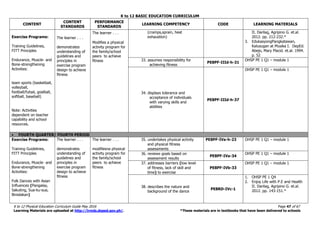
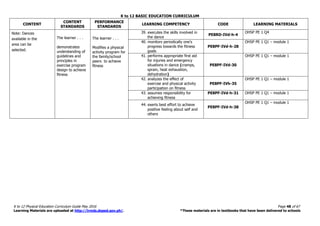
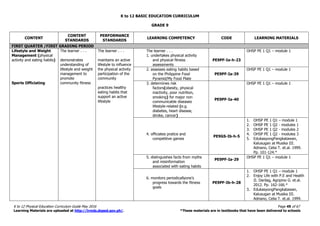
GRADE 7
CONTENT
CONTENT
STANDARDS
PERFORMANCE
STANDARDS
LEARNING COMPETENCY CODE LEARNING MATERIALS
FIRST QUARTER /FIRST GRADING PERIOD
Exercise Programs:
Training Guidelines, FITT
Principles
Endurance, Muscle- and Bone-
strengthening Activities:
a. individual sports
1. running
2. rhythmic sportive
gymnastics
3. swimming
b. dual sports
1. badminton
2. table tennis
3. tennis
c. combative sports
1. arnis(anyo)
2. taekwondo(poomsae)
3. karate(kata)
Note: Activities dependent on
teacher capability and school
resources.
The learner . . .
demonstrates
understanding of
guidelines and
principles in
exercise program
design to achieve
personal fitness
The learner . . .
designs an
individualized
exercise program
to achieve
personal fitness
The learner . . .
1. undertakes physical activity
and physical fitness
assessments
PE7PF-Ia-h-
23
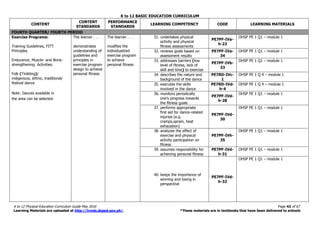
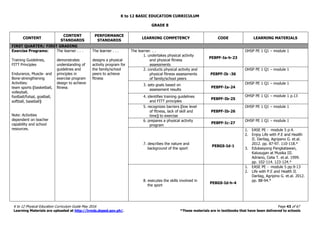
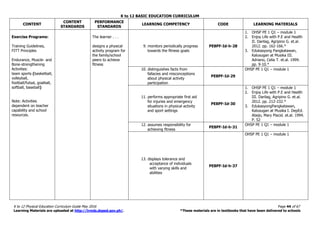
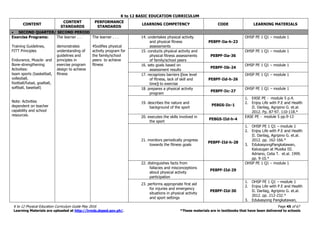
OHSP PE 1 Q1 – module 1
2. sets goals based on
assessment results
PE7PF-Ia-
24
OHSP PE 1 Q1 – module 1
3. identifies training
guidelines and FITT
principles
PE7PF-Ib-
25
OHSP PE 1 Q1 – module 1
4. recognizes barriers(low
level of fitness, lack of
skill and time) to exercise
PE7PF-Ib-
26
OHSP PE 1 Q1 – module 1
5. prepares an exercise
program
PE7PF-Ic-
27
OHSP PE 1 Q1 – module 1
6. describes the nature and
background of the sport
PE7GS-Id-5
1. OHSP PE 1 Q2 module1
2. OHSP PE 1 Q2 module2
3. OHSP PE 1 Q2 module3
4. OHSP PE 1 Q3 module 1
5. Enjoy Life with P.E and Health II.
Darilag, Agripino G. et.al 2012. P.
69.*
6. EdukasyongPangkatawan,Kalusugan
at Musika III. Adriano, Celia T.
et.al. 1999. Pp. 73-74.90.*
7. EdukasyongPangkatawan,
Kalusugan at Musika I. Abejo, Mary
Placid. Et.al. DepEd. 1994. Pp. 164.
173. 181-182.268
7. executes the skills
involved in the sport
PE7GS-Id-
h-4
1. OHSP PE 1 Q2 module1
2. OHSP PE 1 Q2 module2
3. OHSP PE 1 Q2 module3
4. OHSP PE 1 Q3 module 1
K to 12 BASIC EDUCATION CURRICULUM
K to 12 Physical Education Curriculum Guide May 2016 Page 39 of 67
Learning Materials are uploaded at http://lrmds.deped.gov.ph/. *These materials are in textbooks that have been delivered to schools
CONTENT
CONTENT
STANDARDS
PERFORMANCE
STANDARDS
LEARNING COMPETENCY CODE LEARNING MATERIALS
Exercise Programs:
Training Guidelines, FITT
Principles
Endurance, Muscle- and Bone-
strengthening Activities:
a. individual sports
1. running
2. rhythmic sportive
gymnastics
3. swimming
b. dual sports
1. badminton
2. table tennis
3. tennis
c. combative sports
1. arnis(anyo)
2. taekwondo(poomsae)
3. karate(kata)
Note: Activities dependent on
teacher capability and school
resources.
The learner . . .
demonstrates
understanding of
guidelines and
principles in
exercise program
design to achieve
personal fitness
The learner . . .
designs an
individualized
exercise program
to achieve
personal fitness
5. Enjoy Life with P.E and Health II.
Darilag, Agripino G. et.al. 2012. pp.
72-73.*
6. EdukasyongPangkatawan,
Kalusugan at Musika I. Abejo, Mary
Placid. et.al. DepEd. 1994. Pp. 166-
170. 175-178. 183-185. 269-285.
8. monitors periodically
one’s progress towards
the fitness goals
PE7PF-Id-h-
28
OHSP PE 1 Q1 – module 1
9. distinguishes from
fallacies and
misconceptions about the
physical activity
participation
PE7PF-Id-
29
OHSP PE 1 Q1 – module 1
10. performs appropriate
first aid for sports-related
injuries (e.g.
cramps,sprain, heat
exhaustion)
PE7PF-Id-
30
OHSP PE 1 Q1 – module 1
11. assumes responsibility
for achieving personal
fitness
PE7PF-Id-h-
31
OHSP PE 1 Q1 – module 1
12. keeps the importance of
winning and losing in
perspective
PE7PF-Id-h-
32
OHSP PE 1 Q1 – module 1
 SECOND QUARTER/ SECOND PERIOD
Exercise Programs:
Training Guidelines, FITT
Principles
Endurance, Muscle- and Bone-
The learner . . .
demonstrates
understanding of
guidelines and
principles in
The learner . . .
modifies the
individualized
exercise program
to achieve
13. undertakes physical
activity and physical
fitness assessments
PE7PF-IIa-
h-23
OHSP PE 1 Q1 – module 1
14. reviews goals based on
assessment results
PE7PF-IIa-
24
OHSP PE 1 Q1 – module 1
K to 12 BASIC EDUCATION CURRICULUM
K to 12 Physical Education Curriculum Guide May 2016 Page 40 of 67
Learning Materials are uploaded at http://lrmds.deped.gov.ph/. *These materials are in textbooks that have been delivered to schools
CONTENT
CONTENT
STANDARDS
PERFORMANCE
STANDARDS
LEARNING COMPETENCY CODE LEARNING MATERIALS
strengthening Activities:
a. individual sports
1. running
2. rhythmic sportive
gymnastics
3. swimming
b. dual sports
1. badminton
2. table tennis
3. tennis
c. combative sports
1. arnis(anyo)
2. taekwondo(poomsae)
3. karate(kata)
Note: Activities dependent on
teacher capability and school
resources.
exercise program
design to achieve
personal fitness
personal fitness 15. addresses barriers (low
level of fitness, lack of
skill and time) to exercise
PE7PF-IIb-
33
OHSP PE 1 Q1 – module 1
16. describes the nature and
background of the sport
PE7GS-IId-
5
1. OHSP PE 1 Q2 module1
2. OHSP PE 1 Q2 module2
3. OHSP PE 1 Q2 module3
4. OHSP PE 1 Q3 module1
5. Enjoy Life with P.E and Health II.
Darilag, Agripino G. et.al. 2012. P.
69.*
6. Edukasyong Pangkatawan,
Kalusugan at Musika III. Adriano,
Celia T. et.al. 1999. Pp. 73-74. 90.*
7. Edukasyong Pangkatawan,
Kalusugan at Musika I. Abejo, Mary
Placid. et.al.DepEd. 1994. Pp. 164.
173. 181-182. 268
17. executes the skills
involved in the sport
PE7GS-IId-
h-4
1. OHSP PE 1 Q2 module1
2. OHSP PE 1 Q2 module2
3. OHSP PE 1 Q2 module3
4. OHSP PE 1 Q3 module1
5. Enjoy Life with P.E and Health II.
Darilag, Agripino G. et.al. 2012. pp.
72-73.*
6. Edukasyong Pangkatwan,
Kalusugan at Musika I. Abejo, Mary
Placid. et.al. DepEd. 1994. Pp. 166-
170. 175-178. 183-185. 269-285
18. monitors periodically
one’s progress towards
the fitness goals
PE7PF-IId-
h-28
OHSP PE 1 Q1 – module 1
19. performs appropriate
first aid for sports-related
injuries
(e.g.cramps,sprain, heat
PE7PF-IId-
30
OHSP PE 1 Q1 – module 1
K to 12 BASIC EDUCATION CURRICULUM
K to 12 Physical Education Curriculum Guide May 2016 Page 41 of 67
Learning Materials are uploaded at http://lrmds.deped.gov.ph/. *These materials are in textbooks that have been delivered to schools
CONTENT
CONTENT
STANDARDS
PERFORMANCE
STANDARDS
LEARNING COMPETENCY CODE LEARNING MATERIALS
exhaustion)
20. assumes responsibility for
achieving personal fitness
PE7PF-IId-
h-31
OHSP PE 1 Q1 – module 1
21. keeps the importance of
winning and losing in
perspective
PE7PF-IId-
h-32
OHSP PE 1 Q1 – module 1
THIRD QUARTER/ THIRD PERIOD
Exercise Programs:
Training Guidelines, FITT
Principles
Endurance, Muscle- and Bone-
strengthening Activities:
Folk (Tinikling)/
indigenous, ethnic, traditional/
festival dance
Note: Dances available in
the area can be selected.
The learner . . .
demonstrates
understanding of
guidelines and
principles in
exercise program
design to achieve
personal fitness
The learner . . .
demonstrates
understanding of
guidelines and
principles in
exercise program
design to achieve
personal fitness
22. undertakes physical
activity and physical
fitness assessments
PE7PF-IIIa-
h-23
OHSP PE 1 Q1 – module 1
23. reviews goals based on
assessment results
PE7PF-IIIa-
34
OHSP PE 1 Q1 – module 1
24. addresses barriers (low
level of fitness, lack of
skill and time) to exercise
PE7PF-IIIb-
33
OHSP PE 1 Q1 – module 1
25. describes the nature and
background of the dance
PE7RD-
IIId-1
OHSP PE 1 Q 4 – module 1
26. executes the skills
involved in the dance
PE7RD-
IIId-h-4
OHSP PE 1 Q 4 – module 1
27. monitors periodically
one’s progress towards
the fitness goals
PE7PF-IIId-
h-28
OHSP PE 1 Q1 – module 1
28. performs appropriate
first aid for dance-related
injuries (e.g.
cramps,sprain, heat
exhaustion)
PE7PF-IIId-
30
OHSP PE 1 Q1 – module 1
29. assumes responsibility for
achieving personal fitness
PE7PF-IIId-
h-31
OHSP PE 1 Q1 – module 1
30. keeps the importance of
winning and losing in
perspective
PE7PF-IIId-
h-32
OHSP PE 1 Q1 – module 1
K to 12 BASIC EDUCATION CURRICULUM
K to 12 Physical Education Curriculum Guide May 2016 Page 42 of 67
Learning Materials are uploaded at http://lrmds.deped.gov.ph/. *These materials are in textbooks that have been delivered to schools
CONTENT
CONTENT
STANDARDS
PERFORMANCE
STANDARDS
LEARNING COMPETENCY CODE LEARNING MATERIALS
FOURTH QUARTER/ FOURTH PERIOD
Exercise Programs:
Training Guidelines, FITT
Principles
Endurance, Muscle- and Bone-
strengthening Activities:
Folk (Tinikling)/
indigenous, ethnic, traditional/
festival dance
Note: Dances available in
the area can be selected.
The learner . . .
demonstrates
understanding of
guidelines and
principles in
exercise program
design to achieve
personal fitness
The learner . . .
modifies the
individualized
exercise program
to achieve
personal fitness
31. undertakes physical
activity and physical
fitness assessments
PE7PF-IVa-
h-23
OHSP PE 1 Q1 – module 1
32. reviews goals based on
assessment results
PE7PF-IVa-
34
OHSP PE 1 Q1 – module 1
33. addresses barriers (low
level of fitness, lack of
skill and time) to exercise
PE7PF-IVb-
33
OHSP PE 1 Q1 – module 1
34. describes the nature and
background of the dance
PE7RD-IVc-
1
OHSP PE 1 Q 4 – module 1
35. executes the skills
involved in the dance
PE7RD-IVd-
h-4
OHSP PE 1 Q 4 – module 1
36. monitors periodically
one’s progress towards
the fitness goals
PE7PF-IVd-
h-28
OHSP PE 1 Q1 – module 1
37. performs appropriate
first aid for dance-related
injuries (e.g.
cramps,sprain, heat
exhaustion)
PE7PF-IVd-
30
OHSP PE 1 Q1 – module 1
38. analyzes the effect of
exercise and physical
activity participation on
fitness
PE7PF-IVh-
35
OHSP PE 1 Q1 – module 1
39. assumes responsibility for
achieving personal fitness
PE7PF-IVd-
h-31
OHSP PE 1 Q1 – module 1
40. keeps the importance of
winning and losing in
perspective
PE7PF-IVd-
h-32
OHSP PE 1 Q1 – module 1
K to 12 BASIC EDUCATION CURRICULUM
K to 12 Physical Education Curriculum Guide May 2016 Page 43 of 67
Learning Materials are uploaded at http://lrmds.deped.gov.ph/. *These materials are in textbooks that have been delivered to schools
GRADE 8
CONTENT
CONTENT
STANDARDS
PERFORMANCE
STANDARDS
LEARNING COMPETENCY CODE LEARNING MATERIALS
FIRST QUARTER/ FIRST GRADING
Exercise Programs:
Training Guidelines,
FITT Principles
Endurance, Muscle- and
Bone-strengthening
Activities:
team sports (basketball,
volleyball,
football/futsal, goalball,
softball, baseball)
Note: Activities
dependent on teacher
capability and school
resources.
The learner . . .
demonstrates
understanding of
guidelines and
principles in
exercise program
design to achieve
fitness
The learner . . .
designs a physical
activity program for
the family/school
peers to achieve
fitness
The learner. . .
1. undertakes physical activity
and physical fitness
assessments
PE8PF-Ia-h-23
OHSP PE 1 Q1 – module 1
2. conducts physical activity and
physical fitness assessments
of family/school peers
PE8PF-Ib -36
OHSP PE 1 Q1 – module 1
3. sets goals based on
assessment results
PE8PF-Ia-24
OHSP PE 1 Q1 – module 1
4. identifies training guidelines
and FITT principles
PE8PF-Ib-25
OHSP PE 1 Q1 – module 1 p.13
5. recognizes barriers (low level
of fitness, lack of skill and
time) to exercise
PE8PF-Ib-26
OHSP PE 1 Q1 – module 1
6. prepares a physical activity
program
PE8PF-Ic-27
OHSP PE 1 Q1 – module 1
7. describes the nature and
background of the sport
PE8GS-Id-1
1. EASE PE - module 5 p.4.
2. Enjoy Life with P.E and Health
II. Darilag, Agripano G. et.al.
2012. pp. 87-97. 110-118.*
3. Edukasyong Pangkatawan,
Kalusugan at Musika III.
Adriano, Celia T. et.al. 1999.
pp. 102-114. 123-124.*
8. executes the skills involved in
the sport
PE8GS-Id-h-4
1. EASE PE - module 5 pp.9-13
2. Life with P.E and Health II.
Darilag, Agripino G. et.al. 2012.
pp. 88-94.*
K to 12 BASIC EDUCATION CURRICULUM
K to 12 Physical Education Curriculum Guide May 2016 Page 44 of 67
Learning Materials are uploaded at http://lrmds.deped.gov.ph/. *These materials are in textbooks that have been delivered to schools
CONTENT
CONTENT
STANDARDS
PERFORMANCE
STANDARDS
LEARNING COMPETENCY CODE LEARNING MATERIALS
Exercise Programs:
Training Guidelines,
FITT Principles
Endurance, Muscle- and
Bone-strengthening
Activities:
team sports (basketball,
volleyball,
football/futsal, goalball,
softball, baseball)
Note: Activities
dependent on teacher
capability and school
resources.
The learner . . .
designs a physical
activity program for
the family/school
peers to achieve
fitness
9. monitors periodically progress
towards the fitness goals
PE8PF-Id-h-28
1. OHSP PE 1 Q1 – module 1
2. Enjoy Life with P.E and Health
II. Darilag, Agripino G. et.al.
2012. pp. 162-166.*
3. Edukasyong Pangkatawan,
Kalusugan at Musika III.
Adriano, Celia T. et.al. 1999.
pp. 9-10.*
10. distinguishes facts from
fallacies and misconceptions
about physical activity
participation
PE8PF-Id-29
OHSP PE 1 Q1 – module 1
11. performs appropriate first aid
for injuries and emergency
situations in physical activity
and sport settings
PE8PF-Id-30
1. OHSP PE 1 Q1 – module 1
2. Enjoy Life with P.E and Health
III. Darilag, Agripino G. et.al.
2012. pp. 212-232.*
3. EdukasyongPangkatawan,
Kalusugan at Musika I. DepEd.
Abejo, Mary Placid. et.al. 1994.
P. 52
12. assumes responsibility for
achieving fitness
PE8PF-Id-h-31
OHSP PE 1 Q1 – module 1
13. displays tolerance and
acceptance of individuals
with varying skills and
abilities
PE8PF-Id-h-37
OHSP PE 1 Q1 – module 1
K to 12 BASIC EDUCATION CURRICULUM
K to 12 Physical Education Curriculum Guide May 2016 Page 45 of 67
Learning Materials are uploaded at http://lrmds.deped.gov.ph/. *These materials are in textbooks that have been delivered to schools
CONTENT
CONTENT
STANDARDS
PERFORMANCE
STANDARDS
LEARNING COMPETENCY CODE LEARNING MATERIALS
 SECOND QUARTER/ SECOND PERIOD
Exercise Programs:
Training Guidelines,
FITT Principles
Endurance, Muscle- and
Bone-strengthening
Activities:
team sports (basketball,
volleyball,
football/futsal, goalball,
softball, baseball)
Note: Activities
dependent on teacher
capability and school
resources.
The learner . . .
demonstrates
understanding of
guidelines and
principles in
exercise program
design to achieve
fitness
The learner . . .
45odifies physical
activity program for
the family/school
peers to achieve
fitness
14. undertakes physical activity
and physical fitness
assessments
PE8PF-Iia-h-23
OHSP PE 1 Q1 – module 1
15. conducts physical activity and
physical fitness assessments
of family/school peers
PE8PF-Iia-36
OHSP PE 1 Q1 – module 1
16. sets goals based on
assessment results
PE8PF-Iib-24
OHSP PE 1 Q1 – module 1
17. recognizes barriers (low level
of fitness, lack of skill and
time) to exercise
PE8PF-Iid-h-26
OHSP PE 1 Q1 – module 1
18. prepares a physical activity
program
PE8PF-Iic-27
OHSP PE 1 Q1 – module 1
19. describes the nature and
background of the sport
PE8GS-Iic-1
1. EASE PE - module 5 p.4.
2. Enjoy Life with P.E and Health
II. Darilag, Agripino G. et.al.
2012. Pp. 87-97. 110-118.*
20. executes the skills involved in
the sport
PE8GS-IId-h-4
EASE PE - module 5 pp.9-13
21. monitors periodically progress
towards the fitness goals
PE8PF-IId-h-28
1. OHSP PE 1 Q1 – module 1
2. Enjoy Life with P.E and Health
II. Darilag, Agripino G. et.al.
2012. pp. 162-166.*
3. EdukasyongPangkatawan,
Kalusugan at Musika III.
Adriano, Celia T. et.al. 1999.
pp. 9-10.*
22. distinguishes facts from
fallacies and misconceptions
about physical activity
participation
PE8PF-IId-29
OHSP PE 1 Q1 – module 1
23. performs appropriate first aid
for injuries and emergency
situations in physical activity
and sport settings
PE8PF-IId-30
1. OHSP PE 1 Q1 – module 1
2. Enjoy Life with P.E and Health
II. Darilag, Agripino G. et.al.
2012. pp. 212-232.*
3. Edukasyong Pangkatawan,
K to 12 BASIC EDUCATION CURRICULUM
K to 12 Physical Education Curriculum Guide May 2016 Page 46 of 67
Learning Materials are uploaded at http://lrmds.deped.gov.ph/. *These materials are in textbooks that have been delivered to schools
CONTENT
CONTENT
STANDARDS
PERFORMANCE
STANDARDS
LEARNING COMPETENCY CODE LEARNING MATERIALS
Kalusugan at Musika I. DepEd.
Abejo, Mary Placid. 1994. p. 52
24. assumes responsibility for
achieving fitness
PE8PF-IId-h-31
OHSP PE 1 Q1 – module 1
25. displays tolerance and
acceptance of individuals
with varying skills and
abilities
PE8PF-IId-h-37
OHSP PE 1 Q1 – module 1
 THIRD QUARTER/ THIRD PERIOD
Exercise Programs:
Training Guidelines,
FITT Principles
Endurance, Muscle- and
Bone-strengthening
Activities:
team sports (basketball,
volleyball,
football/futsal, goalball,
softball, baseball)
Note: Activities
dependent on teacher
capability and school
resources.
The learner . . .
demonstrates
understanding of
guidelines and
principles in
exercise program
design to achieve
fitness
The learner . . .
Modifies a physical
activity program for
the family/school
peers to achieve
fitness
26. undertakes physical activity
and physical fitness
assessments
PE8PF-IIIa-h-23
OHSP PE 1 Q1 – module 1
27. reviews goals based on
assessment results
PE8PF-IIIa-34
OHSP PE 1 Q1 – module 1
28. addresses barriers (low level
of fitness, lack of skill and
time) to exercise
PE8PF-IIIb-33
OHSP PE 1 Q1 – module 1
29. describes the nature and
background of the sport
PE8GS-IIIc-1
1. EASE PE - module 5
2. Enjoy Life with P.E and Health
II. Darilag, Agripino G. et.al.
2012. pp. 87-97. 110-118.*
3. EdukasyongPangkatawan,
Kalusugan at Musika III.
Adriano, Celia T. et.al. 1999.
pp. 102-114. 123-124.*
30. executes the skills involved in
the sport
PE8GS-IIId-h-4
EASE PE - module 5
31. monitors periodically one’s
progress towards the fitness
goals
PE8PF-IIId-h-28
1. OHSP PE 1 Q1 – module 1
2. Enjoy life with P.E and Health
II. Darilag, Agripino G. et.al.
2012. pp. 162-166.*
3. Edukasyong Pangkatawan,
kalusugan at Musika III.
Adriano, Celia T. et.al. 1999.
pp. 9-10.*
32. performs appropriate first aid
for sport-related injuries
PE8PF-IIId-30
1. OHSP PE 1 Q1 – module 1
2. Enjoy Life with P.E and Health
K to 12 BASIC EDUCATION CURRICULUM
K to 12 Physical Education Curriculum Guide May 2016 Page 47 of 67
Learning Materials are uploaded at http://lrmds.deped.gov.ph/. *These materials are in textbooks that have been delivered to schools
CONTENT
CONTENT
STANDARDS
PERFORMANCE
STANDARDS
LEARNING COMPETENCY CODE LEARNING MATERIALS
Exercise Programs:
Training Guidelines,
FITT Principles
Endurance, Muscle- and
Bone-strengthening
Activities:
team sports (basketball,
volleyball,
football/futsal, goalball,
softball, baseball)
Note: Activities
dependent on teacher
capability and school
resources.
The learner . . .
demonstrates
understanding of
guidelines and
principles in
exercise program
design to achieve
fitness
The learner . . .
Modifies a physical
activity program for
the family/school
peers to achieve
fitness
(cramps,sprain, heat
exhaustion)
II. Darilag, Agripino G. et.al.
2012. pp. 212-232.*
3. EdukasyongPangkatawan,
Kalusugan at Musika I. DepEd.
Abejo, Mary Placid. et.al. 1994.
p. 52
33. assumes responsibility for
achieving fitness
PE8PF-IIId-h-31
OHSP PE 1 Q1 – module 1
34. displays tolerance and
acceptance of individuals
with varying skills and
abilities
PE8PF-IIId-h-37
OHSP PE 1 Q1 – module 1
 FOURTH QUARTER/ FOURTH PERIOD
Exercise Programs:
Training Guidelines,
FITT Principles
Endurance, Muscle- and
Bone-strengthening
Activities:
Folk Dances with Asian
Influences (Pangalay,
Sakuting, Sua-ku-sua,
Binislakan)
The learner . . .
demonstrates
understanding of
guidelines and
principles in
exercise program
design to achieve
fitness
The learner . . .
modifiesna physical
activity program for
the family/school
peers to achieve
fitness
35. undertakes physical activity
and physical fitness
assessments
PE8PF-IVa-h-23 OHSP PE 1 Q1 – module 1
36. reviews goals based on
assessment results
PE8PF-IVa-34
OHSP PE 1 Q1 – module 1
37. addresses barriers (low level
of fitness, lack of skill and
time) to exercise
PE8PF-IVb-33
OHSP PE 1 Q1 – module 1
38. describes the nature and
background of the dance
PE8RD-IVc-1
1. OHSP PE 1 Q4
2. Enjoy Life with P.E and Health
II. Darilag, Agripino G. et.al.
2012. pp. 143-151.*
K to 12 BASIC EDUCATION CURRICULUM
K to 12 Physical Education Curriculum Guide May 2016 Page 48 of 67
Learning Materials are uploaded at http://lrmds.deped.gov.ph/. *These materials are in textbooks that have been delivered to schools
CONTENT
CONTENT
STANDARDS
PERFORMANCE
STANDARDS
LEARNING COMPETENCY CODE LEARNING MATERIALS
Note: Dances
available in the
area can be
selected.
The learner . . .
demonstrates
understanding of
guidelines and
principles in
exercise program
design to achieve
fitness
The learner . . .
Modifies a physical
activity program for
the family/school
peers to achieve
fitness
39. executes the skills involved in
the dance
PE8RD-IVd-h-4
OHSP PE 1 Q4
40. monitors periodically one’s
progress towards the fitness
goals
PE8PF-IVd-h-28
OHSP PE 1 Q1 – module 1
41. performs appropriate first aid
for injuries and emergency
situations in dance (cramps,
sprain, heat exhaustion,
dehydration)
PE8PF-IVd-30
OHSP PE 1 Q1 – module 1
42. analyzes the effect of
exercise and physical activity
participation on fitness
PE8PF-IVh-35
OHSP PE 1 Q1 – module 1
43. assumes responsibility for
achieving fitness
PE8PF-IVd-h-31 OHSP PE 1 Q1 – module 1
44. exerts best effort to achieve
positive feeling about self and
others
PE8PF-IVd-h-38
OHSP PE 1 Q1 – module 1
K to 12 BASIC EDUCATION CURRICULUM
K to 12 Physical Education Curriculum Guide May 2016 Page 49 of 67
Learning Materials are uploaded at http://lrmds.deped.gov.ph/. *These materials are in textbooks that have been delivered to schools
GRADE 9
CONTENT
CONTENT
STANDARDS
PERFORMANCE
STANDARDS
LEARNING COMPETENCY CODE LEARNING MATERIALS
FIRST QUARTER /FIRST GRADING PERIOD
Lifestyle and Weight
Management (physical
activity and eating habits)
Sports Officiating
The learner . . .
demonstrates
understanding of
lifestyle and weight
management to
promote
community fitness
The learner . . .
maintains an active
lifestyle to influence
the physical activity
participation of the
community
practices healthy
eating habits that
support an active
lifestyle
The learner . . .
1. undertakes physical activity
and physical fitness
assessments
PE9PF-Ia-h-23
OHSP PE 1 Q1 – module 1
2. assesses eating habits based
on the Philippine Food
Pyramid/My Food Plate
PE9PF-Ia-39
OHSP PE 1 Q1 – module 1
3. determines risk
factors(obesity, physical
inactivity, poor nutrition,
smoking) for major non
communicable diseases
lifestyle-related (e.g.
diabetes, heart disease,
stroke, cancer)
PE9PF-Ia-40
OHSP PE 1 Q1 – module 1
4. officiates pratice and
competitive games
PE9GS-Ib-h-5
1. OHSP PE 1 Q1 – module 1
2. OHSP PE 1 Q2 - modules 1
3. OHSP PE 1 Q2 - modules 2
4. OHSP PE 1 Q2 - modules 3
5. EdukasyongPangkatawan,
Kalusugan at Musika III.
Adriano, Celia T. et.al. 1999.
Pp. 101-124.*
5. distinguishes facts from myths
and misinformation
associated with eating habits
PE9PF-Ia-29
OHSP PE 1 Q1 – module 1
6. monitors periodicallyone’s
progress towards the fitness
goals
PE9PF-Ib-h-28
1. OHSP PE 1 Q1 – module 1
2. Enjoy Life with P.E and Health
II. Darilag, Agripino G. et.al.
2012. Pp. 162-166.*
3. EdukasyongPangkatawan,
Kalusugan at Musika III.
Adriano, Celia T. et.al. 1999.
K to 12 BASIC EDUCATION CURRICULUM
K to 12 Physical Education Curriculum Guide May 2016 Page 50 of 67
Learning Materials are uploaded at http://lrmds.deped.gov.ph/. *These materials are in textbooks that have been delivered to schools
CONTENT
CONTENT
STANDARDS
PERFORMANCE
STANDARDS
LEARNING COMPETENCY CODE LEARNING MATERIALS
Lifestyle and Weight
Management (physical
activity and eating habits)
Sports Officiating
The learner . . .
demonstrates
understanding of
lifestyle and weight
management to
promote
community fitness
The learner . . .
maintains an active
lifestyle to influence
the physical activity
participation of the
community
practices healthy
eating habits that
support an active
lifestyle
Pp. 9-10.*
7. performs appropriate first aid
for injuries and emergency
situations in physical activity
and sports settings (e.g.
cramps,sprain, heat
exhaustion)
PE9PF-Ib-30
1. OHSP PE 1 Q1 – module 1
2. Enjoy Life with P.E and Health.
Darilag, Agripino G. et.al.
2012. Pp. 212-232.*
3. EdukasyongPangkatawan,
Kalusugan at Musika I. Abejo,
Mary Placid. et.al. DepEd.
1994. P. 52
8. involves oneself in community
service through sports
officiating and physical activity
programs
PE9PF-Ie-h-41
OHSP PE 1 Q1 – module 1
9. recognizes the needs of others in
real life and in meaningful ways
PE9PF-Ie-h-42 OHSP PE 1 Q1 – module 1
SECOND QUARTER/ SECOND PERIOD
Social (community
dance, mixers, festival)
and Ballroom dances
(Cha-cha, rock and roll)
The learner . . .
demonstrates
understanding of
lifestyle and weight
management to
promote
community fitness
The learner . . .
maintains an active
lifestyle to influence
the physical activity
participation of the
community
practices healthy
eating habits that
support an active
lifestyle
10. undertakes physical activity
and physical fitness
assessments
PE9PF-IIa-h-23
OHSP PE 1 Q1 – module 1
11. assesses eating habits based
on the Philippine Food
Pyramid/MyFoodPlate
PE9PF-IIa-39
OHSP PE 1 Q1 – module 1
12. determines risk factors
related to lifestyle diseases
(obesity, diabetes, heart
disease)
PE9PF-IIa-40
OHSP PE 1 Q1 – module 1
13. distinguishes facts from
myths and misinformation
associated with eating habits
PE9PF-IIb-29
OHSP PE 1 Q1 – module 1
14. describes the nature and
background of the dance
PE9RD-IIb-1
1. OHSP PE 1 Q4 – module 1
2. EdukasyongPangkatawan,
Kalusugan at Musika IV.
Buenviaje, Paz. et.al. DepEd.
1992. Pp. 49. 52. 54. 56. 63.
64. 68. 71. 73.
K to 12 BASIC EDUCATION CURRICULUM
K to 12 Physical Education Curriculum Guide May 2016 Page 51 of 67
Learning Materials are uploaded at http://lrmds.deped.gov.ph/. *These materials are in textbooks that have been delivered to schools
CONTENT
CONTENT
STANDARDS
PERFORMANCE
STANDARDS
LEARNING COMPETENCY CODE LEARNING MATERIALS
Social (community
dance, mixers, festival)
and Ballroom dances
(Cha-cha, rock and roll)
The learner . . .
demonstrates
understanding of
lifestyle and weight
management to
promote
community fitness
The learner . . .
maintains an active
lifestyle to influence
the physical activity
participation of the
community
practices healthy
eating habits that
support an active
lifestyle
3. Edukasongpangkatawan,
Kalusugan at Musika IV.
Sacdalan, Guinevere. et.al.
1999. pp. 37. 42. 44. 49. 51.
55.*
15. executes the skills involved in
the dance
PE9RD-IIb-h-4
OHSP PE 1 Q4 – module 1
16. monitors periodically one’s
progress towards the fitness
goals
PE9PF-IIb-h-28
OHSP PE 1 Q1 – module 1
17. performs appropriate first aid
for injuries and emergency
situations in physical activity
and dance settings
(cramps,sprain, heat
exhaustion)
PE9PF-IIb-h-30
OHSP PE 1 Q1 – module 1
18. involves oneself in community
service through dance activities
in the community
PE9PF-IIg-h-41
OHSP PE 1 Q1 – module 1
19. recognizes the needs of others
in real life and in meaningful
ways
PE9PF-IIa-h-42
OHSP PE 1 Q1 – module 1
THIRD QUARTER/ THIRD PERIOD
Social (community
dance, mixers, festival)
and Ballroom dances
(Cha-cha, rock and roll)
The learner . . .
demonstrates
understanding of
lifestyle and weight
management to
promote
community fitness
The learner . . .
maintains an active
lifestyle to influence
the physical activity
participation of the
community
practices healthy
eating habits that
20. undertakes physical activity
and physical fitness
assessments
PE9PF-IIIa-h-
23
OHSP PE 1 Q1 – module 1
21. assesses eating habits based
on the Philippine Food
Pyramid/MyFoodPlate
PE9PF-IIIa-39
OHSP PE 1 Q1 – module 1
22. determines risk factors
related to lifestyle diseases
(obesity, diabetes, heart
disease)
PE9PF-IIIa-40
OHSP PE 1 Q1 – module 1
K to 12 BASIC EDUCATION CURRICULUM
K to 12 Physical Education Curriculum Guide May 2016 Page 52 of 67
Learning Materials are uploaded at http://lrmds.deped.gov.ph/. *These materials are in textbooks that have been delivered to schools
CONTENT
CONTENT
STANDARDS
PERFORMANCE
STANDARDS
LEARNING COMPETENCY CODE LEARNING MATERIALS
Social (community
dance, mixers, festival)
and Ballroom dances
(Cha-cha, rock and roll)
The learner . . .
demonstrates
understanding of
lifestyle and weight
management to
promote
community fitness
support an active
lifestyle
The learner . . .
maintains an active
lifestyle to influence
the physical activity
participation of the
community
practices healthy
eating habits that
support an active
lifestyle
23. distinguishes facts from
myths and misinformation
associated with eating habits
PE9PF-IIIb-29
OHSP PE 1 Q1 – module 1
24. describes the nature and
background of the dance
PE9RD-IIIb-1
1. OHSP PE 1 Q4 – module 1
2. EdukasyongPangkatawan,
Kalusugan at Musika IV.
Buenviaje, Paz. et.al. DepEd.
1992. Pp. 49. 52. 54. 56.. 63.
64. 68. 71. 73.
3. EdukasyongPangkatawan,
Kalusugan at Musika IV.
Sacdalan, Guinevere I. et.al.
1999. Pp. 37. 42. 44. 49. 51.
55.*
25. executes the skills involved in
the dance
PE9RD-IIIb-h-4
OHSP PE 1 Q4 – module 1
26. monitors periodically one’s
progress towards the fitness
goals
PE9PF-IIIb-h-
28
OHSP PE 1 Q1 – module 1
27. performs appropriate first aid
for injuries and emergency
situations in physical activity
and dance settings
(cramps,sprain, heat
exhaustion)
PE9PF-IIIb-h-
30
OHSP PE 1 Q1 – module 1
28. involves oneself in community
service through dance activities
in the community
PE9PF-IIIg-h-
41
OHSP PE 1 Q1 – module 1
K to 12 BASIC EDUCATION CURRICULUM
K to 12 Physical Education Curriculum Guide May 2016 Page 53 of 67
Learning Materials are uploaded at http://lrmds.deped.gov.ph/. *These materials are in textbooks that have been delivered to schools
CONTENT
CONTENT
STANDARDS
PERFORMANCE
STANDARDS
LEARNING COMPETENCY CODE LEARNING MATERIALS
29. recognizes the needs of others
in real life and in meaningful
ways
PE9PF-IIIa-h-
42
OHSP PE 1 Q1 – module 1
FOURTH QUARTER/ FOURTH PERIOD
Active Recreation
a. Indoor
1.individual and
dual sports
2. team sports
3. dances
b. Out door
1.Hiking
2.Camping
3.Orienteering
4.Biking
Note: Activities not
limited to the above list
The learner . . .
demonstrates
understanding of
lifestyle and weight
management to
promote
community fitness
The learner . . .
maintains an active
lifestyle to influence
the physical activity
participation of the
community
practices healthy
eating habits that
support an active
lifestyle
30. discusses the nature and
background of indoor and
outdoor recreational activities
PE9GS-IVa-6
1. EASE PE - module 2
2. EASE PE - module 5
3. OHSP PE 1 Q1 – module 1
4. OHSP PE 1 Q2 – module 1
5. OHSP PE 1 Q2 – module 2
6. OHSP PE 1 Q2 – module 3
31. participates in active
recreation
PE9GS-IVb-h-7
1. EASE PE - module 2
2. EASE PE - module 5
3. OHSP PE 1 Q1 – module 1
4. OHSP PE 1 Q2 – module 1
5. OHSP PE 1 Q2 – module 2
6. OHSP PE 1 Q2 – module 3
7. OHSP PE 1 Q3 - module 1
32. advocates community efforts
to increase participation in
physical activities and
improve nutrition practices
PE9PF-IVb-h-43
OHSP PE 1 Q1 – module 1
33. practices environmental ethics
(e.g Leave No Trace) during
participation in recreational
activities of the community
PE9PF-IVb-h-44
OHSP PE 1 Q1 – module 1
K to 12 BASIC EDUCATION CURRICULUM
K to 12 Physical Education Curriculum Guide May 2016 Page 54 of 67
Learning Materials are uploaded at http://lrmds.deped.gov.ph/. *These materials are in textbooks that have been delivered to schools
GRADE 10
CONTENT
CONTENT
STANDARDS
PERFORMANCE
STANDARDS
LEARNING COMPETENCY CODE LEARNING MATERIALS
FIRST QUARTER /FIRST GRADING PERIOD
Lifestyle and Weight
Management (physical
activity and eating habits)
Active Recreation
(sports)
Suggested activities
1. individual and dual
sports
2. team sports
3. fitness activities
(strength training,
running and walking
for fitness, yoga,
group exercises)
The learner . . .
demonstrates
understanding of
lifestyle and
weight
management to
promote societal
fitness
The learner . . .
maintains an active
lifestyle to influence
the physical activity
participation of the
community and
society
practices healthy
eating habits that
support an active
lifestyle
The learner . . .
1. assesses physical activity,
exercise and eating habits
PE10PF-Ia-h-
39
1. OHSP PE 1 Q1 – module 1
2. Edukasyong Pangkatawan,
Kalusugan at Musika III. Adriano,
Celia T. et.al. 1999. pp. 19-25.*
3. Edukasyong Pangkatawan,
Kalusugan at Musika I. DepEd.
Abejo, Mary Placid. et.al. 1994. pp.
76-80
4. Enjoy life with P.E and Health II.
Darilag, Agripino G. et.al. 2012. pp.
40-45.*
2. determines risk factors
related to lifestyle diseases
(obesity, diabetes, heart
disease)
PE10PF-Ia-40
OHSP PE 1 Q1 – module 1
3. engages in moderate to
vigorous physical activities
for at least 60 minutes a day
in and out of school
PE10PF-Ib-h-
45
1. OHSP PE 1 Q1 – module 1
2. OHSP PE 1 Q2 – module 1
3. OHSP PE 1 Q2 – module 2
4. OHSP PE 1 Q2 – module 3
5. OHSP PE 1 Q3 – module 1
4. applies correct techniques to
minimize risk of injuries
PE10PF-Ib-h-
56
1. EASE PE - module 2
2. EASE PE - module 5
3. OHSP PE 1 Q1 – module 1
4. OHSP PE 1 Q2 – module 1
5. OHSP PE 1 Q2 – module 2
6. OHSP PE 1 Q2 – module 3
7. OHSP PE 1 Q3 – module 1
5. analyzes the effects of media
and technology on fitness
and physical activity
PE10PF-Ib-46
OHSP PE 1 Q1 – module 1
6. critiques (verifies and
validates) media information
on fitness and physical
PE10PF-Ib-47
OHSP PE 1 Q1 – module 1
K to 12 BASIC EDUCATION CURRICULUM
K to 12 Physical Education Curriculum Guide May 2016 Page 55 of 67
Learning Materials are uploaded at http://lrmds.deped.gov.ph/. *These materials are in textbooks that have been delivered to schools
CONTENT
CONTENT
STANDARDS
PERFORMANCE
STANDARDS
LEARNING COMPETENCY CODE LEARNING MATERIALS
activity issues
7. expresses a sense of purpose
and belongingness by
participating in physical
activity-related community
services and programs
PE10PF-Ib-h-
48
OHSP PE 1 Q1 – module 1
SECOND QUARTER/ SECOND PERIOD
Lifestyle and Weight
Management (physical
activity and eating habits)
Active Recreation
(sports)
Suggested activities
1. individual and dual
sports
2. teams sports
3. fitness activities
(strength training,
running and walking for
fitness, yoga, group
exercises)
The
learner ...
demonstrates
understanding of
lifestyle and
weight
management to
promote societal
fitness
The learner
...
maintains an active
lifestyle to influence
the physical activity
participation of the
community and
society
practices healthy
eating habits that
support an active
lifestyle
8. assesses physical activities,
exercises and eating habits
PE10PF-IIa-h-
39
OHSP PE 1 Q1 – module 1
9. determines risk factors
related to lifestyle diseases
(obesity, diabetes, heart
disease)
PE10PF-IIa-
40
OHSP PE 1 Q1 – module 1
10. engages in moderate to
vigorous physical activities for
at least 60 minutes a day in
and out of school
PE10PF-IIc-h-
45
1. EASE PE - module 2
2. EASE PE - module 5
3. OHSP PE 1 Q1 – module 1
4. OHSP PE 1 Q2 – module 1
5. OHSP PE 1 Q2 – module 2
6. OHSP PE 1 Q2 – module 3
7. OHSP PE 1 Q3 – module 1
11. applies correct techniques to
minimize risk of injuries
PE10PF-IIc-h-
56
1. EASE PE - module 2
2. EASE PE - module 5
3. OHSP PE 1 Q1 – module 1
4. OHSP PE 1 Q2 – module 1
5. OHSP PE 1 Q2 – module 2
6. OHSP PE 1 Q2 – module 3
7. OHSP PE 1 Q3 – module 1
12. analyzes the effects of
media and technology on
fitness and physical activity
PE10PF-IIb-
46
OHSP PE 1 Q1 – module 1
13. critiques (verifies and
validates) media information
on fitness and physical
activity issues
PE10PF-IIb-
47
OHSP PE 1 Q1 – module 1
14. expresses a sense of purpose
and belongingness by
participating in physical
PE10PF-IIc-h-
48
OHSP PE 1 Q1 – module 1
K to 12 BASIC EDUCATION CURRICULUM
K to 12 Physical Education Curriculum Guide May 2016 Page 56 of 67
Learning Materials are uploaded at http://lrmds.deped.gov.ph/. *These materials are in textbooks that have been delivered to schools
CONTENT
CONTENT
STANDARDS
PERFORMANCE
STANDARDS
LEARNING COMPETENCY CODE LEARNING MATERIALS
activity-related community
services and programs
THIRD QUARTER/ THIRD PERIOD
Other Dance Forms
(Hip-hop, Street dance,
Cheer dance, Contemporary
dance)
The
learner ...
demonstrates
understanding of
lifestyle and
weight
management to
promote societal
fitness
The learner
...
maintains an active
lifestyle to influence
the physical activity
participation of the
community and
society
practices healthy
eating habits that
support an active
lifestyle
15. assesses physical activities,
exercises and eating habits
PE10PF-IIIa-
h-39
OHSP PE 1 Q1 – module 1
16. determines risk factors
related to lifestyle diseases
(obesity, diabetes, heart
disease)
PE10PF-IIIa-
40
OHSP PE 1 Q1 – module 1
17. engages in moderate to
vigorous physical activities
for at least 60 minutes a day
in and out of school
PE10PF-IIIc-
h-45
OHSP PE 1 Q4 – module 1
18. applies correct techniques to
minimize risk of injuries
PE10PF-IIIc-
h-56
OHSP PE 1 Q4 – module 1
19. analyzes the effects of media
and technology on fitness
and physical activity
PE10PF-IIIb-
46
OHSP PE 1 Q1 – module 1
20. critiques (verifies and
validates) media information
on fitness and physical
activity issues
PE10PF-IIIb-
47
OHSP PE 1 Q1 – module 1
21. expresses a sense of
purpose and belongingness
by participating in physical
activity-related community
services and programs
PE10PF-IIIc-
h-48
OHSP PE 1 Q1 – module 1
22. recognizes the needs of
others in real life and in
meaningful ways
PE10PF-IIIc-
h-49
OHSP PE 1 Q1 – module 1
FOURTH QUARTER/ FOURTH PERIOD
Other Dance Forms
(Hip-hop, Street dance,
Cheer dance, Contemporary
dance)
The
learner ...
demonstrates
understanding of
lifestyle and
The learner ...
maintains an active
lifestyle to influence
the physical activity
participation of the
23. assesses physical activities,
exercises and eating habits
PE10PF-IVa-
h-39
OHSP PE 1 Q1 – module 1
24. determines risk factors
related to lifestyle diseases
(obesity, diabetes, heart
disease)
PE10PF-IVa-
40
OHSP PE 1 Q1 – module 1
K to 12 BASIC EDUCATION CURRICULUM
K to 12 Physical Education Curriculum Guide May 2016 Page 57 of 67
Learning Materials are uploaded at http://lrmds.deped.gov.ph/. *These materials are in textbooks that have been delivered to schools
CONTENT
CONTENT
STANDARDS
PERFORMANCE
STANDARDS
LEARNING COMPETENCY CODE LEARNING MATERIALS
Other Dance Forms
(Hip-hop, Street dance,
Cheer dance, Contemporary
dance)
weight
management to
promote societal
fitness
community and
society
practices healthy
eating habits that
support an active
lifestyle
25. engages in moderate to
vigorous physical activities
for at least 60 minutes a
day in and out of school
PE10PF-IVc-h-
45
OHSP PE 1 Q4 – module 1
26. applies correct techniques
to minimize risk of injuries
PE10PF-IVc-h-
56
OHSP PE 1 Q4 – module 1
27. analyzes the effects of
media and technology on
fitness and physical
activity
PE10PF-IVb-
46
OHSP PE 1 Q1 – module 1
28. critiques (verifies and
validates) media
information on fitness and
physical activity issues
PE10PF-IVb-
47
OHSP PE 1 Q1 – module 1
29. expresses a sense of
purpose and
belongingness by
participating in physical
activity-related
PE10PF-IVc-h-
48
OHSP PE 1 Q1 – module 1
30. recognizes the needs of
others in real life and in
meaningful ways
PE10PF-IIIc-
h-49
OHSP PE 1 Q1 – module 1
K to 12 BASIC EDUCATION CURRICULUM
K to 12 Physical Education Curriculum Guide May 2016 Page 58 of 67
Learning Materials are uploaded at http://lrmds.deped.gov.ph/. *These materials are in textbooks that have been delivered to schools
GLOSSARY
Adherence Voluntary, self-regulated and sustained regular participation in exercise program
Anxiety
Negative state of arousal characterized by physical, mental and behavioural manifestations such unpleasant feeling, negative thoughts, excessive
sweating, biting of nails and fidgeting
Apparently healthy
individual
Adults 18-65 years of age with no noticeable symptoms and have no significant disease or physical condition that prevents them from engaging
in physical activities.
Children, adolescents, men less than 45 years, and women less than 55 years who have no symptoms of or known presence of heart disease or
major cardiovascular disease (CVD) risk factors.
Men 45 years or older and women 55 years or older who have no symptoms or known presence of heart disease and with less than two major
CVD risk factors.
Men 45 years or older and women 55 years or older who have no symptoms or known presence of heart disease and with two or more CVD risk
factors.
Arousal A state of being awake ranging from relaxed to frenzy.
Basic Life Support
(BLS)
An emergency procedure that consists of recognizing respiratory or cardiac arrest or both and the proper application of CPR to maintain life until
rescuer or advanced life support is available
Bend Movement that causes the formation of a curve.
Burnout Exhaustion and diminished interest resulting from long term-stress
Cohesion The tendency of a group to stick together and remain united in pursuit of a goal.
Collapse To fall down
Competition
environment
This comprises of individuals and material resources where competition is held
Competition
environment
management
Managing aspect of sports setting where competition is held (athletes and spectators, facilities and equipment, others)
Conflict
management
The process of limiting the negative aspects of conflict while increasing the positive aspects of conflict thereby enhancing learning and outcomes
or performance.
Handling conflict (formal protest, verbal disagreements, physical altercation, etc.) among athletes, parents, spectators and others before, during
or after the competition=
Cueing Verbal or physical signal provided in anticipation of a movement.
Dance Mixers
Is a kind of participation dance in a social dance setting that involves changing partners as an integral part. It allows dancer to meet new
partners and allow beginners to dance with more advanced dancers.
Deconditioning To lose fitness
K to 12 BASIC EDUCATION CURRICULUM
K to 12 Physical Education Curriculum Guide May 2016 Page 59 of 67
Learning Materials are uploaded at http://lrmds.deped.gov.ph/. *These materials are in textbooks that have been delivered to schools
GLOSSARY
Dehydration Excessive loss of body water with an accompanying disruption of metabolic processes
Directions refer to linear-forward and backward, lateral sideward and multi- directional movement
Disaster A sudden or serious disruption of life caused by nature or humans that creates or threatens to create injuries to a number of person or properties
Dynamic Flexibility is doing flexibility exercises while moving
Ethical behaviour Acting in ways that are consistent with one’s personal values and commonly held norms of the society.
Ethical standards Principles that promote values such as trust, good behaviour, fairness and kindness
Exercise program A carefully designed plan for improving health or fitness.
Feasibility
assessment
Assessment of how beneficial or practical the development of a particular system will be to an event.
First aid An immediate and temporary care given to a person who suddenly gets ill or injured
Flexibility Is the ability of a person to bend or stretch without hurting themselves.
Flow Refers to smoothness of movement
Force Refers to light, lighter, lightest/strong, stronger and strongest
Gallop Feet face forward, step forward & close with the trail foot, step & close… (Same foot always leads).
Game statistics A metric of one’s game or competition performance in specific sports terms such as game point average, assists, errors, home runs, etc.
General space Is an unlimited area where you move from one place to another.
Group dynamics Behavioural and psychological processes which occur within a group
Head level dribbling It is dribbling the balloon the head level/head and waist in between.
Heat fatigue A heat exhaustion which is a milder form of heat-related illness that can occur after prolonged exposure to high temperature.
Heat stroke A life threatening condition with symptoms of high body temperature, rapid pulse and difficulty of breathing.
Hop Push off 1 foot, land on same foot. Vertical or horizontal
Hyperthermia An elevated body temperature due to failed thermoregulation that occurs when the body produces or absorbs more heat that it dissipates
Hypothermia A condition in which core temperature drops below the required temperature (370
C)for normal metabolism and body functions
K to 12 BASIC EDUCATION CURRICULUM
K to 12 Physical Education Curriculum Guide May 2016 Page 60 of 67
Learning Materials are uploaded at http://lrmds.deped.gov.ph/. *These materials are in textbooks that have been delivered to schools
GLOSSARY
Implements An instrument, tool, or utensil for accomplishing work.
Inclusion The principle of ensuring participation of all learners.
Indigenous game Is a native game in one place specially in a region or country
Jump Take off 1 or 2 feet, land on 2 feet. Vertical or horizontal
Knee level dribbling Is dribbling the ball on the knee level/below.
Kunday Literary means move the hands gracefully somewhat like a kumintang
Lead-up games Is an organize game that can be used to improve the locomotor skills like catching and throwing/passing.
Leap Take off 1 foot, cover a large distance. Land on other foot. Use several running steps to lead into the leap
Levels Refer to high, Middle, and Low movements
Life skills Behaviours used appropriately and responsibly in the management of personal affairs
Location Refer to behind, infront, under, over, personal space, and general space
Luksong tinik Is an indigenous/native game played by three or more players using hand as tinik.
Manipulative skills Are done with the use of light implements. It is also a combination of locomotor and non-locomotor movements.
Motivational
strategies
Techniques or exercises used to improve a participant’s drive and persistence toward his/her goal.
Motor control
The process by which the central nervous system produces purposeful and coordinated movement in its interaction with the rest of the body and
the environment
Motor learning A set of internal processes associated with practice or experience leading to relatively permanent changes and the capability for skilled behaviour
Movement screen An assessment technique for identifying imbalances in mobility and stability during the performance of fundamental movement patterns. The
assessment results can be used for the prevention of non-contact injuries and optimization of performance.
Movements Is a change of position of body or body parts in space
Objects Refers to ribbons, hoops, balls, and any available indigenous/improvised materials
Parameter A measurable factor of a set that defines a system.
PAR-Q Physical Activity Readiness Questionnaire
Performance Measures taken to perform better in sports or exercise.
K to 12 BASIC EDUCATION CURRICULUM
K to 12 Physical Education Curriculum Guide May 2016 Page 61 of 67
Learning Materials are uploaded at http://lrmds.deped.gov.ph/. *These materials are in textbooks that have been delivered to schools
GLOSSARY
enhancement
Performance goal Specific personal standard unaffected by the performance of others
Person Refers to individual partners, group.
Personal best The highest performance achieved by an athlete expressed in quantitative terms (time, score, distance, etc.).
Personal or self-
space
Is a given space when you move in your fixed position.
Physical activity
Any bodily activity that enhances or maintains physical fitness, health and wellness
Any bodily movement produced by skeletal muscles that requires energy expenditure
Physical fitness A state of good health and well-being of an individual
Planes Refer to a diagonal, horizontal, vertical, rotational
Preventive activities Activities that help avoid injuries
Promotional
strategies
A careful plan for spreading the word about a product or service to stakeholders and the broader public.
Psychological
impact
Mental, emotional, or behavioural consequence.
Psychosocial Individual and social factors influencing participation, performance, adherence and well-being in sports and exercise
Pull Exert force on object to move it towards source of force
Punch Use forceful actions with various body parts – hands, feet knees, elbows.
Push Try to move away by pressure.
Recreation
instruction
Teaching sports and other related activities as leisure pursuits.
Rehabilitative
activities
Activities designed to restore something to its former condition.
Rhythmic routine Is an activity that helps us express our feeling to a person and the objects used.
Ring Is one of the many implements that can be used in rhythmic routines.
Risk assessment Assessment of threats, problems and other concerns that may arise in an event.
Run Move fast by using the feet, with one foot off the ground at any given time
K to 12 BASIC EDUCATION CURRICULUM
K to 12 Physical Education Curriculum Guide May 2016 Page 62 of 67
Learning Materials are uploaded at http://lrmds.deped.gov.ph/. *These materials are in textbooks that have been delivered to schools
GLOSSARY
Safety awareness Knowledge of safety issues and of potential hazards to reduce risk and threat to life
Self-efficacy Belief in one’s ability to complete a task or reach one’s goal.
Simulation The act of imitating the behaviour of some situation or process by means of something similar for the purpose of studying and training
Skip Step forward, hop on that foot while bringing other foot forward to step and hop and switch. Slide
Slash Longer movements but powerful like punches (picture a slashing sword)
Slide Step to the side, close with other foot, step to the side again, close with other…
Sport-life balance
The need to equip the learner with skills to manage the demands of one’s study and training through integral formation. This is significant to an
athlete’s performance, longevity in the sport and preparation for life after sport.
Static Flexibility Is doing flexibility exercises on a stationary position.
Stress Anything that poses threat or challenge to body and/or mind.
Stretch Extend the limbs or muscles, or the entire body.
Stretching
Is a form of physical exercise in which a specific muscle or tendon (or muscle group) is deliberately fixed or stretched in order to improve the
muscle’s felt elasticity and achieve comfortable muscle tone.
Sway Swing unsteadily; rock by moving back and forth sideways.
Swing Move or walk in a to and fro or swaying manner.
Tiklos
Is a dance which refers to a group of peasants who agree to work for each other one day each week to clear the forest, prepare the soil for
planting
Time Refers to slow, slower, slowest/fast, faster, fastest.
Tumbang Preso Is the game that will test your skills in running, walking, and dodging in slow and fast pace in varying directions.
Turn Partial or full rotation of the body while shifting the base of support (spin to make yourself dizzy)
Twist Rotate body or body parts around a stationary base (twist upper body back and forth, keep feet still)
Waist level Is dribbling the ball on the waist level/waist and knee in between. Waist level
Walk Using the feet to advance the steps.
K to 12 BASIC EDUCATION CURRICULUM
K to 12 Physical Education Curriculum Guide May 2016 Page 63 of 67
Learning Materials are uploaded at http://lrmds.deped.gov.ph/. *These materials are in textbooks that have been delivered to schools
CODE BOOK LEGEND
Sample: PE2PF-IIa-h-14
LEGEND SAMPLE
First Entry
Learning Area and
Strand/ Subject or
Specialization
Physical Education
PE2
Grade Level Grade 2
Uppercase Letter/s
Domain/Content/
Component/ Topic
Physical Fitness PF
-
Roman Numeral
*Zero if no specific quarter
Quarter Second Quarter II
Lowercase Letter/s
*Put a hyphen (-) in between
letters to indicate more than a
specific week
Week Week one to eight a-h
-
Arabic Number Competency
Observes correct posture
and body mechanics
while performing
movement activities
14
DOMAIN/ COMPONENT CODE
Body Management EL
Movement Skills MS
Physical Fitness PF
Games and Sports GS
Rhythms and Dance RD
K to 12 BASIC EDUCATION CURRICULUM
K to 12 Physical Education Curriculum Guide May 2016 Page 64 of 67
Learning Materials are uploaded at http://lrmds.deped.gov.ph/. *These materials are in textbooks that have been delivered to schools
REFERENCES
Alejandro, Reynaldo, Philippine Dance, (New Manila: Vera-Reyes, Inc., 1978)
American Red Cross, Life Saving and Water Safety, (USA: Blakiston Sons and Co. Philadelphia., 1991)
Aquino, Francisca R. Dances for All Occasions. (Manila: National Bookstore, 1985)
Aquino, Francisca R. Foreign Folk Dances. (Manila: National Bookstore, 1987)
Aquino, Francisca R. Philippine Folk Dances Vols. I, II, III, IV, V and VI. (Manila: National Book Store, 1987)
Aquino, Gaudencio V. Effective Teaching, 3rd
ed.(Manila: National Book Store, 2003)
Austin, George. Swimming for Fitness. (London: London A and C Blad Co., 1994)
Balajadia-Ducut, Ruth M. and Pangilinan, Diana B. Manual of Standards for Research. (Manila: University of the Assumption Press, 2006)
Baum, Gartner T. Measurement for Evaluation in PE (USA: Boston Houghter Mifflin, 2000)
Borich, Gary D. Effective Teaching Methods. 5th
ed. (New Jersey: Pearson Education, Inc., 2004)
Bowe, Franl. Birth to five; Early Childhood Special Education: (New York: Delmar, 1995)
Brooks, George. Exercise Physiology. (USA: California Mayfield Publishing, 2000)
Brown, D. Dance and Choreography. (New York: Mamiston Publishing, D., 2008)
Bucher, Charles A., Foundations of Physical Education and Sports 12th
edition. (USA: Mosby-Year Book, Inc., 1989)
Bucher, Charles and Krotee, March. Management of PE and Sport. (USA: Missouri Mosby Books, 1987)
Bush, Paul. All you wanted know about swimming. (New Delhi: New Down Press, 2007)
Butler, Richard J. Sports Psychology in Action. (England: Butterworth Heinemann Ltd., 1996)
Bureau of Secondary Education, Department of Education. Basic Education Curriculum. Pasig City, 2002.
Bureau of Secondary Education, Department of Education Culture and Sports. Desired Learning Competencies New Secondary Education Curriculum. Pasig City, 1991.
K to 12 BASIC EDUCATION CURRICULUM
K to 12 Physical Education Curriculum Guide May 2016 Page 65 of 67
Learning Materials are uploaded at http://lrmds.deped.gov.ph/. *These materials are in textbooks that have been delivered to schools
Bureau of Secondary Education, Department of Education Culture and Sports. Desired Learning Competencies New Secondary Education Curriculum. Pasig City, 1998.
Bureau of Secondary Education, Department of Education. Secondary Education Curriculum. Pasig City, 2010
Byl, John. Co-Educational Recreational Games. (USA: New York Human Kinetics, 2002)
Capon, Jack. Perceptual Motor Development. (USA: Belmont Ca. Fearon Pittman, 1975)
Clarke, Mary Crisp Clement. History of Dance. (London: Obis Publishing, 1981)
Clement, Annie and Artman, Betty G. The Teaching of Physical Skills, (WCB Brown and Benchwork, 1996)
Corbin, Charles et. al., Concept on Fitness and Wellness. (USA: McGraw Hill Higher Education, 2003)
Danny, Sauder and Swalley Nina. Simulation and Games as Transition Change. (USA: John Hopkins University Press, 2000)
Dauer, Victor P. and Robert P. Pangrazi. Dynamic Physical Education for Children 9th
ed., (New York: Macmillan Publishing Company, 1989)
Diñoso, Clarita P. Gymnastic Book. (Quezon City: Rex Bookstore, 1982)
Dutta Pratik. Strategies on Games, tricky and practice. (USA: University of Toronto Press, 2004)
Eisner, Elliot W. The Educational Imagination, Our Design and Evaluation of School Program 3rd
Edition, (New York: Macmillan, 1994)
Ellington, Henry and Gordon, Monica. Using Games and Simulations in the Classroom. (U.K.: Jen University, 1998)
Fajardo, Libertad V., Visayan Folk Dances Vols. I, (Manila: National Book Store, 1979)
Fajardo, Libertad V. See the World in Dances. (Manila: National Book Store, 1967)
Francis, M. C. Principles of Classroom Management. (New Jersey: Eaglewood Cliffs, Prentice Hall, 2006)
Gabao, Larry A., Dance with Me, (Manila: PNU Press, 2007)
Gallahue, David. and Ozmun, John. Understanding Motor Development 5th
edition. (New York: Human Kinetics, 2002)
Garrett, William. Exercise and Sport Science. (Philadelphia USA: Lippincot and Williams Wilkins, 2000)
Gogningco, Leonor O., Dances of the Emerald Isles. (Quezon City: Ben Lor Publishing, 1980)
K to 12 BASIC EDUCATION CURRICULUM
K to 12 Physical Education Curriculum Guide May 2016 Page 66 of 67
Learning Materials are uploaded at http://lrmds.deped.gov.ph/. *These materials are in textbooks that have been delivered to schools
Gootman, Marilyn. Classroom Management. (New Jersey: Eaglewood Cliffs, Prentice Hall, 2008)
Greenberg, Jerrold et. al., Physical Fitness and Wellness. (USA: Simon Schuster Co., 1995)
Hennessy, Betty F., Physical Education Source Book, (Illinois: Human Kinetics Champaign, 1996)
Henson, Mari. Game Filipino Children Used to Play, (Quezon City: Rex Publishing, 2001)
Hinson, Curt. Fitness for Children, (Champaign Illinois: Human Kinetics, 1995)
Hoeger, Sharon and Hoeger Werner. Principles and Labs for Fitness and Wellness. (Wadsworth, 2004)
Hoeger, Werner. Fitness and wellness 5th
edition. (Callifornia: Mayfield Publishing, 2002)
Hutchinson, Walter. Customs of the World. (Delhi India: Reprint, 1984)
Jensen, Clayne R., Applied Kinesiology. (New York: McGraw Hill, 1977)
Johnson, Larry I. and Jack K. Nelson. Practical Measurement for Evaluation in Physical Education 4th
Ed., (London, 1986)
Jonas, Gerald. The Power of Dance Around the World. (UK: BBC Books, 1992)
Katz, Jane Ed. D. Updated, Swimming for total fitness Dolphine Book. (New York, 1992)
Katz and Brunning , Swimming for Total Fitness. (New York: Doubleday Dell Publishing, 2003)
Kinchner, Glenn. Physical Education for Elementary School Children. (UK: W.C. Brown Publishers, 1992)
Klein, Hans T., The Arts of Interactive Teaching with cases, simulations, games and methods, (California: University of California Press, 2002)
Kogar, Sheila. Step by step: A complete movement education curriculum. (Champaign Illinois: Human Kinetics, 2004)
Kraus, Richard et. al.. History of Dance in Art and Education. (New Jersey: Eaglewood Cliffs, 1991)
Lee, Martin. Coaching Children in Sport Principles and Practice. (UK, 1993)
Lews, Rena et. al.. Teaching Special Students in the Mainstream. (Columbus , Ohio: Bell and Howell, 1983)
McCornick, Brian. Crossover. The new model of youth basketball. (USA: Washington D.C., 2008)
K to 12 BASIC EDUCATION CURRICULUM
K to 12 Physical Education Curriculum Guide May 2016 Page 67 of 67
Learning Materials are uploaded at http://lrmds.deped.gov.ph/. *These materials are in textbooks that have been delivered to schools
Miller, David K., Measurement by the Physical Educator. (Virginia: McGraw-Hill, 2001)
Morris, Jim Stiehl. Changing Kids Games. (Human Kinetics, New York, 1999)
Nichols, Beverly. Moving and Learning. (USA: Von Heffman Press McGraw Hill, 1994)
Nixon, John E. and Ann Jewett, Introduction to Physical Education. (Philadelphia: Saundess Publishing, 1980)
Ornstein, Allan C., Strategies for Effective Teacher. (New York: Collins Publisher, 1990)
Pangrazi, Robert P. and Darst, Paul W.. Dynamic Physical Education Curriculum and Instruction for Secondary Students. (Minnesota: Burgess Co., 1985)
Ratey, John. The Revolutionary New Science of Exercise and the Brain. (New York: Little, Brown and Company, 2010)
Rosato, Frank. Fitness and Wellness. (USA: West Publishing, 1990)
Cultural Center of the Philippines. Sayaw: Dances of Phil. Islands Phil. Folk Dance Society Volume 1-7. (Pasay: Cultural Center of the Philippines, 2010)
Shaller, Bob. The Everything Kids Basketball 3rd
Edition. (NY USA: F&W Media, Inc., 2009)
Shapiro, Sherry. Dance in the World of Change. (USA: Sheridan Books, 2008)
Smith – Autard, Jacqueline, Dance Composition. (London: AJ Black Limited, 1992)
Smith – Autard, Jacqueline, The Art of Dance in Education. (London: AJ Black Limited, 1992)
Snow, Donatelle, Wellness Choices for Health and Fitness. (San Francisco: Benjamin Cummings Publishing, 1995)
Sugar, S., Games that Boost Performance. (London: University Press, 2005)
Summers, Morris T., Sport Psychology. Theory and Application. (Singapore: John Wiley and Sons, 1995)
Thomer, David. Swimming Steps to Success. (New York, USA: Human Kinetics, 2005)
Villarus, Basillio Esteban. Treading though: 45 years of Philippine dance. (Quezon City: U.P. Press, 2006)

PE-CG.pdf

  • 1.
    Republic of thePhilippines Department of Education DepEd Complex, Meralco Avenue Pasig City May 2016 K to 12 Curriculum Guide PHYSICAL EDUCATION (Grade 1 to Grade 10)
  • 2.
    K to 12BASIC EDUCATION CURRICULUM K to 12 Physical Education Curriculum Guide May 2016 Page 2 of 67 Learning Materials are uploaded at http://lrmds.deped.gov.ph/. *These materials are in textbooks that have been delivered to schools CURRICULAR FRAMEWORK K to 12 Basic Education Program: An Overview Essentially, the K to 12 curriculum proposed in 2011 seeks to develop 21st century skills among its learners. These include the cognitive skills of critical thinking, problem-solving and creative thinking; the social or interpersonal skills of communication, collaboration, leadership and cross-cultural skills; self- management skills of self- monitoring and self-direction, as well as task or project management skills, and personal characteristics which are part of ethics, civic responsibility and accountability. The Curricular Philosophy of the K to 12 PE Curriculum Fitness and movement education content is the core of the K to 12 PE Curriculum. It includes value, knowledge, skills and experiences in physical activity participation in order to (1) achieve and maintain health-related fitness (HRF), as well as (2) optimize health. In particular, it hopes to instill an understanding of why HRF is important so that the learner can translate HRF knowledge into action. Thus, self-management is an important skill. In addition, this curriculum recognizes the view that fitness and healthy physical activity (PA) behaviors must take the family and other environmental settings (e.g. school, community and larger society) into consideration. This curricular orientation is a paradigm shift from the previous sports-dominated PE curriculum aimed at athletic achievement. Move to learn is the context of physical activity as the means for learning, while Learn to move embodies the learning of skills, and techniques and the acquisition of understanding that are requisites to participation in a variety of physical activities that include exercise, games, sports, dance and recreation. Learning Outcomes The K to 12 PE Curriculum develops the students’ skills in accessing, synthesizing and evaluating information, making informed decisions, enhancing and advocating their own and others’ fitness and health. The knowledge, understanding and skills underpin the competence, confidence and commitment required ofall students to live an active life for fitness and health. The K to 12 PE Curriculum prioritizes the following standards: 1. Habitual physical activity participation to achieve and maintain health-enhancing levels of fitness. 2. Competence in movement and motor skills requisite to various physical activity performances. 3. Valuing physical activities for enjoyment, challenge, social interaction and career opportunities. 4. Understanding various movement concepts, principles, strategies and tactics as they apply to the learning of physical activity.
  • 3.
    K to 12BASIC EDUCATION CURRICULUM K to 12 Physical Education Curriculum Guide May 2016 Page 3 of 67 Learning Materials are uploaded at http://lrmds.deped.gov.ph/. *These materials are in textbooks that have been delivered to schools Learning Approaches Physical literacy is consists of movement, motor- and activity-specific skills. In the early grades the learners are taught the ‘what,’ ‘why’ and ‘how’ of the movement. This progresses to an understanding of the ‘why’ of the movement which is achieved by developing more mature movement patterns and motor skills in a wide range and variety of exercise, sports and dance activities to specifically enhance fitness parameters. The learners builds on these knowledge and skills in order to plan, set goals and monitor their participation in physical activities (exercise, sports and dance) and constantly evaluate how well they have integrated this their personal lifestyle. This implies the provision of ongoing and developmentally-appropriate activities so that the learners can practice, create, apply and evaluate the knowledge, understanding and skills necessary to maintain and enhance their own as well as others’ fitness and health through participation in physical activities. The curriculum also allows for an inclusive approach that understands and respects the diverse range of learners; thus, the program takes into account their needs, strengths and abilities. This is to ensure that all learners have equivalent opportunities and choices in Physical Education. The curriculum emphasizes knowing the ‘what’, ‘how’ and ‘why’ of movement. It focuses on developing the learners’ understanding of how the body responds, adjusts and adapts to physical activities. This will equip the learner to become self-regulated and self-directed as a result of knowing what should be done and actually doing it; is the learners are equally confident in influencing their peers, family, immediate community, and ultimately, society. These are all valuable 21st century skills which the K to 12 PE Curriculum aspires for the learners to develop. Learning Strands The program has five learning strands: 1. Body management which includes body awareness, space awareness, qualities and relationships of movements and how these are used dynamically in various physical activities. 2. Movement skills related to the fundamental movement patterns and motor skills that form the basis of all physical activities. 3. Games and sports consisting of simple, lead-up and indigenous games; as well as individual, dual and team sports in competitive and recreational settings. 4. Rhythms and dances include rhythmical movement patterns; the promotion and appreciation of Philippine folk dance, indigenous and traditional dances as well as other dance forms. 5. Physical fitness includes assessment through fitness tests and records, interpreting, planning and implementing appropriate programs that support fitness and health goals. The acquisition of physical literacy serves as the foundation for lifelong physical activity participation which is critical to maintaining and promoting health. Thus, the health strand in the senior high school (SHS) is seamlessly integrated in the PE curriculum. This strand optimizes the learner’s potential for health and wellbeing and contributes to building healthy, active communities. Thus, the course title, Health-optimizing PE or H.O.P.E.
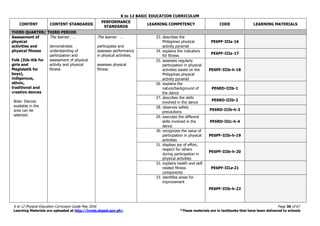
  • 4.
    K to 12BASIC EDUCATION CURRICULUM K to 12 Physical Education Curriculum Guide May 2016 Page 4 of 67 Learning Materials are uploaded at http://lrmds.deped.gov.ph/. *These materials are in textbooks that have been delivered to schools . Figure 1. The Conceptual Framework of Physical Education PHYSICAL LITERACY Fundamental Movement Skills Fundamental Motor skills Activity-specific Activity Rhythms & Dances Games & Sports MOVE TO LEARN, LEARN TO MOVE A graduate who lives an active life for fitness and lifelong health Body Management K ----1---2---3---4---5---6---7---8----9---10---11---12 Activity-Based Developmentally Appropriate Standard based Integrated Inclusive
  • 5.
    K to 12BASIC EDUCATION CURRICULUM K to 12 Physical Education Curriculum Guide May 2016 Page 5 of 67 Learning Materials are uploaded at http://lrmds.deped.gov.ph/. *These materials are in textbooks that have been delivered to schools Learning Area Standard The learner demonstrates understanding of the concept of physical fitness and physical activity in achieving, sustaining, and promoting an active life for fitness and health Key Stage Standards Strands K – 3 4 – 6 7 - 10 The learner demonstrates understanding of movement concepts and skills in preparation for active participation in various physical activities. The learner demonstrates understanding of principles in movement and fitness for active participation in various physical activities. The learner demonstrates understanding of integrating physical activity behaviors in achieving an active lifestyle. Body Management Movement Skills Physical Fitness Games and Sports Rhythms and Dance
  • 6.
    K to 12BASIC EDUCATION CURRICULUM K to 12 Physical Education Curriculum Guide May 2016 Page 6 of 67 Learning Materials are uploaded at http://lrmds.deped.gov.ph/. *These materials are in textbooks that have been delivered to schools GRADE LEVEL STANDARDS Grade Level Grade Level Standards Grade 1 The learner demonstrates understanding of body awareness, space awareness, qualities of effort and movement relationships through participation in enjoyable physical activities. Grade 2 Grade 3 Grade 4 The learner demonstrates understanding of the importance of physical activity and physical fitness through participation in and assessment of physical activities. Grade 5 Grade 6 Grade 7 The learner demonstrates understanding of personal fitness in achieving an active lifestyle. Grade 8 The learner demonstrates understanding of family and school fitness in sustaining an active lifestyle. Grade 9 The learner demonstrates understanding of community fitness in sustaining and promoting an active lifestyle. Grade 10 The learner demonstrates understanding of societal fitness in promoting an active lifestyle.
  • 7.
    K to 12BASIC EDUCATION CURRICULUM K to 12 Physical Education Curriculum Guide May 2016 Page 7 of 67 Learning Materials are uploaded at http://lrmds.deped.gov.ph/. *These materials are in textbooks that have been delivered to schools Table 1a - Scope and Sequence of Physical Education from Grades 1-3 Key Stage 1 Grade Level Strands Q1 Q2 Q3 Q4 GRADE 1 Body management Movement skills Rhythms and dance Games and sports Physical fitness Body Awareness Space Awareness Qualities of Effort Relationships Participation in enjoyable singing games, action songs, simple games, Chasing/Fleeing type games and mimetics. GRADE 2 Body management Movement skills Rhythms and dance Games and sports Physical fitness Body Shapes and Body Actions Locations, Directions, Levels, Pathways and Planes Time, Force and Flow Person, Objects, Sound and Environment Participation in enjoyable activities in different locomotor, non- locomotor and manipulative activities, folk dances, rhythmic routines (ribbon, hoop, balls, indigenous/improvised materials), relays and races GRADE 3 Body management Movement skills Rhythms and dance Games and sports Physical fitness Body Shapes and Body Actions Locations, Directions, Levels, Pathways and Planes Time, Force and Flow Person, Objects, Sound and Environment Participation in enjoyable and challenging activities in different locomotor, non- locomotor and manipulative activities ,simple folk dance, rhythmic routines (ribbon, hoop, balls, etc.)Lead-up and organized games(indigenous) and corrective exercises. Note: The scope and sequence for Grades 1 to 3 activities are integrative and inclusive in context.
  • 8.
    K to 12BASIC EDUCATION CURRICULUM K to 12 Physical Education Curriculum Guide May 2016 Page 8 of 67 Learning Materials are uploaded at http://lrmds.deped.gov.ph/. *These materials are in textbooks that have been delivered to schools Table 1a - Scope and Sequence of Physical Education from Grades 4-6 Key Stage 2 Grade Level Strands Q1 Q2 Q3 Q4 Health-Enhancing Fitness 1 GRADE 4 Physical fitness Assessments of physical activities and physical fitness (Health-related and skill-related) Games and sports Target games, striking/fielding games, Invasion games Rhythms and dance Folk, indigenous, ethnic, traditional and creative dances Health-Enhancing Fitness 2 GRADE 5 Physical fitness Assessments of physical activities and physical fitness (Health-related and skill-related) Games and sports Target games, striking/fielding games Invasion games Wall/net games, invasion games Rhythms and dance Folk, indigenous, ethnic, traditional and creative dances Health-Enhancing Fitness 3 GRADE 6 Physical fitness Assessments of physical activities and physical fitness (Health-related and skill-related) Games and sports Target games, striking/fielding games Invasion games Rhythms and dance Folk, indigenous, ethnic, traditional and creative dances Note: The scope and sequence for Grades 4 to 6 are focused on health and skill enhancing activities, ensuring that they are integrative and inclusive in context.
  • 9.
    K to 12BASIC EDUCATION CURRICULUM K to 12 Physical Education Curriculum Guide May 2016 Page 9 of 67 Learning Materials are uploaded at http://lrmds.deped.gov.ph/. *These materials are in textbooks that have been delivered to schools Table 1d - Scope and Sequence of Physical Education from Grades 7-10 Key Stage 3 Grade Level Strands Q1 Q2 Q3 Q4 GRADE 7 Personal Fitness Physical fitness Exercise programs: Training Guidelines, FITT Principle Endurance and Muscle-and bone- strengthening activities Games and sports Individual and Dual sports Rhythms and dance Folk/indigenous, ethnic, traditional/festival dances GRADE 8 Family and School Fitness Physical fitness Physical activity programs: Training Guidelines, FITT Principle Endurance and Muscle-and bone- strengthening activities Games and sports Team Sports Rhythms and dance Folk dances with Asian influence GRADE 9 Community Fitness Physical fitness Lifestyle & Weight Management (Physical activities and eating habits) Games and sports Sports officiating Active Recreation (indoor & outdoor) Rhythms and dance Social, ballroom dances and Festival dances GRADE 10 Societal Fitness Physical fitness Lifestyle & Weight Management (Physical activities and eating habits) Games and sports Active Recreation (Sports) Rhythms and dance Active Recreation (Other dance forms-Hip-hop, Street Dance, Cheer dance, Contemporary, etc.) Note: The scope and sequence for Grades 7 to 10 are thematically organized; ensure that they are integrative and inclusive context.
  • 10.
    K to 12BASIC EDUCATION CURRICULUM K to 12 Physical Education Curriculum Guide May 2016 Page 10 of 67 Learning Materials are uploaded at http://lrmds.deped.gov.ph/. *These materials are in textbooks that have been delivered to schools Table 1d - Scope and Sequence of Physical Education and Health from Grades 11-12 Grade Level Strands Semester 1 Semester 2 Q1 Q2 Q3 Q4 GRADE 11 Fitness/Exercise HEALTH OPTIMIZING PHYSICAL EDUCATION (H.O.P.E 1 and 2) Aerobic, muscle and bone-strengthening activities Sports Individual, dual and team sports HEALTH OPTIMIZING PHYSICAL EDUCATION (H.O.P.E 3 and 4) GRADE 12 Dance Traditional, contemporary, ethnic, folk and social dances Recreation Aquatic and mountaineering activities Note: Students can elect from the menu of physical activity courses
  • 11.
    K to 12BASIC EDUCATION CURRICULUM K to 12 Physical Education Curriculum Guide May 2016 Page 11 of 67 Learning Materials are uploaded at http://lrmds.deped.gov.ph/. *These materials are in textbooks that have been delivered to schools TIME ALLOTMENT FOR PHYSICAL EDUCATION Grade Level Time Allotment Kindergarten Integrated with other subject areas Grades 1 – 6 40 minutes / week Grades 7 – 10 60 minutes / week Grades 11 – 12 120 minutes / week
  • 12.
    K to 12BASIC EDUCATION CURRICULUM K to 12 Physical Education Curriculum Guide May 2016 Page 12 of 67 Learning Materials are uploaded at http://lrmds.deped.gov.ph/. *These materials are in textbooks that have been delivered to schools GRADE 1 CONTENT CONTENT STANDARDS PERFORMANCE STANDARDS LEARNING COMPETENCY CODE LEARNING MATERIALS FIRST QUARTER /FIRST GRADING PERIOD Body Awareness (Different body parts and their movements) The learner . . . demonstrates understanding awareness of body parts in preparation for participation in physical activities. The learner . . . performs with coordination enjoyable movements on body awareness . The learner . . . 1. describes the different parts of the body and their movements through enjoyable physical activities PE1BM-Ia-b-1 MISOSA 4- module 4 2. creates shapes by using different body parts PE1BM-Ic-d-2 3. shows balance on one, two, three, four and five body parts PE1BM-Ie-f-3 MISOSA 4- module 4 4. exhibits transfer of weight PE1BM-Ig-h-4 MISOSA 4- module 4 5. recognizes the importance of participating in fun and enjoyable physical activities PE1PF-Ia-h-1 MISOSA 4- module 4 6. engages in fun and enjoyable physical activities with coordination Suggested learning activities  action songs  singing games  simple games  chasing and fleeing games  mimetics PE1PF-Ia-h-2 MISOSA 4- module 4 SECOND QUARTER/ SECOND GRADING Space Awareness (Moving in different directions at spatial levels) The learner . . . demonstrates understanding ofspace awareness in preparation for The learner . . . performs movement skills in a given space with coordination. 7. identifies locomotor skills PE1BM-IIa-b- 5 1. MISOSA 4- module 1 2. Music, Art, Physical Education and Health 2. (Tagalog)DepEd. - Falcutila, Rogelio F. et.al. 2013. pp. 303-305
  • 13.
    K to 12BASIC EDUCATION CURRICULUM K to 12 Physical Education Curriculum Guide May 2016 Page 13 of 67 Learning Materials are uploaded at http://lrmds.deped.gov.ph/. *These materials are in textbooks that have been delivered to schools CONTENT CONTENT STANDARDS PERFORMANCE STANDARDS LEARNING COMPETENCY CODE LEARNING MATERIALS Space Awareness (Moving in different directions at spatial levels) participation in physical activities. 8. demonstrates moving within a group without bumping or falling using locomotors skills PE1BM-IIc-e- 6 1. MISOSA 4- module 1 2. Music, Art, Physical Education and Health 2. (Tagalog)DepEd. - Faculita, Rogelio F. et.al. 2013.pp. 304-305 9. executes locomotor skills while moving in different directions at different spatial levels PE1BM-IIf-h- 7 MISOSA 4- module 1 pp.2-3 10. engages in fun and enjoyable physical activities with coordination PE1PF-IIa-h- 2 1. MISOSA 4- module 1 2. Music, Art, Physical Education and Health 2. (Tagalog)DepEd. - Falculita, Rogelio et.al. 2013. 306-307 11. illustrates/demonstrate acceptable responses to challenges, successes, and failures during participation in motor fitness activities PE1PF-IIa-h- 3 MISOSA 4- module 1 12. demonstrates acceptable responses to challenges, successes, and failures during participation in physical activities Suggested learning activities  action songs  singing games  simple games  chasing and fleeing games  mimetics PE1PF-IIa-h- 4 1. MISOSA 4- module 1 2. Music, Art, Physical Education and Health 2. (Tagalog)DepEd. - Faliculita, Rogelio F. et.al. 2013. pp. 311-314
  • 14.
    K to 12BASIC EDUCATION CURRICULUM K to 12 Physical Education Curriculum Guide May 2016 Page 14 of 67 Learning Materials are uploaded at http://lrmds.deped.gov.ph/. *These materials are in textbooks that have been delivered to schools CONTENT CONTENT STANDARDS PERFORMANCE STANDARDS LEARNING COMPETENCY CODE LEARNING MATERIALS THIRD QUARTER/ THIRD GRADING Qualities of Effort (Slow and fast, heavy and light, free and bound movements) The learner . . . demonstrates understanding of qualities of effort in preparation for participation in physical activities. The learner . . . performs movements of varying qualities of effort with coordination. 13.describes the difference between slow and fast, heavy and light, free and bound movements PE1BM-IIIa- b-8 MISOSA 4- module 1 14. demonstrates contrast between slow and fast speeds while using locomotor skills PE1BM-IIIc- d-9 MISOSA 4- module 1 p.4 15. demonstrates the difference between heavy and light while moving PE1BM-IIIe-f- 10 MISOSA 4- module 1 16. demonstrates the difference between free and bound PE1BM-IIIg- h-11 MISOSA 4- module 1 17. demonstrates the difference between free and bound PE1PF-IIIa-h- 2 MISOSA 4- module 1 18. engages in fun and enjoyable physical activities PE1PF-IIIa-h- 6 MISOSA 4- module 1 19. enumerates the characteristics of a good team player PE1PF-IIIa-h- 7 20. differentiates sharing from cooperating PE1PF-IIIa-h- 8 21. demonstrates the characteristics of sharing and cooperating in physical activities Suggested learning activities  action songs  singing games  simple games  chasing and fleeing games  mimetics PE1PF-IIIa-h- 9 FOURTH QUARTER/ FOURTH GRADING Movement Relationships (Relationship to a moving The learner . . . demonstrates understanding of The learner . . . performs movements in 22. identifies movement relationships PE1BM-IVa-b- 12 MISOSA 4- module 1 23. demonstrates relationship of movement PE1BM-IVc-e- 13 MISOSA 4- module 1
  • 15.
    K to 12BASIC EDUCATION CURRICULUM K to 12 Physical Education Curriculum Guide May 2016 Page 15 of 67 Learning Materials are uploaded at http://lrmds.deped.gov.ph/. *These materials are in textbooks that have been delivered to schools CONTENT CONTENT STANDARDS PERFORMANCE STANDARDS LEARNING COMPETENCY CODE LEARNING MATERIALS or stationary object/person) relationships of movement skills in preparation for participation in physical activities relation to a stationary or moving object/person with coordination. 24. performs jumping over a stationary object several times in succession, using forward- and- back and side-to-side movement patterns PE1BM-IVf-h- 14 MISOSA 4- module 1 25. engages in fun and enjoyable physical activities PE1PF-IVa-h- 2 MISOSA 4- module 1 26. shows interest in participating in physical activities PE1PF-IVa-h- 9 MISOSA 4- module 1 27. follows simple instructions and rules PE1PF-IVa-h- 10 MISOSA 4- module 1 28. enjoys participating in physical activities Suggested learning activities  action songs  singing games  simple games  chasing and fleeing games  mimetics PE1PF-IVa-h- 11 MISOSA 4- module 1
  • 16.
    K to 12BASIC EDUCATION CURRICULUM K to 12 Physical Education Curriculum Guide May 2016 Page 16 of 67 Learning Materials are uploaded at http://lrmds.deped.gov.ph/. *These materials are in textbooks that have been delivered to schools GRADE 2 CONTENT CONTENT STANDARDS PERFORMANCE STANDARDS LEARNING COMPETENCY CODE LEARNING MATERIALS FIRST QUARTER /FIRST GRADING PERIOD Body Shapes (Straight, curled, wide and twisted) and Body Actions (Walking, standing, sitting) The learner . . . demonstrates understanding of body shapes and body actions in preparation for various movement activities The learner . . . performs body shapes and actions properly. The learner . . 1.describes body shapes and actions PE2BM-Ia-b-1 Music, Art, Physical Education and Health 2. (Tagalog) DepEd. Falculita, Rogelio F. et.al. 2013. pp. 295-296 2. demonstrates body shapes and actions PE2BM-Ic-d-15 Music, Art, Physical Education and Health 2. Tagalog) DepEd. Falculita, Rogelio F. et.al. 2013. pp. 297-299 3. creates body shapes and actions PE2BM-Ie-f-2 Music, Art, Physical Education and Health 2.(Tagalog) DepEd. Falculita, Rogelio F. et.al.2013. pp. 300-301 4. demonstrates momentary stillness in symmetrical and asymmetrical shapes using body parts other than both feet as a base of support PE2BM-Ig-h-16 1. MISOSA 4 - module 1. 2. Music, Art, Physical Education and Health 2. (Tagalog) DepEd. Falculita, Rogelio F. et.al. 2013. pp. 300-301 5. demonstrates movement skills in response to sound and music PE2MS-Ia-h-1 6. exhibits correct body posture PE2PF-Ia-h-12 MISOSA 6 – module 5 7. assesses body posture PE2PF-Ia-h-13 Music, Art, Physical Education and Health 2.(Tagalog) DepeEd. Falculita, Rogelio F. et.al. 2013. pp. 380-382 8. engages in fun and enjoyable physical activities Suggested learning activities  movement skills activities (locomotor, non- locomotor and PE2PF-Ia-h-2 1. MISOSA 6 – module 1 - 5 2. Music, Art, Physical Education and Health 2.(Tagalog) DepEd. Falculita, Rogelio F. et.al.2013. pp. 303-305. 311-314. 375
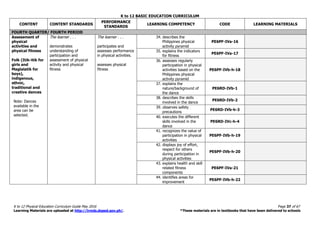
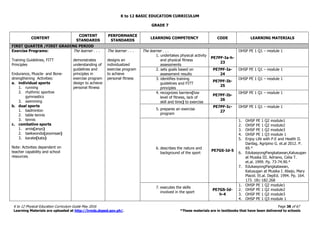
  • 17.
    K to 12BASIC EDUCATION CURRICULUM K to 12 Physical Education Curriculum Guide May 2016 Page 17 of 67 Learning Materials are uploaded at http://lrmds.deped.gov.ph/. *These materials are in textbooks that have been delivered to schools CONTENT CONTENT STANDARDS PERFORMANCE STANDARDS LEARNING COMPETENCY CODE LEARNING MATERIALS Body Shapes (Straight, curled, wide and twisted) and Body Actions (Walking, standing, sitting) The learner . . . demonstrates understanding of body shapes and body actions in preparation for various movement activities The learner . . . performs body shapes and actions properly. manipulative skills)  folk dances (Alitaptap/Rabong)  rhythmic routines (ribbon, hoop, balls, and any available indigenous/improvised materials) relays and races SECOND QUARTER/ SECOND GRADING Locations (Behind,infront, under, over, personal space, general space) Directions (linear- forward and backward, lateral- sideward, and multi-directional) Levels (High, middle, low) Pathways (Straight, curved, zigzag) and Planes (Diagonal, horizontal, vertical, and rotational) Th The learner . . . demonstrates understanding of locations, directions, levels, pathways and planes Th ThThe learner. . . performs movements accurately involving locations, directions, levels, pathways and planes. 9. describes movements in a location, direction, level, pathway and plane PE2BM-IIa-b-17 MISOSA 4 - module 1 10. moves in:  personal and general space  forward, backward, and sideward directions  high, middle, and low levels  straight, curve, and zigzag pathways  diagonal and horizontal planes PE2BM-IIc-h-18 11. demonstrates movement skills in response to sounds and music PE2MS-IIa-h-1 12. observes correct posture and body mechanics while performing movement PE2PF-IIa-h-14 Music, Art, Physical Education and Health 2.(Tagalog) DepEd. Falculita, Rogelio F. et.al.2013. pp. 380-381
  • 18.
    K to 12BASIC EDUCATION CURRICULUM K to 12 Physical Education Curriculum Guide May 2016 Page 18 of 67 Learning Materials are uploaded at http://lrmds.deped.gov.ph/. *These materials are in textbooks that have been delivered to schools CONTENT CONTENT STANDARDS PERFORMANCE STANDARDS LEARNING COMPETENCY CODE LEARNING MATERIALS Locations (Behind, infront, under, over, personal space, general space) Directions(linear- forward and backward, lateral- sideward, and multi- directional) Levels (High, middle, low) Pathways (Straight, curved, zigzag) and Planes (Diagonal, horizontal, vertical, and rotational The learner . . . demonstrates understanding of locations, directions, levels, pathways and planes The learner. . . performs movements accurately involving locations, directions, levels, pathways and planes. activities 13. engages in fun and enjoyable physicalactivities Suggested learning activities  movement skills activities (locomotor, non- locomotor and manipulative skills)  folk dances  rhythmic routines (ribbon, hoop, balls, and any available indigenous/improvised materials)  relays and races PE2PF-IIa-h-2 Music, Art, Physical Education and Health 2.(Tagalog) DepEd. Falculita, Rogelio F. et.al.2013. pp. 375. 303- 305. 313-314 THIRD QUARTER/ THIRD GRADING Time (slow, slower, slowest/fast, faster, fastest) Force (light, lighter, lightest/strong, stronger, strongest) and Flow (smoothness of movement) The learner . . . demonstrates understanding of movement in relation to time, force and flow The learner . . . performs movements accurately involving time, force, and flow. 14. describes movements in a location, direction, level, pathway and plane PE2BM-IIIa-b- 17 15. moves: 15.1 at slow, slower, slowest/fast, faster, fastest pace 15.2 using light, lighter, lightest/strong, stronger, strongest force with smoothness PE2BM-IIIc-h- 19 MISOSA 4 - module 1 16. demonstrates movement skills in PE2MS-IIIa-h-1 Music, Art, Physical Education and Health 2.(Tagalog) DepEd. Falculita,
  • 19.
    K to 12BASIC EDUCATION CURRICULUM K to 12 Physical Education Curriculum Guide May 2016 Page 19 of 67 Learning Materials are uploaded at http://lrmds.deped.gov.ph/. *These materials are in textbooks that have been delivered to schools CONTENT CONTENT STANDARDS PERFORMANCE STANDARDS LEARNING COMPETENCY CODE LEARNING MATERIALS Time (slow, slower, slowest/fast, faster, fastest) Force (light, lighter, lightest/strong, stronger, strongest) and Flow (smoothness of movement) The learner . . . demonstrates understanding of movement in relation to time, force and flow The learner . . . performs movements accurately involving time, force, and flow. response to sound and music Rogelio F. et.al.2013.. pp. 309-310 17. engages in fun and enjoyable physical activities PE2PF-IIIa-h-2 Music, Art, Physical Education and Health 2.(Tagalog) DepEd. Falculita, Rogelio F. et.al.2013. pp. 304-305 18. observes correct posture and body mechanics while performing movement activities Suggested learning activities  movement skills activities locomotor, non- locomotor and manipulative skills  folk dances (Alitaptap/Rabong)  rhythmic routines (ribbon, hoop, balls, and any available indigenous/improvised materials) relays and races PE2PF-IIIa-h-14 1. MISOSA 6 – module 1 2. Music, Art, Physical Education and Health 2.(Tagalog) DepEd. Falculita, Rogelio F. et.al.2013. pp. 375. 303-305. 313-314 FOURTH QUARTER/ FOURTH GRADING Person (Individual, pair, group), Objects (ribbon, hoop, balls, and any available indigenous/improvised materials), Sound, Environment (indoor and outdoor settings) Person (Individual, pair, group), Objects The learner . . . demonstrates understanding of movement activities relating to person, objects, music and environment The learner . . . performs movement activities involving person, objects, music and environment correctly 19. familiarizes in various movement activities involving person, objects, music and environment PE2BM-IV-a-b- 20 MISOSA 5 –module 1 20. moves: 20.1 individually, with partner, and with group 20.2 with ribbon, PE2BM-IV-c-h- 21 MISOSA 5 –module 1pp.2-3
  • 20.
    K to 12BASIC EDUCATION CURRICULUM K to 12 Physical Education Curriculum Guide May 2016 Page 20 of 67 Learning Materials are uploaded at http://lrmds.deped.gov.ph/. *These materials are in textbooks that have been delivered to schools CONTENT CONTENT STANDARDS PERFORMANCE STANDARDS LEARNING COMPETENCY CODE LEARNING MATERIALS (ribbon, hoop, balls, and any available indigenous/improvised materials), Sound, Environment (indoor and outdoor settings) The learner . . . demonstrates understanding of movement activities relating to person, objects, music and environment The learner . . . performs movement activities involving person, objects, music and environment correctly hoop, balls, and any available indigenous/impr ovised materials 20.3 with sound 20.4 in indoor and outdoor settings 21. demonstrates movement skills in response to sound PE2MS-IV-a-h-1 Music, Art, Physical Education and Health 2.(Tagalog) DepEd. Falculita, Rogelio F. et.al.2013. pp. 356-357 22. engages in fun and enjoyable physical activities PE2PF-IV-a-h-2 Music, Art, Physical Education and Health 2.(Tagalog) DepEd. Falculita, Rogelio F. et.al.2013. pp.313-314 23. observes correct body posture and body mechanics while performing movement activities Suggested learning activities  movement skills activities locomotor, non-locomotor and manipulative skills  folk dances (Alitaptap/Rabong)  rhythmic routines (ribbon, hoop, balls, and any available indigenous/improvised materials) relays and races PE2PF-IV-a-h- 14 MISOSA 6 –module 1pp.1-6
  • 21.
    K to 12BASIC EDUCATION CURRICULUM K to 12 Physical Education Curriculum Guide May 2016 Page 21 of 67 Learning Materials are uploaded at http://lrmds.deped.gov.ph/. *These materials are in textbooks that have been delivered to schools GRADE 3 CONTENT CONTENT STANDARDS PERFORMANCE STANDARDS LEARNING COMPETENCY CODE LEARNING MATERIALS FIRST QUARTER /FIRST GRADING PERIOD Body Shapes (Straight, curled, wide and twisted) and Body Actions (Walking, standing, sitting) The learner . . . demonstrates understanding of body shapes and body actions in preparation for various movement activities The learner . . . performs body shapes and actions properly. The learner . . . 1. describes body shapes and actions PE3BM-Ia-b-1 Music, Art, Physical Education and Health 2.(Tagalog) DepEd. Falculita, Rogelio F. et.al.2013. pp. 295-296 2. performs body shapes and actions PE3BM-Ic-d-15 Music, Art, Physical Education and Health 2.(Tagalog) DepEd. Falculita, Rogelio F. et.al.2013. pp. 297-299 3. creates body shapes and actions PE3BM-Ie-f-2 Music, Art, Physical Education and Health 2.(Tagalog) DepEd. Falculita, Rogelio F. et.al.2013. pp. 300-301 4. demonstrates momentary stillness in symmetrical and asymmetrical shapes using body parts other than both feet as a base of support PE3BM-Ig-h-16 Music, Art, Physical Education and Health 2.(Tagalog) DepEd. Falculita, Rogelio F. et.al.2013. pp. 300-301 5. demonstrates movement skills in response to sounds and music PE3MS-Ia-h-1 6. identifies conditioning and flexibility exercises that will improve posture PE3PF-Ia-h-15 Music, Art, Physical Education and Health 2.(Tagalog) DepEd. Falculita, Rogelio F. et.al.2013. pp. 381-382 7. performs conditioning and flexibility exercises that will improve body posture PE3PF-Ia-h-16 Music, Art, Physical Education and Health 2.(Tagalog) DepEd. Falculita, Rogelio F. et.al.2013. pp. 381-382 8. engages in fun and enjoyable physical activities Suggested learning activities  movement skills activities PE3PF-Ia-h-2 Music, Art, Physical Education and Health 2.(Tagalog) DepEd. Falculita, Rogelio F. et.al.2013. pp. 303-305. 313-314
  • 22.
    K to 12BASIC EDUCATION CURRICULUM K to 12 Physical Education Curriculum Guide May 2016 Page 22 of 67 Learning Materials are uploaded at http://lrmds.deped.gov.ph/. *These materials are in textbooks that have been delivered to schools CONTENT CONTENT STANDARDS PERFORMANCE STANDARDS LEARNING COMPETENCY CODE LEARNING MATERIALS Body Shapes (Straight, curled, wide and twisted) and Body Actions (Walking, standing, sitting) The learner . . . demonstrates understanding of body shapes and body actions in preparation for various movement activities The learner . . . performs body shapes and actions properly. (locomotor, non-locomotor and manipulative skills)  folk dances (Tiklos/Kunday- kunday)  rhythmic routines (ribbon, hoop, balls, and any available indigenous/improvised materials)  lead up, organized and indigenous games corrective exercises SECOND QUARTER/ SECOND GRADING Locations (Behind,in front, under, over, personal space, general space) Directions (linear-forward and backward, lateral- sideward, and multi- directional) Levels (High, middle, low) Pathways (Straight, curve, zigzag) and Planes (Diagonal, horizontal, vertical, and rotational) The learner . . . demonstrates understanding of locations, directions, levels, pathways and planes The learner . . . performs movements accurately involving locations, directions, levels, pathways and planes. The learner . . . 9. describes movements in a location, direction, level, pathway and plane PE3BM-IIa-b-17 10. moves in:  personal and general space  forward, backward, and sideward directions  high, middle, and low levels  straight, curve, and zigzag pathways  diagonal and horizontal planes PE3BM-IIc-h-18 11. demonstrates movement skills in response to sound PE3MS-IIa-h-1 MISOSA 4 – module 1 12. identifies conditioning and flexibility exercises that will improve body PE3PF-IIa-h-15 1. MISOSA 5 - module 1 2. MISOSA 5 - module 5. pp. 1-5
  • 23.
    K to 12BASIC EDUCATION CURRICULUM K to 12 Physical Education Curriculum Guide May 2016 Page 23 of 67 Learning Materials are uploaded at http://lrmds.deped.gov.ph/. *These materials are in textbooks that have been delivered to schools CONTENT CONTENT STANDARDS PERFORMANCE STANDARDS LEARNING COMPETENCY CODE LEARNING MATERIALS Locations (Behind,in front, under, over, personal space, general space) Directions (linear-forward and backward, lateral- sideward, and multi- directional) Levels (High, middle, low) Pathways (Straight, curve, zigzag) and Planes (Diagonal, horizontal, vertical, and rotational) The learner . . . demonstrates understanding of locations, directions, levels, pathways and planes The learner . . . performs movements accurately involving locations, directions, levels, pathways and planes. mechanics 13. performs conditioning and flexibility exercises that will improve body mechanics PE3PF-IIa-h-16 MISOSA 6- Module 5. pp.1-6. 14. engages in fun and enjoyable physical activities Suggested learning activities  movement skills activities (locomotor, non-locomotor and manipulative skills)  folk dances (Tiklos/ Kunday- kunday)  rhythmic routines (ribbon, hoop, balls, and any available indigenous/improvised materials)  lead up, organized and indigenous games corrective exercises PE3PF-IIa-h-2 Music, Art, Physical Education and Health 2.(Tagalog) DepEd. Falculita, Rogelio F. et.al.2013. pp. 345. 313-314 THIRD QUARTER/ THIRD GRADING Time (slow, slower, slowest/fast, faster, fastest ) Force (light, lighter, lightest/strong, stronger, strongest) and Flow (smoothness of movement) The learner . . . demonstrates understanding of movement in relation to time, force and flow The learner . . . performs movements accurately involving time, force, and flow. 15. describes movements in a location, direction, level, pathway and plane PE3BM-IIIa-b- 17 MISOSA 4 – module 1 pp.3-4 16. moves:  at slow, slower, slowest/fast, faster, fastest pace  using light, lighter, lightest/strong, stronger, strongest force with smoothness PE3BM-IIIc-h- 19 17. demonstrates movement skills in response to PE3MS-IIIa-h-1
  • 24.
    K to 12BASIC EDUCATION CURRICULUM K to 12 Physical Education Curriculum Guide May 2016 Page 24 of 67 Learning Materials are uploaded at http://lrmds.deped.gov.ph/. *These materials are in textbooks that have been delivered to schools CONTENT CONTENT STANDARDS PERFORMANCE STANDARDS LEARNING COMPETENCY CODE LEARNING MATERIALS Time (slow, slower, slowest/fast, faster, fastest ) Force (light, lighter, lightest/strong, stronger, strongest) and Flow (smoothness of movement) The learner . . . demonstrates understanding of movement in relation to time, force and flow The learner . . . performs movements accurately involving time, force, and flow. sound 18. engages in fun and enjoyable physical activities PE3PF-IIIa-h-2 19. identifies conditioning and flexibility exercises that will improve body mechanics PE3PF-IIIa-h-15 MISOSA 5 – module 1. pp.1-5 20. performs conditioning and flexibility exercises that will improve body mechanics Suggested learning activities  movement skills activities locomotor, non-locomotor and manipulative skills  folk dances (Tiklos/ Kunday- kunday)  rhythmic routines (ribbon, hoop, balls, and any available indigenous/improvised materials)  lead up, organized and indigenous games  corrective exercises PE3PF-IIIa-h-16 MISOSA 5 – module 1. FOURTH QUARTER/ FOURTH GRADING Person (Invidual, pair, group) Objects (ribbon, hoop, balls, and any available indigenous/improvised materials), Sound and Environment The learner . . . demonstrates understanding of movement activities relating to person, objects, music and environment The learner . . . performs movement activities involving person, objects, music and environment correctly The learner . . . 21. participates in various movement activities involving person, objects, music and environment PE3BM-IV-a-b- 20 MISOSA 4 – module 5. pp.3-5 22. moves:  individually, with partner, and with PE3BM-IV-c-h- 21
  • 25.
    K to 12BASIC EDUCATION CURRICULUM K to 12 Physical Education Curriculum Guide May 2016 Page 25 of 67 Learning Materials are uploaded at http://lrmds.deped.gov.ph/. *These materials are in textbooks that have been delivered to schools CONTENT CONTENT STANDARDS PERFORMANCE STANDARDS LEARNING COMPETENCY CODE LEARNING MATERIALS (indoor and outdoor settings) Person (Invidual, pair, group) Objects (ribbon, hoop, balls, and any available indigenous/improvised materials), Sound and Environment (indoor and outdoor settings) The learner . . . demonstrates understanding of movement activities relating to person, objects, music and environment The learner . . . performs movement activities involving person, objects, music and environment correctly group  with ribbon, hoop, balls, and any available indigenous/improvised materials  with sound  in indoor and outdoor settings 23. demonstrates movement skills in response to sounds and music PE3MS-IV-a-h-1 24. engages in fun and enjoyable physical activities PE3PF-IV-a-h-2 25. identifies conditioning and flexibility exercises that will improve posture PE3PF-IV-a-h- 15 26. performs conditioning and flexibility exercises that will improve body mechanics Suggested learning activities  movement skills activities locomotor, non-locomotor and manipulative skills  folk dances (Tiklos/Kunday- kunday)  rhythmic routines (ribbon, hoop, balls, and any available indigenous/improvised materials)  lead up, organized and indigenous games corrective exercises PE3PF-IV-a-h- 16
  • 26.
    K to 12BASIC EDUCATION CURRICULUM K to 12 Physical Education Curriculum Guide May 2016 Page 26 of 67 Learning Materials are uploaded at http://lrmds.deped.gov.ph/. *These materials are in textbooks that have been delivered to schools GRADE 4 CONTENT CONTENT STANDARDS PERFORMANCE STANDARDS LEARNING COMPETENCY CODE LEARNING MATERIALS FIRST QUARTER /FIRST GRADING PERIOD Assessment of physical activities and physical fitness Target games (Tumbangpreso, tamaang-tao/batuhang bola, tatsing), striking/fielding games (syato, basagang palayok, kickball) Note: Games are not limited to the above listed activities The learner . . . demonstrates understanding of participation and assessment of physical activities and physical fitness The learner . . . participates and assesses performance in physical activities. assesses physical fitness The learner . . . 1. describes the physical activity pyramid PE4PF-Ia-16 2. explains the indicators for fitness PE4PF-Ia-17 3. assesses regularly participation in physical activities based on physical activity pyramid PE4PF-Ib-h-18 4. explains the nature/background of the games PE4GS-Ib-1 EASE PE - module 2. pp. 6-7, 12- 13. 5. describes the skills involved in the games PE4GS-Ib-2 EASE PE - module 2. 6. observes safety precautions PE4GS-Ib-h-3 7. executes the different skills involved in the game PE4GS-Ic-h-4 8. recognizes the value of participation in physical activities PE4PF-Ib-h-19 9. displays joy of effort, respect for others and fair play during participation in physical activities PE4PF-Ib-h-20 10. explains health and skill related fitness components PE4PF-Ia-21 11. identifies areas for improvement PE4PF-Ib-h-22
  • 27.
    K to 12BASIC EDUCATION CURRICULUM K to 12 Physical Education Curriculum Guide May 2016 Page 27 of 67 Learning Materials are uploaded at http://lrmds.deped.gov.ph/. *These materials are in textbooks that have been delivered to schools CONTENT CONTENT STANDARDS PERFORMANCE STANDARDS LEARNING COMPETENCY CODE LEARNING MATERIALS SECOND QUARTER/ SECOND PERIOD Assessment of physical activities and physical fitness Invasion games (agawan base, lawin at sisiw, agawanpanyo) Note: Games are not limited to the above listed activities The learner . . . demonstrates understanding of participation in and assessment of physical activities and physical fitness The learner . . . participates and assesses performance in physical activities. assesses physical fitness 12. describes the Philippines physical activity pyramid PE4PF-IIa-16 13. explains the indicators for fitness PE4PF-IIa-17 14. assesses regularly participation in physical activities based on physical activity pyramid PE4PF-IIb-h-18 15. explains the nature/background of the games PE4GS-IIb-1 16. describes the skills involved in the games PE4GS-IIb-2 17. observes safety precautions PE4GS-IIb-h-3 18. executes the different skills involved in the game PE4GS-IIc-h-4 19. recognizes the value of participation in physical activities PE4PF-IIb-h-19 20. displays joy of effort, respect for others and fair play during participation in physical activities PE4PF-IIb-h-20 21. explains health and skill related fitness components PE4PF-IIa-21 22. identifies areas for improvement PE4PF-IIb-h-22 THIRD QUARTER / THIRD GRADING Assessment of physical activities and physical fitness Folk (Liki/Ba-Ingles), indigenous, ethnic, The learner . . . demonstrates understanding of participation and assessment of The learner . . . participates and assesses performance in physical activities. 23. describes the Philippines physical activity pyramid PE4PF-IIIa-16 24. explains the indicators for fitness PE4PF-IIIa-17 25. assesses regularly participation in physical PE4PF-IIIb-h- 18
  • 28.
    K to 12BASIC EDUCATION CURRICULUM K to 12 Physical Education Curriculum Guide May 2016 Page 28 of 67 Learning Materials are uploaded at http://lrmds.deped.gov.ph/. *These materials are in textbooks that have been delivered to schools CONTENT CONTENT STANDARDS PERFORMANCE STANDARDS LEARNING COMPETENCY CODE LEARNING MATERIALS traditional and creative dances Note: Dances available in the area can be selected. physical activity and physical fitness assesses physical fitness activities based on physical activity pyramid 26. explains the nature/background of the dance PE4GS-IIIb-1 27. describes the skills involved in the dance PE4GS-IIIb-2 28. observes safety precautions PE4GS-IIIb-h-3 29. executes the different skills involved in the dance PE4GS-IIIc-h-4 30. recognizes the value of participation in physical activities PE4PF-IIIb-h- 19 31. displays joy of effort, respect for others during participation in physical activities PE4PF-IIIb-h- 20 32. explains health and skill related fitness components PE4PF-IIIa-21 33. identifies areas for improvement PE4PF-IIIa-22 FOURTH QUARTER/ FOURTH PERIOD Assessment of physical activities and physical fitness Folk (Liki/Ba-Ingles), indigenous, ethnic, traditional and creative dances Note: Dances available in the area can be selected. The learner . . . demonstrates understanding of participation and assessment of physical activity and physical fitness The learner . . . participates and assesses performance in physical activities. assesses physical fitness 34. describes the Philippines physical activity pyramid PE4PF-IVa-16 35. explains the indicators for fitness PE4PF-IVa-17 36. assesses regularly participation in physical activities based on Philippines physical activity pyramid PE4PF-IVb-h-18 37. explains the nature/background of the dance PE4RD-IVb-1
  • 29.
    K to 12BASIC EDUCATION CURRICULUM K to 12 Physical Education Curriculum Guide May 2016 Page 29 of 67 Learning Materials are uploaded at http://lrmds.deped.gov.ph/. *These materials are in textbooks that have been delivered to schools CONTENT CONTENT STANDARDS PERFORMANCE STANDARDS LEARNING COMPETENCY CODE LEARNING MATERIALS Assessment of physical activities and physical fitness Folk (Liki/Ba-Ingles), indigenous, ethnic, traditional and creative dances Note: Dances available in the area can be selected. The learner . . . demonstrates understanding of participation and assessment of physical activity and physical fitness The learner . . . participates and assesses performance in physical activities. assesses physical fitness 38. describes the skills involved in the dance PE4RD-IVb-2 39. observes safety precautions PE4RD-IVb-h-3 40. executes the different skills involved in the dance PE4RD-IVc-h-4 41. recognizes the value of participation in physical activities PE4PF-IVb-h-19 42. displays joy of effort, respect for others during participation in physical activities PE4PF-IVb-h-20 43. explains health and skill related fitness components PE4PF-IVa-21 44. identifies areas for improvement PE4PF-IVb-h-22
  • 30.
    K to 12BASIC EDUCATION CURRICULUM K to 12 Physical Education Curriculum Guide May 2016 Page 30 of 67 Learning Materials are uploaded at http://lrmds.deped.gov.ph/. *These materials are in textbooks that have been delivered to schools GRADE 5 CONTENT CONTENT STANDARDS PERFORMANCE STANDARDS LEARNING COMPETENCY CODE LEARNING MATERIALS FIRST QUARTER /FIRST GRADING PERIOD Assessment of physical activity and physical fitness Target games (Tumbangpreso, tamaang-tao/batuhang bola, tatsing), striking/fielding games (syato/,basagangpalayok, kickball) Note: Games are not limited to the above listed activities The learner . . . demonstrates understanding of participation and assessment of physical activity and physical fitness The learner . . . participates and assesses performance in physical activities. assesses physical fitness The learner . . . 1. describes the Philippines physical activity pyramid PE5PF-Ia-16 2. explains the indicators for fitness PE5PF-Ia-17 3. assesses regularly participation in physical activities based on the Philippines physical activity pyramid PE5PF-Ib-h- 18 4. explains the nature/background of the games PE5GS-Ib-1 Ease P.E - Module 2. pp. 4. 6- 7. 12-13 5. describes the skills involved in the games PE5GS-Ib-2 6. observes safety precautions PE5GS-Ib-h-3 7. executes the different skills involved in the game PE5GS-Ic-h-4 8. recognizes the value of participation in physical activities PE5PF-Ib-h- 19 9. displays joy of effort, respect for others and fair play during participation in physical activities PE5PF-Ib-h- 20 10. explains health and skill related fitness components PE5PF-Ia-21 11. identifies areas for improvement PE5PF-Ib-h- 22
  • 31.
    K to 12BASIC EDUCATION CURRICULUM K to 12 Physical Education Curriculum Guide May 2016 Page 31 of 67 Learning Materials are uploaded at http://lrmds.deped.gov.ph/. *These materials are in textbooks that have been delivered to schools CONTENT CONTENT STANDARDS PERFORMANCE STANDARDS LEARNING COMPETENCY CODE LEARNING MATERIALS SECOND QUARTER / SECOND GRADING Assessment of physical activities and physical fitness Invasion games (agawan base, lawin at sisiw, agawanpanyo) Note: Games are not limited to the above listed activities The learner . . . demonstrates understanding of participation in and assessment of physical activity and physical fitness The learner . . . participates and assesses performance in physical activities. assesses physical fitness 12. describes the Philippines physical activity pyramid PE5PF-IIa-16 13. explains the indicators for fitness PE5PF-IIa-17 14. assesses regularly participation in physical activities based on the Philippines physical activity pyramid PE5PF-IIb-h- 18 15. explains the nature/background of the games PE5GS-IIb-1 16. describes the skills involved in the games PE5GS-IIb-2 17. observes safety precautions PE5GS-IIb-h- 3 18. executes the different skills involved in the game PE5GS-IIc-h- 4 19. recognizes the value of participation in physical activities PE5PF-IIb-h- 19 20. displays joy of effort, respect for others and fair play during participation in physical activities PE5PF-IIb-h- 20 21. explains health and skill related fitness components PE5PF-IIa-21 22. identifies areas for improvement PE5PF-IIb-h- 22 THIRD QUARTER/ THIRD PERIOD Assessment of physical activities and physical fitness The learner . . . demonstrates The learner . . . participates and 23. describes the Philippines physical activity pyramid PE5PF-IIIa- 16 24. explains the indicators for fitness PE5PF-IIIa- 17
  • 32.
    K to 12BASIC EDUCATION CURRICULUM K to 12 Physical Education Curriculum Guide May 2016 Page 32 of 67 Learning Materials are uploaded at http://lrmds.deped.gov.ph/. *These materials are in textbooks that have been delivered to schools CONTENT CONTENT STANDARDS PERFORMANCE STANDARDS LEARNING COMPETENCY CODE LEARNING MATERIALS Folk (Cariñosa/ Polka saNayon), indigenous, ethnic, traditional and creative dances Note: Dances available in the area can be selected. understanding of participation and assessment of physical activity and physical fitness assesses performance in physical activities. assesses physical fitness 25. assesses regularly participation in physical activities based on the Philippines physical activity pyramid PE5PF-IIIb- h-18 26. explains the nature/background of the dance PE5RD-IIIb-1 1. Enjoy Life with P.E and Health II. Darilag, Agripino G. et.al. 2012. pp. 127. 134. 143. 152. 153.* 2. EdukasyongPangkatawan, Kalusugan at Musika III. Adriano, Celia T. et.al. 1999. p. 31.* 27. describes the skills involved in the dance PE5RD-IIIb-2 Enjoy Life with P.E and Health II. Darilag, Agripino G. et.al. 2012. pp. 128-161.* 28. observes safety precautions PE5RD-IIIb- h-3 29. executes the different skills involved in the dance PE5RD-IIIc- h-4 Enjoy Life with P.E and Health II. Darilag, Agripino G. et.al. 2012. pp. 128-161.* 30. recognizes the value of participation in physical activities PE5PF-IIIb- h-19 31. displays joy of effort, respect for others during participation in physical activities PE5PF-IIIb- h-20 32. explains health and skill related fitness components PE5PF-IIIa- 21 33. identifies areas for improvement PE5PF-IIIb- h-22
  • 33.
    K to 12BASIC EDUCATION CURRICULUM K to 12 Physical Education Curriculum Guide May 2016 Page 33 of 67 Learning Materials are uploaded at http://lrmds.deped.gov.ph/. *These materials are in textbooks that have been delivered to schools CONTENT CONTENT STANDARDS PERFORMANCE STANDARDS LEARNING COMPETENCY CODE LEARNING MATERIALS FOURTH QUARTER/ FOURTH PERIOD Assessment of physical activities and physical fitness Folk (Cariñosa/ Polka saNayon), indigenous, ethnic, traditional and creative dances Note: Dances available in the area can be selected. The learner . . . demonstrates understanding of participation and assessment of physical activity and physical fitness The learner . . . participates and assesses performance in physical activities. assesses physical fitness 34. describes the Philippines physical activity pyramid PE5PF-IVa-16 35. explains the indicators for fitness PE5PF-IVa-17 36. assesses regularly participation in physical activities based on the Philippines physical activity pyramid PE5PF-IVb-h- 18 37. explains the nature/background of the dance PE5RD-IVb-1 1. EdukasyongPangkatawan, Kalusugan at Musika III. Adriano, Celia T. 1999. p. 31.* 2. Enjoy Life with P.E and Health II. Darilag, Agripino G. et.al. 2012. pp. 127. 134. 143. 152. 153.* 38. describes the skills involved in the dance PE5RD-IVb-2 Enjoy Life with P.E and Health II. Darilag, Agripino G. et.al. 2012. pp. 128-161.* 39. observes safety precautions PE5RD-IVb- h-3 40. executes the different skills involved in the dance PE5RD-IVc-h- 4 Enjoy Life with P.E and Health II. Darilag, Agripino G. et.al. 2012. pp. 128-169.* 41. recognizes the value of participation in physical activities PE5PF-IVb-h- 19 42. displays joy of effort, respect for others during participation in physical activities PE5PF-IVb-h- 20 43. explains health and skill related fitness components PE5PF-IVa-21 44. identifies areas for improvement PE5PF-IVb-h- 22
  • 34.
    K to 12BASIC EDUCATION CURRICULUM K to 12 Physical Education Curriculum Guide May 2016 Page 34 of 67 Learning Materials are uploaded at http://lrmds.deped.gov.ph/. *These materials are in textbooks that have been delivered to schools GRADE 6 CONTENT CONTENT STANDARDS PERFORMANCE STANDARDS LEARNING COMPETENCY CODE LEARNING MATERIALS FIRST QUARTER /FIRST GRADING PERIOD Assessment of physical activities and physical fitness Target games (Tumbang preso, tamaang- tao/batuhang bola, tatsing), striking/fielding games (syato/,basagang palayok, kickball) Note: Games are not limited to the above listed activities The learner . . . demonstrates understanding of participation and assessment of physical activity and physical fitness The learner . . . participates and assesses performance in physical activities. assesses physical fitness The learner . . . 1. describes the Philippines physical activity pyramid PE6PF-Ia-16 2. explains the indicators for fitness PE6PF-Ia-17 3. assesses regularly participation in physical activities based on the Philippines physical activity pyramid PE6PF-Ib-h-18 4. explains the nature/background of the games PE6GS-Ib-1 EASE P.E Module 2 pp.6-7,12-13 5. describes the skills involved in the games PE6GS-Ib-2 EASE P.E Module 2 pp.6-7,12-13 6. observes safety precautions PE6GS-Ib-h-3 7. executes the different skills involved in the game PE6GS-Ic-h-4 8. recognizes the value of participation in physical activities PE6PF-Ib-h-19 9. displays joy of effort, respect for others and fair play during participation in physical activities PE6PF-Ib-h-20 10. explains health and skill related fitness components PE6PF-Ia-21 11. identifies areas for improvement PE6PF-Ib-h-22
  • 35.
    K to 12BASIC EDUCATION CURRICULUM K to 12 Physical Education Curriculum Guide May 2016 Page 35 of 67 Learning Materials are uploaded at http://lrmds.deped.gov.ph/. *These materials are in textbooks that have been delivered to schools CONTENT CONTENT STANDARDS PERFORMANCE STANDARDS LEARNING COMPETENCY CODE LEARNING MATERIALS SECOND QUARTER/ SECOND PERIOD Assessment of physical activities and physical fitness Invasion games (agawan base, lawin at sisiw, agawan panyo) Note: Games are not limited to the above listed activities The learner . . . demonstrates understanding of participation in and assessment of physical activities and physical fitness The learner . . . participates and assesses performance in physical activities. assesses physical fitness 12. describes the Philippines physical activity pyramid PE6PF-IIa-16 13. explains the indicators for fitness PE6PF-IIa-17 14. assesses regularly participation in physical activities based on the Philippines physical activity pyramid PE6PF-IIb-h-18 15. explains the nature/background of the games PE6GS-IIb-1 16. describes the skills involved in the games PE6GS-IIb-2 17. observes safety precautions PE6GS-IIb-h-3 18. executes the different skills involved in the game PE6GS-IIc-h-4 19. recognizes the value of participation in physical activities PE6PF-IIb-h-19 20. displays joy of effort, respect for others and fair play during participation in physical activities PE6PF-IIb-h-20 21. explains health and skill related fitness components PE6PF-IIa-21 22. identifies areas for improvement PE6PF-IIb-h-22
  • 36.
    K to 12BASIC EDUCATION CURRICULUM K to 12 Physical Education Curriculum Guide May 2016 Page 36 of 67 Learning Materials are uploaded at http://lrmds.deped.gov.ph/. *These materials are in textbooks that have been delivered to schools CONTENT CONTENT STANDARDS PERFORMANCE STANDARDS LEARNING COMPETENCY CODE LEARNING MATERIALS THIRD QUARTER/ THIRD PERIOD Assessment of physical activities and physical fitness Folk (Itik-itik for girls and Maglalatik for boys), indigenous, ethnic, traditional and creative dances Note: Dances available in the area can be selected. The learner . . . demonstrates understanding of participation and assessment of physical activity and physical fitness The learner . . . participates and assesses performance in physical activities. assesses physical fitness 23. describes the Philippines physical activity pyramid PE6PF-IIIa-16 24. explains the indicators for fitness PE6PF-IIIa-17 25. assesses regularly participation in physical activities based on the Philippines physical activity pyramid PE6PF-IIIb-h-18 26. explains the nature/background of the dance PE6RD-IIIb-1 27. describes the skills involved in the dance PE6RD-IIIb-2 28. observes safety precautions PE6RD-IIIb-h-3 29. executes the different skills involved in the dance PE6RD-IIIc-h-4 30. recognizes the value of participation in physical activities PE6PF-IIIb-h-19 31. displays joy of effort, respect for others during participation in physical activities PE6PF-IIIb-h-20 32. explains health and skill related fitness components PE6PF-IIIa-21 33. identifies areas for improvement PE6PF-IIIb-h-22
  • 37.
    K to 12BASIC EDUCATION CURRICULUM K to 12 Physical Education Curriculum Guide May 2016 Page 37 of 67 Learning Materials are uploaded at http://lrmds.deped.gov.ph/. *These materials are in textbooks that have been delivered to schools CONTENT CONTENT STANDARDS PERFORMANCE STANDARDS LEARNING COMPETENCY CODE LEARNING MATERIALS FOURTH QUARTER/ FOURTH PERIOD Assessment of physical activities and physical fitness Folk (Itik-itik for girls and Maglalatik for boys), indigenous, ethnic, traditional and creative dances Note: Dances available in the area can be selected. The learner . . . demonstrates understanding of participation and assessment of physical activity and physical fitness The learner . . . participates and assesses performance in physical activities. assesses physical fitness 34. describes the Philippines physical activity pyramid PE6PF-IVa-16 35. explains the indicators for fitness PE6PF-IVa-17 36. assesses regularly participation in physical activities based on the Philippines physical activity pyramid PE6PF-IVb-h-18 37. explains the nature/background of the dance PE6RD-IVb-1 38. describes the skills involved in the dance PE6RD-IVb-2 39. observes safety precautions PE6RD-IVb-h-3 40. executes the different skills involved in the dance PE6RD-IVc-h-4 41. recognizes the value of participation in physical activities PE6PF-IVb-h-19 42. displays joy of effort, respect for others during participation in physical activities PE6PF-IVb-h-20 43. explains health and skill related fitness components PE6PF-IVa-21 44. identifies areas for improvement PE6PF-IVb-h-22
  • 38.
    K to 12BASIC EDUCATION CURRICULUM K to 12 Physical Education Curriculum Guide May 2016 Page 38 of 67 Learning Materials are uploaded at http://lrmds.deped.gov.ph/. *These materials are in textbooks that have been delivered to schools GRADE 7 CONTENT CONTENT STANDARDS PERFORMANCE STANDARDS LEARNING COMPETENCY CODE LEARNING MATERIALS FIRST QUARTER /FIRST GRADING PERIOD Exercise Programs: Training Guidelines, FITT Principles Endurance, Muscle- and Bone- strengthening Activities: a. individual sports 1. running 2. rhythmic sportive gymnastics 3. swimming b. dual sports 1. badminton 2. table tennis 3. tennis c. combative sports 1. arnis(anyo) 2. taekwondo(poomsae) 3. karate(kata) Note: Activities dependent on teacher capability and school resources. The learner . . . demonstrates understanding of guidelines and principles in exercise program design to achieve personal fitness The learner . . . designs an individualized exercise program to achieve personal fitness The learner . . . 1. undertakes physical activity and physical fitness assessments PE7PF-Ia-h- 23 OHSP PE 1 Q1 – module 1 2. sets goals based on assessment results PE7PF-Ia- 24 OHSP PE 1 Q1 – module 1 3. identifies training guidelines and FITT principles PE7PF-Ib- 25 OHSP PE 1 Q1 – module 1 4. recognizes barriers(low level of fitness, lack of skill and time) to exercise PE7PF-Ib- 26 OHSP PE 1 Q1 – module 1 5. prepares an exercise program PE7PF-Ic- 27 OHSP PE 1 Q1 – module 1 6. describes the nature and background of the sport PE7GS-Id-5 1. OHSP PE 1 Q2 module1 2. OHSP PE 1 Q2 module2 3. OHSP PE 1 Q2 module3 4. OHSP PE 1 Q3 module 1 5. Enjoy Life with P.E and Health II. Darilag, Agripino G. et.al 2012. P. 69.* 6. EdukasyongPangkatawan,Kalusugan at Musika III. Adriano, Celia T. et.al. 1999. Pp. 73-74.90.* 7. EdukasyongPangkatawan, Kalusugan at Musika I. Abejo, Mary Placid. Et.al. DepEd. 1994. Pp. 164. 173. 181-182.268 7. executes the skills involved in the sport PE7GS-Id- h-4 1. OHSP PE 1 Q2 module1 2. OHSP PE 1 Q2 module2 3. OHSP PE 1 Q2 module3 4. OHSP PE 1 Q3 module 1
  • 39.
    K to 12BASIC EDUCATION CURRICULUM K to 12 Physical Education Curriculum Guide May 2016 Page 39 of 67 Learning Materials are uploaded at http://lrmds.deped.gov.ph/. *These materials are in textbooks that have been delivered to schools CONTENT CONTENT STANDARDS PERFORMANCE STANDARDS LEARNING COMPETENCY CODE LEARNING MATERIALS Exercise Programs: Training Guidelines, FITT Principles Endurance, Muscle- and Bone- strengthening Activities: a. individual sports 1. running 2. rhythmic sportive gymnastics 3. swimming b. dual sports 1. badminton 2. table tennis 3. tennis c. combative sports 1. arnis(anyo) 2. taekwondo(poomsae) 3. karate(kata) Note: Activities dependent on teacher capability and school resources. The learner . . . demonstrates understanding of guidelines and principles in exercise program design to achieve personal fitness The learner . . . designs an individualized exercise program to achieve personal fitness 5. Enjoy Life with P.E and Health II. Darilag, Agripino G. et.al. 2012. pp. 72-73.* 6. EdukasyongPangkatawan, Kalusugan at Musika I. Abejo, Mary Placid. et.al. DepEd. 1994. Pp. 166- 170. 175-178. 183-185. 269-285. 8. monitors periodically one’s progress towards the fitness goals PE7PF-Id-h- 28 OHSP PE 1 Q1 – module 1 9. distinguishes from fallacies and misconceptions about the physical activity participation PE7PF-Id- 29 OHSP PE 1 Q1 – module 1 10. performs appropriate first aid for sports-related injuries (e.g. cramps,sprain, heat exhaustion) PE7PF-Id- 30 OHSP PE 1 Q1 – module 1 11. assumes responsibility for achieving personal fitness PE7PF-Id-h- 31 OHSP PE 1 Q1 – module 1 12. keeps the importance of winning and losing in perspective PE7PF-Id-h- 32 OHSP PE 1 Q1 – module 1  SECOND QUARTER/ SECOND PERIOD Exercise Programs: Training Guidelines, FITT Principles Endurance, Muscle- and Bone- The learner . . . demonstrates understanding of guidelines and principles in The learner . . . modifies the individualized exercise program to achieve 13. undertakes physical activity and physical fitness assessments PE7PF-IIa- h-23 OHSP PE 1 Q1 – module 1 14. reviews goals based on assessment results PE7PF-IIa- 24 OHSP PE 1 Q1 – module 1
  • 40.
    K to 12BASIC EDUCATION CURRICULUM K to 12 Physical Education Curriculum Guide May 2016 Page 40 of 67 Learning Materials are uploaded at http://lrmds.deped.gov.ph/. *These materials are in textbooks that have been delivered to schools CONTENT CONTENT STANDARDS PERFORMANCE STANDARDS LEARNING COMPETENCY CODE LEARNING MATERIALS strengthening Activities: a. individual sports 1. running 2. rhythmic sportive gymnastics 3. swimming b. dual sports 1. badminton 2. table tennis 3. tennis c. combative sports 1. arnis(anyo) 2. taekwondo(poomsae) 3. karate(kata) Note: Activities dependent on teacher capability and school resources. exercise program design to achieve personal fitness personal fitness 15. addresses barriers (low level of fitness, lack of skill and time) to exercise PE7PF-IIb- 33 OHSP PE 1 Q1 – module 1 16. describes the nature and background of the sport PE7GS-IId- 5 1. OHSP PE 1 Q2 module1 2. OHSP PE 1 Q2 module2 3. OHSP PE 1 Q2 module3 4. OHSP PE 1 Q3 module1 5. Enjoy Life with P.E and Health II. Darilag, Agripino G. et.al. 2012. P. 69.* 6. Edukasyong Pangkatawan, Kalusugan at Musika III. Adriano, Celia T. et.al. 1999. Pp. 73-74. 90.* 7. Edukasyong Pangkatawan, Kalusugan at Musika I. Abejo, Mary Placid. et.al.DepEd. 1994. Pp. 164. 173. 181-182. 268 17. executes the skills involved in the sport PE7GS-IId- h-4 1. OHSP PE 1 Q2 module1 2. OHSP PE 1 Q2 module2 3. OHSP PE 1 Q2 module3 4. OHSP PE 1 Q3 module1 5. Enjoy Life with P.E and Health II. Darilag, Agripino G. et.al. 2012. pp. 72-73.* 6. Edukasyong Pangkatwan, Kalusugan at Musika I. Abejo, Mary Placid. et.al. DepEd. 1994. Pp. 166- 170. 175-178. 183-185. 269-285 18. monitors periodically one’s progress towards the fitness goals PE7PF-IId- h-28 OHSP PE 1 Q1 – module 1 19. performs appropriate first aid for sports-related injuries (e.g.cramps,sprain, heat PE7PF-IId- 30 OHSP PE 1 Q1 – module 1
  • 41.
    K to 12BASIC EDUCATION CURRICULUM K to 12 Physical Education Curriculum Guide May 2016 Page 41 of 67 Learning Materials are uploaded at http://lrmds.deped.gov.ph/. *These materials are in textbooks that have been delivered to schools CONTENT CONTENT STANDARDS PERFORMANCE STANDARDS LEARNING COMPETENCY CODE LEARNING MATERIALS exhaustion) 20. assumes responsibility for achieving personal fitness PE7PF-IId- h-31 OHSP PE 1 Q1 – module 1 21. keeps the importance of winning and losing in perspective PE7PF-IId- h-32 OHSP PE 1 Q1 – module 1 THIRD QUARTER/ THIRD PERIOD Exercise Programs: Training Guidelines, FITT Principles Endurance, Muscle- and Bone- strengthening Activities: Folk (Tinikling)/ indigenous, ethnic, traditional/ festival dance Note: Dances available in the area can be selected. The learner . . . demonstrates understanding of guidelines and principles in exercise program design to achieve personal fitness The learner . . . demonstrates understanding of guidelines and principles in exercise program design to achieve personal fitness 22. undertakes physical activity and physical fitness assessments PE7PF-IIIa- h-23 OHSP PE 1 Q1 – module 1 23. reviews goals based on assessment results PE7PF-IIIa- 34 OHSP PE 1 Q1 – module 1 24. addresses barriers (low level of fitness, lack of skill and time) to exercise PE7PF-IIIb- 33 OHSP PE 1 Q1 – module 1 25. describes the nature and background of the dance PE7RD- IIId-1 OHSP PE 1 Q 4 – module 1 26. executes the skills involved in the dance PE7RD- IIId-h-4 OHSP PE 1 Q 4 – module 1 27. monitors periodically one’s progress towards the fitness goals PE7PF-IIId- h-28 OHSP PE 1 Q1 – module 1 28. performs appropriate first aid for dance-related injuries (e.g. cramps,sprain, heat exhaustion) PE7PF-IIId- 30 OHSP PE 1 Q1 – module 1 29. assumes responsibility for achieving personal fitness PE7PF-IIId- h-31 OHSP PE 1 Q1 – module 1 30. keeps the importance of winning and losing in perspective PE7PF-IIId- h-32 OHSP PE 1 Q1 – module 1
  • 42.
    K to 12BASIC EDUCATION CURRICULUM K to 12 Physical Education Curriculum Guide May 2016 Page 42 of 67 Learning Materials are uploaded at http://lrmds.deped.gov.ph/. *These materials are in textbooks that have been delivered to schools CONTENT CONTENT STANDARDS PERFORMANCE STANDARDS LEARNING COMPETENCY CODE LEARNING MATERIALS FOURTH QUARTER/ FOURTH PERIOD Exercise Programs: Training Guidelines, FITT Principles Endurance, Muscle- and Bone- strengthening Activities: Folk (Tinikling)/ indigenous, ethnic, traditional/ festival dance Note: Dances available in the area can be selected. The learner . . . demonstrates understanding of guidelines and principles in exercise program design to achieve personal fitness The learner . . . modifies the individualized exercise program to achieve personal fitness 31. undertakes physical activity and physical fitness assessments PE7PF-IVa- h-23 OHSP PE 1 Q1 – module 1 32. reviews goals based on assessment results PE7PF-IVa- 34 OHSP PE 1 Q1 – module 1 33. addresses barriers (low level of fitness, lack of skill and time) to exercise PE7PF-IVb- 33 OHSP PE 1 Q1 – module 1 34. describes the nature and background of the dance PE7RD-IVc- 1 OHSP PE 1 Q 4 – module 1 35. executes the skills involved in the dance PE7RD-IVd- h-4 OHSP PE 1 Q 4 – module 1 36. monitors periodically one’s progress towards the fitness goals PE7PF-IVd- h-28 OHSP PE 1 Q1 – module 1 37. performs appropriate first aid for dance-related injuries (e.g. cramps,sprain, heat exhaustion) PE7PF-IVd- 30 OHSP PE 1 Q1 – module 1 38. analyzes the effect of exercise and physical activity participation on fitness PE7PF-IVh- 35 OHSP PE 1 Q1 – module 1 39. assumes responsibility for achieving personal fitness PE7PF-IVd- h-31 OHSP PE 1 Q1 – module 1 40. keeps the importance of winning and losing in perspective PE7PF-IVd- h-32 OHSP PE 1 Q1 – module 1
  • 43.
    K to 12BASIC EDUCATION CURRICULUM K to 12 Physical Education Curriculum Guide May 2016 Page 43 of 67 Learning Materials are uploaded at http://lrmds.deped.gov.ph/. *These materials are in textbooks that have been delivered to schools GRADE 8 CONTENT CONTENT STANDARDS PERFORMANCE STANDARDS LEARNING COMPETENCY CODE LEARNING MATERIALS FIRST QUARTER/ FIRST GRADING Exercise Programs: Training Guidelines, FITT Principles Endurance, Muscle- and Bone-strengthening Activities: team sports (basketball, volleyball, football/futsal, goalball, softball, baseball) Note: Activities dependent on teacher capability and school resources. The learner . . . demonstrates understanding of guidelines and principles in exercise program design to achieve fitness The learner . . . designs a physical activity program for the family/school peers to achieve fitness The learner. . . 1. undertakes physical activity and physical fitness assessments PE8PF-Ia-h-23 OHSP PE 1 Q1 – module 1 2. conducts physical activity and physical fitness assessments of family/school peers PE8PF-Ib -36 OHSP PE 1 Q1 – module 1 3. sets goals based on assessment results PE8PF-Ia-24 OHSP PE 1 Q1 – module 1 4. identifies training guidelines and FITT principles PE8PF-Ib-25 OHSP PE 1 Q1 – module 1 p.13 5. recognizes barriers (low level of fitness, lack of skill and time) to exercise PE8PF-Ib-26 OHSP PE 1 Q1 – module 1 6. prepares a physical activity program PE8PF-Ic-27 OHSP PE 1 Q1 – module 1 7. describes the nature and background of the sport PE8GS-Id-1 1. EASE PE - module 5 p.4. 2. Enjoy Life with P.E and Health II. Darilag, Agripano G. et.al. 2012. pp. 87-97. 110-118.* 3. Edukasyong Pangkatawan, Kalusugan at Musika III. Adriano, Celia T. et.al. 1999. pp. 102-114. 123-124.* 8. executes the skills involved in the sport PE8GS-Id-h-4 1. EASE PE - module 5 pp.9-13 2. Life with P.E and Health II. Darilag, Agripino G. et.al. 2012. pp. 88-94.*
  • 44.
    K to 12BASIC EDUCATION CURRICULUM K to 12 Physical Education Curriculum Guide May 2016 Page 44 of 67 Learning Materials are uploaded at http://lrmds.deped.gov.ph/. *These materials are in textbooks that have been delivered to schools CONTENT CONTENT STANDARDS PERFORMANCE STANDARDS LEARNING COMPETENCY CODE LEARNING MATERIALS Exercise Programs: Training Guidelines, FITT Principles Endurance, Muscle- and Bone-strengthening Activities: team sports (basketball, volleyball, football/futsal, goalball, softball, baseball) Note: Activities dependent on teacher capability and school resources. The learner . . . designs a physical activity program for the family/school peers to achieve fitness 9. monitors periodically progress towards the fitness goals PE8PF-Id-h-28 1. OHSP PE 1 Q1 – module 1 2. Enjoy Life with P.E and Health II. Darilag, Agripino G. et.al. 2012. pp. 162-166.* 3. Edukasyong Pangkatawan, Kalusugan at Musika III. Adriano, Celia T. et.al. 1999. pp. 9-10.* 10. distinguishes facts from fallacies and misconceptions about physical activity participation PE8PF-Id-29 OHSP PE 1 Q1 – module 1 11. performs appropriate first aid for injuries and emergency situations in physical activity and sport settings PE8PF-Id-30 1. OHSP PE 1 Q1 – module 1 2. Enjoy Life with P.E and Health III. Darilag, Agripino G. et.al. 2012. pp. 212-232.* 3. EdukasyongPangkatawan, Kalusugan at Musika I. DepEd. Abejo, Mary Placid. et.al. 1994. P. 52 12. assumes responsibility for achieving fitness PE8PF-Id-h-31 OHSP PE 1 Q1 – module 1 13. displays tolerance and acceptance of individuals with varying skills and abilities PE8PF-Id-h-37 OHSP PE 1 Q1 – module 1
  • 45.
    K to 12BASIC EDUCATION CURRICULUM K to 12 Physical Education Curriculum Guide May 2016 Page 45 of 67 Learning Materials are uploaded at http://lrmds.deped.gov.ph/. *These materials are in textbooks that have been delivered to schools CONTENT CONTENT STANDARDS PERFORMANCE STANDARDS LEARNING COMPETENCY CODE LEARNING MATERIALS  SECOND QUARTER/ SECOND PERIOD Exercise Programs: Training Guidelines, FITT Principles Endurance, Muscle- and Bone-strengthening Activities: team sports (basketball, volleyball, football/futsal, goalball, softball, baseball) Note: Activities dependent on teacher capability and school resources. The learner . . . demonstrates understanding of guidelines and principles in exercise program design to achieve fitness The learner . . . 45odifies physical activity program for the family/school peers to achieve fitness 14. undertakes physical activity and physical fitness assessments PE8PF-Iia-h-23 OHSP PE 1 Q1 – module 1 15. conducts physical activity and physical fitness assessments of family/school peers PE8PF-Iia-36 OHSP PE 1 Q1 – module 1 16. sets goals based on assessment results PE8PF-Iib-24 OHSP PE 1 Q1 – module 1 17. recognizes barriers (low level of fitness, lack of skill and time) to exercise PE8PF-Iid-h-26 OHSP PE 1 Q1 – module 1 18. prepares a physical activity program PE8PF-Iic-27 OHSP PE 1 Q1 – module 1 19. describes the nature and background of the sport PE8GS-Iic-1 1. EASE PE - module 5 p.4. 2. Enjoy Life with P.E and Health II. Darilag, Agripino G. et.al. 2012. Pp. 87-97. 110-118.* 20. executes the skills involved in the sport PE8GS-IId-h-4 EASE PE - module 5 pp.9-13 21. monitors periodically progress towards the fitness goals PE8PF-IId-h-28 1. OHSP PE 1 Q1 – module 1 2. Enjoy Life with P.E and Health II. Darilag, Agripino G. et.al. 2012. pp. 162-166.* 3. EdukasyongPangkatawan, Kalusugan at Musika III. Adriano, Celia T. et.al. 1999. pp. 9-10.* 22. distinguishes facts from fallacies and misconceptions about physical activity participation PE8PF-IId-29 OHSP PE 1 Q1 – module 1 23. performs appropriate first aid for injuries and emergency situations in physical activity and sport settings PE8PF-IId-30 1. OHSP PE 1 Q1 – module 1 2. Enjoy Life with P.E and Health II. Darilag, Agripino G. et.al. 2012. pp. 212-232.* 3. Edukasyong Pangkatawan,
  • 46.
    K to 12BASIC EDUCATION CURRICULUM K to 12 Physical Education Curriculum Guide May 2016 Page 46 of 67 Learning Materials are uploaded at http://lrmds.deped.gov.ph/. *These materials are in textbooks that have been delivered to schools CONTENT CONTENT STANDARDS PERFORMANCE STANDARDS LEARNING COMPETENCY CODE LEARNING MATERIALS Kalusugan at Musika I. DepEd. Abejo, Mary Placid. 1994. p. 52 24. assumes responsibility for achieving fitness PE8PF-IId-h-31 OHSP PE 1 Q1 – module 1 25. displays tolerance and acceptance of individuals with varying skills and abilities PE8PF-IId-h-37 OHSP PE 1 Q1 – module 1  THIRD QUARTER/ THIRD PERIOD Exercise Programs: Training Guidelines, FITT Principles Endurance, Muscle- and Bone-strengthening Activities: team sports (basketball, volleyball, football/futsal, goalball, softball, baseball) Note: Activities dependent on teacher capability and school resources. The learner . . . demonstrates understanding of guidelines and principles in exercise program design to achieve fitness The learner . . . Modifies a physical activity program for the family/school peers to achieve fitness 26. undertakes physical activity and physical fitness assessments PE8PF-IIIa-h-23 OHSP PE 1 Q1 – module 1 27. reviews goals based on assessment results PE8PF-IIIa-34 OHSP PE 1 Q1 – module 1 28. addresses barriers (low level of fitness, lack of skill and time) to exercise PE8PF-IIIb-33 OHSP PE 1 Q1 – module 1 29. describes the nature and background of the sport PE8GS-IIIc-1 1. EASE PE - module 5 2. Enjoy Life with P.E and Health II. Darilag, Agripino G. et.al. 2012. pp. 87-97. 110-118.* 3. EdukasyongPangkatawan, Kalusugan at Musika III. Adriano, Celia T. et.al. 1999. pp. 102-114. 123-124.* 30. executes the skills involved in the sport PE8GS-IIId-h-4 EASE PE - module 5 31. monitors periodically one’s progress towards the fitness goals PE8PF-IIId-h-28 1. OHSP PE 1 Q1 – module 1 2. Enjoy life with P.E and Health II. Darilag, Agripino G. et.al. 2012. pp. 162-166.* 3. Edukasyong Pangkatawan, kalusugan at Musika III. Adriano, Celia T. et.al. 1999. pp. 9-10.* 32. performs appropriate first aid for sport-related injuries PE8PF-IIId-30 1. OHSP PE 1 Q1 – module 1 2. Enjoy Life with P.E and Health
  • 47.
    K to 12BASIC EDUCATION CURRICULUM K to 12 Physical Education Curriculum Guide May 2016 Page 47 of 67 Learning Materials are uploaded at http://lrmds.deped.gov.ph/. *These materials are in textbooks that have been delivered to schools CONTENT CONTENT STANDARDS PERFORMANCE STANDARDS LEARNING COMPETENCY CODE LEARNING MATERIALS Exercise Programs: Training Guidelines, FITT Principles Endurance, Muscle- and Bone-strengthening Activities: team sports (basketball, volleyball, football/futsal, goalball, softball, baseball) Note: Activities dependent on teacher capability and school resources. The learner . . . demonstrates understanding of guidelines and principles in exercise program design to achieve fitness The learner . . . Modifies a physical activity program for the family/school peers to achieve fitness (cramps,sprain, heat exhaustion) II. Darilag, Agripino G. et.al. 2012. pp. 212-232.* 3. EdukasyongPangkatawan, Kalusugan at Musika I. DepEd. Abejo, Mary Placid. et.al. 1994. p. 52 33. assumes responsibility for achieving fitness PE8PF-IIId-h-31 OHSP PE 1 Q1 – module 1 34. displays tolerance and acceptance of individuals with varying skills and abilities PE8PF-IIId-h-37 OHSP PE 1 Q1 – module 1  FOURTH QUARTER/ FOURTH PERIOD Exercise Programs: Training Guidelines, FITT Principles Endurance, Muscle- and Bone-strengthening Activities: Folk Dances with Asian Influences (Pangalay, Sakuting, Sua-ku-sua, Binislakan) The learner . . . demonstrates understanding of guidelines and principles in exercise program design to achieve fitness The learner . . . modifiesna physical activity program for the family/school peers to achieve fitness 35. undertakes physical activity and physical fitness assessments PE8PF-IVa-h-23 OHSP PE 1 Q1 – module 1 36. reviews goals based on assessment results PE8PF-IVa-34 OHSP PE 1 Q1 – module 1 37. addresses barriers (low level of fitness, lack of skill and time) to exercise PE8PF-IVb-33 OHSP PE 1 Q1 – module 1 38. describes the nature and background of the dance PE8RD-IVc-1 1. OHSP PE 1 Q4 2. Enjoy Life with P.E and Health II. Darilag, Agripino G. et.al. 2012. pp. 143-151.*
  • 48.
    K to 12BASIC EDUCATION CURRICULUM K to 12 Physical Education Curriculum Guide May 2016 Page 48 of 67 Learning Materials are uploaded at http://lrmds.deped.gov.ph/. *These materials are in textbooks that have been delivered to schools CONTENT CONTENT STANDARDS PERFORMANCE STANDARDS LEARNING COMPETENCY CODE LEARNING MATERIALS Note: Dances available in the area can be selected. The learner . . . demonstrates understanding of guidelines and principles in exercise program design to achieve fitness The learner . . . Modifies a physical activity program for the family/school peers to achieve fitness 39. executes the skills involved in the dance PE8RD-IVd-h-4 OHSP PE 1 Q4 40. monitors periodically one’s progress towards the fitness goals PE8PF-IVd-h-28 OHSP PE 1 Q1 – module 1 41. performs appropriate first aid for injuries and emergency situations in dance (cramps, sprain, heat exhaustion, dehydration) PE8PF-IVd-30 OHSP PE 1 Q1 – module 1 42. analyzes the effect of exercise and physical activity participation on fitness PE8PF-IVh-35 OHSP PE 1 Q1 – module 1 43. assumes responsibility for achieving fitness PE8PF-IVd-h-31 OHSP PE 1 Q1 – module 1 44. exerts best effort to achieve positive feeling about self and others PE8PF-IVd-h-38 OHSP PE 1 Q1 – module 1
  • 49.
    K to 12BASIC EDUCATION CURRICULUM K to 12 Physical Education Curriculum Guide May 2016 Page 49 of 67 Learning Materials are uploaded at http://lrmds.deped.gov.ph/. *These materials are in textbooks that have been delivered to schools GRADE 9 CONTENT CONTENT STANDARDS PERFORMANCE STANDARDS LEARNING COMPETENCY CODE LEARNING MATERIALS FIRST QUARTER /FIRST GRADING PERIOD Lifestyle and Weight Management (physical activity and eating habits) Sports Officiating The learner . . . demonstrates understanding of lifestyle and weight management to promote community fitness The learner . . . maintains an active lifestyle to influence the physical activity participation of the community practices healthy eating habits that support an active lifestyle The learner . . . 1. undertakes physical activity and physical fitness assessments PE9PF-Ia-h-23 OHSP PE 1 Q1 – module 1 2. assesses eating habits based on the Philippine Food Pyramid/My Food Plate PE9PF-Ia-39 OHSP PE 1 Q1 – module 1 3. determines risk factors(obesity, physical inactivity, poor nutrition, smoking) for major non communicable diseases lifestyle-related (e.g. diabetes, heart disease, stroke, cancer) PE9PF-Ia-40 OHSP PE 1 Q1 – module 1 4. officiates pratice and competitive games PE9GS-Ib-h-5 1. OHSP PE 1 Q1 – module 1 2. OHSP PE 1 Q2 - modules 1 3. OHSP PE 1 Q2 - modules 2 4. OHSP PE 1 Q2 - modules 3 5. EdukasyongPangkatawan, Kalusugan at Musika III. Adriano, Celia T. et.al. 1999. Pp. 101-124.* 5. distinguishes facts from myths and misinformation associated with eating habits PE9PF-Ia-29 OHSP PE 1 Q1 – module 1 6. monitors periodicallyone’s progress towards the fitness goals PE9PF-Ib-h-28 1. OHSP PE 1 Q1 – module 1 2. Enjoy Life with P.E and Health II. Darilag, Agripino G. et.al. 2012. Pp. 162-166.* 3. EdukasyongPangkatawan, Kalusugan at Musika III. Adriano, Celia T. et.al. 1999.
  • 50.
    K to 12BASIC EDUCATION CURRICULUM K to 12 Physical Education Curriculum Guide May 2016 Page 50 of 67 Learning Materials are uploaded at http://lrmds.deped.gov.ph/. *These materials are in textbooks that have been delivered to schools CONTENT CONTENT STANDARDS PERFORMANCE STANDARDS LEARNING COMPETENCY CODE LEARNING MATERIALS Lifestyle and Weight Management (physical activity and eating habits) Sports Officiating The learner . . . demonstrates understanding of lifestyle and weight management to promote community fitness The learner . . . maintains an active lifestyle to influence the physical activity participation of the community practices healthy eating habits that support an active lifestyle Pp. 9-10.* 7. performs appropriate first aid for injuries and emergency situations in physical activity and sports settings (e.g. cramps,sprain, heat exhaustion) PE9PF-Ib-30 1. OHSP PE 1 Q1 – module 1 2. Enjoy Life with P.E and Health. Darilag, Agripino G. et.al. 2012. Pp. 212-232.* 3. EdukasyongPangkatawan, Kalusugan at Musika I. Abejo, Mary Placid. et.al. DepEd. 1994. P. 52 8. involves oneself in community service through sports officiating and physical activity programs PE9PF-Ie-h-41 OHSP PE 1 Q1 – module 1 9. recognizes the needs of others in real life and in meaningful ways PE9PF-Ie-h-42 OHSP PE 1 Q1 – module 1 SECOND QUARTER/ SECOND PERIOD Social (community dance, mixers, festival) and Ballroom dances (Cha-cha, rock and roll) The learner . . . demonstrates understanding of lifestyle and weight management to promote community fitness The learner . . . maintains an active lifestyle to influence the physical activity participation of the community practices healthy eating habits that support an active lifestyle 10. undertakes physical activity and physical fitness assessments PE9PF-IIa-h-23 OHSP PE 1 Q1 – module 1 11. assesses eating habits based on the Philippine Food Pyramid/MyFoodPlate PE9PF-IIa-39 OHSP PE 1 Q1 – module 1 12. determines risk factors related to lifestyle diseases (obesity, diabetes, heart disease) PE9PF-IIa-40 OHSP PE 1 Q1 – module 1 13. distinguishes facts from myths and misinformation associated with eating habits PE9PF-IIb-29 OHSP PE 1 Q1 – module 1 14. describes the nature and background of the dance PE9RD-IIb-1 1. OHSP PE 1 Q4 – module 1 2. EdukasyongPangkatawan, Kalusugan at Musika IV. Buenviaje, Paz. et.al. DepEd. 1992. Pp. 49. 52. 54. 56. 63. 64. 68. 71. 73.
  • 51.
    K to 12BASIC EDUCATION CURRICULUM K to 12 Physical Education Curriculum Guide May 2016 Page 51 of 67 Learning Materials are uploaded at http://lrmds.deped.gov.ph/. *These materials are in textbooks that have been delivered to schools CONTENT CONTENT STANDARDS PERFORMANCE STANDARDS LEARNING COMPETENCY CODE LEARNING MATERIALS Social (community dance, mixers, festival) and Ballroom dances (Cha-cha, rock and roll) The learner . . . demonstrates understanding of lifestyle and weight management to promote community fitness The learner . . . maintains an active lifestyle to influence the physical activity participation of the community practices healthy eating habits that support an active lifestyle 3. Edukasongpangkatawan, Kalusugan at Musika IV. Sacdalan, Guinevere. et.al. 1999. pp. 37. 42. 44. 49. 51. 55.* 15. executes the skills involved in the dance PE9RD-IIb-h-4 OHSP PE 1 Q4 – module 1 16. monitors periodically one’s progress towards the fitness goals PE9PF-IIb-h-28 OHSP PE 1 Q1 – module 1 17. performs appropriate first aid for injuries and emergency situations in physical activity and dance settings (cramps,sprain, heat exhaustion) PE9PF-IIb-h-30 OHSP PE 1 Q1 – module 1 18. involves oneself in community service through dance activities in the community PE9PF-IIg-h-41 OHSP PE 1 Q1 – module 1 19. recognizes the needs of others in real life and in meaningful ways PE9PF-IIa-h-42 OHSP PE 1 Q1 – module 1 THIRD QUARTER/ THIRD PERIOD Social (community dance, mixers, festival) and Ballroom dances (Cha-cha, rock and roll) The learner . . . demonstrates understanding of lifestyle and weight management to promote community fitness The learner . . . maintains an active lifestyle to influence the physical activity participation of the community practices healthy eating habits that 20. undertakes physical activity and physical fitness assessments PE9PF-IIIa-h- 23 OHSP PE 1 Q1 – module 1 21. assesses eating habits based on the Philippine Food Pyramid/MyFoodPlate PE9PF-IIIa-39 OHSP PE 1 Q1 – module 1 22. determines risk factors related to lifestyle diseases (obesity, diabetes, heart disease) PE9PF-IIIa-40 OHSP PE 1 Q1 – module 1
  • 52.
    K to 12BASIC EDUCATION CURRICULUM K to 12 Physical Education Curriculum Guide May 2016 Page 52 of 67 Learning Materials are uploaded at http://lrmds.deped.gov.ph/. *These materials are in textbooks that have been delivered to schools CONTENT CONTENT STANDARDS PERFORMANCE STANDARDS LEARNING COMPETENCY CODE LEARNING MATERIALS Social (community dance, mixers, festival) and Ballroom dances (Cha-cha, rock and roll) The learner . . . demonstrates understanding of lifestyle and weight management to promote community fitness support an active lifestyle The learner . . . maintains an active lifestyle to influence the physical activity participation of the community practices healthy eating habits that support an active lifestyle 23. distinguishes facts from myths and misinformation associated with eating habits PE9PF-IIIb-29 OHSP PE 1 Q1 – module 1 24. describes the nature and background of the dance PE9RD-IIIb-1 1. OHSP PE 1 Q4 – module 1 2. EdukasyongPangkatawan, Kalusugan at Musika IV. Buenviaje, Paz. et.al. DepEd. 1992. Pp. 49. 52. 54. 56.. 63. 64. 68. 71. 73. 3. EdukasyongPangkatawan, Kalusugan at Musika IV. Sacdalan, Guinevere I. et.al. 1999. Pp. 37. 42. 44. 49. 51. 55.* 25. executes the skills involved in the dance PE9RD-IIIb-h-4 OHSP PE 1 Q4 – module 1 26. monitors periodically one’s progress towards the fitness goals PE9PF-IIIb-h- 28 OHSP PE 1 Q1 – module 1 27. performs appropriate first aid for injuries and emergency situations in physical activity and dance settings (cramps,sprain, heat exhaustion) PE9PF-IIIb-h- 30 OHSP PE 1 Q1 – module 1 28. involves oneself in community service through dance activities in the community PE9PF-IIIg-h- 41 OHSP PE 1 Q1 – module 1
  • 53.
    K to 12BASIC EDUCATION CURRICULUM K to 12 Physical Education Curriculum Guide May 2016 Page 53 of 67 Learning Materials are uploaded at http://lrmds.deped.gov.ph/. *These materials are in textbooks that have been delivered to schools CONTENT CONTENT STANDARDS PERFORMANCE STANDARDS LEARNING COMPETENCY CODE LEARNING MATERIALS 29. recognizes the needs of others in real life and in meaningful ways PE9PF-IIIa-h- 42 OHSP PE 1 Q1 – module 1 FOURTH QUARTER/ FOURTH PERIOD Active Recreation a. Indoor 1.individual and dual sports 2. team sports 3. dances b. Out door 1.Hiking 2.Camping 3.Orienteering 4.Biking Note: Activities not limited to the above list The learner . . . demonstrates understanding of lifestyle and weight management to promote community fitness The learner . . . maintains an active lifestyle to influence the physical activity participation of the community practices healthy eating habits that support an active lifestyle 30. discusses the nature and background of indoor and outdoor recreational activities PE9GS-IVa-6 1. EASE PE - module 2 2. EASE PE - module 5 3. OHSP PE 1 Q1 – module 1 4. OHSP PE 1 Q2 – module 1 5. OHSP PE 1 Q2 – module 2 6. OHSP PE 1 Q2 – module 3 31. participates in active recreation PE9GS-IVb-h-7 1. EASE PE - module 2 2. EASE PE - module 5 3. OHSP PE 1 Q1 – module 1 4. OHSP PE 1 Q2 – module 1 5. OHSP PE 1 Q2 – module 2 6. OHSP PE 1 Q2 – module 3 7. OHSP PE 1 Q3 - module 1 32. advocates community efforts to increase participation in physical activities and improve nutrition practices PE9PF-IVb-h-43 OHSP PE 1 Q1 – module 1 33. practices environmental ethics (e.g Leave No Trace) during participation in recreational activities of the community PE9PF-IVb-h-44 OHSP PE 1 Q1 – module 1
  • 54.
    K to 12BASIC EDUCATION CURRICULUM K to 12 Physical Education Curriculum Guide May 2016 Page 54 of 67 Learning Materials are uploaded at http://lrmds.deped.gov.ph/. *These materials are in textbooks that have been delivered to schools GRADE 10 CONTENT CONTENT STANDARDS PERFORMANCE STANDARDS LEARNING COMPETENCY CODE LEARNING MATERIALS FIRST QUARTER /FIRST GRADING PERIOD Lifestyle and Weight Management (physical activity and eating habits) Active Recreation (sports) Suggested activities 1. individual and dual sports 2. team sports 3. fitness activities (strength training, running and walking for fitness, yoga, group exercises) The learner . . . demonstrates understanding of lifestyle and weight management to promote societal fitness The learner . . . maintains an active lifestyle to influence the physical activity participation of the community and society practices healthy eating habits that support an active lifestyle The learner . . . 1. assesses physical activity, exercise and eating habits PE10PF-Ia-h- 39 1. OHSP PE 1 Q1 – module 1 2. Edukasyong Pangkatawan, Kalusugan at Musika III. Adriano, Celia T. et.al. 1999. pp. 19-25.* 3. Edukasyong Pangkatawan, Kalusugan at Musika I. DepEd. Abejo, Mary Placid. et.al. 1994. pp. 76-80 4. Enjoy life with P.E and Health II. Darilag, Agripino G. et.al. 2012. pp. 40-45.* 2. determines risk factors related to lifestyle diseases (obesity, diabetes, heart disease) PE10PF-Ia-40 OHSP PE 1 Q1 – module 1 3. engages in moderate to vigorous physical activities for at least 60 minutes a day in and out of school PE10PF-Ib-h- 45 1. OHSP PE 1 Q1 – module 1 2. OHSP PE 1 Q2 – module 1 3. OHSP PE 1 Q2 – module 2 4. OHSP PE 1 Q2 – module 3 5. OHSP PE 1 Q3 – module 1 4. applies correct techniques to minimize risk of injuries PE10PF-Ib-h- 56 1. EASE PE - module 2 2. EASE PE - module 5 3. OHSP PE 1 Q1 – module 1 4. OHSP PE 1 Q2 – module 1 5. OHSP PE 1 Q2 – module 2 6. OHSP PE 1 Q2 – module 3 7. OHSP PE 1 Q3 – module 1 5. analyzes the effects of media and technology on fitness and physical activity PE10PF-Ib-46 OHSP PE 1 Q1 – module 1 6. critiques (verifies and validates) media information on fitness and physical PE10PF-Ib-47 OHSP PE 1 Q1 – module 1
  • 55.
    K to 12BASIC EDUCATION CURRICULUM K to 12 Physical Education Curriculum Guide May 2016 Page 55 of 67 Learning Materials are uploaded at http://lrmds.deped.gov.ph/. *These materials are in textbooks that have been delivered to schools CONTENT CONTENT STANDARDS PERFORMANCE STANDARDS LEARNING COMPETENCY CODE LEARNING MATERIALS activity issues 7. expresses a sense of purpose and belongingness by participating in physical activity-related community services and programs PE10PF-Ib-h- 48 OHSP PE 1 Q1 – module 1 SECOND QUARTER/ SECOND PERIOD Lifestyle and Weight Management (physical activity and eating habits) Active Recreation (sports) Suggested activities 1. individual and dual sports 2. teams sports 3. fitness activities (strength training, running and walking for fitness, yoga, group exercises) The learner ... demonstrates understanding of lifestyle and weight management to promote societal fitness The learner ... maintains an active lifestyle to influence the physical activity participation of the community and society practices healthy eating habits that support an active lifestyle 8. assesses physical activities, exercises and eating habits PE10PF-IIa-h- 39 OHSP PE 1 Q1 – module 1 9. determines risk factors related to lifestyle diseases (obesity, diabetes, heart disease) PE10PF-IIa- 40 OHSP PE 1 Q1 – module 1 10. engages in moderate to vigorous physical activities for at least 60 minutes a day in and out of school PE10PF-IIc-h- 45 1. EASE PE - module 2 2. EASE PE - module 5 3. OHSP PE 1 Q1 – module 1 4. OHSP PE 1 Q2 – module 1 5. OHSP PE 1 Q2 – module 2 6. OHSP PE 1 Q2 – module 3 7. OHSP PE 1 Q3 – module 1 11. applies correct techniques to minimize risk of injuries PE10PF-IIc-h- 56 1. EASE PE - module 2 2. EASE PE - module 5 3. OHSP PE 1 Q1 – module 1 4. OHSP PE 1 Q2 – module 1 5. OHSP PE 1 Q2 – module 2 6. OHSP PE 1 Q2 – module 3 7. OHSP PE 1 Q3 – module 1 12. analyzes the effects of media and technology on fitness and physical activity PE10PF-IIb- 46 OHSP PE 1 Q1 – module 1 13. critiques (verifies and validates) media information on fitness and physical activity issues PE10PF-IIb- 47 OHSP PE 1 Q1 – module 1 14. expresses a sense of purpose and belongingness by participating in physical PE10PF-IIc-h- 48 OHSP PE 1 Q1 – module 1
  • 56.
    K to 12BASIC EDUCATION CURRICULUM K to 12 Physical Education Curriculum Guide May 2016 Page 56 of 67 Learning Materials are uploaded at http://lrmds.deped.gov.ph/. *These materials are in textbooks that have been delivered to schools CONTENT CONTENT STANDARDS PERFORMANCE STANDARDS LEARNING COMPETENCY CODE LEARNING MATERIALS activity-related community services and programs THIRD QUARTER/ THIRD PERIOD Other Dance Forms (Hip-hop, Street dance, Cheer dance, Contemporary dance) The learner ... demonstrates understanding of lifestyle and weight management to promote societal fitness The learner ... maintains an active lifestyle to influence the physical activity participation of the community and society practices healthy eating habits that support an active lifestyle 15. assesses physical activities, exercises and eating habits PE10PF-IIIa- h-39 OHSP PE 1 Q1 – module 1 16. determines risk factors related to lifestyle diseases (obesity, diabetes, heart disease) PE10PF-IIIa- 40 OHSP PE 1 Q1 – module 1 17. engages in moderate to vigorous physical activities for at least 60 minutes a day in and out of school PE10PF-IIIc- h-45 OHSP PE 1 Q4 – module 1 18. applies correct techniques to minimize risk of injuries PE10PF-IIIc- h-56 OHSP PE 1 Q4 – module 1 19. analyzes the effects of media and technology on fitness and physical activity PE10PF-IIIb- 46 OHSP PE 1 Q1 – module 1 20. critiques (verifies and validates) media information on fitness and physical activity issues PE10PF-IIIb- 47 OHSP PE 1 Q1 – module 1 21. expresses a sense of purpose and belongingness by participating in physical activity-related community services and programs PE10PF-IIIc- h-48 OHSP PE 1 Q1 – module 1 22. recognizes the needs of others in real life and in meaningful ways PE10PF-IIIc- h-49 OHSP PE 1 Q1 – module 1 FOURTH QUARTER/ FOURTH PERIOD Other Dance Forms (Hip-hop, Street dance, Cheer dance, Contemporary dance) The learner ... demonstrates understanding of lifestyle and The learner ... maintains an active lifestyle to influence the physical activity participation of the 23. assesses physical activities, exercises and eating habits PE10PF-IVa- h-39 OHSP PE 1 Q1 – module 1 24. determines risk factors related to lifestyle diseases (obesity, diabetes, heart disease) PE10PF-IVa- 40 OHSP PE 1 Q1 – module 1
  • 57.
    K to 12BASIC EDUCATION CURRICULUM K to 12 Physical Education Curriculum Guide May 2016 Page 57 of 67 Learning Materials are uploaded at http://lrmds.deped.gov.ph/. *These materials are in textbooks that have been delivered to schools CONTENT CONTENT STANDARDS PERFORMANCE STANDARDS LEARNING COMPETENCY CODE LEARNING MATERIALS Other Dance Forms (Hip-hop, Street dance, Cheer dance, Contemporary dance) weight management to promote societal fitness community and society practices healthy eating habits that support an active lifestyle 25. engages in moderate to vigorous physical activities for at least 60 minutes a day in and out of school PE10PF-IVc-h- 45 OHSP PE 1 Q4 – module 1 26. applies correct techniques to minimize risk of injuries PE10PF-IVc-h- 56 OHSP PE 1 Q4 – module 1 27. analyzes the effects of media and technology on fitness and physical activity PE10PF-IVb- 46 OHSP PE 1 Q1 – module 1 28. critiques (verifies and validates) media information on fitness and physical activity issues PE10PF-IVb- 47 OHSP PE 1 Q1 – module 1 29. expresses a sense of purpose and belongingness by participating in physical activity-related PE10PF-IVc-h- 48 OHSP PE 1 Q1 – module 1 30. recognizes the needs of others in real life and in meaningful ways PE10PF-IIIc- h-49 OHSP PE 1 Q1 – module 1
  • 58.
    K to 12BASIC EDUCATION CURRICULUM K to 12 Physical Education Curriculum Guide May 2016 Page 58 of 67 Learning Materials are uploaded at http://lrmds.deped.gov.ph/. *These materials are in textbooks that have been delivered to schools GLOSSARY Adherence Voluntary, self-regulated and sustained regular participation in exercise program Anxiety Negative state of arousal characterized by physical, mental and behavioural manifestations such unpleasant feeling, negative thoughts, excessive sweating, biting of nails and fidgeting Apparently healthy individual Adults 18-65 years of age with no noticeable symptoms and have no significant disease or physical condition that prevents them from engaging in physical activities. Children, adolescents, men less than 45 years, and women less than 55 years who have no symptoms of or known presence of heart disease or major cardiovascular disease (CVD) risk factors. Men 45 years or older and women 55 years or older who have no symptoms or known presence of heart disease and with less than two major CVD risk factors. Men 45 years or older and women 55 years or older who have no symptoms or known presence of heart disease and with two or more CVD risk factors. Arousal A state of being awake ranging from relaxed to frenzy. Basic Life Support (BLS) An emergency procedure that consists of recognizing respiratory or cardiac arrest or both and the proper application of CPR to maintain life until rescuer or advanced life support is available Bend Movement that causes the formation of a curve. Burnout Exhaustion and diminished interest resulting from long term-stress Cohesion The tendency of a group to stick together and remain united in pursuit of a goal. Collapse To fall down Competition environment This comprises of individuals and material resources where competition is held Competition environment management Managing aspect of sports setting where competition is held (athletes and spectators, facilities and equipment, others) Conflict management The process of limiting the negative aspects of conflict while increasing the positive aspects of conflict thereby enhancing learning and outcomes or performance. Handling conflict (formal protest, verbal disagreements, physical altercation, etc.) among athletes, parents, spectators and others before, during or after the competition= Cueing Verbal or physical signal provided in anticipation of a movement. Dance Mixers Is a kind of participation dance in a social dance setting that involves changing partners as an integral part. It allows dancer to meet new partners and allow beginners to dance with more advanced dancers. Deconditioning To lose fitness
  • 59.
    K to 12BASIC EDUCATION CURRICULUM K to 12 Physical Education Curriculum Guide May 2016 Page 59 of 67 Learning Materials are uploaded at http://lrmds.deped.gov.ph/. *These materials are in textbooks that have been delivered to schools GLOSSARY Dehydration Excessive loss of body water with an accompanying disruption of metabolic processes Directions refer to linear-forward and backward, lateral sideward and multi- directional movement Disaster A sudden or serious disruption of life caused by nature or humans that creates or threatens to create injuries to a number of person or properties Dynamic Flexibility is doing flexibility exercises while moving Ethical behaviour Acting in ways that are consistent with one’s personal values and commonly held norms of the society. Ethical standards Principles that promote values such as trust, good behaviour, fairness and kindness Exercise program A carefully designed plan for improving health or fitness. Feasibility assessment Assessment of how beneficial or practical the development of a particular system will be to an event. First aid An immediate and temporary care given to a person who suddenly gets ill or injured Flexibility Is the ability of a person to bend or stretch without hurting themselves. Flow Refers to smoothness of movement Force Refers to light, lighter, lightest/strong, stronger and strongest Gallop Feet face forward, step forward & close with the trail foot, step & close… (Same foot always leads). Game statistics A metric of one’s game or competition performance in specific sports terms such as game point average, assists, errors, home runs, etc. General space Is an unlimited area where you move from one place to another. Group dynamics Behavioural and psychological processes which occur within a group Head level dribbling It is dribbling the balloon the head level/head and waist in between. Heat fatigue A heat exhaustion which is a milder form of heat-related illness that can occur after prolonged exposure to high temperature. Heat stroke A life threatening condition with symptoms of high body temperature, rapid pulse and difficulty of breathing. Hop Push off 1 foot, land on same foot. Vertical or horizontal Hyperthermia An elevated body temperature due to failed thermoregulation that occurs when the body produces or absorbs more heat that it dissipates Hypothermia A condition in which core temperature drops below the required temperature (370 C)for normal metabolism and body functions
  • 60.
    K to 12BASIC EDUCATION CURRICULUM K to 12 Physical Education Curriculum Guide May 2016 Page 60 of 67 Learning Materials are uploaded at http://lrmds.deped.gov.ph/. *These materials are in textbooks that have been delivered to schools GLOSSARY Implements An instrument, tool, or utensil for accomplishing work. Inclusion The principle of ensuring participation of all learners. Indigenous game Is a native game in one place specially in a region or country Jump Take off 1 or 2 feet, land on 2 feet. Vertical or horizontal Knee level dribbling Is dribbling the ball on the knee level/below. Kunday Literary means move the hands gracefully somewhat like a kumintang Lead-up games Is an organize game that can be used to improve the locomotor skills like catching and throwing/passing. Leap Take off 1 foot, cover a large distance. Land on other foot. Use several running steps to lead into the leap Levels Refer to high, Middle, and Low movements Life skills Behaviours used appropriately and responsibly in the management of personal affairs Location Refer to behind, infront, under, over, personal space, and general space Luksong tinik Is an indigenous/native game played by three or more players using hand as tinik. Manipulative skills Are done with the use of light implements. It is also a combination of locomotor and non-locomotor movements. Motivational strategies Techniques or exercises used to improve a participant’s drive and persistence toward his/her goal. Motor control The process by which the central nervous system produces purposeful and coordinated movement in its interaction with the rest of the body and the environment Motor learning A set of internal processes associated with practice or experience leading to relatively permanent changes and the capability for skilled behaviour Movement screen An assessment technique for identifying imbalances in mobility and stability during the performance of fundamental movement patterns. The assessment results can be used for the prevention of non-contact injuries and optimization of performance. Movements Is a change of position of body or body parts in space Objects Refers to ribbons, hoops, balls, and any available indigenous/improvised materials Parameter A measurable factor of a set that defines a system. PAR-Q Physical Activity Readiness Questionnaire Performance Measures taken to perform better in sports or exercise.
  • 61.
    K to 12BASIC EDUCATION CURRICULUM K to 12 Physical Education Curriculum Guide May 2016 Page 61 of 67 Learning Materials are uploaded at http://lrmds.deped.gov.ph/. *These materials are in textbooks that have been delivered to schools GLOSSARY enhancement Performance goal Specific personal standard unaffected by the performance of others Person Refers to individual partners, group. Personal best The highest performance achieved by an athlete expressed in quantitative terms (time, score, distance, etc.). Personal or self- space Is a given space when you move in your fixed position. Physical activity Any bodily activity that enhances or maintains physical fitness, health and wellness Any bodily movement produced by skeletal muscles that requires energy expenditure Physical fitness A state of good health and well-being of an individual Planes Refer to a diagonal, horizontal, vertical, rotational Preventive activities Activities that help avoid injuries Promotional strategies A careful plan for spreading the word about a product or service to stakeholders and the broader public. Psychological impact Mental, emotional, or behavioural consequence. Psychosocial Individual and social factors influencing participation, performance, adherence and well-being in sports and exercise Pull Exert force on object to move it towards source of force Punch Use forceful actions with various body parts – hands, feet knees, elbows. Push Try to move away by pressure. Recreation instruction Teaching sports and other related activities as leisure pursuits. Rehabilitative activities Activities designed to restore something to its former condition. Rhythmic routine Is an activity that helps us express our feeling to a person and the objects used. Ring Is one of the many implements that can be used in rhythmic routines. Risk assessment Assessment of threats, problems and other concerns that may arise in an event. Run Move fast by using the feet, with one foot off the ground at any given time
  • 62.
    K to 12BASIC EDUCATION CURRICULUM K to 12 Physical Education Curriculum Guide May 2016 Page 62 of 67 Learning Materials are uploaded at http://lrmds.deped.gov.ph/. *These materials are in textbooks that have been delivered to schools GLOSSARY Safety awareness Knowledge of safety issues and of potential hazards to reduce risk and threat to life Self-efficacy Belief in one’s ability to complete a task or reach one’s goal. Simulation The act of imitating the behaviour of some situation or process by means of something similar for the purpose of studying and training Skip Step forward, hop on that foot while bringing other foot forward to step and hop and switch. Slide Slash Longer movements but powerful like punches (picture a slashing sword) Slide Step to the side, close with other foot, step to the side again, close with other… Sport-life balance The need to equip the learner with skills to manage the demands of one’s study and training through integral formation. This is significant to an athlete’s performance, longevity in the sport and preparation for life after sport. Static Flexibility Is doing flexibility exercises on a stationary position. Stress Anything that poses threat or challenge to body and/or mind. Stretch Extend the limbs or muscles, or the entire body. Stretching Is a form of physical exercise in which a specific muscle or tendon (or muscle group) is deliberately fixed or stretched in order to improve the muscle’s felt elasticity and achieve comfortable muscle tone. Sway Swing unsteadily; rock by moving back and forth sideways. Swing Move or walk in a to and fro or swaying manner. Tiklos Is a dance which refers to a group of peasants who agree to work for each other one day each week to clear the forest, prepare the soil for planting Time Refers to slow, slower, slowest/fast, faster, fastest. Tumbang Preso Is the game that will test your skills in running, walking, and dodging in slow and fast pace in varying directions. Turn Partial or full rotation of the body while shifting the base of support (spin to make yourself dizzy) Twist Rotate body or body parts around a stationary base (twist upper body back and forth, keep feet still) Waist level Is dribbling the ball on the waist level/waist and knee in between. Waist level Walk Using the feet to advance the steps.
  • 63.
    K to 12BASIC EDUCATION CURRICULUM K to 12 Physical Education Curriculum Guide May 2016 Page 63 of 67 Learning Materials are uploaded at http://lrmds.deped.gov.ph/. *These materials are in textbooks that have been delivered to schools CODE BOOK LEGEND Sample: PE2PF-IIa-h-14 LEGEND SAMPLE First Entry Learning Area and Strand/ Subject or Specialization Physical Education PE2 Grade Level Grade 2 Uppercase Letter/s Domain/Content/ Component/ Topic Physical Fitness PF - Roman Numeral *Zero if no specific quarter Quarter Second Quarter II Lowercase Letter/s *Put a hyphen (-) in between letters to indicate more than a specific week Week Week one to eight a-h - Arabic Number Competency Observes correct posture and body mechanics while performing movement activities 14 DOMAIN/ COMPONENT CODE Body Management EL Movement Skills MS Physical Fitness PF Games and Sports GS Rhythms and Dance RD
  • 64.
    K to 12BASIC EDUCATION CURRICULUM K to 12 Physical Education Curriculum Guide May 2016 Page 64 of 67 Learning Materials are uploaded at http://lrmds.deped.gov.ph/. *These materials are in textbooks that have been delivered to schools REFERENCES Alejandro, Reynaldo, Philippine Dance, (New Manila: Vera-Reyes, Inc., 1978) American Red Cross, Life Saving and Water Safety, (USA: Blakiston Sons and Co. Philadelphia., 1991) Aquino, Francisca R. Dances for All Occasions. (Manila: National Bookstore, 1985) Aquino, Francisca R. Foreign Folk Dances. (Manila: National Bookstore, 1987) Aquino, Francisca R. Philippine Folk Dances Vols. I, II, III, IV, V and VI. (Manila: National Book Store, 1987) Aquino, Gaudencio V. Effective Teaching, 3rd ed.(Manila: National Book Store, 2003) Austin, George. Swimming for Fitness. (London: London A and C Blad Co., 1994) Balajadia-Ducut, Ruth M. and Pangilinan, Diana B. Manual of Standards for Research. (Manila: University of the Assumption Press, 2006) Baum, Gartner T. Measurement for Evaluation in PE (USA: Boston Houghter Mifflin, 2000) Borich, Gary D. Effective Teaching Methods. 5th ed. (New Jersey: Pearson Education, Inc., 2004) Bowe, Franl. Birth to five; Early Childhood Special Education: (New York: Delmar, 1995) Brooks, George. Exercise Physiology. (USA: California Mayfield Publishing, 2000) Brown, D. Dance and Choreography. (New York: Mamiston Publishing, D., 2008) Bucher, Charles A., Foundations of Physical Education and Sports 12th edition. (USA: Mosby-Year Book, Inc., 1989) Bucher, Charles and Krotee, March. Management of PE and Sport. (USA: Missouri Mosby Books, 1987) Bush, Paul. All you wanted know about swimming. (New Delhi: New Down Press, 2007) Butler, Richard J. Sports Psychology in Action. (England: Butterworth Heinemann Ltd., 1996) Bureau of Secondary Education, Department of Education. Basic Education Curriculum. Pasig City, 2002. Bureau of Secondary Education, Department of Education Culture and Sports. Desired Learning Competencies New Secondary Education Curriculum. Pasig City, 1991.
  • 65.
    K to 12BASIC EDUCATION CURRICULUM K to 12 Physical Education Curriculum Guide May 2016 Page 65 of 67 Learning Materials are uploaded at http://lrmds.deped.gov.ph/. *These materials are in textbooks that have been delivered to schools Bureau of Secondary Education, Department of Education Culture and Sports. Desired Learning Competencies New Secondary Education Curriculum. Pasig City, 1998. Bureau of Secondary Education, Department of Education. Secondary Education Curriculum. Pasig City, 2010 Byl, John. Co-Educational Recreational Games. (USA: New York Human Kinetics, 2002) Capon, Jack. Perceptual Motor Development. (USA: Belmont Ca. Fearon Pittman, 1975) Clarke, Mary Crisp Clement. History of Dance. (London: Obis Publishing, 1981) Clement, Annie and Artman, Betty G. The Teaching of Physical Skills, (WCB Brown and Benchwork, 1996) Corbin, Charles et. al., Concept on Fitness and Wellness. (USA: McGraw Hill Higher Education, 2003) Danny, Sauder and Swalley Nina. Simulation and Games as Transition Change. (USA: John Hopkins University Press, 2000) Dauer, Victor P. and Robert P. Pangrazi. Dynamic Physical Education for Children 9th ed., (New York: Macmillan Publishing Company, 1989) Diñoso, Clarita P. Gymnastic Book. (Quezon City: Rex Bookstore, 1982) Dutta Pratik. Strategies on Games, tricky and practice. (USA: University of Toronto Press, 2004) Eisner, Elliot W. The Educational Imagination, Our Design and Evaluation of School Program 3rd Edition, (New York: Macmillan, 1994) Ellington, Henry and Gordon, Monica. Using Games and Simulations in the Classroom. (U.K.: Jen University, 1998) Fajardo, Libertad V., Visayan Folk Dances Vols. I, (Manila: National Book Store, 1979) Fajardo, Libertad V. See the World in Dances. (Manila: National Book Store, 1967) Francis, M. C. Principles of Classroom Management. (New Jersey: Eaglewood Cliffs, Prentice Hall, 2006) Gabao, Larry A., Dance with Me, (Manila: PNU Press, 2007) Gallahue, David. and Ozmun, John. Understanding Motor Development 5th edition. (New York: Human Kinetics, 2002) Garrett, William. Exercise and Sport Science. (Philadelphia USA: Lippincot and Williams Wilkins, 2000) Gogningco, Leonor O., Dances of the Emerald Isles. (Quezon City: Ben Lor Publishing, 1980)
  • 66.
    K to 12BASIC EDUCATION CURRICULUM K to 12 Physical Education Curriculum Guide May 2016 Page 66 of 67 Learning Materials are uploaded at http://lrmds.deped.gov.ph/. *These materials are in textbooks that have been delivered to schools Gootman, Marilyn. Classroom Management. (New Jersey: Eaglewood Cliffs, Prentice Hall, 2008) Greenberg, Jerrold et. al., Physical Fitness and Wellness. (USA: Simon Schuster Co., 1995) Hennessy, Betty F., Physical Education Source Book, (Illinois: Human Kinetics Champaign, 1996) Henson, Mari. Game Filipino Children Used to Play, (Quezon City: Rex Publishing, 2001) Hinson, Curt. Fitness for Children, (Champaign Illinois: Human Kinetics, 1995) Hoeger, Sharon and Hoeger Werner. Principles and Labs for Fitness and Wellness. (Wadsworth, 2004) Hoeger, Werner. Fitness and wellness 5th edition. (Callifornia: Mayfield Publishing, 2002) Hutchinson, Walter. Customs of the World. (Delhi India: Reprint, 1984) Jensen, Clayne R., Applied Kinesiology. (New York: McGraw Hill, 1977) Johnson, Larry I. and Jack K. Nelson. Practical Measurement for Evaluation in Physical Education 4th Ed., (London, 1986) Jonas, Gerald. The Power of Dance Around the World. (UK: BBC Books, 1992) Katz, Jane Ed. D. Updated, Swimming for total fitness Dolphine Book. (New York, 1992) Katz and Brunning , Swimming for Total Fitness. (New York: Doubleday Dell Publishing, 2003) Kinchner, Glenn. Physical Education for Elementary School Children. (UK: W.C. Brown Publishers, 1992) Klein, Hans T., The Arts of Interactive Teaching with cases, simulations, games and methods, (California: University of California Press, 2002) Kogar, Sheila. Step by step: A complete movement education curriculum. (Champaign Illinois: Human Kinetics, 2004) Kraus, Richard et. al.. History of Dance in Art and Education. (New Jersey: Eaglewood Cliffs, 1991) Lee, Martin. Coaching Children in Sport Principles and Practice. (UK, 1993) Lews, Rena et. al.. Teaching Special Students in the Mainstream. (Columbus , Ohio: Bell and Howell, 1983) McCornick, Brian. Crossover. The new model of youth basketball. (USA: Washington D.C., 2008)
  • 67.
    K to 12BASIC EDUCATION CURRICULUM K to 12 Physical Education Curriculum Guide May 2016 Page 67 of 67 Learning Materials are uploaded at http://lrmds.deped.gov.ph/. *These materials are in textbooks that have been delivered to schools Miller, David K., Measurement by the Physical Educator. (Virginia: McGraw-Hill, 2001) Morris, Jim Stiehl. Changing Kids Games. (Human Kinetics, New York, 1999) Nichols, Beverly. Moving and Learning. (USA: Von Heffman Press McGraw Hill, 1994) Nixon, John E. and Ann Jewett, Introduction to Physical Education. (Philadelphia: Saundess Publishing, 1980) Ornstein, Allan C., Strategies for Effective Teacher. (New York: Collins Publisher, 1990) Pangrazi, Robert P. and Darst, Paul W.. Dynamic Physical Education Curriculum and Instruction for Secondary Students. (Minnesota: Burgess Co., 1985) Ratey, John. The Revolutionary New Science of Exercise and the Brain. (New York: Little, Brown and Company, 2010) Rosato, Frank. Fitness and Wellness. (USA: West Publishing, 1990) Cultural Center of the Philippines. Sayaw: Dances of Phil. Islands Phil. Folk Dance Society Volume 1-7. (Pasay: Cultural Center of the Philippines, 2010) Shaller, Bob. The Everything Kids Basketball 3rd Edition. (NY USA: F&W Media, Inc., 2009) Shapiro, Sherry. Dance in the World of Change. (USA: Sheridan Books, 2008) Smith – Autard, Jacqueline, Dance Composition. (London: AJ Black Limited, 1992) Smith – Autard, Jacqueline, The Art of Dance in Education. (London: AJ Black Limited, 1992) Snow, Donatelle, Wellness Choices for Health and Fitness. (San Francisco: Benjamin Cummings Publishing, 1995) Sugar, S., Games that Boost Performance. (London: University Press, 2005) Summers, Morris T., Sport Psychology. Theory and Application. (Singapore: John Wiley and Sons, 1995) Thomer, David. Swimming Steps to Success. (New York, USA: Human Kinetics, 2005) Villarus, Basillio Esteban. Treading though: 45 years of Philippine dance. (Quezon City: U.P. Press, 2006)