1
Glossary of Terms
1."504 Plan": This an individualized plan developed for a student with a disability that
specifies what accommodations and/or services they will get in school to "level the playing field"
so that they may derive as much benefit from their public educational program as their
nondisabled peers. Example: The plan follows from the requirements of Section 504 of the
Rehabilitation Act of 1973, and also applies to extracurricular activities and non-student
situations such as employment.
2. ADD/ADHD: Attention deficit disorder and attention deficit hyperactivity disorder are
medical conditions characterized by a child's inability to focus, while possessing impulsivity,
fidgeting and inattention. ADHD stands for Attention Deficit Hyperactivity Disorder, a condition
with symptoms such as inattentiveness, impulsivity, and hyperactivity. The symptoms differ
from person to person. Example: The child is moving all the time, the child is unable to sit still,
the child wiggles and fidgets, the child talks incessantly, the child skips, runs, jumps, walks,
bends, and climbs when others are standing still, the child is loud when asked to play quietly.
3. At Risk: The term at-risk is often used to describe students or groups of students who are
considered to have a higher probability of failing academically or dropping out of school. The
term may be applied to students who face circumstances that could jeopardize their ability to
complete school. Example: Children who are homelessness, incarceration, teenage pregnancy,
serious health issues, domestic violence, transiency (as in the case of migrant-worker
families), or other conditions, or it may refer to learning disabilities, low test scores,
disciplinary problems, grade retentions, or other learning-related factors that could adversely
affect the educational performance and attainment of some students.
2
4. Autism: A brain development disorder characterized by impaired social interaction,
communication and by restricted and repetitive behaviour. Signs usually begin before a child is 3
years old. Example: Children with autism appear to be fascinated by details that most of us
would overlook. They can spend hours watching a small object, turning it over in their hands,
examining it. They can listen to a recording over and over. They often like to check the
textures or the smells of objects or people that they are near. Some of the children will lick
objects. Some of the children will put inappropriate things in their mouths.
5. Bipolar Disorders: Characterized by cycles of mania alternating with depression. It is
difficult to diagnose children with this disorder and often controversial. Example: People with
bipolar disorder experience unusually intense emotional states that occur in distinct periods
called "mood episodes. Each mood episode represents a drastic change from a person’s usual
mood and behaviour. An overly joyful or overexcited state is called a manic episode, and an
extremely sad or hopeless state is called a depressive episode. Sometimes, a mood episode
includes symptoms of both mania and depression. This is called a mixed state.
6. Cerebral Palsy: A series of motor problems and physical disorders related to brain injury. CP
causes uncontrollable reflex movements and muscle tightness and may cause problems in
balance and depth perception. Severe cases can result in mental retardation, seizures or vision.
Example: A child with CP has trouble controlling the muscles of the body. Normally, the brain
tells the rest of the body exactly what to do and when to do it. But because CP affects the
brain, depending on what part of the brain is affected, a kid might not be able to walk, talk,
eat, or play the way most kids do.
3
7. Disability: Physical or mental impairment that substantially limits one or more major life
activities. A "disability" is often distinguished from a "handicap" by reference to the setting and
environmental demands: a person who uses a wheelchair for mobility is not “handicapped" in an
employment setting that does not require her to walk or do steps, whereas in another setting she
might be "handicapped." Example: A person with a disability may also be "handicapped" due
to society's attitude towards the disability, e.g., if society views people with neurobiological
conditions as being "crazy" or somehow "less than" others, then the individual with such a
known diagnosis may be considered "handicapped."
8. Free Appropriate Public Education (FAPE): Free Appropriate Public Education (FAPE) is
an educational right of children with disabilities that is guaranteed by the Rehabilitation Act and
the Individuals with Disabilities Education Act (IDEA). Example: Students with disabilities and
students without disabilities must be placed in the same setting, to the maximum extent
appropriate to the education needs of the students with disabilities.
9. Individuals with Disabilities Education Act (IDEA 2004): The Individuals with Disabilities
Education Act (IDEA) is a law that requires schools to serve the educational needs of eligible
students with disabilities. IDEA defines "special education" as "specially designed instruction to
meet the unique needs of a child with a disability," including instruction conducted in the
classroom and in other settings. It is a "Specially Designed Instruction" or means of adapting the
content, methodology, or delivery of instruction to address the child's unique disability-related
needs and enable the child to meet the standards embedded in the regular education curriculum
adopted for all students. Example: IDEA contains detailed requirements for planning the
education of individual students. Each student is provided a comprehensive evaluation of his
or her educational needs at least once every three years. IDEA consists of evaluations and
4
evaluation requirements, and the role they may play in ensuring high quality, equitable
learning for school-to-work participants with disabilities.
10. Individualized Education Plan (IEP): An IEP is an Individualized Education Plan
developed for students with disabilities to ensure their educational goals are achieved. An
Individualized Education Plan (IEP) is a required step in the process of receiving special
education services. A student's parents, teachers, and other service providers meet to come to a
consensus about the educational accommodations necessary to assist the student in meeting the
objectives. Example: IEPs are required to include certain information including, but not
limited to, the child's current level of performance, goals, accommodations, modification,
services, and least restriction environment explanations.
11. Independent Educational Evaluation (IEE): A school district is required by law to conduct
assessments for students who may be eligible for special education. The district must provide
parents with information about how to obtain an IEE. An independent educational evaluation
means an evaluation conducted by a qualified examiner who is not employed by the school
district. Example: If the parent disagrees with the results of a school district's evaluation
conducted on their child, they have the right to request an independent educational
evaluation.
12. Individualized Education Program Team: This is a term used to describe the committee of
parents, teachers, administrators and school personnel that provides services to the student. The
committee may also include medical professional and other relevant parties. Example: The team
may review assessment results, determine goals and objectives and program placement for the
child needing services.
5
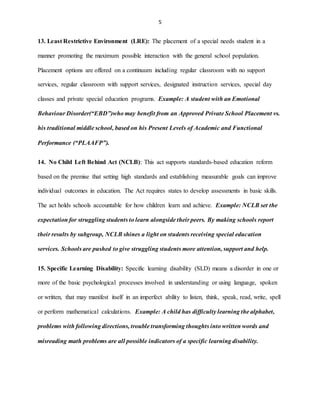
13. Least Restrictive Environment (LRE): The placement of a special needs student in a
manner promoting the maximum possible interaction with the general school population.
Placement options are offered on a continuum including regular classroom with no support
services, regular classroom with support services, designated instruction services, special day
classes and private special education programs. Example: A student with an Emotional
Behaviour Disorder(“EBD”)who may benefit from an Approved Private School Placement vs.
his traditional middle school, based on his Present Levels of Academic and Functional
Performance (“PLAAFP”).
14. No Child Left Behind Act (NCLB): This act supports standards-based education reform
based on the premise that setting high standards and establishing measurable goals can improve
individual outcomes in education. The Act requires states to develop assessments in basic skills.
The act holds schools accountable for how children learn and achieve. Example: NCLB set the
expectation for struggling students to learn alongside their peers. By making schools report
their results by subgroup, NCLB shines a light on students receiving special education
services. Schools are pushed to give struggling students more attention, support and help.
15. Specific Learning Disability: Specific learning disability (SLD) means a disorder in one or
more of the basic psychological processes involved in understanding or using language, spoken
or written, that may manifest itself in an imperfect ability to listen, think, speak, read, write, spell
or perform mathematical calculations. Example: A child has difficulty learning the alphabet,
problems with following directions, trouble transforming thoughts into written words and
misreading math problems are all possible indicators of a specific learning disability.
6
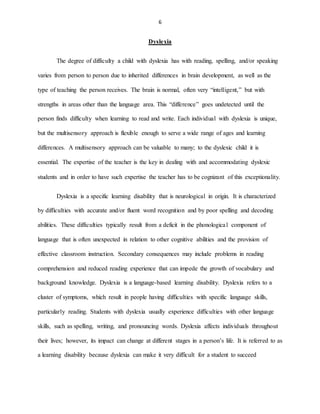
Dyslexia
The degree of difficulty a child with dyslexia has with reading, spelling, and/or speaking
varies from person to person due to inherited differences in brain development, as well as the
type of teaching the person receives. The brain is normal, often very “intelligent,” but with
strengths in areas other than the language area. This “difference” goes undetected until the
person finds difficulty when learning to read and write. Each individual with dyslexia is unique,
but the multisensory approach is flexible enough to serve a wide range of ages and learning
differences. A multisensory approach can be valuable to many; to the dyslexic child it is
essential. The expertise of the teacher is the key in dealing with and accommodating dyslexic
students and in order to have such expertise the teacher has to be cognizant of this exceptionality.
Dyslexia is a specific learning disability that is neurological in origin. It is characterized
by difficulties with accurate and/or fluent word recognition and by poor spelling and decoding
abilities. These difficulties typically result from a deficit in the phonological component of
language that is often unexpected in relation to other cognitive abilities and the provision of
effective classroom instruction. Secondary consequences may include problems in reading
comprehension and reduced reading experience that can impede the growth of vocabulary and
background knowledge. Dyslexia is a language-based learning disability. Dyslexia refers to a
cluster of symptoms, which result in people having difficulties with specific language skills,
particularly reading. Students with dyslexia usually experience difficulties with other language
skills, such as spelling, writing, and pronouncing words. Dyslexia affects individuals throughout
their lives; however, its impact can change at different stages in a person’s life. It is referred to as
a learning disability because dyslexia can make it very difficult for a student to succeed
7
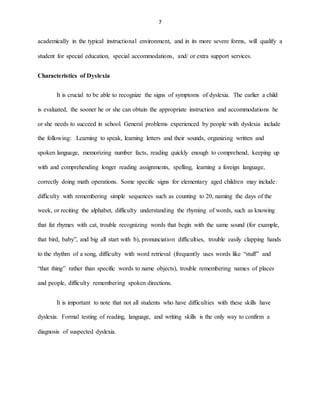
academically in the typical instructional environment, and in its more severe forms, will qualify a
student for special education, special accommodations, and/ or extra support services.
Characteristics of Dyslexia
It is crucial to be able to recognize the signs of symptoms of dyslexia. The earlier a child
is evaluated, the sooner he or she can obtain the appropriate instruction and accommodations he
or she needs to succeed in school. General problems experienced by people with dyslexia include
the following: Learning to speak, learning letters and their sounds, organizing written and
spoken language, memorizing number facts, reading quickly enough to comprehend, keeping up
with and comprehending longer reading assignments, spelling, learning a foreign language,
correctly doing math operations. Some specific signs for elementary aged children may include:
difficulty with remembering simple sequences such as counting to 20, naming the days of the
week, or reciting the alphabet, difficulty understanding the rhyming of words, such as knowing
that fat rhymes with cat, trouble recognizing words that begin with the same sound (for example,
that bird, baby”, and big all start with b), pronunciation difficulties, trouble easily clapping hands
to the rhythm of a song, difficulty with word retrieval (frequently uses words like “stuff” and
“that thing” rather than specific words to name objects), trouble remembering names of places
and people, difficulty remembering spoken directions.
It is important to note that not all students who have difficulties with these skills have
dyslexia. Formal testing of reading, language, and writing skills is the only way to confirm a
diagnosis of suspected dyslexia.
8
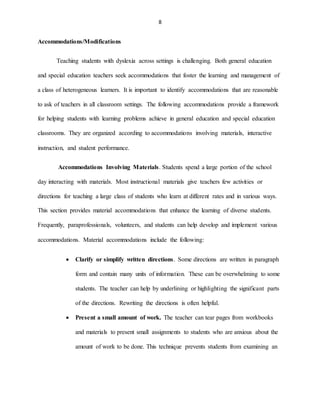
Accommodations/Modifications
Teaching students with dyslexia across settings is challenging. Both general education
and special education teachers seek accommodations that foster the learning and management of
a class of heterogeneous learners. It is important to identify accommodations that are reasonable
to ask of teachers in all classroom settings. The following accommodations provide a framework
for helping students with learning problems achieve in general education and special education
classrooms. They are organized according to accommodations involving materials, interactive
instruction, and student performance.
Accommodations Involving Materials. Students spend a large portion of the school
day interacting with materials. Most instructional materials give teachers few activities or
directions for teaching a large class of students who learn at different rates and in various ways.
This section provides material accommodations that enhance the learning of diverse students.
Frequently, paraprofessionals, volunteers, and students can help develop and implement various
accommodations. Material accommodations include the following:
 Clarify or simplify written directions. Some directions are written in paragraph
form and contain many units of information. These can be overwhelming to some
students. The teacher can help by underlining or highlighting the significant parts
of the directions. Rewriting the directions is often helpful.
 Present a small amount of work. The teacher can tear pages from workbooks
and materials to present small assignments to students who are anxious about the
amount of work to be done. This technique prevents students from examining an
9
entire workbook, text, or material and becoming discouraged by the amount of
work.
 Block out extraneous stimuli. If a student is easily distracted by visual stimuli
on a full worksheet or page, a blank sheet of paper can be used to cover sections
of the page not being worked on at the time. Also, line markers can be used to aid
reading, and windows can be used to display individual math problems.
Additionally, using larger font sizes and increasing spacing can help separate
sections.
 Highlight essential information. If an adolescent can read a regular textbook but
has difficulty finding the essential information, the teacher can mark this
information with a highlight pen.
 Use a placeholder in consumable material. In consumable materials in which
students progress sequentially (such as workbooks), the student can make a
diagonal cut across the lower right-hand corner of the pages as they are
completed. With all the completed pages cut, the student and teacher can readily
locate the next page that needs to be corrected or completed.
 Provide additional practice activities. Some materials do not provide enough
practice activities for students with learning problems to acquire mastery on
selected skills. Teachers then must supplement the material with practice
activities. Recommended practice exercises include instructional games, peer
teaching activities, self-correcting materials, computer software programs, and
additional worksheets.
10
 Provide a glossary in content areas. Students often benefit from a glossary of
content-related terms.
 Developreading guides. A reading guide helps the reader understand the main
ideas and sort out the numerous details related to the main ideas. A reading guide
can be developed paragraph-by-paragraph, page-by-page, or section-by-section.
 Use an audio recording device. Directions, stories, and specific lessons can be
recorded. The student can replay the tape to clarify understanding of directions or
concepts. Also, to improve reading skills, the student can read the printed words
silently as they are presented on tape.
 Use of assistive technology. Assistive technology products such as tablets,
electronic readers/dictionaries/spellers, text to speech programs, audio books, and
more can be very useful tools.
Accommodations Involving Interactive Instruction
The task of gaining students’ attention and engaging them for a period of time requires
many teaching and managing skills. Teaching and interactions should provide successful
learning experiences for each student. Some accommodations to enhance successful interactive
instructional activities are:
 Use explicit teaching procedures. Many commercial materials do not cue
teachers to use explicit teaching procedures; thus, the teacher often must adapt a
material to include these procedures. Teachers can include explicit teaching steps
within their lessons (i.e., present an advanced organizer, demonstrate the skill,
11
provide guided practice, offer corrective feedback, set up independent practice,
monitor practice, and review).
 Repeat directions. Students who have difficulty following directions are often
helped by asking them to repeat the directions in their own words. The student
can repeat the directions to a peer when the teacher is unavailable. If directions
contain several steps, break down the directions into subsets. Simplify directions
by presenting only one portion at a time and by writing each portion on the
chalkboard as well as stating it orally. When using written directions, be sure that
students are able to read and understand the words as well as comprehend the
meaning of sentences.
 Maintain daily routines. Many students with learning problems need the
structure of daily routines to know and do what is expected. Provide a copy of
lesson notes. The teacher can give a copy of lesson notes to students who have
difficulty taking notes during presentations.
 Provide students with a graphic organizer. An outline, chart, or blank web can
be given to students to fill in during presentations. This helps students listen for
key information and see the relationships among concepts and related
information.
 Use step-by-step instruction. New or difficult information can be presented in
small sequential steps. This helps learners with limited prior knowledge that need
explicit or part-to-whole instruction.
 Simultaneously combine verbal and visual information. Verbal information
can be provided with visual displays (e.g., on an overhead or handout). Write key
12
points or words on the chalkboard/whiteboard. Prior to a presentation, the teacher
can write new vocabulary words and key points on the chalkboard/whiteboard.
 Use balanced presentations and activities. An effort should be made to balance
oral presentations with visual information and participatory activities. Also, there
should be a balance between large group, small group, and individual activities.
 Use mnemonic instruction. Mnemonic devices can be used to help students
remember key information or steps in a learning strategy.
 Emphasize daily review. Daily review of previous learning or lessons can help
students connect new information with prior knowledge.
Accommodations Involving Student Performance
Students vary significantly in their ability to respond in different modes. For example,
students vary in their ability to give oral presentations; participate in discussions; write letters
and numbers; write paragraphs; draw objects; spell; work in noisy or cluttered settings; and read,
write, or speak at a fast pace. Moreover, students vary in their ability to process information
presented in visual or auditory formats. The following accommodation involving mode of
reception and expression can be used to enhance students’ performance:
 Change response mode. For students who have difficulty with fine motor
responses (such as handwriting), the response mode can be changed to
underlining, selecting from multiple choices, sorting, or marking. Students with
fine motor problems can be given extra space for writing answers on worksheets
or can be allowed to respond on individual chalkboards/whiteboards.
13
 Provide an outline of the lesson. An outline enables some students to follow the
lesson successfully and make appropriate notes. Moreover, an outline helps
students to see the organization of the material and ask timely questions.
 Encourage use of graphic organizers. A graphic organizer involves organizing
material into a visual format. To develop a graphic organizer, the student can list
the topic on the first line, collect and divide information into major headings, list
all information relating to major headings on index cards, organize information
into major areas, place information under appropriate subheadings, and place
information into the organizer format.
 Place students close to the teacher. Students with attention problems can be
seated close to the teacher, chalkboard/whiteboard, or work area and away from
distracting sounds, materials, or objects.
 Encourage use of assignment books or calendars. Students can use calendars to
record assignment due dates, list school related activities, record test dates, and
schedule timelines for school work. Students should set aside a special section in
an assignment book or calendar for recording homework assignments. Have
students turn lined paper vertically for math. Lined paper can be turned vertically
to help students keep numbers in appropriate columns while computing math
problems.
 Use cues to denote important items. Asterisks or bullets can denote questions or
activities that count heavily in evaluation. This helps students spend time
appropriately during tests or assignments.
14
 Designhierarchical worksheets. The teacher can design worksheets with
problems arranged from easiest to hardest. Early success helps students begin to
work.
 Allow use of instructional aides. Students can be provided with letter and
number strips to help them write correctly. Number lines, counters, calculators,
and other assistive technology can help students compute once they understand
the mathematical operations.
 Display work samples. Samples of completed assignments can be displayed to
help students realize expectations and plan accordingly.
 Use peer-mediated learning. The teacher can pair peers of different ability levels
to review their notes, study for a test, read aloud to each other, write stories, or
conduct laboratory experiments. Also, a partner can read math problems for
students with reading problems to solve.
 Use flexible work times. Students who work slowly can be given additional time
to complete written assignments.
 Provide additional practice. Students require different amounts of practice to
master skills or content. Many students with learning problems need additional
practice to learn at a fluency level.
 Use assignment substitutions or adjustments. Students can be allowed to
complete projects instead of oral reports or vice versa. Also, tests can be given in
oral or written format.
15
Teaching strategies to manage these disabilities in the general classroom
Effective instruction for students with dyslexia is explicit, direct, cumulative, intensive,
and focused on the structure of language. This is the idea of structured language instruction.
Multisensory learning involves the use of visual, auditory, and kinaesthetic-tactile pathways
simultaneously to enhance memory and learning of written language. Links are consistently
made between the visual (language we see), auditory (language we hear), and kinaesthetic-tactile
(language symbols we feel) pathways in learning to read and spell. . Margaret Byrd Rawson, a
former President of the International Dyslexia Association (IDA), said it well:
“Dyslexic students need a different approach to learning language from that employed in
most classrooms. They need to be taught, slowly and thoroughly, the basic elements of their
language—the sounds and the letters which represent them—and how to put these together and
take them apart. They have to have lots of practice in having their writing hands, eyes, ears, and
voices working together for conscious organization and retention of their learning.”
Teachers who use this approach help students perceive the speech sounds in words
(phonemes) by looking in the mirror when they speak or exaggerating the movements of their
mouths. Students learn to link speech sounds (phonemes) to letters or letter patterns by saying
sounds for letters they see, or writing letters for sounds they hear. As students learn a new letter
or pattern (such as s or th), they may repeat five to seven words that are dictated by the teacher
and contain the sound of the new letter or pattern; the students discover the sound that is the
same in all the words. Next, they may look at the words written on a piece of paper or the
chalkboard and discover the new letter or pattern. Finally, they carefully trace, copy, and write
the letter(s) while saying the corresponding sound. The sound may be dictated by the teacher,
and the letter name(s) given by the student. Students then read and spell words, phrases, and
16
sentences using these patterns to build their reading fluency. Teachers and their students rely on
all three pathways for learning rather than focusing on a “whole word memory method,” a
“tracing method,” or a “phonetic method” alone. The principle of combining movement with
speech and reading is applied at other levels of language learning as well. Students may learn
hand gestures to help them memorize the definition of a noun. Students may manipulate word
cards to create sentences or classify the words in sentences by physically moving them into
categories. They might move sentences around to make paragraphs. The elements of a story may
be taught with reference to a three dimensional, tactile aid. In all, the hand, body, and/or
movement are used to support comprehension or production of language.
17
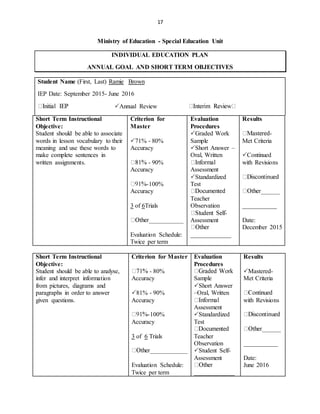
Ministry of Education - Special Education Unit
INDIVIDUAL EDUCATION PLAN
ANNUAL GOAL AND SHORT TERM OBJECTIVES
Student Name (First, Last) Ramie Brown
IEP Date: September 2015- June 2016
Annual Review
Short Term Instructional
Objective:
Student should be able to associate
words in lesson vocabulary to their
meaning and use these words to
make complete sentences in
written assignments.
Criterion for
Master
71% - 80%
Accuracy
- 90%
Accuracy
-100%
Accuracy
3 of 6Trials
Evaluation Schedule:
Twice per term
Evaluation
Procedures
Graded Work
Sample
Short Answer –
Oral, Written
Assessment
Standardized
Test
Teacher
Observation
-
Assessment
_____________
Results
-
Met Criteria
Continued
with Revisions
___________
Date:
December 2015
Short Term Instructional
Objective:
Student should be able to analyse,
infer and interpret information
from pictures, diagrams and
paragraphs in order to answer
given questions.
Criterion for Master
- 80%
Accuracy
81% - 90%
Accuracy
-100%
Accuracy
3 of 6 Trials
Evaluation Schedule:
Twice per term
Evaluation
Procedures
Sample
Short Answer
–Oral, Written
Assessment
Standardized
Test
Teacher
Observation
Student Self-
Assessment
_____________
Results
Mastered-
Met Criteria
with Revisions
___________
Date:
June 2016
18
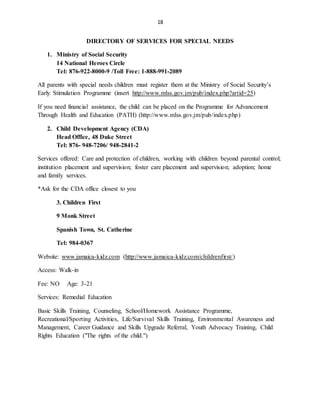
DIRECTORY OF SERVICES FOR SPECIAL NEEDS
1. Ministry of Social Security
14 National Heroes Circle
Tel: 876-922-8000-9 /Toll Free: 1-888-991-2089
All parents with special needs children must register them at the Ministry of Social Security’s
Early Stimulation Programme (insert http://www.mlss.gov.jm/pub/index.php?artid=25)
If you need financial assistance, the child can be placed on the Programme for Advancement
Through Health and Education (PATH) (http://www.mlss.gov.jm/pub/index.php)
2. Child Development Agency (CDA)
Head Office, 48 Duke Street
Tel: 876- 948-7206/ 948-2841-2
Services offered: Care and protection of children, working with children beyond parental control;
institution placement and supervision; foster care placement and supervision; adoption; home
and family services.
*Ask for the CDA office closest to you
3. Children First
9 Monk Street
Spanish Town, St. Catherine
Tel: 984-0367
Website: www.jamaica-kidz.com (http://www.jamaica-kidz.com/childrenfirst/)
Access: Walk-in
Fee: NO Age: 3-21
Services: Remedial Education
Basic Skills Training, Counseling, School/Homework Assistance Programme,
Recreational/Sporting Activities, Life/Survival Skills Training, Environmental Awareness and
Management, Career Guidance and Skills Upgrade Referral, Youth Advocacy Training, Child
Rights Education ("The rights of the child.")
19
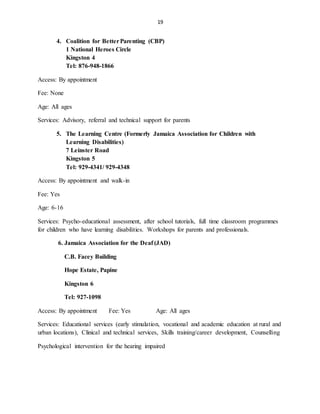
4. Coalition for BetterParenting (CBP)
1 National Heroes Circle
Kingston 4
Tel: 876-948-1866
Access: By appointment
Fee: None
Age: All ages
Services: Advisory, referral and technical support for parents
5. The Learning Centre (Formerly Jamaica Association for Children with
Learning Disabilities)
7 Leinster Road
Kingston 5
Tel: 929-4341/ 929-4348
Access: By appointment and walk-in
Fee: Yes
Age: 6-16
Services: Psycho-educational assessment, after school tutorials, full time classroom programmes
for children who have learning disabilities. Workshops for parents and professionals.
6. Jamaica Association for the Deaf (JAD)
C.B. Facey Building
Hope Estate, Papine
Kingston 6
Tel: 927-1098
Access: By appointment Fee: Yes Age: All ages
Services: Educational services (early stimulation, vocational and academic education at rural and
urban locations), Clinical and technical services, Skills training/career development, Counselling
Psychological intervention for the hearing impaired
20
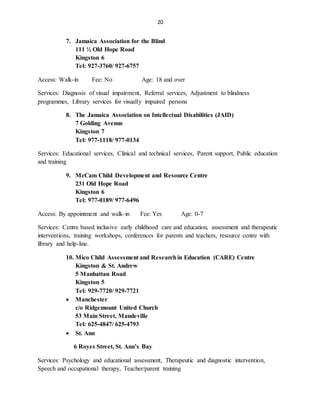
7. Jamaica Association for the Blind
111 ½ Old Hope Road
Kingston 6
Tel: 927-3760/ 927-6757
Access: Walk-in Fee: No Age: 18 and over
Services: Diagnosis of visual impairment, Referral services, Adjustment to blindness
programmes, Library services for visually impaired persons
8. The Jamaica Association on Intellectual Disabilities (JAID)
7 Golding Avenue
Kingston 7
Tel: 977-1118/ 977-0134
Services: Educational services, Clinical and technical services, Parent support, Public education
and training
9. McCam Child Development and Resource Centre
231 Old Hope Road
Kingston 6
Tel: 977-0189/ 977-6496
Access: By appointment and walk-in Fee: Yes Age: 0-7
Services: Centre based inclusive early childhood care and education, assessment and therapeutic
interventions, training workshops, conferences for parents and teachers, resource centre with
library and help-line.
10. Mico Child Assessment and Researchin Education (CARE) Centre
Kingston & St. Andrew
5 Manhattan Road
Kingston 5
Tel: 929-7720/ 929-7721
 Manchester
c/o Ridgemount United Church
53 Main Street, Mandeville
Tel: 625-4847/ 625-4793
 St. Ann
6 Royes Street, St. Ann’s Bay
Services: Psychology and educational assessment, Therapeutic and diagnostic intervention,
Speech and occupational therapy, Teacher/parent training
21
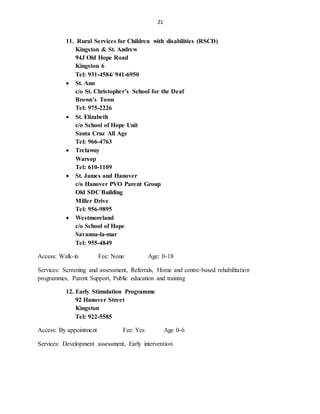
11. Rural Services for Children with disabilities (RSCD)
Kingston & St. Andrew
94J Old Hope Road
Kingston 6
Tel: 931-4584/ 941-6950
 St. Ann
c/o St. Christopher’s School for the Deaf
Brown’s Town
Tel: 975-2226
 St. Elizabeth
c/o School of Hope Unit
Santa Cruz All Age
Tel: 966-4763
 Trelawny
Warsop
Tel: 610-1109
 St. James and Hanover
c/o Hanover PVO Parent Group
Old SDC Building
Miller Drive
Tel: 956-9895
 Westmoreland
c/o School of Hope
Savanna-la-mar
Tel: 955-4849
Access: Walk-in Fee: None Age: 0-18
Services: Screening and assessment, Referrals, Home and centre-based rehabilitation
programmes, Parent Support, Public education and training
12. Early Stimulation Programme
92 Hanover Street
Kingston
Tel: 922-5585
Access: By appointment Fee: Yes Age 0-6
Services: Development assessment, Early intervention
22
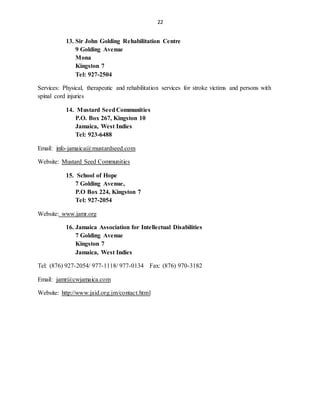
13. Sir John Golding Rehabilitation Centre
9 Golding Avenue
Mona
Kingston 7
Tel: 927-2504
Services: Physical, therapeutic and rehabilitation services for stroke victims and persons with
spinal cord injuries
14. Mustard SeedCommunities
P.O. Box 267, Kingston 10
Jamaica, West Indies
Tel: 923-6488
Email: info-jamaica@mustardseed.com
Website: Mustard Seed Communities
15. School of Hope
7 Golding Avenue,
P.O Box 224, Kingston 7
Tel: 927-2054
Website: www.jamr.org
16. Jamaica Association for Intellectual Disabilities
7 Golding Avenue
Kingston 7
Jamaica, West Indies
Tel: (876) 927-2054/ 977-1118/ 977-0134 Fax: (876) 970-3182
Email: jamr@cwjamaica.com
Website: http://www.jaid.org.jm/contact.html
23
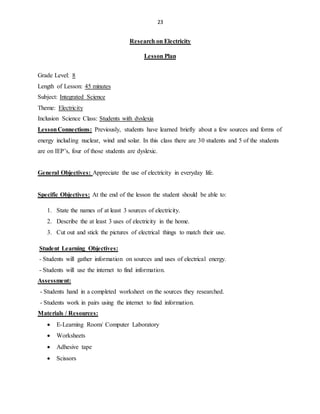
Research on Electricity
Lesson Plan
Grade Level: 8
Length of Lesson: 45 minutes
Subject: Integrated Science
Theme: Electricity
Inclusion Science Class: Students with dyslexia
LessonConnections: Previously, students have learned briefly about a few sources and forms of
energy including nuclear, wind and solar. In this class there are 30 students and 5 of the students
are on IEP’s, four of those students are dyslexic.
General Objectives: Appreciate the use of electricity in everyday life.
Specific Objectives: At the end of the lesson the student should be able to:
1. State the names of at least 3 sources of electricity.
2. Describe the at least 3 uses of electricity in the home.
3. Cut out and stick the pictures of electrical things to match their use.
Student Learning Objectives:
- Students will gather information on sources and uses of electrical energy.
- Students will use the internet to find information.
Assessment:
- Students hand in a completed worksheet on the sources they researched.
- Students work in pairs using the internet to find information.
Materials / Resources:
 E-Learning Room/ Computer Laboratory
 Worksheets
 Adhesive tape
 Scissors
24
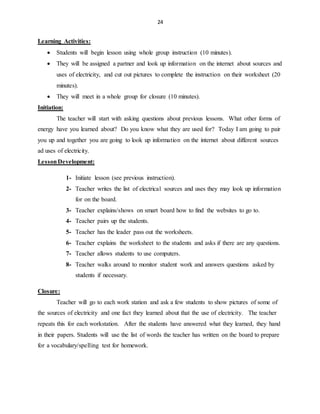
Learning Activities:
 Students will begin lesson using whole group instruction (10 minutes).
 They will be assigned a partner and look up information on the internet about sources and
uses of electricity, and cut out pictures to complete the instruction on their worksheet (20
minutes).
 They will meet in a whole group for closure (10 minutes).
Initiation:
The teacher will start with asking questions about previous lessons. What other forms of
energy have you learned about? Do you know what they are used for? Today I am going to pair
you up and together you are going to look up information on the internet about different sources
ad uses of electricity.
LessonDevelopment:
1- Initiate lesson (see previous instruction).
2- Teacher writes the list of electrical sources and uses they may look up information
for on the board.
3- Teacher explains/shows on smart board how to find the websites to go to.
4- Teacher pairs up the students.
5- Teacher has the leader pass out the worksheets.
6- Teacher explains the worksheet to the students and asks if there are any questions.
7- Teacher allows students to use computers.
8- Teacher walks around to monitor student work and answers questions asked by
students if necessary.
Closure:
Teacher will go to each work station and ask a few students to show pictures of some of
the sources of electricity and one fact they learned about that the use of electricity. The teacher
repeats this for each workstation. After the students have answered what they learned, they hand
in their papers. Students will use the list of words the teacher has written on the board to prepare
for a vocabulary/spelling test for homework.
25
Differentiation
While I was explaining the activity to the class, I modelled what they were going to be
doing first. For the students on the IEP’s I will make sure to stop by their desks to ensure that
they understand the assignment. Each group of student is to hand in a worksheet, for the
dyslexic students, they are able to dictate to their partner what they would like written down and
cut out the correct pictures provided on the worksheet. Since the students will be using the
computer I have pre-selected the websites they are to go to, for some students I will direct them
to a certain website that is easier to navigate through. The website will have fewer words on the
pages, but the same information.
Co-teaching component
In this class there are 5 students that are on IEP’s and there is also a Reading Specialist in
the school. During this lesson she was present. While explaining the activity and showing the
students what to do, the Reading Specialist stayed near them to let them go through the steps on
the computer as well. Before the class the Reading Specialist and I sat and went through the
lesson along with the vocabulary that will be used in the lesson, and I explained to her what was
expected from the students with IEP’s. The Reading Specialist and I both moved around the
classroom to monitor. The Reading Specialist and I both agreed in the beginning that she would
be a help to all the students not just the 5 on IEP’s, so they do not feel isolated.
26
27
REFLECTION ON THE IMPACT OF SPECIAL NEEDS EDUCATION
As teachers, we look forward to each academic year to provide fresh ideas for students’
improved academic performance. One of the most important tasks for all teachers is to help
students with disabilities participate in general education as much as possible. The general
education environment—the core environment—provides the best access to the content that all
students are expected to learn. We have a unique opportunity to be a part of the work of
implementing the newly adopted common core standards of dealing with exceptionalities with
the perusal of the course Special Needs in Education. We will need to contribute our best ideas
regarding appropriate accommodations that can be used in classroom instruction and assessment
to ensure that all students are benefiting from these standards. We also need to ensure the
meaningful participation of students with disabilities in the large-scale assessment that all
students must take.
It’s with a this level of cognizance that we as teachers must be mindful of the fact that the
responsibility is ours to become content experts, leading the discussion within our schools
around the components of special needs that are content specific . We should also be initiating,
planning, and conducting universal screening of all students ensuring that all students are catered
for. Teachers must utilize universal screening data to guide teaching and learning activities for
all students and in turn initiate and conduct student progress monitoring for implementation with
all students. These best practices will allow teachers to make meaningful instructional
adjustments based upon ongoing progress monitoring data. This will allow for sharing data and
student progress with all other teachers thus allowing us to making adjustments across the
curriculum.
28
With the current nature of teacher preparation programs and their reported limitations in
equipping teachers for inclusion, it may be that factors associated with teachers’ attitudes such as
discomfort, fear, uncertainty, sympathy, vulnerability and coping, may be important
considerations for the perusal of a course in Special Needs Education. Participation in this course
has had the greatest impact in two areas, namely, uncertainty and coping. On a personal note, the
most noticeable improvement regarding interactions with a person with a disability was that I felt
less ignorant, more able to act normally and surer of how to behave, as soon as I’ve had
completed the course. It was evident in my approach that I also demonstrated less pity and a
greater focus on the person rather than the disability. Given my relative youthfulness and limited
experience of the present research, it would seem that participation in the course (which included
some elements considered essential for development of a supportive school environment) has
contributed to my personal growth as well as my knowledge of individuals with disabilities. This
personal growth provides a sense of maturity and confidence which will enable me to use in
teaching of all students and particularly those with special needs.
The fulfilment of this course has brought to light certain legal applications that are
incurred in teaching children with disabilities including The Disabilities Act, No Child Left
Behind Act and Least Restrictive Environment. These amendments serve as legal bonds to
ensure that teachers are held accountable for any prejudice or disregard for students with
exceptionalities. Special Needs in Education will help me to appreciate the importance of
individual differences, knowing that all learners do not develop at the same level and are not
likely to learn the same things at the same time. This will help me to underscore the individual
strengths and weaknesses. As a Science Teacher, this course has helped me to understand that
some children have vision but cannot read, a phenomenon called word blindness, while some
29
children have specific difficulties with school subject not because they are lazy but because the
problem is a result of intrinsic or inherent problems. An understanding of Special Needs in
Education will improve and develop a variety of my teaching methods, equip me with the
capacity to procure and use a wide range of teaching and learning materials that can be adapted
to suit the learning needs of every individual. I will be able to educate parents on how to manage
special children; parents through me will become more aware of the causes and prevention of
disabilities.
The ill informed and negative impression about special education will change, once
teachers become aware that special education is not exclusively for persons with obvious
disabilities. Teachers like me will become aware of their children’s disabilities as well as their
own and will realize that special education cuts across all subject areas and that where their
subject ends is precisely where special education begins. Knowledge of Special Needs Education
will expose us to scientific causes of disabilities as I am now better able understand the learning
difficulties and problems of children. It is because of this course that I will also have an insight
into the psychology of disabilities. I will have a better understanding of students’ successes,
failures and struggles during the school period and use this understanding of learning problems
to prevent other children from going through such traumatic and lonely experiences while they
are under my care.
Clearly Special Needs in Education has a of relevance for the teacher and it is therefore
important for all teachers to be exposed to the rudiments in special education so as to become
effective in their teaching, understanding the needs of all students and helping children who will
be at risk for disabilities and failure in school.
30
REFERENCES
Deno, S., Fuchs, L., Marston, D., & Shin, J. (2001). Using curriculum-based measurement to
establish growth standards for students with learning disabilities. School Psychology
Review, 30, 507-524.
Fuchs, L., & Fuchs, D. (2000). Analogue assessment of academic skills: Curriculum-based
measurement and performance assessment. Behavioral assessment in schools: Theory,
research, and clinical foundations (2nd ed). Shapiro, E., & Kratochwill, T., (Ed). New
York, NY, US: Guilford press, pp. 168-201.
Hayes, K.J. (2002). Ensuring that students with disabilities receive a high-quality education: The
No Child Left Behind Act. Retrieved from:
http://www.ed.gov/print/policy/speced/leg/ncclb-dis.html.
Heward, W. (2003). Ten faulty notions about teaching and learning that hinder the effectiveness
of special education. Journal of Special Education, 36, 186-205.
Mercer, C. (2004). Accommodating students with dyslexia in all classroom settings.
Moats, L., & Dakin, K. (2008). Moats, L., & Dakin, K. (2008). Dyslexia basics, 1-3. Retrieved
from IDA website: www.interdys.org.
Moats, L., & Dakin, K. (2008). Basic facts about dyslexia and other reading problems.
Baltimore, MD: International Dyslexia Association.
Ryan, M. (2004). Social and emotional problems related to dyslexia, 1-5. Retrieved from IDA
website: www.interdys.org.
School age dyslexia screener (2013, October) Retrieved from IDA website:
http:www.interdys.org
31
Kochlar, C., West, L., & Taymans, J. (2000). Successful inclusion: Practical strategies for a
shared responsibility. (2nd ed.). Upper Saddle River, NJ: Merrill.
Shultz, J. (2013). The dyslexia-stress-anxiety connection, 1-4. Retrieved from IDA website:
www.interdys.org.
Resources For Special Needs Children. Retrieved from:
http://www.digjamaica.com/special_needs
Weiss, M. P., & Lloyd, J. W. (2002). Congruence between roles and actions of secondary special
educators in co-taught and special education settings. The Journal of Special Education,
36, 58-68.

Special Needs Portfolio 1

  • 1.
    1 Glossary of Terms 1."504Plan": This an individualized plan developed for a student with a disability that specifies what accommodations and/or services they will get in school to "level the playing field" so that they may derive as much benefit from their public educational program as their nondisabled peers. Example: The plan follows from the requirements of Section 504 of the Rehabilitation Act of 1973, and also applies to extracurricular activities and non-student situations such as employment. 2. ADD/ADHD: Attention deficit disorder and attention deficit hyperactivity disorder are medical conditions characterized by a child's inability to focus, while possessing impulsivity, fidgeting and inattention. ADHD stands for Attention Deficit Hyperactivity Disorder, a condition with symptoms such as inattentiveness, impulsivity, and hyperactivity. The symptoms differ from person to person. Example: The child is moving all the time, the child is unable to sit still, the child wiggles and fidgets, the child talks incessantly, the child skips, runs, jumps, walks, bends, and climbs when others are standing still, the child is loud when asked to play quietly. 3. At Risk: The term at-risk is often used to describe students or groups of students who are considered to have a higher probability of failing academically or dropping out of school. The term may be applied to students who face circumstances that could jeopardize their ability to complete school. Example: Children who are homelessness, incarceration, teenage pregnancy, serious health issues, domestic violence, transiency (as in the case of migrant-worker families), or other conditions, or it may refer to learning disabilities, low test scores, disciplinary problems, grade retentions, or other learning-related factors that could adversely affect the educational performance and attainment of some students.
  • 2.
    2 4. Autism: Abrain development disorder characterized by impaired social interaction, communication and by restricted and repetitive behaviour. Signs usually begin before a child is 3 years old. Example: Children with autism appear to be fascinated by details that most of us would overlook. They can spend hours watching a small object, turning it over in their hands, examining it. They can listen to a recording over and over. They often like to check the textures or the smells of objects or people that they are near. Some of the children will lick objects. Some of the children will put inappropriate things in their mouths. 5. Bipolar Disorders: Characterized by cycles of mania alternating with depression. It is difficult to diagnose children with this disorder and often controversial. Example: People with bipolar disorder experience unusually intense emotional states that occur in distinct periods called "mood episodes. Each mood episode represents a drastic change from a person’s usual mood and behaviour. An overly joyful or overexcited state is called a manic episode, and an extremely sad or hopeless state is called a depressive episode. Sometimes, a mood episode includes symptoms of both mania and depression. This is called a mixed state. 6. Cerebral Palsy: A series of motor problems and physical disorders related to brain injury. CP causes uncontrollable reflex movements and muscle tightness and may cause problems in balance and depth perception. Severe cases can result in mental retardation, seizures or vision. Example: A child with CP has trouble controlling the muscles of the body. Normally, the brain tells the rest of the body exactly what to do and when to do it. But because CP affects the brain, depending on what part of the brain is affected, a kid might not be able to walk, talk, eat, or play the way most kids do.
  • 3.
    3 7. Disability: Physicalor mental impairment that substantially limits one or more major life activities. A "disability" is often distinguished from a "handicap" by reference to the setting and environmental demands: a person who uses a wheelchair for mobility is not “handicapped" in an employment setting that does not require her to walk or do steps, whereas in another setting she might be "handicapped." Example: A person with a disability may also be "handicapped" due to society's attitude towards the disability, e.g., if society views people with neurobiological conditions as being "crazy" or somehow "less than" others, then the individual with such a known diagnosis may be considered "handicapped." 8. Free Appropriate Public Education (FAPE): Free Appropriate Public Education (FAPE) is an educational right of children with disabilities that is guaranteed by the Rehabilitation Act and the Individuals with Disabilities Education Act (IDEA). Example: Students with disabilities and students without disabilities must be placed in the same setting, to the maximum extent appropriate to the education needs of the students with disabilities. 9. Individuals with Disabilities Education Act (IDEA 2004): The Individuals with Disabilities Education Act (IDEA) is a law that requires schools to serve the educational needs of eligible students with disabilities. IDEA defines "special education" as "specially designed instruction to meet the unique needs of a child with a disability," including instruction conducted in the classroom and in other settings. It is a "Specially Designed Instruction" or means of adapting the content, methodology, or delivery of instruction to address the child's unique disability-related needs and enable the child to meet the standards embedded in the regular education curriculum adopted for all students. Example: IDEA contains detailed requirements for planning the education of individual students. Each student is provided a comprehensive evaluation of his or her educational needs at least once every three years. IDEA consists of evaluations and
  • 4.
    4 evaluation requirements, andthe role they may play in ensuring high quality, equitable learning for school-to-work participants with disabilities. 10. Individualized Education Plan (IEP): An IEP is an Individualized Education Plan developed for students with disabilities to ensure their educational goals are achieved. An Individualized Education Plan (IEP) is a required step in the process of receiving special education services. A student's parents, teachers, and other service providers meet to come to a consensus about the educational accommodations necessary to assist the student in meeting the objectives. Example: IEPs are required to include certain information including, but not limited to, the child's current level of performance, goals, accommodations, modification, services, and least restriction environment explanations. 11. Independent Educational Evaluation (IEE): A school district is required by law to conduct assessments for students who may be eligible for special education. The district must provide parents with information about how to obtain an IEE. An independent educational evaluation means an evaluation conducted by a qualified examiner who is not employed by the school district. Example: If the parent disagrees with the results of a school district's evaluation conducted on their child, they have the right to request an independent educational evaluation. 12. Individualized Education Program Team: This is a term used to describe the committee of parents, teachers, administrators and school personnel that provides services to the student. The committee may also include medical professional and other relevant parties. Example: The team may review assessment results, determine goals and objectives and program placement for the child needing services.
  • 5.
    5 13. Least RestrictiveEnvironment (LRE): The placement of a special needs student in a manner promoting the maximum possible interaction with the general school population. Placement options are offered on a continuum including regular classroom with no support services, regular classroom with support services, designated instruction services, special day classes and private special education programs. Example: A student with an Emotional Behaviour Disorder(“EBD”)who may benefit from an Approved Private School Placement vs. his traditional middle school, based on his Present Levels of Academic and Functional Performance (“PLAAFP”). 14. No Child Left Behind Act (NCLB): This act supports standards-based education reform based on the premise that setting high standards and establishing measurable goals can improve individual outcomes in education. The Act requires states to develop assessments in basic skills. The act holds schools accountable for how children learn and achieve. Example: NCLB set the expectation for struggling students to learn alongside their peers. By making schools report their results by subgroup, NCLB shines a light on students receiving special education services. Schools are pushed to give struggling students more attention, support and help. 15. Specific Learning Disability: Specific learning disability (SLD) means a disorder in one or more of the basic psychological processes involved in understanding or using language, spoken or written, that may manifest itself in an imperfect ability to listen, think, speak, read, write, spell or perform mathematical calculations. Example: A child has difficulty learning the alphabet, problems with following directions, trouble transforming thoughts into written words and misreading math problems are all possible indicators of a specific learning disability.
  • 6.
    6 Dyslexia The degree ofdifficulty a child with dyslexia has with reading, spelling, and/or speaking varies from person to person due to inherited differences in brain development, as well as the type of teaching the person receives. The brain is normal, often very “intelligent,” but with strengths in areas other than the language area. This “difference” goes undetected until the person finds difficulty when learning to read and write. Each individual with dyslexia is unique, but the multisensory approach is flexible enough to serve a wide range of ages and learning differences. A multisensory approach can be valuable to many; to the dyslexic child it is essential. The expertise of the teacher is the key in dealing with and accommodating dyslexic students and in order to have such expertise the teacher has to be cognizant of this exceptionality. Dyslexia is a specific learning disability that is neurological in origin. It is characterized by difficulties with accurate and/or fluent word recognition and by poor spelling and decoding abilities. These difficulties typically result from a deficit in the phonological component of language that is often unexpected in relation to other cognitive abilities and the provision of effective classroom instruction. Secondary consequences may include problems in reading comprehension and reduced reading experience that can impede the growth of vocabulary and background knowledge. Dyslexia is a language-based learning disability. Dyslexia refers to a cluster of symptoms, which result in people having difficulties with specific language skills, particularly reading. Students with dyslexia usually experience difficulties with other language skills, such as spelling, writing, and pronouncing words. Dyslexia affects individuals throughout their lives; however, its impact can change at different stages in a person’s life. It is referred to as a learning disability because dyslexia can make it very difficult for a student to succeed
  • 7.
    7 academically in thetypical instructional environment, and in its more severe forms, will qualify a student for special education, special accommodations, and/ or extra support services. Characteristics of Dyslexia It is crucial to be able to recognize the signs of symptoms of dyslexia. The earlier a child is evaluated, the sooner he or she can obtain the appropriate instruction and accommodations he or she needs to succeed in school. General problems experienced by people with dyslexia include the following: Learning to speak, learning letters and their sounds, organizing written and spoken language, memorizing number facts, reading quickly enough to comprehend, keeping up with and comprehending longer reading assignments, spelling, learning a foreign language, correctly doing math operations. Some specific signs for elementary aged children may include: difficulty with remembering simple sequences such as counting to 20, naming the days of the week, or reciting the alphabet, difficulty understanding the rhyming of words, such as knowing that fat rhymes with cat, trouble recognizing words that begin with the same sound (for example, that bird, baby”, and big all start with b), pronunciation difficulties, trouble easily clapping hands to the rhythm of a song, difficulty with word retrieval (frequently uses words like “stuff” and “that thing” rather than specific words to name objects), trouble remembering names of places and people, difficulty remembering spoken directions. It is important to note that not all students who have difficulties with these skills have dyslexia. Formal testing of reading, language, and writing skills is the only way to confirm a diagnosis of suspected dyslexia.
  • 8.
    8 Accommodations/Modifications Teaching students withdyslexia across settings is challenging. Both general education and special education teachers seek accommodations that foster the learning and management of a class of heterogeneous learners. It is important to identify accommodations that are reasonable to ask of teachers in all classroom settings. The following accommodations provide a framework for helping students with learning problems achieve in general education and special education classrooms. They are organized according to accommodations involving materials, interactive instruction, and student performance. Accommodations Involving Materials. Students spend a large portion of the school day interacting with materials. Most instructional materials give teachers few activities or directions for teaching a large class of students who learn at different rates and in various ways. This section provides material accommodations that enhance the learning of diverse students. Frequently, paraprofessionals, volunteers, and students can help develop and implement various accommodations. Material accommodations include the following:  Clarify or simplify written directions. Some directions are written in paragraph form and contain many units of information. These can be overwhelming to some students. The teacher can help by underlining or highlighting the significant parts of the directions. Rewriting the directions is often helpful.  Present a small amount of work. The teacher can tear pages from workbooks and materials to present small assignments to students who are anxious about the amount of work to be done. This technique prevents students from examining an
  • 9.
    9 entire workbook, text,or material and becoming discouraged by the amount of work.  Block out extraneous stimuli. If a student is easily distracted by visual stimuli on a full worksheet or page, a blank sheet of paper can be used to cover sections of the page not being worked on at the time. Also, line markers can be used to aid reading, and windows can be used to display individual math problems. Additionally, using larger font sizes and increasing spacing can help separate sections.  Highlight essential information. If an adolescent can read a regular textbook but has difficulty finding the essential information, the teacher can mark this information with a highlight pen.  Use a placeholder in consumable material. In consumable materials in which students progress sequentially (such as workbooks), the student can make a diagonal cut across the lower right-hand corner of the pages as they are completed. With all the completed pages cut, the student and teacher can readily locate the next page that needs to be corrected or completed.  Provide additional practice activities. Some materials do not provide enough practice activities for students with learning problems to acquire mastery on selected skills. Teachers then must supplement the material with practice activities. Recommended practice exercises include instructional games, peer teaching activities, self-correcting materials, computer software programs, and additional worksheets.
  • 10.
    10  Provide aglossary in content areas. Students often benefit from a glossary of content-related terms.  Developreading guides. A reading guide helps the reader understand the main ideas and sort out the numerous details related to the main ideas. A reading guide can be developed paragraph-by-paragraph, page-by-page, or section-by-section.  Use an audio recording device. Directions, stories, and specific lessons can be recorded. The student can replay the tape to clarify understanding of directions or concepts. Also, to improve reading skills, the student can read the printed words silently as they are presented on tape.  Use of assistive technology. Assistive technology products such as tablets, electronic readers/dictionaries/spellers, text to speech programs, audio books, and more can be very useful tools. Accommodations Involving Interactive Instruction The task of gaining students’ attention and engaging them for a period of time requires many teaching and managing skills. Teaching and interactions should provide successful learning experiences for each student. Some accommodations to enhance successful interactive instructional activities are:  Use explicit teaching procedures. Many commercial materials do not cue teachers to use explicit teaching procedures; thus, the teacher often must adapt a material to include these procedures. Teachers can include explicit teaching steps within their lessons (i.e., present an advanced organizer, demonstrate the skill,
  • 11.
    11 provide guided practice,offer corrective feedback, set up independent practice, monitor practice, and review).  Repeat directions. Students who have difficulty following directions are often helped by asking them to repeat the directions in their own words. The student can repeat the directions to a peer when the teacher is unavailable. If directions contain several steps, break down the directions into subsets. Simplify directions by presenting only one portion at a time and by writing each portion on the chalkboard as well as stating it orally. When using written directions, be sure that students are able to read and understand the words as well as comprehend the meaning of sentences.  Maintain daily routines. Many students with learning problems need the structure of daily routines to know and do what is expected. Provide a copy of lesson notes. The teacher can give a copy of lesson notes to students who have difficulty taking notes during presentations.  Provide students with a graphic organizer. An outline, chart, or blank web can be given to students to fill in during presentations. This helps students listen for key information and see the relationships among concepts and related information.  Use step-by-step instruction. New or difficult information can be presented in small sequential steps. This helps learners with limited prior knowledge that need explicit or part-to-whole instruction.  Simultaneously combine verbal and visual information. Verbal information can be provided with visual displays (e.g., on an overhead or handout). Write key
  • 12.
    12 points or wordson the chalkboard/whiteboard. Prior to a presentation, the teacher can write new vocabulary words and key points on the chalkboard/whiteboard.  Use balanced presentations and activities. An effort should be made to balance oral presentations with visual information and participatory activities. Also, there should be a balance between large group, small group, and individual activities.  Use mnemonic instruction. Mnemonic devices can be used to help students remember key information or steps in a learning strategy.  Emphasize daily review. Daily review of previous learning or lessons can help students connect new information with prior knowledge. Accommodations Involving Student Performance Students vary significantly in their ability to respond in different modes. For example, students vary in their ability to give oral presentations; participate in discussions; write letters and numbers; write paragraphs; draw objects; spell; work in noisy or cluttered settings; and read, write, or speak at a fast pace. Moreover, students vary in their ability to process information presented in visual or auditory formats. The following accommodation involving mode of reception and expression can be used to enhance students’ performance:  Change response mode. For students who have difficulty with fine motor responses (such as handwriting), the response mode can be changed to underlining, selecting from multiple choices, sorting, or marking. Students with fine motor problems can be given extra space for writing answers on worksheets or can be allowed to respond on individual chalkboards/whiteboards.
  • 13.
    13  Provide anoutline of the lesson. An outline enables some students to follow the lesson successfully and make appropriate notes. Moreover, an outline helps students to see the organization of the material and ask timely questions.  Encourage use of graphic organizers. A graphic organizer involves organizing material into a visual format. To develop a graphic organizer, the student can list the topic on the first line, collect and divide information into major headings, list all information relating to major headings on index cards, organize information into major areas, place information under appropriate subheadings, and place information into the organizer format.  Place students close to the teacher. Students with attention problems can be seated close to the teacher, chalkboard/whiteboard, or work area and away from distracting sounds, materials, or objects.  Encourage use of assignment books or calendars. Students can use calendars to record assignment due dates, list school related activities, record test dates, and schedule timelines for school work. Students should set aside a special section in an assignment book or calendar for recording homework assignments. Have students turn lined paper vertically for math. Lined paper can be turned vertically to help students keep numbers in appropriate columns while computing math problems.  Use cues to denote important items. Asterisks or bullets can denote questions or activities that count heavily in evaluation. This helps students spend time appropriately during tests or assignments.
  • 14.
    14  Designhierarchical worksheets.The teacher can design worksheets with problems arranged from easiest to hardest. Early success helps students begin to work.  Allow use of instructional aides. Students can be provided with letter and number strips to help them write correctly. Number lines, counters, calculators, and other assistive technology can help students compute once they understand the mathematical operations.  Display work samples. Samples of completed assignments can be displayed to help students realize expectations and plan accordingly.  Use peer-mediated learning. The teacher can pair peers of different ability levels to review their notes, study for a test, read aloud to each other, write stories, or conduct laboratory experiments. Also, a partner can read math problems for students with reading problems to solve.  Use flexible work times. Students who work slowly can be given additional time to complete written assignments.  Provide additional practice. Students require different amounts of practice to master skills or content. Many students with learning problems need additional practice to learn at a fluency level.  Use assignment substitutions or adjustments. Students can be allowed to complete projects instead of oral reports or vice versa. Also, tests can be given in oral or written format.
  • 15.
    15 Teaching strategies tomanage these disabilities in the general classroom Effective instruction for students with dyslexia is explicit, direct, cumulative, intensive, and focused on the structure of language. This is the idea of structured language instruction. Multisensory learning involves the use of visual, auditory, and kinaesthetic-tactile pathways simultaneously to enhance memory and learning of written language. Links are consistently made between the visual (language we see), auditory (language we hear), and kinaesthetic-tactile (language symbols we feel) pathways in learning to read and spell. . Margaret Byrd Rawson, a former President of the International Dyslexia Association (IDA), said it well: “Dyslexic students need a different approach to learning language from that employed in most classrooms. They need to be taught, slowly and thoroughly, the basic elements of their language—the sounds and the letters which represent them—and how to put these together and take them apart. They have to have lots of practice in having their writing hands, eyes, ears, and voices working together for conscious organization and retention of their learning.” Teachers who use this approach help students perceive the speech sounds in words (phonemes) by looking in the mirror when they speak or exaggerating the movements of their mouths. Students learn to link speech sounds (phonemes) to letters or letter patterns by saying sounds for letters they see, or writing letters for sounds they hear. As students learn a new letter or pattern (such as s or th), they may repeat five to seven words that are dictated by the teacher and contain the sound of the new letter or pattern; the students discover the sound that is the same in all the words. Next, they may look at the words written on a piece of paper or the chalkboard and discover the new letter or pattern. Finally, they carefully trace, copy, and write the letter(s) while saying the corresponding sound. The sound may be dictated by the teacher, and the letter name(s) given by the student. Students then read and spell words, phrases, and
  • 16.
    16 sentences using thesepatterns to build their reading fluency. Teachers and their students rely on all three pathways for learning rather than focusing on a “whole word memory method,” a “tracing method,” or a “phonetic method” alone. The principle of combining movement with speech and reading is applied at other levels of language learning as well. Students may learn hand gestures to help them memorize the definition of a noun. Students may manipulate word cards to create sentences or classify the words in sentences by physically moving them into categories. They might move sentences around to make paragraphs. The elements of a story may be taught with reference to a three dimensional, tactile aid. In all, the hand, body, and/or movement are used to support comprehension or production of language.
  • 17.
    17 Ministry of Education- Special Education Unit INDIVIDUAL EDUCATION PLAN ANNUAL GOAL AND SHORT TERM OBJECTIVES Student Name (First, Last) Ramie Brown IEP Date: September 2015- June 2016 Annual Review Short Term Instructional Objective: Student should be able to associate words in lesson vocabulary to their meaning and use these words to make complete sentences in written assignments. Criterion for Master 71% - 80% Accuracy - 90% Accuracy -100% Accuracy 3 of 6Trials Evaluation Schedule: Twice per term Evaluation Procedures Graded Work Sample Short Answer – Oral, Written Assessment Standardized Test Teacher Observation - Assessment _____________ Results - Met Criteria Continued with Revisions ___________ Date: December 2015 Short Term Instructional Objective: Student should be able to analyse, infer and interpret information from pictures, diagrams and paragraphs in order to answer given questions. Criterion for Master - 80% Accuracy 81% - 90% Accuracy -100% Accuracy 3 of 6 Trials Evaluation Schedule: Twice per term Evaluation Procedures Sample Short Answer –Oral, Written Assessment Standardized Test Teacher Observation Student Self- Assessment _____________ Results Mastered- Met Criteria with Revisions ___________ Date: June 2016
  • 18.
    18 DIRECTORY OF SERVICESFOR SPECIAL NEEDS 1. Ministry of Social Security 14 National Heroes Circle Tel: 876-922-8000-9 /Toll Free: 1-888-991-2089 All parents with special needs children must register them at the Ministry of Social Security’s Early Stimulation Programme (insert http://www.mlss.gov.jm/pub/index.php?artid=25) If you need financial assistance, the child can be placed on the Programme for Advancement Through Health and Education (PATH) (http://www.mlss.gov.jm/pub/index.php) 2. Child Development Agency (CDA) Head Office, 48 Duke Street Tel: 876- 948-7206/ 948-2841-2 Services offered: Care and protection of children, working with children beyond parental control; institution placement and supervision; foster care placement and supervision; adoption; home and family services. *Ask for the CDA office closest to you 3. Children First 9 Monk Street Spanish Town, St. Catherine Tel: 984-0367 Website: www.jamaica-kidz.com (http://www.jamaica-kidz.com/childrenfirst/) Access: Walk-in Fee: NO Age: 3-21 Services: Remedial Education Basic Skills Training, Counseling, School/Homework Assistance Programme, Recreational/Sporting Activities, Life/Survival Skills Training, Environmental Awareness and Management, Career Guidance and Skills Upgrade Referral, Youth Advocacy Training, Child Rights Education ("The rights of the child.")
  • 19.
    19 4. Coalition forBetterParenting (CBP) 1 National Heroes Circle Kingston 4 Tel: 876-948-1866 Access: By appointment Fee: None Age: All ages Services: Advisory, referral and technical support for parents 5. The Learning Centre (Formerly Jamaica Association for Children with Learning Disabilities) 7 Leinster Road Kingston 5 Tel: 929-4341/ 929-4348 Access: By appointment and walk-in Fee: Yes Age: 6-16 Services: Psycho-educational assessment, after school tutorials, full time classroom programmes for children who have learning disabilities. Workshops for parents and professionals. 6. Jamaica Association for the Deaf (JAD) C.B. Facey Building Hope Estate, Papine Kingston 6 Tel: 927-1098 Access: By appointment Fee: Yes Age: All ages Services: Educational services (early stimulation, vocational and academic education at rural and urban locations), Clinical and technical services, Skills training/career development, Counselling Psychological intervention for the hearing impaired
  • 20.
    20 7. Jamaica Associationfor the Blind 111 ½ Old Hope Road Kingston 6 Tel: 927-3760/ 927-6757 Access: Walk-in Fee: No Age: 18 and over Services: Diagnosis of visual impairment, Referral services, Adjustment to blindness programmes, Library services for visually impaired persons 8. The Jamaica Association on Intellectual Disabilities (JAID) 7 Golding Avenue Kingston 7 Tel: 977-1118/ 977-0134 Services: Educational services, Clinical and technical services, Parent support, Public education and training 9. McCam Child Development and Resource Centre 231 Old Hope Road Kingston 6 Tel: 977-0189/ 977-6496 Access: By appointment and walk-in Fee: Yes Age: 0-7 Services: Centre based inclusive early childhood care and education, assessment and therapeutic interventions, training workshops, conferences for parents and teachers, resource centre with library and help-line. 10. Mico Child Assessment and Researchin Education (CARE) Centre Kingston & St. Andrew 5 Manhattan Road Kingston 5 Tel: 929-7720/ 929-7721  Manchester c/o Ridgemount United Church 53 Main Street, Mandeville Tel: 625-4847/ 625-4793  St. Ann 6 Royes Street, St. Ann’s Bay Services: Psychology and educational assessment, Therapeutic and diagnostic intervention, Speech and occupational therapy, Teacher/parent training
  • 21.
    21 11. Rural Servicesfor Children with disabilities (RSCD) Kingston & St. Andrew 94J Old Hope Road Kingston 6 Tel: 931-4584/ 941-6950  St. Ann c/o St. Christopher’s School for the Deaf Brown’s Town Tel: 975-2226  St. Elizabeth c/o School of Hope Unit Santa Cruz All Age Tel: 966-4763  Trelawny Warsop Tel: 610-1109  St. James and Hanover c/o Hanover PVO Parent Group Old SDC Building Miller Drive Tel: 956-9895  Westmoreland c/o School of Hope Savanna-la-mar Tel: 955-4849 Access: Walk-in Fee: None Age: 0-18 Services: Screening and assessment, Referrals, Home and centre-based rehabilitation programmes, Parent Support, Public education and training 12. Early Stimulation Programme 92 Hanover Street Kingston Tel: 922-5585 Access: By appointment Fee: Yes Age 0-6 Services: Development assessment, Early intervention
  • 22.
    22 13. Sir JohnGolding Rehabilitation Centre 9 Golding Avenue Mona Kingston 7 Tel: 927-2504 Services: Physical, therapeutic and rehabilitation services for stroke victims and persons with spinal cord injuries 14. Mustard SeedCommunities P.O. Box 267, Kingston 10 Jamaica, West Indies Tel: 923-6488 Email: info-jamaica@mustardseed.com Website: Mustard Seed Communities 15. School of Hope 7 Golding Avenue, P.O Box 224, Kingston 7 Tel: 927-2054 Website: www.jamr.org 16. Jamaica Association for Intellectual Disabilities 7 Golding Avenue Kingston 7 Jamaica, West Indies Tel: (876) 927-2054/ 977-1118/ 977-0134 Fax: (876) 970-3182 Email: jamr@cwjamaica.com Website: http://www.jaid.org.jm/contact.html
  • 23.
    23 Research on Electricity LessonPlan Grade Level: 8 Length of Lesson: 45 minutes Subject: Integrated Science Theme: Electricity Inclusion Science Class: Students with dyslexia LessonConnections: Previously, students have learned briefly about a few sources and forms of energy including nuclear, wind and solar. In this class there are 30 students and 5 of the students are on IEP’s, four of those students are dyslexic. General Objectives: Appreciate the use of electricity in everyday life. Specific Objectives: At the end of the lesson the student should be able to: 1. State the names of at least 3 sources of electricity. 2. Describe the at least 3 uses of electricity in the home. 3. Cut out and stick the pictures of electrical things to match their use. Student Learning Objectives: - Students will gather information on sources and uses of electrical energy. - Students will use the internet to find information. Assessment: - Students hand in a completed worksheet on the sources they researched. - Students work in pairs using the internet to find information. Materials / Resources:  E-Learning Room/ Computer Laboratory  Worksheets  Adhesive tape  Scissors
  • 24.
    24 Learning Activities:  Studentswill begin lesson using whole group instruction (10 minutes).  They will be assigned a partner and look up information on the internet about sources and uses of electricity, and cut out pictures to complete the instruction on their worksheet (20 minutes).  They will meet in a whole group for closure (10 minutes). Initiation: The teacher will start with asking questions about previous lessons. What other forms of energy have you learned about? Do you know what they are used for? Today I am going to pair you up and together you are going to look up information on the internet about different sources ad uses of electricity. LessonDevelopment: 1- Initiate lesson (see previous instruction). 2- Teacher writes the list of electrical sources and uses they may look up information for on the board. 3- Teacher explains/shows on smart board how to find the websites to go to. 4- Teacher pairs up the students. 5- Teacher has the leader pass out the worksheets. 6- Teacher explains the worksheet to the students and asks if there are any questions. 7- Teacher allows students to use computers. 8- Teacher walks around to monitor student work and answers questions asked by students if necessary. Closure: Teacher will go to each work station and ask a few students to show pictures of some of the sources of electricity and one fact they learned about that the use of electricity. The teacher repeats this for each workstation. After the students have answered what they learned, they hand in their papers. Students will use the list of words the teacher has written on the board to prepare for a vocabulary/spelling test for homework.
  • 25.
    25 Differentiation While I wasexplaining the activity to the class, I modelled what they were going to be doing first. For the students on the IEP’s I will make sure to stop by their desks to ensure that they understand the assignment. Each group of student is to hand in a worksheet, for the dyslexic students, they are able to dictate to their partner what they would like written down and cut out the correct pictures provided on the worksheet. Since the students will be using the computer I have pre-selected the websites they are to go to, for some students I will direct them to a certain website that is easier to navigate through. The website will have fewer words on the pages, but the same information. Co-teaching component In this class there are 5 students that are on IEP’s and there is also a Reading Specialist in the school. During this lesson she was present. While explaining the activity and showing the students what to do, the Reading Specialist stayed near them to let them go through the steps on the computer as well. Before the class the Reading Specialist and I sat and went through the lesson along with the vocabulary that will be used in the lesson, and I explained to her what was expected from the students with IEP’s. The Reading Specialist and I both moved around the classroom to monitor. The Reading Specialist and I both agreed in the beginning that she would be a help to all the students not just the 5 on IEP’s, so they do not feel isolated.
  • 26.
  • 27.
    27 REFLECTION ON THEIMPACT OF SPECIAL NEEDS EDUCATION As teachers, we look forward to each academic year to provide fresh ideas for students’ improved academic performance. One of the most important tasks for all teachers is to help students with disabilities participate in general education as much as possible. The general education environment—the core environment—provides the best access to the content that all students are expected to learn. We have a unique opportunity to be a part of the work of implementing the newly adopted common core standards of dealing with exceptionalities with the perusal of the course Special Needs in Education. We will need to contribute our best ideas regarding appropriate accommodations that can be used in classroom instruction and assessment to ensure that all students are benefiting from these standards. We also need to ensure the meaningful participation of students with disabilities in the large-scale assessment that all students must take. It’s with a this level of cognizance that we as teachers must be mindful of the fact that the responsibility is ours to become content experts, leading the discussion within our schools around the components of special needs that are content specific . We should also be initiating, planning, and conducting universal screening of all students ensuring that all students are catered for. Teachers must utilize universal screening data to guide teaching and learning activities for all students and in turn initiate and conduct student progress monitoring for implementation with all students. These best practices will allow teachers to make meaningful instructional adjustments based upon ongoing progress monitoring data. This will allow for sharing data and student progress with all other teachers thus allowing us to making adjustments across the curriculum.
  • 28.
    28 With the currentnature of teacher preparation programs and their reported limitations in equipping teachers for inclusion, it may be that factors associated with teachers’ attitudes such as discomfort, fear, uncertainty, sympathy, vulnerability and coping, may be important considerations for the perusal of a course in Special Needs Education. Participation in this course has had the greatest impact in two areas, namely, uncertainty and coping. On a personal note, the most noticeable improvement regarding interactions with a person with a disability was that I felt less ignorant, more able to act normally and surer of how to behave, as soon as I’ve had completed the course. It was evident in my approach that I also demonstrated less pity and a greater focus on the person rather than the disability. Given my relative youthfulness and limited experience of the present research, it would seem that participation in the course (which included some elements considered essential for development of a supportive school environment) has contributed to my personal growth as well as my knowledge of individuals with disabilities. This personal growth provides a sense of maturity and confidence which will enable me to use in teaching of all students and particularly those with special needs. The fulfilment of this course has brought to light certain legal applications that are incurred in teaching children with disabilities including The Disabilities Act, No Child Left Behind Act and Least Restrictive Environment. These amendments serve as legal bonds to ensure that teachers are held accountable for any prejudice or disregard for students with exceptionalities. Special Needs in Education will help me to appreciate the importance of individual differences, knowing that all learners do not develop at the same level and are not likely to learn the same things at the same time. This will help me to underscore the individual strengths and weaknesses. As a Science Teacher, this course has helped me to understand that some children have vision but cannot read, a phenomenon called word blindness, while some
  • 29.
    29 children have specificdifficulties with school subject not because they are lazy but because the problem is a result of intrinsic or inherent problems. An understanding of Special Needs in Education will improve and develop a variety of my teaching methods, equip me with the capacity to procure and use a wide range of teaching and learning materials that can be adapted to suit the learning needs of every individual. I will be able to educate parents on how to manage special children; parents through me will become more aware of the causes and prevention of disabilities. The ill informed and negative impression about special education will change, once teachers become aware that special education is not exclusively for persons with obvious disabilities. Teachers like me will become aware of their children’s disabilities as well as their own and will realize that special education cuts across all subject areas and that where their subject ends is precisely where special education begins. Knowledge of Special Needs Education will expose us to scientific causes of disabilities as I am now better able understand the learning difficulties and problems of children. It is because of this course that I will also have an insight into the psychology of disabilities. I will have a better understanding of students’ successes, failures and struggles during the school period and use this understanding of learning problems to prevent other children from going through such traumatic and lonely experiences while they are under my care. Clearly Special Needs in Education has a of relevance for the teacher and it is therefore important for all teachers to be exposed to the rudiments in special education so as to become effective in their teaching, understanding the needs of all students and helping children who will be at risk for disabilities and failure in school.
  • 30.
    30 REFERENCES Deno, S., Fuchs,L., Marston, D., & Shin, J. (2001). Using curriculum-based measurement to establish growth standards for students with learning disabilities. School Psychology Review, 30, 507-524. Fuchs, L., & Fuchs, D. (2000). Analogue assessment of academic skills: Curriculum-based measurement and performance assessment. Behavioral assessment in schools: Theory, research, and clinical foundations (2nd ed). Shapiro, E., & Kratochwill, T., (Ed). New York, NY, US: Guilford press, pp. 168-201. Hayes, K.J. (2002). Ensuring that students with disabilities receive a high-quality education: The No Child Left Behind Act. Retrieved from: http://www.ed.gov/print/policy/speced/leg/ncclb-dis.html. Heward, W. (2003). Ten faulty notions about teaching and learning that hinder the effectiveness of special education. Journal of Special Education, 36, 186-205. Mercer, C. (2004). Accommodating students with dyslexia in all classroom settings. Moats, L., & Dakin, K. (2008). Moats, L., & Dakin, K. (2008). Dyslexia basics, 1-3. Retrieved from IDA website: www.interdys.org. Moats, L., & Dakin, K. (2008). Basic facts about dyslexia and other reading problems. Baltimore, MD: International Dyslexia Association. Ryan, M. (2004). Social and emotional problems related to dyslexia, 1-5. Retrieved from IDA website: www.interdys.org. School age dyslexia screener (2013, October) Retrieved from IDA website: http:www.interdys.org
  • 31.
    31 Kochlar, C., West,L., & Taymans, J. (2000). Successful inclusion: Practical strategies for a shared responsibility. (2nd ed.). Upper Saddle River, NJ: Merrill. Shultz, J. (2013). The dyslexia-stress-anxiety connection, 1-4. Retrieved from IDA website: www.interdys.org. Resources For Special Needs Children. Retrieved from: http://www.digjamaica.com/special_needs Weiss, M. P., & Lloyd, J. W. (2002). Congruence between roles and actions of secondary special educators in co-taught and special education settings. The Journal of Special Education, 36, 58-68.