Oil Spill Prevention, Control and Countermeasure (SPCC) Rule1Code of Federal RegulationsTitle 40 CFR Part 112
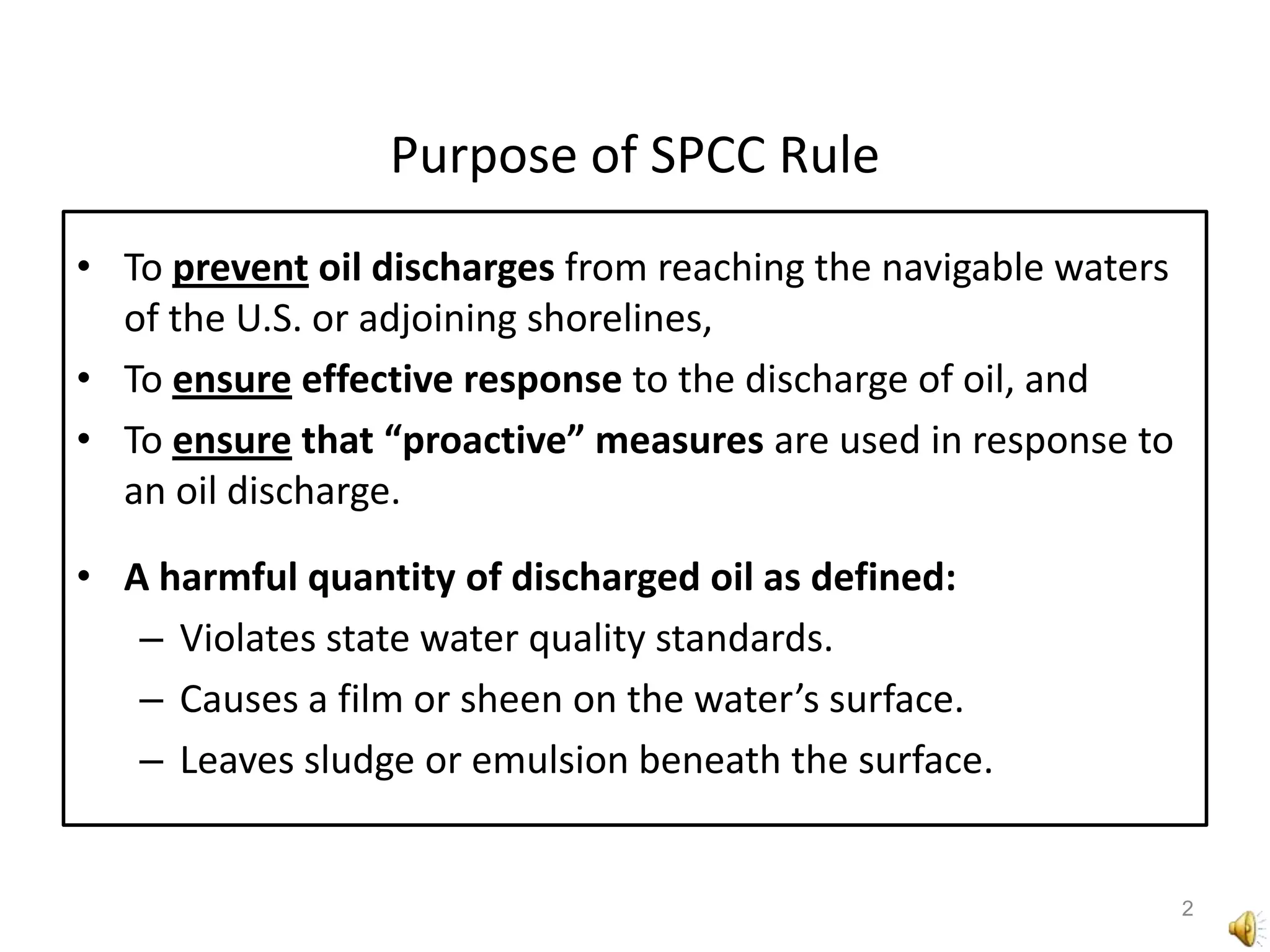
Purpose of SPCC RuleTo prevent oil discharges from reaching the navigable waters of the U.S. or adjoining shorelines, To ensure effective response to the discharge of oil, and To ensure that “proactive” measures are used in response to an oil discharge.A harmful quantity of discharged oil as defined:Violates state water quality standards.Causes a film or sheen on the water’s surface.Leaves sludge or emulsion beneath the surface.2
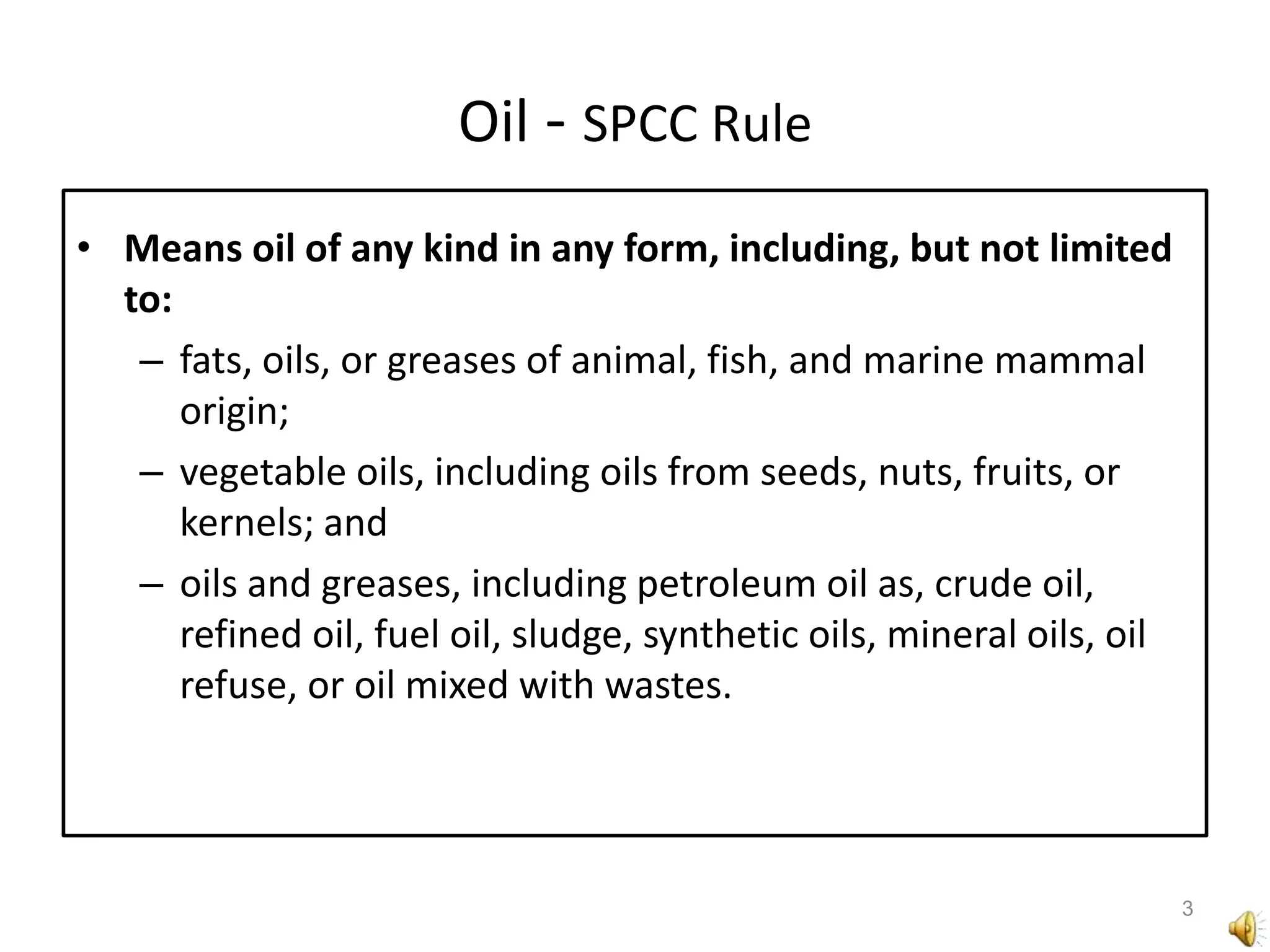
Oil - SPCC RuleMeans oil of any kind in any form, including, but not limited to: fats, oils, or greases of animal, fish, and marine mammal origin; vegetable oils, including oils from seeds, nuts, fruits, or kernels; and oils and greases, including petroleum oil as, crude oil, refined oil, fuel oil, sludge, synthetic oils, mineral oils, oil refuse, or oil mixed with wastes.3
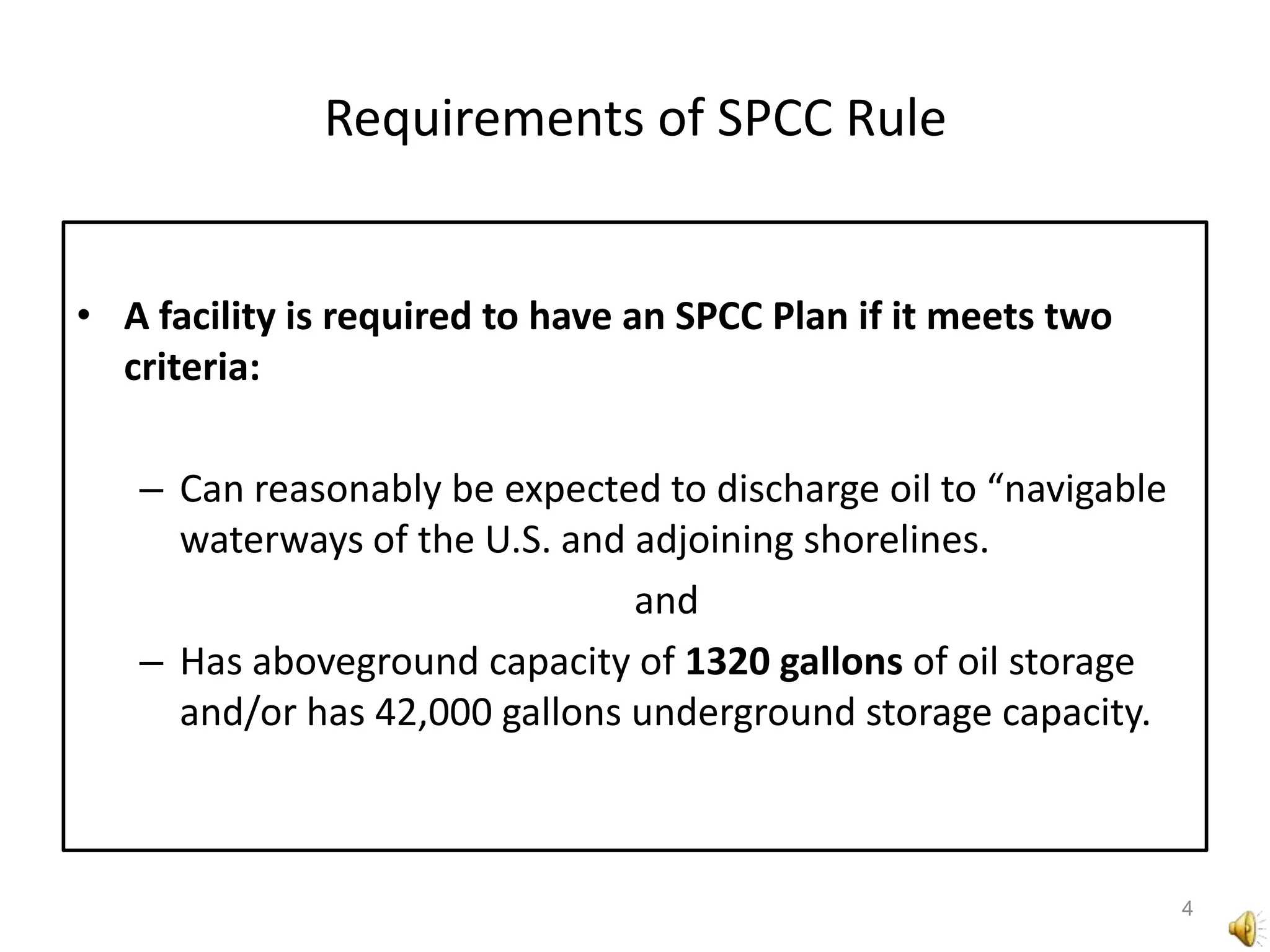
Requirements of SPCC RuleA facility is required to have an SPCC Plan if it meets two criteria:Can reasonably be expected to discharge oil to “navigable waterways of the U.S. and adjoining shorelines. 	andHas aboveground capacity of 1320 gallons of oil storage and/or has 42,000 gallons underground storage capacity.4
Requirements of SPCC RuleA facility is required to have an SPCC Plan to address:Operating procedures for routine handling of products to prevent a discharge of oil.Prevent overfilling of tanks.Maintain gauges and alarms.Perform regular inspections.Ensure that delivery drivers remain with delivery vehicle at all times while loading/unloading oil.Discharge or drainage control measures to prevent a discharge of oil:Maintain secondary containment.Maintain tanks and supports to prevent leaks and spills.Know your system’s layout, valves, and shutoffs.
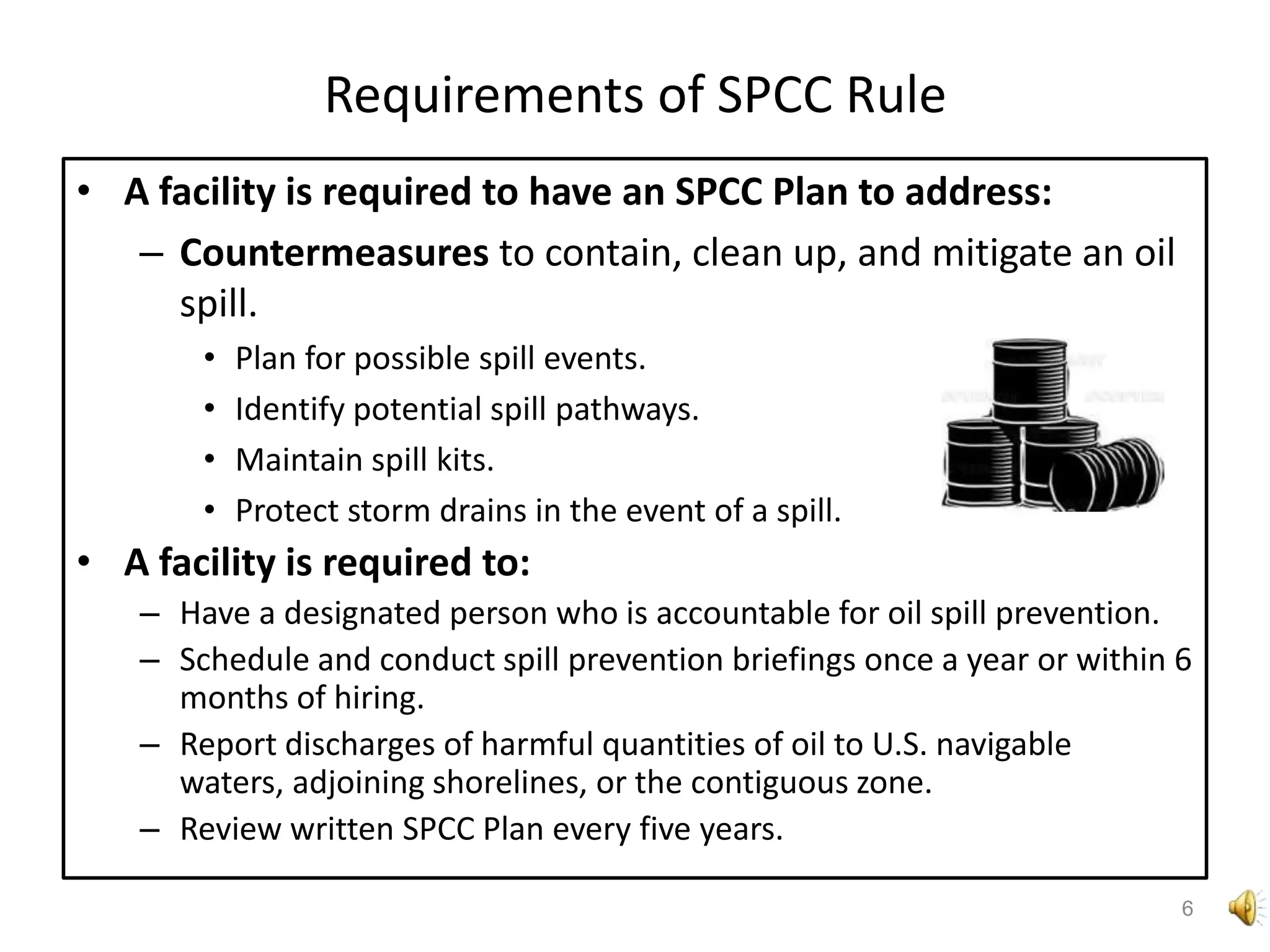
Requirements of SPCC RuleA facility is required to have an SPCC Plan to address:Countermeasures to contain, clean up, and mitigate an oil spill.Plan for possible spill events.Identify potential spill pathways.Maintain spill kits.Protect storm drains in the event of a spill.A facility is required to:Have a designated person who is accountable for oil spill prevention.Schedule and conduct spill prevention briefings once a year or within 6 months of hiring.Report discharges of harmful quantities of oil to U.S. navigable waters, adjoining shorelines, or the contiguous zone.Review written SPCC Plan every five years. 6
7SPCC Plan
SPILL PREVENTION, CONTROL, ANDCOUNTERMEASURE PLANBerry CollegeOffice of Environmental Compliance & SustainabilityP.O. Box 495053Mount Berry, GA 30149Phone: (706) 368-5627 Contact:Eddie Elsberry, Director of ECoS8
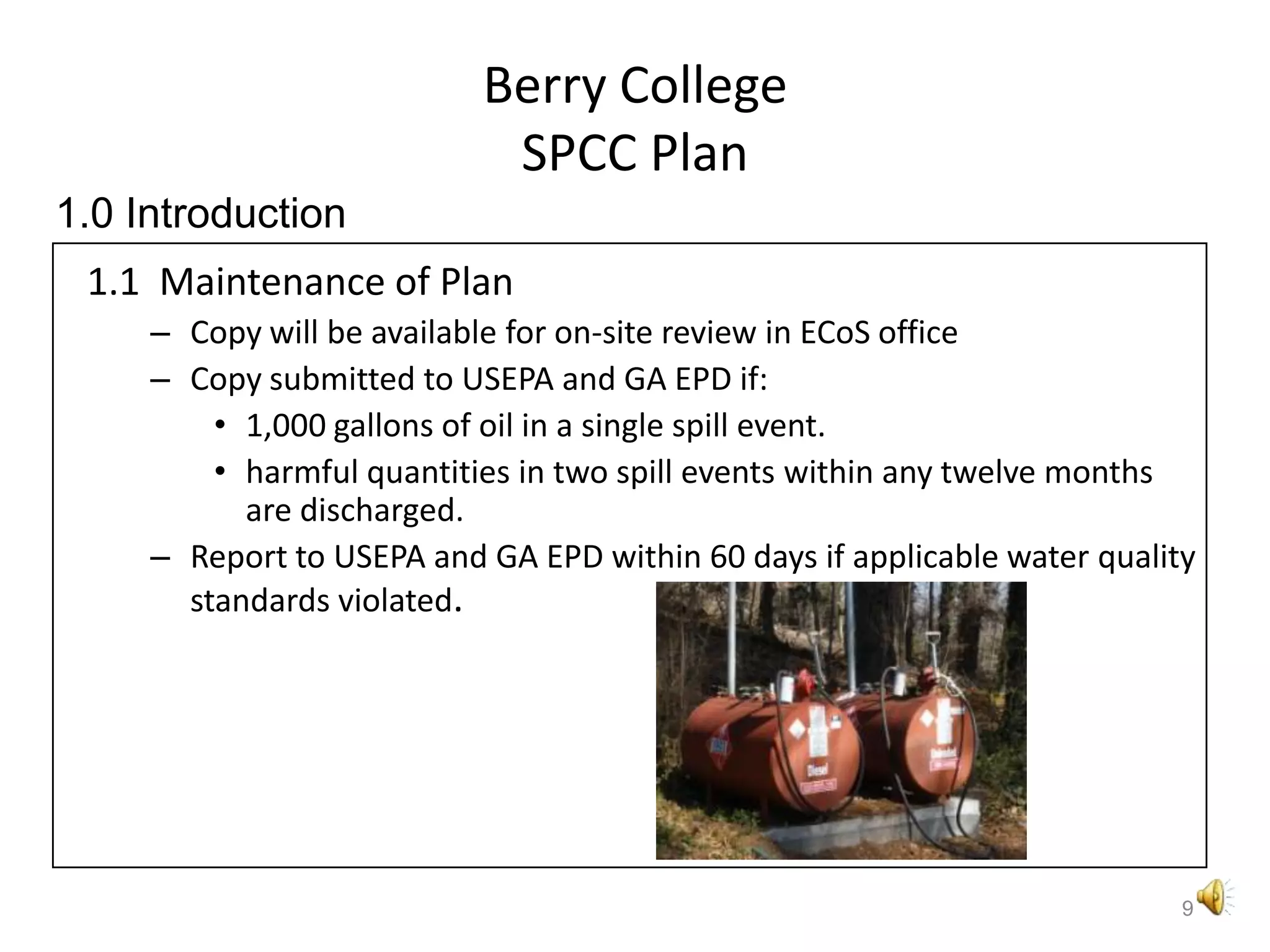
Berry CollegeSPCC Plan1.1  Maintenance of PlanCopy will be available for on-site review in ECoS officeCopy submitted to USEPA and GA EPD if:1,000 gallons of oil in a single spill event.harmful quantities in two spill events within any twelve months are discharged.Report to USEPA and GA EPD within 60 days if applicable water quality standards violated.91.0Introduction
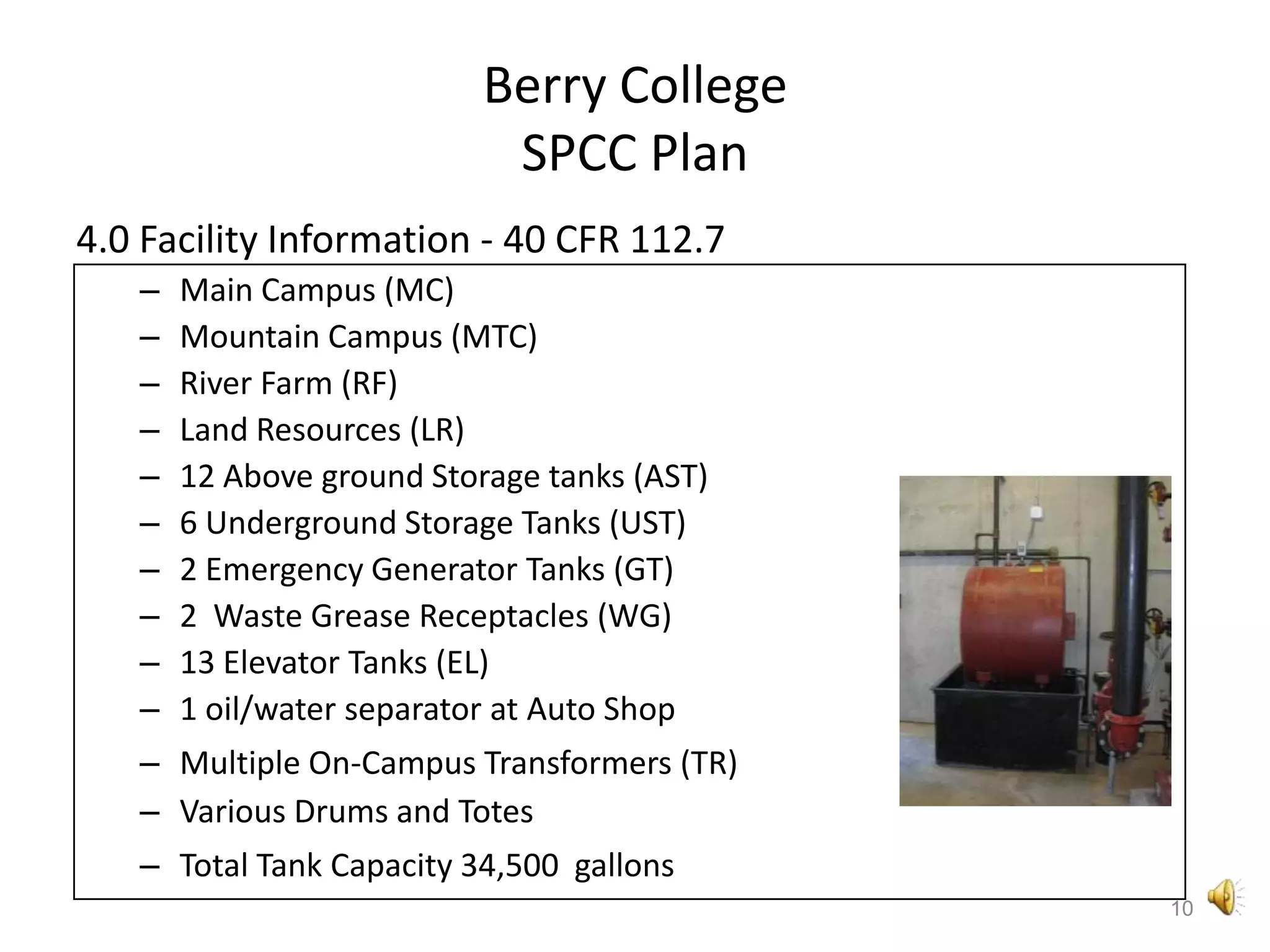
Berry CollegeSPCC Plan4.0 Facility Information - 40 CFR 112.7Main Campus (MC)Mountain Campus (MTC)River Farm (RF)Land Resources (LR)12 Above ground Storage tanks (AST)6 Underground Storage Tanks (UST)2 Emergency Generator Tanks (GT)2  Waste Grease Receptacles (WG)13 Elevator Tanks (EL)1 oil/water separator at Auto ShopMultiple On-Campus Transformers (TR)Various Drums and TotesTotal Tank Capacity 34,500  gallons10
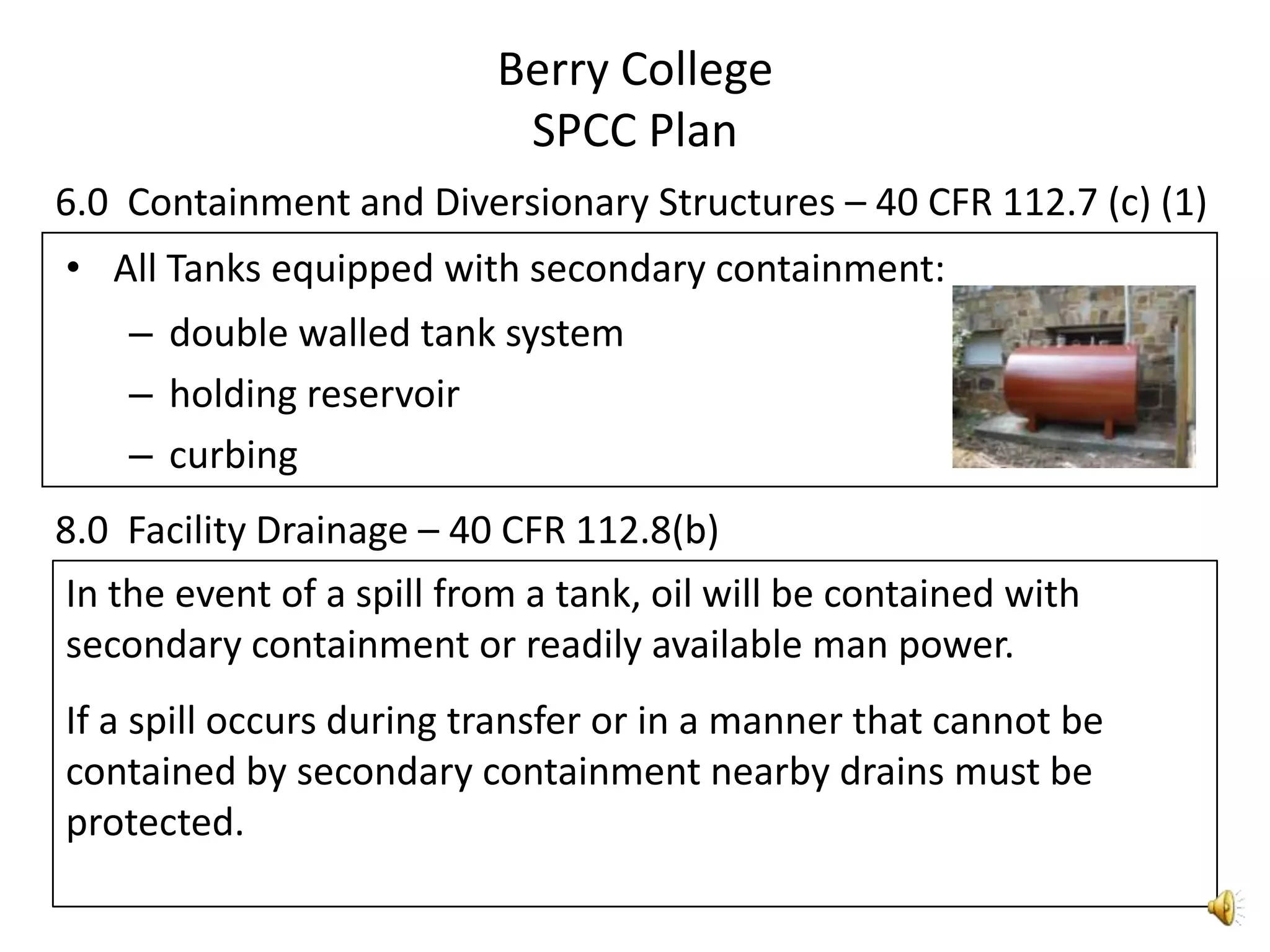
Berry CollegeSPCC Plan6.0  Containment and Diversionary Structures – 40 CFR 112.7 (c) (1)All Tanks equipped with secondary containment:double walled tank systemholding reservoircurbing8.0  Facility Drainage – 40 CFR 112.8(b)In the event of a spill from a tank, oil will be contained with secondary containment or readily available man power. If a spill occurs during transfer or in a manner that cannot be contained by secondary containment nearby drains must be protected.
Berry CollegeSPCC PlanInspections consist of:A complete walk through of the tank area to identify;Tank damage or leakage.Stained or discolored ground surfaces.Security problems.Continuous look out for anything that would indicate an oil leak.All bulk storage tanks are to be inspected monthly and reports submitted to the Office of Environmental Compliance & Sustainability.Annual inspections will be performed by ECoS personnel using the check list in Appendix F. All records relevant to this SPCC plan (including training records) are maintained in the Office of ECoS.1212.0  Inspections and Records – 40 CFR 112.7 (e)
Berry CollegeSPCC Plan15.0  Emergency Contact ListCampus Safety: 706- 236-2262Non-Emergency (706) 368-6999Office of Environmental Compliance and Sustainability(706)368-5627Physical Plant	(706) 236-2231Georgia EPD Emergency Response Hotline	(800)241-4113National Response Center (NRC)	(800) 424-8802Within 2 hours of oil entering surface water and if 10 gallons or more spilled on land.13
SPCC Appendices14
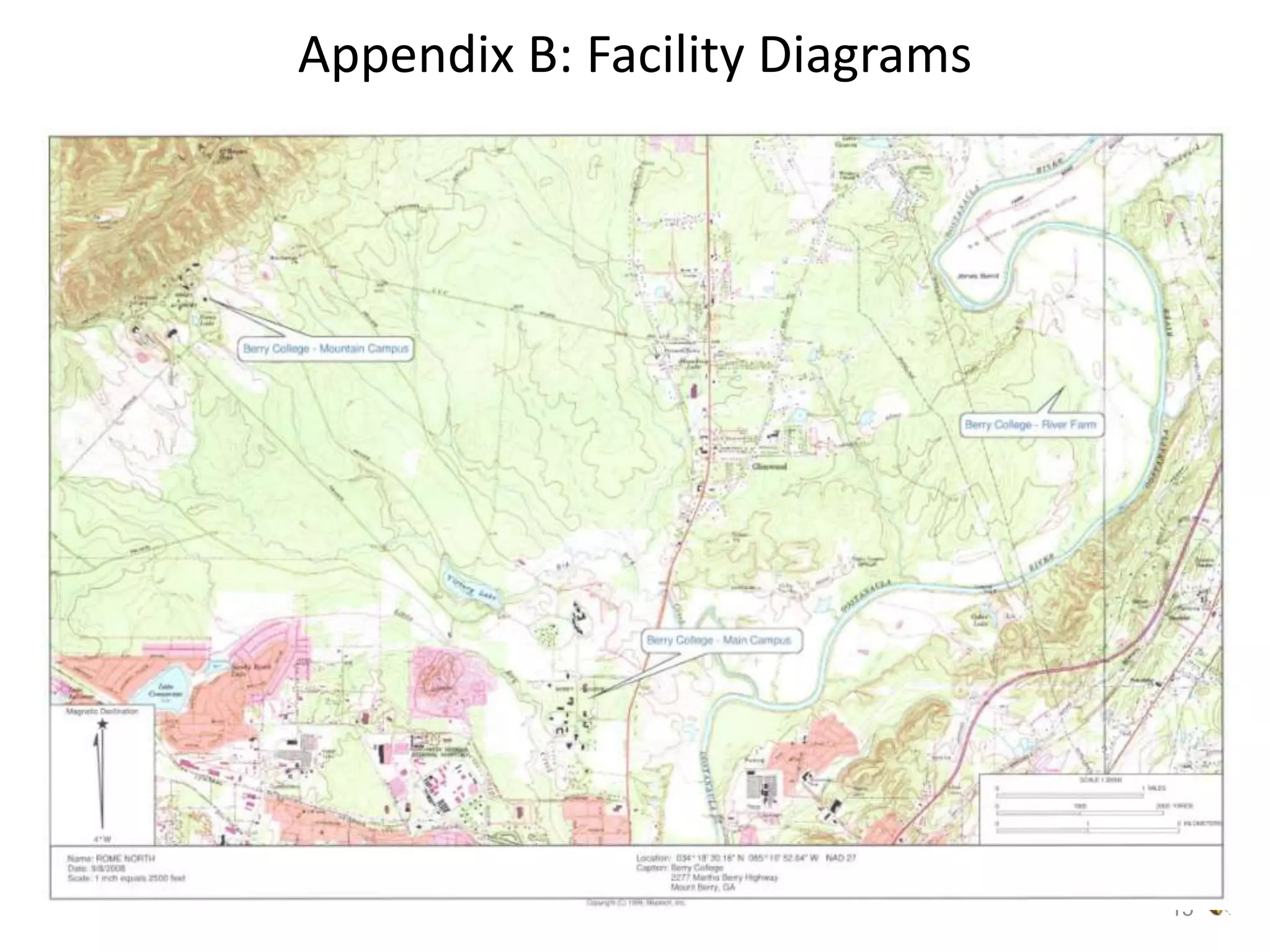
Appendix B: Facility Diagrams15
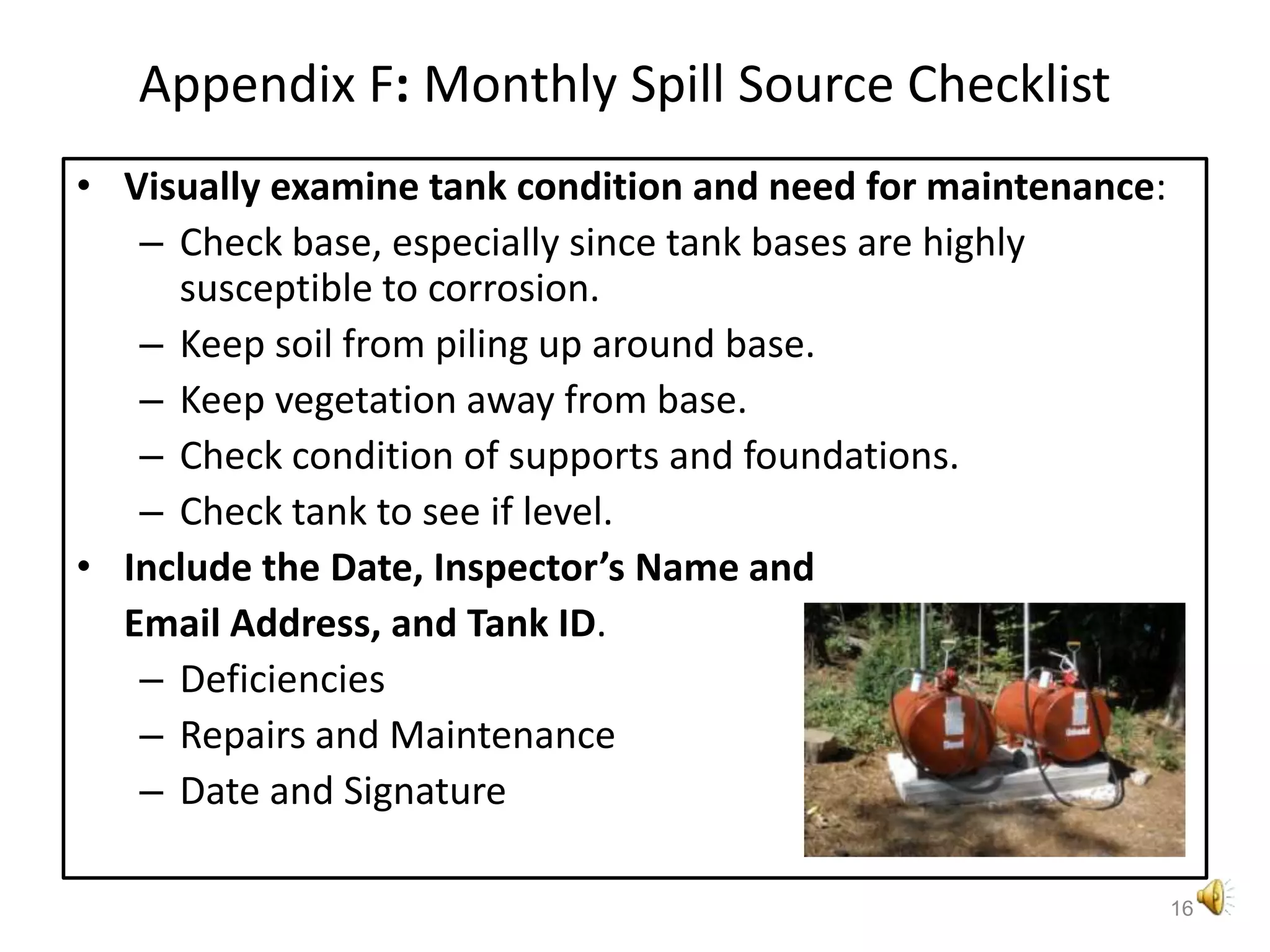
Appendix F: Monthly Spill Source ChecklistVisually examine tank condition and need for maintenance:Check base, especially since tank bases are highly susceptible to corrosion.Keep soil from piling up around base.Keep vegetation away from base.Check condition of supports and foundations.Check tank to see if level.Include the Date, Inspector’s Name and Email Address, and Tank ID.DeficienciesRepairs and MaintenanceDate and Signature16
Appendix G: Tank Truck Delivery Driver ProcedureDriver must remain with vehicle at all times while loading/unloading oil.Prior to Truck DepartureDrains and outlets must be checked for leakage.Disconnect inspection must be performed.Driver must maintain spill cleanup equipment.17
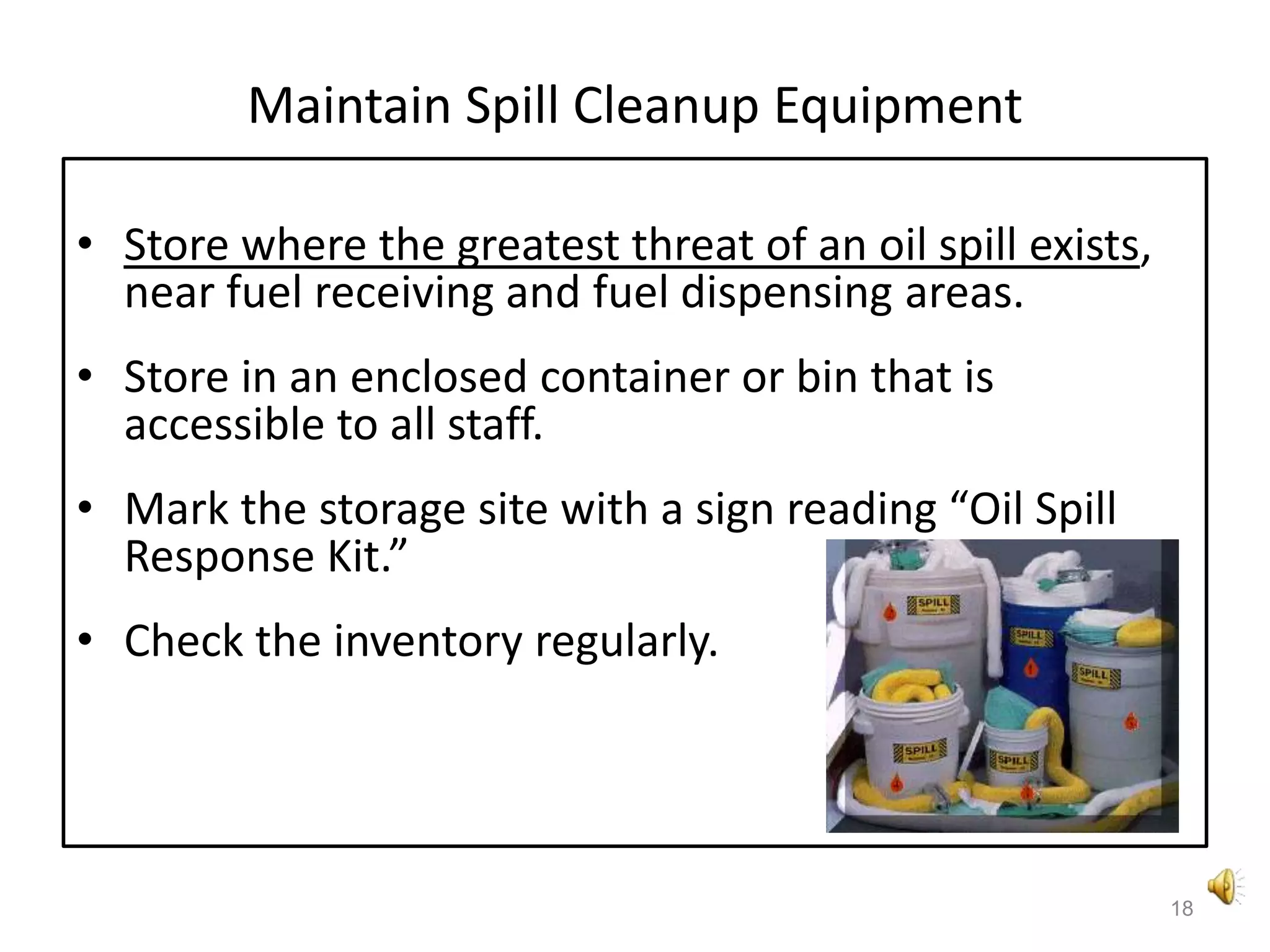
Maintain Spill Cleanup EquipmentStore where the greatest threat of an oil spill exists, near fuel receiving and fuel dispensing areas. Store in an enclosed container or bin that is accessible to all staff. Mark the storage site with a sign reading “Oil Spill Response Kit.”Check the inventory regularly.18
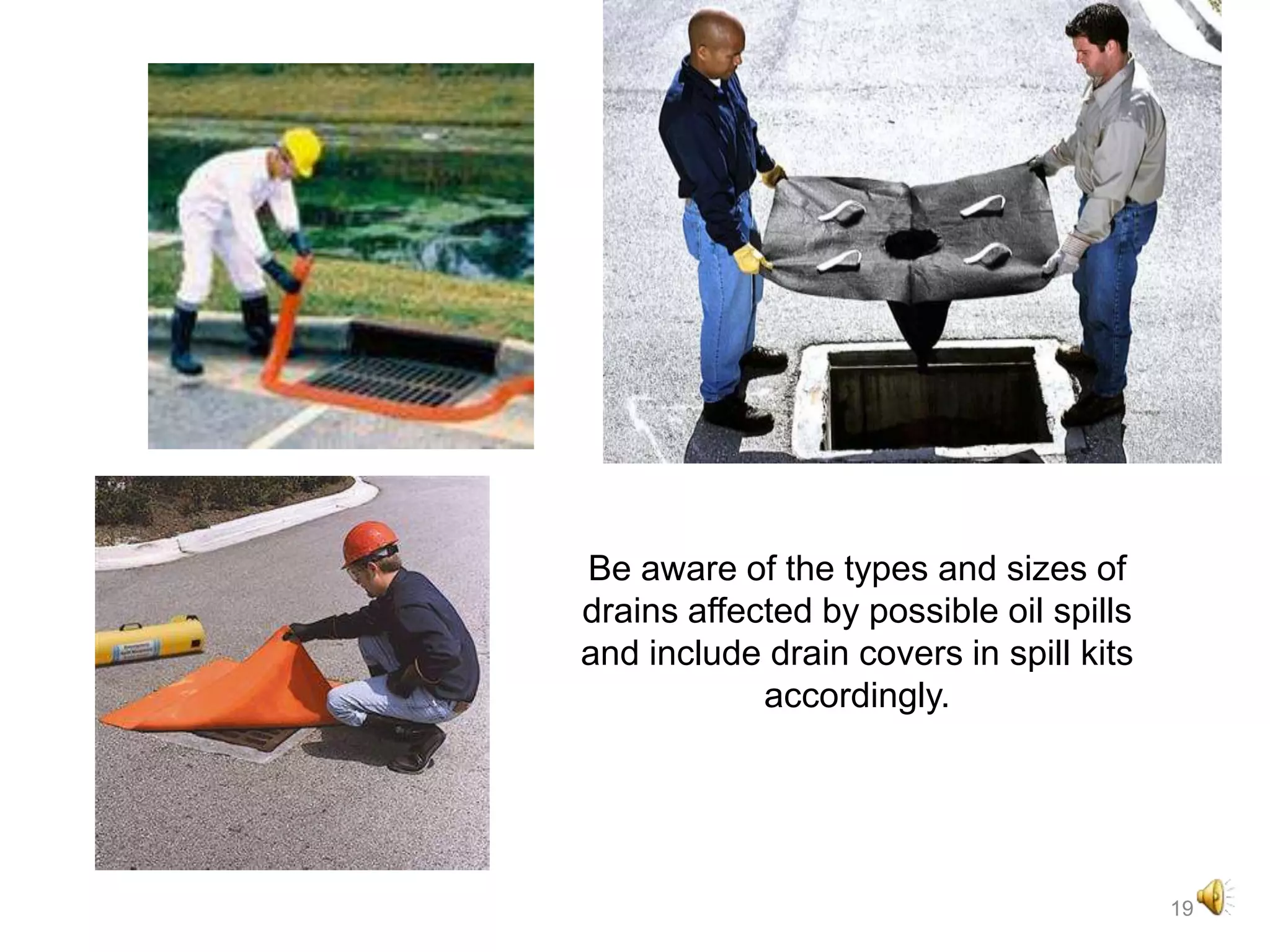
Be aware of the types and sizes of drains affected by possible oil spills and include drain covers in spill kits accordingly.19
Appendix H: Oil Spill ResponseAn incidental oil spill;Is manageable and poses no safety/health danger or harm to environment.Has not entered a sanitary or storm drain.Has not entered groundwater or surface water.Can be contained or stopped.Incidental Oil Spill Response ProceduresEliminate the source of the spill.Prevent oil from entering drains. Spread absorbents over the source of spill.Call ECoS @ 706-368-5627 during normal business hours if spill control assistance is needed.20
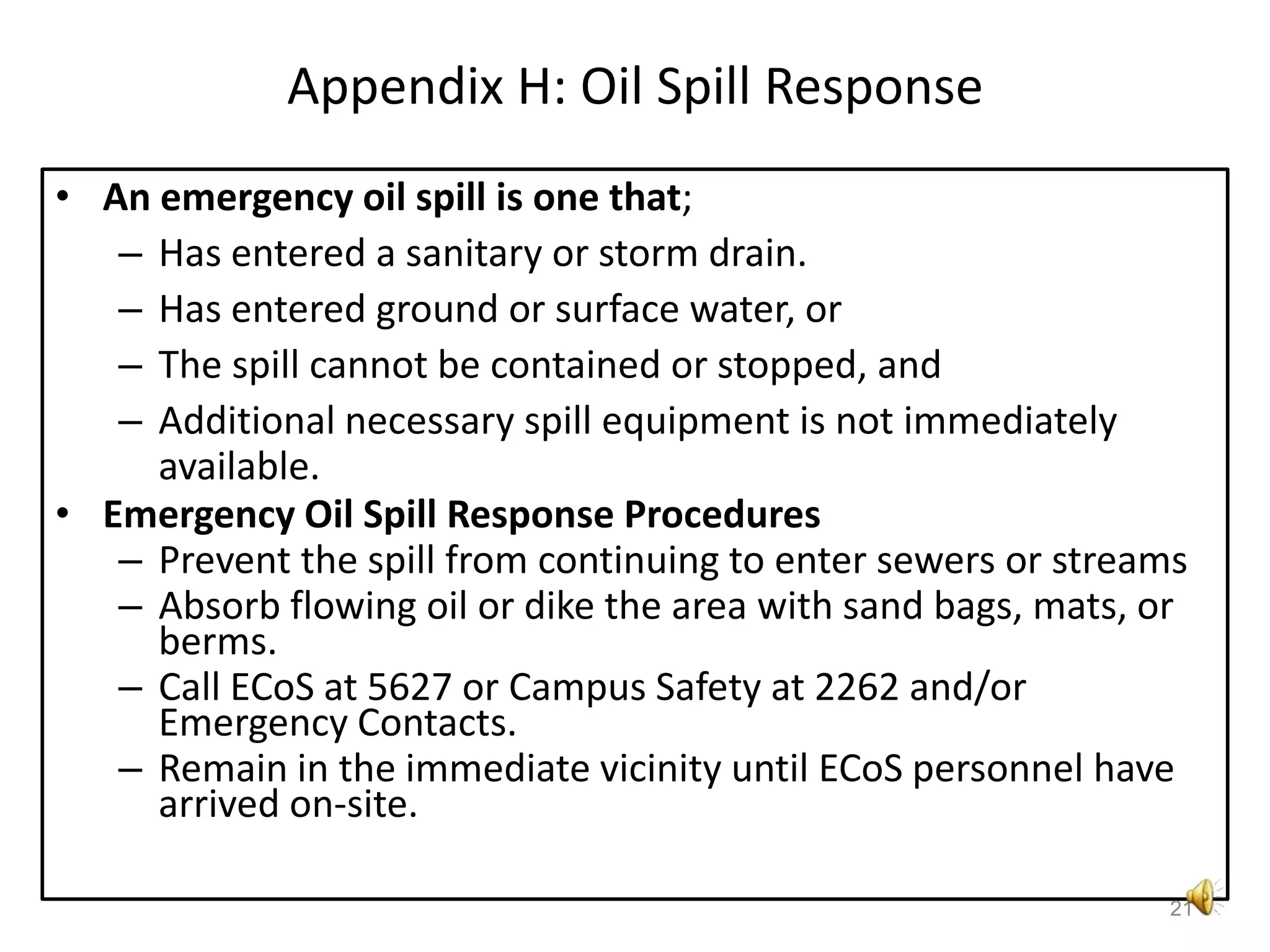
Appendix H: Oil Spill ResponseAn emergency oil spill is one that; Has entered a sanitary or storm drain.Has entered ground or surface water, orThe spill cannot be contained or stopped, andAdditional necessary spill equipment is not immediately available.Emergency Oil Spill Response ProceduresPrevent the spill from continuing to enter sewers or streamsAbsorb flowing oil or dike the area with sand bags, mats, or berms.Call ECoS at 5627 or Campus Safety at 2262 and/or Emergency Contacts.Remain in the immediate vicinity until ECoS personnel have arrived on-site.21
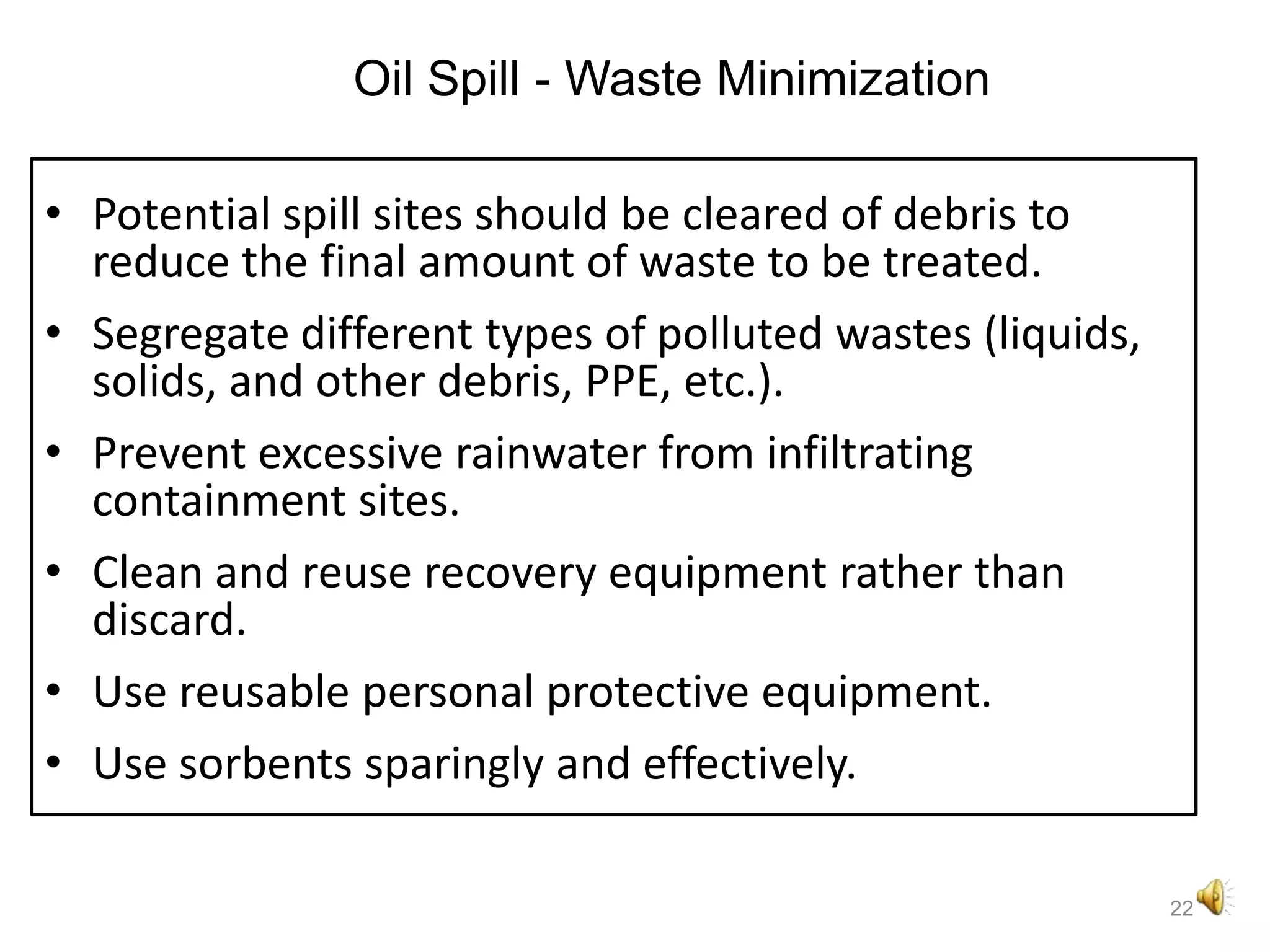
22Oil Spill - Waste Minimization Potential spill sites should be cleared of debris to reduce the final amount of waste to be treated.
Segregate different types of polluted wastes (liquids, solids, and other debris, PPE, etc.).
Prevent excessive rainwater from infiltrating containment sites.
Clean and reuse recovery equipment rather than discard.

Spcc training

  • 1.
    Oil Spill Prevention,Control and Countermeasure (SPCC) Rule1Code of Federal RegulationsTitle 40 CFR Part 112
  • 2.
    Purpose of SPCCRuleTo prevent oil discharges from reaching the navigable waters of the U.S. or adjoining shorelines, To ensure effective response to the discharge of oil, and To ensure that “proactive” measures are used in response to an oil discharge.A harmful quantity of discharged oil as defined:Violates state water quality standards.Causes a film or sheen on the water’s surface.Leaves sludge or emulsion beneath the surface.2
  • 3.
    Oil - SPCCRuleMeans oil of any kind in any form, including, but not limited to: fats, oils, or greases of animal, fish, and marine mammal origin; vegetable oils, including oils from seeds, nuts, fruits, or kernels; and oils and greases, including petroleum oil as, crude oil, refined oil, fuel oil, sludge, synthetic oils, mineral oils, oil refuse, or oil mixed with wastes.3
  • 4.
    Requirements of SPCCRuleA facility is required to have an SPCC Plan if it meets two criteria:Can reasonably be expected to discharge oil to “navigable waterways of the U.S. and adjoining shorelines. andHas aboveground capacity of 1320 gallons of oil storage and/or has 42,000 gallons underground storage capacity.4
  • 5.
    Requirements of SPCCRuleA facility is required to have an SPCC Plan to address:Operating procedures for routine handling of products to prevent a discharge of oil.Prevent overfilling of tanks.Maintain gauges and alarms.Perform regular inspections.Ensure that delivery drivers remain with delivery vehicle at all times while loading/unloading oil.Discharge or drainage control measures to prevent a discharge of oil:Maintain secondary containment.Maintain tanks and supports to prevent leaks and spills.Know your system’s layout, valves, and shutoffs.
  • 6.
    Requirements of SPCCRuleA facility is required to have an SPCC Plan to address:Countermeasures to contain, clean up, and mitigate an oil spill.Plan for possible spill events.Identify potential spill pathways.Maintain spill kits.Protect storm drains in the event of a spill.A facility is required to:Have a designated person who is accountable for oil spill prevention.Schedule and conduct spill prevention briefings once a year or within 6 months of hiring.Report discharges of harmful quantities of oil to U.S. navigable waters, adjoining shorelines, or the contiguous zone.Review written SPCC Plan every five years. 6
  • 7.
  • 8.
    SPILL PREVENTION, CONTROL,ANDCOUNTERMEASURE PLANBerry CollegeOffice of Environmental Compliance & SustainabilityP.O. Box 495053Mount Berry, GA 30149Phone: (706) 368-5627 Contact:Eddie Elsberry, Director of ECoS8
  • 9.
    Berry CollegeSPCC Plan1.1 Maintenance of PlanCopy will be available for on-site review in ECoS officeCopy submitted to USEPA and GA EPD if:1,000 gallons of oil in a single spill event.harmful quantities in two spill events within any twelve months are discharged.Report to USEPA and GA EPD within 60 days if applicable water quality standards violated.91.0Introduction
  • 10.
    Berry CollegeSPCC Plan4.0Facility Information - 40 CFR 112.7Main Campus (MC)Mountain Campus (MTC)River Farm (RF)Land Resources (LR)12 Above ground Storage tanks (AST)6 Underground Storage Tanks (UST)2 Emergency Generator Tanks (GT)2 Waste Grease Receptacles (WG)13 Elevator Tanks (EL)1 oil/water separator at Auto ShopMultiple On-Campus Transformers (TR)Various Drums and TotesTotal Tank Capacity 34,500 gallons10
  • 11.
    Berry CollegeSPCC Plan6.0 Containment and Diversionary Structures – 40 CFR 112.7 (c) (1)All Tanks equipped with secondary containment:double walled tank systemholding reservoircurbing8.0 Facility Drainage – 40 CFR 112.8(b)In the event of a spill from a tank, oil will be contained with secondary containment or readily available man power. If a spill occurs during transfer or in a manner that cannot be contained by secondary containment nearby drains must be protected.
  • 12.
    Berry CollegeSPCC PlanInspectionsconsist of:A complete walk through of the tank area to identify;Tank damage or leakage.Stained or discolored ground surfaces.Security problems.Continuous look out for anything that would indicate an oil leak.All bulk storage tanks are to be inspected monthly and reports submitted to the Office of Environmental Compliance & Sustainability.Annual inspections will be performed by ECoS personnel using the check list in Appendix F. All records relevant to this SPCC plan (including training records) are maintained in the Office of ECoS.1212.0 Inspections and Records – 40 CFR 112.7 (e)
  • 13.
    Berry CollegeSPCC Plan15.0 Emergency Contact ListCampus Safety: 706- 236-2262Non-Emergency (706) 368-6999Office of Environmental Compliance and Sustainability(706)368-5627Physical Plant (706) 236-2231Georgia EPD Emergency Response Hotline (800)241-4113National Response Center (NRC) (800) 424-8802Within 2 hours of oil entering surface water and if 10 gallons or more spilled on land.13
  • 14.
  • 15.
  • 16.
    Appendix F: MonthlySpill Source ChecklistVisually examine tank condition and need for maintenance:Check base, especially since tank bases are highly susceptible to corrosion.Keep soil from piling up around base.Keep vegetation away from base.Check condition of supports and foundations.Check tank to see if level.Include the Date, Inspector’s Name and Email Address, and Tank ID.DeficienciesRepairs and MaintenanceDate and Signature16
  • 17.
    Appendix G: TankTruck Delivery Driver ProcedureDriver must remain with vehicle at all times while loading/unloading oil.Prior to Truck DepartureDrains and outlets must be checked for leakage.Disconnect inspection must be performed.Driver must maintain spill cleanup equipment.17
  • 18.
    Maintain Spill CleanupEquipmentStore where the greatest threat of an oil spill exists, near fuel receiving and fuel dispensing areas. Store in an enclosed container or bin that is accessible to all staff. Mark the storage site with a sign reading “Oil Spill Response Kit.”Check the inventory regularly.18
  • 19.
    Be aware ofthe types and sizes of drains affected by possible oil spills and include drain covers in spill kits accordingly.19
  • 20.
    Appendix H: OilSpill ResponseAn incidental oil spill;Is manageable and poses no safety/health danger or harm to environment.Has not entered a sanitary or storm drain.Has not entered groundwater or surface water.Can be contained or stopped.Incidental Oil Spill Response ProceduresEliminate the source of the spill.Prevent oil from entering drains. Spread absorbents over the source of spill.Call ECoS @ 706-368-5627 during normal business hours if spill control assistance is needed.20
  • 21.
    Appendix H: OilSpill ResponseAn emergency oil spill is one that; Has entered a sanitary or storm drain.Has entered ground or surface water, orThe spill cannot be contained or stopped, andAdditional necessary spill equipment is not immediately available.Emergency Oil Spill Response ProceduresPrevent the spill from continuing to enter sewers or streamsAbsorb flowing oil or dike the area with sand bags, mats, or berms.Call ECoS at 5627 or Campus Safety at 2262 and/or Emergency Contacts.Remain in the immediate vicinity until ECoS personnel have arrived on-site.21
  • 22.
    22Oil Spill -Waste Minimization Potential spill sites should be cleared of debris to reduce the final amount of waste to be treated.
  • 23.
    Segregate different typesof polluted wastes (liquids, solids, and other debris, PPE, etc.).
  • 24.
    Prevent excessive rainwaterfrom infiltrating containment sites.
  • 25.
    Clean and reuserecovery equipment rather than discard.
  • 26.
    Use reusable personalprotective equipment.
  • 27.
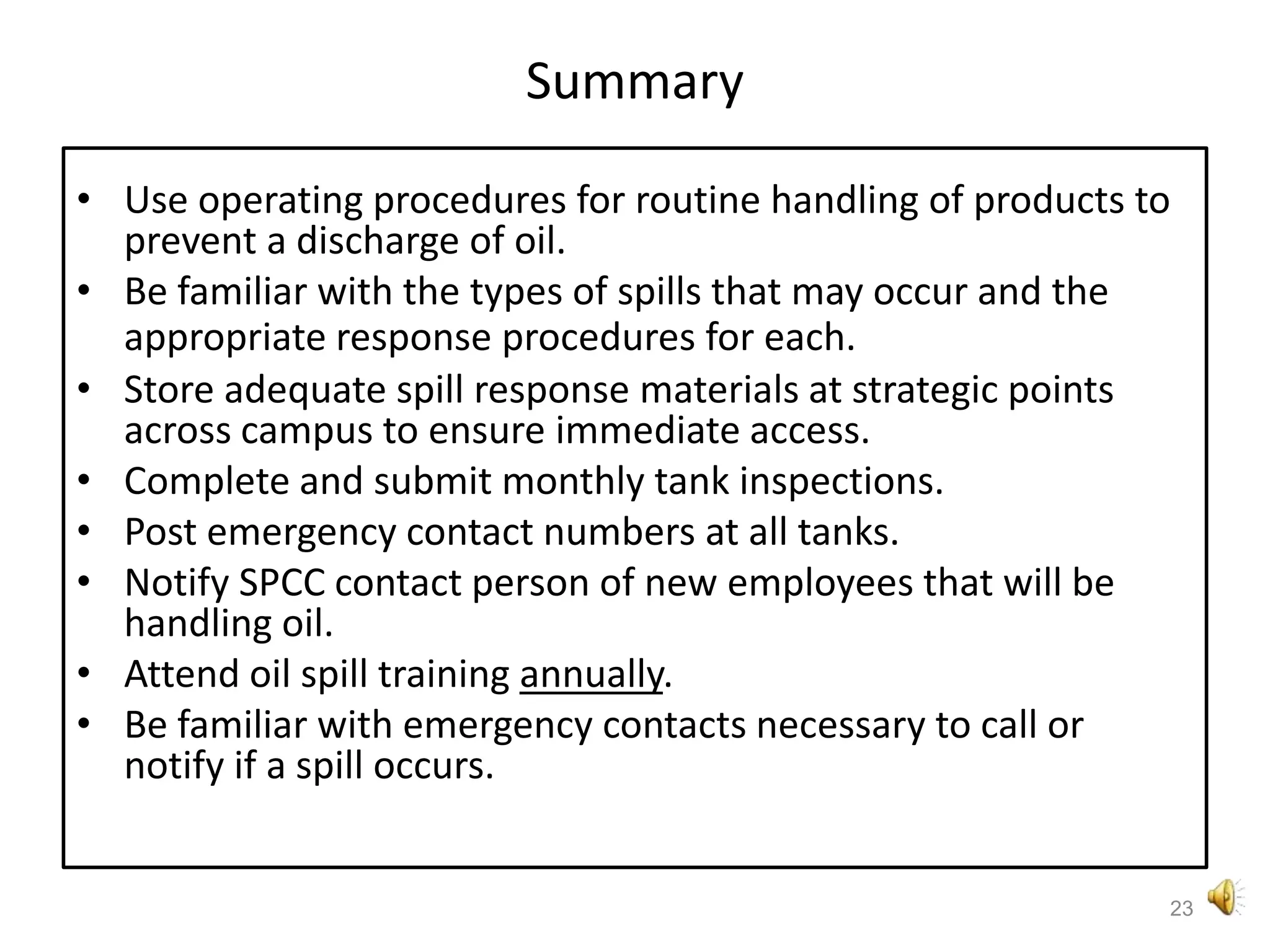
    Use sorbents sparinglyand effectively.SummaryUse operating procedures for routine handling of products to prevent a discharge of oil.Be familiar with the types of spills that may occur and the appropriate response procedures for each.Store adequate spill response materials at strategic points across campus to ensure immediate access.Complete and submit monthly tank inspections.Post emergency contact numbers at all tanks.Notify SPCC contact person of new employees that will be handling oil.Attend oil spill training annually.Be familiar with emergency contacts necessary to call or notify if a spill occurs.23
  • 28.
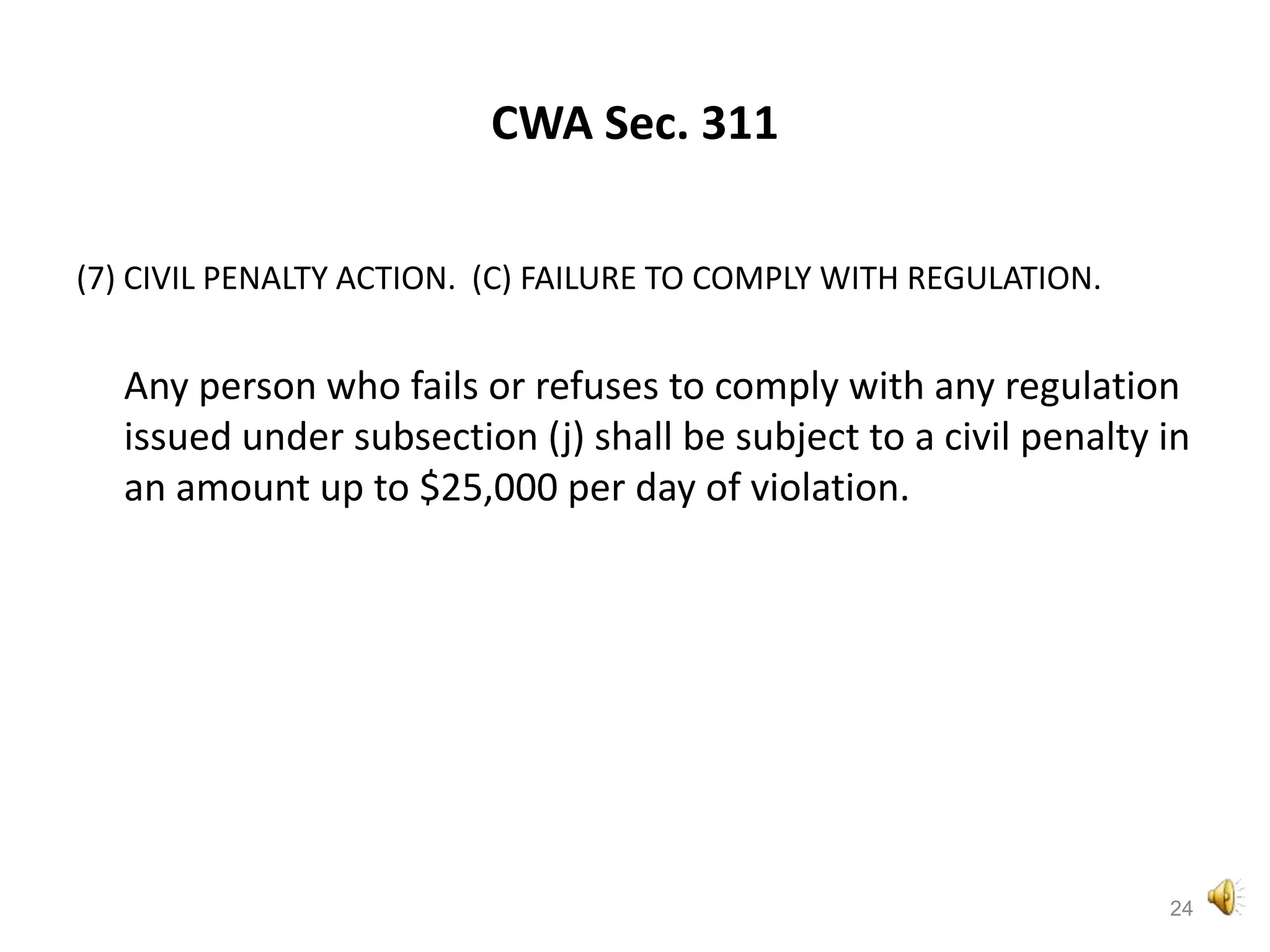
    CWA Sec. 311(7)CIVIL PENALTY ACTION. (C) FAILURE TO COMPLY WITH REGULATION. Any person who fails or refuses to comply with any regulation issued under subsection (j) shall be subject to a civil penalty in an amount up to $25,000 per day of violation.24
  • 29.
    You havecompleted your SPCC TrainingIf you have any questions call 706-368-5627 or email eelsberry@berry.eduPlease contact office ASAP with any issues or info regarding Oil or Fuel storage on campus.Please access the link below on the ECoS web page to take the training exam and document your training session.Training Session25