Kindling 
Getting Started With Spark & Cassandra
Data Source 
• I used the movielens data set for my examples: 
• Details about the data are at: 
http://www.grouplens.org/datasets/movielens/ 
• I used the 10M review dataset 
• A direct link to the10M dataset files: 
http://files.grouplens.org/datasets/movielens/ml- 
10m.zip
Code Examples 
• Here is a Gist with the Spark Shell code I 
executed during the presentation: 
• https://gist.github.com/erichgess/292dd29513e3 
393bf969
Overview 
• What is Spark 
• Spark Introduction 
• Spark + Cassandra 
• Demonstrations
Goal 
• Build out the basic foundations for using Spark 
with Cassandra 
• Simple Introduction 
• Give a couple examples showing how to use 
Spark with Cassandra
What is Spark 
• Distributed Compute Platform 
• In Memory (FAST) 
• Batch and Stream Processing 
• Multi-language Support 
• Java, Python, and Scala out of the box 
• Shell – You can do interactive distributed 
computing and analytics in Scala or Python
The Basics 
• Spark Context 
• The connection to the cluster 
• The Resilient Distributed Dataset 
• Abstracts the distributed data 
• The core of Spark 
• Functional First Approach 
• Less code, more obvious intentions
Spark Context 
• This is your connection to the Spark cluster 
• Create RDDs 
• When you open the Spark Shell, it 
automatically creates a context to the cluster 
• When writing a standalone application to run on 
Spark you create a SparkContext and configure 
it to connect to the cluster
The Resilient Distributed Dataset 
• Use this to interact with data that has been 
distributed across the cluster 
• The RDD is the starting point for doing parallel 
computations on Spark 
• External Datasets 
• HDFS, S3, SQL, Cassandra, and so on
The Resilient Distributed Dataset 
• Functional Transformations 
• These transform the individual elements of the 
RDD in one form or another 
• Map, Reduce, Filter, etc. 
• Lazy Evaluation: until you do something which 
requires a result, nothing is evaluated 
• These will be familiar if you work with any functional 
language or Scala/C#/Java8
The RDD (2) 
• Cache into Memory 
• Lets you put an RDD into memory 
• Dramatically speeds up processing on large 
datasets 
• The RDD will not be put in memory until an action 
forces the RDD to be computed (this is the lazy 
evaluation again)
Transformations 
• Transformations are monadic 
• They take an RDD and return an RDD 
• The type the RDD wraps is irrelevant 
• Can be chained together 
• Map, filter, etc 
• Simply Put: Transformations return another 
RDD, Actions do not
Transformations 
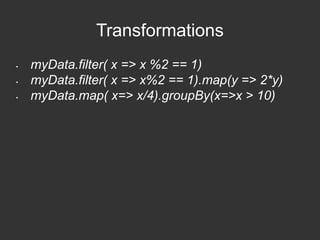
• myData.filter( x => x %2 == 1) 
• myData.filter( x => x%2 == 1).map(y => 2*y) 
• myData.map( x=> x/4).groupBy(x=>x > 10)
Actions 
• Actions 
• These are functions which “unwrap” the RDD 
• They return a value of a non RDD type 
• Because of this they force the RDD and 
transformation chain to be evaluated 
• Reduce, fold, count, first, etc
Actions 
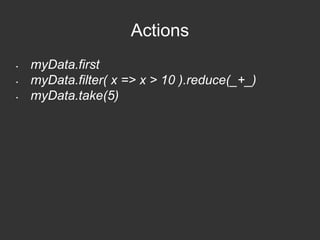
• myData.first 
• myData.filter( x => x > 10 ).reduce(_+_) 
• myData.take(5)
The Shell 
• Spark provides a Scala and a Python shell 
• Do interactive distributed computing 
• Let's you build complex programs while testing 
them on the cluster 
• Connects to the full Spark cluster
Spark + Data 
• Out of the Box 
• Spark supports standard Hadoop inputs 
• HDFS 
• Other Data Sources 
• Third Party drivers allow connecting to other data 
stores 
• SQL Databases 
• Cassandra 
• Data gets put into an RDD
Spark + Cassandra 
• DataStax provides an easy to use driver to 
connect Spark to Cassandra 
• Configure everything with DataStax Enterprise 
and the DataStax Analytics stack 
• Read and write data from Spark 
• Interact with Cassandra through the Spark 
Shell
Spark + DSE 
• Each node has both a Spark worker and 
Cassandra 
• Data Locality Awareness 
• The Spark workers are aware of the locality of data 
and will pull the data on their local Cassandra 
nodes
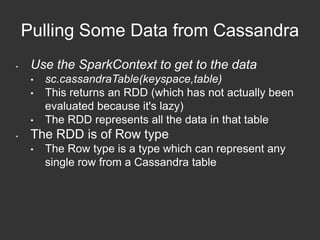
Pulling Some Data from Cassandra 
• Use the SparkContext to get to the data 
• sc.cassandraTable(keyspace,table) 
• This returns an RDD (which has not actually been 
evaluated because it's lazy) 
• The RDD represents all the data in that table 
• The RDD is of Row type 
• The Row type is a type which can represent any 
single row from a Cassandra table
Sample Code 
• Reading From Cassandra: 
• val data = sc.cassandraTable(“spark_demo”, 
“first_example” ) 
• data is an RDD of type CassandraRow. To 
access values you need to use the get[A] 
method: 
• data.first.get[Int]("value")
Pulling Data a Little Cleaner 
• The Row type is a little messy to deal with 
• Let's use a case class to load a table directly 
into a type which represents what's in the table 
• Case class MyData(Id: Int, Text: String) 
• sc.cassandraTable[MyData](keyspace,table) 
• Now we get an RDD of MyData elements
Sample Code 
• Reading from Cassandra: 
• case class FirstExample(Id: Int, Value: Int) 
• val data = 
sc.cassandraTable[FirstExample](“spark_demo” 
, “first_example”) 
• This returns an RDD of type FirstExample: 
• data.first.Value
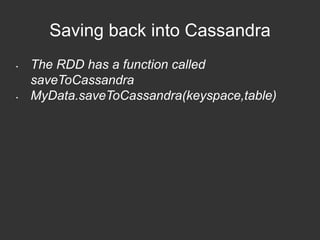
Saving back into Cassandra 
• The RDD has a function called 
saveToCassandra 
• MyData.saveToCassandra(keyspace,table)
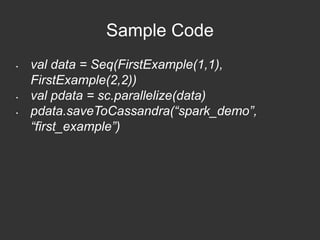
Sample Code 
• val data = Seq(FirstExample(1,1), 
FirstExample(2,2)) 
• val pdata = sc.parallelize(data) 
• pdata.saveToCassandra(“spark_demo”, 
“first_example”)
Simple Demo 
• Pull data out of Cassandra 
• Process that data 
• Save back into Cassandra
Beyond 
• Streams 
• Mesos 
• Machine Learning 
• Graph Processing

Spark Introduction

  • 1.
    Kindling Getting StartedWith Spark & Cassandra
  • 2.
    Data Source •I used the movielens data set for my examples: • Details about the data are at: http://www.grouplens.org/datasets/movielens/ • I used the 10M review dataset • A direct link to the10M dataset files: http://files.grouplens.org/datasets/movielens/ml- 10m.zip
  • 3.
    Code Examples •Here is a Gist with the Spark Shell code I executed during the presentation: • https://gist.github.com/erichgess/292dd29513e3 393bf969
  • 4.
    Overview • Whatis Spark • Spark Introduction • Spark + Cassandra • Demonstrations
  • 5.
    Goal • Buildout the basic foundations for using Spark with Cassandra • Simple Introduction • Give a couple examples showing how to use Spark with Cassandra
  • 6.
    What is Spark • Distributed Compute Platform • In Memory (FAST) • Batch and Stream Processing • Multi-language Support • Java, Python, and Scala out of the box • Shell – You can do interactive distributed computing and analytics in Scala or Python
  • 7.
    The Basics •Spark Context • The connection to the cluster • The Resilient Distributed Dataset • Abstracts the distributed data • The core of Spark • Functional First Approach • Less code, more obvious intentions
  • 8.
    Spark Context •This is your connection to the Spark cluster • Create RDDs • When you open the Spark Shell, it automatically creates a context to the cluster • When writing a standalone application to run on Spark you create a SparkContext and configure it to connect to the cluster
  • 9.
    The Resilient DistributedDataset • Use this to interact with data that has been distributed across the cluster • The RDD is the starting point for doing parallel computations on Spark • External Datasets • HDFS, S3, SQL, Cassandra, and so on
  • 10.
    The Resilient DistributedDataset • Functional Transformations • These transform the individual elements of the RDD in one form or another • Map, Reduce, Filter, etc. • Lazy Evaluation: until you do something which requires a result, nothing is evaluated • These will be familiar if you work with any functional language or Scala/C#/Java8
  • 11.
    The RDD (2) • Cache into Memory • Lets you put an RDD into memory • Dramatically speeds up processing on large datasets • The RDD will not be put in memory until an action forces the RDD to be computed (this is the lazy evaluation again)
  • 12.
    Transformations • Transformationsare monadic • They take an RDD and return an RDD • The type the RDD wraps is irrelevant • Can be chained together • Map, filter, etc • Simply Put: Transformations return another RDD, Actions do not
  • 13.
    Transformations • myData.filter(x => x %2 == 1) • myData.filter( x => x%2 == 1).map(y => 2*y) • myData.map( x=> x/4).groupBy(x=>x > 10)
  • 14.
    Actions • Actions • These are functions which “unwrap” the RDD • They return a value of a non RDD type • Because of this they force the RDD and transformation chain to be evaluated • Reduce, fold, count, first, etc
  • 15.
    Actions • myData.first • myData.filter( x => x > 10 ).reduce(_+_) • myData.take(5)
  • 16.
    The Shell •Spark provides a Scala and a Python shell • Do interactive distributed computing • Let's you build complex programs while testing them on the cluster • Connects to the full Spark cluster
  • 17.
    Spark + Data • Out of the Box • Spark supports standard Hadoop inputs • HDFS • Other Data Sources • Third Party drivers allow connecting to other data stores • SQL Databases • Cassandra • Data gets put into an RDD
  • 18.
    Spark + Cassandra • DataStax provides an easy to use driver to connect Spark to Cassandra • Configure everything with DataStax Enterprise and the DataStax Analytics stack • Read and write data from Spark • Interact with Cassandra through the Spark Shell
  • 19.
    Spark + DSE • Each node has both a Spark worker and Cassandra • Data Locality Awareness • The Spark workers are aware of the locality of data and will pull the data on their local Cassandra nodes
  • 20.
    Pulling Some Datafrom Cassandra • Use the SparkContext to get to the data • sc.cassandraTable(keyspace,table) • This returns an RDD (which has not actually been evaluated because it's lazy) • The RDD represents all the data in that table • The RDD is of Row type • The Row type is a type which can represent any single row from a Cassandra table
  • 21.
    Sample Code •Reading From Cassandra: • val data = sc.cassandraTable(“spark_demo”, “first_example” ) • data is an RDD of type CassandraRow. To access values you need to use the get[A] method: • data.first.get[Int]("value")
  • 22.
    Pulling Data aLittle Cleaner • The Row type is a little messy to deal with • Let's use a case class to load a table directly into a type which represents what's in the table • Case class MyData(Id: Int, Text: String) • sc.cassandraTable[MyData](keyspace,table) • Now we get an RDD of MyData elements
  • 23.
    Sample Code •Reading from Cassandra: • case class FirstExample(Id: Int, Value: Int) • val data = sc.cassandraTable[FirstExample](“spark_demo” , “first_example”) • This returns an RDD of type FirstExample: • data.first.Value
  • 24.
    Saving back intoCassandra • The RDD has a function called saveToCassandra • MyData.saveToCassandra(keyspace,table)
  • 25.
    Sample Code •val data = Seq(FirstExample(1,1), FirstExample(2,2)) • val pdata = sc.parallelize(data) • pdata.saveToCassandra(“spark_demo”, “first_example”)
  • 26.
    Simple Demo •Pull data out of Cassandra • Process that data • Save back into Cassandra
  • 27.
    Beyond • Streams • Mesos • Machine Learning • Graph Processing