Martin Zapletal @zapletal_martin
Cake Solutions @cakesolutions
#CassandraSummit
Presented by Anirvan Chakraborty @anirvan_c
● Introduction
● Event sourcing and CQRS
● An emerging technology stack to handle data
● A reference application and it’s architecture
● A few use cases of the reference application
● Conclusion
● Increasing importance of data analytics
● Current state
○ Destructive updates
○ Analytics tools with poor scalability and integration
○ Manual processes
○ Slow iterations
○ Not suitable for large amounts of data
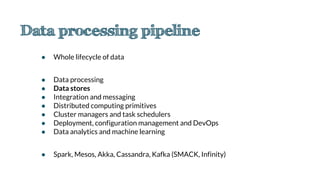
● Whole lifecycle of data
● Data processing
● Data stores
● Integration and messaging
● Distributed computing primitives
● Cluster managers and task schedulers
● Deployment, configuration management and DevOps
● Data analytics and machine learning
● Spark, Mesos, Akka, Cassandra, Kafka (SMACK, Infinity)
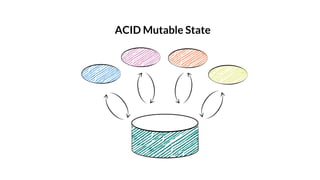
ACID Mutable State
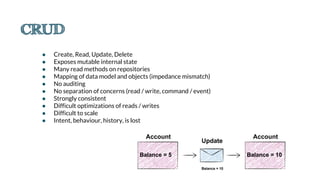
● Create, Read, Update, Delete
● Exposes mutable internal state
● Many read methods on repositories
● Mapping of data model and objects (impedance mismatch)
● No auditing
● No separation of concerns (read / write, command / event)
● Strongly consistent
● Difficult optimizations of reads / writes
● Difficult to scale
● Intent, behaviour, history, is lost
Balance = 5
Balance = 10
Update
Account
Balance = 10
Account
[1]
CQRS
Client
QueryCommand
DBDB
Denormalise
/Precompute
Kappa architecture
Batch-Pipeline
Kafka
Allyourdata
NoSQL
SQL
Spark
Client
Client
Client Views
Stream
processor
Flume
Scoop
Hive
Impala
Oozie
HDFS
Lambda Architecture
Batch Layer Serving
Layer
Stream layer (fast)
Query
Query
Allyourdata Serving DB
[2, 3]
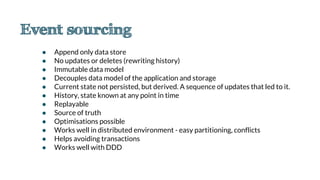
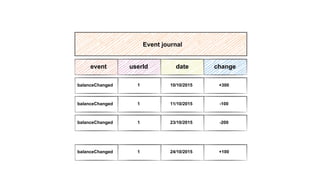
● Append only data store
● No updates or deletes (rewriting history)
● Immutable data model
● Decouples data model of the application and storage
● Current state not persisted, but derived. A sequence of updates that led to it.
● History, state known at any point in time
● Replayable
● Source of truth
● Optimisations possible
● Works well in distributed environment - easy partitioning, conflicts
● Helps avoiding transactions
● Works well with DDD
userId date change
1
1
1
10/10/2015
11/10/2015
23/10/2015
+300
-100
-200
1 24/10/2015 +100
balanceChanged
event
balanceChanged
balanceChanged
balanceChanged
Event journal
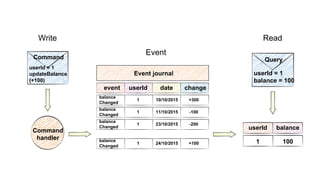
● Command Query Responsibility Segregation
● Read and write logically and physically separated
● Reasoning about the application
● Clear separation of concerns (business logic)
● Often different technology, scalability
● Often lower consistency - eventual, causal
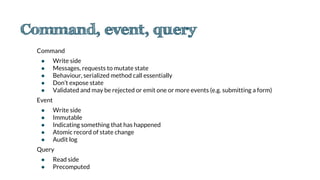
Command
● Write side
● Messages, requests to mutate state
● Behaviour, serialized method call essentially
● Don’t expose state
● Validated and may be rejected or emit one or more events (e.g. submitting a form)
Event
● Write side
● Immutable
● Indicating something that has happened
● Atomic record of state change
● Audit log
Query
● Read side
● Precomputed
userId = 1
updateBalance
(+100)
Write
Command
Event
userId date change
1
1
1
10/10/2015
11/10/2015
23/10/2015
+300
-100
-200
1 24/10/2015 +100
balance
Changed
event
balance
Changed
balance
Changed
balance
Changed
Event journal
Command
handler
Read
balance
1 100
userId = 1
balance = 100
Query
userId
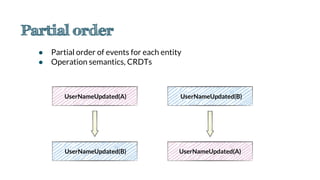
● Partial order of events for each entity
● Operation semantics, CRDTs
UserNameUpdated(B)
UserNameUpdated(B)
UserNameUpdated(A)
UserNameUpdated(A)
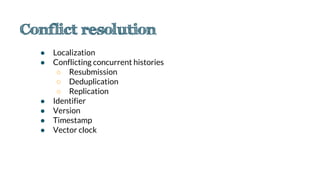
● Localization
● Conflicting concurrent histories
○ Resubmission
○ Deduplication
○ Replication
● Identifier
● Version
● Timestamp
● Vector clock
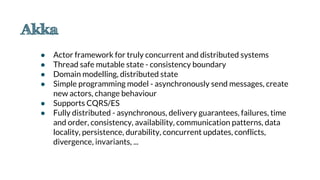
● Actor framework for truly concurrent and distributed systems
● Thread safe mutable state - consistency boundary
● Domain modelling, distributed state
● Simple programming model - asynchronously send messages, create
new actors, change behaviour
● Supports CQRS/ES
● Fully distributed - asynchronous, delivery guarantees, failures, time
and order, consistency, availability, communication patterns, data
locality, persistence, durability, concurrent updates, conflicts,
divergence, invariants, ...
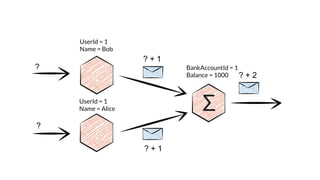
?
?
? + 1
? + 1
? + 2
UserId = 1
Name = Bob
BankAccountId = 1
Balance = 1000
UserId = 1
Name = Alice
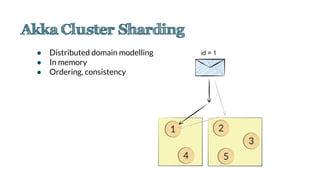
● Distributed domain modelling
● In memory
● Ordering, consistency
id = 1
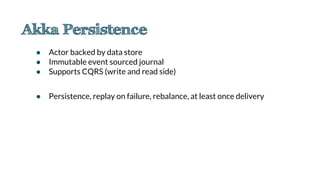
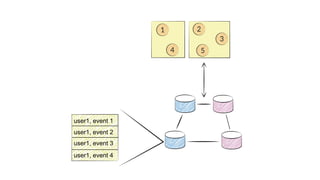
● Actor backed by data store
● Immutable event sourced journal
● Supports CQRS (write and read side)
● Persistence, replay on failure, rebalance, at least once delivery
user1, event 2
user1, event 3
user1, event 4
user1, event 1
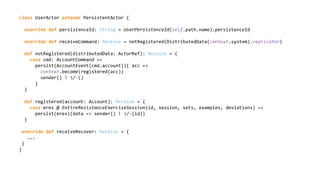
class UserActor extends PersistentActor {
override def persistenceId: String = UserPersistenceId(self.path.name).persistenceId
override def receiveCommand: Receive = notRegistered(DistributedData(context.system).replicator)
def notRegistered(distributedData: ActorRef): Receive = {
case cmd: AccountCommand =>
persist(AccountEvent(cmd.account)){ acc =>
context.become(registered(acc))
sender() ! /-()
}
}
def registered(account: Account): Receive = {
case eres @ EntireResistanceExerciseSession(id, session, sets, examples, deviations) =>
persist(eres)(data => sender() ! /-(id))
}
override def receiveRecover: Receive = {
...
}
}
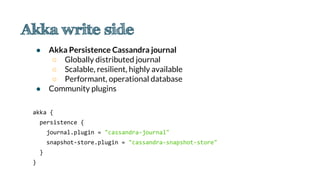
● Akka Persistence Cassandra journal
○ Globally distributed journal
○ Scalable, resilient, highly available
○ Performant, operational database
● Community plugins
akka {
persistence {
journal.plugin = "cassandra-journal"
snapshot-store.plugin = "cassandra-snapshot-store"
}
}
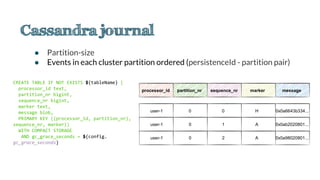
● Partition-size
● Events in each cluster partition ordered (persistenceId - partition pair)
CREATE TABLE IF NOT EXISTS ${tableName} (
processor_id text,
partition_nr bigint,
sequence_nr bigint,
marker text,
message blob,
PRIMARY KEY ((processor_id, partition_nr),
sequence_nr, marker))
WITH COMPACT STORAGE
AND gc_grace_seconds = ${config.
gc_grace_seconds}
processor_id partition_nr sequence_nr marker message
user-1 0 0 H 0x0a6643b334...
user-1 0 1 A 0x0ab2020801...
user-1 0 2 A 0x0a98020801...
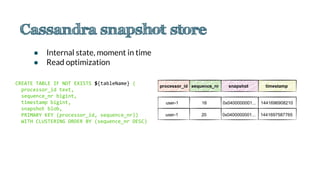
● Internal state, moment in time
● Read optimization
CREATE TABLE IF NOT EXISTS ${tableName} (
processor_id text,
sequence_nr bigint,
timestamp bigint,
snapshot blob,
PRIMARY KEY (processor_id, sequence_nr))
WITH CLUSTERING ORDER BY (sequence_nr DESC)
processor_id sequence_nr snapshot timestamp
user-1 16 0x0400000001... 1441696908210
user-1 20 0x0400000001... 1441697587765
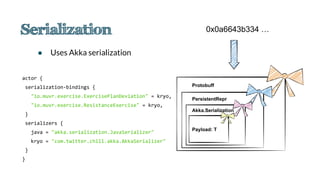
● Uses Akka serialization
0x0a6643b334 …
PersistentRepr
Akka.Serialization
Payload: T
Protobuff
actor {
serialization-bindings {
"io.muvr.exercise.ExercisePlanDeviation" = kryo,
"io.muvr.exercise.ResistanceExercise" = kryo,
}
serializers {
java = "akka.serialization.JavaSerializer"
kryo = "com.twitter.chill.akka.AkkaSerializer"
}
}
class UserActorView(userId: String) extends PersistentView {
override def persistenceId: String = UserPersistenceId(userId).persistenceId
override def viewId: String = UserPersistenceId(userId).persistentViewId
override def autoUpdateInterval: FiniteDuration = FiniteDuration(100, TimeUnit.MILLISECONDS)
def receive: Receive = viewState(List.empty)
def viewState(processedDeviations: List[ExercisePlanProcessedDeviation]): Receive = {
case EntireResistanceExerciseSession(_, _, _, _, deviations) if isPersistent =>
context.become(viewState(deviations.filter(condition).map(process) ::: processedDeviations))
case GetProcessedDeviations => sender() ! processedDeviations
}
}
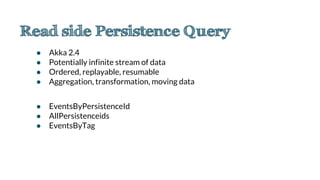
● Akka 2.4
● Potentially infinite stream of data
● Ordered, replayable, resumable
● Aggregation, transformation, moving data
● EventsByPersistenceId
● AllPersistenceids
● EventsByTag
val readJournal =
PersistenceQuery(system).readJournalFor(CassandraJournal.Identifier)
val source = readJournal.query(
EventsByPersistenceId(UserPersistenceId(name).persistenceId, 0, Long.MaxValue), NoRefresh)
.map(_.event)
.collect{ case s: EntireResistanceExerciseSession => s }
.mapConcat(_.deviations)
.filter(condition)
.map(process)
implicit val mat = ActorMaterializer()
val result = source.runFold(List.empty[ExercisePlanDeviation])((x, y) => y :: x)
● Potentially infinite stream of events
Source[Any].map(process).filter(condition)
Publisher Subscriber
process
condition
backpressure
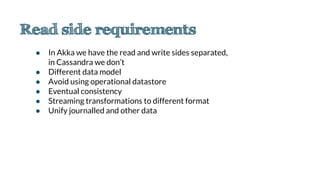
● In Akka we have the read and write sides separated,
in Cassandra we don’t
● Different data model
● Avoid using operational datastore
● Eventual consistency
● Streaming transformations to different format
● Unify journalled and other data
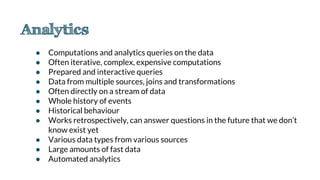
● Computations and analytics queries on the data
● Often iterative, complex, expensive computations
● Prepared and interactive queries
● Data from multiple sources, joins and transformations
● Often directly on a stream of data
● Whole history of events
● Historical behaviour
● Works retrospectively, can answer questions in the future that we don’t
know exist yet
● Various data types from various sources
● Large amounts of fast data
● Automated analytics
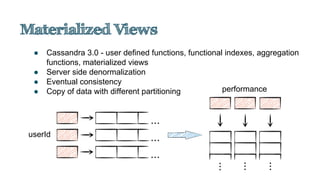
● Cassandra 3.0 - user defined functions, functional indexes, aggregation
functions, materialized views
● Server side denormalization
● Eventual consistency
● Copy of data with different partitioning
userId
performance
● In memory dataflow distributed data processing framework, streaming
and batch
● Distributes computation using a higher level API
● Load balancing
● Moves computation to data
● Fault tolerant
● Resilient Distributed Datasets
● Fault tolerance
● Caching
● Serialization
● Transformations
○ Lazy, form the DAG
○ map, filter, flatMap, union, group, reduce, sort, join, repartition, cartesian, glom, ...
● Actions
○ Execute DAG, retrieve result
○ reduce, collect, count, first, take, foreach, saveAs…, min, max, ...
● Accumulators
● Broadcast Variables
● Integration
● Streaming
● Machine Learning
● Graph Processing
textFile mapmap
reduceByKey
collect
sc.textFile("counts")
.map(line => line.split("t"))
.map(word => (word(0), word(1).toInt))
.reduceByKey(_ + _)
.collect()
[4]
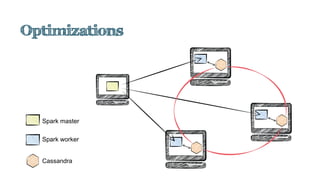
Spark master
Spark worker
Cassandra
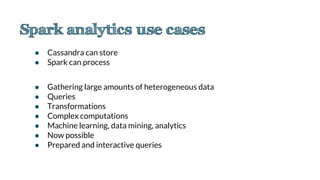
● Cassandra can store
● Spark can process
● Gathering large amounts of heterogeneous data
● Queries
● Transformations
● Complex computations
● Machine learning, data mining, analytics
● Now possible
● Prepared and interactive queries
lazy val sparkConf: SparkConf =
new SparkConf()
.setAppName(...).setMaster(...).set("spark.cassandra.connection.host", "127.0.0.1")
val sc = new SparkContext(sparkConf)
val data = sc.cassandraTable[T]("keyspace", "table").select("columns")
val processedData = data.flatMap(...)...
processedData.saveToCassandra("keyspace", "table")
● Akka Analytics project
● Handles custom Akka serialization
case class JournalKey(persistenceId: String, partition: Long, sequenceNr: Long)
lazy val sparkConf: SparkConf =
new SparkConf()
.setAppName(...).setMaster(...).set("spark.cassandra.connection.host", "127.0.0.1")
val sc = new SparkContext(sparkConf)
val events: RDD[(JournalKey, Any)] = sc.eventTable()
events.sortByKey().map(...).filter(...).collect().foreach(println)
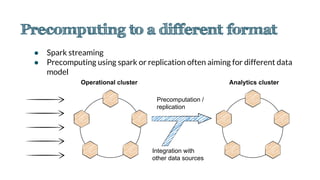
● Spark streaming
● Precomputing using spark or replication often aiming for different data
model
Operational cluster Analytics cluster
Precomputation /
replication
Integration with
other data sources
val events: RDD[(JournalKey, Any)] = sc.eventTable().cache().filterClass[EntireResistanceExerciseSession].flatMap(_.deviations)
val deviationsFrequency = sqlContext.sql(
"""SELECT planned.exercise, hour(time), COUNT(1)
FROM exerciseDeviations
WHERE planned.exercise = 'bench press'
GROUP BY planned.exercise, hour(time)""")
val deviationsFrequency2 = exerciseDeviationsDF
.where(exerciseDeviationsDF("planned.exercise") === "bench press")
.groupBy(
exerciseDeviationsDF("planned.exercise"),
exerciseDeviationsDF("time”))
.count()
val deviationsFrequency3 = exerciseDeviations
.filter(_.planned.exercise == "bench press")
.groupBy(d => (d.planned.exercise, d.time.getHours))
.map(d => (d._1, d._2.size))
def toVector(user: User): mllib.linalg.Vector =
Vectors.dense(
user.frequency, user.performanceIndex, user.improvementIndex)
val events: RDD[(JournalKey, Any)] = sc.eventTable().cache()
val users: RDD[User] = events.filterClass[User]
val kmeans = new KMeans()
.setK(5)
.set...
val clusters = kmeans.run(users.map(_.toVector))
val weight: RDD[(JournalKey, Any)] = sc.eventTable().cache()
val exerciseDeviations = events
.filterClass[EntireResistanceExerciseSession]
.flatMap(session =>
session.sets.flatMap(set =>
set.sets.map(exercise => (session.id.id, exercise.exercise))))
.groupBy(e => e)
.map(g =>
Rating(normalize(g._1._1), normalize(g._1._2),
normalize(g._2.size)))
val model = new ALS().run(ratings)
val predictions = model.predict(recommend)
bench
press
bicep
curl
dead
lift
user 1 5 2
user 2 4 3
user 3 5 2
user 4 3 1
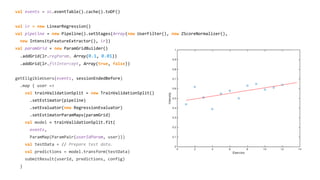
val events = sc.eventTable().cache().toDF()
val lr = new LinearRegression()
val pipeline = new Pipeline().setStages(Array(new UserFilter(), new ZScoreNormalizer(),
new IntensityFeatureExtractor(), lr))
val paramGrid = new ParamGridBuilder()
.addGrid(lr.regParam, Array(0.1, 0.01))
.addGrid(lr.fitIntercept, Array(true, false))
getEligibleUsers(events, sessionEndedBefore)
.map { user =>
val trainValidationSplit = new TrainValidationSplit()
.setEstimator(pipeline)
.setEvaluator(new RegressionEvaluator)
.setEstimatorParamMaps(paramGrid)
val model = trainValidationSplit.fit(
events,
ParamMap(ParamPair(userIdParam, user)))
val testData = // Prepare test data.
val predictions = model.transform(testData)
submitResult(userId, predictions, config)
}
val events: RDD[(JournalKey, Any)] = sc.eventTable().cache()
val connections = events.filterClass[Connections]
val vertices: RDD[(VertexId, Long)] =
connections.map(c => (c.id, 1l))
val edges: RDD[Edge[Long]] = connections
.flatMap(c => c.connections
.map(Edge(c.id, _, 1l)))
val graph = Graph(vertices, edges)
val ranks = graph.pageRank(0.0001).vertices
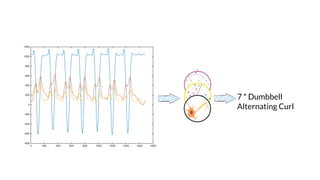
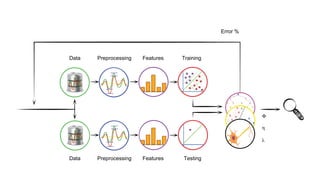
7 * Dumbbell
Alternating Curl
Data
Data
Preprocessing
Preprocessing
Features
Features
Training
Testing
Error %
● Exercise domain as an example
● Analytics of both batch (offline) and streaming (online) data
● Analytics important in other areas (banking, stock market, network,
cluster monitoring, business intelligence, commerce, internet of things, ...)
● Enabling value of data
● Event sourcing
● CQRS
● Technologies to handle the data
○ Spark
○ Mesos
○ Akka
○ Cassandra
○ Kafka
● Handling data
● Insights and analytics enable value in data
● Jobs at www.cakesolutions.net/careers
● Code at https://github.com/muvr
● Martin Zapletal @zapletal_martin
● Anirvan Chakraborty @anirvan_c
[1] http://www.benstopford.com/2015/04/28/elements-of-scale-composing-and-scaling-data-platforms/
[2] http://malteschwarzkopf.de/research/assets/google-stack.pdf
[3] http://malteschwarzkopf.de/research/assets/facebook-stack.pdf
[4] http://www.slideshare.net/LisaHua/spark-overview-37479609

Cassandra as event sourced journal for big data analytics

  • 1.
    Martin Zapletal @zapletal_martin CakeSolutions @cakesolutions #CassandraSummit Presented by Anirvan Chakraborty @anirvan_c
  • 2.
    ● Introduction ● Eventsourcing and CQRS ● An emerging technology stack to handle data ● A reference application and it’s architecture ● A few use cases of the reference application ● Conclusion
  • 3.
    ● Increasing importanceof data analytics ● Current state ○ Destructive updates ○ Analytics tools with poor scalability and integration ○ Manual processes ○ Slow iterations ○ Not suitable for large amounts of data
  • 4.
    ● Whole lifecycleof data ● Data processing ● Data stores ● Integration and messaging ● Distributed computing primitives ● Cluster managers and task schedulers ● Deployment, configuration management and DevOps ● Data analytics and machine learning ● Spark, Mesos, Akka, Cassandra, Kafka (SMACK, Infinity)
  • 5.
  • 6.
    ● Create, Read,Update, Delete ● Exposes mutable internal state ● Many read methods on repositories ● Mapping of data model and objects (impedance mismatch) ● No auditing ● No separation of concerns (read / write, command / event) ● Strongly consistent ● Difficult optimizations of reads / writes ● Difficult to scale ● Intent, behaviour, history, is lost Balance = 5 Balance = 10 Update Account Balance = 10 Account
  • 7.
  • 8.
  • 9.
    ● Append onlydata store ● No updates or deletes (rewriting history) ● Immutable data model ● Decouples data model of the application and storage ● Current state not persisted, but derived. A sequence of updates that led to it. ● History, state known at any point in time ● Replayable ● Source of truth ● Optimisations possible ● Works well in distributed environment - easy partitioning, conflicts ● Helps avoiding transactions ● Works well with DDD
  • 10.
    userId date change 1 1 1 10/10/2015 11/10/2015 23/10/2015 +300 -100 -200 124/10/2015 +100 balanceChanged event balanceChanged balanceChanged balanceChanged Event journal
  • 11.
    ● Command QueryResponsibility Segregation ● Read and write logically and physically separated ● Reasoning about the application ● Clear separation of concerns (business logic) ● Often different technology, scalability ● Often lower consistency - eventual, causal
  • 12.
    Command ● Write side ●Messages, requests to mutate state ● Behaviour, serialized method call essentially ● Don’t expose state ● Validated and may be rejected or emit one or more events (e.g. submitting a form) Event ● Write side ● Immutable ● Indicating something that has happened ● Atomic record of state change ● Audit log Query ● Read side ● Precomputed
  • 13.
    userId = 1 updateBalance (+100) Write Command Event userIddate change 1 1 1 10/10/2015 11/10/2015 23/10/2015 +300 -100 -200 1 24/10/2015 +100 balance Changed event balance Changed balance Changed balance Changed Event journal Command handler Read balance 1 100 userId = 1 balance = 100 Query userId
  • 14.
    ● Partial orderof events for each entity ● Operation semantics, CRDTs UserNameUpdated(B) UserNameUpdated(B) UserNameUpdated(A) UserNameUpdated(A)
  • 15.
    ● Localization ● Conflictingconcurrent histories ○ Resubmission ○ Deduplication ○ Replication ● Identifier ● Version ● Timestamp ● Vector clock
  • 18.
    ● Actor frameworkfor truly concurrent and distributed systems ● Thread safe mutable state - consistency boundary ● Domain modelling, distributed state ● Simple programming model - asynchronously send messages, create new actors, change behaviour ● Supports CQRS/ES ● Fully distributed - asynchronous, delivery guarantees, failures, time and order, consistency, availability, communication patterns, data locality, persistence, durability, concurrent updates, conflicts, divergence, invariants, ...
  • 19.
    ? ? ? + 1 ?+ 1 ? + 2 UserId = 1 Name = Bob BankAccountId = 1 Balance = 1000 UserId = 1 Name = Alice
  • 20.
    ● Distributed domainmodelling ● In memory ● Ordering, consistency id = 1
  • 21.
    ● Actor backedby data store ● Immutable event sourced journal ● Supports CQRS (write and read side) ● Persistence, replay on failure, rebalance, at least once delivery
  • 22.
    user1, event 2 user1,event 3 user1, event 4 user1, event 1
  • 23.
    class UserActor extendsPersistentActor { override def persistenceId: String = UserPersistenceId(self.path.name).persistenceId override def receiveCommand: Receive = notRegistered(DistributedData(context.system).replicator) def notRegistered(distributedData: ActorRef): Receive = { case cmd: AccountCommand => persist(AccountEvent(cmd.account)){ acc => context.become(registered(acc)) sender() ! /-() } } def registered(account: Account): Receive = { case eres @ EntireResistanceExerciseSession(id, session, sets, examples, deviations) => persist(eres)(data => sender() ! /-(id)) } override def receiveRecover: Receive = { ... } }
  • 24.
    ● Akka PersistenceCassandra journal ○ Globally distributed journal ○ Scalable, resilient, highly available ○ Performant, operational database ● Community plugins akka { persistence { journal.plugin = "cassandra-journal" snapshot-store.plugin = "cassandra-snapshot-store" } }
  • 25.
    ● Partition-size ● Eventsin each cluster partition ordered (persistenceId - partition pair) CREATE TABLE IF NOT EXISTS ${tableName} ( processor_id text, partition_nr bigint, sequence_nr bigint, marker text, message blob, PRIMARY KEY ((processor_id, partition_nr), sequence_nr, marker)) WITH COMPACT STORAGE AND gc_grace_seconds = ${config. gc_grace_seconds} processor_id partition_nr sequence_nr marker message user-1 0 0 H 0x0a6643b334... user-1 0 1 A 0x0ab2020801... user-1 0 2 A 0x0a98020801...
  • 26.
    ● Internal state,moment in time ● Read optimization CREATE TABLE IF NOT EXISTS ${tableName} ( processor_id text, sequence_nr bigint, timestamp bigint, snapshot blob, PRIMARY KEY (processor_id, sequence_nr)) WITH CLUSTERING ORDER BY (sequence_nr DESC) processor_id sequence_nr snapshot timestamp user-1 16 0x0400000001... 1441696908210 user-1 20 0x0400000001... 1441697587765
  • 27.
    ● Uses Akkaserialization 0x0a6643b334 … PersistentRepr Akka.Serialization Payload: T Protobuff actor { serialization-bindings { "io.muvr.exercise.ExercisePlanDeviation" = kryo, "io.muvr.exercise.ResistanceExercise" = kryo, } serializers { java = "akka.serialization.JavaSerializer" kryo = "com.twitter.chill.akka.AkkaSerializer" } }
  • 28.
    class UserActorView(userId: String)extends PersistentView { override def persistenceId: String = UserPersistenceId(userId).persistenceId override def viewId: String = UserPersistenceId(userId).persistentViewId override def autoUpdateInterval: FiniteDuration = FiniteDuration(100, TimeUnit.MILLISECONDS) def receive: Receive = viewState(List.empty) def viewState(processedDeviations: List[ExercisePlanProcessedDeviation]): Receive = { case EntireResistanceExerciseSession(_, _, _, _, deviations) if isPersistent => context.become(viewState(deviations.filter(condition).map(process) ::: processedDeviations)) case GetProcessedDeviations => sender() ! processedDeviations } }
  • 29.
    ● Akka 2.4 ●Potentially infinite stream of data ● Ordered, replayable, resumable ● Aggregation, transformation, moving data ● EventsByPersistenceId ● AllPersistenceids ● EventsByTag
  • 30.
    val readJournal = PersistenceQuery(system).readJournalFor(CassandraJournal.Identifier) valsource = readJournal.query( EventsByPersistenceId(UserPersistenceId(name).persistenceId, 0, Long.MaxValue), NoRefresh) .map(_.event) .collect{ case s: EntireResistanceExerciseSession => s } .mapConcat(_.deviations) .filter(condition) .map(process) implicit val mat = ActorMaterializer() val result = source.runFold(List.empty[ExercisePlanDeviation])((x, y) => y :: x)
  • 31.
    ● Potentially infinitestream of events Source[Any].map(process).filter(condition) Publisher Subscriber process condition backpressure
  • 32.
    ● In Akkawe have the read and write sides separated, in Cassandra we don’t ● Different data model ● Avoid using operational datastore ● Eventual consistency ● Streaming transformations to different format ● Unify journalled and other data
  • 33.
    ● Computations andanalytics queries on the data ● Often iterative, complex, expensive computations ● Prepared and interactive queries ● Data from multiple sources, joins and transformations ● Often directly on a stream of data ● Whole history of events ● Historical behaviour ● Works retrospectively, can answer questions in the future that we don’t know exist yet ● Various data types from various sources ● Large amounts of fast data ● Automated analytics
  • 34.
    ● Cassandra 3.0- user defined functions, functional indexes, aggregation functions, materialized views ● Server side denormalization ● Eventual consistency ● Copy of data with different partitioning userId performance
  • 35.
    ● In memorydataflow distributed data processing framework, streaming and batch ● Distributes computation using a higher level API ● Load balancing ● Moves computation to data ● Fault tolerant
  • 36.
    ● Resilient DistributedDatasets ● Fault tolerance ● Caching ● Serialization ● Transformations ○ Lazy, form the DAG ○ map, filter, flatMap, union, group, reduce, sort, join, repartition, cartesian, glom, ... ● Actions ○ Execute DAG, retrieve result ○ reduce, collect, count, first, take, foreach, saveAs…, min, max, ... ● Accumulators ● Broadcast Variables ● Integration ● Streaming ● Machine Learning ● Graph Processing
  • 37.
    textFile mapmap reduceByKey collect sc.textFile("counts") .map(line =>line.split("t")) .map(word => (word(0), word(1).toInt)) .reduceByKey(_ + _) .collect() [4]
  • 38.
  • 39.
    ● Cassandra canstore ● Spark can process ● Gathering large amounts of heterogeneous data ● Queries ● Transformations ● Complex computations ● Machine learning, data mining, analytics ● Now possible ● Prepared and interactive queries
  • 40.
    lazy val sparkConf:SparkConf = new SparkConf() .setAppName(...).setMaster(...).set("spark.cassandra.connection.host", "127.0.0.1") val sc = new SparkContext(sparkConf) val data = sc.cassandraTable[T]("keyspace", "table").select("columns") val processedData = data.flatMap(...)... processedData.saveToCassandra("keyspace", "table")
  • 41.
    ● Akka Analyticsproject ● Handles custom Akka serialization case class JournalKey(persistenceId: String, partition: Long, sequenceNr: Long) lazy val sparkConf: SparkConf = new SparkConf() .setAppName(...).setMaster(...).set("spark.cassandra.connection.host", "127.0.0.1") val sc = new SparkContext(sparkConf) val events: RDD[(JournalKey, Any)] = sc.eventTable() events.sortByKey().map(...).filter(...).collect().foreach(println)
  • 42.
    ● Spark streaming ●Precomputing using spark or replication often aiming for different data model Operational cluster Analytics cluster Precomputation / replication Integration with other data sources
  • 43.
    val events: RDD[(JournalKey,Any)] = sc.eventTable().cache().filterClass[EntireResistanceExerciseSession].flatMap(_.deviations) val deviationsFrequency = sqlContext.sql( """SELECT planned.exercise, hour(time), COUNT(1) FROM exerciseDeviations WHERE planned.exercise = 'bench press' GROUP BY planned.exercise, hour(time)""") val deviationsFrequency2 = exerciseDeviationsDF .where(exerciseDeviationsDF("planned.exercise") === "bench press") .groupBy( exerciseDeviationsDF("planned.exercise"), exerciseDeviationsDF("time”)) .count() val deviationsFrequency3 = exerciseDeviations .filter(_.planned.exercise == "bench press") .groupBy(d => (d.planned.exercise, d.time.getHours)) .map(d => (d._1, d._2.size))
  • 44.
    def toVector(user: User):mllib.linalg.Vector = Vectors.dense( user.frequency, user.performanceIndex, user.improvementIndex) val events: RDD[(JournalKey, Any)] = sc.eventTable().cache() val users: RDD[User] = events.filterClass[User] val kmeans = new KMeans() .setK(5) .set... val clusters = kmeans.run(users.map(_.toVector))
  • 45.
    val weight: RDD[(JournalKey,Any)] = sc.eventTable().cache() val exerciseDeviations = events .filterClass[EntireResistanceExerciseSession] .flatMap(session => session.sets.flatMap(set => set.sets.map(exercise => (session.id.id, exercise.exercise)))) .groupBy(e => e) .map(g => Rating(normalize(g._1._1), normalize(g._1._2), normalize(g._2.size))) val model = new ALS().run(ratings) val predictions = model.predict(recommend) bench press bicep curl dead lift user 1 5 2 user 2 4 3 user 3 5 2 user 4 3 1
  • 46.
    val events =sc.eventTable().cache().toDF() val lr = new LinearRegression() val pipeline = new Pipeline().setStages(Array(new UserFilter(), new ZScoreNormalizer(), new IntensityFeatureExtractor(), lr)) val paramGrid = new ParamGridBuilder() .addGrid(lr.regParam, Array(0.1, 0.01)) .addGrid(lr.fitIntercept, Array(true, false)) getEligibleUsers(events, sessionEndedBefore) .map { user => val trainValidationSplit = new TrainValidationSplit() .setEstimator(pipeline) .setEvaluator(new RegressionEvaluator) .setEstimatorParamMaps(paramGrid) val model = trainValidationSplit.fit( events, ParamMap(ParamPair(userIdParam, user))) val testData = // Prepare test data. val predictions = model.transform(testData) submitResult(userId, predictions, config) }
  • 47.
    val events: RDD[(JournalKey,Any)] = sc.eventTable().cache() val connections = events.filterClass[Connections] val vertices: RDD[(VertexId, Long)] = connections.map(c => (c.id, 1l)) val edges: RDD[Edge[Long]] = connections .flatMap(c => c.connections .map(Edge(c.id, _, 1l))) val graph = Graph(vertices, edges) val ranks = graph.pageRank(0.0001).vertices
  • 51.
  • 52.
  • 53.
    ● Exercise domainas an example ● Analytics of both batch (offline) and streaming (online) data ● Analytics important in other areas (banking, stock market, network, cluster monitoring, business intelligence, commerce, internet of things, ...) ● Enabling value of data
  • 54.
    ● Event sourcing ●CQRS ● Technologies to handle the data ○ Spark ○ Mesos ○ Akka ○ Cassandra ○ Kafka ● Handling data ● Insights and analytics enable value in data
  • 56.
    ● Jobs atwww.cakesolutions.net/careers ● Code at https://github.com/muvr ● Martin Zapletal @zapletal_martin ● Anirvan Chakraborty @anirvan_c
  • 57.
    [1] http://www.benstopford.com/2015/04/28/elements-of-scale-composing-and-scaling-data-platforms/ [2] http://malteschwarzkopf.de/research/assets/google-stack.pdf [3]http://malteschwarzkopf.de/research/assets/facebook-stack.pdf [4] http://www.slideshare.net/LisaHua/spark-overview-37479609