SPARCL
OVMC LANDMARK TRIALS SERIES
Amarenco P, et al. "High-dose atorvastatin after stroke
or transient ischemic attack". The New England Journal
of Medicine. 2006. 355(6):549-559.
STROKE PREVENTION by Aggressive Reduction in Cholesterol Levels (SPARCL)
Summarized by Isabella Lai; Laxmi Suthar
BACKGROUND
 CARE, LIPID, and 4S trials showed that the role
of statins in primary prevention of stroke and
TIA in patients with high risk CVA
 However, prior to SPARCL, there were not clear
guidelines for secondary prevention of stroke
and TIA
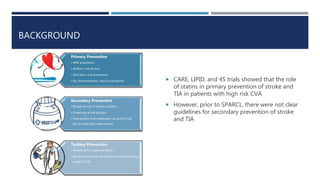
Primary Prevention
• Well population
• Address risk factors
• Education and prevention
• Eg: Immunizations, exercise programs
Secondary Prevention
• People at risk of health problem
• Screening at risk groups
• Intervention and medication to control risk
factors and early intervention
Tertiary Prevention
• People with a health problem
• Rehab, preventing complications and improving
quality of life
CLINICAL QUESTION
 For patients prior stroke or TIA, does
HIGH-DOSE ATORVASTATIN reduce the
risk of recurrent stroke?
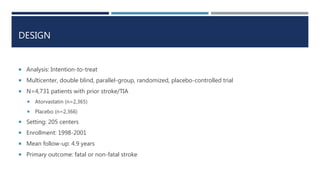
DESIGN
 Analysis: Intention-to-treat
 Multicenter, double blind, parallel-group, randomized, placebo-controlled trial
 N=4,731 patients with prior stroke/TIA
 Atorvastatin (n=2,365)
 Placebo (n=2,366)
 Setting: 205 centers
 Enrollment: 1998-2001
 Mean follow-up: 4.9 years
 Primary outcome: fatal or non-fatal stroke
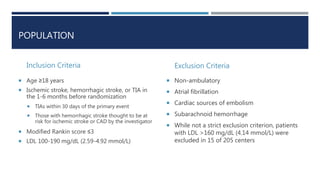
POPULATION
Inclusion Criteria
 Age ≥18 years
 Ischemic stroke, hemorrhagic stroke, or TIA in
the 1-6 months before randomization
 TIAs within 30 days of the primary event
 Those with hemorrhagic stroke thought to be at
risk for ischemic stroke or CAD by the investigator
 Modified Rankin score ≤3
 LDL 100-190 mg/dL (2.59-4.92 mmol/L)
Exclusion Criteria
 Non-ambulatory
 Atrial fibrillation
 Cardiac sources of embolism
 Subarachnoid hemorrhage
 While not a strict exclusion criterion, patients
with LDL >160 mg/dL (4.14 mmol/L) were
excluded in 15 of 205 centers
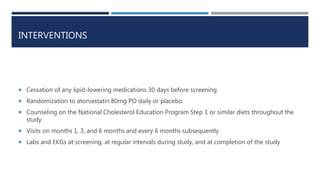
INTERVENTIONS
 Cessation of any lipid-lowering medications 30 days before screening
 Randomization to atorvastatin 80mg PO daily or placebo
 Counseling on the National Cholesterol Education Program Step 1 or similar diets throughout the
study
 Visits on months 1, 3, and 6 months and every 6 months subsequently
 Labs and EKGs at screening, at regular intervals during study, and at completion of the study
CRITICISMS
 Power of SPARCL study not sufficient to assess mortality
 SPARCL did not have a run-in period. Other lipid studies did so it is harder to assess tolerability of
high-dose atorvastatin in SPARCL
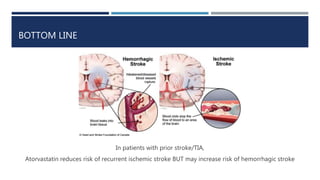
BOTTOM LINE
In patients with prior stroke/TIA,
Atorvastatin reduces risk of recurrent ischemic stroke BUT may increase risk of hemorrhagic stroke
DISCUSSION QUESTIONS
 For a patient with history of ischemic stroke, would
you give Atorvastatin? When would you re-consider
giving Atrovastatin?
 What is a run-in period?
DISCUSSION QUESTIONS
 For a patient with history of ischemic stroke, would you give Atorvastatin?
 ANSWER: Yes, give High-dose Atorvastatin 40mg or 80mg
 When would you re-consider giving Atorvastatin?
 ANSWER: For patients with ischemic stroke
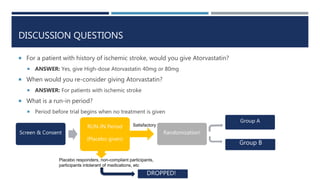
 What is a run-in period?
 Period before trial begins when no treatment is given
Screen & Consent
RUN-IN Period
(Placebo given)
Randomization!
Group A
Group B
Placebo responders, non-compliant participants,
participants intolerant of medications, etc
Satisfactory
DROPPED!
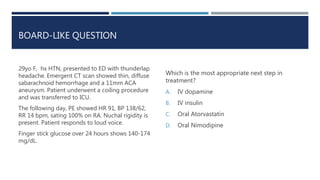
BOARD-LIKE QUESTION
29yo F, hx HTN, presented to ED with thunderlap
headache. Emergent CT scan showed thin, diffuse
sabarachnoid hemorrhage and a 11mm ACA
aneurysm. Patient underwent a coiling procedure
and was transferred to ICU.
The following day, PE showed HR 91, BP 138/62,
RR 14 bpm, sating 100% on RA. Nuchal rigidity is
present. Patient responds to loud voice.
Finger stick glucose over 24 hours shows 140-174
mg/dL.
Which is the most appropriate next step in
treatment?
A. IV dopamine
B. IV insulin
C. Oral Atorvastatin
D. Oral Nimodipine
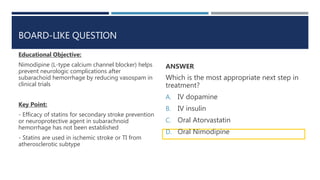
BOARD-LIKE QUESTION
Educational Objective:
Nimodipine (L-type calcium channel blocker) helps
prevent neurologic complications after
subarachoid hemorrhage by reducing vasospam in
clinical trials
Key Point:
- Efficacy of statins for secondary stroke prevention
or neuroprotective agent in subarachnoid
hemorrhage has not been established
- Statins are used in ischemic stroke or TI from
atherosclerotic subtype
ANSWER
Which is the most appropriate next step in
treatment?
A. IV dopamine
B. IV insulin
C. Oral Atorvastatin
D. Oral Nimodipine
REFERENCES
 High-dose Atorvastatin after stroke or transient Ischemic attack (2006). New England Journal of
Medicine, 355(6), 549–559. doi:10.1056/nejmoa061894
 Brain, P. SPARCL. From https://www.wikijournalclub.org/wiki/SPARCL

SPARCL

  • 1.
    SPARCL OVMC LANDMARK TRIALSSERIES Amarenco P, et al. "High-dose atorvastatin after stroke or transient ischemic attack". The New England Journal of Medicine. 2006. 355(6):549-559.
  • 2.
    STROKE PREVENTION byAggressive Reduction in Cholesterol Levels (SPARCL) Summarized by Isabella Lai; Laxmi Suthar
  • 3.
    BACKGROUND  CARE, LIPID,and 4S trials showed that the role of statins in primary prevention of stroke and TIA in patients with high risk CVA  However, prior to SPARCL, there were not clear guidelines for secondary prevention of stroke and TIA Primary Prevention • Well population • Address risk factors • Education and prevention • Eg: Immunizations, exercise programs Secondary Prevention • People at risk of health problem • Screening at risk groups • Intervention and medication to control risk factors and early intervention Tertiary Prevention • People with a health problem • Rehab, preventing complications and improving quality of life
  • 4.
    CLINICAL QUESTION  Forpatients prior stroke or TIA, does HIGH-DOSE ATORVASTATIN reduce the risk of recurrent stroke?
  • 5.
    DESIGN  Analysis: Intention-to-treat Multicenter, double blind, parallel-group, randomized, placebo-controlled trial  N=4,731 patients with prior stroke/TIA  Atorvastatin (n=2,365)  Placebo (n=2,366)  Setting: 205 centers  Enrollment: 1998-2001  Mean follow-up: 4.9 years  Primary outcome: fatal or non-fatal stroke
  • 6.
    POPULATION Inclusion Criteria  Age≥18 years  Ischemic stroke, hemorrhagic stroke, or TIA in the 1-6 months before randomization  TIAs within 30 days of the primary event  Those with hemorrhagic stroke thought to be at risk for ischemic stroke or CAD by the investigator  Modified Rankin score ≤3  LDL 100-190 mg/dL (2.59-4.92 mmol/L) Exclusion Criteria  Non-ambulatory  Atrial fibrillation  Cardiac sources of embolism  Subarachnoid hemorrhage  While not a strict exclusion criterion, patients with LDL >160 mg/dL (4.14 mmol/L) were excluded in 15 of 205 centers
  • 7.
    INTERVENTIONS  Cessation ofany lipid-lowering medications 30 days before screening  Randomization to atorvastatin 80mg PO daily or placebo  Counseling on the National Cholesterol Education Program Step 1 or similar diets throughout the study  Visits on months 1, 3, and 6 months and every 6 months subsequently  Labs and EKGs at screening, at regular intervals during study, and at completion of the study
  • 8.
    CRITICISMS  Power ofSPARCL study not sufficient to assess mortality  SPARCL did not have a run-in period. Other lipid studies did so it is harder to assess tolerability of high-dose atorvastatin in SPARCL
  • 9.
    BOTTOM LINE In patientswith prior stroke/TIA, Atorvastatin reduces risk of recurrent ischemic stroke BUT may increase risk of hemorrhagic stroke
  • 10.
    DISCUSSION QUESTIONS  Fora patient with history of ischemic stroke, would you give Atorvastatin? When would you re-consider giving Atrovastatin?  What is a run-in period?
  • 11.
    DISCUSSION QUESTIONS  Fora patient with history of ischemic stroke, would you give Atorvastatin?  ANSWER: Yes, give High-dose Atorvastatin 40mg or 80mg  When would you re-consider giving Atorvastatin?  ANSWER: For patients with ischemic stroke  What is a run-in period?  Period before trial begins when no treatment is given Screen & Consent RUN-IN Period (Placebo given) Randomization! Group A Group B Placebo responders, non-compliant participants, participants intolerant of medications, etc Satisfactory DROPPED!
  • 12.
    BOARD-LIKE QUESTION 29yo F,hx HTN, presented to ED with thunderlap headache. Emergent CT scan showed thin, diffuse sabarachnoid hemorrhage and a 11mm ACA aneurysm. Patient underwent a coiling procedure and was transferred to ICU. The following day, PE showed HR 91, BP 138/62, RR 14 bpm, sating 100% on RA. Nuchal rigidity is present. Patient responds to loud voice. Finger stick glucose over 24 hours shows 140-174 mg/dL. Which is the most appropriate next step in treatment? A. IV dopamine B. IV insulin C. Oral Atorvastatin D. Oral Nimodipine
  • 13.
    BOARD-LIKE QUESTION Educational Objective: Nimodipine(L-type calcium channel blocker) helps prevent neurologic complications after subarachoid hemorrhage by reducing vasospam in clinical trials Key Point: - Efficacy of statins for secondary stroke prevention or neuroprotective agent in subarachnoid hemorrhage has not been established - Statins are used in ischemic stroke or TI from atherosclerotic subtype ANSWER Which is the most appropriate next step in treatment? A. IV dopamine B. IV insulin C. Oral Atorvastatin D. Oral Nimodipine
  • 14.
    REFERENCES  High-dose Atorvastatinafter stroke or transient Ischemic attack (2006). New England Journal of Medicine, 355(6), 549–559. doi:10.1056/nejmoa061894  Brain, P. SPARCL. From https://www.wikijournalclub.org/wiki/SPARCL