CORTICUS
OVMC LANDMARK TRIALS SERIES
Sprung CL, et al. "Hydrocortisone therapy for patients
with septic shock". New England Journal of Medicine.
2008. 358(2):111-24.
Corticosteroid Therapy of Septic Shock (CORTICUS)
Summarized by Isabella Lai, MD; Laxmi Suthar, MD
BACKGROUND
 Severe sepsis is major cause of mortality/morbidity
 Septic shock is most severe manifestation (occurs in 2-
20% of hospitalized patients)
 Steroid use has been controversial
 Prior to CORTICUS, trials (eg Annane Trial, 2002)
showed benefit from hydrocortisone and
fludrocortisone in septic shock and patients with
relative adrenal insufficiency
 Subsequent studies were not able to replicate Annane
Trial and even showed harm (related to infection) when
hydrocortisone was given
 Hydrocortisone has both glucocorticoid and
mineralocorticoid activity.
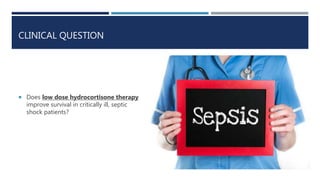
CLINICAL QUESTION
 Does low dose hydrocortisone therapy
improve survival in critically ill, septic
shock patients?
DESIGN
 Trial Design: Multicenter, double-blind, parallel-group, randomized, placebo-controlled trial
 N=499
 Hydrocortisone (n=251)
 Placebo (n=248)
 Mean follow-up: 28 days
 Primary Outcome: rate of death at 28 days in patients who did not have a response to corticotropin
 Secondary Outcomes: rate of death at 28 days who had response to corticotropin; rate of death in
ICU/hospital/ rate of death at 1 year after randomization; reversal of organ failure
POPULATION
Inclusion Criteria
 Patients 18 years and older
 All patients hospitalized in ICU
 Septic shock within the past 72h (as defined by
sBP <90 despite IV fluid resuscitation OR need
for vasopressors >1h) and hypoperfusion or
organ dysfunction attributable to sepsis
Exclusion Criteria
 Underlying disease with poor prognosis
 Life expectancy <24h
 Immunosuppression
 Treatment with long-term corticosteroids
within past 6 months or short-term
corticosteroids within past 4 weeks
INTERVENTIONS
 Participants randomly assigned to:
 Hydrocortisone 50mg IV q6hour, tapered over 6 days
 Placebo IV q 6 h, tapered over 6 days
 Randomization: Concealed from investigators
 High dose of (250mcg) ACTH-stimulation test was performed 60 minutes prior to admin of meds
 Patients were classified as responsive (cortisol increase >9 mcg/dL) or non-responsive to ACTH
(cortisol increase ≤9 mcg/dL)
CRITICISMS/LIMITATIONS/FUNDING
 The trial was underpowered (needed enrollment of 800 to detect 10% decrease in mortality)
 Patient population was less ill than patients enrolled in prior trials of corticosteroids in shock
 Inclusion criteria of 72 hours may have missed the optimal window of opportunity
 No studies on myopathy induced in patients by hydrocortisone
 Post-hoc analysis showed appropriate antibiotics in 72% vs. 78%, outcomes reported as NSS; this means that one-
quarter of patients did not receive appropriate antibiotics
FUNDING:
European Commission
European Society of Intensive Care Medicine
European Critical Care Research Network
International Sepsis Forum
Gorham Foundation
BOTTOM LINE
Hydrocortisone hastens the reversal of shock IN WHOM shock was reversed
BUT does not confer a survival benefit among patients with septic shock.
Based on CORTICUS and selected other studies, corticosteroids should not be routinely used in
adult patients with septic shock. NEVERTHELESS, there may be a benefit among selected patients.
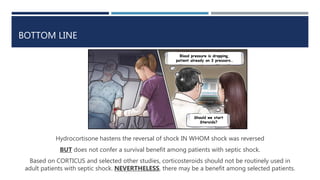
Blood pressure is dropping,
patient already on 3 pressors…
Should we start
Steroids?
SURVIVING SEPSIS CAMPAIGN
Guidelines for Severe Sepsis and Septic Shock
 If unable to reverse hemodynamic instability with fluid resuscitation and pressors, then
Hydrocortisone 200mg IV daily can be used
 Recommend against ACTH stimulation test in adults with septic shock (Grade 2B)
 Recommend against using hydrocortisone when vasopressors aren’t required (Grade 2D)
 Recommend against using corticosteroids in sepsis without shock (Grade 1D)
DISCUSSION QUESTIONS
 Based on the CORTICUS trial, should hydrocortisone be given in patients with septic shock?
 What is a criticism for why the CORTICUS trial cannot be extrapolated to all patients with septic
shock?
 When should Hydrocortisone be given in critically ill patients with septic shock?
DISCUSSION QUESTIONS
 Based on the CORTICUS trial, should hydrocortisone be given in patients with septic shock?
 ANSWER: Yes, with the understanding that Hydrocortisone can reverse shock, but not improve survival.
 What is a criticism for why the CORTICUS trial cannot be extrapolated to all patients with septic
shock?
 ANSWER: The patients in the CORTICUS trial were not as sick as prior trials. Also, 72 hour window may have
missed optimal window for medication.
 When should Hydrocortisone be given in critically ill patients with septic shock?
 ANSWER: When fluids and vasopressors cannot achieve hemodynamic stability and patient is in persistent
shock
BOARD-LIKE QUESTION
72yo F, admitted to ICU for CAP complicated by
septic shock. Within past 24 hours, patient no
longer requires Levophed to maintain blood
pressure. He is currently receive 100cc/hr of IVNS.
Net fluid balance since admission is 10L. Currently,
he is receiving CTX, Azithromycin, and
Dexmedetomidine.
On PE, T 36.8, HR 78, BP 94/55.
Labs: K 4, Creatinine 2.2
ABG 7.31/51/87
ADAPTED FROM MKSAP 17
QUESTION
Which is the most appropriate next step in
treatment?
A. Give 500cc mL of 12.5% albumin q6hour
B. Start hemodialysis
C. Start hydrocortisone
D. Discontinue IVNS
BOARD-LIKE QUESTION
Educational Objective:
Septic Shock and AKI
Key Point:
In patients with septic shock, aggressive fluid
resuscitation is known to be beneficial only during
early period (within first several hours).
After initial period, fluids unlikely to make kidneys
better (and may worsen it). Can trial d/c IV fluids
and start diuretics.
Albumin can cause harm during recovery phase,
hemodialysis currently not indicated.
Hydrocortisone has not consistently shown benefit.
Additionally, this patient is able to maintain BP
without pressors so hydrocortisone should not be
used.
ANSWER
Which is the most appropriate next step in
treatment?
A. Give 500cc mL of 12.5% albumin q6hour
B. Start hemodialysis
C. Start hydrocortisone
D. Discontinue IVNS
REFERENCES
 Intensive versus conventional glucose control in critically ill patients (2009). New England Journal of
Medicine, 360(13), 1283–1297. doi:10.1056/nejmoa0810
 Brain, P. CORTICUS. Retrieved March 5, 2017, from https://www.wikijournalclub.org/wiki/CORTICUS
625

CORTICUS

  • 1.
    CORTICUS OVMC LANDMARK TRIALSSERIES Sprung CL, et al. "Hydrocortisone therapy for patients with septic shock". New England Journal of Medicine. 2008. 358(2):111-24.
  • 2.
    Corticosteroid Therapy ofSeptic Shock (CORTICUS) Summarized by Isabella Lai, MD; Laxmi Suthar, MD
  • 3.
    BACKGROUND  Severe sepsisis major cause of mortality/morbidity  Septic shock is most severe manifestation (occurs in 2- 20% of hospitalized patients)  Steroid use has been controversial  Prior to CORTICUS, trials (eg Annane Trial, 2002) showed benefit from hydrocortisone and fludrocortisone in septic shock and patients with relative adrenal insufficiency  Subsequent studies were not able to replicate Annane Trial and even showed harm (related to infection) when hydrocortisone was given  Hydrocortisone has both glucocorticoid and mineralocorticoid activity.
  • 4.
    CLINICAL QUESTION  Doeslow dose hydrocortisone therapy improve survival in critically ill, septic shock patients?
  • 5.
    DESIGN  Trial Design:Multicenter, double-blind, parallel-group, randomized, placebo-controlled trial  N=499  Hydrocortisone (n=251)  Placebo (n=248)  Mean follow-up: 28 days  Primary Outcome: rate of death at 28 days in patients who did not have a response to corticotropin  Secondary Outcomes: rate of death at 28 days who had response to corticotropin; rate of death in ICU/hospital/ rate of death at 1 year after randomization; reversal of organ failure
  • 6.
    POPULATION Inclusion Criteria  Patients18 years and older  All patients hospitalized in ICU  Septic shock within the past 72h (as defined by sBP <90 despite IV fluid resuscitation OR need for vasopressors >1h) and hypoperfusion or organ dysfunction attributable to sepsis Exclusion Criteria  Underlying disease with poor prognosis  Life expectancy <24h  Immunosuppression  Treatment with long-term corticosteroids within past 6 months or short-term corticosteroids within past 4 weeks
  • 7.
    INTERVENTIONS  Participants randomlyassigned to:  Hydrocortisone 50mg IV q6hour, tapered over 6 days  Placebo IV q 6 h, tapered over 6 days  Randomization: Concealed from investigators  High dose of (250mcg) ACTH-stimulation test was performed 60 minutes prior to admin of meds  Patients were classified as responsive (cortisol increase >9 mcg/dL) or non-responsive to ACTH (cortisol increase ≤9 mcg/dL)
  • 8.
    CRITICISMS/LIMITATIONS/FUNDING  The trialwas underpowered (needed enrollment of 800 to detect 10% decrease in mortality)  Patient population was less ill than patients enrolled in prior trials of corticosteroids in shock  Inclusion criteria of 72 hours may have missed the optimal window of opportunity  No studies on myopathy induced in patients by hydrocortisone  Post-hoc analysis showed appropriate antibiotics in 72% vs. 78%, outcomes reported as NSS; this means that one- quarter of patients did not receive appropriate antibiotics FUNDING: European Commission European Society of Intensive Care Medicine European Critical Care Research Network International Sepsis Forum Gorham Foundation
  • 9.
    BOTTOM LINE Hydrocortisone hastensthe reversal of shock IN WHOM shock was reversed BUT does not confer a survival benefit among patients with septic shock. Based on CORTICUS and selected other studies, corticosteroids should not be routinely used in adult patients with septic shock. NEVERTHELESS, there may be a benefit among selected patients. Blood pressure is dropping, patient already on 3 pressors… Should we start Steroids?
  • 10.
    SURVIVING SEPSIS CAMPAIGN Guidelinesfor Severe Sepsis and Septic Shock  If unable to reverse hemodynamic instability with fluid resuscitation and pressors, then Hydrocortisone 200mg IV daily can be used  Recommend against ACTH stimulation test in adults with septic shock (Grade 2B)  Recommend against using hydrocortisone when vasopressors aren’t required (Grade 2D)  Recommend against using corticosteroids in sepsis without shock (Grade 1D)
  • 11.
    DISCUSSION QUESTIONS  Basedon the CORTICUS trial, should hydrocortisone be given in patients with septic shock?  What is a criticism for why the CORTICUS trial cannot be extrapolated to all patients with septic shock?  When should Hydrocortisone be given in critically ill patients with septic shock?
  • 12.
    DISCUSSION QUESTIONS  Basedon the CORTICUS trial, should hydrocortisone be given in patients with septic shock?  ANSWER: Yes, with the understanding that Hydrocortisone can reverse shock, but not improve survival.  What is a criticism for why the CORTICUS trial cannot be extrapolated to all patients with septic shock?  ANSWER: The patients in the CORTICUS trial were not as sick as prior trials. Also, 72 hour window may have missed optimal window for medication.  When should Hydrocortisone be given in critically ill patients with septic shock?  ANSWER: When fluids and vasopressors cannot achieve hemodynamic stability and patient is in persistent shock
  • 13.
    BOARD-LIKE QUESTION 72yo F,admitted to ICU for CAP complicated by septic shock. Within past 24 hours, patient no longer requires Levophed to maintain blood pressure. He is currently receive 100cc/hr of IVNS. Net fluid balance since admission is 10L. Currently, he is receiving CTX, Azithromycin, and Dexmedetomidine. On PE, T 36.8, HR 78, BP 94/55. Labs: K 4, Creatinine 2.2 ABG 7.31/51/87 ADAPTED FROM MKSAP 17 QUESTION Which is the most appropriate next step in treatment? A. Give 500cc mL of 12.5% albumin q6hour B. Start hemodialysis C. Start hydrocortisone D. Discontinue IVNS
  • 14.
    BOARD-LIKE QUESTION Educational Objective: SepticShock and AKI Key Point: In patients with septic shock, aggressive fluid resuscitation is known to be beneficial only during early period (within first several hours). After initial period, fluids unlikely to make kidneys better (and may worsen it). Can trial d/c IV fluids and start diuretics. Albumin can cause harm during recovery phase, hemodialysis currently not indicated. Hydrocortisone has not consistently shown benefit. Additionally, this patient is able to maintain BP without pressors so hydrocortisone should not be used. ANSWER Which is the most appropriate next step in treatment? A. Give 500cc mL of 12.5% albumin q6hour B. Start hemodialysis C. Start hydrocortisone D. Discontinue IVNS
  • 15.
    REFERENCES  Intensive versusconventional glucose control in critically ill patients (2009). New England Journal of Medicine, 360(13), 1283–1297. doi:10.1056/nejmoa0810  Brain, P. CORTICUS. Retrieved March 5, 2017, from https://www.wikijournalclub.org/wiki/CORTICUS 625