ATN
OVMC LANDMARK TRIALS SERIES
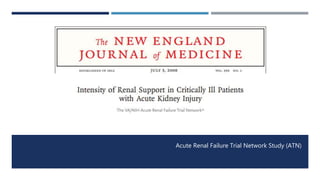
Palevsky PM, et al. "Intensity of renal support in
critically ill patients with acute kidney injury". The New
England Journal of Medicine. 2008. 359(1):7-20.
Acute Renal Failure Trial Network Study (ATN)
BACKGROUND
SOME FACTS:
 Acute tubular necrosis (ATN) is associated with a
mortality of >50% in critically ill patients
 ATN involves the death of tubular epithelial cells of
the renal tubules of the kidneys. Common causes
include low BP and use of nephrotoxic drugs
PRIOR TO TRIAL:
 Prior to the ATN trial, the intensity of renal
replacement therapy (RRT) has not been well
established.
 Many single center trials showed that intensive RRT
programs led improved mortality
CLINICAL QUESTION
 In critically ill patients with acute
tubular necrosis, does more
intensive renal replacement
therapy decrease the risk of
death at 60 days compared to
conventional less-intensive
renal replacement therapy?
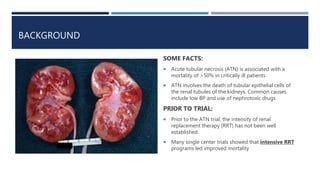
Photo Credit: Pathology Department of James Cook University
DESIGN
 Analysis: Intention-to-treat
 Multicenter, open-label, parallel-group, randomized, controlled trial
 N=1,124 patients with critical illness and ATN
 Intensive renal replacement therapy (n=563)
 Conventional low-intensity renal replacement therapy (n=561)
 Setting: 31 centers in the United States
 Enrollment: 2003-2007
 Follow-up: 60 days
 Primary outcome: All-cause mortality at 60 days
POPULATION
Inclusion Criteria
 Age ≥18 years
 Admitted to ICU
 Acute tubular necrosis, defined by:
 Clinically apparent ischemia or nephrotoxic injury
and
 One or more of oliguria (average urine output <
20 ml/hr for >24 hours), or increased serum
creatinine >2 in men or >1.5 in women
 Failure of one or more non-renal organs (SOFA
score ≥2) or sepsis
Exclusion Criteria
 Elevated baseline serum creatinine >2 mg/dl
for men and >1.5 mg/dl for women)
 Etiology of AKI other than ATN
 Hemodialysis already given
 Previous renal transplant
 Pregnancy
 Prisoner
 Weight >128.5 kg
 Patient unlikely to survive 28 days
INTERVENTIONS
 Randomization:
 Intensive RRT
 Conventional less intensive RRT
 Sequential Organ Failure Assessment (SOFA) Score determined intermittent versus continuous therapy. There
were different modalities that were used, but study only examined treatment intensity
 Intensive renal replacement therapy:
 Intermittent hemodialysis or sustained low-efficiency dialysis: 6 treatments per week
 Continuous venovenous hemodiafiltration (CVVHDF): Prescribed total effluent flow rate of 35 ml/kg/hour
 Conventional renal replacement therapy:
 Intermittent hemodialysis or sustained low-efficiency dialysis: 3 treatments per week
 Continuous venovenous hemodiafiltration (CVVHDF): Prescribed total effluent flow rate of 20 ml/kg/hour
CRITICISMS
 Timing of RRT initiation was not standardized
 Many patients in study had dynamically changing disease severity, BUT a dynamic dosing regimen
was not used
 Possible biased outcomes due to prolonged ICU stay, differences in fluid balance, high rate of
treatment with CRRT before randomization
 It is unclear why the renal recovery rate was so low
 Generalizability limited because:
 Men were overrepresented in the study (25% from VA centers)
 Excluded patients with baseline advanced CKD
BOTTOM LINE
In critically ill patients with acute tubular
necrosis, more intensive renal
replacement therapy DOES NOT
improve all-cause mortality at 60 days
compared to conventional less-intensive
therapy.
Intensive RRT DID NOT improve renal
function or nonrenal organ dysfunction,
although it was associated with more
frequent hypotensive episodes.
DISCUSSION QUESTIONS
 What did the ATN show in terms of intensive RRT and renal function?
 What type of patients were studied in the ATN trial?
 Possible controversy: how should unstable patients with acute kidney injury be treated?
DISCUSSION QUESTIONS/ANSWERS
 What did the ATN show in terms of intensive RRT and renal function?
 ANSWER: RRT did not improve renal function or nonrenal organ dysfunction, although it was
associated with more frequent hypotensive episodes.
 What type of patients were studied in the ATN trial?
 ANSWER: ICU patients with apparent nephrotoxic injury and evidence of kidney injury
 Defined as oliguria (average urine output < 20 ml/hr for >24 hours), OR increased serum
creatinine >2 in men or >1.5 in women
MKSAP NEPHROLOGY QUESTION #32
A 47-year-old man is admitted to the medical ICU with
severe sepsis, multi-lobar pneumonia, and acute
respiratory distress syndrome. He developed oliguric
acute kidney injury on hospital day 3; he has produced
only 240 mL of urine over the past 24 hours despite
adequate intravenous hydration. He is mechanically
ventilated and requires 80% FIO2. Medical history is
unremarkable, and current medications are
piperacillin/tazobactam, vancomycin, norepinephrine,
vasopressin and propofol infusions, and a proton pump
inhibitor.
On physical examination the patient is intubated and
sedated. Temperature is 38.5 °C (101.3 °F), blood pressure
is 95/60 mm Hg, and pulse rate is 130/min. Estimated
central venous pressure is 14 cm H2O. There is no rash.
Generalized anasarca is noted. Examination of the chest
reveals coarse breath sounds and inspiratory crackles
throughout both lungs.
(ADAPTED from MKSAP 17)
Which of the following is the most appropriate treatment
for this patient's kidney failure?
A. Initiate continuous renal replacement therapy
B. Initiate intermittent hemodialysis
C. Initiate slow continuous ultrafiltration
D. Start laxis IV
ANSWER UP FOR DISCUSSION
Educational Objective:
Treat acute kidney injury with continuous renal
replacement therapy.
Key Point:
- Continuous renal replacement therapy is
preferred for critically ill, unstable patients
with acute kidney injury because it provides a
slower rate of solute and fluid removal per
unit of time, resulting in better hemodynamic
tolerance.
- Tolwani A. Continuous renal replacement
therapy for AKI. N Engl J Med. 2012 Dec
27;367(26):2505-14.
ANSWER
Which of the following is the most
appropriate treatment for this patient's
kidney failure?
A. Initiate continuous renal replacement
therapy
B. Initiate intermittent hemodialysis
C. Initiate slow continuous ultrafiltration
D. Start laxis IV

ATN

  • 1.
    ATN OVMC LANDMARK TRIALSSERIES Palevsky PM, et al. "Intensity of renal support in critically ill patients with acute kidney injury". The New England Journal of Medicine. 2008. 359(1):7-20.
  • 2.
    Acute Renal FailureTrial Network Study (ATN)
  • 3.
    BACKGROUND SOME FACTS:  Acutetubular necrosis (ATN) is associated with a mortality of >50% in critically ill patients  ATN involves the death of tubular epithelial cells of the renal tubules of the kidneys. Common causes include low BP and use of nephrotoxic drugs PRIOR TO TRIAL:  Prior to the ATN trial, the intensity of renal replacement therapy (RRT) has not been well established.  Many single center trials showed that intensive RRT programs led improved mortality
  • 4.
    CLINICAL QUESTION  Incritically ill patients with acute tubular necrosis, does more intensive renal replacement therapy decrease the risk of death at 60 days compared to conventional less-intensive renal replacement therapy? Photo Credit: Pathology Department of James Cook University
  • 5.
    DESIGN  Analysis: Intention-to-treat Multicenter, open-label, parallel-group, randomized, controlled trial  N=1,124 patients with critical illness and ATN  Intensive renal replacement therapy (n=563)  Conventional low-intensity renal replacement therapy (n=561)  Setting: 31 centers in the United States  Enrollment: 2003-2007  Follow-up: 60 days  Primary outcome: All-cause mortality at 60 days
  • 6.
    POPULATION Inclusion Criteria  Age≥18 years  Admitted to ICU  Acute tubular necrosis, defined by:  Clinically apparent ischemia or nephrotoxic injury and  One or more of oliguria (average urine output < 20 ml/hr for >24 hours), or increased serum creatinine >2 in men or >1.5 in women  Failure of one or more non-renal organs (SOFA score ≥2) or sepsis Exclusion Criteria  Elevated baseline serum creatinine >2 mg/dl for men and >1.5 mg/dl for women)  Etiology of AKI other than ATN  Hemodialysis already given  Previous renal transplant  Pregnancy  Prisoner  Weight >128.5 kg  Patient unlikely to survive 28 days
  • 7.
    INTERVENTIONS  Randomization:  IntensiveRRT  Conventional less intensive RRT  Sequential Organ Failure Assessment (SOFA) Score determined intermittent versus continuous therapy. There were different modalities that were used, but study only examined treatment intensity  Intensive renal replacement therapy:  Intermittent hemodialysis or sustained low-efficiency dialysis: 6 treatments per week  Continuous venovenous hemodiafiltration (CVVHDF): Prescribed total effluent flow rate of 35 ml/kg/hour  Conventional renal replacement therapy:  Intermittent hemodialysis or sustained low-efficiency dialysis: 3 treatments per week  Continuous venovenous hemodiafiltration (CVVHDF): Prescribed total effluent flow rate of 20 ml/kg/hour
  • 8.
    CRITICISMS  Timing ofRRT initiation was not standardized  Many patients in study had dynamically changing disease severity, BUT a dynamic dosing regimen was not used  Possible biased outcomes due to prolonged ICU stay, differences in fluid balance, high rate of treatment with CRRT before randomization  It is unclear why the renal recovery rate was so low  Generalizability limited because:  Men were overrepresented in the study (25% from VA centers)  Excluded patients with baseline advanced CKD
  • 9.
    BOTTOM LINE In criticallyill patients with acute tubular necrosis, more intensive renal replacement therapy DOES NOT improve all-cause mortality at 60 days compared to conventional less-intensive therapy. Intensive RRT DID NOT improve renal function or nonrenal organ dysfunction, although it was associated with more frequent hypotensive episodes.
  • 10.
    DISCUSSION QUESTIONS  Whatdid the ATN show in terms of intensive RRT and renal function?  What type of patients were studied in the ATN trial?  Possible controversy: how should unstable patients with acute kidney injury be treated?
  • 11.
    DISCUSSION QUESTIONS/ANSWERS  Whatdid the ATN show in terms of intensive RRT and renal function?  ANSWER: RRT did not improve renal function or nonrenal organ dysfunction, although it was associated with more frequent hypotensive episodes.  What type of patients were studied in the ATN trial?  ANSWER: ICU patients with apparent nephrotoxic injury and evidence of kidney injury  Defined as oliguria (average urine output < 20 ml/hr for >24 hours), OR increased serum creatinine >2 in men or >1.5 in women
  • 12.
    MKSAP NEPHROLOGY QUESTION#32 A 47-year-old man is admitted to the medical ICU with severe sepsis, multi-lobar pneumonia, and acute respiratory distress syndrome. He developed oliguric acute kidney injury on hospital day 3; he has produced only 240 mL of urine over the past 24 hours despite adequate intravenous hydration. He is mechanically ventilated and requires 80% FIO2. Medical history is unremarkable, and current medications are piperacillin/tazobactam, vancomycin, norepinephrine, vasopressin and propofol infusions, and a proton pump inhibitor. On physical examination the patient is intubated and sedated. Temperature is 38.5 °C (101.3 °F), blood pressure is 95/60 mm Hg, and pulse rate is 130/min. Estimated central venous pressure is 14 cm H2O. There is no rash. Generalized anasarca is noted. Examination of the chest reveals coarse breath sounds and inspiratory crackles throughout both lungs. (ADAPTED from MKSAP 17) Which of the following is the most appropriate treatment for this patient's kidney failure? A. Initiate continuous renal replacement therapy B. Initiate intermittent hemodialysis C. Initiate slow continuous ultrafiltration D. Start laxis IV
  • 13.
    ANSWER UP FORDISCUSSION Educational Objective: Treat acute kidney injury with continuous renal replacement therapy. Key Point: - Continuous renal replacement therapy is preferred for critically ill, unstable patients with acute kidney injury because it provides a slower rate of solute and fluid removal per unit of time, resulting in better hemodynamic tolerance. - Tolwani A. Continuous renal replacement therapy for AKI. N Engl J Med. 2012 Dec 27;367(26):2505-14. ANSWER Which of the following is the most appropriate treatment for this patient's kidney failure? A. Initiate continuous renal replacement therapy B. Initiate intermittent hemodialysis C. Initiate slow continuous ultrafiltration D. Start laxis IV