EPHESUS
ISABELLA LAI
Pitt B, et al. "Eplerenone, a selective aldosterone
blocker, in patients with left ventricular dysfunction after
myocardial infarction". The New England Journal of
Medicine. 2003. 348(14):1309-21.
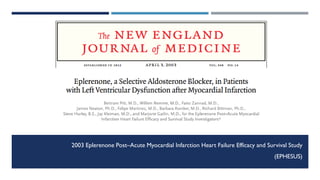
2003 Eplerenone Post–Acute Myocardial Infarction Heart Failure Efficacy and Survival Study
(EPHESUS)
BACKGROUND
 The RALES 1999 showed that aldosterone
antagonists reduce mortality for patients with heart
failure with reduced EF (HFrEF)
 Mechanism of Aldosterone blockade for Mortality:
 Likely through decreasing inflammation preventing ventricular
remodeling and collagen formation in patients with LV
dysfunction after MI
 RALES studied spironolactone in patients with HFrEF 35%,
NYHA III-IV symptoms
BACKGROUND
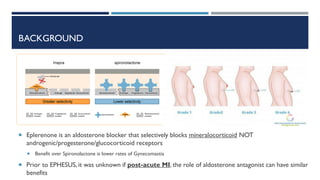
 Eplerenone is an aldosterone blocker that selectively blocks mineralocorticoid NOT
androgenic/progesterone/glucocorticoid receptors
 Benefit over Spironolactone is lower rates of Gynecomastia
 Prior to EPHESUS, it was unknown if post-acute MI, the role of aldosterone antagonist can have similar
benefits
CLINICAL QUESTION
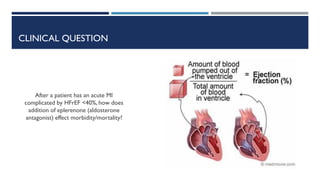
After a patient has an acute MI
complicated by HFrEF <40%, how does
addition of eplerenone (aldosterone
antagonist) effect morbidity/mortality?
DESIGN
 Trial Design: Multicenter, double-blind, international,parallel-group, randomized, placebo-controlled trial
 N=6,642 (88% power to detect 18% difference between the two groups)
 Eplerenone (n=3,313)
 Placebo (n=3,319)
 Mean follow-up: 16 months
DESIGN
 Primary outcomes:
 1) Time to death from ANY cause
 2) Time to death from CV events or complications
 3) First hospitalization from CV event
 Secondary outcomes:
 Death from CV events and death from any cause OR any hospitalization
INTERVENTIONS
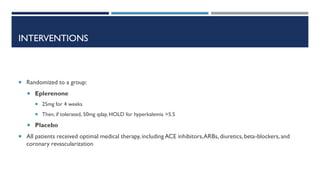
 Randomized to a group:
 Eplerenone
 25mg for 4 weeks
 Then, if tolerated, 50mg qday, HOLD for hyperkalemia >5.5
 Placebo
 All patients received optimal medical therapy, including ACE inhibitors,ARBs, diuretics, beta-blockers, and
coronary revascularization
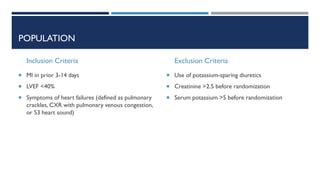
POPULATION
Inclusion Criteria
 MI in prior 3-14 days
 LVEF <40%
 Symptoms of heart failures (defined as pulmonary
crackles, CXR with pulmonary venous congestion,
or S3 heart sound)
Exclusion Criteria
 Use of potassium-sparing diuretics
 Creatinine >2.5 before randomization
 Serum potassium >5 before randomization
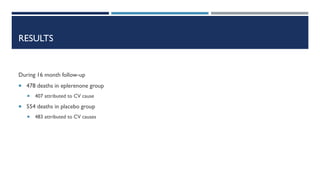
RESULTS
During 16 month follow-up
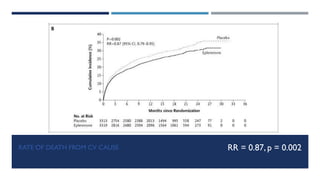
 478 deaths in eplerenone group
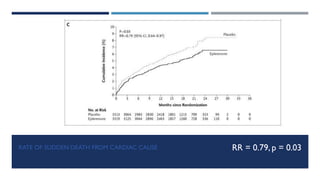
 407 attributed to CV cause
 554 deaths in placebo group
 483 attributed to CV causes
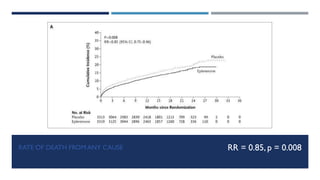
RATE OF DEATH FROM ANY CAUSE RR = 0.85, p = 0.008
RATE OF DEATH FROM CV CAUSE RR = 0.87, p = 0.002
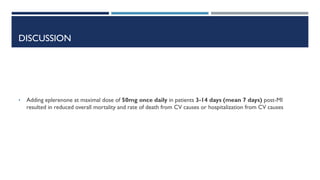
RATE OF SUDDEN DEATH FROM CARDIAC CAUSE RR = 0.79, p = 0.03
SIDE EFFECTS
 Hyperkalemia
 3.4 vs. 2.0% (p<0.001)
 Serious hyperkalemia (>6)
 5.5 vs. 3.9% (p = 0.002)
 Hypokalemia
 0.5 vs. 1.5% (0<0.001)
 Serious hypokalemia (<3.5)
 8.4% vs. 13.1% (p<0.001)
 GI Disorder
 19.9% vs. 17.7 (p = 0.02)
 Gynecomastia
 0.5 vs 0.6% (p = non-significant)
DISCUSSION
• Adding eplerenone at maximal dose of 50mg once daily in patients 3-14 days (mean 7 days) post-MI
resulted in reduced overall mortality and rate of death from CV causes or hospitalization from CV causes
DISCUSSION (CONT.)
• However, of note, mortality rate in control group of this trial was 13.6% (those who received both ACEi and
Beta blockers)  This is HIGHER than in CAPRICORN (Carvedilol) trial and OPTIMAAL trial (Losartan) post-
MI
• Thought to be due to high number of patients in heart failure
• Mortality in Eplerenone group HIGHER than in Spironolactone group of RALES trial
• Mean EF in Ephesus 33%, EF in RALES was 25%)
BOTTOM LINE
Among patients with acute MI complicated by LV
dysfunction with reduced EF<40%, the addition
of eplerenone to optimal medical therapy showed a
15% REDUCTION in morbidity and mortality.
Number needed to treat of 50 patients to save
one life in 1 year
Number needed to treat of 33 to prevent one
death from CV causes or one hospitalization
for CV event in 1 year
CRITICISMS
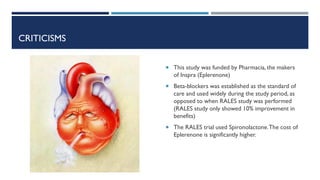
 This study was funded by Pharmacia, the makers
of Inspra (Eplerenone)
 Beta-blockers was established as the standard of
care and used widely during the study period, as
opposed to when RALES study was performed
(RALES study only showed 10% improvement in
benefits)
 The RALES trial used Spironolactone.The cost of
Eplerenone is significantly higher.
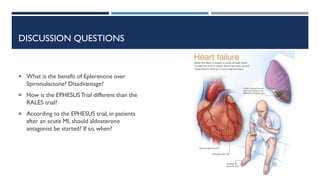
DISCUSSION QUESTIONS
 What is the benefit of Eplerenone over
Spironolactone? Disadvantage?
 How is the EPHESUSTrial different than the
RALES trial?
 According to the EPHESUS trial, in patients
after an acute MI, should aldosterone
antagonist be started? If so, when?
DISCUSSION QUESTIONS/ANSWERS
 What is the benefit of Eplerenone over Spironolactone? Disadvantage?
 ANSWER:
 Benefit: Lower rates of Gynecomastia
 Disadvantage: Cost--Eplerenone is more expensive
 How is the EPHESUSTrial different than the RALES trial?
 ANSWER: The RALES trial showed that aldosterone blockade reduces mortality in severe systolic
heart failure.The EPHESUS trial showed that mineralcorticoid antagonist after an acute MI is beneficial
 According to the EPHESUS trial, in patients after an acute MI, should aldosterone antagonist be started? If so,
when?
 ANSWER: Yes,Aldosterone antagonist should be started in patients after an acute MI if HFrEF is
present (LVEF <40%)
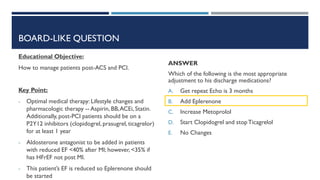
BOARD-LIKE QUESTION
A 61 yo women, with hx DM2, HTN, HLD, is 5 days
s/p DES in LAD for STEMI For the past few days, she
is chest pain free.
Meds include Aspirin 81,Ticagrelor, Metoprolol,
Lisinopril, atorvastatin, and sublingual nitroglycerin
PRN.
Physical examination:
HR 78, BP 121, 72. BMI 22.
Lungs clear
Heart: RRR, normal S1/S2, no S3/S4/gallops/murmurs
Labs: K 4.5, Creatinine 1.7 (baseline)
Echo: LVEF 25%
(ADAPTED from MKSAP 17)
QUESTION
Which of the following is the most appropriate
adjustment to his discharge medications?
A. Get repeat Echo is 3 months
B. Add Eplerenone
C. Increase Metoprolol
D. Start Clopidogrel and stopTicagrelol
E. No Changes
BOARD-LIKE QUESTION
Educational Objective:
How to manage patients post-ACS and PCI.
Key Point:
- Optimal medical therapy: Lifestyle changes and
pharmacologic therapy -- Aspirin, BB,ACEi, Statin.
Additionally, post-PCI patients should be on a
P2Y12 inhibitors (clopidogrel, prasugrel, ticagrelor)
for at least 1 year
- Aldosterone antagonist to be added in patients
with reduced EF <40% after MI; however, <35% if
has HFrEF not post MI.
- This patient’s EF is reduced so Eplerenone should
be started
ANSWER
Which of the following is the most appropriate
adjustment to his discharge medications?
A. Get repeat Echo is 3 months
B. Add Eplerenone
C. Increase Metoprolol
D. Start Clopidogrel and stopTicagrelol
E. No Changes
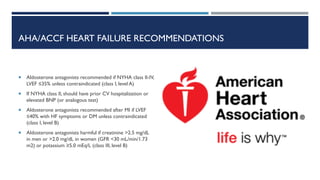
AHA/ACCF HEART FAILURE RECOMMENDATIONS
 Aldosterone antagonists recommended if NYHA class II-IV,
LVEF ≤35% unless contraindicated (class I, level A)
 If NYHA class II, should have prior CV hospitalization or
elevated BNP (or analogous test)
 Aldosterone antagonists recommended after MI if LVEF
≤40% with HF symptoms or DM unless contraindicated
(class I, level B)
 Aldosterone antagonists harmful if creatinine >2.5 mg/dL
in men or >2.0 mg/dL in women (GFR <30 mL/min/1.73
m2) or potassium ≥5.0 mEq/L (class III, level B)
REFERENCES
 Pitt B, et al. "Eplerenone, a selective aldosterone
blocker, in patients with left ventricular dysfunction
after myocardial infarction". The New England Journal
of Medicine. 2003. 348(14):1309-21.
 Brain, P. EPHESUS.
https://www.wikijournalclub.org/wiki/EPHESUS

Ephesus

  • 1.
    EPHESUS ISABELLA LAI Pitt B,et al. "Eplerenone, a selective aldosterone blocker, in patients with left ventricular dysfunction after myocardial infarction". The New England Journal of Medicine. 2003. 348(14):1309-21.
  • 2.
    2003 Eplerenone Post–AcuteMyocardial Infarction Heart Failure Efficacy and Survival Study (EPHESUS)
  • 3.
    BACKGROUND  The RALES1999 showed that aldosterone antagonists reduce mortality for patients with heart failure with reduced EF (HFrEF)  Mechanism of Aldosterone blockade for Mortality:  Likely through decreasing inflammation preventing ventricular remodeling and collagen formation in patients with LV dysfunction after MI  RALES studied spironolactone in patients with HFrEF 35%, NYHA III-IV symptoms
  • 4.
    BACKGROUND  Eplerenone isan aldosterone blocker that selectively blocks mineralocorticoid NOT androgenic/progesterone/glucocorticoid receptors  Benefit over Spironolactone is lower rates of Gynecomastia  Prior to EPHESUS, it was unknown if post-acute MI, the role of aldosterone antagonist can have similar benefits
  • 5.
    CLINICAL QUESTION After apatient has an acute MI complicated by HFrEF <40%, how does addition of eplerenone (aldosterone antagonist) effect morbidity/mortality?
  • 6.
    DESIGN  Trial Design:Multicenter, double-blind, international,parallel-group, randomized, placebo-controlled trial  N=6,642 (88% power to detect 18% difference between the two groups)  Eplerenone (n=3,313)  Placebo (n=3,319)  Mean follow-up: 16 months
  • 7.
    DESIGN  Primary outcomes: 1) Time to death from ANY cause  2) Time to death from CV events or complications  3) First hospitalization from CV event  Secondary outcomes:  Death from CV events and death from any cause OR any hospitalization
  • 8.
    INTERVENTIONS  Randomized toa group:  Eplerenone  25mg for 4 weeks  Then, if tolerated, 50mg qday, HOLD for hyperkalemia >5.5  Placebo  All patients received optimal medical therapy, including ACE inhibitors,ARBs, diuretics, beta-blockers, and coronary revascularization
  • 9.
    POPULATION Inclusion Criteria  MIin prior 3-14 days  LVEF <40%  Symptoms of heart failures (defined as pulmonary crackles, CXR with pulmonary venous congestion, or S3 heart sound) Exclusion Criteria  Use of potassium-sparing diuretics  Creatinine >2.5 before randomization  Serum potassium >5 before randomization
  • 10.
    RESULTS During 16 monthfollow-up  478 deaths in eplerenone group  407 attributed to CV cause  554 deaths in placebo group  483 attributed to CV causes
  • 11.
    RATE OF DEATHFROM ANY CAUSE RR = 0.85, p = 0.008
  • 12.
    RATE OF DEATHFROM CV CAUSE RR = 0.87, p = 0.002
  • 13.
    RATE OF SUDDENDEATH FROM CARDIAC CAUSE RR = 0.79, p = 0.03
  • 14.
    SIDE EFFECTS  Hyperkalemia 3.4 vs. 2.0% (p<0.001)  Serious hyperkalemia (>6)  5.5 vs. 3.9% (p = 0.002)  Hypokalemia  0.5 vs. 1.5% (0<0.001)  Serious hypokalemia (<3.5)  8.4% vs. 13.1% (p<0.001)  GI Disorder  19.9% vs. 17.7 (p = 0.02)  Gynecomastia  0.5 vs 0.6% (p = non-significant)
  • 15.
    DISCUSSION • Adding eplerenoneat maximal dose of 50mg once daily in patients 3-14 days (mean 7 days) post-MI resulted in reduced overall mortality and rate of death from CV causes or hospitalization from CV causes
  • 16.
    DISCUSSION (CONT.) • However,of note, mortality rate in control group of this trial was 13.6% (those who received both ACEi and Beta blockers)  This is HIGHER than in CAPRICORN (Carvedilol) trial and OPTIMAAL trial (Losartan) post- MI • Thought to be due to high number of patients in heart failure • Mortality in Eplerenone group HIGHER than in Spironolactone group of RALES trial • Mean EF in Ephesus 33%, EF in RALES was 25%)
  • 17.
    BOTTOM LINE Among patientswith acute MI complicated by LV dysfunction with reduced EF<40%, the addition of eplerenone to optimal medical therapy showed a 15% REDUCTION in morbidity and mortality. Number needed to treat of 50 patients to save one life in 1 year Number needed to treat of 33 to prevent one death from CV causes or one hospitalization for CV event in 1 year
  • 18.
    CRITICISMS  This studywas funded by Pharmacia, the makers of Inspra (Eplerenone)  Beta-blockers was established as the standard of care and used widely during the study period, as opposed to when RALES study was performed (RALES study only showed 10% improvement in benefits)  The RALES trial used Spironolactone.The cost of Eplerenone is significantly higher.
  • 19.
    DISCUSSION QUESTIONS  Whatis the benefit of Eplerenone over Spironolactone? Disadvantage?  How is the EPHESUSTrial different than the RALES trial?  According to the EPHESUS trial, in patients after an acute MI, should aldosterone antagonist be started? If so, when?
  • 20.
    DISCUSSION QUESTIONS/ANSWERS  Whatis the benefit of Eplerenone over Spironolactone? Disadvantage?  ANSWER:  Benefit: Lower rates of Gynecomastia  Disadvantage: Cost--Eplerenone is more expensive  How is the EPHESUSTrial different than the RALES trial?  ANSWER: The RALES trial showed that aldosterone blockade reduces mortality in severe systolic heart failure.The EPHESUS trial showed that mineralcorticoid antagonist after an acute MI is beneficial  According to the EPHESUS trial, in patients after an acute MI, should aldosterone antagonist be started? If so, when?  ANSWER: Yes,Aldosterone antagonist should be started in patients after an acute MI if HFrEF is present (LVEF <40%)
  • 21.
    BOARD-LIKE QUESTION A 61yo women, with hx DM2, HTN, HLD, is 5 days s/p DES in LAD for STEMI For the past few days, she is chest pain free. Meds include Aspirin 81,Ticagrelor, Metoprolol, Lisinopril, atorvastatin, and sublingual nitroglycerin PRN. Physical examination: HR 78, BP 121, 72. BMI 22. Lungs clear Heart: RRR, normal S1/S2, no S3/S4/gallops/murmurs Labs: K 4.5, Creatinine 1.7 (baseline) Echo: LVEF 25% (ADAPTED from MKSAP 17) QUESTION Which of the following is the most appropriate adjustment to his discharge medications? A. Get repeat Echo is 3 months B. Add Eplerenone C. Increase Metoprolol D. Start Clopidogrel and stopTicagrelol E. No Changes
  • 22.
    BOARD-LIKE QUESTION Educational Objective: Howto manage patients post-ACS and PCI. Key Point: - Optimal medical therapy: Lifestyle changes and pharmacologic therapy -- Aspirin, BB,ACEi, Statin. Additionally, post-PCI patients should be on a P2Y12 inhibitors (clopidogrel, prasugrel, ticagrelor) for at least 1 year - Aldosterone antagonist to be added in patients with reduced EF <40% after MI; however, <35% if has HFrEF not post MI. - This patient’s EF is reduced so Eplerenone should be started ANSWER Which of the following is the most appropriate adjustment to his discharge medications? A. Get repeat Echo is 3 months B. Add Eplerenone C. Increase Metoprolol D. Start Clopidogrel and stopTicagrelol E. No Changes
  • 23.
    AHA/ACCF HEART FAILURERECOMMENDATIONS  Aldosterone antagonists recommended if NYHA class II-IV, LVEF ≤35% unless contraindicated (class I, level A)  If NYHA class II, should have prior CV hospitalization or elevated BNP (or analogous test)  Aldosterone antagonists recommended after MI if LVEF ≤40% with HF symptoms or DM unless contraindicated (class I, level B)  Aldosterone antagonists harmful if creatinine >2.5 mg/dL in men or >2.0 mg/dL in women (GFR <30 mL/min/1.73 m2) or potassium ≥5.0 mEq/L (class III, level B)
  • 24.
    REFERENCES  Pitt B,et al. "Eplerenone, a selective aldosterone blocker, in patients with left ventricular dysfunction after myocardial infarction". The New England Journal of Medicine. 2003. 348(14):1309-21.  Brain, P. EPHESUS. https://www.wikijournalclub.org/wiki/EPHESUS