Trattamento percutaneoTrattamento percutaneo
dell'insufficienza mitralicadell'insufficienza mitralica
Francesco MaisanoFrancesco Maisano
Direttore del programma “trattamentoDirettore del programma “trattamento
trans-catetere delle valvulopatie”trans-catetere delle valvulopatie”
Ospedale San Raffaele MilanoOspedale San Raffaele Milano
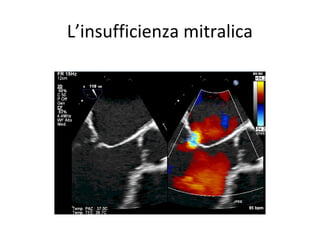
L’insufficienza mitralica
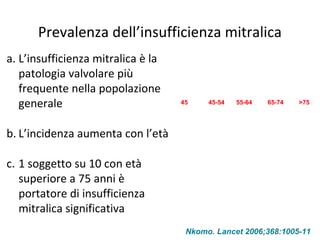
Nkomo. Lancet 2006;368:1005-11
45 45-54 55-64 65-74 >75
Prevalenza dell’insufficienza mitralica
a. L’insufficienza mitralica è la
patologia valvolare più
frequente nella popolazione
generale
b. L’incidenza aumenta con l’età
c. 1 soggetto su 10 con età
superiore a 75 anni è
portatore di insufficienza
mitralica significativa
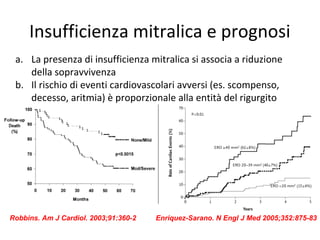
Insufficienza mitralica e prognosi
Robbins. Am J Cardiol. 2003;91:360-2 Enriquez-Sarano. N Engl J Med 2005;352:875-83
a. La presenza di insufficienza mitralica si associa a riduzione
della sopravvivenza
b. Il rischio di eventi cardiovascolari avversi (es. scompenso,
decesso, aritmia) è proporzionale alla entità del rigurgito
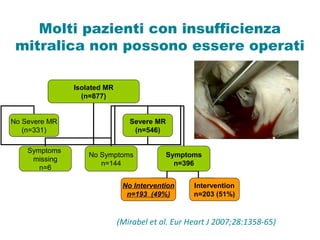
Molti pazienti con insufficienza
mitralica non possono essere operati
Isolated MR
(n=877)
No Severe MR
(n=331)
Severe MR
(n=546)
No Symptoms
n=144
Symptoms
n=396
Intervention
n=203 (51%)
No Intervention
n=193 (49%)
Symptoms
missing
n=6
(Mirabel et al. Eur Heart J 2007;28:1358-65)
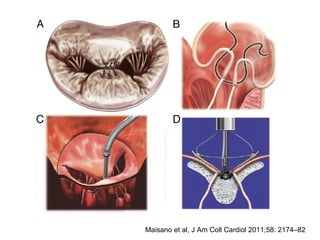
Maisano et al, J Am Coll Cardiol 2011;58: 2174–82
Il Signor TL….
• Ottobre 2010
• 62 anni, cardiomiopatia dilatativa post-ischemica
• Pregresso By-pass aortocoronarico e
angioplastiche plurime
• Portatore di defibrillatore e resincronizzazione
biventricolare
• Copatologie. Insufficienza epatica, ipertensione,
dislipidemia
• Sintomatico per dispnea (Classe IV, MLHF 36)
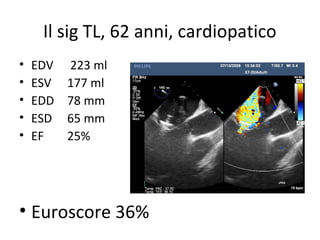
Il sig TL, 62 anni, cardiopatico
• EDV 223 ml
• ESV 177 ml
• EDD 78 mm
• ESD 65 mm
• EF 25%
• Euroscore 36%
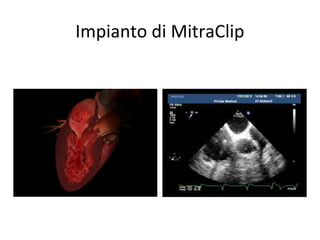
Impianto di MitraClip
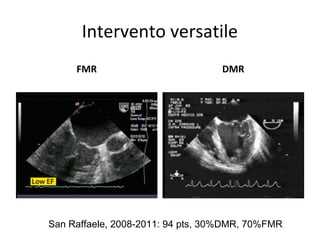
Intervento versatile
FMR DMR
San Raffaele, 2008-2011: 94 pts, 30%DMR, 70%FMR
11
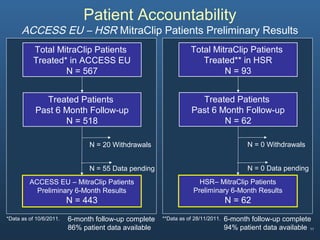
Patient Accountability
ACCESS EU – HSR MitraClip Patients Preliminary Results
Treated Patients
Past 6 Month Follow-up
N = 518
Total MitraClip Patients
Treated* in ACCESS EU
N = 567
*Data as of 10/6/2011.
ACCESS EU – MitraClip Patients
Preliminary 6-Month Results
N = 443
6-month follow-up complete
86% patient data available
N = 20 Withdrawals
N = 55 Data pending
Treated Patients
Past 6 Month Follow-up
N = 62
Total MitraClip Patients
Treated** in HSR
N = 93
**Data as of 28/11/2011.
HSR– MitraClip Patients
Preliminary 6-Month Results
N = 62
6-month follow-up complete
94% patient data available
N = 0 Withdrawals
N = 0 Data pending
12
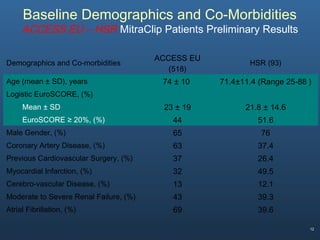
Baseline Demographics and Co-Morbidities
ACCESS EU – HSR MitraClip Patients Preliminary Results
Demographics and Co-morbidities
ACCESS EU
(518)
HSR (93)
Age (mean ± SD), years 74 ± 10 71.4±11.4 (Range 25-88 )
Logistic EuroSCORE, (%)
Mean ± SD 23 ± 19 21.8 ± 14.6
EuroSCORE ≥ 20%, (%) 44 51.6
Male Gender, (%) 65 76
Coronary Artery Disease, (%) 63 37.4
Previous Cardiovascular Surgery, (%) 37 26.4
Myocardial Infarction, (%) 32 49.5
Cerebro-vascular Disease, (%) 13 12.1
Moderate to Severe Renal Failure, (%) 43 39.3
Atrial Fibrillation, (%) 69 39.6
13
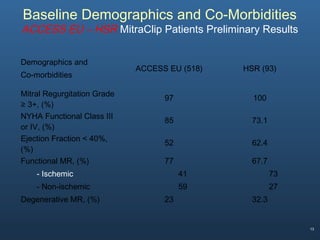
Baseline Demographics and Co-Morbidities
ACCESS EU – HSR MitraClip Patients Preliminary Results
Demographics and
Co-morbidities
ACCESS EU (518) HSR (93)
Mitral Regurgitation Grade
≥ 3+, (%)
97 100
NYHA Functional Class III
or IV, (%)
85 73.1
Ejection Fraction < 40%,
(%)
52 62.4
Functional MR, (%) 77 67.7
- Ischemic 41 73
- Non-ischemic 59 27
Degenerative MR, (%) 23 32.3
14
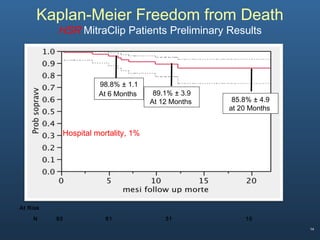
Kaplan-Meier Freedom from Death
HSR MitraClip Patients Preliminary Results
At Risk
N 93 61 31 10
98.8% ± 1.1
At 6 Months 89.1% ± 3.9
At 12 Months 85.8% ± 4.9
at 20 Months
Hospital mortality, 1%
15
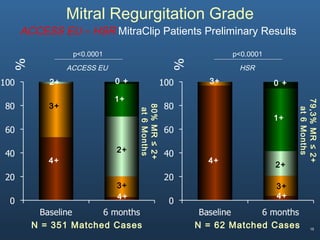
Mitral Regurgitation Grade
ACCESS EU – HSR MitraClip Patients Preliminary Results
80%MR≤2+
at6Months
3+
4+
3+
2+
1+
0 +
p<0.0001
N = 351 Matched Cases
2+
4+
79,3%MR≤2+
at6Months
3+
4+
3+
2+
1+
0 +
p<0.0001
ACCESS EU HSR
N = 62 Matched Cases
4+
16
0
20
40
60
80
BASELINE 6 MONTHS
41
48
6066
0
50
100
150
200
BASELINE 6 MONTHS
107115
157
176
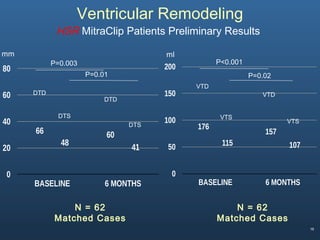
Ventricular Remodeling
HSR MitraClip Patients Preliminary Results
VTS
VTD
VTS
VTD
DTS
DTD
DTS
DTD
P=0.003
P=0.01
P<0.001
P=0.02
N = 62
Matched Cases
N = 62
Matched Cases
mm ml
17
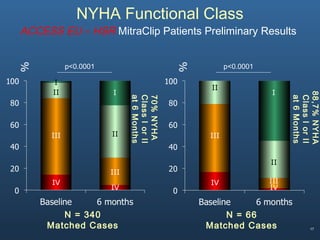
NYHA Functional Class
ACCESS EU – HSR MitraClip Patients Preliminary Results
II
III
IV
II
III
IV
I
N = 340
Matched Cases
p<0.0001
I
70%NYHA
ClassIorII
at6Months
II
III
IV
II
III
IV
I
N = 66
Matched Cases
p<0.0001
88,7%NYHA
ClassIorII
at6Months
18
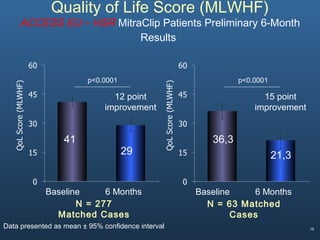
Quality of Life Score (MLWHF)
ACCESS EU – HSR MitraClip Patients Preliminary 6-Month
Results
Data presented as mean ± 95% confidence interval
p<0.0001
Baseline 6 Months
N = 277
Matched Cases
41
29
12 point
improvement
p<0.0001
Baseline 6 Months
N = 63 Matched
Cases
36,3
21,3
15 point
improvement
19
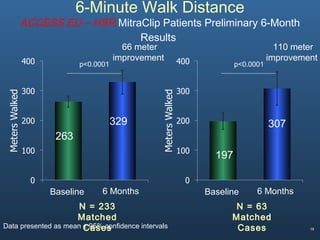
6-Minute Walk Distance
ACCESS EU – HSR MitraClip Patients Preliminary 6-Month
Results
Data presented as mean ± 95% confidence intervals
Baseline 6 Months
N = 233
Matched
Cases
p<0.0001
66 meter
improvement
263
329
Baseline 6 Months
N = 63
Matched
Cases
p<0.0001
110 meter
improvement
197
307
20
Il signor TL… a 2 anni di follow-up
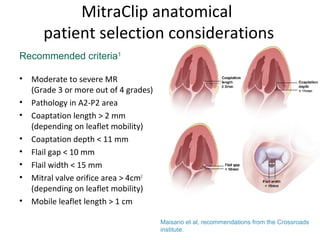
MitraClip anatomical
patient selection considerations
• Moderate to severe MR
(Grade 3 or more out of 4 grades)
• Pathology in A2-P2 area
• Coaptation length > 2 mm
(depending on leaflet mobility)
• Coaptation depth < 11 mm
• Flail gap < 10 mm
• Flail width < 15 mm
• Mitral valve orifice area > 4cm2
(depending on leaflet mobility)
• Mobile leaflet length > 1 cm
Recommended criteria1
Maisano et al, recommendations from the Crossroads
institute.
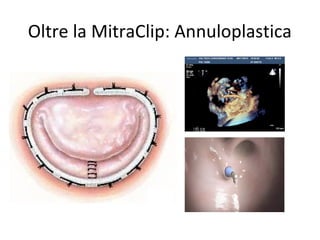
Oltre la MitraClip: Annuloplastica
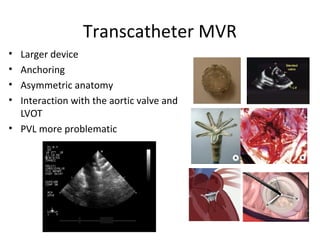
Transcatheter MVR
• Larger device
• Anchoring
• Asymmetric anatomy
• Interaction with the aortic valve and
LVOT
• PVL more problematic
24
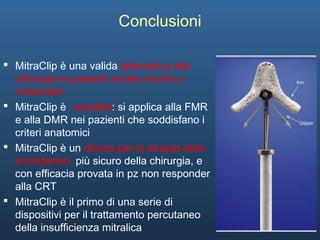
Conclusioni
 MitraClip è una valida alternativa alla
chirurgia in pazienti ad alto rischio o
inoperabili
 MitraClip è versatile: si applica alla FMR
e alla DMR nei pazienti che soddisfano i
criteri anatomici
 MitraClip è un device per la terapia dello
scompenso, più sicuro della chirurgia, e
con efficacia provata in pz non responder
alla CRT
 MitraClip è il primo di una serie di
dispositivi per il trattamento percutaneo
della insufficienza mitralica

Mitraclip san raffaele experience

  • 1.
    Trattamento percutaneoTrattamento percutaneo dell'insufficienzamitralicadell'insufficienza mitralica Francesco MaisanoFrancesco Maisano Direttore del programma “trattamentoDirettore del programma “trattamento trans-catetere delle valvulopatie”trans-catetere delle valvulopatie” Ospedale San Raffaele MilanoOspedale San Raffaele Milano
  • 2.
  • 3.
    Nkomo. Lancet 2006;368:1005-11 4545-54 55-64 65-74 >75 Prevalenza dell’insufficienza mitralica a. L’insufficienza mitralica è la patologia valvolare più frequente nella popolazione generale b. L’incidenza aumenta con l’età c. 1 soggetto su 10 con età superiore a 75 anni è portatore di insufficienza mitralica significativa
  • 4.
    Insufficienza mitralica eprognosi Robbins. Am J Cardiol. 2003;91:360-2 Enriquez-Sarano. N Engl J Med 2005;352:875-83 a. La presenza di insufficienza mitralica si associa a riduzione della sopravvivenza b. Il rischio di eventi cardiovascolari avversi (es. scompenso, decesso, aritmia) è proporzionale alla entità del rigurgito
  • 5.
    Molti pazienti coninsufficienza mitralica non possono essere operati Isolated MR (n=877) No Severe MR (n=331) Severe MR (n=546) No Symptoms n=144 Symptoms n=396 Intervention n=203 (51%) No Intervention n=193 (49%) Symptoms missing n=6 (Mirabel et al. Eur Heart J 2007;28:1358-65)
  • 6.
    Maisano et al,J Am Coll Cardiol 2011;58: 2174–82
  • 7.
    Il Signor TL…. •Ottobre 2010 • 62 anni, cardiomiopatia dilatativa post-ischemica • Pregresso By-pass aortocoronarico e angioplastiche plurime • Portatore di defibrillatore e resincronizzazione biventricolare • Copatologie. Insufficienza epatica, ipertensione, dislipidemia • Sintomatico per dispnea (Classe IV, MLHF 36)
  • 8.
    Il sig TL,62 anni, cardiopatico • EDV 223 ml • ESV 177 ml • EDD 78 mm • ESD 65 mm • EF 25% • Euroscore 36%
  • 9.
  • 10.
    Intervento versatile FMR DMR SanRaffaele, 2008-2011: 94 pts, 30%DMR, 70%FMR
  • 11.
    11 Patient Accountability ACCESS EU– HSR MitraClip Patients Preliminary Results Treated Patients Past 6 Month Follow-up N = 518 Total MitraClip Patients Treated* in ACCESS EU N = 567 *Data as of 10/6/2011. ACCESS EU – MitraClip Patients Preliminary 6-Month Results N = 443 6-month follow-up complete 86% patient data available N = 20 Withdrawals N = 55 Data pending Treated Patients Past 6 Month Follow-up N = 62 Total MitraClip Patients Treated** in HSR N = 93 **Data as of 28/11/2011. HSR– MitraClip Patients Preliminary 6-Month Results N = 62 6-month follow-up complete 94% patient data available N = 0 Withdrawals N = 0 Data pending
  • 12.
    12 Baseline Demographics andCo-Morbidities ACCESS EU – HSR MitraClip Patients Preliminary Results Demographics and Co-morbidities ACCESS EU (518) HSR (93) Age (mean ± SD), years 74 ± 10 71.4±11.4 (Range 25-88 ) Logistic EuroSCORE, (%) Mean ± SD 23 ± 19 21.8 ± 14.6 EuroSCORE ≥ 20%, (%) 44 51.6 Male Gender, (%) 65 76 Coronary Artery Disease, (%) 63 37.4 Previous Cardiovascular Surgery, (%) 37 26.4 Myocardial Infarction, (%) 32 49.5 Cerebro-vascular Disease, (%) 13 12.1 Moderate to Severe Renal Failure, (%) 43 39.3 Atrial Fibrillation, (%) 69 39.6
  • 13.
    13 Baseline Demographics andCo-Morbidities ACCESS EU – HSR MitraClip Patients Preliminary Results Demographics and Co-morbidities ACCESS EU (518) HSR (93) Mitral Regurgitation Grade ≥ 3+, (%) 97 100 NYHA Functional Class III or IV, (%) 85 73.1 Ejection Fraction < 40%, (%) 52 62.4 Functional MR, (%) 77 67.7 - Ischemic 41 73 - Non-ischemic 59 27 Degenerative MR, (%) 23 32.3
  • 14.
    14 Kaplan-Meier Freedom fromDeath HSR MitraClip Patients Preliminary Results At Risk N 93 61 31 10 98.8% ± 1.1 At 6 Months 89.1% ± 3.9 At 12 Months 85.8% ± 4.9 at 20 Months Hospital mortality, 1%
  • 15.
    15 Mitral Regurgitation Grade ACCESSEU – HSR MitraClip Patients Preliminary Results 80%MR≤2+ at6Months 3+ 4+ 3+ 2+ 1+ 0 + p<0.0001 N = 351 Matched Cases 2+ 4+ 79,3%MR≤2+ at6Months 3+ 4+ 3+ 2+ 1+ 0 + p<0.0001 ACCESS EU HSR N = 62 Matched Cases 4+
  • 16.
    16 0 20 40 60 80 BASELINE 6 MONTHS 41 48 6066 0 50 100 150 200 BASELINE6 MONTHS 107115 157 176 Ventricular Remodeling HSR MitraClip Patients Preliminary Results VTS VTD VTS VTD DTS DTD DTS DTD P=0.003 P=0.01 P<0.001 P=0.02 N = 62 Matched Cases N = 62 Matched Cases mm ml
  • 17.
    17 NYHA Functional Class ACCESSEU – HSR MitraClip Patients Preliminary Results II III IV II III IV I N = 340 Matched Cases p<0.0001 I 70%NYHA ClassIorII at6Months II III IV II III IV I N = 66 Matched Cases p<0.0001 88,7%NYHA ClassIorII at6Months
  • 18.
    18 Quality of LifeScore (MLWHF) ACCESS EU – HSR MitraClip Patients Preliminary 6-Month Results Data presented as mean ± 95% confidence interval p<0.0001 Baseline 6 Months N = 277 Matched Cases 41 29 12 point improvement p<0.0001 Baseline 6 Months N = 63 Matched Cases 36,3 21,3 15 point improvement
  • 19.
    19 6-Minute Walk Distance ACCESSEU – HSR MitraClip Patients Preliminary 6-Month Results Data presented as mean ± 95% confidence intervals Baseline 6 Months N = 233 Matched Cases p<0.0001 66 meter improvement 263 329 Baseline 6 Months N = 63 Matched Cases p<0.0001 110 meter improvement 197 307
  • 20.
    20 Il signor TL…a 2 anni di follow-up
  • 21.
    MitraClip anatomical patient selectionconsiderations • Moderate to severe MR (Grade 3 or more out of 4 grades) • Pathology in A2-P2 area • Coaptation length > 2 mm (depending on leaflet mobility) • Coaptation depth < 11 mm • Flail gap < 10 mm • Flail width < 15 mm • Mitral valve orifice area > 4cm2 (depending on leaflet mobility) • Mobile leaflet length > 1 cm Recommended criteria1 Maisano et al, recommendations from the Crossroads institute.
  • 22.
    Oltre la MitraClip:Annuloplastica
  • 23.
    Transcatheter MVR • Largerdevice • Anchoring • Asymmetric anatomy • Interaction with the aortic valve and LVOT • PVL more problematic
  • 24.
    24 Conclusioni  MitraClip èuna valida alternativa alla chirurgia in pazienti ad alto rischio o inoperabili  MitraClip è versatile: si applica alla FMR e alla DMR nei pazienti che soddisfano i criteri anatomici  MitraClip è un device per la terapia dello scompenso, più sicuro della chirurgia, e con efficacia provata in pz non responder alla CRT  MitraClip è il primo di una serie di dispositivi per il trattamento percutaneo della insufficienza mitralica

Editor's Notes

  • #4 This is the Bulleted List slide. To create this particular slide, click the NEW SLIDE button on your toolbar and choose the BULLETED LIST format. (Top row, second from left) The Sub-Heading and footnote will not appear when you insert a new slide. If you need either one, copy and paste it from the sample slide. If you choose not to use a Sub-Heading, let us know when you hand in your presentation for clean-up and we’ll adjust where the bullets begin on your master page. Also, be sure to insert the presentation title onto the BULLETED LIST MASTER as follows: Choose View / Master / Slide Master from your menu. Select the text at the bottom of the slide and type in a short version of your presentation title. Click the SLIDE VIEW button in the lower left hand part of your screen to return to the slide show. (Small white rectangle)
  • #12 518 patients have reached their 6-month follow-up - However, AVSH still has not received 6-month visit data on 55 patients AVSH has complete 6-month data on 443 patients 443/518 = 86%