CYCLOPS
OVMC LANDMARK TRIALS SERIES
de Groot K, et al. "Pulse versus daily oral
cyclophosphamide for induction of remission in
antineutrophil cytoplasmic antibody-associated
vasculitis: A randomized trial". Annals of Internal
Medicine. 2009. 150(10):670-680.
(CYCLOPS)
BACKGROUND
SOME FACTS:
 ANCA-associated vasculitis used to be fatal until Fauci et al
introduced cyclophosphamide and glucocorticoid therapy
 ANCA-associated small-vessel vasculitis include microscopic
polyangiitis, Wegener's granulomatosis, Churg-Strauss
syndrome, and drug-induced vasculitis.
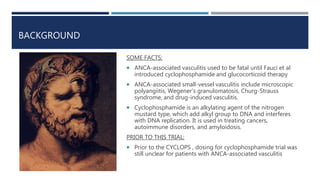
 Cyclophosphamide is an alkylating agent of the nitrogen
mustard type, which add alkyl group to DNA and interferes
with DNA replication. It is used in treating cancers,
autoimmune disorders, and amyloidosis.
PRIOR TO THIS TRIAL:
 Prior to the CYCLOPS , dosing for cyclophosphamide trial was
still unclear for patients with ANCA-associated vasculitis
CLINICAL QUESTION
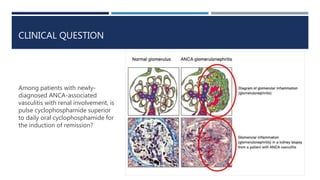
Among patients with newly-
diagnosed ANCA-associated
vasculitis with renal involvement, is
pulse cyclophosphamide superior
to daily oral cyclophosphamide for
the induction of remission?
DESIGN
 Analysis: Intention-to-treat
 Multicenter, open-label, parallel-group, randomized, controlled trial
 N=149 (160 screened)
 Pulse cyclophosphamide (n=76)
 Daily oral cyclophosphamide (n=73)
 Setting: 42 centers in Europe and Mexico
 Median follow-up: 18 months
 Primary outcome: Time to remission
POPULATION
Inclusion Criteria
 Age 18-80 years
 New diagnosis of ANCA
 Renal involvement of the disease, defined by
≥1 of the following:
 Creatinine > 1.69 mg/dL but < 5.6 mg/dL
 Biopsy showing necrotizing glomerulonephritis
 RBC casts
 Urine showing >30 RBC/high-powered field and
proteinuria (>1 gram/day)
 Confirmatory histology or ANCA positive
serology
Exclusion Criteria
 >2 weeks of prior cyclophosphamide or other
cytotoxic drug therapy in the prior year or
corticosteroids for >4 weeks
 Other multisystem autoimmune disease
 Hepatitis B, C, or HIV HIV
 Life-threatening organ dysfunction
 Prior malignancy
 Pregnancy
 Anti-GBM Ab+
INTERVENTIONS
 Randomized to a group:
 Pulse cyclophosphamide: 15 mg/kg IV pulses q2 weeks x 6 weeks, then 15 mg/kg IV pulses q3
weeks until remission, and then for 3 months following remission
 adjusted for WBC level, age, and renal function
 Weeks 7-25 could be be administered orally as 5 mg/kg/day for 3 days per week
 Daily oral cyclophosphamide: 2 mg/kg/day until remission (generally about 3 months), then 1.5
mg/kg/day for 3 months following remission
 adjusted for WBC count, age, and renal function
 Additional immunosuppression (administered to both groups):
 Prednisolone 1 mg/kg/day oral, tapered to 0.4 mg/kg/day by month 3 and 5 mg/kg/day by
month 15
 Azathioprine 2 mg/kg/day starting 3 months after remission, continued until the end of the
study
CRITICISMS
 Unclear generalizability to areas with endemic TB because pulse cyclophosphamide can lead to
worse outcomes for those with latent TB
 Daily oral therapy may have been more effective than pulse therapy for renal function recovery
 Contrary to the author's comments, pulse therapy is not likely more convenient
 No report of proteinuria
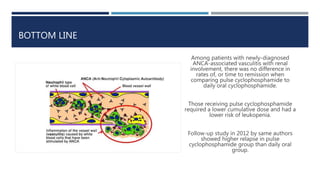
BOTTOM LINE
Among patients with newly-diagnosed
ANCA-associated vasculitis with renal
involvement, there was no difference in
rates of, or time to remission when
comparing pulse cyclophosphamide to
daily oral cyclophosphamide.
Those receiving pulse cyclophosphamide
required a lower cumulative dose and had a
lower risk of leukopenia.
Follow-up study in 2012 by same authors
showed higher relapse in pulse
cyclophosphamide group than daily oral
group.
DISCUSSION QUESTIONS
 According to the CYCLOPS study, what is
the benefit in receiving pulse
cyclophosphamide rather than daily dosing
of cyclophosphamide?
 In areas with endemic TB, which is worse:
pulse cyclophosphamide or daily
cyclophosphamide?
 What was the final conclusion in terms of
pulse vs. daily cyclophosphamide in the
CYCLOPS trial?
DISCUSSION QUESTIONS/ANSWERS
 According to the CYCLOPS study, what is the benefit in receiving pulse cyclophosphamide rather
than daily dosing of cyclophosphamide?
 ANSWER: Receiving pulse cyclophosphamide required a lower cumulative dose and had a lower
risk of leukopenia.
 In areas with endemic TB, which is worse: pulse cyclophosphamide or daily cyclophosphamide?
 ANSWER: Pulse cyclophosphamide leads to worse outcomes for TB edemic areas due to high
rate of latent TB
 What was the final conclusion in terms of pulse vs. daily cyclophosphamide in the CYCLOPS trial?
 ANSWER: There is no difference in rates/time of remission between pulse vs. daily. However,
pulse cyclophosphamide (while may lead to decreased cumulative dose) is associated with
higher relapse rates.
BOARD-LIKE QUESTION
42yo Female presents to her primary care doctor’s office.
She reports that she had 2 episodes of hemoptysis within
the past week in setting of chronic fevers. She also
reports chronic sinus infections, weight loss.
Physical exam:
T 37.0°C, HR 60, BP 137/79. BMI is 22 No abnormalities
Labs:
Hg 11, ESR 35
Urinalysis: Trace protein, 10-20 RBC, 0-2 WBC, no casts
QUESTION
What is the best treatment regimen to start in this patient?
A. Glucocorticoids
B. Pulse dose Cyclophosphamide + Glucocortioids
C. Daily dose cyclophosphamide + Glucocorticoids
D. Rituximab
E. Either B or C
BOARD-LIKE QUESTION
Educational Objective:
Knowledge of treatment for ANCA-associated vasculitis
Key Point:
- This patient suffers from granulomatosis with
polyangiitis (Priorly known as Wegener’s)
- First line treatment option is usually corticosteroids
and cyclophosphamide (either pulse or daily dosing)
ANSWER
What is the best treatment regimen to start in this patient?
A. Glucocorticoids
B. Pulse dose Cyclophosphamide + Glucocortioids
C. Daily dose cyclophosphamide + Glucocorticoids
D. Rituximab
E. Either B or C
BOARD-LIKE QUESTION
A 60yo female presents for painless blood urine for past 2
months. History is significant for eosinophilic
granulomatosis with polyangiitis (previously known as
Churg-Strauss) diagnosed 10 years ago, which is now in
remission. She was treated with prednisone for 3 years
and oral cyclophosphamide for 1 year. She uses albuterol
PRN for her asthma.
Physical exam:
T 37.0°C, HR 60, BP 138/81. BMI is 28. No abnormalities
Labs:
Hg 12, ESR 35
Urinalysis: Trace protein, 10-20 RBC, 0-2 WBC, no casts.
Urine culture: Negative
(Adapted from MKSAP 17)
QUESTION
Which of the following is the most
appropriate diagnostic test to perform
next?
A. CT abdomen/pelvis w/o contrast
B. Cytoscopy
C. Kidney/Bladder US
D. Urine eosinophil measurement
E. Urine protein/creatinine ratio
BOARD-LIKE QUESTION
Educational Objective:
Know the association between bladder cancer
and cyclophosphamide
Key Point:
- The use of cyclophosphamide is associated
with increased risk of malignancy, especially
bladder cancer, and patients should be
evaluated accordingly.
ANSWER
Which of the following is the most
appropriate diagnostic test to perform
next?
A. CT abdomen/pelvis w/o contrast
B. Cytoscopy
C. Kidney/Bladder US
D. Urine eosinophil measurement
E. Urine protein/creatinine ratio

CYCLOPS

  • 1.
    CYCLOPS OVMC LANDMARK TRIALSSERIES de Groot K, et al. "Pulse versus daily oral cyclophosphamide for induction of remission in antineutrophil cytoplasmic antibody-associated vasculitis: A randomized trial". Annals of Internal Medicine. 2009. 150(10):670-680.
  • 2.
  • 3.
    BACKGROUND SOME FACTS:  ANCA-associatedvasculitis used to be fatal until Fauci et al introduced cyclophosphamide and glucocorticoid therapy  ANCA-associated small-vessel vasculitis include microscopic polyangiitis, Wegener's granulomatosis, Churg-Strauss syndrome, and drug-induced vasculitis.  Cyclophosphamide is an alkylating agent of the nitrogen mustard type, which add alkyl group to DNA and interferes with DNA replication. It is used in treating cancers, autoimmune disorders, and amyloidosis. PRIOR TO THIS TRIAL:  Prior to the CYCLOPS , dosing for cyclophosphamide trial was still unclear for patients with ANCA-associated vasculitis
  • 4.
    CLINICAL QUESTION Among patientswith newly- diagnosed ANCA-associated vasculitis with renal involvement, is pulse cyclophosphamide superior to daily oral cyclophosphamide for the induction of remission?
  • 5.
    DESIGN  Analysis: Intention-to-treat Multicenter, open-label, parallel-group, randomized, controlled trial  N=149 (160 screened)  Pulse cyclophosphamide (n=76)  Daily oral cyclophosphamide (n=73)  Setting: 42 centers in Europe and Mexico  Median follow-up: 18 months  Primary outcome: Time to remission
  • 6.
    POPULATION Inclusion Criteria  Age18-80 years  New diagnosis of ANCA  Renal involvement of the disease, defined by ≥1 of the following:  Creatinine > 1.69 mg/dL but < 5.6 mg/dL  Biopsy showing necrotizing glomerulonephritis  RBC casts  Urine showing >30 RBC/high-powered field and proteinuria (>1 gram/day)  Confirmatory histology or ANCA positive serology Exclusion Criteria  >2 weeks of prior cyclophosphamide or other cytotoxic drug therapy in the prior year or corticosteroids for >4 weeks  Other multisystem autoimmune disease  Hepatitis B, C, or HIV HIV  Life-threatening organ dysfunction  Prior malignancy  Pregnancy  Anti-GBM Ab+
  • 7.
    INTERVENTIONS  Randomized toa group:  Pulse cyclophosphamide: 15 mg/kg IV pulses q2 weeks x 6 weeks, then 15 mg/kg IV pulses q3 weeks until remission, and then for 3 months following remission  adjusted for WBC level, age, and renal function  Weeks 7-25 could be be administered orally as 5 mg/kg/day for 3 days per week  Daily oral cyclophosphamide: 2 mg/kg/day until remission (generally about 3 months), then 1.5 mg/kg/day for 3 months following remission  adjusted for WBC count, age, and renal function  Additional immunosuppression (administered to both groups):  Prednisolone 1 mg/kg/day oral, tapered to 0.4 mg/kg/day by month 3 and 5 mg/kg/day by month 15  Azathioprine 2 mg/kg/day starting 3 months after remission, continued until the end of the study
  • 8.
    CRITICISMS  Unclear generalizabilityto areas with endemic TB because pulse cyclophosphamide can lead to worse outcomes for those with latent TB  Daily oral therapy may have been more effective than pulse therapy for renal function recovery  Contrary to the author's comments, pulse therapy is not likely more convenient  No report of proteinuria
  • 9.
    BOTTOM LINE Among patientswith newly-diagnosed ANCA-associated vasculitis with renal involvement, there was no difference in rates of, or time to remission when comparing pulse cyclophosphamide to daily oral cyclophosphamide. Those receiving pulse cyclophosphamide required a lower cumulative dose and had a lower risk of leukopenia. Follow-up study in 2012 by same authors showed higher relapse in pulse cyclophosphamide group than daily oral group.
  • 10.
    DISCUSSION QUESTIONS  Accordingto the CYCLOPS study, what is the benefit in receiving pulse cyclophosphamide rather than daily dosing of cyclophosphamide?  In areas with endemic TB, which is worse: pulse cyclophosphamide or daily cyclophosphamide?  What was the final conclusion in terms of pulse vs. daily cyclophosphamide in the CYCLOPS trial?
  • 11.
    DISCUSSION QUESTIONS/ANSWERS  Accordingto the CYCLOPS study, what is the benefit in receiving pulse cyclophosphamide rather than daily dosing of cyclophosphamide?  ANSWER: Receiving pulse cyclophosphamide required a lower cumulative dose and had a lower risk of leukopenia.  In areas with endemic TB, which is worse: pulse cyclophosphamide or daily cyclophosphamide?  ANSWER: Pulse cyclophosphamide leads to worse outcomes for TB edemic areas due to high rate of latent TB  What was the final conclusion in terms of pulse vs. daily cyclophosphamide in the CYCLOPS trial?  ANSWER: There is no difference in rates/time of remission between pulse vs. daily. However, pulse cyclophosphamide (while may lead to decreased cumulative dose) is associated with higher relapse rates.
  • 12.
    BOARD-LIKE QUESTION 42yo Femalepresents to her primary care doctor’s office. She reports that she had 2 episodes of hemoptysis within the past week in setting of chronic fevers. She also reports chronic sinus infections, weight loss. Physical exam: T 37.0°C, HR 60, BP 137/79. BMI is 22 No abnormalities Labs: Hg 11, ESR 35 Urinalysis: Trace protein, 10-20 RBC, 0-2 WBC, no casts QUESTION What is the best treatment regimen to start in this patient? A. Glucocorticoids B. Pulse dose Cyclophosphamide + Glucocortioids C. Daily dose cyclophosphamide + Glucocorticoids D. Rituximab E. Either B or C
  • 13.
    BOARD-LIKE QUESTION Educational Objective: Knowledgeof treatment for ANCA-associated vasculitis Key Point: - This patient suffers from granulomatosis with polyangiitis (Priorly known as Wegener’s) - First line treatment option is usually corticosteroids and cyclophosphamide (either pulse or daily dosing) ANSWER What is the best treatment regimen to start in this patient? A. Glucocorticoids B. Pulse dose Cyclophosphamide + Glucocortioids C. Daily dose cyclophosphamide + Glucocorticoids D. Rituximab E. Either B or C
  • 14.
    BOARD-LIKE QUESTION A 60yofemale presents for painless blood urine for past 2 months. History is significant for eosinophilic granulomatosis with polyangiitis (previously known as Churg-Strauss) diagnosed 10 years ago, which is now in remission. She was treated with prednisone for 3 years and oral cyclophosphamide for 1 year. She uses albuterol PRN for her asthma. Physical exam: T 37.0°C, HR 60, BP 138/81. BMI is 28. No abnormalities Labs: Hg 12, ESR 35 Urinalysis: Trace protein, 10-20 RBC, 0-2 WBC, no casts. Urine culture: Negative (Adapted from MKSAP 17) QUESTION Which of the following is the most appropriate diagnostic test to perform next? A. CT abdomen/pelvis w/o contrast B. Cytoscopy C. Kidney/Bladder US D. Urine eosinophil measurement E. Urine protein/creatinine ratio
  • 15.
    BOARD-LIKE QUESTION Educational Objective: Knowthe association between bladder cancer and cyclophosphamide Key Point: - The use of cyclophosphamide is associated with increased risk of malignancy, especially bladder cancer, and patients should be evaluated accordingly. ANSWER Which of the following is the most appropriate diagnostic test to perform next? A. CT abdomen/pelvis w/o contrast B. Cytoscopy C. Kidney/Bladder US D. Urine eosinophil measurement E. Urine protein/creatinine ratio