SPACEBORNE FULLY POLARIMETRIC TIME-SERIES DATASETS FOR LAND COVER ANALYSIS IETR – UMR CNRS 6164 SAPHIR Team University of Rennes 1 Rennes, France IGARSS – 2010 SAPHIR LETG – UMR CNRS 6554 COSTEL University of Rennes 2 Rennes, France Cécile MARECHAL, Eric POTTIER, Laurence HUBERT-MOY Samuel CORGNE, Sophie ALLAIN, Stéphane MERIC
Objectives of the project Radarsat 2 dataset and ALOS images presentation Ground thruth campaigns 1st Qualitative analysis results Outlook and summary Contents
Objectives Evaluating Radarsat 2 data: -   to  delineate   wetlands  & Map vegetation ; - Identify agricultural practices; - determine watercycle and waterlevels. Evaluate the contribution of both   very high resolution optical data  and  radar data  for  wetlands delineation  and  characterization .
Regions permanently or seasonaly  flooded; Transition area (ecotone):  mosaic of ecosystems; Important role in the regulation of water flow,  protection of the water  quality. Prevention  of the  reduction and degradation to maintain the diversity of species ,  habitats (nesting area for migratory birds). In view of the strong dynamic of this environment,  a remote sensing multitemporal study  is essential to  monitor  of wetland. Wetlands
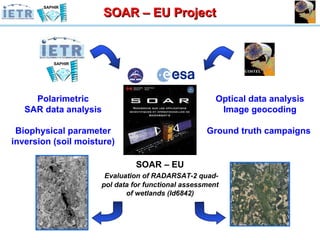
SOAR – EU Evaluation of RADARSAT-2 quad-pol data for functional assessment of wetlands (Id6842) Polarimetric SAR data analysis Biophysical parameter inversion (soil moisture) Optical data analysis Image geocoding Ground truth campaigns  SOAR – EU Project COSTEL SAPHIR
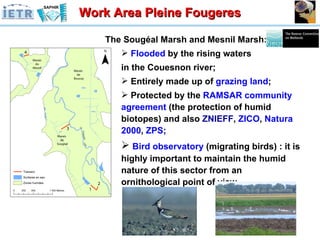
The Sougéal Marsh and Mesnil Marsh: Flooded  by the rising waters in the Couesnon river; Entirely made up of  grazing   land ; Protected by the  RAMSAR   community   agreement  (the protection of humid biotopes) and also  ZNIEFF ,  ZICO ,  Natura   2000 ,  ZPS ; Bird   observatory  (migrating birds) : it is highly important to maintain the humid nature of this sector from an ornithological point of view . Work Area Pleine Fougeres
Objectives of the project Radarsat 2 dataset and ALOS images presentation Ground thruth campaigns 1st Qualitative analysis results Outlook and summary Contents
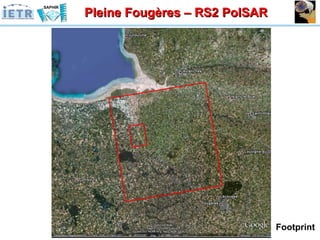
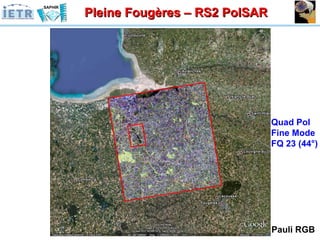
Pleine Fougères – RS2 PolSAR Footprint
Pleine Fougères – RS2 PolSAR Quad Pol Fine Mode FQ 23 (44°) Pauli RGB
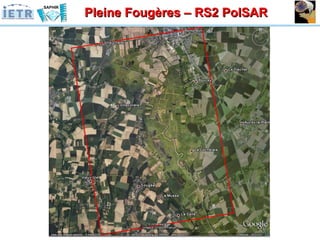
Pleine Fougères – RS2 PolSAR
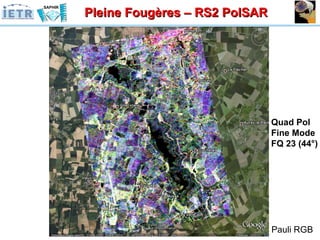
Pleine Fougères – RS2 PolSAR Quad Pol Fine Mode FQ 23 (44°) Pauli RGB
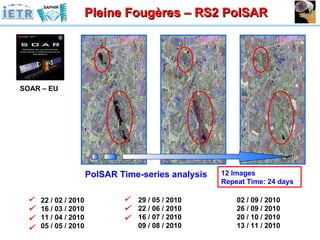
SOAR – EU PolSAR Time-series analysis  22 / 02 / 2010 16 / 03 / 2010 11 / 04 / 2010 05 / 05 / 2010       29 / 05 / 2010 22 / 06 / 2010 16 / 07 / 2010 09 / 08 / 2010 02 / 09 / 2010 26 / 09 / 2010 20 / 10 / 2010 13 / 11 / 2010      Pleine Fougères – RS2 PolSAR 12 Images Repeat Time: 24 days
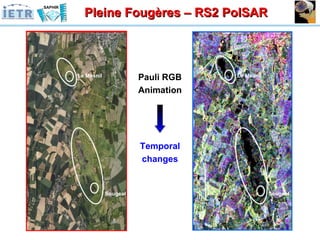
Sougeal Le Mesnil Sougeal Le Mesnil Pauli RGB Animation Temporal changes Pleine Fougères – RS2 PolSAR
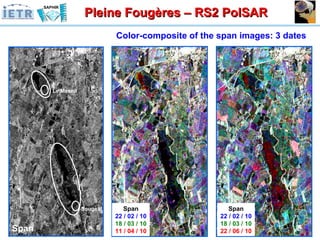
Span 22 / 02 / 10 18 / 03 / 10 11 / 04 / 10 Span 22 / 02 / 10 18 / 03 / 10 22 / 06 / 10 Sougeal Le Mesnil Span Pleine Fougères – RS2 PolSAR Color-composite of the span images: 3 dates
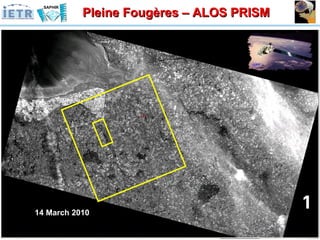
Pleine Fougères – ALOS PRISM 14 March 2010
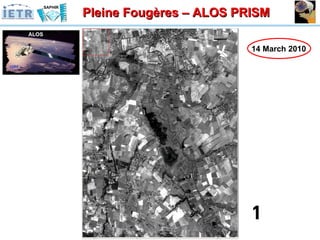
Pleine Fougères – ALOS PRISM 14 March 2010 ALOS
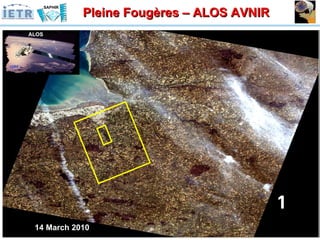
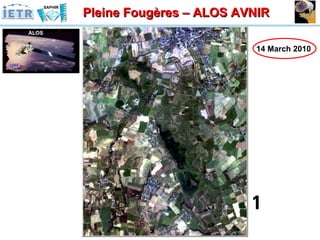
Pleine Fougères – ALOS AVNIR 14 March 2010 ALOS
Objectives of the project Radarsat 2 dataset and ALOS images presentation Ground thruth campaigns 1st Qualitative analysis results Outlook and summary Contents
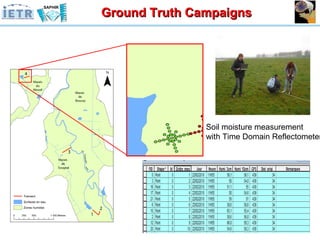
Ground Truth Campaigns Soil moisture measurement  with Time Domain Reflectometer
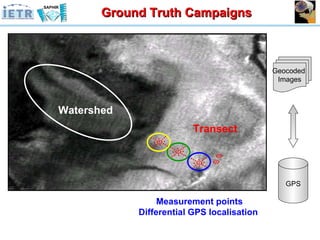
Ground Truth Campaigns Measurement points Differential GPS localisation  Watershed Transect GPS Geocoded  Images
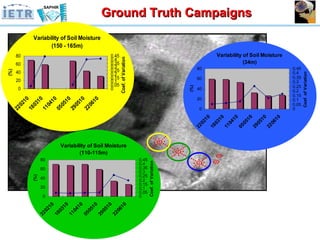
Ground Truth Campaigns
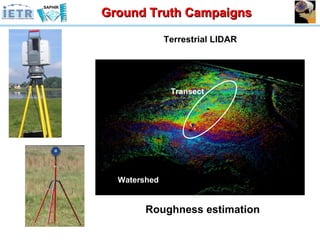
Watershed Transect Ground Truth Campaigns Terrestrial LIDAR Roughness estimation
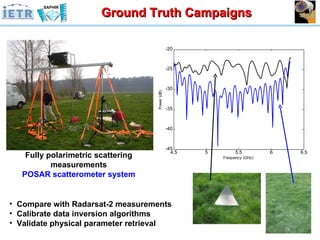
Ground Truth Campaigns Fully polarimetric scattering measurements POSAR scatterometer system Compare with Radarsat-2 measurements Calibrate data inversion algorithms Validate physical parameter retrieval
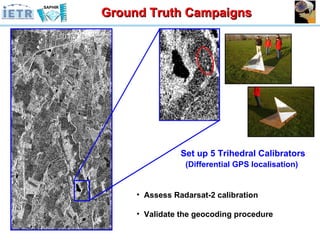
Ground Truth Campaigns Set up 5 Trihedral Calibrators (Differential GPS localisation)   Assess Radarsat-2 calibration Validate the geocoding procedure
Objectives of the project Radarsat 2 dataset and ALOS images presentation Ground thruth campaigns 1st Qualitative analysis results Outlook and summary Contents
Radarsat-2 Pre-Processing Data Extract [ T3 ] Post-Processing Methodology Polarimetric Decomposition Theorems Polarimetric descriptor sensitive to the  Temporal Variability  of the marsh  flooded areas 1st Qualitative analysis Pauli RGB RADARSAT 2 H A 
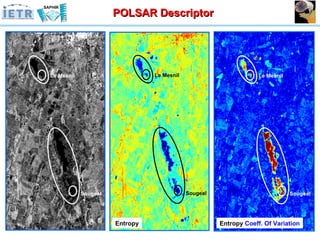
Entropy Entropy  Coeff. Of Variation Sougeal Le Mesnil Sougeal Sougeal Le Mesnil Le Mesnil POLSAR Descriptor
Radarsat-2 Pre-Processing Data Extract [ T3 ] Post-Processing Methodology Supervised Classification ML – Wishart Classification procedure 1st Qualitative analysis Pauli RGB ML - Wishart RADARSAT 2
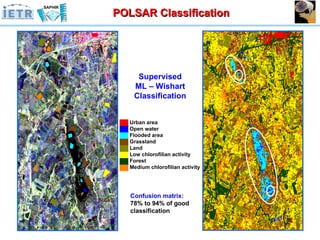
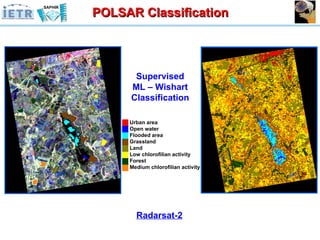
Urban area Open water Flooded area Grassland Land Low chlorofilian activity Forest Medium chlorofilian activity Supervised ML – Wishart Classification Confusion matrix: 78% to 94% of good classification POLSAR Classification
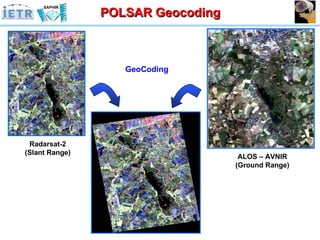
Radarsat-2 Pre-Processing Data Extract [ T3 ] Post-Processing Methodology GeoCoding T3 Matrix 46 G.C.P rms: 0.9 pix Pauli RGB ML - Wishart 1st Qualitative analysis RADARSAT 2
GeoCoding Radarsat-2 (Slant Range) ALOS – AVNIR (Ground Range) POLSAR Geocoding
Urban area Open water Flooded area Grassland Land Low chlorofilian activity Forest Medium chlorofilian activity Supervised ML – Wishart Classification Radarsat-2 POLSAR Classification
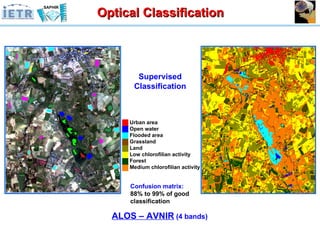
Urban area Open water Flooded area Grassland Land Low chlorofilian activity Forest Medium chlorofilian activity Supervised Classification ALOS – AVNIR  (4 bands) Optical Classification Confusion matrix: 88% to 99% of good classification
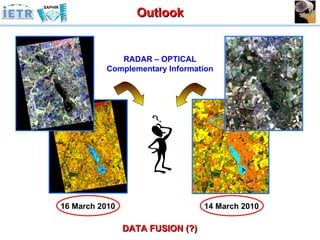
RADAR – OPTICAL Complementary Information DATA FUSION (?) Outlook 14 March 2010 16 March 2010
Outlook: Data inversion  for parameter retrieval ( soil moisture - roughness )  from Radarsat-2 time-series datasets; -  Cross Validation  using ground truth campaigns (soil moisture + roughness measurements); -  Data fusion  : radar & optical data Summary More case studies will contribute to an  improved  understanding  of useful  Polarimetric SAR   analysis  techniques. First results very promissive :  These results show the  potential of polarimetric SAR data for mapping  land  use & land cover and  monitor  wetland areas.
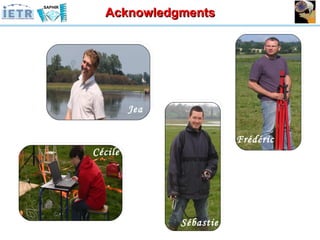
Acknowledgments Cécile Frédéric Jean Sébastien
Q uestions  ? HH…VV… HV … VH

TU3.L09 - SPACEBORNE FULLY POLARIMETRIC TIME-SERIES DATASETS FOR LAND COVER ANALYSIS

  • 1.
    SPACEBORNE FULLY POLARIMETRICTIME-SERIES DATASETS FOR LAND COVER ANALYSIS IETR – UMR CNRS 6164 SAPHIR Team University of Rennes 1 Rennes, France IGARSS – 2010 SAPHIR LETG – UMR CNRS 6554 COSTEL University of Rennes 2 Rennes, France Cécile MARECHAL, Eric POTTIER, Laurence HUBERT-MOY Samuel CORGNE, Sophie ALLAIN, Stéphane MERIC
  • 2.
    Objectives of theproject Radarsat 2 dataset and ALOS images presentation Ground thruth campaigns 1st Qualitative analysis results Outlook and summary Contents
  • 3.
    Objectives Evaluating Radarsat2 data: - to delineate wetlands & Map vegetation ; - Identify agricultural practices; - determine watercycle and waterlevels. Evaluate the contribution of both very high resolution optical data and radar data for wetlands delineation and characterization .
  • 4.
    Regions permanently orseasonaly flooded; Transition area (ecotone): mosaic of ecosystems; Important role in the regulation of water flow, protection of the water quality. Prevention of the reduction and degradation to maintain the diversity of species , habitats (nesting area for migratory birds). In view of the strong dynamic of this environment, a remote sensing multitemporal study is essential to monitor of wetland. Wetlands
  • 5.
    SOAR – EUEvaluation of RADARSAT-2 quad-pol data for functional assessment of wetlands (Id6842) Polarimetric SAR data analysis Biophysical parameter inversion (soil moisture) Optical data analysis Image geocoding Ground truth campaigns SOAR – EU Project COSTEL SAPHIR
  • 6.
    The Sougéal Marshand Mesnil Marsh: Flooded by the rising waters in the Couesnon river; Entirely made up of grazing land ; Protected by the RAMSAR community agreement (the protection of humid biotopes) and also ZNIEFF , ZICO , Natura 2000 , ZPS ; Bird observatory (migrating birds) : it is highly important to maintain the humid nature of this sector from an ornithological point of view . Work Area Pleine Fougeres
  • 7.
    Objectives of theproject Radarsat 2 dataset and ALOS images presentation Ground thruth campaigns 1st Qualitative analysis results Outlook and summary Contents
  • 8.
    Pleine Fougères –RS2 PolSAR Footprint
  • 9.
    Pleine Fougères –RS2 PolSAR Quad Pol Fine Mode FQ 23 (44°) Pauli RGB
  • 10.
  • 11.
    Pleine Fougères –RS2 PolSAR Quad Pol Fine Mode FQ 23 (44°) Pauli RGB
  • 12.
    SOAR – EUPolSAR Time-series analysis 22 / 02 / 2010 16 / 03 / 2010 11 / 04 / 2010 05 / 05 / 2010     29 / 05 / 2010 22 / 06 / 2010 16 / 07 / 2010 09 / 08 / 2010 02 / 09 / 2010 26 / 09 / 2010 20 / 10 / 2010 13 / 11 / 2010    Pleine Fougères – RS2 PolSAR 12 Images Repeat Time: 24 days
  • 13.
    Sougeal Le MesnilSougeal Le Mesnil Pauli RGB Animation Temporal changes Pleine Fougères – RS2 PolSAR
  • 14.
    Span 22 /02 / 10 18 / 03 / 10 11 / 04 / 10 Span 22 / 02 / 10 18 / 03 / 10 22 / 06 / 10 Sougeal Le Mesnil Span Pleine Fougères – RS2 PolSAR Color-composite of the span images: 3 dates
  • 15.
    Pleine Fougères –ALOS PRISM 14 March 2010
  • 16.
    Pleine Fougères –ALOS PRISM 14 March 2010 ALOS
  • 17.
    Pleine Fougères –ALOS AVNIR 14 March 2010 ALOS
  • 18.
    Pleine Fougères –ALOS AVNIR 14 March 2010 ALOS
  • 19.
    Objectives of theproject Radarsat 2 dataset and ALOS images presentation Ground thruth campaigns 1st Qualitative analysis results Outlook and summary Contents
  • 20.
    Ground Truth CampaignsSoil moisture measurement with Time Domain Reflectometer
  • 21.
    Ground Truth CampaignsMeasurement points Differential GPS localisation Watershed Transect GPS Geocoded Images
  • 22.
  • 23.
    Watershed Transect GroundTruth Campaigns Terrestrial LIDAR Roughness estimation
  • 24.
    Ground Truth CampaignsFully polarimetric scattering measurements POSAR scatterometer system Compare with Radarsat-2 measurements Calibrate data inversion algorithms Validate physical parameter retrieval
  • 25.
    Ground Truth CampaignsSet up 5 Trihedral Calibrators (Differential GPS localisation) Assess Radarsat-2 calibration Validate the geocoding procedure
  • 26.
    Objectives of theproject Radarsat 2 dataset and ALOS images presentation Ground thruth campaigns 1st Qualitative analysis results Outlook and summary Contents
  • 27.
    Radarsat-2 Pre-Processing DataExtract [ T3 ] Post-Processing Methodology Polarimetric Decomposition Theorems Polarimetric descriptor sensitive to the Temporal Variability of the marsh flooded areas 1st Qualitative analysis Pauli RGB RADARSAT 2 H A 
  • 28.
    Entropy Entropy Coeff. Of Variation Sougeal Le Mesnil Sougeal Sougeal Le Mesnil Le Mesnil POLSAR Descriptor
  • 29.
    Radarsat-2 Pre-Processing DataExtract [ T3 ] Post-Processing Methodology Supervised Classification ML – Wishart Classification procedure 1st Qualitative analysis Pauli RGB ML - Wishart RADARSAT 2
  • 30.
    Urban area Openwater Flooded area Grassland Land Low chlorofilian activity Forest Medium chlorofilian activity Supervised ML – Wishart Classification Confusion matrix: 78% to 94% of good classification POLSAR Classification
  • 31.
    Radarsat-2 Pre-Processing DataExtract [ T3 ] Post-Processing Methodology GeoCoding T3 Matrix 46 G.C.P rms: 0.9 pix Pauli RGB ML - Wishart 1st Qualitative analysis RADARSAT 2
  • 32.
    GeoCoding Radarsat-2 (SlantRange) ALOS – AVNIR (Ground Range) POLSAR Geocoding
  • 33.
    Urban area Openwater Flooded area Grassland Land Low chlorofilian activity Forest Medium chlorofilian activity Supervised ML – Wishart Classification Radarsat-2 POLSAR Classification
  • 34.
    Urban area Openwater Flooded area Grassland Land Low chlorofilian activity Forest Medium chlorofilian activity Supervised Classification ALOS – AVNIR (4 bands) Optical Classification Confusion matrix: 88% to 99% of good classification
  • 35.
    RADAR – OPTICALComplementary Information DATA FUSION (?) Outlook 14 March 2010 16 March 2010
  • 36.
    Outlook: Data inversion for parameter retrieval ( soil moisture - roughness ) from Radarsat-2 time-series datasets; - Cross Validation using ground truth campaigns (soil moisture + roughness measurements); - Data fusion : radar & optical data Summary More case studies will contribute to an improved understanding of useful Polarimetric SAR analysis techniques. First results very promissive : These results show the potential of polarimetric SAR data for mapping land use & land cover and monitor wetland areas.
  • 37.
  • 38.
    Q uestions ? HH…VV… HV … VH

Editor's Notes