Southwest Australia
      By: Austin Couser


                          S
General Info
S The South West region
  is one of the nine
  regions of Western
  Australia. It is so
  named because it
  located in the south-
  west corner of Western
  Australia. The South
  West region has an area
  of 23,970 km², and a
  population of about
  123,000 people.
Characteristics of Region


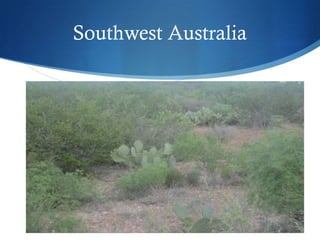
S A biodiversity hotspot that includes the Mediterranean
  forests, woodlands, and scrub ecoregions of Western
  Australia. The region has a wet-winter, dry-summer
  Mediterranean climate, one of five such regions in the
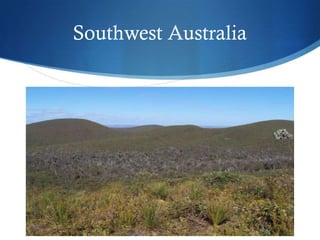
  world. The region is mainly woody, including forests,
  woodlands, shrublands, and heathlands, but no grasslands.
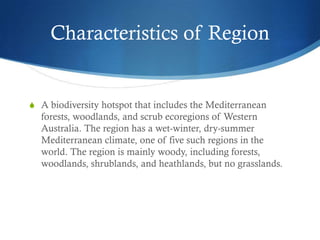
Southwest Australia
Southwest Australia
Southwest Australia
Animals


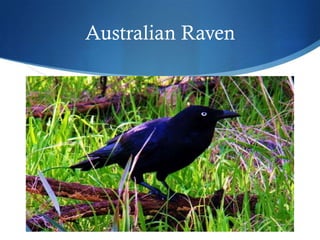
S Australian Raven, Western Grey Kangaroo, Western Brush
  Wallaby, Tammar Wallaby, Numbat, Quenda, Western
  Swamp Turtle, The Turtle Frog, Brown Quail, Fairy Prion.

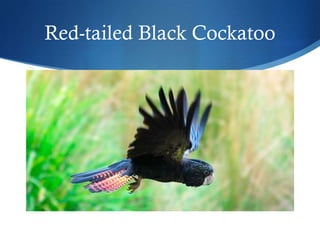
S Endangered Animals- red-tailed black cockatoo, western
  swamp turtle, Gilbert’s Potoroo, tasmanian tiger
Australian Raven
Red-tailed Black Cockatoo
Gilbert’s Potoroo
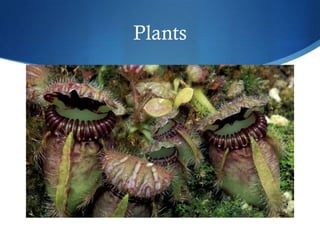
Plants


S Banksia, Dryandra, Grevillea, Hakea, the waratah. Boronia,
   Correa, Callistemon, Eucalyptus, Melaleuca, Leptospermum,
   Pultenaea, Daviesia, Bossiaea
Plants
Plants
Plants
Major Threats


S Large-scale mining for bauxite is increasingly a threat to
  Southwest Australia's ecosystems; the region is one of the
  largest producers of alumina in the world.
S One of the most serious current threats to the natural
  vegetation of Southwest Australia is the spread of root
  disease, or caused by the root fungus Phytophthora
  cinnamomi. The disease was first noticed in the jarrah
  forests in 1940 but not identified until 1965. By that time,
  thousands of hectares of forest had been infected and killed.
Major Threats


S Introduced alien species, especially foxes and cats, threaten
  native fauna and have caused major declines in species like
  the numbat in Southwest Australia.

S Land managers have successfully poisoned these alien
  species with sodium flouroacetate; amazingly, native
  mammals are immune to the poison because the compound
  occurs naturally in the leaves of many native legumes.

Southwestaustraliahotspot

  • 1.
    Southwest Australia By: Austin Couser S
  • 2.
    General Info S TheSouth West region is one of the nine regions of Western Australia. It is so named because it located in the south- west corner of Western Australia. The South West region has an area of 23,970 km², and a population of about 123,000 people.
  • 3.
    Characteristics of Region SA biodiversity hotspot that includes the Mediterranean forests, woodlands, and scrub ecoregions of Western Australia. The region has a wet-winter, dry-summer Mediterranean climate, one of five such regions in the world. The region is mainly woody, including forests, woodlands, shrublands, and heathlands, but no grasslands.
  • 4.
  • 5.
  • 6.
  • 7.
    Animals S Australian Raven,Western Grey Kangaroo, Western Brush Wallaby, Tammar Wallaby, Numbat, Quenda, Western Swamp Turtle, The Turtle Frog, Brown Quail, Fairy Prion. S Endangered Animals- red-tailed black cockatoo, western swamp turtle, Gilbert’s Potoroo, tasmanian tiger
  • 8.
  • 9.
  • 10.
  • 11.
    Plants S Banksia, Dryandra,Grevillea, Hakea, the waratah. Boronia, Correa, Callistemon, Eucalyptus, Melaleuca, Leptospermum, Pultenaea, Daviesia, Bossiaea
  • 12.
  • 13.
  • 14.
  • 15.
    Major Threats S Large-scalemining for bauxite is increasingly a threat to Southwest Australia's ecosystems; the region is one of the largest producers of alumina in the world. S One of the most serious current threats to the natural vegetation of Southwest Australia is the spread of root disease, or caused by the root fungus Phytophthora cinnamomi. The disease was first noticed in the jarrah forests in 1940 but not identified until 1965. By that time, thousands of hectares of forest had been infected and killed.
  • 16.
    Major Threats S Introducedalien species, especially foxes and cats, threaten native fauna and have caused major declines in species like the numbat in Southwest Australia. S Land managers have successfully poisoned these alien species with sodium flouroacetate; amazingly, native mammals are immune to the poison because the compound occurs naturally in the leaves of many native legumes.