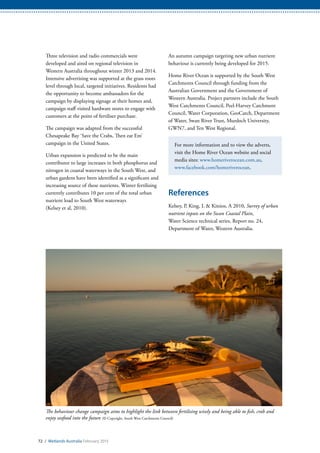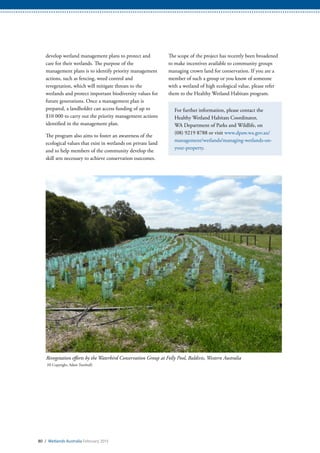
Wetlands Australia
National wetlands update February 2015—Issue No 26
Disclaimer
The views and opinions expressed in this publication are those of the authors and do not necessarily reflect those
of the Australian Government or the Minister for the Environment.
The Department of the Environment acknowledges the traditional owners of country throughout Australia and
their continuing connection to land, sea and community. We pay our respects to them and their cultures and to
their elders both past and present
© Copyright Commonwealth of Australia, 2015
Wetlands Australia National Wetlands Update February 2015 - Issue No 26 is licensed by the Commonwealth of
Australia for use under a Creative Commons By Attribution 3.0 Australia licence with the exception of the
Coat of Arms of the Commonwealth of Australia, the logo of the agency responsible for publishing the report,
content supplied by third parties, and any images depicting people. For licence conditions see:
http://creativecommons.org/licenses/by/3.0/au
This report should be attributed as ‘Wetlands Australia, National Wetlands Update February 2015 — Issue No 26,
Commonwealth of Australia 2015’
The Commonwealth of Australia has made all reasonable efforts to identify content supplied by third parties
using the following format ‘© Copyright, [name of third party] ’.
Cover images
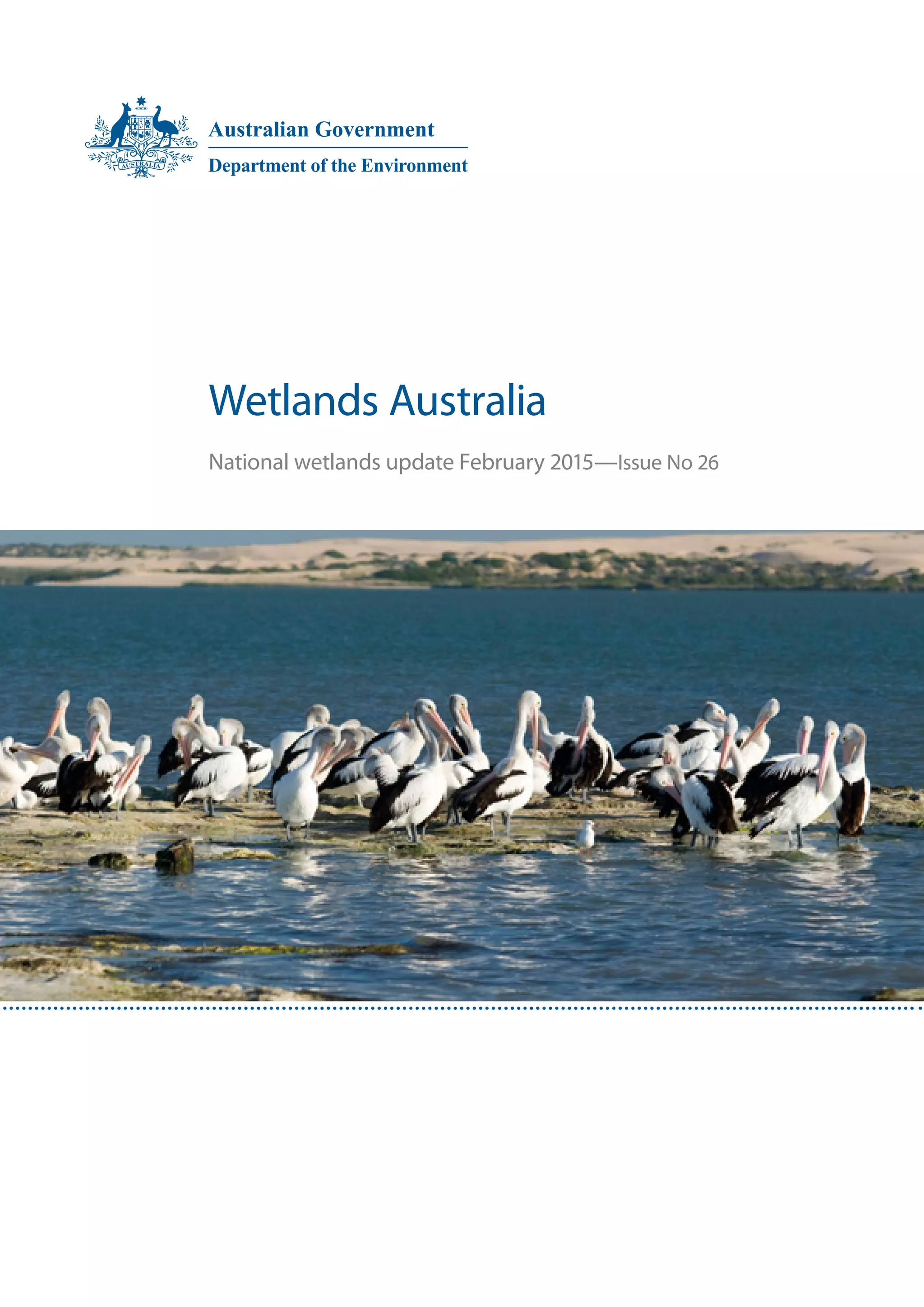
Front cover: Large numbers of waterbirds, including Pelicans (Pelecanus conspicillatus), utilise the Coorong and
Lakes Alexandrina and Albert Ramsar Site at the mouth of the Murray River in South Australia (© Copyright, John Baker)
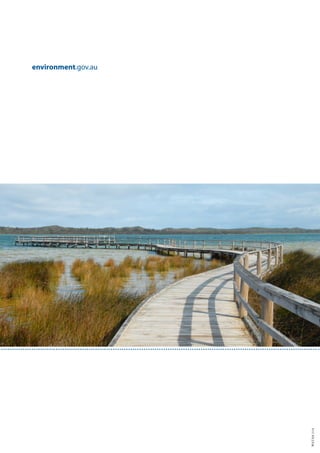
Back cover: Lake Clifton, part of the Peel Yalgorup System Ramsar site in Western Australia, provides a range of
ecosystem services to the local community (© Copyright, Nerida Sloane)
ii / Wetlands Australia February 2015
iii / Wetlands Australia February 2015
Contents
Introduction to Wetlands Australia February 2015	 1
Looking after Australia’s Ramsar wetlands	 2
Ramsar Secretary General visits Australia	 3
Defence and Fitzroy Basin Association: Managing a unique
Ramsar wetland in Queensland	 6
Banrock Station Wetland Complex Ramsar site in South Australia
is helping to bring a species back from the brink 	 8
A ‘systems repair’ approach to restoring the Ramsar wetlands of
Bowling Green Bay in Queensland	 10
Future proofing world-class wetlands in Victoria: A joint effort	 12
Active water management is underway at the Hunter Estuary Wetlands Ramsar site	 15
Puddles of paradise support threatened species in Gunbower Forest Ramsar site 	 17
Lake Mealup on the road to recovery 	 19
Environmental flows aid the recovery of Gunbower Forest Ramsar site	 21
Aquatic habitat improves during low flow years at a South Australian Ramsar site	 23
Environmental watering supports wetlands in the Murray–Darling Basin	 25
Classifying aquatic ecosystems in the Murray–Darling Basin	 26
SMART targets guide environmental watering of the Murray–Darling Basin	 30
Follow that sound — it’s the southern bell frog!	 33
Mallee Wetlands: A rehabilitation program in the making	 34
Black Box floodplains bouncing back in New South Wales	 36
Research to support environmental watering:
a collaborative approach in the Murray–Darling Basin 	 38
Managing wetlands for the future	 39
The future of Oceania wetlands	 40
Farming journey takes Victorian farmer back to nature	 42
The future of wetland co-management is here	 44
Twenty-three years experience in wetland and environmental
water management and still going strong...	 46
Camden Council Aquatic Plant Management Procedures	 48
Managing Western Australia’s Historic Lowlands Reserve	 51
Setting the trend in modern methods of fire management	 53
New fence protects estuarine crocodile habitat in Western Australia 	 55
Wetlands, brolgas and Latham’s snipe: south-west Victoria’s great natural assets	 57
New book launched to promote North Queensland wetland plants	 59
iv / Wetlands Australia February 2015
Communities helping to protect our wetlands	 61
Students on a mission for the Great Barrier Reef	 62
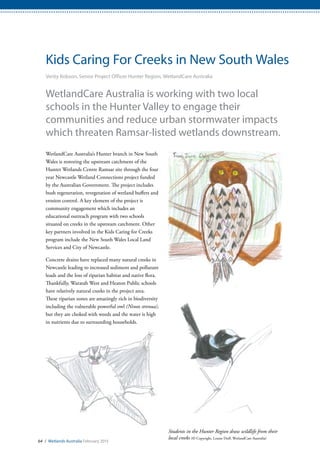
Kids Caring For Creeks in New South Wales	 64
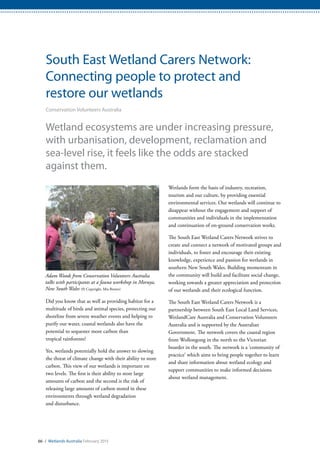
South East Wetland Carers Network: Connecting people
to protect and restore our wetlands	 66
Discovering the hidden secrets of the cryptic burrowing crayfish	 68
Pitt Town Lagoon in New South Wales celebrates a new bird hide	 70
Home River Ocean: Protecting waterways through social marketing	 71
Eavesdropping on frogs: Citizen science guiding wetland health management	 73
Wetland restoration and conservation	 75
Restoring wetlands of the upper Wannon River floodplain, south-west Victoria	 76
Healthy Wetland Habitats program provides incentives to private
wetland managers on the Swan Coastal Plain, Western Australia	 79
Farmers go with the flow on the New South Wales North Coast	 81
Protecting Wetlands in a new National Park in Sydney	 83
Rehabilitation of a floodplain wetland in the Macquarie Marshes	 85
Pin map project to record on-ground works for wetlands in Queensland	 87
Restoring the Lagoon of Islands in Tasmania	 89
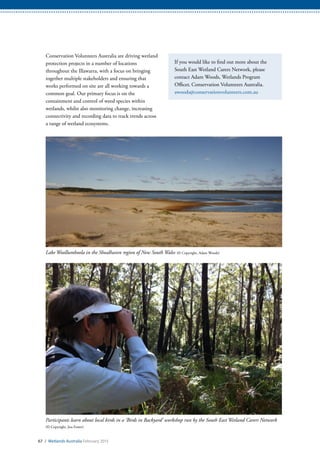
Lake Wollumboola, New South Wales: A special lake for birds	 90
Commonwealth and State Government wetland updates	 92
Australian Government Update	 93
New South Wales Government Update	 95
Victorian Government Update	 96
Queensland Government Update	 97
South Australian Government Update	 100
Tasmanian Government Update	 102
2015 CALENDAR OF EVENTS	 103
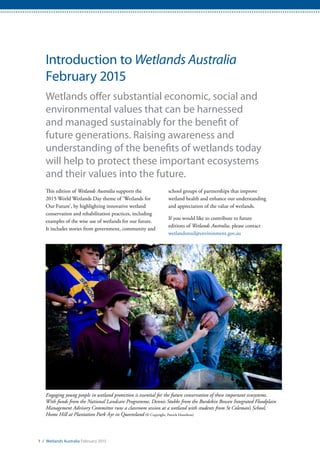
Engaging young people in wetland protection is essential for the future conservation of these important ecosystems.
With funds from the National Landcare Programme, Dennis Stubbs from the Burdekin Bowen Integrated Floodplain
Management Advisory Committee runs a classroom session at a wetland with students from St Coleman’s School,
Home Hill at Plantation Park Ayr in Queensland (© Copyright, Patrick Hamilton)
1 / Wetlands Australia February 2015
Introduction to Wetlands Australia
February 2015
Wetlands offer substantial economic, social and
environmental values that can be harnessed
and managed sustainably for the benefit of
future generations. Raising awareness and
understanding of the benefits of wetlands today
will help to protect these important ecosystems
and their values into the future.
This edition of Wetlands Australia supports the
2015 World Wetlands Day theme of ‘Wetlands for
Our Future’, by highlighting innovative wetland
conservation and rehabilitation practices, including
examples of the wise use of wetlands for our future.
It includes stories from government, community and
school groups of partnerships that improve
wetland health and enhance our understanding
and appreciation of the value of wetlands.
If you would like to contribute to future
editions of Wetlands Australia, please contact
wetlandsmail@environment.gov.au
2 / Wetlands Australia February 2015
Looking after
Australia’s Ramsar
wetlands
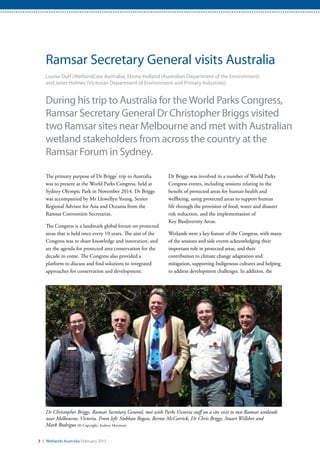
Dr Christopher Briggs, Ramsar Secretary General, met with Parks Victoria staff on a site visit to two Ramsar wetlands
near Melbourne, Victoria. From left: Siobhan Rogan, Bernie McCarrick, Dr Chris Briggs, Stuart Willsher and
Mark Rodrigue (© Copyright, Andrew Morrison)
3 / Wetlands Australia February 2015
Ramsar Secretary General visits Australia
Louise Duff (WetlandCare Australia), Ebony Holland (Australian Department of the Environment)
and Janet Holmes (Victorian Department of Environment and Primary Industries)
During his trip to Australia for theWorld Parks Congress,
Ramsar Secretary General Dr Christopher Briggs visited
two Ramsar sites near Melbourne and met with Australian
wetland stakeholders from across the country at the
Ramsar Forum in Sydney.
The primary purpose of Dr Briggs’ trip to Australia
was to present at the World Parks Congress, held at
Sydney Olympic Park in November 2014. Dr Briggs
was accompanied by Mr Llewellyn Young, Senior
Regional Advisor for Asia and Oceania from the
Ramsar Convention Secretariat.
The Congress is a landmark global forum on protected
areas that is held once every 10 years. The aim of the
Congress was to share knowledge and innovation, and
set the agenda for protected area conservation for the
decade to come. The Congress also provided a
platform to discuss and find solutions to integrated
approaches for conservation and development.
Dr Briggs was involved in a number of World Parks
Congress events, including sessions relating to the
benefit of protected areas for human health and
wellbeing, using protected areas to support human
life through the provision of food, water and disaster
risk reduction, and the implementation of
Key Biodiversity Areas.
Wetlands were a key feature of the Congress, with many
of the sessions and side events acknowledging their
important role in protected areas, and their
contribution to climate change adaptation and
mitigation, supporting Indigenous cultures and helping
to address development challenges. In addition, the
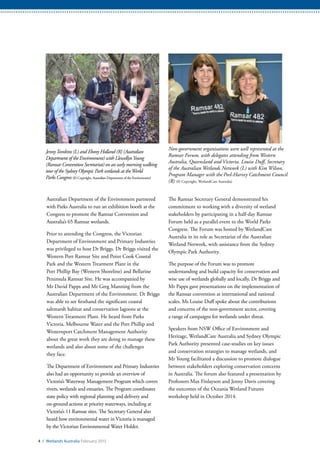
Non-government organisations were well represented at the
Ramsar Forum, with delegates attending from Western
Australia, Queensland and Victoria. Louise Duff, Secretary
of the Australian Wetlands Network (L) with Kim Wilson,
Program Manager with the Peel-Harvey Catchment Council
(R) (© Copyright, WetlandCare Australia)
4 / Wetlands Australia February 2015
Australian Department of the Environment partnered
with Parks Australia to run an exhibition booth at the
Congress to promote the Ramsar Convention and
Australia’s 65 Ramsar wetlands.
Prior to attending the Congress, the Victorian
Department of Environment and Primary Industries
was privileged to host Dr Briggs. Dr Briggs visited the
Western Port Ramsar Site and Point Cook Coastal
Park and the Western Treatment Plant in the
Port Phillip Bay (Western Shoreline) and Bellarine
Peninsula Ramsar Site. He was accompanied by
Mr David Papps and Mr Greg Manning from the
Australian Department of the Environment. Dr Briggs
was able to see firsthand the significant coastal
saltmarsh habitat and conservation lagoons at the
Western Treatment Plant. He heard from Parks
Victoria, Melbourne Water and the Port Phillip and
Westernport Catchment Management Authority
about the great work they are doing to manage these
wetlands and also about some of the challenges
they face.
The Department of Environment and Primary Industries
also had an opportunity to provide an overview of
Victoria’s Waterway Management Program which covers
rivers, wetlands and estuaries. The Program coordinates
state policy with regional planning and delivery and
on-ground actions at priority waterways, including at
Victoria’s 11 Ramsar sites. The Secretary General also
heard how environmental water in Victoria is managed
by the Victorian Environmental Water Holder.
The Ramsar Secretary General demonstrated his
commitment to working with a diversity of wetland
stakeholders by participating in a half-day Ramsar
Forum held as a parallel event to the World Parks
Congress. The Forum was hosted by WetlandCare
Australia in its role as Secretariat of the Australian
Wetland Network, with assistance from the Sydney
Olympic Park Authority.
The purpose of the Forum was to promote
understanding and build capacity for conservation and
wise use of wetlands globally and locally. Dr Briggs and
Mr Papps gave presentations on the implementation of
the Ramsar convention at international and national
scales. Ms Louise Duff spoke about the contributions
and concerns of the non-government sector, covering
a range of campaigns for wetlands under threat.
Speakers from NSW Office of Environment and
Heritage, WetlandCare Australia and Sydney Olympic
Park Authority presented case-studies on key issues
and conservation strategies to manage wetlands, and
Mr Young facilitated a discussion to promote dialogue
between stakeholders exploring conservation concerns
in Australia. The forum also featured a presentation by
Professors Max Finlayson and Jenny Davis covering
the outcomes of the Oceania Wetland Futures
workshop held in October 2014.
JennyTomkins (L) and Ebony Holland (R) (Australian
Department of the Environment) with LlewellynYoung
(Ramsar Convention Secretariat) on an early morning walking
tour of the Sydney Olympic Park wetlands at theWorld
Parks Congress (© Copyright, Australian Department of the Environment)
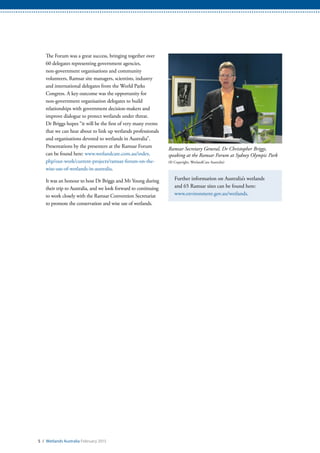
Ramsar Secretary General, Dr Christopher Briggs,
speaking at the Ramsar Forum at Sydney Olympic Park
(© Copyright, WetlandCare Australia)
5 / Wetlands Australia February 2015
The Forum was a great success, bringing together over
60 delegates representing government agencies,
non-government organisations and community
volunteers, Ramsar site managers, scientists, industry
and international delegates from the World Parks
Congress. A key outcome was the opportunity for
non-government organisation delegates to build
relationships with government decision-makers and
improve dialogue to protect wetlands under threat.
Dr Briggs hopes “it will be the first of very many events
that we can hear about to link up wetlands professionals
and organisations devoted to wetlands in Australia”.
Presentations by the presenters at the Ramsar Forum
can be found here: www.wetlandcare.com.au/index.
php/our-work/current-projects/ramsar-forum-on-the-
wise-use-of-wetlands-in-australia.
It was an honour to host Dr Briggs and Mr Young during
their trip to Australia, and we look forward to continuing
to work closely with the Ramsar Convention Secretariat
to promote the conservation and wise use of wetlands.
Further information on Australia’s wetlands
and 65 Ramsar sites can be found here:
www.environment.gov.au/wetlands.
6 / Wetlands Australia February 2015
Defence and Fitzroy Basin Association:
Managing a unique Ramsar wetland
in Queensland
Australian Department of Defence and the Fitzroy Basin Association Inc.
A Ramsar wetland in Queensland benefits from the
effective collaboration between government and
non-government organisations.
The Shoalwater and Corio Bays Area (Shoalwater Bay
Training Area, in part — Corio Bay) wetland was
listed in 1996 under the Ramsar Convention on
Wetlands of International Importance. The wetland is
situated on the central Queensland coast, north-east of
Rockhampton, covering an area of approximately
239 100 hectares.
The wetland is unique in that it covers marine and
estuarine waters, and freshwater wetlands on State and
Commonwealth land and waters. The marine waters
are part of the Great Barrier Reef Marine Park and are
one of the major dugong (Dugong dugon) protection
areas within Australia.
This wetland system comprises a high diversity of
ecosystems, high numbers of endemic and threatened
species and habitat required by many migratory
species. There is the potential for the wetland to be
adversely impacted by invasive plant and animal
species which would impact the significant
environmental value of the Ramsar site.
The Australian Department of Defence (Defence) is
responsible for management of the wetlands which exist
within the Shoalwater Bay Training Area. Defence
recognises the need to work closely with stakeholders
and community organisations, such as the Fitzroy Basin
Association Inc. (FBA), who have similar interests in
achieving positive environmental outcomes.
FBA is the lead organisation for sustainable natural
resource management in Central Queensland. Healthy
ecosystems are highly valued and the conservation of
critical habitat such as the Ramsar wetland complex is
an important focus for the organisation. FBA partners
with regional stakeholders to ensure appropriate
management practices are considered and implemented.
Defence and FBA have worked collaboratively since
2008 to achieve change on the ground at the site utilising
Australian Government funds. Programs have targeted a
number of issues which threaten the Ramsar site,
including Weeds of National Significance, feral pigs,
invasive aquatic species and marine debris on beaches.
Combatting weed incursions has resulted in the
improved integrity of native vegetation and increased
wetland health. Feral pig control has been innovative
to suit the local conditions and has resulted in a
decrease in the degradation of wetland and coastal
habitat. Debris removal from beaches has reduced the
risk to wildlife. Surveys for aquatic pests have shown
the wetland to be free of invasive fish species which is
critical given the recent discovery of tilapia (a pest
species originally introduced for use in aquaria) in the
nearby Fitzroy River. Based on these issues, Defence
and FBA must be ever vigilant in their joint efforts to
combat threats to our valuable natural assets.
Together Defence and FBA are committed to continue
the vital work needed to protect this fragile wetland
area for future generations.
For more information on the Shoalwater and
Corio Bays Area Ramsar site, please visit:
www.environment.gov.au/cgi-bin/wetlands/
ramsardetails.pl?refcode=44.
7 / Wetlands Australia February 2015
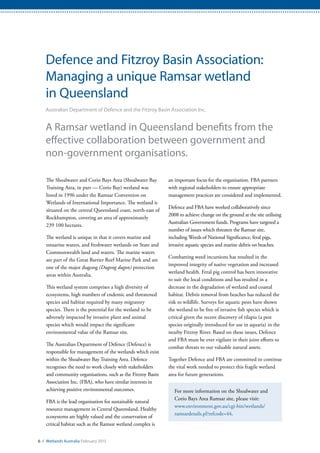
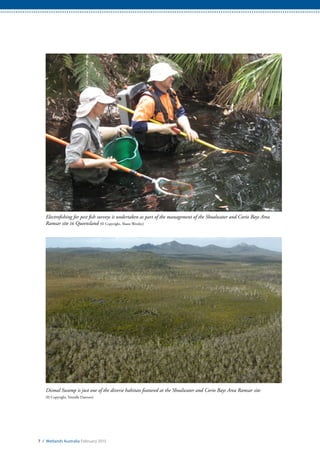
Electrofishing for pest fish surveys is undertaken as part of the management of the Shoalwater and Corio Bays Area
Ramsar site in Queensland (© Copyright, Shane Westley)
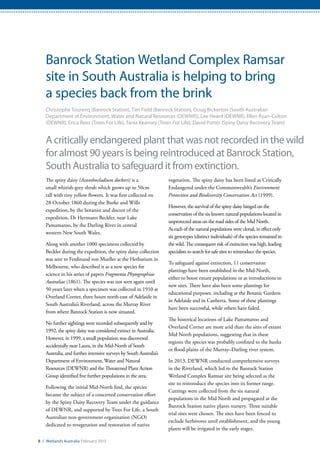
Dismal Swamp is just one of the diverse habitats featured at the Shoalwater and Corio Bays Area Ramsar site
(© Copyright, Tennille Danvers)
vegetation. The spiny daisy has been listed as Critically
Endangered under the Commonwealth’s Environment
Protection and Biodiversity Conservation Act (1999).
However, the survival of the spiny daisy hinged on the
conservation of the six known natural populations located in
unprotected areas on the road sides of the Mid North.
As each of the natural populations were clonal, in effect only
six genotypes (distinct individuals) of the species remained in
the wild. The consequent risk of extinction was high, leading
specialists to search for safe sites to reintroduce the species.
To safeguard against extinction, 11 conservation
plantings have been established in the Mid-North,
either to boost extant populations or as introductions to
new sites. There have also been some plantings for
educational purposes, including at the Botanic Gardens
in Adelaide and in Canberra. Some of these plantings
have been successful, while others have failed.
The historical locations of Lake Pamamaroo and
Overland Corner are more arid than the sites of extant
Mid North populations, suggesting that in these
regions the species was probably confined to the banks
or flood plains of the Murray–Darling river system.
In 2013, DEWNR conducted comprehensive surveys
in the Riverland, which led to the Banrock Station
Wetland Complex Ramsar site being selected as the
site to reintroduce the species into its former range.
Cuttings were collected from the six natural
populations in the Mid North and propagated at the
Banrock Station native plants nursery. Three suitable
trial sites were chosen. The sites have been fenced to
exclude herbivores until establishment, and the young
plants will be irrigated in the early stages.
8 / Wetlands Australia February 2015
Banrock Station Wetland Complex Ramsar
site in South Australia is helping to bring
a species back from the brink
Christophe Tourenq (Banrock Station), Tim Field (Banrock Station), Doug Bickerton (South Australian
Department of Environment, Water and Natural Resources (DEWNR)), Lee Heard (DEWNR), Ellen Ryan-Colton
(DEWNR), Erica Rees (Trees For Life), Tania Kearney (Trees For Life), David Potter (Spiny Daisy Recovery Team)
A critically endangered plant that was not recorded in the wild
for almost 90 years is being reintroduced at Banrock Station,
South Australia to safeguard it from extinction.
The spiny daisy (Acanthocladium dockeri) is a
small whitish-grey shrub which grows up to 50cm
tall with tiny yellow flowers. It was first collected on
28 October 1860 during the Burke and Wills
expedition, by the botanist and doctor of the
expedition, Dr Hermann Beckler, near Lake
Pamamaroo, by the Darling River in central
western New South Wales.
Along with another 1000 specimens collected by
Beckler during the expedition, the spiny daisy collection
was sent to Ferdinand von Mueller at the Herbarium in
Melbourne, who described it as a new species for
science in his series of papers Fragmenta Phytographiae
Australiae (1861). The species was not seen again until
50 years later when a specimen was collected in 1910 at
Overland Corner, three hours north-east of Adelaide in
South Australia’s Riverland, across the Murray River
from where Banrock Station is now situated.
No further sightings were recorded subsequently and by
1992, the spiny daisy was considered extinct in Australia.
However, in 1999, a small population was discovered
accidentally near Laura, in the Mid-North of South
Australia, and further intensive surveys by South Australia’s
Department of Environment, Water and Natural
Resources (DEWNR) and the Threatened Plant Action
Group identified five further populations in the area.
Following the initial Mid-North find, the species
became the subject of a concerted conservation effort
by the Spiny Daisy Recovery Team under the guidance
of DEWNR, and supported by Trees For Life, a South
Australian non-government organisation (NGO)
dedicated to revegetation and restoration of native
On 24 July 2014, the cuttings were planted by
representatives of the organisations involved in
recovering the spiny daisy from extinction.
The re-introduction is a great example of positive
partnerships between a conservation-minded private
company, government agencies and an NGO
dedicated to nature conservation. Depending on
the success of these trial plantings, the plan is to
undertake further plantings in subsequent years.
The translocation has been funded by the
Banrock Station Environmental Trust.
The critically endangered spiny daisy (Acanthocladium dockeri) is being reintroduced at Banrock Station, South Australia
(© Copyright, Christophe Tourenq, Banrock Station)
Banrock Station Wetland Complex Ramsar site in South Australia was chosen as the location for the reintroduction of the
spine daisy (Acanthocladium dockeri) (© Copyright, Christophe Tourenq, Banrock Station)
The site of the spiny daisy (Acanthocladium dockeri)
reintroduction is protected from herbivores
(© Copyright, Christophe Tourenq, Banrock Station)
9 / Wetlands Australia February 2015
10 / Wetlands Australia February 2015
A ‘systems repair’ approach to restoring
the Ramsar wetlands of Bowling Green Bay
in Queensland
Paul Duncanson, NQ Dry Tropics
The Bowling Green Bay Ramsar site (BGB) contains
abundant and diverse aquatic ecosystems in the
North Queensland dry tropics region, and sits adjacent
to the Great Barrier Reef World Heritage Area.
The BGB wetlands also play an important role in
capturing and sequestering diffuse source pollutants
from intensive agriculture in the catchment,
predominantly irrigated sugar cane production,
before the waters enter the Great Barrier Reef lagoon.
Since the expansion of agriculture and the
construction of the Burdekin Falls Dam in the 1980s,
coastal catchments feeding the BGB wetlands have
undergone significant hydrological changes.
What were once vast expanses of pristine ephemeral
wetlands and waterways now act as permanently
inundated conduits for bulk water supply and runoff
from sugar cane farms. This has contributed to a
decline in wetland condition, habitat fragmentation
and significant loss of productive grazing land as weed
chokes spread across the landscape due to constant
inputs of eutrophic water.
Addressing this requires a ‘systems repair’ approach to
build landscape resilience to deal with future pressures
and ultimately improve the health of the Great Barrier
Reef and Ramsar wetlands. The work complements
existing initiatives to reduce diffuse agricultural
pollutants (nutrients, pesticides and sediments)
under the Australian Government’s Reef Programme.
NQ Dry Tropics is working with local councils, water
managers and farmers to modernise and operate more
efficiently to tackle longstanding issues through the
‘Restoring Burdekin Coastal Ecosystems for the Great
Barrier Reef and Ramsar’ project. The project aims to
optimise and manipulate the water supply chain to
limit the excessive volume of water entering the BGB
Ramsar wetlands and strategically restore ecological
function to priority sites whilst not impacting on the
most productive sugar growing region of Australia.
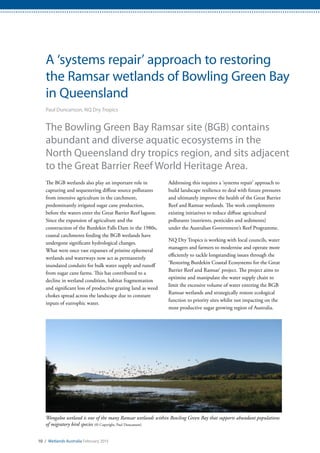
Wongaloo wetland is one of the many Ramsar wetlands within Bowling Green Bay that supports abundant populations
of migratory bird species (© Copyright, Paul Duncanson)
11 / Wetlands Australia February 2015
Recent studies by NQ Dry Tropics show vast expanses
of weed chokes can be cleared by limiting freshwater
inputs into the wetlands. This recreates a wetting-
drying cycle that mimics natural wetland seasonality
characteristic of the dry tropics region and restores
aquatic connectivity for a suite of native fish species.
To do this on a system wide scale requires innovative
techniques, such as frequent monitoring of flows,
automated gate telemetry, construction of fishways
and monitoring of native plant and fish communities.
To date NQ Dry Tropics and project partners have
revegetated 1.5 hectares of stream bank with over
2000 plants, and controlled 420 hectares of aquatic
weeds using these techniques which are far more
cost effective than more traditional methods of
weed control (e.g. mechanical removal).
To find out more, contact
NQ Dry Tropics on (07) 4724 3544
or visit www.nqdrytropics.com.au.
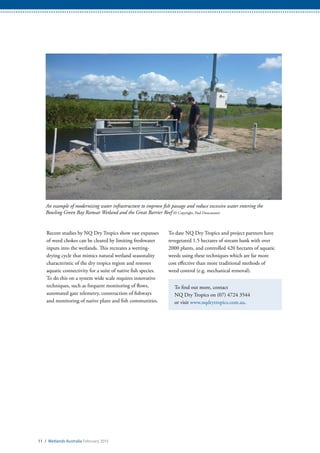
An example of modernising water infrastructure to improve fish passage and reduce excessive water entering the
Bowling Green Bay Ramsar Wetland and the Great Barrier Reef (© Copyright, Paul Duncanson)
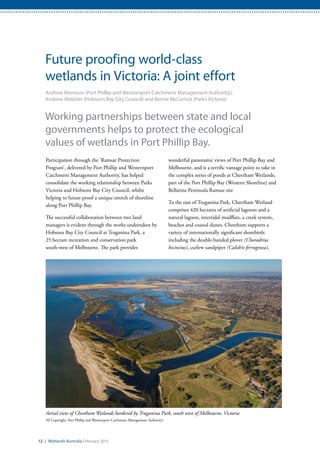
Aerial view of Cheetham Wetlands bordered by Truganina Park, south west of Melbourne, Victoria
(© Copyright, Port Phillip and Westernport Catchment Management Authority)
12 / Wetlands Australia February 2015
Future proofing world-class
wetlands in Victoria: A joint effort
Andrew Morrison (Port Phillip and Westernport Catchment Management Authority),
Andrew Webster (Hobsons Bay City Council) and Bernie McCarrick (Parks Victoria)
Working partnerships between state and local
governments helps to protect the ecological
values of wetlands in Port Phillip Bay.
Participation through the ‘Ramsar Protection
Program’, delivered by Port Phillip and Westernport
Catchment Management Authority, has helped
consolidate the working relationship between Parks
Victoria and Hobsons Bay City Council, whilst
helping to future proof a unique stretch of shoreline
along Port Phillip Bay.
The successful collaboration between two land
managers is evident through the works undertaken by
Hobsons Bay City Council at Truganina Park, a
25 hectare recreation and conservation park
south-west of Melbourne. The park provides
wonderful panoramic views of Port Phillip Bay and
Melbourne, and is a terrific vantage point to take in
the complex series of ponds at Cheetham Wetlands,
part of the Port Phillip Bay (Western Shoreline) and
Bellarine Peninsula Ramsar site
To the east of Truganina Park, Cheetham Wetland
comprises 420 hectares of artificial lagoons and a
natural lagoon, intertidal mudflats, a creek system,
beaches and coastal dunes. Cheetham supports a
variety of internationally significant shorebirds
including the double-banded plover (Charadrius
bicinctus), curlew sandpiper (Calidris ferruginea),
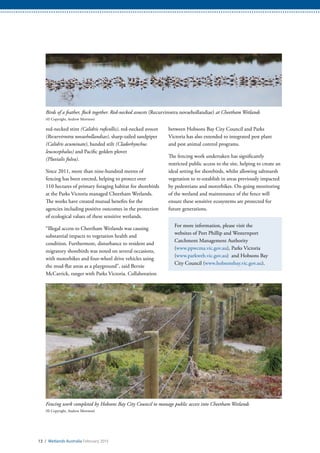
Birds of a feather, flock together. Red-necked avocets (Recurvirostra novaehollandiae) at Cheetham Wetlands
(© Copyright, Andrew Morrison)
Fencing work completed by Hobsons Bay City Council to manage public access into Cheetham Wetlands
(© Copyright, Andrew Morrison)
13 / Wetlands Australia February 2015
red-necked stint (Calidris ruficollis), red-necked avocet
(Recurvirostra novaehollandiae), sharp-tailed sandpiper
(Calidris acuminate), banded stilt (Cladorhynchus
leucocephalus) and Pacific golden plover
(Pluvialis fulva).
Since 2011, more than nine-hundred metres of
fencing has been erected, helping to protect over
110 hectares of primary foraging habitat for shorebirds
at the Parks Victoria managed Cheetham Wetlands.
The works have created mutual benefits for the
agencies including positive outcomes in the protection
of ecological values of these sensitive wetlands.
“Illegal access to Cheetham Wetlands was causing
substantial impacts to vegetation health and
condition. Furthermore, disturbance to resident and
migratory shorebirds was noted on several occasions,
with motorbikes and four-wheel drive vehicles using
the mud-flat areas as a playground”, said Bernie
McCarrick, ranger with Parks Victoria. Collaboration
between Hobsons Bay City Council and Parks
Victoria has also extended to integrated pest plant
and pest animal control programs.
The fencing work undertaken has significantly
restricted public access to the site, helping to create an
ideal setting for shorebirds, whilst allowing saltmarsh
vegetation to re-establish in areas previously impacted
by pedestrians and motorbikes. On-going monitoring
of the wetland and maintenance of the fence will
ensure these sensitive ecosystems are protected for
future generations.
For more information, please visit the
websites of Port Phillip and Westernport
Catchment Management Authority
(www.ppwcma.vic.gov.au), Parks Victoria
(www.parkweb.vic.gov.au) and Hobsons Bay
City Council (www.hobsonsbay.vic.gov.au).
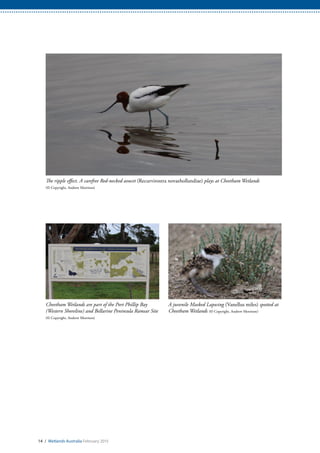
The ripple effect. A carefree Red-necked avocet (Recurvirostra novaehollandiae) plays at Cheetham Wetlands
(© Copyright, Andrew Morrison)
Cheetham Wetlands are part of the Port Phillip Bay
(Western Shoreline) and Bellarine Peninsula Ramsar Site
(© Copyright, Andrew Morrison)
A juvenile Masked Lapwing (Vanellus miles) spotted at
Cheetham Wetlands (© Copyright, Andrew Morrison)
14 / Wetlands Australia February 2015
15 / Wetlands Australia February 2015
Active water management is underway at
the Hunter Estuary Wetlands Ramsar site
Hunter Wetlands Centre Australia
Following a long history of hydrological changes,
wetlands in Newcastle are improving as a result of
active management.
The natural hydrological regime of the Hunter
Wetlands Centre component of the Hunter Estuary
Wetlands Ramsar site has been altered significantly
since the 1930s. Prior to 2008, the construction of
causeways and filling of nearby land resulted in several
ponds permanently holding water throughout the year.
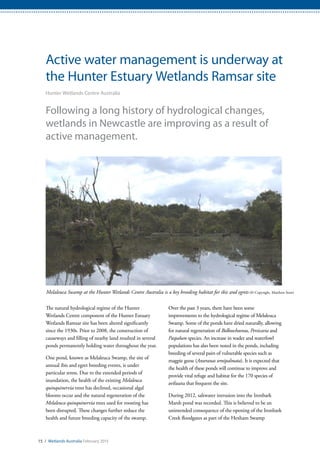
One pond, known as Melaleuca Swamp, the site of
annual ibis and egret breeding events, is under
particular stress. Due to the extended periods of
inundation, the health of the existing Melaleuca
quinquinervia trees has declined, occasional algal
blooms occur and the natural regeneration of the
Melaleuca quinquinervia trees used for roosting has
been disrupted. These changes further reduce the
health and future breeding capacity of the swamp.
Over the past 3 years, there have been some
improvements to the hydrological regime of Melaleuca
Swamp. Some of the ponds have dried naturally, allowing
for natural regeneration of Bolboschoenus, Persicaria and
Paspalum species. An increase in wader and waterfowl
populations has also been noted in the ponds, including
breeding of several pairs of vulnerable species such as
magpie geese (Anseranas semipalmata). It is expected that
the health of these ponds will continue to improve and
provide vital refuge and habitat for the 170 species of
avifauna that frequent the site.
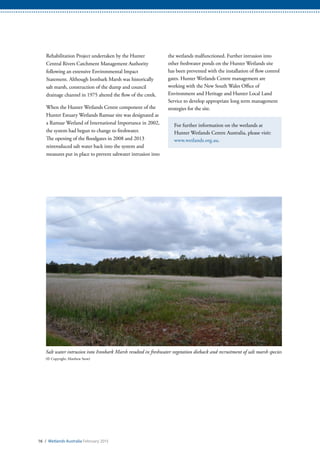
During 2012, saltwater intrusion into the Ironbark
Marsh pond was recorded. This is believed to be an
unintended consequence of the opening of the Ironbark
Creek floodgates as part of the Hexham Swamp
Melaleuca Swamp at the Hunter Wetlands Centre Australia is a key breeding habitat for ibis and egrets (© Copyright, Matthew Stow)
16 / Wetlands Australia February 2015
Rehabilitation Project undertaken by the Hunter
Central Rivers Catchment Management Authority
following an extensive Environmental Impact
Statement. Although Ironbark Marsh was historically
salt marsh, construction of the dump and council
drainage channel in 1975 altered the flow of the creek.
When the Hunter Wetlands Centre component of the
Hunter Estuary Wetlands Ramsar site was designated as
a Ramsar Wetland of International Importance in 2002,
the system had begun to change to freshwater.
The opening of the floodgates in 2008 and 2013
reintroduced salt water back into the system and
measures put in place to prevent saltwater intrusion into
the wetlands malfunctioned. Further intrusion into
other freshwater ponds on the Hunter Wetlands site
has been prevented with the installation of flow control
gates. Hunter Wetlands Centre management are
working with the New South Wales Office of
Environment and Heritage and Hunter Local Land
Service to develop appropriate long term management
strategies for the site.
For further information on the wetlands at
Hunter Wetlands Centre Australia, please visit:
www.wetlands.org.au.
Salt water intrusion into Ironbark Marsh resulted in freshwater vegetation dieback and recruitment of salt marsh species
(© Copyright, Matthew Stow)
17 / Wetlands Australia February 2015
Puddles of paradise support threatened
species in Gunbower Forest Ramsar site
Tessa Grieves, North Central Catchment Management Authority
Nationally threatened species are settling in well in
what can be described as no more than a trackside
puddle in the Gunbower Forest Ramsar site in Victoria.
The North Central Catchment Management
Authority’s (CMA) Gunbower Forest Protection
Project team has been working with local ecologists
to reintroduce threatened wetland flora species back
into the forest.
Stiff groundsel (Sencio behrianus) and ridged
water-milfoil (Myriophyllum porcatum) are both listed
as threatened under the Environment Protection and
Biodiversity Conservation Act 1999 (EPBC Act).
Neither species are particularly eye catching, but both
are a key part of enhancing biodiversity within the
Gunbower Forest which has suffered significant flora
declines since the arrival of Europeans.
Historic records indicate that both species were once
far more widespread throughout the Murray–Darling
Basin. Interestingly though, little is known about the
history and distribution of stiff groundsel. The species
was thought to be extinct, having not been seen since
the late 1880s, until it was discovered in the small rural
district of Corop, Victoria in 1991(Nevill, G.R. and
Camilleri, M., 2010).
The decline of these species throughout the Gunbower
Forest, and elsewhere in Victoria, is largely due to
historic wetland drainage, habitat fragmentation,
grazing pressure, river regulation and unseasonal
flooding regimes.
While the hydrological regime and fragmentation
issues are harder to overcome, the project team has
been able to undertake significant threat abatement
works to reduce the encroachment of both terrestrial
and aquatic weeds which compete with these
fragile natives.
Choosing appropriate locations to reintroduce these
wonderful little plants was surprisingly simple despite
each species having quite varied habitat requirements.
Being an aquatic plant, ridged water-milfoil requires
seasonally inundated habitats while the stiff groundsel
prefers the higher fringes of ephemeral wetlands.
Trackside and forest gilgai type depressions were
identified as suitable planting sites, supported by
recent inundation from the release of the largest
environmental watering event into the Gunbower
Forest as part of The Living Murray initiative.
While ground conditions were ideal as a result of
the water availability, the plants required further
protection from the abundance of wildlife present in
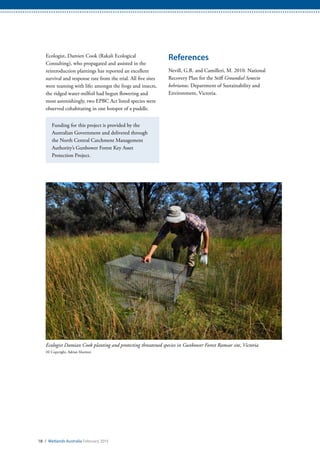
the forest. Strong wire guards were erected to keep out
foraging waterbirds, emus (Dromaius novaehollandiae)
and wallabies. All the ‘puddles’ were water-quality
tested, GPS referenced and several have had follow
up watering to increase survival rates.
18 / Wetlands Australia February 2015
Ecologist, Damien Cook (Rakali Ecological
Consulting), who propagated and assisted in the
reintroduction plantings has reported an excellent
survival and response rate from the trial. All five sites
were teaming with life; amongst the frogs and insects,
the ridged water-milfoil had begun flowering and
most astonishingly, two EPBC Act listed species were
observed cohabitating in one hotspot of a puddle.
Funding for this project is provided by the
Australian Government and delivered through
the North Central Catchment Management
Authority’s Gunbower Forest Key Asset
Protection Project.
References
Nevill, G.R. and Camilleri, M. 2010. National
Recovery Plan for the Stiff Groundsel Senecio
behrianus. Department of Sustainability and
Environment, Victoria.
Ecologist Damian Cook planting and protecting threatened species in Gunbower Forest Ramsar site, Victoria
(© Copyright, Adrian Martins)
19 / Wetlands Australia February 2015
Lake Mealup on the road to recovery
Western Australian Department of Parks and Wildlife
Restoration works are being undertaken to
protect the ecological values of Lake Mealup, part
of the Peel-Yalgorup System Ramsar site on the
Swan Coastal Plain in Western Australia.
Lake Mealup is recognised under the Ramsar
Convention as internationally important for migratory
waterbirds. Declining rainfall since the 1970s and
modified drainage has led to the lake drying out.
Exposure of the sediments has caused extreme
acidification and loss of habitat for waterbirds.
In response, a collaborative effort between
Government and community groups has started
to restore the Lake and protect the future of the
Lakes ecological values.
Changes in the lake’s natural hydrology have resulted in
the wetland system becoming drier, exposing sulfidic
sediments and allowing the invasion of the bulrush
(Typha orientalis). The resulting decline in ecological
health of the lake (the lake recorded a pH of 2.69 in
November 2009) exceeded the limits of acceptable
change identified within the Ecological Character
Description for the Peel-Yalgorup System Ramsar Site.
The Lake Mealup Recovery Program was developed to
respond to this decline. The recovery program is a
collaboration between the State Government agencies
of Parks and Wildlife and the Department of Water,
the Lake Mealup Preservation Society, the Peel-Harvey
Catchment Council and the South West Catchment
Council. Community groups, landholders, Aboriginal
representatives and state government agencies are
working together to restore the lake.
The Lake Mealup Recovery Program’s greatest asset
has been its range of stakeholders. There has been
tremendous support from the community for the
planning process. The recovery program follows an
adaptive management approach which identifies
targets for ecological health and monitoring triggers
for management action. The key component of the
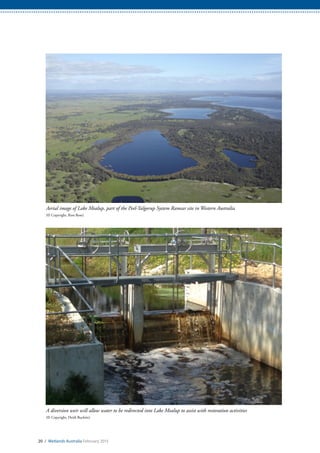
recovery program is the diversion weir which allows
controlled diversion of flow from the Mealup Main
Drain into Lake Mealup to maintain water levels and
reduce acidification.
Prior to commissioning the weir in June 2012, over
43 hectares of bulrush were cut, with the crushed
plants providing the necessary carbon for
biogeochemical processes to neutralise acidity.
On returning surface water flow to the system, the
results were almost immediate with pH returning to
within normal range after only two months. Since
then, the abundance of water birds has increased from
less than 100 before the recovery program to over
2000 birds with 43 species recorded, including swans,
ducks, grebes, darters, cormorants, egrets and
spoonbills. New species sighted in 2014 include the
trans-equatorial migrants bar-tailed godwit (Limosa
lapponica), curlew sandpiper (Calidris ferruginea),
marsh sandpiper (Tringa stagnatilis), wood
sandpiper (Tringa glareola), sharp-tailed sandpiper
(Calidris acuminate) and common greenshank
(Tringa nebularia).
The ultimate aim for Lake Mealup is for the site to
be managed as a wetland habitat for water birds.
Members of the Technical Advisory Group for the
project will continue to monitor the condition of the
lake and use this information to manage water levels
to optimise lake health.
For more information, please contact
Heidi Bucktin (08 9303 7757) from the
Western Australian Department of Parks
and Wildlife.
20 / Wetlands Australia February 2015
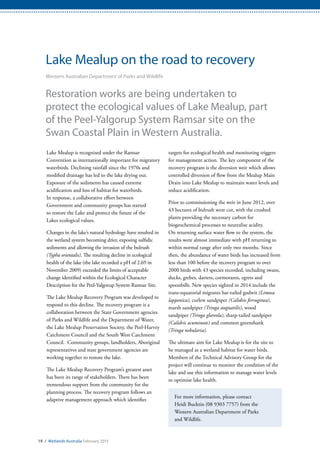
Aerial image of Lake Mealup, part of the Peel-Yalgorup System Ramsar site in Western Australia
(© Copyright, Ross Rose)
A diversion weir will allow water to be redirected into Lake Mealup to assist with restoration activities
(© Copyright, Heidi Bucktin)
21 / Wetlands Australia February 2015
Environmental flows aid the recovery
of Gunbower Forest Ramsar site
Anna Chatfield and Kathryn Stanislawski, North Central Catchment Management Authority
Life-giving environmental water aids continued
recovery of a forest in the Murray–Darling Basin.
In 2014, Gunbower Forest was allocated 60 gigalitres
of environmental water to enable it to continue
its recovery from the Millennium drought.
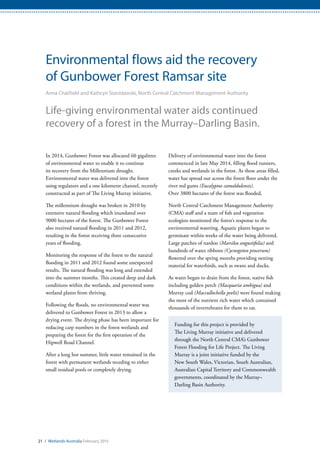
Environmental water was delivered into the forest
using regulators and a one kilometre channel, recently
constructed as part of The Living Murray initiative.
The millennium drought was broken in 2010 by
extensive natural flooding which inundated over
9000 hectares of the forest. The Gunbower Forest
also received natural flooding in 2011 and 2012,
resulting in the forest receiving three consecutive
years of flooding.
Monitoring the response of the forest to the natural
flooding in 2011 and 2012 found some unexpected
results. The natural flooding was long and extended
into the summer months. This created deep and dark
conditions within the wetlands, and prevented some
wetland plants from thriving.
Following the floods, no environmental water was
delivered to Gunbower Forest in 2013 to allow a
drying event. The drying phase has been important for
reducing carp numbers in the forest wetlands and
preparing the forest for the first operation of the
Hipwell Road Channel.
After a long hot summer, little water remained in the
forest with permanent wetlands receding to either
small residual pools or completely drying.
Delivery of environmental water into the forest
commenced in late May 2014, filling flood runners,
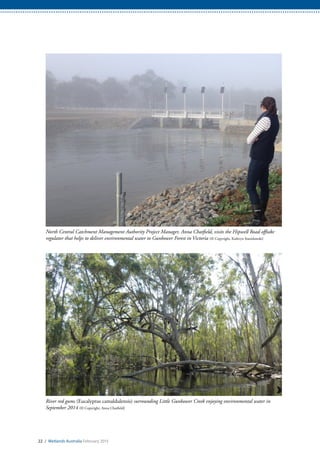
creeks and wetlands in the forest. As these areas filled,
water has spread out across the forest floor under the
river red gums (Eucalyptus camaldulensis).
Over 3800 hectares of the forest was flooded.
North Central Catchment Management Authority
(CMA) staff and a team of fish and vegetation
ecologists monitored the forest’s response to the
environmental watering. Aquatic plants began to
germinate within weeks of the water being delivered.
Large patches of nardoo (Marsilea angustifolia) and
hundreds of water ribbons (Cycnogeton procerum)
flowered over the spring months providing nesting
material for waterbirds, such as swans and ducks.
As water began to drain from the forest, native fish
including golden perch (Macquaria ambigua) and
Murray cod (Maccullochella peelii) were found making
the most of the nutrient rich water which contained
thousands of invertebrates for them to eat.
Funding for this project is provided by
The Living Murray initiative and delivered
through the North Central CMA’s Gunbower
Forest Flooding for Life Project. The Living
Murray is a joint initiative funded by the
New South Wales, Victorian, South Australian,
Australian Capital Territory and Commonwealth
governments, coordinated by the Murray–
Darling Basin Authority.
22 / Wetlands Australia February 2015
North Central Catchment Management Authority Project Manager, Anna Chatfield, visits the Hipwell Road offtake
regulator that helps to deliver environmental water to Gunbower Forest in Victoria (© Copyright, Kathryn Stanislawski)
River red gums (Eucalyptus camaldulensis) surrounding Little Gunbower Creek enjoying environmental water in
September 2014 (© Copyright, Anna Chatfield)
23 / Wetlands Australia February 2015
Aquatic habitat improves during low flow
years at a South Australian Ramsar site
South Australian Department of Environment, Water and Natural Resources
New infrastructure at the Bool and Hacks Lagoons
Ramsar site in South Australia is helping to improve the
hydrological regime and aquatic habitat at the wetland.
The 3220 hectare Bool and Hacks Lagoons Ramsar
site is located in South Australia’s south-east, and was
designated as a Ramsar site in 1985. The site consists
of a seasonal fresh water lake and wetland area, and
supports a mosaic of aquatic and semi-aquatic
vegetation communities that provide habitat for a
diverse range of waterbirds and nationally threatened
fish, reptiles and frogs. Bool Lagoon is connected to
Hacks Lagoon by four man-made channels and is
managed as one unit. The water levels within the
Lagoons are maintained by a regulating structure on
the western side of Bool Lagoon.
A majority of the site’s surface water comes from
Mosquito Creek, and whilst flows in the creek
fluctuate seasonally, base flow was maintained all year
until 2002 when the creek ceased to flow for the first
time since gauging commenced in 1971. Since this
time, flows have been limited with the creek
continuing to dry annually for extended periods.
This is due to a number of factors including the
drought conditions experienced in 2006–2009,
changes in catchment landuse including irrigation
and forestry, and possibly climate change impacts.
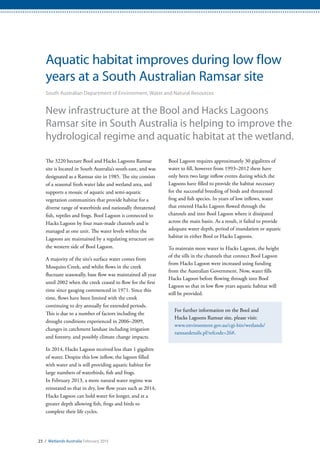
In 2014, Hacks Lagoon received less than 1 gigalitre
of water. Despite this low inflow, the lagoon filled
with water and is still providing aquatic habitat for
large numbers of waterbirds, fish and frogs.
In February 2013, a more natural water regime was
reinstated so that in dry, low flow years such as 2014,
Hacks Lagoon can hold water for longer, and at a
greater depth allowing fish, frogs and birds to
complete their life cycles.
Bool Lagoon requires approximately 30 gigalitres of
water to fill, however from 1993–2012 there have
only been two large inflow events during which the
Lagoons have filled to provide the habitat necessary
for the successful breeding of birds and threatened
frog and fish species. In years of low inflows, water
that entered Hacks Lagoon flowed through the
channels and into Bool Lagoon where it dissipated
across the main basin. As a result, it failed to provide
adequate water depth, period of inundation or aquatic
habitat in either Bool or Hacks Lagoons.
To maintain more water in Hacks Lagoon, the height
of the sills in the channels that connect Bool Lagoon
from Hacks Lagoon were increased using funding
from the Australian Government. Now, water fills
Hacks Lagoon before flowing through into Bool
Lagoon so that in low flow years aquatic habitat will
still be provided.
For further information on the Bool and
Hacks Lagoons Ramsar site, please visit:
www.environment.gov.au/cgi-bin/wetlands/
ramsardetails.pl?refcode=26#.
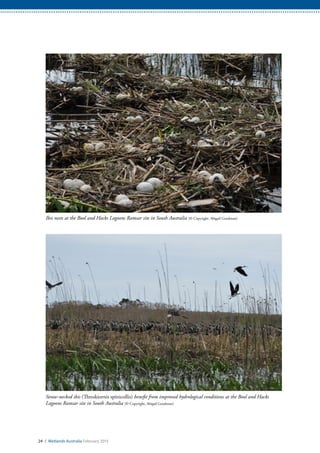
Straw-necked ibis (Threskiornis spinicollis) benefit from improved hydrological conditions at the Bool and Hacks
Lagoons Ramsar site in South Australia (© Copyright, Abigail Goodman)
Ibis nests at the Bool and Hacks Lagoons Ramsar site in South Australia (© Copyright, Abigail Goodman)
24 / Wetlands Australia February 2015
25 / Wetlands Australia February 2015
Environmental watering
supports wetlands in the
Murray–Darling Basin
Classifying aquatic ecosystems
in the Murray–Darling Basin
Alana Wilkes (Commonwealth Environmental Water Officer (CEWO)), Benjamin Docker (CEWO), Rebecca
White (Murray–Darling Basin Authority (MDBA)), Ashraf L. Hanna (MDBA), Ian Neave (MDBA), Amy O’Brien
(CEWO), Neil Freeman (Australian Department of the Environment), Paul Marsh (Australian Department of
the Environment), Tristan Skinner (CEWO)
The Commonwealth Environmental Water Office and
Murray–Darling Basin Authority have jointly developed
an interim classification and typology of aquatic
ecosystems across Australia’s Murray–Darling Basin.
The classification project
The project was developed using the interim
Australian National Aquatic Ecosystems (ANAE)
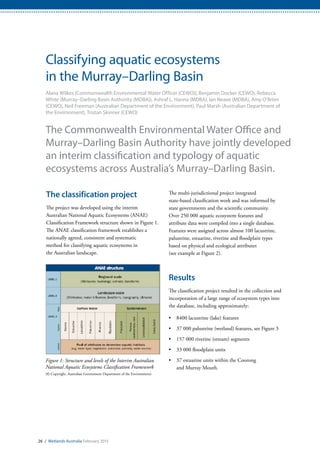
Classification Framework structure shown in Figure 1.
The ANAE classification framework establishes a
nationally agreed, consistent and systematic
method for classifying aquatic ecosystems in
the Australian landscape.
The multi-jurisdictional project integrated
state-based classification work and was informed by
state governments and the scientific community.
Over 250 000 aquatic ecosystem features and
attribute data were compiled into a single database.
Features were assigned across almost 100 lacustrine,
palustrine, estuarine, riverine and floodplain types
based on physical and ecological attributes
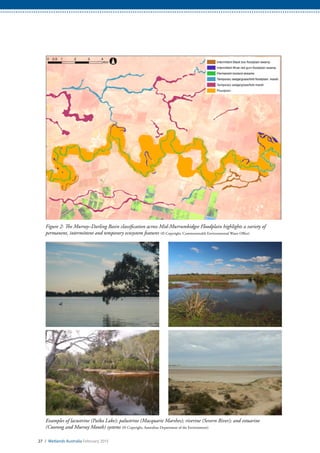
(see example at Figure 2).
Results
The classification project resulted in the collection and
incorporation of a large range of ecosystem types into
the database, including approximately:
•	 8400 lacustrine (lake) features
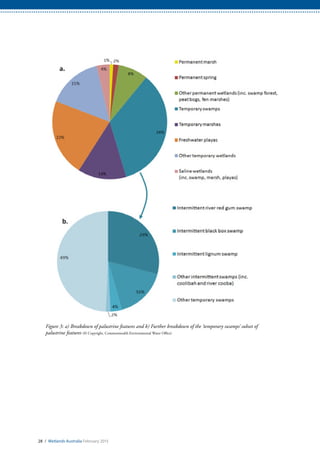
•	 37 000 palustrine (wetland) features, see Figure 3
•	 157 000 riverine (stream) segments
•	 33 000 floodplain units
•	 37 estuarine units within the Coorong
and Murray Mouth.
Figure 1: Structure and levels of the Interim Australian
National Aquatic Ecosystems Classification Framework
(© Copyright, Australian Government Department of the Environment)
26 / Wetlands Australia February 2015
Examples of lacustrine (Paika Lake); palustrine (Macquarie Marshes); riverine (Severn River); and estuarine
(Coorong and Murray Mouth) systems (© Copyright, Australian Department of the Environment)
Figure 2: The Murray–Darling Basin classification across Mid-Murrumbidgee Floodplain highlights a variety of
permanent, intermittent and temporary ecosystem features (© Copyright, Commonwealth Environmental Water Office)
27 / Wetlands Australia February 2015
Figure 3: a) Breakdown of palustrine features and b) Further breakdown of the ‘temporary swamps’ subset of
palustrine features (© Copyright, Commonwealth Environmental Water Office)
28 / Wetlands Australia February 2015
Applying the classification
to environmental water
management
The classification of the ecosystem features will help to
inform the implementation of the Murray–Darling
Basin Plan; prioritisation of environmental watering;
monitoring, evaluation and reporting activities; and
adaptive management. By way of example, the
classification identifies wetland types, which can be
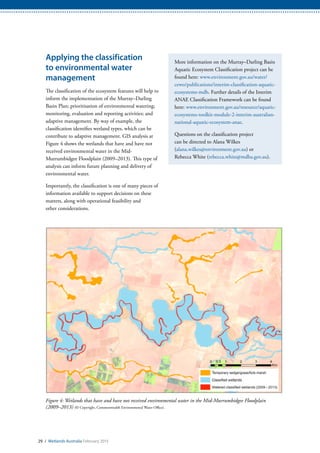
contribute to adaptive management. GIS analysis at
Figure 4 shows the wetlands that have and have not
received environmental water in the Mid-
Murrumbidgee Floodplain (2009–2013). This type of
analysis can inform future planning and delivery of
environmental water.
Importantly, the classification is one of many pieces of
information available to support decisions on these
matters, along with operational feasibility and
other considerations.
More information on the Murray–Darling Basin
Aquatic Ecosystem Classification project can be
found here: www.environment.gov.au/water/
cewo/publications/interim-classification-aquatic-
ecosystems-mdb. Further details of the Interim
ANAE Classification Framework can be found
here: www.environment.gov.au/resource/aquatic-
ecosystems-toolkit-module-2-interim-australian-
national-aquatic-ecosystem-anae.
Questions on the classification project
can be directed to Alana Wilkes
(alana.wilkes@environment.gov.au) or
Rebecca White (rebecca.white@mdba.gov.au).
Figure 4: Wetlands that have and have not received environmental water in the Mid-Murrumbidgee Floodplain
(2009–2013) (© Copyright, Commonwealth Environmental Water Office).
29 / Wetlands Australia February 2015
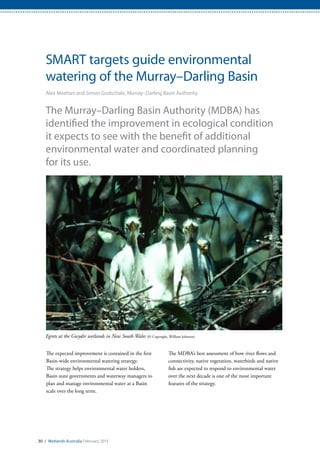
Egrets at the Gwydir wetlands in New South Wales (© Copyright, William Johnson)
30 / Wetlands Australia February 2015
SMART targets guide environmental
watering of the Murray–Darling Basin
Alex Meehan and Simon Godschalx, Murray–Darling Basin Authority
The Murray–Darling Basin Authority (MDBA) has
identified the improvement in ecological condition
it expects to see with the benefit of additional
environmental water and coordinated planning
for its use.
The expected improvement is contained in the first
Basin-wide environmental watering strategy.
The strategy helps environmental water holders,
Basin state governments and waterway managers to
plan and manage environmental water at a Basin
scale over the long term.
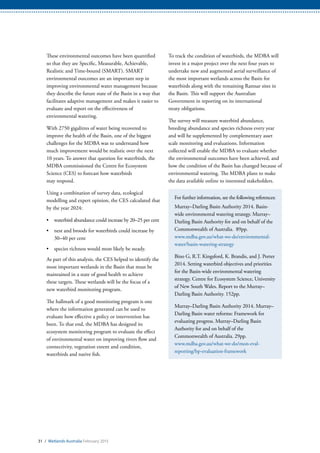
The MDBA’s best assessment of how river flows and
connectivity, native vegetation, waterbirds and native
fish are expected to respond to environmental water
over the next decade is one of the most important
features of the strategy.
31 / Wetlands Australia February 2015
These environmental outcomes have been quantified
so that they are Specific, Measurable, Achievable,
Realistic and Time-bound (SMART). SMART
environmental outcomes are an important step in
improving environmental water management because
they describe the future state of the Basin in a way that
facilitates adaptive management and makes it easier to
evaluate and report on the effectiveness of
environmental watering.
With 2750 gigalitres of water being recovered to
improve the health of the Basin, one of the biggest
challenges for the MDBA was to understand how
much improvement would be realistic over the next
10 years. To answer that question for waterbirds, the
MDBA commissioned the Centre for Ecosystem
Science (CES) to forecast how waterbirds
may respond.
Using a combination of survey data, ecological
modelling and expert opinion, the CES calculated that
by the year 2024:
•	 waterbird abundance could increase by 20–25 per cent
•	 nest and broods for waterbirds could increase by
30–40 per cent
•	 species richness would most likely be steady.
As part of this analysis, the CES helped to identify the
most important wetlands in the Basin that must be
maintained in a state of good health to achieve
these targets. These wetlands will be the focus of a
new waterbird monitoring program.
The hallmark of a good monitoring program is one
where the information generated can be used to
evaluate how effective a policy or intervention has
been. To that end, the MDBA has designed its
ecosystem monitoring program to evaluate the effect
of environmental water on improving rivers flow and
connectivity, vegetation extent and condition,
waterbirds and native fish.
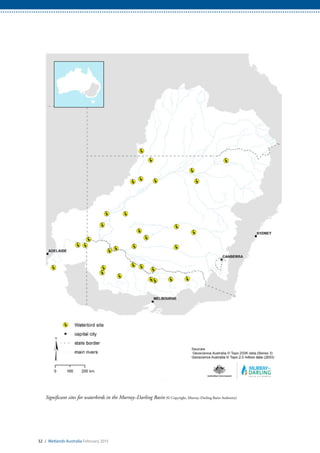
To track the condition of waterbirds, the MDBA will
invest in a major project over the next four years to
undertake new and augmented aerial surveillance of
the most important wetlands across the Basin for
waterbirds along with the remaining Ramsar sites in
the Basin. This will support the Australian
Government in reporting on its international
treaty obligations.
The survey will measure waterbird abundance,
breeding abundance and species richness every year
and will be supplemented by complementary asset
scale monitoring and evaluations. Information
collected will enable the MDBA to evaluate whether
the environmental outcomes have been achieved, and
how the condition of the Basin has changed because of
environmental watering. The MDBA plans to make
the data available online to interested stakeholders.
For further information, see the following references:
Murray–Darling Basin Authority 2014. Basin-
wide environmental watering strategy. Murray–
Darling Basin Authority for and on behalf of the
Commonwealth of Australia. 89pp.
www.mdba.gov.au/what-we-do/environmental-
water/basin-watering-strategy
Bino G, R.T. Kingsford, K. Brandis, and J. Porter
2014. Setting waterbird objectives and priorities
for the Basin-wide environmental watering
strategy. Centre for Ecosystem Science, University
of New South Wales. Report to the Murray–
Darling Basin Authority. 152pp.
Murray–Darling Basin Authority 2014. Murray–
Darling Basin water reforms: Framework for
evaluating progress. Murray–Darling Basin
Authority for and on behalf of the
Commonwealth of Australia. 29pp.
www.mdba.gov.au/what-we-do/mon-eval-
reporting/bp-evaluation-framework
Significant sites for waterbirds in the Murray–Darling Basin (© Copyright, Murray–Darling Basin Authority)
32 / Wetlands Australia February 2015
Follow that sound — it’s the
southern bell frog!
New South Wales Office of Environment and Heritage
Environmental flows have triggered the return of an
endangered amphibian to the Lower Lachlan River in
south-west New SouthWales.
The southern bell frog (Litoria raniformis) had not been
seen or heard in the Lachlan catchment for more than
30 years until major floods in 2012 led to the recording
of an individual in Lake Bullogal. The lake had been
dry for more than 20 years and it is thought the frogs
survived unnoticed in nearby farm dams and billabongs.
In an effort to consolidate the positive effects
of he 2012 floods, an environmental flow of
90 000 megalitres was released into the Lower Lachlan
River over the winter of 2013. As a result of this flow,
the frogs were heard calling soon after from a billabong
at ‘The Ville’, a property 5 kilometres from Corrong, on
the Lower Lachlan River. While not seen, researchers
were able to record the distinctive call, confirming that
the frog had returned. The remarkable response has
reinforced the position that careful and well-planned
use of environmental water can assist the recovery of
this endangered amphibian.
The New South Wales Office of Environment and
Heritage (OEH), which manages these environmental
flows, has funded researchers from Charles Sturt
University to undertake surveys to establish the
responses of frogs to the flows. Further monitoring and
event-based surveys are also planned. OEH staff are also
on the lookout for southern bell frogs in other areas of
the catchment using audio recording equipment to
capture their calls.
It is hoped that further environmental flows may
encourage existing populations to recover and
repopulate the catchment. The Lachlan community
continues to play an important role in the recovery of
the southern bell frog. Landholders are in an ideal
position to provide valuable intelligence on the presence
of the southern bell frog on their properties, and OEH
staff are keen to hear from anyone who thinks they may
have southern bell frogs on their land.
For more information about NSW
Office of Environment and Heritage
environmental watering please visit:
www.environment.nsw.gov.au/
environmentalwater.
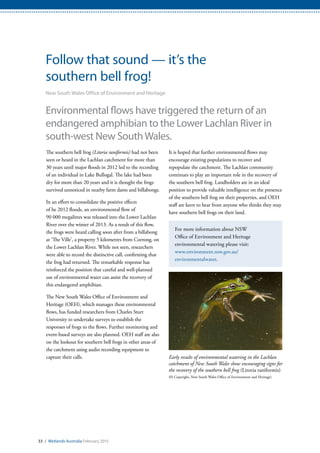
Early results of environmental watering in the Lachlan
catchment of New South Wales show encouraging signs for
the recovery of the southern bell frog (Litoria raniformis)
(© Copyright, New South Wales Office of Environment and Heritage)
33 / Wetlands Australia February 2015
34 / Wetlands Australia February 2015
Mallee Wetlands:
A rehabilitation program in the making
Commonwealth Environmental Water Holder, Victorian Environmental Water Holder and the
Mallee Catchment Management Authority
An environmental watering program aims to support
the rehabilitation of floodplain wetlands along the
River Murray.
The watering program, being organised by the Mallee
Catchment Management Authority (CMA) in
partnership with the Commonwealth Environmental
Water Holder and the Victorian Environmental Water
Holder (VEWH), will complement other natural
resource management activities within the Mallee
region in Victoria. The expected outcomes of the
program include:
•	 improved condition and maintenance of native
floodplain and wetland vegetation
•	 improved diversity and condition of frog and
waterbird populations through maintenance of
suitable aquatic habitat
•	 managed transport and export of salt from the
River Murray system to the Southern Ocean.
The watering program aims to support the long term
recovery of the endangered Murray hardyhead
(Craterocephalus fluviatilis), a unique freshwater fish
that flourishes in moderately saline waters.
An environmental watering program has been
undertaken at two wetlands in the Mallee region,
Cardross Lakes and Lake Koorlong, for over ten years
to maintain stable Murray hardyhead populations.
The long-term aim of the rehabilitation program for
the floodplain wetlands, which are ecologically
important as they contain remnants of the River
Murray floodplain natural character and attributes, is
to provide appropriate habitat to support translocated
populations of Murray hardyhead. Translocation has
started at Brickworks Billabong, in an attempt to
establish self-sustaining populations and build further
resilience of this species in the region.
The success of the translocation of Murray hardyhead
into new wetland sites hinges on adaptive
management to maintain suitable habitat conditions
and on providing either the necessary dilution flows or
reducing rates of discharge from wetlands to maintain
river salinities below target thresholds. Preliminary
monitoring suggests that Brickworks Billabong is
suitable for Murray hardyhead, and that Psyche
Lagoon may provide a suitable translocation site
within 12–18 months. In addition to water quality
monitoring at the Murray hardyhead sites and
downstream in the River Murray, preliminary fish
monitoring indicates that Murray hardyhead continue
to survive in Lake Koorlong, with annual
recruitment occurring.
Photopoint locations have been established to show
riparian response before and after watering. At the end
of the 2013–14 water year, many sites had only just
finished receiving environmental water, and as such,
it is too early to see a definitive response in vegetation
condition. However, observations have indicated high
visitation by waterbirds including ducks, pelicans and
cormorants, which have been sighted at Brickworks
Billabong, Woorlong Wetland, Karadoc Swamp and
Bullock Swamp following inundation.
35 / Wetlands Australia February 2015
The environmental watering program is managed by
the Mallee CMA in line with the VEWH Seasonal
watering Plan 2014–15. Up to 27 000 megalitres of
Commonwealth environmental water has been made
available to support the watering program at these
wetlands over a three-year period (out to 2015–16),
which will be delivered in conjunction with water
made available by the VEWH.
If you would like to know more about
environmental watering in the Victorian
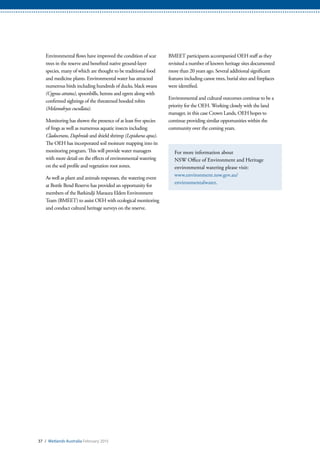
Mallee region, please contact the Mallee CMA
on 03 5051 4377 or visit
www.malleecma.vic.gov.au.
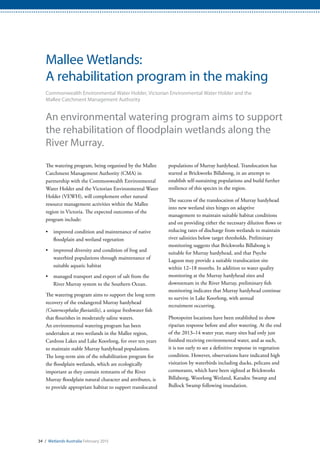
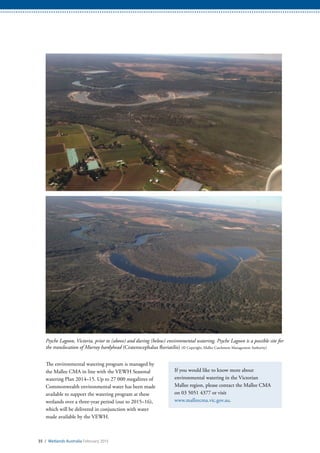
Psyche Lagoon, Victoria, prior to (above) and during (below) environmental watering. Psyche Lagoon is a possible site for
the translocation of Murray hardyhead (Craterocephalus fluviatilis) (© Copyright, Mallee Catchment Management Authority)
Black Box floodplains bouncing back
in New South Wales
New South Wales Office of Environment and Heritage
Black Box floodplains are bouncing back to health
thanks to environmental watering at Bottle Bend
Reserve near Mildura.
The NSW Office of Environment and Heritage (OEH)
has overseen two watering events targeting a 423 hectare
area within the 1700 hectare reserve.
In 2012–13, 1650 megalitres of environmental water was
delivered to the site followed by a further 2000 megalitres
in 2013–14. The flows were timed to provide the black
box (Eucalyptus largiflorens) with water during periods of
most active growth and to minimise disruption to reserve
visitors. The site became the largest area of black box
dominated floodplain to be targeted by environmental
water in NSW.
For almost two decades prior to environmental watering,
the floodplain had not received any natural flooding. As a
result, the ecosystem was showing signs of severe stress.
Despite this extended dry spell, the vegetation response to
successive years of watering has been positive. Black box
have set seed and seedlings have grown. Wetland plants
including nardoo (Marsilea angustifolia), water ribbon
(Cycnogeton procerum) and spike rush (Eleocharis spp.) have
responded well to the watering which has provided an
opportunity for plants to recruit and reset the seed bank.
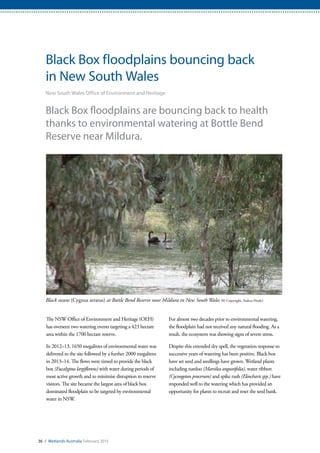
Black swans (Cygnus atratus) at Bottle Bend Reserve near Mildura in New South Wales (© Copyright, Sashca Healy)
36 / Wetlands Australia February 2015
Environmental flows have improved the condition of scar
trees in the reserve and benefited native ground-layer
species, many of which are thought to be traditional food
and medicine plants. Environmental water has attracted
numerous birds including hundreds of ducks, black swans
(Cygnus atratus), spoonbills, herons and egrets along with
confirmed sightings of the threatened hooded robin
(Melanodryas cucullata).
Monitoring has shown the presence of at least five species
of frogs as well as numerous aquatic insects including
Cladocerans, Daphnids and shield shrimp (Lepidurus apus).
The OEH has incorporated soil moisture mapping into its
monitoring program. This will provide water managers
with more detail on the effects of environmental watering
on the soil profile and vegetation root zones.
As well as plant and animals responses, the watering event
at Bottle Bend Reserve has provided an opportunity for
members of the Barkindji Maraura Elders Environment
Team (BMEET) to assist OEH with ecological monitoring
and conduct cultural heritage surveys on the reserve.
BMEET participants accompanied OEH staff as they
revisited a number of known heritage sites documented
more than 20 years ago. Several additional significant
features including canoe trees, burial sites and fireplaces
were identified.
Environmental and cultural outcomes continue to be a
priority for the OEH. Working closely with the land
manager, in this case Crown Lands, OEH hopes to
continue providing similar opportunities within the
community over the coming years.
For more information about
NSW Office of Environment and Heritage
environmental watering please visit:
www.environment.nsw.gov.au/
environmentalwater.
37 / Wetlands Australia February 2015
The research outcomes are expected to make a
significant contribution to the ability to assess and
understand incremental changes in ecological
condition in the medium- to long-term, within the
context of multiple management interventions,
stressors and pressures
The Murray–Darling Basin Environmental
Water Knowledge and Research Project is
supported through funding from the
Australian Government and co-ordinated
by the Murray–Darling Freshwater Research
Centre (MDFRC). For updates and information
about MDB EWKR, visit the dedicated
section on the MDFRC website at
www.mdfrc.org.au/projects/ewkr.
38 / Wetlands Australia February 2015
Research to support environmental
watering: a collaborative approach in
the Murray–Darling Basin
The Murray–Darling Freshwater Research Centre
The Murray–Darling Basin Environmental Water
Knowledge and Research Project (MDB EWKR) will
support the evolving needs of environmental water
managers in the Murray–Darling Basin.
The knowledge generated by this $10 million project
will support the environmental and adaptive
management objectives of the Basin Plan. The project
commenced in 2014 with a scoping and planning
phase to engage water managers and researchers in an
analysis of environmental water knowledge and
research needs. This phase will identify research
priorities and establish a work plan for five years
of investigations.
Phase two of the project will be on-ground
investigations conducted by a range of collaborating
teams, commencing mid-2015. Through a range of
partnerships between government agencies and
research institutions, this research will generate new
knowledge about the complex response of aquatic
ecosystems to changes in flows across a range of spatial
and temporal scales in the Basin. Phase 2 research
seeks to:
•	 improve identification, assessment and
understanding of the links between ecological
responses to watering regimes (e.g. natural and/or
managed events) and incremental changes in
ecological condition
•	 investigate medium- and long-term changes in
ecological condition, including the effects of
threats (hydrological, aquatic and terrestrial)
which may reduce or prevent the ecological
improvement expected.
39 / Wetlands Australia February 2015
Managing wetlands
for the future
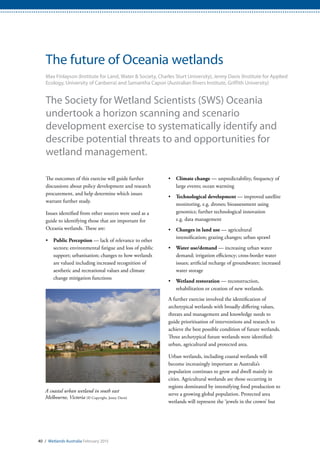
A coastal urban wetland in south east
Melbourne, Victoria (© Copyright, Jenny Davis)
40 / Wetlands Australia February 2015
The future of Oceania wetlands
Max Finlayson (Institute for Land, Water & Society, Charles Sturt University), Jenny Davis (Institute for Applied
Ecology, University of Canberra) and Samantha Capon (Australian Rivers Institute, Griffith University)
The Society for Wetland Scientists (SWS) Oceania
undertook a horizon scanning and scenario
development exercise to systematically identify and
describe potential threats to and opportunities for
wetland management.
The outcomes of this exercise will guide further
discussions about policy development and research
procurement, and help determine which issues
warrant further study.
Issues identified from other sources were used as a
guide to identifying those that are important for
Oceania wetlands. These are:
•	 Public Perception — lack of relevance to other
sectors; environmental fatigue and loss of public
support; urbanisation; changes to how wetlands
are valued including increased recognition of
aesthetic and recreational values and climate
change mitigation functions
•	 Climate change — unpredictability, frequency of
large events; ocean warming
•	 Technological development — improved satellite
monitoring, e.g. drones; bioassessment using
genomics; further technological innovation
e.g. data management
•	 Changes in land use — agricultural
intensification; grazing changes; urban sprawl
•	 Water use/demand — increasing urban water
demand; irrigation efficiency; cross-border water
issues; artificial recharge of groundwater; increased
water storage
•	 Wetland restoration — reconstruction,
rehabilitation or creation of new wetlands.
A further exercise involved the identification of
archetypical wetlands with broadly differing values,
threats and management and knowledge needs to
guide prioritisation of interventions and research to
achieve the best possible condition of future wetlands.
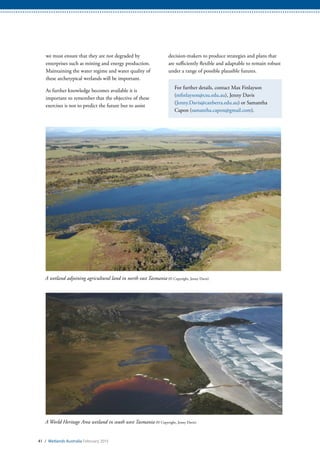
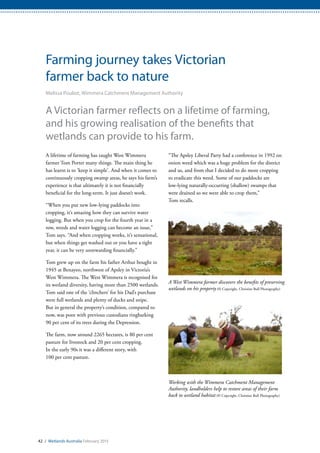
Three archetypical future wetlands were identified:
urban, agricultural and protected area.
Urban wetlands, including coastal wetlands will
become increasingly important as Australia’s
population continues to grow and dwell mainly in
cities. Agricultural wetlands are those occurring in
regions dominated by intensifying food production to
serve a growing global population. Protected area
wetlands will represent the ‘jewels in the crown’ but
A wetland adjoining agricultural land in north east Tasmania (© Copyright, Jenny Davis)
A World Heritage Area wetland in south west Tasmania (© Copyright, Jenny Davis)
41 / Wetlands Australia February 2015
we must ensure that they are not degraded by
enterprises such as mining and energy production.
Maintaining the water regime and water quality of
these archetypical wetlands will be important.
As further knowledge becomes available it is
important to remember that the objective of these
exercises is not to predict the future but to assist
decision-makers to produce strategies and plans that
are sufficiently flexible and adaptable to remain robust
under a range of possible plausible futures.
For further details, contact Max Finlayson
(mfinlayson@csu.edu.au), Jenny Davis
(Jenny.Davis@canberra.edu.au) or Samantha
Capon (samantha.capon@gmail.com).
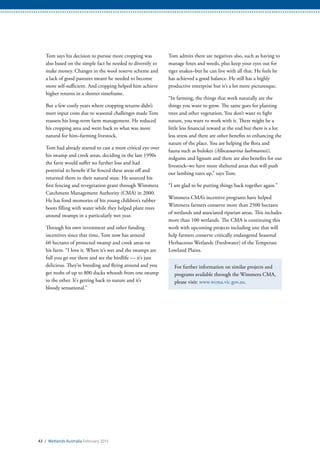
A West Wimmera farmer discovers the benefits of preserving
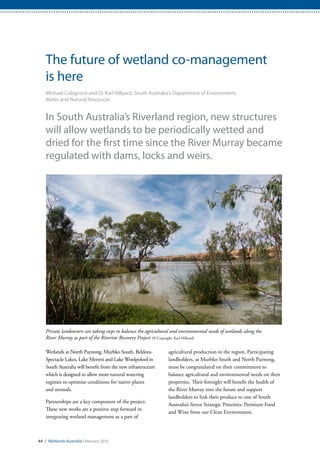
wetlands on his property (© Copyright, Christine Bull Photography)
Working with the Wimmera Catchment Management
Authority, landholders help to restore areas of their farm
back to wetland habitat (© Copyright, Christine Bull Photography)
42 / Wetlands Australia February 2015
Farming journey takes Victorian
farmer back to nature
Melissa Pouliot, Wimmera Catchment Management Authority
A Victorian farmer reflects on a lifetime of farming,
and his growing realisation of the benefits that
wetlands can provide to his farm.
A lifetime of farming has taught West Wimmera
farmer Tom Porter many things. The main thing he
has learnt is to ‘keep it simple’. And when it comes to
continuously cropping swamp areas, he says his farm’s
experience is that ultimately it is not financially
beneficial for the long-term. It just doesn’t work.
“When you put new low-lying paddocks into
cropping, it’s amazing how they can survive water
logging. But when you crop for the fourth year in a
row, weeds and water logging can become an issue,”
Tom says. “And when cropping works, it’s sensational,
but when things get washed out or you have a tight
year, it can be very unrewarding financially.”
Tom grew up on the farm his father Arthur bought in
1945 at Benayeo, northwest of Apsley in Victoria’s
West Wimmera. The West Wimmera is recognised for
its wetland diversity, having more than 2500 wetlands.
Tom said one of the ‘clinchers’ for his Dad’s purchase
were full wetlands and plenty of ducks and snipe.
But in general the property’s condition, compared to
now, was poor with previous custodians ringbarking
90 per cent of its trees during the Depression.
The farm, now around 2265 hectares, is 80 per cent
pasture for livestock and 20 per cent cropping.
In the early 90s it was a different story, with
100 per cent pasture.
“The Apsley Liberal Party had a conference in 1992 on
onion weed which was a huge problem for the district
and us, and from that I decided to do more cropping
to eradicate this weed. Some of our paddocks are
low-lying naturally-occurring (shallow) swamps that
were drained so we were able to crop them,”
Tom recalls.
43 / Wetlands Australia February 2015
Tom says his decision to pursue more cropping was
also based on the simple fact he needed to diversify to
make money. Changes in the wool reserve scheme and
a lack of good pastures meant he needed to become
more self-sufficient. And cropping helped him achieve
higher returns in a shorter timeframe.
But a few costly years where cropping returns didn’t
meet input costs due to seasonal challenges made Tom
reassess his long-term farm management. He reduced
his cropping area and went back to what was more
natural for him–farming livestock.
Tom had already started to cast a more critical eye over
his swamp and creek areas, deciding in the late 1990s
the farm would suffer no further loss and had
potential to benefit if he fenced these areas off and
returned them to their natural state. He sourced his
first fencing and revegetation grant through Wimmera
Catchment Management Authority (CMA) in 2000.
He has fond memories of his young children’s rubber
boots filling with water while they helped plant trees
around swamps in a particularly wet year.
Through his own investment and other funding
incentives since that time, Tom now has around
60 hectares of protected swamp and creek areas on
his farm. “I love it. When it’s wet and the swamps are
full you go out there and see the birdlife — it’s just
delicious. They’re breeding and flying around and you
get mobs of up to 800 ducks whoosh from one swamp
to the other. It’s getting back to nature and it’s
bloody sensational.”
Tom admits there are negatives also, such as having to
manage foxes and weeds, plus keep your eyes out for
tiger snakes–but he can live with all that. He feels he
has achieved a good balance. He still has a highly
productive enterprise but it’s a lot more picturesque.
“In farming, the things that work naturally are the
things you want to grow. The same goes for planting
trees and other vegetation. You don’t want to fight
nature, you want to work with it. There might be a
little less financial reward at the end but there is a lot
less stress and there are other benefits to enhancing the
nature of the place. You are helping the flora and
fauna such as bulokes (Allocasuarina luehmannii),
redgums and lignum and there are also benefits for our
livestock–we have more sheltered areas that will push
our lambing rates up,” says Tom.
“I am glad to be putting things back together again.”
Wimmera CMA’s incentive programs have helped
Wimmera farmers conserve more than 2500 hectares
of wetlands and associated riparian areas. This includes
more than 100 wetlands. The CMA is continuing this
work with upcoming projects including one that will
help farmers conserve critically endangered Seasonal
Herbaceous Wetlands (Freshwater) of the Temperate
Lowland Plains.
For further information on similar projects and
programs available through the Wimmera CMA,
please visit: www.wcma.vic.gov.au.
The future of wetland co-management
is here
Michael Colagrossi and Dr Karl Hillyard, South Australia’s Department of Environment,
Water and Natural Resources
In South Australia’s Riverland region, new structures
will allow wetlands to be periodically wetted and
dried for the first time since the River Murray became
regulated with dams, locks and weirs.
Wetlands at North Purnong, Murbko South, Beldora-
Spectacle Lakes, Lake Merreti and Lake Woolpolool in
South Australia will benefit from the new infrastructure
which is designed to allow more natural watering
regimes to optimise conditions for native plants
and animals.
Partnerships are a key component of the project.
These new works are a positive step forward in
integrating wetland management as a part of
agricultural production in the region. Participating
landholders, at Murbko South and North Purnong,
must be congratulated on their commitment to
balance agricultural and environmental needs on their
properties. Their foresight will benefit the health of
the River Murray into the future and support
landholders to link their produce to one of South
Australia’s Seven Strategic Priorities: Premium Food
and Wine from our Clean Environment.
Private landowners are taking steps to balance the agricultural and environmental needs of wetlands along the
River Murray as part of the Riverine Recovery Project (© Copyright, Karl Hillyard)
44 / Wetlands Australia February 2015
The benefits to the environment are huge. The owners
of Beldora Station, who have a long history of
managing the neighbouring Beldora-Spectacle Lakes
floodplain, want to leave a legacy to the next
generation. By managing the system as a whole, they
will improve the condition and abundance of wetland
plants, prevent long-term impacts of groundwater
salinity, support bird, fish and frog communities, and
manage water levels in a way that disadvantages pest
plants and animals.
The Traditional Owners of the lands and waters on
which these Riverine Recovery Project (RRP) works
have taken place have been actively engaged in the
project to ensure that Aboriginal cultural interests and
principles are considered in RRP infrastructure design
and endorsement. The representative bodies include
the First Peoples of the River Murray and Mallee and
the Ngarrindjeri Regional Authority, and its member
organisation the Mannum Aboriginal Community
Association Inc.
Engagement has been achieved largely through
cultural heritage assessment surveys and input into
wetland management plans. At Lakes Merreti and
Woolpolool, partnerships have been established with
land managers already interested in conservation.
Both lakes are in the Riverland Ramsar site, and are
located on Calperum Station. Works included upgrading
water regulation infrastructure at the two lakes. As well as
providing opportunities for wetland-dependent plants
and animals, the structures will help keep groundwater-
derived salinity at bay and will help better capture
high flows.
These works were funded by the South
Australian and Australian governments’
$100 million Riverine Recovery Project which
aims to ensure the health of River Murray
wetlands into the future.
45 / Wetlands Australia February 2015
46 / Wetlands Australia February 2015
Twenty-three years experience in
wetland and environmental water
management and still going strong...
Murray Darling Wetlands Working Group Ltd.
The Murray Darling Wetlands Working Group
Ltd. celebrates 23 years of developing and
implementing well researched, technically
sound and community-endorsed management
plans for specific wetlands.
The Working Group was born from the well-known
NSW Murray Wetlands Working Group Inc.
formed 23 years ago.
From its humble beginnings as a sub-committee of the
NSW Murray and Lower Murray Darling Catchment
Committees, the Working Group is now an independent,
not-for-profit organisation that focuses on the Murray–
Darling Basin in NSW, Victoria and South Australia.
Its Board of Directors are experts in wetland management
and science, community engagement, irrigation and
primary productivity, company governance and
environmental law.
The Working Group received four Rivercare 2000 awards
and was a finalist in the 2002 Thiess Australian Riverprize
for its work in the rehabilitation of Moira Lake.
The Working Group received the 2007 Thiess Australian
Riverprize for its innovative wetland rehabilitation
programme for successfully delivering 75 000 megalitres
of water to more than 200 wetlands covering 71 000
hectares across two catchments. This project was also
voted as one of the “Top 25” Australasian Ecological
Restoration Projects by the Global Restoration Network.
Key outcomes for the Working Group over the past
23 years include:
•	 rehabilitation of more than 3900 hectares of
wetland habitat
•	 investment of more than $1.2 million in
114 wetland-based projects
•	 delivery of more than 102 000 megalitres of
environmental water to more than 200 wetlands
•	 recipients of $11 million worth of government
funded projects and environmental water.
Further information on the Murray Darling
Wetlands Working Group and key achievements
is available at: www.murraydarlingwetlands.com.
au, or Facebook www.facebook.com/pages/
Murray-Darling-Wetlands-Working-
Group/139994559394028.
The Murray Darling Wetlands Working Group Ltd. engage with a variety of stakeholders, including private
landholders with wetlands on their property (© Copyright, Murray Darling Wetlands Working Group)
47 / Wetlands Australia February 2015
Kings Billabong near Mildura, Victoria is one of the many wetlands that the Murray Darling Wetlands Working
Group Ltd. have been involved with over the last 23 years (© Copyright, Murray Darling Wetlands Working Group)
48 / Wetlands Australia February 2015
Camden Council Aquatic Plant
Management Procedures
Raphael Morgan, nghenvironmental
Camden’s waterways are being improved through
the implementation of new procedures for managing
aquatic plants in local waterways and wetlands.
The consultants, nghenvironmental, on behalf of
Camden Council in New South Wales, undertook
field surveys and developed Standard Operating
Procedures (SOP) for the management of aquatic
plants within the Camden Local Government Area
(LGA). The principal aim of the procedures was to
increase knowledge and skill levels of Council staff to
manage aquatic plants within waterways and wetlands
to ensure the ecosystems maintain their functions
without compromising the values of the water bodies
in which they occur. The procedures will also assist in
minimising Council’s long term maintenance costs.
The most relevant issues to aquatic plant management
that were observed during field surveys included:
•	 Frequent blockages to water flow in all but the
largest waterways as a result of raised culverts,
concrete paths, large boulders, concrete barriers,
dams and spillways, and litter. Blockages lead to a
build up of sediment, and the growth of
problematic plants such as cumbungi (Typha
latifolia), river oak (Casuarina cunninghamiana),
swamp oak (Casuarina glauca), marsh club-rush
(Bolboschoenus fluviatilis), spike-sedge (Eleocharis
sphacelata), tufted sedge (Carex appressa), water
couch (Paspalum distichum) and rushes.
Tributary of the Nepean River in Camden, New South Wales with common rush (Juncus usitatus) in the foreground
(© Copyright, Stephanie Mifsud)
49 / Wetlands Australia February 2015
•	 A high prevalence of invasive exotic weeds
throughout the riparian zones. Weeds have in
many instances become dominant, which affects
the ecology of the waterways. Eleven noxious
weeds were observed, including three
aquatic species.
•	 Sparse or thin riparian vegetation zones. Without a
substantial buffer between maintained areas and
waterways, declines in water quality, ecosystem
function and diversity will be inevitable. Small
riparian zones facilitate weed invasion.
Specific advice on weeding and plant-removal
activities is provided in the SOPs, including:
•	 Performing regular sediment and nuisance plant
removal activities in minor waterways.
•	 A substantial weed control and eradication
effort applied across the LGA.
•	 Planting and management activities designed to
protect and increase the width, diversity and
connectivity of riparian vegetation.
Categorisation of waterways within the Camden Local Government Area including sites surveyed as part of the study
(© Copyright, Stephanie Mifsud)
50 / Wetlands Australia February 2015
•	 Increase community awareness of management
issues relating to aquatic and riparian situations.
Involving the community in activities such as
planting or weeding days in riparian situations can
help to foster community support and promote
the appreciation of the natural environment.
•	 Modifications to the built environment’s
interaction with waterways such as the removal of
boulders, barriers and adjustment of culverts to
improve water flow.
Through the SOPs, the long-term outlook for
ecosystem function in Camden’s waterways will be
improved and better positioned to meet the targets of
the Community Strategic Plan for 2040, ie:
“natural systems are resilient and fully functional, and
as a result provide for the health and wellbeing of the
current and future populations through clean air,
water, natural systems and diverse ecosystems”.
For more information on the SOPs,
please contact Bernadette McKinnon
(Team Leader — Sustainability,
Camden Council) on 02 4645 5004 or
bernadette.mackinnon@camden.nsw.gov.au.
51 / Wetlands Australia February 2015
Managing Western Australia’s
Historic Lowlands Reserve
Western Australian Department of Parks and Wildlife
Managed by the Richardson family for over
150 years, Lowlands Reserve has recently come
under management of the West Australian
Department of Parks and Wildlife as an important
conservation reserve.
Lowlands Reserve is the only large remnant area of its
type remaining on the Swan Coastal Plain between
Perth and Bunbury. It contains 1310 hecatres of intact
ecosystems including remnant bushlands and the
Serpentine River system. Lowlands is proposed as a
Class A nature reserve and is the focus of a major
conservation initiative.
The intact riverine ecological system of Lowlands
Reserve provides spawning grounds for endangered
and priority aquatic species (Carters freshwater mussel
(Westralunio carteri), pouched lamprey (Geotria
australis), nightfish (Guyu wujalwujalensis), marron
(Cherax tenuimanus), western minnow (Galaxias
occidentalis), western pygmy perch (Nannoperca
vittata) and Swan River goby (Pseudogobius olorum)),
several threatened wetlands such as Hymus Swamp,
populations of threatened flora (grand spider–orchid
(Caladenia huegelii), glossy leaved hammer-orchid
(Drakaea elastic)) and fauna (Carnaby’s black-cockatoo
(Calyptorhynchus latirostris), forest red-tailed cockatoo
(Calyptorhynchus banksii naso), chuditch (Dasyurus
geoffroii), brush-tailed phascogale (Phascogale
tapoatafa), rakali (Hydromys chrysogaster) and quenda
(Isoodon obesulus fusciventer)). Lowlands Reserve also
has a significant area of remnant mature Banksia
woodland. It is the only remaining place where these
species are still found together on the Swan
Coastal Plain.
There are some major threats to Lowlands Reserve
including dieback (Phytophthora), altered hydrological
regime on the riverine system (particularly decreasing
water levels from a drying climate or water extraction),
introduced species including weeds (arum lily
(Zantedeschia aethiopica), blackberry (Rubus fruticosus),
bridal creeper (Asparagus asparagoides), freesia (Freesia
leichtlinii), black flag (Ferraria crispa) and watsonia
(Watsonia meriana)), invasive alien species of animals
(foxes (Vulpes vulpes) and cats (Felis catus)) plus the
potential impacts of wildfire. Other potential impacts
are from surrounding land uses and lack of
connectivity to other bushland.
Lowlands Reserve has been included in the Peel
Harvey Catchment Council project ‘Rivers to Ramsar:
Connecting River Corridors for Landscape Resilience’
through funding from the Australian Government.
With support from partners, the Department of Parks
and Wildlife is implementing control measures as well
as restoring areas of bushland and aquatic habitat to
ensure the reserve’s values remain intact. The project
will reconnect corridors to increase refuge, breeding
and food sources for native fauna (both terrestrial and
aquatic) that traverse the landscape.
To date, the Department of Parks and Wildlife has
been able to undertake several measures to control
threats. These include undertaking a dieback survey
and identifying management options, 1080 fox
baiting, replanting over 50 000 seedlings, collecting
endemic native seeds, installing more than
52 / Wetlands Australia February 2015
5 kilometres of fencing and undertaking over
40 hectares of weed control. In the coming years, the
Department will install an additional 16 kilometres of
fencing, continue fox baiting, plant a further 70 000
seedlings (including 1000 die back resistant jarrah
seedlings), conduct an additional 40 hectares of weed
control, undertake dieback control measures, and
continue to establish a seed back collection.
The Department has established a working group of
neighbouring landholders and local community to
ensure the best outcomes for the reserve.
For more information, please contact
Megan Rowland (0412 782 351) from the
Western Australian Department of Parks
and Wildlife.
Lowlands Reserve is the focus of a major conservation
initiative by the Western Australian Department of
Parks and Wildlife (© Copyright, Heidi Bucktin)
Lowlands Reserve on the Swan Coastal Plain in Western
Australia contains 1310 hectares of intact ecosystems
(© Copyright, Heidi Bucktin)
53 / Wetlands Australia February 2015
Setting the trend in modern methods of
fire management
Hanna Kogelman, Regional Manager, WetlandCare Australia
Fire ecology is a fundamental component of modern
methods of natural resource management and
landscape rehabilitation.
Some vegetation communities are well adapted to,
and benefit from, regular fire and it is a feature of the
landscape within the Burdekin region of far north
Queensland. WetlandCare Australia (WCA) is
managing, along with our community partners,
the Delivering Biodiversity Dividends for the
Barratta Creek Catchment project, funded by the
Australian Government.
Key project outcomes include the training of
Indigenous rangers in fire, weed and land management
methods, for their long-term employment in such
activities, and reversing the decline in remnant
vegetation through co-ordinated fire regime
management. Fire is a high priority element of the
project, and WCA has been successfully working with
local partners and community groups, as well as the
farmers of the region to incorporate sustainable fire
management for lasting and positive landscape
outcomes into the future.
WCA has implemented the co-ordinated Fire
Management Strategy and developed Fire
Management Guidelines, which include training for
land managers and fire wardens, establishing necessary
agreements to achieve controlled burns across varying
land tenures, and the development of an effective
post-fire flora and fauna response monitoring
program. Integrated grazing and burning regimes from
the ‘Controlled Grazing Guidelines’ (WCA, 2011)
will be implemented to promote extensive
regeneration in areas where it has been stalled.
Fires are a feature of the landscape within the Burdekin region of far north Queensland (© Copyright, Merv Pyott, WetlandCare Australia)
54 / Wetlands Australia February 2015
On Wednesday 9 July 2014, a controlled burn was
undertaken on a section of the Burdekin Shire
Council reserve at the corner of Brown and Barratta
Roads adjacent to Viv Cox Bridge. Stakeholders
commented that they have never witnessed controlled
burns as early as July in the Burdekin.
The three main aims of the controlled burn were to:
•	 reduce the grass fuel and the risk of a hot late
season wildfire that would threaten neighbours
and severely impact biodiversity
•	 burn at a time when the fire would have little
negative effect on flora and fauna, particularly
ground nesting birds and reptiles
•	 eradicate pest weeds in the understory.
The controlled burn was organised by WCA’s Senior
Project Manager, Merv Pyott and was attended by NQ
Dry Tropics, Gudjuda Reference Group, Burdekin
Shire Council, Queensland Fire Services and adjoining
landholders. The 60 hectare burn is part of a trial to
test early dry season burns in the Barratta
environmental zones to continue to meet hazard
reduction targets, protecting crops and infrastructure
while having less impact on native plants and animals.
For further information on the project, please
visit: www.wetlandcare.com.au/index.php/
our-work/current-projects/delivering-
biodiversity-dividends-in-the-barratta-creek-
catchmen.
Fire management is a key component of the Barratta Creek catchment project (© Copyright, Merv Pyott, WetlandCare Australia)
55 / Wetlands Australia February 2015
New fence protects estuarine crocodile
habitat in Western Australia
Western Australian Department of Parks and Wildlife
Estuarine crocodile (Crocodylus porosus) nesting sites
in the Ord River Nature Reserve have been separated
from wandering cattle with a new 20 kilometre fence
constructed by the Western Australian Department of
Parks and Wildlife.
The fence, when combined with existing pastoral
property fences, safeguards approximately
1500 hectares of valuable estuarine (saltwater)
crocodile nesting habitat, said Parks and Wildlife
officer Trent Stillman.
“The Ord River is recognised as one of the most
significant breeding sites for this species in WA.
In past years, up to 1000 head of cattle have been
observed grazing within the boundary of the nature
reserve. On a number of occasions they have been
rounded up and removed, but over time they have
reinvaded the riverine grasslands within the reserve.
Cattle trample and disturb species like crocodiles that
live or nest at ground level,” Mr Stillman said.
“Cattle also degrade wetland habitats generally by
altering vegetation composition, fouling water bodies,
spreading weeds, denuding soils, increasing runoff and
erosion and facilitating the intrusion of saltwater into
critical freshwater habitats.”
The 20 kilometre fence will help to protect estuarine crocodiles (Crocodylus porosus) within the Ord River Nature
Reserve in Western Australia (© Copyright, Western Australian Department of Parks and Wildlife)
56 / Wetlands Australia February 2015
Mr Stillman said a fence was considered the best
long-term strategy for reducing cattle incursions into
the reserve and reversing the impacts caused by them.
“As part of the department’s Remote Regions Nature
Conservation Program, Parks and Wildlife staff from
the Warren region travelled to the north of the State to
assist East Kimberley staff, including Miriuwung
Gajerrong rangers, with the fence-building project,”
he said.
“Construction began in the 2012 dry season after
securing an Australian Government grant and was
completed earlier this year.”
Mr Stillman said crocodile spotlight surveys
conducted in the Ord River area since 1987 as part of
a long-term population monitoring program would
continue in 2014. “This will show us whether there
has been an increase in estuarine crocodiles in the Ord
River Nature Reserve since cattle have been excluded.”
Estuarine crocodiles are protected under the Western
Australian Wildlife Conservation Act 1950. They live in
coastal rivers and creek systems, and often occur in
open sea and around islands. Estuarine crocodiles also
move inland along major rivers, floodplains,
billabongs and into freshwater, rivers, creeks
and swamps.
For further information, please contact the
Western Australian Department of Parks and
Wildlife media on 08 9219 9999, or follow
them on facebook (www.facebook.com/dpawwa)
or Twitter (@WAPARKSWILDLIFE).
57 / Wetlands Australia February 2015
Wetlands, brolgas and Latham’s snipe:
south-west Victoria’s great natural assets
Birgita Hansen and Inka Veltheim, Federation University Australia, Ballarat
The wetland landscape of south-west Victoria is
home to two very different but fascinating waterbird
species: the brolga (Grus rubicunda) and Latham’s
snipe (Gallinago hardwickii).
Brolgas breed in shallow freshwater wetlands that are
scattered throughout the agricultural landscape. They
also depend on more permanent freshwater and saline
lakes during the non-breeding season. These wetlands
provide a critical network of breeding and roosting
habitat distributed amongst cropping and livestock
grazing paddocks, where birds feed during the day.
The majority of the wetlands occur on private land,
and their preservation relies on the goodwill
of landowners. Rural drainage and changes to flooding
regimes pose a significant threat to brolgas as they alter
the natural wetting and drying cycles critical for
successful breeding and fledging of chicks.
Latham’s snipe is a small, cryptic migratory shorebird
that breeds in Japan during the Australian winter and
undertakes a spectacular trans-equatorial migration
twice a year. One of the largest snipe populations in
Australia occurs in the small urban Powling Street
wetlands in Port Fairy, Victoria. Snipe use this wetland
for protection and roosting during the day and
disperse across the landscape at night to feed in nearby
wetlands, drains and flooded paddocks. The provision
of different wetlands habitats allows birds to rest and
fatten up over spring and summer in preparation for
their long migration back to Japan for breeding.
Researchers at Federation University Australia are
investigating what wetland habitats these two species
are using in south-west Victoria. They are working
closely with local communities and organisations to
protect brolgas and snipe, and improve management
of these wetlands.
The variety of wetlands scattered throughout south-
west Victoria is one of the region’s great natural assets.
Ultimately, the preservation of a network of wetlands
of different size, depth and vegetation types will ensure
the future of these enigmatic birds in Victoria.
For further information, please contact
Birgita Hansen (b.hansen@federation.edu.au) or
Inka Veltheim (inka.veltheim@gmail.com).
The cryptic Latham’s snipe (Gallinago hardwickii)
undertakes a long trans-equatorial migration between
Japan and Australia each year (© Copyright, Roger Standen)
58 / Wetlands Australia February 2015
Brolga’s (Grus rubicunda) utilize a variety of wetlands
across agricultural areas in south-west Victoria
(© Copyright, Inka Veltheim)
59 / Wetlands Australia February 2015
New book launched to promote
North Queensland wetland plants
Queensland Department of Environment and Heritage Protection
A new plant identification book‘Wetland Plants
of the Townsville-Burdekin Floodplain’has been
developed to assist with wetlands rehabilitation
and management in this key location.
The full colour field guide will make it easier to
identify and select suitable local wetland plants to use
in revegetation and constructed wetland projects. It is
hoped the publication will lead to greater propagation
and planting of these endemic species in rehabilitation
and other projects.
The Queensland Department of Agriculture, Fisheries
and Forestry (DAFF) under the Queensland Wetlands
Program, joined forces with the Lower Burdekin
Landcare Association Inc. and the RPS Group
Townsville, to develop the publication.
A freshwater wetland on the Townsville-Burdekin floodplain featured on the cover of ‘Wetlands Plants of the
Townsville-Burdekin Floodplain’ (© Copyright, Dr Greg Calvert)
60 / Wetlands Australia February 2015
Dedicated wetland ecologists Dr Greg Calvert and
Laurence Liessmann, from the RPS Group Townsville,
shared their collective experiences and catalogues to
produce the book.
“This book has a long-awaited focus on wetland plants
in the Townsville and Burdekin area and provides a
valuable resource for community groups, local
government, land managers and others with an
interest in wetland plants and habitats,”
Dr Calvert said.
“The book profiles more than 50 submerged plants,
floating and attached plants, free floating plants,
herbs, grasses and sedges with information on uses
and propagation. It also includes common
introduced species,” he said.
DAFF extension officer Terri Buono said the
book is a welcome tool for anyone involved in
wetlands management.
“As our area boasts the Ramsar-listed Bowling Green
Bay wetlands and nationally important wetlands, it is
important that people protecting and rehabilitating
wetlands can identify and use local native species to
ensure the long-term sustainability of our
wetland systems.”
“What is particularly special about the book is the
focus on planting local native species in constructed
wetlands and bioretention structures to treat
stormwater and agricultural run-off, which are
becoming more common in both urban and rural
landscapes,” Ms Buono said.
Local native plants are often overlooked in favour of
sub-tropical species due to a lack of knowledge and
commercial availability. Sub-tropical species are less
likely to succeed in our hot and seasonally dry climate.
There is also a risk that non-local species will
proliferate and out-compete local wetlands species
to become weeds.
The Lower Burdekin Landcare secretary, Linda Kirk,
was instrumental in developing the book.
“We will now propagate local wetland species
at our nursery and promote their use in
revegetation projects.”
“We are grateful to our sponsors the Queensland
Wetlands Program, Burdekin Shire Council and
Wilmar International Ltd and NQ Dry Tropics.
“Greg Laurence, Lower Burdekin Landcare, DAFF
and RPS Group Townsville also provided significant
in-kind support and contributions,” she said.
To obtain a copy of the book, contact Linda
Kirk at Lower Burdekin Landcare or visit the
website www.LowerBurdekinLandcare.org.au
61 / Wetlands Australia February 2015
Communities helping to
protect our wetlands
62 / Wetlands Australia February 2015
Students on a mission for the
Great Barrier Reef
Great Barrier Reef Marine Park Authority
Mission Beach State School students are taking the
health of local wetlands and the Great Barrier Reef
into their own hands.
Last year, the school launched a project to restore a
cyclone-devastated wetland beside their school.
Cyclones Larry and Yasi had severely damaged the
coastal wetland, decimating melaleuca woodlands and
other vegetation. The wetland became choked with
weeds which blocked the natural creek flow and
caused flooding. With help from the Cassowary Coast
Regional Council, 20 truckloads of weeds were
removed from the site. Students and the local
community then planted over 2000 seedlings on
the newly cleared banks.
The return of waterlilies, fish and birds are positive
signs that the wetland is recovering from the cyclones.
The wetland is also attracting students and has become
an outdoor classroom where students monitor the
changes taking place.
Principal Gordon Robertson said restoring the
wetland was vital as the creek fed into the ocean at
Wongaling Beach, where there were inshore reefs.
“Even though it’s a small-scale project, it shows our
kids that every little bit we can do to maintain and
improve the environment is worth doing,” said
Gordon. “If we can get it back to a more natural state,
the water quality and therefore the reef and fish
diversity in the immediate vicinity of Mission Beach
will improve.”
The Great Barrier Reef Marine Park Authority
has recognised the school and the council as
“Reef Guardians” for their work to help build a
healthier and more resilient reef.
Mission Beach State School students help to rehabilitate a
wetland near their school that was damaged by Cyclones
Larry and Yasi (© Copyright, Great Barrier Reef Marine Park Authority)
Karlie Nicholson and Jamela Sepon from Mission Beach
State School helped to plant over 2000 seedlings at a wetland
near their school (© Copyright, Great Barrier Reef Marine Park Authority)
63 / Wetlands Australia February 2015
A cyclone-damaged coastal wetland near Mission Beach State School received some much needed restoration assistance
thanks to local students, government and community groups (© Copyright, Great Barrier Reef Marine Park Authority)
The Mission Beach State School would like to thank
their partners the Cassowary Coast Regional Council,
Dunk Island View Caravan Park, Djiru Traditional
Owners, Girringun Aboriginal Corporation,
Cassowary Coast River Improvement Trust,
Community for Coastal and Cassowary Conservation
(C4), Terrain Natural Resource Management,
Cassowary Coast Local Marine Advisory Committee,
Great Barrier Reef Marine Park Authority, and the
Mission Beach community.
Mission Beach State School and the Cassowary
Coast Regional Council are part of the
Great Barrier Reef Marine Park Authority’s Reef
Guardians program. For further information
visit: www.gbrmpa.gov.au/our-partners/
reef-guardians.
64 / Wetlands Australia February 2015
Kids Caring For Creeks in New South Wales
Verity Robson, Senior Project Officer Hunter Region, WetlandCare Australia
WetlandCare Australia is working with two local
schools in the Hunter Valley to engage their
communities and reduce urban stormwater impacts
which threaten Ramsar-listed wetlands downstream.
WetlandCare Australia’s Hunter branch in New South
Wales is restoring the upstream catchment of the
Hunter Wetlands Centre Ramsar site through the four
year Newcastle Wetland Connections project funded
by the Australian Government. The project includes
bush regeneration, revegetation of wetland buffers and
erosion control. A key element of the project is
community engagement which includes an
educational outreach program with two schools
situated on creeks in the upstream catchment. Other
key partners involved in the Kids Caring for Creeks
program include the New South Wales Local Land
Services and City of Newcastle.
Concrete drains have replaced many natural creeks in
Newcastle leading to increased sediment and pollutant
loads and the loss of riparian habitat and native flora.
Thankfully, Waratah West and Heaton Public schools
have relatively natural creeks in the project area.
These riparian zones are amazingly rich in biodiversity
including the vulnerable powerful owl (Ninox strenua),
but they are choked with weeds and the water is high
in nutrients due to surrounding households.
Students in the Hunter Region draw wildlife from their
local creeks (© Copyright, Louise Duff, WetlandCare Australia)
65 / Wetlands Australia February 2015
To address these problems, Verity Robson from
WetlandCare Australia involved students in outdoor
lessons observing plants and wildlife. Students worked
together to write key messages and create stunning
artworks, which Verity composed into a “letter to
neighbours” promoting sustainable behaviours to
protect the creeks. Key messages included removing
weeds to prevent “backyard escapees”, planting native
vegetation, using council green waste bins, limiting
fertilisers, scooping dog poo and washing cars
on grass. Once complete, students hit the streets to
hand deliver 300 letters to their neighbours.
It was wonderful to see the students enthusiastically
telling residents, their families and other students
about the rich biodiversity that exists in the middle
of Newcastle thanks to riparian bushland, urban
waterways and nearby significant wetlands.
In addition to working with students, WetlandCare
Australia and partners are removing weeds and
planting local natives to restore riparian habitat and
water quality over time. Both schools will continue to
involve students in bush regeneration and weed
maintenance at their creeks, while on-ground work for
the Newcastle Wetland Connections Project continues
across 14 sites.
To find out more about the project, please
contact Louise Duff, Wetlandcare Australia
Manager Hunter Region, 02 4951 1425,
Hunter@wetlandcare.com.au or visit:
www.wetlandcare.com.au/index.php/our-work/
current-projects/newcastle-wetland-connections-
program. You can also visit the MERIT site on
the Atlas of Living Australia and search for the
‘Newcastle Wetland Connections project’.
66 / Wetlands Australia February 2015
South East Wetland Carers Network:
Connecting people to protect and
restore our wetlands
Conservation Volunteers Australia
Wetland ecosystems are under increasing pressure,
with urbanisation, development, reclamation and
sea-level rise, it feels like the odds are stacked
against them.
Did you know that as well as providing habitat for a
multitude of birds and animal species, protecting our
shoreline from severe weather events and helping to
purify our water, coastal wetlands also have the
potential to sequester more carbon than
tropical rainforests?
Yes, wetlands potentially hold the answer to slowing
the threat of climate change with their ability to store
carbon. This view of our wetlands is important on
two levels. The first is their ability to store large
amounts of carbon and the second is the risk of
releasing large amounts of carbon stored in these
environments through wetland degradation
and disturbance.
Wetlands form the basis of industry, recreation,
tourism and our culture, by providing essential
environmental services. Our wetlands will continue to
disappear without the engagement and support of
communities and individuals in the implementation
and continuation of on-ground conservation works.
The South East Wetland Carers Network strives to
create and connect a network of motivated groups and
individuals, to foster and encourage their existing
knowledge, experience and passion for wetlands in
southern New South Wales. Building momentum in
the community will build and facilitate social change,
working towards a greater appreciation and protection
of our wetlands and their ecological function.
The South East Wetland Carers Network is a
partnership between South East Local Land Services,
WetlandCare Australia and Conservation Volunteers
Australia and is supported by the Australian
Government. The network covers the coastal region
from Wollongong in the north to the Victorian
boarder in the south. The network is a ‘community of
practice’ which aims to bring people together to learn
and share information about wetland ecology and
support communities to make informed decisions
about wetland management.
Adam Woods from Conservation Volunteers Australia
talks with participants at a fauna workshop in Moruya,
New South Wales (© Copyright, Mia Brown)
67 / Wetlands Australia February 2015
Conservation Volunteers Australia are driving wetland
protection projects in a number of locations
throughout the Illawarra, with a focus on bringing
together multiple stakeholders and ensuring that
works performed on site are all working towards a
common goal. Our primary focus is on the
containment and control of weed species within
wetlands, whilst also monitoring change, increasing
connectivity and recording data to track trends across
a range of wetland ecosystems.
If you would like to find out more about the
South East Wetland Carers Network, please
contact Adam Woods, Wetlands Program
Officer, Conservation Volunteers Australia.
awoods@conservationvolunteers.com.au
Lake Woollumboola in the Shoalhaven region of New South Wales (© Copyright, Adam Woods)
Participants learn about local birds in a ‘Birds in Backyard’ workshop run by the South East Wetland Carers Network
(© Copyright, Jess Foster)
68 / Wetlands Australia February 2015
Discovering the hidden secrets of the
cryptic burrowing crayfish
Lauren Veale, Nature Glenelg Trust
Ecologists engage a range of stakeholders to learn
more and raise awareness about some of Victoria’s
least known wetland species.
Ecologists at Nature Glenelg Trust have been working
with community groups, landholders and regional
schools to unlock some of the mysteries surrounding
two of western Victoria’s least known wetland species,
the hairy burrowing crayfish (Engaeus sericatus) and
the Portland burrowing crayfish (Engaeus strictifrons).
While both species are listed as vulnerable in Victoria,
very little is currently known of their ecology.
To address this large knowledge gap, the Trust was
awarded grant funding by the Victorian Department
of Environment and Primary Industries and Glenelg
Hopkins Catchment Management Authority to
determine the current distribution, threats and habitat
requirements of these species and increase community
awareness on the importance of their conservation.
While these critters are known to play vital roles in
ecosystems through aerating soils and recycling
nutrients, their trademark burrows also provide a
window into past and present wetland extents and
areas of groundwater interaction.
Over the wetter periods, crayfish are busy maintaining
their intricate underground homes. Like engineering
masters, they bring soil pellets to the surface of their
burrows and form ‘chimney-like’ structures, which can
be visible along roadsides drains or in low-lying
pastoral or wetland areas. These damp habitats allow
crayfish to burrow down to the water table (sometimes
up to 2 metres below ground).
The hairy claw of the hairy burrowing cray
(Engaeus sericatus) (© Copyright, David Mossop)
Hairy burrowing crays (Engaues sericatus)
can burrow up to 2 metres below the ground
(© Copyright, Lachlan Farrington)
69 / Wetlands Australia February 2015
The Trust has been working with students at
Hawkesdale P-12 College, who have been keeping a
watchful eye on a colony of crayfish burrows spotted
along a nearby creek. Students at Port Fairy
Consolidated School have also been actively taking
part in surveys along a freshwater wetland on a nearby
private property. These students have become citizen
scientists by recording the location and number of
crayfish burrows they see along their bus routes, taking
notes on adjacent land-use and helping to formulate
ideas on threats and threat management.
Students from Port Fairy Consolidated School in Victoria get involved in crayfish surveys at a local freshwater wetland
(© Copyright, Lachlan Farrington)
While previous monitoring has used sampling
methods that have either been inefficient or
destructive, the Trust has recently teamed up with
researchers at La Trobe University to explore
alternative methods to extract DNA from soil samples
collected from burrows. These new techniques offer
great potential for determining if a crayfish is present,
and indeed which species it belongs to, without the
need for capture. This will make monitoring easier and
ultimately improve our understanding of these lesser
known but fascinating wetland species.
For further information on the project,
please visit the Nature Glenelg Trust’s website:
natureglenelg.org.au.
70 / Wetlands Australia February 2015
Pitt Town Lagoon in New South Wales
celebrates a new bird hide
Keith Brandwood, Cumberland Bird Observers Club
After many years of discussions by Cumberland
Bird Observers Club (CBOC), the Pitt Town Bird Hide
and Island Modification project became a reality on
World Wetlands Day 2014.
The project involved the construction of a new bird
hide, and modifications to three of the seven islands at
the western end of Pitt Town Lagoon in north-west
Sydney. The plan was to reduce the height of the
islands and clear them of vegetation to encourage
shorebirds to use them. The modification has proved
to be a huge success. Prior to modification, you would
have been lucky to record a dozen birds using them at
any given time. Since the modification, there have
been recordings of many tens of ducks, lapwings,
egrets, ibis, coots, pelicans, cormorants and herons
roosting on the islands and we are confident that
shorebirds will use them when they arrive from their
migration. Trees that were removed from the islands
and placed in the lagoon are also used extensively as
roosts by a number of species.
The project was a collaboration between CBOC,
New South Wales National Parks and Wildlife Service
(NPWS) and Greater Sydney Local Land Services
(GSLLS). More than seventy people from CBOC and
other bird clubs, local residents, GSLLS and NPWS
staff gathered to watch our patron, John Dengate, cut
the ribbon and declare the Pitt Town Lagoon bird
hide open.
Not to let this important occasion down,
approximately 500 birds turned up to join the
celebrations, including yellow-billed spoonbills
(Platalea flavipes) and Royal spoonbills (Platalea regia),
four species of egret, hundreds of ducks and three
species of ibis. A highlight for bird watchers was the
roosting of five freckled ducks (Stictonetta naevosa),
which are listed as vulnerable in NSW, on one of the
modified islands.
Many of the bird watchers were expecting a much
smaller hide, and were pleasantly surprised by the large
light airy hide that was built. The new bird hide leaves
bird watchers with no excuse for not filling in record
sheets provided in the records box, now that they can
sit and do it in comfort. All records are entered into
the CBOC and Birdlife Australia databases and are of
great importance. There are 165 species recorded from
Pitt Town Nature Reserve, and CBOC has over
10 000 individual records in its database.
CBOC members contributed funds to this project and
I think you will agree it was funds well spent. CBOC’s
future plans are to encourage schools, study centres
and local groups to use the bird hide and Lagoon as a
means of educating people on the importance of
wetlands and their biodiversity.
For more information on Pitt Town Lagoon
and other bird watching activities in this area,
please visit the Cumberland Bird Observers
Club website: www.cboc.org.au.
Bird watchers enjoy the new bird hide at Pitt Town Lagoon in
north-west Sydney, New South Wales (© Copyright, John Duranti)
71 / Wetlands Australia February 2015
Home River Ocean: Protecting waterways
through social marketing
South West Catchments Council, Western Australia
Social marketing is being used in the South West of
Western Australia in an effort to improve the water
quality of coastal receiving environments.
The Home River Ocean program aims to reduce
nutrient runoff from urban areas entering waterways
through a series of targeted behaviour change
campaigns. The first campaign, Save the Crabs,
Then eat Them, targets winter fertilising by
encouraging residents and lawn care providers
to hold off on the fertiliser till spring.
Unlike traditional environmental campaigns, Save the
Crabs, Then eat Them focuses on lifestyle in an effort to
reach the unengaged public, and uses humour and
clever marketing to make the link between fertilising
wisely and being able to fish, crab and enjoy seafood
into the future.
“While comedic and engaging, the campaign is also
based on well researched behaviour change science,”
said South West Catchments Council CEO
Damien Postma.
“Learning from international best practice in how to
engage in today’s busy and digital world, it’s critical
that the audience quickly understands the information
and feels empowered to personally contribute to
the solution.”
‘Lawn for Lunch’: the Home River Ocean program uses humour and social media to reach the unengaged public
(© Copyright, Bill Kaye, Blowup Photography)
72 / Wetlands Australia February 2015
Three television and radio commercials were
developed and aired on regional television in
Western Australia throughout winter 2013 and 2014.
Intensive advertising was supported at the grass roots
level through local, targeted initiatives. Residents had
the opportunity to become ambassadors for the
campaign by displaying signage at their homes and,
campaign staff visited hardware stores to engage with
customers at the point of fertiliser purchase.
The campaign was adapted from the successful
Chesapeake Bay ‘Save the Crabs, Then eat Em’
campaign in the United States.
Urban expansion is predicted to be the main
contributor to large increases in both phosphorus and
nitrogen in coastal waterways in the South West, and
urban gardens have been identified as a significant and
increasing source of these nutrients. Winter fertilising
currently contributes 10 per cent of the total urban
nutrient load to South West waterways
(Kelsey et al, 2010).
An autumn campaign targeting new urban nutrient
behaviour is currently being developed for 2015.
Home River Ocean is supported by the South West
Catchments Council through funding from the
Australian Government and the Government of
Western Australia. Project partners include the South
West Catchments Council, Peel-Harvey Catchment
Council, Water Corporation, GeoCatch, Department
of Water, Swan River Trust, Murdoch University,
GWN7, and Ten West Regional.
For more information and to view the adverts,
visit the Home River Ocean website and social
media sites: www.homeriverocean.com.au,
www.facebook.com/homeriverocean.
References
Kelsey, P, King, L & Kitsios, A 2010, Survey of urban
nutrient inputs on the Swan Coastal Plain,
Water Science technical series, Report no. 24,
Department of Water, Western Australia.
The behaviour change campaign aims to highlight the link between fertilising wisely and being able to fish, crab and
enjoy seafood into the future (© Copyright, South West Catchments Council)
73 / Wetlands Australia February 2015
Eavesdropping on frogs: Citizen science
guiding wetland health management
Anke Maria Hoefer, Australian Capital Territory and Region Frogwatch Coordinator
Healthy waterways are important for our local
environment as well as for overall catchment health.
One way of testing wetland condition is to count
frogs, as they are universally used as an indicator
species for environmental health.
The ACT and Region Frogwatch Program, run by the
Ginninderra Catchment Group, uses the monitoring
of our local frog species as an indication of the health
of our waterways. For over a decade, trained
volunteers of all ages and walks of lives have been
monitoring and assessing urban waterways for habitat
quality and frog occurrence in the Capital region.
Collected data (so far almost 4000 surveys at 500 sites
across the ACT) is used for strategic planning and
sustainable landscape-scale management by many
natural resource management organisations, such as
local Landcare/Parkcare groups and the Environment
ACT Wildlife Research and Monitoring Unit.
Data from 2002–2010 are currently being
summarized for an online publication.
However, collecting data is not the only
Frogwatch achievement!
Frogwatch is a long-term study of frog populations.
This very popular citizen science program has involved well
over 1500 volunteers! Frogwatch has filled an important
data gap as it is the only state-wide frog monitoring
program in the ACT. Based on long-term observations,
Frogwatch has been able to strategically improve and create
frog habitat across the ACT through on-ground plantings
(funded through an ACT Environment Grant).
Furthermore, Frogwatch has been instrumental in
recording new frog species for the region, such as the iconic
green and golden bell frog (Litoria aurea), the broad-
palmed rocket frog (Litoria latopalmata), and the rocky
river frog (Litoria lesueuri). Last but not least, Frogwatch
runs a range of education programs.
In summary, Frogwatch has contributed to a healthier
environment and has collected long-term data about a
threatened species group by increasing skill and
knowledge levels in local communities. The program
has helped build strong relationships within and across
communities, offering common goals and providing
achievable community outcomes. Volunteers have
enjoyed increased interactions and a strong sense of
ownership of the environment surrounding them,
which has led to long-term behavioural changes that
are beneficial for the environment and for the
well-being of the participants.
Frogwatch is working hard to secure core funding for
future frog monitoring activities and to continue to
provide education services. A recently awarded ACT
Environment Grant will allow for a much needed
upgrade of the online data portal, which in turn will
make Frogwatch even more cost-effective.
For more information on the
Australian Capital Territory and Region
Frogwatch Program, please visit:
www.ginninderralandcare.org.au/frogwatch.
74 / Wetlands Australia February 2015
Alice Johansson-Granfield and Lillian Burless learn how to identify a frog during a Frogwatch field trip
(© Copyright, Anke Maria Hoefer)
75 / Wetlands Australia February 2015
Wetland restoration
and conservation
76 / Wetlands Australia February 2015
Restoring wetlands of the upper Wannon
River floodplain, south-west Victoria
Mark Bachmann, Nature Glenelg Trust
Following historic artificial drainage, wetlands
are now bouncing back with the help of
new partnerships and innovative wetland
restoration techniques.
In a previous edition of Wetlands Australia (Issue 25,
August 2014), readers were introduced to the initial
results of a restoration trial undertaken at Gooseneck
Swamp in the Grampians National Park, south
west Victoria.
However, this wetland is just one of a series situated in
the upper Wannon River floodplain that has been
impacted by previous artificial drainage works. The early
success of the Gooseneck Swamp Restoration Trial has
led to a number of new partnerships across public and
private land, resulting in some positive developments for
other wetlands in this part of the catchment.
With the critical support of private landholders
(Todd and Roger Burger, Doug Craig, Vanne and Judy
Trompf, and Macquarie Forestry), Parks Victoria and
the Glenelg Hopkins Catchment Management
Authority (CMA), and funding provided by the
Australian Government, Nature Glenelg Trust (NGT)
has installed a further two restoration trial structures
in 2014 at Brady and Walker Swamps.
The structure at Brady Swamp was constructed in
March 2014 with the support of 25 community
volunteers. In spite of below average rainfall in the
winter/spring of 2014, the structure is already having
a positive impact on the hydrology of the wetland by
increasing the retention level of water (and hence the
duration of inundation) in the swamp, as well as
re-invigorating flows in the adjacent natural
Wannon River flowpath.
The second trial at Walker Swamp commenced in
August 2014, with another team of NGT staff and
volunteers doing a fantastic job — only this time in
flowing conditions. While this makes things a bit
more logistically difficult, it does have the advantage
of enabling us to make an immediate assessment of
the structure operating in real time.
The Gooseneck Swamp Restoration Trial Structure was
installed in August 2013 and is situated in the artifical
outlet drain from the swamp (© Copyright, Mark Bachmann)
77 / Wetlands Australia February 2015
In a very positive footnote to this story, Nature
Glenelg Trust has now received a Living Victoria Fund
grant (awarded by the Office of Living Victoria) to
permanently reinstate the natural banks of Gooseneck
and Brady Swamp where they have been breached by
artificial drains. This will capitalise on the results of
the restoration trials by permanently protecting the
re-instated hydrology of these important floodplain
wetlands and restoring natural flow conditions to the
upper Wannon River.
Nature Glenelg Trust will keep you up to
date on the progress of its wetland
restoration projects through our website:
natureglenelg.org.au and future editions
of the Wetlands Australia publication.
Although Walker Swamp receives catchment inflows
and still certainly looks and behaves like a wetland for
a short period each year, the drain that passes through
the swamp (constructed in the 1950s) has caused the
swamp to drain down rapidly every year as soon as
inflows cease. The restoration trial at this site is
therefore designed to prevent the swamp from
emptying prematurely, but still enabling water to exit
the swamp at the spillway height set for the structure,
as negotiated with the private landowner. Importantly,
during the trial phase planned for this site over the
next couple of years, the spillway height can be
adjusted to reflect a range of operating conditions.
In the dry spring of 2014, the design of the structure
worked perfectly by significantly extending the
duration of inundation in Walker Swamp, long after
catchment inflows ceased.
Oblique view of the Upper Wannon River in Victoria, showing the wetlands associated with the floodplain and the
direction of flow where the river exits the Grampians, before heading west towards Dunkeld (© Copyright, Mark Bachmann)
78 / Wetlands Australia February 2015
A restoration trial structure was installed on the outlet from Brady Swamp in March 2014. The site is shown here before
construction in March and with the trial structure operational in August 2014 (© Copyright, Mark Bachmann)
The restoration trial structure at Walker Swamp, installed in August 2014 (© Copyright, Mark Bachmann)
The drain passing through the centre of Walker Swamp, August 2014 (© Copyright, Mark Bachmann)
79 / Wetlands Australia February 2015
Healthy Wetland Habitats program
provides incentives to private wetland
managers on the Swan Coastal Plain,
Western Australia
Adam Turnbull, Healthy Wetland Habitats Coordinator, Western Australian Department of Parks and Wildlife
Healthy Wetland Habitats is a voluntary program giving
technical and financial support to private landholders
who manage wetlands on the Swan Coastal Plain.
The program is an initiative of the Western Australian
Government and is administered by the Department
of Parks and Wildlife.
Wetlands on the Swan Coastal Plain are under threat
from a variety of pressures, including climate change
and associated alteration of natural hydrology and
water quality, weeds, feral animals and development.
An estimated 80 per cent of all of the wetlands that
were once present on the Swan Coastal Plain prior to
European settlement have been cleared, filled or
developed. Land clearing and the introduction of
weeds and feral animals, such as foxes and cats, have
contributed to the extinction of 18 fauna species,
15 flora species and three ecological communities
across Western Australia in the last 100 years.
The Healthy Wetland Habitats program aims to
support those landholders who are managing their
wetlands for biodiversity conservation and for the
enjoyment of future generations.
The focus of Healthy Wetland Habitats is to
contribute to the conservation of wetlands on the
Swan Coastal Plain by helping private landholders
Tony and Frances Reeve set up photopoints to monitor management progress at Ludlow, Western Australia
(© Copyright, Adam Turnbull)
80 / Wetlands Australia February 2015
The scope of the project has recently been broadened
to make incentives available to community groups
managing crown land for conservation. If you are a
member of such a group or you know of someone
with a wetland of high ecological value, please refer
them to the Healthy Wetland Habitats program.
For further information, please contact the
Healthy Wetland Habitats Coordinator,
WA Department of Parks and Wildlife, on
(08) 9219 8788 or visit www.dpaw.wa.gov.au/
management/wetlands/managing-wetlands-on-
your-property.
develop wetland management plans to protect and
care for their wetlands. The purpose of the
management plans is to identify priority management
actions, such as fencing, weed control and
revegetation, which will mitigate threats to the
wetlands and protect important biodiversity values for
future generations. Once a management plan is
prepared, a landholder can access funding of up to
$10 000 to carry out the priority management actions
identified in the management plan.
The program also aims to foster an awareness of the
ecological values that exist in wetlands on private land
and to help members of the community develop the
skill sets necessary to achieve conservation outcomes.
Revegetation efforts by the Waterbird Conservation Group at Folly Pool, Baldivis, Western Australia
(© Copyright, Adam Turnbull)
81 / Wetlands Australia February 2015
Farmers go with the flow on the New
South Wales North Coast
New South Wales Department of Primary Industries
Four farmers on the New South Wales North Coast have
put life back into drained swamps on their properties
by participating in a Department of Primary Industries
(DPI) program that allows them to regulate the amount
of water that enters wetland areas.
DPI Fisheries Manager, Simon Walsh said the ‘Go
with the Flow’ program allows farmers to utilise once
dry swamps for grazing land, while also improving
natural wetland conditions on land along the
Richmond River.
“Many privately owned artificially drained wetlands
along the NSW coast suffer from poor quality thin
soils, which produce sulfuric acid when they dry out,”
Mr Walsh said. “The acid from the soil then moves
out into the river, where it can directly kill fish and
oysters or reduce their ability to thrive.
“Dry swamps also encourage growth of unsuitable
plants that decompose quickly once flooded, leading
to blackwater events that in recent years have caused
fish kills.”
Mr Walsh said as part of the ‘Go with the Flow’
program, DPI installed simple structures on four
properties near Coraki on the Richmond River.
“This gives farmers the opportunity to regulate the
amount of freshwater in the swamp to meet their
changing needs,” Mr Walsh said.
“In very wet periods, these farmers will now be able to
let excess surface water leave the swamp areas, while
during dry seasons and droughts they will be able to
hold more water in the area. By assisting farmers to
maintain higher groundwater levels in swamp country,
they can encourage the establishment of nutritious
native grass species which cattle thrive on.”
Mr Walsh said more water in swamps also has a range
of environmental benefits for wildlife and water
quality for the catchment.
“Around 300 hectares of wetland area now have higher
surface water levels as a result of this program,” Mr
Walsh said. “This has seen significantly improved
conditions for water dependent wildlife, including
fish, prawns, frogs, insects and waterbirds.”
This project has been implemented through a
partnership which includes DPI, WetlandCare Australia
and North Coast Local Land Services and has been
funded by the NSW Environmental Trust, Catchment
Action NSW and the Australian Government.
Landholders with drained swamp country that
are interested in participating in the program
should contact Simon Walsh on (02) 6626 1256.
82 / Wetlands Australia February 2015
Before and after: Boutells Lagoon on the New South Wales north-coast is inundated with water as a result of the
‘Go with the Flow’ program (© Copyright, Simon Walsh)
83 / Wetlands Australia February 2015
Protecting Wetlands in a new
National Park in Sydney
Judith Bennett, President of Friends of Narrabeen Lagoon Catchment
Sydney’s Northern Beaches contain an important
collection of ecosystems and wetlands.
Friends of Narrabeen Lagoon Catchment report that
within Sydney’s Northern Beaches suburbs, there is a
collection of endangered ecosystems which are not
currently represented within the National Park system.
These lands are within the catchments of Narrabeen
Lagoon and Middle Harbour and are recognised as
being an important regional resource. A large
proportion of the bushland is owned by the
Metropolitan Local Aboriginal Land Council
(MLALC).
Most of the remaining bushland is within Oxford Falls
Regional Crown Reserve but is under claim by
MLALC, who have proposed that their freehold land
plus the crown lands under the claim be amalgamated
into the Gai-mariagal Aboriginal-owned National Park
under Part 4A of the New South Wales National Parks
and Wildlife Act 1974.
MLALC is the first Aboriginal land council in NSW
to propose a National Park on their lands following
guidelines issued in 2008 for Aboriginal lands of high
conservation value.
If approved, the proposal would provide Aboriginal
training, employment and cultural tourism
opportunities. Waratah Park, which was recently
transferred to MLALC ownership, is proposed to be
the “Gateway” to the Gai-mariagal National Park. An
Aboriginal Cultural Centre will be developed there.
The proposed Gai-mariagal National Park would help
to conserve an ecological corridor that links coastal/
estuarine lagoon habitats such as dunes, seagrasses,
reed-beds and mud flat habitats to floodplain
ecosystems that contain swamp oak forests and swamp
sclerophyll forest.
The park would also contain a range of ecosystems
types including palm forest, eucalypt forest, rainforest
and gully forest, as well as the endangered Duffy’s
Forest, shrub-land, woodland, heath and hanging
swamps that occur on lateritic ridges in the north,
south and west.
Protecting such a complete progression of habitats is
important, particularly with the projected impacts of
global warming, to allow movement of a wide variety
of fauna species such as gliders, honey eaters and tree
snakes across vegetation types and up and down
altitude gradients to utilise seasonal resources.
More information on the proposed
Gai-mariagal National Park can be found at
www.Gai-mariagal.land.
Hanging Swamp forms part of the proposed Gai-mariagal
National Park (© Copyright, Judith Bennett)
84 / Wetlands Australia February 2015
Sundews (Drosera macrophylla), red carnivorous plants, are located in the hanging swamp area of the proposed
Gai-mariagal National Park (© Copyright, Judith Bennett)
85 / Wetlands Australia February 2015
Rehabilitation of a floodplain wetland
in the Macquarie Marshes
New South Wales Office of Environment and Heritage
The Macquarie Marshes area of New South Wales
is showing encouraging signs of restoration after
a long agricultural history.
In 2008, the Macquarie Marshes in north-western
New South Wales were in the grip of a severe drought.
Many wetland plant communities were parched and
iconic species such as river red gums (Eucalyptus
camaldulensis) were dying. Despite the bleak outlook for
the wetlands at the time, when a 2436 hectare portion of
the property, Pillicawarrina was put up for sale it was
purchased using funds from the Australian Government
and the New South Wales Government through the
Rivers Environmental Restoration Programme.
The acquisition of the property included both the land
and associated water licences. The NSW National Parks
and Wildlife Service became the new land manager, while
the water licences were added to the environmental water
holdings for the Macquarie Catchment.
Pillicawarrina was a mixed cropping and grazing
enterprise located on the southern boundary of the
North Marsh Nature Reserve. The landscape of
Pillicawarrina had been heavily modified for
agricultural production. Over 80 per cent of the
property had been cleared and infrastructure such as
roads, levee banks and irrigation channels severely
interrupted connectivity between the river channels
and the surrounding floodplain. A strategy of “assisted
natural regeneration” was employed for the
regeneration of the vegetation on the new reserve.
Initial rehabilitation activities included breeching levee
banks, increasing the size of culverts under roads and
filling in irrigation channels to allow floodwaters to
travel across the floodplain and stimulate seeds in the
soil seed bank. Next, what was needed was water.
In 2010, the drought finally broke and for the next
two and a half years much of the reserve was
inundated regularly from a combination of natural
floods and environmental water deliveries. Now, six
years after the acquisition of the land, regeneration of
the native vegetation in the parts of the reserve covered
by floodwaters has been impressive. River red gums,
river cooba (Acacia stenophylla) and lignum (Duma
florulenta) have re-colonised formerly cleared and
laser-levelled paddocks. Revegetation on the non-
flooded parts of the reserve, however, has not
progressed as quickly and future active rehabilitation
through tree planting and the introduction of native
grasses may be considered to accelerate recovery.
In the six years since acquisition, the transformation of
Pillicawarrina from an agricultural landscape to a
floodplain wetland has been encouraging. The experience
gained in the rehabilitation of the landscape has
highlighted the critical role water plays as the driver of
ecosystem processes in these ephemeral wetlands. It has
also demonstrated the resilience of these wetland systems
to both human and natural disturbance.
For further information, please contact Peter Berney
(Peter.Berney@environment.nsw.gov.au) from the
NSW Office of Environment and Heritage.
86 / Wetlands Australia February 2015
An upgraded culvert under the Pillicawarrina access road across the Macquarie Marshes State Conservation Area
allows enhanced water movement across the floodplain (© Copyright, Peter Berney)
River red gum (Eucalyptus camaldulensis) saplings growing along a flow channel on the Pillicawarrina floodplain
in the Macquarie Marshes State Conservation Area (© Copyright, Peter Berney)
87 / Wetlands Australia February 2015
Pin map project to record on-ground
works for wetlands in Queensland
Queensland Department of Environment and Heritage Protection
The Queensland Department of Environment and
Heritage Protection, through the Queensland
Wetland Program, will pilot a project that links
project summaries for on-ground works for wetlands
to locations on a publically available‘pin’map.
The project is being funded through the Natural
Resource Management Investment Program’s Critical
Reef Support Project and will initially focus on three
geographical areas of the Great Barrier Reef
catchments, South East Queensland and the Great
Sandy catchment regional area. The project is being
conducted with many partners and will attempt to
harness data from multiple programs with minimal
rehandling. The aim is to display the information in a
consistent manner with key information.
Over many years, funding has been invested in
on-ground works associated with wetlands in
Queensland. There is no central tool showing the
locations of where investment has occurred and the
nature of the projects or the outcomes.
Some examples of on-ground works include
revegetation, rehabilitation, removal of sediment
accumulation, weed and feral animal control,
construction of wetlands, construction of fish passage,
removal of barriers, fire management, bank stabilisation
and other measures to prevent or minimise erosion.
Restoration work on the banks of John Quagliata’s Lagoon, Airville Queensland is an example of the types of projects that
will be mapped using the new publically available tool (© Copyright, Queensland Department of Environment and Heritage Protection)
88 / Wetlands Australia February 2015
The pilot project will:
•	 aim to set up the technical capabilities to capture
data historically, currently and into the future
•	 provide the spatial location (virtual pins on a map)
and project summaries to record on-ground wetland
activities so that the future funding of on-ground
works for wetlands can be strategically planned and
success of projects can continue to be built upon
•	 provide information on the success of projects,
including lessons learnt
•	 work with partners to promote successes achieved
through funded projects and partnerships
•	 provide a mechanism to gather information about
on-ground wetlands activities for reporting and
monitoring purposes.
There is great potential for the project to provide
valuable information on what is happening where, and
how successful the project has been. Data extraction
and collection will be ongoing and project success will
depend on stakeholder willingness to provide access or
permission to access information. Based on the interest
and success of the pilot the project may be expanded to
others areas and partners.
Further information on the
Queensland Wetlands Program website:
wetlandinfo.ehp.qld.gov.au/wetlands.
89 / Wetlands Australia February 2015
Restoring the Lagoon of Islands
in Tasmania
Tasmanian Department of Primary Industries, Parks, Water and Environment
Hydro Tasmania are undertaking restoration works
in central Tasmania to return a previously flooded
lagoon to a more natural state.
Originally a unique ecosystem characterised by floating
islands of vegetation, Lagoon of Islands in central
Tasmania was flooded in 1964 to provide water to
downstream irrigators along the Ouse River. Hydro
Tasmania explored and implemented a number of
remedial actions to improve water quality and ecosystem
health over 10 years, but these activities did not provided
a long-term solution.
With irrigation needs now met from Great Lake, Lagoon
of Islands has not been used for its intended purpose for
a number of years. In response to the continually
deteriorating ecosystem, Hydro Tasmania established
an ambitious project to decommission the dam and
rehabilitate the lagoon to a natural, healthy and self-
sustaining state. In April 2013, the 320 metre long,
six-metre high earth wall dam and associated
infrastructure were removed and the area was
replanted with native vegetation.
Comprehensive monitoring of water quality, vegetation,
weeds and algae will track the progress of the lagoon’s
recovery. The lagoon re-wetted for the first time since
decommissioning in July 2013, with an immediate
improvement in water quality. Nutrient concentrations
have dropped by an order of magnitude, light can now
penetrate to the sediments of the lagoon and there has not
been an algal bloom since the dam was decommissioned.
Since Lagoon of Islands was returned to a wetland
ecosystem, strong vegetation growth has been observed
across the lagoon, the algal assemblage is diverse, and an
abundant and diverse zooplankton community has
returned to the lagoon.
Further information on the
Lagoon of Islands rehabilitation project can
be found on the Hydro Tasmania website:
www.hydro.com.au/lagoon-of-islands.
The Lagoon of Islands in Tasmania is undergoing restoration (© Copyright, Pete Harmsen)
90 / Wetlands Australia February 2015
Lake Wollumboola, New South Wales:
A special lake for birds
Joy M Pegler
Lake Wollumboola on the Shoalhaven coast of New
South Wales supports large numbers of waterbirds.
It was gazetted as a bird sanctuary in 1925, and in 2002
was included in the Jervis Bay National Park. To date
more than 90 species have been recorded there, including
17 threatened species and 29 species protected under
international treaties. It is now recognised as an
Important Bird Area based on its populations of black
swan (Cygnus atratus) and chestnut teal (Anas castanea).
The lake has many characteristics that make it
particularly attractive to birds:
•	 It is one of the unique intermittently
closing and opening lakes & lagoons of
the New South Wales coast.
•	 It is a shallow, perched lake.
•	 Its salinity and water level vary depending upon its
entrance status, local rainfall, groundwater input
and evaporation, with the average salinity
fluctuating around half that of seawater.1
•	 The dense growth of sea tassel (Ruppia maritima)
and the charophyte Lamprothamnium succinctum
underpins the productivity and biodiversity of the lake.
Flocks of mixed species on Lake Wollumboola, New South Wales in February 2014. Species include black swan
(Cygnus atratus), royal spoonbill (Platalea regia), grey teal (Anas gracilis), chestnut teal (Anas castanea) and
silver gull (Chroicocephalus novaehollandiae) (© Copyright, Joy M Pegler)
91 / Wetlands Australia February 2015
There is an inverse relationship between the water level and
species richness.2
The black swan persists over all water
depths, only leaving if the level suddenly rises. More than
13 000 black swans were recorded in one count in 2003.
Ducks, fish eaters, large waders and shorebirds move in as
the water level drops. At least 55 species were recorded in
the year following the opening and closing of the entrance
in 2013. These included 35 pied oystercatchers
(Haematopus longirostris), 58 white-fronted chats
(Epthianura albifrons), and a little tern (Sternula albifrons)
breeding colony. These are all threatened species.
What are the unique values of Lake Wollumboola that
have survived to the present day?
•	 Its catchment is still largely unmodified so nutrient
pollution through surface and groundwater input
is low.
•	 The very low concentrations of phosphate in the
water column limit the production of destructive
algal blooms.
•	 The Lamprothamnium takes up phosphate
absorbed on the substrate.3
•	 Seepage of unpolluted groundwater provides fresh
drinking water, especially for the black swan at low
water and high salinity levels.2
•	 Low levels of human disturbance allow waterfowl
to feed and moult in safety.
There have been continuing proposals over the last
20 years for urban and recreational development in the
catchment. These have been vigorously opposed by local
environmentalists. The two primary concerns have been
nutrient pollution of the lake which would be
catastrophic for the entire lake ecosystem, and increasing
levels of human disturbance which would be
unacceptable for most bird species.
References
1.	 Pollard, D A (1994): Opening regimes and salinity
characteristics of intermittently opening and
permanently open coastal lagoons on the South Coast
of New South Wales. Wetlands (Australia) 13.
pp 16–35.
2.	 Keating J and Pegler J (2003): Patterns of waterbird
assemblages in Lake Wollumboola. NSW NP&WS.
Nowra.
3.	 Scanes P, Ferguson A and Potts J (2013)
Environmental sensitivity of Lake Wollumboola:
Input to considerations of development applications
for Long Bow Point, Culburra. NSW Office of
Environment and Heritage, Sydney
Black swan (Cygnus atratus) drinking at fresh groundwater soaks at Lake Wollumboola, New South Wales in October 2013
(© Copyright, Joy M Pegler)
92 / Wetlands Australia February 2015
Commonwealth and
State Government
wetland updates
93 / Wetlands Australia February 2015
Australian Government Update
The Australian Government had a busy and
productive year in 2014 working to promote the wise
use and conservation of wetlands across the country.
Prior to the twelfth meeting of the Ramsar Conference of
the Contracting Parties (COP12) in Uruguay, June 2015,
Australia has submitted a detailed national report to the
Ramsar Secretariat. The report provides an overview of
Australia’s implementation of the Ramsar Convention in
the current triennium, including successes and
challenges, and a summary of implementation for each of
the country’s 65 Ramsar sites. Australia’s COP12 national
report is available from the Department’s website:
www.environment.gov.au/water/wetlands/publications.
For more information on COP12, see: www.ramsar.org/
news/12th-meeting-of-the-conference-of-the-parties-
cop12.
In preparation for COP12, Oceania contracting
parties gathered in Fiji on 18-20 August 2014 for the
sixth Oceania Regional Meeting. Australia was
represented by Mr David Papps, head of Australia’s
Administrative Authority for the Ramsar Convention,
and Ms Georgina Usher, Australia’s National Focal
Point for the Convention. Other contracting parties
represented at the meeting included Kiribati, Marshall
Islands, New Zealand, Papua New Guinea, Samoa and
Fiji. The meeting provided an opportunity for parties
to share experiences and discuss regional issues ahead
of COP12, including draft resolutions that are likely
to be put forward. A summary of the sixth Oceania
Regional Meeting is available here: www.ramsar.org/
news/oceania-contracting-parties-prepare-for-cop12.
Closer to home, the Australian Government released
the Boundary Description and Mapping Guidelines
for Ramsar wetlands. The Guidelines provide guidance
and extensive examples on how to describe
boundaries, generate and manage spatial data and
produce maps for Australian Ramsar sites. They are
intended to assist Ramsar site managers and agencies
that have a role in the preparation and approval of
documentation for Ramsar wetlands. The guidelines
update and replace the Mapping Specifications for
Australian Ramsar Wetlands (Version 1),
and can be accessed on the Department’s website:
www.environment.gov.au/water/publications/
wetlands/boundary-description-and-mapping-
guidelines-second-edition.
The Boundary and Mapping Guidelines form part of
the Australian National Guidelines for Ramsar
Wetlands which provide a framework for Ramsar
Convention implementation in Australia and provide
jurisdictions and other interested parties with
guidance on the management of Ramsar sites. Other
guidelines can be accessed on the Department’s
website: www.environment.gov.au/water/wetlands/
ramsar/australian-national-guidelines.
To celebrate World Wetlands Day 2015 and the global
theme of ‘Wetlands for our Future’, the Australian
Government has developed a number of materials
which can be found on the Department’s World
Wetlands Day webpage: www.environment.gov.au/
water/wetlands/world-wetlands-day. There is also a
calendar of events at this link to highlight World
Wetlands Day 2015 events happening across Australia.
In addition, the Ramsar Secretariat has developed a set
of materials to celebrate the occasion which can be
found at: www.ramsar.org/activity/world-wetlands-
day-2015.
The Australian Government has also released a new
publication showcasing 23 of Australia’s Ramsar
wetlands, including the iconic Kakadu National Park
in the top end, Barmah Forest in the Murray–Darling
Basin, the Coorong in South Australia and Moulting
Lagoon in Tasmania. The publication highlights the
unique environmental and cultural aspects of these
sites, and demonstrates the wide diversity of wetland
ecosystems across the country. The publication can be
found on the Department’s website:
www.environment.gov.au/water/wetlands/
publications/celebrating-australias-wetlands.
94 / Wetlands Australia February 2015
During 2014, an exhibition toured the country, to
celebrate the 40th anniversary of the listing of the
world’s first Ramsar wetland, Cobourg Peninsula in
the Northern Territory, and to show the variety of
Australia’s wetlands. Over 35 000 visitors saw the
exhibition, which was on display at the Australian
National Botanic Gardens in Canberra, Kakadu
National Park, ReefHQ in Townsville and the
Boondall Wetlands Centre in Brisbane. Staff also
attended the World Parks Congress in November
2014 to discuss Ramsar wetlands with Congress
participants at an exhibition.
In addition, to celebrate the 40th anniversary, a video
about the Cobourg Peninsula Ramsar wetland was
produced in partnership with the National Film and
Sound Archive. It highlights the Indigenous, historical
and environmental values of the Peninsula.
See: http://www.youtube.com/
watch?v=dKcX3i3JuVI&list=UU3rz6-
O0WRfvRcvtl8Q0R-Q.
The Australian Government’s Wildlife Conservation
Plan for Migratory Shorebirds has been revised with
public consultation ending in December 2014.
The plan has been updated to outline a national
framework for identifying research and management
actions to protect migratory shorebirds and will be
finalised in early 2015. More information can be
obtained here: www.environment.gov.au/biodiversity/
migratory-species.
At consultative meetings on the Japan-Australia
Migratory Bird Agreement (JAMBA), China-Australia
Migratory Bird Agreement (CAMBA) and the
Republic of Korea-Australia Migratory Bird
Agreement (ROKAMBA), held in Incheon, Republic
of Korea in November 2012, it was agreed to
recommend to their respective Governments a number
of amendments to the Annex to each Agreement.
As a result of these recommendations, there will be a
net addition of 5 species and removal of 28 species
from the EPBC Act migratory species list. Recent
consultative meetings on the bilateral migratory bird
agreements were held in Deqing, China in
November 2014.
The East Asian-Australasian Flyway Partnership
recently held its 8th Meeting of Partners in Kushiro,
Japan. Partners reported on their progress on
implementing actions in their jurisdictions,
including additions to the Flyway Site Network.
The Partnership’s website can be accessed here:
www.eaaflyway.net.
Australia participated in the Eleventh Meeting of the
Conference of the Parties to the Convention on the
Conservation of Migratory Species of Wild Animals
(CMS) which was held in November 2014.
The meeting involved negotiations aiming to set
conservation actions for the benefit of the world’s
migratory species for the coming years. Thirty-one
proposals to add species to the Convention’s two
appendices to improve the conservation status of
endangered species were approved, including shark,
ray and sawfish species, the Polar Bear (Ursus
maritimus) and several migratory bird species.
The meeting marked a milestone in the development
of the CMS to fulfill its mandate to conserve
endangered migratory species. Further information
on the CMS can be found here: www.cms.int.
In October 2014, Australia participated in the twelfth
meeting of the Conference of the Parties (COP) to the
Convention on Biological Diversity (CBD) in the
Republic of Korea. Parties to the CBD welcomed the
work of the Ramsar Convention and initiatives that
support the conservation and restoration of coastal
wetlands. The importance of wetlands was
emphasised, particularly regarding their significance
for ecosystem function and services for migratory bird
species, sustainable livelihoods, climate change
adaptation and disaster risk reduction. The meetiong
also encouraged Parties to continue improving
cooperation between conventions, to enhance
effectiveness and implementation of CBD objectives.
Further information on the CBD can be found here:
www.cbd.int.
95 / Wetlands Australia February 2015
New South Wales Government Update
Environmental watering continues to produce
good results and strengthens partnerships in
New South Wales.
Wetland communities and river systems in New South
Wales continue to make significant progress towards
recovery following consecutive years of higher rainfall
after the drought and the continued delivery of
environmental water and on-ground works
and infrastructure.
In 2013–14, the Office of Environment and Heritage
(OEH) delivered approximately 625 000 megalitres of
water to a range of rivers and wetlands across the
Gwydir, Macquarie, Lachlan, Murrumbidgee and the
Murray and Lower Darling valleys. The aim has been
to build on the improvements to wetland health
achieved during the wet period of 2010–11, to
improve drought resilience of wetlands and maintain
basic ecological functions.
Highlights in 2013–14 include working with partners
to achieve significant environmental flow outcomes in
the Gwydir and Lower Murray–Darling catchments.
In the Gwydir catchment, Commonwealth and
New South Wales environmental water was used for
four successful environmental flows into recovering
wetland and in-stream systems. Waterbird ground
surveys recorded up to 44 waterbird species in the
Mehi-Mallowa systems, including threatened species.
In the Lower Murray–Darling valley, an environmental
water program was started in the Edward-Wakool River
system, in partnership with the Commonwealth
government. The objective is to restore Murray cod
(Maccullochella peelii) habitats and provide opportunity
for their recruitment over several years of
environmental watering.
In addition, OEH has successfully delivered
environmental flows into Tuppal Creek with the
support of local landholders, Murray Local Land
Services, the Commonwealth government and Murray
Irrigation. The natural hydrology of Tuppal Creek is
now recovering following decades of restricted
water flows. This ongoing project is strongly
supported by local landholders.
During 2013–14, OEH began implementation of
the Murray Darling Basin Plan (the Basin Plan) in
collaboration with other agencies. Under the Basin
plan, OEH is responsible for developing annual
watering priorities and Long Term Watering Plans.
Long Term Watering Plans will provide long term
guidance for environmental watering to achieve
outcomes at both catchment and Basin-wide scales.
These plans will be developed over the next four years
for all major Basin catchments.
Please visit www.environment.nsw.gov.au/
environmentalwater for more information about
NSW Office of Environment and Heritage
environmental watering, including the latest
Environmental Water Use in NSW Outcomes
2013–14.
Peron’s tree frog (Litoria peronii) is one of four types of
frog species found in Tuppal Creek, New South Wales
(© Copyright, Sashca Healy)
96 / Wetlands Australia February 2015
Victorian Government Update
The Victorian Government is preparing documentation
for the Ramsar nomination of the Glenelg Estuary
and Long Swamp wetland in south-west Victoria, and
working to improve waterway planning and wetland
management and data collection.
In Victoria, a highlight for 2014 was the
announcement by the Premier, the Hon. Dr Denis
Napthine that work would commence to prepare
documentation for the nomination of the Glenelg
Estuary and Long Swamp in south west Victoria as a
new Ramsar site. This site is an internationally
important non-breeding area for sanderling (Calidris
alba) and an important breeding area for hooded
plover (Thinornis rubricollis rubricollis). Ramsar listing
is strongly supported by the Glenelg-Hopkins
Catchment Management Authority (CMA) and local
community groups, notably Nelson Coastcare.
Following the release of the Victorian Waterway
Strategy in October 2013, Victoria’s nine CMAs
have completed regional waterway strategies which
set out an eight-year work program for each region’s
waterways (rivers, wetlands and estuaries).
The regional waterway strategies include
management planning arrangements for seven of
Victoria’s 11 Ramsar sites. Individual Ramsar site
management plans are being developed for the
remaining four sites in 2014 and 2015.
In September 2014, a further update of the Victorian
Wetlands Inventory was completed. The inventory
adopts a new wetland classification framework that
aligns with the Interim Australian National Aquatic
Ecosystem Classification Framework. The update drew
on additional data sources to improve the accuracy of
several wetland attributes. For example, Geoscience
Australia’s Water Observations from Space dataset
proved useful in populating wetland water regime
categories. A report on the project is available on the
Victorian Department of Environment and Primary
Industries (DEPI) website: www.depi.vic.gov.au.
DEPI released the Index of Condition System in 2014
(ics.water.vic.gov.au/ics). The system stores results of
statewide Index of Wetland Condition (IWC) and
Index of Stream Condition assessments. It also
provides access to the tools and publications that
support the IWC.
CMAs worked with landholders, wetland managers
and communities to undertake a wide range of on
ground management activities across the state.
Environmental water was delivered to several wetlands
in accordance with environmental water management
plans prepared by CMAs and the annual seasonal
watering plan developed by the Victorian
Environmental Water Holder (www.vewh.vic.gov.au/
news-and-resources/resource-library/seasonal-
watering-plan). Work was undertaken to restore the
hydrology of several wetlands which had been subject
to drainage, for example, Gooseneck Swamp on the
Wannon River. Invasive species control and fencing
wetlands on private land to manage or exclude
livestock grazing are other activities that occurred in
wetlands across Victoria in 2014.
Lake Monibeong, in the Glenelg Estuary and Long Swamp
wetland system, is part of the proposed Ramsar site
nomination being prepared by the Victorian Government
(© Copyright, Dr Andrea White)
97 / Wetlands Australia February 2015
Queensland Government Update
The Queensland Government continues to support
important wetland management and research in the
third phase of the Queensland Wetlands Program (QWP).
Since its inception in 2003, the Program has
developed many useful tools for wetland management,
contributing to a suite of ground-breaking initiatives
and first offs for planners, wetland managers, councils
and community groups.
QWP’s Phase 3 will build on the earlier phases with a
focus on whole-of-catchment management, the
promotion of existing tools and the integration of
these tools into decision making.
The ‘Wetlands and catchment management and
rehabilitation in South East Queensland’ project has
seen extensive collaboration with every Council in
South East Queensland, other state departments,
non-government organisations and catchment groups
to identify, map and model where groundwater
dependent ecosystems occur in this region.
A range of products are under development, including
handbooks of groundwater dependent ecosystems in
each catchment, detailed groundwater dependent
ecosystem mapping for use in land use planning and
management, and conceptual models which assist with
understanding groundwater dependency. An Aquatic
Conservation Assessment for South East Queensland
for riverine and non-riverine wetlands has also been
developed. This conservation ranking product can also
contribute to better catchment management decisions.
QWP is also driving The Critical Reef Support Project
(CRS) funded by the Queensland Regional Natural
Resource Management Investment Program. Its major
goal aligns with the Reef Water Quality Protection
Plan 2013 targets and involves engaging with
stakeholders to facilitate and support the management
of wetlands from a whole-of-landscape perspective,
providing training and support, and developing
products and tools specific to stakeholders, including a
pin map that links project summaries for on-ground
wetland works to locations on a publically available
‘pin’ map.
Shorebirds and waterbirds are also a priority for
Queensland. Outlines of the ecology, breeding
requirements, significant habitat overviews and
threatened species status of many species will shortly
be loaded to WetlandInfo (www.wetlandinfo.ehp.qld.
gov.au), Queensland’s primary source of wetland
management resources.
More links to specific wetlands data and information,
management tools, monitoring programs, assessment
techniques, education tools and latest initiatives have
also been uploaded.
The Queensland Government is working with the
Australian Government to update the Ramsar
Information Sheets and related Ramsar site
documentation for Queensland’s five Ramsar sites:
Moreton Bay, Great Sandy Strait, Shoalwater and
Corio Bays Area, Bowling Green Bay and Currawinya
Lakes. Under the Ramsar Convention, Queensland
regularly updates information on wetlands designated
as sites of international importance.
98 / Wetlands Australia February 2015
Another key focus has been the development of an
integrated intertidal and subtidal habitat classification
system for coastal marine and estuarine habitats
(wetlandinfo.ehp.qld.gov.au/resources/static/pdf/
resources/fact-sheets/fs-coastal-marine-estuary-
clasification-191113.pdf). This will help coastal
planning and management in Queensland. The project
will build on the existing, attribute-based, aquatic
ecosystem classification and typology work of the
Interim Australian National Aquatic Ecosystem
(ANAE) Classification Scheme. The project will also
apply this classification system to the existing
intertidal mapping component of the Queensland
Wetlands Mapping (QWM).
One of the many conceptual models developed to help explain surface water and groundwater relationships
(© Copyright, Queensland Wetlands Program)
This project is a collaboration between several
Queensland Government agencies, Gladstone Ports
Corporation, Queensland universities, CSIRO, the
Great Barrier Reef Marine Park Authority and natural
resource management bodies. Gladstone Ports
Corporation has provided financial assistance to this
project as a fish habitat initiative, meeting approved
development-related fish habitat offset requirements.
99 / Wetlands Australia February 2015
!
!
!
!
!
Bowling Green Bay
Currawinya Lakes
Great Sandy Strait
Moreton Bay
Shoalwater and Corio Bays Area
Currawinya Lakes
Bowling Green Bay Shoalwater and Corio Bays Area
!
!
!
!
!
!
Sarina
MACKAY
Yeppoon
Gladstone
ROCKHAMPTON
Mount Morgan
Great Sandy Strait
Moreton Bay
0 30 km
!
!
!
Eulo
Hungerford
Cunnamulla
!
!
!
!
!
!
!
Cooroy
Gympie
Goomeri
Biggenden
BUNDABERG
Hervey
Bay
Maryborough
Queensland's 5 Ramsar Sites
!
!
!
!
!
!
!
!
Logan
BRISBANE
Beenleigh
Redcliffe
Caloundra
Beaudesert
Gold Coast
Surfers Paradise
!
!
!
Ayr
Home Hill
TOWNSVILLE
Ramsar site
0 10 km
New South Wales
0 10 km
0 30 km
0 10 km
Queensland has five Ramsar Sites (© Copyright, Queensland Wetlands Program)
100 / Wetlands Australia February 2015
South Australian Government Update
South Australia has undertaken a number of major
projects in the Murray–Darling Basin, and has secured a
substantial bird conservation site north of Adelaide.
Improved wetland management continues to be
implemented in the SA Murray–Darling Basin with
substantial infrastructure and planning activities
completed in 2014–15, through the $100 million
Riverine Recovery Project, funded by the Australian
and South Australian Governments. Activities include:
•	 completion of works at Riverland Ramsar site at
Lakes Merreti and Woolpolool to improve water
flow onto the floodplain and enable more natural
wetting and drying regimes
•	 upgrade to hydrological management
infrastructure at the Ramsar listed Banrock Station
and new infrastructure completed at 4 further
wetland sites in the region
•	 construction of the Deep Creek regulator on the
Pike Floodplain to allow native fish, in particular
large bodied fish, access to the Pike Anabranch fast
flowing habitat
•	 wetland management planning and design of
structures for 14 more sites.
Construction of significant new environmental water
management infrastructure at the Chowilla Floodplain
Icon Site, was completed during 2014 as part of The
Living Murray Program of the Murray–Darling Basin
Authority. The works include a major environmental
regulator on Chowilla Creek incorporating denil and
vertical slot fishways and ancillary structures on Woolshed
Creek and Chowilla Island Loop. The new infrastructure
will be operated in conjunction with raising of Lock 6 to
generate broad scale floodplain inundation at relatively
lower River Murray flows. See www.environment.sa.gov.
au/chowilla-floodplain for more information.
The provision of environmental water from The Living
Murray and the Commonwealth Environmental
Water Office has helped to prolong and extend flows
to the Coorong and estuary. This has improved water
quality in the region, populations of birds, fish and
aquatic plants such as Ruppia tuberosa post the
Millennium drought. A summary of ecological
monitoring results from this region from 2012-13 can
be found at www.environment.sa.gov.au/managing-
natural-resources/river-murray/river-restoration-and-
environmental-water/monitoring-river-health.
Port Gawler Conservation Park and surrounds which will form part of the Adelaide International Bird Sanctuary
(© Copyright, South Australian Coast Protection Board)
101 / Wetlands Australia February 2015
The South East Flows Restoration Project (SEFRP),
funded by the $200 million Australian and South
Australian Government’s Coorong, Lower Lakes and
Murray Mouth Recovery Project (CLLMM) began
in 2014. The SEFRP aims to re-direct freshwater into
the Coorong from the South East drainage system
while enabling additional water to be diverted into
South East wetlands en route to the Coorong.
This will improve the health of the Coorong and
supports other CLLMM Recovery Project actions to
restore lakeshore and estuarine habitats.
Gulf St Vincent is the second most important area for
shorebirds in South Australia behind the Coorong.
The Gulf is bordered by shallow waters and fringed by
extensive mudflats, mangroves, sandy beaches and
saltmarsh wetland. The area regularly supports in
excess of 25 000 shorebirds with 12 species occurring
in internationally significant numbers.
A 35 kilometre long commercial saltfield complex
on the coastline north of Adelaide has become an
important resource for the resident and migratory
birds. The Dry Creek Saltfield consists of diverse and
relatively pristine saltmarsh and wetland habitat that is
in decline elsewhere in the region and across the
State due to urban encroachment, pollution and
agricultural expansion. Salt production ceased in
June 2013 and the State Government took the
opportunity to secure a significant conservation and
community asset whilst also helping to prevent severe
degradation of the operating saltfield through acid
sulphate soil development.
In mid-2014, the South Australian Government
purchased 2300 hectares of land along this coastline to
add to existing conservation parks and Crown land.
Between 2014 and 2018, it will work to create a
significant sanctuary (the Adelaide International Bird
Sanctuary) that will not only protect migratory birds,
but will also preserve and protect coastal ecosystems
which are crucial for sustaining water quality in Gulf
St Vincent. The mangroves, saltmarsh and wetlands
will help to protect against the future impacts of sea
level rise and provide a natural green space for
community amenity and wellbeing.
Please visit the following site for further information
on the Adelaide International Bird Sanctuary
www.naturalresources.sa.gov.au/adelaidemtloftyranges/
plants-and-animals/adelaide-bird-sanctuary.
102 / Wetlands Australia February 2015
Tasmanian Government Update
New conservation covenants on private land in
Tasmania will help to protect the Pitt Water-Orielton
Lagoon Ramsar site.
Tasmania has 20 600 hectares of wetlands, with
60 per cent protected under state and federal
legislation. Recent conservation programs have
identified wetlands as a priority, and 1160 hectares
have now been protected under conservation
covenants on private land.
In particular, significant areas of unreserved saline
wetlands on private land in the Pitt Water Estuary
have been placed under conservation covenant to
protect threatened plant species and saltmarsh plant
communities from being degraded due to stock access.
These covenant areas have effectively increased the area
under protection adjacent to the Pitt Water Nature
Reserve by around 50 hectares. These areas also
provide significant potential for climate retreat to
extend the existence of saltmarsh vegetation
communities and habitat into the future.
Pitt Water Nature Reserve is also within the
Pitt Water-Orielton Lagoon Ramsar Site, a site of
international significance as important feeding habitat
for migratory shorebirds. It also provides important
habitat for resident shorebird species, including
increasingly rare species such as the pied oystercatcher
(Haematopus longirostris) and great crested grebe
(Podiceps cristatus).
The Derwent Estuary Program, an agreement between
state and local government and industry partners to
restore, promote and protect the Derwent Estuary,
has been extended for another five years.
NRM Groups have been driving a range of wetland-
related activities across the state. Examples include:
•	 a 10 year management plan for the Apsley Marshes
Ramsar site is being implemented.
•	 NRM South is working with diverse partners
in coastal areas and Ramsar sites to minimise
damaging impacts on a range of
wetland environments.
•	 Cradle Coast NRM, King Island NRM Group
and local volunteers have been monitoring
catchment health on King Island.
•	 NRM North continues its collaboration with a
range of partners via the Tamar Estuary and
Esk Rivers (TEER) Program.
For more information, please visit the website of
the Tasmanian Department of Primary Industries,
Parks, Water and Environment: dpipwe.tas.gov.au.
Pitt Water-Orielton Lagoon Ramsar site from Butchers
Hill (Richmond, Tasmania) including area of a
conservation covenant protecting saline wetlands
(© Copyright, Iona Mitchell)
103 / Wetlands Australia February 2015
2015 CALENDAR OF EVENTS
2 February 2015 — World Wetlands Day
www.environment.gov.au/water/wetlands/world-wetlands-day
2 February 2015 — 11th Annual Western Australian Wetland Management Conference
cockburnwetlandscentre.wordpress.com/world-wetlands-day
1 March 2015 — Clean Up Australia Day
www.cleanup.org.au/au
3 March 2015 — World Wildlife Day
www.un.org/en/events/wildlifeday
22 March 2015 — World Water Day
www.unwater.org/worldwaterday
12–14 May 2015 — Ozwater’15 Conference, Adelaide
www.ozwater.org
10–11 May 2015 — World Migratory Bird Day
www.worldmigratorybirdday.org
22 May 2015 — International Day for Biological Diversity
www.cbd.int
5 June 2015 — World Environment Day
www.unep.org/wed
11–14 October 2015 — Australian Society for Fish Biology Conferece
and International Symposium on Stock Enchancement and Sea Ranching
www.asfb.org.au/events
23–28 August 2015 — World Water Week
www.worldwaterweek.org
September 2015 — Biodiversity Month
www.environment.gov.au/node/14287
WAT318.1114
environment.gov.au

Wetlands

  • 1.
    Wetlands Australia National wetlandsupdate February 2015—Issue No 26
  • 2.
    Disclaimer The views andopinions expressed in this publication are those of the authors and do not necessarily reflect those of the Australian Government or the Minister for the Environment. The Department of the Environment acknowledges the traditional owners of country throughout Australia and their continuing connection to land, sea and community. We pay our respects to them and their cultures and to their elders both past and present © Copyright Commonwealth of Australia, 2015 Wetlands Australia National Wetlands Update February 2015 - Issue No 26 is licensed by the Commonwealth of Australia for use under a Creative Commons By Attribution 3.0 Australia licence with the exception of the Coat of Arms of the Commonwealth of Australia, the logo of the agency responsible for publishing the report, content supplied by third parties, and any images depicting people. For licence conditions see: http://creativecommons.org/licenses/by/3.0/au This report should be attributed as ‘Wetlands Australia, National Wetlands Update February 2015 — Issue No 26, Commonwealth of Australia 2015’ The Commonwealth of Australia has made all reasonable efforts to identify content supplied by third parties using the following format ‘© Copyright, [name of third party] ’. Cover images Front cover: Large numbers of waterbirds, including Pelicans (Pelecanus conspicillatus), utilise the Coorong and Lakes Alexandrina and Albert Ramsar Site at the mouth of the Murray River in South Australia (© Copyright, John Baker) Back cover: Lake Clifton, part of the Peel Yalgorup System Ramsar site in Western Australia, provides a range of ecosystem services to the local community (© Copyright, Nerida Sloane) ii / Wetlands Australia February 2015
  • 3.
    iii / Wetlands Australia February2015 Contents Introduction to Wetlands Australia February 2015 1 Looking after Australia’s Ramsar wetlands 2 Ramsar Secretary General visits Australia 3 Defence and Fitzroy Basin Association: Managing a unique Ramsar wetland in Queensland 6 Banrock Station Wetland Complex Ramsar site in South Australia is helping to bring a species back from the brink 8 A ‘systems repair’ approach to restoring the Ramsar wetlands of Bowling Green Bay in Queensland 10 Future proofing world-class wetlands in Victoria: A joint effort 12 Active water management is underway at the Hunter Estuary Wetlands Ramsar site 15 Puddles of paradise support threatened species in Gunbower Forest Ramsar site 17 Lake Mealup on the road to recovery 19 Environmental flows aid the recovery of Gunbower Forest Ramsar site 21 Aquatic habitat improves during low flow years at a South Australian Ramsar site 23 Environmental watering supports wetlands in the Murray–Darling Basin 25 Classifying aquatic ecosystems in the Murray–Darling Basin 26 SMART targets guide environmental watering of the Murray–Darling Basin 30 Follow that sound — it’s the southern bell frog! 33 Mallee Wetlands: A rehabilitation program in the making 34 Black Box floodplains bouncing back in New South Wales 36 Research to support environmental watering: a collaborative approach in the Murray–Darling Basin 38 Managing wetlands for the future 39 The future of Oceania wetlands 40 Farming journey takes Victorian farmer back to nature 42 The future of wetland co-management is here 44 Twenty-three years experience in wetland and environmental water management and still going strong... 46 Camden Council Aquatic Plant Management Procedures 48 Managing Western Australia’s Historic Lowlands Reserve 51 Setting the trend in modern methods of fire management 53 New fence protects estuarine crocodile habitat in Western Australia 55 Wetlands, brolgas and Latham’s snipe: south-west Victoria’s great natural assets 57 New book launched to promote North Queensland wetland plants 59
  • 4.
    iv / Wetlands Australia February2015 Communities helping to protect our wetlands 61 Students on a mission for the Great Barrier Reef 62 Kids Caring For Creeks in New South Wales 64 South East Wetland Carers Network: Connecting people to protect and restore our wetlands 66 Discovering the hidden secrets of the cryptic burrowing crayfish 68 Pitt Town Lagoon in New South Wales celebrates a new bird hide 70 Home River Ocean: Protecting waterways through social marketing 71 Eavesdropping on frogs: Citizen science guiding wetland health management 73 Wetland restoration and conservation 75 Restoring wetlands of the upper Wannon River floodplain, south-west Victoria 76 Healthy Wetland Habitats program provides incentives to private wetland managers on the Swan Coastal Plain, Western Australia 79 Farmers go with the flow on the New South Wales North Coast 81 Protecting Wetlands in a new National Park in Sydney 83 Rehabilitation of a floodplain wetland in the Macquarie Marshes 85 Pin map project to record on-ground works for wetlands in Queensland 87 Restoring the Lagoon of Islands in Tasmania 89 Lake Wollumboola, New South Wales: A special lake for birds 90 Commonwealth and State Government wetland updates 92 Australian Government Update 93 New South Wales Government Update 95 Victorian Government Update 96 Queensland Government Update 97 South Australian Government Update 100 Tasmanian Government Update 102 2015 CALENDAR OF EVENTS 103
  • 5.
    Engaging young peoplein wetland protection is essential for the future conservation of these important ecosystems. With funds from the National Landcare Programme, Dennis Stubbs from the Burdekin Bowen Integrated Floodplain Management Advisory Committee runs a classroom session at a wetland with students from St Coleman’s School, Home Hill at Plantation Park Ayr in Queensland (© Copyright, Patrick Hamilton) 1 / Wetlands Australia February 2015 Introduction to Wetlands Australia February 2015 Wetlands offer substantial economic, social and environmental values that can be harnessed and managed sustainably for the benefit of future generations. Raising awareness and understanding of the benefits of wetlands today will help to protect these important ecosystems and their values into the future. This edition of Wetlands Australia supports the 2015 World Wetlands Day theme of ‘Wetlands for Our Future’, by highlighting innovative wetland conservation and rehabilitation practices, including examples of the wise use of wetlands for our future. It includes stories from government, community and school groups of partnerships that improve wetland health and enhance our understanding and appreciation of the value of wetlands. If you would like to contribute to future editions of Wetlands Australia, please contact wetlandsmail@environment.gov.au
  • 6.
    2 / Wetlands Australia February2015 Looking after Australia’s Ramsar wetlands
  • 7.
    Dr Christopher Briggs,Ramsar Secretary General, met with Parks Victoria staff on a site visit to two Ramsar wetlands near Melbourne, Victoria. From left: Siobhan Rogan, Bernie McCarrick, Dr Chris Briggs, Stuart Willsher and Mark Rodrigue (© Copyright, Andrew Morrison) 3 / Wetlands Australia February 2015 Ramsar Secretary General visits Australia Louise Duff (WetlandCare Australia), Ebony Holland (Australian Department of the Environment) and Janet Holmes (Victorian Department of Environment and Primary Industries) During his trip to Australia for theWorld Parks Congress, Ramsar Secretary General Dr Christopher Briggs visited two Ramsar sites near Melbourne and met with Australian wetland stakeholders from across the country at the Ramsar Forum in Sydney. The primary purpose of Dr Briggs’ trip to Australia was to present at the World Parks Congress, held at Sydney Olympic Park in November 2014. Dr Briggs was accompanied by Mr Llewellyn Young, Senior Regional Advisor for Asia and Oceania from the Ramsar Convention Secretariat. The Congress is a landmark global forum on protected areas that is held once every 10 years. The aim of the Congress was to share knowledge and innovation, and set the agenda for protected area conservation for the decade to come. The Congress also provided a platform to discuss and find solutions to integrated approaches for conservation and development. Dr Briggs was involved in a number of World Parks Congress events, including sessions relating to the benefit of protected areas for human health and wellbeing, using protected areas to support human life through the provision of food, water and disaster risk reduction, and the implementation of Key Biodiversity Areas. Wetlands were a key feature of the Congress, with many of the sessions and side events acknowledging their important role in protected areas, and their contribution to climate change adaptation and mitigation, supporting Indigenous cultures and helping to address development challenges. In addition, the
  • 8.
    Non-government organisations werewell represented at the Ramsar Forum, with delegates attending from Western Australia, Queensland and Victoria. Louise Duff, Secretary of the Australian Wetlands Network (L) with Kim Wilson, Program Manager with the Peel-Harvey Catchment Council (R) (© Copyright, WetlandCare Australia) 4 / Wetlands Australia February 2015 Australian Department of the Environment partnered with Parks Australia to run an exhibition booth at the Congress to promote the Ramsar Convention and Australia’s 65 Ramsar wetlands. Prior to attending the Congress, the Victorian Department of Environment and Primary Industries was privileged to host Dr Briggs. Dr Briggs visited the Western Port Ramsar Site and Point Cook Coastal Park and the Western Treatment Plant in the Port Phillip Bay (Western Shoreline) and Bellarine Peninsula Ramsar Site. He was accompanied by Mr David Papps and Mr Greg Manning from the Australian Department of the Environment. Dr Briggs was able to see firsthand the significant coastal saltmarsh habitat and conservation lagoons at the Western Treatment Plant. He heard from Parks Victoria, Melbourne Water and the Port Phillip and Westernport Catchment Management Authority about the great work they are doing to manage these wetlands and also about some of the challenges they face. The Department of Environment and Primary Industries also had an opportunity to provide an overview of Victoria’s Waterway Management Program which covers rivers, wetlands and estuaries. The Program coordinates state policy with regional planning and delivery and on-ground actions at priority waterways, including at Victoria’s 11 Ramsar sites. The Secretary General also heard how environmental water in Victoria is managed by the Victorian Environmental Water Holder. The Ramsar Secretary General demonstrated his commitment to working with a diversity of wetland stakeholders by participating in a half-day Ramsar Forum held as a parallel event to the World Parks Congress. The Forum was hosted by WetlandCare Australia in its role as Secretariat of the Australian Wetland Network, with assistance from the Sydney Olympic Park Authority. The purpose of the Forum was to promote understanding and build capacity for conservation and wise use of wetlands globally and locally. Dr Briggs and Mr Papps gave presentations on the implementation of the Ramsar convention at international and national scales. Ms Louise Duff spoke about the contributions and concerns of the non-government sector, covering a range of campaigns for wetlands under threat. Speakers from NSW Office of Environment and Heritage, WetlandCare Australia and Sydney Olympic Park Authority presented case-studies on key issues and conservation strategies to manage wetlands, and Mr Young facilitated a discussion to promote dialogue between stakeholders exploring conservation concerns in Australia. The forum also featured a presentation by Professors Max Finlayson and Jenny Davis covering the outcomes of the Oceania Wetland Futures workshop held in October 2014. JennyTomkins (L) and Ebony Holland (R) (Australian Department of the Environment) with LlewellynYoung (Ramsar Convention Secretariat) on an early morning walking tour of the Sydney Olympic Park wetlands at theWorld Parks Congress (© Copyright, Australian Department of the Environment)
  • 9.
    Ramsar Secretary General,Dr Christopher Briggs, speaking at the Ramsar Forum at Sydney Olympic Park (© Copyright, WetlandCare Australia) 5 / Wetlands Australia February 2015 The Forum was a great success, bringing together over 60 delegates representing government agencies, non-government organisations and community volunteers, Ramsar site managers, scientists, industry and international delegates from the World Parks Congress. A key outcome was the opportunity for non-government organisation delegates to build relationships with government decision-makers and improve dialogue to protect wetlands under threat. Dr Briggs hopes “it will be the first of very many events that we can hear about to link up wetlands professionals and organisations devoted to wetlands in Australia”. Presentations by the presenters at the Ramsar Forum can be found here: www.wetlandcare.com.au/index. php/our-work/current-projects/ramsar-forum-on-the- wise-use-of-wetlands-in-australia. It was an honour to host Dr Briggs and Mr Young during their trip to Australia, and we look forward to continuing to work closely with the Ramsar Convention Secretariat to promote the conservation and wise use of wetlands. Further information on Australia’s wetlands and 65 Ramsar sites can be found here: www.environment.gov.au/wetlands.
  • 10.
    6 / Wetlands Australia February2015 Defence and Fitzroy Basin Association: Managing a unique Ramsar wetland in Queensland Australian Department of Defence and the Fitzroy Basin Association Inc. A Ramsar wetland in Queensland benefits from the effective collaboration between government and non-government organisations. The Shoalwater and Corio Bays Area (Shoalwater Bay Training Area, in part — Corio Bay) wetland was listed in 1996 under the Ramsar Convention on Wetlands of International Importance. The wetland is situated on the central Queensland coast, north-east of Rockhampton, covering an area of approximately 239 100 hectares. The wetland is unique in that it covers marine and estuarine waters, and freshwater wetlands on State and Commonwealth land and waters. The marine waters are part of the Great Barrier Reef Marine Park and are one of the major dugong (Dugong dugon) protection areas within Australia. This wetland system comprises a high diversity of ecosystems, high numbers of endemic and threatened species and habitat required by many migratory species. There is the potential for the wetland to be adversely impacted by invasive plant and animal species which would impact the significant environmental value of the Ramsar site. The Australian Department of Defence (Defence) is responsible for management of the wetlands which exist within the Shoalwater Bay Training Area. Defence recognises the need to work closely with stakeholders and community organisations, such as the Fitzroy Basin Association Inc. (FBA), who have similar interests in achieving positive environmental outcomes. FBA is the lead organisation for sustainable natural resource management in Central Queensland. Healthy ecosystems are highly valued and the conservation of critical habitat such as the Ramsar wetland complex is an important focus for the organisation. FBA partners with regional stakeholders to ensure appropriate management practices are considered and implemented. Defence and FBA have worked collaboratively since 2008 to achieve change on the ground at the site utilising Australian Government funds. Programs have targeted a number of issues which threaten the Ramsar site, including Weeds of National Significance, feral pigs, invasive aquatic species and marine debris on beaches. Combatting weed incursions has resulted in the improved integrity of native vegetation and increased wetland health. Feral pig control has been innovative to suit the local conditions and has resulted in a decrease in the degradation of wetland and coastal habitat. Debris removal from beaches has reduced the risk to wildlife. Surveys for aquatic pests have shown the wetland to be free of invasive fish species which is critical given the recent discovery of tilapia (a pest species originally introduced for use in aquaria) in the nearby Fitzroy River. Based on these issues, Defence and FBA must be ever vigilant in their joint efforts to combat threats to our valuable natural assets. Together Defence and FBA are committed to continue the vital work needed to protect this fragile wetland area for future generations. For more information on the Shoalwater and Corio Bays Area Ramsar site, please visit: www.environment.gov.au/cgi-bin/wetlands/ ramsardetails.pl?refcode=44.
  • 11.
    7 / Wetlands Australia February2015 Electrofishing for pest fish surveys is undertaken as part of the management of the Shoalwater and Corio Bays Area Ramsar site in Queensland (© Copyright, Shane Westley) Dismal Swamp is just one of the diverse habitats featured at the Shoalwater and Corio Bays Area Ramsar site (© Copyright, Tennille Danvers)
  • 12.
    vegetation. The spinydaisy has been listed as Critically Endangered under the Commonwealth’s Environment Protection and Biodiversity Conservation Act (1999). However, the survival of the spiny daisy hinged on the conservation of the six known natural populations located in unprotected areas on the road sides of the Mid North. As each of the natural populations were clonal, in effect only six genotypes (distinct individuals) of the species remained in the wild. The consequent risk of extinction was high, leading specialists to search for safe sites to reintroduce the species. To safeguard against extinction, 11 conservation plantings have been established in the Mid-North, either to boost extant populations or as introductions to new sites. There have also been some plantings for educational purposes, including at the Botanic Gardens in Adelaide and in Canberra. Some of these plantings have been successful, while others have failed. The historical locations of Lake Pamamaroo and Overland Corner are more arid than the sites of extant Mid North populations, suggesting that in these regions the species was probably confined to the banks or flood plains of the Murray–Darling river system. In 2013, DEWNR conducted comprehensive surveys in the Riverland, which led to the Banrock Station Wetland Complex Ramsar site being selected as the site to reintroduce the species into its former range. Cuttings were collected from the six natural populations in the Mid North and propagated at the Banrock Station native plants nursery. Three suitable trial sites were chosen. The sites have been fenced to exclude herbivores until establishment, and the young plants will be irrigated in the early stages. 8 / Wetlands Australia February 2015 Banrock Station Wetland Complex Ramsar site in South Australia is helping to bring a species back from the brink Christophe Tourenq (Banrock Station), Tim Field (Banrock Station), Doug Bickerton (South Australian Department of Environment, Water and Natural Resources (DEWNR)), Lee Heard (DEWNR), Ellen Ryan-Colton (DEWNR), Erica Rees (Trees For Life), Tania Kearney (Trees For Life), David Potter (Spiny Daisy Recovery Team) A critically endangered plant that was not recorded in the wild for almost 90 years is being reintroduced at Banrock Station, South Australia to safeguard it from extinction. The spiny daisy (Acanthocladium dockeri) is a small whitish-grey shrub which grows up to 50cm tall with tiny yellow flowers. It was first collected on 28 October 1860 during the Burke and Wills expedition, by the botanist and doctor of the expedition, Dr Hermann Beckler, near Lake Pamamaroo, by the Darling River in central western New South Wales. Along with another 1000 specimens collected by Beckler during the expedition, the spiny daisy collection was sent to Ferdinand von Mueller at the Herbarium in Melbourne, who described it as a new species for science in his series of papers Fragmenta Phytographiae Australiae (1861). The species was not seen again until 50 years later when a specimen was collected in 1910 at Overland Corner, three hours north-east of Adelaide in South Australia’s Riverland, across the Murray River from where Banrock Station is now situated. No further sightings were recorded subsequently and by 1992, the spiny daisy was considered extinct in Australia. However, in 1999, a small population was discovered accidentally near Laura, in the Mid-North of South Australia, and further intensive surveys by South Australia’s Department of Environment, Water and Natural Resources (DEWNR) and the Threatened Plant Action Group identified five further populations in the area. Following the initial Mid-North find, the species became the subject of a concerted conservation effort by the Spiny Daisy Recovery Team under the guidance of DEWNR, and supported by Trees For Life, a South Australian non-government organisation (NGO) dedicated to revegetation and restoration of native
  • 13.
    On 24 July2014, the cuttings were planted by representatives of the organisations involved in recovering the spiny daisy from extinction. The re-introduction is a great example of positive partnerships between a conservation-minded private company, government agencies and an NGO dedicated to nature conservation. Depending on the success of these trial plantings, the plan is to undertake further plantings in subsequent years. The translocation has been funded by the Banrock Station Environmental Trust. The critically endangered spiny daisy (Acanthocladium dockeri) is being reintroduced at Banrock Station, South Australia (© Copyright, Christophe Tourenq, Banrock Station) Banrock Station Wetland Complex Ramsar site in South Australia was chosen as the location for the reintroduction of the spine daisy (Acanthocladium dockeri) (© Copyright, Christophe Tourenq, Banrock Station) The site of the spiny daisy (Acanthocladium dockeri) reintroduction is protected from herbivores (© Copyright, Christophe Tourenq, Banrock Station) 9 / Wetlands Australia February 2015
  • 14.
    10 / Wetlands Australia February2015 A ‘systems repair’ approach to restoring the Ramsar wetlands of Bowling Green Bay in Queensland Paul Duncanson, NQ Dry Tropics The Bowling Green Bay Ramsar site (BGB) contains abundant and diverse aquatic ecosystems in the North Queensland dry tropics region, and sits adjacent to the Great Barrier Reef World Heritage Area. The BGB wetlands also play an important role in capturing and sequestering diffuse source pollutants from intensive agriculture in the catchment, predominantly irrigated sugar cane production, before the waters enter the Great Barrier Reef lagoon. Since the expansion of agriculture and the construction of the Burdekin Falls Dam in the 1980s, coastal catchments feeding the BGB wetlands have undergone significant hydrological changes. What were once vast expanses of pristine ephemeral wetlands and waterways now act as permanently inundated conduits for bulk water supply and runoff from sugar cane farms. This has contributed to a decline in wetland condition, habitat fragmentation and significant loss of productive grazing land as weed chokes spread across the landscape due to constant inputs of eutrophic water. Addressing this requires a ‘systems repair’ approach to build landscape resilience to deal with future pressures and ultimately improve the health of the Great Barrier Reef and Ramsar wetlands. The work complements existing initiatives to reduce diffuse agricultural pollutants (nutrients, pesticides and sediments) under the Australian Government’s Reef Programme. NQ Dry Tropics is working with local councils, water managers and farmers to modernise and operate more efficiently to tackle longstanding issues through the ‘Restoring Burdekin Coastal Ecosystems for the Great Barrier Reef and Ramsar’ project. The project aims to optimise and manipulate the water supply chain to limit the excessive volume of water entering the BGB Ramsar wetlands and strategically restore ecological function to priority sites whilst not impacting on the most productive sugar growing region of Australia. Wongaloo wetland is one of the many Ramsar wetlands within Bowling Green Bay that supports abundant populations of migratory bird species (© Copyright, Paul Duncanson)
  • 15.
    11 / Wetlands Australia February2015 Recent studies by NQ Dry Tropics show vast expanses of weed chokes can be cleared by limiting freshwater inputs into the wetlands. This recreates a wetting- drying cycle that mimics natural wetland seasonality characteristic of the dry tropics region and restores aquatic connectivity for a suite of native fish species. To do this on a system wide scale requires innovative techniques, such as frequent monitoring of flows, automated gate telemetry, construction of fishways and monitoring of native plant and fish communities. To date NQ Dry Tropics and project partners have revegetated 1.5 hectares of stream bank with over 2000 plants, and controlled 420 hectares of aquatic weeds using these techniques which are far more cost effective than more traditional methods of weed control (e.g. mechanical removal). To find out more, contact NQ Dry Tropics on (07) 4724 3544 or visit www.nqdrytropics.com.au. An example of modernising water infrastructure to improve fish passage and reduce excessive water entering the Bowling Green Bay Ramsar Wetland and the Great Barrier Reef (© Copyright, Paul Duncanson)
  • 16.
    Aerial view ofCheetham Wetlands bordered by Truganina Park, south west of Melbourne, Victoria (© Copyright, Port Phillip and Westernport Catchment Management Authority) 12 / Wetlands Australia February 2015 Future proofing world-class wetlands in Victoria: A joint effort Andrew Morrison (Port Phillip and Westernport Catchment Management Authority), Andrew Webster (Hobsons Bay City Council) and Bernie McCarrick (Parks Victoria) Working partnerships between state and local governments helps to protect the ecological values of wetlands in Port Phillip Bay. Participation through the ‘Ramsar Protection Program’, delivered by Port Phillip and Westernport Catchment Management Authority, has helped consolidate the working relationship between Parks Victoria and Hobsons Bay City Council, whilst helping to future proof a unique stretch of shoreline along Port Phillip Bay. The successful collaboration between two land managers is evident through the works undertaken by Hobsons Bay City Council at Truganina Park, a 25 hectare recreation and conservation park south-west of Melbourne. The park provides wonderful panoramic views of Port Phillip Bay and Melbourne, and is a terrific vantage point to take in the complex series of ponds at Cheetham Wetlands, part of the Port Phillip Bay (Western Shoreline) and Bellarine Peninsula Ramsar site To the east of Truganina Park, Cheetham Wetland comprises 420 hectares of artificial lagoons and a natural lagoon, intertidal mudflats, a creek system, beaches and coastal dunes. Cheetham supports a variety of internationally significant shorebirds including the double-banded plover (Charadrius bicinctus), curlew sandpiper (Calidris ferruginea),
  • 17.
    Birds of afeather, flock together. Red-necked avocets (Recurvirostra novaehollandiae) at Cheetham Wetlands (© Copyright, Andrew Morrison) Fencing work completed by Hobsons Bay City Council to manage public access into Cheetham Wetlands (© Copyright, Andrew Morrison) 13 / Wetlands Australia February 2015 red-necked stint (Calidris ruficollis), red-necked avocet (Recurvirostra novaehollandiae), sharp-tailed sandpiper (Calidris acuminate), banded stilt (Cladorhynchus leucocephalus) and Pacific golden plover (Pluvialis fulva). Since 2011, more than nine-hundred metres of fencing has been erected, helping to protect over 110 hectares of primary foraging habitat for shorebirds at the Parks Victoria managed Cheetham Wetlands. The works have created mutual benefits for the agencies including positive outcomes in the protection of ecological values of these sensitive wetlands. “Illegal access to Cheetham Wetlands was causing substantial impacts to vegetation health and condition. Furthermore, disturbance to resident and migratory shorebirds was noted on several occasions, with motorbikes and four-wheel drive vehicles using the mud-flat areas as a playground”, said Bernie McCarrick, ranger with Parks Victoria. Collaboration between Hobsons Bay City Council and Parks Victoria has also extended to integrated pest plant and pest animal control programs. The fencing work undertaken has significantly restricted public access to the site, helping to create an ideal setting for shorebirds, whilst allowing saltmarsh vegetation to re-establish in areas previously impacted by pedestrians and motorbikes. On-going monitoring of the wetland and maintenance of the fence will ensure these sensitive ecosystems are protected for future generations. For more information, please visit the websites of Port Phillip and Westernport Catchment Management Authority (www.ppwcma.vic.gov.au), Parks Victoria (www.parkweb.vic.gov.au) and Hobsons Bay City Council (www.hobsonsbay.vic.gov.au).
  • 18.
    The ripple effect.A carefree Red-necked avocet (Recurvirostra novaehollandiae) plays at Cheetham Wetlands (© Copyright, Andrew Morrison) Cheetham Wetlands are part of the Port Phillip Bay (Western Shoreline) and Bellarine Peninsula Ramsar Site (© Copyright, Andrew Morrison) A juvenile Masked Lapwing (Vanellus miles) spotted at Cheetham Wetlands (© Copyright, Andrew Morrison) 14 / Wetlands Australia February 2015
  • 19.
    15 / Wetlands Australia February2015 Active water management is underway at the Hunter Estuary Wetlands Ramsar site Hunter Wetlands Centre Australia Following a long history of hydrological changes, wetlands in Newcastle are improving as a result of active management. The natural hydrological regime of the Hunter Wetlands Centre component of the Hunter Estuary Wetlands Ramsar site has been altered significantly since the 1930s. Prior to 2008, the construction of causeways and filling of nearby land resulted in several ponds permanently holding water throughout the year. One pond, known as Melaleuca Swamp, the site of annual ibis and egret breeding events, is under particular stress. Due to the extended periods of inundation, the health of the existing Melaleuca quinquinervia trees has declined, occasional algal blooms occur and the natural regeneration of the Melaleuca quinquinervia trees used for roosting has been disrupted. These changes further reduce the health and future breeding capacity of the swamp. Over the past 3 years, there have been some improvements to the hydrological regime of Melaleuca Swamp. Some of the ponds have dried naturally, allowing for natural regeneration of Bolboschoenus, Persicaria and Paspalum species. An increase in wader and waterfowl populations has also been noted in the ponds, including breeding of several pairs of vulnerable species such as magpie geese (Anseranas semipalmata). It is expected that the health of these ponds will continue to improve and provide vital refuge and habitat for the 170 species of avifauna that frequent the site. During 2012, saltwater intrusion into the Ironbark Marsh pond was recorded. This is believed to be an unintended consequence of the opening of the Ironbark Creek floodgates as part of the Hexham Swamp Melaleuca Swamp at the Hunter Wetlands Centre Australia is a key breeding habitat for ibis and egrets (© Copyright, Matthew Stow)
  • 20.
    16 / Wetlands Australia February2015 Rehabilitation Project undertaken by the Hunter Central Rivers Catchment Management Authority following an extensive Environmental Impact Statement. Although Ironbark Marsh was historically salt marsh, construction of the dump and council drainage channel in 1975 altered the flow of the creek. When the Hunter Wetlands Centre component of the Hunter Estuary Wetlands Ramsar site was designated as a Ramsar Wetland of International Importance in 2002, the system had begun to change to freshwater. The opening of the floodgates in 2008 and 2013 reintroduced salt water back into the system and measures put in place to prevent saltwater intrusion into the wetlands malfunctioned. Further intrusion into other freshwater ponds on the Hunter Wetlands site has been prevented with the installation of flow control gates. Hunter Wetlands Centre management are working with the New South Wales Office of Environment and Heritage and Hunter Local Land Service to develop appropriate long term management strategies for the site. For further information on the wetlands at Hunter Wetlands Centre Australia, please visit: www.wetlands.org.au. Salt water intrusion into Ironbark Marsh resulted in freshwater vegetation dieback and recruitment of salt marsh species (© Copyright, Matthew Stow)
  • 21.
    17 / Wetlands Australia February2015 Puddles of paradise support threatened species in Gunbower Forest Ramsar site Tessa Grieves, North Central Catchment Management Authority Nationally threatened species are settling in well in what can be described as no more than a trackside puddle in the Gunbower Forest Ramsar site in Victoria. The North Central Catchment Management Authority’s (CMA) Gunbower Forest Protection Project team has been working with local ecologists to reintroduce threatened wetland flora species back into the forest. Stiff groundsel (Sencio behrianus) and ridged water-milfoil (Myriophyllum porcatum) are both listed as threatened under the Environment Protection and Biodiversity Conservation Act 1999 (EPBC Act). Neither species are particularly eye catching, but both are a key part of enhancing biodiversity within the Gunbower Forest which has suffered significant flora declines since the arrival of Europeans. Historic records indicate that both species were once far more widespread throughout the Murray–Darling Basin. Interestingly though, little is known about the history and distribution of stiff groundsel. The species was thought to be extinct, having not been seen since the late 1880s, until it was discovered in the small rural district of Corop, Victoria in 1991(Nevill, G.R. and Camilleri, M., 2010). The decline of these species throughout the Gunbower Forest, and elsewhere in Victoria, is largely due to historic wetland drainage, habitat fragmentation, grazing pressure, river regulation and unseasonal flooding regimes. While the hydrological regime and fragmentation issues are harder to overcome, the project team has been able to undertake significant threat abatement works to reduce the encroachment of both terrestrial and aquatic weeds which compete with these fragile natives. Choosing appropriate locations to reintroduce these wonderful little plants was surprisingly simple despite each species having quite varied habitat requirements. Being an aquatic plant, ridged water-milfoil requires seasonally inundated habitats while the stiff groundsel prefers the higher fringes of ephemeral wetlands. Trackside and forest gilgai type depressions were identified as suitable planting sites, supported by recent inundation from the release of the largest environmental watering event into the Gunbower Forest as part of The Living Murray initiative. While ground conditions were ideal as a result of the water availability, the plants required further protection from the abundance of wildlife present in the forest. Strong wire guards were erected to keep out foraging waterbirds, emus (Dromaius novaehollandiae) and wallabies. All the ‘puddles’ were water-quality tested, GPS referenced and several have had follow up watering to increase survival rates.
  • 22.
    18 / Wetlands Australia February2015 Ecologist, Damien Cook (Rakali Ecological Consulting), who propagated and assisted in the reintroduction plantings has reported an excellent survival and response rate from the trial. All five sites were teaming with life; amongst the frogs and insects, the ridged water-milfoil had begun flowering and most astonishingly, two EPBC Act listed species were observed cohabitating in one hotspot of a puddle. Funding for this project is provided by the Australian Government and delivered through the North Central Catchment Management Authority’s Gunbower Forest Key Asset Protection Project. References Nevill, G.R. and Camilleri, M. 2010. National Recovery Plan for the Stiff Groundsel Senecio behrianus. Department of Sustainability and Environment, Victoria. Ecologist Damian Cook planting and protecting threatened species in Gunbower Forest Ramsar site, Victoria (© Copyright, Adrian Martins)
  • 23.
    19 / Wetlands Australia February2015 Lake Mealup on the road to recovery Western Australian Department of Parks and Wildlife Restoration works are being undertaken to protect the ecological values of Lake Mealup, part of the Peel-Yalgorup System Ramsar site on the Swan Coastal Plain in Western Australia. Lake Mealup is recognised under the Ramsar Convention as internationally important for migratory waterbirds. Declining rainfall since the 1970s and modified drainage has led to the lake drying out. Exposure of the sediments has caused extreme acidification and loss of habitat for waterbirds. In response, a collaborative effort between Government and community groups has started to restore the Lake and protect the future of the Lakes ecological values. Changes in the lake’s natural hydrology have resulted in the wetland system becoming drier, exposing sulfidic sediments and allowing the invasion of the bulrush (Typha orientalis). The resulting decline in ecological health of the lake (the lake recorded a pH of 2.69 in November 2009) exceeded the limits of acceptable change identified within the Ecological Character Description for the Peel-Yalgorup System Ramsar Site. The Lake Mealup Recovery Program was developed to respond to this decline. The recovery program is a collaboration between the State Government agencies of Parks and Wildlife and the Department of Water, the Lake Mealup Preservation Society, the Peel-Harvey Catchment Council and the South West Catchment Council. Community groups, landholders, Aboriginal representatives and state government agencies are working together to restore the lake. The Lake Mealup Recovery Program’s greatest asset has been its range of stakeholders. There has been tremendous support from the community for the planning process. The recovery program follows an adaptive management approach which identifies targets for ecological health and monitoring triggers for management action. The key component of the recovery program is the diversion weir which allows controlled diversion of flow from the Mealup Main Drain into Lake Mealup to maintain water levels and reduce acidification. Prior to commissioning the weir in June 2012, over 43 hectares of bulrush were cut, with the crushed plants providing the necessary carbon for biogeochemical processes to neutralise acidity. On returning surface water flow to the system, the results were almost immediate with pH returning to within normal range after only two months. Since then, the abundance of water birds has increased from less than 100 before the recovery program to over 2000 birds with 43 species recorded, including swans, ducks, grebes, darters, cormorants, egrets and spoonbills. New species sighted in 2014 include the trans-equatorial migrants bar-tailed godwit (Limosa lapponica), curlew sandpiper (Calidris ferruginea), marsh sandpiper (Tringa stagnatilis), wood sandpiper (Tringa glareola), sharp-tailed sandpiper (Calidris acuminate) and common greenshank (Tringa nebularia). The ultimate aim for Lake Mealup is for the site to be managed as a wetland habitat for water birds. Members of the Technical Advisory Group for the project will continue to monitor the condition of the lake and use this information to manage water levels to optimise lake health. For more information, please contact Heidi Bucktin (08 9303 7757) from the Western Australian Department of Parks and Wildlife.
  • 24.
    20 / Wetlands Australia February2015 Aerial image of Lake Mealup, part of the Peel-Yalgorup System Ramsar site in Western Australia (© Copyright, Ross Rose) A diversion weir will allow water to be redirected into Lake Mealup to assist with restoration activities (© Copyright, Heidi Bucktin)
  • 25.
    21 / Wetlands Australia February2015 Environmental flows aid the recovery of Gunbower Forest Ramsar site Anna Chatfield and Kathryn Stanislawski, North Central Catchment Management Authority Life-giving environmental water aids continued recovery of a forest in the Murray–Darling Basin. In 2014, Gunbower Forest was allocated 60 gigalitres of environmental water to enable it to continue its recovery from the Millennium drought. Environmental water was delivered into the forest using regulators and a one kilometre channel, recently constructed as part of The Living Murray initiative. The millennium drought was broken in 2010 by extensive natural flooding which inundated over 9000 hectares of the forest. The Gunbower Forest also received natural flooding in 2011 and 2012, resulting in the forest receiving three consecutive years of flooding. Monitoring the response of the forest to the natural flooding in 2011 and 2012 found some unexpected results. The natural flooding was long and extended into the summer months. This created deep and dark conditions within the wetlands, and prevented some wetland plants from thriving. Following the floods, no environmental water was delivered to Gunbower Forest in 2013 to allow a drying event. The drying phase has been important for reducing carp numbers in the forest wetlands and preparing the forest for the first operation of the Hipwell Road Channel. After a long hot summer, little water remained in the forest with permanent wetlands receding to either small residual pools or completely drying. Delivery of environmental water into the forest commenced in late May 2014, filling flood runners, creeks and wetlands in the forest. As these areas filled, water has spread out across the forest floor under the river red gums (Eucalyptus camaldulensis). Over 3800 hectares of the forest was flooded. North Central Catchment Management Authority (CMA) staff and a team of fish and vegetation ecologists monitored the forest’s response to the environmental watering. Aquatic plants began to germinate within weeks of the water being delivered. Large patches of nardoo (Marsilea angustifolia) and hundreds of water ribbons (Cycnogeton procerum) flowered over the spring months providing nesting material for waterbirds, such as swans and ducks. As water began to drain from the forest, native fish including golden perch (Macquaria ambigua) and Murray cod (Maccullochella peelii) were found making the most of the nutrient rich water which contained thousands of invertebrates for them to eat. Funding for this project is provided by The Living Murray initiative and delivered through the North Central CMA’s Gunbower Forest Flooding for Life Project. The Living Murray is a joint initiative funded by the New South Wales, Victorian, South Australian, Australian Capital Territory and Commonwealth governments, coordinated by the Murray– Darling Basin Authority.
  • 26.
    22 / Wetlands Australia February2015 North Central Catchment Management Authority Project Manager, Anna Chatfield, visits the Hipwell Road offtake regulator that helps to deliver environmental water to Gunbower Forest in Victoria (© Copyright, Kathryn Stanislawski) River red gums (Eucalyptus camaldulensis) surrounding Little Gunbower Creek enjoying environmental water in September 2014 (© Copyright, Anna Chatfield)
  • 27.
    23 / Wetlands Australia February2015 Aquatic habitat improves during low flow years at a South Australian Ramsar site South Australian Department of Environment, Water and Natural Resources New infrastructure at the Bool and Hacks Lagoons Ramsar site in South Australia is helping to improve the hydrological regime and aquatic habitat at the wetland. The 3220 hectare Bool and Hacks Lagoons Ramsar site is located in South Australia’s south-east, and was designated as a Ramsar site in 1985. The site consists of a seasonal fresh water lake and wetland area, and supports a mosaic of aquatic and semi-aquatic vegetation communities that provide habitat for a diverse range of waterbirds and nationally threatened fish, reptiles and frogs. Bool Lagoon is connected to Hacks Lagoon by four man-made channels and is managed as one unit. The water levels within the Lagoons are maintained by a regulating structure on the western side of Bool Lagoon. A majority of the site’s surface water comes from Mosquito Creek, and whilst flows in the creek fluctuate seasonally, base flow was maintained all year until 2002 when the creek ceased to flow for the first time since gauging commenced in 1971. Since this time, flows have been limited with the creek continuing to dry annually for extended periods. This is due to a number of factors including the drought conditions experienced in 2006–2009, changes in catchment landuse including irrigation and forestry, and possibly climate change impacts. In 2014, Hacks Lagoon received less than 1 gigalitre of water. Despite this low inflow, the lagoon filled with water and is still providing aquatic habitat for large numbers of waterbirds, fish and frogs. In February 2013, a more natural water regime was reinstated so that in dry, low flow years such as 2014, Hacks Lagoon can hold water for longer, and at a greater depth allowing fish, frogs and birds to complete their life cycles. Bool Lagoon requires approximately 30 gigalitres of water to fill, however from 1993–2012 there have only been two large inflow events during which the Lagoons have filled to provide the habitat necessary for the successful breeding of birds and threatened frog and fish species. In years of low inflows, water that entered Hacks Lagoon flowed through the channels and into Bool Lagoon where it dissipated across the main basin. As a result, it failed to provide adequate water depth, period of inundation or aquatic habitat in either Bool or Hacks Lagoons. To maintain more water in Hacks Lagoon, the height of the sills in the channels that connect Bool Lagoon from Hacks Lagoon were increased using funding from the Australian Government. Now, water fills Hacks Lagoon before flowing through into Bool Lagoon so that in low flow years aquatic habitat will still be provided. For further information on the Bool and Hacks Lagoons Ramsar site, please visit: www.environment.gov.au/cgi-bin/wetlands/ ramsardetails.pl?refcode=26#.
  • 28.
    Straw-necked ibis (Threskiornisspinicollis) benefit from improved hydrological conditions at the Bool and Hacks Lagoons Ramsar site in South Australia (© Copyright, Abigail Goodman) Ibis nests at the Bool and Hacks Lagoons Ramsar site in South Australia (© Copyright, Abigail Goodman) 24 / Wetlands Australia February 2015
  • 29.
    25 / Wetlands Australia February2015 Environmental watering supports wetlands in the Murray–Darling Basin
  • 30.
    Classifying aquatic ecosystems inthe Murray–Darling Basin Alana Wilkes (Commonwealth Environmental Water Officer (CEWO)), Benjamin Docker (CEWO), Rebecca White (Murray–Darling Basin Authority (MDBA)), Ashraf L. Hanna (MDBA), Ian Neave (MDBA), Amy O’Brien (CEWO), Neil Freeman (Australian Department of the Environment), Paul Marsh (Australian Department of the Environment), Tristan Skinner (CEWO) The Commonwealth Environmental Water Office and Murray–Darling Basin Authority have jointly developed an interim classification and typology of aquatic ecosystems across Australia’s Murray–Darling Basin. The classification project The project was developed using the interim Australian National Aquatic Ecosystems (ANAE) Classification Framework structure shown in Figure 1. The ANAE classification framework establishes a nationally agreed, consistent and systematic method for classifying aquatic ecosystems in the Australian landscape. The multi-jurisdictional project integrated state-based classification work and was informed by state governments and the scientific community. Over 250 000 aquatic ecosystem features and attribute data were compiled into a single database. Features were assigned across almost 100 lacustrine, palustrine, estuarine, riverine and floodplain types based on physical and ecological attributes (see example at Figure 2). Results The classification project resulted in the collection and incorporation of a large range of ecosystem types into the database, including approximately: • 8400 lacustrine (lake) features • 37 000 palustrine (wetland) features, see Figure 3 • 157 000 riverine (stream) segments • 33 000 floodplain units • 37 estuarine units within the Coorong and Murray Mouth. Figure 1: Structure and levels of the Interim Australian National Aquatic Ecosystems Classification Framework (© Copyright, Australian Government Department of the Environment) 26 / Wetlands Australia February 2015
  • 31.
    Examples of lacustrine(Paika Lake); palustrine (Macquarie Marshes); riverine (Severn River); and estuarine (Coorong and Murray Mouth) systems (© Copyright, Australian Department of the Environment) Figure 2: The Murray–Darling Basin classification across Mid-Murrumbidgee Floodplain highlights a variety of permanent, intermittent and temporary ecosystem features (© Copyright, Commonwealth Environmental Water Office) 27 / Wetlands Australia February 2015
  • 32.
    Figure 3: a)Breakdown of palustrine features and b) Further breakdown of the ‘temporary swamps’ subset of palustrine features (© Copyright, Commonwealth Environmental Water Office) 28 / Wetlands Australia February 2015
  • 33.
    Applying the classification toenvironmental water management The classification of the ecosystem features will help to inform the implementation of the Murray–Darling Basin Plan; prioritisation of environmental watering; monitoring, evaluation and reporting activities; and adaptive management. By way of example, the classification identifies wetland types, which can be contribute to adaptive management. GIS analysis at Figure 4 shows the wetlands that have and have not received environmental water in the Mid- Murrumbidgee Floodplain (2009–2013). This type of analysis can inform future planning and delivery of environmental water. Importantly, the classification is one of many pieces of information available to support decisions on these matters, along with operational feasibility and other considerations. More information on the Murray–Darling Basin Aquatic Ecosystem Classification project can be found here: www.environment.gov.au/water/ cewo/publications/interim-classification-aquatic- ecosystems-mdb. Further details of the Interim ANAE Classification Framework can be found here: www.environment.gov.au/resource/aquatic- ecosystems-toolkit-module-2-interim-australian- national-aquatic-ecosystem-anae. Questions on the classification project can be directed to Alana Wilkes (alana.wilkes@environment.gov.au) or Rebecca White (rebecca.white@mdba.gov.au). Figure 4: Wetlands that have and have not received environmental water in the Mid-Murrumbidgee Floodplain (2009–2013) (© Copyright, Commonwealth Environmental Water Office). 29 / Wetlands Australia February 2015
  • 34.
    Egrets at theGwydir wetlands in New South Wales (© Copyright, William Johnson) 30 / Wetlands Australia February 2015 SMART targets guide environmental watering of the Murray–Darling Basin Alex Meehan and Simon Godschalx, Murray–Darling Basin Authority The Murray–Darling Basin Authority (MDBA) has identified the improvement in ecological condition it expects to see with the benefit of additional environmental water and coordinated planning for its use. The expected improvement is contained in the first Basin-wide environmental watering strategy. The strategy helps environmental water holders, Basin state governments and waterway managers to plan and manage environmental water at a Basin scale over the long term. The MDBA’s best assessment of how river flows and connectivity, native vegetation, waterbirds and native fish are expected to respond to environmental water over the next decade is one of the most important features of the strategy.
  • 35.
    31 / Wetlands Australia February2015 These environmental outcomes have been quantified so that they are Specific, Measurable, Achievable, Realistic and Time-bound (SMART). SMART environmental outcomes are an important step in improving environmental water management because they describe the future state of the Basin in a way that facilitates adaptive management and makes it easier to evaluate and report on the effectiveness of environmental watering. With 2750 gigalitres of water being recovered to improve the health of the Basin, one of the biggest challenges for the MDBA was to understand how much improvement would be realistic over the next 10 years. To answer that question for waterbirds, the MDBA commissioned the Centre for Ecosystem Science (CES) to forecast how waterbirds may respond. Using a combination of survey data, ecological modelling and expert opinion, the CES calculated that by the year 2024: • waterbird abundance could increase by 20–25 per cent • nest and broods for waterbirds could increase by 30–40 per cent • species richness would most likely be steady. As part of this analysis, the CES helped to identify the most important wetlands in the Basin that must be maintained in a state of good health to achieve these targets. These wetlands will be the focus of a new waterbird monitoring program. The hallmark of a good monitoring program is one where the information generated can be used to evaluate how effective a policy or intervention has been. To that end, the MDBA has designed its ecosystem monitoring program to evaluate the effect of environmental water on improving rivers flow and connectivity, vegetation extent and condition, waterbirds and native fish. To track the condition of waterbirds, the MDBA will invest in a major project over the next four years to undertake new and augmented aerial surveillance of the most important wetlands across the Basin for waterbirds along with the remaining Ramsar sites in the Basin. This will support the Australian Government in reporting on its international treaty obligations. The survey will measure waterbird abundance, breeding abundance and species richness every year and will be supplemented by complementary asset scale monitoring and evaluations. Information collected will enable the MDBA to evaluate whether the environmental outcomes have been achieved, and how the condition of the Basin has changed because of environmental watering. The MDBA plans to make the data available online to interested stakeholders. For further information, see the following references: Murray–Darling Basin Authority 2014. Basin- wide environmental watering strategy. Murray– Darling Basin Authority for and on behalf of the Commonwealth of Australia. 89pp. www.mdba.gov.au/what-we-do/environmental- water/basin-watering-strategy Bino G, R.T. Kingsford, K. Brandis, and J. Porter 2014. Setting waterbird objectives and priorities for the Basin-wide environmental watering strategy. Centre for Ecosystem Science, University of New South Wales. Report to the Murray– Darling Basin Authority. 152pp. Murray–Darling Basin Authority 2014. Murray– Darling Basin water reforms: Framework for evaluating progress. Murray–Darling Basin Authority for and on behalf of the Commonwealth of Australia. 29pp. www.mdba.gov.au/what-we-do/mon-eval- reporting/bp-evaluation-framework
  • 36.
    Significant sites forwaterbirds in the Murray–Darling Basin (© Copyright, Murray–Darling Basin Authority) 32 / Wetlands Australia February 2015
  • 37.
    Follow that sound— it’s the southern bell frog! New South Wales Office of Environment and Heritage Environmental flows have triggered the return of an endangered amphibian to the Lower Lachlan River in south-west New SouthWales. The southern bell frog (Litoria raniformis) had not been seen or heard in the Lachlan catchment for more than 30 years until major floods in 2012 led to the recording of an individual in Lake Bullogal. The lake had been dry for more than 20 years and it is thought the frogs survived unnoticed in nearby farm dams and billabongs. In an effort to consolidate the positive effects of he 2012 floods, an environmental flow of 90 000 megalitres was released into the Lower Lachlan River over the winter of 2013. As a result of this flow, the frogs were heard calling soon after from a billabong at ‘The Ville’, a property 5 kilometres from Corrong, on the Lower Lachlan River. While not seen, researchers were able to record the distinctive call, confirming that the frog had returned. The remarkable response has reinforced the position that careful and well-planned use of environmental water can assist the recovery of this endangered amphibian. The New South Wales Office of Environment and Heritage (OEH), which manages these environmental flows, has funded researchers from Charles Sturt University to undertake surveys to establish the responses of frogs to the flows. Further monitoring and event-based surveys are also planned. OEH staff are also on the lookout for southern bell frogs in other areas of the catchment using audio recording equipment to capture their calls. It is hoped that further environmental flows may encourage existing populations to recover and repopulate the catchment. The Lachlan community continues to play an important role in the recovery of the southern bell frog. Landholders are in an ideal position to provide valuable intelligence on the presence of the southern bell frog on their properties, and OEH staff are keen to hear from anyone who thinks they may have southern bell frogs on their land. For more information about NSW Office of Environment and Heritage environmental watering please visit: www.environment.nsw.gov.au/ environmentalwater. Early results of environmental watering in the Lachlan catchment of New South Wales show encouraging signs for the recovery of the southern bell frog (Litoria raniformis) (© Copyright, New South Wales Office of Environment and Heritage) 33 / Wetlands Australia February 2015
  • 38.
    34 / Wetlands Australia February2015 Mallee Wetlands: A rehabilitation program in the making Commonwealth Environmental Water Holder, Victorian Environmental Water Holder and the Mallee Catchment Management Authority An environmental watering program aims to support the rehabilitation of floodplain wetlands along the River Murray. The watering program, being organised by the Mallee Catchment Management Authority (CMA) in partnership with the Commonwealth Environmental Water Holder and the Victorian Environmental Water Holder (VEWH), will complement other natural resource management activities within the Mallee region in Victoria. The expected outcomes of the program include: • improved condition and maintenance of native floodplain and wetland vegetation • improved diversity and condition of frog and waterbird populations through maintenance of suitable aquatic habitat • managed transport and export of salt from the River Murray system to the Southern Ocean. The watering program aims to support the long term recovery of the endangered Murray hardyhead (Craterocephalus fluviatilis), a unique freshwater fish that flourishes in moderately saline waters. An environmental watering program has been undertaken at two wetlands in the Mallee region, Cardross Lakes and Lake Koorlong, for over ten years to maintain stable Murray hardyhead populations. The long-term aim of the rehabilitation program for the floodplain wetlands, which are ecologically important as they contain remnants of the River Murray floodplain natural character and attributes, is to provide appropriate habitat to support translocated populations of Murray hardyhead. Translocation has started at Brickworks Billabong, in an attempt to establish self-sustaining populations and build further resilience of this species in the region. The success of the translocation of Murray hardyhead into new wetland sites hinges on adaptive management to maintain suitable habitat conditions and on providing either the necessary dilution flows or reducing rates of discharge from wetlands to maintain river salinities below target thresholds. Preliminary monitoring suggests that Brickworks Billabong is suitable for Murray hardyhead, and that Psyche Lagoon may provide a suitable translocation site within 12–18 months. In addition to water quality monitoring at the Murray hardyhead sites and downstream in the River Murray, preliminary fish monitoring indicates that Murray hardyhead continue to survive in Lake Koorlong, with annual recruitment occurring. Photopoint locations have been established to show riparian response before and after watering. At the end of the 2013–14 water year, many sites had only just finished receiving environmental water, and as such, it is too early to see a definitive response in vegetation condition. However, observations have indicated high visitation by waterbirds including ducks, pelicans and cormorants, which have been sighted at Brickworks Billabong, Woorlong Wetland, Karadoc Swamp and Bullock Swamp following inundation.
  • 39.
    35 / Wetlands Australia February2015 The environmental watering program is managed by the Mallee CMA in line with the VEWH Seasonal watering Plan 2014–15. Up to 27 000 megalitres of Commonwealth environmental water has been made available to support the watering program at these wetlands over a three-year period (out to 2015–16), which will be delivered in conjunction with water made available by the VEWH. If you would like to know more about environmental watering in the Victorian Mallee region, please contact the Mallee CMA on 03 5051 4377 or visit www.malleecma.vic.gov.au. Psyche Lagoon, Victoria, prior to (above) and during (below) environmental watering. Psyche Lagoon is a possible site for the translocation of Murray hardyhead (Craterocephalus fluviatilis) (© Copyright, Mallee Catchment Management Authority)
  • 40.
    Black Box floodplainsbouncing back in New South Wales New South Wales Office of Environment and Heritage Black Box floodplains are bouncing back to health thanks to environmental watering at Bottle Bend Reserve near Mildura. The NSW Office of Environment and Heritage (OEH) has overseen two watering events targeting a 423 hectare area within the 1700 hectare reserve. In 2012–13, 1650 megalitres of environmental water was delivered to the site followed by a further 2000 megalitres in 2013–14. The flows were timed to provide the black box (Eucalyptus largiflorens) with water during periods of most active growth and to minimise disruption to reserve visitors. The site became the largest area of black box dominated floodplain to be targeted by environmental water in NSW. For almost two decades prior to environmental watering, the floodplain had not received any natural flooding. As a result, the ecosystem was showing signs of severe stress. Despite this extended dry spell, the vegetation response to successive years of watering has been positive. Black box have set seed and seedlings have grown. Wetland plants including nardoo (Marsilea angustifolia), water ribbon (Cycnogeton procerum) and spike rush (Eleocharis spp.) have responded well to the watering which has provided an opportunity for plants to recruit and reset the seed bank. Black swans (Cygnus atratus) at Bottle Bend Reserve near Mildura in New South Wales (© Copyright, Sashca Healy) 36 / Wetlands Australia February 2015
  • 41.
    Environmental flows haveimproved the condition of scar trees in the reserve and benefited native ground-layer species, many of which are thought to be traditional food and medicine plants. Environmental water has attracted numerous birds including hundreds of ducks, black swans (Cygnus atratus), spoonbills, herons and egrets along with confirmed sightings of the threatened hooded robin (Melanodryas cucullata). Monitoring has shown the presence of at least five species of frogs as well as numerous aquatic insects including Cladocerans, Daphnids and shield shrimp (Lepidurus apus). The OEH has incorporated soil moisture mapping into its monitoring program. This will provide water managers with more detail on the effects of environmental watering on the soil profile and vegetation root zones. As well as plant and animals responses, the watering event at Bottle Bend Reserve has provided an opportunity for members of the Barkindji Maraura Elders Environment Team (BMEET) to assist OEH with ecological monitoring and conduct cultural heritage surveys on the reserve. BMEET participants accompanied OEH staff as they revisited a number of known heritage sites documented more than 20 years ago. Several additional significant features including canoe trees, burial sites and fireplaces were identified. Environmental and cultural outcomes continue to be a priority for the OEH. Working closely with the land manager, in this case Crown Lands, OEH hopes to continue providing similar opportunities within the community over the coming years. For more information about NSW Office of Environment and Heritage environmental watering please visit: www.environment.nsw.gov.au/ environmentalwater. 37 / Wetlands Australia February 2015
  • 42.
    The research outcomesare expected to make a significant contribution to the ability to assess and understand incremental changes in ecological condition in the medium- to long-term, within the context of multiple management interventions, stressors and pressures The Murray–Darling Basin Environmental Water Knowledge and Research Project is supported through funding from the Australian Government and co-ordinated by the Murray–Darling Freshwater Research Centre (MDFRC). For updates and information about MDB EWKR, visit the dedicated section on the MDFRC website at www.mdfrc.org.au/projects/ewkr. 38 / Wetlands Australia February 2015 Research to support environmental watering: a collaborative approach in the Murray–Darling Basin The Murray–Darling Freshwater Research Centre The Murray–Darling Basin Environmental Water Knowledge and Research Project (MDB EWKR) will support the evolving needs of environmental water managers in the Murray–Darling Basin. The knowledge generated by this $10 million project will support the environmental and adaptive management objectives of the Basin Plan. The project commenced in 2014 with a scoping and planning phase to engage water managers and researchers in an analysis of environmental water knowledge and research needs. This phase will identify research priorities and establish a work plan for five years of investigations. Phase two of the project will be on-ground investigations conducted by a range of collaborating teams, commencing mid-2015. Through a range of partnerships between government agencies and research institutions, this research will generate new knowledge about the complex response of aquatic ecosystems to changes in flows across a range of spatial and temporal scales in the Basin. Phase 2 research seeks to: • improve identification, assessment and understanding of the links between ecological responses to watering regimes (e.g. natural and/or managed events) and incremental changes in ecological condition • investigate medium- and long-term changes in ecological condition, including the effects of threats (hydrological, aquatic and terrestrial) which may reduce or prevent the ecological improvement expected.
  • 43.
    39 / Wetlands Australia February2015 Managing wetlands for the future
  • 44.
    A coastal urbanwetland in south east Melbourne, Victoria (© Copyright, Jenny Davis) 40 / Wetlands Australia February 2015 The future of Oceania wetlands Max Finlayson (Institute for Land, Water & Society, Charles Sturt University), Jenny Davis (Institute for Applied Ecology, University of Canberra) and Samantha Capon (Australian Rivers Institute, Griffith University) The Society for Wetland Scientists (SWS) Oceania undertook a horizon scanning and scenario development exercise to systematically identify and describe potential threats to and opportunities for wetland management. The outcomes of this exercise will guide further discussions about policy development and research procurement, and help determine which issues warrant further study. Issues identified from other sources were used as a guide to identifying those that are important for Oceania wetlands. These are: • Public Perception — lack of relevance to other sectors; environmental fatigue and loss of public support; urbanisation; changes to how wetlands are valued including increased recognition of aesthetic and recreational values and climate change mitigation functions • Climate change — unpredictability, frequency of large events; ocean warming • Technological development — improved satellite monitoring, e.g. drones; bioassessment using genomics; further technological innovation e.g. data management • Changes in land use — agricultural intensification; grazing changes; urban sprawl • Water use/demand — increasing urban water demand; irrigation efficiency; cross-border water issues; artificial recharge of groundwater; increased water storage • Wetland restoration — reconstruction, rehabilitation or creation of new wetlands. A further exercise involved the identification of archetypical wetlands with broadly differing values, threats and management and knowledge needs to guide prioritisation of interventions and research to achieve the best possible condition of future wetlands. Three archetypical future wetlands were identified: urban, agricultural and protected area. Urban wetlands, including coastal wetlands will become increasingly important as Australia’s population continues to grow and dwell mainly in cities. Agricultural wetlands are those occurring in regions dominated by intensifying food production to serve a growing global population. Protected area wetlands will represent the ‘jewels in the crown’ but
  • 45.
    A wetland adjoiningagricultural land in north east Tasmania (© Copyright, Jenny Davis) A World Heritage Area wetland in south west Tasmania (© Copyright, Jenny Davis) 41 / Wetlands Australia February 2015 we must ensure that they are not degraded by enterprises such as mining and energy production. Maintaining the water regime and water quality of these archetypical wetlands will be important. As further knowledge becomes available it is important to remember that the objective of these exercises is not to predict the future but to assist decision-makers to produce strategies and plans that are sufficiently flexible and adaptable to remain robust under a range of possible plausible futures. For further details, contact Max Finlayson (mfinlayson@csu.edu.au), Jenny Davis (Jenny.Davis@canberra.edu.au) or Samantha Capon (samantha.capon@gmail.com).
  • 46.
    A West Wimmerafarmer discovers the benefits of preserving wetlands on his property (© Copyright, Christine Bull Photography) Working with the Wimmera Catchment Management Authority, landholders help to restore areas of their farm back to wetland habitat (© Copyright, Christine Bull Photography) 42 / Wetlands Australia February 2015 Farming journey takes Victorian farmer back to nature Melissa Pouliot, Wimmera Catchment Management Authority A Victorian farmer reflects on a lifetime of farming, and his growing realisation of the benefits that wetlands can provide to his farm. A lifetime of farming has taught West Wimmera farmer Tom Porter many things. The main thing he has learnt is to ‘keep it simple’. And when it comes to continuously cropping swamp areas, he says his farm’s experience is that ultimately it is not financially beneficial for the long-term. It just doesn’t work. “When you put new low-lying paddocks into cropping, it’s amazing how they can survive water logging. But when you crop for the fourth year in a row, weeds and water logging can become an issue,” Tom says. “And when cropping works, it’s sensational, but when things get washed out or you have a tight year, it can be very unrewarding financially.” Tom grew up on the farm his father Arthur bought in 1945 at Benayeo, northwest of Apsley in Victoria’s West Wimmera. The West Wimmera is recognised for its wetland diversity, having more than 2500 wetlands. Tom said one of the ‘clinchers’ for his Dad’s purchase were full wetlands and plenty of ducks and snipe. But in general the property’s condition, compared to now, was poor with previous custodians ringbarking 90 per cent of its trees during the Depression. The farm, now around 2265 hectares, is 80 per cent pasture for livestock and 20 per cent cropping. In the early 90s it was a different story, with 100 per cent pasture. “The Apsley Liberal Party had a conference in 1992 on onion weed which was a huge problem for the district and us, and from that I decided to do more cropping to eradicate this weed. Some of our paddocks are low-lying naturally-occurring (shallow) swamps that were drained so we were able to crop them,” Tom recalls.
  • 47.
    43 / Wetlands Australia February2015 Tom says his decision to pursue more cropping was also based on the simple fact he needed to diversify to make money. Changes in the wool reserve scheme and a lack of good pastures meant he needed to become more self-sufficient. And cropping helped him achieve higher returns in a shorter timeframe. But a few costly years where cropping returns didn’t meet input costs due to seasonal challenges made Tom reassess his long-term farm management. He reduced his cropping area and went back to what was more natural for him–farming livestock. Tom had already started to cast a more critical eye over his swamp and creek areas, deciding in the late 1990s the farm would suffer no further loss and had potential to benefit if he fenced these areas off and returned them to their natural state. He sourced his first fencing and revegetation grant through Wimmera Catchment Management Authority (CMA) in 2000. He has fond memories of his young children’s rubber boots filling with water while they helped plant trees around swamps in a particularly wet year. Through his own investment and other funding incentives since that time, Tom now has around 60 hectares of protected swamp and creek areas on his farm. “I love it. When it’s wet and the swamps are full you go out there and see the birdlife — it’s just delicious. They’re breeding and flying around and you get mobs of up to 800 ducks whoosh from one swamp to the other. It’s getting back to nature and it’s bloody sensational.” Tom admits there are negatives also, such as having to manage foxes and weeds, plus keep your eyes out for tiger snakes–but he can live with all that. He feels he has achieved a good balance. He still has a highly productive enterprise but it’s a lot more picturesque. “In farming, the things that work naturally are the things you want to grow. The same goes for planting trees and other vegetation. You don’t want to fight nature, you want to work with it. There might be a little less financial reward at the end but there is a lot less stress and there are other benefits to enhancing the nature of the place. You are helping the flora and fauna such as bulokes (Allocasuarina luehmannii), redgums and lignum and there are also benefits for our livestock–we have more sheltered areas that will push our lambing rates up,” says Tom. “I am glad to be putting things back together again.” Wimmera CMA’s incentive programs have helped Wimmera farmers conserve more than 2500 hectares of wetlands and associated riparian areas. This includes more than 100 wetlands. The CMA is continuing this work with upcoming projects including one that will help farmers conserve critically endangered Seasonal Herbaceous Wetlands (Freshwater) of the Temperate Lowland Plains. For further information on similar projects and programs available through the Wimmera CMA, please visit: www.wcma.vic.gov.au.
  • 48.
    The future ofwetland co-management is here Michael Colagrossi and Dr Karl Hillyard, South Australia’s Department of Environment, Water and Natural Resources In South Australia’s Riverland region, new structures will allow wetlands to be periodically wetted and dried for the first time since the River Murray became regulated with dams, locks and weirs. Wetlands at North Purnong, Murbko South, Beldora- Spectacle Lakes, Lake Merreti and Lake Woolpolool in South Australia will benefit from the new infrastructure which is designed to allow more natural watering regimes to optimise conditions for native plants and animals. Partnerships are a key component of the project. These new works are a positive step forward in integrating wetland management as a part of agricultural production in the region. Participating landholders, at Murbko South and North Purnong, must be congratulated on their commitment to balance agricultural and environmental needs on their properties. Their foresight will benefit the health of the River Murray into the future and support landholders to link their produce to one of South Australia’s Seven Strategic Priorities: Premium Food and Wine from our Clean Environment. Private landowners are taking steps to balance the agricultural and environmental needs of wetlands along the River Murray as part of the Riverine Recovery Project (© Copyright, Karl Hillyard) 44 / Wetlands Australia February 2015
  • 49.
    The benefits tothe environment are huge. The owners of Beldora Station, who have a long history of managing the neighbouring Beldora-Spectacle Lakes floodplain, want to leave a legacy to the next generation. By managing the system as a whole, they will improve the condition and abundance of wetland plants, prevent long-term impacts of groundwater salinity, support bird, fish and frog communities, and manage water levels in a way that disadvantages pest plants and animals. The Traditional Owners of the lands and waters on which these Riverine Recovery Project (RRP) works have taken place have been actively engaged in the project to ensure that Aboriginal cultural interests and principles are considered in RRP infrastructure design and endorsement. The representative bodies include the First Peoples of the River Murray and Mallee and the Ngarrindjeri Regional Authority, and its member organisation the Mannum Aboriginal Community Association Inc. Engagement has been achieved largely through cultural heritage assessment surveys and input into wetland management plans. At Lakes Merreti and Woolpolool, partnerships have been established with land managers already interested in conservation. Both lakes are in the Riverland Ramsar site, and are located on Calperum Station. Works included upgrading water regulation infrastructure at the two lakes. As well as providing opportunities for wetland-dependent plants and animals, the structures will help keep groundwater- derived salinity at bay and will help better capture high flows. These works were funded by the South Australian and Australian governments’ $100 million Riverine Recovery Project which aims to ensure the health of River Murray wetlands into the future. 45 / Wetlands Australia February 2015
  • 50.
    46 / Wetlands Australia February2015 Twenty-three years experience in wetland and environmental water management and still going strong... Murray Darling Wetlands Working Group Ltd. The Murray Darling Wetlands Working Group Ltd. celebrates 23 years of developing and implementing well researched, technically sound and community-endorsed management plans for specific wetlands. The Working Group was born from the well-known NSW Murray Wetlands Working Group Inc. formed 23 years ago. From its humble beginnings as a sub-committee of the NSW Murray and Lower Murray Darling Catchment Committees, the Working Group is now an independent, not-for-profit organisation that focuses on the Murray– Darling Basin in NSW, Victoria and South Australia. Its Board of Directors are experts in wetland management and science, community engagement, irrigation and primary productivity, company governance and environmental law. The Working Group received four Rivercare 2000 awards and was a finalist in the 2002 Thiess Australian Riverprize for its work in the rehabilitation of Moira Lake. The Working Group received the 2007 Thiess Australian Riverprize for its innovative wetland rehabilitation programme for successfully delivering 75 000 megalitres of water to more than 200 wetlands covering 71 000 hectares across two catchments. This project was also voted as one of the “Top 25” Australasian Ecological Restoration Projects by the Global Restoration Network. Key outcomes for the Working Group over the past 23 years include: • rehabilitation of more than 3900 hectares of wetland habitat • investment of more than $1.2 million in 114 wetland-based projects • delivery of more than 102 000 megalitres of environmental water to more than 200 wetlands • recipients of $11 million worth of government funded projects and environmental water. Further information on the Murray Darling Wetlands Working Group and key achievements is available at: www.murraydarlingwetlands.com. au, or Facebook www.facebook.com/pages/ Murray-Darling-Wetlands-Working- Group/139994559394028.
  • 51.
    The Murray DarlingWetlands Working Group Ltd. engage with a variety of stakeholders, including private landholders with wetlands on their property (© Copyright, Murray Darling Wetlands Working Group) 47 / Wetlands Australia February 2015 Kings Billabong near Mildura, Victoria is one of the many wetlands that the Murray Darling Wetlands Working Group Ltd. have been involved with over the last 23 years (© Copyright, Murray Darling Wetlands Working Group)
  • 52.
    48 / Wetlands Australia February2015 Camden Council Aquatic Plant Management Procedures Raphael Morgan, nghenvironmental Camden’s waterways are being improved through the implementation of new procedures for managing aquatic plants in local waterways and wetlands. The consultants, nghenvironmental, on behalf of Camden Council in New South Wales, undertook field surveys and developed Standard Operating Procedures (SOP) for the management of aquatic plants within the Camden Local Government Area (LGA). The principal aim of the procedures was to increase knowledge and skill levels of Council staff to manage aquatic plants within waterways and wetlands to ensure the ecosystems maintain their functions without compromising the values of the water bodies in which they occur. The procedures will also assist in minimising Council’s long term maintenance costs. The most relevant issues to aquatic plant management that were observed during field surveys included: • Frequent blockages to water flow in all but the largest waterways as a result of raised culverts, concrete paths, large boulders, concrete barriers, dams and spillways, and litter. Blockages lead to a build up of sediment, and the growth of problematic plants such as cumbungi (Typha latifolia), river oak (Casuarina cunninghamiana), swamp oak (Casuarina glauca), marsh club-rush (Bolboschoenus fluviatilis), spike-sedge (Eleocharis sphacelata), tufted sedge (Carex appressa), water couch (Paspalum distichum) and rushes. Tributary of the Nepean River in Camden, New South Wales with common rush (Juncus usitatus) in the foreground (© Copyright, Stephanie Mifsud)
  • 53.
    49 / Wetlands Australia February2015 • A high prevalence of invasive exotic weeds throughout the riparian zones. Weeds have in many instances become dominant, which affects the ecology of the waterways. Eleven noxious weeds were observed, including three aquatic species. • Sparse or thin riparian vegetation zones. Without a substantial buffer between maintained areas and waterways, declines in water quality, ecosystem function and diversity will be inevitable. Small riparian zones facilitate weed invasion. Specific advice on weeding and plant-removal activities is provided in the SOPs, including: • Performing regular sediment and nuisance plant removal activities in minor waterways. • A substantial weed control and eradication effort applied across the LGA. • Planting and management activities designed to protect and increase the width, diversity and connectivity of riparian vegetation. Categorisation of waterways within the Camden Local Government Area including sites surveyed as part of the study (© Copyright, Stephanie Mifsud)
  • 54.
    50 / Wetlands Australia February2015 • Increase community awareness of management issues relating to aquatic and riparian situations. Involving the community in activities such as planting or weeding days in riparian situations can help to foster community support and promote the appreciation of the natural environment. • Modifications to the built environment’s interaction with waterways such as the removal of boulders, barriers and adjustment of culverts to improve water flow. Through the SOPs, the long-term outlook for ecosystem function in Camden’s waterways will be improved and better positioned to meet the targets of the Community Strategic Plan for 2040, ie: “natural systems are resilient and fully functional, and as a result provide for the health and wellbeing of the current and future populations through clean air, water, natural systems and diverse ecosystems”. For more information on the SOPs, please contact Bernadette McKinnon (Team Leader — Sustainability, Camden Council) on 02 4645 5004 or bernadette.mackinnon@camden.nsw.gov.au.
  • 55.
    51 / Wetlands Australia February2015 Managing Western Australia’s Historic Lowlands Reserve Western Australian Department of Parks and Wildlife Managed by the Richardson family for over 150 years, Lowlands Reserve has recently come under management of the West Australian Department of Parks and Wildlife as an important conservation reserve. Lowlands Reserve is the only large remnant area of its type remaining on the Swan Coastal Plain between Perth and Bunbury. It contains 1310 hecatres of intact ecosystems including remnant bushlands and the Serpentine River system. Lowlands is proposed as a Class A nature reserve and is the focus of a major conservation initiative. The intact riverine ecological system of Lowlands Reserve provides spawning grounds for endangered and priority aquatic species (Carters freshwater mussel (Westralunio carteri), pouched lamprey (Geotria australis), nightfish (Guyu wujalwujalensis), marron (Cherax tenuimanus), western minnow (Galaxias occidentalis), western pygmy perch (Nannoperca vittata) and Swan River goby (Pseudogobius olorum)), several threatened wetlands such as Hymus Swamp, populations of threatened flora (grand spider–orchid (Caladenia huegelii), glossy leaved hammer-orchid (Drakaea elastic)) and fauna (Carnaby’s black-cockatoo (Calyptorhynchus latirostris), forest red-tailed cockatoo (Calyptorhynchus banksii naso), chuditch (Dasyurus geoffroii), brush-tailed phascogale (Phascogale tapoatafa), rakali (Hydromys chrysogaster) and quenda (Isoodon obesulus fusciventer)). Lowlands Reserve also has a significant area of remnant mature Banksia woodland. It is the only remaining place where these species are still found together on the Swan Coastal Plain. There are some major threats to Lowlands Reserve including dieback (Phytophthora), altered hydrological regime on the riverine system (particularly decreasing water levels from a drying climate or water extraction), introduced species including weeds (arum lily (Zantedeschia aethiopica), blackberry (Rubus fruticosus), bridal creeper (Asparagus asparagoides), freesia (Freesia leichtlinii), black flag (Ferraria crispa) and watsonia (Watsonia meriana)), invasive alien species of animals (foxes (Vulpes vulpes) and cats (Felis catus)) plus the potential impacts of wildfire. Other potential impacts are from surrounding land uses and lack of connectivity to other bushland. Lowlands Reserve has been included in the Peel Harvey Catchment Council project ‘Rivers to Ramsar: Connecting River Corridors for Landscape Resilience’ through funding from the Australian Government. With support from partners, the Department of Parks and Wildlife is implementing control measures as well as restoring areas of bushland and aquatic habitat to ensure the reserve’s values remain intact. The project will reconnect corridors to increase refuge, breeding and food sources for native fauna (both terrestrial and aquatic) that traverse the landscape. To date, the Department of Parks and Wildlife has been able to undertake several measures to control threats. These include undertaking a dieback survey and identifying management options, 1080 fox baiting, replanting over 50 000 seedlings, collecting endemic native seeds, installing more than
  • 56.
    52 / Wetlands Australia February2015 5 kilometres of fencing and undertaking over 40 hectares of weed control. In the coming years, the Department will install an additional 16 kilometres of fencing, continue fox baiting, plant a further 70 000 seedlings (including 1000 die back resistant jarrah seedlings), conduct an additional 40 hectares of weed control, undertake dieback control measures, and continue to establish a seed back collection. The Department has established a working group of neighbouring landholders and local community to ensure the best outcomes for the reserve. For more information, please contact Megan Rowland (0412 782 351) from the Western Australian Department of Parks and Wildlife. Lowlands Reserve is the focus of a major conservation initiative by the Western Australian Department of Parks and Wildlife (© Copyright, Heidi Bucktin) Lowlands Reserve on the Swan Coastal Plain in Western Australia contains 1310 hectares of intact ecosystems (© Copyright, Heidi Bucktin)
  • 57.
    53 / Wetlands Australia February2015 Setting the trend in modern methods of fire management Hanna Kogelman, Regional Manager, WetlandCare Australia Fire ecology is a fundamental component of modern methods of natural resource management and landscape rehabilitation. Some vegetation communities are well adapted to, and benefit from, regular fire and it is a feature of the landscape within the Burdekin region of far north Queensland. WetlandCare Australia (WCA) is managing, along with our community partners, the Delivering Biodiversity Dividends for the Barratta Creek Catchment project, funded by the Australian Government. Key project outcomes include the training of Indigenous rangers in fire, weed and land management methods, for their long-term employment in such activities, and reversing the decline in remnant vegetation through co-ordinated fire regime management. Fire is a high priority element of the project, and WCA has been successfully working with local partners and community groups, as well as the farmers of the region to incorporate sustainable fire management for lasting and positive landscape outcomes into the future. WCA has implemented the co-ordinated Fire Management Strategy and developed Fire Management Guidelines, which include training for land managers and fire wardens, establishing necessary agreements to achieve controlled burns across varying land tenures, and the development of an effective post-fire flora and fauna response monitoring program. Integrated grazing and burning regimes from the ‘Controlled Grazing Guidelines’ (WCA, 2011) will be implemented to promote extensive regeneration in areas where it has been stalled. Fires are a feature of the landscape within the Burdekin region of far north Queensland (© Copyright, Merv Pyott, WetlandCare Australia)
  • 58.
    54 / Wetlands Australia February2015 On Wednesday 9 July 2014, a controlled burn was undertaken on a section of the Burdekin Shire Council reserve at the corner of Brown and Barratta Roads adjacent to Viv Cox Bridge. Stakeholders commented that they have never witnessed controlled burns as early as July in the Burdekin. The three main aims of the controlled burn were to: • reduce the grass fuel and the risk of a hot late season wildfire that would threaten neighbours and severely impact biodiversity • burn at a time when the fire would have little negative effect on flora and fauna, particularly ground nesting birds and reptiles • eradicate pest weeds in the understory. The controlled burn was organised by WCA’s Senior Project Manager, Merv Pyott and was attended by NQ Dry Tropics, Gudjuda Reference Group, Burdekin Shire Council, Queensland Fire Services and adjoining landholders. The 60 hectare burn is part of a trial to test early dry season burns in the Barratta environmental zones to continue to meet hazard reduction targets, protecting crops and infrastructure while having less impact on native plants and animals. For further information on the project, please visit: www.wetlandcare.com.au/index.php/ our-work/current-projects/delivering- biodiversity-dividends-in-the-barratta-creek- catchmen. Fire management is a key component of the Barratta Creek catchment project (© Copyright, Merv Pyott, WetlandCare Australia)
  • 59.
    55 / Wetlands Australia February2015 New fence protects estuarine crocodile habitat in Western Australia Western Australian Department of Parks and Wildlife Estuarine crocodile (Crocodylus porosus) nesting sites in the Ord River Nature Reserve have been separated from wandering cattle with a new 20 kilometre fence constructed by the Western Australian Department of Parks and Wildlife. The fence, when combined with existing pastoral property fences, safeguards approximately 1500 hectares of valuable estuarine (saltwater) crocodile nesting habitat, said Parks and Wildlife officer Trent Stillman. “The Ord River is recognised as one of the most significant breeding sites for this species in WA. In past years, up to 1000 head of cattle have been observed grazing within the boundary of the nature reserve. On a number of occasions they have been rounded up and removed, but over time they have reinvaded the riverine grasslands within the reserve. Cattle trample and disturb species like crocodiles that live or nest at ground level,” Mr Stillman said. “Cattle also degrade wetland habitats generally by altering vegetation composition, fouling water bodies, spreading weeds, denuding soils, increasing runoff and erosion and facilitating the intrusion of saltwater into critical freshwater habitats.” The 20 kilometre fence will help to protect estuarine crocodiles (Crocodylus porosus) within the Ord River Nature Reserve in Western Australia (© Copyright, Western Australian Department of Parks and Wildlife)
  • 60.
    56 / Wetlands Australia February2015 Mr Stillman said a fence was considered the best long-term strategy for reducing cattle incursions into the reserve and reversing the impacts caused by them. “As part of the department’s Remote Regions Nature Conservation Program, Parks and Wildlife staff from the Warren region travelled to the north of the State to assist East Kimberley staff, including Miriuwung Gajerrong rangers, with the fence-building project,” he said. “Construction began in the 2012 dry season after securing an Australian Government grant and was completed earlier this year.” Mr Stillman said crocodile spotlight surveys conducted in the Ord River area since 1987 as part of a long-term population monitoring program would continue in 2014. “This will show us whether there has been an increase in estuarine crocodiles in the Ord River Nature Reserve since cattle have been excluded.” Estuarine crocodiles are protected under the Western Australian Wildlife Conservation Act 1950. They live in coastal rivers and creek systems, and often occur in open sea and around islands. Estuarine crocodiles also move inland along major rivers, floodplains, billabongs and into freshwater, rivers, creeks and swamps. For further information, please contact the Western Australian Department of Parks and Wildlife media on 08 9219 9999, or follow them on facebook (www.facebook.com/dpawwa) or Twitter (@WAPARKSWILDLIFE).
  • 61.
    57 / Wetlands Australia February2015 Wetlands, brolgas and Latham’s snipe: south-west Victoria’s great natural assets Birgita Hansen and Inka Veltheim, Federation University Australia, Ballarat The wetland landscape of south-west Victoria is home to two very different but fascinating waterbird species: the brolga (Grus rubicunda) and Latham’s snipe (Gallinago hardwickii). Brolgas breed in shallow freshwater wetlands that are scattered throughout the agricultural landscape. They also depend on more permanent freshwater and saline lakes during the non-breeding season. These wetlands provide a critical network of breeding and roosting habitat distributed amongst cropping and livestock grazing paddocks, where birds feed during the day. The majority of the wetlands occur on private land, and their preservation relies on the goodwill of landowners. Rural drainage and changes to flooding regimes pose a significant threat to brolgas as they alter the natural wetting and drying cycles critical for successful breeding and fledging of chicks. Latham’s snipe is a small, cryptic migratory shorebird that breeds in Japan during the Australian winter and undertakes a spectacular trans-equatorial migration twice a year. One of the largest snipe populations in Australia occurs in the small urban Powling Street wetlands in Port Fairy, Victoria. Snipe use this wetland for protection and roosting during the day and disperse across the landscape at night to feed in nearby wetlands, drains and flooded paddocks. The provision of different wetlands habitats allows birds to rest and fatten up over spring and summer in preparation for their long migration back to Japan for breeding. Researchers at Federation University Australia are investigating what wetland habitats these two species are using in south-west Victoria. They are working closely with local communities and organisations to protect brolgas and snipe, and improve management of these wetlands. The variety of wetlands scattered throughout south- west Victoria is one of the region’s great natural assets. Ultimately, the preservation of a network of wetlands of different size, depth and vegetation types will ensure the future of these enigmatic birds in Victoria. For further information, please contact Birgita Hansen (b.hansen@federation.edu.au) or Inka Veltheim (inka.veltheim@gmail.com). The cryptic Latham’s snipe (Gallinago hardwickii) undertakes a long trans-equatorial migration between Japan and Australia each year (© Copyright, Roger Standen)
  • 62.
    58 / Wetlands Australia February2015 Brolga’s (Grus rubicunda) utilize a variety of wetlands across agricultural areas in south-west Victoria (© Copyright, Inka Veltheim)
  • 63.
    59 / Wetlands Australia February2015 New book launched to promote North Queensland wetland plants Queensland Department of Environment and Heritage Protection A new plant identification book‘Wetland Plants of the Townsville-Burdekin Floodplain’has been developed to assist with wetlands rehabilitation and management in this key location. The full colour field guide will make it easier to identify and select suitable local wetland plants to use in revegetation and constructed wetland projects. It is hoped the publication will lead to greater propagation and planting of these endemic species in rehabilitation and other projects. The Queensland Department of Agriculture, Fisheries and Forestry (DAFF) under the Queensland Wetlands Program, joined forces with the Lower Burdekin Landcare Association Inc. and the RPS Group Townsville, to develop the publication. A freshwater wetland on the Townsville-Burdekin floodplain featured on the cover of ‘Wetlands Plants of the Townsville-Burdekin Floodplain’ (© Copyright, Dr Greg Calvert)
  • 64.
    60 / Wetlands Australia February2015 Dedicated wetland ecologists Dr Greg Calvert and Laurence Liessmann, from the RPS Group Townsville, shared their collective experiences and catalogues to produce the book. “This book has a long-awaited focus on wetland plants in the Townsville and Burdekin area and provides a valuable resource for community groups, local government, land managers and others with an interest in wetland plants and habitats,” Dr Calvert said. “The book profiles more than 50 submerged plants, floating and attached plants, free floating plants, herbs, grasses and sedges with information on uses and propagation. It also includes common introduced species,” he said. DAFF extension officer Terri Buono said the book is a welcome tool for anyone involved in wetlands management. “As our area boasts the Ramsar-listed Bowling Green Bay wetlands and nationally important wetlands, it is important that people protecting and rehabilitating wetlands can identify and use local native species to ensure the long-term sustainability of our wetland systems.” “What is particularly special about the book is the focus on planting local native species in constructed wetlands and bioretention structures to treat stormwater and agricultural run-off, which are becoming more common in both urban and rural landscapes,” Ms Buono said. Local native plants are often overlooked in favour of sub-tropical species due to a lack of knowledge and commercial availability. Sub-tropical species are less likely to succeed in our hot and seasonally dry climate. There is also a risk that non-local species will proliferate and out-compete local wetlands species to become weeds. The Lower Burdekin Landcare secretary, Linda Kirk, was instrumental in developing the book. “We will now propagate local wetland species at our nursery and promote their use in revegetation projects.” “We are grateful to our sponsors the Queensland Wetlands Program, Burdekin Shire Council and Wilmar International Ltd and NQ Dry Tropics. “Greg Laurence, Lower Burdekin Landcare, DAFF and RPS Group Townsville also provided significant in-kind support and contributions,” she said. To obtain a copy of the book, contact Linda Kirk at Lower Burdekin Landcare or visit the website www.LowerBurdekinLandcare.org.au
  • 65.
    61 / Wetlands Australia February2015 Communities helping to protect our wetlands
  • 66.
    62 / Wetlands Australia February2015 Students on a mission for the Great Barrier Reef Great Barrier Reef Marine Park Authority Mission Beach State School students are taking the health of local wetlands and the Great Barrier Reef into their own hands. Last year, the school launched a project to restore a cyclone-devastated wetland beside their school. Cyclones Larry and Yasi had severely damaged the coastal wetland, decimating melaleuca woodlands and other vegetation. The wetland became choked with weeds which blocked the natural creek flow and caused flooding. With help from the Cassowary Coast Regional Council, 20 truckloads of weeds were removed from the site. Students and the local community then planted over 2000 seedlings on the newly cleared banks. The return of waterlilies, fish and birds are positive signs that the wetland is recovering from the cyclones. The wetland is also attracting students and has become an outdoor classroom where students monitor the changes taking place. Principal Gordon Robertson said restoring the wetland was vital as the creek fed into the ocean at Wongaling Beach, where there were inshore reefs. “Even though it’s a small-scale project, it shows our kids that every little bit we can do to maintain and improve the environment is worth doing,” said Gordon. “If we can get it back to a more natural state, the water quality and therefore the reef and fish diversity in the immediate vicinity of Mission Beach will improve.” The Great Barrier Reef Marine Park Authority has recognised the school and the council as “Reef Guardians” for their work to help build a healthier and more resilient reef. Mission Beach State School students help to rehabilitate a wetland near their school that was damaged by Cyclones Larry and Yasi (© Copyright, Great Barrier Reef Marine Park Authority) Karlie Nicholson and Jamela Sepon from Mission Beach State School helped to plant over 2000 seedlings at a wetland near their school (© Copyright, Great Barrier Reef Marine Park Authority)
  • 67.
    63 / Wetlands Australia February2015 A cyclone-damaged coastal wetland near Mission Beach State School received some much needed restoration assistance thanks to local students, government and community groups (© Copyright, Great Barrier Reef Marine Park Authority) The Mission Beach State School would like to thank their partners the Cassowary Coast Regional Council, Dunk Island View Caravan Park, Djiru Traditional Owners, Girringun Aboriginal Corporation, Cassowary Coast River Improvement Trust, Community for Coastal and Cassowary Conservation (C4), Terrain Natural Resource Management, Cassowary Coast Local Marine Advisory Committee, Great Barrier Reef Marine Park Authority, and the Mission Beach community. Mission Beach State School and the Cassowary Coast Regional Council are part of the Great Barrier Reef Marine Park Authority’s Reef Guardians program. For further information visit: www.gbrmpa.gov.au/our-partners/ reef-guardians.
  • 68.
    64 / Wetlands Australia February2015 Kids Caring For Creeks in New South Wales Verity Robson, Senior Project Officer Hunter Region, WetlandCare Australia WetlandCare Australia is working with two local schools in the Hunter Valley to engage their communities and reduce urban stormwater impacts which threaten Ramsar-listed wetlands downstream. WetlandCare Australia’s Hunter branch in New South Wales is restoring the upstream catchment of the Hunter Wetlands Centre Ramsar site through the four year Newcastle Wetland Connections project funded by the Australian Government. The project includes bush regeneration, revegetation of wetland buffers and erosion control. A key element of the project is community engagement which includes an educational outreach program with two schools situated on creeks in the upstream catchment. Other key partners involved in the Kids Caring for Creeks program include the New South Wales Local Land Services and City of Newcastle. Concrete drains have replaced many natural creeks in Newcastle leading to increased sediment and pollutant loads and the loss of riparian habitat and native flora. Thankfully, Waratah West and Heaton Public schools have relatively natural creeks in the project area. These riparian zones are amazingly rich in biodiversity including the vulnerable powerful owl (Ninox strenua), but they are choked with weeds and the water is high in nutrients due to surrounding households. Students in the Hunter Region draw wildlife from their local creeks (© Copyright, Louise Duff, WetlandCare Australia)
  • 69.
    65 / Wetlands Australia February2015 To address these problems, Verity Robson from WetlandCare Australia involved students in outdoor lessons observing plants and wildlife. Students worked together to write key messages and create stunning artworks, which Verity composed into a “letter to neighbours” promoting sustainable behaviours to protect the creeks. Key messages included removing weeds to prevent “backyard escapees”, planting native vegetation, using council green waste bins, limiting fertilisers, scooping dog poo and washing cars on grass. Once complete, students hit the streets to hand deliver 300 letters to their neighbours. It was wonderful to see the students enthusiastically telling residents, their families and other students about the rich biodiversity that exists in the middle of Newcastle thanks to riparian bushland, urban waterways and nearby significant wetlands. In addition to working with students, WetlandCare Australia and partners are removing weeds and planting local natives to restore riparian habitat and water quality over time. Both schools will continue to involve students in bush regeneration and weed maintenance at their creeks, while on-ground work for the Newcastle Wetland Connections Project continues across 14 sites. To find out more about the project, please contact Louise Duff, Wetlandcare Australia Manager Hunter Region, 02 4951 1425, Hunter@wetlandcare.com.au or visit: www.wetlandcare.com.au/index.php/our-work/ current-projects/newcastle-wetland-connections- program. You can also visit the MERIT site on the Atlas of Living Australia and search for the ‘Newcastle Wetland Connections project’.
  • 70.
    66 / Wetlands Australia February2015 South East Wetland Carers Network: Connecting people to protect and restore our wetlands Conservation Volunteers Australia Wetland ecosystems are under increasing pressure, with urbanisation, development, reclamation and sea-level rise, it feels like the odds are stacked against them. Did you know that as well as providing habitat for a multitude of birds and animal species, protecting our shoreline from severe weather events and helping to purify our water, coastal wetlands also have the potential to sequester more carbon than tropical rainforests? Yes, wetlands potentially hold the answer to slowing the threat of climate change with their ability to store carbon. This view of our wetlands is important on two levels. The first is their ability to store large amounts of carbon and the second is the risk of releasing large amounts of carbon stored in these environments through wetland degradation and disturbance. Wetlands form the basis of industry, recreation, tourism and our culture, by providing essential environmental services. Our wetlands will continue to disappear without the engagement and support of communities and individuals in the implementation and continuation of on-ground conservation works. The South East Wetland Carers Network strives to create and connect a network of motivated groups and individuals, to foster and encourage their existing knowledge, experience and passion for wetlands in southern New South Wales. Building momentum in the community will build and facilitate social change, working towards a greater appreciation and protection of our wetlands and their ecological function. The South East Wetland Carers Network is a partnership between South East Local Land Services, WetlandCare Australia and Conservation Volunteers Australia and is supported by the Australian Government. The network covers the coastal region from Wollongong in the north to the Victorian boarder in the south. The network is a ‘community of practice’ which aims to bring people together to learn and share information about wetland ecology and support communities to make informed decisions about wetland management. Adam Woods from Conservation Volunteers Australia talks with participants at a fauna workshop in Moruya, New South Wales (© Copyright, Mia Brown)
  • 71.
    67 / Wetlands Australia February2015 Conservation Volunteers Australia are driving wetland protection projects in a number of locations throughout the Illawarra, with a focus on bringing together multiple stakeholders and ensuring that works performed on site are all working towards a common goal. Our primary focus is on the containment and control of weed species within wetlands, whilst also monitoring change, increasing connectivity and recording data to track trends across a range of wetland ecosystems. If you would like to find out more about the South East Wetland Carers Network, please contact Adam Woods, Wetlands Program Officer, Conservation Volunteers Australia. awoods@conservationvolunteers.com.au Lake Woollumboola in the Shoalhaven region of New South Wales (© Copyright, Adam Woods) Participants learn about local birds in a ‘Birds in Backyard’ workshop run by the South East Wetland Carers Network (© Copyright, Jess Foster)
  • 72.
    68 / Wetlands Australia February2015 Discovering the hidden secrets of the cryptic burrowing crayfish Lauren Veale, Nature Glenelg Trust Ecologists engage a range of stakeholders to learn more and raise awareness about some of Victoria’s least known wetland species. Ecologists at Nature Glenelg Trust have been working with community groups, landholders and regional schools to unlock some of the mysteries surrounding two of western Victoria’s least known wetland species, the hairy burrowing crayfish (Engaeus sericatus) and the Portland burrowing crayfish (Engaeus strictifrons). While both species are listed as vulnerable in Victoria, very little is currently known of their ecology. To address this large knowledge gap, the Trust was awarded grant funding by the Victorian Department of Environment and Primary Industries and Glenelg Hopkins Catchment Management Authority to determine the current distribution, threats and habitat requirements of these species and increase community awareness on the importance of their conservation. While these critters are known to play vital roles in ecosystems through aerating soils and recycling nutrients, their trademark burrows also provide a window into past and present wetland extents and areas of groundwater interaction. Over the wetter periods, crayfish are busy maintaining their intricate underground homes. Like engineering masters, they bring soil pellets to the surface of their burrows and form ‘chimney-like’ structures, which can be visible along roadsides drains or in low-lying pastoral or wetland areas. These damp habitats allow crayfish to burrow down to the water table (sometimes up to 2 metres below ground). The hairy claw of the hairy burrowing cray (Engaeus sericatus) (© Copyright, David Mossop) Hairy burrowing crays (Engaues sericatus) can burrow up to 2 metres below the ground (© Copyright, Lachlan Farrington)
  • 73.
    69 / Wetlands Australia February2015 The Trust has been working with students at Hawkesdale P-12 College, who have been keeping a watchful eye on a colony of crayfish burrows spotted along a nearby creek. Students at Port Fairy Consolidated School have also been actively taking part in surveys along a freshwater wetland on a nearby private property. These students have become citizen scientists by recording the location and number of crayfish burrows they see along their bus routes, taking notes on adjacent land-use and helping to formulate ideas on threats and threat management. Students from Port Fairy Consolidated School in Victoria get involved in crayfish surveys at a local freshwater wetland (© Copyright, Lachlan Farrington) While previous monitoring has used sampling methods that have either been inefficient or destructive, the Trust has recently teamed up with researchers at La Trobe University to explore alternative methods to extract DNA from soil samples collected from burrows. These new techniques offer great potential for determining if a crayfish is present, and indeed which species it belongs to, without the need for capture. This will make monitoring easier and ultimately improve our understanding of these lesser known but fascinating wetland species. For further information on the project, please visit the Nature Glenelg Trust’s website: natureglenelg.org.au.
  • 74.
    70 / Wetlands Australia February2015 Pitt Town Lagoon in New South Wales celebrates a new bird hide Keith Brandwood, Cumberland Bird Observers Club After many years of discussions by Cumberland Bird Observers Club (CBOC), the Pitt Town Bird Hide and Island Modification project became a reality on World Wetlands Day 2014. The project involved the construction of a new bird hide, and modifications to three of the seven islands at the western end of Pitt Town Lagoon in north-west Sydney. The plan was to reduce the height of the islands and clear them of vegetation to encourage shorebirds to use them. The modification has proved to be a huge success. Prior to modification, you would have been lucky to record a dozen birds using them at any given time. Since the modification, there have been recordings of many tens of ducks, lapwings, egrets, ibis, coots, pelicans, cormorants and herons roosting on the islands and we are confident that shorebirds will use them when they arrive from their migration. Trees that were removed from the islands and placed in the lagoon are also used extensively as roosts by a number of species. The project was a collaboration between CBOC, New South Wales National Parks and Wildlife Service (NPWS) and Greater Sydney Local Land Services (GSLLS). More than seventy people from CBOC and other bird clubs, local residents, GSLLS and NPWS staff gathered to watch our patron, John Dengate, cut the ribbon and declare the Pitt Town Lagoon bird hide open. Not to let this important occasion down, approximately 500 birds turned up to join the celebrations, including yellow-billed spoonbills (Platalea flavipes) and Royal spoonbills (Platalea regia), four species of egret, hundreds of ducks and three species of ibis. A highlight for bird watchers was the roosting of five freckled ducks (Stictonetta naevosa), which are listed as vulnerable in NSW, on one of the modified islands. Many of the bird watchers were expecting a much smaller hide, and were pleasantly surprised by the large light airy hide that was built. The new bird hide leaves bird watchers with no excuse for not filling in record sheets provided in the records box, now that they can sit and do it in comfort. All records are entered into the CBOC and Birdlife Australia databases and are of great importance. There are 165 species recorded from Pitt Town Nature Reserve, and CBOC has over 10 000 individual records in its database. CBOC members contributed funds to this project and I think you will agree it was funds well spent. CBOC’s future plans are to encourage schools, study centres and local groups to use the bird hide and Lagoon as a means of educating people on the importance of wetlands and their biodiversity. For more information on Pitt Town Lagoon and other bird watching activities in this area, please visit the Cumberland Bird Observers Club website: www.cboc.org.au. Bird watchers enjoy the new bird hide at Pitt Town Lagoon in north-west Sydney, New South Wales (© Copyright, John Duranti)
  • 75.
    71 / Wetlands Australia February2015 Home River Ocean: Protecting waterways through social marketing South West Catchments Council, Western Australia Social marketing is being used in the South West of Western Australia in an effort to improve the water quality of coastal receiving environments. The Home River Ocean program aims to reduce nutrient runoff from urban areas entering waterways through a series of targeted behaviour change campaigns. The first campaign, Save the Crabs, Then eat Them, targets winter fertilising by encouraging residents and lawn care providers to hold off on the fertiliser till spring. Unlike traditional environmental campaigns, Save the Crabs, Then eat Them focuses on lifestyle in an effort to reach the unengaged public, and uses humour and clever marketing to make the link between fertilising wisely and being able to fish, crab and enjoy seafood into the future. “While comedic and engaging, the campaign is also based on well researched behaviour change science,” said South West Catchments Council CEO Damien Postma. “Learning from international best practice in how to engage in today’s busy and digital world, it’s critical that the audience quickly understands the information and feels empowered to personally contribute to the solution.” ‘Lawn for Lunch’: the Home River Ocean program uses humour and social media to reach the unengaged public (© Copyright, Bill Kaye, Blowup Photography)
  • 76.
    72 / Wetlands Australia February2015 Three television and radio commercials were developed and aired on regional television in Western Australia throughout winter 2013 and 2014. Intensive advertising was supported at the grass roots level through local, targeted initiatives. Residents had the opportunity to become ambassadors for the campaign by displaying signage at their homes and, campaign staff visited hardware stores to engage with customers at the point of fertiliser purchase. The campaign was adapted from the successful Chesapeake Bay ‘Save the Crabs, Then eat Em’ campaign in the United States. Urban expansion is predicted to be the main contributor to large increases in both phosphorus and nitrogen in coastal waterways in the South West, and urban gardens have been identified as a significant and increasing source of these nutrients. Winter fertilising currently contributes 10 per cent of the total urban nutrient load to South West waterways (Kelsey et al, 2010). An autumn campaign targeting new urban nutrient behaviour is currently being developed for 2015. Home River Ocean is supported by the South West Catchments Council through funding from the Australian Government and the Government of Western Australia. Project partners include the South West Catchments Council, Peel-Harvey Catchment Council, Water Corporation, GeoCatch, Department of Water, Swan River Trust, Murdoch University, GWN7, and Ten West Regional. For more information and to view the adverts, visit the Home River Ocean website and social media sites: www.homeriverocean.com.au, www.facebook.com/homeriverocean. References Kelsey, P, King, L & Kitsios, A 2010, Survey of urban nutrient inputs on the Swan Coastal Plain, Water Science technical series, Report no. 24, Department of Water, Western Australia. The behaviour change campaign aims to highlight the link between fertilising wisely and being able to fish, crab and enjoy seafood into the future (© Copyright, South West Catchments Council)
  • 77.
    73 / Wetlands Australia February2015 Eavesdropping on frogs: Citizen science guiding wetland health management Anke Maria Hoefer, Australian Capital Territory and Region Frogwatch Coordinator Healthy waterways are important for our local environment as well as for overall catchment health. One way of testing wetland condition is to count frogs, as they are universally used as an indicator species for environmental health. The ACT and Region Frogwatch Program, run by the Ginninderra Catchment Group, uses the monitoring of our local frog species as an indication of the health of our waterways. For over a decade, trained volunteers of all ages and walks of lives have been monitoring and assessing urban waterways for habitat quality and frog occurrence in the Capital region. Collected data (so far almost 4000 surveys at 500 sites across the ACT) is used for strategic planning and sustainable landscape-scale management by many natural resource management organisations, such as local Landcare/Parkcare groups and the Environment ACT Wildlife Research and Monitoring Unit. Data from 2002–2010 are currently being summarized for an online publication. However, collecting data is not the only Frogwatch achievement! Frogwatch is a long-term study of frog populations. This very popular citizen science program has involved well over 1500 volunteers! Frogwatch has filled an important data gap as it is the only state-wide frog monitoring program in the ACT. Based on long-term observations, Frogwatch has been able to strategically improve and create frog habitat across the ACT through on-ground plantings (funded through an ACT Environment Grant). Furthermore, Frogwatch has been instrumental in recording new frog species for the region, such as the iconic green and golden bell frog (Litoria aurea), the broad- palmed rocket frog (Litoria latopalmata), and the rocky river frog (Litoria lesueuri). Last but not least, Frogwatch runs a range of education programs. In summary, Frogwatch has contributed to a healthier environment and has collected long-term data about a threatened species group by increasing skill and knowledge levels in local communities. The program has helped build strong relationships within and across communities, offering common goals and providing achievable community outcomes. Volunteers have enjoyed increased interactions and a strong sense of ownership of the environment surrounding them, which has led to long-term behavioural changes that are beneficial for the environment and for the well-being of the participants. Frogwatch is working hard to secure core funding for future frog monitoring activities and to continue to provide education services. A recently awarded ACT Environment Grant will allow for a much needed upgrade of the online data portal, which in turn will make Frogwatch even more cost-effective. For more information on the Australian Capital Territory and Region Frogwatch Program, please visit: www.ginninderralandcare.org.au/frogwatch.
  • 78.
    74 / Wetlands Australia February2015 Alice Johansson-Granfield and Lillian Burless learn how to identify a frog during a Frogwatch field trip (© Copyright, Anke Maria Hoefer)
  • 79.
    75 / Wetlands Australia February2015 Wetland restoration and conservation
  • 80.
    76 / Wetlands Australia February2015 Restoring wetlands of the upper Wannon River floodplain, south-west Victoria Mark Bachmann, Nature Glenelg Trust Following historic artificial drainage, wetlands are now bouncing back with the help of new partnerships and innovative wetland restoration techniques. In a previous edition of Wetlands Australia (Issue 25, August 2014), readers were introduced to the initial results of a restoration trial undertaken at Gooseneck Swamp in the Grampians National Park, south west Victoria. However, this wetland is just one of a series situated in the upper Wannon River floodplain that has been impacted by previous artificial drainage works. The early success of the Gooseneck Swamp Restoration Trial has led to a number of new partnerships across public and private land, resulting in some positive developments for other wetlands in this part of the catchment. With the critical support of private landholders (Todd and Roger Burger, Doug Craig, Vanne and Judy Trompf, and Macquarie Forestry), Parks Victoria and the Glenelg Hopkins Catchment Management Authority (CMA), and funding provided by the Australian Government, Nature Glenelg Trust (NGT) has installed a further two restoration trial structures in 2014 at Brady and Walker Swamps. The structure at Brady Swamp was constructed in March 2014 with the support of 25 community volunteers. In spite of below average rainfall in the winter/spring of 2014, the structure is already having a positive impact on the hydrology of the wetland by increasing the retention level of water (and hence the duration of inundation) in the swamp, as well as re-invigorating flows in the adjacent natural Wannon River flowpath. The second trial at Walker Swamp commenced in August 2014, with another team of NGT staff and volunteers doing a fantastic job — only this time in flowing conditions. While this makes things a bit more logistically difficult, it does have the advantage of enabling us to make an immediate assessment of the structure operating in real time. The Gooseneck Swamp Restoration Trial Structure was installed in August 2013 and is situated in the artifical outlet drain from the swamp (© Copyright, Mark Bachmann)
  • 81.
    77 / Wetlands Australia February2015 In a very positive footnote to this story, Nature Glenelg Trust has now received a Living Victoria Fund grant (awarded by the Office of Living Victoria) to permanently reinstate the natural banks of Gooseneck and Brady Swamp where they have been breached by artificial drains. This will capitalise on the results of the restoration trials by permanently protecting the re-instated hydrology of these important floodplain wetlands and restoring natural flow conditions to the upper Wannon River. Nature Glenelg Trust will keep you up to date on the progress of its wetland restoration projects through our website: natureglenelg.org.au and future editions of the Wetlands Australia publication. Although Walker Swamp receives catchment inflows and still certainly looks and behaves like a wetland for a short period each year, the drain that passes through the swamp (constructed in the 1950s) has caused the swamp to drain down rapidly every year as soon as inflows cease. The restoration trial at this site is therefore designed to prevent the swamp from emptying prematurely, but still enabling water to exit the swamp at the spillway height set for the structure, as negotiated with the private landowner. Importantly, during the trial phase planned for this site over the next couple of years, the spillway height can be adjusted to reflect a range of operating conditions. In the dry spring of 2014, the design of the structure worked perfectly by significantly extending the duration of inundation in Walker Swamp, long after catchment inflows ceased. Oblique view of the Upper Wannon River in Victoria, showing the wetlands associated with the floodplain and the direction of flow where the river exits the Grampians, before heading west towards Dunkeld (© Copyright, Mark Bachmann)
  • 82.
    78 / Wetlands Australia February2015 A restoration trial structure was installed on the outlet from Brady Swamp in March 2014. The site is shown here before construction in March and with the trial structure operational in August 2014 (© Copyright, Mark Bachmann) The restoration trial structure at Walker Swamp, installed in August 2014 (© Copyright, Mark Bachmann) The drain passing through the centre of Walker Swamp, August 2014 (© Copyright, Mark Bachmann)
  • 83.
    79 / Wetlands Australia February2015 Healthy Wetland Habitats program provides incentives to private wetland managers on the Swan Coastal Plain, Western Australia Adam Turnbull, Healthy Wetland Habitats Coordinator, Western Australian Department of Parks and Wildlife Healthy Wetland Habitats is a voluntary program giving technical and financial support to private landholders who manage wetlands on the Swan Coastal Plain. The program is an initiative of the Western Australian Government and is administered by the Department of Parks and Wildlife. Wetlands on the Swan Coastal Plain are under threat from a variety of pressures, including climate change and associated alteration of natural hydrology and water quality, weeds, feral animals and development. An estimated 80 per cent of all of the wetlands that were once present on the Swan Coastal Plain prior to European settlement have been cleared, filled or developed. Land clearing and the introduction of weeds and feral animals, such as foxes and cats, have contributed to the extinction of 18 fauna species, 15 flora species and three ecological communities across Western Australia in the last 100 years. The Healthy Wetland Habitats program aims to support those landholders who are managing their wetlands for biodiversity conservation and for the enjoyment of future generations. The focus of Healthy Wetland Habitats is to contribute to the conservation of wetlands on the Swan Coastal Plain by helping private landholders Tony and Frances Reeve set up photopoints to monitor management progress at Ludlow, Western Australia (© Copyright, Adam Turnbull)
  • 84.
    80 / Wetlands Australia February2015 The scope of the project has recently been broadened to make incentives available to community groups managing crown land for conservation. If you are a member of such a group or you know of someone with a wetland of high ecological value, please refer them to the Healthy Wetland Habitats program. For further information, please contact the Healthy Wetland Habitats Coordinator, WA Department of Parks and Wildlife, on (08) 9219 8788 or visit www.dpaw.wa.gov.au/ management/wetlands/managing-wetlands-on- your-property. develop wetland management plans to protect and care for their wetlands. The purpose of the management plans is to identify priority management actions, such as fencing, weed control and revegetation, which will mitigate threats to the wetlands and protect important biodiversity values for future generations. Once a management plan is prepared, a landholder can access funding of up to $10 000 to carry out the priority management actions identified in the management plan. The program also aims to foster an awareness of the ecological values that exist in wetlands on private land and to help members of the community develop the skill sets necessary to achieve conservation outcomes. Revegetation efforts by the Waterbird Conservation Group at Folly Pool, Baldivis, Western Australia (© Copyright, Adam Turnbull)
  • 85.
    81 / Wetlands Australia February2015 Farmers go with the flow on the New South Wales North Coast New South Wales Department of Primary Industries Four farmers on the New South Wales North Coast have put life back into drained swamps on their properties by participating in a Department of Primary Industries (DPI) program that allows them to regulate the amount of water that enters wetland areas. DPI Fisheries Manager, Simon Walsh said the ‘Go with the Flow’ program allows farmers to utilise once dry swamps for grazing land, while also improving natural wetland conditions on land along the Richmond River. “Many privately owned artificially drained wetlands along the NSW coast suffer from poor quality thin soils, which produce sulfuric acid when they dry out,” Mr Walsh said. “The acid from the soil then moves out into the river, where it can directly kill fish and oysters or reduce their ability to thrive. “Dry swamps also encourage growth of unsuitable plants that decompose quickly once flooded, leading to blackwater events that in recent years have caused fish kills.” Mr Walsh said as part of the ‘Go with the Flow’ program, DPI installed simple structures on four properties near Coraki on the Richmond River. “This gives farmers the opportunity to regulate the amount of freshwater in the swamp to meet their changing needs,” Mr Walsh said. “In very wet periods, these farmers will now be able to let excess surface water leave the swamp areas, while during dry seasons and droughts they will be able to hold more water in the area. By assisting farmers to maintain higher groundwater levels in swamp country, they can encourage the establishment of nutritious native grass species which cattle thrive on.” Mr Walsh said more water in swamps also has a range of environmental benefits for wildlife and water quality for the catchment. “Around 300 hectares of wetland area now have higher surface water levels as a result of this program,” Mr Walsh said. “This has seen significantly improved conditions for water dependent wildlife, including fish, prawns, frogs, insects and waterbirds.” This project has been implemented through a partnership which includes DPI, WetlandCare Australia and North Coast Local Land Services and has been funded by the NSW Environmental Trust, Catchment Action NSW and the Australian Government. Landholders with drained swamp country that are interested in participating in the program should contact Simon Walsh on (02) 6626 1256.
  • 86.
    82 / Wetlands Australia February2015 Before and after: Boutells Lagoon on the New South Wales north-coast is inundated with water as a result of the ‘Go with the Flow’ program (© Copyright, Simon Walsh)
  • 87.
    83 / Wetlands Australia February2015 Protecting Wetlands in a new National Park in Sydney Judith Bennett, President of Friends of Narrabeen Lagoon Catchment Sydney’s Northern Beaches contain an important collection of ecosystems and wetlands. Friends of Narrabeen Lagoon Catchment report that within Sydney’s Northern Beaches suburbs, there is a collection of endangered ecosystems which are not currently represented within the National Park system. These lands are within the catchments of Narrabeen Lagoon and Middle Harbour and are recognised as being an important regional resource. A large proportion of the bushland is owned by the Metropolitan Local Aboriginal Land Council (MLALC). Most of the remaining bushland is within Oxford Falls Regional Crown Reserve but is under claim by MLALC, who have proposed that their freehold land plus the crown lands under the claim be amalgamated into the Gai-mariagal Aboriginal-owned National Park under Part 4A of the New South Wales National Parks and Wildlife Act 1974. MLALC is the first Aboriginal land council in NSW to propose a National Park on their lands following guidelines issued in 2008 for Aboriginal lands of high conservation value. If approved, the proposal would provide Aboriginal training, employment and cultural tourism opportunities. Waratah Park, which was recently transferred to MLALC ownership, is proposed to be the “Gateway” to the Gai-mariagal National Park. An Aboriginal Cultural Centre will be developed there. The proposed Gai-mariagal National Park would help to conserve an ecological corridor that links coastal/ estuarine lagoon habitats such as dunes, seagrasses, reed-beds and mud flat habitats to floodplain ecosystems that contain swamp oak forests and swamp sclerophyll forest. The park would also contain a range of ecosystems types including palm forest, eucalypt forest, rainforest and gully forest, as well as the endangered Duffy’s Forest, shrub-land, woodland, heath and hanging swamps that occur on lateritic ridges in the north, south and west. Protecting such a complete progression of habitats is important, particularly with the projected impacts of global warming, to allow movement of a wide variety of fauna species such as gliders, honey eaters and tree snakes across vegetation types and up and down altitude gradients to utilise seasonal resources. More information on the proposed Gai-mariagal National Park can be found at www.Gai-mariagal.land. Hanging Swamp forms part of the proposed Gai-mariagal National Park (© Copyright, Judith Bennett)
  • 88.
    84 / Wetlands Australia February2015 Sundews (Drosera macrophylla), red carnivorous plants, are located in the hanging swamp area of the proposed Gai-mariagal National Park (© Copyright, Judith Bennett)
  • 89.
    85 / Wetlands Australia February2015 Rehabilitation of a floodplain wetland in the Macquarie Marshes New South Wales Office of Environment and Heritage The Macquarie Marshes area of New South Wales is showing encouraging signs of restoration after a long agricultural history. In 2008, the Macquarie Marshes in north-western New South Wales were in the grip of a severe drought. Many wetland plant communities were parched and iconic species such as river red gums (Eucalyptus camaldulensis) were dying. Despite the bleak outlook for the wetlands at the time, when a 2436 hectare portion of the property, Pillicawarrina was put up for sale it was purchased using funds from the Australian Government and the New South Wales Government through the Rivers Environmental Restoration Programme. The acquisition of the property included both the land and associated water licences. The NSW National Parks and Wildlife Service became the new land manager, while the water licences were added to the environmental water holdings for the Macquarie Catchment. Pillicawarrina was a mixed cropping and grazing enterprise located on the southern boundary of the North Marsh Nature Reserve. The landscape of Pillicawarrina had been heavily modified for agricultural production. Over 80 per cent of the property had been cleared and infrastructure such as roads, levee banks and irrigation channels severely interrupted connectivity between the river channels and the surrounding floodplain. A strategy of “assisted natural regeneration” was employed for the regeneration of the vegetation on the new reserve. Initial rehabilitation activities included breeching levee banks, increasing the size of culverts under roads and filling in irrigation channels to allow floodwaters to travel across the floodplain and stimulate seeds in the soil seed bank. Next, what was needed was water. In 2010, the drought finally broke and for the next two and a half years much of the reserve was inundated regularly from a combination of natural floods and environmental water deliveries. Now, six years after the acquisition of the land, regeneration of the native vegetation in the parts of the reserve covered by floodwaters has been impressive. River red gums, river cooba (Acacia stenophylla) and lignum (Duma florulenta) have re-colonised formerly cleared and laser-levelled paddocks. Revegetation on the non- flooded parts of the reserve, however, has not progressed as quickly and future active rehabilitation through tree planting and the introduction of native grasses may be considered to accelerate recovery. In the six years since acquisition, the transformation of Pillicawarrina from an agricultural landscape to a floodplain wetland has been encouraging. The experience gained in the rehabilitation of the landscape has highlighted the critical role water plays as the driver of ecosystem processes in these ephemeral wetlands. It has also demonstrated the resilience of these wetland systems to both human and natural disturbance. For further information, please contact Peter Berney (Peter.Berney@environment.nsw.gov.au) from the NSW Office of Environment and Heritage.
  • 90.
    86 / Wetlands Australia February2015 An upgraded culvert under the Pillicawarrina access road across the Macquarie Marshes State Conservation Area allows enhanced water movement across the floodplain (© Copyright, Peter Berney) River red gum (Eucalyptus camaldulensis) saplings growing along a flow channel on the Pillicawarrina floodplain in the Macquarie Marshes State Conservation Area (© Copyright, Peter Berney)
  • 91.
    87 / Wetlands Australia February2015 Pin map project to record on-ground works for wetlands in Queensland Queensland Department of Environment and Heritage Protection The Queensland Department of Environment and Heritage Protection, through the Queensland Wetland Program, will pilot a project that links project summaries for on-ground works for wetlands to locations on a publically available‘pin’map. The project is being funded through the Natural Resource Management Investment Program’s Critical Reef Support Project and will initially focus on three geographical areas of the Great Barrier Reef catchments, South East Queensland and the Great Sandy catchment regional area. The project is being conducted with many partners and will attempt to harness data from multiple programs with minimal rehandling. The aim is to display the information in a consistent manner with key information. Over many years, funding has been invested in on-ground works associated with wetlands in Queensland. There is no central tool showing the locations of where investment has occurred and the nature of the projects or the outcomes. Some examples of on-ground works include revegetation, rehabilitation, removal of sediment accumulation, weed and feral animal control, construction of wetlands, construction of fish passage, removal of barriers, fire management, bank stabilisation and other measures to prevent or minimise erosion. Restoration work on the banks of John Quagliata’s Lagoon, Airville Queensland is an example of the types of projects that will be mapped using the new publically available tool (© Copyright, Queensland Department of Environment and Heritage Protection)
  • 92.
    88 / Wetlands Australia February2015 The pilot project will: • aim to set up the technical capabilities to capture data historically, currently and into the future • provide the spatial location (virtual pins on a map) and project summaries to record on-ground wetland activities so that the future funding of on-ground works for wetlands can be strategically planned and success of projects can continue to be built upon • provide information on the success of projects, including lessons learnt • work with partners to promote successes achieved through funded projects and partnerships • provide a mechanism to gather information about on-ground wetlands activities for reporting and monitoring purposes. There is great potential for the project to provide valuable information on what is happening where, and how successful the project has been. Data extraction and collection will be ongoing and project success will depend on stakeholder willingness to provide access or permission to access information. Based on the interest and success of the pilot the project may be expanded to others areas and partners. Further information on the Queensland Wetlands Program website: wetlandinfo.ehp.qld.gov.au/wetlands.
  • 93.
    89 / Wetlands Australia February2015 Restoring the Lagoon of Islands in Tasmania Tasmanian Department of Primary Industries, Parks, Water and Environment Hydro Tasmania are undertaking restoration works in central Tasmania to return a previously flooded lagoon to a more natural state. Originally a unique ecosystem characterised by floating islands of vegetation, Lagoon of Islands in central Tasmania was flooded in 1964 to provide water to downstream irrigators along the Ouse River. Hydro Tasmania explored and implemented a number of remedial actions to improve water quality and ecosystem health over 10 years, but these activities did not provided a long-term solution. With irrigation needs now met from Great Lake, Lagoon of Islands has not been used for its intended purpose for a number of years. In response to the continually deteriorating ecosystem, Hydro Tasmania established an ambitious project to decommission the dam and rehabilitate the lagoon to a natural, healthy and self- sustaining state. In April 2013, the 320 metre long, six-metre high earth wall dam and associated infrastructure were removed and the area was replanted with native vegetation. Comprehensive monitoring of water quality, vegetation, weeds and algae will track the progress of the lagoon’s recovery. The lagoon re-wetted for the first time since decommissioning in July 2013, with an immediate improvement in water quality. Nutrient concentrations have dropped by an order of magnitude, light can now penetrate to the sediments of the lagoon and there has not been an algal bloom since the dam was decommissioned. Since Lagoon of Islands was returned to a wetland ecosystem, strong vegetation growth has been observed across the lagoon, the algal assemblage is diverse, and an abundant and diverse zooplankton community has returned to the lagoon. Further information on the Lagoon of Islands rehabilitation project can be found on the Hydro Tasmania website: www.hydro.com.au/lagoon-of-islands. The Lagoon of Islands in Tasmania is undergoing restoration (© Copyright, Pete Harmsen)
  • 94.
    90 / Wetlands Australia February2015 Lake Wollumboola, New South Wales: A special lake for birds Joy M Pegler Lake Wollumboola on the Shoalhaven coast of New South Wales supports large numbers of waterbirds. It was gazetted as a bird sanctuary in 1925, and in 2002 was included in the Jervis Bay National Park. To date more than 90 species have been recorded there, including 17 threatened species and 29 species protected under international treaties. It is now recognised as an Important Bird Area based on its populations of black swan (Cygnus atratus) and chestnut teal (Anas castanea). The lake has many characteristics that make it particularly attractive to birds: • It is one of the unique intermittently closing and opening lakes & lagoons of the New South Wales coast. • It is a shallow, perched lake. • Its salinity and water level vary depending upon its entrance status, local rainfall, groundwater input and evaporation, with the average salinity fluctuating around half that of seawater.1 • The dense growth of sea tassel (Ruppia maritima) and the charophyte Lamprothamnium succinctum underpins the productivity and biodiversity of the lake. Flocks of mixed species on Lake Wollumboola, New South Wales in February 2014. Species include black swan (Cygnus atratus), royal spoonbill (Platalea regia), grey teal (Anas gracilis), chestnut teal (Anas castanea) and silver gull (Chroicocephalus novaehollandiae) (© Copyright, Joy M Pegler)
  • 95.
    91 / Wetlands Australia February2015 There is an inverse relationship between the water level and species richness.2 The black swan persists over all water depths, only leaving if the level suddenly rises. More than 13 000 black swans were recorded in one count in 2003. Ducks, fish eaters, large waders and shorebirds move in as the water level drops. At least 55 species were recorded in the year following the opening and closing of the entrance in 2013. These included 35 pied oystercatchers (Haematopus longirostris), 58 white-fronted chats (Epthianura albifrons), and a little tern (Sternula albifrons) breeding colony. These are all threatened species. What are the unique values of Lake Wollumboola that have survived to the present day? • Its catchment is still largely unmodified so nutrient pollution through surface and groundwater input is low. • The very low concentrations of phosphate in the water column limit the production of destructive algal blooms. • The Lamprothamnium takes up phosphate absorbed on the substrate.3 • Seepage of unpolluted groundwater provides fresh drinking water, especially for the black swan at low water and high salinity levels.2 • Low levels of human disturbance allow waterfowl to feed and moult in safety. There have been continuing proposals over the last 20 years for urban and recreational development in the catchment. These have been vigorously opposed by local environmentalists. The two primary concerns have been nutrient pollution of the lake which would be catastrophic for the entire lake ecosystem, and increasing levels of human disturbance which would be unacceptable for most bird species. References 1. Pollard, D A (1994): Opening regimes and salinity characteristics of intermittently opening and permanently open coastal lagoons on the South Coast of New South Wales. Wetlands (Australia) 13. pp 16–35. 2. Keating J and Pegler J (2003): Patterns of waterbird assemblages in Lake Wollumboola. NSW NP&WS. Nowra. 3. Scanes P, Ferguson A and Potts J (2013) Environmental sensitivity of Lake Wollumboola: Input to considerations of development applications for Long Bow Point, Culburra. NSW Office of Environment and Heritage, Sydney Black swan (Cygnus atratus) drinking at fresh groundwater soaks at Lake Wollumboola, New South Wales in October 2013 (© Copyright, Joy M Pegler)
  • 96.
    92 / Wetlands Australia February2015 Commonwealth and State Government wetland updates
  • 97.
    93 / Wetlands Australia February2015 Australian Government Update The Australian Government had a busy and productive year in 2014 working to promote the wise use and conservation of wetlands across the country. Prior to the twelfth meeting of the Ramsar Conference of the Contracting Parties (COP12) in Uruguay, June 2015, Australia has submitted a detailed national report to the Ramsar Secretariat. The report provides an overview of Australia’s implementation of the Ramsar Convention in the current triennium, including successes and challenges, and a summary of implementation for each of the country’s 65 Ramsar sites. Australia’s COP12 national report is available from the Department’s website: www.environment.gov.au/water/wetlands/publications. For more information on COP12, see: www.ramsar.org/ news/12th-meeting-of-the-conference-of-the-parties- cop12. In preparation for COP12, Oceania contracting parties gathered in Fiji on 18-20 August 2014 for the sixth Oceania Regional Meeting. Australia was represented by Mr David Papps, head of Australia’s Administrative Authority for the Ramsar Convention, and Ms Georgina Usher, Australia’s National Focal Point for the Convention. Other contracting parties represented at the meeting included Kiribati, Marshall Islands, New Zealand, Papua New Guinea, Samoa and Fiji. The meeting provided an opportunity for parties to share experiences and discuss regional issues ahead of COP12, including draft resolutions that are likely to be put forward. A summary of the sixth Oceania Regional Meeting is available here: www.ramsar.org/ news/oceania-contracting-parties-prepare-for-cop12. Closer to home, the Australian Government released the Boundary Description and Mapping Guidelines for Ramsar wetlands. The Guidelines provide guidance and extensive examples on how to describe boundaries, generate and manage spatial data and produce maps for Australian Ramsar sites. They are intended to assist Ramsar site managers and agencies that have a role in the preparation and approval of documentation for Ramsar wetlands. The guidelines update and replace the Mapping Specifications for Australian Ramsar Wetlands (Version 1), and can be accessed on the Department’s website: www.environment.gov.au/water/publications/ wetlands/boundary-description-and-mapping- guidelines-second-edition. The Boundary and Mapping Guidelines form part of the Australian National Guidelines for Ramsar Wetlands which provide a framework for Ramsar Convention implementation in Australia and provide jurisdictions and other interested parties with guidance on the management of Ramsar sites. Other guidelines can be accessed on the Department’s website: www.environment.gov.au/water/wetlands/ ramsar/australian-national-guidelines. To celebrate World Wetlands Day 2015 and the global theme of ‘Wetlands for our Future’, the Australian Government has developed a number of materials which can be found on the Department’s World Wetlands Day webpage: www.environment.gov.au/ water/wetlands/world-wetlands-day. There is also a calendar of events at this link to highlight World Wetlands Day 2015 events happening across Australia. In addition, the Ramsar Secretariat has developed a set of materials to celebrate the occasion which can be found at: www.ramsar.org/activity/world-wetlands- day-2015. The Australian Government has also released a new publication showcasing 23 of Australia’s Ramsar wetlands, including the iconic Kakadu National Park in the top end, Barmah Forest in the Murray–Darling Basin, the Coorong in South Australia and Moulting Lagoon in Tasmania. The publication highlights the unique environmental and cultural aspects of these sites, and demonstrates the wide diversity of wetland ecosystems across the country. The publication can be found on the Department’s website: www.environment.gov.au/water/wetlands/ publications/celebrating-australias-wetlands.
  • 98.
    94 / Wetlands Australia February2015 During 2014, an exhibition toured the country, to celebrate the 40th anniversary of the listing of the world’s first Ramsar wetland, Cobourg Peninsula in the Northern Territory, and to show the variety of Australia’s wetlands. Over 35 000 visitors saw the exhibition, which was on display at the Australian National Botanic Gardens in Canberra, Kakadu National Park, ReefHQ in Townsville and the Boondall Wetlands Centre in Brisbane. Staff also attended the World Parks Congress in November 2014 to discuss Ramsar wetlands with Congress participants at an exhibition. In addition, to celebrate the 40th anniversary, a video about the Cobourg Peninsula Ramsar wetland was produced in partnership with the National Film and Sound Archive. It highlights the Indigenous, historical and environmental values of the Peninsula. See: http://www.youtube.com/ watch?v=dKcX3i3JuVI&list=UU3rz6- O0WRfvRcvtl8Q0R-Q. The Australian Government’s Wildlife Conservation Plan for Migratory Shorebirds has been revised with public consultation ending in December 2014. The plan has been updated to outline a national framework for identifying research and management actions to protect migratory shorebirds and will be finalised in early 2015. More information can be obtained here: www.environment.gov.au/biodiversity/ migratory-species. At consultative meetings on the Japan-Australia Migratory Bird Agreement (JAMBA), China-Australia Migratory Bird Agreement (CAMBA) and the Republic of Korea-Australia Migratory Bird Agreement (ROKAMBA), held in Incheon, Republic of Korea in November 2012, it was agreed to recommend to their respective Governments a number of amendments to the Annex to each Agreement. As a result of these recommendations, there will be a net addition of 5 species and removal of 28 species from the EPBC Act migratory species list. Recent consultative meetings on the bilateral migratory bird agreements were held in Deqing, China in November 2014. The East Asian-Australasian Flyway Partnership recently held its 8th Meeting of Partners in Kushiro, Japan. Partners reported on their progress on implementing actions in their jurisdictions, including additions to the Flyway Site Network. The Partnership’s website can be accessed here: www.eaaflyway.net. Australia participated in the Eleventh Meeting of the Conference of the Parties to the Convention on the Conservation of Migratory Species of Wild Animals (CMS) which was held in November 2014. The meeting involved negotiations aiming to set conservation actions for the benefit of the world’s migratory species for the coming years. Thirty-one proposals to add species to the Convention’s two appendices to improve the conservation status of endangered species were approved, including shark, ray and sawfish species, the Polar Bear (Ursus maritimus) and several migratory bird species. The meeting marked a milestone in the development of the CMS to fulfill its mandate to conserve endangered migratory species. Further information on the CMS can be found here: www.cms.int. In October 2014, Australia participated in the twelfth meeting of the Conference of the Parties (COP) to the Convention on Biological Diversity (CBD) in the Republic of Korea. Parties to the CBD welcomed the work of the Ramsar Convention and initiatives that support the conservation and restoration of coastal wetlands. The importance of wetlands was emphasised, particularly regarding their significance for ecosystem function and services for migratory bird species, sustainable livelihoods, climate change adaptation and disaster risk reduction. The meetiong also encouraged Parties to continue improving cooperation between conventions, to enhance effectiveness and implementation of CBD objectives. Further information on the CBD can be found here: www.cbd.int.
  • 99.
    95 / Wetlands Australia February2015 New South Wales Government Update Environmental watering continues to produce good results and strengthens partnerships in New South Wales. Wetland communities and river systems in New South Wales continue to make significant progress towards recovery following consecutive years of higher rainfall after the drought and the continued delivery of environmental water and on-ground works and infrastructure. In 2013–14, the Office of Environment and Heritage (OEH) delivered approximately 625 000 megalitres of water to a range of rivers and wetlands across the Gwydir, Macquarie, Lachlan, Murrumbidgee and the Murray and Lower Darling valleys. The aim has been to build on the improvements to wetland health achieved during the wet period of 2010–11, to improve drought resilience of wetlands and maintain basic ecological functions. Highlights in 2013–14 include working with partners to achieve significant environmental flow outcomes in the Gwydir and Lower Murray–Darling catchments. In the Gwydir catchment, Commonwealth and New South Wales environmental water was used for four successful environmental flows into recovering wetland and in-stream systems. Waterbird ground surveys recorded up to 44 waterbird species in the Mehi-Mallowa systems, including threatened species. In the Lower Murray–Darling valley, an environmental water program was started in the Edward-Wakool River system, in partnership with the Commonwealth government. The objective is to restore Murray cod (Maccullochella peelii) habitats and provide opportunity for their recruitment over several years of environmental watering. In addition, OEH has successfully delivered environmental flows into Tuppal Creek with the support of local landholders, Murray Local Land Services, the Commonwealth government and Murray Irrigation. The natural hydrology of Tuppal Creek is now recovering following decades of restricted water flows. This ongoing project is strongly supported by local landholders. During 2013–14, OEH began implementation of the Murray Darling Basin Plan (the Basin Plan) in collaboration with other agencies. Under the Basin plan, OEH is responsible for developing annual watering priorities and Long Term Watering Plans. Long Term Watering Plans will provide long term guidance for environmental watering to achieve outcomes at both catchment and Basin-wide scales. These plans will be developed over the next four years for all major Basin catchments. Please visit www.environment.nsw.gov.au/ environmentalwater for more information about NSW Office of Environment and Heritage environmental watering, including the latest Environmental Water Use in NSW Outcomes 2013–14. Peron’s tree frog (Litoria peronii) is one of four types of frog species found in Tuppal Creek, New South Wales (© Copyright, Sashca Healy)
  • 100.
    96 / Wetlands Australia February2015 Victorian Government Update The Victorian Government is preparing documentation for the Ramsar nomination of the Glenelg Estuary and Long Swamp wetland in south-west Victoria, and working to improve waterway planning and wetland management and data collection. In Victoria, a highlight for 2014 was the announcement by the Premier, the Hon. Dr Denis Napthine that work would commence to prepare documentation for the nomination of the Glenelg Estuary and Long Swamp in south west Victoria as a new Ramsar site. This site is an internationally important non-breeding area for sanderling (Calidris alba) and an important breeding area for hooded plover (Thinornis rubricollis rubricollis). Ramsar listing is strongly supported by the Glenelg-Hopkins Catchment Management Authority (CMA) and local community groups, notably Nelson Coastcare. Following the release of the Victorian Waterway Strategy in October 2013, Victoria’s nine CMAs have completed regional waterway strategies which set out an eight-year work program for each region’s waterways (rivers, wetlands and estuaries). The regional waterway strategies include management planning arrangements for seven of Victoria’s 11 Ramsar sites. Individual Ramsar site management plans are being developed for the remaining four sites in 2014 and 2015. In September 2014, a further update of the Victorian Wetlands Inventory was completed. The inventory adopts a new wetland classification framework that aligns with the Interim Australian National Aquatic Ecosystem Classification Framework. The update drew on additional data sources to improve the accuracy of several wetland attributes. For example, Geoscience Australia’s Water Observations from Space dataset proved useful in populating wetland water regime categories. A report on the project is available on the Victorian Department of Environment and Primary Industries (DEPI) website: www.depi.vic.gov.au. DEPI released the Index of Condition System in 2014 (ics.water.vic.gov.au/ics). The system stores results of statewide Index of Wetland Condition (IWC) and Index of Stream Condition assessments. It also provides access to the tools and publications that support the IWC. CMAs worked with landholders, wetland managers and communities to undertake a wide range of on ground management activities across the state. Environmental water was delivered to several wetlands in accordance with environmental water management plans prepared by CMAs and the annual seasonal watering plan developed by the Victorian Environmental Water Holder (www.vewh.vic.gov.au/ news-and-resources/resource-library/seasonal- watering-plan). Work was undertaken to restore the hydrology of several wetlands which had been subject to drainage, for example, Gooseneck Swamp on the Wannon River. Invasive species control and fencing wetlands on private land to manage or exclude livestock grazing are other activities that occurred in wetlands across Victoria in 2014. Lake Monibeong, in the Glenelg Estuary and Long Swamp wetland system, is part of the proposed Ramsar site nomination being prepared by the Victorian Government (© Copyright, Dr Andrea White)
  • 101.
    97 / Wetlands Australia February2015 Queensland Government Update The Queensland Government continues to support important wetland management and research in the third phase of the Queensland Wetlands Program (QWP). Since its inception in 2003, the Program has developed many useful tools for wetland management, contributing to a suite of ground-breaking initiatives and first offs for planners, wetland managers, councils and community groups. QWP’s Phase 3 will build on the earlier phases with a focus on whole-of-catchment management, the promotion of existing tools and the integration of these tools into decision making. The ‘Wetlands and catchment management and rehabilitation in South East Queensland’ project has seen extensive collaboration with every Council in South East Queensland, other state departments, non-government organisations and catchment groups to identify, map and model where groundwater dependent ecosystems occur in this region. A range of products are under development, including handbooks of groundwater dependent ecosystems in each catchment, detailed groundwater dependent ecosystem mapping for use in land use planning and management, and conceptual models which assist with understanding groundwater dependency. An Aquatic Conservation Assessment for South East Queensland for riverine and non-riverine wetlands has also been developed. This conservation ranking product can also contribute to better catchment management decisions. QWP is also driving The Critical Reef Support Project (CRS) funded by the Queensland Regional Natural Resource Management Investment Program. Its major goal aligns with the Reef Water Quality Protection Plan 2013 targets and involves engaging with stakeholders to facilitate and support the management of wetlands from a whole-of-landscape perspective, providing training and support, and developing products and tools specific to stakeholders, including a pin map that links project summaries for on-ground wetland works to locations on a publically available ‘pin’ map. Shorebirds and waterbirds are also a priority for Queensland. Outlines of the ecology, breeding requirements, significant habitat overviews and threatened species status of many species will shortly be loaded to WetlandInfo (www.wetlandinfo.ehp.qld. gov.au), Queensland’s primary source of wetland management resources. More links to specific wetlands data and information, management tools, monitoring programs, assessment techniques, education tools and latest initiatives have also been uploaded. The Queensland Government is working with the Australian Government to update the Ramsar Information Sheets and related Ramsar site documentation for Queensland’s five Ramsar sites: Moreton Bay, Great Sandy Strait, Shoalwater and Corio Bays Area, Bowling Green Bay and Currawinya Lakes. Under the Ramsar Convention, Queensland regularly updates information on wetlands designated as sites of international importance.
  • 102.
    98 / Wetlands Australia February2015 Another key focus has been the development of an integrated intertidal and subtidal habitat classification system for coastal marine and estuarine habitats (wetlandinfo.ehp.qld.gov.au/resources/static/pdf/ resources/fact-sheets/fs-coastal-marine-estuary- clasification-191113.pdf). This will help coastal planning and management in Queensland. The project will build on the existing, attribute-based, aquatic ecosystem classification and typology work of the Interim Australian National Aquatic Ecosystem (ANAE) Classification Scheme. The project will also apply this classification system to the existing intertidal mapping component of the Queensland Wetlands Mapping (QWM). One of the many conceptual models developed to help explain surface water and groundwater relationships (© Copyright, Queensland Wetlands Program) This project is a collaboration between several Queensland Government agencies, Gladstone Ports Corporation, Queensland universities, CSIRO, the Great Barrier Reef Marine Park Authority and natural resource management bodies. Gladstone Ports Corporation has provided financial assistance to this project as a fish habitat initiative, meeting approved development-related fish habitat offset requirements.
  • 103.
    99 / Wetlands Australia February2015 ! ! ! ! ! Bowling Green Bay Currawinya Lakes Great Sandy Strait Moreton Bay Shoalwater and Corio Bays Area Currawinya Lakes Bowling Green Bay Shoalwater and Corio Bays Area ! ! ! ! ! ! Sarina MACKAY Yeppoon Gladstone ROCKHAMPTON Mount Morgan Great Sandy Strait Moreton Bay 0 30 km ! ! ! Eulo Hungerford Cunnamulla ! ! ! ! ! ! ! Cooroy Gympie Goomeri Biggenden BUNDABERG Hervey Bay Maryborough Queensland's 5 Ramsar Sites ! ! ! ! ! ! ! ! Logan BRISBANE Beenleigh Redcliffe Caloundra Beaudesert Gold Coast Surfers Paradise ! ! ! Ayr Home Hill TOWNSVILLE Ramsar site 0 10 km New South Wales 0 10 km 0 30 km 0 10 km Queensland has five Ramsar Sites (© Copyright, Queensland Wetlands Program)
  • 104.
    100 / Wetlands Australia February2015 South Australian Government Update South Australia has undertaken a number of major projects in the Murray–Darling Basin, and has secured a substantial bird conservation site north of Adelaide. Improved wetland management continues to be implemented in the SA Murray–Darling Basin with substantial infrastructure and planning activities completed in 2014–15, through the $100 million Riverine Recovery Project, funded by the Australian and South Australian Governments. Activities include: • completion of works at Riverland Ramsar site at Lakes Merreti and Woolpolool to improve water flow onto the floodplain and enable more natural wetting and drying regimes • upgrade to hydrological management infrastructure at the Ramsar listed Banrock Station and new infrastructure completed at 4 further wetland sites in the region • construction of the Deep Creek regulator on the Pike Floodplain to allow native fish, in particular large bodied fish, access to the Pike Anabranch fast flowing habitat • wetland management planning and design of structures for 14 more sites. Construction of significant new environmental water management infrastructure at the Chowilla Floodplain Icon Site, was completed during 2014 as part of The Living Murray Program of the Murray–Darling Basin Authority. The works include a major environmental regulator on Chowilla Creek incorporating denil and vertical slot fishways and ancillary structures on Woolshed Creek and Chowilla Island Loop. The new infrastructure will be operated in conjunction with raising of Lock 6 to generate broad scale floodplain inundation at relatively lower River Murray flows. See www.environment.sa.gov. au/chowilla-floodplain for more information. The provision of environmental water from The Living Murray and the Commonwealth Environmental Water Office has helped to prolong and extend flows to the Coorong and estuary. This has improved water quality in the region, populations of birds, fish and aquatic plants such as Ruppia tuberosa post the Millennium drought. A summary of ecological monitoring results from this region from 2012-13 can be found at www.environment.sa.gov.au/managing- natural-resources/river-murray/river-restoration-and- environmental-water/monitoring-river-health. Port Gawler Conservation Park and surrounds which will form part of the Adelaide International Bird Sanctuary (© Copyright, South Australian Coast Protection Board)
  • 105.
    101 / Wetlands Australia February2015 The South East Flows Restoration Project (SEFRP), funded by the $200 million Australian and South Australian Government’s Coorong, Lower Lakes and Murray Mouth Recovery Project (CLLMM) began in 2014. The SEFRP aims to re-direct freshwater into the Coorong from the South East drainage system while enabling additional water to be diverted into South East wetlands en route to the Coorong. This will improve the health of the Coorong and supports other CLLMM Recovery Project actions to restore lakeshore and estuarine habitats. Gulf St Vincent is the second most important area for shorebirds in South Australia behind the Coorong. The Gulf is bordered by shallow waters and fringed by extensive mudflats, mangroves, sandy beaches and saltmarsh wetland. The area regularly supports in excess of 25 000 shorebirds with 12 species occurring in internationally significant numbers. A 35 kilometre long commercial saltfield complex on the coastline north of Adelaide has become an important resource for the resident and migratory birds. The Dry Creek Saltfield consists of diverse and relatively pristine saltmarsh and wetland habitat that is in decline elsewhere in the region and across the State due to urban encroachment, pollution and agricultural expansion. Salt production ceased in June 2013 and the State Government took the opportunity to secure a significant conservation and community asset whilst also helping to prevent severe degradation of the operating saltfield through acid sulphate soil development. In mid-2014, the South Australian Government purchased 2300 hectares of land along this coastline to add to existing conservation parks and Crown land. Between 2014 and 2018, it will work to create a significant sanctuary (the Adelaide International Bird Sanctuary) that will not only protect migratory birds, but will also preserve and protect coastal ecosystems which are crucial for sustaining water quality in Gulf St Vincent. The mangroves, saltmarsh and wetlands will help to protect against the future impacts of sea level rise and provide a natural green space for community amenity and wellbeing. Please visit the following site for further information on the Adelaide International Bird Sanctuary www.naturalresources.sa.gov.au/adelaidemtloftyranges/ plants-and-animals/adelaide-bird-sanctuary.
  • 106.
    102 / Wetlands Australia February2015 Tasmanian Government Update New conservation covenants on private land in Tasmania will help to protect the Pitt Water-Orielton Lagoon Ramsar site. Tasmania has 20 600 hectares of wetlands, with 60 per cent protected under state and federal legislation. Recent conservation programs have identified wetlands as a priority, and 1160 hectares have now been protected under conservation covenants on private land. In particular, significant areas of unreserved saline wetlands on private land in the Pitt Water Estuary have been placed under conservation covenant to protect threatened plant species and saltmarsh plant communities from being degraded due to stock access. These covenant areas have effectively increased the area under protection adjacent to the Pitt Water Nature Reserve by around 50 hectares. These areas also provide significant potential for climate retreat to extend the existence of saltmarsh vegetation communities and habitat into the future. Pitt Water Nature Reserve is also within the Pitt Water-Orielton Lagoon Ramsar Site, a site of international significance as important feeding habitat for migratory shorebirds. It also provides important habitat for resident shorebird species, including increasingly rare species such as the pied oystercatcher (Haematopus longirostris) and great crested grebe (Podiceps cristatus). The Derwent Estuary Program, an agreement between state and local government and industry partners to restore, promote and protect the Derwent Estuary, has been extended for another five years. NRM Groups have been driving a range of wetland- related activities across the state. Examples include: • a 10 year management plan for the Apsley Marshes Ramsar site is being implemented. • NRM South is working with diverse partners in coastal areas and Ramsar sites to minimise damaging impacts on a range of wetland environments. • Cradle Coast NRM, King Island NRM Group and local volunteers have been monitoring catchment health on King Island. • NRM North continues its collaboration with a range of partners via the Tamar Estuary and Esk Rivers (TEER) Program. For more information, please visit the website of the Tasmanian Department of Primary Industries, Parks, Water and Environment: dpipwe.tas.gov.au. Pitt Water-Orielton Lagoon Ramsar site from Butchers Hill (Richmond, Tasmania) including area of a conservation covenant protecting saline wetlands (© Copyright, Iona Mitchell)
  • 107.
    103 / Wetlands Australia February2015 2015 CALENDAR OF EVENTS 2 February 2015 — World Wetlands Day www.environment.gov.au/water/wetlands/world-wetlands-day 2 February 2015 — 11th Annual Western Australian Wetland Management Conference cockburnwetlandscentre.wordpress.com/world-wetlands-day 1 March 2015 — Clean Up Australia Day www.cleanup.org.au/au 3 March 2015 — World Wildlife Day www.un.org/en/events/wildlifeday 22 March 2015 — World Water Day www.unwater.org/worldwaterday 12–14 May 2015 — Ozwater’15 Conference, Adelaide www.ozwater.org 10–11 May 2015 — World Migratory Bird Day www.worldmigratorybirdday.org 22 May 2015 — International Day for Biological Diversity www.cbd.int 5 June 2015 — World Environment Day www.unep.org/wed 11–14 October 2015 — Australian Society for Fish Biology Conferece and International Symposium on Stock Enchancement and Sea Ranching www.asfb.org.au/events 23–28 August 2015 — World Water Week www.worldwaterweek.org September 2015 — Biodiversity Month www.environment.gov.au/node/14287
  • 108.