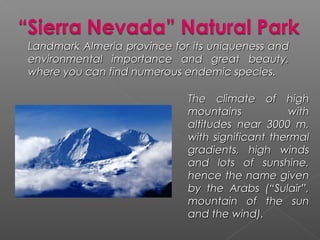
Landmark Almeria province for its uniqueness and
environmental importance and great beauty,
where you can find numerous endemic species.
 
                             The climate of high
                             mountains           with
                             altitudes near 3000 m,
                             with significant thermal
                             gradients, high winds
                             and lots of sunshine,
                             hence the name given
                             by the Arabs (“Sulair”,
                             mountain of the sun
                             and the wind).
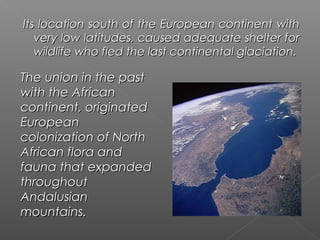
 Its location south of the European continent with
  very low latitudes, caused adequate shelter for
  wildlife who fled the last continental glaciation.

The union in the past
with the African
continent, originated
European
colonization of North
African flora and
fauna that expanded
throughout
Andalusian
mountains.
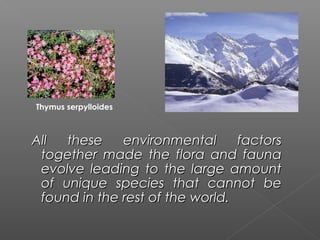
Thymus serpylloides


 All  these    environmental       factors
  together made the flora and fauna
  evolve leading to the large amount
  of unique species that cannot be
  found in the rest of the world.   
                           world.
 
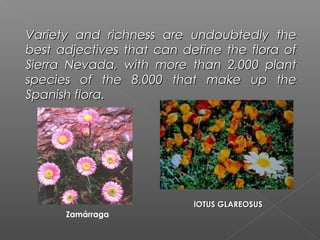
Variety and richness are undoubtedly the
best adjectives that can define the flora of
Sierra Nevada, with more than 2,000 plant
species of the 8,000 that make up the
Spanish flora.


                           lOTUS GLAREOSUS
      Zamárraga
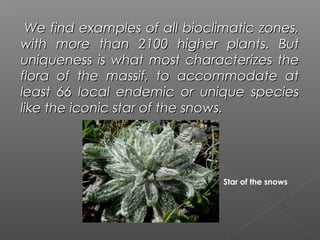
 We find examples of all bioclimatic zones,
with more than 2100 higher plants. But
uniqueness is what most characterizes the
flora of the massif, to accommodate at
least 66 local endemic or unique species
like the iconic star of the snows.


                               Star of the snows
The arid and low rainfall climatology of this
  mountain give it a steppe character,
  which determines undoubtedly the kind
  of wildlife that lives here.
It is the high mountain
which houses the most
unique animal species
of Sierra Nevada.
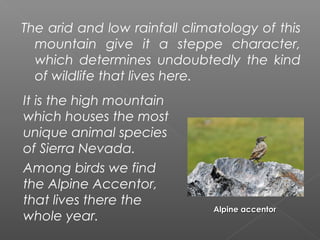
Among birds we find
the Alpine Accentor,
that lives there the
                              Alpine accentor
whole year.
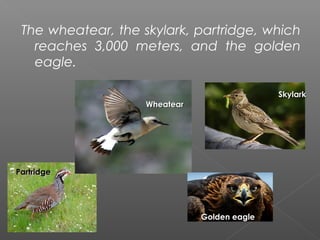
The wheatear, the skylark, partridge, which
   reaches 3,000 meters, and the golden
   eagle.

                                              Skylark
                    Wheatear


Partridge


                               Golden eagle
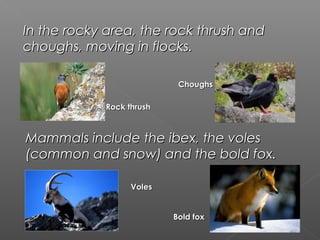
In the rocky area, the rock thrush and
choughs, moving in flocks.

                           Choughs

            Rock thrush


Mammals include the ibex, the voles
(common and snow) and the bold fox.

                  Voles


                          Bold fox
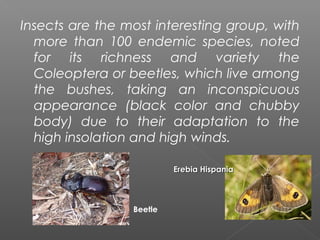
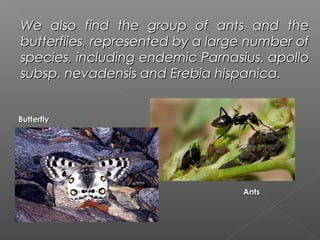
Insects are the most interesting group, with
  more than 100 endemic species, noted
  for its richness and variety the
  Coleoptera or beetles, which live among
  the bushes, taking an inconspicuous
  appearance (black color and chubby
  body) due to their adaptation to the
  high insolation and high winds.

                          Erebia Hispania


                 Beetle
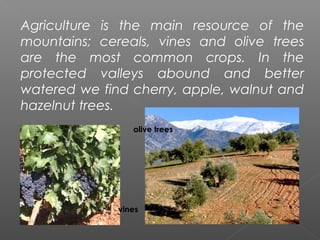
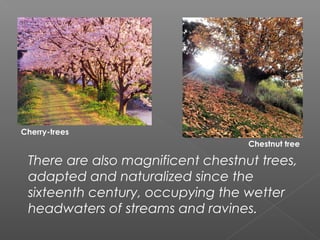
We also find the group of ants and the
butterflies, represented by a large number of
species, including endemic Parnasius. apollo
subsp. nevadensis and Erebia hispanica.


Butterfly


                                  Ants
Agriculture is the main resource of the
mountains; cereals, vines and olive trees
are the most common crops. In the
protected valleys abound and better
watered we find cherry, apple, walnut and
hazelnut trees.
                 olive trees


              vines
Cherry-trees
                                   Chestnut tree

 There are also magnificent chestnut trees,
 adapted and naturalized since the
 sixteenth century, occupying the wetter
 headwaters of streams and ravines.
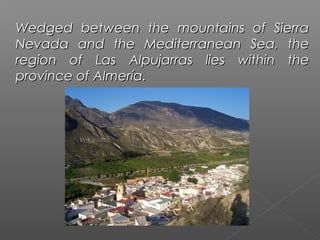
Wedged between the mountains of Sierra
Nevada and the Mediterranean Sea, the
region of Las Alpujarras lies within the
province of Almería.
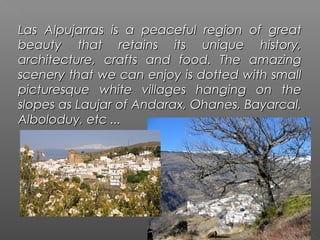
Las Alpujarras is a peaceful region of great
beauty that retains its unique history,
architecture, crafts and food. The amazing
scenery that we can enjoy is dotted with small
picturesque white villages hanging on the
slopes as Laujar of Andarax, Ohanes, Bayarcal,
Alboloduy, etc ...
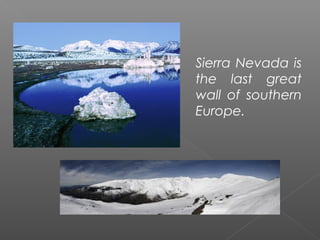
Sierra Nevada is
the last great
wall of southern
Europe.
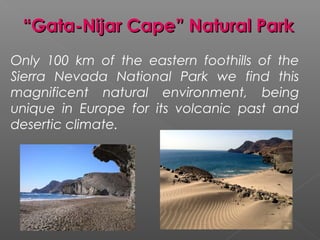
“Gata-Nijar Cape” Natural Park
Only 100 km of the eastern foothills of the
Sierra Nevada National Park we find this
magnificent natural environment, being
unique in Europe for its volcanic past and
desertic climate.
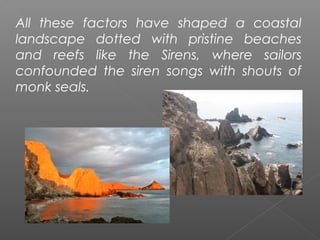
All these factors have shaped a coastal
landscape dotted with pristine beaches
and reefs like the Sirens, where sailors
confounded the siren songs with shouts of
monk seals.
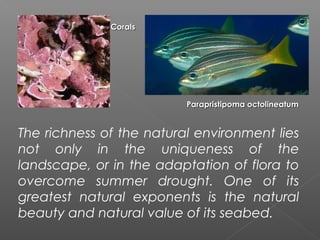
Corals


                          Parapristipoma octolineatum


The richness of the natural environment lies
not only in the uniqueness of the
landscape, or in the adaptation of flora to
overcome summer drought. One of its
greatest natural exponents is the natural
beauty and natural value of its seabed.
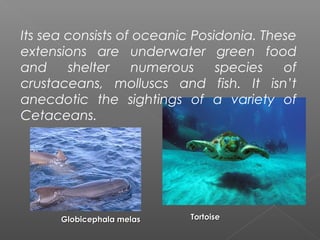
Its sea consists of oceanic Posidonia. These
extensions are underwater green food
and     shelter    numerous     species   of
crustaceans, molluscs and fish. It isn’t
anecdotic the sightings of a variety of
Cetaceans.


      Globicephala melas   Tortoise

Spanish flora and_fauna

  • 1.
    Landmark Almeria provincefor its uniqueness and environmental importance and great beauty, where you can find numerous endemic species.   The climate of high mountains with altitudes near 3000 m, with significant thermal gradients, high winds and lots of sunshine, hence the name given by the Arabs (“Sulair”, mountain of the sun and the wind).
  • 2.
     Its location southof the European continent with very low latitudes, caused adequate shelter for wildlife who fled the last continental glaciation. The union in the past with the African continent, originated European colonization of North African flora and fauna that expanded throughout Andalusian mountains.
  • 3.
    Thymus serpylloides  All these environmental factors together made the flora and fauna evolve leading to the large amount of unique species that cannot be found in the rest of the world.    world.  
  • 4.
    Variety and richnessare undoubtedly the best adjectives that can define the flora of Sierra Nevada, with more than 2,000 plant species of the 8,000 that make up the Spanish flora. lOTUS GLAREOSUS Zamárraga
  • 5.
     We find examplesof all bioclimatic zones, with more than 2100 higher plants. But uniqueness is what most characterizes the flora of the massif, to accommodate at least 66 local endemic or unique species like the iconic star of the snows. Star of the snows
  • 6.
    The arid andlow rainfall climatology of this mountain give it a steppe character, which determines undoubtedly the kind of wildlife that lives here. It is the high mountain which houses the most unique animal species of Sierra Nevada. Among birds we find the Alpine Accentor, that lives there the Alpine accentor whole year.
  • 7.
    The wheatear, theskylark, partridge, which reaches 3,000 meters, and the golden eagle. Skylark Wheatear Partridge Golden eagle
  • 8.
    In the rockyarea, the rock thrush and choughs, moving in flocks. Choughs Rock thrush Mammals include the ibex, the voles (common and snow) and the bold fox. Voles Bold fox
  • 9.
    Insects are themost interesting group, with more than 100 endemic species, noted for its richness and variety the Coleoptera or beetles, which live among the bushes, taking an inconspicuous appearance (black color and chubby body) due to their adaptation to the high insolation and high winds. Erebia Hispania Beetle
  • 10.
    We also findthe group of ants and the butterflies, represented by a large number of species, including endemic Parnasius. apollo subsp. nevadensis and Erebia hispanica. Butterfly Ants
  • 11.
    Agriculture is themain resource of the mountains; cereals, vines and olive trees are the most common crops. In the protected valleys abound and better watered we find cherry, apple, walnut and hazelnut trees. olive trees vines
  • 12.
    Cherry-trees Chestnut tree There are also magnificent chestnut trees, adapted and naturalized since the sixteenth century, occupying the wetter headwaters of streams and ravines.
  • 13.
    Wedged between themountains of Sierra Nevada and the Mediterranean Sea, the region of Las Alpujarras lies within the province of Almería.
  • 14.
    Las Alpujarras isa peaceful region of great beauty that retains its unique history, architecture, crafts and food. The amazing scenery that we can enjoy is dotted with small picturesque white villages hanging on the slopes as Laujar of Andarax, Ohanes, Bayarcal, Alboloduy, etc ...
  • 15.
    Sierra Nevada is thelast great wall of southern Europe.
  • 16.
    “Gata-Nijar Cape” NaturalPark Only 100 km of the eastern foothills of the Sierra Nevada National Park we find this magnificent natural environment, being unique in Europe for its volcanic past and desertic climate.
  • 17.
    All these factorshave shaped a coastal landscape dotted with pristine beaches and reefs like the Sirens, where sailors confounded the siren songs with shouts of monk seals.
  • 18.
    Corals Parapristipoma octolineatum The richness of the natural environment lies not only in the uniqueness of the landscape, or in the adaptation of flora to overcome summer drought. One of its greatest natural exponents is the natural beauty and natural value of its seabed.
  • 19.
    Its sea consistsof oceanic Posidonia. These extensions are underwater green food and shelter numerous species of crustaceans, molluscs and fish. It isn’t anecdotic the sightings of a variety of Cetaceans. Globicephala melas Tortoise