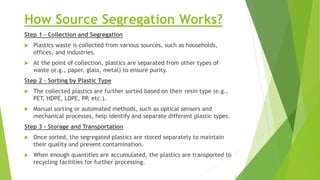
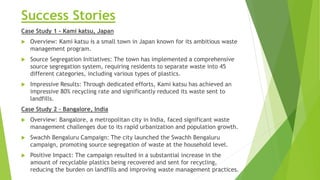
Plastic pollution has become a major environmental issue, but source segregation of plastics waste can help address this problem. Source segregation involves separating different types of plastics at the point of generation, like households or businesses. This allows plastics to be recycled more effectively. Source segregation provides key benefits like reduced plastic pollution, increased recycling rates, and lower greenhouse gas emissions. Several case studies from places like Japan and India demonstrate how source segregation can improve waste management and environmental protection.




![Green living[1]](https://cdn.slidesharecdn.com/ss_thumbnails/greenliving1-130918023447-phpapp02-thumbnail.jpg?width=640&height=640&fit=bounds)


![Qcl-15-v4 [4]-[banasthali vidyapeeth]_[rachika mittal]](https://cdn.slidesharecdn.com/ss_thumbnails/qcl-15-v44banasthalividyapeethrachikamittal-150215061013-conversion-gate01-thumbnail.jpg?width=640&height=640&fit=bounds)


