Sound & Light

• Muhammad Fahad Ansari
                  12IEEM14
15 Lecture Material for Introduction of
               Environmental Physics
                 Class 12 EE Batch
1. Sound and Light
2. Radiation Understanding
3. Global Warming
4. Terrestrial Environment
5. Extra-Terrestrial Environment
6. Natural and Man made radiation
7. Universe understanding
8. Understanding water
9. Cloud formation
10. Climate
11. Climate change
Sound and Light
•   WABVES
•   Light & the Electromagnetic Spectrum
•   Refraction of Light
•   LIGHT & ITS USES
© 2000 Microsoft Clip Gallery


  WAVES: SOUND & LIGHT


Waves carry energy from one place to
              another
NATURE OF WAVES
• Waves (Def.) – A wave is a disturbance that
© 2000 Microsoft Clip Gallery


  transfers energy.

• Medium – Substance or region through which
  a wave is transmitted.

• Speed of Waves – Depends on the properties
  of the medium.
SAMPLE LESSON: Light & the
           Electromagnetic Spectrum


© 2000 Microsoft Clip Gallery
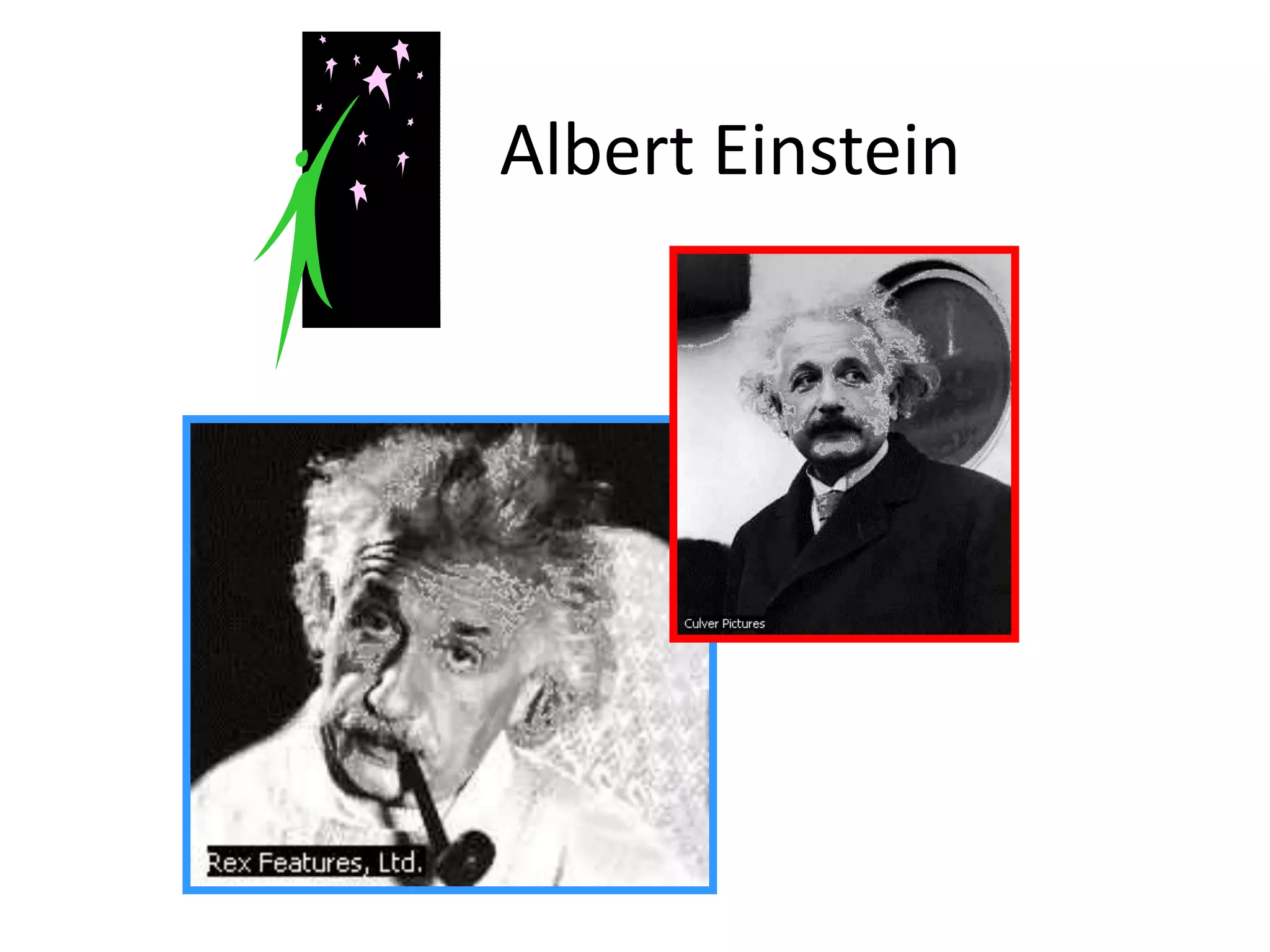
Albert Einstein
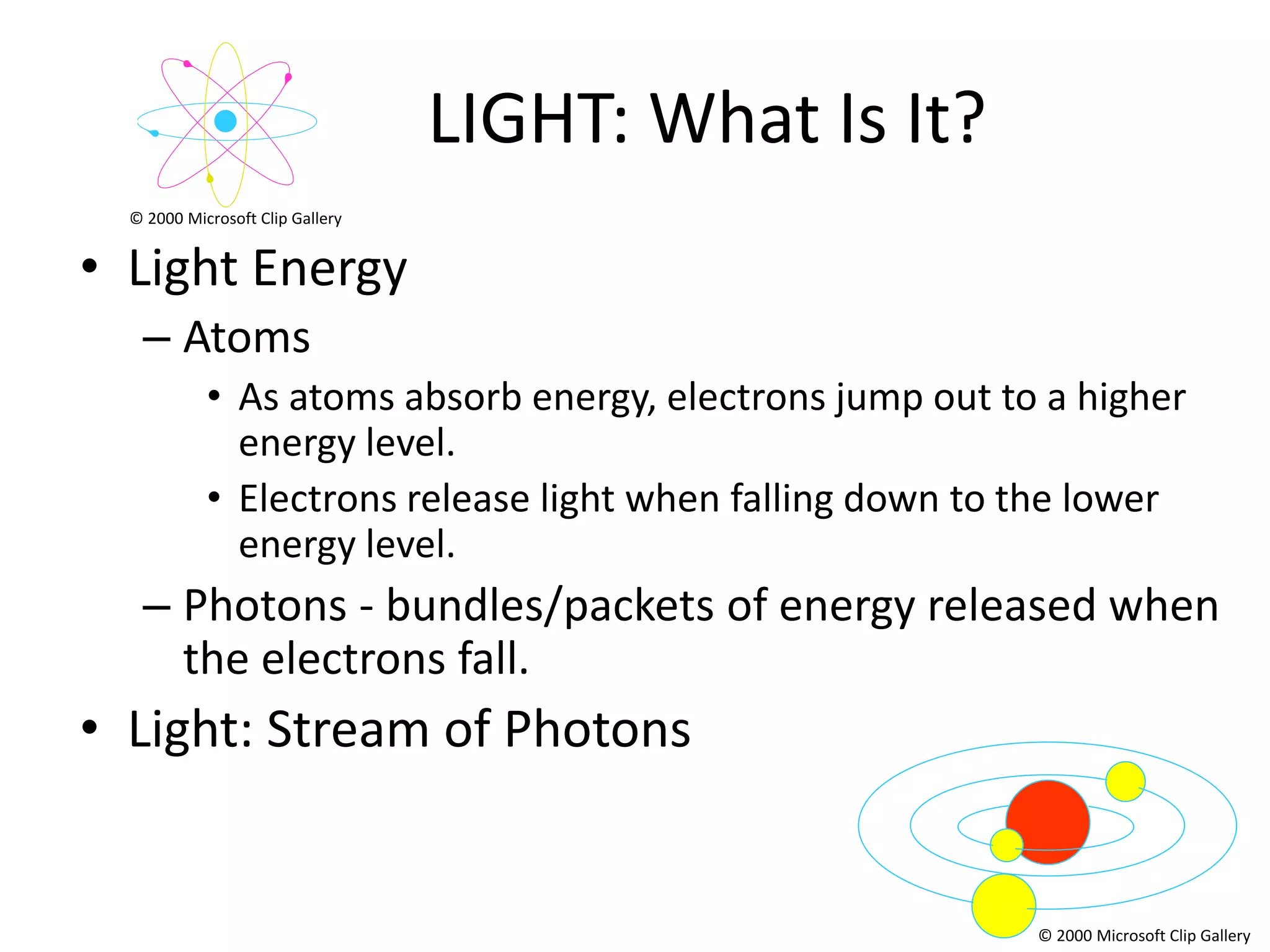
LIGHT: What Is It?
  © 2000 Microsoft Clip Gallery


• Light Energy
   – Atoms
            • As atoms absorb energy, electrons jump out to a higher
              energy level.
            • Electrons release light when falling down to the lower
              energy level.
   – Photons - bundles/packets of energy released when
     the electrons fall.
• Light: Stream of Photons


                                                           © 2000 Microsoft Clip Gallery
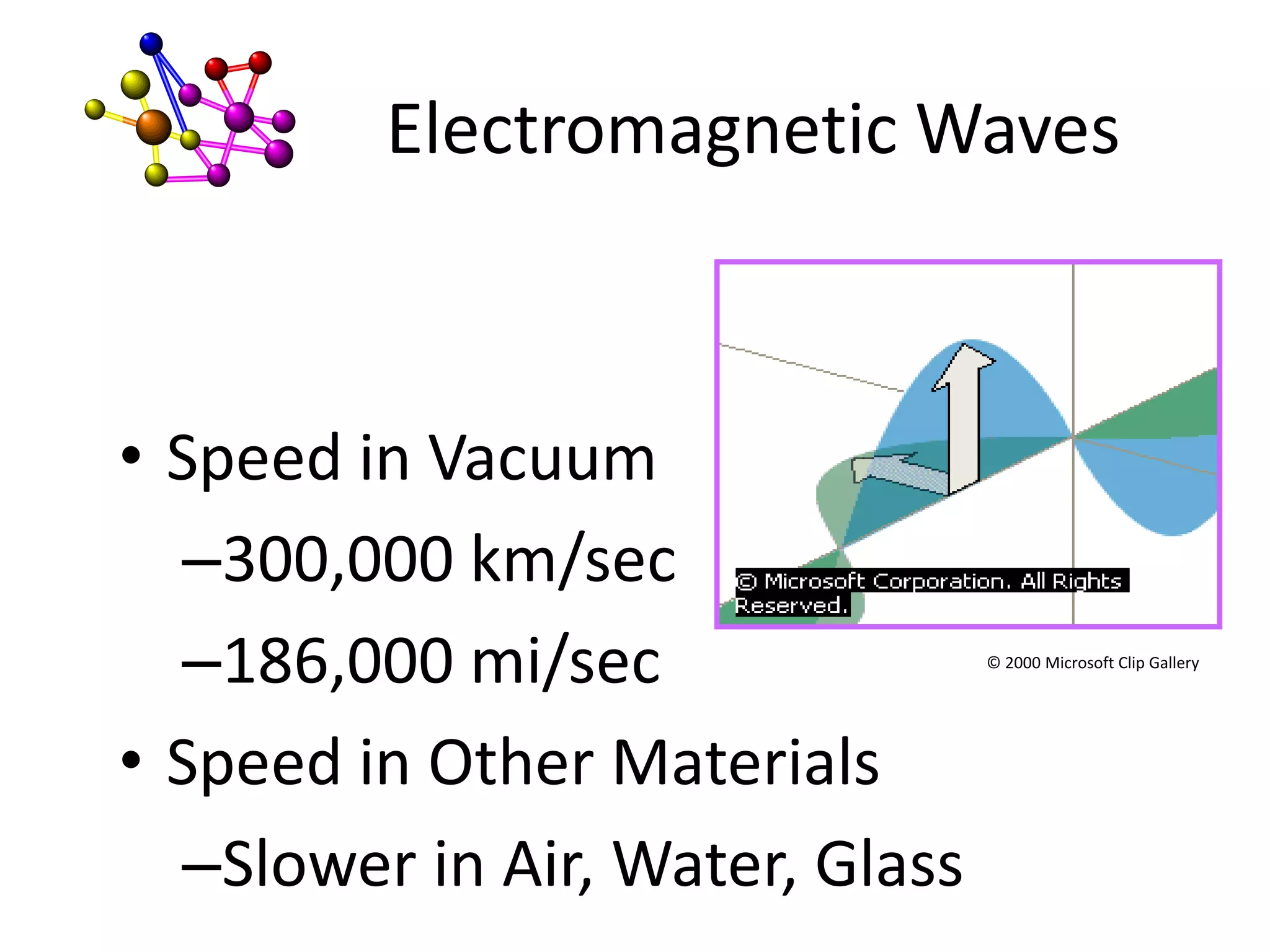
Electromagnetic Waves


• Speed in Vacuum
  –300,000 km/sec
  –186,000 mi/sec                © 2000 Microsoft Clip Gallery


• Speed in Other Materials
  –Slower in Air, Water, Glass
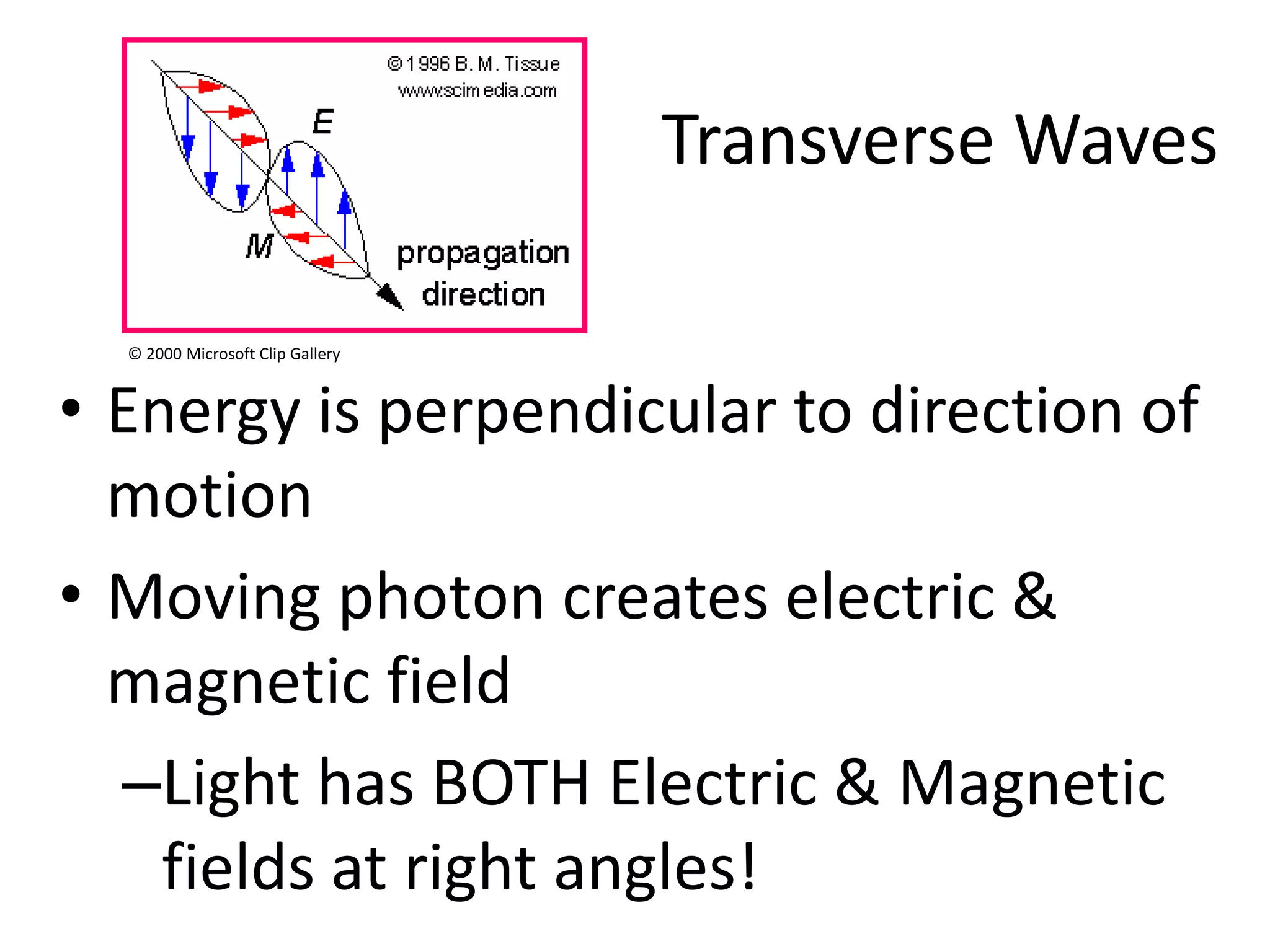
Transverse Waves

  © 2000 Microsoft Clip Gallery


• Energy is perpendicular to direction of
  motion
• Moving photon creates electric &
  magnetic field
  –Light has BOTH Electric & Magnetic
    fields at right angles!
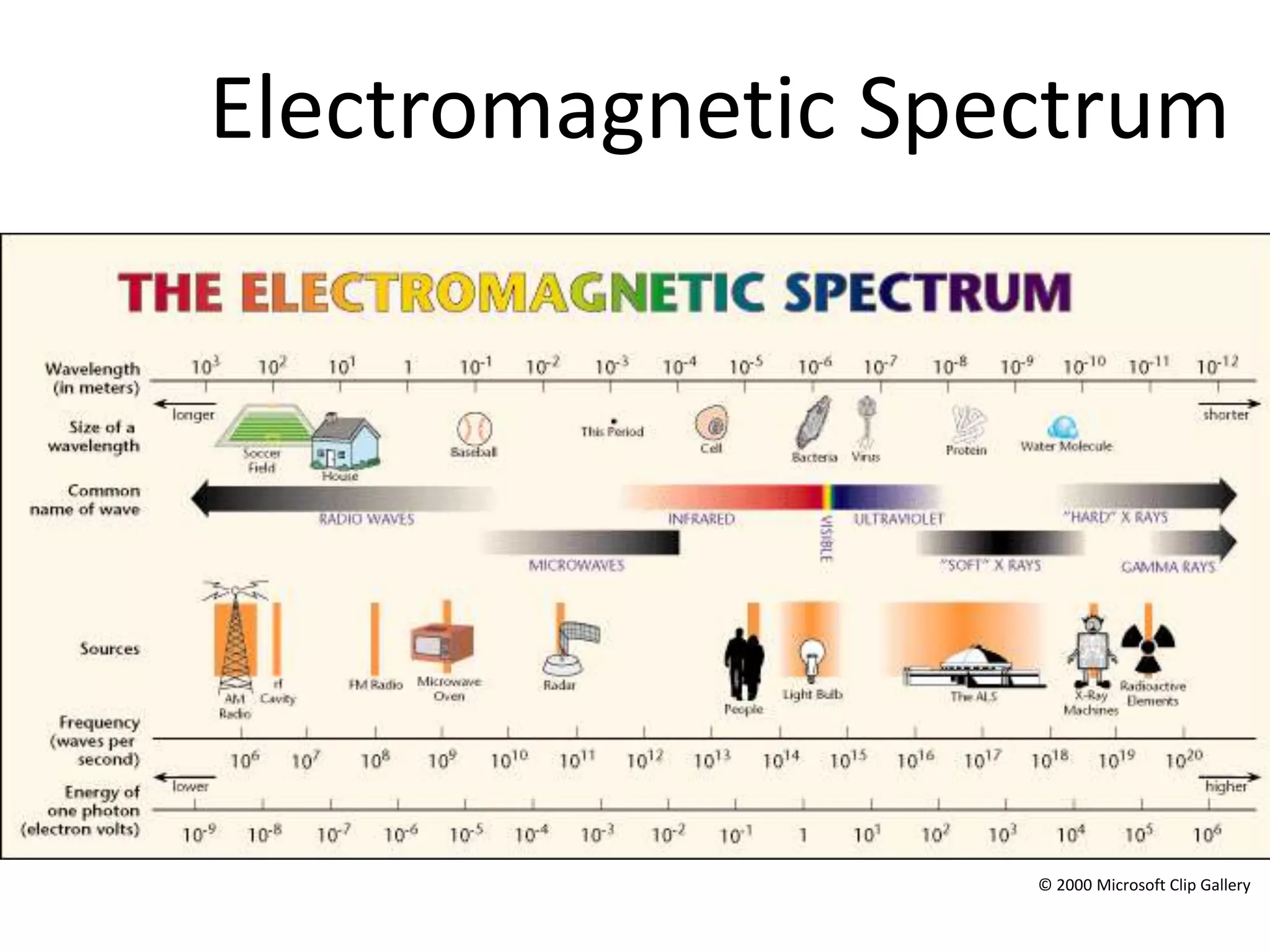
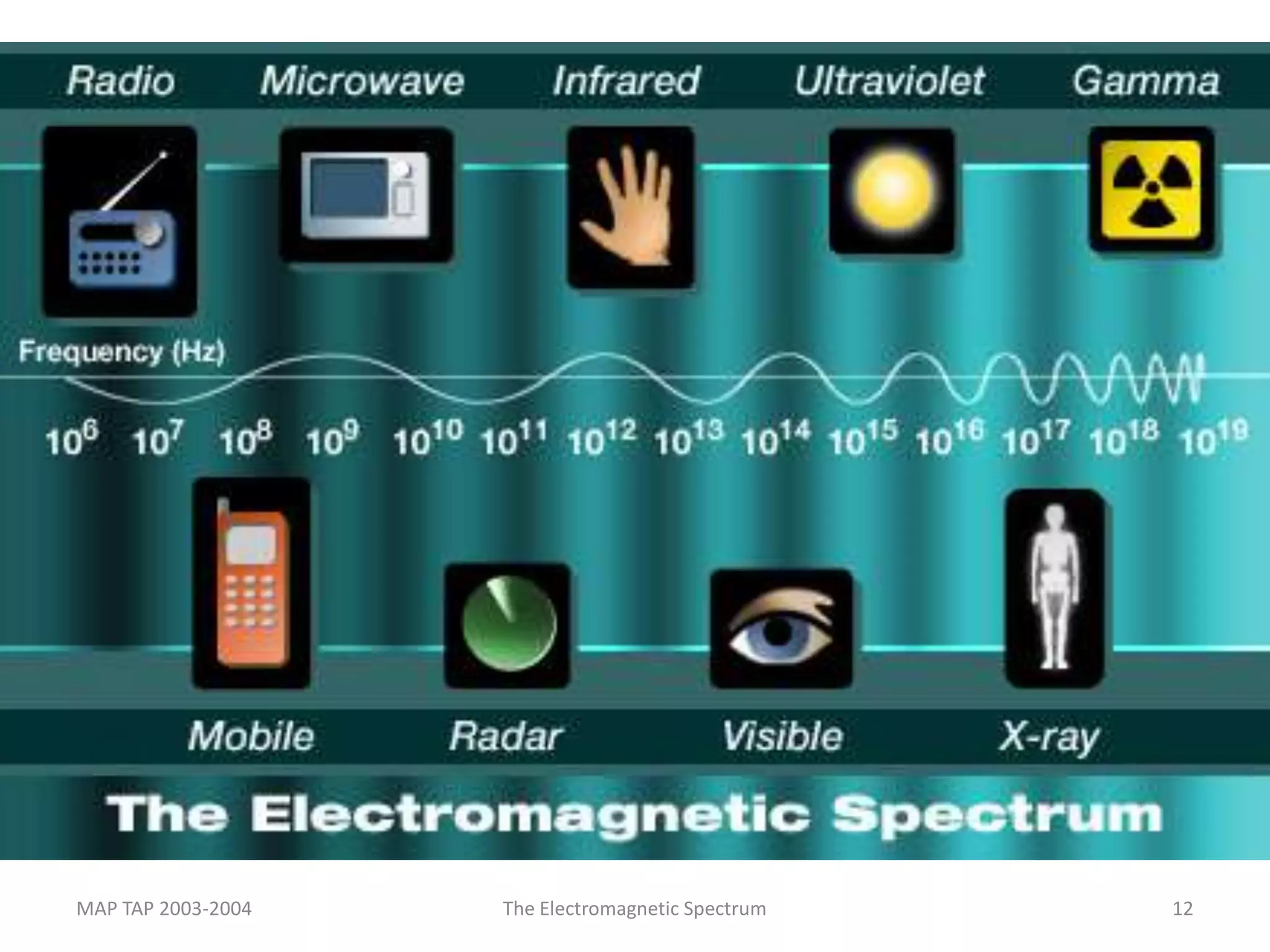
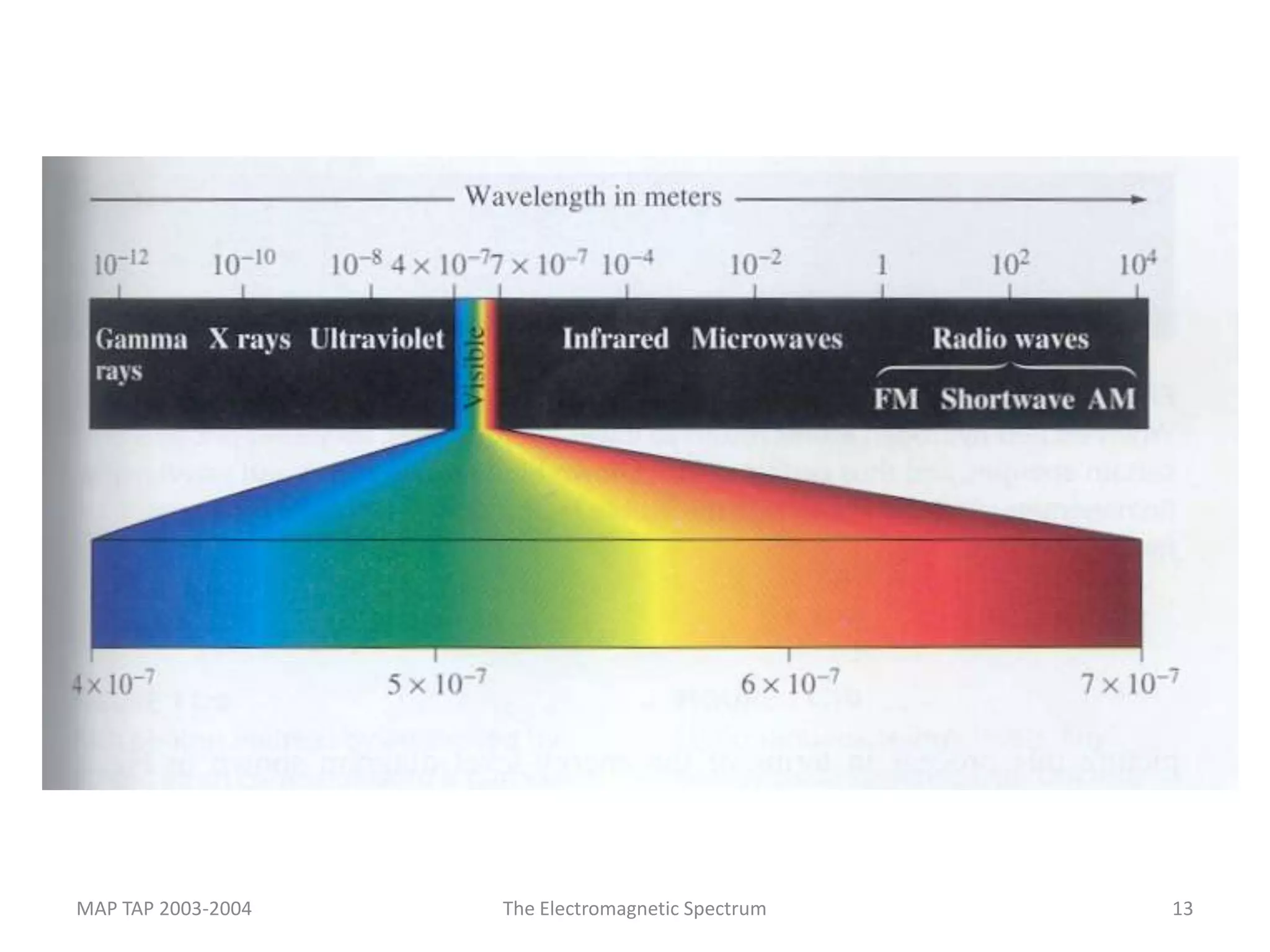
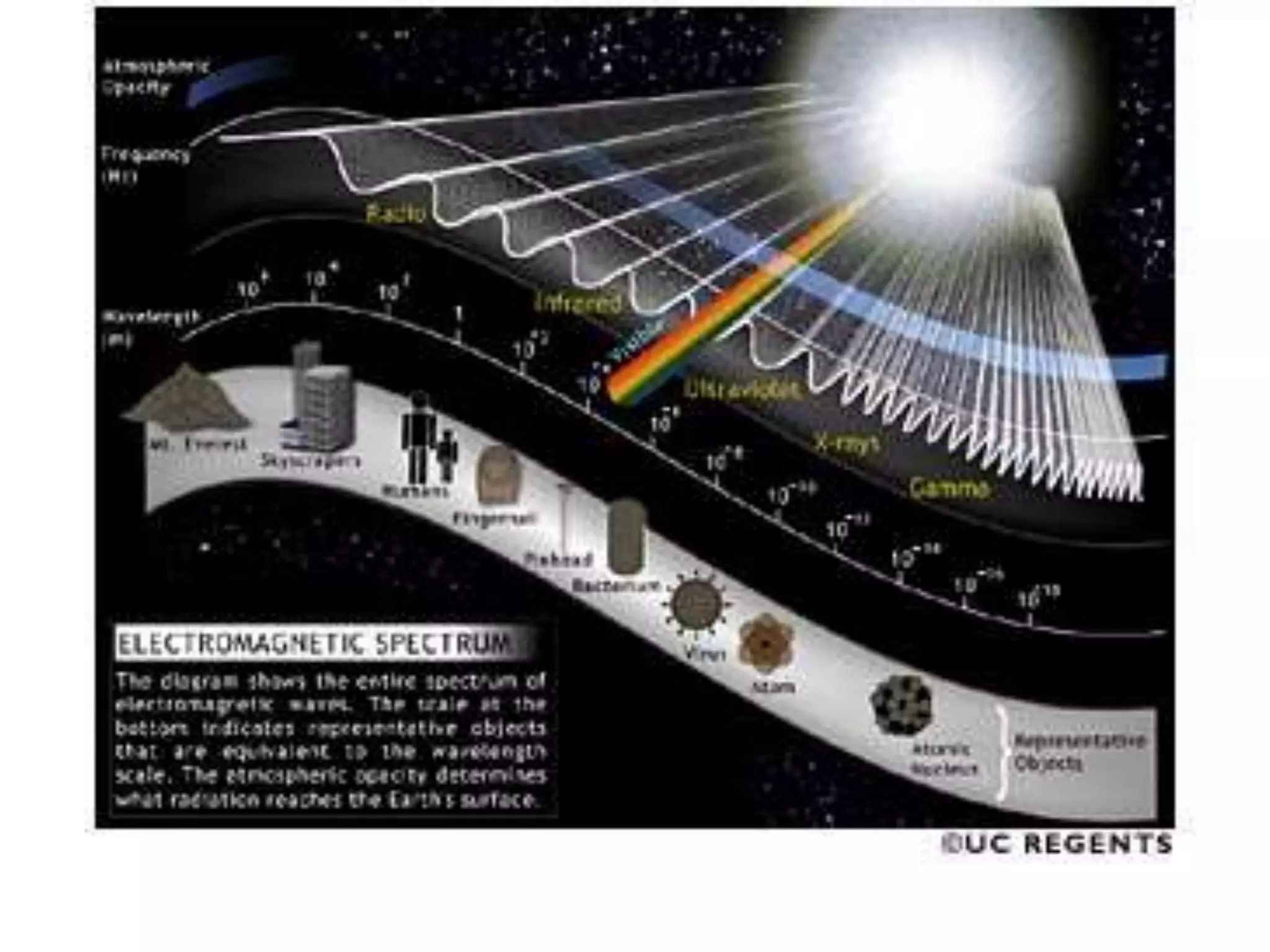
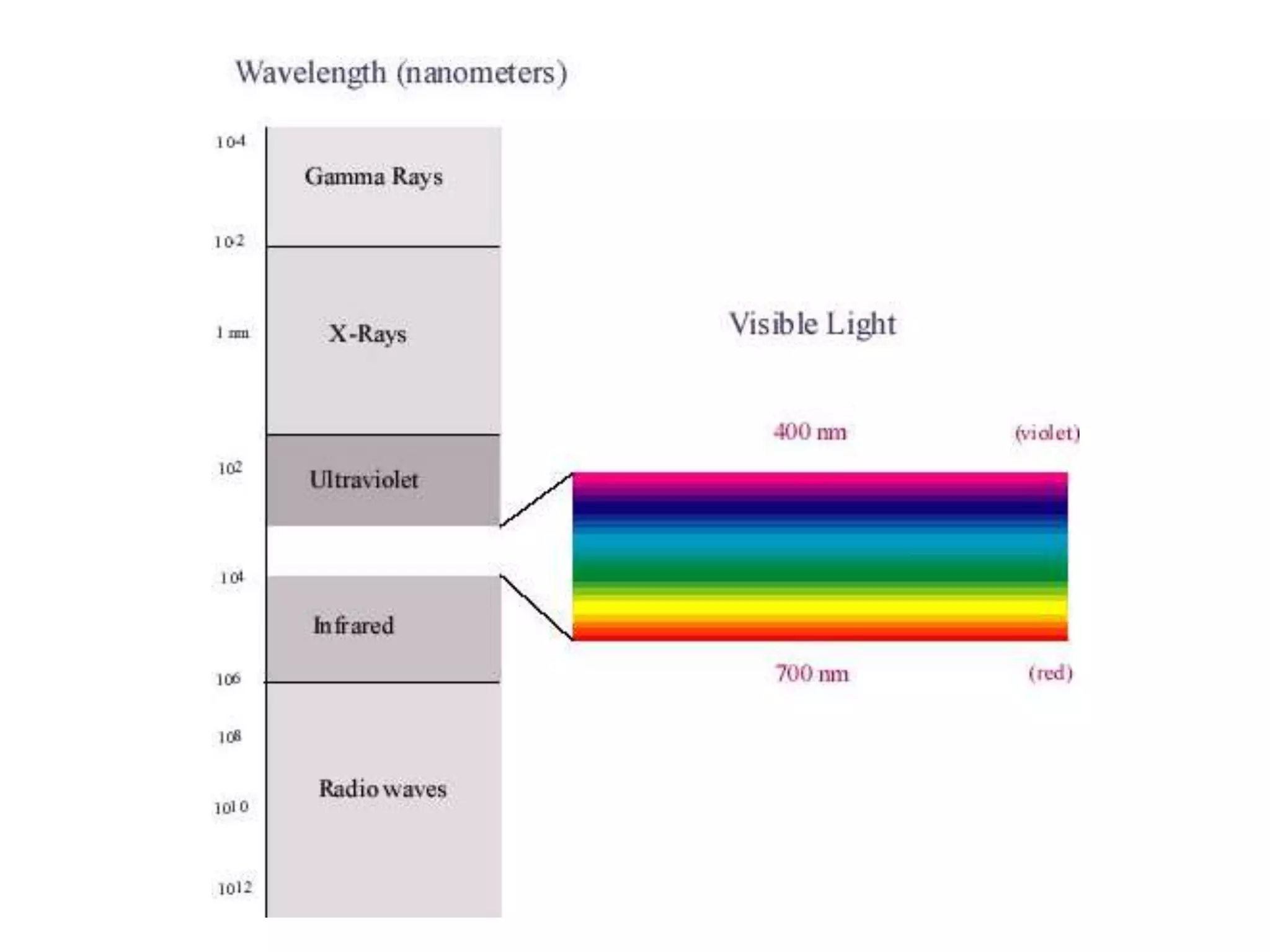
Electromagnetic Spectrum


                   © 2000 Microsoft Clip Gallery
MAP TAP 2003-2004   The Electromagnetic Spectrum   12
MAP TAP 2003-2004   The Electromagnetic Spectrum   13
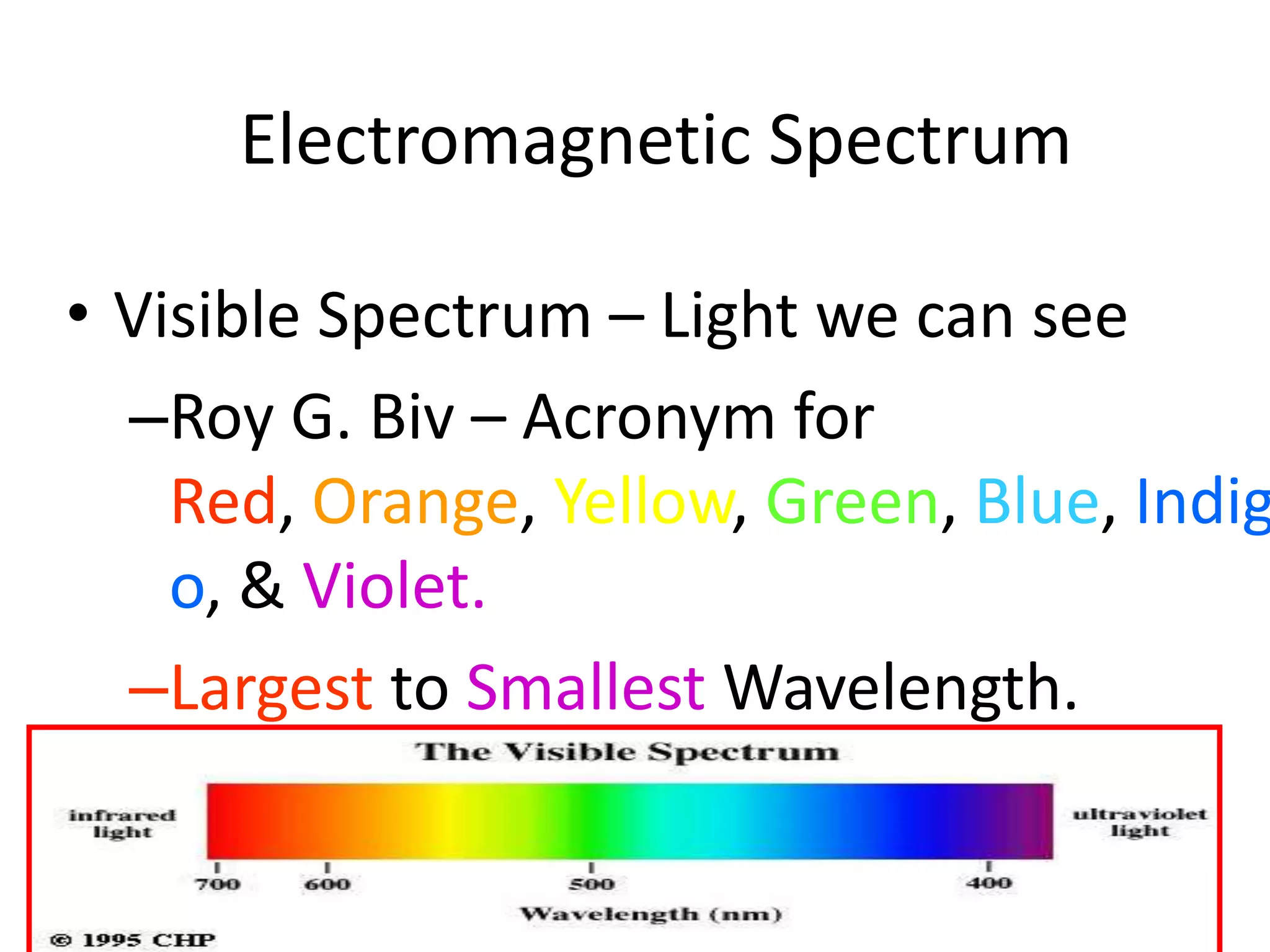
Electromagnetic Spectrum

• Visible Spectrum – Light we can see
  –Roy G. Biv – Acronym for
    Red, Orange, Yellow, Green, Blue, Indig
    o, & Violet.
  –Largest to Smallest Wavelength.
Electromagnetic Spectrum

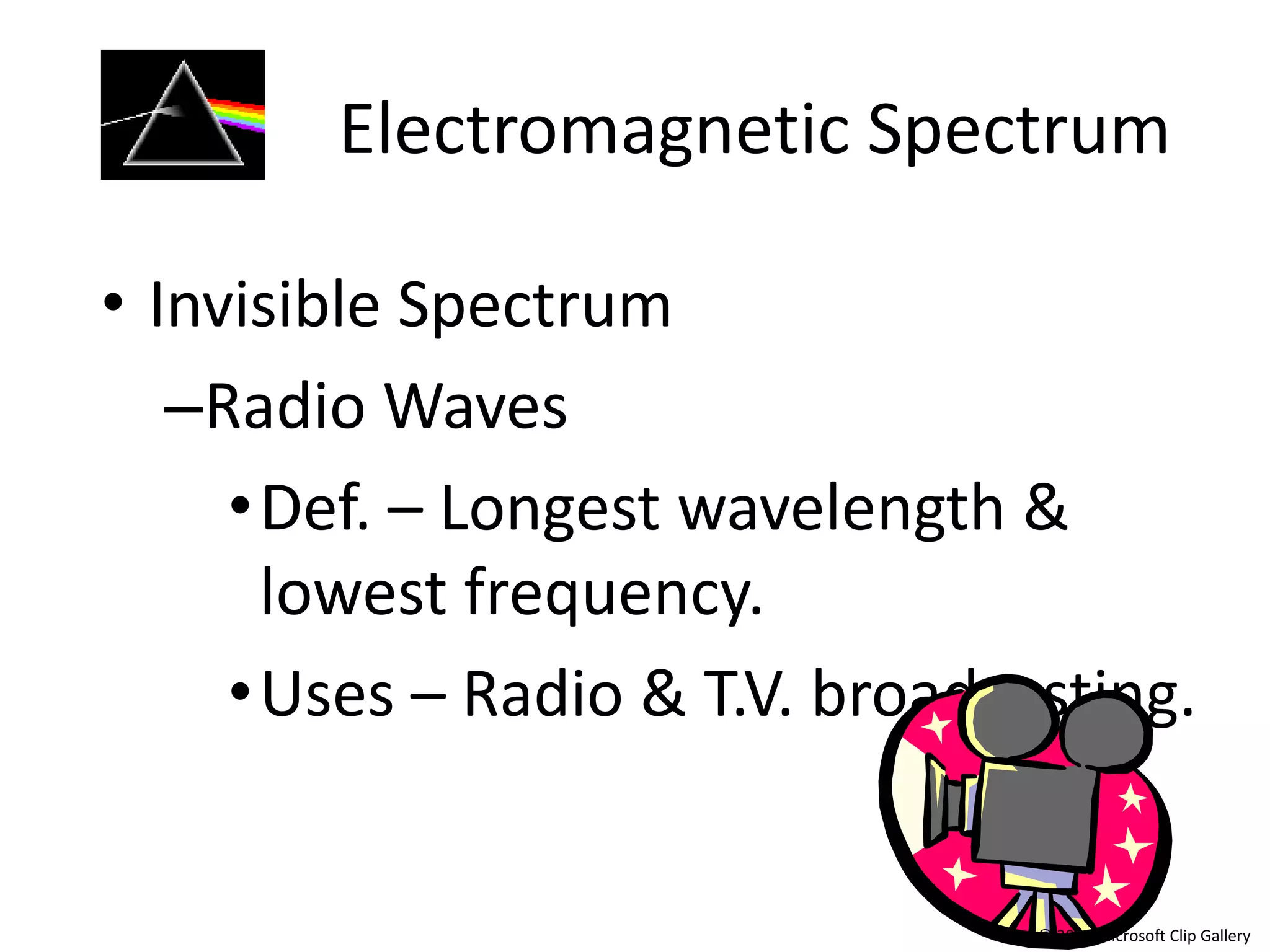
• Invisible Spectrum
   –Radio Waves
     • Def. – Longest wavelength &
       lowest frequency.
     • Uses – Radio & T.V. broadcasting.


                                  © 2000 Microsoft Clip Gallery
Modulating Radio Waves
© 2000 Microsoft Clip Gallery

 • Modulation - variation of amplitude or
   frequency when waves are broadcast
          – AM – amplitude modulation
                  • Carries audio for T.V. Broadcasts
                  • Longer wavelength so can bend around hills
          – FM – frequency modulation
                  • Carries video for T.V. Broadcasts
Short Wavelength Microwave

• Invisible Spectrum (Cont.)
   –Infrared Rays
     • Def – Light rays with longer
       wavelength than red light.
     • Uses: Cooking, Medicine, T.V.
       remote controls
Electromagnetic Spectrum

• Invisible spectrum (cont.).
   –Ultraviolet rays.
     • Def. – EM waves with frequencies
       slightly higher than visible light
     • Uses: food processing & hospitals
       to kill germs’ cells
     • Helps your body use vitamin D.
Electromagnetic Spectrum

• Invisible Spectrum (Cont.)
   –X-Rays
     • Def. - EM waves that are shorter
      than UV rays.
     • Uses: Medicine – Bones absorb x-
      rays; soft tissue does not.
     • Lead absorbs X-rays.
Electromagnetic Spectrum

• Invisible spectrum (cont.)
   –Gamma rays
     • Def. Highest frequency EM
       waves; Shortest wavelength.
       They come from outer space.
     • Uses: cancer treatment.
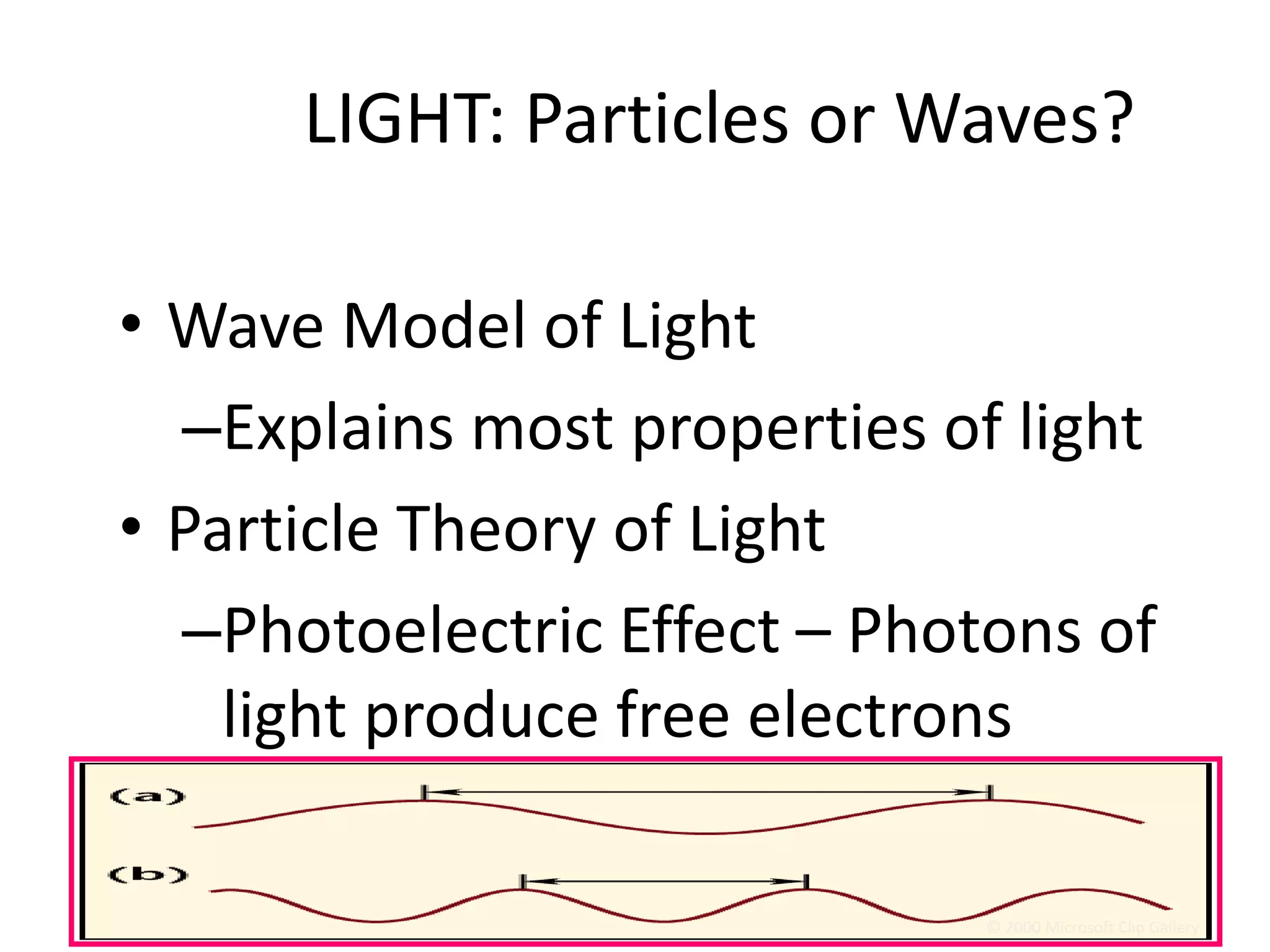
LIGHT: Particles or Waves?

• Wave Model of Light
  –Explains most properties of light
• Particle Theory of Light
  –Photoelectric Effect – Photons of
    light produce free electrons

                              © 2000 Microsoft Clip Gallery
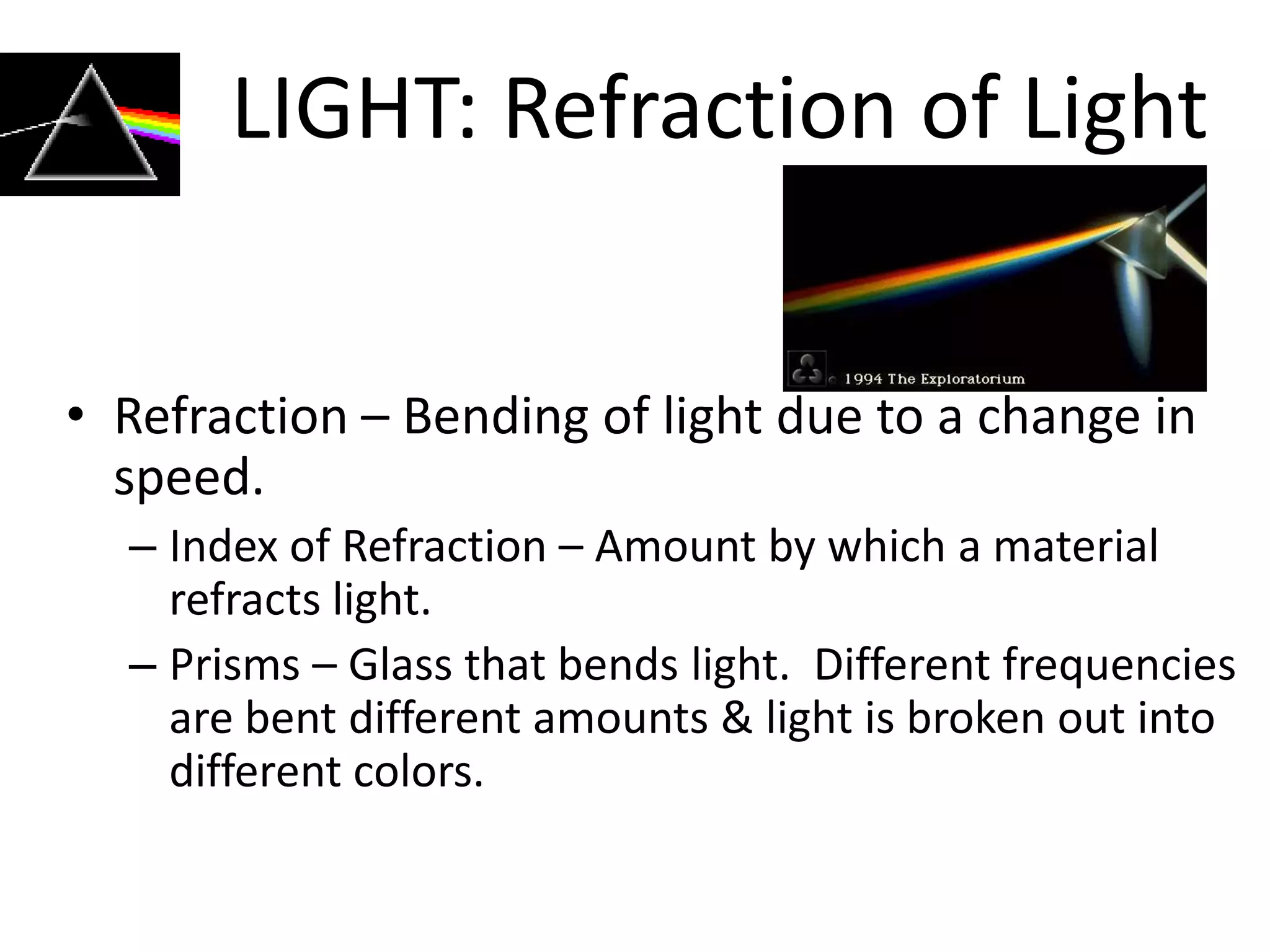
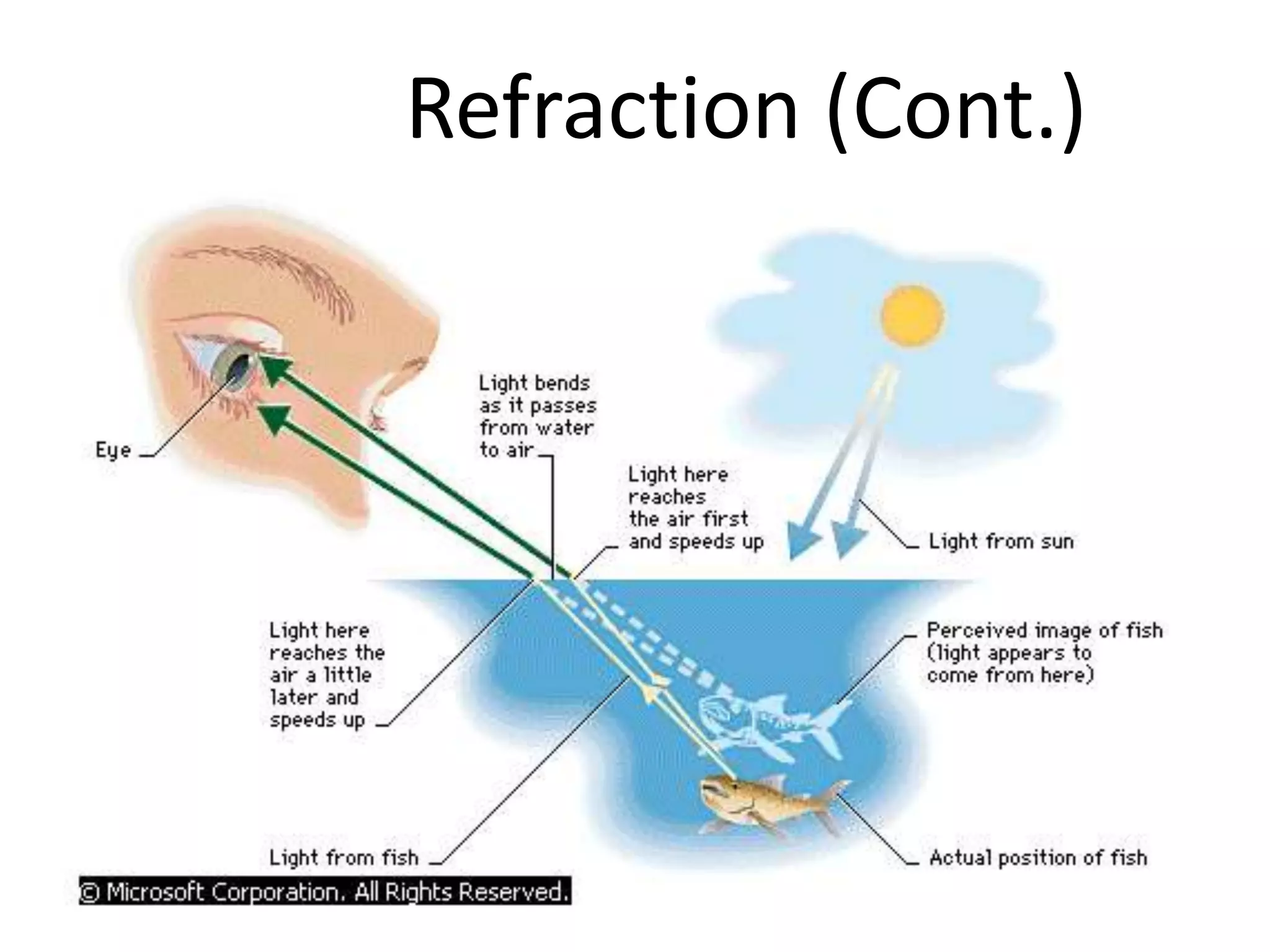
LIGHT: Refraction of Light


• Refraction – Bending of light due to a change in
  speed.
  – Index of Refraction – Amount by which a material
    refracts light.
  – Prisms – Glass that bends light. Different frequencies
    are bent different amounts & light is broken out into
    different colors.
Refraction (Cont.)
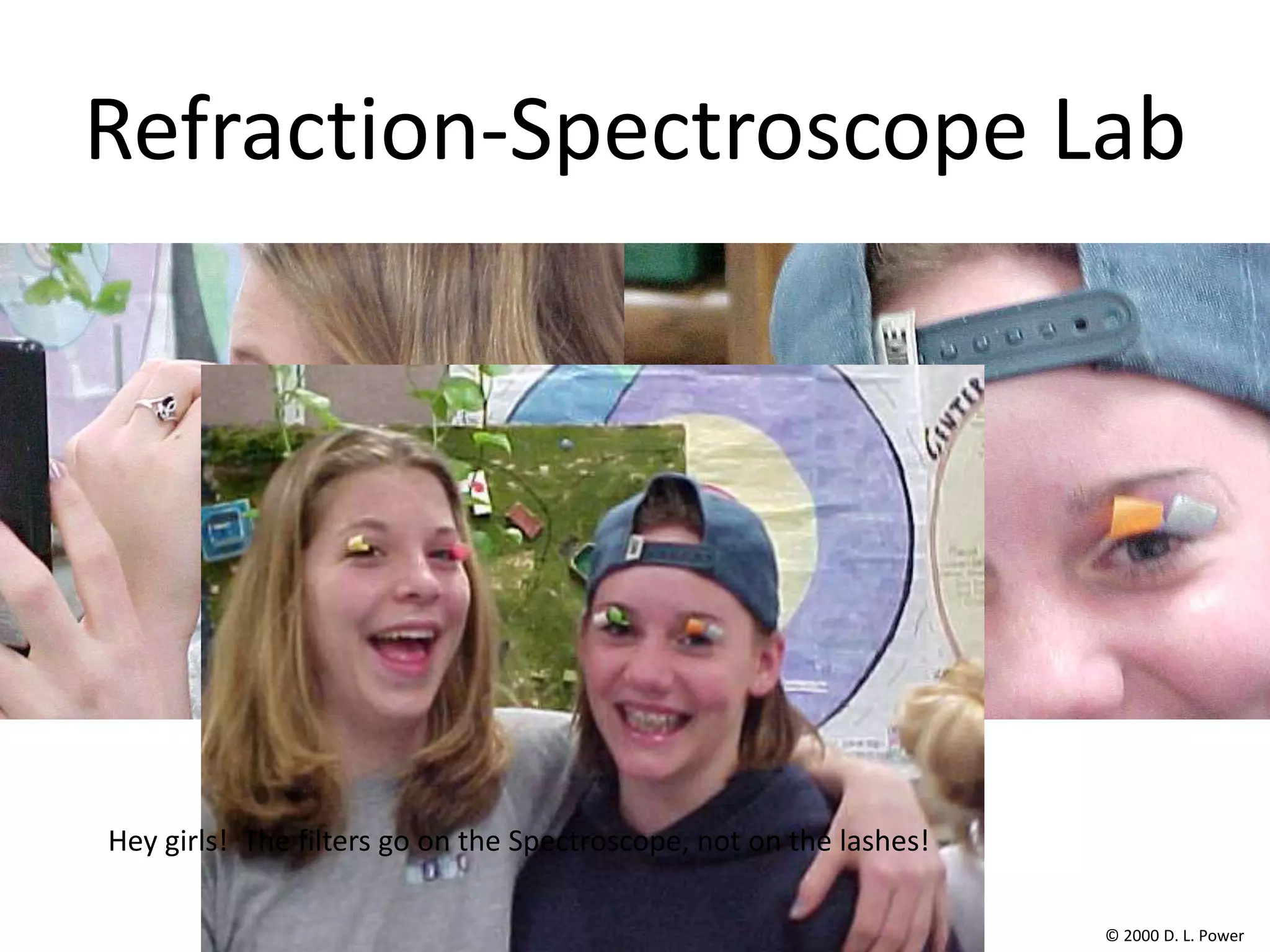
Refraction-Spectroscope Lab


Hey girls! The filters go on the Spectroscope, not on the lashes!

                                                                    © 2000 D. L. Power
Color of Light
• Transparent Objects:
   © 2000 Microsoft Clip Gallery


  – Light transmitted because of no scattering
  – Color transmitted is color you see. All other colors are
    absorbed.
• Translucent:
  – Light is scattered and transmitted some.
• Opaque:
  – Light is either reflected or absorbed.
  – Color of opaque objects is color it reflects.
Color of Light (Cont.)

• Color of Objects
  – White light is the presence of ALL the colors of
    the visible spectrum.
  – Black objects absorb ALL the colors and no light
    is reflected back.


                                            © 2000 Microsoft Clip Gallery
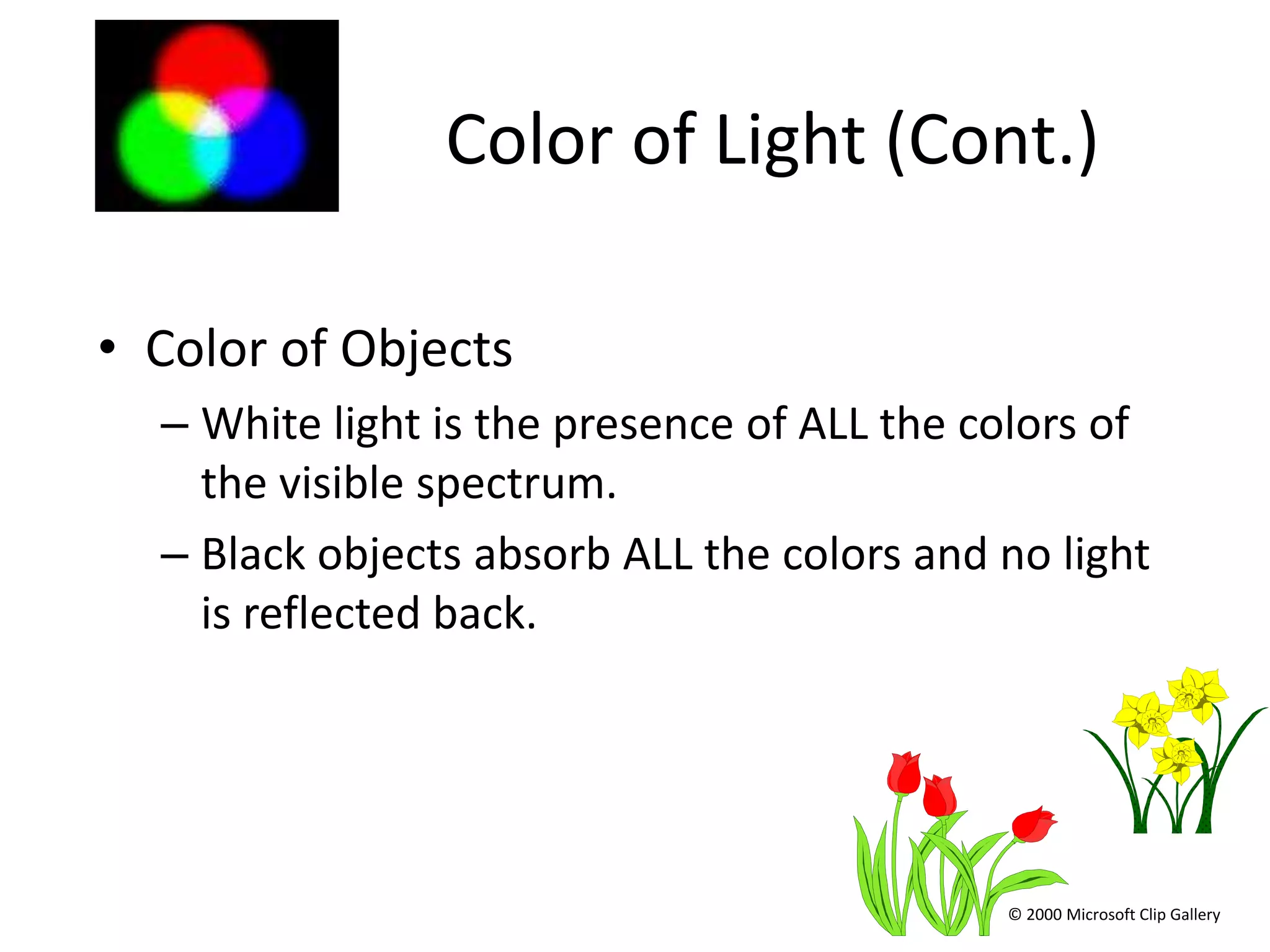
Color of Light (Cont.)
  © 2000 Microsoft Clip Gallery


• Primary Colors of Light
  – Three colors that can be mixed to
   produce any other colored light
  – Red + blue + green = white light
• Complimentary Colors of Light
  – Two complimentary colors combine
   to make white light-Magenta,Cyan,Yellow
How You See
     © 2000 Microsoft Clip Gallery


• Retina –
  – Lens refracts light to converge on the retina.
    Nerves transmit the image
• Rods –
  – Nerve cells in the retina. Very sensitive to light &
    dark
• Cones –
  – Nerve cells help to see light/color
Paint Pigments
© 2000 Microsoft Clip Gallery


– Pigments absorb the frequency of
  light that you see

– Primary pigments
       • Yellow + cyan + magenta = black
       • Primary pigments are compliments
         of the primary colors of light.
Complementary Pigments
© 2000 Microsoft Clip Gallery


 • Green, blue, red
 • Complimentary
   pigments are
   primary colors
   for light!
                                        © 2000 Microsoft Clip Gallery
LIGHT & ITS USES
 © 2000 Microsoft Clip Gallery


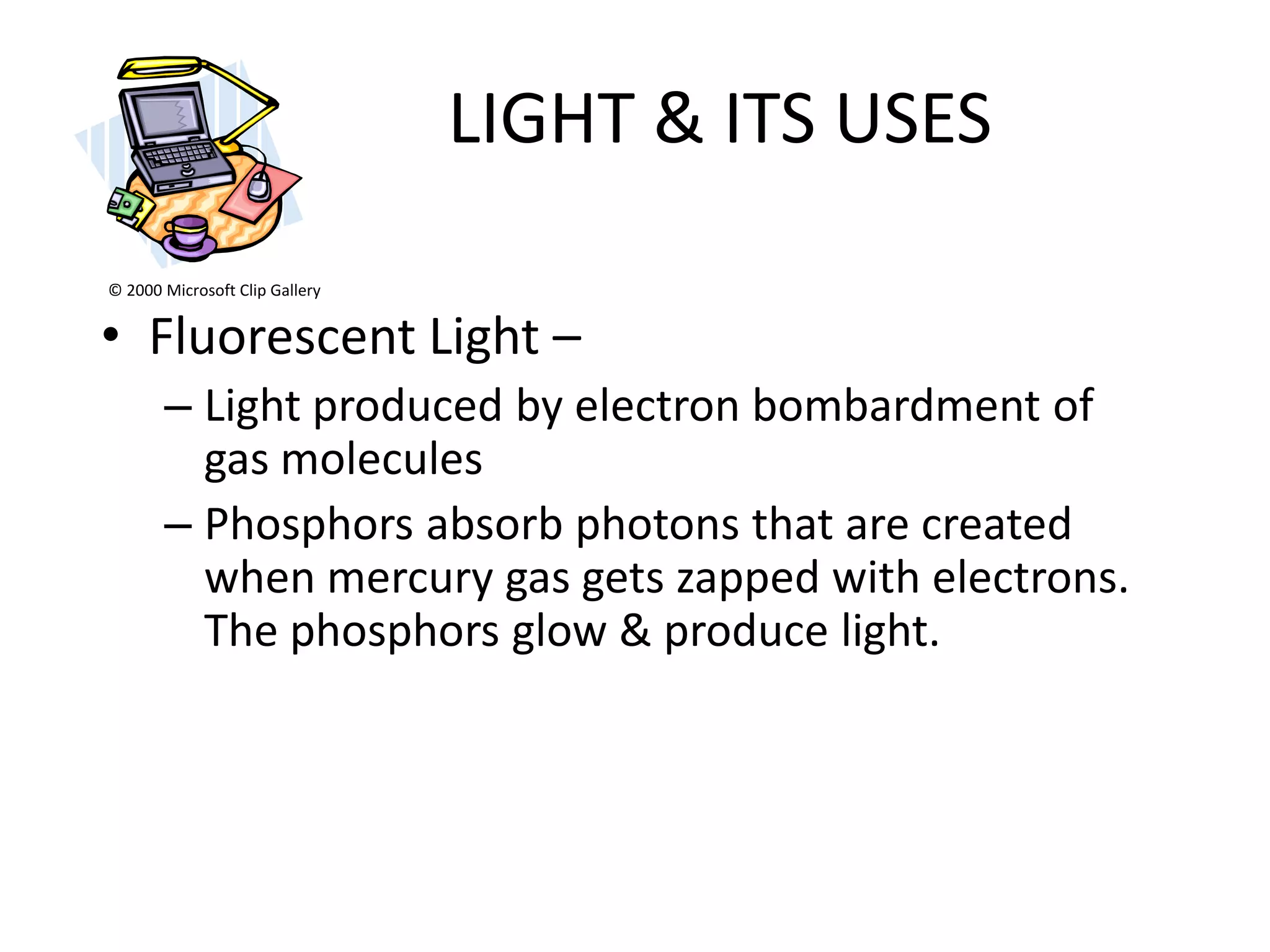
• Sources of Light
  –Incandescent
    light – light
    produced by
    heating an object
    until it glows.
                                              © 2000 Microsoft Clip Gallery
LIGHT & ITS USES
© 2000 Microsoft Clip Gallery


• Fluorescent Light –
       – Light produced by electron bombardment of
         gas molecules
       – Phosphors absorb photons that are created
         when mercury gas gets zapped with electrons.
         The phosphors glow & produce light.
LIGHT & ITS USES - Neon

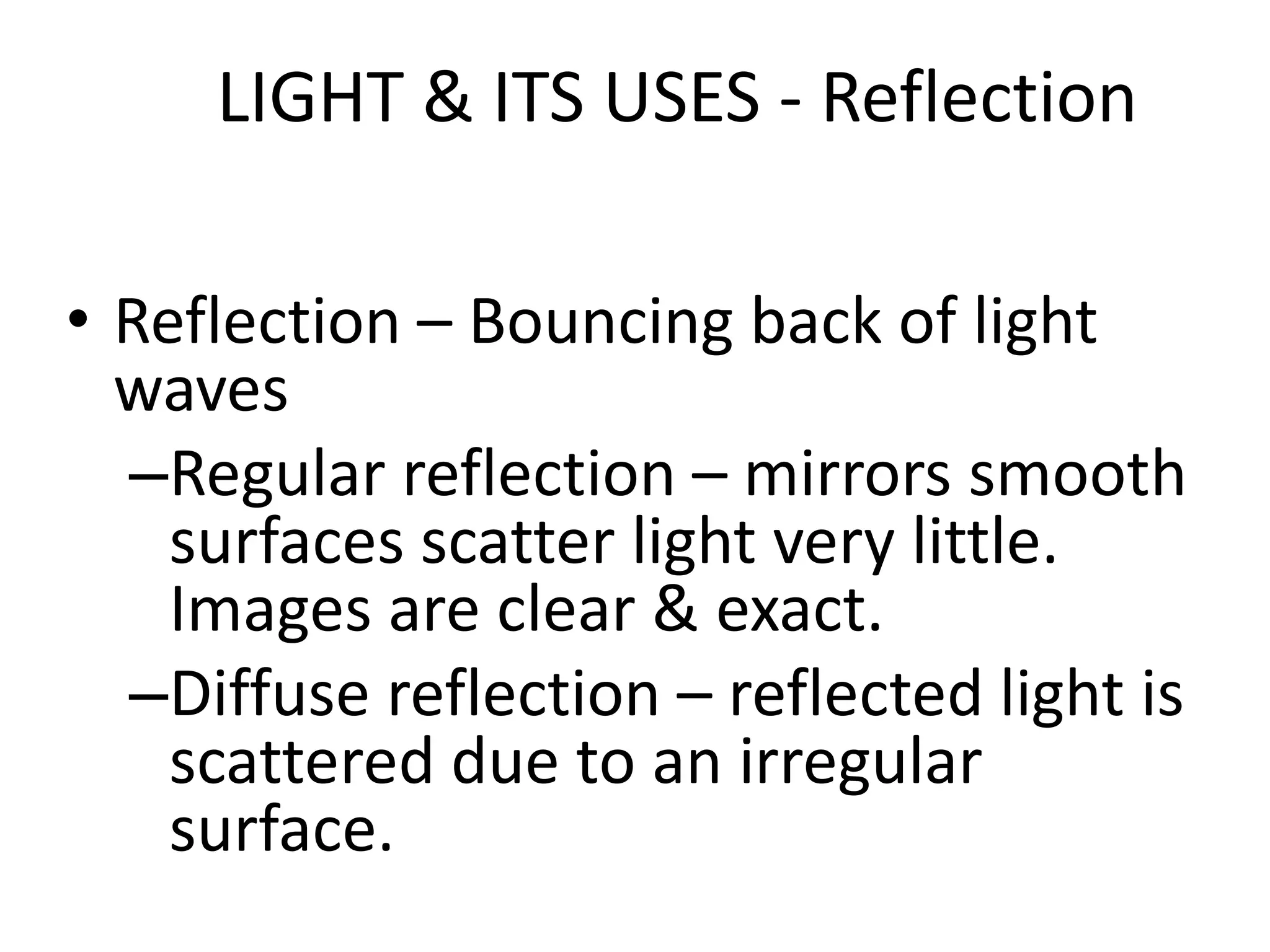
• Neon light –
  neon inside glass
  tubes makes red
  light. Other
  gases make other
  colors.
                           © 2000 Microsoft Clip Gallery
LIGHT & ITS USES - Reflection

• Reflection – Bouncing back of light
  waves
  –Regular reflection – mirrors smooth
    surfaces scatter light very little.
    Images are clear & exact.
  –Diffuse reflection – reflected light is
    scattered due to an irregular
    surface.
LIGHT & ITS USES:
          Reflection Vocabulary


• Enlarged –                                      © 2000 Microsoft Clip Gallery


  –Image is larger than actual
    object.
• Reduced –
  –Image is smaller than object.

                       © 2000 Microsoft Clip Gallery
LIGHT & ITS USES:
                                Reflection Vocabulary
© 2000 Microsoft Clip Gallery


• Erect –
   –Image is right side up.
• Inverted –
   –Image is upside down.

                                                  © 2000 Microsoft Clip Gallery
LIGHT & ITS USES:
            Reflection Vocabulary
• Real Image –
  –Image is made from “real” light rays
    that converge at a real focal point so
    the image is REAL
  –Can be projected onto a screen
    because light actually passes through
    the point where the image appears
  –Always inverted
LIGHT & ITS USES:
          Reflection Vocabulary


• Virtual Image–
  –“Not Real” because it cannot be
    projected
  –Image only seems to be there!
Light & Its Uses: Mirrors

• Reflection Vocabulary
                                © 2000 Microsoft Clip Gallery


  –Optical Axis – Base line through the
    center of a mirror or lens
  –Focal Point – Point where reflected or
    refracted rays meet & image is
    formed
  –Focal Length – Distance between
    center of mirror/lens and focal point
LIGHT & ITS USES: Mirrors


• Plane Mirrors – Perfectly flat
  – Virtual – Image is “Not Real” because it cannot
    be projected

  – Erect – Image is right side up


                                            © 2000 Microsoft Clip Gallery
LIGHT & ITS USES: Mirrors

   • Reflection & Mirrors (Cont.)
     –Convex Mirror
        • Curves outward
        • Enlarges images.
     –Use: Rear view mirrors, store
       security…
CAUTION! Objects are closer than they appear!
                                                © 2000 Microsoft Clip Gallery
LIGHT & ITS USES: Lenses

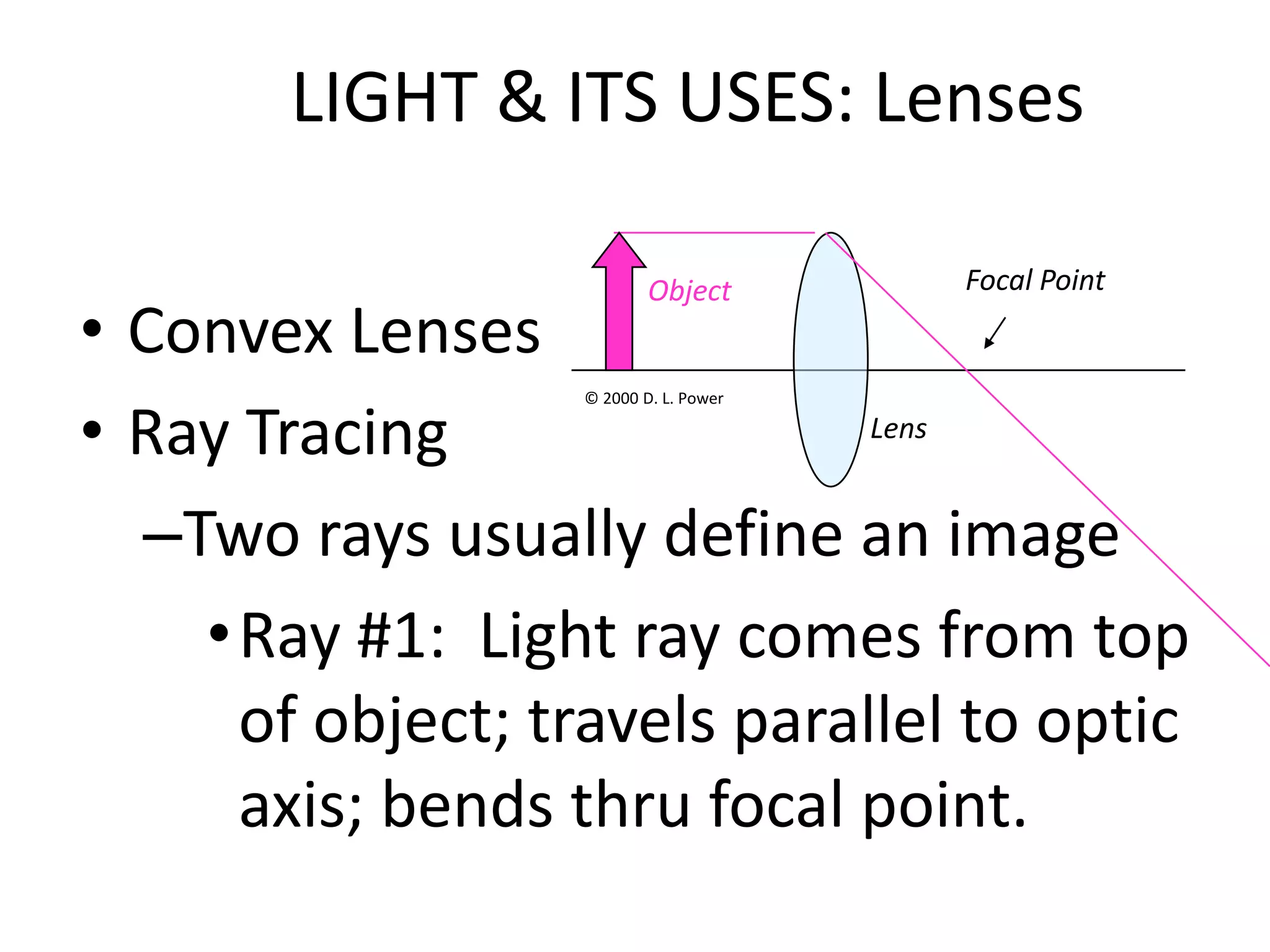
• Convex Lenses
  –Thicker in the center than edges.
  –Lens that converges (brings together)
   light rays.
  –Forms real images and virtual images
   depending on position of the object
LIGHT & ITS USES: Lenses

                           Object       Focal Point
• Convex Lenses
• Ray Tracing
                   © 2000 D. L. Power
                              Lens


  –Two rays usually define an image
    • Ray #1: Light ray comes from top
      of object; travels parallel to optic
      axis; bends thru focal point.
LIGHT & ITS USES: Lenses

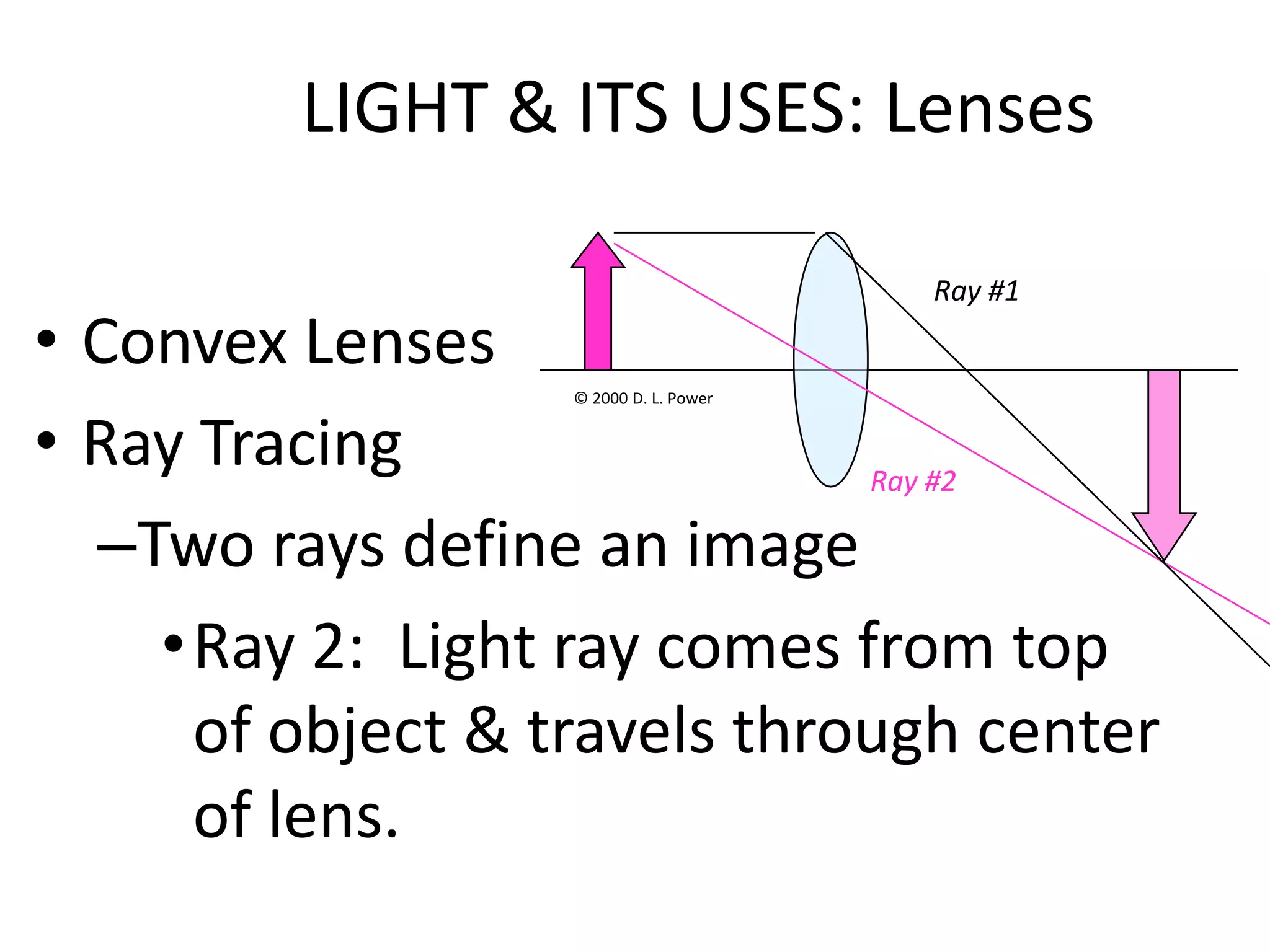
                                        Ray #1
• Convex Lenses
                   © 2000 D. L. Power


• Ray Tracing                 Ray #2

  –Two rays define an image
    • Ray 2: Light ray comes from top
      of object & travels through center
      of lens.
LIGHT & ITS USES: Lenses

                       © 2000 D. L. Power


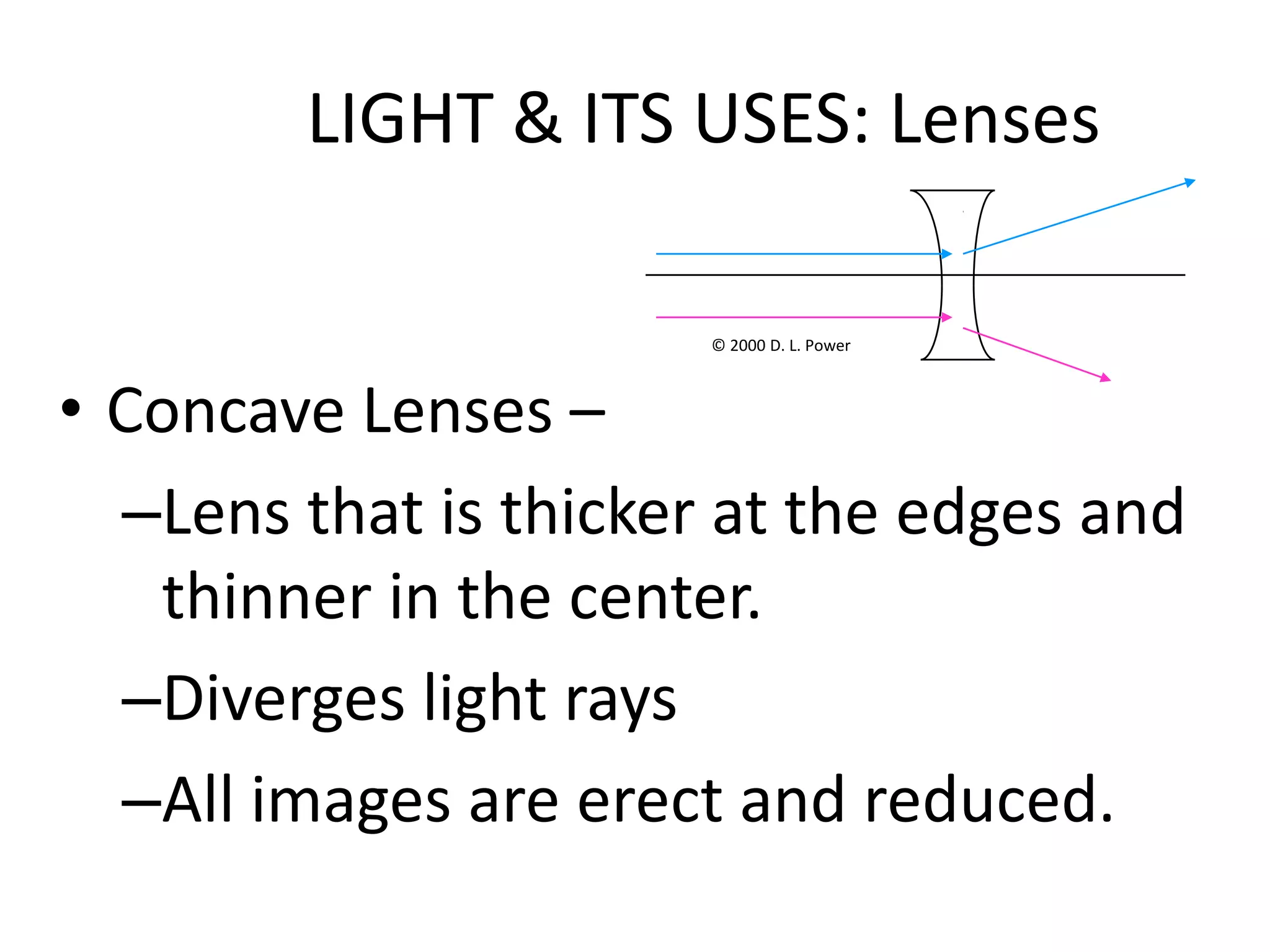
• Concave Lenses –
  –Lens that is thicker at the edges and
   thinner in the center.
  –Diverges light rays
  –All images are erect and reduced.
How You See

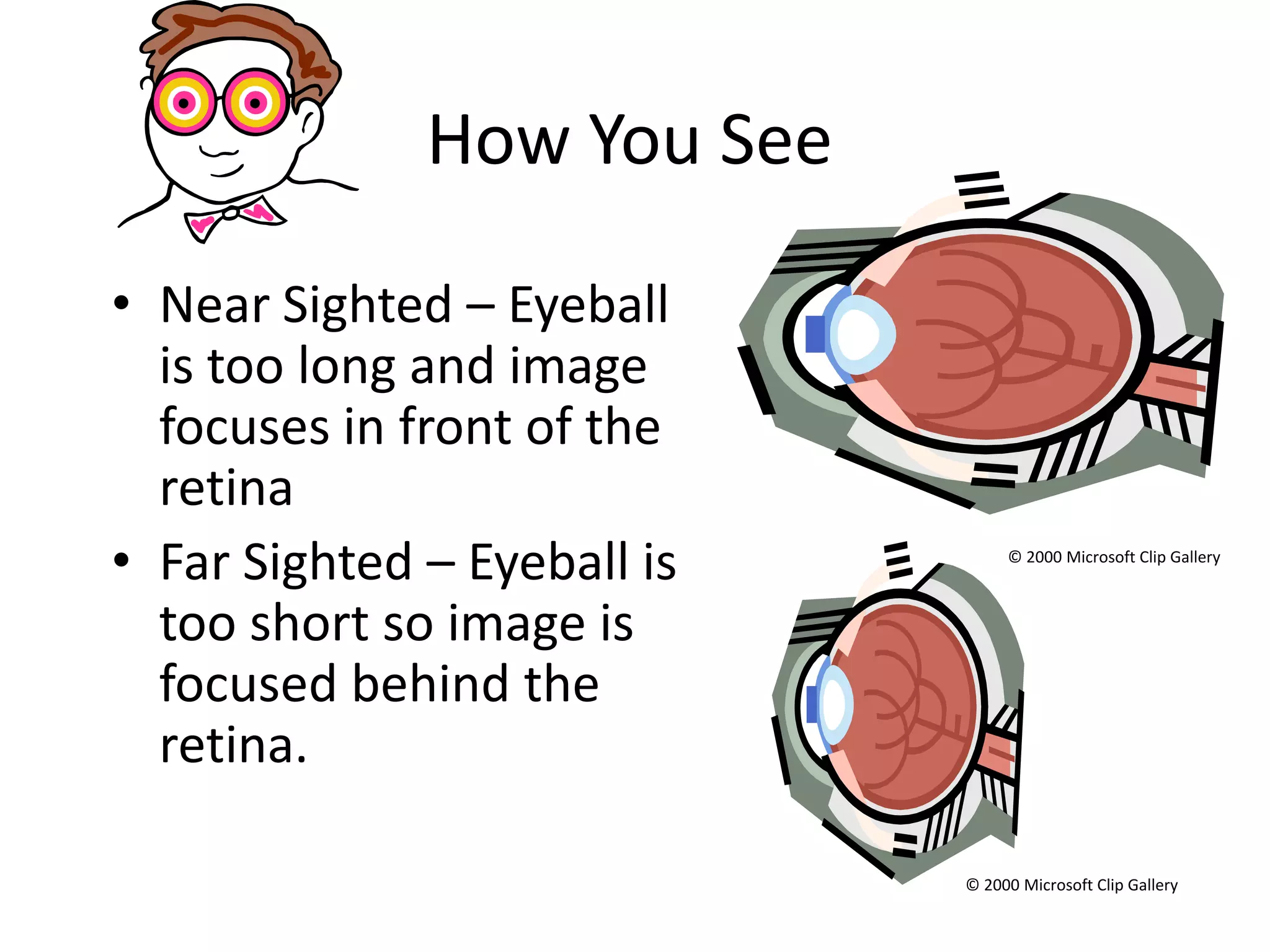
• Near Sighted – Eyeball
  is too long and image
  focuses in front of the
  retina
• Far Sighted – Eyeball is        © 2000 Microsoft Clip Gallery


  too short so image is
  focused behind the
  retina.

                             © 2000 Microsoft Clip Gallery
LIGHT & USES: Lenses

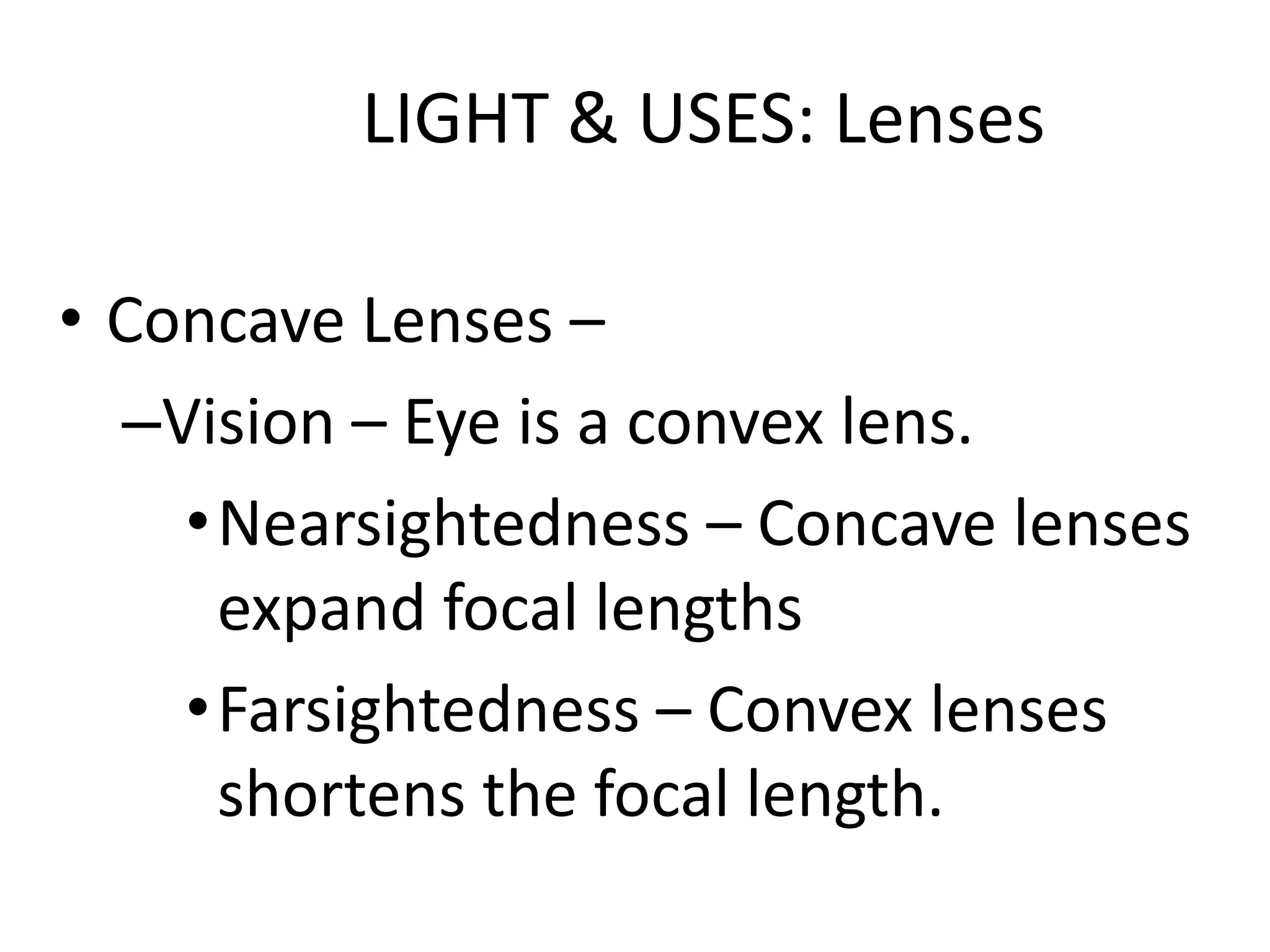
• Concave Lenses –
  –Vision – Eye is a convex lens.
    • Nearsightedness – Concave lenses
      expand focal lengths
    • Farsightedness – Convex lenses
      shortens the focal length.
LIGHT & USES: Optical Instruments


• Cameras
• Telescopes
• Microscopes                              © 2000 Microsoft Clip Gallery


           © 2000 Microsoft Clip Gallery                                   © 2000 Microsoft Clip Gallery
LIGHT & USES: Optical Instruments


• LASERS
   –Acronym: Light Amplification by
    Stimulated Emission of Radiation
   –Coherent Light – Waves are in phase
    so it is VERY powerful & VERY
    intense.
LIGHT & USES: Optical Instruments
• LASERS
  – Holography – Use of Lasers to create 3-D images
  – Fiber Optics – Light energy transferred through
    long, flexible fibers of glass/plastic
  – Uses – Communications, medicine, t.v.
    transmission, data processing.
LIGHT & USES: Diffraction


• Diffraction – Bending of waves around the
  edge of a barrier. New waves are formed
  from the original. breaks images into bands
  of light & dark and colors.
• Refraction – Bending of waves due to a
  change in speed through an object.
LIGHT & USES: Diffraction


                                                      © 2000 Microsoft Encarta


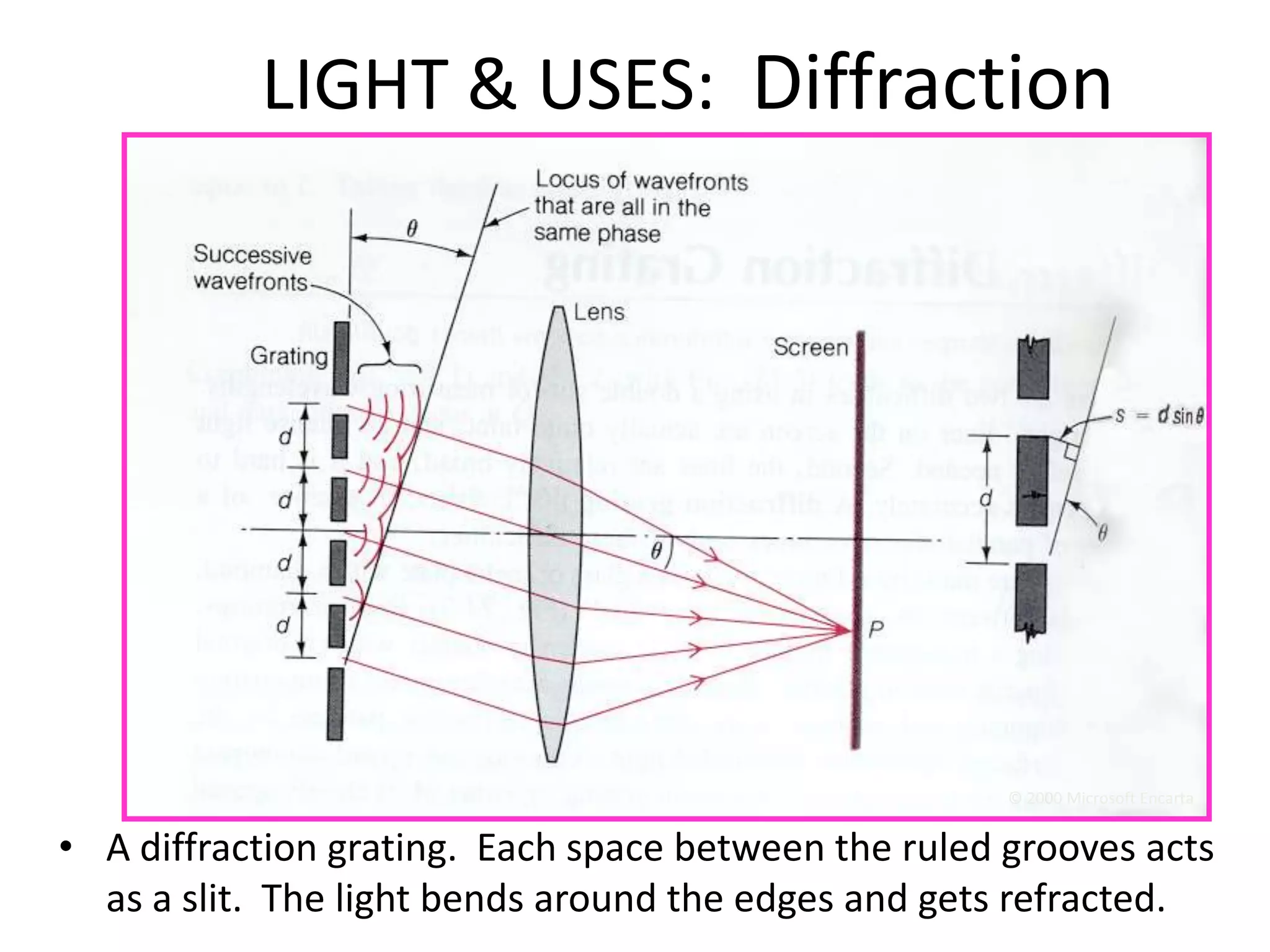
• A diffraction grating. Each space between the ruled grooves acts
  as a slit. The light bends around the edges and gets refracted.
EVALUATION: State Standards

• Waves carry energy from one place to another
• Identify transverse and longitudinal waves in
  mechanical media such as spring, ropes, and the
  earth (seismic waves)
• Solve problems involving
  wavelength, frequency, & speed.
.
EVALUATION: State Standards

• Radio waves, light, and x-rays are different
  wavelength bands in the spectrum of
  electromagnetic waves whose speed in vacuum is
  approximately 3x10 m/sec
• Sound is a longitudinal wave whose speed
  depends on the properties of the medium in
  which it propagates.
EVALUATION: State Standards

• Identify the characteristic properties of
  waves:
  – Interference
  – Diffraction
  – Refraction
  – Doppler Effect
  – Polarization.
The End…


© 2000 Microsoft Clip Gallery

Sound and light by Muhammad Fahad Ansari 12IEEM14

  • 1.
    Sound & Light •Muhammad Fahad Ansari 12IEEM14
  • 2.
    15 Lecture Materialfor Introduction of Environmental Physics Class 12 EE Batch 1. Sound and Light 2. Radiation Understanding 3. Global Warming 4. Terrestrial Environment 5. Extra-Terrestrial Environment 6. Natural and Man made radiation 7. Universe understanding 8. Understanding water 9. Cloud formation 10. Climate 11. Climate change
  • 3.
    Sound and Light • WABVES • Light & the Electromagnetic Spectrum • Refraction of Light • LIGHT & ITS USES
  • 4.
    © 2000 MicrosoftClip Gallery WAVES: SOUND & LIGHT Waves carry energy from one place to another
  • 5.
    NATURE OF WAVES •Waves (Def.) – A wave is a disturbance that © 2000 Microsoft Clip Gallery transfers energy. • Medium – Substance or region through which a wave is transmitted. • Speed of Waves – Depends on the properties of the medium.
  • 6.
    SAMPLE LESSON: Light& the Electromagnetic Spectrum © 2000 Microsoft Clip Gallery
  • 7.
  • 8.
    LIGHT: What IsIt? © 2000 Microsoft Clip Gallery • Light Energy – Atoms • As atoms absorb energy, electrons jump out to a higher energy level. • Electrons release light when falling down to the lower energy level. – Photons - bundles/packets of energy released when the electrons fall. • Light: Stream of Photons © 2000 Microsoft Clip Gallery
  • 9.
    Electromagnetic Waves • Speedin Vacuum –300,000 km/sec –186,000 mi/sec © 2000 Microsoft Clip Gallery • Speed in Other Materials –Slower in Air, Water, Glass
  • 10.
    Transverse Waves © 2000 Microsoft Clip Gallery • Energy is perpendicular to direction of motion • Moving photon creates electric & magnetic field –Light has BOTH Electric & Magnetic fields at right angles!
  • 11.
    Electromagnetic Spectrum © 2000 Microsoft Clip Gallery
  • 12.
    MAP TAP 2003-2004 The Electromagnetic Spectrum 12
  • 13.
    MAP TAP 2003-2004 The Electromagnetic Spectrum 13
  • 16.
    Electromagnetic Spectrum • VisibleSpectrum – Light we can see –Roy G. Biv – Acronym for Red, Orange, Yellow, Green, Blue, Indig o, & Violet. –Largest to Smallest Wavelength.
  • 17.
    Electromagnetic Spectrum • InvisibleSpectrum –Radio Waves • Def. – Longest wavelength & lowest frequency. • Uses – Radio & T.V. broadcasting. © 2000 Microsoft Clip Gallery
  • 18.
    Modulating Radio Waves ©2000 Microsoft Clip Gallery • Modulation - variation of amplitude or frequency when waves are broadcast – AM – amplitude modulation • Carries audio for T.V. Broadcasts • Longer wavelength so can bend around hills – FM – frequency modulation • Carries video for T.V. Broadcasts
  • 19.
    Short Wavelength Microwave •Invisible Spectrum (Cont.) –Infrared Rays • Def – Light rays with longer wavelength than red light. • Uses: Cooking, Medicine, T.V. remote controls
  • 20.
    Electromagnetic Spectrum • Invisiblespectrum (cont.). –Ultraviolet rays. • Def. – EM waves with frequencies slightly higher than visible light • Uses: food processing & hospitals to kill germs’ cells • Helps your body use vitamin D.
  • 21.
    Electromagnetic Spectrum • InvisibleSpectrum (Cont.) –X-Rays • Def. - EM waves that are shorter than UV rays. • Uses: Medicine – Bones absorb x- rays; soft tissue does not. • Lead absorbs X-rays.
  • 22.
    Electromagnetic Spectrum • Invisiblespectrum (cont.) –Gamma rays • Def. Highest frequency EM waves; Shortest wavelength. They come from outer space. • Uses: cancer treatment.
  • 23.
    LIGHT: Particles orWaves? • Wave Model of Light –Explains most properties of light • Particle Theory of Light –Photoelectric Effect – Photons of light produce free electrons © 2000 Microsoft Clip Gallery
  • 24.
    LIGHT: Refraction ofLight • Refraction – Bending of light due to a change in speed. – Index of Refraction – Amount by which a material refracts light. – Prisms – Glass that bends light. Different frequencies are bent different amounts & light is broken out into different colors.
  • 25.
  • 26.
    Refraction-Spectroscope Lab Hey girls!The filters go on the Spectroscope, not on the lashes! © 2000 D. L. Power
  • 27.
    Color of Light •Transparent Objects: © 2000 Microsoft Clip Gallery – Light transmitted because of no scattering – Color transmitted is color you see. All other colors are absorbed. • Translucent: – Light is scattered and transmitted some. • Opaque: – Light is either reflected or absorbed. – Color of opaque objects is color it reflects.
  • 28.
    Color of Light(Cont.) • Color of Objects – White light is the presence of ALL the colors of the visible spectrum. – Black objects absorb ALL the colors and no light is reflected back. © 2000 Microsoft Clip Gallery
  • 29.
    Color of Light(Cont.) © 2000 Microsoft Clip Gallery • Primary Colors of Light – Three colors that can be mixed to produce any other colored light – Red + blue + green = white light • Complimentary Colors of Light – Two complimentary colors combine to make white light-Magenta,Cyan,Yellow
  • 30.
    How You See © 2000 Microsoft Clip Gallery • Retina – – Lens refracts light to converge on the retina. Nerves transmit the image • Rods – – Nerve cells in the retina. Very sensitive to light & dark • Cones – – Nerve cells help to see light/color
  • 31.
    Paint Pigments © 2000Microsoft Clip Gallery – Pigments absorb the frequency of light that you see – Primary pigments • Yellow + cyan + magenta = black • Primary pigments are compliments of the primary colors of light.
  • 32.
    Complementary Pigments © 2000Microsoft Clip Gallery • Green, blue, red • Complimentary pigments are primary colors for light! © 2000 Microsoft Clip Gallery
  • 33.
    LIGHT & ITSUSES © 2000 Microsoft Clip Gallery • Sources of Light –Incandescent light – light produced by heating an object until it glows. © 2000 Microsoft Clip Gallery
  • 34.
    LIGHT & ITSUSES © 2000 Microsoft Clip Gallery • Fluorescent Light – – Light produced by electron bombardment of gas molecules – Phosphors absorb photons that are created when mercury gas gets zapped with electrons. The phosphors glow & produce light.
  • 35.
    LIGHT & ITSUSES - Neon • Neon light – neon inside glass tubes makes red light. Other gases make other colors. © 2000 Microsoft Clip Gallery
  • 36.
    LIGHT & ITSUSES - Reflection • Reflection – Bouncing back of light waves –Regular reflection – mirrors smooth surfaces scatter light very little. Images are clear & exact. –Diffuse reflection – reflected light is scattered due to an irregular surface.
  • 37.
    LIGHT & ITSUSES: Reflection Vocabulary • Enlarged – © 2000 Microsoft Clip Gallery –Image is larger than actual object. • Reduced – –Image is smaller than object. © 2000 Microsoft Clip Gallery
  • 38.
    LIGHT & ITSUSES: Reflection Vocabulary © 2000 Microsoft Clip Gallery • Erect – –Image is right side up. • Inverted – –Image is upside down. © 2000 Microsoft Clip Gallery
  • 39.
    LIGHT & ITSUSES: Reflection Vocabulary • Real Image – –Image is made from “real” light rays that converge at a real focal point so the image is REAL –Can be projected onto a screen because light actually passes through the point where the image appears –Always inverted
  • 40.
    LIGHT & ITSUSES: Reflection Vocabulary • Virtual Image– –“Not Real” because it cannot be projected –Image only seems to be there!
  • 41.
    Light & ItsUses: Mirrors • Reflection Vocabulary © 2000 Microsoft Clip Gallery –Optical Axis – Base line through the center of a mirror or lens –Focal Point – Point where reflected or refracted rays meet & image is formed –Focal Length – Distance between center of mirror/lens and focal point
  • 42.
    LIGHT & ITSUSES: Mirrors • Plane Mirrors – Perfectly flat – Virtual – Image is “Not Real” because it cannot be projected – Erect – Image is right side up © 2000 Microsoft Clip Gallery
  • 43.
    LIGHT & ITSUSES: Mirrors • Reflection & Mirrors (Cont.) –Convex Mirror • Curves outward • Enlarges images. –Use: Rear view mirrors, store security… CAUTION! Objects are closer than they appear! © 2000 Microsoft Clip Gallery
  • 44.
    LIGHT & ITSUSES: Lenses • Convex Lenses –Thicker in the center than edges. –Lens that converges (brings together) light rays. –Forms real images and virtual images depending on position of the object
  • 45.
    LIGHT & ITSUSES: Lenses Object Focal Point • Convex Lenses • Ray Tracing © 2000 D. L. Power Lens –Two rays usually define an image • Ray #1: Light ray comes from top of object; travels parallel to optic axis; bends thru focal point.
  • 46.
    LIGHT & ITSUSES: Lenses Ray #1 • Convex Lenses © 2000 D. L. Power • Ray Tracing Ray #2 –Two rays define an image • Ray 2: Light ray comes from top of object & travels through center of lens.
  • 47.
    LIGHT & ITSUSES: Lenses © 2000 D. L. Power • Concave Lenses – –Lens that is thicker at the edges and thinner in the center. –Diverges light rays –All images are erect and reduced.
  • 48.
    How You See •Near Sighted – Eyeball is too long and image focuses in front of the retina • Far Sighted – Eyeball is © 2000 Microsoft Clip Gallery too short so image is focused behind the retina. © 2000 Microsoft Clip Gallery
  • 49.
    LIGHT & USES:Lenses • Concave Lenses – –Vision – Eye is a convex lens. • Nearsightedness – Concave lenses expand focal lengths • Farsightedness – Convex lenses shortens the focal length.
  • 50.
    LIGHT & USES:Optical Instruments • Cameras • Telescopes • Microscopes © 2000 Microsoft Clip Gallery © 2000 Microsoft Clip Gallery © 2000 Microsoft Clip Gallery
  • 51.
    LIGHT & USES:Optical Instruments • LASERS –Acronym: Light Amplification by Stimulated Emission of Radiation –Coherent Light – Waves are in phase so it is VERY powerful & VERY intense.
  • 52.
    LIGHT & USES:Optical Instruments • LASERS – Holography – Use of Lasers to create 3-D images – Fiber Optics – Light energy transferred through long, flexible fibers of glass/plastic – Uses – Communications, medicine, t.v. transmission, data processing.
  • 53.
    LIGHT & USES:Diffraction • Diffraction – Bending of waves around the edge of a barrier. New waves are formed from the original. breaks images into bands of light & dark and colors. • Refraction – Bending of waves due to a change in speed through an object.
  • 54.
    LIGHT & USES:Diffraction © 2000 Microsoft Encarta • A diffraction grating. Each space between the ruled grooves acts as a slit. The light bends around the edges and gets refracted.
  • 55.
    EVALUATION: State Standards •Waves carry energy from one place to another • Identify transverse and longitudinal waves in mechanical media such as spring, ropes, and the earth (seismic waves) • Solve problems involving wavelength, frequency, & speed. .
  • 56.
    EVALUATION: State Standards •Radio waves, light, and x-rays are different wavelength bands in the spectrum of electromagnetic waves whose speed in vacuum is approximately 3x10 m/sec • Sound is a longitudinal wave whose speed depends on the properties of the medium in which it propagates.
  • 57.
    EVALUATION: State Standards •Identify the characteristic properties of waves: – Interference – Diffraction – Refraction – Doppler Effect – Polarization.
  • 58.
    The End… © 2000Microsoft Clip Gallery