Page 1
The ulTIMaTe guIde To
lIVIng green Wall lIghTIng
by Eric Westerduin of Suite Plants
Table of Contents
Introduction |4|
Types of Light |6|
Measuring Light Intensity |7|
Light Quality |8|
Selecting the Right Bulbs |14|
Incandescent Bulb |17|
Halogen Bulb |17|
Flourescent Tubes |18|
Light Emitting Diodes (LED) |20|
High Intensity Discharge (HID) Lamps |20|
Summary |21|
Page 4
Proper LIghting
is absolutely essential to the success of a living wall, or any indoor plants for that matter. Light is the food
that fuels healthy plant growth. Plants without enough light will get thin, lose color, grow "stretchy" and look
unhealthy. Unhealthy plants are not attractive. Learning about proper lighting will ensure that your next
living wall installation looks like a luscious green jungle.
Insufficient lighting is the most frequent cause of living wall failures. We know that lack of light results
in unhealthy looking plants, but it also causes the plants to stop drinking water. Because the plants stop
drinking, excess water builds up in the soil and creates a toxic anaerobic environment. This damp soil
downs the plants and causes root rot. It is also a fertile environment for soil-borne pathogens, molds and
bugs, which can further compound the problem.
Since insufficient lighting can lead to a host of nasty problems, it's imperative that we learn how to properly
light a living wall. To do this, we need to understand the different types of light, how to measure light
intensity, light quality and how to select the right light bulbs. The science behind can be complicated, so
here's a brief synopsis before we get started:
What is Light?
Light is actually just waves of electromagnetic radiation. There is a wide range of electromagnetic
radiation including X-rays, Microwaves and FM/AM radio waves. What we refer to as light is the
portion of these waves which is visible to the human eye. Visible light has a wavelength in the range
of 400 nanometres (nm) to 700 nanometres – between the infrared (with longer wavelengths) and the
ultraviolet (with shorter wavelengths).
Types Of Light:
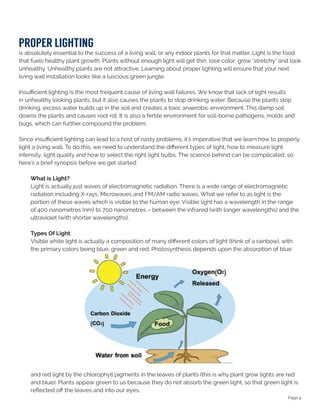
Visible white light is actually a composition of many different colors of light (think of a rainbow), with
the primary colors being blue, green and red. Photosynthesis depends upon the absorption of blue
and red light by the chlorophyll pigments in the leaves of plants (this is why plant grow lights are red
and blue). Plants appear green to us because they do not absorb the green light, so that green light is
reflected off the leaves and into our eyes.
Page 5
Measuring Light Intensity:
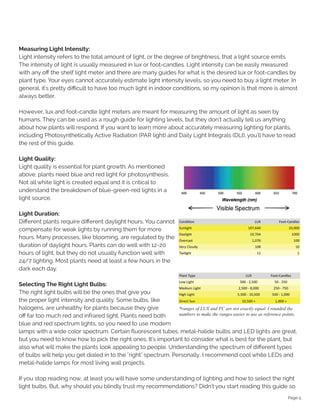
Light intensity refers to the total amount of light, or the degree of brightness, that a light source emits.
The intensity of light is usually measured in lux or foot-candles. Light intensity can be easily measured
with any off the shelf light meter and there are many guides for what is the desired lux or foot-candles by
plant type. Your eyes cannot accurately estimate light intensity levels, so you need to buy a light meter. In
general, it's pretty difficult to have too much light in indoor conditions, so my opinion is that more is almost
always better.
However, lux and foot-candle light meters are meant for measuring the amount of light as seen by
humans. They can be used as a rough guide for lighting levels, but they don’t actually tell us anything
about how plants will respond. If you want to learn more about accurately measuring lighting for plants,
including Photosynthetically Active Radiation (PAR light) and Daily Light Integrals (DLI), you'll have to read
the rest of this guide.
Light Quality:
Light quality is essential for plant growth. As mentioned
above, plants need blue and red light for photosynthesis.
Not all white light is created equal and it is critical to
understand the breakdown of blue-green-red lights in a
light source.
Light Duration:
Different plants require different daylight hours. You cannot
compensate for weak lights by running them for more
hours. Many processes, like blooming, are regulated by the
duration of daylight hours. Plants can do well with 12-20
hours of light, but they do not usually function well with
24/7 lighting. Most plants need at least a few hours in the
dark each day.
Selecting The Right Light Bulbs:
The right light bulbs will be the ones that give you
the proper light intensity and quality. Some bulbs, like
halogens, are unhealthy for plants because they give
off far too much red and infrared light. Plants need both
blue and red spectrum lights, so you need to use modern
lamps with a wide color spectrum. Certain fluorescent tubes, metal-halide bulbs and LED lights are great,
but you need to know how to pick the right ones. It's important to consider what is best for the plant, but
also what will make the plants look appealing to people. Understanding the spectrum of different types
of bulbs will help you get dialed in to the "right" spectrum. Personally, I recommend cool white LEDs and
metal-halide lamps for most living wall projects.
If you stop reading now, at least you will have some understanding of lighting and how to select the right
light bulbs. But, why should you blindly trust my recommendations? Didn't you start reading this guide so
Page 6
that you could finally learn about lighting once and for all? I strongly suggest that you keep reading and
learn about the science behind lighting and how to pick the right light bulbs.
This can get a little complicated, but I'm going to do my best to make this science easy to understand.
Types of Light
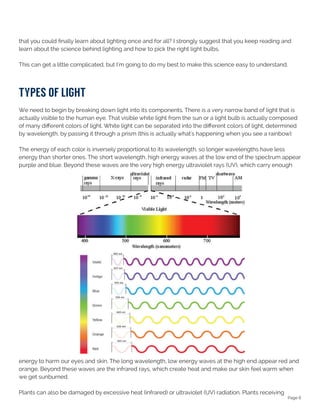
We need to begin by breaking down light into its components. There is a very narrow band of light that is
actually visible to the human eye. That visible white light from the sun or a light bulb is actually composed
of many different colors of light. White light can be separated into the different colors of light, determined
by wavelength, by passing it through a prism (this is actually what's happening when you see a rainbow):
The energy of each color is inversely proportional to its wavelength, so longer wavelengths have less
energy than shorter ones. The short wavelength, high energy waves at the low end of the spectrum appear
purple and blue. Beyond these waves are the very high energy ultraviolet rays (UV), which carry enough
energy to harm our eyes and skin. The long wavelength, low energy waves at the high end appear red and
orange. Beyond these waves are the infrared rays, which create heat and make our skin feel warm when
we get sunburned.
Plants can also be damaged by excessive heat (infrared) or ultraviolet (UV) radiation. Plants receiving
Page 7
excessive amounts of light can dry up, develop extra growing points, become bleached (through the
destruction of chlorophyll) and display other symptoms of excessive stress. However, the risk of infrared
and UV damage with artificial lighting indoors is minimal.
Now that we understand white light's components, the next step is to determine its intensity.
Measuring Light Intensity
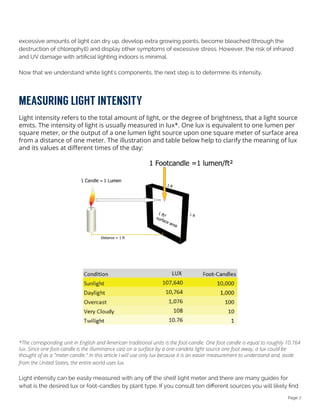
Light intensity refers to the total amount of light, or the degree of brightness, that a light source
emits. The intensity of light is usually measured in lux*. One lux is equivalent to one lumen per
square meter, or the output of a one lumen light source upon one square meter of surface area
from a distance of one meter. The illustration and table below help to clarify the meaning of lux
and its values at different times of the day:
*The corresponding unit in English and American traditional units is the foot-candle. One foot candle is equal to roughly 10.764
lux. Since one foot-candle is the illuminance cast on a surface by a one-candela light source one foot away, a lux could be
thought of as a "meter-candle." In this article I will use only lux because it is an easier measurement to understand and, aside
from the United States, the entire world uses lux.
Light intensity can be easily measured with any off the shelf light meter and there are many guides for
what is the desired lux or foot-candles by plant type. If you consult ten different sources you will likely find
Page 8
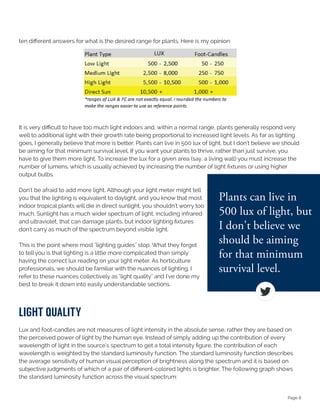
ten different answers for what is the desired range for plants. Here is my opinion:
It is very difficult to have too much light indoors and, within a normal range, plants generally respond very
well to additional light with their growth rate being proportional to increased light levels. As far as lighting
goes, I generally believe that more is better. Plants can live in 500 lux of light, but I don't believe we should
be aiming for that minimum survival level. If you want your plants to thrive, rather than just survive, you
have to give them more light. To increase the lux for a given area (say, a living wall) you must increase the
number of lumens, which is usually achieved by increasing the number of light fixtures or using higher
output bulbs.
Don't be afraid to add more light. Although your light meter might tell
you that the lighting is equivalent to daylight, and you know that most
indoor tropical plants will die in direct sunlight, you shouldn't worry too
much. Sunlight has a much wider spectrum of light, including infrared
and ultraviolet, that can damage plants, but indoor lighting fixtures
don't carry as much of the spectrum beyond visible light.
This is the point where most "lighting guides" stop. What they forget
to tell you is that lighting is a little more complicated than simply
having the correct lux reading on your light meter. As horticulture
professionals, we should be familiar with the nuances of lighting. I
refer to these nuances collectively as "light quality" and I've done my
best to break it down into easily understandable sections.
lIghT QualITy
Lux and foot-candles are not measures of light intensity in the absolute sense, rather they are based on
the perceived power of light by the human eye. Instead of simply adding up the contribution of every
wavelength of light in the source's spectrum to get a total intensity figure, the contribution of each
wavelength is weighted by the standard luminosity function. The standard luminosity function describes
the average sensitivity of human visual perception of brightness along the spectrum and it is based on
subjective judgments of which of a pair of different-colored lights is brighter. The following graph shows
the standard luminosity function across the visual spectrum:
Page 9
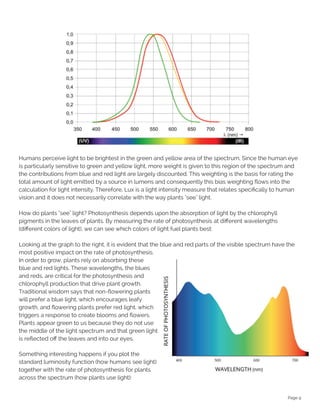
Humans perceive light to be brightest in the green and yellow area of the spectrum. Since the human eye
is particularly sensitive to green and yellow light, more weight is given to this region of the spectrum and
the contributions from blue and red light are largely discounted. This weighting is the basis for rating the
total amount of light emitted by a source in lumens and consequently this bias weighting flows into the
calculation for light intensity. Therefore, Lux is a light intensity measure that relates specifically to human
vision and it does not necessarily correlate with the way plants "see" light.
How do plants "see" light? Photosynthesis depends upon the absorption of light by the chlorophyll
pigments in the leaves of plants. By measuring the rate of photosynthesis at different wavelengths
(different colors of light), we can see which colors of light fuel plants best:
Looking at the graph to the right, it is evident that the blue and red parts of the visible spectrum have the
most positive impact on the rate of photosynthesis.
In order to grow, plants rely on absorbing these
blue and red lights. These wavelengths, the blues
and reds, are critical for the photosynthesis and
chlorophyll production that drive plant growth.
Traditional wisdom says that non-flowering plants
will prefer a blue light, which encourages leafy
growth, and flowering plants prefer red light, which
triggers a response to create blooms and flowers.
Plants appear green to us because they do not use
the middle of the light spectrum and that green light
is reflected off the leaves and into our eyes.
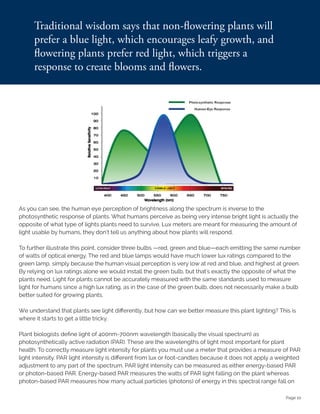
Something interesting happens if you plot the
standard luminosity function (how humans see light)
together with the rate of photosynthesis for plants
across the spectrum (how plants use light):
Page 10
As you can see, the human eye perception of brightness along the spectrum is inverse to the
photosynthetic response of plants. What humans perceive as being very intense bright light is actually the
opposite of what type of lights plants need to survive. Lux meters are meant for measuring the amount of
light usable by humans, they don’t tell us anything about how plants will respond.
To further illustrate this point, consider three bulbs —red, green and blue—each emitting the same number
of watts of optical energy. The red and blue lamps would have much lower lux ratings compared to the
green lamp, simply because the human visual perception is very low at red and blue, and highest at green.
By relying on lux ratings alone we would install the green bulb, but that's exactly the opposite of what the
plants need. Light for plants cannot be accurately measured with the same standards used to measure
light for humans since a high lux rating, as in the case of the green bulb, does not necessarily make a bulb
better suited for growing plants.
We understand that plants see light differently, but how can we better measure this plant lighting? This is
where it starts to get a little tricky.
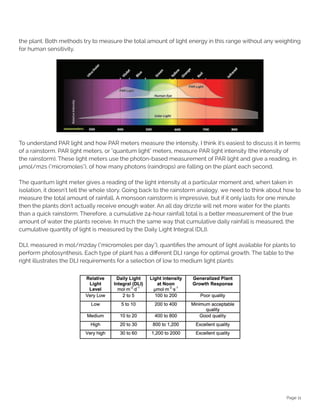
Plant biologists define light of 400nm-700nm wavelength (basically the visual spectrum) as
photosynthetically active radiation (PAR). These are the wavelengths of light most important for plant
health. To correctly measure light intensity for plants you must use a meter that provides a measure of PAR
light intensity. PAR light intensity is different from lux or foot-candles because it does not apply a weighted
adjustment to any part of the spectrum. PAR light intensity can be measured as either energy-based PAR
or photon-based PAR. Energy-based PAR measures the watts of PAR light falling on the plant whereas
photon-based PAR measures how many actual particles (photons) of energy in this spectral range fall on
Page 11
the plant. Both methods try to measure the total amount of light energy in this range without any weighting
for human sensitivity.
To understand PAR light and how PAR meters measure the intensity, I think it's easiest to discuss it in terms
of a rainstorm. PAR light meters, or "quantum light" meters, measure PAR light intensity (the intensity of
the rainstorm). These light meters use the photon-based measurement of PAR light and give a reading, in
µmol/m2s ("micromoles"), of how many photons (raindrops) are falling on the plant each second.
The quantum light meter gives a reading of the light intensity at a particular moment and, when taken in
isolation, it doesn't tell the whole story. Going back to the rainstorm analogy, we need to think about how to
measure the total amount of rainfall. A monsoon rainstorm is impressive, but if it only lasts for one minute
then the plants don't actually receive enough water. An all day drizzle will net more water for the plants
than a quick rainstorm. Therefore, a cumulative 24-hour rainfall total is a better measurement of the true
amount of water the plants receive. In much the same way that cumulative daily rainfall is measured, the
cumulative quantity of light is measured by the Daily Light Integral (DLI).
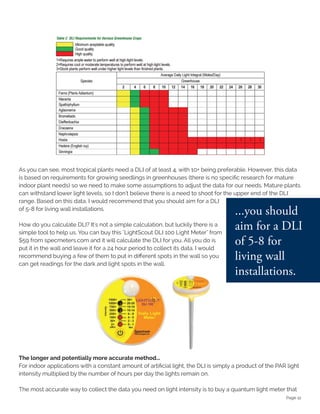
DLI, measured in mol/m2day ("micromoles per day"), quantifies the amount of light available for plants to
perform photosynthesis. Each type of plant has a different DLI range for optimal growth. The table to the
right illustrates the DLI requirements for a selection of low to medium light plants:
Page 12
As you can see, most tropical plants need a DLI of at least 4, with 10+ being preferable. However, this data
is based on requirements for growing seedlings in greenhouses (there is no specific research for mature
indoor plant needs) so we need to make some assumptions to adjust the data for our needs. Mature plants
can withstand lower light levels, so I don't believe there is a need to shoot for the upper end of the DLI
range. Based on this data, I would recommend that you should aim for a DLI
of 5-8 for living wall installations.
How do you calculate DLI? It's not a simple calculation, but luckily there is a
simple tool to help us. You can buy this "LightScout DLI 100 Light Meter" from
$59 from specmeters.com and it will calculate the DLI for you. All you do is
put it in the wall and leave it for a 24 hour period to collect its data. I would
recommend buying a few of them to put in different spots in the wall so you
can get readings for the dark and light spots in the wall.
The longer and potentially more accurate method...
For indoor applications with a constant amount of artificial light, the DLI is simply a product of the PAR light
intensity multiplied by the number of hours per day the lights remain on.
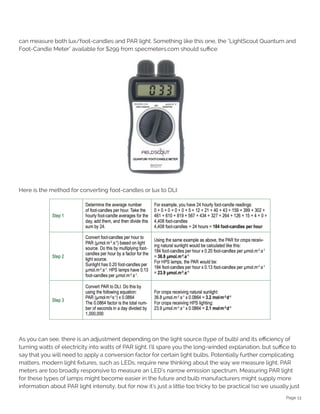
The most accurate way to collect the data you need on light intensity is to buy a quantum light meter that
Page 13
can measure both lux/foot-candles and PAR light. Something like this one, the "LightScout Quantum and
Foot-Candle Meter" available for $299 from specmeters.com should suffice:
Here is the method for converting foot-candles or lux to DLI:
As you can see, there is an adjustment depending on the light source (type of bulb) and its efficiency of
turning watts of electricity into watts of PAR light. I'll spare you the long-winded explanation, but suffice to
say that you will need to apply a conversion factor for certain light bulbs. Potentially further complicating
matters, modern light fixtures, such as LEDs, require new thinking about the way we measure light. PAR
meters are too broadly responsive to measure an LED's narrow emission spectrum. Measuring PAR light
for these types of lamps might become easier in the future and bulb manufacturers might supply more
information about PAR light intensity, but for now it's just a little too tricky to be practical (so we usually just

Page 14
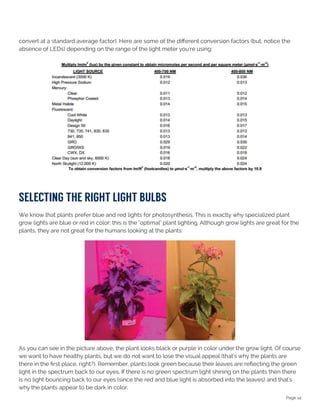
convert at a standard average factor). Here are some of the different conversion factors (but, notice the
absence of LEDs) depending on the range of the light meter you're using:
seleCTIng The rIghT lIghT bulbs
We know that plants prefer blue and red lights for photosynthesis. This is exactly why specialized plant
grow lights are blue or red in color; this is the "optimal" plant lighting. Although grow lights are great for the
plants, they are not great for the humans looking at the plants:
As you can see in the picture above, the plant looks black or purple in color under the grow light. Of course
we want to have healthy plants, but we do not want to lose the visual appeal (that's why the plants are
there in the first place, right?). Remember, plants look green because their leaves are reflecting the green
light in the spectrum back to our eyes. If there is no green spectrum light shining on the plants then there
is no light bouncing back to our eyes (since the red and blue light is absorbed into the leaves) and that's
why the plants appear to be dark in color.
Page 15
Of course we want to have quality lighting that's good for the plants, but we also want to make sure the
plants look appealing to the human eye. In this final section we will discuss how to select the right light
bulbs (lamps).
There are many different types of light bulbs including incandescent, fluorescent, halogen, High Intensity
Discharge (HID) and Light Emitting Diode (LED). Each bulb has its own rating for energy use (watts), light
output (lumens), color temperature (degrees Kelvin) and color rendering index (CRI). Watts and lumen are
pretty intuitive to understand, but it's the color temperature and color rendering index that deserve more
discussion.
The color rendering index identifies the degree of color shift objects undergo when illuminated by a
particular light source compared to a standard source. In simple terms, the CRI expresses the degree to
which a light source renders the true color impression. The CRI is an index and ranges from 0 to 100. A
light source having a CRI of 100 means objects illuminated by it look like they're supposed to; that is their
natural color is not distorted. A light source having a very low CRI would tend to make objects appear to
be a different shade or even color that they really are. An example of light with a high CRI is, obviously,
sunlight. A plant grow light has a very low CRI (remember the ugly plants under the grow light). CRI is
important because you want your plants to look appealing and display their natural colors.
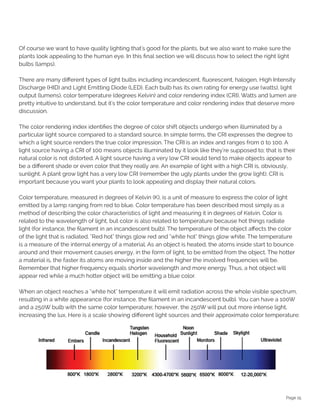
Color temperature, measured in degrees of Kelvin (K), is a unit of measure to express the color of light
emitted by a lamp ranging from red to blue. Color temperature has been described most simply as a
method of describing the color characteristics of light and measuring it in degrees of Kelvin. Color is
related to the wavelength of light, but color is also related to temperature because hot things radiate
light (for instance, the filament in an incandescent bulb). The temperature of the object affects the color
of the light that is radiated. "Red hot" things glow red and "white hot" things glow white. The temperature
is a measure of the internal energy of a material. As an object is heated, the atoms inside start to bounce
around and their movement causes energy, in the form of light, to be emitted from the object. The hotter
a material is, the faster its atoms are moving inside and the higher the involved frequencies will be.
Remember that higher frequency equals shorter wavelength and more energy. Thus, a hot object will
appear red while a much hotter object will be emitting a blue color.
When an object reaches a "white hot" temperature it will emit radiation across the whole visible spectrum,
resulting in a white appearance (for instance, the filament in an incandescent bulb). You can have a 100W
and a 250W bulb with the same color temperature; however, the 250W will put out more intense light,
increasing the lux. Here is a scale showing different light sources and their approximate color temperature:
Page 16
As we already know, the color of the light will determine a
plant's ability to thrive. The blues encourage good leaf and
stem growth while reds and oranges promote flowering.
Sunlight naturally provides a full spectrum of light, but
interior plants must rely on artificial lighting that is imperfect.
For indoor applications we want to make sure that we are
providing enough red and blue light for the plants.
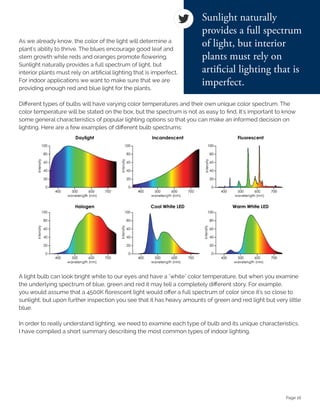
Different types of bulbs will have varying color temperatures and their own unique color spectrum. The
color temperature will be stated on the box, but the spectrum is not as easy to find. It's important to know
some general characteristics of popular lighting options so that you can make an informed decision on
lighting. Here are a few examples of different bulb spectrums:
A light bulb can look bright white to our eyes and have a "white" color temperature, but when you examine
the underlying spectrum of blue, green and red it may tell a completely different story. For example,
you would assume that a 4500K florescent light would offer a full spectrum of color since it's so close to
sunlight, but upon further inspection you see that it has heavy amounts of green and red light but very little
blue.
In order to really understand lighting, we need to examine each type of bulb and its unique characteristics.
I have compiled a short summary describing the most common types of indoor lighting.
Page 17
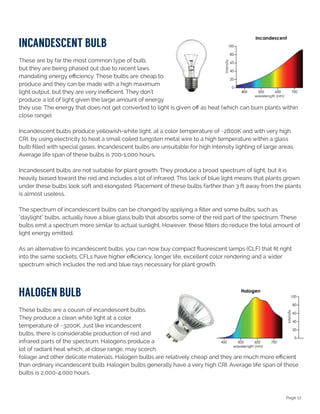
Incandescent bulb
These are by far the most common type of bulb,
but they are being phased out due to recent laws
mandating energy efficiency. These bulbs are cheap to
produce and they can be made with a high maximum
light output, but they are very inefficient. They don't
produce a lot of light given the large amount of energy
they use. The energy that does not get converted to light is given off as heat (which can burn plants within
close range).
Incandescent bulbs produce yellowish-white light, at a color temperature of ~2800K and with very high
CRI, by using electricity to heat a small coiled tungsten metal wire to a high temperature within a glass
bulb filled with special gases. Incandescent bulbs are unsuitable for high intensity lighting of large areas.
Average life span of these bulbs is 700-1,000 hours.
Incandescent bulbs are not suitable for plant growth. They produce a broad spectrum of light, but it is
heavily biased toward the red and includes a lot of infrared. This lack of blue light means that plants grown
under these bulbs look soft and elongated. Placement of these bulbs farther than 3 ft away from the plants
is almost useless.
The spectrum of incandescent bulbs can be changed by applying a filter and some bulbs, such as
"daylight" bulbs, actually have a blue glass bulb that absorbs some of the red part of the spectrum. These
bulbs emit a spectrum more similar to actual sunlight. However, these filters do reduce the total amount of
light energy emitted.
As an alternative to incandescent bulbs, you can now buy compact fluorescent lamps (CLF) that fit right
into the same sockets. CFLs have higher efficiency, longer life, excellent color rendering and a wider
spectrum which includes the red and blue rays necessary for plant growth.
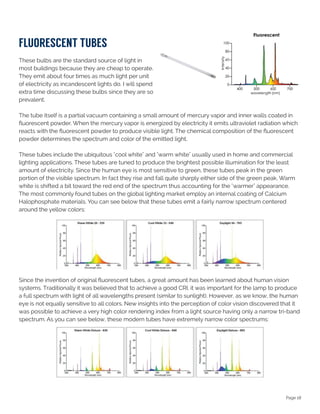
Halogen bulb
These bulbs are a cousin of incandescent bulbs.
They produce a clean white light at a color
temperature of ~3200K. Just like incandescent
bulbs, there is considerable production of red and
infrared parts of the spectrum. Halogens produce a
lot of radiant heat which, at close range, may scorch
foliage and other delicate materials. Halogen bulbs are relatively cheap and they are much more efficient
than ordinary incandescent bulb. Halogen bulbs generally have a very high CRI. Average life span of these
bulbs is 2,000-4,000 hours.
Page 18
Fluorescent tubes
These bulbs are the standard source of light in
most buildings because they are cheap to operate.
They emit about four times as much light per unit
of electricity as incandescent lights do. I will spend
extra time discussing these bulbs since they are so
prevalent.
The tube itself is a partial vacuum containing a small amount of mercury vapor and inner walls coated in
fluorescent powder. When the mercury vapor is energized by electricity it emits ultraviolet radiation which
reacts with the fluorescent powder to produce visible light. The chemical composition of the fluorescent
powder determines the spectrum and color of the emitted light.
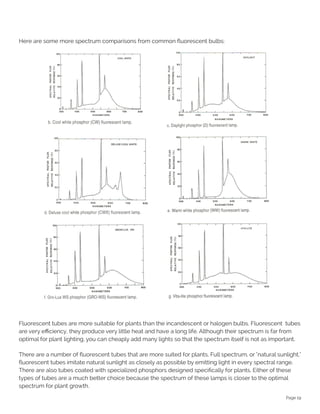
These tubes include the ubiquitous "cool white" and "warm white" usually used in home and commercial
lighting applications. These tubes are tuned to produce the brightest possible illumination for the least
amount of electricity. Since the human eye is most sensitive to green, these tubes peak in the green
portion of the visible spectrum. In fact they rise and fall quite sharply either side of the green peak. Warm
white is shifted a bit toward the red end of the spectrum thus accounting for the "warmer" appearance.
The most commonly found tubes on the global lighting market employ an internal coating of Calcium
Halophosphate materials. You can see below that these tubes emit a fairly narrow spectrum centered
around the yellow colors:
Since the invention of original fluorescent tubes, a great amount has been learned about human vision
systems. Traditionally it was believed that to achieve a good CRI, it was important for the lamp to produce
a full spectrum with light of all wavelengths present (similar to sunlight). However, as we know, the human
eye is not equally sensitive to all colors. New insights into the perception of color vision discovered that it
was possible to achieve a very high color rendering index from a light source having only a narrow tri-band
spectrum. As you can see below, these modern tubes have extremely narrow color spectrums:
Page 19
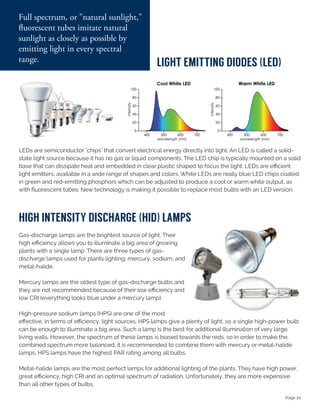
Here are some more spectrum comparisons from common fluorescent bulbs:
Fluorescent tubes are more suitable for plants than the incandescent or halogen bulbs. Fluorescent tubes
are very efficiency, they produce very little heat and have a long life. Although their spectrum is far from
optimal for plant lighting, you can cheaply add many lights so that the spectrum itself is not as important.
There are a number of fluorescent tubes that are more suited for plants. Full spectrum, or "natural sunlight,"
fluorescent tubes imitate natural sunlight as closely as possible by emitting light in every spectral range.
There are also tubes coated with specialized phosphors designed specifically for plants. Either of these
types of tubes are a much better choice because the spectrum of these lamps is closer to the optimal
spectrum for plant growth.
Page 20
Light Emitting Diodes (LED)
LEDs are semiconductor "chips" that convert electrical energy directly into light. An LED is called a solid-
state light source because it has no gas or liquid components. The LED chip is typically mounted on a solid
base that can dissipate heat and embedded in clear plastic shaped to focus the light. LEDs are efficient
light emitters, available in a wide range of shapes and colors. White LEDs are really blue LED chips coated
in green and red-emitting phosphors which can be adjusted to produce a cool or warm white output, as
with fluorescent tubes. New technology is making it possible to replace most bulbs with an LED version.
High Intensity Discharge (HID) lamps
Gas-discharge lamps are the brightest source of light. Their
high efficiency allows you to illuminate a big area of growing
plants with a single lamp. There are three types of gas-
discharge lamps used for plants lighting: mercury, sodium, and
metal-halide.
Mercury lamps are the oldest type of gas-discharge bulbs and
they are not recommended because of their low efficiency and
low CRI (everything looks blue under a mercury lamp).
High-pressure sodium lamps (HPS) are one of the most
effective, in terms of efficiency, light sources. HPS lamps give a plenty of light, so a single high-power bulb
can be enough to illuminate a big area. Such a lamp is the best for additional illumination of very large
living walls. However, the spectrum of these lamps is biased towards the reds, so in order to make the
combined spectrum more balanced, it is recommended to combine them with mercury or metal-halide
lamps. HPS lamps have the highest PAR rating among all bulbs.
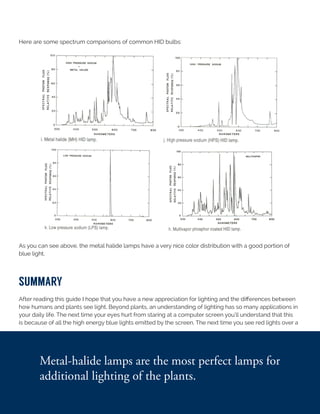
Metal-halide lamps are the most perfect lamps for additional lighting of the plants. They have high power,
great efficiency, high CRI and an optimal spectrum of radiation. Unfortunately, they are more expensive
than all other types of bulbs.
Page 21
Here are some spectrum comparisons of common HID bulbs:
As you can see above, the metal halide lamps have a very nice color distribution with a good portion of
blue light.
suMMary
After reading this guide I hope that you have a new appreciation for lighting and the differences between
how humans and plants see light. Beyond plants, an understanding of lighting has so many applications in
your daily life. The next time your eyes hurt from staring at a computer screen you'll understand that this
is because of all the high energy blue lights emitted by the screen. The next time you see red lights over a
Page 22
buffet table you'll understand that this is because red lights carry heat and keep the food warm. Now you
also know that plants need those blue and red lights in order to survive.
When designing a living wall, there many factors to consider in regards to lighting. Just to reiterate what I
said at the beginning, you need to consider:
Types Of Light:
White light is actually a composition of many different colors of light (think of a rainbow), with the
primary colors being blue, green and red. Photosynthesis depends upon the absorption of light by the
chlorophyll pigments in the leaves of plants. Blue and red lights are critical for plant growth (this is why
plant grow lights are red and blue). Plants appear green to us because they do not absorb the
green light, so that green light is reflected off the leaves and into our eyes.
Measuring Light Intensity:
Light intensity refers to the total amount of light, or the degree of
brightness, that a light source emits. The intensity of light is usually
measured in lux or foot-candles. Light intensity can be easily
measured with any off the shelf light meter and there are many
guides for what is the desired lux or foot-candles by plant type. Go
out and buy a light meter; you cannot eyeball the intensity. However,
light meters are meant for measuring the amount of light as seen by
humans, they don’t tell us anything about how plants will respond.
You will also need to consider the PAR light intensity and the DLI
reading to get a more accurate measurement. Having a DLI reading
in addition to the lux reading gives you two pieces of data to establish
that you have adequate lighting intensity. You cannot compensate
for weak lights by running them for more hours. In general, it's pretty
difficult to have too much light in indoor conditions, so my opinion is
that more is almost always better.
Light Quality:
Light quality is essential for plant growth. As mentioned above, plants need blue and red light for
photosynthesis. Not all white light is created equal and it is critical to understand the breakdown of
blue-green-red lights in a light source.
Light Duration:
Different plants require different daylight hours. Many processes, like blooming, are regulated by the
duration of daylight hours. Plants do well with 10-18 hours of lighting, or even a little more, but they do
not function well with 24/7 lighting. Most plants need at least a few hours in the dark each day.
Selecting The Right Light Bulbs:
The right light bulbs will be the ones that give you the proper light intensity and quality. It's important
to understand the different light spectrum emitted by various types of bulbs. Some bulbs, like
halogens, are unhealthy for plants because they give off far too much red and infrared light. Plants
need red and blue spectrum lights, and as long as you use modern lamps with wide spectrum, like
compact fluorescent or metal-halide, you should be safe. Understanding the spectrum of different
Page 23
types of bulbs will help you get dialed in to "the right" spectrum. Personally, I recommend cool white
LEDs and metal-halide lamps for most living wall projects, however, specialty fluorescent tubes made
for plants and plant-specific LEDs are great too. Any light it better than no light, so even sub-optimal
bulbs will still provide some benefit to the plants. Having the "right" bulbs just helps to ensure that the
plants are getting the spectrum they need.
Eric Westerduin
Suite Plants
www.suiteplants.com
Eric Westerduin is a co-founder of Suite Plants, a manufacturer of living wall
systems. Eric is a registered Green Plants For Green Buildings trainer and presents
the accredited Advanced Living Walls continuing education course to architects
& interior designers across North America. Eric earned his Bachelor's degree from
Cornell University's College of Agriculture and Life Sciences.
References and additional reading:
https://www.extension.purdue.edu/extmedia/ho/ho-238-w.pdf
https://www.extension.purdue.edu/extmedia/ho/ho-238-b-w.pdf
www.controlledenvironments.org/Growth_Chamber_Handbook/Ch01.pdf
www.toptropicals.com/html/toptropicals/articles/techno/lamps/lighting.htm
www.sunmastergrowlamps.com/SunmLightandPlants.html
www.extension.missouri.edu/p/G6515
www.greenroofs.com/content/articles/132-How-Important-is-Lighting-for-Living-Walls.htm#.ValNH_lViko

LightingGuide2016-1

  • 1.
    Page 1 The ulTIMaTeguIde To lIVIng green Wall lIghTIng by Eric Westerduin of Suite Plants
  • 3.
    Table of Contents Introduction|4| Types of Light |6| Measuring Light Intensity |7| Light Quality |8| Selecting the Right Bulbs |14| Incandescent Bulb |17| Halogen Bulb |17| Flourescent Tubes |18| Light Emitting Diodes (LED) |20| High Intensity Discharge (HID) Lamps |20| Summary |21|
  • 4.
    Page 4 Proper LIghting isabsolutely essential to the success of a living wall, or any indoor plants for that matter. Light is the food that fuels healthy plant growth. Plants without enough light will get thin, lose color, grow "stretchy" and look unhealthy. Unhealthy plants are not attractive. Learning about proper lighting will ensure that your next living wall installation looks like a luscious green jungle. Insufficient lighting is the most frequent cause of living wall failures. We know that lack of light results in unhealthy looking plants, but it also causes the plants to stop drinking water. Because the plants stop drinking, excess water builds up in the soil and creates a toxic anaerobic environment. This damp soil downs the plants and causes root rot. It is also a fertile environment for soil-borne pathogens, molds and bugs, which can further compound the problem. Since insufficient lighting can lead to a host of nasty problems, it's imperative that we learn how to properly light a living wall. To do this, we need to understand the different types of light, how to measure light intensity, light quality and how to select the right light bulbs. The science behind can be complicated, so here's a brief synopsis before we get started: What is Light? Light is actually just waves of electromagnetic radiation. There is a wide range of electromagnetic radiation including X-rays, Microwaves and FM/AM radio waves. What we refer to as light is the portion of these waves which is visible to the human eye. Visible light has a wavelength in the range of 400 nanometres (nm) to 700 nanometres – between the infrared (with longer wavelengths) and the ultraviolet (with shorter wavelengths). Types Of Light: Visible white light is actually a composition of many different colors of light (think of a rainbow), with the primary colors being blue, green and red. Photosynthesis depends upon the absorption of blue and red light by the chlorophyll pigments in the leaves of plants (this is why plant grow lights are red and blue). Plants appear green to us because they do not absorb the green light, so that green light is reflected off the leaves and into our eyes.
  • 5.
    Page 5 Measuring LightIntensity: Light intensity refers to the total amount of light, or the degree of brightness, that a light source emits. The intensity of light is usually measured in lux or foot-candles. Light intensity can be easily measured with any off the shelf light meter and there are many guides for what is the desired lux or foot-candles by plant type. Your eyes cannot accurately estimate light intensity levels, so you need to buy a light meter. In general, it's pretty difficult to have too much light in indoor conditions, so my opinion is that more is almost always better. However, lux and foot-candle light meters are meant for measuring the amount of light as seen by humans. They can be used as a rough guide for lighting levels, but they don’t actually tell us anything about how plants will respond. If you want to learn more about accurately measuring lighting for plants, including Photosynthetically Active Radiation (PAR light) and Daily Light Integrals (DLI), you'll have to read the rest of this guide. Light Quality: Light quality is essential for plant growth. As mentioned above, plants need blue and red light for photosynthesis. Not all white light is created equal and it is critical to understand the breakdown of blue-green-red lights in a light source. Light Duration: Different plants require different daylight hours. You cannot compensate for weak lights by running them for more hours. Many processes, like blooming, are regulated by the duration of daylight hours. Plants can do well with 12-20 hours of light, but they do not usually function well with 24/7 lighting. Most plants need at least a few hours in the dark each day. Selecting The Right Light Bulbs: The right light bulbs will be the ones that give you the proper light intensity and quality. Some bulbs, like halogens, are unhealthy for plants because they give off far too much red and infrared light. Plants need both blue and red spectrum lights, so you need to use modern lamps with a wide color spectrum. Certain fluorescent tubes, metal-halide bulbs and LED lights are great, but you need to know how to pick the right ones. It's important to consider what is best for the plant, but also what will make the plants look appealing to people. Understanding the spectrum of different types of bulbs will help you get dialed in to the "right" spectrum. Personally, I recommend cool white LEDs and metal-halide lamps for most living wall projects. If you stop reading now, at least you will have some understanding of lighting and how to select the right light bulbs. But, why should you blindly trust my recommendations? Didn't you start reading this guide so
  • 6.
    Page 6 that youcould finally learn about lighting once and for all? I strongly suggest that you keep reading and learn about the science behind lighting and how to pick the right light bulbs. This can get a little complicated, but I'm going to do my best to make this science easy to understand. Types of Light We need to begin by breaking down light into its components. There is a very narrow band of light that is actually visible to the human eye. That visible white light from the sun or a light bulb is actually composed of many different colors of light. White light can be separated into the different colors of light, determined by wavelength, by passing it through a prism (this is actually what's happening when you see a rainbow): The energy of each color is inversely proportional to its wavelength, so longer wavelengths have less energy than shorter ones. The short wavelength, high energy waves at the low end of the spectrum appear purple and blue. Beyond these waves are the very high energy ultraviolet rays (UV), which carry enough energy to harm our eyes and skin. The long wavelength, low energy waves at the high end appear red and orange. Beyond these waves are the infrared rays, which create heat and make our skin feel warm when we get sunburned. Plants can also be damaged by excessive heat (infrared) or ultraviolet (UV) radiation. Plants receiving
  • 7.
    Page 7 excessive amountsof light can dry up, develop extra growing points, become bleached (through the destruction of chlorophyll) and display other symptoms of excessive stress. However, the risk of infrared and UV damage with artificial lighting indoors is minimal. Now that we understand white light's components, the next step is to determine its intensity. Measuring Light Intensity Light intensity refers to the total amount of light, or the degree of brightness, that a light source emits. The intensity of light is usually measured in lux*. One lux is equivalent to one lumen per square meter, or the output of a one lumen light source upon one square meter of surface area from a distance of one meter. The illustration and table below help to clarify the meaning of lux and its values at different times of the day: *The corresponding unit in English and American traditional units is the foot-candle. One foot candle is equal to roughly 10.764 lux. Since one foot-candle is the illuminance cast on a surface by a one-candela light source one foot away, a lux could be thought of as a "meter-candle." In this article I will use only lux because it is an easier measurement to understand and, aside from the United States, the entire world uses lux. Light intensity can be easily measured with any off the shelf light meter and there are many guides for what is the desired lux or foot-candles by plant type. If you consult ten different sources you will likely find
  • 8.
    Page 8 ten differentanswers for what is the desired range for plants. Here is my opinion: It is very difficult to have too much light indoors and, within a normal range, plants generally respond very well to additional light with their growth rate being proportional to increased light levels. As far as lighting goes, I generally believe that more is better. Plants can live in 500 lux of light, but I don't believe we should be aiming for that minimum survival level. If you want your plants to thrive, rather than just survive, you have to give them more light. To increase the lux for a given area (say, a living wall) you must increase the number of lumens, which is usually achieved by increasing the number of light fixtures or using higher output bulbs. Don't be afraid to add more light. Although your light meter might tell you that the lighting is equivalent to daylight, and you know that most indoor tropical plants will die in direct sunlight, you shouldn't worry too much. Sunlight has a much wider spectrum of light, including infrared and ultraviolet, that can damage plants, but indoor lighting fixtures don't carry as much of the spectrum beyond visible light. This is the point where most "lighting guides" stop. What they forget to tell you is that lighting is a little more complicated than simply having the correct lux reading on your light meter. As horticulture professionals, we should be familiar with the nuances of lighting. I refer to these nuances collectively as "light quality" and I've done my best to break it down into easily understandable sections. lIghT QualITy Lux and foot-candles are not measures of light intensity in the absolute sense, rather they are based on the perceived power of light by the human eye. Instead of simply adding up the contribution of every wavelength of light in the source's spectrum to get a total intensity figure, the contribution of each wavelength is weighted by the standard luminosity function. The standard luminosity function describes the average sensitivity of human visual perception of brightness along the spectrum and it is based on subjective judgments of which of a pair of different-colored lights is brighter. The following graph shows the standard luminosity function across the visual spectrum:
  • 9.
    Page 9 Humans perceivelight to be brightest in the green and yellow area of the spectrum. Since the human eye is particularly sensitive to green and yellow light, more weight is given to this region of the spectrum and the contributions from blue and red light are largely discounted. This weighting is the basis for rating the total amount of light emitted by a source in lumens and consequently this bias weighting flows into the calculation for light intensity. Therefore, Lux is a light intensity measure that relates specifically to human vision and it does not necessarily correlate with the way plants "see" light. How do plants "see" light? Photosynthesis depends upon the absorption of light by the chlorophyll pigments in the leaves of plants. By measuring the rate of photosynthesis at different wavelengths (different colors of light), we can see which colors of light fuel plants best: Looking at the graph to the right, it is evident that the blue and red parts of the visible spectrum have the most positive impact on the rate of photosynthesis. In order to grow, plants rely on absorbing these blue and red lights. These wavelengths, the blues and reds, are critical for the photosynthesis and chlorophyll production that drive plant growth. Traditional wisdom says that non-flowering plants will prefer a blue light, which encourages leafy growth, and flowering plants prefer red light, which triggers a response to create blooms and flowers. Plants appear green to us because they do not use the middle of the light spectrum and that green light is reflected off the leaves and into our eyes. Something interesting happens if you plot the standard luminosity function (how humans see light) together with the rate of photosynthesis for plants across the spectrum (how plants use light):
  • 10.
    Page 10 As youcan see, the human eye perception of brightness along the spectrum is inverse to the photosynthetic response of plants. What humans perceive as being very intense bright light is actually the opposite of what type of lights plants need to survive. Lux meters are meant for measuring the amount of light usable by humans, they don’t tell us anything about how plants will respond. To further illustrate this point, consider three bulbs —red, green and blue—each emitting the same number of watts of optical energy. The red and blue lamps would have much lower lux ratings compared to the green lamp, simply because the human visual perception is very low at red and blue, and highest at green. By relying on lux ratings alone we would install the green bulb, but that's exactly the opposite of what the plants need. Light for plants cannot be accurately measured with the same standards used to measure light for humans since a high lux rating, as in the case of the green bulb, does not necessarily make a bulb better suited for growing plants. We understand that plants see light differently, but how can we better measure this plant lighting? This is where it starts to get a little tricky. Plant biologists define light of 400nm-700nm wavelength (basically the visual spectrum) as photosynthetically active radiation (PAR). These are the wavelengths of light most important for plant health. To correctly measure light intensity for plants you must use a meter that provides a measure of PAR light intensity. PAR light intensity is different from lux or foot-candles because it does not apply a weighted adjustment to any part of the spectrum. PAR light intensity can be measured as either energy-based PAR or photon-based PAR. Energy-based PAR measures the watts of PAR light falling on the plant whereas photon-based PAR measures how many actual particles (photons) of energy in this spectral range fall on
  • 11.
    Page 11 the plant.Both methods try to measure the total amount of light energy in this range without any weighting for human sensitivity. To understand PAR light and how PAR meters measure the intensity, I think it's easiest to discuss it in terms of a rainstorm. PAR light meters, or "quantum light" meters, measure PAR light intensity (the intensity of the rainstorm). These light meters use the photon-based measurement of PAR light and give a reading, in µmol/m2s ("micromoles"), of how many photons (raindrops) are falling on the plant each second. The quantum light meter gives a reading of the light intensity at a particular moment and, when taken in isolation, it doesn't tell the whole story. Going back to the rainstorm analogy, we need to think about how to measure the total amount of rainfall. A monsoon rainstorm is impressive, but if it only lasts for one minute then the plants don't actually receive enough water. An all day drizzle will net more water for the plants than a quick rainstorm. Therefore, a cumulative 24-hour rainfall total is a better measurement of the true amount of water the plants receive. In much the same way that cumulative daily rainfall is measured, the cumulative quantity of light is measured by the Daily Light Integral (DLI). DLI, measured in mol/m2day ("micromoles per day"), quantifies the amount of light available for plants to perform photosynthesis. Each type of plant has a different DLI range for optimal growth. The table to the right illustrates the DLI requirements for a selection of low to medium light plants:
  • 12.
    Page 12 As youcan see, most tropical plants need a DLI of at least 4, with 10+ being preferable. However, this data is based on requirements for growing seedlings in greenhouses (there is no specific research for mature indoor plant needs) so we need to make some assumptions to adjust the data for our needs. Mature plants can withstand lower light levels, so I don't believe there is a need to shoot for the upper end of the DLI range. Based on this data, I would recommend that you should aim for a DLI of 5-8 for living wall installations. How do you calculate DLI? It's not a simple calculation, but luckily there is a simple tool to help us. You can buy this "LightScout DLI 100 Light Meter" from $59 from specmeters.com and it will calculate the DLI for you. All you do is put it in the wall and leave it for a 24 hour period to collect its data. I would recommend buying a few of them to put in different spots in the wall so you can get readings for the dark and light spots in the wall. The longer and potentially more accurate method... For indoor applications with a constant amount of artificial light, the DLI is simply a product of the PAR light intensity multiplied by the number of hours per day the lights remain on. The most accurate way to collect the data you need on light intensity is to buy a quantum light meter that
  • 13.
    Page 13 can measureboth lux/foot-candles and PAR light. Something like this one, the "LightScout Quantum and Foot-Candle Meter" available for $299 from specmeters.com should suffice: Here is the method for converting foot-candles or lux to DLI: As you can see, there is an adjustment depending on the light source (type of bulb) and its efficiency of turning watts of electricity into watts of PAR light. I'll spare you the long-winded explanation, but suffice to say that you will need to apply a conversion factor for certain light bulbs. Potentially further complicating matters, modern light fixtures, such as LEDs, require new thinking about the way we measure light. PAR meters are too broadly responsive to measure an LED's narrow emission spectrum. Measuring PAR light for these types of lamps might become easier in the future and bulb manufacturers might supply more information about PAR light intensity, but for now it's just a little too tricky to be practical (so we usually just
  • 14.
    Page 14 convert ata standard average factor). Here are some of the different conversion factors (but, notice the absence of LEDs) depending on the range of the light meter you're using: seleCTIng The rIghT lIghT bulbs We know that plants prefer blue and red lights for photosynthesis. This is exactly why specialized plant grow lights are blue or red in color; this is the "optimal" plant lighting. Although grow lights are great for the plants, they are not great for the humans looking at the plants: As you can see in the picture above, the plant looks black or purple in color under the grow light. Of course we want to have healthy plants, but we do not want to lose the visual appeal (that's why the plants are there in the first place, right?). Remember, plants look green because their leaves are reflecting the green light in the spectrum back to our eyes. If there is no green spectrum light shining on the plants then there is no light bouncing back to our eyes (since the red and blue light is absorbed into the leaves) and that's why the plants appear to be dark in color.
  • 15.
    Page 15 Of coursewe want to have quality lighting that's good for the plants, but we also want to make sure the plants look appealing to the human eye. In this final section we will discuss how to select the right light bulbs (lamps). There are many different types of light bulbs including incandescent, fluorescent, halogen, High Intensity Discharge (HID) and Light Emitting Diode (LED). Each bulb has its own rating for energy use (watts), light output (lumens), color temperature (degrees Kelvin) and color rendering index (CRI). Watts and lumen are pretty intuitive to understand, but it's the color temperature and color rendering index that deserve more discussion. The color rendering index identifies the degree of color shift objects undergo when illuminated by a particular light source compared to a standard source. In simple terms, the CRI expresses the degree to which a light source renders the true color impression. The CRI is an index and ranges from 0 to 100. A light source having a CRI of 100 means objects illuminated by it look like they're supposed to; that is their natural color is not distorted. A light source having a very low CRI would tend to make objects appear to be a different shade or even color that they really are. An example of light with a high CRI is, obviously, sunlight. A plant grow light has a very low CRI (remember the ugly plants under the grow light). CRI is important because you want your plants to look appealing and display their natural colors. Color temperature, measured in degrees of Kelvin (K), is a unit of measure to express the color of light emitted by a lamp ranging from red to blue. Color temperature has been described most simply as a method of describing the color characteristics of light and measuring it in degrees of Kelvin. Color is related to the wavelength of light, but color is also related to temperature because hot things radiate light (for instance, the filament in an incandescent bulb). The temperature of the object affects the color of the light that is radiated. "Red hot" things glow red and "white hot" things glow white. The temperature is a measure of the internal energy of a material. As an object is heated, the atoms inside start to bounce around and their movement causes energy, in the form of light, to be emitted from the object. The hotter a material is, the faster its atoms are moving inside and the higher the involved frequencies will be. Remember that higher frequency equals shorter wavelength and more energy. Thus, a hot object will appear red while a much hotter object will be emitting a blue color. When an object reaches a "white hot" temperature it will emit radiation across the whole visible spectrum, resulting in a white appearance (for instance, the filament in an incandescent bulb). You can have a 100W and a 250W bulb with the same color temperature; however, the 250W will put out more intense light, increasing the lux. Here is a scale showing different light sources and their approximate color temperature:
  • 16.
    Page 16 As wealready know, the color of the light will determine a plant's ability to thrive. The blues encourage good leaf and stem growth while reds and oranges promote flowering. Sunlight naturally provides a full spectrum of light, but interior plants must rely on artificial lighting that is imperfect. For indoor applications we want to make sure that we are providing enough red and blue light for the plants. Different types of bulbs will have varying color temperatures and their own unique color spectrum. The color temperature will be stated on the box, but the spectrum is not as easy to find. It's important to know some general characteristics of popular lighting options so that you can make an informed decision on lighting. Here are a few examples of different bulb spectrums: A light bulb can look bright white to our eyes and have a "white" color temperature, but when you examine the underlying spectrum of blue, green and red it may tell a completely different story. For example, you would assume that a 4500K florescent light would offer a full spectrum of color since it's so close to sunlight, but upon further inspection you see that it has heavy amounts of green and red light but very little blue. In order to really understand lighting, we need to examine each type of bulb and its unique characteristics. I have compiled a short summary describing the most common types of indoor lighting.
  • 17.
    Page 17 Incandescent bulb Theseare by far the most common type of bulb, but they are being phased out due to recent laws mandating energy efficiency. These bulbs are cheap to produce and they can be made with a high maximum light output, but they are very inefficient. They don't produce a lot of light given the large amount of energy they use. The energy that does not get converted to light is given off as heat (which can burn plants within close range). Incandescent bulbs produce yellowish-white light, at a color temperature of ~2800K and with very high CRI, by using electricity to heat a small coiled tungsten metal wire to a high temperature within a glass bulb filled with special gases. Incandescent bulbs are unsuitable for high intensity lighting of large areas. Average life span of these bulbs is 700-1,000 hours. Incandescent bulbs are not suitable for plant growth. They produce a broad spectrum of light, but it is heavily biased toward the red and includes a lot of infrared. This lack of blue light means that plants grown under these bulbs look soft and elongated. Placement of these bulbs farther than 3 ft away from the plants is almost useless. The spectrum of incandescent bulbs can be changed by applying a filter and some bulbs, such as "daylight" bulbs, actually have a blue glass bulb that absorbs some of the red part of the spectrum. These bulbs emit a spectrum more similar to actual sunlight. However, these filters do reduce the total amount of light energy emitted. As an alternative to incandescent bulbs, you can now buy compact fluorescent lamps (CLF) that fit right into the same sockets. CFLs have higher efficiency, longer life, excellent color rendering and a wider spectrum which includes the red and blue rays necessary for plant growth. Halogen bulb These bulbs are a cousin of incandescent bulbs. They produce a clean white light at a color temperature of ~3200K. Just like incandescent bulbs, there is considerable production of red and infrared parts of the spectrum. Halogens produce a lot of radiant heat which, at close range, may scorch foliage and other delicate materials. Halogen bulbs are relatively cheap and they are much more efficient than ordinary incandescent bulb. Halogen bulbs generally have a very high CRI. Average life span of these bulbs is 2,000-4,000 hours.
  • 18.
    Page 18 Fluorescent tubes Thesebulbs are the standard source of light in most buildings because they are cheap to operate. They emit about four times as much light per unit of electricity as incandescent lights do. I will spend extra time discussing these bulbs since they are so prevalent. The tube itself is a partial vacuum containing a small amount of mercury vapor and inner walls coated in fluorescent powder. When the mercury vapor is energized by electricity it emits ultraviolet radiation which reacts with the fluorescent powder to produce visible light. The chemical composition of the fluorescent powder determines the spectrum and color of the emitted light. These tubes include the ubiquitous "cool white" and "warm white" usually used in home and commercial lighting applications. These tubes are tuned to produce the brightest possible illumination for the least amount of electricity. Since the human eye is most sensitive to green, these tubes peak in the green portion of the visible spectrum. In fact they rise and fall quite sharply either side of the green peak. Warm white is shifted a bit toward the red end of the spectrum thus accounting for the "warmer" appearance. The most commonly found tubes on the global lighting market employ an internal coating of Calcium Halophosphate materials. You can see below that these tubes emit a fairly narrow spectrum centered around the yellow colors: Since the invention of original fluorescent tubes, a great amount has been learned about human vision systems. Traditionally it was believed that to achieve a good CRI, it was important for the lamp to produce a full spectrum with light of all wavelengths present (similar to sunlight). However, as we know, the human eye is not equally sensitive to all colors. New insights into the perception of color vision discovered that it was possible to achieve a very high color rendering index from a light source having only a narrow tri-band spectrum. As you can see below, these modern tubes have extremely narrow color spectrums:
  • 19.
    Page 19 Here aresome more spectrum comparisons from common fluorescent bulbs: Fluorescent tubes are more suitable for plants than the incandescent or halogen bulbs. Fluorescent tubes are very efficiency, they produce very little heat and have a long life. Although their spectrum is far from optimal for plant lighting, you can cheaply add many lights so that the spectrum itself is not as important. There are a number of fluorescent tubes that are more suited for plants. Full spectrum, or "natural sunlight," fluorescent tubes imitate natural sunlight as closely as possible by emitting light in every spectral range. There are also tubes coated with specialized phosphors designed specifically for plants. Either of these types of tubes are a much better choice because the spectrum of these lamps is closer to the optimal spectrum for plant growth.
  • 20.
    Page 20 Light EmittingDiodes (LED) LEDs are semiconductor "chips" that convert electrical energy directly into light. An LED is called a solid- state light source because it has no gas or liquid components. The LED chip is typically mounted on a solid base that can dissipate heat and embedded in clear plastic shaped to focus the light. LEDs are efficient light emitters, available in a wide range of shapes and colors. White LEDs are really blue LED chips coated in green and red-emitting phosphors which can be adjusted to produce a cool or warm white output, as with fluorescent tubes. New technology is making it possible to replace most bulbs with an LED version. High Intensity Discharge (HID) lamps Gas-discharge lamps are the brightest source of light. Their high efficiency allows you to illuminate a big area of growing plants with a single lamp. There are three types of gas- discharge lamps used for plants lighting: mercury, sodium, and metal-halide. Mercury lamps are the oldest type of gas-discharge bulbs and they are not recommended because of their low efficiency and low CRI (everything looks blue under a mercury lamp). High-pressure sodium lamps (HPS) are one of the most effective, in terms of efficiency, light sources. HPS lamps give a plenty of light, so a single high-power bulb can be enough to illuminate a big area. Such a lamp is the best for additional illumination of very large living walls. However, the spectrum of these lamps is biased towards the reds, so in order to make the combined spectrum more balanced, it is recommended to combine them with mercury or metal-halide lamps. HPS lamps have the highest PAR rating among all bulbs. Metal-halide lamps are the most perfect lamps for additional lighting of the plants. They have high power, great efficiency, high CRI and an optimal spectrum of radiation. Unfortunately, they are more expensive than all other types of bulbs.
  • 21.
    Page 21 Here aresome spectrum comparisons of common HID bulbs: As you can see above, the metal halide lamps have a very nice color distribution with a good portion of blue light. suMMary After reading this guide I hope that you have a new appreciation for lighting and the differences between how humans and plants see light. Beyond plants, an understanding of lighting has so many applications in your daily life. The next time your eyes hurt from staring at a computer screen you'll understand that this is because of all the high energy blue lights emitted by the screen. The next time you see red lights over a
  • 22.
    Page 22 buffet tableyou'll understand that this is because red lights carry heat and keep the food warm. Now you also know that plants need those blue and red lights in order to survive. When designing a living wall, there many factors to consider in regards to lighting. Just to reiterate what I said at the beginning, you need to consider: Types Of Light: White light is actually a composition of many different colors of light (think of a rainbow), with the primary colors being blue, green and red. Photosynthesis depends upon the absorption of light by the chlorophyll pigments in the leaves of plants. Blue and red lights are critical for plant growth (this is why plant grow lights are red and blue). Plants appear green to us because they do not absorb the green light, so that green light is reflected off the leaves and into our eyes. Measuring Light Intensity: Light intensity refers to the total amount of light, or the degree of brightness, that a light source emits. The intensity of light is usually measured in lux or foot-candles. Light intensity can be easily measured with any off the shelf light meter and there are many guides for what is the desired lux or foot-candles by plant type. Go out and buy a light meter; you cannot eyeball the intensity. However, light meters are meant for measuring the amount of light as seen by humans, they don’t tell us anything about how plants will respond. You will also need to consider the PAR light intensity and the DLI reading to get a more accurate measurement. Having a DLI reading in addition to the lux reading gives you two pieces of data to establish that you have adequate lighting intensity. You cannot compensate for weak lights by running them for more hours. In general, it's pretty difficult to have too much light in indoor conditions, so my opinion is that more is almost always better. Light Quality: Light quality is essential for plant growth. As mentioned above, plants need blue and red light for photosynthesis. Not all white light is created equal and it is critical to understand the breakdown of blue-green-red lights in a light source. Light Duration: Different plants require different daylight hours. Many processes, like blooming, are regulated by the duration of daylight hours. Plants do well with 10-18 hours of lighting, or even a little more, but they do not function well with 24/7 lighting. Most plants need at least a few hours in the dark each day. Selecting The Right Light Bulbs: The right light bulbs will be the ones that give you the proper light intensity and quality. It's important to understand the different light spectrum emitted by various types of bulbs. Some bulbs, like halogens, are unhealthy for plants because they give off far too much red and infrared light. Plants need red and blue spectrum lights, and as long as you use modern lamps with wide spectrum, like compact fluorescent or metal-halide, you should be safe. Understanding the spectrum of different
  • 23.
    Page 23 types ofbulbs will help you get dialed in to "the right" spectrum. Personally, I recommend cool white LEDs and metal-halide lamps for most living wall projects, however, specialty fluorescent tubes made for plants and plant-specific LEDs are great too. Any light it better than no light, so even sub-optimal bulbs will still provide some benefit to the plants. Having the "right" bulbs just helps to ensure that the plants are getting the spectrum they need. Eric Westerduin Suite Plants www.suiteplants.com Eric Westerduin is a co-founder of Suite Plants, a manufacturer of living wall systems. Eric is a registered Green Plants For Green Buildings trainer and presents the accredited Advanced Living Walls continuing education course to architects & interior designers across North America. Eric earned his Bachelor's degree from Cornell University's College of Agriculture and Life Sciences. References and additional reading: https://www.extension.purdue.edu/extmedia/ho/ho-238-w.pdf https://www.extension.purdue.edu/extmedia/ho/ho-238-b-w.pdf www.controlledenvironments.org/Growth_Chamber_Handbook/Ch01.pdf www.toptropicals.com/html/toptropicals/articles/techno/lamps/lighting.htm www.sunmastergrowlamps.com/SunmLightandPlants.html www.extension.missouri.edu/p/G6515 www.greenroofs.com/content/articles/132-How-Important-is-Lighting-for-Living-Walls.htm#.ValNH_lViko