
Sorted Tree
Dictionary
Logic Programming - Fall 12


   Benjamin GUILLET
What's the matter?
● We want to build a index (dictionary) of
  performances of horses

● Let's build a database!
                     winnings(abaris, 582).
                     winnings(careful,17).
                     winnings(jingling_silver, 300).
                     winnings(maloja, 356).


 ● It's slow! O(n)
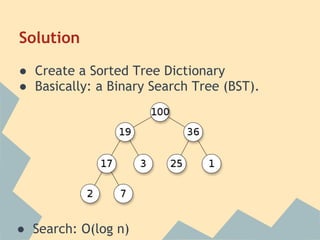
Solution

● Create a Sorted Tree Dictionary
● Basically: a Binary Search Tree (BST).


● Search: O(log n)
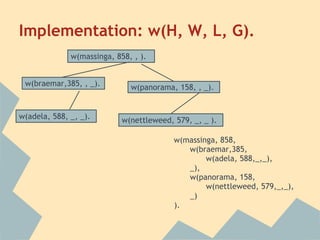
Implementation: w(H, W, L, G).
              w(massinga, 858, , ).


 w(braemar,385, , _).         w(panorama, 158, , _).


w(adela, 588, _, _).        w(nettleweed, 579, _, _ ).

                                          w(massinga, 858,
                                             w(braemar,385,
                                                  w(adela, 588,_,_),
                                             _),
                                             w(panorama, 158,
                                                  w(nettleweed, 579,_,_),
                                             _)
                                          ).
Implementation: lookup
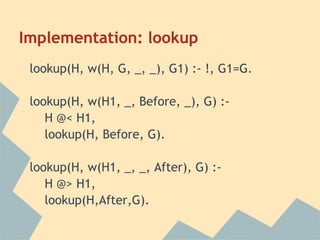
 lookup(H, w(H, G, _, _), G1) :- !, G1=G.

 lookup(H, w(H1, _, Before, _), G) :-
    H @< H1,
    lookup(H, Before, G).

 lookup(H, w(H1, _, _, After), G) :-
    H @> H1,
    lookup(H,After,G).
Experiment (1)
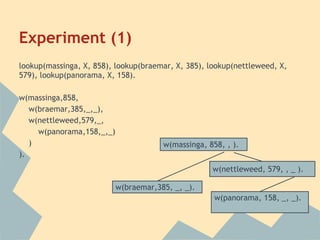
lookup(massinga, X, 858), lookup(braemar, X, 385), lookup(nettleweed, X,
579), lookup(panorama, X, 158).

w(massinga,858,
   w(braemar,385,_,_),
   w(nettleweed,579,_,
     w(panorama,158,_,_)
   )                                   w(massinga, 858, , ).
).
                                                    w(nettleweed, 579, , _ ).

                           w(braemar,385, _, _).
                                                     w(panorama, 158, _, _).
Experiment (2)
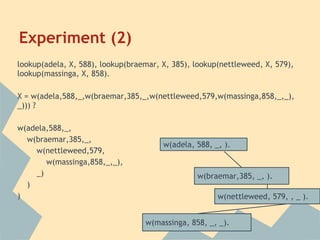
lookup(adela, X, 588), lookup(braemar, X, 385), lookup(nettleweed, X, 579),
lookup(massinga, X, 858).

X = w(adela,588,_,w(braemar,385,_,w(nettleweed,579,w(massinga,858,_,_),
_))) ?

w(adela,588,_,
  w(braemar,385,_,
                                       w(adela, 588, _, ).
    w(nettleweed,579,
       w(massinga,858,_,_),
    _)                                          w(braemar,385, _, ).
  )
)                                                     w(nettleweed, 579, , _ ).


                                  w(massinga, 858, _, _).
Extension: Is it a heap?!
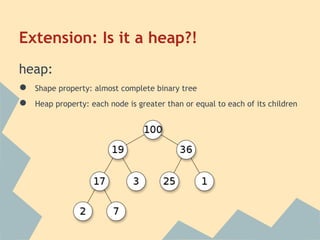
heap:
● Shape property: almost complete binary tree
● Heap property: each node is greater than or equal to each of its children
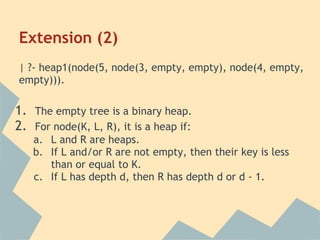
Extension (2)
| ?- heap1(node(5, node(3, empty, empty), node(4, empty,
empty))).

1. The empty tree is a binary heap.
2. For node(K, L, R), it is a heap if:
   a. L and R are heaps.
   b. If L and/or R are not empty, then their key is less
      than or equal to K.
   c. If L has depth d, then R has depth d or d - 1.
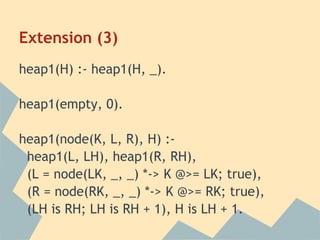
Extension (3)
heap1(H) :- heap1(H, _).

heap1(empty, 0).

heap1(node(K, L, R), H) :-
 heap1(L, LH), heap1(R, RH),
 (L = node(LK, _, _) *-> K @>= LK; true),
 (R = node(RK, _, _) *-> K @>= RK; true),
 (LH is RH; LH is RH + 1), H is LH + 1.
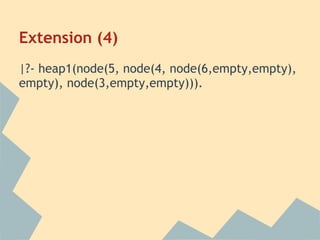
Extension (4)
|?- heap1(node(5, node(4, node(6,empty,empty),
empty), node(3,empty,empty))).
Thank you!

Binary Search Tree and Heap in Prolog

  • 1.
    Sorted Tree Dictionary Logic Programming- Fall 12 Benjamin GUILLET
  • 2.
    What's the matter? ●We want to build a index (dictionary) of performances of horses ● Let's build a database! winnings(abaris, 582). winnings(careful,17). winnings(jingling_silver, 300). winnings(maloja, 356). ● It's slow! O(n)
  • 3.
    Solution ● Create aSorted Tree Dictionary ● Basically: a Binary Search Tree (BST). ● Search: O(log n)
  • 4.
    Implementation: w(H, W,L, G). w(massinga, 858, , ). w(braemar,385, , _). w(panorama, 158, , _). w(adela, 588, _, _). w(nettleweed, 579, _, _ ). w(massinga, 858, w(braemar,385, w(adela, 588,_,_), _), w(panorama, 158, w(nettleweed, 579,_,_), _) ).
  • 5.
    Implementation: lookup lookup(H,w(H, G, _, _), G1) :- !, G1=G. lookup(H, w(H1, _, Before, _), G) :- H @< H1, lookup(H, Before, G). lookup(H, w(H1, _, _, After), G) :- H @> H1, lookup(H,After,G).
  • 6.
    Experiment (1) lookup(massinga, X,858), lookup(braemar, X, 385), lookup(nettleweed, X, 579), lookup(panorama, X, 158). w(massinga,858, w(braemar,385,_,_), w(nettleweed,579,_, w(panorama,158,_,_) ) w(massinga, 858, , ). ). w(nettleweed, 579, , _ ). w(braemar,385, _, _). w(panorama, 158, _, _).
  • 7.
    Experiment (2) lookup(adela, X,588), lookup(braemar, X, 385), lookup(nettleweed, X, 579), lookup(massinga, X, 858). X = w(adela,588,_,w(braemar,385,_,w(nettleweed,579,w(massinga,858,_,_), _))) ? w(adela,588,_, w(braemar,385,_, w(adela, 588, _, ). w(nettleweed,579, w(massinga,858,_,_), _) w(braemar,385, _, ). ) ) w(nettleweed, 579, , _ ). w(massinga, 858, _, _).
  • 8.
    Extension: Is ita heap?! heap: ● Shape property: almost complete binary tree ● Heap property: each node is greater than or equal to each of its children
  • 9.
    Extension (2) | ?-heap1(node(5, node(3, empty, empty), node(4, empty, empty))). 1. The empty tree is a binary heap. 2. For node(K, L, R), it is a heap if: a. L and R are heaps. b. If L and/or R are not empty, then their key is less than or equal to K. c. If L has depth d, then R has depth d or d - 1.
  • 10.
    Extension (3) heap1(H) :-heap1(H, _). heap1(empty, 0). heap1(node(K, L, R), H) :- heap1(L, LH), heap1(R, RH), (L = node(LK, _, _) *-> K @>= LK; true), (R = node(RK, _, _) *-> K @>= RK; true), (LH is RH; LH is RH + 1), H is LH + 1.
  • 11.
    Extension (4) |?- heap1(node(5,node(4, node(6,empty,empty), empty), node(3,empty,empty))).
  • 12.