LYALLPUR
FOOD
INDUSTRIES
FoodSafetyManagementSystem
Manual
ISO22000:2015
StandardOperating
Procedures
Page 1 of 33
Issue Date: 01.09.2019 Rev. No.- A Issued By: Approved By:
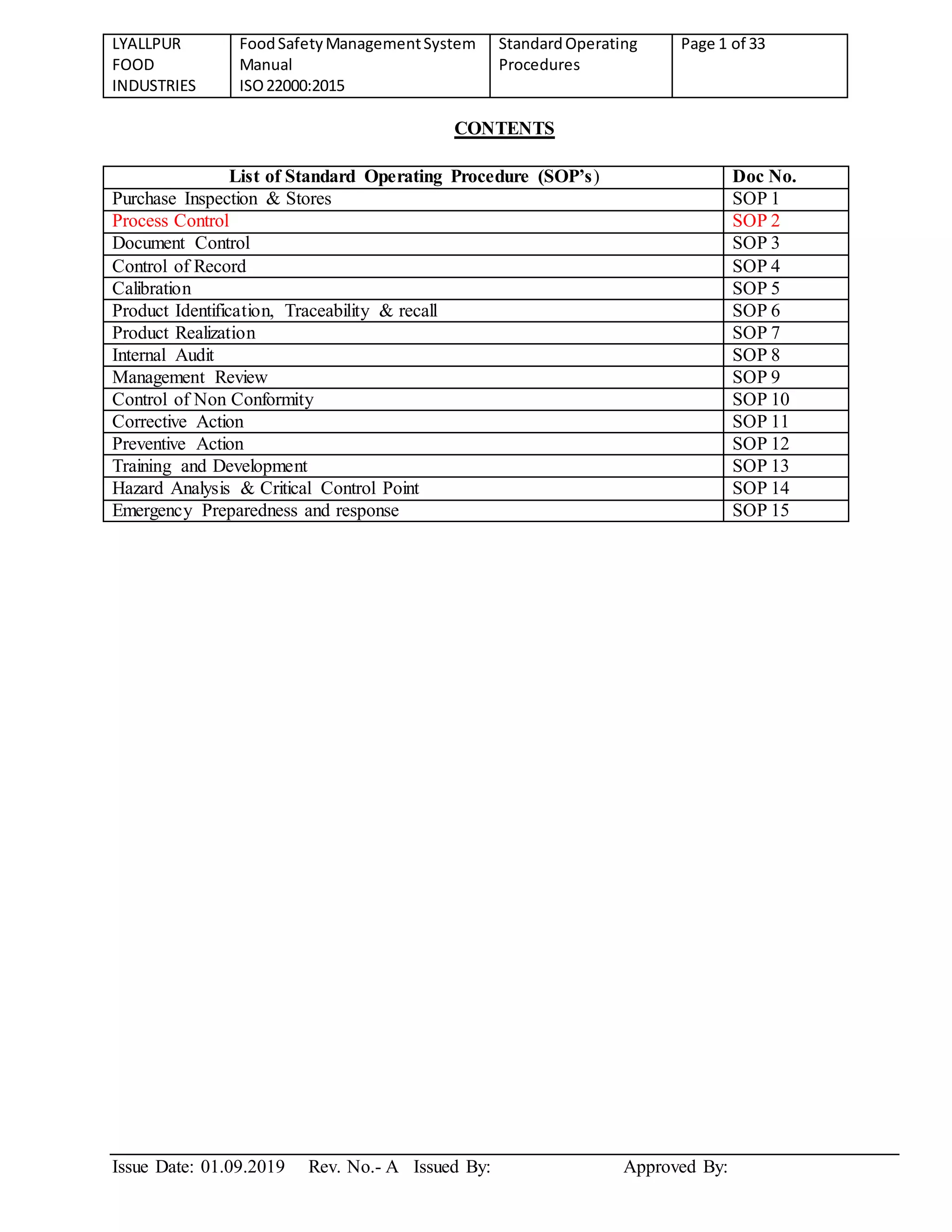
CONTENTS
List of Standard Operating Procedure (SOP’s) Doc No.
Purchase Inspection & Stores SOP 1
Process Control SOP 2
Document Control SOP 3
Control of Record SOP 4
Calibration SOP 5
Product Identification, Traceability & recall SOP 6
Product Realization SOP 7
Internal Audit SOP 8
Management Review SOP 9
Control of Non Conformity SOP 10
Corrective Action SOP 11
Preventive Action SOP 12
Training and Development SOP 13
Hazard Analysis & Critical Control Point SOP 14
Emergency Preparedness and response SOP 15
LYALLPUR
FOOD
INDUSTRIES
FoodSafetyManagementSystem
Manual
ISO22000:2015
StandardOperating
Procedures
Page 2 of 33
Issue Date: 01.09.2019 Rev. No.- A Issued By: Approved By:
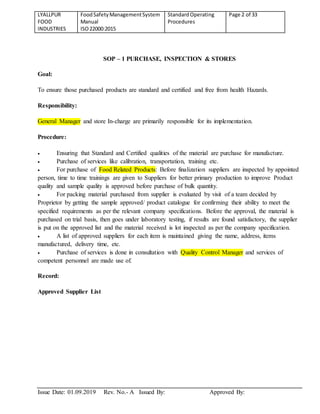
SOP – 1 PURCHASE, INSPECTION & STORES
Goal:
To ensure those purchased products are standard and certified and free from health Hazards.
Responsibility:
General Manager and store In-charge are primarily responsible for its implementation.
Procedure:
 Ensuring that Standard and Certified qualities of the material are purchase for manufacture.
 Purchase of services like calibration, transportation, training etc.
 For purchase of Food Related Products: Before finalization suppliers are inspected by appointed
person, time to time trainings are given to Suppliers for better primary production to improve Product
quality and sample quality is approved before purchase of bulk quantity.
 For packing material purchased from supplier is evaluated by visit of a team decided by
Proprietor by getting the sample approved/ product catalogue for confirming their ability to meet the
specified requirements as per the relevant company specifications. Before the approval, the material is
purchased on trial basis, then goes under laboratory testing, if results are found satisfactory, the supplier
is put on the approved list and the material received is lot inspected as per the company specification.
 A list of approved suppliers for each item is maintained giving the name, address, items
manufactured, delivery time, etc.
 Purchase of services is done in consultation with Quality Control Manager and services of
competent personnel are made use of.
Record:
Approved Supplier List
LYALLPUR
FOOD
INDUSTRIES
FoodSafetyManagementSystem
Manual
ISO22000:2015
StandardOperating
Procedures
Page 3 of 33
Issue Date: 01.09.2019 Rev. No.- A Issued By: Approved By:
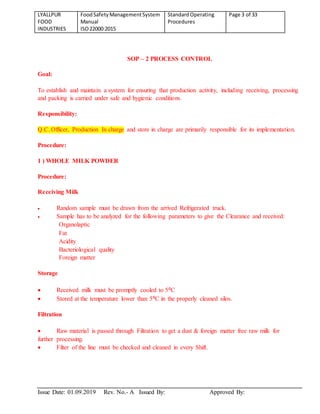
SOP – 2 PROCESS CONTROL
Goal:
To establish and maintain a system for ensuring that production activity, including receiving, processing
and packing is carried under safe and hygienic conditions.
Responsibility:
Q.C. Officer, Production In charge and store in charge are primarily responsible for its implementation.
Procedure:
1 ) WHOLE MILK POWDER
Procedure:
Receiving Milk
 Random sample must be drawn from the arrived Refrigerated truck.
 Sample has to be analyzed for the following parameters to give the Clearance and received:
Organolaptic
Fat
Acidity
Bacteriological quality
Foreign matter
Storage
 Received milk must be promptly cooled to 5⁰C
 Stored at the temperature lower than 5⁰C in the properly cleaned silos.
Filtration
 Raw material is passed through Filtration to get a dust & foreign matter free raw milk for
further processing.
 Filter of the line must be checked and cleaned in every Shift.
LYALLPUR
FOOD
INDUSTRIES
FoodSafetyManagementSystem
Manual
ISO22000:2015
StandardOperating
Procedures
Page 4 of 33
Issue Date: 01.09.2019 Rev. No.- A Issued By: Approved By:
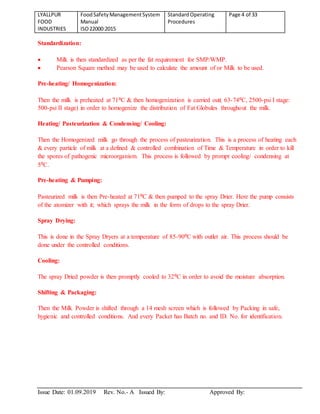
Standardization:
 Milk is then standardized as per the fat requirement for SMP/WMP.
 Pearson Square method may be used to calculate the amount of or Milk to be used.
Pre-heating/ Homogenization:
Then the milk is preheated at 71⁰C & then homogenization is carried out( 63-74⁰C, 2500-psi I stage:
500-psi II stage) in order to homogenize the distribution of Fat Globules throughout the milk.
Heating/ Pasteurization & Condensing/ Cooling:
Then the Homogenized milk go through the process of pasteurization. This is a process of heating each
& every particle of milk at a defined & controlled combination of Time & Temperature in order to kill
the spores of pathogenic microorganism. This process is followed by prompt cooling/ condensing at
5⁰C.
Pre-heating & Pumping:
Pasteurized milk is then Pre-heated at 71⁰C & then pumped to the spray Drier. Here the pump consists
of the atomizer with it; which sprays the milk in the form of drops to the spray Drier.
Spray Drying:
This is done in the Spray Dryers at a temperature of 85-90⁰C with outlet air. This process should be
done under the controlled conditions.
Cooling:
The spray Dried powder is then promptly cooled to 32⁰C in order to avoid the moisture absorption.
Shifting & Packaging:
Then the Milk Powder is shifted through a 14 mesh screen which is followed by Packing in safe,
hygienic and controlled conditions. And every Packet has Batch no. and ID. No. for identification.
LYALLPUR
FOOD
INDUSTRIES
FoodSafetyManagementSystem
Manual
ISO22000:2015
StandardOperating
Procedures
Page 5 of 33
Issue Date: 01.09.2019 Rev. No.- A Issued By: Approved By:
II) SKIM MILK POWDER
Receiving Milk & Filtration
 Random sample must be drawn from the arrived Refrigerated truck/cans.
 Sample has to be analyzed for the following parameters to give the clearance and received:
Organoleptic
Fat
Acidity
Bacteriological Quality
Foreign matter
 Raw milk is then passed through Filtration to get a dust & foreign matter free raw milk for
further processing.
 Filters of the line must be checked and cleaned in every Shift.
Cooling & storage
 Received milk must be promptly cooled to 5⁰ C
 Storage at the temperature lower than 5⁰ C in the properly cleaned silos.
Separation:
 Cream is separated from milk in order to decrease the Fat level at the percentage lower than 1%
in orders to reduce the fat level. Cream and skim milk is separated
 Calculative method may be used to calculate the amount of or Milk to be used.
Pasteurization & Storage:
Then the Homogenized milk go through the process of pasteurization. This is a process of heating each
& every particle of Milk at a defined & controlled combination of time & Temperature in order to kill
the spores of pathogenic microorganism. This process is followed by prompt cooling/ condensing at
5⁰C.
Condensing / Evaporation: Pasteurized Skimmed milk is further condensed and evaporated by
preheating to reduce the moisture level.
Filtration & Pumping:
 Filtration is done in order to remove the extraneous matter if any.
LYALLPUR
FOOD
INDUSTRIES
FoodSafetyManagementSystem
Manual
ISO22000:2015
StandardOperating
Procedures
Page 6 of 33
Issue Date: 01.09.2019 Rev. No.- A Issued By: Approved By:
 Milk is then pumped to the spray drier. Here the pump consists of the atomizer with it, which
sprays the milk in the form of drops to the spray Drier.
Spray Drying:
This is done in the Spray Dryers at a temperature of 85-90⁰C with outlet air. This process should be
done under the controlled conditions.
Cooling:
The spray dried powder is then promptly cooled to 32⁰C in order to avoid the moisture absorption.
Shifting & Packaging:
Then the Milk Powder is shifted through a 14 mesh screen which is followed by Packaging in safe,
hygienic and controlled conditions. And every Packet has Batch no. and ID. No. for identification.
III) GHEE
Receiving of Raw Ingredients
a) Receiving of Raw milk
 Receiving milk should go through the following steps:
Weighing
Sampling
Grading
Cooling (5degC)
Storage
 Grading should be done as on the basis of following parameters to give the clearance and
received:
Organoleptic
Fat
Acidity
Bacteriological
Foreign matter
 Raw milk is then passed through Filtration to get a dust & foreign matter free raw milk for
further processing.
 Filters of the line must be checked and cleaned in every Shift.
LYALLPUR
FOOD
INDUSTRIES
FoodSafetyManagementSystem
Manual
ISO22000:2015
StandardOperating
Procedures
Page 7 of 33
Issue Date: 01.09.2019 Rev. No.- A Issued By: Approved By:
Separation
 Here Cream is separated from milk.
Cooling & Storage
 Received milk must be promptly cooled to 5⁰ C
 Stored at the temperature lower than 5⁰ C in the properly cleaned Silos.
b) Receiving Cream & Neutralization
a) Receiving of Raw Milk
 Received milk should go through the following steps:
Weighing
Sampling
Grading
Cooling (5 deg C)
Storage
 Grading should be done on the basis of following parameters to give the clearance and received:
Organoleptic
Fat
Acidity
Bacteriological
Foreign matter
 Neutralization is done in order to reduce the acidity of Cream. Neutralization used should be
approved & should be used under the defined limit.
Standardization
 Cream is then standardized as per the Fat requirement for SMP/WMP.
 Pearson Square method may be used to calculate the amount of Fat or Skimmed Milk to be used.
Pasteurization & Cooling:
 Then the Cream go through the process of pasteurization. This is a process of heating each &
every particle of Cream at a defined & controlled combination of Time & Temperature in order to kill
the spores of pathogenic microorganism. This process is followed by prompt cooling/ condensing at 5⁰C
Ageing
 This is done by holding the cream at low temperature (5-10⁰C) for minimum 2-4 hours; best
holding time is 12-14 hours (overnight).
LYALLPUR
FOOD
INDUSTRIES
FoodSafetyManagementSystem
Manual
ISO22000:2015
StandardOperating
Procedures
Page 8 of 33
Issue Date: 01.09.2019 Rev. No.- A Issued By: Approved By:
 Ageing serves ease to the separation of fat as the fat particles solidify & while churning they
separate out easily with a minimum loss of fat.
Churning & Washing
 Fat (Butter) is then churned from cream by using churners.
 Washing is done by cold water in order to wash off the adhered buttermilk from the churned fat.
Cooking of Cream/ butter
 Cream / butter is then cooked into the Ghee Kettle at 104-106⁰C to extract out the Ghee.
Settling, Filtration & Clarification of Ghee
 Extracted Ghee is then let to settle in the ghee kettle for 30-45 minutes.
 Filtration is done by using nylon filter in order to remove the dust or any other foreign matter.
 Clarification is done at 60-85⁰C in order to remove any off-flavor or any other volatile
impurities.
Inspection & Testing:
Prepared Ghee is then tested for the following standards:
Fat %
Foreign matter
Flavor
(Or any other parameter if required)
Filtration:
 Tested Ghee is then Pre- heated filtered in order to remove the extraneous matter if any.
Packaging:
Then the Ghee sent for Packaging under safe, hygienic and controlled conditions. And every Packet has
Batch no. and ID. NO. for identification.
Dispatch:
Ghee is then dispatched at ambient temperature under hygienic conditions.
Record: Batch No Record, Test Record
LYALLPUR
FOOD
INDUSTRIES
FoodSafetyManagementSystem
Manual
ISO22000:2015
StandardOperating
Procedures
Page 9 of 33
Issue Date: 01.09.2019 Rev. No.- A Issued By: Approved By:
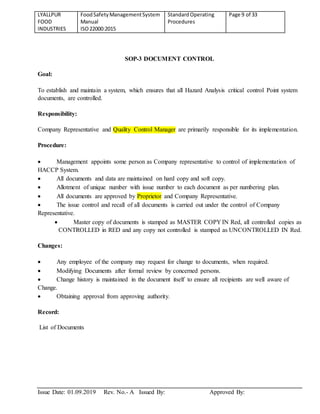
SOP-3 DOCUMENT CONTROL
Goal:
To establish and maintain a system, which ensures that all Hazard Analysis critical control Point system
documents, are controlled.
Responsibility:
Company Representative and Quality Control Manager are primarily responsible for its implementation.
Procedure:
 Management appoints some person as Company representative to control of implementation of
HACCP System.
 All documents and data are maintained on hard copy and soft copy.
 Allotment of unique number with issue number to each document as per numbering plan.
 All documents are approved by Proprietor and Company Representative.
 The issue control and recall of all documents is carried out under the control of Company
Representative.
 Master copy of documents is stamped as MASTER COPY IN Red, all controlled copies as
CONTROLLED in RED and any copy not controlled is stamped as UNCONTROLLED IN Red.
Changes:
 Any employee of the company may request for change to documents, when required.
 Modifying Documents after formal review by concerned persons.
 Change history is maintained in the document itself to ensure all recipients are well aware of
Change.
 Obtaining approval from approving authority.
Record:
List of Documents
LYALLPUR
FOOD
INDUSTRIES
FoodSafetyManagementSystem
Manual
ISO22000:2015
StandardOperating
Procedures
Page 10 of 33
Issue Date: 01.09.2019 Rev. No.- A Issued By: Approved By:
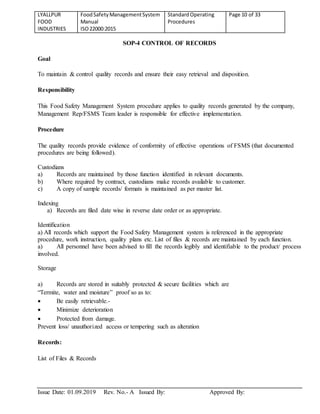
SOP-4 CONTROL OF RECORDS
Goal
To maintain & control quality records and ensure their easy retrieval and disposition.
Responsibility
This Food Safety Management System procedure applies to quality records generated by the company,
Management Rep/FSMS Team leader is responsible for effective implementation.
Procedure
The quality records provide evidence of conformity of effective operations of FSMS (that documented
procedures are being followed).
Custodians
a) Records are maintained by those function identified in relevant documents.
b) Where required by contract, custodians make records available to customer.
c) A copy of sample records/ formats is maintained as per master list.
Indexing
a) Records are filed date wise in reverse date order or as appropriate.
Identification
a) All records which support the Food Safety Management system is referenced in the appropriate
procedure, work instruction, quality plans etc. List of files & records are maintained by each function.
a) All personnel have been advised to fill the records legibly and identifiable to the product/ process
involved.
Storage
a) Records are stored in suitably protected & secure facilities which are
“Termite, water and moisture” proof so as to:
 Be easily retrievable.-
 Minimize deterioration
 Protected from damage.
Prevent loss/ unauthorized access or tempering such as alteration
Records:
List of Files & Records
LYALLPUR
FOOD
INDUSTRIES
FoodSafetyManagementSystem
Manual
ISO22000:2015
StandardOperating
Procedures
Page 11 of 33
Issue Date: 01.09.2019 Rev. No.- A Issued By: Approved By:
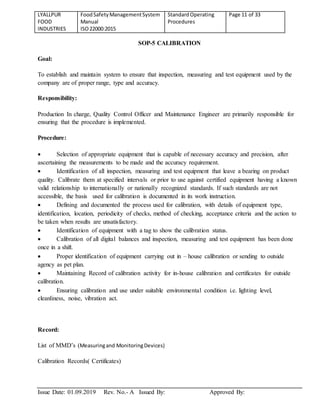
SOP-5 CALIBRATION
Goal:
To establish and maintain system to ensure that inspection, measuring and test equipment used by the
company are of proper range, type and accuracy.
Responsibility:
Production In charge, Quality Control Officer and Maintenance Engineer are primarily responsible for
ensuring that the procedure is implemented.
Procedure:
 Selection of appropriate equipment that is capable of necessary accuracy and precision, after
ascertaining the measurements to be made and the accuracy requirement.
 Identification of all inspection, measuring and test equipment that leave a bearing on product
quality. Calibrate them at specified intervals or prior to use against certified equipment having a known
valid relationship to internationally or nationally recognized standards. If such standards are not
accessible, the basis used for calibration is documented in its work instruction.
 Defining and documented the process used for calibration, with details of equipment type,
identification, location, periodicity of checks, method of checking, acceptance criteria and the action to
be taken when results are unsatisfactory.
 Identification of equipment with a tag to show the calibration status.
 Calibration of all digital balances and inspection, measuring and test equipment has been done
once in a shift.
 Proper identification of equipment carrying out in – house calibration or sending to outside
agency as pet plan.
 Maintaining Record of calibration activity for in-house calibration and certificates for outside
calibration.
 Ensuring calibration and use under suitable environmental condition i.e. lighting level,
cleanliness, noise, vibration act.
Record:
List of MMD’s (Measuringand MonitoringDevices)
Calibration Records( Certificates)
LYALLPUR
FOOD
INDUSTRIES
FoodSafetyManagementSystem
Manual
ISO22000:2015
StandardOperating
Procedures
Page 12 of 33
Issue Date: 01.09.2019 Rev. No.- A Issued By: Approved By:
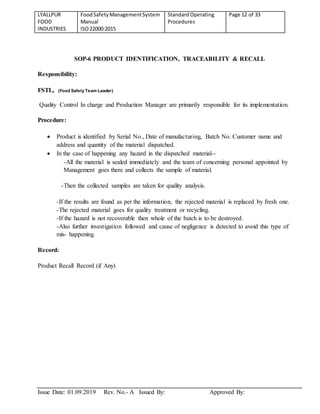
SOP-6 PRODUCT IDENTIFICATION, TRACEABILITY & RECALL
Responsibility:
FSTL, (Food Safety Team Leader)
Quality Control In charge and Production Manager are primarily responsible for its implementation.
Procedure:
 Product is identified by Serial No., Date of manufacturing, Batch No. Customer name and
address and quantity of the material dispatched.
 In the case of happening any hazard in the dispatched material--
-All the material is sealed immediately and the team of concerning personal appointed by
Management goes there and collects the sample of material.
-Then the collected samples are taken for quality analysis.
-If the results are found as per the information, the rejected material is replaced by fresh one.
-The rejected material goes for quality treatment or recycling.
-If the hazard is not recoverable then whole of the batch is to be destroyed.
-Also further investigation followed and cause of negligence is detected to avoid this type of
mis- happening.
Record:
Product Recall Record (if Any)
LYALLPUR
FOOD
INDUSTRIES
FoodSafetyManagementSystem
Manual
ISO22000:2015
StandardOperating
Procedures
Page 13 of 33
Issue Date: 01.09.2019 Rev. No.- A Issued By: Approved By:
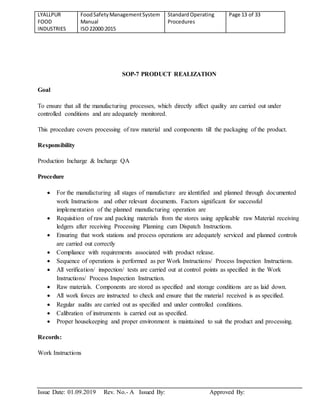
SOP-7 PRODUCT REALIZATION
Goal
To ensure that all the manufacturing processes, which directly affect quality are carried out under
controlled conditions and are adequately monitored.
This procedure covers processing of raw material and components till the packaging of the product.
Responsibility
Production Incharge & Incharge QA
Procedure
 For the manufacturing all stages of manufacture are identified and planned through documented
work Instructions and other relevant documents. Factors significant for successful
implementation of the planned manufacturing operation are
 Requisition of raw and packing materials from the stores using applicable raw Material receiving
ledgers after receiving Processing Planning cum Dispatch Instructions.
 Ensuring that work stations and process operations are adequately serviced and planned controls
are carried out correctly
 Compliance with requirements associated with product release.
 Sequence of operations is performed as per Work Instructions/ Process Inspection Instructions.
 All verification/ inspection/ tests are carried out at control points as specified in the Work
Instructions/ Process Inspection Instruction.
 Raw materials. Components are stored as specified and storage conditions are as laid down.
 All work forces are instructed to check and ensure that the material received is as specified.
 Regular audits are carried out as specified and under controlled conditions.
 Calibration of instruments is carried out as specified.
 Proper housekeeping and proper environment is maintained to suit the product and processing.
Records:
Work Instructions
LYALLPUR
FOOD
INDUSTRIES
FoodSafetyManagementSystem
Manual
ISO22000:2015
StandardOperating
Procedures
Page 14 of 33
Issue Date: 01.09.2019 Rev. No.- A Issued By: Approved By:
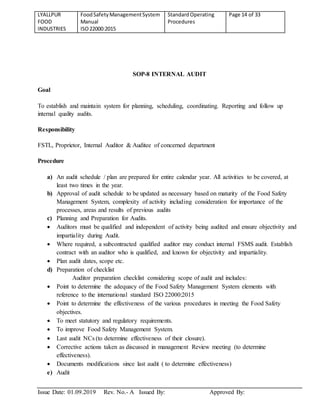
SOP-8 INTERNAL AUDIT
Goal
To establish and maintain system for planning, scheduling, coordinating. Reporting and follow up
internal quality audits.
Responsibility
FSTL, Proprietor, Internal Auditor & Auditee of concerned department
Procedure
a) An audit schedule / plan are prepared for entire calendar year. All activities to be covered, at
least two times in the year.
b) Approval of audit schedule to be updated as necessary based on maturity of the Food Safety
Management System, complexity of activity including consideration for importance of the
processes, areas and results of previous audits
c) Planning and Preparation for Audits.
 Auditors must be qualified and independent of activity being audited and ensure objectivity and
impartiality during Audit.
 Where required, a subcontracted qualified auditor may conduct internal FSMS audit. Establish
contract with an auditor who is qualified, and known for objectivity and impartiality.
 Plan audit dates, scope etc.
d) Preparation of checklist
Auditor preparation checklist considering scope of audit and includes:
 Point to determine the adequacy of the Food Safety Management System elements with
reference to the international standard ISO 22000:2015
 Point to determine the effectiveness of the various procedures in meeting the Food Safety
objectives.
 To meet statutory and regulatory requirements.
 To improve Food Safety Management System.
 Last audit NCs (to determine effectiveness of their closure).
 Corrective actions taken as discussed in management Review meeting (to determine
effectiveness).
 Documents modifications since last audit ( to determine effectiveness)
e) Audit
LYALLPUR
FOOD
INDUSTRIES
FoodSafetyManagementSystem
Manual
ISO22000:2015
StandardOperating
Procedures
Page 15 of 33
Issue Date: 01.09.2019 Rev. No.- A Issued By: Approved By:
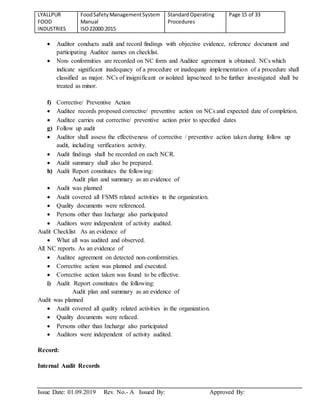
 Auditor conducts audit and record findings with objective evidence, reference document and
participating Auditee names on checklist.
 Non- conformities are recorded on NC form and Auditee agreement is obtained. NCs which
indicate significant inadequacy of a procedure or inadequate implementation of a procedure shall
classified as major. NCs of insignificant or isolated lapse/need to be further investigated shall be
treated as minor.
f) Corrective/ Preventive Action
 Auditee records proposed corrective/ preventive action on NCs and expected date of completion.
 Auditee carries out corrective/ preventive action prior to specified dates
g) Follow up audit
 Auditor shall assess the effectiveness of corrective / preventive action taken during follow up
audit, including verification activity.
 Audit findings shall be recorded on each NCR.
 Audit summary shall also be prepared.
h) Audit Report constitutes the following:
Audit plan and summary as an evidence of
 Audit was planned
 Audit covered all FSMS related activities in the organization.
 Quality documents were referenced.
 Persons other than Incharge also participated
 Auditors were independent of activity audited.
Audit Checklist As an evidence of
 What all was audited and observed.
All NC reports. As an evidence of
 Auditee agreement on detected non-conformities.
 Corrective action was planned and executed.
 Corrective action taken was found to be effective.
i) Audit Report constitutes the following:
Audit plan and summary as an evidence of
Audit was planned
 Audit covered all quality related activities in the organization.
 Quality documents were refaced.
 Persons other than Incharge also participated
 Auditors were independent of activity audited.
Record:
Internal Audit Records
LYALLPUR
FOOD
INDUSTRIES
FoodSafetyManagementSystem
Manual
ISO22000:2015
StandardOperating
Procedures
Page 16 of 33
Issue Date: 01.09.2019 Rev. No.- A Issued By: Approved By:
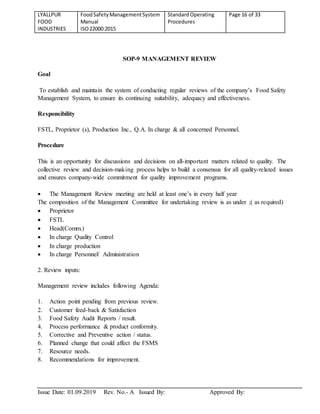
SOP-9 MANAGEMENT REVIEW
Goal
To establish and maintain the system of conducting regular reviews of the company’s Food Safety
Management System, to ensure its continuing suitability, adequacy and effectiveness.
Responsibility
FSTL, Proprietor (s), Production Inc., Q.A. In charge & all concerned Personnel.
Procedure
This is an opportunity for discussions and decisions on all-important matters related to quality. The
collective review and decision-making process helps to build a consensus for all quality-related issues
and ensures company-wide commitment for quality improvement programs.
 The Management Review meeting are held at least one’s in every half year
The composition of the Management Committee for undertaking review is as under ;( as required)
 Proprietor
 FSTL
 Head(Comm.)
 In charge Quality Control
 In charge production
 In charge Personnel/ Administration
2. Review inputs:
Management review includes following Agenda:
1. Action point pending from previous review.
2. Customer feed-back & Satisfaction
3. Food Safety Audit Reports / result.
4. Process performance & product conformity.
5. Corrective and Preventive action / status.
6. Planned change that could affect the FSMS
7. Resource needs.
8. Recommendations for improvement.
LYALLPUR
FOOD
INDUSTRIES
FoodSafetyManagementSystem
Manual
ISO22000:2015
StandardOperating
Procedures
Page 17 of 33
Issue Date: 01.09.2019 Rev. No.- A Issued By: Approved By:
Collection of agenda Data. Following is provided inputs
Maintenance Dept.
 Preview meeting customer feedback including complaints
 Issues related to changes in Food Safety Policy and Objectives.
 Anticipated operation change.
 Training needs Calendar & implementation.
 Competence related activities.
FSTL
 Customer complaints / feedbacks.
 Previous Internal Food Safety Audit Reports/ result
 Effectiveness of Food Safety Management System & improvement if any.
 Corrective and Preventive actions/ status.
In charge Technical
 All interfaces including technical.
In charge Functions
 Summary of quality problems.
 Resource requirements
 Process Performance.
 Product Conformance.
3. Review Output:
The output of Management review includes following:
a. Improvement of effectiveness of food Safety Management System and its processes.
b. Improvement of Product related to Customer requirements. Resource required
4. Minutes of the meeting is prepared, identifying those responsible for taking agreed follow-up action
5. Follow-up on action items
LYALLPUR
FOOD
INDUSTRIES
FoodSafetyManagementSystem
Manual
ISO22000:2015
StandardOperating
Procedures
Page 18 of 33
Issue Date: 01.09.2019 Rev. No.- A Issued By: Approved By:
Records: Management Review Meeting Record
SOP-10 CONTROL OF NON CONFORMING PRODUCT
Goal
To establish and maintain system to ensure that material the identification of non-conforming product
and control to prevent its unintended use or delivery; and also to define control processes, and related
responsibilities and authorities to deal with non-conforming product.
Responsibility
General Manager, store In-charge, Section In charge, Production In charge/ QCI.
Procedure
a. Review and disposal of nonconforming incoming material:
 Record NC material and obtain authorization for disposal from Incharge Concern
 Return to Supplier.
 Enter details in supplier performance
b. Review and disposal of non- conforming in process material
 Inform Processing In charge and obtain authorization for rework.
 Monitor rework, and ensure re- inspection is satisfactorily completed.
 Any rework done is recorded
c. Review and disposal of non- conforming final product.
 Final product is reworked till it satisfactorily passes all tests and inspections.
 Retest the product and verify to confirm conformity with requirements
 Any rework done is recorded
d. Release or acceptance under concession shall be authorized by only the relevant authority and
where applicable, by the customer.
Records of concessions obtained for non-conforming product shall be maintained
e. Nonconformance detected or reported after the product is delivered and / or used, GM who is
responsible for decision and appropriate action including recall of goods, rework at customers end if
required.
Record:
Non Conforming Product Record
LYALLPUR
FOOD
INDUSTRIES
FoodSafetyManagementSystem
Manual
ISO22000:2015
StandardOperating
Procedures
Page 19 of 33
Issue Date: 01.09.2019 Rev. No.- A Issued By: Approved By:
SOP-11 CORRECTIVE ACTION
Goal
To establish and maintain an effective procedure, for taking appropriate corrective action and to
eliminate the cause of nonconformities in order to prevent re-occurrence of non- conformity.
Responsibility
Production In-charge, In-charge Quality Control, Any staff to provide feedback and Proprietor to decide
action & MR.
Procedure
 Corrective Action request is initiated for significant instances of a non-conformance during test and
inspections, process performance etc.
 Corrective action request is initiated for significant instance of Customer Complaint.
 A close watch is kept on all non-conformities. In particular, attention is paid to the following:
 Complaints from customers & Feedback from dealers / sales staff.
 Study of processes and inspections with reference to any trends, which indicate non-conformity.
 Suggestions and observation from employees. Where a corrective action seems possible or is
considered desirable.
 Preventive action request is initiated.
 Action is proposed and executed to remove non-conformities and is recorded. Nonconformities
reported and ascertained from customer complaints are review. Causes on non-conformities are
traced from the relevant records.
 Prepare action plan for eliminating the causes for occurrence of non-conformities & implement
action plan.
 Effectiveness of this action is evaluated during internal quality audits and discussed in
management review meeting.
Record: Corrective Action Records
LYALLPUR
FOOD
INDUSTRIES
FoodSafetyManagementSystem
Manual
ISO22000:2015
StandardOperating
Procedures
Page 20 of 33
Issue Date: 01.09.2019 Rev. No.- A Issued By: Approved By:
SOP-12 PREVENTIVE ACTION
Goal
To establish and maintain an effective procedure, for taking preventive actions to eliminate the causes,
for potential non- conformity, in order to prevent their occurrence. This Food Safety Management
System procedure applies to all preventive measures taken by company, to prevent Occurrence of
potential non-conformities.
Responsibility
General Manager, Proprietor, MR, Concerned Staff
Procedure
a. Preventive action request is initiated for identified potential non-conformance on the basis of
data collected from customer feedback, process identification, trend analysis of non-conformance act.
b. A close watch is kept on all potential non conformities. In particular, attention is paid to the
following:
 Feedback from customers and market
 Feedback from sales staff.
 Study of processes and inspections with reference to any trends, which indicate potential non-
conformity.
 Suggestion and observation from employees. Where a preventive action seems possible or is
considered desirable. Preventive action request is initiated.
c. Action is proposed and executed to remove potential non-conformities and are recorded.
Consider need for changes in Food Safety Management System processes and supportive resources.
d. Effectiveness of these actions are evaluated during internal quality audit and discussed in
management review meeting.
Records: Preventive Action Records
LYALLPUR
FOOD
INDUSTRIES
FoodSafetyManagementSystem
Manual
ISO22000:2015
StandardOperating
Procedures
Page 21 of 33
Issue Date: 01.09.2019 Rev. No.- A Issued By: Approved By:
SOP-13 Training and development
Goal
To determine level of competence for performing work affecting product quality and to identify the
training needs to meet the norms and define a system planned training of employees.
Responsibility
In-charge personnel & Prod. In charge, FSTL / Administration
Procedure
a. Laying down the competence level of operatives and supervisors for performing work affecting
quality of products (in terms of skill grades & experience).
b. Matching the current incumbents with the competence level requirement and defining steps to
tackle deficiency as training needs.
c. Identifying training needs of:
 New entrants before assigning them job responsibility.
 For existing staff, action plans to meet training needs identified shall be discussed in
management review meeting.
 Maintaining qualification, experience necessary for personnel including job description.
d. Records of qualification, skill experience and training of each person employed by the company.
e. Training Modules:
 ISO awareness.
 Exposure to internal quality audit.
 Maintenance training
 Fire safety
 GMP’s Hygiene Practices
 HACCP Awareness
 Packaging
 Process Control & Control of NC Products.
f. Company’s Food Safety Policy, Food Safety Management System.
 Procedures and work instructions as applicable to their area of responsibility.
 Professional/ Technical training.
 In area of their responsibility such as, process engineering, testing, materials procurement act.
LYALLPUR
FOOD
INDUSTRIES
FoodSafetyManagementSystem
Manual
ISO22000:2015
StandardOperating
Procedures
Page 22 of 33
Issue Date: 01.09.2019 Rev. No.- A Issued By: Approved By:
To meet competence level criteria to assign job responsibility.
 How to operate Machinery and instruments.
 Relevance and importance of their activities and awareness of their contribution to product
quality. To help them improve their working style and to become more confident about their work.
 Procedures and work instructions as applicable to their area of responsibility.
g. Indentifying training needs for in-house or external training with consideration/ reference to
following:
 Perceived emerging changes in technology.
 For improvement in operational performance.
Development of individuals
a. Recording conduct of training, trainee’s comments and trainer’s comments as required
b. Verifying effectiveness of training
 By interviewing trainee.
 Assessing his performance.
 Asking trainee to give presentation
Records:
Qualification criteria, Training Record
LYALLPUR
FOOD
INDUSTRIES
FoodSafetyManagementSystem
Manual
ISO22000:2015
StandardOperating
Procedures
Page 23 of 33
Issue Date: 01.09.2019 Rev. No.- A Issued By: Approved By:
SOS 14 HAZARD ANAYSIS & CRITICAL CONTROL PIONTS
Responsibility
The responsibility for development application and monitoring HACCP programmers lies with the
HACCP Team Leader.
Procedure
1. General
Lyallpur Food Industries is fully committed for application of HACCP system for food safety. Prior to
application of HACCP, it has been ensured that the general principles of food hygiene are in place;
Recommended International Code of Practice – General Principles of Food hygiene and food safety
legislation is implemented. During hazard identification, evaluation and operation in designing and
application of HACCP System, due consideration has been given to the impact of raw materials,
ingredients and packing materials and manufacturing practices. The role of manufacturing processes to
control hazard and likely and use of the product, categories of consumers of concern and
epidemiological evidence related to food safety are also given in the procedure.
The HACCP application is reviewed and necessary change made whenever any modification is made in
the product, process or any step.
2. Constitution of HACCP Team
A multi- disciplinary HACCP Team has been constituted which represents the expertise and experience
needed for documenting, verifying and implementing HACCP system. The HACCP Team members
have been trained on basic principles of food Safety Management system.
3. Plant Layout -
The plant layout is given in Annexure of FSMS Manual
4. HACCP Plan
The HACCP Plans for the products manufactured by Lyallpur Food Industries is attached.
5. Construction and on-site Verification of Process Flow Diagram
The HACCP Team has carefully studied all process stages, raw material, ingredients and packing
material and has prepared HACCP Plans as given against and as for the details given below.
5.1 Conducting Hazard Analysis ( Principle-1)
After the process flow diagram is completed and verified the HACCP Team has conducted a hazard
analysis and listed all the biological, chemical and physical hazard that are reasonably expected to occur
at each step and has described the preventive measure that can be used to control these hazards, For
LYALLPUR
FOOD
INDUSTRIES
FoodSafetyManagementSystem
Manual
ISO22000:2015
StandardOperating
Procedures
Page 24 of 33
Issue Date: 01.09.2019 Rev. No.- A Issued By: Approved By:
inclusion in the list, hazards are of the nature such that their elimination or reduction to acceptable levels
is essential to the production and distribution. The team has considered preventive measures, which can
be applied for each hazard. Preventive measures relate to those actions and activities that are required to
eliminate hazards or reduce their impact or occurrence to acceptable levels.
More than one preventive measure may be required to control a specific hazard (s) and More than one
hazard may be controlled by a specified preventive measure,
In conducting the hazard analysis, the HACCP team has kept in mind the following:
a) The likely occurrence of hazards and severity of their adverse health effects:
b) The qualitative and/or quantitative evaluation of the presence of hazards:
c) Survival or multiplication of microorganisms of concern:
The production or persistence of toxins, chemical or physical agents: and conditions leading to the
above.
5.2 Determine Critical control Points (Principle 2)
The Team has identified CCP’s in the HACCP system by applying the decision tree to determine
whether a step is a CCP for the identified hazard. All hazards that may be reasonably expected to occur,
or be introduced at each step, have been considered. Training in the application of the decision tree has
been given to the team members. If a hazard has been identified at a step where control is necessary for
food safety, and no preventative measure exists at that step, or any others, then the process is modified at
that step, or at any earlier or later stage, to include a preventive measure.
5.3 Establishing critical Limits for Each CCP (Principle 3)
Since CCP’s define the boundaries between safe and unsafe products, it is vital that they are set at the
correct level for each criterion. The HACCP team has therefore used the criteria governing safety at
each CCP in order to set the appropriate, critical limits, Critical limit have been specified for each
preventive measure, where required more than one critical limit has been elaborated at a particular step.
Criteria used include control of foreign matter, moisture, microbial load and visual appearance and
enforcement of attract plant personnel hygiene.
5.4 Establish monitoring System for each CCP (Principle 4)
The HACCP team has established a monitoring mechanism for control of CCP’s. Monitoring is one of
the most important aspects of HACCP system. It is the scheduled measurement and observation of a
CCP relative to its critical limits. The monitoring procedures are designed in such a way that they are
enabled to detect loss of control at the CCP and provide information in time for corrective action to be
taken to regain control of the process before there is a need to reject the product. Manager (QA) is
authorized to carry out corrective actions and evaluate data derived from monitoring. The frequency of
monitoring has been specified which is sufficient to guarantee that the CCP is under control. The
LYALLPUR
FOOD
INDUSTRIES
FoodSafetyManagementSystem
Manual
ISO22000:2015
StandardOperating
Procedures
Page 25 of 33
Issue Date: 01.09.2019 Rev. No.- A Issued By: Approved By:
monitoring system has been aligned with the operation of ISO 9001 in the company. The system also
includes calibration of equipment
Most monitoring procedures for CCP’s are done rapidly because they relate to on-line processes and
there will not be time for lengthy analytical testing, Physical and chemical measurements are often and
can often preferred to microbiological testing because they may be done rapidly and can often indicate
the microbiological control of the product. All records and documents associated with monitoring CCPs
are signed by the person(s) doing the monitoring and by a responsible reviewing official(s) in the
functional area.
5.5 Establish corrective action (Principle 5)
Specific corrective actions have been developed for each CCP in the HACCP system in order to deal
with deviations when they occur. The actions taken ensure that the CCP has been brought under control,
Corrective action taken also include proper disposition of the affected product. Deviation and product
disposition procedures are documented in the HACCP record keeping. Corrective action also occurs
when monitoring results indicate a trend towards loss of control at a CCP. Action is taken to bring the
process back into control before the deviation leads to a safety hazard.
5.6 Establish Verification Procedures (Principle 6)
The HACCP system designed includes verification procedures to provide assurance that HACCP system
is being complied with on day –to – day basis. Using internal audit method also monitors this most
effectively. Verification mechanism is given in respective sections. This ensures that the HACCP system
is working correctly and effectively. Monitoring and auditing methods, procedures and test, including
random sampling and analysis are used to determine if the HACCP system is working correctly. The
frequency of audit and verification are kept at appropriate intervals to validate the HACCP system.
Verification activities include:
Review of the HACCP system and its records – during internal audit once in six month Review of
deviations and product dispositions- immediately after occurrence of deviations. Verification of
operations to determine if CCPs are under control- During internal audit. Validation of established
critical limits –Once a year.
5.7 Establish documentation and Record keeping ( Principle- 7)
The HACCP Team has established an efficient record keeping integrating wherever necessary it with
implementation of ISO 22000. An efficient and accurate record keeping is essential to the application of
a HACCP system. Records are therefore kept of all areas, which are critical to product safety to
demonstrate that the HACCP system is in compliance with the documented system. Records provide
basis for analysis of trends as well as for internal investigation of any food safety incidents, which might
have occurred.
LYALLPUR
FOOD
INDUSTRIES
FoodSafetyManagementSystem
Manual
ISO22000:2015
StandardOperating
Procedures
Page 26 of 33
Issue Date: 01.09.2019 Rev. No.- A Issued By: Approved By:
Record: Refer FSMS Manual for Flow Charts, Hazard analysis and HACCP Plan
SOP 15 EMERGENCY PREPAREDNESS & RESPONSE
Goal
Deptt Head has identified the threat & unforeseen event that may occur and has laid down its procedure
to handle the situation in case of any emergency. This procedure is designed to ensure that in case of
crisis the situation is handled in planned manner without any panic. This procedure describes the roles of
each.
Responsibility:
Proprietor, General Manager, Sectional In charges, Supervisors, Employees / Worker & Suppliers
Earth Quake & Tremors
Sudden and violent tremors and earth movements radiating outwards from a localized point, and violent
release of pressures in the earth’s crust is generally referred as an earthquake.
It is advisable that each property must identify an open area within or near by the company which is
easily accessible to be used as assembly/ safe area during an emergency.
An alternate assembly area should also be identified in case the designated assembly area is not
approachable or unsafe or destroyed.
In such a situation there is a possibility of loss life and damage to property, to stabilize the aftermath of
the situation these guidelines should be followed.
 Establishing Command center and assign personnel for emergency response.
 Make available portable radios (Willkie Talkie).
 Arrange for ample of first Aid Supplies.
 Summon your staffs who are trained in First Aid.
 Arrange for Flashlights / Torches and extra batteries.
 Inform Maintenance to arrange for switching of all gas, water valves.
 Do not panic and stay calm.
 Protect yourself by lying down under furniture available nearby, in case of non-availability of
furniture stand in the corners of the room and away from glass fixtures, sliding doors and windows.
 Watch out for falling objects.
 Grab anything handy to protect your head and face from falling debris and splintering glass,
protect your feet from the broken debris or broken glass pieces.
LYALLPUR
FOOD
INDUSTRIES
FoodSafetyManagementSystem
Manual
ISO22000:2015
StandardOperating
Procedures
Page 27 of 33
Issue Date: 01.09.2019 Rev. No.- A Issued By: Approved By:
 Do not panic if the fire alarms or sprinklers go off.
 Do not RUSH outside – Stand in corridors, do not use elevators.
Look out for falling debris and proceed cautiously to open area.
 When you are outside the building: Move away from the building, garage walls, power poles and
lampposts. If possible proceed cautiously to an open area.
 Do no light matchsticks, cigarettes, or electrical switches.
 Treats injured and consider evacuation once the tremors and shaking stops.
 Go to pre arranged assembly points.
 Wait for further instructions from the emergency chief.
In order to minimize the loss of life, injury to human being and to carry out orderly evacuation if
required each department is showered with the additional responsibilities.
*Responsibilities of Respective Departments / section head.
Duty Manager:
 If there is an entrapment in any area the telephone operator should reassure the staff and / or
employee that there is help on the way.
 Keep everyone away from windows and ceiling light. Inform all staffs and staff members to
proceed to the assembly area.
 If extensive damage has occurred to the building and it is thought to be unsafe to occupy upper
floors, determine a safe evacuation route for Assembly area.
 If fire breaks out, proceed with the established fire procedures. Depending on the severity of the
earthquake, it may not be possible to have the assistance of the fire department. A decision will have to
be made to disregard fire fighting and concentrate on Life- Saving procedures.
 Designate personnel to go to the staff floors to assist in the evacuation to the designated
assembly areas.
 Advise Human Resource Department to set up a First- Aid station, if deemed necessary.
Engineering:-
 If power fails and it has been determined that the emergency generator has started automatically,
and is operating properly, periodic inspection is to be conducted to ensure that proper operation
continues.
 Keep all flashlights and walkie-talkie sets and any other equipment deemed necessary.
 Prepare a list of utility damage assessment and control measures taken.
 Help all the staff to the Assembly area.
LYALLPUR
FOOD
INDUSTRIES
FoodSafetyManagementSystem
Manual
ISO22000:2015
StandardOperating
Procedures
Page 28 of 33
Issue Date: 01.09.2019 Rev. No.- A Issued By: Approved By:
 Check staff rooms for injured staffs.
 Assist security in the prevention of any looting that may occur.
Security:-
 Report to the Security Person.
 Check elevators for staffs and staff who may be trapped.
 Encourage staffs to stay calm in the building and keep everyone cleared away from windows and
ceiling lights.
 Assist in the evacuation of people to the Assembly Area designated.
 Set up a First- Aid station in the secured area.
 Ensure that no outsider enters the property, and protect the staff rooms / property from being
looted.
Duties of Telephone Operator:-
 Inform about any elevators in which people are trapped to engineering / security.
 Notify the Security Officer / Shift Engineer of Fire Alarms.
 The Telephone Exchange is one of the most important areas in this type of situation. Remain in
the exchange if at all- possible, unless directed by the Emergency Chief to evacuate.
 When the initial tremors have ceased, direct staff away from window, ceiling lights and overhead
decorative fixtures
 Direct the staff to the assembly areas.
 If evacuation call is given report to the assembly area along with entire staff as soon as possible.
 Assist in directing staffs to the assembly area.
 Take print out of all the in- House staffs and carry to the assembly area for roll call.
 Arrange for a First Aid Kit box at the assembly area.
 If the evacuation call is given proceed to the assembly area.
 Make alternative arrangements for accommodations in case the situation so arise.
Administration:-
 Arrange for First Aid, Doctors at the assembly area.
 Prepare list / Take print out of the staff present in the premises and take roll call at the assembly
area.
LYALLPUR
FOOD
INDUSTRIES
FoodSafetyManagementSystem
Manual
ISO22000:2015
StandardOperating
Procedures
Page 29 of 33
Issue Date: 01.09.2019 Rev. No.- A Issued By: Approved By:
Leakages And Flooding
Submerging of most part of our property under water is generally called flooding. The flooding may be
due to heavy rains, rise in water levels in the sea/ rivers. It could also be due to the blockages in the
drainage systems.
The most common reasons of flooding can be due to leakages / pipe bursts. A checklist has been
prepared to avoid the consequences.
 Check and clear all the terraces for waste and debris and clear all rubbish.
 Check the drainpipes for the scaling / blockages and storm drain (clean with the water pressure)
if required.
 Check all the drainage pumps and carry out preventive maintenance if required.
 Ensure that all the windows, external light are properly sealed with silicon to prevent any
leakages.
 Ensure all the flow drains (underground drainage pipelines) are clear of mud /muck/ act.
 In case heavy rains and cyclonic weather are predicted, remain in constant touch with the local
weather bureau (Meteorological Services).
 Ensure that the low-lying areas of the property are clear of loose / floating material which could
clog the sump pump / drainage lines.
 Portable Fire pumps, send bags, condemned linen, Plastic buckets, Moping equipments, Water
suction machines, barricades which will be used for clearing the water in the flood situation should
be stored in a place where it is easily accessible and should not be in a low lying area.
 Monitor the flood situation in the city, coordinate with the police control room in order to ensure
that the company staffs arrive / depart to the airport without trouble.
 Telephone numbers of police control room, weather bureau, traffic control, fire & Emergency
services, Airport authorities, should be kept updated from time to time.
 Take precautionary measures to ensure that all windows are closed and sealed during heavy rains
/ winds.
 Ensure that all other outer fittings and fixtures are safe and secured properly.
 Avoid parking of staff vehicles under the trees and lampposts etc.
If The Property Still Get Flooded
 Immediately barricade the affected area and prevent the water spreading to non affected parts of
the property.
 Find out the source of water flooding the property.
 Incase heavy leakage detected inside the property stop it immediately.
 Safe guard the staffs and the company property.
 Start all the Sump Pumps and other pumps to drain out the water.
LYALLPUR
FOOD
INDUSTRIES
FoodSafetyManagementSystem
Manual
ISO22000:2015
StandardOperating
Procedures
Page 30 of 33
Issue Date: 01.09.2019 Rev. No.- A Issued By: Approved By:
 Use the portable pumps if necessary.
 If the flooded area is the staff area then relocate the staff to the safe area.
 Cut off the power supply to the affected area and if required provide battery powered emergency
lighting.
 Immediately start drying the area after the floodwater is receded / drained out.
 Assess the damage and initiate insurance claim procedures.
 Take photographs of the affected / damaged area.
 Sanitize the area before releasing for the staff / staff occupation.
Riots and Civil Disturbances
These are the two acts, which can severely affect the business of the company industry and therefore
should not be overlooked. Therefore the plan of action should be prepared which can be implemented in
such a situation.
These can be classified into four basic categories.
 Disturbance in the immediate vicinity of the company.
 Disturbance in communities away from the company.
 Disturbance aimed at the company itself.
 Disturbance in the company.
Consequence of such acts of disturbances.
Panic among company staff
 Rum our spread likes wild fire.
 Staff not able to approach / leave the company due to the road blockages.
 Loss of revenue.
 Shortage of supplies and provisions due to prolonged disturbance.
 Damages to the property/ mob break-in.
 Staff unable to come to work due to disruption of transportation services.
 Possible injuries to staff.
Counter Measures
 Remain in constant touch with the police control to find out the facts and disseminate true
information to the Duty manager and HR for handling staff and staff queries.
 Coordinate with police to provide escort if required
 To provide assistance to purchase department if possible
LYALLPUR
FOOD
INDUSTRIES
FoodSafetyManagementSystem
Manual
ISO22000:2015
StandardOperating
Procedures
Page 31 of 33
Issue Date: 01.09.2019 Rev. No.- A Issued By: Approved By:
 Reinforce perimeter security by requesting help from policy for additional deployment.
 All security staff to be summoned and accommodated in the company
 Only the main entrance to the company should be protected by security throughout the duration
of the situation.
 HR to make arrangements for staff.
 If forced entry is made, control situation till such time the police arrives.
 If possible vehicles belonging to staff, the company and the staff can be moved to a safe area.
 Security may take help from staff of other departments to perform security duties.
 Continues patrol of the entire property should be undertaken round the clock.
 Consider safekeeping of vital records /money.
 Protect all the companies’ vital machinery pertaining to maintenance.
First Aid and Medical Emergency
Aid given to an individual before the professional medical team arrives is termed as first aid.
At any given time there are a large number of individuals present in the company premises, which are
susceptible to sickness and injury. It is therefore necessary that maximum number of company employee
is aware of the first aid guidelines. PLEASE NOTE THAT ALL TIMES PROTECT YOUR SELF
WHEN TREATING AN INDIVIDUAL BY USING LATEX GLOVES. Some of the occasions
where the first aid can be administered are as follows.
Wounds
1. Stop the bleeding by any of the following methods
 Direct pressure.
 Direct finger pressure in case of large bleeding wounds.
 Use tourniquets only as a last resort.
 Avoid touching the wounds with hands or unsterilized material.
 Clear the wound with running water and surrounding area with soap or spirit using clean gauge,
washing away from the wound. Apply readymade adhesive gauge bandage or sterilized gauge and roller
bandage as required.
 Keep the patient quite: razing the extremity if it’s the bleeding part, give no stimulants
 Never apply antiseptic ointment or lotion or iodine or germicides to the open wound.
Shock
 Lay the patient on his back.
 Stop bleeding if any.
 Relive pain by supporting injured part.
LYALLPUR
FOOD
INDUSTRIES
FoodSafetyManagementSystem
Manual
ISO22000:2015
StandardOperating
Procedures
Page 32 of 33
Issue Date: 01.09.2019 Rev. No.- A Issued By: Approved By:
 Keep the patient comfortable, but do not cause sweating. Fluids may be given in small amounts
unless the patient is nauseated, unconscious, likely to be operated, or has an abdominal wound.
 Reassure and cheer up the patient.
Abdominal Wounds
 Keep the patient flat
 Give nothing by mouth
 Maintain warmth
 If intestines protrude from the wound do not attempt to touch or Replace them.
 Apply sterile dressing and bandage to the wounds
 Provide careful and immediate transportation to the hospital
Electric Shock.
 Put of the main switch or detach the individual from the source of electricity by using insulated
material.
 Make rapid examination of the individual.
 Give CPR if necessary.
 Rush to the hospital
Eye wounds
 Do not apply oil or ointment.
 Removal may be attempted, if foreign is not embedded.
 If there is a foreign body embedded. In the eyeball, send the individual immediately to the doctor
after applying pad and loose bandage.
Chemical Burns on The Eyes
 Immediate washing of the eye at least for fifteen min. is of great importance.
 Apply sterile bandage and the individual immediately to the doctor
Back Injury
 Transport on a rigid frame. This frame may be improvised by using available board or a door.
 The rigid frame may be placed on a stretcher for transportation.
 In neck fracture cases, it is much better to get a doctor to the scene, of danger to life is great
Snake Bite
 Clam and reassure the patient
 Wash and cool the wound with soap water.
LYALLPUR
FOOD
INDUSTRIES
FoodSafetyManagementSystem
Manual
ISO22000:2015
StandardOperating
Procedures
Page 33 of 33
Issue Date: 01.09.2019 Rev. No.- A Issued By: Approved By:
 Tie string to pressure block the blood flow towards the heart.
 Take to a doctor immediately.

Sop

  • 1.
    LYALLPUR FOOD INDUSTRIES FoodSafetyManagementSystem Manual ISO22000:2015 StandardOperating Procedures Page 1 of33 Issue Date: 01.09.2019 Rev. No.- A Issued By: Approved By: CONTENTS List of Standard Operating Procedure (SOP’s) Doc No. Purchase Inspection & Stores SOP 1 Process Control SOP 2 Document Control SOP 3 Control of Record SOP 4 Calibration SOP 5 Product Identification, Traceability & recall SOP 6 Product Realization SOP 7 Internal Audit SOP 8 Management Review SOP 9 Control of Non Conformity SOP 10 Corrective Action SOP 11 Preventive Action SOP 12 Training and Development SOP 13 Hazard Analysis & Critical Control Point SOP 14 Emergency Preparedness and response SOP 15
  • 2.
    LYALLPUR FOOD INDUSTRIES FoodSafetyManagementSystem Manual ISO22000:2015 StandardOperating Procedures Page 2 of33 Issue Date: 01.09.2019 Rev. No.- A Issued By: Approved By: SOP – 1 PURCHASE, INSPECTION & STORES Goal: To ensure those purchased products are standard and certified and free from health Hazards. Responsibility: General Manager and store In-charge are primarily responsible for its implementation. Procedure:  Ensuring that Standard and Certified qualities of the material are purchase for manufacture.  Purchase of services like calibration, transportation, training etc.  For purchase of Food Related Products: Before finalization suppliers are inspected by appointed person, time to time trainings are given to Suppliers for better primary production to improve Product quality and sample quality is approved before purchase of bulk quantity.  For packing material purchased from supplier is evaluated by visit of a team decided by Proprietor by getting the sample approved/ product catalogue for confirming their ability to meet the specified requirements as per the relevant company specifications. Before the approval, the material is purchased on trial basis, then goes under laboratory testing, if results are found satisfactory, the supplier is put on the approved list and the material received is lot inspected as per the company specification.  A list of approved suppliers for each item is maintained giving the name, address, items manufactured, delivery time, etc.  Purchase of services is done in consultation with Quality Control Manager and services of competent personnel are made use of. Record: Approved Supplier List
  • 3.
    LYALLPUR FOOD INDUSTRIES FoodSafetyManagementSystem Manual ISO22000:2015 StandardOperating Procedures Page 3 of33 Issue Date: 01.09.2019 Rev. No.- A Issued By: Approved By: SOP – 2 PROCESS CONTROL Goal: To establish and maintain a system for ensuring that production activity, including receiving, processing and packing is carried under safe and hygienic conditions. Responsibility: Q.C. Officer, Production In charge and store in charge are primarily responsible for its implementation. Procedure: 1 ) WHOLE MILK POWDER Procedure: Receiving Milk  Random sample must be drawn from the arrived Refrigerated truck.  Sample has to be analyzed for the following parameters to give the Clearance and received: Organolaptic Fat Acidity Bacteriological quality Foreign matter Storage  Received milk must be promptly cooled to 5⁰C  Stored at the temperature lower than 5⁰C in the properly cleaned silos. Filtration  Raw material is passed through Filtration to get a dust & foreign matter free raw milk for further processing.  Filter of the line must be checked and cleaned in every Shift.
  • 4.
    LYALLPUR FOOD INDUSTRIES FoodSafetyManagementSystem Manual ISO22000:2015 StandardOperating Procedures Page 4 of33 Issue Date: 01.09.2019 Rev. No.- A Issued By: Approved By: Standardization:  Milk is then standardized as per the fat requirement for SMP/WMP.  Pearson Square method may be used to calculate the amount of or Milk to be used. Pre-heating/ Homogenization: Then the milk is preheated at 71⁰C & then homogenization is carried out( 63-74⁰C, 2500-psi I stage: 500-psi II stage) in order to homogenize the distribution of Fat Globules throughout the milk. Heating/ Pasteurization & Condensing/ Cooling: Then the Homogenized milk go through the process of pasteurization. This is a process of heating each & every particle of milk at a defined & controlled combination of Time & Temperature in order to kill the spores of pathogenic microorganism. This process is followed by prompt cooling/ condensing at 5⁰C. Pre-heating & Pumping: Pasteurized milk is then Pre-heated at 71⁰C & then pumped to the spray Drier. Here the pump consists of the atomizer with it; which sprays the milk in the form of drops to the spray Drier. Spray Drying: This is done in the Spray Dryers at a temperature of 85-90⁰C with outlet air. This process should be done under the controlled conditions. Cooling: The spray Dried powder is then promptly cooled to 32⁰C in order to avoid the moisture absorption. Shifting & Packaging: Then the Milk Powder is shifted through a 14 mesh screen which is followed by Packing in safe, hygienic and controlled conditions. And every Packet has Batch no. and ID. No. for identification.
  • 5.
    LYALLPUR FOOD INDUSTRIES FoodSafetyManagementSystem Manual ISO22000:2015 StandardOperating Procedures Page 5 of33 Issue Date: 01.09.2019 Rev. No.- A Issued By: Approved By: II) SKIM MILK POWDER Receiving Milk & Filtration  Random sample must be drawn from the arrived Refrigerated truck/cans.  Sample has to be analyzed for the following parameters to give the clearance and received: Organoleptic Fat Acidity Bacteriological Quality Foreign matter  Raw milk is then passed through Filtration to get a dust & foreign matter free raw milk for further processing.  Filters of the line must be checked and cleaned in every Shift. Cooling & storage  Received milk must be promptly cooled to 5⁰ C  Storage at the temperature lower than 5⁰ C in the properly cleaned silos. Separation:  Cream is separated from milk in order to decrease the Fat level at the percentage lower than 1% in orders to reduce the fat level. Cream and skim milk is separated  Calculative method may be used to calculate the amount of or Milk to be used. Pasteurization & Storage: Then the Homogenized milk go through the process of pasteurization. This is a process of heating each & every particle of Milk at a defined & controlled combination of time & Temperature in order to kill the spores of pathogenic microorganism. This process is followed by prompt cooling/ condensing at 5⁰C. Condensing / Evaporation: Pasteurized Skimmed milk is further condensed and evaporated by preheating to reduce the moisture level. Filtration & Pumping:  Filtration is done in order to remove the extraneous matter if any.
  • 6.
    LYALLPUR FOOD INDUSTRIES FoodSafetyManagementSystem Manual ISO22000:2015 StandardOperating Procedures Page 6 of33 Issue Date: 01.09.2019 Rev. No.- A Issued By: Approved By:  Milk is then pumped to the spray drier. Here the pump consists of the atomizer with it, which sprays the milk in the form of drops to the spray Drier. Spray Drying: This is done in the Spray Dryers at a temperature of 85-90⁰C with outlet air. This process should be done under the controlled conditions. Cooling: The spray dried powder is then promptly cooled to 32⁰C in order to avoid the moisture absorption. Shifting & Packaging: Then the Milk Powder is shifted through a 14 mesh screen which is followed by Packaging in safe, hygienic and controlled conditions. And every Packet has Batch no. and ID. No. for identification. III) GHEE Receiving of Raw Ingredients a) Receiving of Raw milk  Receiving milk should go through the following steps: Weighing Sampling Grading Cooling (5degC) Storage  Grading should be done as on the basis of following parameters to give the clearance and received: Organoleptic Fat Acidity Bacteriological Foreign matter  Raw milk is then passed through Filtration to get a dust & foreign matter free raw milk for further processing.  Filters of the line must be checked and cleaned in every Shift.
  • 7.
    LYALLPUR FOOD INDUSTRIES FoodSafetyManagementSystem Manual ISO22000:2015 StandardOperating Procedures Page 7 of33 Issue Date: 01.09.2019 Rev. No.- A Issued By: Approved By: Separation  Here Cream is separated from milk. Cooling & Storage  Received milk must be promptly cooled to 5⁰ C  Stored at the temperature lower than 5⁰ C in the properly cleaned Silos. b) Receiving Cream & Neutralization a) Receiving of Raw Milk  Received milk should go through the following steps: Weighing Sampling Grading Cooling (5 deg C) Storage  Grading should be done on the basis of following parameters to give the clearance and received: Organoleptic Fat Acidity Bacteriological Foreign matter  Neutralization is done in order to reduce the acidity of Cream. Neutralization used should be approved & should be used under the defined limit. Standardization  Cream is then standardized as per the Fat requirement for SMP/WMP.  Pearson Square method may be used to calculate the amount of Fat or Skimmed Milk to be used. Pasteurization & Cooling:  Then the Cream go through the process of pasteurization. This is a process of heating each & every particle of Cream at a defined & controlled combination of Time & Temperature in order to kill the spores of pathogenic microorganism. This process is followed by prompt cooling/ condensing at 5⁰C Ageing  This is done by holding the cream at low temperature (5-10⁰C) for minimum 2-4 hours; best holding time is 12-14 hours (overnight).
  • 8.
    LYALLPUR FOOD INDUSTRIES FoodSafetyManagementSystem Manual ISO22000:2015 StandardOperating Procedures Page 8 of33 Issue Date: 01.09.2019 Rev. No.- A Issued By: Approved By:  Ageing serves ease to the separation of fat as the fat particles solidify & while churning they separate out easily with a minimum loss of fat. Churning & Washing  Fat (Butter) is then churned from cream by using churners.  Washing is done by cold water in order to wash off the adhered buttermilk from the churned fat. Cooking of Cream/ butter  Cream / butter is then cooked into the Ghee Kettle at 104-106⁰C to extract out the Ghee. Settling, Filtration & Clarification of Ghee  Extracted Ghee is then let to settle in the ghee kettle for 30-45 minutes.  Filtration is done by using nylon filter in order to remove the dust or any other foreign matter.  Clarification is done at 60-85⁰C in order to remove any off-flavor or any other volatile impurities. Inspection & Testing: Prepared Ghee is then tested for the following standards: Fat % Foreign matter Flavor (Or any other parameter if required) Filtration:  Tested Ghee is then Pre- heated filtered in order to remove the extraneous matter if any. Packaging: Then the Ghee sent for Packaging under safe, hygienic and controlled conditions. And every Packet has Batch no. and ID. NO. for identification. Dispatch: Ghee is then dispatched at ambient temperature under hygienic conditions. Record: Batch No Record, Test Record
  • 9.
    LYALLPUR FOOD INDUSTRIES FoodSafetyManagementSystem Manual ISO22000:2015 StandardOperating Procedures Page 9 of33 Issue Date: 01.09.2019 Rev. No.- A Issued By: Approved By: SOP-3 DOCUMENT CONTROL Goal: To establish and maintain a system, which ensures that all Hazard Analysis critical control Point system documents, are controlled. Responsibility: Company Representative and Quality Control Manager are primarily responsible for its implementation. Procedure:  Management appoints some person as Company representative to control of implementation of HACCP System.  All documents and data are maintained on hard copy and soft copy.  Allotment of unique number with issue number to each document as per numbering plan.  All documents are approved by Proprietor and Company Representative.  The issue control and recall of all documents is carried out under the control of Company Representative.  Master copy of documents is stamped as MASTER COPY IN Red, all controlled copies as CONTROLLED in RED and any copy not controlled is stamped as UNCONTROLLED IN Red. Changes:  Any employee of the company may request for change to documents, when required.  Modifying Documents after formal review by concerned persons.  Change history is maintained in the document itself to ensure all recipients are well aware of Change.  Obtaining approval from approving authority. Record: List of Documents
  • 10.
    LYALLPUR FOOD INDUSTRIES FoodSafetyManagementSystem Manual ISO22000:2015 StandardOperating Procedures Page 10 of33 Issue Date: 01.09.2019 Rev. No.- A Issued By: Approved By: SOP-4 CONTROL OF RECORDS Goal To maintain & control quality records and ensure their easy retrieval and disposition. Responsibility This Food Safety Management System procedure applies to quality records generated by the company, Management Rep/FSMS Team leader is responsible for effective implementation. Procedure The quality records provide evidence of conformity of effective operations of FSMS (that documented procedures are being followed). Custodians a) Records are maintained by those function identified in relevant documents. b) Where required by contract, custodians make records available to customer. c) A copy of sample records/ formats is maintained as per master list. Indexing a) Records are filed date wise in reverse date order or as appropriate. Identification a) All records which support the Food Safety Management system is referenced in the appropriate procedure, work instruction, quality plans etc. List of files & records are maintained by each function. a) All personnel have been advised to fill the records legibly and identifiable to the product/ process involved. Storage a) Records are stored in suitably protected & secure facilities which are “Termite, water and moisture” proof so as to:  Be easily retrievable.-  Minimize deterioration  Protected from damage. Prevent loss/ unauthorized access or tempering such as alteration Records: List of Files & Records
  • 11.
    LYALLPUR FOOD INDUSTRIES FoodSafetyManagementSystem Manual ISO22000:2015 StandardOperating Procedures Page 11 of33 Issue Date: 01.09.2019 Rev. No.- A Issued By: Approved By: SOP-5 CALIBRATION Goal: To establish and maintain system to ensure that inspection, measuring and test equipment used by the company are of proper range, type and accuracy. Responsibility: Production In charge, Quality Control Officer and Maintenance Engineer are primarily responsible for ensuring that the procedure is implemented. Procedure:  Selection of appropriate equipment that is capable of necessary accuracy and precision, after ascertaining the measurements to be made and the accuracy requirement.  Identification of all inspection, measuring and test equipment that leave a bearing on product quality. Calibrate them at specified intervals or prior to use against certified equipment having a known valid relationship to internationally or nationally recognized standards. If such standards are not accessible, the basis used for calibration is documented in its work instruction.  Defining and documented the process used for calibration, with details of equipment type, identification, location, periodicity of checks, method of checking, acceptance criteria and the action to be taken when results are unsatisfactory.  Identification of equipment with a tag to show the calibration status.  Calibration of all digital balances and inspection, measuring and test equipment has been done once in a shift.  Proper identification of equipment carrying out in – house calibration or sending to outside agency as pet plan.  Maintaining Record of calibration activity for in-house calibration and certificates for outside calibration.  Ensuring calibration and use under suitable environmental condition i.e. lighting level, cleanliness, noise, vibration act. Record: List of MMD’s (Measuringand MonitoringDevices) Calibration Records( Certificates)
  • 12.
    LYALLPUR FOOD INDUSTRIES FoodSafetyManagementSystem Manual ISO22000:2015 StandardOperating Procedures Page 12 of33 Issue Date: 01.09.2019 Rev. No.- A Issued By: Approved By: SOP-6 PRODUCT IDENTIFICATION, TRACEABILITY & RECALL Responsibility: FSTL, (Food Safety Team Leader) Quality Control In charge and Production Manager are primarily responsible for its implementation. Procedure:  Product is identified by Serial No., Date of manufacturing, Batch No. Customer name and address and quantity of the material dispatched.  In the case of happening any hazard in the dispatched material-- -All the material is sealed immediately and the team of concerning personal appointed by Management goes there and collects the sample of material. -Then the collected samples are taken for quality analysis. -If the results are found as per the information, the rejected material is replaced by fresh one. -The rejected material goes for quality treatment or recycling. -If the hazard is not recoverable then whole of the batch is to be destroyed. -Also further investigation followed and cause of negligence is detected to avoid this type of mis- happening. Record: Product Recall Record (if Any)
  • 13.
    LYALLPUR FOOD INDUSTRIES FoodSafetyManagementSystem Manual ISO22000:2015 StandardOperating Procedures Page 13 of33 Issue Date: 01.09.2019 Rev. No.- A Issued By: Approved By: SOP-7 PRODUCT REALIZATION Goal To ensure that all the manufacturing processes, which directly affect quality are carried out under controlled conditions and are adequately monitored. This procedure covers processing of raw material and components till the packaging of the product. Responsibility Production Incharge & Incharge QA Procedure  For the manufacturing all stages of manufacture are identified and planned through documented work Instructions and other relevant documents. Factors significant for successful implementation of the planned manufacturing operation are  Requisition of raw and packing materials from the stores using applicable raw Material receiving ledgers after receiving Processing Planning cum Dispatch Instructions.  Ensuring that work stations and process operations are adequately serviced and planned controls are carried out correctly  Compliance with requirements associated with product release.  Sequence of operations is performed as per Work Instructions/ Process Inspection Instructions.  All verification/ inspection/ tests are carried out at control points as specified in the Work Instructions/ Process Inspection Instruction.  Raw materials. Components are stored as specified and storage conditions are as laid down.  All work forces are instructed to check and ensure that the material received is as specified.  Regular audits are carried out as specified and under controlled conditions.  Calibration of instruments is carried out as specified.  Proper housekeeping and proper environment is maintained to suit the product and processing. Records: Work Instructions
  • 14.
    LYALLPUR FOOD INDUSTRIES FoodSafetyManagementSystem Manual ISO22000:2015 StandardOperating Procedures Page 14 of33 Issue Date: 01.09.2019 Rev. No.- A Issued By: Approved By: SOP-8 INTERNAL AUDIT Goal To establish and maintain system for planning, scheduling, coordinating. Reporting and follow up internal quality audits. Responsibility FSTL, Proprietor, Internal Auditor & Auditee of concerned department Procedure a) An audit schedule / plan are prepared for entire calendar year. All activities to be covered, at least two times in the year. b) Approval of audit schedule to be updated as necessary based on maturity of the Food Safety Management System, complexity of activity including consideration for importance of the processes, areas and results of previous audits c) Planning and Preparation for Audits.  Auditors must be qualified and independent of activity being audited and ensure objectivity and impartiality during Audit.  Where required, a subcontracted qualified auditor may conduct internal FSMS audit. Establish contract with an auditor who is qualified, and known for objectivity and impartiality.  Plan audit dates, scope etc. d) Preparation of checklist Auditor preparation checklist considering scope of audit and includes:  Point to determine the adequacy of the Food Safety Management System elements with reference to the international standard ISO 22000:2015  Point to determine the effectiveness of the various procedures in meeting the Food Safety objectives.  To meet statutory and regulatory requirements.  To improve Food Safety Management System.  Last audit NCs (to determine effectiveness of their closure).  Corrective actions taken as discussed in management Review meeting (to determine effectiveness).  Documents modifications since last audit ( to determine effectiveness) e) Audit
  • 15.
    LYALLPUR FOOD INDUSTRIES FoodSafetyManagementSystem Manual ISO22000:2015 StandardOperating Procedures Page 15 of33 Issue Date: 01.09.2019 Rev. No.- A Issued By: Approved By:  Auditor conducts audit and record findings with objective evidence, reference document and participating Auditee names on checklist.  Non- conformities are recorded on NC form and Auditee agreement is obtained. NCs which indicate significant inadequacy of a procedure or inadequate implementation of a procedure shall classified as major. NCs of insignificant or isolated lapse/need to be further investigated shall be treated as minor. f) Corrective/ Preventive Action  Auditee records proposed corrective/ preventive action on NCs and expected date of completion.  Auditee carries out corrective/ preventive action prior to specified dates g) Follow up audit  Auditor shall assess the effectiveness of corrective / preventive action taken during follow up audit, including verification activity.  Audit findings shall be recorded on each NCR.  Audit summary shall also be prepared. h) Audit Report constitutes the following: Audit plan and summary as an evidence of  Audit was planned  Audit covered all FSMS related activities in the organization.  Quality documents were referenced.  Persons other than Incharge also participated  Auditors were independent of activity audited. Audit Checklist As an evidence of  What all was audited and observed. All NC reports. As an evidence of  Auditee agreement on detected non-conformities.  Corrective action was planned and executed.  Corrective action taken was found to be effective. i) Audit Report constitutes the following: Audit plan and summary as an evidence of Audit was planned  Audit covered all quality related activities in the organization.  Quality documents were refaced.  Persons other than Incharge also participated  Auditors were independent of activity audited. Record: Internal Audit Records
  • 16.
    LYALLPUR FOOD INDUSTRIES FoodSafetyManagementSystem Manual ISO22000:2015 StandardOperating Procedures Page 16 of33 Issue Date: 01.09.2019 Rev. No.- A Issued By: Approved By: SOP-9 MANAGEMENT REVIEW Goal To establish and maintain the system of conducting regular reviews of the company’s Food Safety Management System, to ensure its continuing suitability, adequacy and effectiveness. Responsibility FSTL, Proprietor (s), Production Inc., Q.A. In charge & all concerned Personnel. Procedure This is an opportunity for discussions and decisions on all-important matters related to quality. The collective review and decision-making process helps to build a consensus for all quality-related issues and ensures company-wide commitment for quality improvement programs.  The Management Review meeting are held at least one’s in every half year The composition of the Management Committee for undertaking review is as under ;( as required)  Proprietor  FSTL  Head(Comm.)  In charge Quality Control  In charge production  In charge Personnel/ Administration 2. Review inputs: Management review includes following Agenda: 1. Action point pending from previous review. 2. Customer feed-back & Satisfaction 3. Food Safety Audit Reports / result. 4. Process performance & product conformity. 5. Corrective and Preventive action / status. 6. Planned change that could affect the FSMS 7. Resource needs. 8. Recommendations for improvement.
  • 17.
    LYALLPUR FOOD INDUSTRIES FoodSafetyManagementSystem Manual ISO22000:2015 StandardOperating Procedures Page 17 of33 Issue Date: 01.09.2019 Rev. No.- A Issued By: Approved By: Collection of agenda Data. Following is provided inputs Maintenance Dept.  Preview meeting customer feedback including complaints  Issues related to changes in Food Safety Policy and Objectives.  Anticipated operation change.  Training needs Calendar & implementation.  Competence related activities. FSTL  Customer complaints / feedbacks.  Previous Internal Food Safety Audit Reports/ result  Effectiveness of Food Safety Management System & improvement if any.  Corrective and Preventive actions/ status. In charge Technical  All interfaces including technical. In charge Functions  Summary of quality problems.  Resource requirements  Process Performance.  Product Conformance. 3. Review Output: The output of Management review includes following: a. Improvement of effectiveness of food Safety Management System and its processes. b. Improvement of Product related to Customer requirements. Resource required 4. Minutes of the meeting is prepared, identifying those responsible for taking agreed follow-up action 5. Follow-up on action items
  • 18.
    LYALLPUR FOOD INDUSTRIES FoodSafetyManagementSystem Manual ISO22000:2015 StandardOperating Procedures Page 18 of33 Issue Date: 01.09.2019 Rev. No.- A Issued By: Approved By: Records: Management Review Meeting Record SOP-10 CONTROL OF NON CONFORMING PRODUCT Goal To establish and maintain system to ensure that material the identification of non-conforming product and control to prevent its unintended use or delivery; and also to define control processes, and related responsibilities and authorities to deal with non-conforming product. Responsibility General Manager, store In-charge, Section In charge, Production In charge/ QCI. Procedure a. Review and disposal of nonconforming incoming material:  Record NC material and obtain authorization for disposal from Incharge Concern  Return to Supplier.  Enter details in supplier performance b. Review and disposal of non- conforming in process material  Inform Processing In charge and obtain authorization for rework.  Monitor rework, and ensure re- inspection is satisfactorily completed.  Any rework done is recorded c. Review and disposal of non- conforming final product.  Final product is reworked till it satisfactorily passes all tests and inspections.  Retest the product and verify to confirm conformity with requirements  Any rework done is recorded d. Release or acceptance under concession shall be authorized by only the relevant authority and where applicable, by the customer. Records of concessions obtained for non-conforming product shall be maintained e. Nonconformance detected or reported after the product is delivered and / or used, GM who is responsible for decision and appropriate action including recall of goods, rework at customers end if required. Record: Non Conforming Product Record
  • 19.
    LYALLPUR FOOD INDUSTRIES FoodSafetyManagementSystem Manual ISO22000:2015 StandardOperating Procedures Page 19 of33 Issue Date: 01.09.2019 Rev. No.- A Issued By: Approved By: SOP-11 CORRECTIVE ACTION Goal To establish and maintain an effective procedure, for taking appropriate corrective action and to eliminate the cause of nonconformities in order to prevent re-occurrence of non- conformity. Responsibility Production In-charge, In-charge Quality Control, Any staff to provide feedback and Proprietor to decide action & MR. Procedure  Corrective Action request is initiated for significant instances of a non-conformance during test and inspections, process performance etc.  Corrective action request is initiated for significant instance of Customer Complaint.  A close watch is kept on all non-conformities. In particular, attention is paid to the following:  Complaints from customers & Feedback from dealers / sales staff.  Study of processes and inspections with reference to any trends, which indicate non-conformity.  Suggestions and observation from employees. Where a corrective action seems possible or is considered desirable.  Preventive action request is initiated.  Action is proposed and executed to remove non-conformities and is recorded. Nonconformities reported and ascertained from customer complaints are review. Causes on non-conformities are traced from the relevant records.  Prepare action plan for eliminating the causes for occurrence of non-conformities & implement action plan.  Effectiveness of this action is evaluated during internal quality audits and discussed in management review meeting. Record: Corrective Action Records
  • 20.
    LYALLPUR FOOD INDUSTRIES FoodSafetyManagementSystem Manual ISO22000:2015 StandardOperating Procedures Page 20 of33 Issue Date: 01.09.2019 Rev. No.- A Issued By: Approved By: SOP-12 PREVENTIVE ACTION Goal To establish and maintain an effective procedure, for taking preventive actions to eliminate the causes, for potential non- conformity, in order to prevent their occurrence. This Food Safety Management System procedure applies to all preventive measures taken by company, to prevent Occurrence of potential non-conformities. Responsibility General Manager, Proprietor, MR, Concerned Staff Procedure a. Preventive action request is initiated for identified potential non-conformance on the basis of data collected from customer feedback, process identification, trend analysis of non-conformance act. b. A close watch is kept on all potential non conformities. In particular, attention is paid to the following:  Feedback from customers and market  Feedback from sales staff.  Study of processes and inspections with reference to any trends, which indicate potential non- conformity.  Suggestion and observation from employees. Where a preventive action seems possible or is considered desirable. Preventive action request is initiated. c. Action is proposed and executed to remove potential non-conformities and are recorded. Consider need for changes in Food Safety Management System processes and supportive resources. d. Effectiveness of these actions are evaluated during internal quality audit and discussed in management review meeting. Records: Preventive Action Records
  • 21.
    LYALLPUR FOOD INDUSTRIES FoodSafetyManagementSystem Manual ISO22000:2015 StandardOperating Procedures Page 21 of33 Issue Date: 01.09.2019 Rev. No.- A Issued By: Approved By: SOP-13 Training and development Goal To determine level of competence for performing work affecting product quality and to identify the training needs to meet the norms and define a system planned training of employees. Responsibility In-charge personnel & Prod. In charge, FSTL / Administration Procedure a. Laying down the competence level of operatives and supervisors for performing work affecting quality of products (in terms of skill grades & experience). b. Matching the current incumbents with the competence level requirement and defining steps to tackle deficiency as training needs. c. Identifying training needs of:  New entrants before assigning them job responsibility.  For existing staff, action plans to meet training needs identified shall be discussed in management review meeting.  Maintaining qualification, experience necessary for personnel including job description. d. Records of qualification, skill experience and training of each person employed by the company. e. Training Modules:  ISO awareness.  Exposure to internal quality audit.  Maintenance training  Fire safety  GMP’s Hygiene Practices  HACCP Awareness  Packaging  Process Control & Control of NC Products. f. Company’s Food Safety Policy, Food Safety Management System.  Procedures and work instructions as applicable to their area of responsibility.  Professional/ Technical training.  In area of their responsibility such as, process engineering, testing, materials procurement act.
  • 22.
    LYALLPUR FOOD INDUSTRIES FoodSafetyManagementSystem Manual ISO22000:2015 StandardOperating Procedures Page 22 of33 Issue Date: 01.09.2019 Rev. No.- A Issued By: Approved By: To meet competence level criteria to assign job responsibility.  How to operate Machinery and instruments.  Relevance and importance of their activities and awareness of their contribution to product quality. To help them improve their working style and to become more confident about their work.  Procedures and work instructions as applicable to their area of responsibility. g. Indentifying training needs for in-house or external training with consideration/ reference to following:  Perceived emerging changes in technology.  For improvement in operational performance. Development of individuals a. Recording conduct of training, trainee’s comments and trainer’s comments as required b. Verifying effectiveness of training  By interviewing trainee.  Assessing his performance.  Asking trainee to give presentation Records: Qualification criteria, Training Record
  • 23.
    LYALLPUR FOOD INDUSTRIES FoodSafetyManagementSystem Manual ISO22000:2015 StandardOperating Procedures Page 23 of33 Issue Date: 01.09.2019 Rev. No.- A Issued By: Approved By: SOS 14 HAZARD ANAYSIS & CRITICAL CONTROL PIONTS Responsibility The responsibility for development application and monitoring HACCP programmers lies with the HACCP Team Leader. Procedure 1. General Lyallpur Food Industries is fully committed for application of HACCP system for food safety. Prior to application of HACCP, it has been ensured that the general principles of food hygiene are in place; Recommended International Code of Practice – General Principles of Food hygiene and food safety legislation is implemented. During hazard identification, evaluation and operation in designing and application of HACCP System, due consideration has been given to the impact of raw materials, ingredients and packing materials and manufacturing practices. The role of manufacturing processes to control hazard and likely and use of the product, categories of consumers of concern and epidemiological evidence related to food safety are also given in the procedure. The HACCP application is reviewed and necessary change made whenever any modification is made in the product, process or any step. 2. Constitution of HACCP Team A multi- disciplinary HACCP Team has been constituted which represents the expertise and experience needed for documenting, verifying and implementing HACCP system. The HACCP Team members have been trained on basic principles of food Safety Management system. 3. Plant Layout - The plant layout is given in Annexure of FSMS Manual 4. HACCP Plan The HACCP Plans for the products manufactured by Lyallpur Food Industries is attached. 5. Construction and on-site Verification of Process Flow Diagram The HACCP Team has carefully studied all process stages, raw material, ingredients and packing material and has prepared HACCP Plans as given against and as for the details given below. 5.1 Conducting Hazard Analysis ( Principle-1) After the process flow diagram is completed and verified the HACCP Team has conducted a hazard analysis and listed all the biological, chemical and physical hazard that are reasonably expected to occur at each step and has described the preventive measure that can be used to control these hazards, For
  • 24.
    LYALLPUR FOOD INDUSTRIES FoodSafetyManagementSystem Manual ISO22000:2015 StandardOperating Procedures Page 24 of33 Issue Date: 01.09.2019 Rev. No.- A Issued By: Approved By: inclusion in the list, hazards are of the nature such that their elimination or reduction to acceptable levels is essential to the production and distribution. The team has considered preventive measures, which can be applied for each hazard. Preventive measures relate to those actions and activities that are required to eliminate hazards or reduce their impact or occurrence to acceptable levels. More than one preventive measure may be required to control a specific hazard (s) and More than one hazard may be controlled by a specified preventive measure, In conducting the hazard analysis, the HACCP team has kept in mind the following: a) The likely occurrence of hazards and severity of their adverse health effects: b) The qualitative and/or quantitative evaluation of the presence of hazards: c) Survival or multiplication of microorganisms of concern: The production or persistence of toxins, chemical or physical agents: and conditions leading to the above. 5.2 Determine Critical control Points (Principle 2) The Team has identified CCP’s in the HACCP system by applying the decision tree to determine whether a step is a CCP for the identified hazard. All hazards that may be reasonably expected to occur, or be introduced at each step, have been considered. Training in the application of the decision tree has been given to the team members. If a hazard has been identified at a step where control is necessary for food safety, and no preventative measure exists at that step, or any others, then the process is modified at that step, or at any earlier or later stage, to include a preventive measure. 5.3 Establishing critical Limits for Each CCP (Principle 3) Since CCP’s define the boundaries between safe and unsafe products, it is vital that they are set at the correct level for each criterion. The HACCP team has therefore used the criteria governing safety at each CCP in order to set the appropriate, critical limits, Critical limit have been specified for each preventive measure, where required more than one critical limit has been elaborated at a particular step. Criteria used include control of foreign matter, moisture, microbial load and visual appearance and enforcement of attract plant personnel hygiene. 5.4 Establish monitoring System for each CCP (Principle 4) The HACCP team has established a monitoring mechanism for control of CCP’s. Monitoring is one of the most important aspects of HACCP system. It is the scheduled measurement and observation of a CCP relative to its critical limits. The monitoring procedures are designed in such a way that they are enabled to detect loss of control at the CCP and provide information in time for corrective action to be taken to regain control of the process before there is a need to reject the product. Manager (QA) is authorized to carry out corrective actions and evaluate data derived from monitoring. The frequency of monitoring has been specified which is sufficient to guarantee that the CCP is under control. The
  • 25.
    LYALLPUR FOOD INDUSTRIES FoodSafetyManagementSystem Manual ISO22000:2015 StandardOperating Procedures Page 25 of33 Issue Date: 01.09.2019 Rev. No.- A Issued By: Approved By: monitoring system has been aligned with the operation of ISO 9001 in the company. The system also includes calibration of equipment Most monitoring procedures for CCP’s are done rapidly because they relate to on-line processes and there will not be time for lengthy analytical testing, Physical and chemical measurements are often and can often preferred to microbiological testing because they may be done rapidly and can often indicate the microbiological control of the product. All records and documents associated with monitoring CCPs are signed by the person(s) doing the monitoring and by a responsible reviewing official(s) in the functional area. 5.5 Establish corrective action (Principle 5) Specific corrective actions have been developed for each CCP in the HACCP system in order to deal with deviations when they occur. The actions taken ensure that the CCP has been brought under control, Corrective action taken also include proper disposition of the affected product. Deviation and product disposition procedures are documented in the HACCP record keeping. Corrective action also occurs when monitoring results indicate a trend towards loss of control at a CCP. Action is taken to bring the process back into control before the deviation leads to a safety hazard. 5.6 Establish Verification Procedures (Principle 6) The HACCP system designed includes verification procedures to provide assurance that HACCP system is being complied with on day –to – day basis. Using internal audit method also monitors this most effectively. Verification mechanism is given in respective sections. This ensures that the HACCP system is working correctly and effectively. Monitoring and auditing methods, procedures and test, including random sampling and analysis are used to determine if the HACCP system is working correctly. The frequency of audit and verification are kept at appropriate intervals to validate the HACCP system. Verification activities include: Review of the HACCP system and its records – during internal audit once in six month Review of deviations and product dispositions- immediately after occurrence of deviations. Verification of operations to determine if CCPs are under control- During internal audit. Validation of established critical limits –Once a year. 5.7 Establish documentation and Record keeping ( Principle- 7) The HACCP Team has established an efficient record keeping integrating wherever necessary it with implementation of ISO 22000. An efficient and accurate record keeping is essential to the application of a HACCP system. Records are therefore kept of all areas, which are critical to product safety to demonstrate that the HACCP system is in compliance with the documented system. Records provide basis for analysis of trends as well as for internal investigation of any food safety incidents, which might have occurred.
  • 26.
    LYALLPUR FOOD INDUSTRIES FoodSafetyManagementSystem Manual ISO22000:2015 StandardOperating Procedures Page 26 of33 Issue Date: 01.09.2019 Rev. No.- A Issued By: Approved By: Record: Refer FSMS Manual for Flow Charts, Hazard analysis and HACCP Plan SOP 15 EMERGENCY PREPAREDNESS & RESPONSE Goal Deptt Head has identified the threat & unforeseen event that may occur and has laid down its procedure to handle the situation in case of any emergency. This procedure is designed to ensure that in case of crisis the situation is handled in planned manner without any panic. This procedure describes the roles of each. Responsibility: Proprietor, General Manager, Sectional In charges, Supervisors, Employees / Worker & Suppliers Earth Quake & Tremors Sudden and violent tremors and earth movements radiating outwards from a localized point, and violent release of pressures in the earth’s crust is generally referred as an earthquake. It is advisable that each property must identify an open area within or near by the company which is easily accessible to be used as assembly/ safe area during an emergency. An alternate assembly area should also be identified in case the designated assembly area is not approachable or unsafe or destroyed. In such a situation there is a possibility of loss life and damage to property, to stabilize the aftermath of the situation these guidelines should be followed.  Establishing Command center and assign personnel for emergency response.  Make available portable radios (Willkie Talkie).  Arrange for ample of first Aid Supplies.  Summon your staffs who are trained in First Aid.  Arrange for Flashlights / Torches and extra batteries.  Inform Maintenance to arrange for switching of all gas, water valves.  Do not panic and stay calm.  Protect yourself by lying down under furniture available nearby, in case of non-availability of furniture stand in the corners of the room and away from glass fixtures, sliding doors and windows.  Watch out for falling objects.  Grab anything handy to protect your head and face from falling debris and splintering glass, protect your feet from the broken debris or broken glass pieces.
  • 27.
    LYALLPUR FOOD INDUSTRIES FoodSafetyManagementSystem Manual ISO22000:2015 StandardOperating Procedures Page 27 of33 Issue Date: 01.09.2019 Rev. No.- A Issued By: Approved By:  Do not panic if the fire alarms or sprinklers go off.  Do not RUSH outside – Stand in corridors, do not use elevators. Look out for falling debris and proceed cautiously to open area.  When you are outside the building: Move away from the building, garage walls, power poles and lampposts. If possible proceed cautiously to an open area.  Do no light matchsticks, cigarettes, or electrical switches.  Treats injured and consider evacuation once the tremors and shaking stops.  Go to pre arranged assembly points.  Wait for further instructions from the emergency chief. In order to minimize the loss of life, injury to human being and to carry out orderly evacuation if required each department is showered with the additional responsibilities. *Responsibilities of Respective Departments / section head. Duty Manager:  If there is an entrapment in any area the telephone operator should reassure the staff and / or employee that there is help on the way.  Keep everyone away from windows and ceiling light. Inform all staffs and staff members to proceed to the assembly area.  If extensive damage has occurred to the building and it is thought to be unsafe to occupy upper floors, determine a safe evacuation route for Assembly area.  If fire breaks out, proceed with the established fire procedures. Depending on the severity of the earthquake, it may not be possible to have the assistance of the fire department. A decision will have to be made to disregard fire fighting and concentrate on Life- Saving procedures.  Designate personnel to go to the staff floors to assist in the evacuation to the designated assembly areas.  Advise Human Resource Department to set up a First- Aid station, if deemed necessary. Engineering:-  If power fails and it has been determined that the emergency generator has started automatically, and is operating properly, periodic inspection is to be conducted to ensure that proper operation continues.  Keep all flashlights and walkie-talkie sets and any other equipment deemed necessary.  Prepare a list of utility damage assessment and control measures taken.  Help all the staff to the Assembly area.
  • 28.
    LYALLPUR FOOD INDUSTRIES FoodSafetyManagementSystem Manual ISO22000:2015 StandardOperating Procedures Page 28 of33 Issue Date: 01.09.2019 Rev. No.- A Issued By: Approved By:  Check staff rooms for injured staffs.  Assist security in the prevention of any looting that may occur. Security:-  Report to the Security Person.  Check elevators for staffs and staff who may be trapped.  Encourage staffs to stay calm in the building and keep everyone cleared away from windows and ceiling lights.  Assist in the evacuation of people to the Assembly Area designated.  Set up a First- Aid station in the secured area.  Ensure that no outsider enters the property, and protect the staff rooms / property from being looted. Duties of Telephone Operator:-  Inform about any elevators in which people are trapped to engineering / security.  Notify the Security Officer / Shift Engineer of Fire Alarms.  The Telephone Exchange is one of the most important areas in this type of situation. Remain in the exchange if at all- possible, unless directed by the Emergency Chief to evacuate.  When the initial tremors have ceased, direct staff away from window, ceiling lights and overhead decorative fixtures  Direct the staff to the assembly areas.  If evacuation call is given report to the assembly area along with entire staff as soon as possible.  Assist in directing staffs to the assembly area.  Take print out of all the in- House staffs and carry to the assembly area for roll call.  Arrange for a First Aid Kit box at the assembly area.  If the evacuation call is given proceed to the assembly area.  Make alternative arrangements for accommodations in case the situation so arise. Administration:-  Arrange for First Aid, Doctors at the assembly area.  Prepare list / Take print out of the staff present in the premises and take roll call at the assembly area.
  • 29.
    LYALLPUR FOOD INDUSTRIES FoodSafetyManagementSystem Manual ISO22000:2015 StandardOperating Procedures Page 29 of33 Issue Date: 01.09.2019 Rev. No.- A Issued By: Approved By: Leakages And Flooding Submerging of most part of our property under water is generally called flooding. The flooding may be due to heavy rains, rise in water levels in the sea/ rivers. It could also be due to the blockages in the drainage systems. The most common reasons of flooding can be due to leakages / pipe bursts. A checklist has been prepared to avoid the consequences.  Check and clear all the terraces for waste and debris and clear all rubbish.  Check the drainpipes for the scaling / blockages and storm drain (clean with the water pressure) if required.  Check all the drainage pumps and carry out preventive maintenance if required.  Ensure that all the windows, external light are properly sealed with silicon to prevent any leakages.  Ensure all the flow drains (underground drainage pipelines) are clear of mud /muck/ act.  In case heavy rains and cyclonic weather are predicted, remain in constant touch with the local weather bureau (Meteorological Services).  Ensure that the low-lying areas of the property are clear of loose / floating material which could clog the sump pump / drainage lines.  Portable Fire pumps, send bags, condemned linen, Plastic buckets, Moping equipments, Water suction machines, barricades which will be used for clearing the water in the flood situation should be stored in a place where it is easily accessible and should not be in a low lying area.  Monitor the flood situation in the city, coordinate with the police control room in order to ensure that the company staffs arrive / depart to the airport without trouble.  Telephone numbers of police control room, weather bureau, traffic control, fire & Emergency services, Airport authorities, should be kept updated from time to time.  Take precautionary measures to ensure that all windows are closed and sealed during heavy rains / winds.  Ensure that all other outer fittings and fixtures are safe and secured properly.  Avoid parking of staff vehicles under the trees and lampposts etc. If The Property Still Get Flooded  Immediately barricade the affected area and prevent the water spreading to non affected parts of the property.  Find out the source of water flooding the property.  Incase heavy leakage detected inside the property stop it immediately.  Safe guard the staffs and the company property.  Start all the Sump Pumps and other pumps to drain out the water.
  • 30.
    LYALLPUR FOOD INDUSTRIES FoodSafetyManagementSystem Manual ISO22000:2015 StandardOperating Procedures Page 30 of33 Issue Date: 01.09.2019 Rev. No.- A Issued By: Approved By:  Use the portable pumps if necessary.  If the flooded area is the staff area then relocate the staff to the safe area.  Cut off the power supply to the affected area and if required provide battery powered emergency lighting.  Immediately start drying the area after the floodwater is receded / drained out.  Assess the damage and initiate insurance claim procedures.  Take photographs of the affected / damaged area.  Sanitize the area before releasing for the staff / staff occupation. Riots and Civil Disturbances These are the two acts, which can severely affect the business of the company industry and therefore should not be overlooked. Therefore the plan of action should be prepared which can be implemented in such a situation. These can be classified into four basic categories.  Disturbance in the immediate vicinity of the company.  Disturbance in communities away from the company.  Disturbance aimed at the company itself.  Disturbance in the company. Consequence of such acts of disturbances. Panic among company staff  Rum our spread likes wild fire.  Staff not able to approach / leave the company due to the road blockages.  Loss of revenue.  Shortage of supplies and provisions due to prolonged disturbance.  Damages to the property/ mob break-in.  Staff unable to come to work due to disruption of transportation services.  Possible injuries to staff. Counter Measures  Remain in constant touch with the police control to find out the facts and disseminate true information to the Duty manager and HR for handling staff and staff queries.  Coordinate with police to provide escort if required  To provide assistance to purchase department if possible
  • 31.
    LYALLPUR FOOD INDUSTRIES FoodSafetyManagementSystem Manual ISO22000:2015 StandardOperating Procedures Page 31 of33 Issue Date: 01.09.2019 Rev. No.- A Issued By: Approved By:  Reinforce perimeter security by requesting help from policy for additional deployment.  All security staff to be summoned and accommodated in the company  Only the main entrance to the company should be protected by security throughout the duration of the situation.  HR to make arrangements for staff.  If forced entry is made, control situation till such time the police arrives.  If possible vehicles belonging to staff, the company and the staff can be moved to a safe area.  Security may take help from staff of other departments to perform security duties.  Continues patrol of the entire property should be undertaken round the clock.  Consider safekeeping of vital records /money.  Protect all the companies’ vital machinery pertaining to maintenance. First Aid and Medical Emergency Aid given to an individual before the professional medical team arrives is termed as first aid. At any given time there are a large number of individuals present in the company premises, which are susceptible to sickness and injury. It is therefore necessary that maximum number of company employee is aware of the first aid guidelines. PLEASE NOTE THAT ALL TIMES PROTECT YOUR SELF WHEN TREATING AN INDIVIDUAL BY USING LATEX GLOVES. Some of the occasions where the first aid can be administered are as follows. Wounds 1. Stop the bleeding by any of the following methods  Direct pressure.  Direct finger pressure in case of large bleeding wounds.  Use tourniquets only as a last resort.  Avoid touching the wounds with hands or unsterilized material.  Clear the wound with running water and surrounding area with soap or spirit using clean gauge, washing away from the wound. Apply readymade adhesive gauge bandage or sterilized gauge and roller bandage as required.  Keep the patient quite: razing the extremity if it’s the bleeding part, give no stimulants  Never apply antiseptic ointment or lotion or iodine or germicides to the open wound. Shock  Lay the patient on his back.  Stop bleeding if any.  Relive pain by supporting injured part.
  • 32.
    LYALLPUR FOOD INDUSTRIES FoodSafetyManagementSystem Manual ISO22000:2015 StandardOperating Procedures Page 32 of33 Issue Date: 01.09.2019 Rev. No.- A Issued By: Approved By:  Keep the patient comfortable, but do not cause sweating. Fluids may be given in small amounts unless the patient is nauseated, unconscious, likely to be operated, or has an abdominal wound.  Reassure and cheer up the patient. Abdominal Wounds  Keep the patient flat  Give nothing by mouth  Maintain warmth  If intestines protrude from the wound do not attempt to touch or Replace them.  Apply sterile dressing and bandage to the wounds  Provide careful and immediate transportation to the hospital Electric Shock.  Put of the main switch or detach the individual from the source of electricity by using insulated material.  Make rapid examination of the individual.  Give CPR if necessary.  Rush to the hospital Eye wounds  Do not apply oil or ointment.  Removal may be attempted, if foreign is not embedded.  If there is a foreign body embedded. In the eyeball, send the individual immediately to the doctor after applying pad and loose bandage. Chemical Burns on The Eyes  Immediate washing of the eye at least for fifteen min. is of great importance.  Apply sterile bandage and the individual immediately to the doctor Back Injury  Transport on a rigid frame. This frame may be improvised by using available board or a door.  The rigid frame may be placed on a stretcher for transportation.  In neck fracture cases, it is much better to get a doctor to the scene, of danger to life is great Snake Bite  Clam and reassure the patient  Wash and cool the wound with soap water.
  • 33.
    LYALLPUR FOOD INDUSTRIES FoodSafetyManagementSystem Manual ISO22000:2015 StandardOperating Procedures Page 33 of33 Issue Date: 01.09.2019 Rev. No.- A Issued By: Approved By:  Tie string to pressure block the blood flow towards the heart.  Take to a doctor immediately.