Prepared by:
Jared L. Espeleta
Tarek al mourad
HACCP Team Coordinator
IntroductionIntroduction ToTo HACCPHACCP
What is HACCP?
Hazard analysis critical control points is a preventive approach to
Food Safety from Biological, Chemical , and physical hazards in the
whole life cycle of the product, starting production till it reach the
customer level. These processes might cause harm to the finished
product, making it unsafe for human consumption. HACCP serve as
measurements to reduce these risks to a safe level.
Food Poisoning
Mishandling the product might cause damage to it. Food
poisoning might result in such situations.
Common symptoms:
– stomach aches
– vomiting
– diarrhea
– fever
Can result in long-term diseases and death.
Often caused by food that looks, smells and tastes normal.
Types of Hazards in
Food
Food can be contaminated by:
– Chemical hazard
– Physical hazard
– Micro-Biological hazard
Chemical Hazards
Chemical Hazards
Chemicals in the home include those used:
– to clean surfaces and equipment
– as pesticides.
Chemicals can be very harmful if they are:
– spilt on or near food
– mistaken for food or drink.
Chemical Hazards: Natural
Toxins
Toxins are poisonous substances produced by some micro-organisms,
plants and animals.
Most toxins that cause food poisoning are tasteless and remain toxic
even after cooking.
In warehouse:
It is essential to make sure cleaning chemicals , oil or any type of
chemical material will not be kept in direct contact with the product.
During both storing and distribution
For this cleaning chemical must stored and labeled in specified area.
Physical Hazards
Physical Hazards
Foreign matter can:
– physically injure people
– introduce harmful bacteria into food.
Examples of foreign matter include:
– Dead insects
– Hair
– Jewelry
– Glass
– Pieces of metal.
The above mentioned hazard mostly happens during production , but still precaution must
be taken and proper preservation of the product is needed during storing and distribution
Microbiological Hazards
Microbiological HazardsThis hazard comes from microorganisms that can make us sick
such as :
– Viruses (rotavirus, norwalk virus..)
– Bacteria (Salmonella, E. coli, Listeria…)
– Parasites (Toxoplasma gondii, Trichinella spiralis..)
– Mould (Aspergillus flavus..)
Viruses and bacteria are the most common causes of food
poisoning.
Most foodborne disease is preventable with proper food handling
.Temperature monitoring during storage and distribution is an OPRP
.
Temperature should be ≤ 5 for fresh
And ≤ 25 for UHT and Processed jar cheese
Pre-requisite Programs
Pre-Requisite Programs
Supplier Approval Management
Pest Control Systems
Hygiene Regulations and Training
Cleaning & Disinfection Systems
Waste Management
Pre-Planned Maintenance
Hygienic Premises Design
Effective Temperature and Storage Controls
Supplier Approval
Management
•We need to be sure that we use reputable suppliers so
that food we produce is made from ingredients that are
known to be safe in the first place.
–In practice this means that we:
• Carry out supplier audits and/or
• Request a supplier questionnaire each year
• Maintain records on supplier issues and corrective actions taken
Pest Control System
We need to be sure that we have good
pest control and detection systems in
place so that we minimize the risks of
infestations.
In practice this means that we:
Appoint a pest control Company ( Nadec
have signed a contract with SAMES as
national contract)
Have good Pest Prevention & detection
measures in place
Maintain records on pest issues and
corrective actions taken. It is mandatory
to implement .
Hygiene Regulations &
Trainings
We need to be sure that all Food
handling staff are trained in hygiene
and are aware of the rules and
regulations
◦In practice this means that we:
◦Train all staff in food hygiene
practices
◦Enforce a hygiene Policy
◦Provide good clean protective
clothing
◦Maintain records on training and
staff illness.
Cleaning and Disinfection
Systems
We need to be sure that all processing
equipment and Food rooms cleaned on
regular basis and that we can monitor
levels of cleanliness
◦In practice this means that we:
◦Require a cleaning schedule
◦Require professional cleaning
equipment and chemicals
◦Keep records of cleaning and micro
results
◦Maintain records on all corrective
actions
Waste Management
We need to be sure that waste is stored
and processed properly and it does not
encourage pests or cause cross
contamination
◦In practices this means that:
◦Wastes are stored in professional
waste bins
◦Regular removal of waste
◦Wastes are stored in areas away from
food processing
◦Records of waste and its removal
from site
Pre-Planned
Maintenance
We need to ensure that crucial
equipment such as coolers
pasteurizers, filling machines etc. are
well maintained and do not breakdown
or malfunction.
◦In practice this means:
◦Regular service of equipment
◦A maintenance schedule
◦Engineers trained in hygiene
practices
◦Records of maintenance carried
out
Hygienic Premises
Design
We need to ensure that the premises that
we store and manufacture food has been
designed and is kept in a hygienic
manner.
◦In practice this means:
◦Smooth, non-porous surfaces
◦Easy to clean equipment
◦Modern wall cladding
◦Adequate drainage
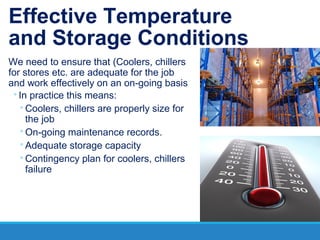
Effective Temperature
and Storage Conditions
We need to ensure that (Coolers, chillers
for stores etc. are adequate for the job
and work effectively on an on-going basis
◦In practice this means:
◦Coolers, chillers are properly size for
the job
◦On-going maintenance records.
◦Adequate storage capacity
◦Contingency plan for coolers, chillers
failure
Preparation & HACCP
Team
Before you start to HACCP plan you need a
HACCP team capable of working together to
build your HACCP system.
The HACCP Team should consist of a range
of skills from the business and ideally have
the following knowledge or experience.
• Product knowledge
• Senior Managers of the business
operations
• Knowledge of bacteria/advanced food
Hygiene
• Trained in HACCP principles
Preparation & HACCP
Team
•Clear roles need to be decided in the
HACCP team so that it functions effectively.
•The HACCP team should appoint the
following roles and responsibilities,
– Chairperson
– Meeting documenter
– Policy and procedure coordinator
– HACCP documenter
– System Implementation and training
– System supervisor
One person may take one or more than one role in the HACCP
team but they should not do all roles.
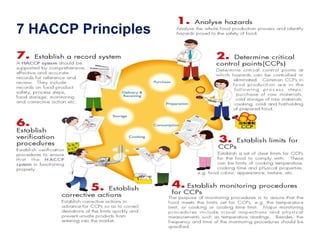
The Seven Principles of
HACCP
1. Conduct a hazard analysis
2. Determine critical Control Points
3. Establish Critical Limits
4. Establish Monitoring Procedures
5. Establish Corrective Actions
6. Establish Verification Procedures
7. Document the System
The Seven Principles the
logical way….
• If you decide a Hazard is critical to
food safety then it needs Limits that
are monitored.
• Monitoring rings the Alarm Bell
when it finds bad results.
• Corrective action is required to
bring things under control once
more.
• Everything needs to be
documented so we can prove food
is safe for human consumption.
7 HACCP Principles
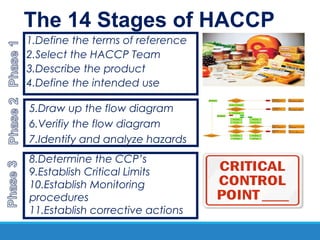
The 14 Stages of HACCP
1.Define the terms of reference
2.Select the HACCP Team
3.Describe the product
4.Define the intended use
5.Draw up the flow diagram
6.Verifiy the flow diagram
7.Identify and analyze hazards
8.Determine the CCP’s
9.Establish Critical Limits
10.Establish Monitoring
procedures
11.Establish corrective actions
The 14 Stages of HACCP
12.Verify the HACCP plan
13.Document the HACCP plan
14.Review the HACCP Plan
Phase 1 – Terms of Reference, HACCP
Team, Product Intended Use
This phase of HACCP planning involves planning the foundation of the
HACCP by outlining in a document called “Terms of Reference”.
In this phase we need to:
Document the terms of reference
•Products, Process, Activities to be Analyzed.
•What types of Hazards are being considered, usually
microbiological, chemical, physical and sometimes, Allergenic
hazards.
•Decide if pre-requisite program hazards are to be included.
•Describe the product/process in words from start to finish.
•Describe the intended use of finished product.
•Record the HACCP Team details, roles and responsibilities.
It is important to determine the scope of
HACCP , Study the process and analyze
what are the Hazard that might happen to
the product
Nadec List of Products
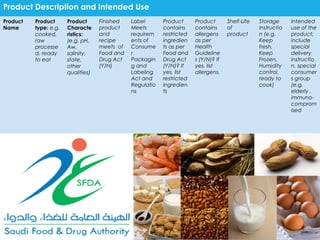
Product Description and Intended Use
Product
Name
Product
type: e.g.
cooked,
raw
processe
d, ready
to eat
Product
Characte
ristics:
(e.g. pH,
Aw,
salinity,
state,
other
qualities)
Finished
product
and
recipe
meets of
Food and
Drug Act
(Y/N)
Label
Meets
requirem
ents of
Consume
r
Packagin
g and
Labeling
Act and
Regulatio
ns
Product
contains
restricted
ingredien
ts as per
Food and
Drug Act
(Y/N)? If
yes, list
restricted
ingredien
ts
Product
contains
allergens
as per
Health
Guideline
s (Y/N)? If
yes, list
allergens.
Shelf-Life
of
product
Storage
Instructio
n (e.g.
Keep
fresh,
Keep
Frozen,
Humidity
control,
ready to
cook)
Intended
use of the
product;
include
special
delivery
instructio
n, special
consumer
s group
(e.g.
elderly ,
immuno-
comprom
ised
Product Description
Product Name:
Product Description:
Characteristics:
Chemical:
Microbiological:
Ingredients:
Important Preservation
Characteristics:
Shelf Life:
Packaging:
Primary Packaging:
Secondary Packaging:
Labeling Instruction:
Where the product is Sold:
Special Distribution
Control:
Product Use:
Identification of
Consumer Suitability:
The National Agricultural Development Company Form No.: HM-003
Depot HACCP Manual - Product Description and Intended Use
Rev. No.: 03
Issue Date: 12.12.15
Fresh Juice and Cavita
Fruit Concentrates, pulps, natural flavours, vitamin C, stabilizers, colours. Sugar
Keep closed and refrigerated after opening
30 Days
Wholesaler and Retailer
Avoidance from any bottles or caps damage. Keep at temperature <5OC
For direct consumption as Fresh Juices
Product Suitable for general population
Please refer to Raw and Packaging Materials Specifications
PET, HDPE and LDPE bottles and Caps, Aluminum Foil Seal for 1.0 L, 1.75 L, 3.0 Liter
Pack in HDPE Crates or corrugated box.
Hijira Calendar , Gregorian and English text on Print Code
Refrigerate after opening
Page No.: 1 of 23
Fresh Juices
Apple Juice - Golden coloured apple juice, smooth light texture, sweet.
Berry Cocktail Juice – Dark Violet coloured Berry Cocktail juice, smooth light texture, sweet.
Mango Juice - Orange colour mango juice, smooth thick texture, sweet
Strawberry Juice - Strawberry fruits with seeds crushed and dissolved in a syrup solution, with
added colour and flavour. Sweet , Thick product with rich mouth feel. No smooth texture due to
crushed strawberry seeds.
Mixed Fruit - Red coloured cocktail juice, smooth light texture, sweet.
Lemon Mint Juice – cloudy colorless lemont juice, smooth light texture, sweet
Kiwi Lime Juice – lime green Kiwi and Lime juice, smooth light texture, sweet
Pomegranate Juice – Dark red pomegranate juice, smooth light texture, sweet
Pineapple Juice – Cloudy yellow pineapple juice, smoth light texture, sweet
Mango Cherry Juice – Brick Red mango cherry juice. Smooth thick product with rich mouth feel.
Sweet
Mango Lychee Juice – Dark Orange juice. Smooth thick product with rich mouth feel. Sweet
Please refer to finished product specifications sheet (Ref.SP-016/6.1)
Full details of Fresh juice are
mentioned in product
description. Information such as
color of the product,
specifications and packaging
material are highlighted.
Information's stated on the label
must follow SASO and GSO
regulatory standards.
Phase 2 – Flow Diagram and Hazard
Analysis
This phase of HACCP planning involves sketching out the process flow
diagram and listing all possible hazards and their control measures.
In this phase we need to:
•Draw and verify a process flow diagram.
•List all possible hazards for the process or product.
•Identify Pre-requisite program hazards.
•Carry out a risk assessment for each hazards
•Record and discard hazards of very low significance
•Agree the control measure for each hazard
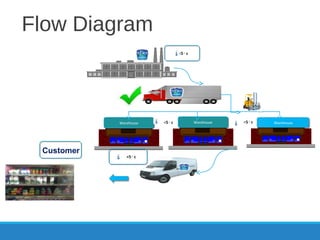
Flow Diagram
<5 c◦
<5 c◦
<5 c◦
WarehouseWarehouseWarehouseWarehouseWarehouse <5 c◦
Customer
Process Flow Diagram
It is required to maintain proper record for temperature monitoring in addition to taking
corrective and preventive action.
Decide whether to show or not to show the
PRP’s in the HACCP Plan
Decide before proceeding to the risk assessment.
Document your decision in the terms of reference document.
There are benefits in including them, such as:
•Ease of staff training
•One overall, integrated management system
•A “ones stop shop” for all food safety information.
“ If we assess these two questions together in a grid we can easily arrive to a decision of overall significance and set a
threshold above which we deem the hazard as a “Not significant” and therefore not to be included in the HACCP Plan
Risk AssessmentThe risk assessment can be carried out by asking two simple questions about each hazard as follows:
Q1. What are the consequence of this hazard
Q2. What is the likelihood that this hazard will occur
Likelihood Description
A - Daily
B - Once a Week
C - Once a Month
D - Once a Year
E - Once Every Five Years
Note: Severity Description
1 - 10 considered as significant hazards 1 Fatality with long term sequels
2 Serious Sickness with long term sequels
3 Sickness without long term sequel
4 moderate sickness (fast recovery)
5 Not significant
25
17 20
4 10 14 18 21 23
5 15 19 22 24
11
2 3 5 8 12 16
7
Severity
1 1 2 4
3 6 9 13
The National Agricultural Development Company Form No.: HM-015
HACCP Manual
Rev. No.: 01
Issue Date: 01.04.15
Risk Assessment Page No.: 1 of 1
Risk Assessment Matrix
Likelihood
A B C D E
Hazard Analysis
“Any hazard that you identify as not significant should not appear in you main HACCP plans but instead it should be
documented why you arrived at this decisions in terms of its significance”
StepNo. Cause Likelihood Severity Significance
Doesthisstepeliminate,reduce
hazardstoacceptablelevels?
Doesthisstepneedahighlevelof
monitoring/regularmonitoringall
daylonginordertopreventall
proliferationcases?
Final
Significance
Q1 Q2 Q3 Q4
CCP/OPRP
/PRP
ControlMeasures
Biological MicrobiologicalGrowth
Microbiologicalgrowthduetoinsufficientcoolingor
hightemperatureattrailer.
C 2 8 No No No - - - - PRP
VehicleInspectionduringreceiving.SOP, GWP,Trainingin
place
Biological MicrobiologicalGrowth
Badhandlingpractices.Microbiologicalgrowthon
damagedproductduetoimproperhandling.
E 2 16 - - - - - - - - -
Biological MicrobiologicalGrowth
BadPractices-Staffhandlingproducts without
washingtheirhands.Staffmayobservesomeloosed
capandtightenitbytheirbarehands,eventuallythe
productwillbesenttomarket.
E 2 16 - - - - - - - - -
Physical
Insects/pest
contamination
Contaminationofpest/insects migratingthrough
damagedpacks.
D 2 12 - - - - - - - PRP PestControlinPlace,SOP,GWP,Training
Physical Woodpiecesfrompallets
Woodpieces duetothe useofbrokenordamaged
pallets.
E 2 16 - - - - - - - - -
Physical Brokenglass pieces Brokenglasspieces fromlights insidethetrailers E 2 16 - - - - - - - - -
Chemical
Hazardous
chemicals/cleaning
chemicals
Crosscontaminationofhazardous
chemicals/cleaningchemicalsfromtrailers
previouslyusedtotransportchemicals.Trailer
previouslycleanedusingcleaningchemicalsbutnot
properlyrinsed.
E 3 20 - - - - - - - - -
TheNational Agricultural DevelopmentCompany DocumentNo.: HMD-004
DEPOTHACCPManual Rev.No.: 00
HazardAnalysis
IssueDate: 01.08.15
PageNo.: 3of4
Hazard
Receivingof
finished
products
Phase 3 – Determine CCP’s, Critical Limits,
Monitoring Corrective Action
Some key tips when using the decision tree
questions
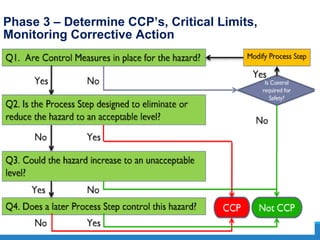
Q1. Are control measures in place to control the hazard?
Tip: Because we have already identified the possible control measure during Phase 1
the answer to this question is always yes.
Q2. Is the process step designed to eliminate the hazard to an acceptable level?
Tip: Substitute the process step and the hazard name into the question and read it back
to answer this question e.g.
Is UHT Processing designed to eliminate pathogens or reduce to acceptable level?
Q3. Could the hazard increase to an unacceptable level?
Tip: You need to consider what changes might occur that could cause the hazard to
occur more frequently. Things like changes in staff, Management, The process step,
ingredients, suppliers, even the seasons can affect the answer to this question.
Q4. Does a later process step control this hazard/
Tip: Make a list of the later process steps “downstream” of the current process step and
decide if any of those process steps will control the hazard
Best Practices
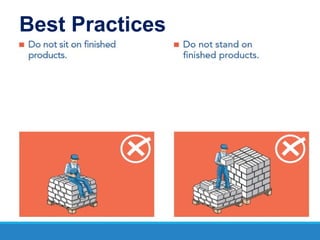
Best Practices
Product must be highlighted and specified displaying
Production Date for better tracking of FEFO and FIFO
Best Practices
Best Practices
Best Practices
Best Practices
Best Practices
Thank youThank you

Haccp development training course warehouse

  • 1.
    Prepared by: Jared L.Espeleta Tarek al mourad HACCP Team Coordinator IntroductionIntroduction ToTo HACCPHACCP
  • 2.
    What is HACCP? Hazardanalysis critical control points is a preventive approach to Food Safety from Biological, Chemical , and physical hazards in the whole life cycle of the product, starting production till it reach the customer level. These processes might cause harm to the finished product, making it unsafe for human consumption. HACCP serve as measurements to reduce these risks to a safe level.
  • 3.
    Food Poisoning Mishandling theproduct might cause damage to it. Food poisoning might result in such situations. Common symptoms: – stomach aches – vomiting – diarrhea – fever Can result in long-term diseases and death. Often caused by food that looks, smells and tastes normal.
  • 4.
    Types of Hazardsin Food Food can be contaminated by: – Chemical hazard – Physical hazard – Micro-Biological hazard
  • 6.
  • 7.
    Chemical Hazards Chemicals inthe home include those used: – to clean surfaces and equipment – as pesticides. Chemicals can be very harmful if they are: – spilt on or near food – mistaken for food or drink.
  • 8.
    Chemical Hazards: Natural Toxins Toxinsare poisonous substances produced by some micro-organisms, plants and animals. Most toxins that cause food poisoning are tasteless and remain toxic even after cooking. In warehouse: It is essential to make sure cleaning chemicals , oil or any type of chemical material will not be kept in direct contact with the product. During both storing and distribution For this cleaning chemical must stored and labeled in specified area.
  • 9.
  • 10.
    Physical Hazards Foreign mattercan: – physically injure people – introduce harmful bacteria into food. Examples of foreign matter include: – Dead insects – Hair – Jewelry – Glass – Pieces of metal. The above mentioned hazard mostly happens during production , but still precaution must be taken and proper preservation of the product is needed during storing and distribution
  • 11.
  • 12.
    Microbiological HazardsThis hazardcomes from microorganisms that can make us sick such as : – Viruses (rotavirus, norwalk virus..) – Bacteria (Salmonella, E. coli, Listeria…) – Parasites (Toxoplasma gondii, Trichinella spiralis..) – Mould (Aspergillus flavus..) Viruses and bacteria are the most common causes of food poisoning. Most foodborne disease is preventable with proper food handling .Temperature monitoring during storage and distribution is an OPRP . Temperature should be ≤ 5 for fresh And ≤ 25 for UHT and Processed jar cheese
  • 15.
  • 16.
    Pre-Requisite Programs Supplier ApprovalManagement Pest Control Systems Hygiene Regulations and Training Cleaning & Disinfection Systems Waste Management Pre-Planned Maintenance Hygienic Premises Design Effective Temperature and Storage Controls
  • 17.
    Supplier Approval Management •We needto be sure that we use reputable suppliers so that food we produce is made from ingredients that are known to be safe in the first place. –In practice this means that we: • Carry out supplier audits and/or • Request a supplier questionnaire each year • Maintain records on supplier issues and corrective actions taken
  • 18.
    Pest Control System Weneed to be sure that we have good pest control and detection systems in place so that we minimize the risks of infestations. In practice this means that we: Appoint a pest control Company ( Nadec have signed a contract with SAMES as national contract) Have good Pest Prevention & detection measures in place Maintain records on pest issues and corrective actions taken. It is mandatory to implement .
  • 19.
    Hygiene Regulations & Trainings Weneed to be sure that all Food handling staff are trained in hygiene and are aware of the rules and regulations ◦In practice this means that we: ◦Train all staff in food hygiene practices ◦Enforce a hygiene Policy ◦Provide good clean protective clothing ◦Maintain records on training and staff illness.
  • 20.
    Cleaning and Disinfection Systems Weneed to be sure that all processing equipment and Food rooms cleaned on regular basis and that we can monitor levels of cleanliness ◦In practice this means that we: ◦Require a cleaning schedule ◦Require professional cleaning equipment and chemicals ◦Keep records of cleaning and micro results ◦Maintain records on all corrective actions
  • 21.
    Waste Management We needto be sure that waste is stored and processed properly and it does not encourage pests or cause cross contamination ◦In practices this means that: ◦Wastes are stored in professional waste bins ◦Regular removal of waste ◦Wastes are stored in areas away from food processing ◦Records of waste and its removal from site
  • 22.
    Pre-Planned Maintenance We need toensure that crucial equipment such as coolers pasteurizers, filling machines etc. are well maintained and do not breakdown or malfunction. ◦In practice this means: ◦Regular service of equipment ◦A maintenance schedule ◦Engineers trained in hygiene practices ◦Records of maintenance carried out
  • 23.
    Hygienic Premises Design We needto ensure that the premises that we store and manufacture food has been designed and is kept in a hygienic manner. ◦In practice this means: ◦Smooth, non-porous surfaces ◦Easy to clean equipment ◦Modern wall cladding ◦Adequate drainage
  • 24.
    Effective Temperature and StorageConditions We need to ensure that (Coolers, chillers for stores etc. are adequate for the job and work effectively on an on-going basis ◦In practice this means: ◦Coolers, chillers are properly size for the job ◦On-going maintenance records. ◦Adequate storage capacity ◦Contingency plan for coolers, chillers failure
  • 25.
    Preparation & HACCP Team Beforeyou start to HACCP plan you need a HACCP team capable of working together to build your HACCP system. The HACCP Team should consist of a range of skills from the business and ideally have the following knowledge or experience. • Product knowledge • Senior Managers of the business operations • Knowledge of bacteria/advanced food Hygiene • Trained in HACCP principles
  • 26.
    Preparation & HACCP Team •Clearroles need to be decided in the HACCP team so that it functions effectively. •The HACCP team should appoint the following roles and responsibilities, – Chairperson – Meeting documenter – Policy and procedure coordinator – HACCP documenter – System Implementation and training – System supervisor One person may take one or more than one role in the HACCP team but they should not do all roles.
  • 28.
    The Seven Principlesof HACCP 1. Conduct a hazard analysis 2. Determine critical Control Points 3. Establish Critical Limits 4. Establish Monitoring Procedures 5. Establish Corrective Actions 6. Establish Verification Procedures 7. Document the System
  • 29.
    The Seven Principlesthe logical way…. • If you decide a Hazard is critical to food safety then it needs Limits that are monitored. • Monitoring rings the Alarm Bell when it finds bad results. • Corrective action is required to bring things under control once more. • Everything needs to be documented so we can prove food is safe for human consumption.
  • 30.
  • 31.
    The 14 Stagesof HACCP 1.Define the terms of reference 2.Select the HACCP Team 3.Describe the product 4.Define the intended use 5.Draw up the flow diagram 6.Verifiy the flow diagram 7.Identify and analyze hazards 8.Determine the CCP’s 9.Establish Critical Limits 10.Establish Monitoring procedures 11.Establish corrective actions
  • 32.
    The 14 Stagesof HACCP 12.Verify the HACCP plan 13.Document the HACCP plan 14.Review the HACCP Plan
  • 33.
    Phase 1 –Terms of Reference, HACCP Team, Product Intended Use This phase of HACCP planning involves planning the foundation of the HACCP by outlining in a document called “Terms of Reference”. In this phase we need to: Document the terms of reference •Products, Process, Activities to be Analyzed. •What types of Hazards are being considered, usually microbiological, chemical, physical and sometimes, Allergenic hazards. •Decide if pre-requisite program hazards are to be included. •Describe the product/process in words from start to finish. •Describe the intended use of finished product. •Record the HACCP Team details, roles and responsibilities.
  • 34.
    It is importantto determine the scope of HACCP , Study the process and analyze what are the Hazard that might happen to the product
  • 35.
    Nadec List ofProducts
  • 36.
    Product Description andIntended Use Product Name Product type: e.g. cooked, raw processe d, ready to eat Product Characte ristics: (e.g. pH, Aw, salinity, state, other qualities) Finished product and recipe meets of Food and Drug Act (Y/N) Label Meets requirem ents of Consume r Packagin g and Labeling Act and Regulatio ns Product contains restricted ingredien ts as per Food and Drug Act (Y/N)? If yes, list restricted ingredien ts Product contains allergens as per Health Guideline s (Y/N)? If yes, list allergens. Shelf-Life of product Storage Instructio n (e.g. Keep fresh, Keep Frozen, Humidity control, ready to cook) Intended use of the product; include special delivery instructio n, special consumer s group (e.g. elderly , immuno- comprom ised
  • 37.
    Product Description Product Name: ProductDescription: Characteristics: Chemical: Microbiological: Ingredients: Important Preservation Characteristics: Shelf Life: Packaging: Primary Packaging: Secondary Packaging: Labeling Instruction: Where the product is Sold: Special Distribution Control: Product Use: Identification of Consumer Suitability: The National Agricultural Development Company Form No.: HM-003 Depot HACCP Manual - Product Description and Intended Use Rev. No.: 03 Issue Date: 12.12.15 Fresh Juice and Cavita Fruit Concentrates, pulps, natural flavours, vitamin C, stabilizers, colours. Sugar Keep closed and refrigerated after opening 30 Days Wholesaler and Retailer Avoidance from any bottles or caps damage. Keep at temperature <5OC For direct consumption as Fresh Juices Product Suitable for general population Please refer to Raw and Packaging Materials Specifications PET, HDPE and LDPE bottles and Caps, Aluminum Foil Seal for 1.0 L, 1.75 L, 3.0 Liter Pack in HDPE Crates or corrugated box. Hijira Calendar , Gregorian and English text on Print Code Refrigerate after opening Page No.: 1 of 23 Fresh Juices Apple Juice - Golden coloured apple juice, smooth light texture, sweet. Berry Cocktail Juice – Dark Violet coloured Berry Cocktail juice, smooth light texture, sweet. Mango Juice - Orange colour mango juice, smooth thick texture, sweet Strawberry Juice - Strawberry fruits with seeds crushed and dissolved in a syrup solution, with added colour and flavour. Sweet , Thick product with rich mouth feel. No smooth texture due to crushed strawberry seeds. Mixed Fruit - Red coloured cocktail juice, smooth light texture, sweet. Lemon Mint Juice – cloudy colorless lemont juice, smooth light texture, sweet Kiwi Lime Juice – lime green Kiwi and Lime juice, smooth light texture, sweet Pomegranate Juice – Dark red pomegranate juice, smooth light texture, sweet Pineapple Juice – Cloudy yellow pineapple juice, smoth light texture, sweet Mango Cherry Juice – Brick Red mango cherry juice. Smooth thick product with rich mouth feel. Sweet Mango Lychee Juice – Dark Orange juice. Smooth thick product with rich mouth feel. Sweet Please refer to finished product specifications sheet (Ref.SP-016/6.1) Please refer to finished product specifications sheet (Ref.SP-016/6.1) Full details of Fresh juice are mentioned in product description. Information such as color of the product, specifications and packaging material are highlighted. Information's stated on the label must follow SASO and GSO regulatory standards.
  • 38.
    Phase 2 –Flow Diagram and Hazard Analysis This phase of HACCP planning involves sketching out the process flow diagram and listing all possible hazards and their control measures. In this phase we need to: •Draw and verify a process flow diagram. •List all possible hazards for the process or product. •Identify Pre-requisite program hazards. •Carry out a risk assessment for each hazards •Record and discard hazards of very low significance •Agree the control measure for each hazard
  • 39.
    Flow Diagram <5 c◦ <5c◦ <5 c◦ WarehouseWarehouseWarehouseWarehouseWarehouse <5 c◦ Customer
  • 40.
    Process Flow Diagram Itis required to maintain proper record for temperature monitoring in addition to taking corrective and preventive action.
  • 41.
    Decide whether toshow or not to show the PRP’s in the HACCP Plan Decide before proceeding to the risk assessment. Document your decision in the terms of reference document. There are benefits in including them, such as: •Ease of staff training •One overall, integrated management system •A “ones stop shop” for all food safety information.
  • 42.
    “ If weassess these two questions together in a grid we can easily arrive to a decision of overall significance and set a threshold above which we deem the hazard as a “Not significant” and therefore not to be included in the HACCP Plan Risk AssessmentThe risk assessment can be carried out by asking two simple questions about each hazard as follows: Q1. What are the consequence of this hazard Q2. What is the likelihood that this hazard will occur Likelihood Description A - Daily B - Once a Week C - Once a Month D - Once a Year E - Once Every Five Years Note: Severity Description 1 - 10 considered as significant hazards 1 Fatality with long term sequels 2 Serious Sickness with long term sequels 3 Sickness without long term sequel 4 moderate sickness (fast recovery) 5 Not significant 25 17 20 4 10 14 18 21 23 5 15 19 22 24 11 2 3 5 8 12 16 7 Severity 1 1 2 4 3 6 9 13 The National Agricultural Development Company Form No.: HM-015 HACCP Manual Rev. No.: 01 Issue Date: 01.04.15 Risk Assessment Page No.: 1 of 1 Risk Assessment Matrix Likelihood A B C D E
  • 43.
    Hazard Analysis “Any hazardthat you identify as not significant should not appear in you main HACCP plans but instead it should be documented why you arrived at this decisions in terms of its significance” StepNo. Cause Likelihood Severity Significance Doesthisstepeliminate,reduce hazardstoacceptablelevels? Doesthisstepneedahighlevelof monitoring/regularmonitoringall daylonginordertopreventall proliferationcases? Final Significance Q1 Q2 Q3 Q4 CCP/OPRP /PRP ControlMeasures Biological MicrobiologicalGrowth Microbiologicalgrowthduetoinsufficientcoolingor hightemperatureattrailer. C 2 8 No No No - - - - PRP VehicleInspectionduringreceiving.SOP, GWP,Trainingin place Biological MicrobiologicalGrowth Badhandlingpractices.Microbiologicalgrowthon damagedproductduetoimproperhandling. E 2 16 - - - - - - - - - Biological MicrobiologicalGrowth BadPractices-Staffhandlingproducts without washingtheirhands.Staffmayobservesomeloosed capandtightenitbytheirbarehands,eventuallythe productwillbesenttomarket. E 2 16 - - - - - - - - - Physical Insects/pest contamination Contaminationofpest/insects migratingthrough damagedpacks. D 2 12 - - - - - - - PRP PestControlinPlace,SOP,GWP,Training Physical Woodpiecesfrompallets Woodpieces duetothe useofbrokenordamaged pallets. E 2 16 - - - - - - - - - Physical Brokenglass pieces Brokenglasspieces fromlights insidethetrailers E 2 16 - - - - - - - - - Chemical Hazardous chemicals/cleaning chemicals Crosscontaminationofhazardous chemicals/cleaningchemicalsfromtrailers previouslyusedtotransportchemicals.Trailer previouslycleanedusingcleaningchemicalsbutnot properlyrinsed. E 3 20 - - - - - - - - - TheNational Agricultural DevelopmentCompany DocumentNo.: HMD-004 DEPOTHACCPManual Rev.No.: 00 HazardAnalysis IssueDate: 01.08.15 PageNo.: 3of4 Hazard Receivingof finished products
  • 44.
    Phase 3 –Determine CCP’s, Critical Limits, Monitoring Corrective Action
  • 45.
    Some key tipswhen using the decision tree questions Q1. Are control measures in place to control the hazard? Tip: Because we have already identified the possible control measure during Phase 1 the answer to this question is always yes. Q2. Is the process step designed to eliminate the hazard to an acceptable level? Tip: Substitute the process step and the hazard name into the question and read it back to answer this question e.g. Is UHT Processing designed to eliminate pathogens or reduce to acceptable level? Q3. Could the hazard increase to an unacceptable level? Tip: You need to consider what changes might occur that could cause the hazard to occur more frequently. Things like changes in staff, Management, The process step, ingredients, suppliers, even the seasons can affect the answer to this question. Q4. Does a later process step control this hazard/ Tip: Make a list of the later process steps “downstream” of the current process step and decide if any of those process steps will control the hazard
  • 46.
  • 47.
    Best Practices Product mustbe highlighted and specified displaying Production Date for better tracking of FEFO and FIFO
  • 48.
  • 49.
  • 50.
  • 51.
  • 52.
  • 53.