PLASTICPoetryNotes – GCSE EnglishLiterature PastandPresent:PoetryAnthology –Love andRelationships –Sonnet29, P.10
Poetic devices and their effects – form (ballad,
sonnet,free verse, dramatic monologue),alliteration,
rhyme, rhythm, onomatopoeia,
Some ryhyming couplets andsome alternate rhymes Suggests variations intheir togetherness
Dramatic monologue We see the poet’s verypersonal take on their linkwiththeir
lover
Staccato rhythmwithlots of caesura Mirrors the slow merging process ofher thoughts around
him. Slow, methodical.
Language and its effects – what sortof words are in
the poem? Violent,loving, colloquial,archaic,semantic
fields,diction,religious,romantic language
Comparatives:‘dearer, better’ Shows that she abases herselfin the face of his
‘superiority’.Attempting to flatter to win him over.
Semantic fieldof growth – ‘twine, bud, burst’ Sense of togetherness which builds to growthand thenan
eruptionof love andexcitement.
Imperatives – ‘renew’, ‘rustle’, ‘set’ and‘let’ Wants things to happen deeplyandquickly – forcingthe
issue
Alternative interpretations – Can quotations be read in
two ways for different meanings?
‘as wild vines’ Sense of natural growth in her love andactions OR a sense
that her love has an uncontrollable qualityand cannot be
tamed.
‘put out broad leaves’ Her thoughts become a part of himand a extensionof his
being OR she wants to helpprotect him
Structure and its effects – tonal shifts,pace, caesura,
Caesura inthe first few lines Suggests the slow and disruptedwayin whichher thoughts
are minglingwith his. Sinister?
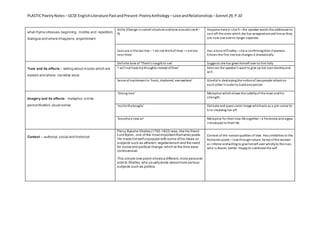
PLASTICPoetryNotes – GCSE EnglishLiterature PastandPresent:PoetryAnthology –Love andRelationships –Sonnet29, P.10
what rhyme stresses,beginning, middle,end,repetition,
dialogue and where ithappens,enjambment
Volta (Change insonnet structure andtone aroundLine 8 –
9)
Happens here in Line 9 – the speaker wants the addressee to
cast off the vines which she has wrappedaround himas they
are now one andno longer separate.
Caesura inthe last line – ‘I do not thinkof thee – I amtoo
near thee’
Has a tone offinality– she is confirmingtheir closeness.
Echoes the first line but changes it dramatically.
Tone and its effects – talking about moods which are
evoked and where, narrative voice
Definite tone of ‘There’s nought to see’ Suggests she has givenherself over to him fully
‘I will not have mythoughts instead ofthee’ Stresses the speaker’s want to give up her ownidentityand
will.
Sense of excitement in ‘burst, shattered, everywhere’ Gleeful in destroyingthe notionof twopeople reliant on
each other inorder to buildone person
Imagery and its effects - metaphor,simile,
personification,visual sense
‘Strong tree’ Metaphor whichshows the solidityof the lover andhis
strength
‘rustle thyboughs’ Delicate and quasi-comic image whichacts as a pre-cursor to
him shedding her off
‘breathe a new air’ Metaphor for their new life together – a freshness andvigour
introduced to their life.
Context – authorial,social and historical
Percy Bysshe Shelley(1792-1822) was,like his friend
Lord Byron, one of the mostimportantRomantic poets.
He made himselfunpopular with some ofhis ideas on
subjects such as atheism,vegetarianism and the need
for social and political change,which at the time were
controversial.
This simple love poem shows a different,more personal
side to Shelley, who usuallywrote aboutmore serious
subjects such as politics.
Context of the natural qualities of love. Hassimilarities to the
Romantic poets – love through nature. Sense ofthe woman
as inferior andwilling to give herself over whollyto the man,
who is dearer, better. Happyto sublimate the self.

Sonnet 29 -_I_think_of_thee_plastic

  • 1.
    PLASTICPoetryNotes – GCSEEnglishLiterature PastandPresent:PoetryAnthology –Love andRelationships –Sonnet29, P.10 Poetic devices and their effects – form (ballad, sonnet,free verse, dramatic monologue),alliteration, rhyme, rhythm, onomatopoeia, Some ryhyming couplets andsome alternate rhymes Suggests variations intheir togetherness Dramatic monologue We see the poet’s verypersonal take on their linkwiththeir lover Staccato rhythmwithlots of caesura Mirrors the slow merging process ofher thoughts around him. Slow, methodical. Language and its effects – what sortof words are in the poem? Violent,loving, colloquial,archaic,semantic fields,diction,religious,romantic language Comparatives:‘dearer, better’ Shows that she abases herselfin the face of his ‘superiority’.Attempting to flatter to win him over. Semantic fieldof growth – ‘twine, bud, burst’ Sense of togetherness which builds to growthand thenan eruptionof love andexcitement. Imperatives – ‘renew’, ‘rustle’, ‘set’ and‘let’ Wants things to happen deeplyandquickly – forcingthe issue Alternative interpretations – Can quotations be read in two ways for different meanings? ‘as wild vines’ Sense of natural growth in her love andactions OR a sense that her love has an uncontrollable qualityand cannot be tamed. ‘put out broad leaves’ Her thoughts become a part of himand a extensionof his being OR she wants to helpprotect him Structure and its effects – tonal shifts,pace, caesura, Caesura inthe first few lines Suggests the slow and disruptedwayin whichher thoughts are minglingwith his. Sinister?
  • 2.
    PLASTICPoetryNotes – GCSEEnglishLiterature PastandPresent:PoetryAnthology –Love andRelationships –Sonnet29, P.10 what rhyme stresses,beginning, middle,end,repetition, dialogue and where ithappens,enjambment Volta (Change insonnet structure andtone aroundLine 8 – 9) Happens here in Line 9 – the speaker wants the addressee to cast off the vines which she has wrappedaround himas they are now one andno longer separate. Caesura inthe last line – ‘I do not thinkof thee – I amtoo near thee’ Has a tone offinality– she is confirmingtheir closeness. Echoes the first line but changes it dramatically. Tone and its effects – talking about moods which are evoked and where, narrative voice Definite tone of ‘There’s nought to see’ Suggests she has givenherself over to him fully ‘I will not have mythoughts instead ofthee’ Stresses the speaker’s want to give up her ownidentityand will. Sense of excitement in ‘burst, shattered, everywhere’ Gleeful in destroyingthe notionof twopeople reliant on each other inorder to buildone person Imagery and its effects - metaphor,simile, personification,visual sense ‘Strong tree’ Metaphor whichshows the solidityof the lover andhis strength ‘rustle thyboughs’ Delicate and quasi-comic image whichacts as a pre-cursor to him shedding her off ‘breathe a new air’ Metaphor for their new life together – a freshness andvigour introduced to their life. Context – authorial,social and historical Percy Bysshe Shelley(1792-1822) was,like his friend Lord Byron, one of the mostimportantRomantic poets. He made himselfunpopular with some ofhis ideas on subjects such as atheism,vegetarianism and the need for social and political change,which at the time were controversial. This simple love poem shows a different,more personal side to Shelley, who usuallywrote aboutmore serious subjects such as politics. Context of the natural qualities of love. Hassimilarities to the Romantic poets – love through nature. Sense ofthe woman as inferior andwilling to give herself over whollyto the man, who is dearer, better. Happyto sublimate the self.