translated by Mark Eisner
How does your
experience of
life change
when you are
deeply in love
with someone?
1. I don’t love you as if you were a rose of salt, topaz,
2. or arrow of carnations that propagate fire:
3. I love you as one loves certain obscure things,
4. secretly, between the shadow and the soul.
1. I love you as the plant that doesn’t bloom but carries
2. the light of those flowers, hidden, within itself,
3. and thanks to your love the tight aroma that arose
4. from the earth lives dimly in my body.
1. I love you without knowing how, or when, or from where,
2. I love you directly without problems or pride:
3. I love you like this because I don’t know any other way to
love,
4. except in this form in which I am not nor are you,
5. so close that your hand upon my chest is mine,
6. so close that your eyes close with my dreams.
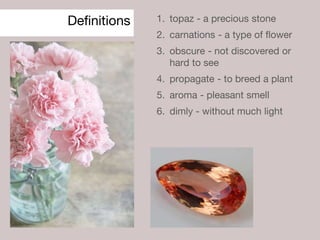
Definitions 1. topaz - a precious stone
2. carnations - a type of flower
3. obscure - not discovered or
hard to see
4. propagate - to breed a plant
5. aroma - pleasant smell
6. dimly - without much light
stanza
one
1. I don’t love you as if you were a rose of salt, topaz,
2. or arrow of carnations that propagate fire:
3. I love you as one loves certain obscure things,
4. secretly, between the shadow and the soul.
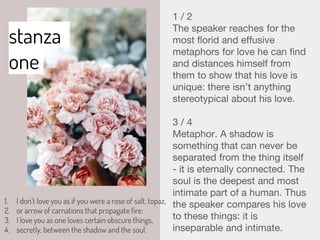
1 / 2
The speaker reaches for the
most florid and effusive
metaphors for love he can find
and distances himself from
them to show that his love is
unique: there isn’t anything
stereotypical about his love.
3 / 4
Metaphor. A shadow is
something that can never be
separated from the thing itself
- it is eternally connected. The
soul is the deepest and most
intimate part of a human. Thus
the speaker compares his love
to these things: it is
inseparable and intimate.
stanza
two
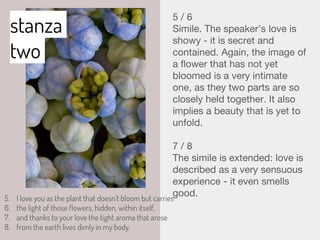
5 / 6
Simile. The speaker’s love is
showy - it is secret and
contained. Again, the image of
a flower that has not yet
bloomed is a very intimate
one, as they two parts are so
closely held together. It also
implies a beauty that is yet to
unfold.
7 / 8
The simile is extended: love is
described as a very sensuous
experience - it even smells
good.
5. I love you as the plant that doesn’t bloom but carries
6. the light of those flowers, hidden, within itself,
7. and thanks to your love the tight aroma that arose
8. from the earth lives dimly in my body.
lines
9-12
The speaker drops the imagery to
speak in more direct terms. He
says there is no way to describe
his love because even he doesn’t
understand it.
His love is pure and
uncomplicated by vices.
Not only is this intense love how
he loves her but he can’t even
imagine any other way for it to be.
His love for her has ereased his
own identity. So fixated on her is
her that he has entirely lost his
sense of self.
9. I love you without knowing how, or when, or from where,
10. I love you directly without problems or pride:
11. I love you like this because I don’t know any other way to love,
12. except in this form in which I am not nor are you,
lines
13 - 14
This final couplet mirror each
other’s form.
The repetition of the words ‘so
close’ emphasize the intimacy
that he feels.
There is a melding of identity -
what’s hers is his and his
dreams (which is the most
autonomous of experiences) is
only made possible through
her actions.
13. so close that your hand upon my chest is mine,
14. so close that your eyes close with my dreams.
Tone, Rhyme, Rhythm
bla
Questions

Sonnet xvii by Pablo Neruda

  • 1.
  • 2.
    How does your experienceof life change when you are deeply in love with someone?
  • 3.
    1. I don’tlove you as if you were a rose of salt, topaz, 2. or arrow of carnations that propagate fire: 3. I love you as one loves certain obscure things, 4. secretly, between the shadow and the soul. 1. I love you as the plant that doesn’t bloom but carries 2. the light of those flowers, hidden, within itself, 3. and thanks to your love the tight aroma that arose 4. from the earth lives dimly in my body. 1. I love you without knowing how, or when, or from where, 2. I love you directly without problems or pride: 3. I love you like this because I don’t know any other way to love, 4. except in this form in which I am not nor are you, 5. so close that your hand upon my chest is mine, 6. so close that your eyes close with my dreams.
  • 4.
    Definitions 1. topaz- a precious stone 2. carnations - a type of flower 3. obscure - not discovered or hard to see 4. propagate - to breed a plant 5. aroma - pleasant smell 6. dimly - without much light
  • 5.
    stanza one 1. I don’tlove you as if you were a rose of salt, topaz, 2. or arrow of carnations that propagate fire: 3. I love you as one loves certain obscure things, 4. secretly, between the shadow and the soul. 1 / 2 The speaker reaches for the most florid and effusive metaphors for love he can find and distances himself from them to show that his love is unique: there isn’t anything stereotypical about his love. 3 / 4 Metaphor. A shadow is something that can never be separated from the thing itself - it is eternally connected. The soul is the deepest and most intimate part of a human. Thus the speaker compares his love to these things: it is inseparable and intimate.
  • 6.
    stanza two 5 / 6 Simile.The speaker’s love is showy - it is secret and contained. Again, the image of a flower that has not yet bloomed is a very intimate one, as they two parts are so closely held together. It also implies a beauty that is yet to unfold. 7 / 8 The simile is extended: love is described as a very sensuous experience - it even smells good. 5. I love you as the plant that doesn’t bloom but carries 6. the light of those flowers, hidden, within itself, 7. and thanks to your love the tight aroma that arose 8. from the earth lives dimly in my body.
  • 7.
    lines 9-12 The speaker dropsthe imagery to speak in more direct terms. He says there is no way to describe his love because even he doesn’t understand it. His love is pure and uncomplicated by vices. Not only is this intense love how he loves her but he can’t even imagine any other way for it to be. His love for her has ereased his own identity. So fixated on her is her that he has entirely lost his sense of self. 9. I love you without knowing how, or when, or from where, 10. I love you directly without problems or pride: 11. I love you like this because I don’t know any other way to love, 12. except in this form in which I am not nor are you,
  • 8.
    lines 13 - 14 Thisfinal couplet mirror each other’s form. The repetition of the words ‘so close’ emphasize the intimacy that he feels. There is a melding of identity - what’s hers is his and his dreams (which is the most autonomous of experiences) is only made possible through her actions. 13. so close that your hand upon my chest is mine, 14. so close that your eyes close with my dreams.
  • 9.
  • 10.