Ambulances


 Philip Larkin
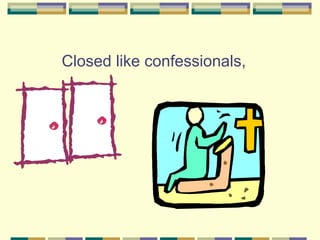
Closed like confessionals,
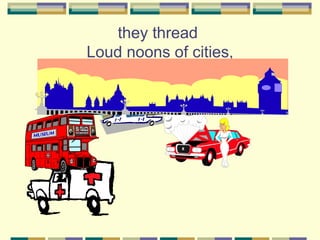
they thread
Loud noons of cities,
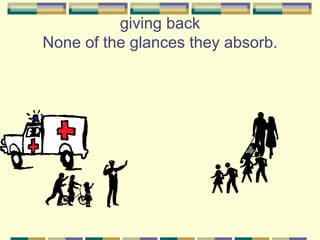
giving back
None of the glances they absorb.
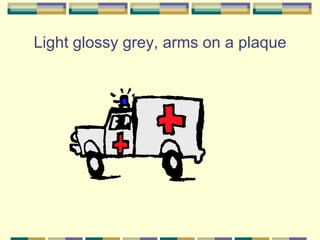
Light glossy grey, arms on a plaque
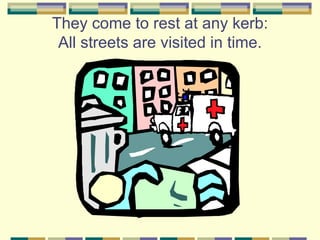
They come to rest at any kerb:
 All streets are visited in time.
Then children strewn on steps or
              road,
Or women coming from the shops
 Past smells of different dinners,
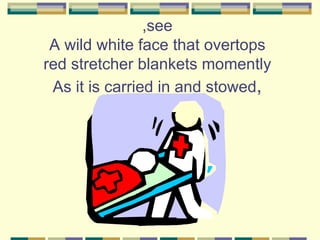
,see
 A wild white face that overtops
red stretcher blankets momently
 As it is carried in and stowed,
And sense the solving emptiness
   That lies under all we do,
And for a second get it whole,
So permanent and blank and true.
The fastened doors recede. Poor
              soul,
They whisper at their own distress;
For borne away in deadened air
 May go the sudden shut of loss
Round something nearly at an end,
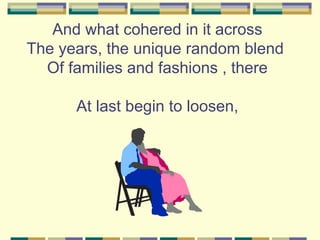
And what cohered in it across
The years, the unique random blend
  Of families and fashions , there

      At last begin to loosen,
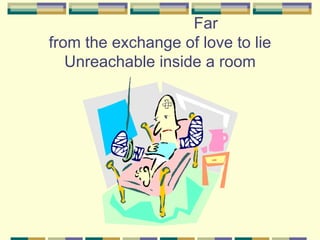
Far
from the exchange of love to lie
   Unreachable inside a room
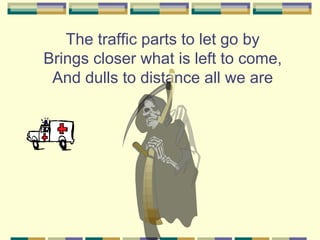
The traffic parts to let go by
Brings closer what is left to come,
 And dulls to distance all we are
So what is this poem about
           then?
How when we see an ambulance taking someone
away to hospital, we are reminded of our own
mortality and often feel more sorry for ourselves than
for the sick person.
What happens in an ambulance is very private and
unseen (like a confessional) and people are curious –
they come to stare.
The ambulance journey could symbolize life drawing
to a close.
When we are reminded of our own mortality, we
realise how insignificant we are and how unimportant
our daily lives really are.
Death in this poem
Death is very important in this poem – it
lies below the surface of our lives and
comes at the end of our lives. In that
sense, death is the solution – it is the
solving emptiness. Death is the
solution to life.
Death is characterised as being empty,
permanent, blank and true.
Philip Larkin (1922 – 1985)
•Born in Coventry and educated at Oxford.
•Worked as a Librarian.
•Shared his life with Monica Jones, English lecturer, for
38 years.
•Wicked sense of humour
•By all acounts a difficult and not very likeable
personality.
Form of the poem
Structure – 5 6-line stanzas
Rhyme scheme – a,b,c,b,c,a
Rhythm – flowing
Mood - sombre
Poetic techniques: enjambement,
similes, personification, contrasts
This poem superbly juxtaposes the meaning of death with the
pragmatics of life. Life, in all its febrile practicality ('all we
are') is blurred into a 'distance' when we are confronted with the
ultimate reality of death. For Larkin, death is a 'solving
emptiness' that comes to take away and RESOLVE the
seemingly endless struggle of existence ('all we do') . Larkin
also points to what Vernon Scannell called 'the huge
inevitability of death' when he states that 'all streets in time are
visited'. There is a sense that we cannot escape death (a major
Larkinian theme) but simultaneously it does come as a
RESOLUTION, albeit a frightening and mysterious one.
For Larkin, life is that 'unique blend of families and
   fashions' which is suddenly terminated, not just by
  physical death, but by the realisation of it, as we are
'borne away' in an ambulance. At this point, we realise
  that (in Shakespeare's parlance) this 'tale told by an
 idiot...full of sound and fury' is about to end. Perhaps
   the central message of this poem is to engage in a
     stoical attitude to life because, in the end, all its
 convoluted intricacies are going to dissipate ('loosen')
 and we are left in 'deadened air', distanced from love
    and the many aspects of life which enabled us to
                    maintain a grip on it.


           Andrew Felton BA (Hons) , MA

Ambulances

  • 1.
  • 2.
  • 3.
  • 4.
    giving back None ofthe glances they absorb.
  • 5.
    Light glossy grey,arms on a plaque
  • 6.
    They come torest at any kerb: All streets are visited in time.
  • 7.
    Then children strewnon steps or road, Or women coming from the shops Past smells of different dinners,
  • 8.
    ,see A wildwhite face that overtops red stretcher blankets momently As it is carried in and stowed,
  • 9.
    And sense thesolving emptiness That lies under all we do,
  • 10.
    And for asecond get it whole, So permanent and blank and true.
  • 11.
    The fastened doorsrecede. Poor soul, They whisper at their own distress;
  • 12.
    For borne awayin deadened air May go the sudden shut of loss Round something nearly at an end,
  • 13.
    And what coheredin it across The years, the unique random blend Of families and fashions , there At last begin to loosen,
  • 14.
    Far from the exchangeof love to lie Unreachable inside a room
  • 15.
    The traffic partsto let go by Brings closer what is left to come, And dulls to distance all we are
  • 16.
    So what isthis poem about then? How when we see an ambulance taking someone away to hospital, we are reminded of our own mortality and often feel more sorry for ourselves than for the sick person. What happens in an ambulance is very private and unseen (like a confessional) and people are curious – they come to stare. The ambulance journey could symbolize life drawing to a close. When we are reminded of our own mortality, we realise how insignificant we are and how unimportant our daily lives really are.
  • 17.
    Death in thispoem Death is very important in this poem – it lies below the surface of our lives and comes at the end of our lives. In that sense, death is the solution – it is the solving emptiness. Death is the solution to life. Death is characterised as being empty, permanent, blank and true.
  • 18.
    Philip Larkin (1922– 1985) •Born in Coventry and educated at Oxford. •Worked as a Librarian. •Shared his life with Monica Jones, English lecturer, for 38 years. •Wicked sense of humour •By all acounts a difficult and not very likeable personality.
  • 19.
    Form of thepoem Structure – 5 6-line stanzas Rhyme scheme – a,b,c,b,c,a Rhythm – flowing Mood - sombre Poetic techniques: enjambement, similes, personification, contrasts
  • 20.
    This poem superblyjuxtaposes the meaning of death with the pragmatics of life. Life, in all its febrile practicality ('all we are') is blurred into a 'distance' when we are confronted with the ultimate reality of death. For Larkin, death is a 'solving emptiness' that comes to take away and RESOLVE the seemingly endless struggle of existence ('all we do') . Larkin also points to what Vernon Scannell called 'the huge inevitability of death' when he states that 'all streets in time are visited'. There is a sense that we cannot escape death (a major Larkinian theme) but simultaneously it does come as a RESOLUTION, albeit a frightening and mysterious one.
  • 21.
    For Larkin, lifeis that 'unique blend of families and fashions' which is suddenly terminated, not just by physical death, but by the realisation of it, as we are 'borne away' in an ambulance. At this point, we realise that (in Shakespeare's parlance) this 'tale told by an idiot...full of sound and fury' is about to end. Perhaps the central message of this poem is to engage in a stoical attitude to life because, in the end, all its convoluted intricacies are going to dissipate ('loosen') and we are left in 'deadened air', distanced from love and the many aspects of life which enabled us to maintain a grip on it. Andrew Felton BA (Hons) , MA