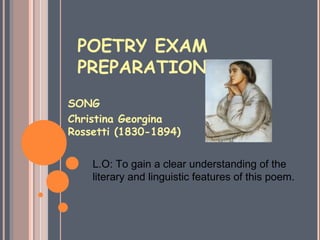
POETRY EXAM
 PREPARATION
SONG
Christina Georgina
Rossetti (1830-1894)


    L.O: To gain a clear understanding of the
    literary and linguistic features of this poem.
SONG
Christina Georgina Rossetti (1830-1894)


When I am dead, my dearest,
Sing no sad songs for me;
Plant thou no roses at my head,
Nor shady cypress tree:
Be the green grass above me
With showers and dewdrops wet:
And if thou wilt, remember,
And if thou wilt, forget.


I shall not see the shadows,
I shall not feel the rain;
I shall not hear the nightingale
Sing on as if in pain:
And dreaming through the twilight
That doth not rise nor set,
Haply I may remember,
And haply may forget.


...
OVERVIEW/CONTEXT
 Context - ’the high priestess of Pre-Raphaelitism’
  Song is a poem in two verses about not wanting to be
  mourned and the uncertainty of death and memory.
 Content – A person’s message to their lover for when
  they die, saying how they want their partner to
  live/act once they have died. Unusual as she reverses
  the traditional; male message to a female lover.
 Audience – Her lover who she will be leaving, anyone
  who has suffered a loss.
 Purpose – To possibly advise others of how to act in
  such times, support them and express feelings.
FORM
Poem splits into two halves – the first half imploring her lover not to mourn
her loss however the second half goes even further against traditional
views as she shows that actually the female is distanced anyway from her
lover.
  Statement           Evidence                       Analysis
Simple lyric
poem in two
octets
parenthesis:       'my dearest'


first person
address

rhythm in octets: (7,6,8,6 / 7,6,7,6)


end stopped         'And if thou wilt,
lines with         remember'
colons,
caesuras:
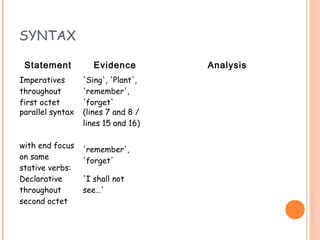
SYNTAX

 Statement           Evidence        Analysis
Imperatives       'Sing', 'Plant',
throughout        'remember',
first octet       'forget'
parallel syntax   (lines 7 and 8 /
                  lines 15 and 16)

with end focus    'remember',
on same           'forget'
stative verbs:
Declarative       'I shall not
throughout        see…'
second octet
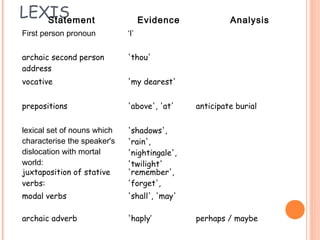
LEXIS
   Statement                       Evidence            Analysis
First person pronoun         ‘I’


archaic second person        'thou'
address
vocative                     'my dearest'


prepositions                 'above', 'at'    anticipate burial


lexical set of nouns which   'shadows',
characterise the speaker's   'rain',
dislocation with mortal      'nightingale',
world:                       'twilight'
juxtaposition of stative     'remember',
verbs:                       'forget',
modal verbs                  'shall', 'may'

archaic adverb               'haply’          perhaps / maybe
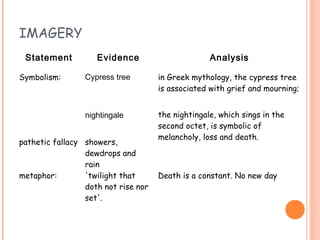
IMAGERY
 Statement          Evidence                       Analysis

Symbolism:       Cypress tree        in Greek mythology, the cypress tree
                                     is associated with grief and mourning;


                 nightingale         the nightingale, which sings in the
                                     second octet, is symbolic of
                                     melancholy, loss and death.
pathetic fallacy showers,
                 dewdrops and
                 rain
metaphor:        'twilight that      Death is a constant. No new day
                 doth not rise nor
                 set'.
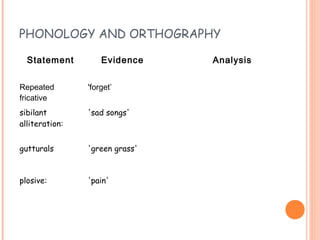
PHONOLOGY AND ORTHOGRAPHY

  Statement         Evidence    Analysis


Repeated        'forget’
fricative
sibilant        'sad songs'
alliteration:


gutturals       'green grass'


plosive:        'pain'

Song

  • 1.
    POETRY EXAM PREPARATION SONG ChristinaGeorgina Rossetti (1830-1894) L.O: To gain a clear understanding of the literary and linguistic features of this poem.
  • 2.
    SONG Christina Georgina Rossetti(1830-1894) When I am dead, my dearest, Sing no sad songs for me; Plant thou no roses at my head, Nor shady cypress tree: Be the green grass above me With showers and dewdrops wet: And if thou wilt, remember, And if thou wilt, forget. I shall not see the shadows, I shall not feel the rain; I shall not hear the nightingale Sing on as if in pain: And dreaming through the twilight That doth not rise nor set, Haply I may remember, And haply may forget. ...
  • 3.
    OVERVIEW/CONTEXT  Context -’the high priestess of Pre-Raphaelitism’ Song is a poem in two verses about not wanting to be mourned and the uncertainty of death and memory.  Content – A person’s message to their lover for when they die, saying how they want their partner to live/act once they have died. Unusual as she reverses the traditional; male message to a female lover.  Audience – Her lover who she will be leaving, anyone who has suffered a loss.  Purpose – To possibly advise others of how to act in such times, support them and express feelings.
  • 4.
    FORM Poem splits intotwo halves – the first half imploring her lover not to mourn her loss however the second half goes even further against traditional views as she shows that actually the female is distanced anyway from her lover. Statement Evidence Analysis Simple lyric poem in two octets parenthesis: 'my dearest' first person address rhythm in octets: (7,6,8,6 / 7,6,7,6) end stopped 'And if thou wilt, lines with remember' colons, caesuras:
  • 5.
    SYNTAX Statement Evidence Analysis Imperatives 'Sing', 'Plant', throughout 'remember', first octet 'forget' parallel syntax (lines 7 and 8 / lines 15 and 16) with end focus 'remember', on same 'forget' stative verbs: Declarative 'I shall not throughout see…' second octet
  • 6.
    LEXIS Statement Evidence Analysis First person pronoun ‘I’ archaic second person 'thou' address vocative 'my dearest' prepositions 'above', 'at' anticipate burial lexical set of nouns which 'shadows', characterise the speaker's 'rain', dislocation with mortal 'nightingale', world: 'twilight' juxtaposition of stative 'remember', verbs: 'forget', modal verbs 'shall', 'may' archaic adverb 'haply’ perhaps / maybe
  • 7.
    IMAGERY Statement Evidence Analysis Symbolism: Cypress tree in Greek mythology, the cypress tree is associated with grief and mourning; nightingale the nightingale, which sings in the second octet, is symbolic of melancholy, loss and death. pathetic fallacy showers, dewdrops and rain metaphor: 'twilight that Death is a constant. No new day doth not rise nor set'.
  • 8.
    PHONOLOGY AND ORTHOGRAPHY Statement Evidence Analysis Repeated 'forget’ fricative sibilant 'sad songs' alliteration: gutturals 'green grass' plosive: 'pain'