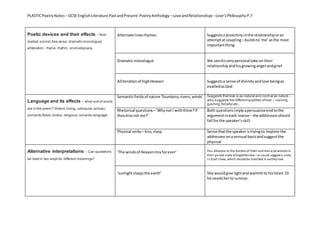
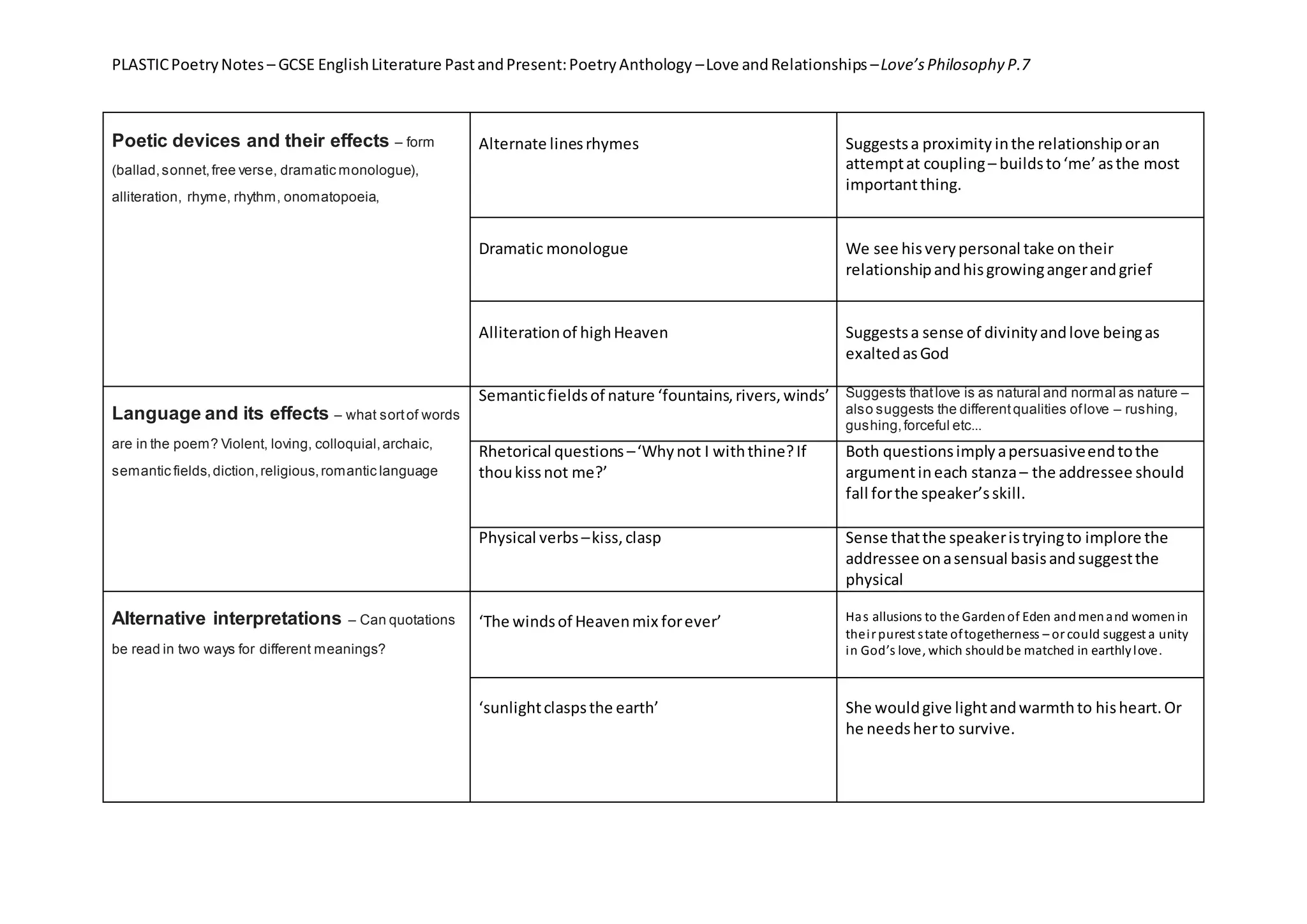
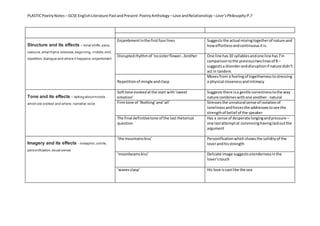
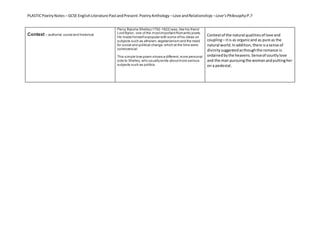
This document provides an analysis of Percy Bysshe Shelley's poem "Love's Philosophy" through discussion of its poetic devices, language, structure, imagery, and context. It notes that the alternating rhyme scheme suggests an attempt at coupling. Dramatic elements convey the speaker's personal perspective and growing distress. References to nature position love as something natural and varying in its qualities. The analysis explores how specific linguistic aspects, such as rhetorical questions, verbs, repetition, and shifts in tone and rhythm are used to convince the addressee and convey meaning. Contextual details about Shelley and the social norms of romantic relationships at the time are also presented.


![Before you were_mine_plastic_notesheet[1]](https://cdn.slidesharecdn.com/ss_thumbnails/beforeyouweremineplasticnotesheet1-160904154545-thumbnail.jpg?width=640&height=640&fit=bounds)


![Climbing my grandfather_plastic_notesheet[1]](https://cdn.slidesharecdn.com/ss_thumbnails/climbingmygrandfatherplasticnotesheet1-160904154429-thumbnail.jpg?width=640&height=640&fit=bounds)


![Aqa anthology-2017-love-and-relationships-poetry-posters[1]](https://cdn.slidesharecdn.com/ss_thumbnails/aqa-anthology-2017-love-and-relationships-poetry-posters1-160904154111-thumbnail.jpg?width=640&height=640&fit=bounds)


