Poetry of the age
Metaphysical poets
 Metaphysical school was one of two major schools of the 17th century.
 John Donne, a significant English poet, is known as the founder of the school.
 Literally, “meta” means beyond and “physics” means physical nature. “Meta” is
a prefix to the Greeks. It was used after Aristotle’s work on physics. Now it is a
term generally applied to a group of 17th century poets like John Donne,
George Herbert, Henry Vaughan, Thomas Carew, Richard Crawshaw and
others.
 Metaphysical schools are geared towards the study of metaphysics, or the
science or philosophy which systematically examines the beginnings of all
existence, eventual reality, knowledge, being and the nature of the universe.
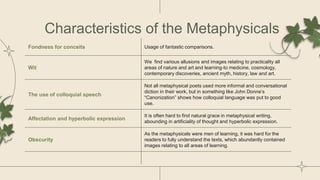
Fondness for conceits Usage of fantastic comparisons.
Wit
We find various allusions and images relating to practicality all
areas of nature and art and learning-to medicine, cosmology,
contemporary discoveries, ancient myth, history, law and art.
The use of colloquial speech
Not all metaphysical poets used more informal and conversational
diction in their work, but in something like John Donne’s
“Canonization” shows how colloquial language was put to good
use.
Affectation and hyperbolic expression
It is often hard to find natural grace in metaphysical writing,
abounding in artificiality of thought and hyperbolic expression.
Obscurity
As the metaphysicals were men of learning, it was hard for the
readers to fully understand the texts, which abundantly contained
images relating to all areas of learning.
Now, let’s analyze some
poems to fully
understand the
metaphysical concepts.
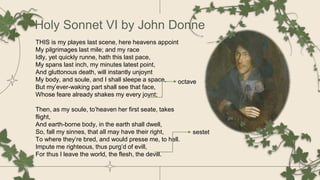
Holy Sonnet VI by John Donne
THIS is my playes last scene, here heavens appoint
My pilgrimages last mile; and my race
Idly, yet quickly runne, hath this last pace,
My spans last inch, my minutes latest point,
And gluttonous death, will instantly unjoynt
My body, and soule, and I shall sleepe a space,
But my’ever-waking part shall see that face,
Whose feare already shakes my every joynt;
Then, as my soule, to’heaven her first seate, takes
flight,
And earth-borne body, in the earth shall dwell,
So, fall my sinnes, that all may have their right,
To where they’re bred, and would presse me, to hell.
Impute me righteous, thus purg’d of evill,
For thus I leave the world, the flesh, the devill.
octave
sestet
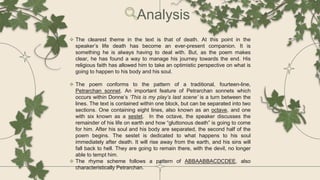
 The clearest theme in the text is that of death. At this point in the
speaker’s life death has become an ever-present companion. It is
something he is always having to deal with. But, as the poem makes
clear, he has found a way to manage his journey towards the end. His
religious faith has allowed him to take an optimistic perspective on what is
going to happen to his body and his soul.
 The poem conforms to the pattern of a traditional, fourteen-line,
Petrarchan sonnet. An important feature of Petrarchan sonnets which
occurs within Donne’s ‘This is my play’s last scene’ is a turn between the
lines. The text is contained within one block, but can be separated into two
sections. One containing eight lines, also known as an octave, and one
with six known as a sestet. In the octave, the speaker discusses the
remainder of his life on earth and how “gluttonous death” is going to come
for him. After his soul and his body are separated, the second half of the
poem begins. The sestet is dedicated to what happens to his soul
immediately after death. It will rise away from the earth, and his sins will
fall back to hell. They are going to remain there, with the devil, no longer
able to tempt him.
 The rhyme scheme follows a pattern of ABBAABBACDCDEE, also
characteristically Petrarchan.
Analysis
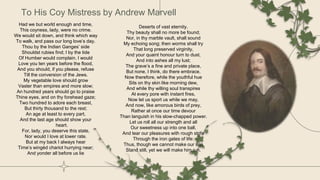
To His Coy Mistress by Andrew Marvell
Deserts of vast eternity.
Thy beauty shall no more be found;
Nor, in thy marble vault, shall sound
My echoing song; then worms shall try
That long preserved virginity,
And your quaint honour turn to dust,
And into ashes all my lust;
The grave’s a fine and private place,
But none, I think, do there embrace.
Now therefore, while the youthful hue
Sits on thy skin like morning dew,
And while thy willing soul transpires
At every pore with instant fires,
Now let us sport us while we may,
And now, like amorous birds of prey,
Rather at once our time devour
Than languish in his slow-chapped power.
Let us roll all our strength and all
Our sweetness up into one ball,
And tear our pleasures with rough strife
Through the iron gates of life:
Thus, though we cannot make our sun
Stand still, yet we will make him run.
Had we but world enough and time,
This coyness, lady, were no crime.
We would sit down, and think which way
To walk, and pass our long love’s day.
Thou by the Indian Ganges’ side
Shouldst rubies find; I by the tide
Of Humber would complain. I would
Love you ten years before the flood,
And you should, if you please, refuse
Till the conversion of the Jews.
My vegetable love should grow
Vaster than empires and more slow;
An hundred years should go to praise
Thine eyes, and on thy forehead gaze;
Two hundred to adore each breast,
But thirty thousand to the rest;
An age at least to every part,
And the last age should show your
heart.
For, lady, you deserve this state,
Nor would I love at lower rate.
But at my back I always hear
Time’s wingèd chariot hurrying near;
And yonder all before us lie
 "To His Coy Mistress" is a carpe diem poem: following the example of Roman poets like Horace, it urges a young
woman to enjoy the pleasures of life before death claims her. Indeed, the poem is an attempt to seduce the titular
"coy mistress." In the process, however, the speaker dwells with grotesque intensity on death itself. Death seems
to take over the poem, displacing the speaker's erotic energy and filling the poem with dread.
 The word "coy" describes a series of contradictory behaviors. Someone who's being coy is simultaneously
flirtatious and withholding, expressing interest but refusing to act on it. In contemporary English, one might
describe it as "playing hard to get"—which is certainly how the speaker of the poem interprets the mistress's
behavior.
 “To His Coy Mistress” is a metaphysical poem in which the speaker attempts to persuade his resistant lover that
they should have sexual intercourse. He explains that if they had all the time in the world, he would have no
problem with their relationship moving this slowly. However, he goes on to explain, they are mortal, and once they
die they will be unable to be intimate together. The poem appears to serve dual purposes: first, to persuade the
mistress to love, and second, to comment on mortality in its inevitability and grotesqueness. It is the latter
objective which adds the philosophical aspect to this love poem.
 "To His Coy Mistress" is organized into rhyming couplets. Each couplet has its own rhyme; after Marvell completes
one rhyme, he moves on to the next. One can see this pattern in the first 10 lines of the poem, which are
rhymed AABBCCDDEE. The couplets are designed to feel separate
Thanks for your
attention!

Metaphysical poets

  • 1.
    Poetry of theage Metaphysical poets
  • 2.
     Metaphysical schoolwas one of two major schools of the 17th century.  John Donne, a significant English poet, is known as the founder of the school.  Literally, “meta” means beyond and “physics” means physical nature. “Meta” is a prefix to the Greeks. It was used after Aristotle’s work on physics. Now it is a term generally applied to a group of 17th century poets like John Donne, George Herbert, Henry Vaughan, Thomas Carew, Richard Crawshaw and others.  Metaphysical schools are geared towards the study of metaphysics, or the science or philosophy which systematically examines the beginnings of all existence, eventual reality, knowledge, being and the nature of the universe.
  • 3.
    Fondness for conceitsUsage of fantastic comparisons. Wit We find various allusions and images relating to practicality all areas of nature and art and learning-to medicine, cosmology, contemporary discoveries, ancient myth, history, law and art. The use of colloquial speech Not all metaphysical poets used more informal and conversational diction in their work, but in something like John Donne’s “Canonization” shows how colloquial language was put to good use. Affectation and hyperbolic expression It is often hard to find natural grace in metaphysical writing, abounding in artificiality of thought and hyperbolic expression. Obscurity As the metaphysicals were men of learning, it was hard for the readers to fully understand the texts, which abundantly contained images relating to all areas of learning.
  • 4.
    Now, let’s analyzesome poems to fully understand the metaphysical concepts.
  • 5.
    Holy Sonnet VIby John Donne THIS is my playes last scene, here heavens appoint My pilgrimages last mile; and my race Idly, yet quickly runne, hath this last pace, My spans last inch, my minutes latest point, And gluttonous death, will instantly unjoynt My body, and soule, and I shall sleepe a space, But my’ever-waking part shall see that face, Whose feare already shakes my every joynt; Then, as my soule, to’heaven her first seate, takes flight, And earth-borne body, in the earth shall dwell, So, fall my sinnes, that all may have their right, To where they’re bred, and would presse me, to hell. Impute me righteous, thus purg’d of evill, For thus I leave the world, the flesh, the devill. octave sestet
  • 6.
     The clearesttheme in the text is that of death. At this point in the speaker’s life death has become an ever-present companion. It is something he is always having to deal with. But, as the poem makes clear, he has found a way to manage his journey towards the end. His religious faith has allowed him to take an optimistic perspective on what is going to happen to his body and his soul.  The poem conforms to the pattern of a traditional, fourteen-line, Petrarchan sonnet. An important feature of Petrarchan sonnets which occurs within Donne’s ‘This is my play’s last scene’ is a turn between the lines. The text is contained within one block, but can be separated into two sections. One containing eight lines, also known as an octave, and one with six known as a sestet. In the octave, the speaker discusses the remainder of his life on earth and how “gluttonous death” is going to come for him. After his soul and his body are separated, the second half of the poem begins. The sestet is dedicated to what happens to his soul immediately after death. It will rise away from the earth, and his sins will fall back to hell. They are going to remain there, with the devil, no longer able to tempt him.  The rhyme scheme follows a pattern of ABBAABBACDCDEE, also characteristically Petrarchan. Analysis
  • 7.
    To His CoyMistress by Andrew Marvell Deserts of vast eternity. Thy beauty shall no more be found; Nor, in thy marble vault, shall sound My echoing song; then worms shall try That long preserved virginity, And your quaint honour turn to dust, And into ashes all my lust; The grave’s a fine and private place, But none, I think, do there embrace. Now therefore, while the youthful hue Sits on thy skin like morning dew, And while thy willing soul transpires At every pore with instant fires, Now let us sport us while we may, And now, like amorous birds of prey, Rather at once our time devour Than languish in his slow-chapped power. Let us roll all our strength and all Our sweetness up into one ball, And tear our pleasures with rough strife Through the iron gates of life: Thus, though we cannot make our sun Stand still, yet we will make him run. Had we but world enough and time, This coyness, lady, were no crime. We would sit down, and think which way To walk, and pass our long love’s day. Thou by the Indian Ganges’ side Shouldst rubies find; I by the tide Of Humber would complain. I would Love you ten years before the flood, And you should, if you please, refuse Till the conversion of the Jews. My vegetable love should grow Vaster than empires and more slow; An hundred years should go to praise Thine eyes, and on thy forehead gaze; Two hundred to adore each breast, But thirty thousand to the rest; An age at least to every part, And the last age should show your heart. For, lady, you deserve this state, Nor would I love at lower rate. But at my back I always hear Time’s wingèd chariot hurrying near; And yonder all before us lie
  • 8.
     "To HisCoy Mistress" is a carpe diem poem: following the example of Roman poets like Horace, it urges a young woman to enjoy the pleasures of life before death claims her. Indeed, the poem is an attempt to seduce the titular "coy mistress." In the process, however, the speaker dwells with grotesque intensity on death itself. Death seems to take over the poem, displacing the speaker's erotic energy and filling the poem with dread.  The word "coy" describes a series of contradictory behaviors. Someone who's being coy is simultaneously flirtatious and withholding, expressing interest but refusing to act on it. In contemporary English, one might describe it as "playing hard to get"—which is certainly how the speaker of the poem interprets the mistress's behavior.  “To His Coy Mistress” is a metaphysical poem in which the speaker attempts to persuade his resistant lover that they should have sexual intercourse. He explains that if they had all the time in the world, he would have no problem with their relationship moving this slowly. However, he goes on to explain, they are mortal, and once they die they will be unable to be intimate together. The poem appears to serve dual purposes: first, to persuade the mistress to love, and second, to comment on mortality in its inevitability and grotesqueness. It is the latter objective which adds the philosophical aspect to this love poem.  "To His Coy Mistress" is organized into rhyming couplets. Each couplet has its own rhyme; after Marvell completes one rhyme, he moves on to the next. One can see this pattern in the first 10 lines of the poem, which are rhymed AABBCCDDEE. The couplets are designed to feel separate
  • 9.