Poem Summary Language Structure Tone/feelings/ wider
issues
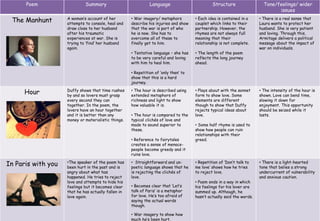
The Manhunt A woman’s account of her
attempts to console, heal and
draw close to her husband
after his traumatic
experiences at war. She is
trying to ‘find’ her husband
again.
• War imagery/ metaphors
describe his injuries and show
that the war is part of who
he is now. She has to
overcome all of these to
finally get to him.
• Tentative language – she has
to be very careful and loving
with him to heal him.
• Repetition of ‘only then’ to
show that this is a hard
journey.
• Each idea is contained in a
couplet which links to their
partnership. However, the
rhymes are not always full
meaning that their
relationship is not complete.
• The length of the poem
reflects the long journey
ahead.
• There is a real sense that
Laura wants to protect her
husband. She is very patient
and loving. Through this,
Armitage delivers a political
message about the impact of
war on individuals.
Hour Duffy shows that time rushes
by and so lovers must grasp
every second they can
together. In the poem, the
lovers have an hour together
and it is better than any
money or materialistic things.
• The hour is described using
extended metaphors of
richness and light to show
how valuable it is.
• The hour is compared to the
typical clichés of love and
made to sound superior to
these.
• Reference to fairytales
creates a sense of menace-
people become greedy and it
ruins love.
• Plays about with the sonnet
form to show love. Some
elements are different
though to show that Duffy
rejects typical ideas about
love.
• Some half rhyme is used to
show how people can ruin
relationships with their
greed.
• The intensity of the hour is
shown. Love can bend time,
slowing it down for
enjoyment. This opportunity
should be seized while it
lasts.
In Paris with you •The speaker of the poem has
been hurt in the past and is
angry about what has
happened. He tries to reject
love and attempts to hide his
feelings but it becomes clear
that he has actually fallen in
love again.
• Straightforward and un-
poetic language shows that he
is rejecting the clichés of
love.
• Becomes clear that ‘Let’s
talk of Paris’ is a metaphor
for love. He’s too afraid of
saying the actual words
though.
• War imagery to show how
much he’s been hurt.
• Repetition of ‘Don’t talk to
me love’ shows how he tries
to reject love.
• Poem ends in a way in which
his feelings for his lover are
summed up. Although, he
hasn’t actually said the words.
• There is a light-hearted
tone that belies a strong
undercurrent of vulnerability
and anxious caution.
Poem Summary Language Structure Tone/feelings/
wider issues
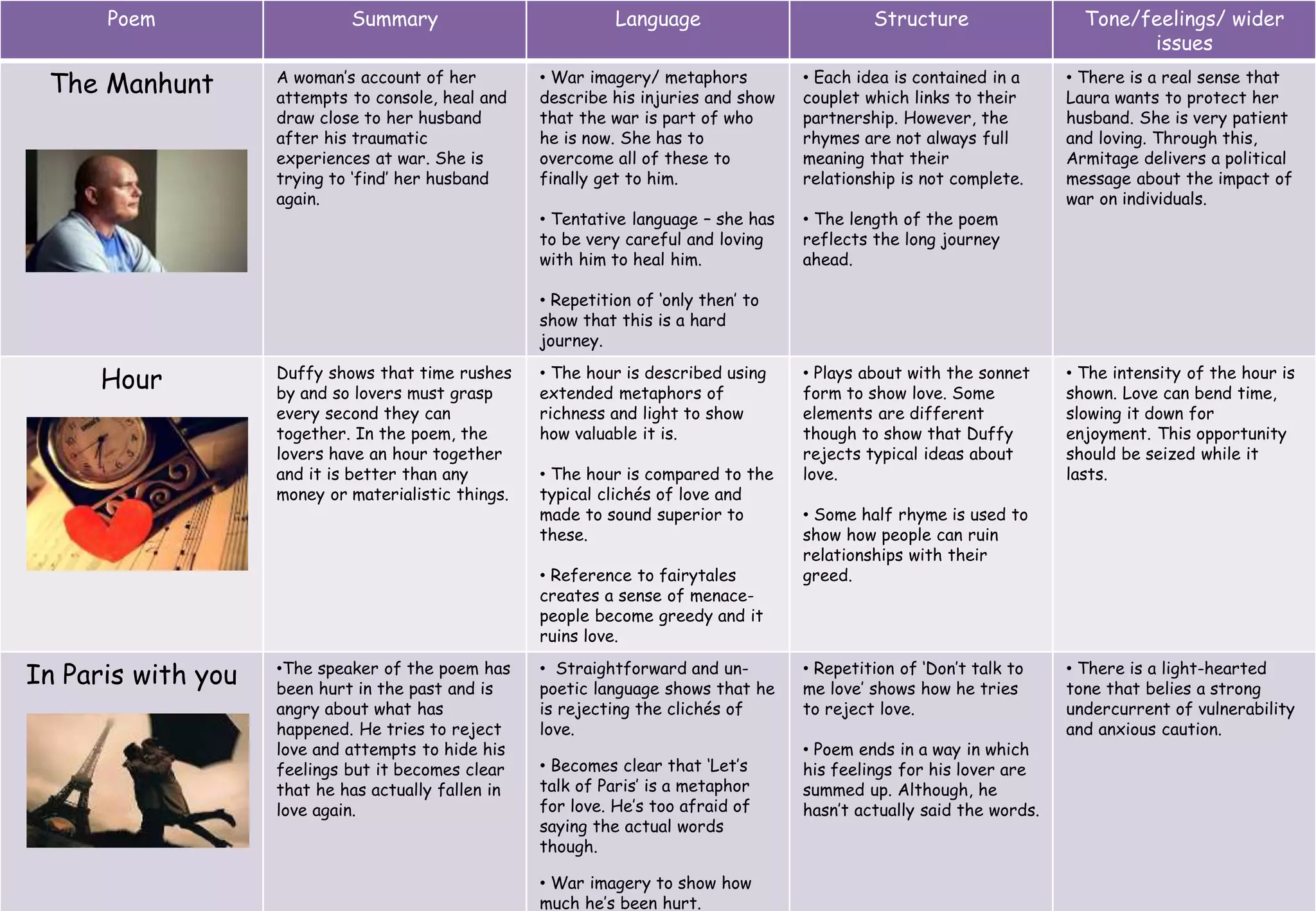
Quickdraw • Duffy presents the pain and
pleasure of being in love and
the difficulties of
communication in a
relationship. There is a phone
conversation presented as a
saloon gunfight.
• Extended metaphor. The
phone call is compared to a
gunfight and words are
bullets designed to hurt.
• There is a sense of high
stakes as though this
conversation is the turning
point of the relationship.
• Images of pain.
• Sonnet sequence of 14 lines
to show love but it’s
fragmented in two places to
show difficulties and pain.
• Line breaks allow Duffy to
emphasise the main messages:
‘You’ve wounded me’...
‘Through the heart’
• Poem shows the first
shadows of pain being cast
over a relationship. Also
parodies modern reliance on
mobile phones.
Ghazal • This is a poem about
seduction. The speaker uses a
range of arguments to
persuade their beloved that
they should be together.
• Images come in
complementary pairs in which
the two parts make a better
whole – like the lovers do.
• Made up of metaphors that
each explore a different side
to love.
• Traditional form of a ghazal
– contains 5 couplets each
with a self-contained idea but
develops a central argument.
• Each couplet is linked by a
refrain ‘woo me’, ‘pursue me’
etc which builds up a
powerful repetitive image
that lends itself to
persuasion.
• Poem shows all the
different sides to love and
how people are better
together than they are alone.
Sonnet 116 • The speaker attempts to
define love and its ability to
remain constant as time
goes by. However, there is
the sense that the love
described will not work in
the real world.
• Metaphors are used to
compare love to images of
security and hope ‘ever
fixed mark’, ‘beacon’, ‘star’
• However, some of the
images suggest distance
showing that maybe this
sort of love is unattainable
in reality.
• The poet sets out to
explain what love is not
suggesting that it is
difficult to define what love
is.
• Typical Shakespearean
structure to represent love.
• The final couplet concludes
his ideas about love but
suggests that he could be
wrong ‘error’.
• Quite a positive poem
about love and how even
though beauty can fade,
love can conquer time and
death. However, this
interpretation of love may
not be so straightforward.
Poem Summary Language Structure Tone/feelings/ wider
issues
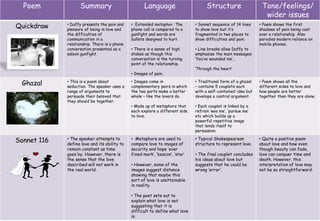
Sonnet 43 • The speaker attempts to
define love but in a more
personal way than Sonnet
116. She is enthusiastic
about listing the ways she
loves her partner.
• Religious images shows
that the love is spiritual.
• Similes are used to
present the power of her
love.
• Repetition of ‘I love thee...’
is used to list the many
different ways she loves
him – her love is all
encompassing.
• Sonnet form represents the
deep love she has for her
partner.
• Enjambment is used in line
2,3,5,9 and 11 to show that
she can’t contain her rush of
feelings – they flow from her.
The speaker enjoys thinking
about the ways she loves her
partner. She is very
enthusiastic.
She loves him with everything
she has got and thinks their
love is wonderful and spiritual
but it is also real.
It transforms her ‘old griefs’
into happiness and it makes
her feel innocent and secure
like a child.
To His coy
Mistress
• The poem is about seduction
but it is also about seizing the
day. The speaker presents an
argument in three parts to
suggest that they need to enjoy
their time together whilst they
can and have sex.
• Romantic imagery and
exaggeration in Stanza 1 shows
that he is trying to flatter her –
could be seen as insincerity.
• Lots of time references in
Stanza 2 to show that time is
fleeting and they must act fast.
• Stanza 3 uses lots of
metaphors to suggest enjoyment
and pleasure of consummating
the relationship.
• Three part argument. Stanza 1
– talks about how he would
romance her if he had all the
time in the world. Stanza 2 –
Introduces the issue: time is
short. Stanza 3 – Introduces the
solution: they love each other so
they should just have sex.
• Sense that the speaker feels
bored by their current
relationship as there are verbs
that show slowness. He doesn’t
think there is time to be coy – he
wants to enjoy the present.
The Farmer’s
Bride
• The poem is about a
dysfunctional marriage. The
marriage is not born out of
romance and the bride is very
unhappy and distant from her
husband. She is trapped.
• Language shows that the bride
is like a frightened, vulnerable,
hunted animal.
• The bride is characterised
through her innocent love of
nature. Shows her youth and also
her desire to be free.
• Obsessive language in the last
stanza suggests that the farmer
is haunted by his bride because
he can’t have her and is
frustrated.
• The poem takes a journey
through the seasons to show
the deterioration of the
relationship.
• The poem ends with both
partners unhappy and
distance between them.
• The poem perhaps makes a
point that arranged marriages
can’t work. The farmer seems
to expect an emotional
closeness without considering
his bride’s feelings.
Poem Summary Language Structure Tone/feelings/
wider issues
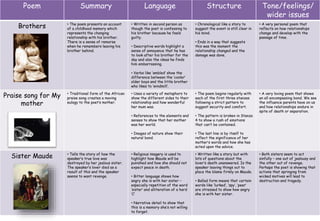
Brothers • The poem presents an account
of a childhood memory which
represents the changing
relationship with his brother.
There is a sense of remorse
when he remembers leaving his
brother behind.
• Written in second person as
though the poet is confessing to
his brother because he feels
guilty.
• Descriptive words highlight a
sense of annoyance that he has
to look after his brother for the
day and also the ideas he finds
him embarrassing.
• Verbs like ‘ambled’ show the
difference between the ‘cooler’
older boys and the little brother
who likes to ‘windmill’.
• Chronological like a story to
suggest the event is still clear in
his mind.
• Ends in a way that suggests
this was the moment the
relationship changed and the
damage was done.
• A very personal poem that
reflects on how relationships
change and develop with the
passage of time.
Praise song for My
mother
• Traditional form of the African
praise song creates a moving
eulogy to the poet’s mother.
• Uses a variety of metaphors to
show the different sides to their
relationship and how wonderful
her mum was.
• References to the elements and
senses to show that her mother
was her world.
• Images of nature show their
natural bond.
• The poem begins regularly with
each of the first three stanzas
following a strict pattern to
suggest security and comfort.
• The pattern is broken in Stanza
4 to show a rush of emotions
that can’t be contained.
• The last line is by itself to
reflect the significance of her
mother’s words and how she has
acted upon the advice.
• A very loving poem that shows
an all encompassing bond. We see
the influence parents have on us
and how relationships endure in
spite of death or separation.
Sister Maude • Tells the story of how the
speaker’s true love was
destroyed by her jealous sister.
The speaker’s lover died as a
result of this and the speaker
seems to want revenge.
• Religious imagery is used to
highlight how Maude will be
punished and how she should not
expect peace in death.
• Bitter language shows how
angry she is with her sister –
especially repetition of the word
‘sister’ and alliteration of a hard
‘C’
• Narrative detail to show that
this is a memory she’s not willing
to forget.
• Written like a story but with
lots of questions about the
lover’s death unanswered. Is the
speaker leaving things out to
place the blame firmly on Maude.
• Ballad form means that certain
words like ‘lurked’, ‘spy’, ‘peer’
are stressed to show how angry
she is with her sister.
• Both sisters seem to act
sinfully – one out of jealousy and
the other out of revenge.
Perhaps the poet is showing that
actions that springing from
wicked motives will lead to
destruction and tragedy.
Poem Summary Language Structure Tone/feelings/
wider issues
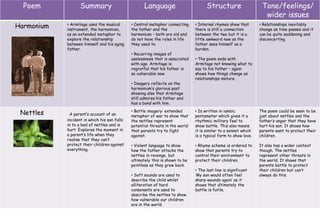
Harmonium • Armitage uses the musical
instrument, the harmonium,
as an extended metaphor to
explore the relationship
between himself and his aging
father.
• Central metaphor connecting
the father and the
harmonium – both are old and
do not have the roles in life
they used to.
• Recurring images of
uselessness that is associated
with age. Armitage is
regretful that his father is
so vulnerable now.
• Imagery reflects on the
harmonium’s glorious past
showing also that Armitage
still admires his father and
has a bond with him.
• Internal rhymes show that
there is still a connection
between the two but it is a
little awkward now as the
father sees himself as a
burden.
• The poem ends with
Armitage not knowing what to
say to his father – again
shows how things change as
relationships mature.
• Relationships inevitably
change as time passes and it
can be quite saddening and
disconcerting.
Nettles A parent’s account of an
incident in which his son falls
in to a bed of nettles and is
hurt. Explores the moment in
a parent’s life when they
realise that they can’t
protect their children against
everything.
• Battle imagery: extended
metaphor of war to show that
the nettles represent
potential threats in the world
that parents try to fight
against.
• Violent language to show
how the father attacks the
nettles in revenge, but
ultimately this is shown to be
pointless as they grow back.
• Soft sounds are used to
describe the child whilst
alliteration of hard
consonants are used to
describe the nettles to show
how vulnerable our children
are in the world.
• Is written in iambic
pentameter which gives it a
rhythmic military feel to
show battle. This also means
it is similar to a sonnet which
is a typical form to show love.
• Rhyme scheme is ordered to
show that parents try to
control their environment to
protect their children.
• The last line is significant
‘My son would often feel
sharp wounds again’ as it
shows that ultimately the
battle is futile.
The poem could be seen to be
just about nettles and the
father’s anger that they have
hurt his son. It shows how
parents want to protect their
children.
It also has a wider context
though. The nettles
represent other threats in
the world. It shows that
parents battle to protect
their children but can’t
always do this.
Poem Summary Language Structure Tone/feelings/
wider issues
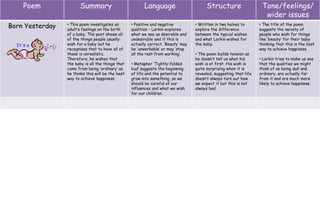
Born Yesterday • This poem investigates an
adult’s feelings on the birth
of a baby. The poet shows all
of the things people usually
wish for a baby but he
recognises that to have all of
these is unrealistic.
Therefore, he wishes that
the baby is all the things that
come from being ‘ordinary’ as
he thinks this will be the best
way to achieve happiness.
• Positive and negative
qualities – Larkin explores
what we see as desirable and
undesirable and if this is
actually correct. ‘Beauty’ may
be ‘unworkable’ or may ‘stop
all the rest from working’.
• Metaphor ‘Tightly-folded
bud’ suggests the beginning
of life and the potential to
grow into something, so we
should be careful of our
influences and what we wish
for our children.
• Written in two halves to
explore the difference
between the typical wishes
and what Larkin wishes for
the baby.
• The poem builds tension as
he doesn’t tell us what his
wish is at first. His wish is
quite surprising when it is
revealed, suggesting that life
doesn’t always turn out how
we expect it but this is not
always bad.
• The title of the poem
suggests the naivety of
people who wish for things
like ‘beauty’ for their baby
thinking that this is the best
way to achieve happiness.
• Larkin tries to make us see
that the qualities we might
think of as being dull and
ordinary, are actually far
from it and are much more
likely to achieve happiness.

Relationship Poetry Revision

  • 1.
    Poem Summary LanguageStructure Tone/feelings/ wider issues The Manhunt A woman’s account of her attempts to console, heal and draw close to her husband after his traumatic experiences at war. She is trying to ‘find’ her husband again. • War imagery/ metaphors describe his injuries and show that the war is part of who he is now. She has to overcome all of these to finally get to him. • Tentative language – she has to be very careful and loving with him to heal him. • Repetition of ‘only then’ to show that this is a hard journey. • Each idea is contained in a couplet which links to their partnership. However, the rhymes are not always full meaning that their relationship is not complete. • The length of the poem reflects the long journey ahead. • There is a real sense that Laura wants to protect her husband. She is very patient and loving. Through this, Armitage delivers a political message about the impact of war on individuals. Hour Duffy shows that time rushes by and so lovers must grasp every second they can together. In the poem, the lovers have an hour together and it is better than any money or materialistic things. • The hour is described using extended metaphors of richness and light to show how valuable it is. • The hour is compared to the typical clichés of love and made to sound superior to these. • Reference to fairytales creates a sense of menace- people become greedy and it ruins love. • Plays about with the sonnet form to show love. Some elements are different though to show that Duffy rejects typical ideas about love. • Some half rhyme is used to show how people can ruin relationships with their greed. • The intensity of the hour is shown. Love can bend time, slowing it down for enjoyment. This opportunity should be seized while it lasts. In Paris with you •The speaker of the poem has been hurt in the past and is angry about what has happened. He tries to reject love and attempts to hide his feelings but it becomes clear that he has actually fallen in love again. • Straightforward and un- poetic language shows that he is rejecting the clichés of love. • Becomes clear that ‘Let’s talk of Paris’ is a metaphor for love. He’s too afraid of saying the actual words though. • War imagery to show how much he’s been hurt. • Repetition of ‘Don’t talk to me love’ shows how he tries to reject love. • Poem ends in a way in which his feelings for his lover are summed up. Although, he hasn’t actually said the words. • There is a light-hearted tone that belies a strong undercurrent of vulnerability and anxious caution.
  • 2.
    Poem Summary LanguageStructure Tone/feelings/ wider issues Quickdraw • Duffy presents the pain and pleasure of being in love and the difficulties of communication in a relationship. There is a phone conversation presented as a saloon gunfight. • Extended metaphor. The phone call is compared to a gunfight and words are bullets designed to hurt. • There is a sense of high stakes as though this conversation is the turning point of the relationship. • Images of pain. • Sonnet sequence of 14 lines to show love but it’s fragmented in two places to show difficulties and pain. • Line breaks allow Duffy to emphasise the main messages: ‘You’ve wounded me’... ‘Through the heart’ • Poem shows the first shadows of pain being cast over a relationship. Also parodies modern reliance on mobile phones. Ghazal • This is a poem about seduction. The speaker uses a range of arguments to persuade their beloved that they should be together. • Images come in complementary pairs in which the two parts make a better whole – like the lovers do. • Made up of metaphors that each explore a different side to love. • Traditional form of a ghazal – contains 5 couplets each with a self-contained idea but develops a central argument. • Each couplet is linked by a refrain ‘woo me’, ‘pursue me’ etc which builds up a powerful repetitive image that lends itself to persuasion. • Poem shows all the different sides to love and how people are better together than they are alone. Sonnet 116 • The speaker attempts to define love and its ability to remain constant as time goes by. However, there is the sense that the love described will not work in the real world. • Metaphors are used to compare love to images of security and hope ‘ever fixed mark’, ‘beacon’, ‘star’ • However, some of the images suggest distance showing that maybe this sort of love is unattainable in reality. • The poet sets out to explain what love is not suggesting that it is difficult to define what love is. • Typical Shakespearean structure to represent love. • The final couplet concludes his ideas about love but suggests that he could be wrong ‘error’. • Quite a positive poem about love and how even though beauty can fade, love can conquer time and death. However, this interpretation of love may not be so straightforward.
  • 3.
    Poem Summary LanguageStructure Tone/feelings/ wider issues Sonnet 43 • The speaker attempts to define love but in a more personal way than Sonnet 116. She is enthusiastic about listing the ways she loves her partner. • Religious images shows that the love is spiritual. • Similes are used to present the power of her love. • Repetition of ‘I love thee...’ is used to list the many different ways she loves him – her love is all encompassing. • Sonnet form represents the deep love she has for her partner. • Enjambment is used in line 2,3,5,9 and 11 to show that she can’t contain her rush of feelings – they flow from her. The speaker enjoys thinking about the ways she loves her partner. She is very enthusiastic. She loves him with everything she has got and thinks their love is wonderful and spiritual but it is also real. It transforms her ‘old griefs’ into happiness and it makes her feel innocent and secure like a child. To His coy Mistress • The poem is about seduction but it is also about seizing the day. The speaker presents an argument in three parts to suggest that they need to enjoy their time together whilst they can and have sex. • Romantic imagery and exaggeration in Stanza 1 shows that he is trying to flatter her – could be seen as insincerity. • Lots of time references in Stanza 2 to show that time is fleeting and they must act fast. • Stanza 3 uses lots of metaphors to suggest enjoyment and pleasure of consummating the relationship. • Three part argument. Stanza 1 – talks about how he would romance her if he had all the time in the world. Stanza 2 – Introduces the issue: time is short. Stanza 3 – Introduces the solution: they love each other so they should just have sex. • Sense that the speaker feels bored by their current relationship as there are verbs that show slowness. He doesn’t think there is time to be coy – he wants to enjoy the present. The Farmer’s Bride • The poem is about a dysfunctional marriage. The marriage is not born out of romance and the bride is very unhappy and distant from her husband. She is trapped. • Language shows that the bride is like a frightened, vulnerable, hunted animal. • The bride is characterised through her innocent love of nature. Shows her youth and also her desire to be free. • Obsessive language in the last stanza suggests that the farmer is haunted by his bride because he can’t have her and is frustrated. • The poem takes a journey through the seasons to show the deterioration of the relationship. • The poem ends with both partners unhappy and distance between them. • The poem perhaps makes a point that arranged marriages can’t work. The farmer seems to expect an emotional closeness without considering his bride’s feelings.
  • 4.
    Poem Summary LanguageStructure Tone/feelings/ wider issues Brothers • The poem presents an account of a childhood memory which represents the changing relationship with his brother. There is a sense of remorse when he remembers leaving his brother behind. • Written in second person as though the poet is confessing to his brother because he feels guilty. • Descriptive words highlight a sense of annoyance that he has to look after his brother for the day and also the ideas he finds him embarrassing. • Verbs like ‘ambled’ show the difference between the ‘cooler’ older boys and the little brother who likes to ‘windmill’. • Chronological like a story to suggest the event is still clear in his mind. • Ends in a way that suggests this was the moment the relationship changed and the damage was done. • A very personal poem that reflects on how relationships change and develop with the passage of time. Praise song for My mother • Traditional form of the African praise song creates a moving eulogy to the poet’s mother. • Uses a variety of metaphors to show the different sides to their relationship and how wonderful her mum was. • References to the elements and senses to show that her mother was her world. • Images of nature show their natural bond. • The poem begins regularly with each of the first three stanzas following a strict pattern to suggest security and comfort. • The pattern is broken in Stanza 4 to show a rush of emotions that can’t be contained. • The last line is by itself to reflect the significance of her mother’s words and how she has acted upon the advice. • A very loving poem that shows an all encompassing bond. We see the influence parents have on us and how relationships endure in spite of death or separation. Sister Maude • Tells the story of how the speaker’s true love was destroyed by her jealous sister. The speaker’s lover died as a result of this and the speaker seems to want revenge. • Religious imagery is used to highlight how Maude will be punished and how she should not expect peace in death. • Bitter language shows how angry she is with her sister – especially repetition of the word ‘sister’ and alliteration of a hard ‘C’ • Narrative detail to show that this is a memory she’s not willing to forget. • Written like a story but with lots of questions about the lover’s death unanswered. Is the speaker leaving things out to place the blame firmly on Maude. • Ballad form means that certain words like ‘lurked’, ‘spy’, ‘peer’ are stressed to show how angry she is with her sister. • Both sisters seem to act sinfully – one out of jealousy and the other out of revenge. Perhaps the poet is showing that actions that springing from wicked motives will lead to destruction and tragedy.
  • 5.
    Poem Summary LanguageStructure Tone/feelings/ wider issues Harmonium • Armitage uses the musical instrument, the harmonium, as an extended metaphor to explore the relationship between himself and his aging father. • Central metaphor connecting the father and the harmonium – both are old and do not have the roles in life they used to. • Recurring images of uselessness that is associated with age. Armitage is regretful that his father is so vulnerable now. • Imagery reflects on the harmonium’s glorious past showing also that Armitage still admires his father and has a bond with him. • Internal rhymes show that there is still a connection between the two but it is a little awkward now as the father sees himself as a burden. • The poem ends with Armitage not knowing what to say to his father – again shows how things change as relationships mature. • Relationships inevitably change as time passes and it can be quite saddening and disconcerting. Nettles A parent’s account of an incident in which his son falls in to a bed of nettles and is hurt. Explores the moment in a parent’s life when they realise that they can’t protect their children against everything. • Battle imagery: extended metaphor of war to show that the nettles represent potential threats in the world that parents try to fight against. • Violent language to show how the father attacks the nettles in revenge, but ultimately this is shown to be pointless as they grow back. • Soft sounds are used to describe the child whilst alliteration of hard consonants are used to describe the nettles to show how vulnerable our children are in the world. • Is written in iambic pentameter which gives it a rhythmic military feel to show battle. This also means it is similar to a sonnet which is a typical form to show love. • Rhyme scheme is ordered to show that parents try to control their environment to protect their children. • The last line is significant ‘My son would often feel sharp wounds again’ as it shows that ultimately the battle is futile. The poem could be seen to be just about nettles and the father’s anger that they have hurt his son. It shows how parents want to protect their children. It also has a wider context though. The nettles represent other threats in the world. It shows that parents battle to protect their children but can’t always do this.
  • 6.
    Poem Summary LanguageStructure Tone/feelings/ wider issues Born Yesterday • This poem investigates an adult’s feelings on the birth of a baby. The poet shows all of the things people usually wish for a baby but he recognises that to have all of these is unrealistic. Therefore, he wishes that the baby is all the things that come from being ‘ordinary’ as he thinks this will be the best way to achieve happiness. • Positive and negative qualities – Larkin explores what we see as desirable and undesirable and if this is actually correct. ‘Beauty’ may be ‘unworkable’ or may ‘stop all the rest from working’. • Metaphor ‘Tightly-folded bud’ suggests the beginning of life and the potential to grow into something, so we should be careful of our influences and what we wish for our children. • Written in two halves to explore the difference between the typical wishes and what Larkin wishes for the baby. • The poem builds tension as he doesn’t tell us what his wish is at first. His wish is quite surprising when it is revealed, suggesting that life doesn’t always turn out how we expect it but this is not always bad. • The title of the poem suggests the naivety of people who wish for things like ‘beauty’ for their baby thinking that this is the best way to achieve happiness. • Larkin tries to make us see that the qualities we might think of as being dull and ordinary, are actually far from it and are much more likely to achieve happiness.