SOME WORKLOAD SCHEDULING
ALTERNATIVES IN THE HIGH
PERFORMANCE COMPUTING
ENVIRONMENT
Tyler A. Simon,
University of Maryland, Baltimore County
Jim McGalliard, FEDSIM
CMG 2013 National Conference
Session 424
November 7, 2013 - La Jolla
1
TOPICS
 HPC WORKLOADS
 BACKFILL
 MAPREDUCE & HADOOP
 HADOOP WORKLOAD SCHEDULING
 ALTERNATIVE PRIORITIZATIONS
 ALTERNATIVE SCHEDULES
 DYNAMIC PRIORITIZATION
 SOME DYNAMIC PRIORITIZATION RESULTS
 CONCLUSIONS
2
HPC Workloads
 Current generation HPCs have many CPUs – say,
1,000 or 10,000. Scale economies of clusters of
commodity processors made price/performance of
custom-designed processors too expensive.
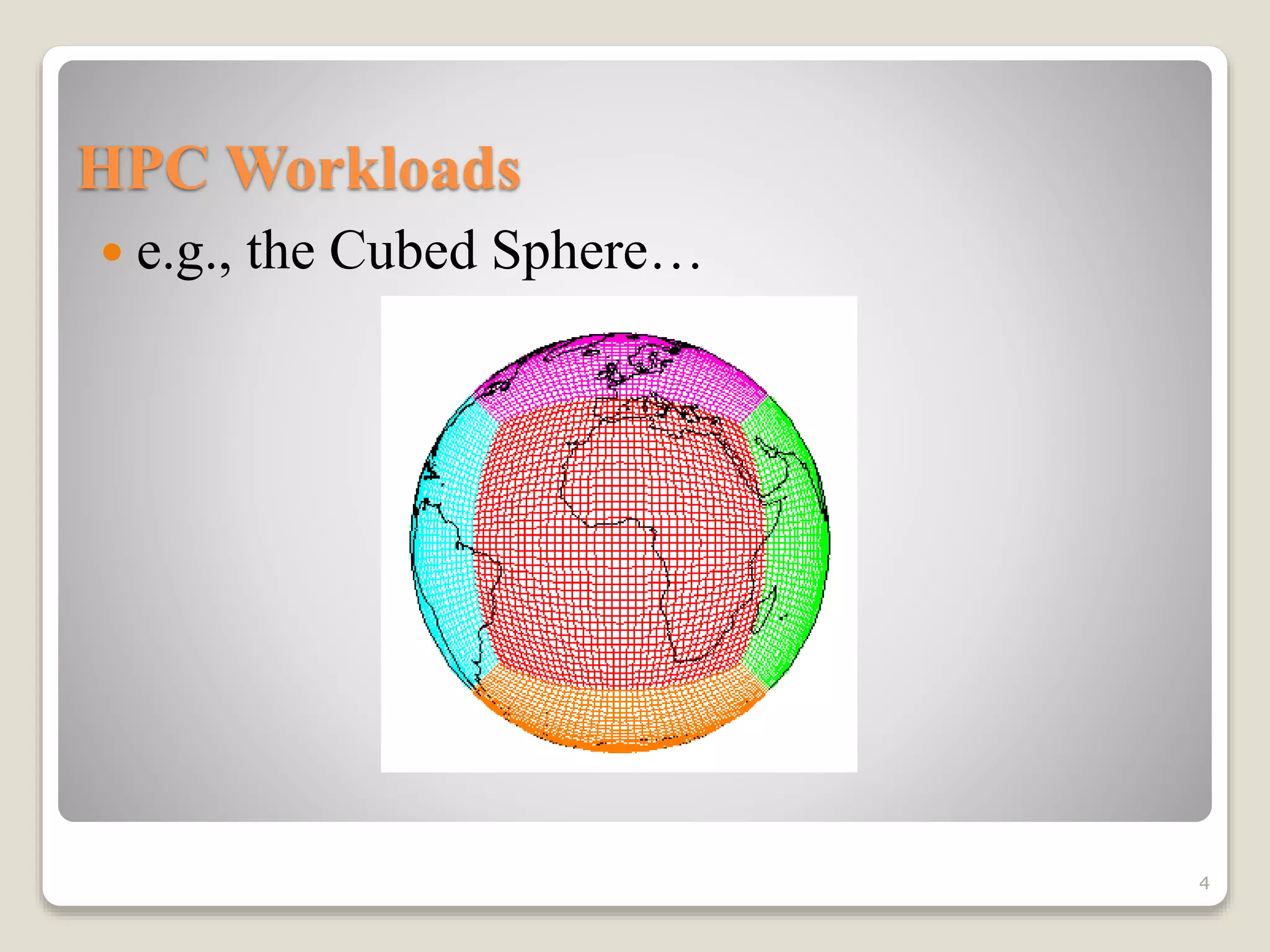
 Typical HPC applications map some system, e.g., a
physical system like the Earth’s atmosphere – into a
matrix.
3
HPC Workloads
4
 e.g., the Cubed Sphere…
HPC Workloads
 Mathematical systems, such as systems of
linear equations
 Physical systems, such as particle or
molecular physics
 Logical systems, including more recently web
activity, of which more later
5
HPC Workloads
 The application software simulates the behavior or
dynamics of the system represented by assigning parts of
the system to nodes of the cluster. After processing, final
results are collected from the nodes.
 Often, applications can represent the behavior of the
system of interest more accurately by using more nodes.
 Mainframes optimize the use of the expensive processor
resource by dispatching new work on it when the current
workload no longer requires it, e.g., at the start of an I/O
operation
6
HPC Workloads
 In contrast to a traditional mainframe workload, HPC
jobs may use hundreds or thousands of processor nodes
simultaneously.
 Halting job execution on 1,000 CPUs so that a single
CPU can start an I/O operation is not efficient.
 Some HPCs have checkpoint/restart capabilities that
could allow job interruption and also easier recovery
from a system failure. Most do not.
 On an HPC system, typically, once a job is dispatched, it
is allowed to run uninterrupted until completion.
 (More on that later.)
7
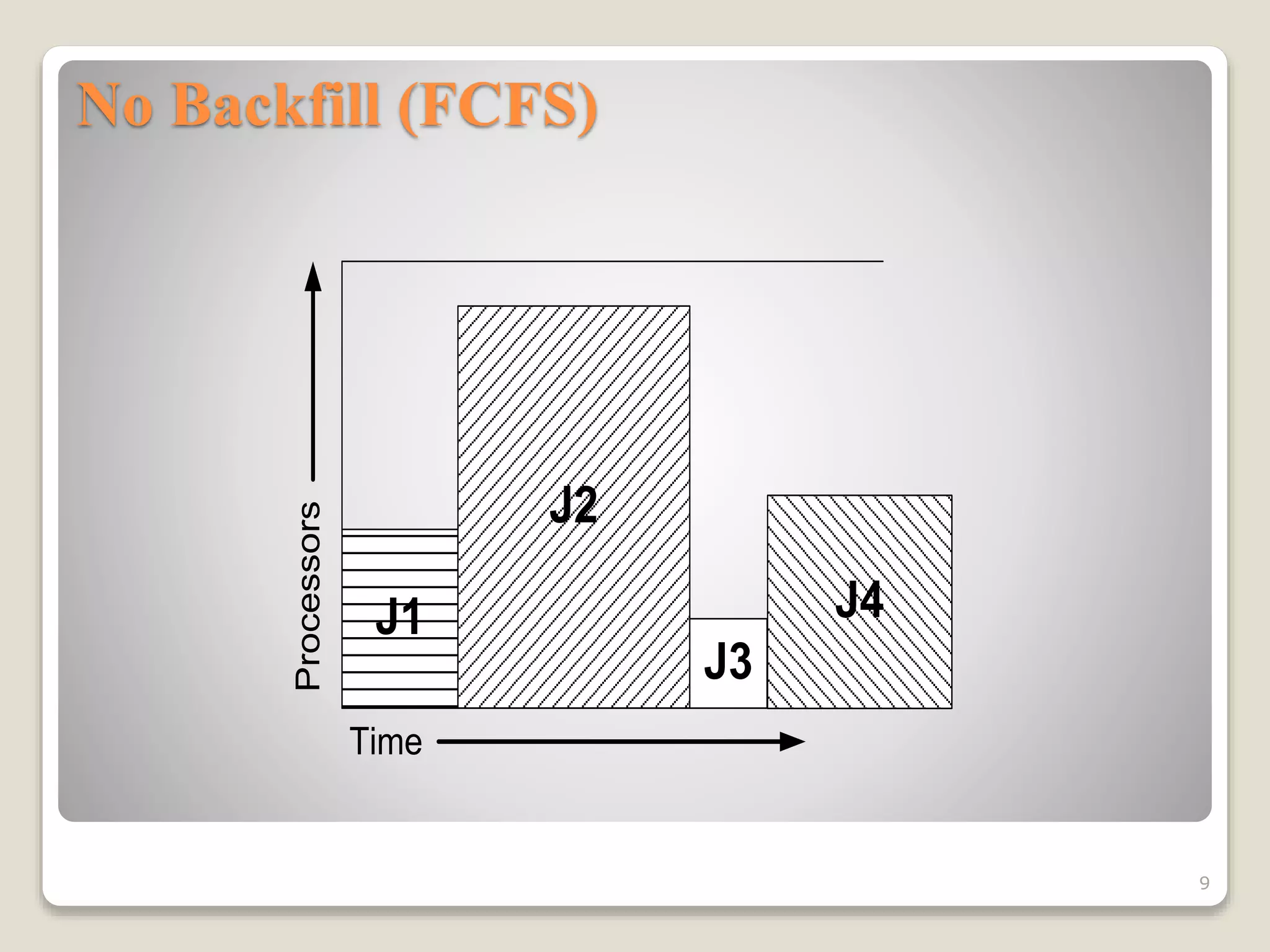
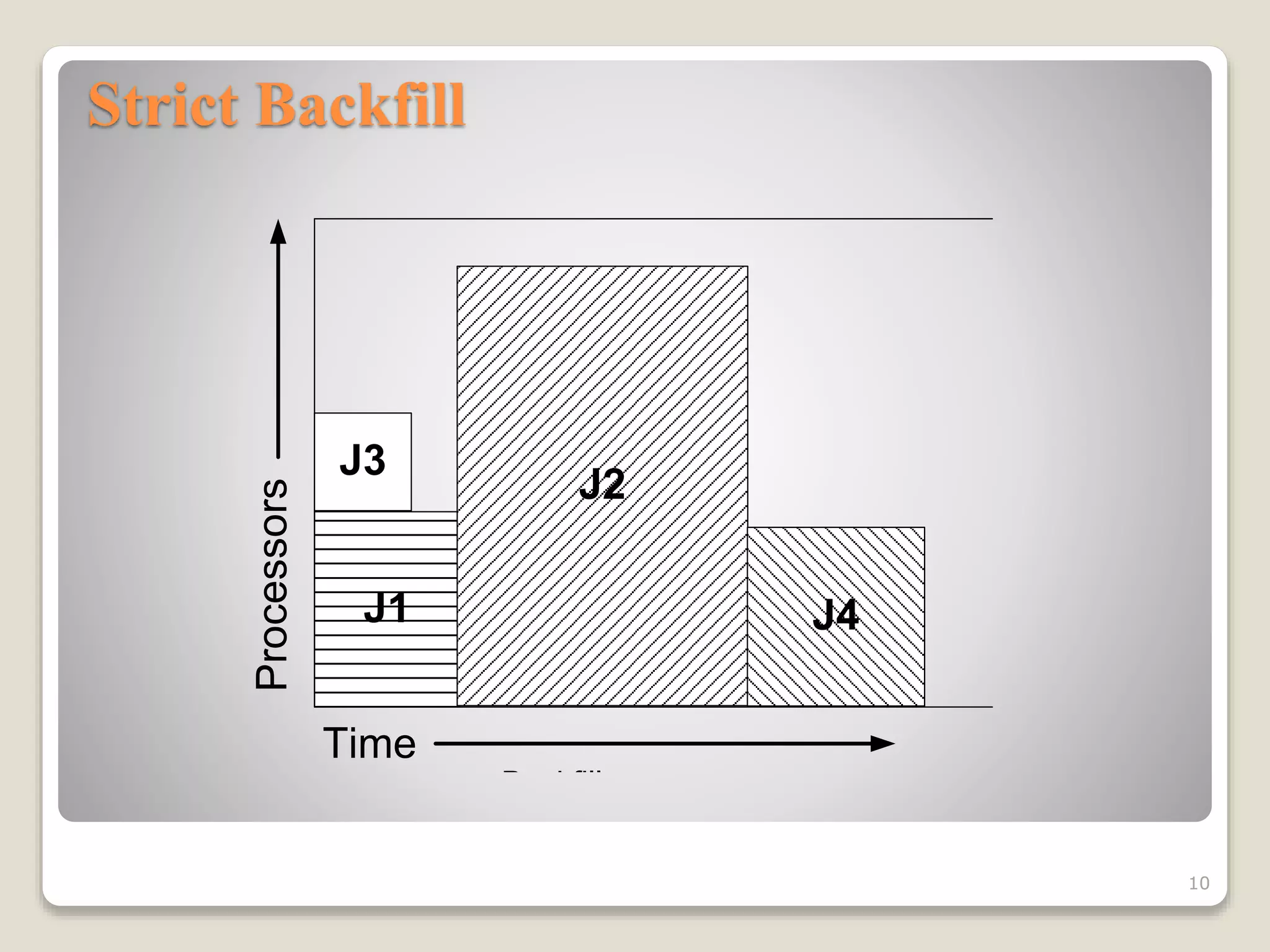
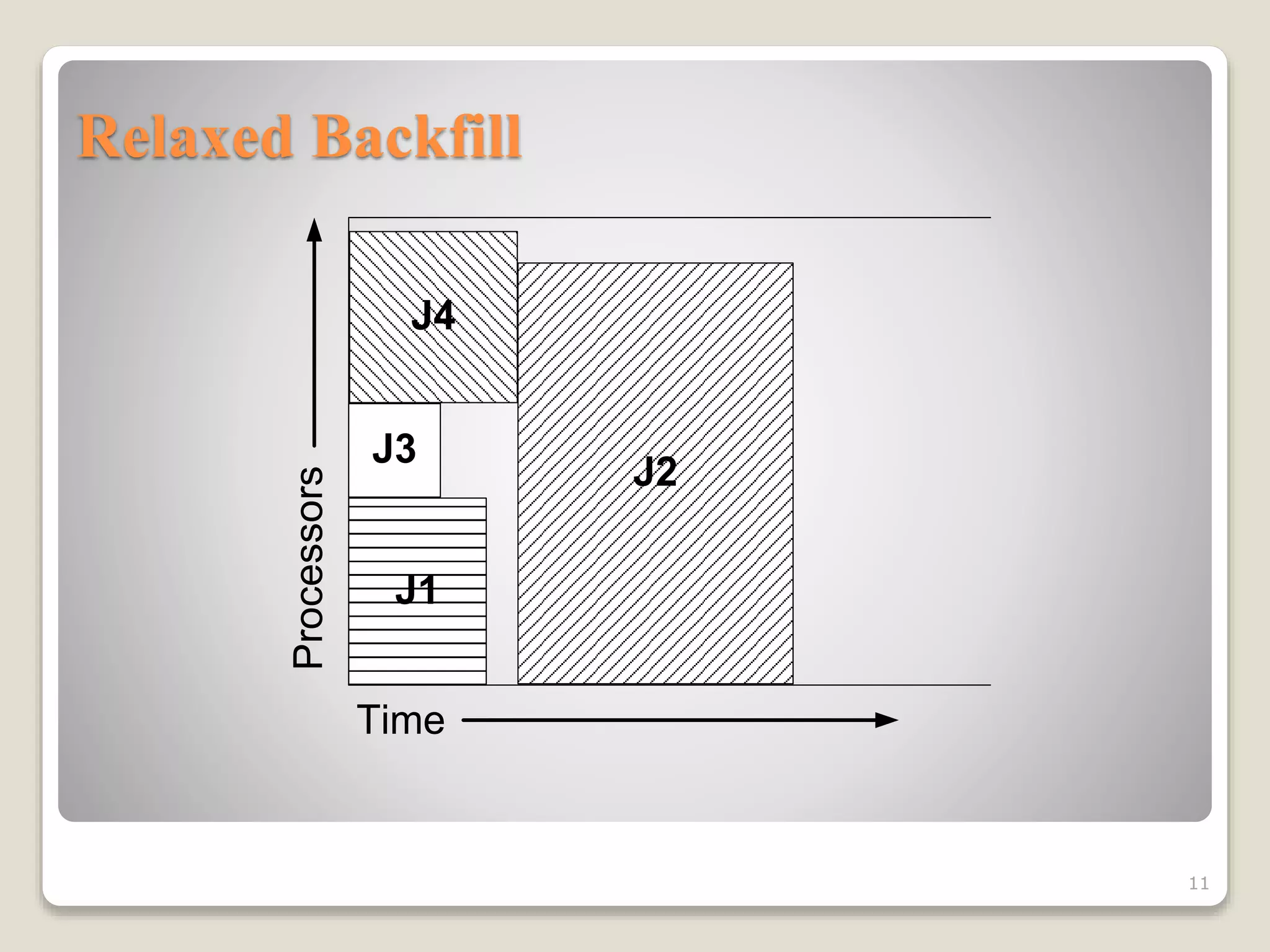
Backfill
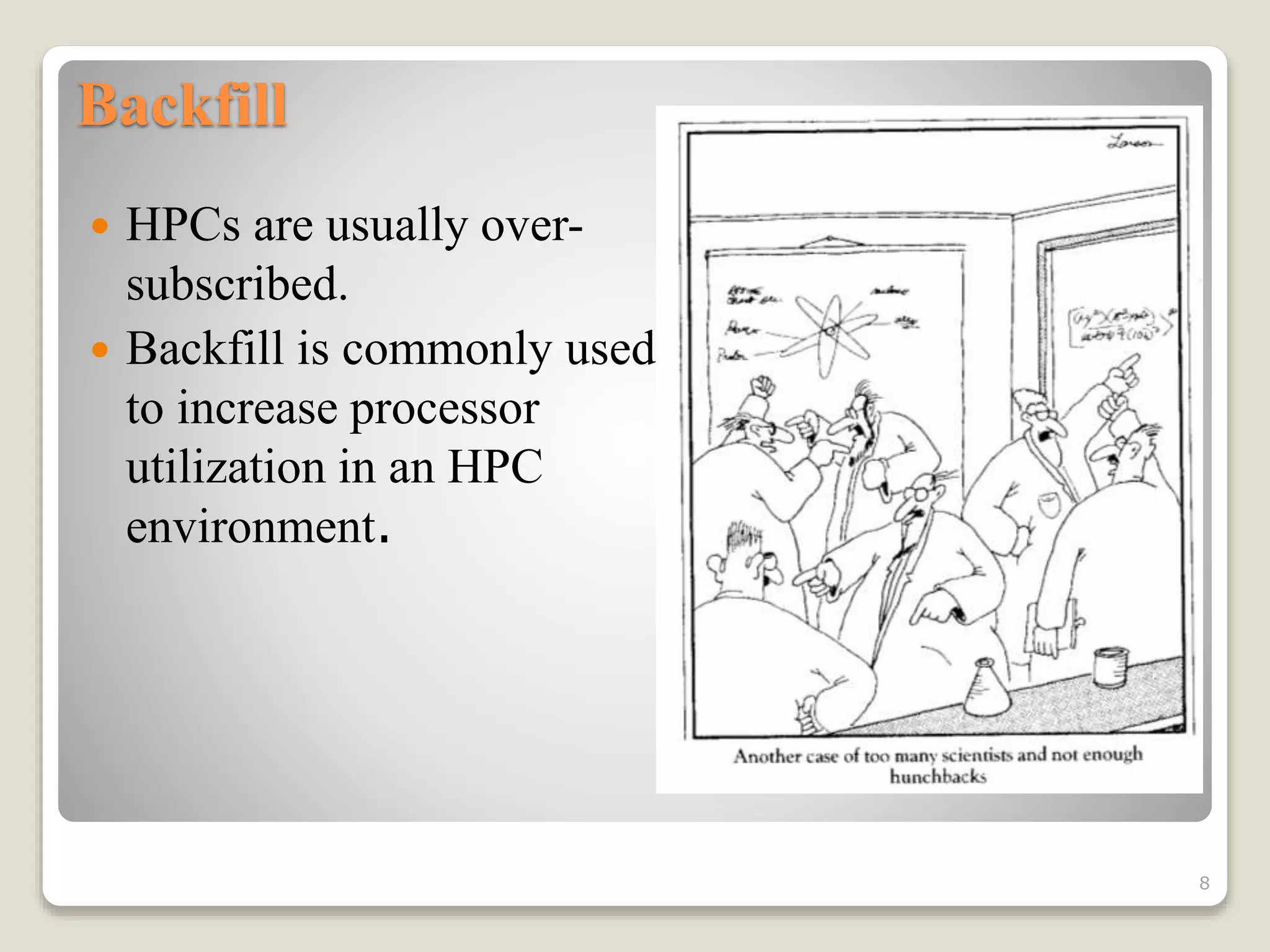
 HPCs are usually over-
subscribed.
 Backfill is commonly used
to increase processor
utilization in an HPC
environment.
8
No Backfill (FCFS)
J1
J2
J3
Time
Processors
`
J4
No Backfill
9
Strict Backfill
J1
J2
J3
Time
Processors
J4
Backfill
10
Relaxed Backfill
11
J1
J2
J3
Time
Processors J4
Relaxed Backfill
MapReduce
 Amdahl’s Law explains why it is important in an
HPC environment for the application to be coded to
exploit parallelism.
 Doing so – programming for parallelism - is an
historically difficult problem.
 MapReduce is a response to this problem.
12
MapReduce
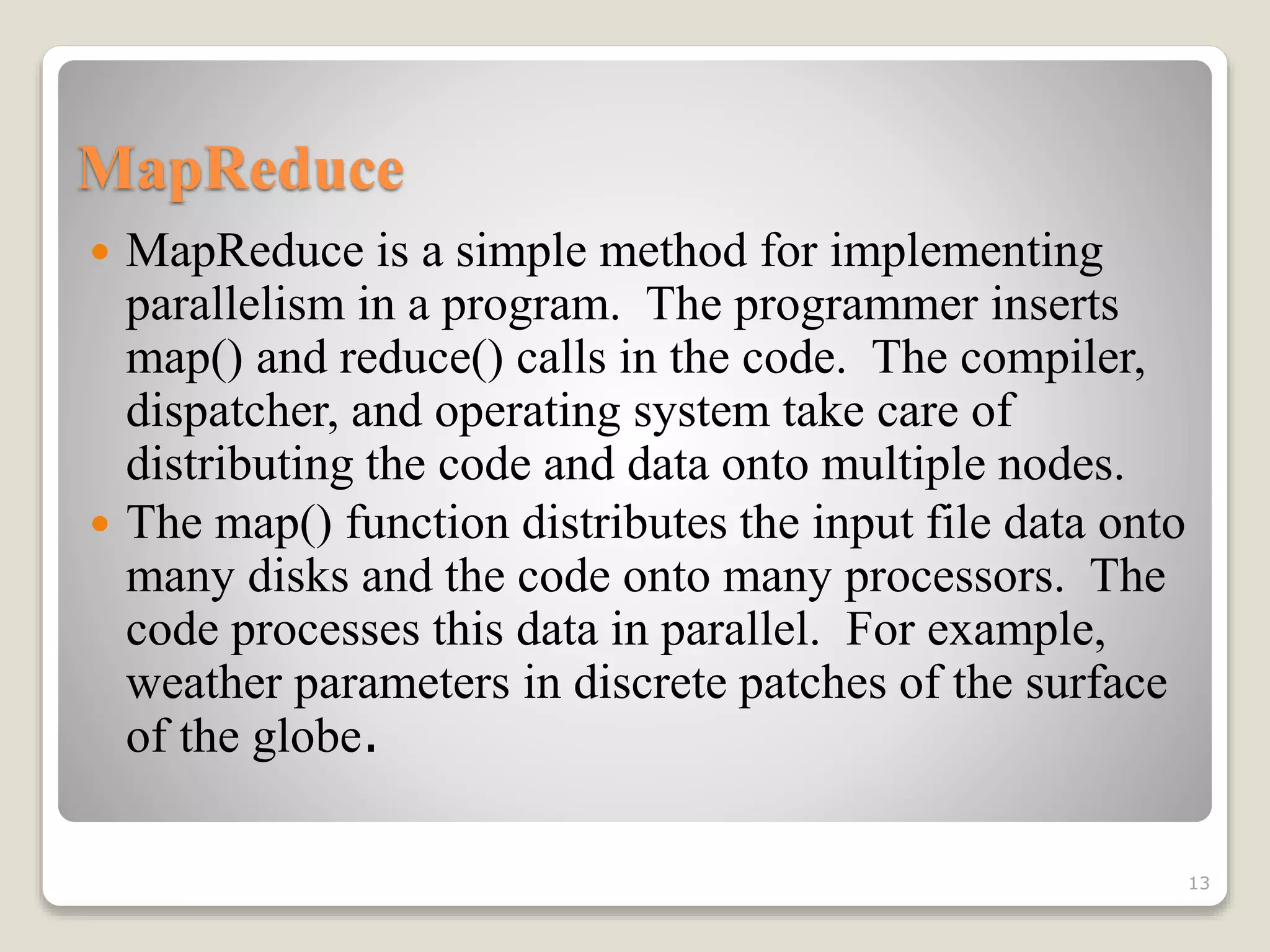
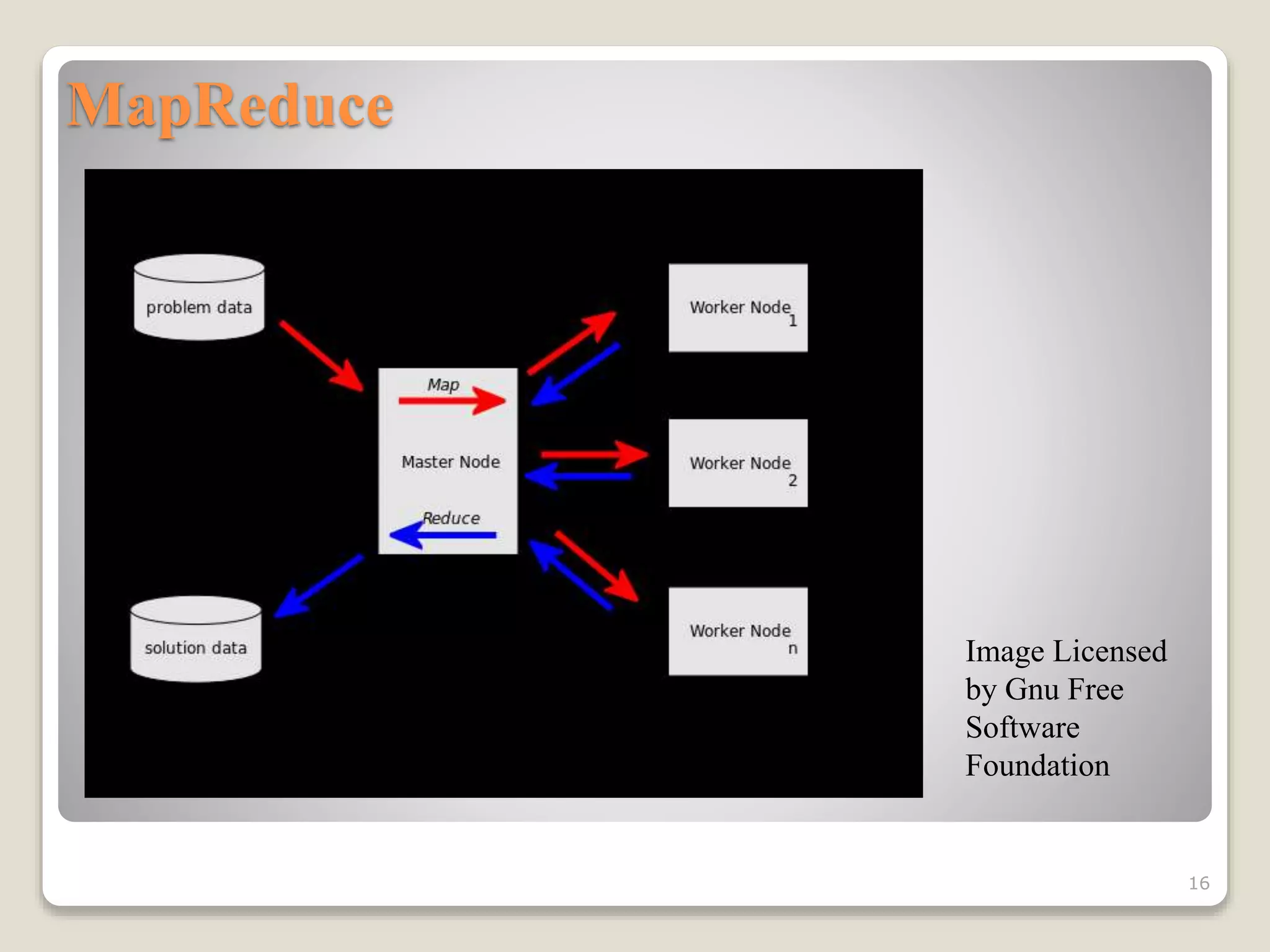
 MapReduce is a simple method for implementing
parallelism in a program. The programmer inserts
map() and reduce() calls in the code. The compiler,
dispatcher, and operating system take care of
distributing the code and data onto multiple nodes.
 The map() function distributes the input file data onto
many disks and the code onto many processors. The
code processes this data in parallel. For example,
weather parameters in discrete patches of the surface
of the globe.
13
MapReduce
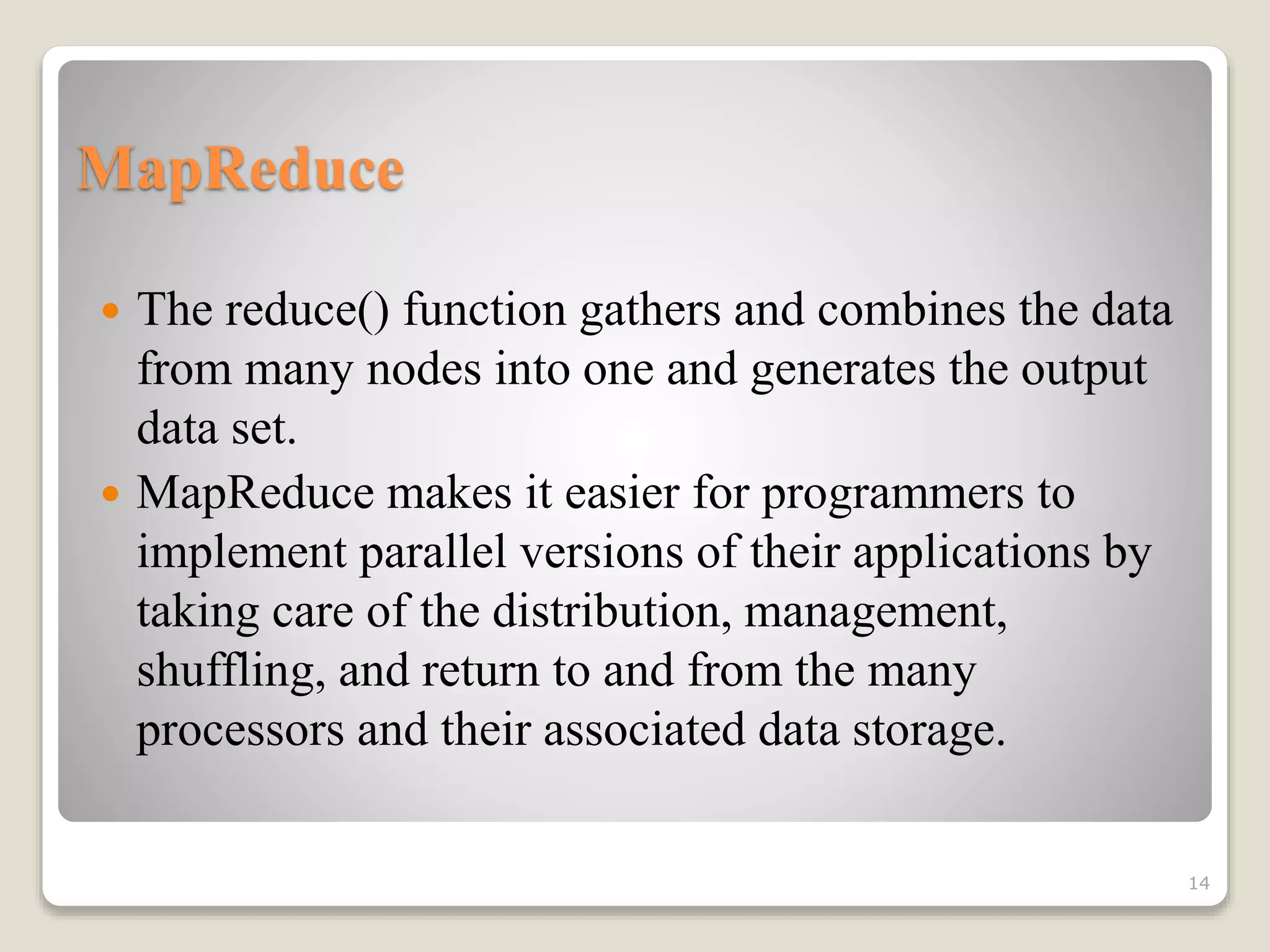
 The reduce() function gathers and combines the data
from many nodes into one and generates the output
data set.
 MapReduce makes it easier for programmers to
implement parallel versions of their applications by
taking care of the distribution, management,
shuffling, and return to and from the many
processors and their associated data storage.
14
MapReduce
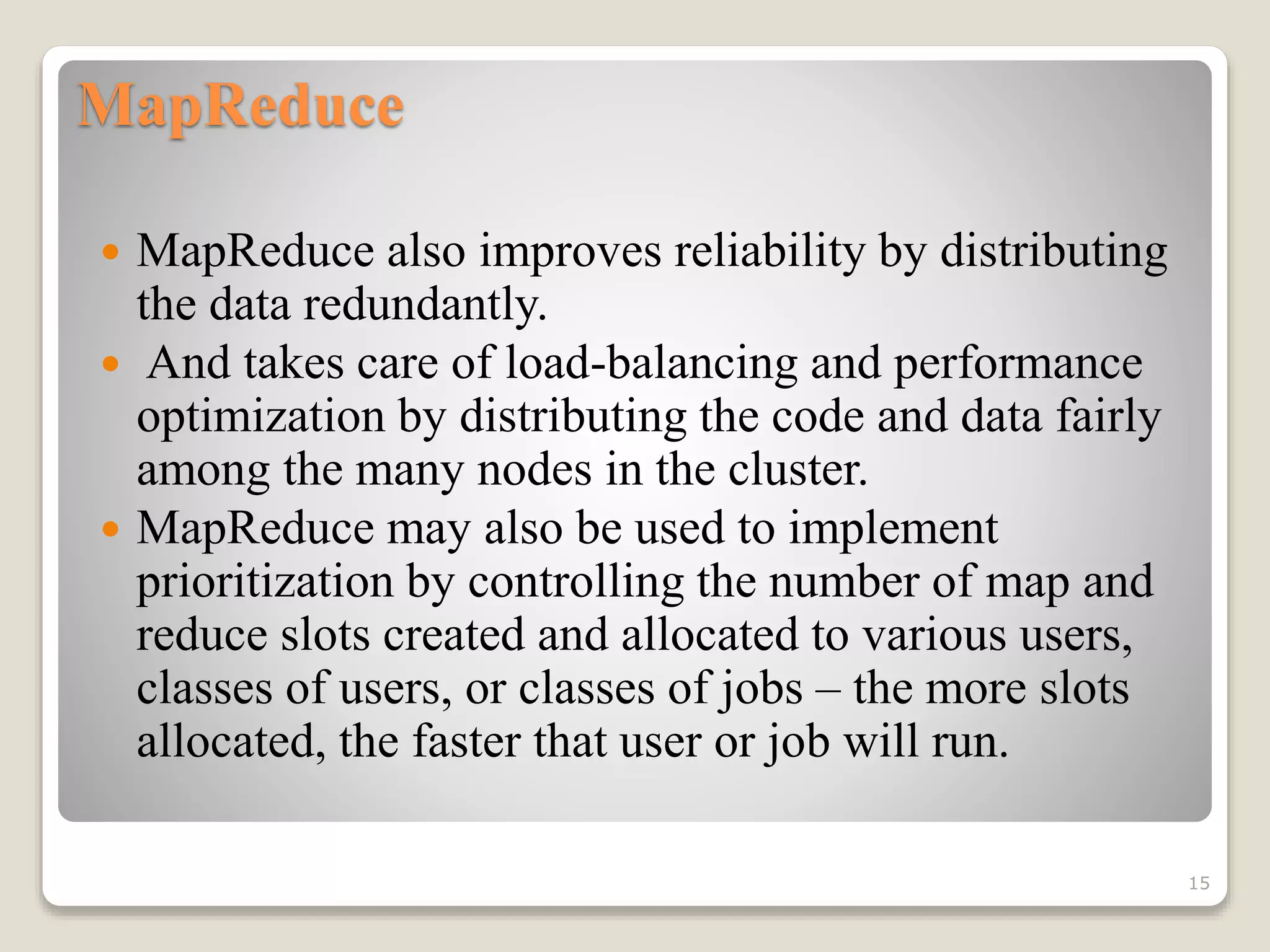
 MapReduce also improves reliability by distributing
the data redundantly.
 And takes care of load-balancing and performance
optimization by distributing the code and data fairly
among the many nodes in the cluster.
 MapReduce may also be used to implement
prioritization by controlling the number of map and
reduce slots created and allocated to various users,
classes of users, or classes of jobs – the more slots
allocated, the faster that user or job will run.
15
MapReduce
Image Licensed
by Gnu Free
Software
Foundation
16
MapReduce
 MapReduce was originally developed for use by
small teams where FIFO or “social scheduling” was
sufficient for workload scheduling.
 It has grown to be used for very large problems, such
as sorting, searching, and indexing large data sets.
 Google uses MapReduce to index the world wide
web and holds a patent on the method.
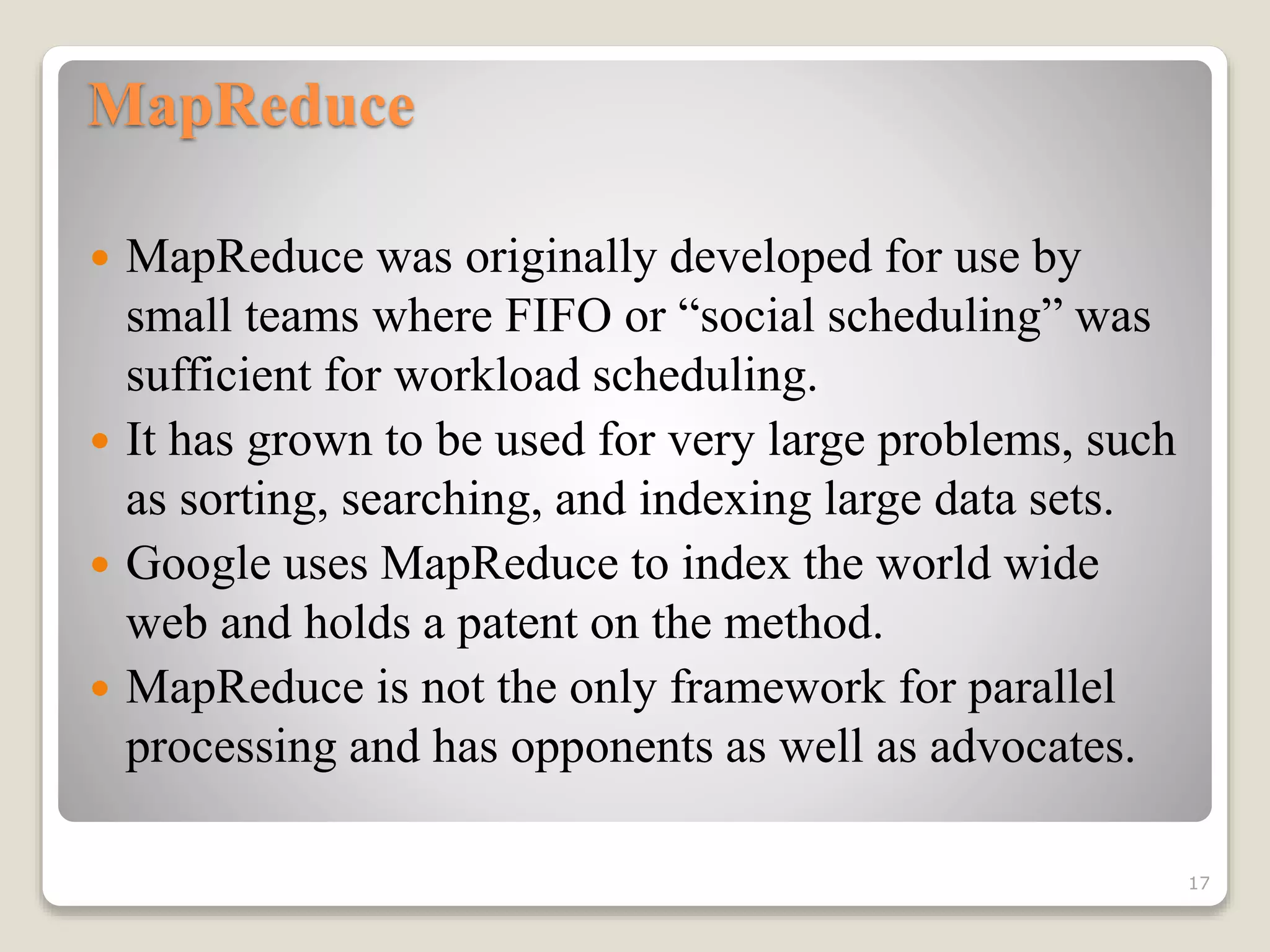
 MapReduce is not the only framework for parallel
processing and has opponents as well as advocates.
17
HADOOP
 Hadoop is a specific open source implementation of
the MapReduce framework written in Java and
licensed by Apache
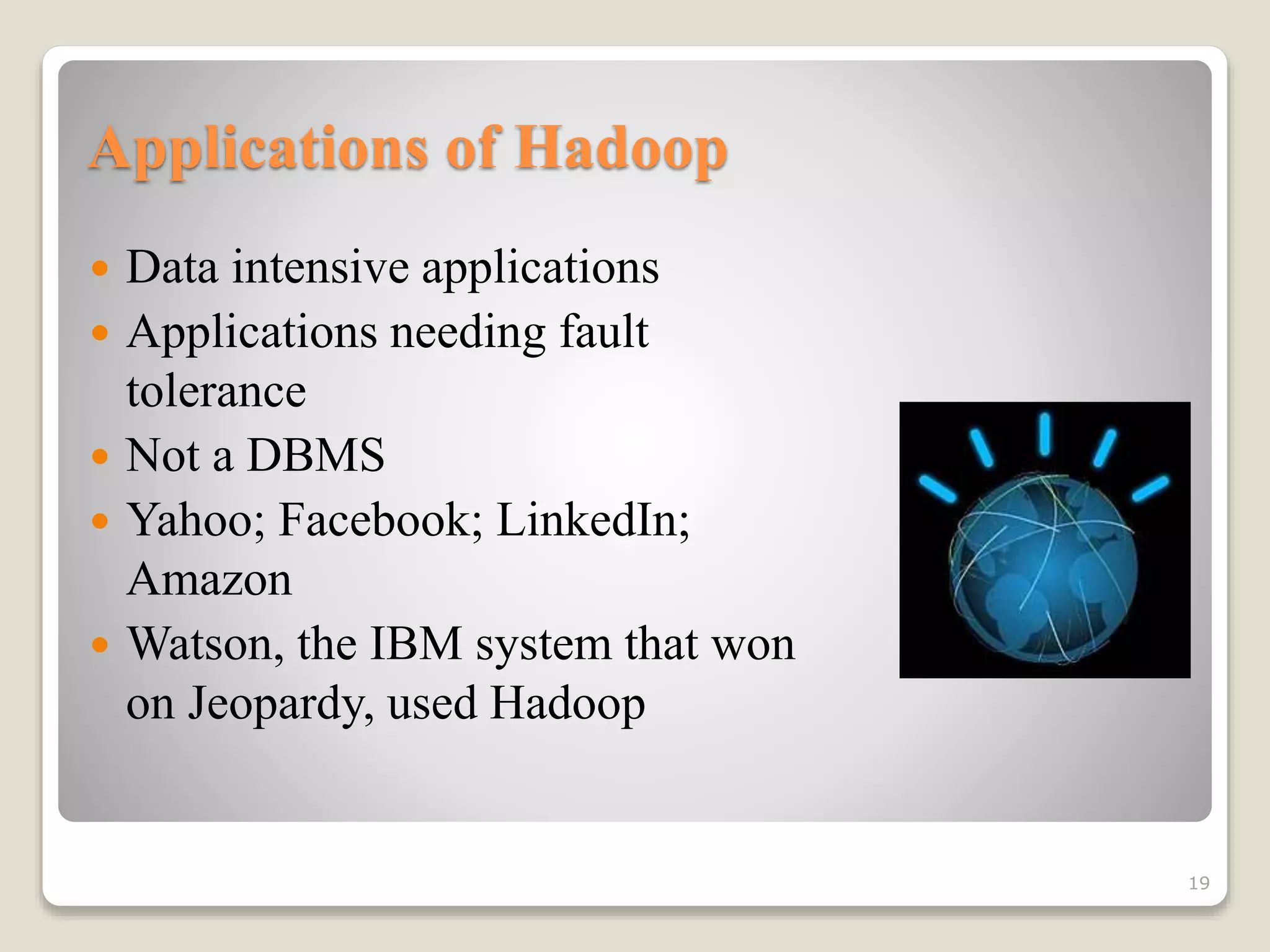
 It includes a distributed file system
 Designed for very large (thousands of processors)
systems using commodity processors, including grid
systems
 Implements data replication for checkpoint (failover)
and locality
 Locality of processors with their data help network
bandwidth
18
Applications of Hadoop
 Data intensive applications
 Applications needing fault
tolerance
 Not a DBMS
 Yahoo; Facebook; LinkedIn;
Amazon
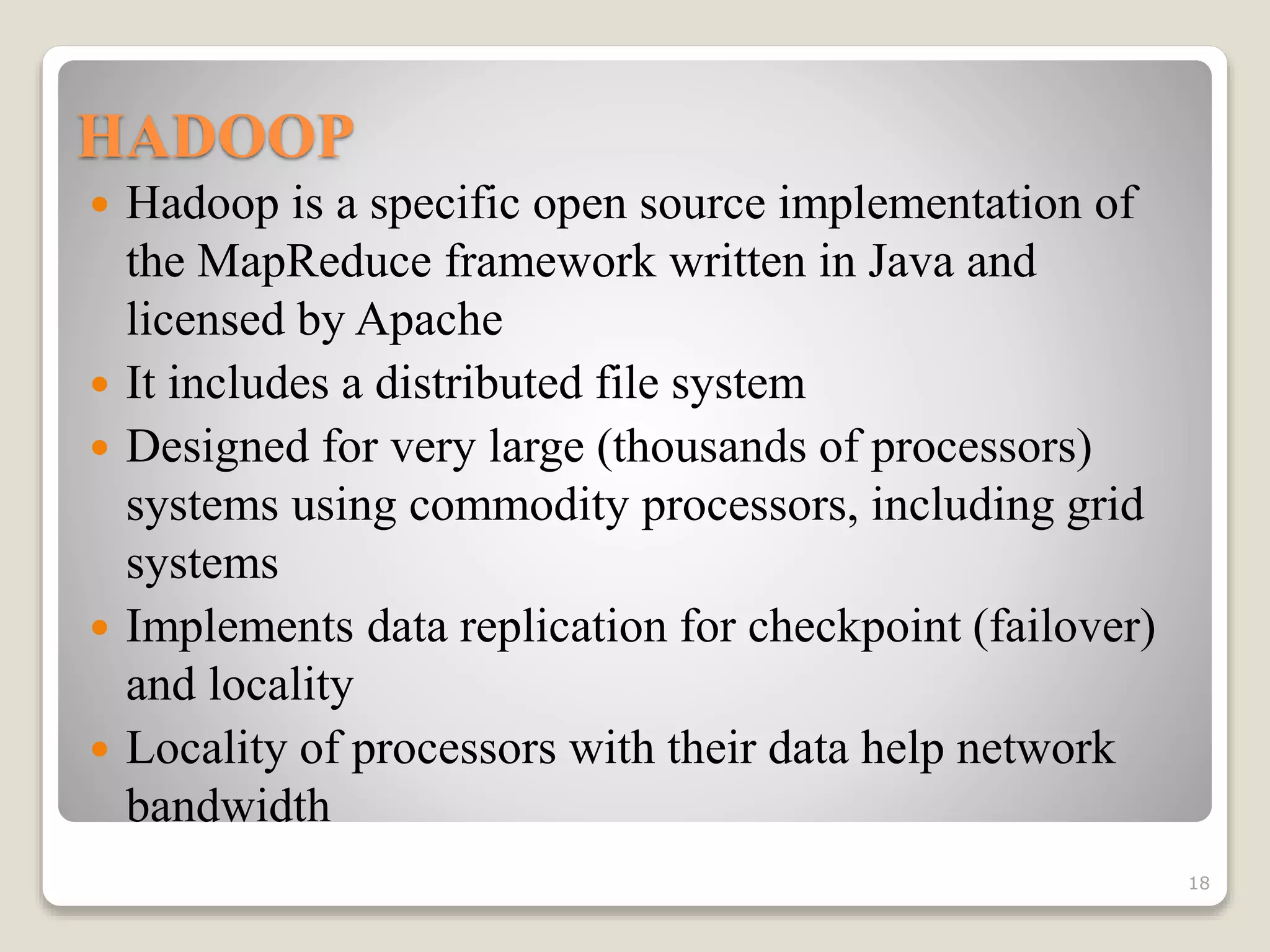
 Watson, the IBM system that won
on Jeopardy, used Hadoop
19
Hadoop MapReduce & Distributed File
System Layers
Source:
Wikipedia
20
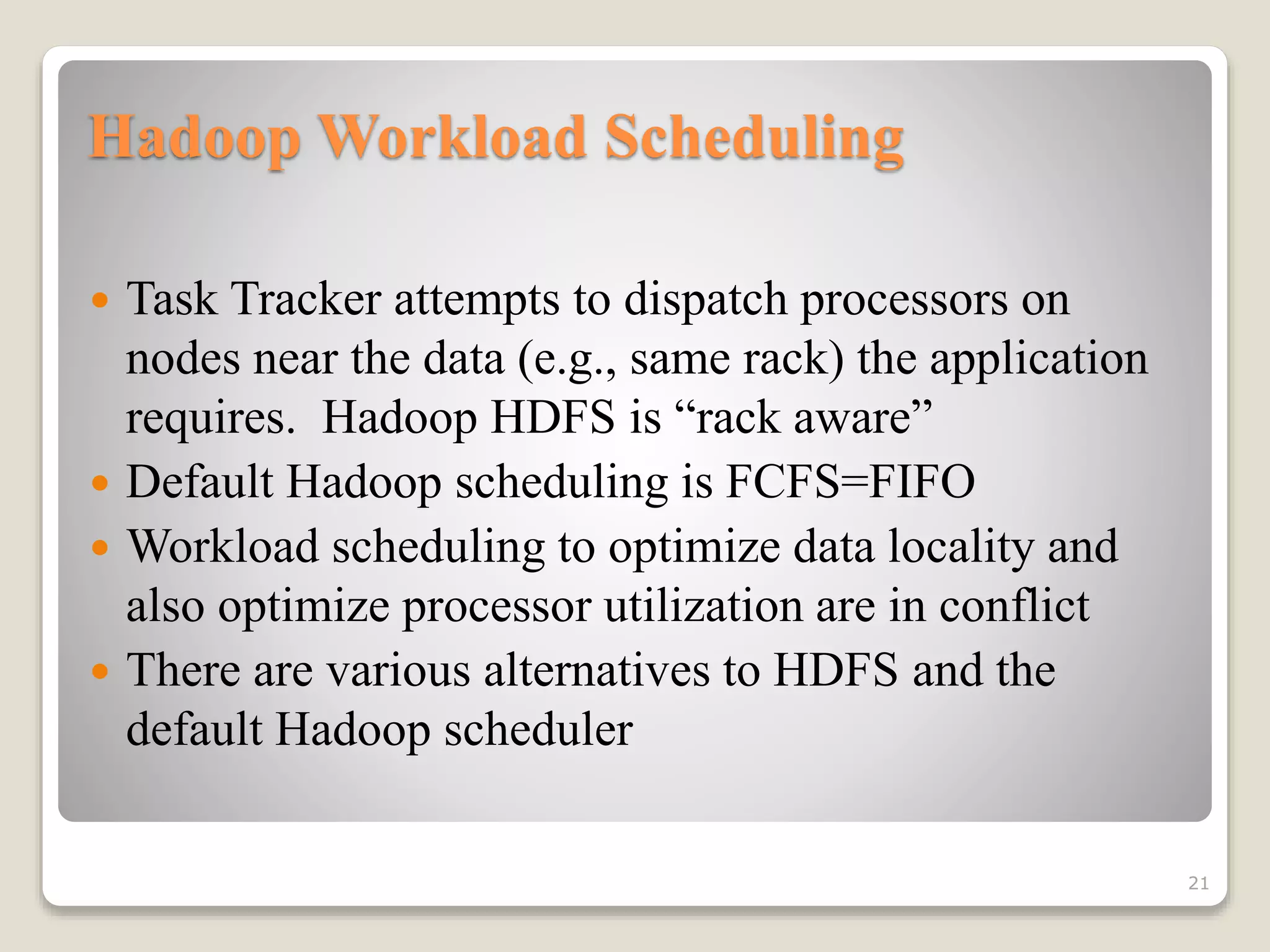
Hadoop Workload Scheduling
 Task Tracker attempts to dispatch processors on
nodes near the data (e.g., same rack) the application
requires. Hadoop HDFS is “rack aware”
 Default Hadoop scheduling is FCFS=FIFO
 Workload scheduling to optimize data locality and
also optimize processor utilization are in conflict
 There are various alternatives to HDFS and the
default Hadoop scheduler
21
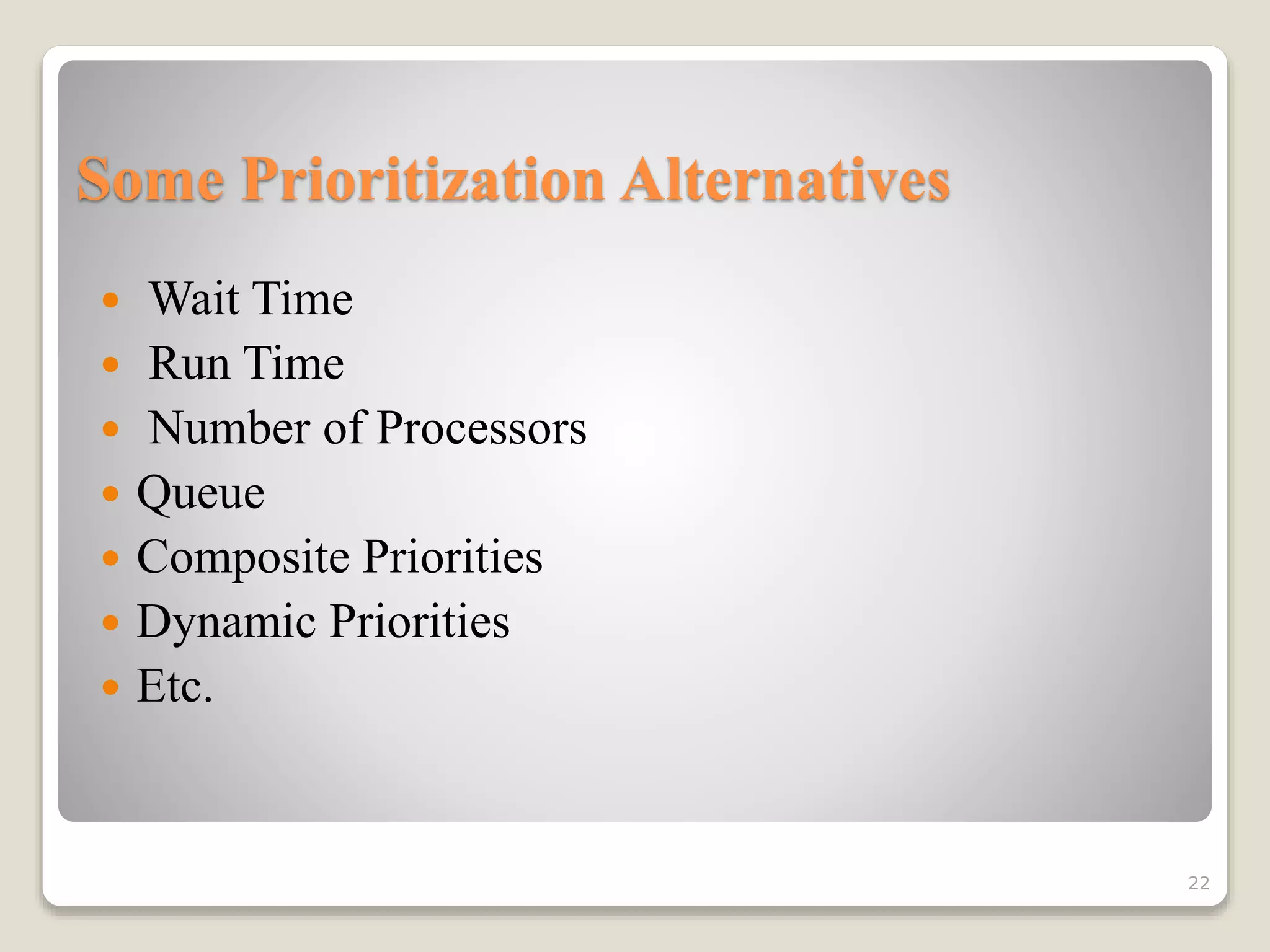
Some Prioritization Alternatives
 Wait Time
 Run Time
 Number of Processors
 Queue
 Composite Priorities
 Dynamic Priorities
 Etc.
22
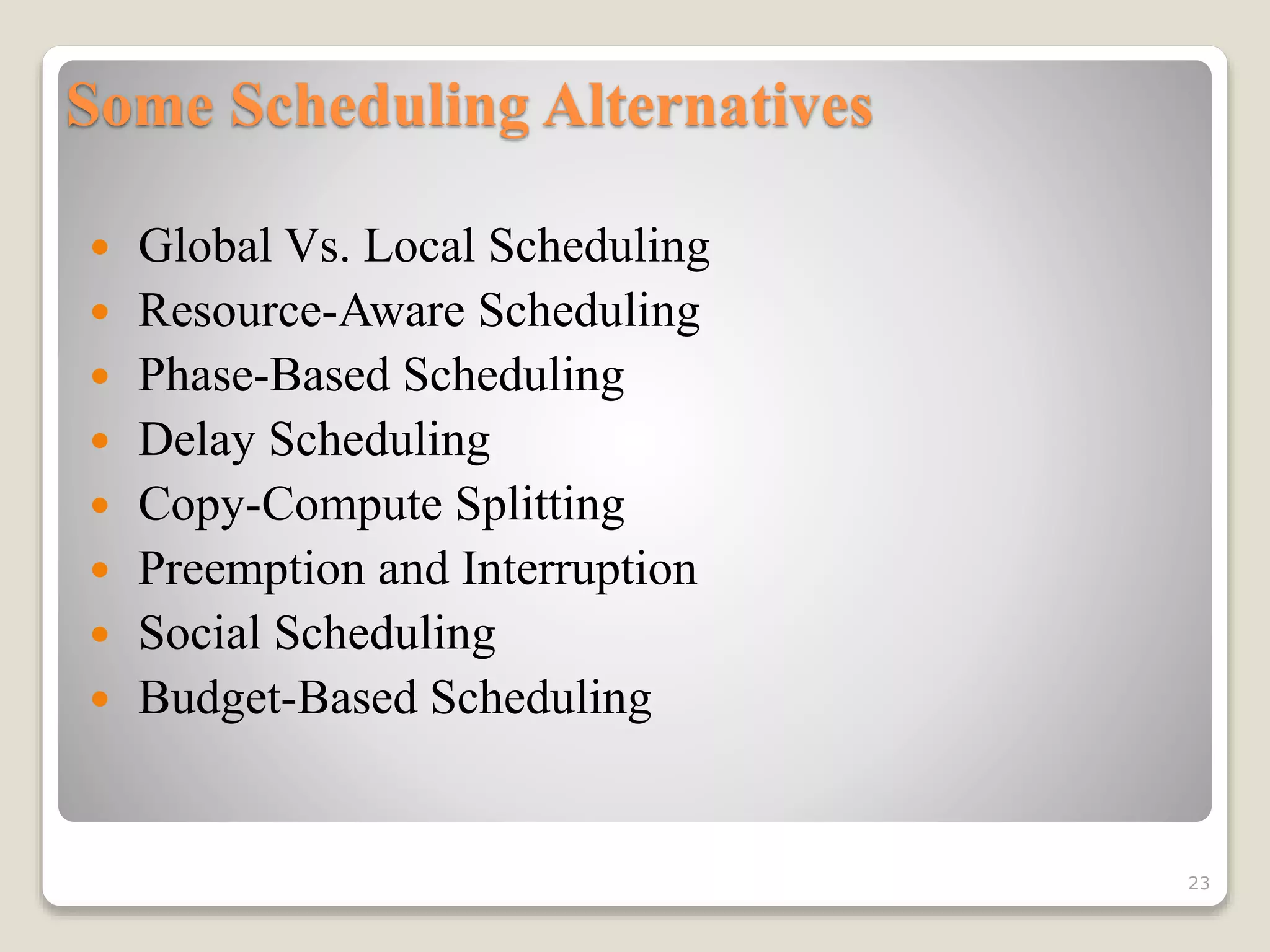
Some Scheduling Alternatives
 Global Vs. Local Scheduling
 Resource-Aware Scheduling
 Phase-Based Scheduling
 Delay Scheduling
 Copy-Compute Splitting
 Preemption and Interruption
 Social Scheduling
 Budget-Based Scheduling
23
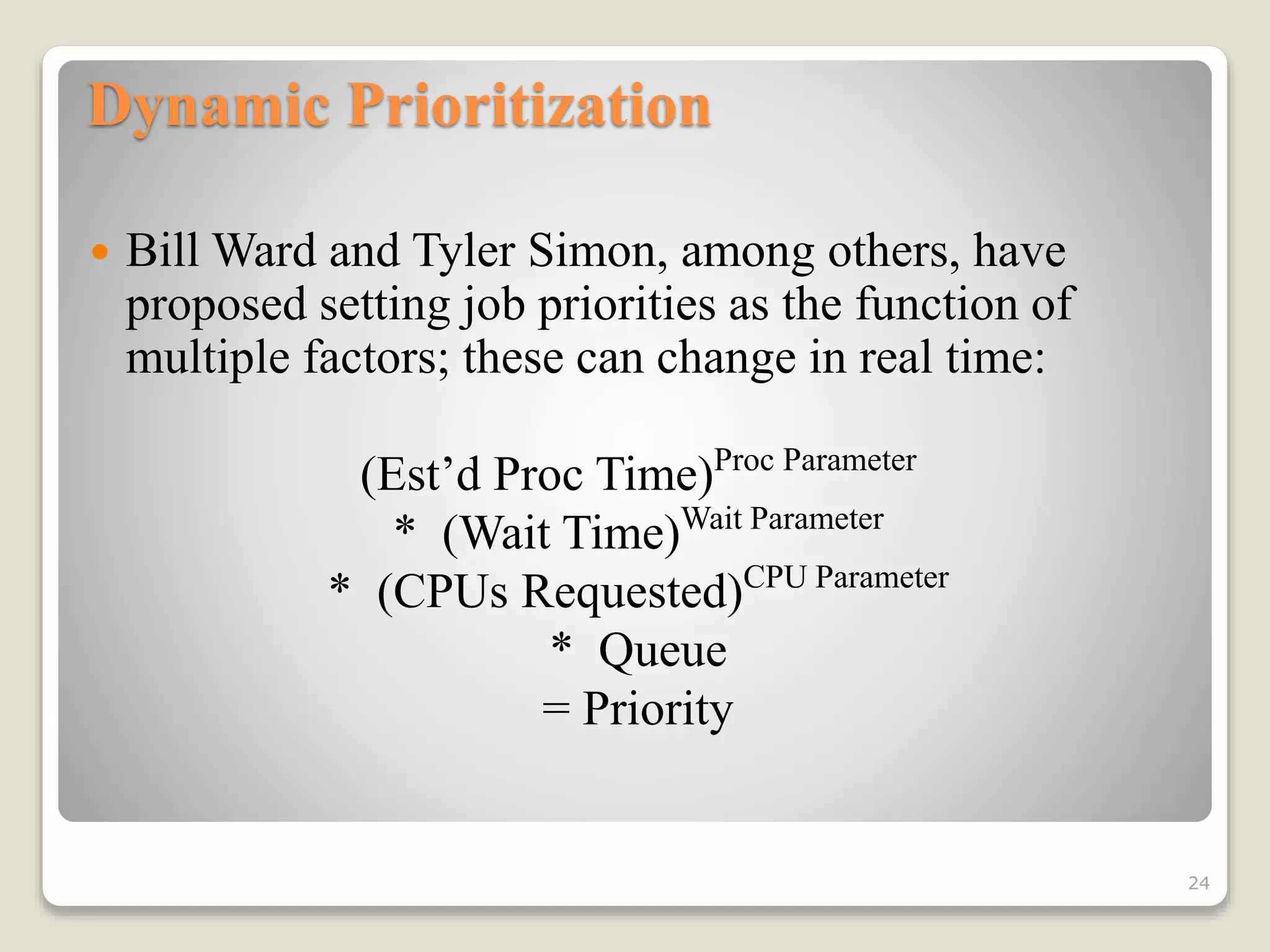
Dynamic Prioritization
 Bill Ward and Tyler Simon, among others, have
proposed setting job priorities as the function of
multiple factors; these can change in real time:
(Est’d Proc Time)Proc Parameter
* (Wait Time)Wait Parameter
* (CPUs Requested)CPU Parameter
* Queue
= Priority
24
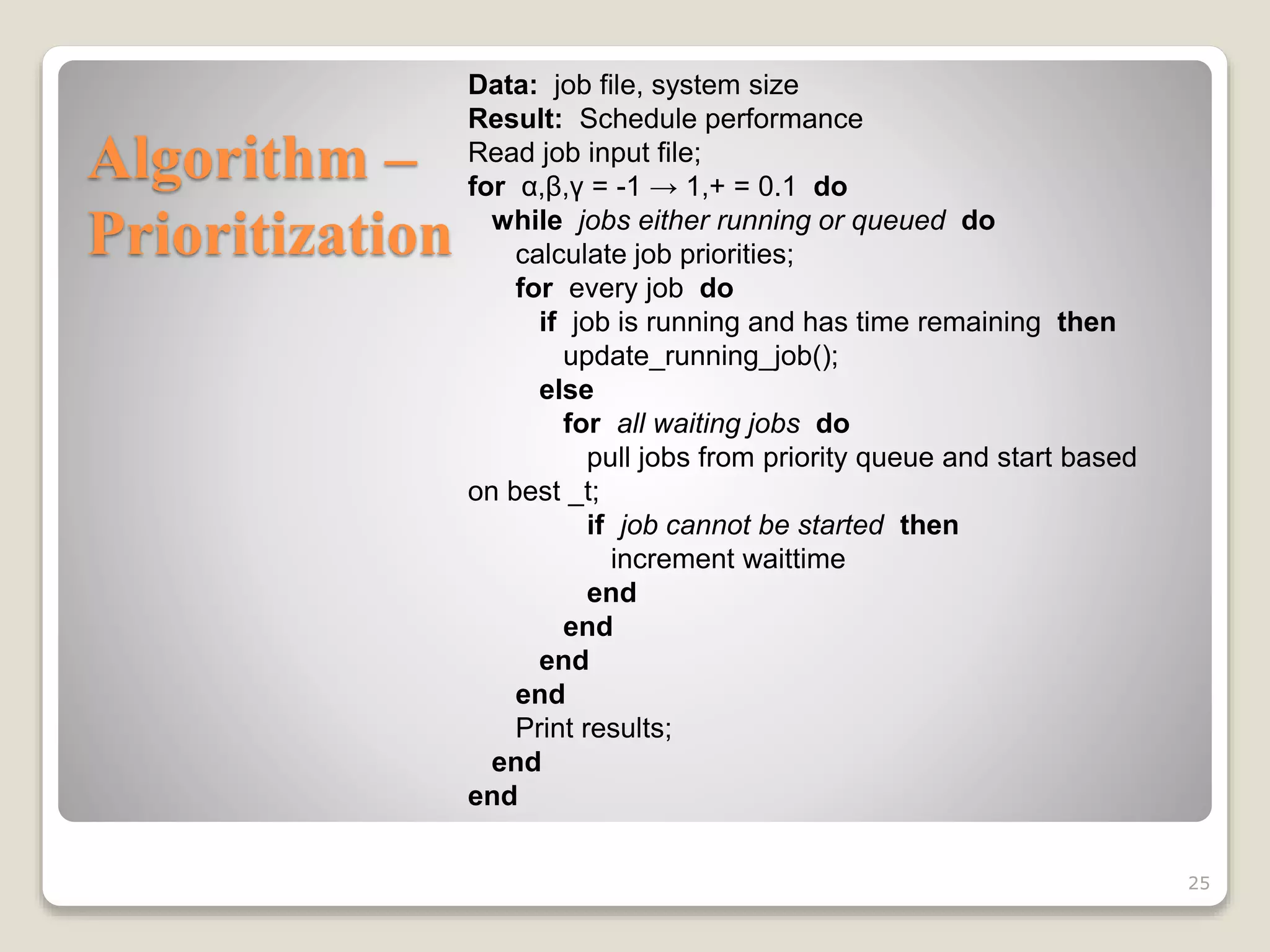
Algorithm –
Prioritization
25
Data: job file, system size
Result: Schedule performance
Read job input file;
for α,β,γ = -1 → 1,+ = 0.1 do
while jobs either running or queued do
calculate job priorities;
for every job do
if job is running and has time remaining then
update_running_job();
else
for all waiting jobs do
pull jobs from priority queue and start based
on best _t;
if job cannot be started then
increment waittime
end
end
end
end
Print results;
end
end
Algorithm – Cost Evaluation
26
Require: C, capacity of the knapsack, n, the number of tasks, a, array of
tasks of size n
Ensure: A cost vector containing Ef for each job class Cost (A, B, C, D,
WRT).
1: i = 0
2: for α = -2 ≤ 2; α+=0.1 do
3: for β = -2 ≤ 2; β+=0.1 do
4: for γ = -2 ≤ 2; γ+=0.1 do
5: Cost[i++] = schedule(α,β,γ)
{For Optimization}
6: if cost[i] < bestSoFar then
7: bestSoFar = cost[i]
8: end if
9: end for
10: end for
11: end for
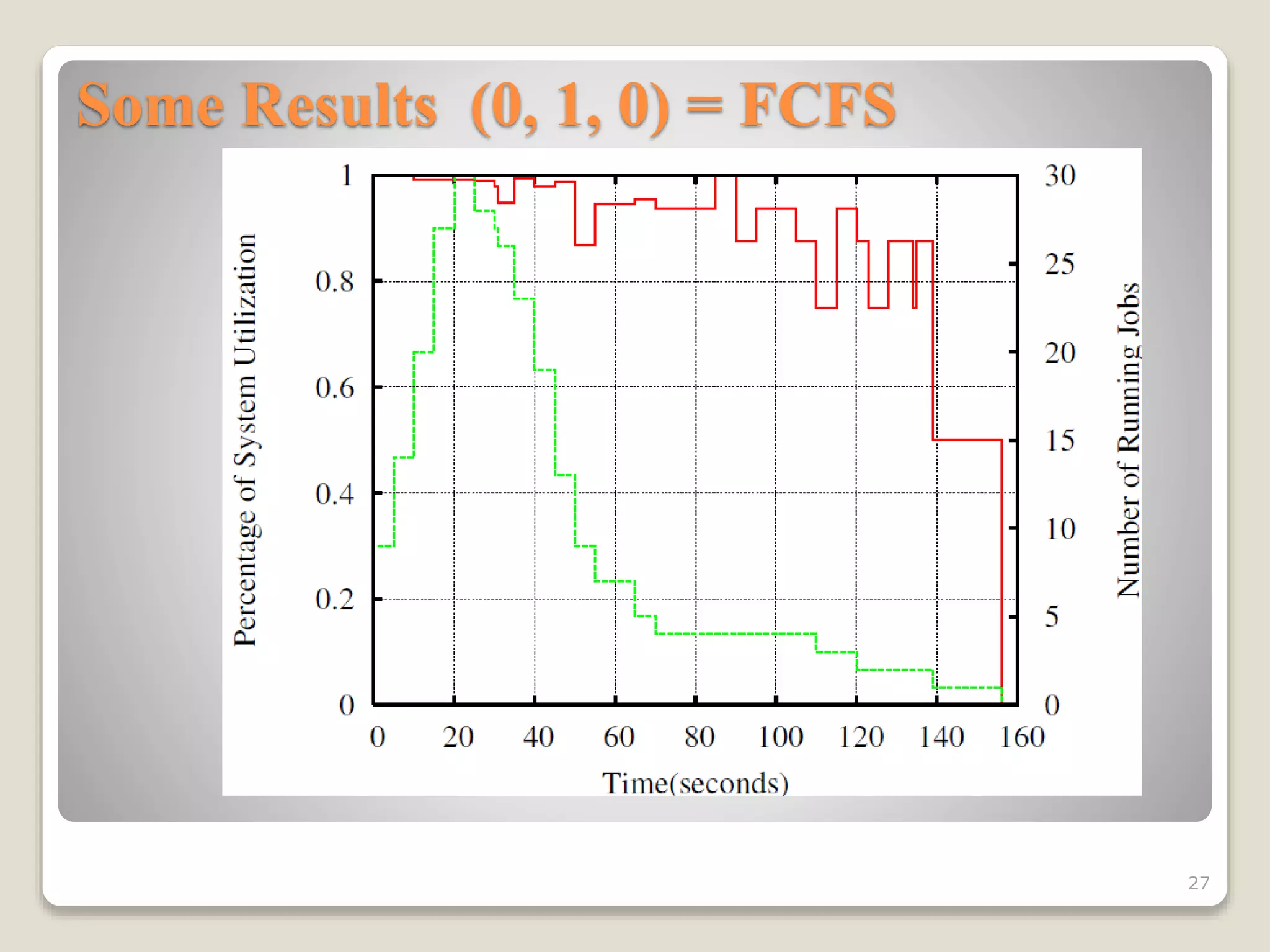
Some Results (0, 1, 0) = FCFS
27
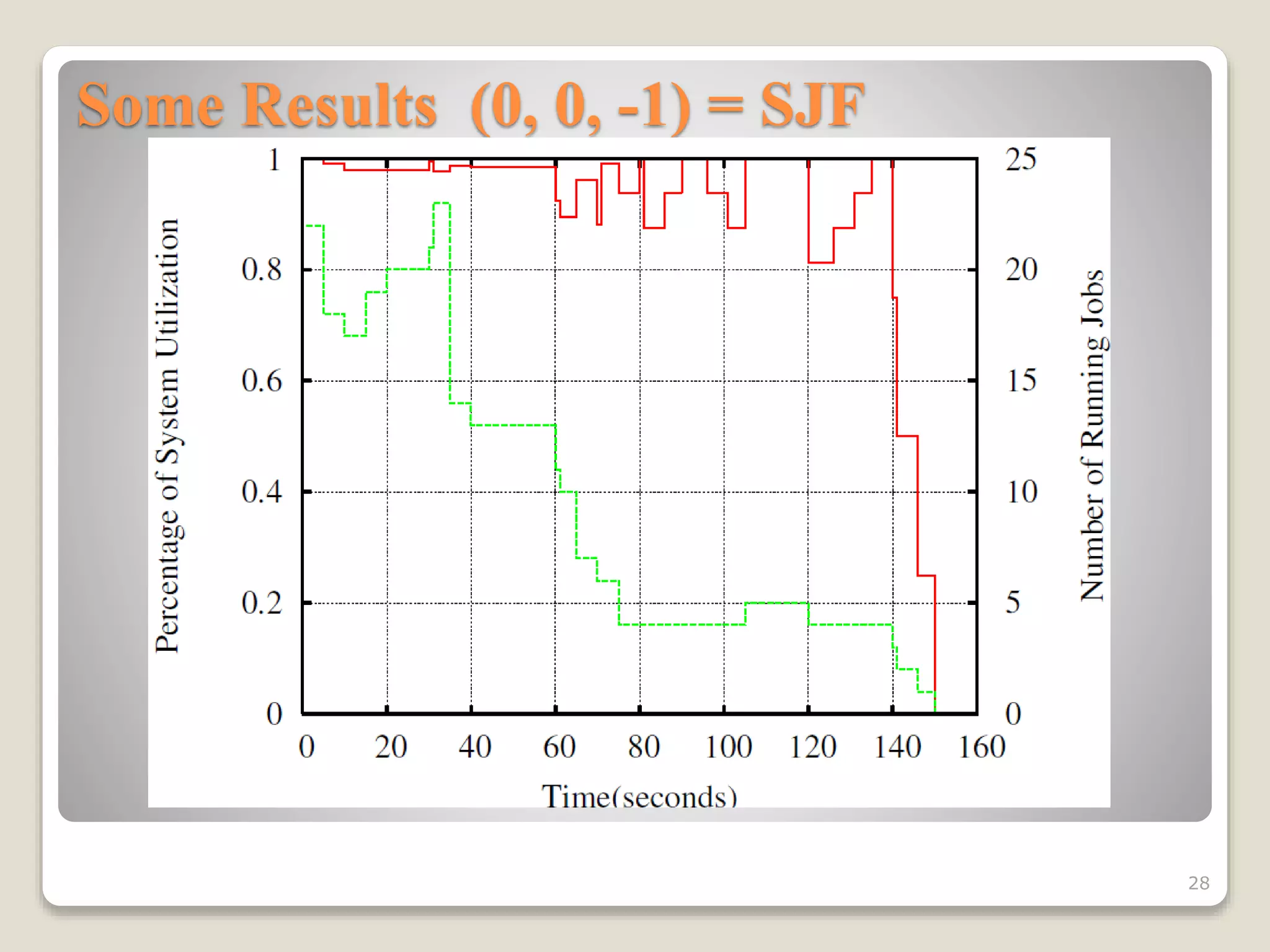
Some Results (0, 0, -1) = SJF
28
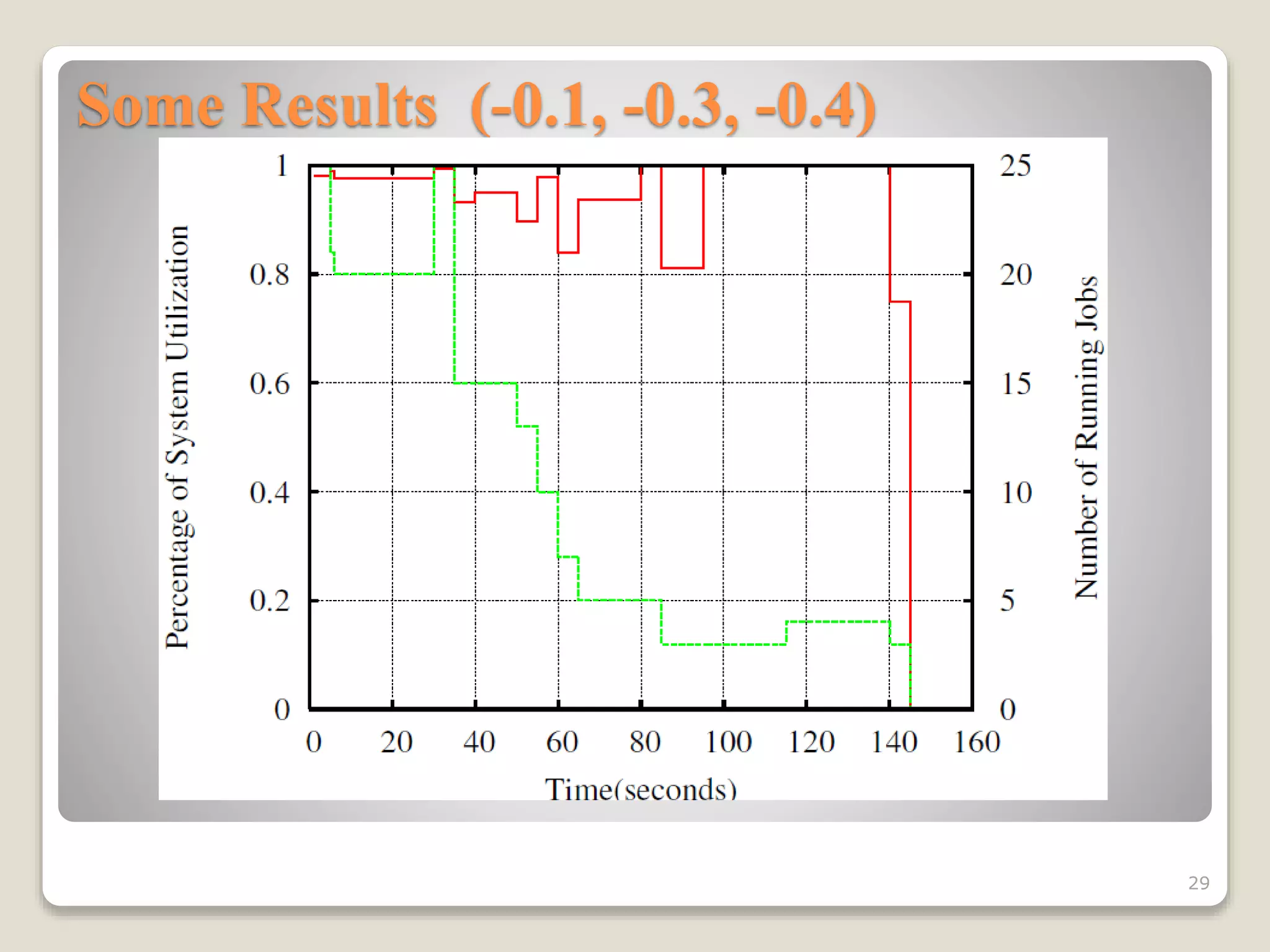
Some Results (-0.1, -0.3, -0.4)
29
Some Results
30
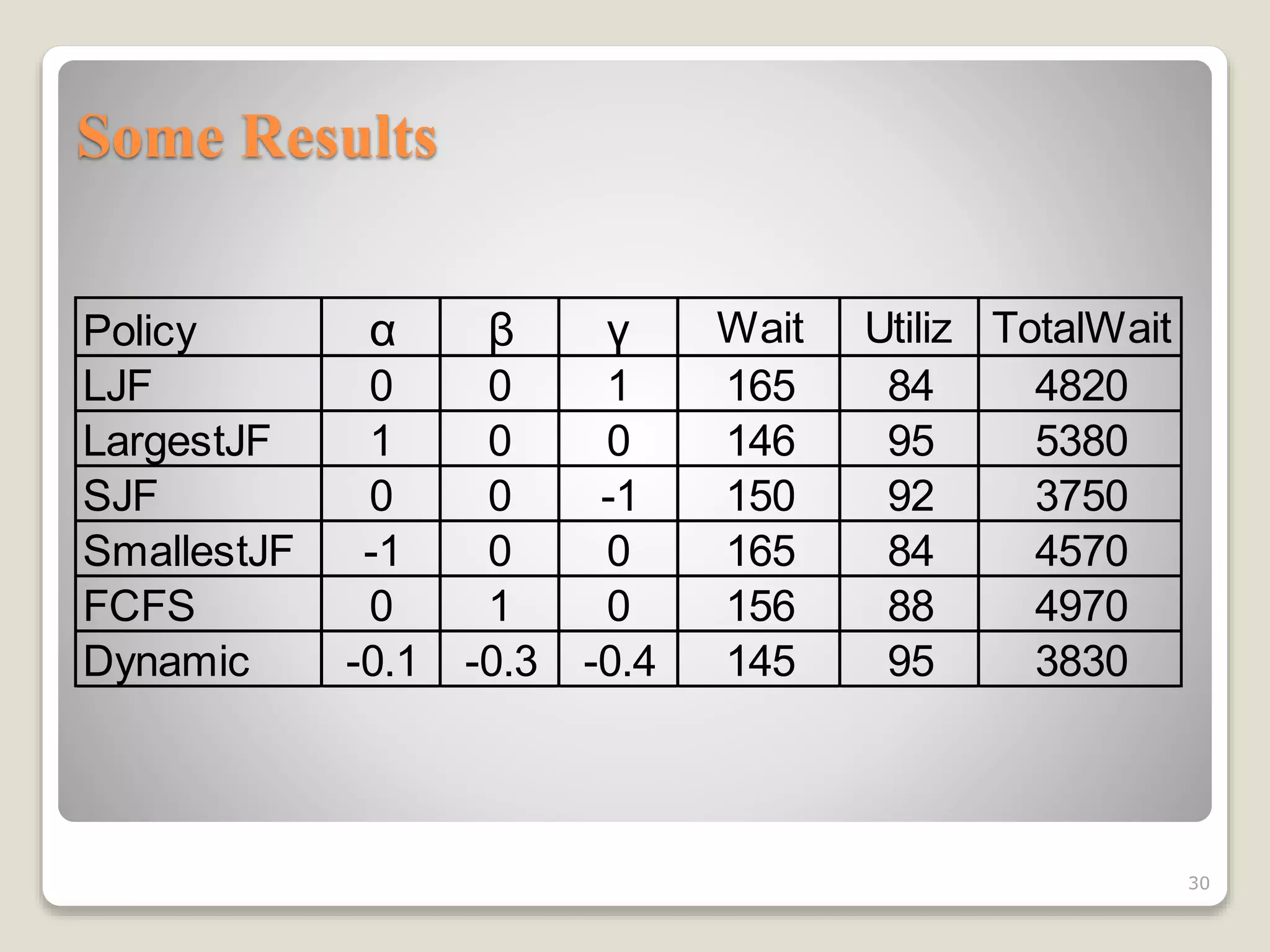
Policy α β γ Wait Utiliz TotalWait
LJF 0 0 1 165 84 4820
LargestJF 1 0 0 146 95 5380
SJF 0 0 -1 150 92 3750
SmallestJF -1 0 0 165 84 4570
FCFS 0 1 0 156 88 4970
Dynamic -0.1 -0.3 -0.4 145 95 3830
Conclusions
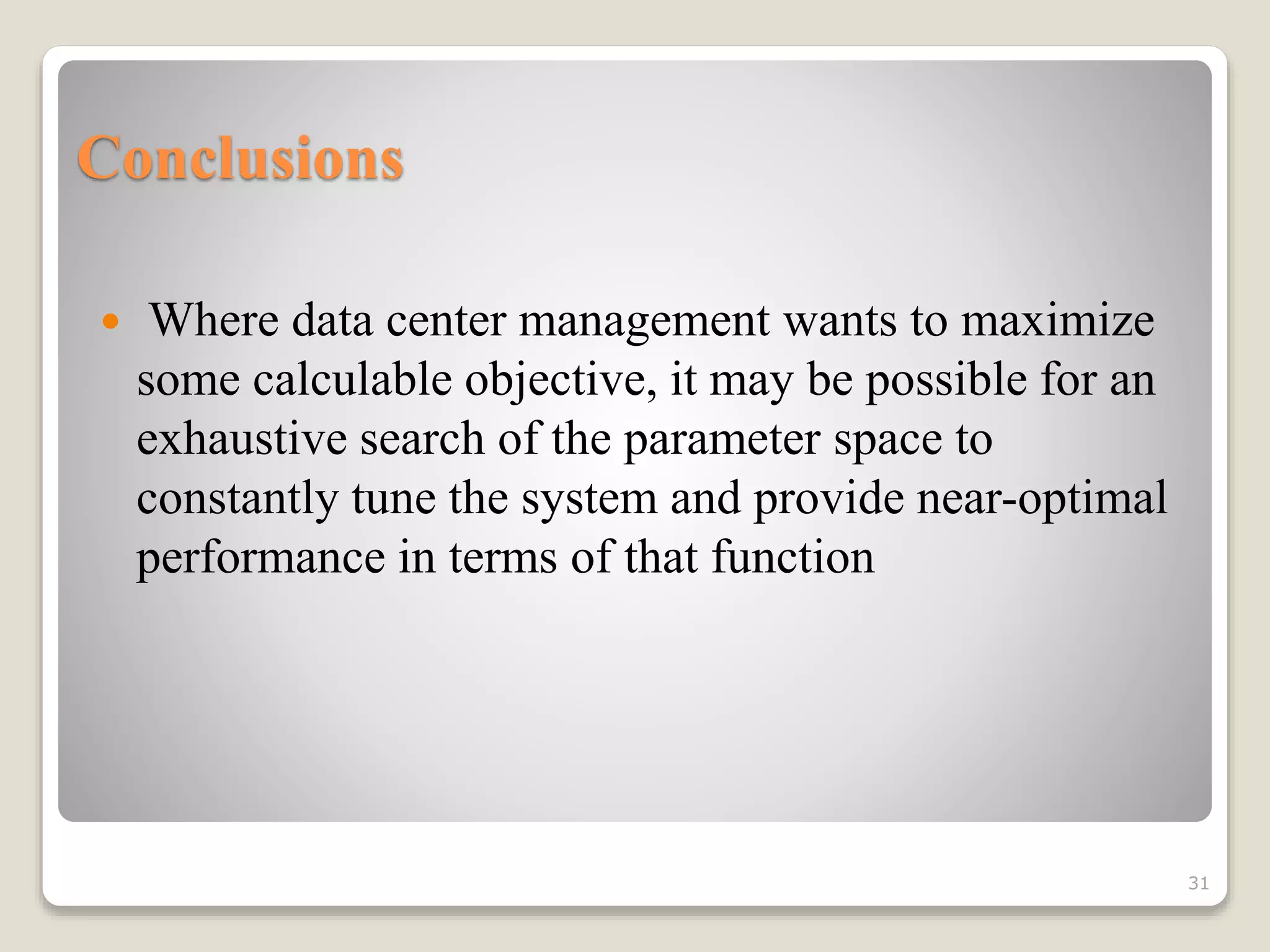
 Where data center management wants to maximize
some calculable objective, it may be possible for an
exhaustive search of the parameter space to
constantly tune the system and provide near-optimal
performance in terms of that function
31
Conclusions
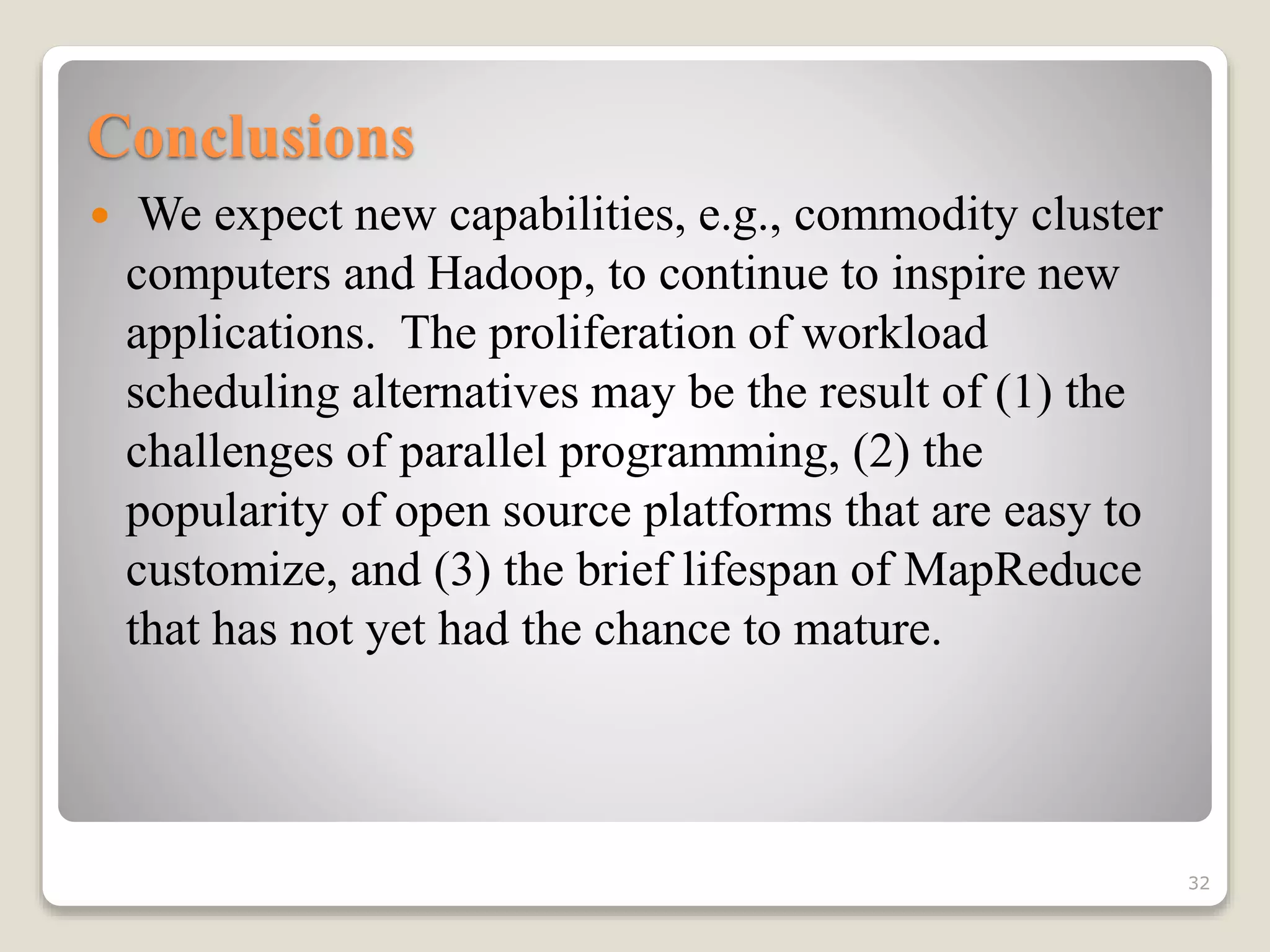
 We expect new capabilities, e.g., commodity cluster
computers and Hadoop, to continue to inspire new
applications. The proliferation of workload
scheduling alternatives may be the result of (1) the
challenges of parallel programming, (2) the
popularity of open source platforms that are easy to
customize, and (3) the brief lifespan of MapReduce
that has not yet had the chance to mature.
32
Contacts
 tsimo1@umbc.edu
 jim.mcgalliard@gsa.gov
 Simulator:
◦ https://github.com/tasimon/DynamicScheduler
33

SOME WORKLOAD SCHEDULING ALTERNATIVES 11.07.2013

  • 1.
    SOME WORKLOAD SCHEDULING ALTERNATIVESIN THE HIGH PERFORMANCE COMPUTING ENVIRONMENT Tyler A. Simon, University of Maryland, Baltimore County Jim McGalliard, FEDSIM CMG 2013 National Conference Session 424 November 7, 2013 - La Jolla 1
  • 2.
    TOPICS  HPC WORKLOADS BACKFILL  MAPREDUCE & HADOOP  HADOOP WORKLOAD SCHEDULING  ALTERNATIVE PRIORITIZATIONS  ALTERNATIVE SCHEDULES  DYNAMIC PRIORITIZATION  SOME DYNAMIC PRIORITIZATION RESULTS  CONCLUSIONS 2
  • 3.
    HPC Workloads  Currentgeneration HPCs have many CPUs – say, 1,000 or 10,000. Scale economies of clusters of commodity processors made price/performance of custom-designed processors too expensive.  Typical HPC applications map some system, e.g., a physical system like the Earth’s atmosphere – into a matrix. 3
  • 4.
    HPC Workloads 4  e.g.,the Cubed Sphere…
  • 5.
    HPC Workloads  Mathematicalsystems, such as systems of linear equations  Physical systems, such as particle or molecular physics  Logical systems, including more recently web activity, of which more later 5
  • 6.
    HPC Workloads  Theapplication software simulates the behavior or dynamics of the system represented by assigning parts of the system to nodes of the cluster. After processing, final results are collected from the nodes.  Often, applications can represent the behavior of the system of interest more accurately by using more nodes.  Mainframes optimize the use of the expensive processor resource by dispatching new work on it when the current workload no longer requires it, e.g., at the start of an I/O operation 6
  • 7.
    HPC Workloads  Incontrast to a traditional mainframe workload, HPC jobs may use hundreds or thousands of processor nodes simultaneously.  Halting job execution on 1,000 CPUs so that a single CPU can start an I/O operation is not efficient.  Some HPCs have checkpoint/restart capabilities that could allow job interruption and also easier recovery from a system failure. Most do not.  On an HPC system, typically, once a job is dispatched, it is allowed to run uninterrupted until completion.  (More on that later.) 7
  • 8.
    Backfill  HPCs areusually over- subscribed.  Backfill is commonly used to increase processor utilization in an HPC environment. 8
  • 9.
  • 10.
  • 11.
  • 12.
    MapReduce  Amdahl’s Lawexplains why it is important in an HPC environment for the application to be coded to exploit parallelism.  Doing so – programming for parallelism - is an historically difficult problem.  MapReduce is a response to this problem. 12
  • 13.
    MapReduce  MapReduce isa simple method for implementing parallelism in a program. The programmer inserts map() and reduce() calls in the code. The compiler, dispatcher, and operating system take care of distributing the code and data onto multiple nodes.  The map() function distributes the input file data onto many disks and the code onto many processors. The code processes this data in parallel. For example, weather parameters in discrete patches of the surface of the globe. 13
  • 14.
    MapReduce  The reduce()function gathers and combines the data from many nodes into one and generates the output data set.  MapReduce makes it easier for programmers to implement parallel versions of their applications by taking care of the distribution, management, shuffling, and return to and from the many processors and their associated data storage. 14
  • 15.
    MapReduce  MapReduce alsoimproves reliability by distributing the data redundantly.  And takes care of load-balancing and performance optimization by distributing the code and data fairly among the many nodes in the cluster.  MapReduce may also be used to implement prioritization by controlling the number of map and reduce slots created and allocated to various users, classes of users, or classes of jobs – the more slots allocated, the faster that user or job will run. 15
  • 16.
    MapReduce Image Licensed by GnuFree Software Foundation 16
  • 17.
    MapReduce  MapReduce wasoriginally developed for use by small teams where FIFO or “social scheduling” was sufficient for workload scheduling.  It has grown to be used for very large problems, such as sorting, searching, and indexing large data sets.  Google uses MapReduce to index the world wide web and holds a patent on the method.  MapReduce is not the only framework for parallel processing and has opponents as well as advocates. 17
  • 18.
    HADOOP  Hadoop isa specific open source implementation of the MapReduce framework written in Java and licensed by Apache  It includes a distributed file system  Designed for very large (thousands of processors) systems using commodity processors, including grid systems  Implements data replication for checkpoint (failover) and locality  Locality of processors with their data help network bandwidth 18
  • 19.
    Applications of Hadoop Data intensive applications  Applications needing fault tolerance  Not a DBMS  Yahoo; Facebook; LinkedIn; Amazon  Watson, the IBM system that won on Jeopardy, used Hadoop 19
  • 20.
    Hadoop MapReduce &Distributed File System Layers Source: Wikipedia 20
  • 21.
    Hadoop Workload Scheduling Task Tracker attempts to dispatch processors on nodes near the data (e.g., same rack) the application requires. Hadoop HDFS is “rack aware”  Default Hadoop scheduling is FCFS=FIFO  Workload scheduling to optimize data locality and also optimize processor utilization are in conflict  There are various alternatives to HDFS and the default Hadoop scheduler 21
  • 22.
    Some Prioritization Alternatives Wait Time  Run Time  Number of Processors  Queue  Composite Priorities  Dynamic Priorities  Etc. 22
  • 23.
    Some Scheduling Alternatives Global Vs. Local Scheduling  Resource-Aware Scheduling  Phase-Based Scheduling  Delay Scheduling  Copy-Compute Splitting  Preemption and Interruption  Social Scheduling  Budget-Based Scheduling 23
  • 24.
    Dynamic Prioritization  BillWard and Tyler Simon, among others, have proposed setting job priorities as the function of multiple factors; these can change in real time: (Est’d Proc Time)Proc Parameter * (Wait Time)Wait Parameter * (CPUs Requested)CPU Parameter * Queue = Priority 24
  • 25.
    Algorithm – Prioritization 25 Data: jobfile, system size Result: Schedule performance Read job input file; for α,β,γ = -1 → 1,+ = 0.1 do while jobs either running or queued do calculate job priorities; for every job do if job is running and has time remaining then update_running_job(); else for all waiting jobs do pull jobs from priority queue and start based on best _t; if job cannot be started then increment waittime end end end end Print results; end end
  • 26.
    Algorithm – CostEvaluation 26 Require: C, capacity of the knapsack, n, the number of tasks, a, array of tasks of size n Ensure: A cost vector containing Ef for each job class Cost (A, B, C, D, WRT). 1: i = 0 2: for α = -2 ≤ 2; α+=0.1 do 3: for β = -2 ≤ 2; β+=0.1 do 4: for γ = -2 ≤ 2; γ+=0.1 do 5: Cost[i++] = schedule(α,β,γ) {For Optimization} 6: if cost[i] < bestSoFar then 7: bestSoFar = cost[i] 8: end if 9: end for 10: end for 11: end for
  • 27.
    Some Results (0,1, 0) = FCFS 27
  • 28.
    Some Results (0,0, -1) = SJF 28
  • 29.
    Some Results (-0.1,-0.3, -0.4) 29
  • 30.
    Some Results 30 Policy αβ γ Wait Utiliz TotalWait LJF 0 0 1 165 84 4820 LargestJF 1 0 0 146 95 5380 SJF 0 0 -1 150 92 3750 SmallestJF -1 0 0 165 84 4570 FCFS 0 1 0 156 88 4970 Dynamic -0.1 -0.3 -0.4 145 95 3830
  • 31.
    Conclusions  Where datacenter management wants to maximize some calculable objective, it may be possible for an exhaustive search of the parameter space to constantly tune the system and provide near-optimal performance in terms of that function 31
  • 32.
    Conclusions  We expectnew capabilities, e.g., commodity cluster computers and Hadoop, to continue to inspire new applications. The proliferation of workload scheduling alternatives may be the result of (1) the challenges of parallel programming, (2) the popularity of open source platforms that are easy to customize, and (3) the brief lifespan of MapReduce that has not yet had the chance to mature. 32
  • 33.
    Contacts  tsimo1@umbc.edu  jim.mcgalliard@gsa.gov Simulator: ◦ https://github.com/tasimon/DynamicScheduler 33