presenting theThe Essential Drucker
12The bookKey Insights
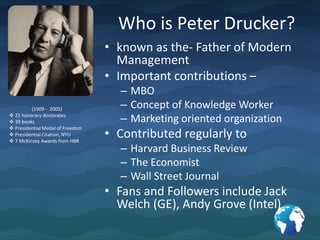
Who is Peter Drucker?known as the- Father of Modern ManagementImportant contributions – MBOConcept of Knowledge WorkerMarketing oriented organizationContributed regularly to Harvard Business ReviewThe EconomistWall Street JournalFans and Followers include Jack Welch (GE), Andy Grove (Intel)(1909 -  2005) 25 honorary doctorates
 39 books
 Presidential Medal of Freedom
 Presidential Citation, NYU
 7 McKinsey Awards from HBRThe book
1The Management
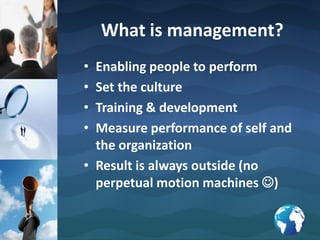
What is management?Enabling people to performSet the cultureTraining & developmentMeasure performance of self and the organizationResult is always outside (no perpetual motion machines )
Dimensions of managementEconomic performance and improve /maintain wealth producing capability of the organizationWork and worker productiveSocial responsibilities
Purpose of businessMarketing and innovationWhat is our business and what should it be?Objectives should beOperationalSelectiveMultipleShould cover areas of survival
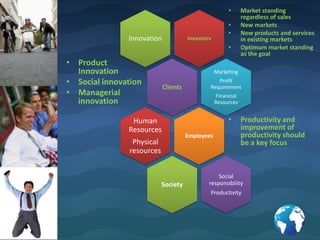
Market standing regardless of salesNew marketsNew products and services in existing marketsOptimum market standing as the goalProduct InnovationSocial innovationManagerial innovationProductivity and improvement of productivity should be a key focus
Lessons from non-profitsStarts with their customersZeal to accomplish missionEffectiveness of boards – CEO and board as colleaguesMeaningful achievementTransformation from non-profit volunteer to non-paid professional
New Paradigms –Searching for the holy grailOne right org structureOne right way to manage peoplePer Drucker -The organization that fits the taskManage for resultsFlat hierarchy
New paradigmsPractice of management – assumptionsTechnology and end use are fixed and givenTechnologies mesh and can impact any industryi.e. the definition “electronics company” is a limitation rather than foundationManagement’s scope is legally defined.Economically linked keiretsu
InformationYield control instead of cost controlActivity  based accountingPrice lead costingTotal factor productivityEconomic value addedBenchmarkingROI / Payback period/Cash flow / Discounted present valueOutsourcing and consulting of information
Why MBOUn-spelt objectives causes misdirectionManagement by drivesMBOOrganizational goals spelt out clearlyDepartmental /bu goals are arrived from org goalsMgr / individual goals are arrived from BU/Org goalsTools like manager’s letterSelf control rather than control from above
Forms and reportsShould Focus on performanceShould Focus on self monitoringControl & controlling the irrelevant should be avoided
Staffing & PromotionManager to be blamed for putting a wrong person in a spotSoldier has a right to competent commandPeople decisions impact the performance capacity of an organizationNew people in established slots
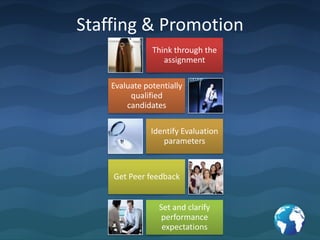
Staffing & Promotion
Staffing & PromotionWidow maker People decisions as a tool of controlas a tool for organizational cultureas strategy
The entrepreneurial businessSpecial handling for new innovative venturesSeparate new businesses from established onesProvide executive coverBuild the desire to innovate in the organization rather than trying to acquire it
2The Individual
Effectiveness ContributionKnow thyselfTimeEffective DecisionsFunctioning communicationsLeadership as workPrinciples of InnovationThe second half-lifeThe Educated person
EffectivenessOperations research and the efficiency of the chef’s kitchenEffectiveness - Doing the right thingEffectiveness is a habit and could be practiced
ContributionResultsDirect resultsBuilding of values and reaffirmationBuilding and developing people of tomorrowMaking the result effective
Know thyselfPersonal strengths should match assignment More than that personal values should match with the assignment
Time80-20 – where should I contribute What could be delegated-- the recurrent fire fightingOverstaffing – mal-organizationConsolidating discretionary time
Characteristics of an entrepreneurDecisiveDecisive even with insufficient dataDecisive even when mistake proneDecisive but learns from mistakes even when mistake proneTradition counts only when it makes senseOwns the result
Effective decisions Right and the wrong compromise – baby and the loafTranslation to workGeneric problem or exceptional problemStart with what is right and make your compromisesDo not hedge
Leadership as workThink through org’s mission
Define and establish it clearly…. and visibly
Leadership as Responsibility and not as rank or privilege
Hold ultimate responsibility for subordinates actions
Promote / praise  / groom subordinates
Earn trust= be an effective manager
InnovationDosAnalyze opportunitiesUnexpected success or failuresIncongruity in customer behaviorPositioningKeep it simple to make it effectiveAim at leadershipDontsToo cleverInnovate for the presentInnovators are opportunity focused and successful ones become one by defining  and containing  the risks
3The Society
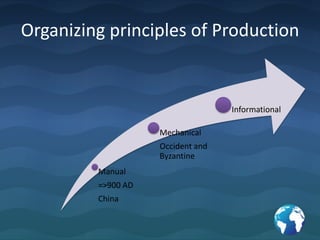
Organizing principles of Production
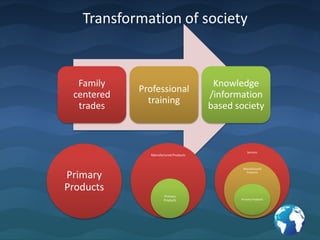
Transformation of society
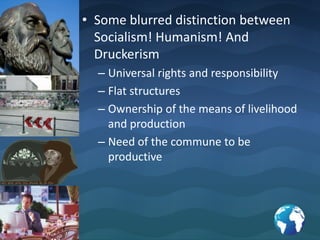
Some blurred distinction between Socialism! Humanism! And DruckerismUniversal rights and responsibilityFlat structuresOwnership of the means of livelihood and productionNeed of the commune to be productive
Challenging the statusquoWelfare state is past --?? Scenario post 2009Mega state vs. non-profit social sectorMega state vs. youtube / twitter / facebookLearning & constant relearning -> outliving obsolescenceDrucker hedging ?! his bets ??Government will NOT become less pervasive, less powerful, less expensive but will depend more on individuals / organizations to be effective
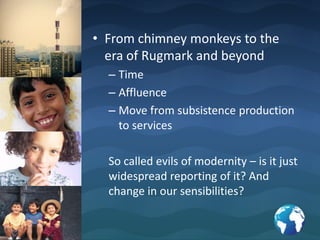
From chimney monkeys to the era of Rugmark and beyondTime AffluenceMove from subsistence production to servicesSo called evils of modernity – is it just widespread reporting of it? And  change in our sensibilities?
Key Insights
Purpose of BusinessPurpose of the business is to satisfy the needs of its customersSome of the questions an organization need to ask frequently are Who is our customer?What should our business be?Planned abandonment -“If we did not do this already, would we go into it now?”The Purpose of a business is to create a customer
Role of ManagementEverything that affects the performance of the organization is a concern for the management and its responsibility.Traditional models perceive the role of management is internal which is a fallacyThe best way to predict the future is to create it.
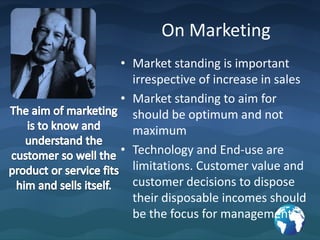
On Marketing Market standing is important irrespective of increase in salesMarket standing to aim for should be optimum and not maximumTechnology and End-use are limitations. Customer value and customer decisions to dispose their disposable incomes should be the focus for managementThe aim of marketing is to know and understand the customer so well the product or service fits him and sells itself.

The Essential Drucker 2010 V2

  • 1.
  • 2.
  • 3.
    Who is PeterDrucker?known as the- Father of Modern ManagementImportant contributions – MBOConcept of Knowledge WorkerMarketing oriented organizationContributed regularly to Harvard Business ReviewThe EconomistWall Street JournalFans and Followers include Jack Welch (GE), Andy Grove (Intel)(1909 - 2005) 25 honorary doctorates
  • 4.
  • 5.
  • 6.
  • 7.
    7 McKinseyAwards from HBRThe book
  • 8.
  • 9.
    What is management?Enablingpeople to performSet the cultureTraining & developmentMeasure performance of self and the organizationResult is always outside (no perpetual motion machines )
  • 10.
    Dimensions of managementEconomicperformance and improve /maintain wealth producing capability of the organizationWork and worker productiveSocial responsibilities
  • 11.
    Purpose of businessMarketingand innovationWhat is our business and what should it be?Objectives should beOperationalSelectiveMultipleShould cover areas of survival
  • 12.
    Market standing regardlessof salesNew marketsNew products and services in existing marketsOptimum market standing as the goalProduct InnovationSocial innovationManagerial innovationProductivity and improvement of productivity should be a key focus
  • 13.
    Lessons from non-profitsStartswith their customersZeal to accomplish missionEffectiveness of boards – CEO and board as colleaguesMeaningful achievementTransformation from non-profit volunteer to non-paid professional
  • 14.
    New Paradigms –Searchingfor the holy grailOne right org structureOne right way to manage peoplePer Drucker -The organization that fits the taskManage for resultsFlat hierarchy
  • 15.
    New paradigmsPractice ofmanagement – assumptionsTechnology and end use are fixed and givenTechnologies mesh and can impact any industryi.e. the definition “electronics company” is a limitation rather than foundationManagement’s scope is legally defined.Economically linked keiretsu
  • 16.
    InformationYield control insteadof cost controlActivity based accountingPrice lead costingTotal factor productivityEconomic value addedBenchmarkingROI / Payback period/Cash flow / Discounted present valueOutsourcing and consulting of information
  • 17.
    Why MBOUn-spelt objectivescauses misdirectionManagement by drivesMBOOrganizational goals spelt out clearlyDepartmental /bu goals are arrived from org goalsMgr / individual goals are arrived from BU/Org goalsTools like manager’s letterSelf control rather than control from above
  • 18.
    Forms and reportsShouldFocus on performanceShould Focus on self monitoringControl & controlling the irrelevant should be avoided
  • 19.
    Staffing & PromotionManagerto be blamed for putting a wrong person in a spotSoldier has a right to competent commandPeople decisions impact the performance capacity of an organizationNew people in established slots
  • 20.
  • 21.
    Staffing & PromotionWidowmaker People decisions as a tool of controlas a tool for organizational cultureas strategy
  • 22.
    The entrepreneurial businessSpecialhandling for new innovative venturesSeparate new businesses from established onesProvide executive coverBuild the desire to innovate in the organization rather than trying to acquire it
  • 23.
  • 24.
    Effectiveness ContributionKnow thyselfTimeEffectiveDecisionsFunctioning communicationsLeadership as workPrinciples of InnovationThe second half-lifeThe Educated person
  • 25.
    EffectivenessOperations research andthe efficiency of the chef’s kitchenEffectiveness - Doing the right thingEffectiveness is a habit and could be practiced
  • 26.
    ContributionResultsDirect resultsBuilding ofvalues and reaffirmationBuilding and developing people of tomorrowMaking the result effective
  • 27.
    Know thyselfPersonal strengthsshould match assignment More than that personal values should match with the assignment
  • 28.
    Time80-20 – whereshould I contribute What could be delegated-- the recurrent fire fightingOverstaffing – mal-organizationConsolidating discretionary time
  • 29.
    Characteristics of anentrepreneurDecisiveDecisive even with insufficient dataDecisive even when mistake proneDecisive but learns from mistakes even when mistake proneTradition counts only when it makes senseOwns the result
  • 30.
    Effective decisions Rightand the wrong compromise – baby and the loafTranslation to workGeneric problem or exceptional problemStart with what is right and make your compromisesDo not hedge
  • 31.
    Leadership as workThinkthrough org’s mission
  • 32.
    Define and establishit clearly…. and visibly
  • 33.
    Leadership as Responsibilityand not as rank or privilege
  • 34.
    Hold ultimate responsibilityfor subordinates actions
  • 35.
    Promote / praise / groom subordinates
  • 36.
    Earn trust= bean effective manager
  • 37.
    InnovationDosAnalyze opportunitiesUnexpected successor failuresIncongruity in customer behaviorPositioningKeep it simple to make it effectiveAim at leadershipDontsToo cleverInnovate for the presentInnovators are opportunity focused and successful ones become one by defining and containing the risks
  • 38.
  • 39.
  • 40.
  • 41.
    Some blurred distinctionbetween Socialism! Humanism! And DruckerismUniversal rights and responsibilityFlat structuresOwnership of the means of livelihood and productionNeed of the commune to be productive
  • 42.
    Challenging the statusquoWelfarestate is past --?? Scenario post 2009Mega state vs. non-profit social sectorMega state vs. youtube / twitter / facebookLearning & constant relearning -> outliving obsolescenceDrucker hedging ?! his bets ??Government will NOT become less pervasive, less powerful, less expensive but will depend more on individuals / organizations to be effective
  • 43.
    From chimney monkeysto the era of Rugmark and beyondTime AffluenceMove from subsistence production to servicesSo called evils of modernity – is it just widespread reporting of it? And change in our sensibilities?
  • 44.
  • 45.
    Purpose of BusinessPurposeof the business is to satisfy the needs of its customersSome of the questions an organization need to ask frequently are Who is our customer?What should our business be?Planned abandonment -“If we did not do this already, would we go into it now?”The Purpose of a business is to create a customer
  • 46.
    Role of ManagementEverythingthat affects the performance of the organization is a concern for the management and its responsibility.Traditional models perceive the role of management is internal which is a fallacyThe best way to predict the future is to create it.
  • 47.
    On Marketing Marketstanding is important irrespective of increase in salesMarket standing to aim for should be optimum and not maximumTechnology and End-use are limitations. Customer value and customer decisions to dispose their disposable incomes should be the focus for managementThe aim of marketing is to know and understand the customer so well the product or service fits him and sells itself.
  • 48.
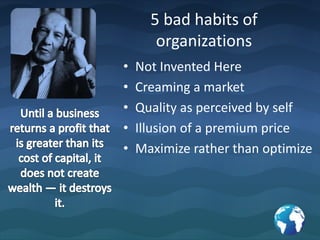
    5 bad habitsof organizationsNot Invented HereCreaming a marketQuality as perceived by selfIllusion of a premium priceMaximize rather than optimizeUntil a business returns a profit that is greater than its cost of capital, it does not create wealth — it destroys it.
  • 49.
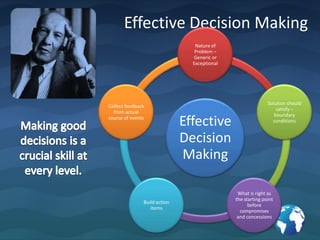
    Effective Decision MakingMakinggood decisions is a crucial skill at every level.
  • 50.
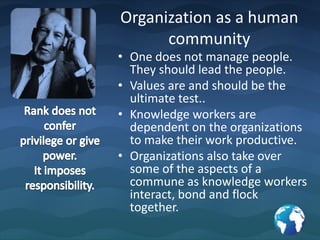
    Organization as ahuman communityOne does not manage people. They should lead the people.Values are and should be the ultimate test..Knowledge workers are dependent on the organizations to make their work productive.Organizations also take over some of the aspects of a commune as knowledge workers interact, bond and flock together.Rank does not confer privilege or give power. It imposes responsibility.
  • 51.
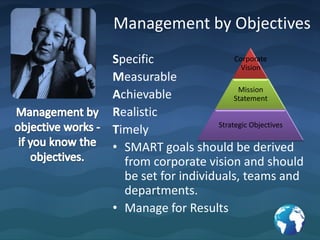
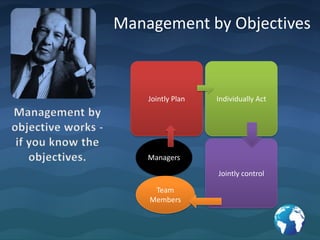
    Management by ObjectivesSpecificMeasurableAchievableRealisticTimelySMARTgoals should be derived from corporate vision and should be set for individuals, teams and departments.Manage for ResultsManagement by objective works - if you know the objectives.
  • 52.
    Management by ObjectivesJointlyPlanIndividually ActManagement by objective works - if you know the objectives.Jointly controlManagersTeam Members
  • 53.
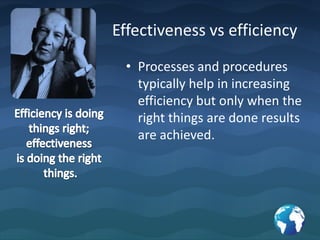
    Effectiveness vs efficiencyProcessesand procedures typically help in increasing efficiency but only when the right things are done results are achieved.Efficiency is doing things right; effectiveness is doing the right things.
  • 54.
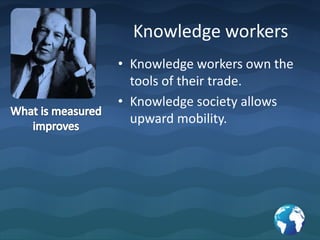
    Knowledge workersKnowledge workersown the tools of their trade.Knowledge society allows upward mobility.What is measured improves
  • 55.
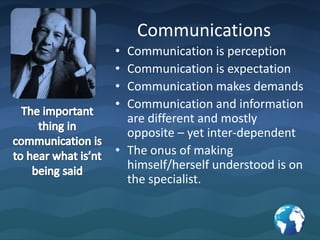
    CommunicationsCommunication is perceptionCommunicationis expectationCommunication makes demandsCommunication and information are different and mostly opposite – yet inter-dependentThe onus of making himself/herself understood is on the specialist.The important thing in communication is to hear what is’nt being said

Editor's Notes

  • #38 Approach should be “what does the customer want to buy?” rather than “what do we sell?”Three essential questions –What is our business?What will be our business?What should be our business?These questions when well thought through will form a solid foundation for any business.The corporation’s strategic mission must be translated to :objectives in the following key areas:Marketing ObjectivesInnovation ObjectivesHuman Resources ObjectivesFinancial Resources ObjectivesPhysical Resources ObjectivesProductivity ObjectivesSocial Responsibility ObjectivesProfit Requirements
  • #39 Factors which affect the performance of the organization whether they are within the control of the organization or outside the control of the organization – they are the responsibility of the management.In the traditional manufacturing mindset, the focus will be on optimizing productivity, optimizing the value chain, increase operational efficiencies. Although this is needed, most of the time, management teams around the world focus highly on this aspect, to the exclusion of all the other important areas.
  • #40 Sales increase alone will not be a good indicator for the sustainability of an organization. Higher sales with shrinking market share means that the market is expanding fast and there are competitors who are expanding faster than us.Dominance in a market or monopoly in a market will lead to complacence.It will also bring in inertia, which will resist changes and innovation inside the organization.Technology and End-use are limitations. Customer value and customer decisions to dispose their disposable incomes should be the focus for management
  • #41 The following are the cardinal rules for creating a customer:Creating customer utilityPricingAdapting to customer’s social and economic realityDelivering a service that is of true value to the customerThe 5 bad habits listed above are against these cardinal rules.
  • #42 PerDrucker, first the nature of the problem needs to be identified. In Six Sigma terms it is known Common Cause (Generic) and exceptional cause (exceptional).Handling exceptions are easy.Generic problems should be handled with policies and procedures so that they are handled as a routine.Identify the boundary conditions under which the problem can be considered as resolved.Identify what is right before starting off making compromises or concessions, otherwise we will never be sure whether we made the right compromises.Once a decision is made, action items should be generated with someone responsible for each action item and a schedule.The results should be analyzed so that the feedback loop is closed, without which future decisions would also be made without the benefits of those “lessons learnt”.
  • #43 Flatter organization structuresMobilitythe fact that the knowledge workers carry the tools of their trade with them wherever they goAre some of the major reasons why employees should be treated as volunteers.Superior / subordinate mentality is a legacy model which would not work in a knowledge society.In this milieu, values of an individual and the values of an organization increasingly pays an important role . They have an inordinate amount of influence in the career of an individual and the growth of an organization.So an individual or an organization find themselves in scenarios where the values do not match, they should go their own ways.As knowledge workers become highly specialized, they are highly dependent on organizations to make their output productive.Unlike before, where businesses and trades are family owned and families and villages served the social needs of a knowledge worker
  • #44 Setting of individual objectives, team objectives, departmental objectives and measuring performance against those objectives (i.e. MBO) is one of the key contributions of Peter Drucker.These goals have to be specific, measurable, achievable, realistic and timely.Improve sales should be replaced with Improve sales by 5% YoY as accruals every quarter starting from q2fy10 to q4fy10 is how a good goal statement should be stated.Although efforts count, effort which does not translate into results should be pruned out.
  • #45 The objectives should be planned jointly by the manager and the employee. The employee is completely responsible for delivering the results and both should get together on a regular basis to control and track the efficacy of the goals, actions taken, and results.
  • #46 Focus should be on both efficiency and effectiveness. Focus on or the other alone can lead to a dysfunctional
  • #47 Unlike feudal age, when the landlord provided the place to work or the tools of the trade (like plough horse / oxen owned by the whole village as a community property) or the industrial age, the where the capital provider or the owner provided the tools and the workplace, the knowledge worker owns the tools of his trade and can carry it with him where he goes.In the feudal age, everyone is born into their station in life and there is no upward / downward mobility. Knowledge society enables upward mobility.
  • #48 As mentioned above for communication to be successful, it has to be understood by the receiver but the onus is always on the expert/specialist to make themselves understood.