Indirect Control
As pointed to in the last lesson
• Theories exist about how we can control
countries indirectly
• Countries still use a variety of methods:
• Military – wars of independence IRA,
Sierra Leone, Libya and Syria
• Political – development help, aid
• Economic – provide aid, embargos
• Cultural – The spread of western culture
Investment in Africa
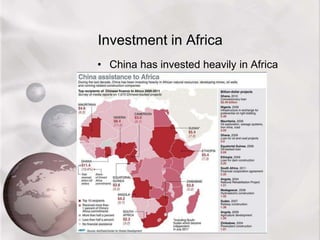
• China has invested heavily in Africa
• Over 1million Chinese people now live in
Africa
• Many in areas of raw materials
• In 2010 80% of Chinese imports from
Africa were mineral products
• China is Africa’s largest trading partner
• They help create jobs, upskill locals,
stimulate growth.
• All of this has made the relations strong.
Case Study Somalia and Somaliland
Use for:
Instability
Investment by countries
Colonialism
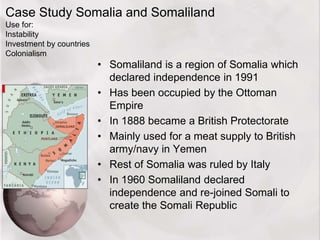
• Somaliland is a region of Somalia which
declared independence in 1991
• Has been occupied by the Ottoman
Empire
• In 1888 became a British Protectorate
• Mainly used for a meat supply to British
army/navy in Yemen
• Rest of Somalia was ruled by Italy
• In 1960 Somaliland declared
independence and re-joined Somali to
create the Somali Republic
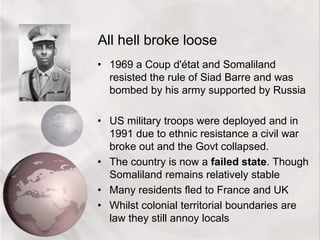
All hell broke loose
• 1969 a Coup d'état and Somaliland
resisted the rule of Siad Barre and was
bombed by his army supported by Russia
• US military troops were deployed and in
1991 due to ethnic resistance a civil war
broke out and the Govt collapsed.
• The country is now a failed state. Though
Somaliland remains relatively stable
• Many residents fled to France and UK
• Whilst colonial territorial boundaries are
law they still annoy locals
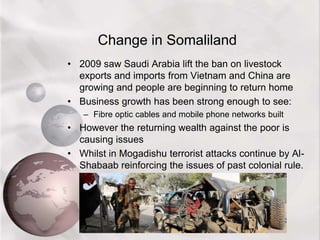
Change in Somaliland
• 2009 saw Saudi Arabia lift the ban on livestock
exports and imports from Vietnam and China are
growing and people are beginning to return home
• Business growth has been strong enough to see:
– Fibre optic cables and mobile phone networks built
• However the returning wealth against the poor is
causing issues
• Whilst in Mogadishu terrorist attacks continue by Al-
Shabaab reinforcing the issues of past colonial rule.

Lesson 3 indirect control

  • 1.
  • 2.
    As pointed toin the last lesson • Theories exist about how we can control countries indirectly • Countries still use a variety of methods: • Military – wars of independence IRA, Sierra Leone, Libya and Syria • Political – development help, aid • Economic – provide aid, embargos • Cultural – The spread of western culture
  • 3.
    Investment in Africa •China has invested heavily in Africa
  • 4.
    • Over 1millionChinese people now live in Africa • Many in areas of raw materials • In 2010 80% of Chinese imports from Africa were mineral products • China is Africa’s largest trading partner • They help create jobs, upskill locals, stimulate growth. • All of this has made the relations strong.
  • 5.
    Case Study Somaliaand Somaliland Use for: Instability Investment by countries Colonialism • Somaliland is a region of Somalia which declared independence in 1991 • Has been occupied by the Ottoman Empire • In 1888 became a British Protectorate • Mainly used for a meat supply to British army/navy in Yemen • Rest of Somalia was ruled by Italy • In 1960 Somaliland declared independence and re-joined Somali to create the Somali Republic
  • 6.
    All hell brokeloose • 1969 a Coup d'état and Somaliland resisted the rule of Siad Barre and was bombed by his army supported by Russia • US military troops were deployed and in 1991 due to ethnic resistance a civil war broke out and the Govt collapsed. • The country is now a failed state. Though Somaliland remains relatively stable • Many residents fled to France and UK • Whilst colonial territorial boundaries are law they still annoy locals
  • 7.
    Change in Somaliland •2009 saw Saudi Arabia lift the ban on livestock exports and imports from Vietnam and China are growing and people are beginning to return home • Business growth has been strong enough to see: – Fibre optic cables and mobile phone networks built • However the returning wealth against the poor is causing issues • Whilst in Mogadishu terrorist attacks continue by Al- Shabaab reinforcing the issues of past colonial rule.