SOMALI ARCHITECTURE
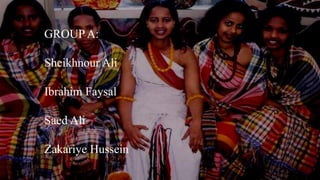
GROUP A:
Sheikhnour Ali
Ibrahim Faysal
Saed Ali
Zakariye Hussein
INTRODUCTION IN SOMALI
HISTORY
• Somalia was known to the ancient Egyptians as the Land of Punt. They valued its
trees which produced the aromatic gum resins frankincense and myrrh. Punt is also
mentioned in the Bible, and ancient Romans called it Cape Aromatic. Somalia is
named for the legendary father of the Somali people, Samaal or (Samale)
• Somalia is on the outer edge of the Somali Peninsula, also called the Horn of Africa,
on the East African coast.
• The Somali people share a common language, Somali, and 99% are Muslims of the
Sunni sect.
INTRODUCTION IN SOMALI
HISTORY
• Somalia was an important centre for commerce with the rest of the ancient world.
• During the Middle Ages, several powerful Somali empires dominated the regional trade,
including the Ajuran Sultanate, the Adal Sultanate, the Warsangali Sultanate, the Sultanate
of the Geledi and the Majeerteen Sultanate.
• In the late 19th century, through a succession of treaties with these kingdoms, the British
and Italians gained control of parts of the coast, and established British Somaliland and
Italian Somaliland
• In the interior, Mohammed Abdullah Hassan's Dervish State successfully repulsed the British
Empire four times and forced it to retreat to the coastal region, but the Dervishes were finally
defeated in 1920 by British airpower.
• The Italian Somalia had its independence on 1960 and the British Somalia joined them to
form a government known as Federal Somalia.
INTRODUCTION IN SOMALI
HISTORY
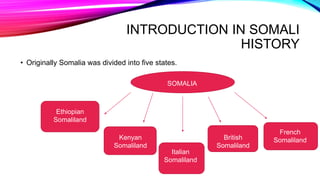
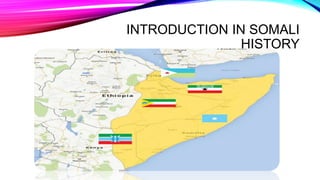
• Originally Somalia was divided into five states.
SOMALIA
Italian
Somaliland
French
SomalilandBritish
Somaliland
Kenyan
Somaliland
Ethiopian
Somaliland
INTRODUCTION IN SOMALI
HISTORY
SOMALI ARCHITECTURE
 It can be defined as the art and science of designing and engineering Somali traditional
constructions.
 The types of Somali constructions:
1. Stone cities.
2. Castles
3. Citadels
4. Fortresses
5. Mosques
6. Lighthouses
7. Towers & Tombs
8. Aqueducts.
SOMALI ARCHITECTURE
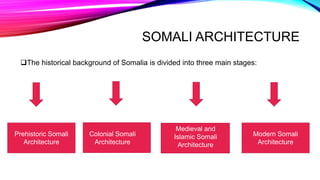
The historical background of Somalia is divided into three main stages:
Prehistoric Somali
Architecture
Colonial Somali
Architecture
Medieval and
Islamic Somali
Architecture
Modern Somali
Architecture
CHAPTER 1: PREHISTORIC
SOMALI ARCHITECTURE
PREHISTORIC SOMALI
ARCHITECTURE
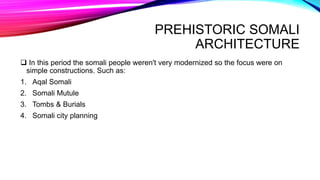
 In this period the somali people weren't very modernized so the focus were on
simple constructions. Such as:
1. Aqal Somali
2. Somali Mutule
3. Tombs & Burials
4. Somali city planning
PREHISTORIC SOMALI
ARCHITECTURE
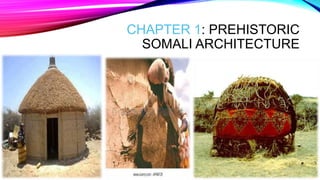
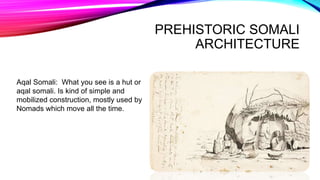
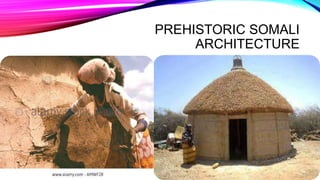
Aqal Somali: What you see is a hut or
aqal somali. Is kind of simple and
mobilized construction, mostly used by
Nomads which move all the time.
PREHISTORIC SOMALI
ARCHITECTURE
PREHISTORIC SOMALI
ARCHITECTURE
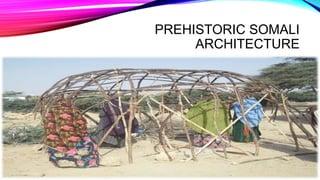
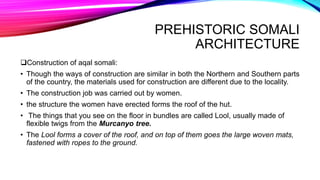
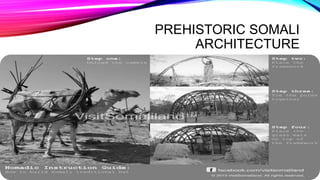
Construction of aqal somali:
• Though the ways of construction are similar in both the Northern and Southern parts
of the country, the materials used for construction are different due to the locality.
• The construction job was carried out by women.
• the structure the women have erected forms the roof of the hut.
• The things that you see on the floor in bundles are called Lool, usually made of
flexible twigs from the Murcanyo tree.
• The Lool forms a cover of the roof, and on top of them goes the large woven mats,
fastened with ropes to the ground.
PREHISTORIC SOMALI
ARCHITECTURE
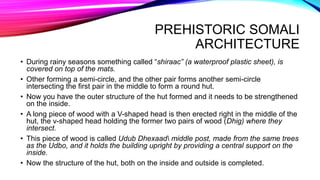
• During rainy seasons something called “shiraac” (a waterproof plastic sheet), is
covered on top of the mats.
• Other forming a semi-circle, and the other pair forms another semi-circle
intersecting the first pair in the middle to form a round hut.
• Now you have the outer structure of the hut formed and it needs to be strengthened
on the inside.
• A long piece of wood with a V-shaped head is then erected right in the middle of the
hut, the v-shaped head holding the former two pairs of wood (Dhig) where they
intersect.
• This piece of wood is called Udub Dhexaad middle post, made from the same trees
as the Udbo, and it holds the building upright by providing a central support on the
inside.
• Now the structure of the hut, both on the inside and outside is completed.
PREHISTORIC SOMALI
ARCHITECTURE
PREHISTORIC SOMALI
ARCHITECTURE
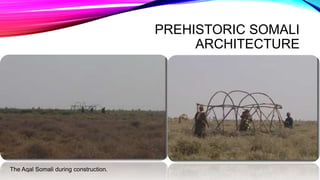
The Aqal Somali during construction.
PREHISTORIC SOMALI
ARCHITECTURE
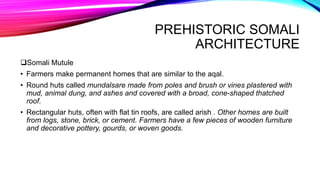
Somali Mutule
• Farmers make permanent homes that are similar to the aqal.
• Round huts called mundalsare made from poles and brush or vines plastered with
mud, animal dung, and ashes and covered with a broad, cone-shaped thatched
roof.
• Rectangular huts, often with flat tin roofs, are called arish . Other homes are built
from logs, stone, brick, or cement. Farmers have a few pieces of wooden furniture
and decorative pottery, gourds, or woven goods.
PREHISTORIC SOMALI
ARCHITECTURE
PREHISTORIC SOMALI
ARCHITECTURE
Tombs & Burials
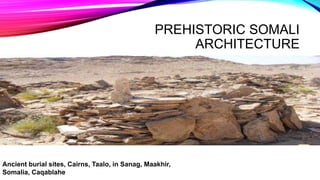
• Ancient cairns in Qa’ableh. Some of the oldest known structures in the territory of
modern-day Somalia consist of burial cairns (taalo) .
• Although found throughout the country and the larger Horn of Africa region, northern
Somalia in particular is home to numerous such archaeological structures, with
many similar edifices found at Haylaan, Qa’ableh, Qombo'ul, Elaayo and Maydh,
among other towns.
• However, many of these ancient structures have yet to be properly explored, a
process which would help shed further light on local history and facilitate their
preservation for posterity.
PREHISTORIC SOMALI
ARCHITECTURE
Ancient burial sites, Cairns, Taalo, in Sanag, Maakhir,
Somalia, Caqablahe
PREHISTORIC SOMALI
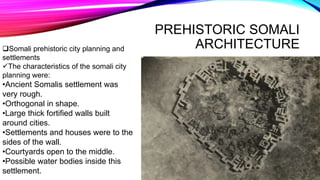
ARCHITECTURESomali prehistoric city planning and
settlements
The characteristics of the somali city
planning were:
•Ancient Somalis settlement was
very rough.
•Orthogonal in shape.
•Large thick fortified walls built
around cities.
•Settlements and houses were to the
sides of the wall.
•Courtyards open to the middle.
•Possible water bodies inside this
settlement.
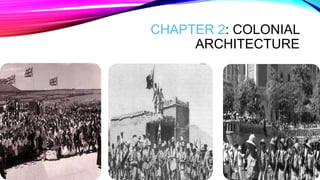
CHAPTER 2: COLONIAL
ARCHITECTURE
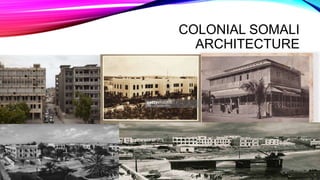
COLONIAL SOMALI
ARCHITECTURE
COLONIAL SOMALI
ARCHITECTURE
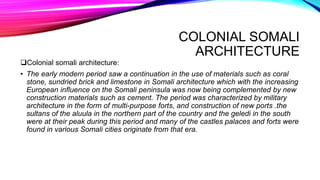
Colonial somali architecture:
• The early modern period saw a continuation in the use of materials such as coral
stone, sundried brick and limestone in Somali architecture which with the increasing
European influence on the Somali peninsula was now being complemented by new
construction materials such as cement. The period was characterized by military
architecture in the form of multi-purpose forts, and construction of new ports .the
sultans of the aluula in the northern part of the country and the geledi in the south
were at their peak during this period and many of the castles palaces and forts were
found in various Somali cities originate from that era.
COLONIAL SOMALI
ARCHITECTURE
• Under the colonial rule Somalia was divided in to five different regions. British
Somaliland, France Somaliland (Djibouti) reserve area (Ethiopian) and NFD (Kenya)
.Under three major European powers.
 Great Britain
 Italy
 France
• This is another factor which contributes political and urban structure of Somalia.
BRITISH COLONIAL
ARCHITECTURE
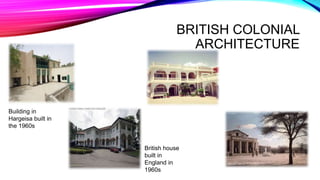
Characteristics of British architecture:
• Resemblance or similarities to British buildings themselves .
• Both built from red bricks.
• Style of building is very similar.
• Both used gable terracotta red roof bricks or left flat.
British colonial officer were settled in Berbera, building their own houses and
administration offices. High court of Hargeisa built in British colonial times. Historical
landmarks at Berbera, Hargeysa and Zayla'. The preservation of historic buildings
including the Ottoman architecture and other historical buildings as well as buildings
dating from the British Colonial presence in Somaliland.
BRITISH COLONIAL
ARCHITECTURE
Building in
Hargeisa built in
the 1960s
British house
built in
England in
1960s
ITALIAN COLONIAL
ARCHITECTURE
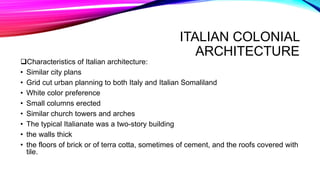
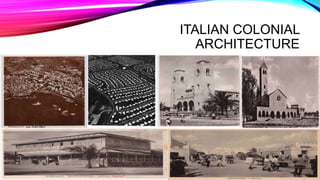
Characteristics of Italian architecture:
• Similar city plans
• Grid cut urban planning to both Italy and Italian Somaliland
• White color preference
• Small columns erected
• Similar church towers and arches
• The typical Italianate was a two-story building
• the walls thick
• the floors of brick or of terra cotta, sometimes of cement, and the roofs covered with
tile.
ITALIAN COLONIAL
ARCHITECTURE
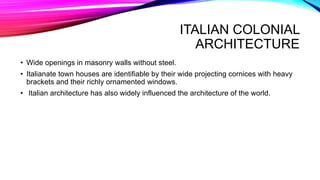
• Wide openings in masonry walls without steel.
• Italianate town houses are identifiable by their wide projecting cornices with heavy
brackets and their richly ornamented windows.
• Italian architecture has also widely influenced the architecture of the world.
ITALIAN COLONIAL
ARCHITECTURE
ITALIAN COLONIAL
ARCHITECTURE
The materials the Italians used in there construction:
• Brick and wood clapboard were the most common building materials used for
Italianate homes with brick being more expensive. The ornamentation was typically
wood and occasionally the brick homes had elaborate, durable cast iron window
and door hoods.
FRENCH COLONIAL
ARCHITECTURE
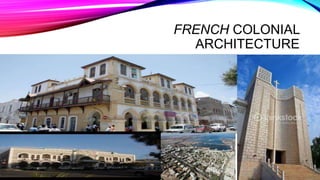
Characteristics of french architecture:
• Grid street plan
• To imitate stone walls, half-timbered houses were stuccoed; wood surfaces were
even textured to resemble masonry.
• thin wooden columns.
• no interior hallways.
• Wide porches, called "galleries” .
• wide hipped roof extends over porches.
• Empty attic areas where breezes could flow through the dormer windows and keep
the lower floors cool.
FRENCH COLONIAL
ARCHITECTURE
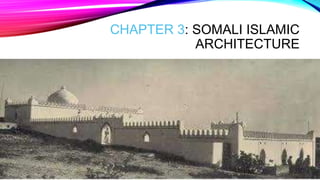
CHAPTER 3: SOMALI ISLAMIC
ARCHITECTURE
SOMALI ISLAMIC ARCHITECTURE
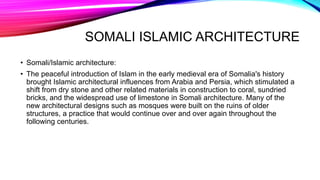
• Somali/Islamic architecture:
• The peaceful introduction of Islam in the early medieval era of Somalia's history
brought Islamic architectural influences from Arabia and Persia, which stimulated a
shift from dry stone and other related materials in construction to coral, sundried
bricks, and the widespread use of limestone in Somali architecture. Many of the
new architectural designs such as mosques were built on the ruins of older
structures, a practice that would continue over and over again throughout the
following centuries.
SOMALI/ISLAMIC ARCHITECTURE:
We would experience in this chapter the Islamical constructions in Somalia such as:
• Stone cities
• Castles and fortresses
• Citadels and city walls
• Mosques and shrines
• Towers and lighthouses
STONE CITIES
STONE CITIES
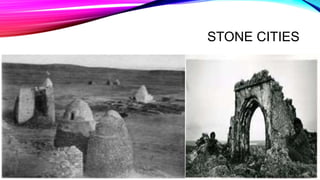
Whitewashed coral stone city of Merca, Somalia:
• Ruins of the Warsangali Sultanate in Las Khorey.
• The lucrative commercial networks of successive medieval Somali empires and
kingdoms such as the Mogadishan Sultanate, the Ajuuraan State, the Empire of
Adal, the Geledi Sultanate and the Warsangali Sultanate saw the establishment of
several dozen stone cities in the interior of Somalia as well as the coastal regions.
• Ibn Battuta visiting Mogadishu in the early 14th century called it a town endless in
size and Vasco Da Gama who passed by Mogadishu in the 15th century noted that
it was a large city with houses of four or five storeys high and big palaces in its
centre.
STONE CITIES
• Somali were an integral part of a long distance caravan trade network connecting
major Somali cities such as Merka, Mogadishu, Zeila, Barawa and Qandala with
other business centers in East Africa.
• The numerous ruined and abandoned towns throughout the interior of Somalia can
be explained as the remains of a once booming inland trade dating back to the
medieval period.
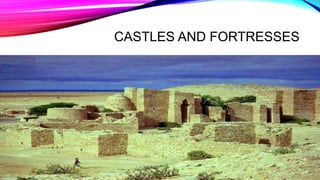
CASTLES AND FORTRESSES
• Throughout the medieval era, castles and fortresses known as Qalcads were built
by Somali Sultans for protection against both foreign and domestic threats.
• The major medieval Somali power engaging in castle building was the Ajuuraan
State, and many of the hundreds of ruined fortifications dotting the landscapes of
Somalia today are attributed to Ajuuraan engineers.
• Other castle building powers were the Gerad Kingdom and the Bari Sultanate.
CASTLES AND FORTRESSES
• The Dervish State in the late 19th century and early 20th century was another
prolific fortress building power in the Somali Peninsula. In 1913, after the British
withdrawal to the coast, the permanent capital and headquarters of the Dervishes
was constructed at Taleh, a large walled town with fourteen fortresses.
• The main fortress, Silsilat, included a walled garden and a guard house. It became
the residence of Muhammad Abdullah Hassan, his wives, family, prominent Somali
military leaders, and also hosted several Turkish,Yemeni and German dignitaries,
architects, masons and arms manufacturers.Several dozen other fortresses were
built in Illig, Eyl, Shimbiris and other parts of the Horn of Africa.
CITADELS AND CITY WALLS
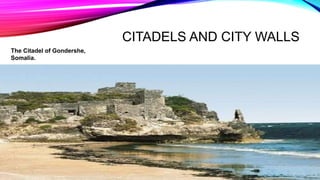
The Citadel of Gondershe,
Somalia.
CITADELS AND CITY WALLS
• The Citadel of Gondershe, Somalia.
• City walls were established around the coastal cities of Merka, Barawa and
Mogadishu to defend the cities against powers such as the Portuguese Empire.
• During the Adal Age, many of the inland cities such as Amud and Abasa in the
northern part of Somalia were built on hills high above sea level with large defensive
stone walls enclosing them.
CITADELS AND CITY WALLS
• Somali city walls also acted as a barrier against the proliferation of arms usually
carried by the Somali and Horn African nomads entering the cities with their caravan
trains. They had to leave behind their weapons at the city gate before they could
enter the markets with their goods and trade with the urban Somalis, Middle
Easterners and Asian merchants.
MOSQUES & ISLAMIC BUILDINGS
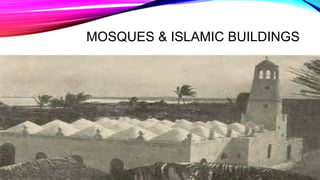
• Concordant with the ancient presence of Islam in the Horn of Africa region,
mosques in Somalia are some of the oldest on the entire continent.
• One architectural feature that made Somali mosques distinct from other mosques in
Africa were minarets.
• For centuries, Arba Rukun (1269), the Friday mosque of Merca (1609) and Fakr ad-
Din (1269) were, in fact, the only mosques in East Africa to have minarets.
• Fakr ad-Din, which dates back to the Mogadishan Golden Age, was built with
marble and coral stone and included a compact rectangular plan with a domed
mihrab axis.
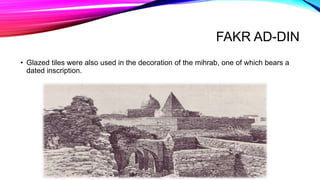
FAKR AD-DIN
• Glazed tiles were also used in the decoration of the mihrab, one of which bears a
dated inscription.
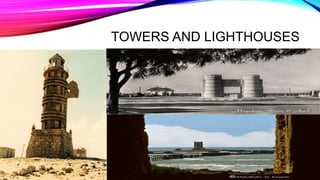
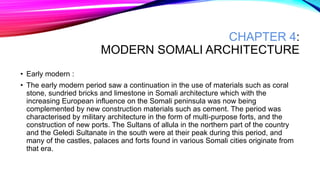
TOWERS AND LIGHTHOUSES
• Almnara Tower Somalia.Somalia's historical strategic location within the world's
oldest and busiest sealanes encouraged the construction of lighthouses to co-
ordinate shipping and to ensure the safe entrance of commercial vessels in the
nation's many port cities. In times of weak central authority the Somalian
civilizational matrix of interior cities and port cities was based on a clan formula that
saw various clans in fierce competition over natural resources that led to chronic
feuding between neighbours. Towers provided the merchant class and the urban
population protection against potential raids from the nomadic regions. Stone
towers such as the 15th century Almnara tower in Mogadishu and the Jamia tower
of Merka were also built for defense. The Dar Ilalo stone towers though initially
constructed to defend the fortress of Taleex were also used as granaries for the
Dervish State.
CHAPTER 4:
MODERN SOMALI ARCHITECTURE
• Early modern :
• The early modern period saw a continuation in the use of materials such as coral
stone, sundried bricks and limestone in Somali architecture which with the
increasing European influence on the Somali peninsula was now being
complemented by new construction materials such as cement. The period was
characterised by military architecture in the form of multi-purpose forts, and the
construction of new ports. The Sultans of allula in the northern part of the country
and the Geledi Sultanate in the south were at their peak during this period, and
many of the castles, palaces and forts found in various Somali cities originate from
that era.
CITY DWELLERS
• City dwellers:
• City dwellers often live in Arab-style whitewashed houses made of stone or brick
covered with
• Plaster or cement. These are one or two-story houses, with a flat roof. Bars cover
the lower
• Windows, which rarely have screens or glass.
• Wealthy Somalis, Europeans, and others may have traditional Western-style homes
with tile roofs and walled courtyards. Many Somalis, even in the cities, do not have
electricity and running water in their homes. Italian occupants also built their own
neighborhoods in Mogadishu and other cities.
MODERN BUILDINGS
MODERN BUILDINGS
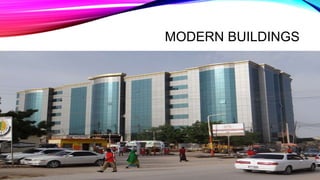
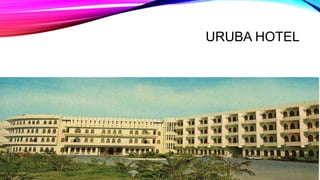
• In the modern period, several Somali cities such as Mogadishu, Hargeisa and
Berbera received large projects, which saw construction in new styles that
harmoniously blended in with the existing old architecture. Due to Italian influence,
parts of Mogadishu are built in the classical style. The Somali government
continued upon that legacy, while also opening the door to German, American and
Chinese designers. As a departure from the prevailing Somali architectural style, the
National Theatre in Mogadishu was completely built from a Chinese perspective.
The town-hall was constructed in the Moroccan style. Much of the new architecture
also continued upon ancient tradition, the Al-Uruba Hotel, the pre-eminent hotel in
Somalia and an iconic feature of Mogadishu's waterfront was entirely designed and
constructed by Somalis in the Arabesque style.
MODERN BUILDINGS
• In recent times, due to the civil war and the subsequent decentralization, many
cities across the country have rapidly developed into urban hubs and have adopted
their own architectural styles independently. In the cities of Garowe, Bosaso and
Hargeisa, construction firms have built hotels, government facilities, airports and
residential neighbourhoods in a modernist style, often utilizing chrome, steel and
glass materials.
URUBA HOTEL

Somali Architecture

  • 1.
  • 2.
    GROUP A: Sheikhnour Ali IbrahimFaysal Saed Ali Zakariye Hussein
  • 3.
    INTRODUCTION IN SOMALI HISTORY •Somalia was known to the ancient Egyptians as the Land of Punt. They valued its trees which produced the aromatic gum resins frankincense and myrrh. Punt is also mentioned in the Bible, and ancient Romans called it Cape Aromatic. Somalia is named for the legendary father of the Somali people, Samaal or (Samale) • Somalia is on the outer edge of the Somali Peninsula, also called the Horn of Africa, on the East African coast. • The Somali people share a common language, Somali, and 99% are Muslims of the Sunni sect.
  • 4.
    INTRODUCTION IN SOMALI HISTORY •Somalia was an important centre for commerce with the rest of the ancient world. • During the Middle Ages, several powerful Somali empires dominated the regional trade, including the Ajuran Sultanate, the Adal Sultanate, the Warsangali Sultanate, the Sultanate of the Geledi and the Majeerteen Sultanate. • In the late 19th century, through a succession of treaties with these kingdoms, the British and Italians gained control of parts of the coast, and established British Somaliland and Italian Somaliland • In the interior, Mohammed Abdullah Hassan's Dervish State successfully repulsed the British Empire four times and forced it to retreat to the coastal region, but the Dervishes were finally defeated in 1920 by British airpower. • The Italian Somalia had its independence on 1960 and the British Somalia joined them to form a government known as Federal Somalia.
  • 5.
    INTRODUCTION IN SOMALI HISTORY •Originally Somalia was divided into five states. SOMALIA Italian Somaliland French SomalilandBritish Somaliland Kenyan Somaliland Ethiopian Somaliland
  • 6.
  • 7.
    SOMALI ARCHITECTURE  Itcan be defined as the art and science of designing and engineering Somali traditional constructions.  The types of Somali constructions: 1. Stone cities. 2. Castles 3. Citadels 4. Fortresses 5. Mosques 6. Lighthouses 7. Towers & Tombs 8. Aqueducts.
  • 8.
    SOMALI ARCHITECTURE The historicalbackground of Somalia is divided into three main stages: Prehistoric Somali Architecture Colonial Somali Architecture Medieval and Islamic Somali Architecture Modern Somali Architecture
  • 9.
  • 10.
    PREHISTORIC SOMALI ARCHITECTURE  Inthis period the somali people weren't very modernized so the focus were on simple constructions. Such as: 1. Aqal Somali 2. Somali Mutule 3. Tombs & Burials 4. Somali city planning
  • 11.
    PREHISTORIC SOMALI ARCHITECTURE Aqal Somali:What you see is a hut or aqal somali. Is kind of simple and mobilized construction, mostly used by Nomads which move all the time.
  • 12.
  • 13.
    PREHISTORIC SOMALI ARCHITECTURE Construction ofaqal somali: • Though the ways of construction are similar in both the Northern and Southern parts of the country, the materials used for construction are different due to the locality. • The construction job was carried out by women. • the structure the women have erected forms the roof of the hut. • The things that you see on the floor in bundles are called Lool, usually made of flexible twigs from the Murcanyo tree. • The Lool forms a cover of the roof, and on top of them goes the large woven mats, fastened with ropes to the ground.
  • 14.
    PREHISTORIC SOMALI ARCHITECTURE • Duringrainy seasons something called “shiraac” (a waterproof plastic sheet), is covered on top of the mats. • Other forming a semi-circle, and the other pair forms another semi-circle intersecting the first pair in the middle to form a round hut. • Now you have the outer structure of the hut formed and it needs to be strengthened on the inside. • A long piece of wood with a V-shaped head is then erected right in the middle of the hut, the v-shaped head holding the former two pairs of wood (Dhig) where they intersect. • This piece of wood is called Udub Dhexaad middle post, made from the same trees as the Udbo, and it holds the building upright by providing a central support on the inside. • Now the structure of the hut, both on the inside and outside is completed.
  • 15.
  • 16.
    PREHISTORIC SOMALI ARCHITECTURE The AqalSomali during construction.
  • 17.
    PREHISTORIC SOMALI ARCHITECTURE Somali Mutule •Farmers make permanent homes that are similar to the aqal. • Round huts called mundalsare made from poles and brush or vines plastered with mud, animal dung, and ashes and covered with a broad, cone-shaped thatched roof. • Rectangular huts, often with flat tin roofs, are called arish . Other homes are built from logs, stone, brick, or cement. Farmers have a few pieces of wooden furniture and decorative pottery, gourds, or woven goods.
  • 18.
  • 19.
    PREHISTORIC SOMALI ARCHITECTURE Tombs &Burials • Ancient cairns in Qa’ableh. Some of the oldest known structures in the territory of modern-day Somalia consist of burial cairns (taalo) . • Although found throughout the country and the larger Horn of Africa region, northern Somalia in particular is home to numerous such archaeological structures, with many similar edifices found at Haylaan, Qa’ableh, Qombo'ul, Elaayo and Maydh, among other towns. • However, many of these ancient structures have yet to be properly explored, a process which would help shed further light on local history and facilitate their preservation for posterity.
  • 20.
    PREHISTORIC SOMALI ARCHITECTURE Ancient burialsites, Cairns, Taalo, in Sanag, Maakhir, Somalia, Caqablahe
  • 21.
    PREHISTORIC SOMALI ARCHITECTURESomali prehistoriccity planning and settlements The characteristics of the somali city planning were: •Ancient Somalis settlement was very rough. •Orthogonal in shape. •Large thick fortified walls built around cities. •Settlements and houses were to the sides of the wall. •Courtyards open to the middle. •Possible water bodies inside this settlement.
  • 22.
  • 23.
  • 24.
    COLONIAL SOMALI ARCHITECTURE Colonial somaliarchitecture: • The early modern period saw a continuation in the use of materials such as coral stone, sundried brick and limestone in Somali architecture which with the increasing European influence on the Somali peninsula was now being complemented by new construction materials such as cement. The period was characterized by military architecture in the form of multi-purpose forts, and construction of new ports .the sultans of the aluula in the northern part of the country and the geledi in the south were at their peak during this period and many of the castles palaces and forts were found in various Somali cities originate from that era.
  • 25.
    COLONIAL SOMALI ARCHITECTURE • Underthe colonial rule Somalia was divided in to five different regions. British Somaliland, France Somaliland (Djibouti) reserve area (Ethiopian) and NFD (Kenya) .Under three major European powers.  Great Britain  Italy  France • This is another factor which contributes political and urban structure of Somalia.
  • 26.
    BRITISH COLONIAL ARCHITECTURE Characteristics ofBritish architecture: • Resemblance or similarities to British buildings themselves . • Both built from red bricks. • Style of building is very similar. • Both used gable terracotta red roof bricks or left flat. British colonial officer were settled in Berbera, building their own houses and administration offices. High court of Hargeisa built in British colonial times. Historical landmarks at Berbera, Hargeysa and Zayla'. The preservation of historic buildings including the Ottoman architecture and other historical buildings as well as buildings dating from the British Colonial presence in Somaliland.
  • 27.
    BRITISH COLONIAL ARCHITECTURE Building in Hargeisabuilt in the 1960s British house built in England in 1960s
  • 28.
    ITALIAN COLONIAL ARCHITECTURE Characteristics ofItalian architecture: • Similar city plans • Grid cut urban planning to both Italy and Italian Somaliland • White color preference • Small columns erected • Similar church towers and arches • The typical Italianate was a two-story building • the walls thick • the floors of brick or of terra cotta, sometimes of cement, and the roofs covered with tile.
  • 29.
    ITALIAN COLONIAL ARCHITECTURE • Wideopenings in masonry walls without steel. • Italianate town houses are identifiable by their wide projecting cornices with heavy brackets and their richly ornamented windows. • Italian architecture has also widely influenced the architecture of the world.
  • 30.
  • 31.
    ITALIAN COLONIAL ARCHITECTURE The materialsthe Italians used in there construction: • Brick and wood clapboard were the most common building materials used for Italianate homes with brick being more expensive. The ornamentation was typically wood and occasionally the brick homes had elaborate, durable cast iron window and door hoods.
  • 32.
    FRENCH COLONIAL ARCHITECTURE Characteristics offrench architecture: • Grid street plan • To imitate stone walls, half-timbered houses were stuccoed; wood surfaces were even textured to resemble masonry. • thin wooden columns. • no interior hallways. • Wide porches, called "galleries” . • wide hipped roof extends over porches. • wide hipped roof extends over porches. • Empty attic areas where breezes could flow through the dormer windows and keep the lower floors cool.
  • 33.
  • 34.
    CHAPTER 3: SOMALIISLAMIC ARCHITECTURE
  • 35.
    SOMALI ISLAMIC ARCHITECTURE •Somali/Islamic architecture: • The peaceful introduction of Islam in the early medieval era of Somalia's history brought Islamic architectural influences from Arabia and Persia, which stimulated a shift from dry stone and other related materials in construction to coral, sundried bricks, and the widespread use of limestone in Somali architecture. Many of the new architectural designs such as mosques were built on the ruins of older structures, a practice that would continue over and over again throughout the following centuries.
  • 36.
    SOMALI/ISLAMIC ARCHITECTURE: We wouldexperience in this chapter the Islamical constructions in Somalia such as: • Stone cities • Castles and fortresses • Citadels and city walls • Mosques and shrines • Towers and lighthouses
  • 37.
  • 38.
    STONE CITIES Whitewashed coralstone city of Merca, Somalia: • Ruins of the Warsangali Sultanate in Las Khorey. • The lucrative commercial networks of successive medieval Somali empires and kingdoms such as the Mogadishan Sultanate, the Ajuuraan State, the Empire of Adal, the Geledi Sultanate and the Warsangali Sultanate saw the establishment of several dozen stone cities in the interior of Somalia as well as the coastal regions. • Ibn Battuta visiting Mogadishu in the early 14th century called it a town endless in size and Vasco Da Gama who passed by Mogadishu in the 15th century noted that it was a large city with houses of four or five storeys high and big palaces in its centre.
  • 39.
    STONE CITIES • Somaliwere an integral part of a long distance caravan trade network connecting major Somali cities such as Merka, Mogadishu, Zeila, Barawa and Qandala with other business centers in East Africa. • The numerous ruined and abandoned towns throughout the interior of Somalia can be explained as the remains of a once booming inland trade dating back to the medieval period.
  • 40.
  • 41.
    CASTLES AND FORTRESSES •Throughout the medieval era, castles and fortresses known as Qalcads were built by Somali Sultans for protection against both foreign and domestic threats. • The major medieval Somali power engaging in castle building was the Ajuuraan State, and many of the hundreds of ruined fortifications dotting the landscapes of Somalia today are attributed to Ajuuraan engineers. • Other castle building powers were the Gerad Kingdom and the Bari Sultanate.
  • 42.
    CASTLES AND FORTRESSES •The Dervish State in the late 19th century and early 20th century was another prolific fortress building power in the Somali Peninsula. In 1913, after the British withdrawal to the coast, the permanent capital and headquarters of the Dervishes was constructed at Taleh, a large walled town with fourteen fortresses. • The main fortress, Silsilat, included a walled garden and a guard house. It became the residence of Muhammad Abdullah Hassan, his wives, family, prominent Somali military leaders, and also hosted several Turkish,Yemeni and German dignitaries, architects, masons and arms manufacturers.Several dozen other fortresses were built in Illig, Eyl, Shimbiris and other parts of the Horn of Africa.
  • 43.
    CITADELS AND CITYWALLS The Citadel of Gondershe, Somalia.
  • 44.
    CITADELS AND CITYWALLS • The Citadel of Gondershe, Somalia. • City walls were established around the coastal cities of Merka, Barawa and Mogadishu to defend the cities against powers such as the Portuguese Empire. • During the Adal Age, many of the inland cities such as Amud and Abasa in the northern part of Somalia were built on hills high above sea level with large defensive stone walls enclosing them.
  • 45.
    CITADELS AND CITYWALLS • Somali city walls also acted as a barrier against the proliferation of arms usually carried by the Somali and Horn African nomads entering the cities with their caravan trains. They had to leave behind their weapons at the city gate before they could enter the markets with their goods and trade with the urban Somalis, Middle Easterners and Asian merchants.
  • 46.
  • 47.
    MOSQUES & ISLAMICBUILDINGS • Concordant with the ancient presence of Islam in the Horn of Africa region, mosques in Somalia are some of the oldest on the entire continent. • One architectural feature that made Somali mosques distinct from other mosques in Africa were minarets. • For centuries, Arba Rukun (1269), the Friday mosque of Merca (1609) and Fakr ad- Din (1269) were, in fact, the only mosques in East Africa to have minarets. • Fakr ad-Din, which dates back to the Mogadishan Golden Age, was built with marble and coral stone and included a compact rectangular plan with a domed mihrab axis.
  • 48.
    FAKR AD-DIN • Glazedtiles were also used in the decoration of the mihrab, one of which bears a dated inscription.
  • 49.
  • 50.
    TOWERS AND LIGHTHOUSES •Almnara Tower Somalia.Somalia's historical strategic location within the world's oldest and busiest sealanes encouraged the construction of lighthouses to co- ordinate shipping and to ensure the safe entrance of commercial vessels in the nation's many port cities. In times of weak central authority the Somalian civilizational matrix of interior cities and port cities was based on a clan formula that saw various clans in fierce competition over natural resources that led to chronic feuding between neighbours. Towers provided the merchant class and the urban population protection against potential raids from the nomadic regions. Stone towers such as the 15th century Almnara tower in Mogadishu and the Jamia tower of Merka were also built for defense. The Dar Ilalo stone towers though initially constructed to defend the fortress of Taleex were also used as granaries for the Dervish State.
  • 51.
    CHAPTER 4: MODERN SOMALIARCHITECTURE • Early modern : • The early modern period saw a continuation in the use of materials such as coral stone, sundried bricks and limestone in Somali architecture which with the increasing European influence on the Somali peninsula was now being complemented by new construction materials such as cement. The period was characterised by military architecture in the form of multi-purpose forts, and the construction of new ports. The Sultans of allula in the northern part of the country and the Geledi Sultanate in the south were at their peak during this period, and many of the castles, palaces and forts found in various Somali cities originate from that era.
  • 52.
    CITY DWELLERS • Citydwellers: • City dwellers often live in Arab-style whitewashed houses made of stone or brick covered with • Plaster or cement. These are one or two-story houses, with a flat roof. Bars cover the lower • Windows, which rarely have screens or glass. • Wealthy Somalis, Europeans, and others may have traditional Western-style homes with tile roofs and walled courtyards. Many Somalis, even in the cities, do not have electricity and running water in their homes. Italian occupants also built their own neighborhoods in Mogadishu and other cities.
  • 53.
  • 54.
    MODERN BUILDINGS • Inthe modern period, several Somali cities such as Mogadishu, Hargeisa and Berbera received large projects, which saw construction in new styles that harmoniously blended in with the existing old architecture. Due to Italian influence, parts of Mogadishu are built in the classical style. The Somali government continued upon that legacy, while also opening the door to German, American and Chinese designers. As a departure from the prevailing Somali architectural style, the National Theatre in Mogadishu was completely built from a Chinese perspective. The town-hall was constructed in the Moroccan style. Much of the new architecture also continued upon ancient tradition, the Al-Uruba Hotel, the pre-eminent hotel in Somalia and an iconic feature of Mogadishu's waterfront was entirely designed and constructed by Somalis in the Arabesque style.
  • 55.
    MODERN BUILDINGS • Inrecent times, due to the civil war and the subsequent decentralization, many cities across the country have rapidly developed into urban hubs and have adopted their own architectural styles independently. In the cities of Garowe, Bosaso and Hargeisa, construction firms have built hotels, government facilities, airports and residential neighbourhoods in a modernist style, often utilizing chrome, steel and glass materials.
  • 56.