Houses

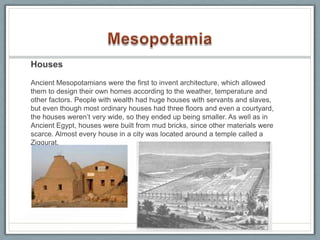
Ancient Mesopotamians were the first to invent architecture, which allowed
them to design their own homes according to the weather, temperature and
other factors. People with wealth had huge houses with servants and slaves,
but even though most ordinary houses had three floors and even a courtyard,
the houses weren’t very wide, so they ended up being smaller. As well as in
Ancient Egypt, houses were built from mud bricks, since other materials were
scarce. Almost every house in a city was located around a temple called a
Ziggurat.
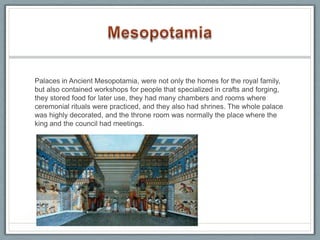
Palaces in Ancient Mesopotamia, were not only the homes for the royal family,
but also contained workshops for people that specialized in crafts and forging,
they stored food for later use, they had many chambers and rooms where
ceremonial rituals were practiced, and they also had shrines. The whole palace
was highly decorated, and the throne room was normally the place where the
king and the council had meetings.
Structures
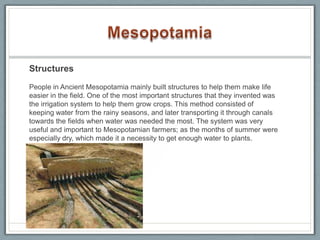
People in Ancient Mesopotamia mainly built structures to help them make life
easier in the field. One of the most important structures that they invented was
the irrigation system to help them grow crops. This method consisted of
keeping water from the rainy seasons, and later transporting it through canals
towards the fields when water was needed the most. The system was very
useful and important to Mesopotamian farmers; as the months of summer were
especially dry, which made it a necessity to get enough water to plants.
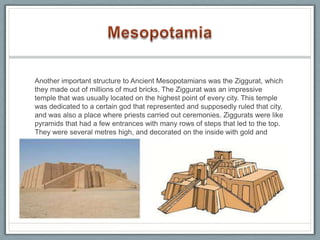
Another important structure to Ancient Mesopotamians was the Ziggurat, which
they made out of millions of mud bricks. The Ziggurat was an impressive
temple that was usually located on the highest point of every city. This temple
was dedicated to a certain god that represented and supposedly ruled that city,
and was also a place where priests carried out ceremonies. Ziggurats were like
pyramids that had a few entrances with many rows of steps that led to the top.
They were several metres high, and decorated on the inside with gold and
other valuable materials.
Houses
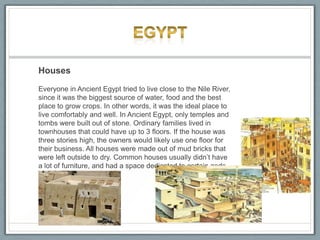
Everyone in Ancient Egypt tried to live close to the Nile River,
since it was the biggest source of water, food and the best
place to grow crops. In other words, it was the ideal place to
live comfortably and well. In Ancient Egypt, only temples and
tombs were built out of stone. Ordinary families lived in
townhouses that could have up to 3 floors. If the house was
three stories high, the owners would likely use one floor for
their business. All houses were made out of mud bricks that
were left outside to dry. Common houses usually didn’t have
a lot of furniture, and had a space dedicated to certain gods.
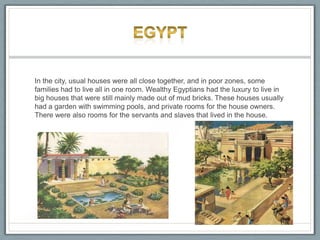
In the city, usual houses were all close together, and in poor zones, some
families had to live all in one room. Wealthy Egyptians had the luxury to live in
big houses that were still mainly made out of mud bricks. These houses usually
had a garden with swimming pools, and private rooms for the house owners.
There were also rooms for the servants and slaves that lived in the house.
Structures
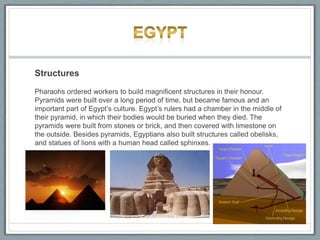
Pharaohs ordered workers to build magnificent structures in their honour.
Pyramids were built over a long period of time, but became famous and an
important part of Egypt’s culture. Egypt’s rulers had a chamber in the middle of
their pyramid, in which their bodies would be buried when they died. The
pyramids were built from stones or brick, and then covered with limestone on
the outside. Besides pyramids, Egyptians also built structures called obelisks,
and statues of lions with a human head called sphinxes.
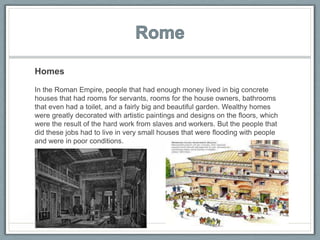
Homes
In the Roman Empire, people that had enough money lived in big concrete
houses that had rooms for servants, rooms for the house owners, bathrooms
that even had a toilet, and a fairly big and beautiful garden. Wealthy homes
were greatly decorated with artistic paintings and designs on the floors, which
were the result of the hard work from slaves and workers. But the people that
did these jobs had to live in very small houses that were flooding with people
and were in poor conditions.
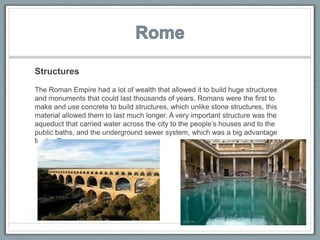
Structures
The Roman Empire had a lot of wealth that allowed it to build huge structures
and monuments that could last thousands of years. Romans were the first to
make and use concrete to build structures, which unlike stone structures, this
material allowed them to last much longer. A very important structure was the
aqueduct that carried water across the city to the people’s houses and to the
public baths, and the underground sewer system, which was a big advantage
for the Romans.
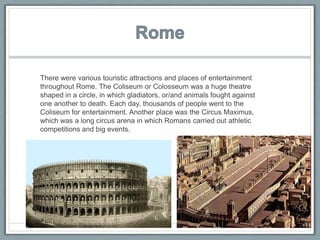
There were various touristic attractions and places of entertainment
throughout Rome. The Coliseum or Colosseum was a huge theatre
shaped in a circle, in which gladiators, or/and animals fought against
one another to death. Each day, thousands of people went to the
Coliseum for entertainment. Another place was the Circus Maximus,
which was a long circus arena in which Romans carried out athletic
competitions and big events.
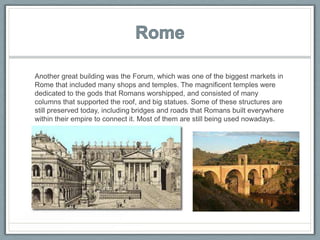
Another great building was the Forum, which was one of the biggest markets in
Rome that included many shops and temples. The magnificent temples were
dedicated to the gods that Romans worshipped, and consisted of many
columns that supported the roof, and big statues. Some of these structures are
still preserved today, including bridges and roads that Romans built everywhere
within their empire to connect it. Most of them are still being used nowadays.
Homes

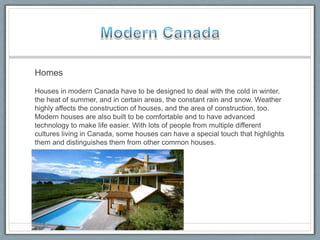
Houses in modern Canada have to be designed to deal with the cold in winter,
the heat of summer, and in certain areas, the constant rain and snow. Weather
highly affects the construction of houses, and the area of construction, too.
Modern houses are also built to be comfortable and to have advanced
technology to make life easier. With lots of people from multiple different
cultures living in Canada, some houses can have a special touch that highlights
them and distinguishes them from other common houses.
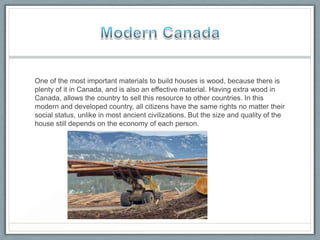
One of the most important materials to build houses is wood, because there is
plenty of it in Canada, and is also an effective material. Having extra wood in
Canada, allows the country to sell this resource to other countries. In this
modern and developed country, all citizens have the same rights no matter their
social status, unlike in most ancient civilizations. But the size and quality of the
house still depends on the economy of each person.
Structures
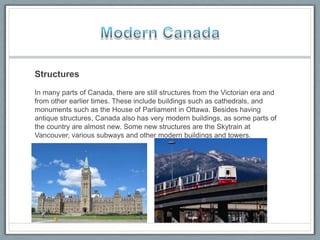
In many parts of Canada, there are still structures from the Victorian era and
from other earlier times. These include buildings such as cathedrals, and
monuments such as the House of Parliament in Ottawa. Besides having
antique structures, Canada also has very modern buildings, as some parts of
the country are almost new. Some new structures are the Skytrain at
Vancouver, various subways and other modern buildings and towers.
Homes
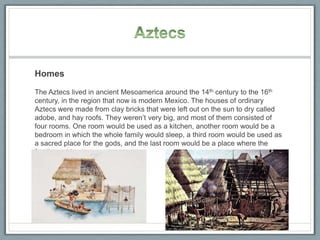
The Aztecs lived in ancient Mesoamerica around the 14th century to the 16th
century, in the region that now is modern Mexico. The houses of ordinary
Aztecs were made from clay bricks that were left out on the sun to dry called
adobe, and hay roofs. They weren’t very big, and most of them consisted of
four rooms. One room would be used as a kitchen, another room would be a
bedroom in which the whole family would sleep, a third room would be used as
a sacred place for the gods, and the last room would be a place where the
family could eat.
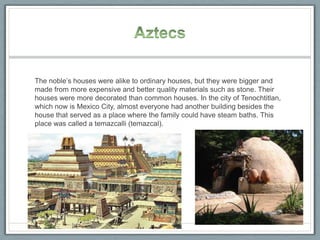
The noble’s houses were alike to ordinary houses, but they were bigger and
made from more expensive and better quality materials such as stone. Their
houses were more decorated than common houses. In the city of Tenochtitlan,
which now is Mexico City, almost everyone had another building besides the
house that served as a place where the family could have steam baths. This
place was called a temazcalli (temazcal).
Structures:
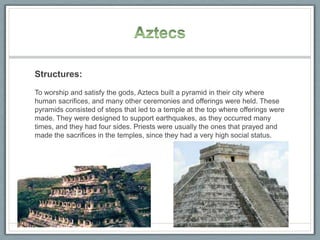
To worship and satisfy the gods, Aztecs built a pyramid in their city where
human sacrifices, and many other ceremonies and offerings were held. These
pyramids consisted of steps that led to a temple at the top where offerings were
made. They were designed to support earthquakes, as they occurred many
times, and they had four sides. Priests were usually the ones that prayed and
made the sacrifices in the temples, since they had a very high social status.
Homes and structures

Homes and structures

  • 2.
    Houses Ancient Mesopotamians werethe first to invent architecture, which allowed them to design their own homes according to the weather, temperature and other factors. People with wealth had huge houses with servants and slaves, but even though most ordinary houses had three floors and even a courtyard, the houses weren’t very wide, so they ended up being smaller. As well as in Ancient Egypt, houses were built from mud bricks, since other materials were scarce. Almost every house in a city was located around a temple called a Ziggurat.
  • 3.
    Palaces in AncientMesopotamia, were not only the homes for the royal family, but also contained workshops for people that specialized in crafts and forging, they stored food for later use, they had many chambers and rooms where ceremonial rituals were practiced, and they also had shrines. The whole palace was highly decorated, and the throne room was normally the place where the king and the council had meetings.
  • 4.
    Structures People in AncientMesopotamia mainly built structures to help them make life easier in the field. One of the most important structures that they invented was the irrigation system to help them grow crops. This method consisted of keeping water from the rainy seasons, and later transporting it through canals towards the fields when water was needed the most. The system was very useful and important to Mesopotamian farmers; as the months of summer were especially dry, which made it a necessity to get enough water to plants.
  • 5.
    Another important structureto Ancient Mesopotamians was the Ziggurat, which they made out of millions of mud bricks. The Ziggurat was an impressive temple that was usually located on the highest point of every city. This temple was dedicated to a certain god that represented and supposedly ruled that city, and was also a place where priests carried out ceremonies. Ziggurats were like pyramids that had a few entrances with many rows of steps that led to the top. They were several metres high, and decorated on the inside with gold and other valuable materials.
  • 6.
    Houses Everyone in AncientEgypt tried to live close to the Nile River, since it was the biggest source of water, food and the best place to grow crops. In other words, it was the ideal place to live comfortably and well. In Ancient Egypt, only temples and tombs were built out of stone. Ordinary families lived in townhouses that could have up to 3 floors. If the house was three stories high, the owners would likely use one floor for their business. All houses were made out of mud bricks that were left outside to dry. Common houses usually didn’t have a lot of furniture, and had a space dedicated to certain gods.
  • 7.
    In the city,usual houses were all close together, and in poor zones, some families had to live all in one room. Wealthy Egyptians had the luxury to live in big houses that were still mainly made out of mud bricks. These houses usually had a garden with swimming pools, and private rooms for the house owners. There were also rooms for the servants and slaves that lived in the house.
  • 8.
    Structures Pharaohs ordered workersto build magnificent structures in their honour. Pyramids were built over a long period of time, but became famous and an important part of Egypt’s culture. Egypt’s rulers had a chamber in the middle of their pyramid, in which their bodies would be buried when they died. The pyramids were built from stones or brick, and then covered with limestone on the outside. Besides pyramids, Egyptians also built structures called obelisks, and statues of lions with a human head called sphinxes.
  • 9.
    Homes In the RomanEmpire, people that had enough money lived in big concrete houses that had rooms for servants, rooms for the house owners, bathrooms that even had a toilet, and a fairly big and beautiful garden. Wealthy homes were greatly decorated with artistic paintings and designs on the floors, which were the result of the hard work from slaves and workers. But the people that did these jobs had to live in very small houses that were flooding with people and were in poor conditions.
  • 10.
    Structures The Roman Empirehad a lot of wealth that allowed it to build huge structures and monuments that could last thousands of years. Romans were the first to make and use concrete to build structures, which unlike stone structures, this material allowed them to last much longer. A very important structure was the aqueduct that carried water across the city to the people’s houses and to the public baths, and the underground sewer system, which was a big advantage for the Romans.
  • 11.
    There were varioustouristic attractions and places of entertainment throughout Rome. The Coliseum or Colosseum was a huge theatre shaped in a circle, in which gladiators, or/and animals fought against one another to death. Each day, thousands of people went to the Coliseum for entertainment. Another place was the Circus Maximus, which was a long circus arena in which Romans carried out athletic competitions and big events.
  • 12.
    Another great buildingwas the Forum, which was one of the biggest markets in Rome that included many shops and temples. The magnificent temples were dedicated to the gods that Romans worshipped, and consisted of many columns that supported the roof, and big statues. Some of these structures are still preserved today, including bridges and roads that Romans built everywhere within their empire to connect it. Most of them are still being used nowadays.
  • 13.
    Homes Houses in modernCanada have to be designed to deal with the cold in winter, the heat of summer, and in certain areas, the constant rain and snow. Weather highly affects the construction of houses, and the area of construction, too. Modern houses are also built to be comfortable and to have advanced technology to make life easier. With lots of people from multiple different cultures living in Canada, some houses can have a special touch that highlights them and distinguishes them from other common houses.
  • 14.
    One of themost important materials to build houses is wood, because there is plenty of it in Canada, and is also an effective material. Having extra wood in Canada, allows the country to sell this resource to other countries. In this modern and developed country, all citizens have the same rights no matter their social status, unlike in most ancient civilizations. But the size and quality of the house still depends on the economy of each person.
  • 15.
    Structures In many partsof Canada, there are still structures from the Victorian era and from other earlier times. These include buildings such as cathedrals, and monuments such as the House of Parliament in Ottawa. Besides having antique structures, Canada also has very modern buildings, as some parts of the country are almost new. Some new structures are the Skytrain at Vancouver, various subways and other modern buildings and towers.
  • 16.
    Homes The Aztecs livedin ancient Mesoamerica around the 14th century to the 16th century, in the region that now is modern Mexico. The houses of ordinary Aztecs were made from clay bricks that were left out on the sun to dry called adobe, and hay roofs. They weren’t very big, and most of them consisted of four rooms. One room would be used as a kitchen, another room would be a bedroom in which the whole family would sleep, a third room would be used as a sacred place for the gods, and the last room would be a place where the family could eat.
  • 17.
    The noble’s houseswere alike to ordinary houses, but they were bigger and made from more expensive and better quality materials such as stone. Their houses were more decorated than common houses. In the city of Tenochtitlan, which now is Mexico City, almost everyone had another building besides the house that served as a place where the family could have steam baths. This place was called a temazcalli (temazcal).
  • 18.
    Structures: To worship andsatisfy the gods, Aztecs built a pyramid in their city where human sacrifices, and many other ceremonies and offerings were held. These pyramids consisted of steps that led to a temple at the top where offerings were made. They were designed to support earthquakes, as they occurred many times, and they had four sides. Priests were usually the ones that prayed and made the sacrifices in the temples, since they had a very high social status.