Solving Assembly
Challenges in Reduced
Footprint Applications
Before We Start
This webinar will be available afterwards at
designworldonline.com & email

Q&A at the end of the presentation -

Post your questions in questions
box in gotowebinar panel on the
right

Hashtag for this webinar: #DWwebinar
Moderator

Presenter

Leslie Langnau

Jay McKenna

Design World

Penn Engineering
PennEngineering
microPEM™ Fastener Technology
Presented by Jay McKenna

Global Product Mgr – New and Micro Products
Solving Assembly Challenges in Reduced Footprint Applications

5
Who is PennEngineering?
• Penn Engineering & Manufacturing Corp. (PEM)
founded in 1942 in Doylestown, Pennsylvania, USA is
the global leader in the design and manufacture of thin
sheet fastening devices and installation systems.
• PEM is the inventor and continues to be the sole
manufacturer of genuine PEM® brand fasteners.
• We currently have regional manufacturing and
technical centers in two U.S. locations, Ireland and
China.
6
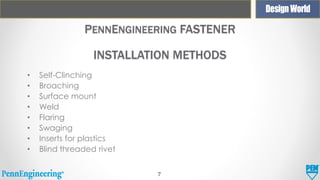
PENNENGINEERING FASTENER
INSTALLATION METHODS
•
•
•
•
•
•
•
•

Self-Clinching
Broaching
Surface mount
Weld
Flaring
Swaging
Inserts for plastics
Blind threaded rivet
7
PENNENGINEERING Technical Services
• On-Site training.
• Comprehensive website includes complete
fastener 3D modeling capabilities.
• Trained field technical representatives
• Global testing laboratories.
• Cost Savings Investigations (C.S.I.).
• Prototype development.
• Installation solutions.
8
What is the “micro” in microPEM?
•
•
•
•
•

Threads as small as M1.
Pin diameters as small as 1mm.
Standoff lengths as short as .040”/1mm.
Attach sheets as thin as .003”/0.08mm.
Clinching into sheets as thin as .012”/0.3mm.

Smaller products are in development.
9
Why so small?
We actively conduct Product Teardowns and CSI
reviews for our customers. We have found in our analysis and
investigations that they often need smaller and smaller clinch
fasteners for thinner and thinner panels, to replace the
adhesives, rivets or welds they have been using. This is driving
us to provide more assembly options for when they are
designing their next product.

1
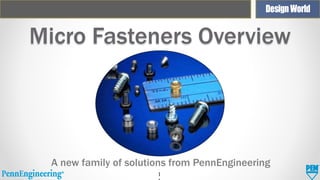
Micro Fasteners Overview

A new family of solutions from PennEngineering
1
MPP

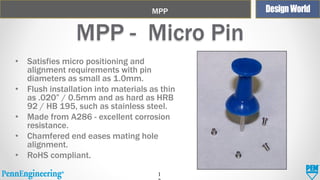
MPP - Micro Pin
• Satisfies micro positioning and
alignment requirements with pin
diameters as small as 1.0mm.
• Flush installation into materials as thin
as .020” / 0.5mm and as hard as HRB
92 / HB 195, such as stainless steel.
• Made from A286 - excellent corrosion
resistance.
• Chamfered end eases mating hole
alignment.
• RoHS compliant.
1
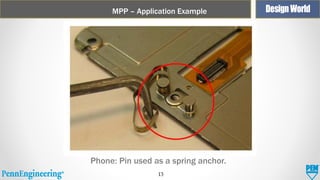
MPP – Application Example

Phone: Pin used as a spring anchor.
13
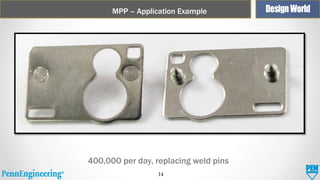
MPP – Application Example

400,000 per day, replacing weld pins
14
MSO4

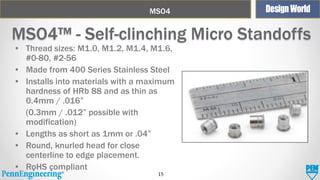
MSO4™ - Self-clinching Micro Standoffs
• Thread sizes: M1.0, M1.2, M1.4, M1.6,
#0-80, #2-56
• Made from 400 Series Stainless Steel
• Installs into materials with a maximum
hardness of HRb 88 and as thin as
0.4mm / .016”
(0.3mm / .012” possible with
modification)
• Lengths as short as 1mm or .04”
• Round, knurled head for close
centerline to edge placement.
• RoHS compliant
15
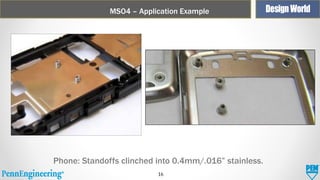
MSO4 – Application Example

Phone: Standoffs clinched into 0.4mm/.016” stainless.
16
MSO4 – Application Example

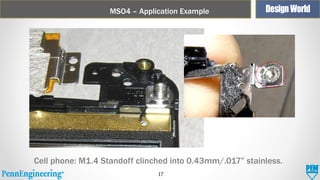
Cell phone: M1.4 Standoff clinched into 0.43mm/.017” stainless.
17
MSO4 – Application Example

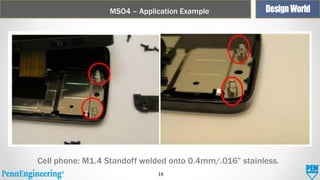
Cell phone: M1.4 Standoff welded onto 0.4mm/.016” stainless.
18
MSO4 – Application Example

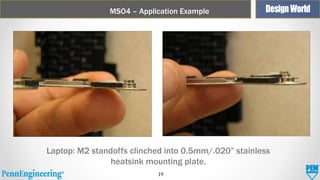
Laptop: M2 standoffs clinched into 0.5mm/.020” stainless
heatsink mounting plate.
19
MSOFA – Flaring Standoff – Application Example

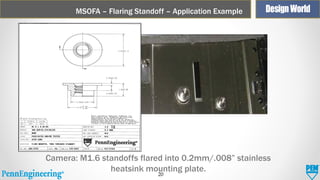
Camera: M1.6 standoffs flared into 0.2mm/.008” stainless
heatsink mounting plate.
20
SMTSO

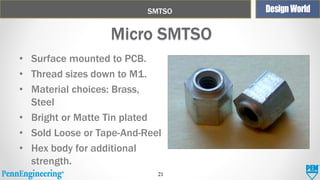
Micro SMTSO
• Surface mounted to PCB.
• Thread sizes down to M1.
• Material choices: Brass,
Steel
• Bright or Matte Tin plated
• Sold Loose or Tape-And-Reel
• Hex body for additional
strength.
21
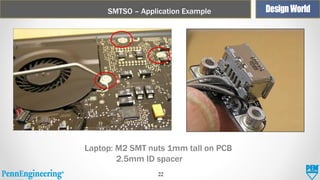
SMTSO – Application Example

Laptop: M2 SMT nuts 1mm tall on PCB
2.5mm ID spacer
22
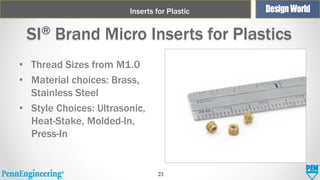
Inserts for Plastic

SI® Brand Micro Inserts for Plastics
• Thread Sizes from M1.0
• Material choices: Brass,
Stainless Steel
• Style Choices: Ultrasonic,
Heat-Stake, Molded-In,
Press-In

23
Do you use micro screws?
1.

Yes – only to hold an assembly together.

2.

Yes – to allow for disassembly and reassembly.
There are now two new engineered solutions.

24
Micro TackPin

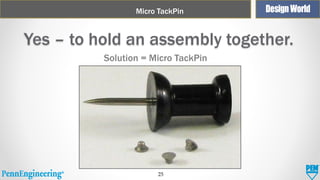
Yes – to hold an assembly together.
Solution = Micro TackPin

25
Micro TackPin

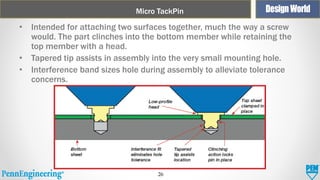
• Intended for attaching two surfaces together, much the way a screw
would. The part clinches into the bottom member while retaining the
top member with a head.
• Tapered tip assists in assembly into the very small mounting hole.
• Interference band sizes hole during assembly to alleviate tolerance
concerns.

26
Micro TackPin

27
Micro TackPin

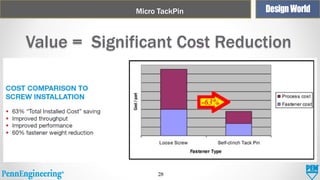
Value = Significant Cost Reduction

28
Micro TackPin – Application Example

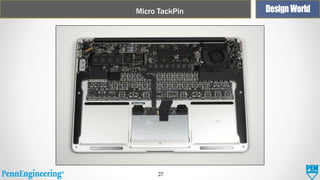
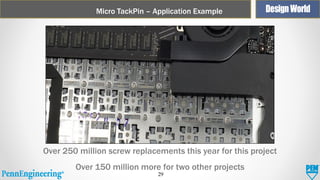
Over 250 million screw replacements this year for this project
Over 150 million more for two other projects
29
Micro TackPin – Application Example

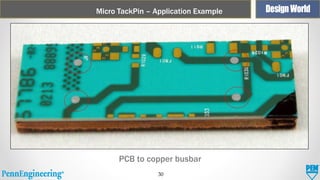
PCB to copper busbar
30
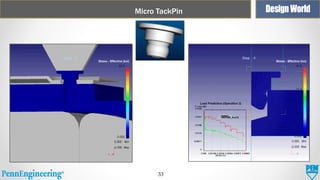
Micro TackPin

• What is the benefit to use a PEM® TackPin instead of a screw?
o The PEM® TackPin is stronger in pullout than the thread strength of a
screw of the same length.
o No risk of cross-threading.
o Less weight than a screw.
o Smaller than a screw, so designs can be thinner/smaller.
o No need for the cost of a nylon locking patch.

31
Micro TackPin

• What is the process cost savings?
Simplified assembly - press-in versus turned screw.
Throughput is faster.
No need to control torque settings to drive screws.
No scrap costs due to cross-threading, over installation, or screw
breakage during assembly.
o If adhesives are used, a PEM® TackPin can be used without any
recycling concerns that adhesives can cause.
o
o
o
o

32
Micro TackPin

33
Do you use micro screws?
1.

Yes – only to hold an assembly together.

2.

Yes – to allow for disassembly and reassembly.
There are now two new engineered solutions.

34
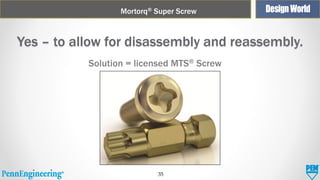
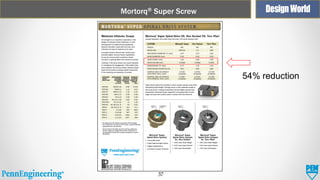
Mortorq® Super Screw

Yes – to allow for disassembly and reassembly.
Solution = licensed MTS® Screw

35
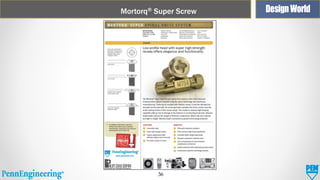
Mortorq® Super Screw

36
Mortorq® Super Screw

54% reduction

37
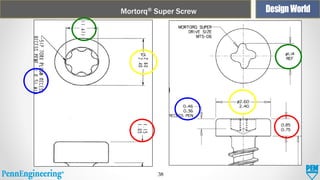
Mortorq® Super Screw

38
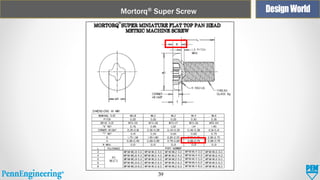
Mortorq® Super Screw

39
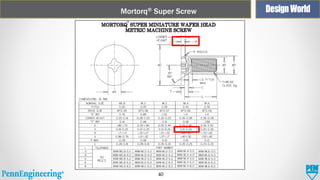
Mortorq® Super Screw

40
PennEngineering
microPEM™ Fastener Technology
Solving Assembly Challenges in Reduced Footprint Applications

41
Questions?
Ask a question by submitting it in the Questions tab in the GoToWebinar panel on the right of your screen

Design World

Leslie Langnau
llangnau@wtwhmedia.com
Phone: 440.234.4531
Twitter: @DW_RapidMfg

Penn Engineering

Jay McKenna
JMcKenna@pemnet.com
Phone: 215-766-8853 x1229
LinkedIn: linkedin.com/in/jaymckenna
Thank You
 This webinar will be available at designworldonline.com & email
 Tweet with hashtag #DWwebinar
 Connect with
 Twitter: @DesignWorld

 Facebook: /engineeringexchange
 LinkedIn: Design World Group
 YouTube: /designworldvideo

 Discuss this on EngineeringExchange.com
Solving Assembly Challenges in Reduced Footprint Applications

Solving Assembly Challenges in Reduced Footprint Applications

  • 1.
    Solving Assembly Challenges inReduced Footprint Applications
  • 2.
    Before We Start Thiswebinar will be available afterwards at designworldonline.com & email Q&A at the end of the presentation - Post your questions in questions box in gotowebinar panel on the right Hashtag for this webinar: #DWwebinar
  • 3.
  • 4.
    PennEngineering microPEM™ Fastener Technology Presentedby Jay McKenna Global Product Mgr – New and Micro Products Solving Assembly Challenges in Reduced Footprint Applications 5
  • 5.
    Who is PennEngineering? •Penn Engineering & Manufacturing Corp. (PEM) founded in 1942 in Doylestown, Pennsylvania, USA is the global leader in the design and manufacture of thin sheet fastening devices and installation systems. • PEM is the inventor and continues to be the sole manufacturer of genuine PEM® brand fasteners. • We currently have regional manufacturing and technical centers in two U.S. locations, Ireland and China. 6
  • 6.
  • 7.
    PENNENGINEERING Technical Services •On-Site training. • Comprehensive website includes complete fastener 3D modeling capabilities. • Trained field technical representatives • Global testing laboratories. • Cost Savings Investigations (C.S.I.). • Prototype development. • Installation solutions. 8
  • 8.
    What is the“micro” in microPEM? • • • • • Threads as small as M1. Pin diameters as small as 1mm. Standoff lengths as short as .040”/1mm. Attach sheets as thin as .003”/0.08mm. Clinching into sheets as thin as .012”/0.3mm. Smaller products are in development. 9
  • 9.
    Why so small? Weactively conduct Product Teardowns and CSI reviews for our customers. We have found in our analysis and investigations that they often need smaller and smaller clinch fasteners for thinner and thinner panels, to replace the adhesives, rivets or welds they have been using. This is driving us to provide more assembly options for when they are designing their next product. 1
  • 10.
    Micro Fasteners Overview Anew family of solutions from PennEngineering 1
  • 11.
    MPP MPP - MicroPin • Satisfies micro positioning and alignment requirements with pin diameters as small as 1.0mm. • Flush installation into materials as thin as .020” / 0.5mm and as hard as HRB 92 / HB 195, such as stainless steel. • Made from A286 - excellent corrosion resistance. • Chamfered end eases mating hole alignment. • RoHS compliant. 1
  • 12.
    MPP – ApplicationExample Phone: Pin used as a spring anchor. 13
  • 13.
    MPP – ApplicationExample 400,000 per day, replacing weld pins 14
  • 14.
    MSO4 MSO4™ - Self-clinchingMicro Standoffs • Thread sizes: M1.0, M1.2, M1.4, M1.6, #0-80, #2-56 • Made from 400 Series Stainless Steel • Installs into materials with a maximum hardness of HRb 88 and as thin as 0.4mm / .016” (0.3mm / .012” possible with modification) • Lengths as short as 1mm or .04” • Round, knurled head for close centerline to edge placement. • RoHS compliant 15
  • 15.
    MSO4 – ApplicationExample Phone: Standoffs clinched into 0.4mm/.016” stainless. 16
  • 16.
    MSO4 – ApplicationExample Cell phone: M1.4 Standoff clinched into 0.43mm/.017” stainless. 17
  • 17.
    MSO4 – ApplicationExample Cell phone: M1.4 Standoff welded onto 0.4mm/.016” stainless. 18
  • 18.
    MSO4 – ApplicationExample Laptop: M2 standoffs clinched into 0.5mm/.020” stainless heatsink mounting plate. 19
  • 19.
    MSOFA – FlaringStandoff – Application Example Camera: M1.6 standoffs flared into 0.2mm/.008” stainless heatsink mounting plate. 20
  • 20.
    SMTSO Micro SMTSO • Surfacemounted to PCB. • Thread sizes down to M1. • Material choices: Brass, Steel • Bright or Matte Tin plated • Sold Loose or Tape-And-Reel • Hex body for additional strength. 21
  • 21.
    SMTSO – ApplicationExample Laptop: M2 SMT nuts 1mm tall on PCB 2.5mm ID spacer 22
  • 22.
    Inserts for Plastic SI®Brand Micro Inserts for Plastics • Thread Sizes from M1.0 • Material choices: Brass, Stainless Steel • Style Choices: Ultrasonic, Heat-Stake, Molded-In, Press-In 23
  • 23.
    Do you usemicro screws? 1. Yes – only to hold an assembly together. 2. Yes – to allow for disassembly and reassembly. There are now two new engineered solutions. 24
  • 24.
    Micro TackPin Yes –to hold an assembly together. Solution = Micro TackPin 25
  • 25.
    Micro TackPin • Intendedfor attaching two surfaces together, much the way a screw would. The part clinches into the bottom member while retaining the top member with a head. • Tapered tip assists in assembly into the very small mounting hole. • Interference band sizes hole during assembly to alleviate tolerance concerns. 26
  • 26.
  • 27.
    Micro TackPin Value =Significant Cost Reduction 28
  • 28.
    Micro TackPin –Application Example Over 250 million screw replacements this year for this project Over 150 million more for two other projects 29
  • 29.
    Micro TackPin –Application Example PCB to copper busbar 30
  • 30.
    Micro TackPin • Whatis the benefit to use a PEM® TackPin instead of a screw? o The PEM® TackPin is stronger in pullout than the thread strength of a screw of the same length. o No risk of cross-threading. o Less weight than a screw. o Smaller than a screw, so designs can be thinner/smaller. o No need for the cost of a nylon locking patch. 31
  • 31.
    Micro TackPin • Whatis the process cost savings? Simplified assembly - press-in versus turned screw. Throughput is faster. No need to control torque settings to drive screws. No scrap costs due to cross-threading, over installation, or screw breakage during assembly. o If adhesives are used, a PEM® TackPin can be used without any recycling concerns that adhesives can cause. o o o o 32
  • 32.
  • 33.
    Do you usemicro screws? 1. Yes – only to hold an assembly together. 2. Yes – to allow for disassembly and reassembly. There are now two new engineered solutions. 34
  • 34.
    Mortorq® Super Screw Yes– to allow for disassembly and reassembly. Solution = licensed MTS® Screw 35
  • 35.
  • 36.
  • 37.
  • 38.
  • 39.
  • 40.
    PennEngineering microPEM™ Fastener Technology SolvingAssembly Challenges in Reduced Footprint Applications 41
  • 41.
    Questions? Ask a questionby submitting it in the Questions tab in the GoToWebinar panel on the right of your screen Design World Leslie Langnau llangnau@wtwhmedia.com Phone: 440.234.4531 Twitter: @DW_RapidMfg Penn Engineering Jay McKenna JMcKenna@pemnet.com Phone: 215-766-8853 x1229 LinkedIn: linkedin.com/in/jaymckenna
  • 42.
    Thank You  Thiswebinar will be available at designworldonline.com & email  Tweet with hashtag #DWwebinar  Connect with  Twitter: @DesignWorld  Facebook: /engineeringexchange  LinkedIn: Design World Group  YouTube: /designworldvideo  Discuss this on EngineeringExchange.com