JEETENDRA JHA
M.SC.MLT (BIOCHEMISTRY)
MASTER TRAINING OF TRAINERS (MTOT)
PRINCIPAL
NATIONAL INSTITUTE OF TECHNOLOGY
BIRATNAGAR-5, MORANG
Solution & Its Types
Definition
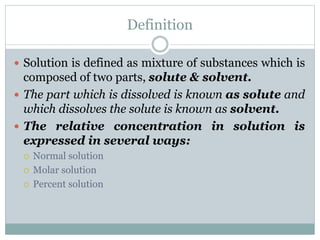
 Solution is defined as mixture of substances which is
composed of two parts, solute & solvent.
 The part which is dissolved is known as solute and
which dissolves the solute is known as solvent.
 The relative concentration in solution is
expressed in several ways:
 Normal solution
 Molar solution
 Percent solution
Normal Solution
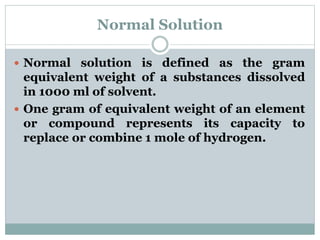
 Normal solution is defined as the gram
equivalent weight of a substances dissolved
in 1000 ml of solvent.
 One gram of equivalent weight of an element
or compound represents its capacity to
replace or combine 1 mole of hydrogen.
Equivalent Weight
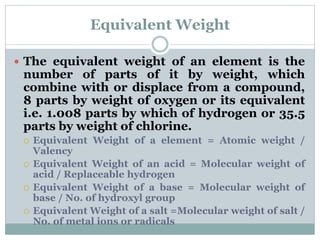
 The equivalent weight of an element is the
number of parts of it by weight, which
combine with or displace from a compound,
8 parts by weight of oxygen or its equivalent
i.e. 1.008 parts by which of hydrogen or 35.5
parts by weight of chlorine.
 Equivalent Weight of a element = Atomic weight /
Valency
 Equivalent Weight of an acid = Molecular weight of
acid / Replaceable hydrogen
 Equivalent Weight of a base = Molecular weight of
base / No. of hydroxyl group
 Equivalent Weight of a salt =Molecular weight of salt /
No. of metal ions or radicals
Molar Solution
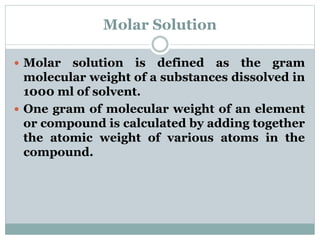
 Molar solution is defined as the gram
molecular weight of a substances dissolved in
1000 ml of solvent.
 One gram of molecular weight of an element
or compound is calculated by adding together
the atomic weight of various atoms in the
compound.
Percent Solution
 Percent solution is defined as a part of a
solute dissolved in 100 parts of a final
solution. The most frequently used in weight
per volume (w/v). e.g. 9% saline (9 gram /100
ml). There are 3 ways of expressing %
solution:
 W/W (Weight by Weight)
 W/V (Weight by Volume)
 V/V (Volume by Volume)
Osmosis
 Osmosis is defined as the movement of solvent
through a semi permeable membrane.
 The movement of solvent takes place from the lower
concentration to a higher concentration solution
when it is separated by semi permeable membrane.
 It is due to osmotic pressure.
 Osmotic pressure is defined as the excess pressure
that must be applied to a solution to prevent the
passage of solvent into the solution on separation
with semi permeable membrane.
Application of Osmosis
 Blood volume & fluid balance
 RBC and fragility
 Transfusion
 Osmotic dieresis
 Edema due to hypo-albuminemia
 Cerebral edema
 Irrigation of wounds
 Action of purgatives
Diffusion
 Diffusion is defined as the movement of solute
molecule from higher concentration to lower
concentration.
 The smaller particles diffuse faster than the larger
molecules hence gas diffuses more rapidly than
liquids.
 Diffusion occurs in gases as well as in colloidal
solution.
Application of diffusion
 Gases exchanges in lungs
 Absorption of nutrients from Gastero Intestinal
tracts.
 Passes of waste products in the renal tubules.
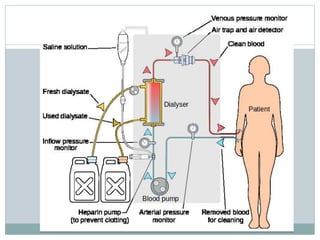
Dialysis
 Dialysis is a process for removing waste and excess
water from the blood, and is used primarily as an
artificial replacement for lost kidney function in
people with kidney failure.
 Dialysis may be used for those with an acute
disturbance in kidney function or progressive but
chronically worsening kidney function (chronic
kidney disease).
 Thank You
Home Work
 Define Solution? Explain about the expression of
concentration of solution?
 Define Normal solution?
 Define Molar Solution?
 Define Percent Solution?
 Prepare 500 ml Normal & Molar solution of
Sulphuric Acid of 5N & 6M concentration.
 Prepare 500 ml Percent solution of Sulphuric Acid.
 Define and differentiate Osmosis & Diffusion.
 Write in short about the dialysis.

Solution & Its Types.pptx

  • 1.
    JEETENDRA JHA M.SC.MLT (BIOCHEMISTRY) MASTERTRAINING OF TRAINERS (MTOT) PRINCIPAL NATIONAL INSTITUTE OF TECHNOLOGY BIRATNAGAR-5, MORANG Solution & Its Types
  • 2.
    Definition  Solution isdefined as mixture of substances which is composed of two parts, solute & solvent.  The part which is dissolved is known as solute and which dissolves the solute is known as solvent.  The relative concentration in solution is expressed in several ways:  Normal solution  Molar solution  Percent solution
  • 3.
    Normal Solution  Normalsolution is defined as the gram equivalent weight of a substances dissolved in 1000 ml of solvent.  One gram of equivalent weight of an element or compound represents its capacity to replace or combine 1 mole of hydrogen.
  • 4.
    Equivalent Weight  Theequivalent weight of an element is the number of parts of it by weight, which combine with or displace from a compound, 8 parts by weight of oxygen or its equivalent i.e. 1.008 parts by which of hydrogen or 35.5 parts by weight of chlorine.  Equivalent Weight of a element = Atomic weight / Valency  Equivalent Weight of an acid = Molecular weight of acid / Replaceable hydrogen  Equivalent Weight of a base = Molecular weight of base / No. of hydroxyl group  Equivalent Weight of a salt =Molecular weight of salt / No. of metal ions or radicals
  • 5.
    Molar Solution  Molarsolution is defined as the gram molecular weight of a substances dissolved in 1000 ml of solvent.  One gram of molecular weight of an element or compound is calculated by adding together the atomic weight of various atoms in the compound.
  • 6.
    Percent Solution  Percentsolution is defined as a part of a solute dissolved in 100 parts of a final solution. The most frequently used in weight per volume (w/v). e.g. 9% saline (9 gram /100 ml). There are 3 ways of expressing % solution:  W/W (Weight by Weight)  W/V (Weight by Volume)  V/V (Volume by Volume)
  • 7.
    Osmosis  Osmosis isdefined as the movement of solvent through a semi permeable membrane.  The movement of solvent takes place from the lower concentration to a higher concentration solution when it is separated by semi permeable membrane.  It is due to osmotic pressure.  Osmotic pressure is defined as the excess pressure that must be applied to a solution to prevent the passage of solvent into the solution on separation with semi permeable membrane.
  • 8.
    Application of Osmosis Blood volume & fluid balance  RBC and fragility  Transfusion  Osmotic dieresis  Edema due to hypo-albuminemia  Cerebral edema  Irrigation of wounds  Action of purgatives
  • 9.
    Diffusion  Diffusion isdefined as the movement of solute molecule from higher concentration to lower concentration.  The smaller particles diffuse faster than the larger molecules hence gas diffuses more rapidly than liquids.  Diffusion occurs in gases as well as in colloidal solution.
  • 10.
    Application of diffusion Gases exchanges in lungs  Absorption of nutrients from Gastero Intestinal tracts.  Passes of waste products in the renal tubules.
  • 11.
    Dialysis  Dialysis isa process for removing waste and excess water from the blood, and is used primarily as an artificial replacement for lost kidney function in people with kidney failure.  Dialysis may be used for those with an acute disturbance in kidney function or progressive but chronically worsening kidney function (chronic kidney disease).
  • 13.
  • 14.
    Home Work  DefineSolution? Explain about the expression of concentration of solution?  Define Normal solution?  Define Molar Solution?  Define Percent Solution?  Prepare 500 ml Normal & Molar solution of Sulphuric Acid of 5N & 6M concentration.  Prepare 500 ml Percent solution of Sulphuric Acid.  Define and differentiate Osmosis & Diffusion.  Write in short about the dialysis.