Biochemistry
for
B.Sc.Nursing
Proteins
BRAINSTROMING NOTES TO PRINT
Protein Review
 Derived from a greek word "Proteious" meaning
'holding the first place'.
 Swedish chemist Berzelius suggested the name
proteins to the group of organic compounds that are
utmost important to life.
 The occur in every part of the cell and constitute
about 50% of cellular dry weight.
 Proteins form the fundamental basis of structure and
function of life.
 Protein contains 20 different amino acids. Out of
these, 10 can be synthesized in our body from the
product formed from metabolism of carbohydrates.
The remaining 10 can be synthesized. We have to
obtain them from food proteins. These 10 are called
essential amino acids.
 Proteins are the basis of structure and
function of life. Composed of twenty amino
acids, the building blocks; organized into
primary, secondary, tertiary and quaternary
structure, containing carbon, hydrogen,
oxygen, nitrogen & sulphur.

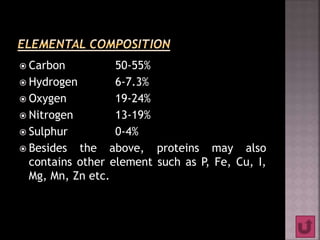
 Carbon 50-55%
 Hydrogen 6-7.3%
 Oxygen 19-24%
 Nitrogen 13-19%
 Sulphur 0-4%
 Besides the above, proteins may also
contains other element such as P, Fe, Cu, I,
Mg, Mn, Zn etc.
 Based on Functional Classification of proteins
 Based on Chemical nature and solubility
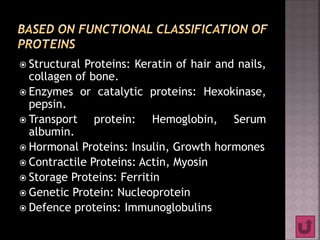
 Structural Proteins: Keratin of hair and nails,
collagen of bone.
 Enzymes or catalytic proteins: Hexokinase,
pepsin.
 Transport protein: Hemoglobin, Serum
albumin.
 Hormonal Proteins: Insulin, Growth hormones
 Contractile Proteins: Actin, Myosin
 Storage Proteins: Ferritin
 Genetic Protein: Nucleoprotein
 Defence proteins: Immunoglobulins
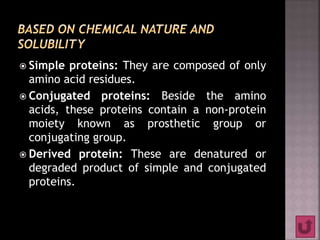
 Simple proteins: They are composed of only
amino acid residues.
 Conjugated proteins: Beside the amino
acids, these proteins contain a non-protein
moiety known as prosthetic group or
conjugating group.
 Derived protein: These are denatured or
degraded product of simple and conjugated
proteins.
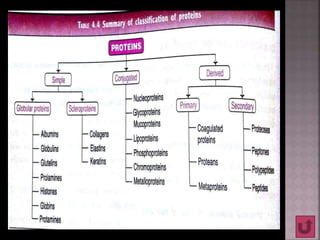
 Proteins that contains of only amino acids are termed as
simple protein.
 Albumin: soluble in water and dilute salt solution and
coagulated by heat.
 Globulin: soluble in neutral and dilute salt solution. E.g.
serum globuli, egg yolk
 Prolamines: soluble in alcohol. E.g gliadin (wheat), zein
(maize)
 Protamines: soluble in ammonium hydroxide. E.g. sperm
protein
 Histones: soluble in water and dilute acid. e.g. globin of
Hb & thymus histones.
 Scleroproteins: keratin (hair, horn, nail), collagen (bone,
skin), elastin (ligaments)
 Glutelin: soluble in dilute acid and alkalies and mostly
found in plant. E.g. glutenin (wheat), Oryzenin (rice).
 Proteins that contains amino acids and additional non-protein
part, are called as conjugated proteins. Non-protein part is also
called as prosthetic group. e.g.
 Nucleoproteins: Nucleic acid is the prosthetic group. E.g.
Nucleoprotamines & nucleohistones.
 Lipoproteins: Protein in combination with lipids as prosthetic
group. E.g. serum lipoproteins, membrane lipoproteins
 Glycoprotein: Protein with carbohydrates (less than 4%) as
prosthetic group. The term mucoprotein is used if carbohydrates
is more than 4%. E.g. Mucin, ovomucoid
 Phosphoproteins: Phosphoric acid as prosthetic group. E.g.
Caseinogen (Milk), Ovavitellin (egg yolk).
 Metalloproteins: these proteins contains metal ions such as Fe,
Zn, Co, Cu, Mg, etc. E.g. Siderophilin (Fe), Ceruloplasmin (Cu).
 Chromoproteins: THe prothetic group is colour in nature. E.g.
Haemoglobin, Cytochrome
 These are formed from high molecular weight
proteins by partial hydrolysis. E.g. Peptone and
gelatin. Gelatine is formed from collagen.
 Coagulated protein: Protein produced by agents
such as heat, acid, alkalies etc. e.g. cooked
protein, coagulated albumin
 Proteans: the earliest product of protein formed
by hydrolysis of enzyme, dilute acid, alkalies
etc. e.g. fibrin formed from fibrinogen.
 Metaproteins: the second stage product of
proteins hydrolysed by treatment with slightly
stronger acids and alkalies. E.g. acid and alkali
metaproteins.
 Non-Essential amino acids:
 Out of 20 amino acids, our body has the ability to
synthesize 10 of them. Even if they are absent in our
dietary proteins, our body can synthesize them. Hence
they are referred to as non-essential amino acids. They
are: Glycine, Alanine, Glutamate, Aspartate, Serine,
Asparagine, Cysteine, Glutamine, Proline, Tyrosine.
(G,A, G,A, S,A,C, G,P,T,)
 Essential amino acids:
 Out of 20 amino acids, our body cannot synthesize the
remaining 10 amino acids. We have to obtain them through
our food proteins. Hence, they are called as essential
amino acids. They are: Methionine, Arginine, Threonine,
Tryptophan, Valine, Isoleucine, Leucine, Phenylalanine,
Histidine, Lysine.(M,A,T,T,V,I,L,P,H,L,Y)
 The structure of proteins is complex which can be divided into four
levels of organization.
 Primary structure:
 The lineal sequence of amino acids forming the backbone of proteins.
E.g. pepsin, gastrin.
 Secondary structure:
 The special arrangement of proteins by twisting of the polypeptide chain.
E.g. collagen, keratin.
 Tertiary structure:
 The three dimensional structure of functional proteins. e.g.
nucleoproteins, myosin
 Quaternary structure:
 Some of the proteins are composed of two or more polypeptide chains
referred to s subunits, the special arrangement of these subunits is
known as quaternary structure.
 Physical
 Taste: They are tasteless. The hydrolytic products (derived proteins) are
bitter in taste.
 Odour: They are odourless. When heated to dryness they turn brown and
give off odour of burning feature.
 Solubility: Proteins form colloidal solution. This is due to huge size of
protein molecules.
 Molecular weight: They have a large molecular weights. (5,700-69,000)
 Shape: May be globular, fibrous or elongated.
 Hydration of proteins: Hydrated in presence of water and swells up
when electrolytes , alcohol or sugar that forms complexes with water are
added to protein solution.
 Protein plays a central role in cell functions and
cell structure.
 Proteins are necessary for the formation of
membranes, muscles and connective tissue.
 All enzymes are proteins.
 Many hormones are proteins.
 Many blood clotting factors are proteins.
 Antibodies which confer immunity against viral &
bacterial infections are proteins.
 Proteins carry (transport) compounds across cell
membrane.
 Protein functions as buffer to maintain pH of the
cells.

Protein

  • 1.
  • 2.
     Derived froma greek word "Proteious" meaning 'holding the first place'.  Swedish chemist Berzelius suggested the name proteins to the group of organic compounds that are utmost important to life.  The occur in every part of the cell and constitute about 50% of cellular dry weight.  Proteins form the fundamental basis of structure and function of life.  Protein contains 20 different amino acids. Out of these, 10 can be synthesized in our body from the product formed from metabolism of carbohydrates. The remaining 10 can be synthesized. We have to obtain them from food proteins. These 10 are called essential amino acids.
  • 3.
     Proteins arethe basis of structure and function of life. Composed of twenty amino acids, the building blocks; organized into primary, secondary, tertiary and quaternary structure, containing carbon, hydrogen, oxygen, nitrogen & sulphur. 
  • 4.
     Carbon 50-55% Hydrogen 6-7.3%  Oxygen 19-24%  Nitrogen 13-19%  Sulphur 0-4%  Besides the above, proteins may also contains other element such as P, Fe, Cu, I, Mg, Mn, Zn etc.
  • 5.
     Based onFunctional Classification of proteins  Based on Chemical nature and solubility
  • 6.
     Structural Proteins:Keratin of hair and nails, collagen of bone.  Enzymes or catalytic proteins: Hexokinase, pepsin.  Transport protein: Hemoglobin, Serum albumin.  Hormonal Proteins: Insulin, Growth hormones  Contractile Proteins: Actin, Myosin  Storage Proteins: Ferritin  Genetic Protein: Nucleoprotein  Defence proteins: Immunoglobulins
  • 7.
     Simple proteins:They are composed of only amino acid residues.  Conjugated proteins: Beside the amino acids, these proteins contain a non-protein moiety known as prosthetic group or conjugating group.  Derived protein: These are denatured or degraded product of simple and conjugated proteins.
  • 9.
     Proteins thatcontains of only amino acids are termed as simple protein.  Albumin: soluble in water and dilute salt solution and coagulated by heat.  Globulin: soluble in neutral and dilute salt solution. E.g. serum globuli, egg yolk  Prolamines: soluble in alcohol. E.g gliadin (wheat), zein (maize)  Protamines: soluble in ammonium hydroxide. E.g. sperm protein  Histones: soluble in water and dilute acid. e.g. globin of Hb & thymus histones.  Scleroproteins: keratin (hair, horn, nail), collagen (bone, skin), elastin (ligaments)  Glutelin: soluble in dilute acid and alkalies and mostly found in plant. E.g. glutenin (wheat), Oryzenin (rice).
  • 10.
     Proteins thatcontains amino acids and additional non-protein part, are called as conjugated proteins. Non-protein part is also called as prosthetic group. e.g.  Nucleoproteins: Nucleic acid is the prosthetic group. E.g. Nucleoprotamines & nucleohistones.  Lipoproteins: Protein in combination with lipids as prosthetic group. E.g. serum lipoproteins, membrane lipoproteins  Glycoprotein: Protein with carbohydrates (less than 4%) as prosthetic group. The term mucoprotein is used if carbohydrates is more than 4%. E.g. Mucin, ovomucoid  Phosphoproteins: Phosphoric acid as prosthetic group. E.g. Caseinogen (Milk), Ovavitellin (egg yolk).  Metalloproteins: these proteins contains metal ions such as Fe, Zn, Co, Cu, Mg, etc. E.g. Siderophilin (Fe), Ceruloplasmin (Cu).  Chromoproteins: THe prothetic group is colour in nature. E.g. Haemoglobin, Cytochrome
  • 11.
     These areformed from high molecular weight proteins by partial hydrolysis. E.g. Peptone and gelatin. Gelatine is formed from collagen.  Coagulated protein: Protein produced by agents such as heat, acid, alkalies etc. e.g. cooked protein, coagulated albumin  Proteans: the earliest product of protein formed by hydrolysis of enzyme, dilute acid, alkalies etc. e.g. fibrin formed from fibrinogen.  Metaproteins: the second stage product of proteins hydrolysed by treatment with slightly stronger acids and alkalies. E.g. acid and alkali metaproteins.
  • 12.
     Non-Essential aminoacids:  Out of 20 amino acids, our body has the ability to synthesize 10 of them. Even if they are absent in our dietary proteins, our body can synthesize them. Hence they are referred to as non-essential amino acids. They are: Glycine, Alanine, Glutamate, Aspartate, Serine, Asparagine, Cysteine, Glutamine, Proline, Tyrosine. (G,A, G,A, S,A,C, G,P,T,)  Essential amino acids:  Out of 20 amino acids, our body cannot synthesize the remaining 10 amino acids. We have to obtain them through our food proteins. Hence, they are called as essential amino acids. They are: Methionine, Arginine, Threonine, Tryptophan, Valine, Isoleucine, Leucine, Phenylalanine, Histidine, Lysine.(M,A,T,T,V,I,L,P,H,L,Y)
  • 13.
     The structureof proteins is complex which can be divided into four levels of organization.  Primary structure:  The lineal sequence of amino acids forming the backbone of proteins. E.g. pepsin, gastrin.  Secondary structure:  The special arrangement of proteins by twisting of the polypeptide chain. E.g. collagen, keratin.  Tertiary structure:  The three dimensional structure of functional proteins. e.g. nucleoproteins, myosin  Quaternary structure:  Some of the proteins are composed of two or more polypeptide chains referred to s subunits, the special arrangement of these subunits is known as quaternary structure.
  • 14.
     Physical  Taste:They are tasteless. The hydrolytic products (derived proteins) are bitter in taste.  Odour: They are odourless. When heated to dryness they turn brown and give off odour of burning feature.  Solubility: Proteins form colloidal solution. This is due to huge size of protein molecules.  Molecular weight: They have a large molecular weights. (5,700-69,000)  Shape: May be globular, fibrous or elongated.  Hydration of proteins: Hydrated in presence of water and swells up when electrolytes , alcohol or sugar that forms complexes with water are added to protein solution.
  • 15.
     Protein playsa central role in cell functions and cell structure.  Proteins are necessary for the formation of membranes, muscles and connective tissue.  All enzymes are proteins.  Many hormones are proteins.  Many blood clotting factors are proteins.  Antibodies which confer immunity against viral & bacterial infections are proteins.  Proteins carry (transport) compounds across cell membrane.  Protein functions as buffer to maintain pH of the cells.