SOLUTIONS to Theory Question 2
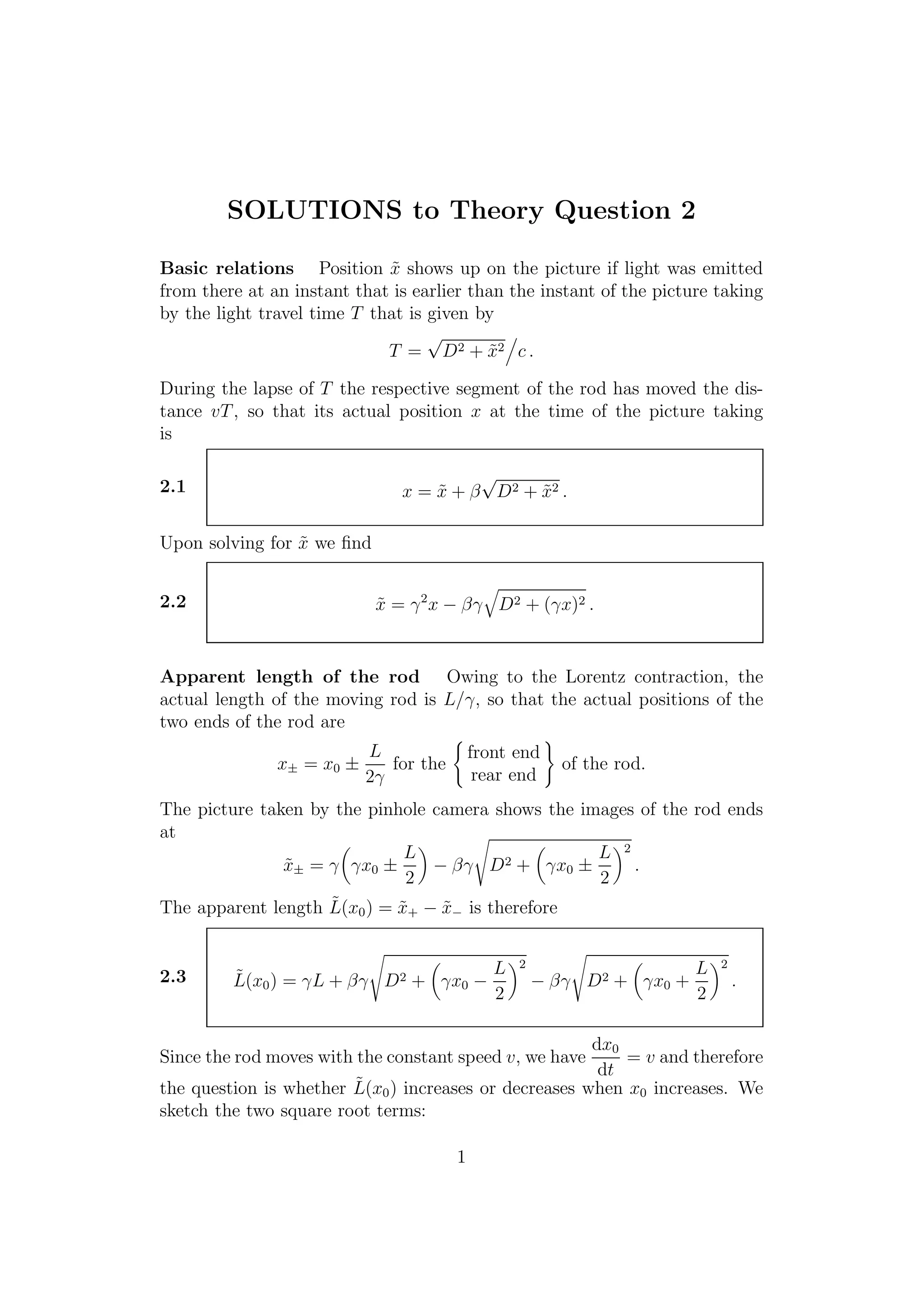
Basic relations Position ˜x shows up on the picture if light was emitted
from there at an instant that is earlier than the instant of the picture taking
by the light travel time T that is given by
T =
√
D2 + ˜x2 c .
During the lapse of T the respective segment of the rod has moved the dis-
tance vT, so that its actual position x at the time of the picture taking
is
2.1 x = ˜x + β
√
D2 + ˜x2 .
Upon solving for ˜x we find
2.2 ˜x = γ2
x − βγ D2 + (γx)2 .
Apparent length of the rod Owing to the Lorentz contraction, the
actual length of the moving rod is L/γ, so that the actual positions of the
two ends of the rod are
x± = x0 ±
L
2γ
for the
front end
rear end
of the rod.
The picture taken by the pinhole camera shows the images of the rod ends
at
˜x± = γ γx0 ±
L
2
− βγ D2 + γx0 ±
L
2
2
.
The apparent length ˜L(x0) = ˜x+ − ˜x− is therefore
2.3 ˜L(x0) = γL + βγ D2 + γx0 −
L
2
2
− βγ D2 + γx0 +
L
2
2
.
Since the rod moves with the constant speed v, we have
dx0
dt
= v and therefore
the question is whether ˜L(x0) increases or decreases when x0 increases. We
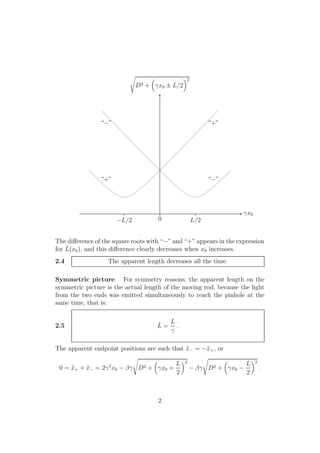
sketch the two square root terms:
1
. ............................................................................................................................................................................................................................................................................................................................................................................................................................................................................................................................................................................................................................................................................................................................................................................................................................................................................................................................ ...................... γx0
.
.........................................................................................................................................................................................................................................................................................................................................................................................................................................................................................................................................................................................................................................................................................
.
...........
..........
D2 + γx0 ± L/2
2
0
.
.........
L/2
.
.........
−L/2
“−”
“+”
“+”
“−”
The difference of the square roots with “−” and “+” appears in the expression
for ˜L(x0), and this difference clearly decreases when x0 increases.
2.4 The apparent length decreases all the time.
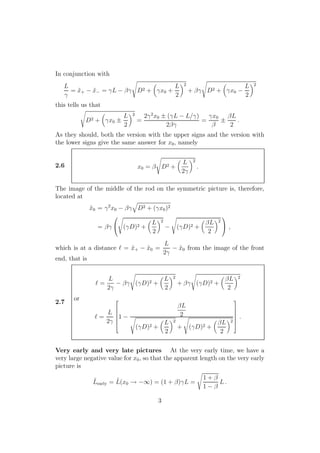
Symmetric picture For symmetry reasons, the apparent length on the
symmetric picture is the actual length of the moving rod, because the light
from the two ends was emitted simultaneously to reach the pinhole at the
same time, that is:
2.5 ˜L =
L
γ
.
The apparent endpoint positions are such that ˜x− = −˜x+, or
0 = ˜x+ + ˜x− = 2γ2
x0 − βγ D2 + γx0 +
L
2
2
− βγ D2 + γx0 −
L
2
2
.
2
In conjunction with
L
γ
= ˜x+ − ˜x− = γL − βγ D2 + γx0 +
L
2
2
+ βγ D2 + γx0 −
L
2
2
this tells us that
D2 + γx0 ±
L
2
2
=
2γ2
x0 ± (γL − L/γ)
2βγ
=
γx0
β
±
βL
2
.
As they should, both the version with the upper signs and the version with
the lower signs give the same answer for x0, namely
2.6 x0 = β D2 +
L
2γ
2
.
The image of the middle of the rod on the symmetric picture is, therefore,
located at
˜x0 = γ2
x0 − βγ D2 + (γx0)2
= βγ

 (γD)2 +
L
2
2
− (γD)2 +
βL
2
2

 ,
which is at a distance ℓ = ˜x+ − ˜x0 =
L
2γ
− ˜x0 from the image of the front
end, that is
2.7
ℓ =
L
2γ
− βγ (γD)2 +
L
2
2
+ βγ (γD)2 +
βL
2
2
or
ℓ =
L
2γ






1 −
βL
2
(γD)2 +
L
2
2
+ (γD)2 +
βL
2
2






.
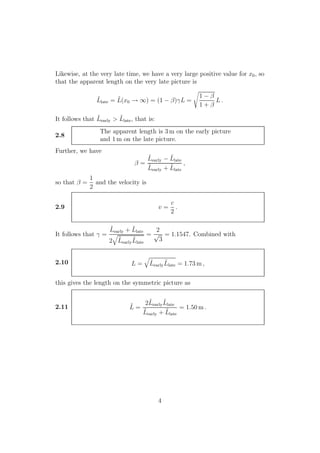
Very early and very late pictures At the very early time, we have a
very large negative value for x0, so that the apparent length on the very early
picture is
˜Learly = ˜L(x0 → −∞) = (1 + β)γL =
1 + β
1 − β
L .
3
Likewise, at the very late time, we have a very large positive value for x0, so
that the apparent length on the very late picture is
˜Llate = ˜L(x0 → ∞) = (1 − β)γL =
1 − β
1 + β
L .
It follows that ˜Learly > ˜Llate, that is:
2.8
The apparent length is 3 m on the early picture
and 1 m on the late picture.
Further, we have
β =
˜Learly − ˜Llate
˜Learly + ˜Llate
,
so that β =
1
2
and the velocity is
2.9 v =
c
2
.
It follows that γ =
˜Learly + ˜Llate
2 ˜Learly
˜Llate
=
2
√
3
= 1.1547. Combined with
2.10 L = ˜Learly
˜Llate = 1.73 m ,
this gives the length on the symmetric picture as
2.11 ˜L =
2˜Learly
˜Llate
˜Learly + ˜Llate
= 1.50 m .
4

Solution 2 i ph o 37

  • 1.
    SOLUTIONS to TheoryQuestion 2 Basic relations Position ˜x shows up on the picture if light was emitted from there at an instant that is earlier than the instant of the picture taking by the light travel time T that is given by T = √ D2 + ˜x2 c . During the lapse of T the respective segment of the rod has moved the dis- tance vT, so that its actual position x at the time of the picture taking is 2.1 x = ˜x + β √ D2 + ˜x2 . Upon solving for ˜x we find 2.2 ˜x = γ2 x − βγ D2 + (γx)2 . Apparent length of the rod Owing to the Lorentz contraction, the actual length of the moving rod is L/γ, so that the actual positions of the two ends of the rod are x± = x0 ± L 2γ for the front end rear end of the rod. The picture taken by the pinhole camera shows the images of the rod ends at ˜x± = γ γx0 ± L 2 − βγ D2 + γx0 ± L 2 2 . The apparent length ˜L(x0) = ˜x+ − ˜x− is therefore 2.3 ˜L(x0) = γL + βγ D2 + γx0 − L 2 2 − βγ D2 + γx0 + L 2 2 . Since the rod moves with the constant speed v, we have dx0 dt = v and therefore the question is whether ˜L(x0) increases or decreases when x0 increases. We sketch the two square root terms: 1
  • 2.
    . ............................................................................................................................................................................................................................................................................................................................................................................................................................................................................................................................................................................................................................................................................................................................................................................................................................................................................................................................ ......................γx0 . ......................................................................................................................................................................................................................................................................................................................................................................................................................................................................................................................................................................................................................................................................................... . ........... .......... D2 + γx0 ± L/2 2 0 . ......... L/2 . ......... −L/2 “−” “+” “+” “−” The difference of the square roots with “−” and “+” appears in the expression for ˜L(x0), and this difference clearly decreases when x0 increases. 2.4 The apparent length decreases all the time. Symmetric picture For symmetry reasons, the apparent length on the symmetric picture is the actual length of the moving rod, because the light from the two ends was emitted simultaneously to reach the pinhole at the same time, that is: 2.5 ˜L = L γ . The apparent endpoint positions are such that ˜x− = −˜x+, or 0 = ˜x+ + ˜x− = 2γ2 x0 − βγ D2 + γx0 + L 2 2 − βγ D2 + γx0 − L 2 2 . 2
  • 3.
    In conjunction with L γ =˜x+ − ˜x− = γL − βγ D2 + γx0 + L 2 2 + βγ D2 + γx0 − L 2 2 this tells us that D2 + γx0 ± L 2 2 = 2γ2 x0 ± (γL − L/γ) 2βγ = γx0 β ± βL 2 . As they should, both the version with the upper signs and the version with the lower signs give the same answer for x0, namely 2.6 x0 = β D2 + L 2γ 2 . The image of the middle of the rod on the symmetric picture is, therefore, located at ˜x0 = γ2 x0 − βγ D2 + (γx0)2 = βγ   (γD)2 + L 2 2 − (γD)2 + βL 2 2   , which is at a distance ℓ = ˜x+ − ˜x0 = L 2γ − ˜x0 from the image of the front end, that is 2.7 ℓ = L 2γ − βγ (γD)2 + L 2 2 + βγ (γD)2 + βL 2 2 or ℓ = L 2γ       1 − βL 2 (γD)2 + L 2 2 + (γD)2 + βL 2 2       . Very early and very late pictures At the very early time, we have a very large negative value for x0, so that the apparent length on the very early picture is ˜Learly = ˜L(x0 → −∞) = (1 + β)γL = 1 + β 1 − β L . 3
  • 4.
    Likewise, at thevery late time, we have a very large positive value for x0, so that the apparent length on the very late picture is ˜Llate = ˜L(x0 → ∞) = (1 − β)γL = 1 − β 1 + β L . It follows that ˜Learly > ˜Llate, that is: 2.8 The apparent length is 3 m on the early picture and 1 m on the late picture. Further, we have β = ˜Learly − ˜Llate ˜Learly + ˜Llate , so that β = 1 2 and the velocity is 2.9 v = c 2 . It follows that γ = ˜Learly + ˜Llate 2 ˜Learly ˜Llate = 2 √ 3 = 1.1547. Combined with 2.10 L = ˜Learly ˜Llate = 1.73 m , this gives the length on the symmetric picture as 2.11 ˜L = 2˜Learly ˜Llate ˜Learly + ˜Llate = 1.50 m . 4