Solid-State Thermal
Management and Energy
Harvesting
Why Solid-State Thermoelectric Heating and
Cooling?
Created by Mr. JASIM ASHRAF
+91-9351346301
Slide Title
• Applications
We believe there are limitless applications for solid-
state heating and cooling. Below are just a few that
are currently in use or being investigated.
What is solid-state thermoelectric technology
and how does it work?
Solid-state thermoelectric heating and cooling
technology is also known as Peltier cooling.
Sometimes it is abbreviated TEC (Thermo-Electric
Cooling) and TED (Thermo-Electric Device)
technology.
How does it work?
Solid-state thermoelectric devices use
multiple semiconductor couples sandwiched
between two ceramic plates. These couples
are usually connected electrically in series.
These devices are powered by electrical
current. Electrical current "pumps" heat
from one side of the device to the other. This
creates a hot side and a cold side. The heat
flow is reversible by reversing the direction
of electrical current. The magnitude of heat
flow is adjustable by varying the amount of
electrical current.
Why solid-state thermoelectric
thermal management?
With recent materials science advances,
solid-state thermoelectric heating and
cooling has started to transform the heating
and cooling and thermal management
industry in a similar way that solid-state
electronics has transformed the electronics
industry and our world.
Applications for solid-state heating
and cooling.
• Solid-State refrigerators
• Heated and cooled mattresses
• Wine bottle coolers
• Telecom devices
• Thermal therapy devices
• Electronics and Peltier CPU cooling
• Thermoelectric battery thermal management
• Electronics kiosk cooling
• Zonal thermoelectric climate control
• Heated and cooled vehicle seats
• Beverage heating and cooling
• Thermoelectric Office chairs
• Mini In-vehicle peltier refrigerators
Advantages of Solid-State
Thermoelectric Thermal Management
Technology
1. Solid-state
There are no moving parts. This means solid-
state thermoelectric technology has higher
reliability which leads to happier customers and
increased profits.
2. No Greenhouse Gases Required
Unlike compressor based conventional cooling
systems, solid-state thermoelectric heating and
cooling does not require expensive refrigerants.
3. Scalability
Systems can be scaled from less than one
watt of cooling power up to kilowatts.
The ability to scale thermoelectric
thermal management systems offers a
much wider range of market share
opportunities compared with systems
that are not scalable. Common
components can be used for large and
small scale systems. This results in
reduced manufacturing and design costs.
4. Efficiency
Solid-state systems have the potential to operate
at much higher efficiency (COP) than competing
technology. Further efficiency gains can be
obtained by using the devices for spot or
distributed cooling rather than cooling an entire
enclosure which is common with conventional
technology. Customers want efficient products.
5. Cooling and Heating in One Device
Unlike compressor based systems, solid-state
devices can heat and cool from the same device
with a simple switch in the direction of electrical
current. This leads to simpler designs with less
parts to break and fewer warranty claims from
customers
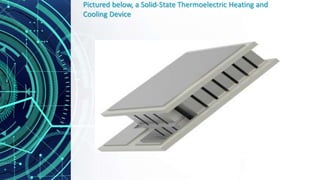
Pictured below, a Solid-State Thermoelectric Heating and
Cooling Device
6. Precise Temperature Control
Solid-state thermoelectric devices excel at precise
temperature control. This makes possible products
that are out of reach with conventional compressor
based systems that are more difficult to control.
7. Below Ambient Cooling
The ability to control temperature to below
ambient allows food to last longer, drinks to feel
colder, batteries to last longer, CPU's to run cooler
and at higher performance, better human thermal
comfort, longer life electronics and safer medicine
storage. All of these result in benefits customers
need and want.
8. Silent Operation
With solid-state technology, there will be no
noise complaints as there are with
conventional vibrating compressor
technology. Customers will leave better
reviews for your product.
9. Mountable in Any Orientation
Since there is no refrigerant or moving
parts, solid-state thermoelectric devices can
be mounted in any orientation. This leads to
greater design flexibility and a wider range of
applications that can keep up with your
creativity.
Slide Title
Product A
• Feature 1
• Feature 2
• Feature 3
Product B
• Feature 1
• Feature 2
• Feature 3
Solid-State Thermal Management and Energy Harvesting

Solid-State Thermal Management and Energy Harvesting

  • 1.
    Solid-State Thermal Management andEnergy Harvesting Why Solid-State Thermoelectric Heating and Cooling? Created by Mr. JASIM ASHRAF +91-9351346301
  • 2.
    Slide Title • Applications Webelieve there are limitless applications for solid- state heating and cooling. Below are just a few that are currently in use or being investigated.
  • 3.
    What is solid-statethermoelectric technology and how does it work? Solid-state thermoelectric heating and cooling technology is also known as Peltier cooling. Sometimes it is abbreviated TEC (Thermo-Electric Cooling) and TED (Thermo-Electric Device) technology.
  • 4.
    How does itwork? Solid-state thermoelectric devices use multiple semiconductor couples sandwiched between two ceramic plates. These couples are usually connected electrically in series. These devices are powered by electrical current. Electrical current "pumps" heat from one side of the device to the other. This creates a hot side and a cold side. The heat flow is reversible by reversing the direction of electrical current. The magnitude of heat flow is adjustable by varying the amount of electrical current.
  • 5.
    Why solid-state thermoelectric thermalmanagement? With recent materials science advances, solid-state thermoelectric heating and cooling has started to transform the heating and cooling and thermal management industry in a similar way that solid-state electronics has transformed the electronics industry and our world.
  • 6.
    Applications for solid-stateheating and cooling. • Solid-State refrigerators • Heated and cooled mattresses • Wine bottle coolers • Telecom devices • Thermal therapy devices • Electronics and Peltier CPU cooling • Thermoelectric battery thermal management • Electronics kiosk cooling • Zonal thermoelectric climate control • Heated and cooled vehicle seats • Beverage heating and cooling • Thermoelectric Office chairs • Mini In-vehicle peltier refrigerators
  • 7.
    Advantages of Solid-State ThermoelectricThermal Management Technology 1. Solid-state There are no moving parts. This means solid- state thermoelectric technology has higher reliability which leads to happier customers and increased profits. 2. No Greenhouse Gases Required Unlike compressor based conventional cooling systems, solid-state thermoelectric heating and cooling does not require expensive refrigerants.
  • 8.
    3. Scalability Systems canbe scaled from less than one watt of cooling power up to kilowatts. The ability to scale thermoelectric thermal management systems offers a much wider range of market share opportunities compared with systems that are not scalable. Common components can be used for large and small scale systems. This results in reduced manufacturing and design costs.
  • 9.
    4. Efficiency Solid-state systemshave the potential to operate at much higher efficiency (COP) than competing technology. Further efficiency gains can be obtained by using the devices for spot or distributed cooling rather than cooling an entire enclosure which is common with conventional technology. Customers want efficient products. 5. Cooling and Heating in One Device Unlike compressor based systems, solid-state devices can heat and cool from the same device with a simple switch in the direction of electrical current. This leads to simpler designs with less parts to break and fewer warranty claims from customers
  • 10.
    Pictured below, aSolid-State Thermoelectric Heating and Cooling Device
  • 11.
    6. Precise TemperatureControl Solid-state thermoelectric devices excel at precise temperature control. This makes possible products that are out of reach with conventional compressor based systems that are more difficult to control. 7. Below Ambient Cooling The ability to control temperature to below ambient allows food to last longer, drinks to feel colder, batteries to last longer, CPU's to run cooler and at higher performance, better human thermal comfort, longer life electronics and safer medicine storage. All of these result in benefits customers need and want.
  • 13.
    8. Silent Operation Withsolid-state technology, there will be no noise complaints as there are with conventional vibrating compressor technology. Customers will leave better reviews for your product. 9. Mountable in Any Orientation Since there is no refrigerant or moving parts, solid-state thermoelectric devices can be mounted in any orientation. This leads to greater design flexibility and a wider range of applications that can keep up with your creativity.
  • 14.
    Slide Title Product A •Feature 1 • Feature 2 • Feature 3 Product B • Feature 1 • Feature 2 • Feature 3