National 3
Chemistry
Online learning
Lesson 1- Learning intentions
• I can state what matter is
• I can state what the three states of matter are
• I can describe the particles of the three states
• I can describe the difference between the states.
Previous Lesson’s
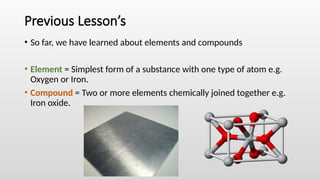
• So far, we have learned about elements and compounds
• Element = Simplest form of a substance with one type of atom e.g.
Oxygen or Iron.
• Compound = Two or more elements chemically joined together e.g.
Iron oxide.
Today’s Lesson
• Today we look at what states we can find those elements and
compounds in.
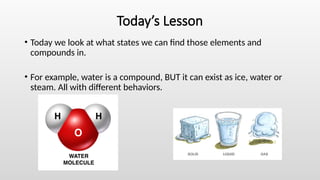
• For example, water is a compound, BUT it can exist as ice, water or
steam. All with different behaviors.
What is Matter?
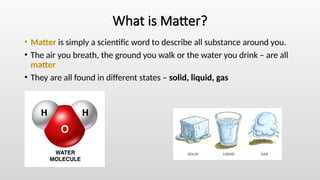
• Matter is simply a scientific word to describe all substance around you.
• The air you breath, the ground you walk or the water you drink – are all
matter
• They are all found in different states – solid, liquid, gas
Physical Change or Chemical?
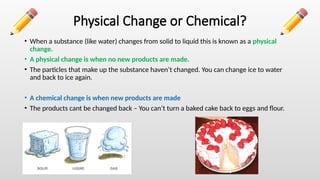
• When a substance (like water) changes from solid to liquid this is known as a physical
change.
• A physical change is when no new products are made.
• The particles that make up the substance haven’t changed. You can change ice to water
and back to ice again.
• A chemical change is when new products are made
• The products cant be changed back – You can’t turn a baked cake back to eggs and flour.
The first state- Solid
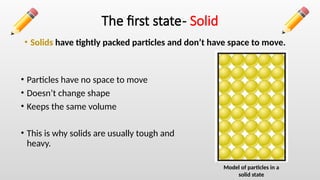
• Solids have tightly packed particles and don’t have space to move.
• Particles have no space to move
• Doesn’t change shape
• Keeps the same volume
• This is why solids are usually tough and
heavy.
Model of particles in a
solid state
The first state- Liquid
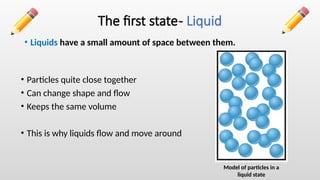
• Liquids have a small amount of space between them.
• Particles quite close together
• Can change shape and flow
• Keeps the same volume
• This is why liquids flow and move around
Model of particles in a
liquid state
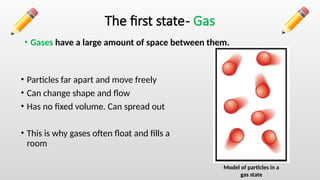
The first state- Gas
• Gases have a large amount of space between them.
• Particles far apart and move freely
• Can change shape and flow
• Has no fixed volume. Can spread out
• This is why gases often float and fills a
room
Model of particles in a
gas state
Videos – Easier to visualise
• States of matter
• https://www.youtube.com/watch?v=21CR01rlmv4
Practice Questions
• What state of matter would you find wood in?
• Solid
• Why does water flow?
• Because the particles have space between them and have room to
move easily.
• Is frying an egg a chemical change or a physical change? Why do you
think that?
• Chemical change, because you can’t uncook an egg back to the clear
liquid egg

Solid, Liquid, Gases Early Years Powerpoint

  • 1.
  • 2.
    Lesson 1- Learningintentions • I can state what matter is • I can state what the three states of matter are • I can describe the particles of the three states • I can describe the difference between the states.
  • 3.
    Previous Lesson’s • Sofar, we have learned about elements and compounds • Element = Simplest form of a substance with one type of atom e.g. Oxygen or Iron. • Compound = Two or more elements chemically joined together e.g. Iron oxide.
  • 4.
    Today’s Lesson • Todaywe look at what states we can find those elements and compounds in. • For example, water is a compound, BUT it can exist as ice, water or steam. All with different behaviors.
  • 5.
    What is Matter? •Matter is simply a scientific word to describe all substance around you. • The air you breath, the ground you walk or the water you drink – are all matter • They are all found in different states – solid, liquid, gas
  • 6.
    Physical Change orChemical? • When a substance (like water) changes from solid to liquid this is known as a physical change. • A physical change is when no new products are made. • The particles that make up the substance haven’t changed. You can change ice to water and back to ice again. • A chemical change is when new products are made • The products cant be changed back – You can’t turn a baked cake back to eggs and flour.
  • 7.
    The first state-Solid • Solids have tightly packed particles and don’t have space to move. • Particles have no space to move • Doesn’t change shape • Keeps the same volume • This is why solids are usually tough and heavy. Model of particles in a solid state
  • 8.
    The first state-Liquid • Liquids have a small amount of space between them. • Particles quite close together • Can change shape and flow • Keeps the same volume • This is why liquids flow and move around Model of particles in a liquid state
  • 9.
    The first state-Gas • Gases have a large amount of space between them. • Particles far apart and move freely • Can change shape and flow • Has no fixed volume. Can spread out • This is why gases often float and fills a room Model of particles in a gas state
  • 10.
    Videos – Easierto visualise • States of matter • https://www.youtube.com/watch?v=21CR01rlmv4
  • 11.
    Practice Questions • Whatstate of matter would you find wood in? • Solid • Why does water flow? • Because the particles have space between them and have room to move easily. • Is frying an egg a chemical change or a physical change? Why do you think that? • Chemical change, because you can’t uncook an egg back to the clear liquid egg