Dr.A. Pushparaj,
Assistant Professor of Zoology,
T.D.M.N.S. College,
T. Kallikulam.
Department of Zoology
Non Major Elective – Public Health & Hygiene
II Physics, II Chemistry & II Botany - EVEN Semester
Introduction
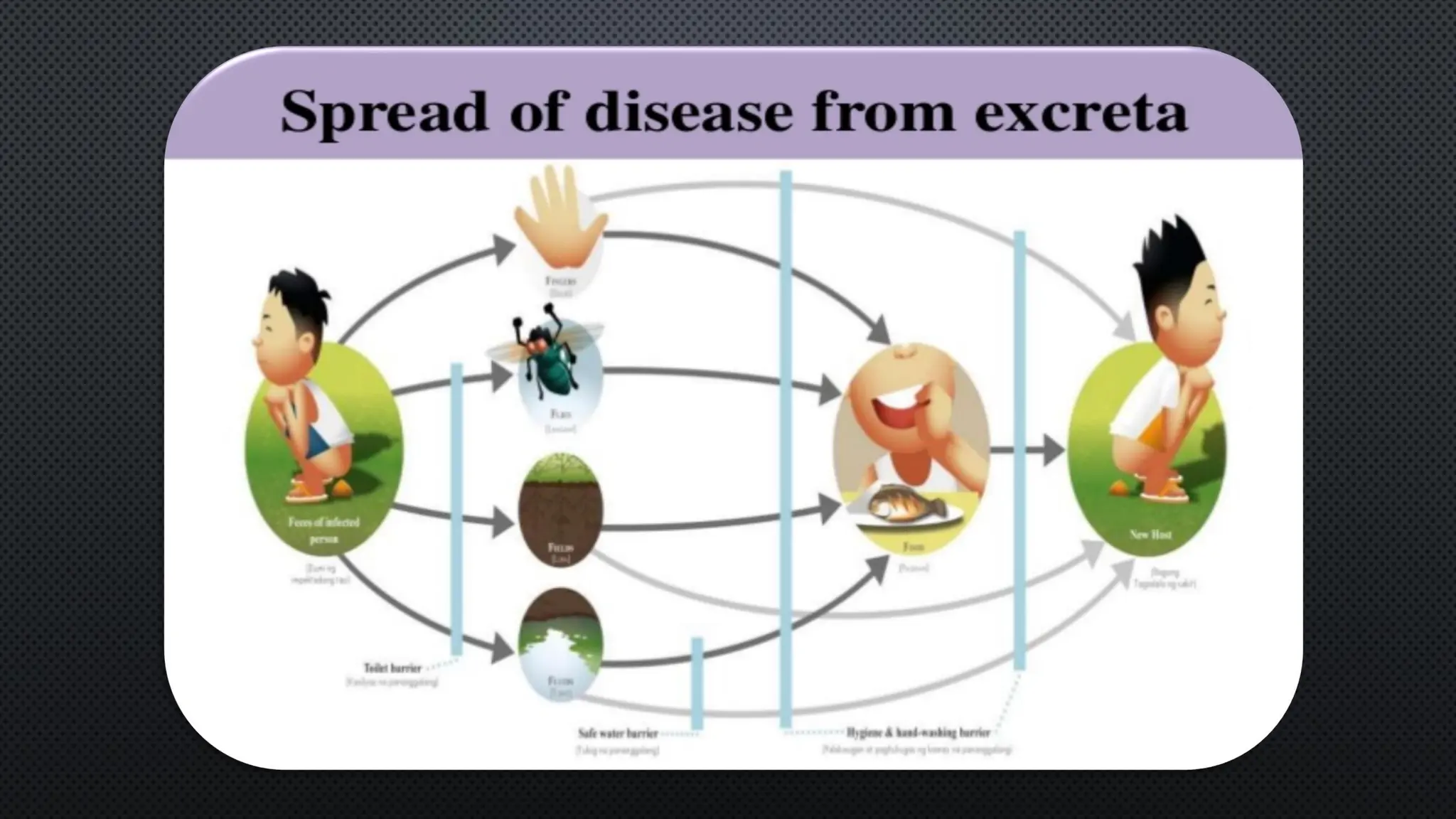
• Human excreta is a source of infection.
• Improper excreta disposal has various health hazards.
• Soil pollution, water pollution, diseases spread by
faecal ‐ oral route
• Disposal of human excreta assumes greater
importance.
In India
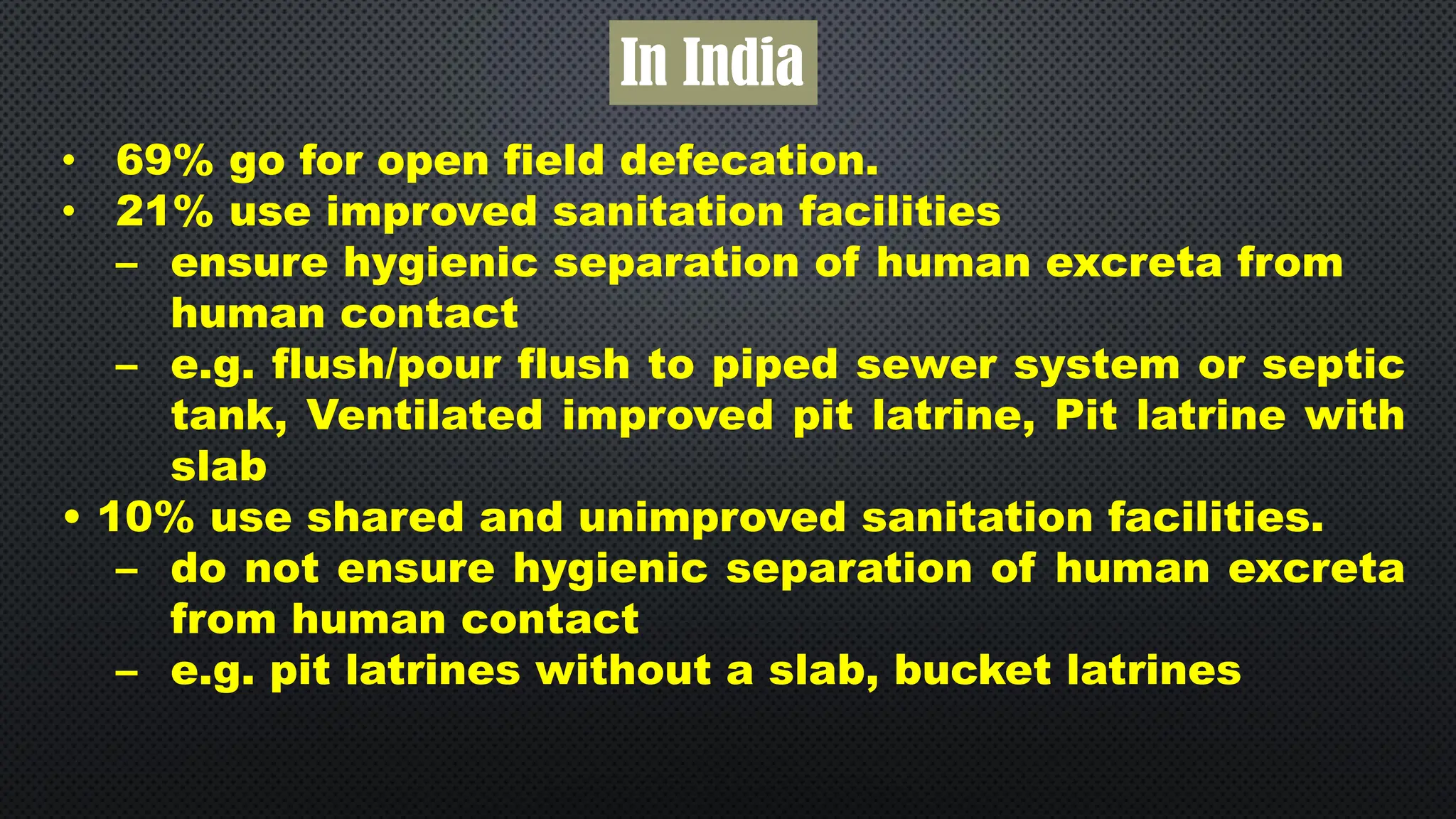
• 69% go for open field defecation.
• 21% use improved sanitation facilities
– ensure hygienic separation of human excreta from
human contact
– e.g. flush/pour flush to piped sewer system or septic
tank, Ventilated improved pit latrine, Pit latrine with
slab
• 10% use shared and unimproved sanitation facilities.
– do not ensure hygienic separation of human excreta
from human contact
– e.g. pit latrines without a slab, bucket latrines
Methods of excreta disposal
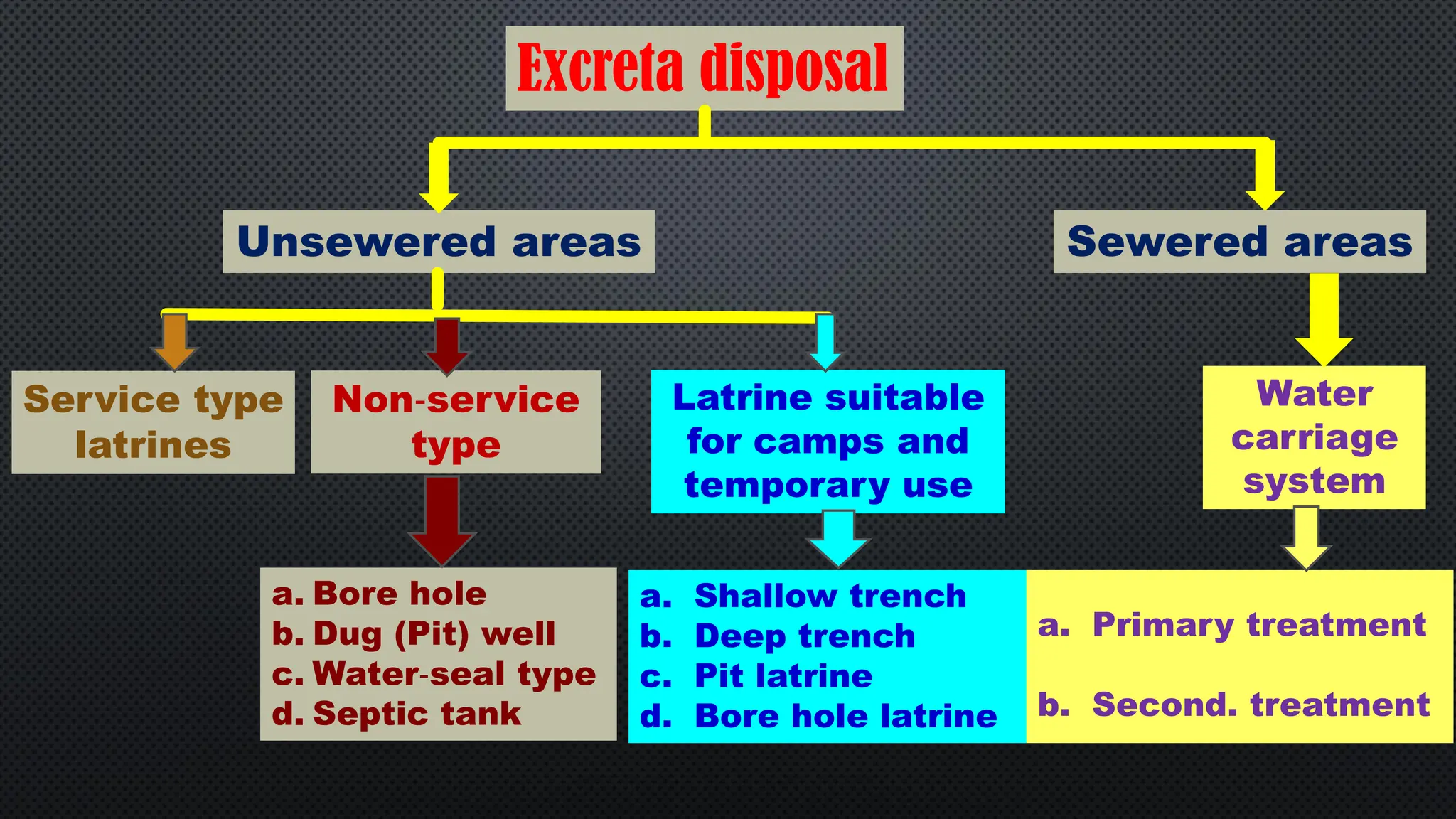
Unsewered areas
Excreta disposal
Sewered areas
Service type
latrines
Non‐service
type
Latrine suitable
for camps and
temporary use
Water
carriage
system
a. Bore hole
b. Dug (Pit) well
c. Water‐seal type
d. Septic tank
a. Shallow trench
b. Deep trench
c. Pit latrine
d. Bore hole latrine
a. Primary treatment
b. Second. treatment
Service type Latrines
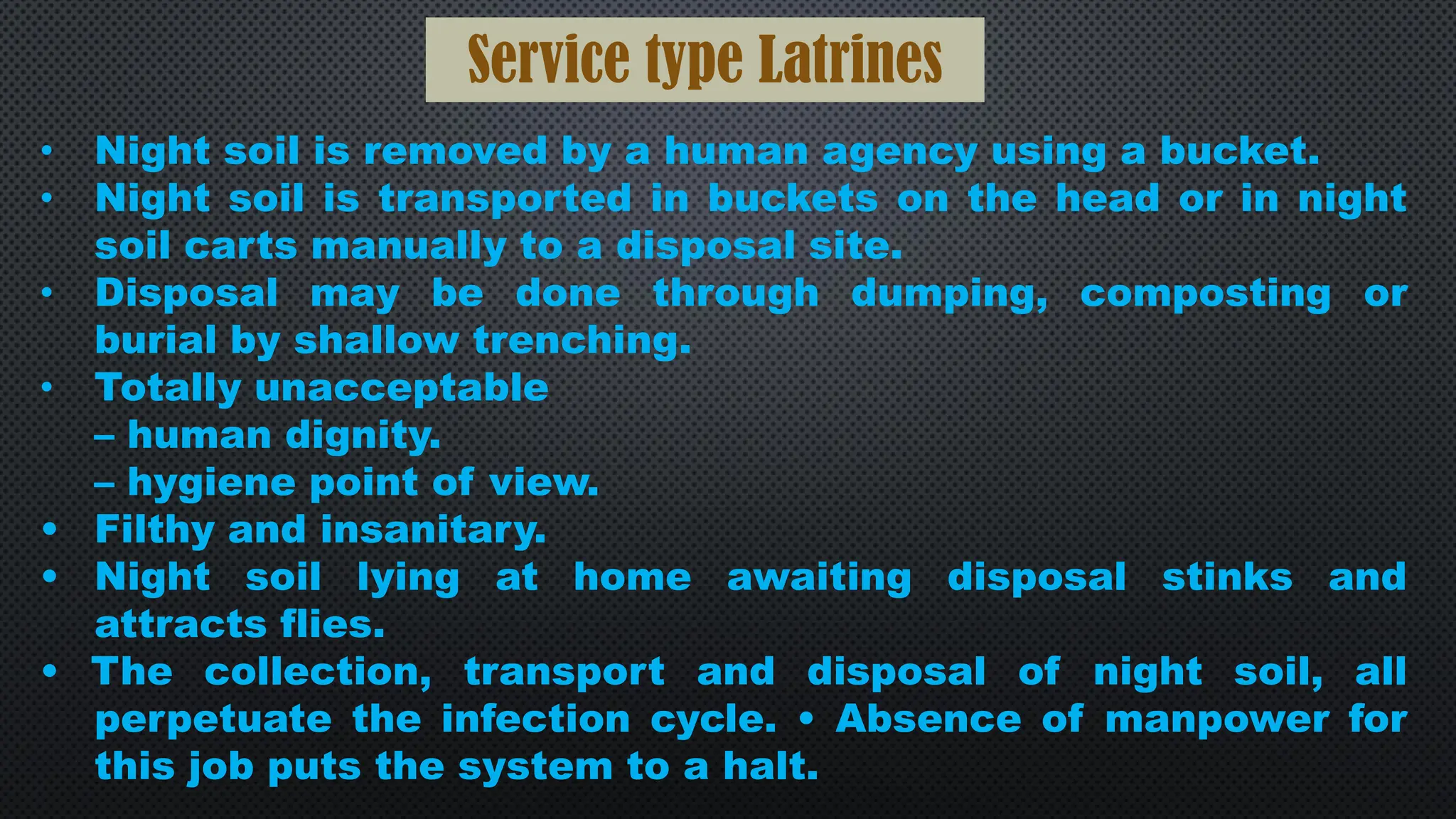
• Night soil is removed by a human agency using a bucket.
• Night soil is transported in buckets on the head or in night
soil carts manually to a disposal site.
• Disposal may be done through dumping, composting or
burial by shallow trenching.
• Totally unacceptable
– human dignity.
– hygiene point of view.
• Filthy and insanitary.
• Night soil lying at home awaiting disposal stinks and
attracts flies.
• The collection, transport and disposal of night soil, all
perpetuate the infection cycle. • Absence of manpower for
this job puts the system to a halt.
Non‐service type
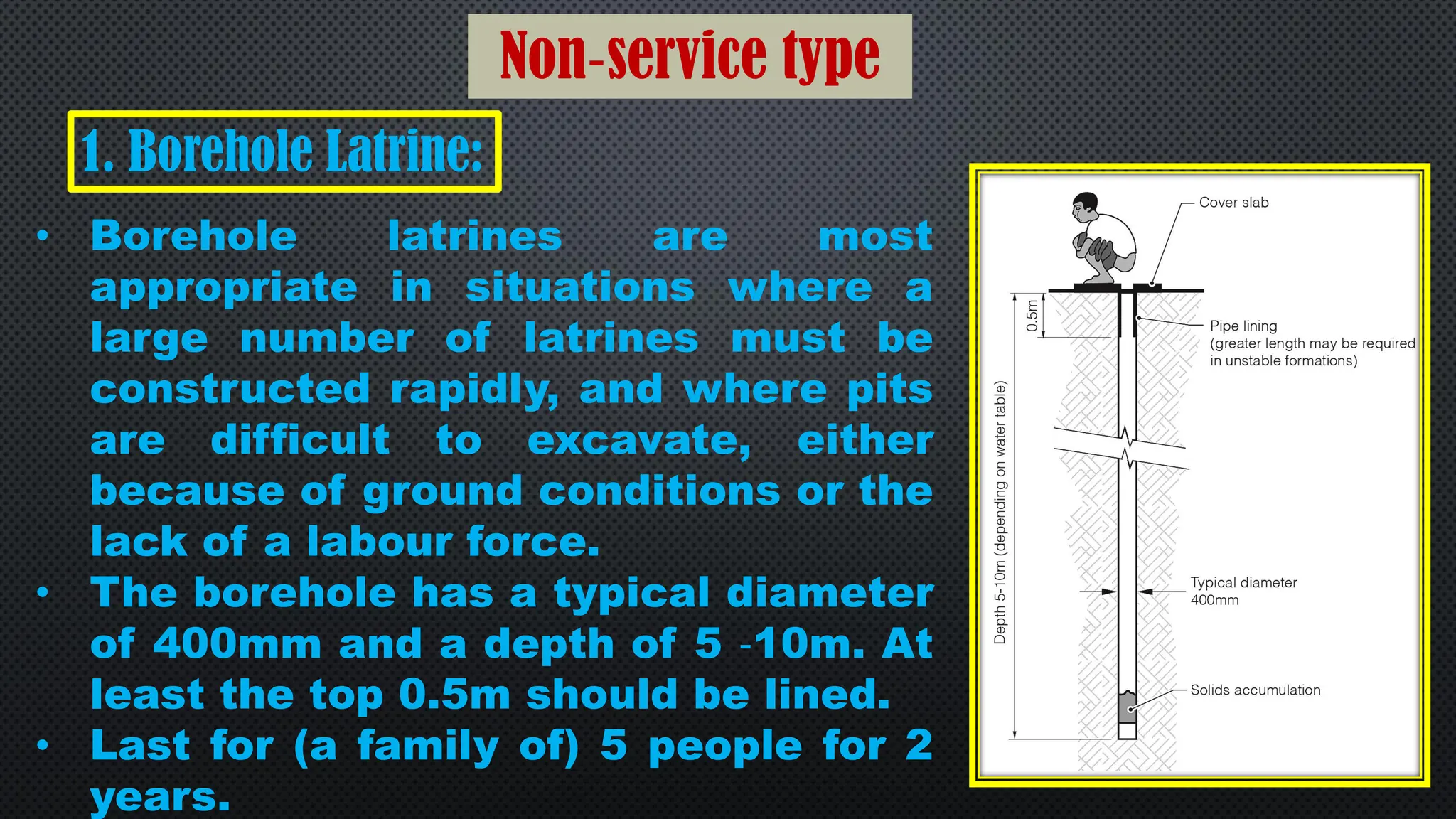
1. Borehole Latrine:
• Borehole latrines are most
appropriate in situations where a
large number of latrines must be
constructed rapidly, and where pits
are difficult to excavate, either
because of ground conditions or the
lack of a labour force.
• The borehole has a typical diameter
of 400mm and a depth of 5 ‐10m. At
least the top 0.5m should be lined.
• Last for (a family of) 5 people for 2
years.
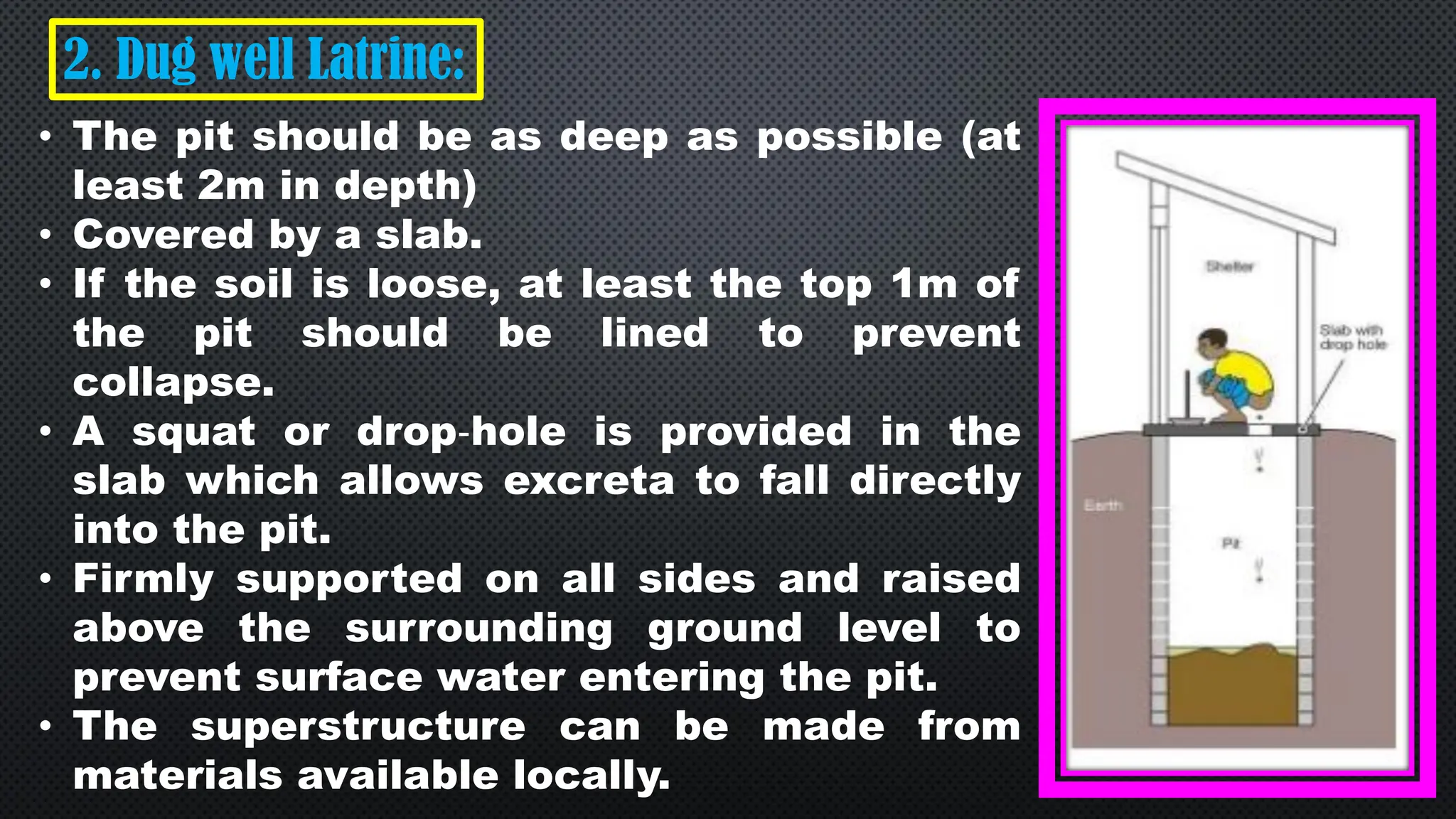
2. Dug well Latrine:
• The pit should be as deep as possible (at
least 2m in depth)
• Covered by a slab.
• If the soil is loose, at least the top 1m of
the pit should be lined to prevent
collapse.
• A squat or drop‐hole is provided in the
slab which allows excreta to fall directly
into the pit.
• Firmly supported on all sides and raised
above the surrounding ground level to
prevent surface water entering the pit.
• The superstructure can be made from
materials available locally.
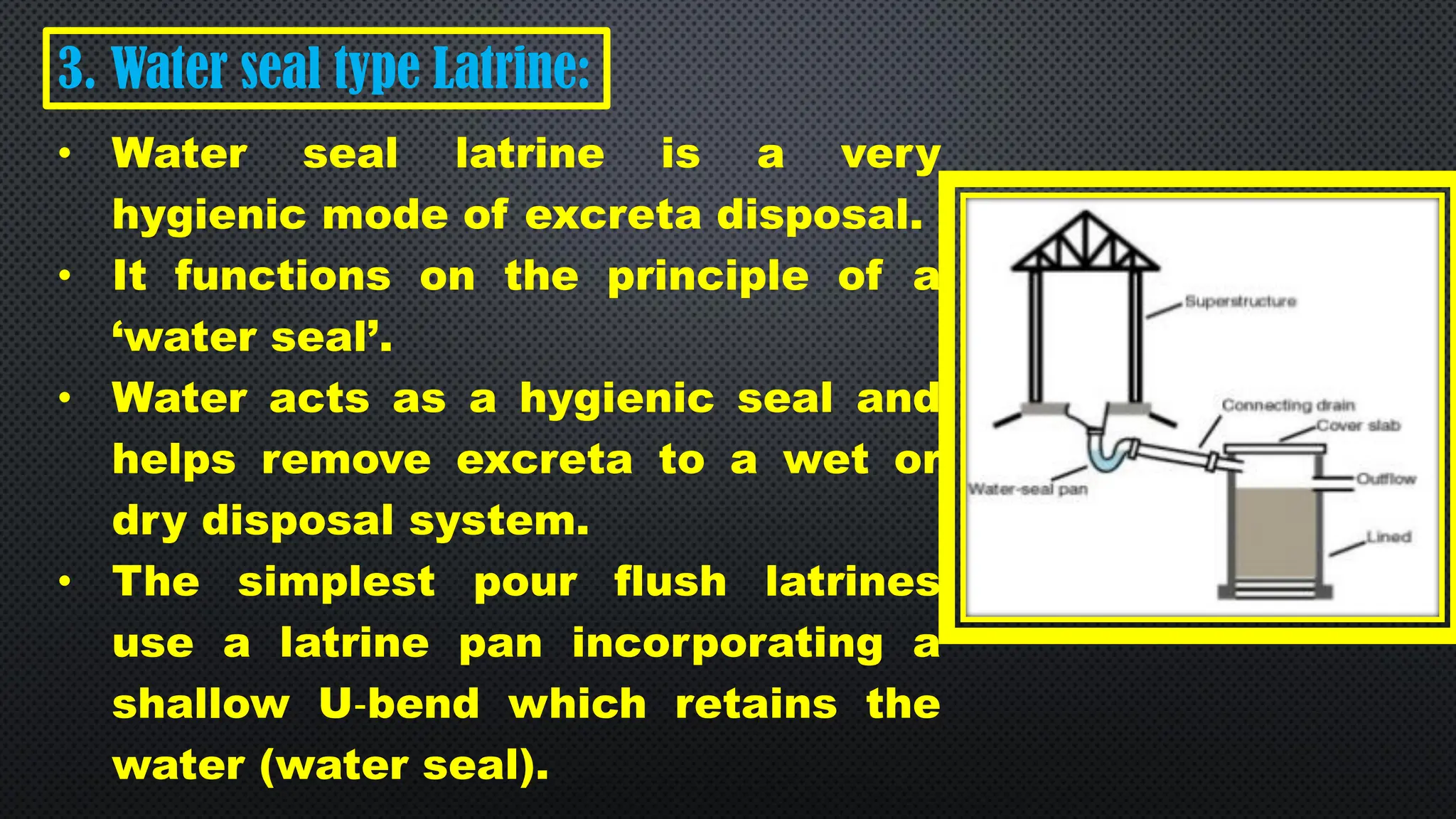
3. Water seal type Latrine:
• Water seal latrine is a very
hygienic mode of excreta disposal.
• It functions on the principle of a
‘water seal’.
• Water acts as a hygienic seal and
helps remove excreta to a wet or
dry disposal system.
• The simplest pour flush latrines
use a latrine pan incorporating a
shallow U‐bend which retains the
water (water seal).
• After defecation, a few litres of water must be thrown
into the bowl in order to flush the excreta into the pit or
sewerage system below.
• The amount of water required to flush the system will
depend on the type and size of the water‐seal
construction.
90mm U‐bend normally requires 2‐3 litres to flush
effectively
120mm U‐bend generally requires 4‐5 litres to flush.
• These quantities are significantly less than the amount
required to flush most western water‐closet toilets
which may use as much as 15 litres per flush.
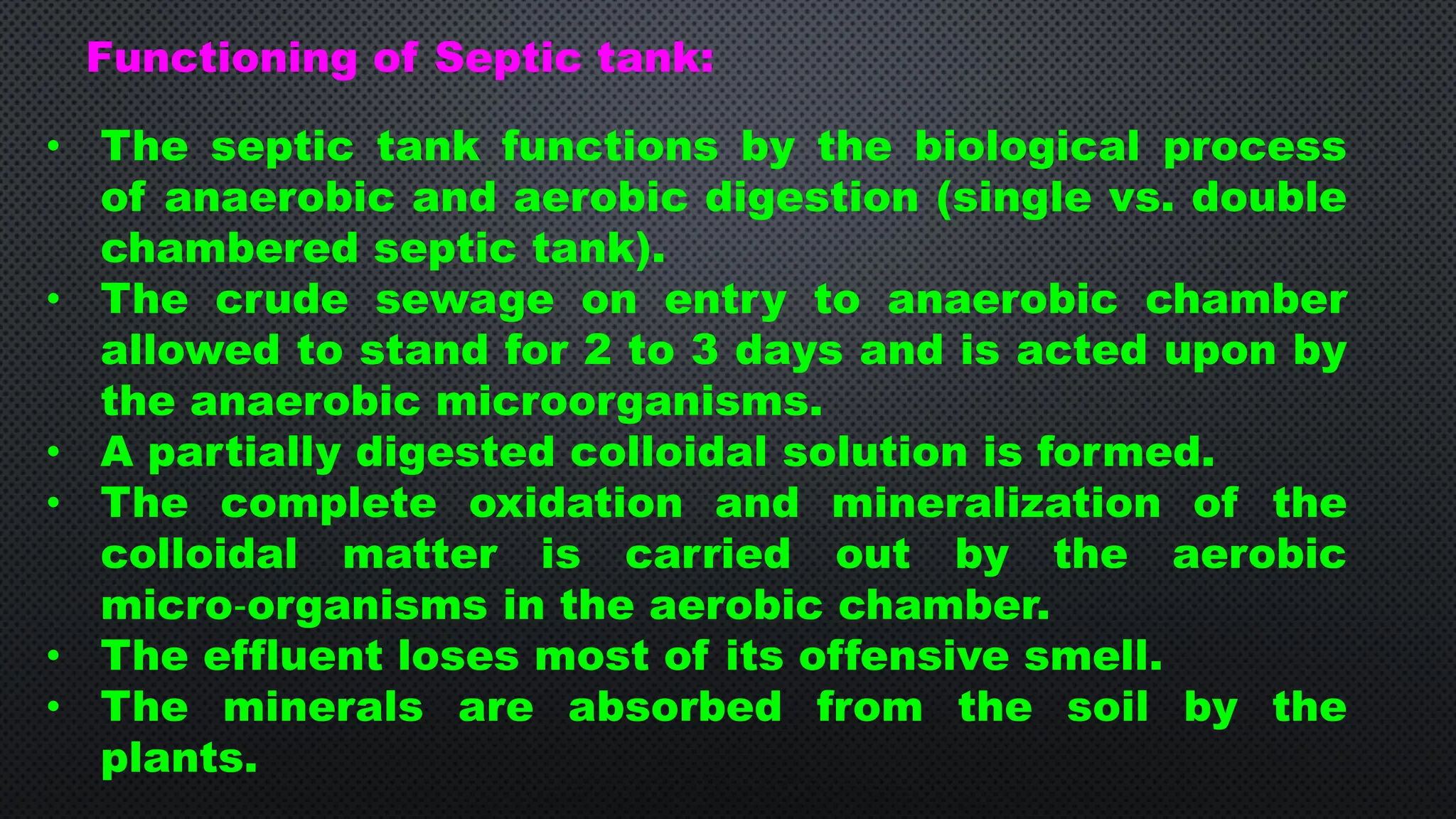
4. Septic Tank:
• Capacity of tank: 20‐30 gallons per
user with a minimum size of
3mx3m (500 gallons).
• 1.5 to 2m deep.
• Minimum air space of 30 cm above
the liquid level.
• The septic tank is covered by a
concrete slab with a manhole in it.
• The aeration chamber should be
ventilated.
• The inlet and exit pipes to the tank
should be trapped.
• The effluent may be disposed into a
soak‐well.
• The septic tank functions by the biological process
of anaerobic and aerobic digestion (single vs. double
chambered septic tank).
• The crude sewage on entry to anaerobic chamber
allowed to stand for 2 to 3 days and is acted upon by
the anaerobic microorganisms.
• A partially digested colloidal solution is formed.
• The complete oxidation and mineralization of the
colloidal matter is carried out by the aerobic
micro‐organisms in the aerobic chamber.
• The effluent loses most of its offensive smell.
• The minerals are absorbed from the soil by the
plants.
Functioning of Septic tank:
Latrine suitable for camps
and temporary use
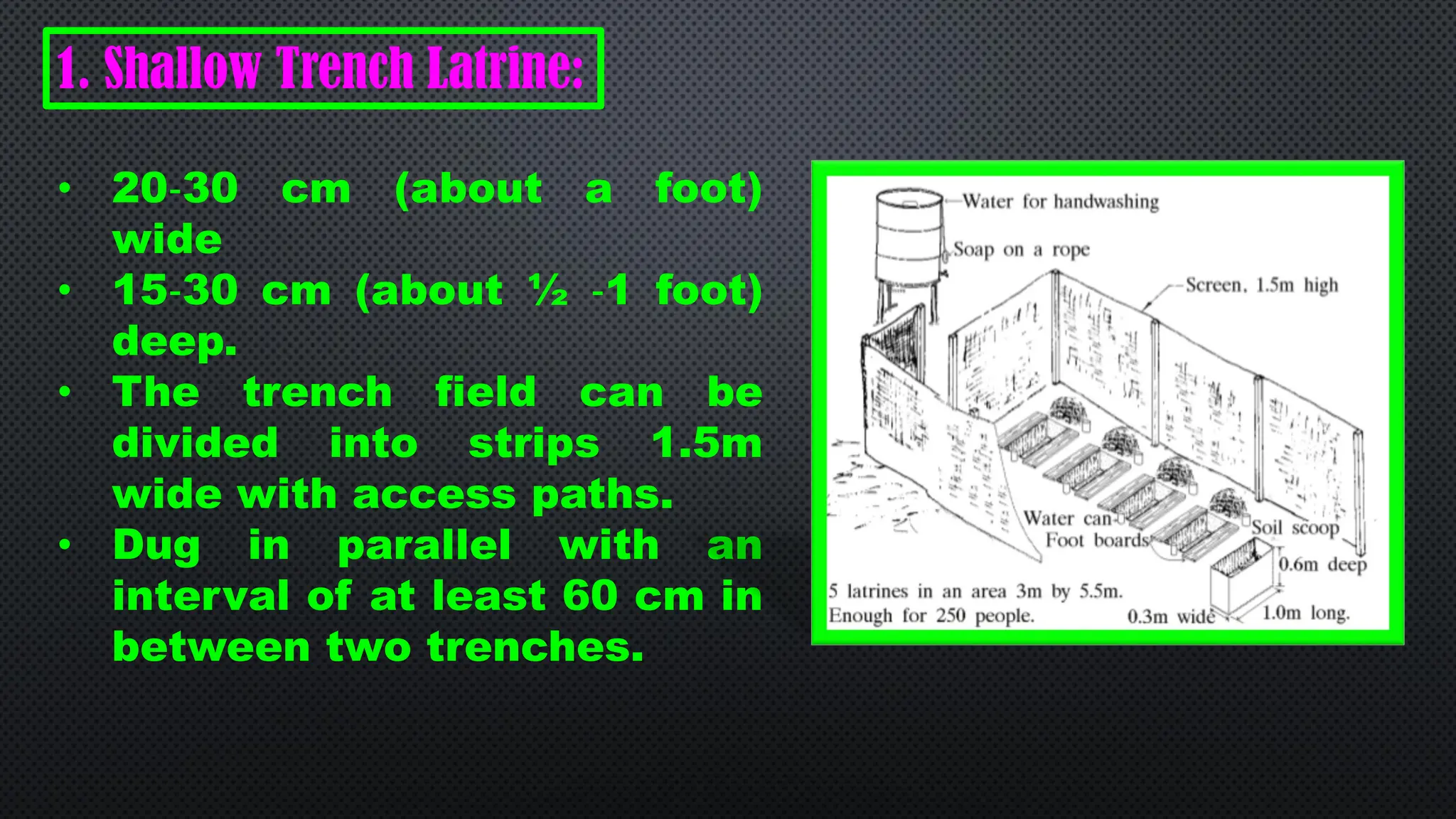
1. Shallow Trench Latrine:
• 20‐30 cm (about a foot)
wide
• 15‐30 cm (about ½ ‐1 foot)
deep.
• The trench field can be
divided into strips 1.5m
wide with access paths.
• Dug in parallel with an
interval of at least 60 cm in
between two trenches.
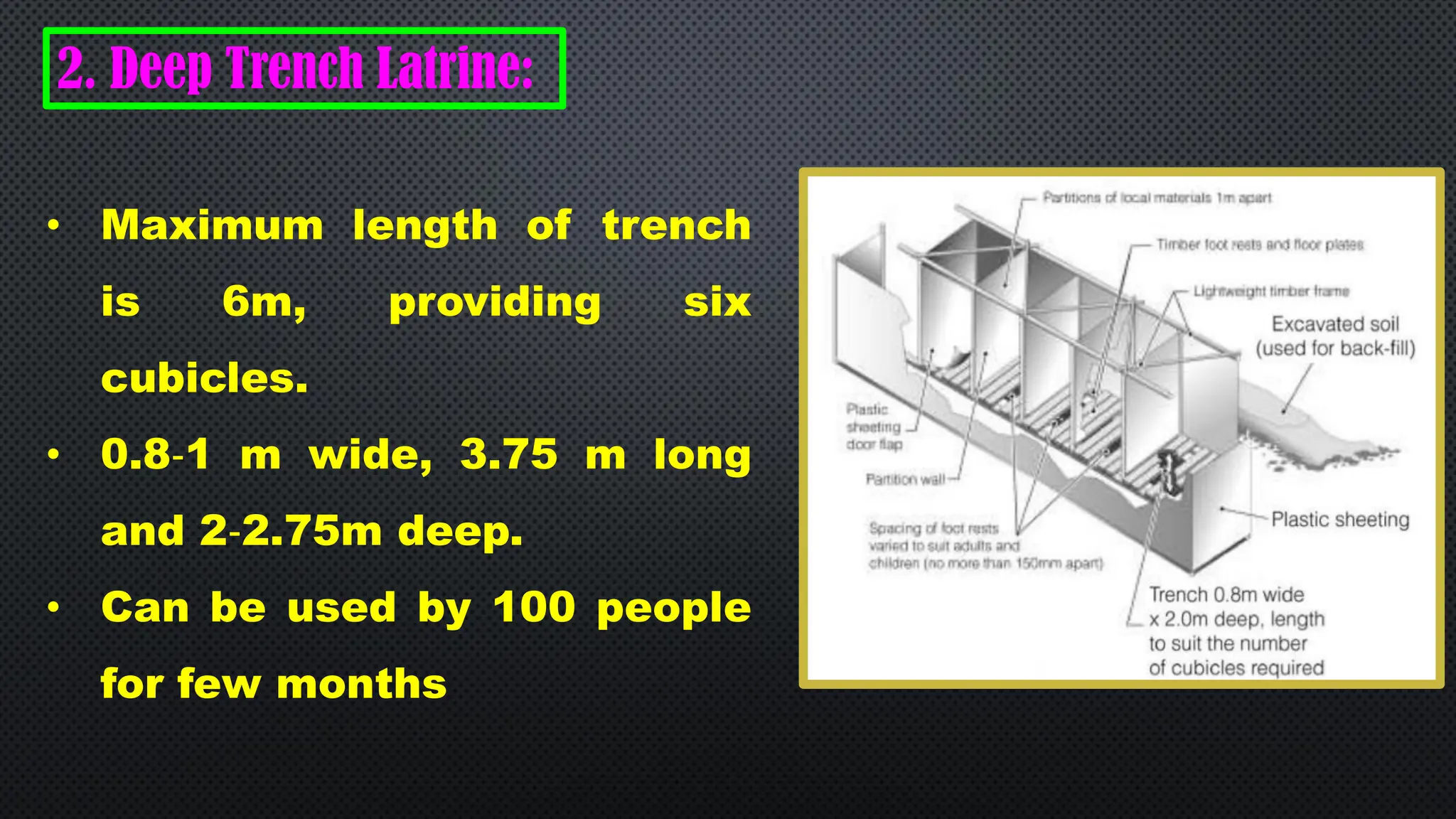
2. Deep Trench Latrine:
• Maximum length of trench
is 6m, providing six
cubicles.
• 0.8‐1 m wide, 3.75 m long
and 2‐2.75m deep.
• Can be used by 100 people
for few months
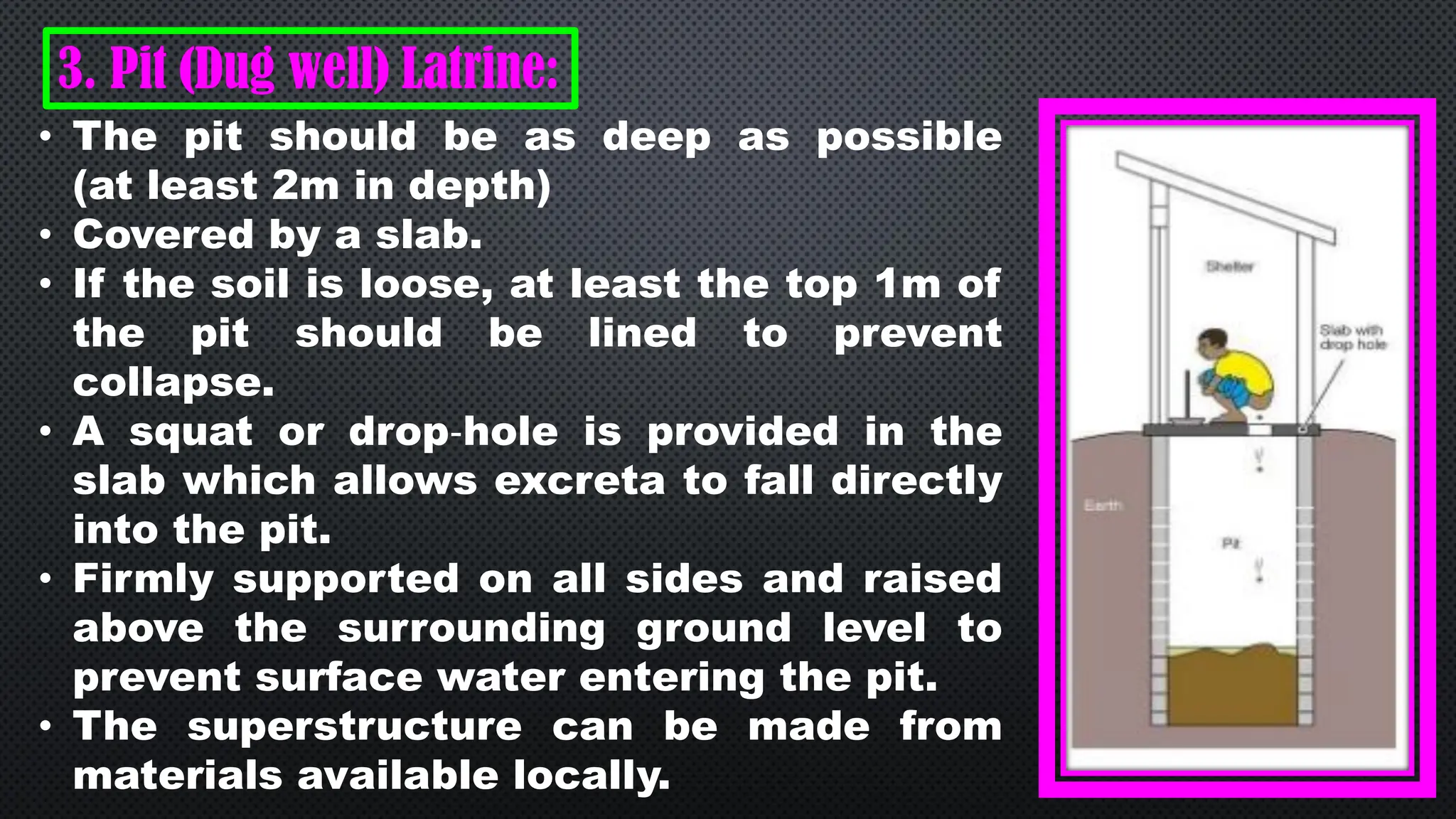
3. Pit (Dug well) Latrine:
• The pit should be as deep as possible
(at least 2m in depth)
• Covered by a slab.
• If the soil is loose, at least the top 1m of
the pit should be lined to prevent
collapse.
• A squat or drop‐hole is provided in the
slab which allows excreta to fall directly
into the pit.
• Firmly supported on all sides and raised
above the surrounding ground level to
prevent surface water entering the pit.
• The superstructure can be made from
materials available locally.
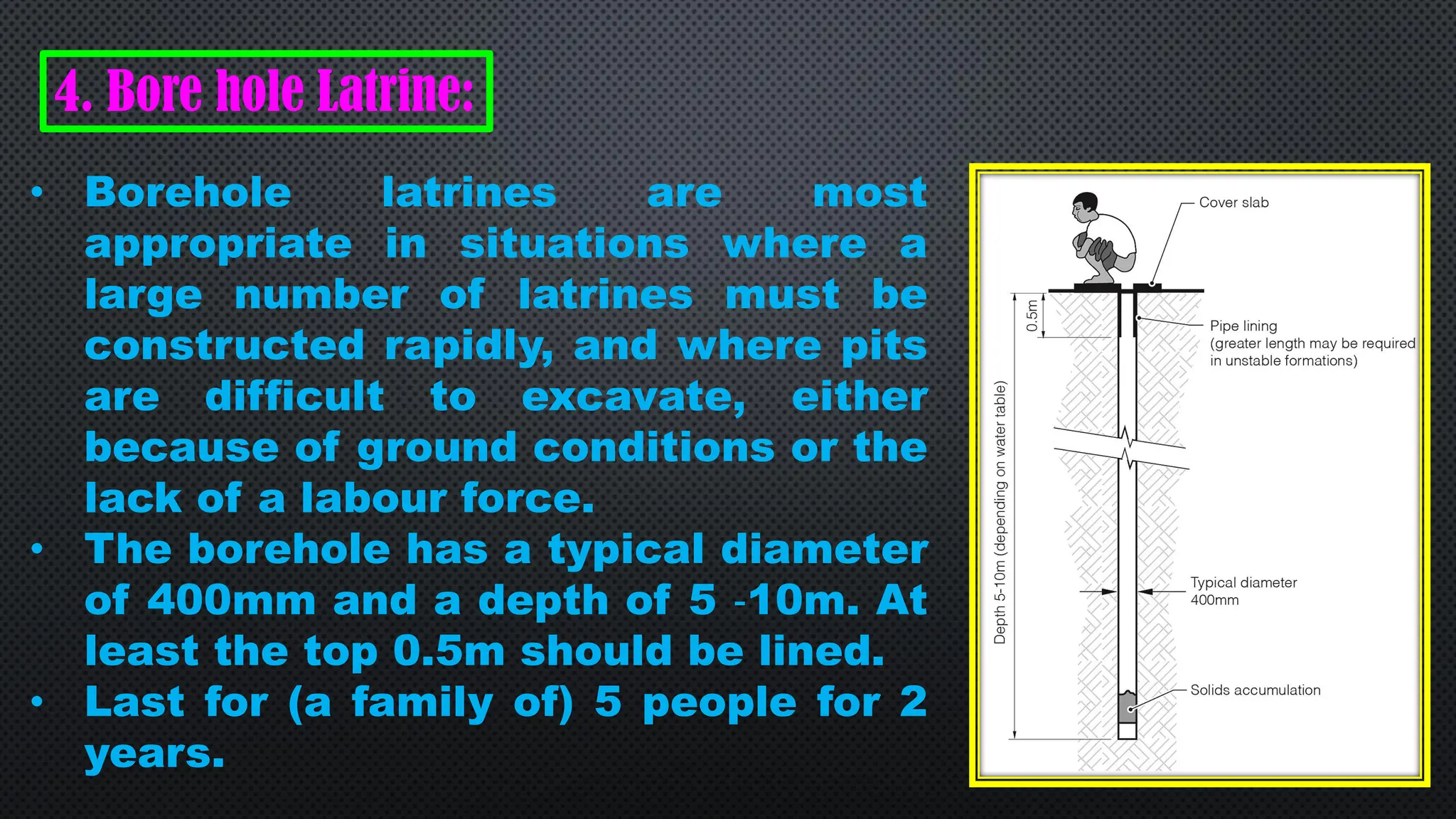
4. Bore hole Latrine:
• Borehole latrines are most
appropriate in situations where a
large number of latrines must be
constructed rapidly, and where pits
are difficult to excavate, either
because of ground conditions or the
lack of a labour force.
• The borehole has a typical diameter
of 400mm and a depth of 5 ‐10m. At
least the top 0.5m should be lined.
• Last for (a family of) 5 people for 2
years.
Water Carriage System
• Useful for large residential and commercial.
• The human excreta and waste water are carried away
by a network of underground pipes called sewers to the
ultimate disposal site.
• Used for the first time in Calcutta (in India) in 1867.
• But even today, unfortunately not more than 20 percent
of the urban areas in India can boast of this method of
sewage disposal.
• Laying down such a system is infrastructure and capital
intensive.
• It amounts to digging up lanes and by‐lanes.
• Skilled manpower is a must to establish the system.
• Piped water supply is mandatory to run the system.
• On ‐ going maintenance has to be done to keep the
pipes going.
• The ideal system of sewage disposal in large cities.
• Effective and hygienic disposal of excreta is a social
need as well as health need.
• Open defecation might still be a preferred method in
many rural areas.
• In the areas without sewage system, simple pit latrines
and bore hole can be used but the pour flush latrine is
the ideal one.
• Trench latrines can be used for camps for short
durations.
• Septic tank is a suitable method of final disposal of
night soil.
• Water carriage system is the ideal system of sewage
disposal.
Take Home Message

TOPIC: EXCRETA DISPOSAL-NEED OF THE HOUR

  • 1.
    Dr.A. Pushparaj, Assistant Professorof Zoology, T.D.M.N.S. College, T. Kallikulam. Department of Zoology Non Major Elective – Public Health & Hygiene II Physics, II Chemistry & II Botany - EVEN Semester
  • 2.
    Introduction • Human excretais a source of infection. • Improper excreta disposal has various health hazards. • Soil pollution, water pollution, diseases spread by faecal ‐ oral route • Disposal of human excreta assumes greater importance.
  • 3.
    In India • 69%go for open field defecation. • 21% use improved sanitation facilities – ensure hygienic separation of human excreta from human contact – e.g. flush/pour flush to piped sewer system or septic tank, Ventilated improved pit latrine, Pit latrine with slab • 10% use shared and unimproved sanitation facilities. – do not ensure hygienic separation of human excreta from human contact – e.g. pit latrines without a slab, bucket latrines
  • 4.
  • 5.
    Unsewered areas Excreta disposal Seweredareas Service type latrines Non‐service type Latrine suitable for camps and temporary use Water carriage system a. Bore hole b. Dug (Pit) well c. Water‐seal type d. Septic tank a. Shallow trench b. Deep trench c. Pit latrine d. Bore hole latrine a. Primary treatment b. Second. treatment
  • 6.
    Service type Latrines •Night soil is removed by a human agency using a bucket. • Night soil is transported in buckets on the head or in night soil carts manually to a disposal site. • Disposal may be done through dumping, composting or burial by shallow trenching. • Totally unacceptable – human dignity. – hygiene point of view. • Filthy and insanitary. • Night soil lying at home awaiting disposal stinks and attracts flies. • The collection, transport and disposal of night soil, all perpetuate the infection cycle. • Absence of manpower for this job puts the system to a halt.
  • 8.
    Non‐service type 1. BoreholeLatrine: • Borehole latrines are most appropriate in situations where a large number of latrines must be constructed rapidly, and where pits are difficult to excavate, either because of ground conditions or the lack of a labour force. • The borehole has a typical diameter of 400mm and a depth of 5 ‐10m. At least the top 0.5m should be lined. • Last for (a family of) 5 people for 2 years.
  • 9.
    2. Dug wellLatrine: • The pit should be as deep as possible (at least 2m in depth) • Covered by a slab. • If the soil is loose, at least the top 1m of the pit should be lined to prevent collapse. • A squat or drop‐hole is provided in the slab which allows excreta to fall directly into the pit. • Firmly supported on all sides and raised above the surrounding ground level to prevent surface water entering the pit. • The superstructure can be made from materials available locally.
  • 10.
    3. Water sealtype Latrine: • Water seal latrine is a very hygienic mode of excreta disposal. • It functions on the principle of a ‘water seal’. • Water acts as a hygienic seal and helps remove excreta to a wet or dry disposal system. • The simplest pour flush latrines use a latrine pan incorporating a shallow U‐bend which retains the water (water seal).
  • 11.
    • After defecation,a few litres of water must be thrown into the bowl in order to flush the excreta into the pit or sewerage system below. • The amount of water required to flush the system will depend on the type and size of the water‐seal construction. 90mm U‐bend normally requires 2‐3 litres to flush effectively 120mm U‐bend generally requires 4‐5 litres to flush. • These quantities are significantly less than the amount required to flush most western water‐closet toilets which may use as much as 15 litres per flush.
  • 12.
    4. Septic Tank: •Capacity of tank: 20‐30 gallons per user with a minimum size of 3mx3m (500 gallons). • 1.5 to 2m deep. • Minimum air space of 30 cm above the liquid level. • The septic tank is covered by a concrete slab with a manhole in it. • The aeration chamber should be ventilated. • The inlet and exit pipes to the tank should be trapped. • The effluent may be disposed into a soak‐well.
  • 13.
    • The septictank functions by the biological process of anaerobic and aerobic digestion (single vs. double chambered septic tank). • The crude sewage on entry to anaerobic chamber allowed to stand for 2 to 3 days and is acted upon by the anaerobic microorganisms. • A partially digested colloidal solution is formed. • The complete oxidation and mineralization of the colloidal matter is carried out by the aerobic micro‐organisms in the aerobic chamber. • The effluent loses most of its offensive smell. • The minerals are absorbed from the soil by the plants. Functioning of Septic tank:
  • 14.
    Latrine suitable forcamps and temporary use
  • 15.
    1. Shallow TrenchLatrine: • 20‐30 cm (about a foot) wide • 15‐30 cm (about ½ ‐1 foot) deep. • The trench field can be divided into strips 1.5m wide with access paths. • Dug in parallel with an interval of at least 60 cm in between two trenches.
  • 16.
    2. Deep TrenchLatrine: • Maximum length of trench is 6m, providing six cubicles. • 0.8‐1 m wide, 3.75 m long and 2‐2.75m deep. • Can be used by 100 people for few months
  • 17.
    3. Pit (Dugwell) Latrine: • The pit should be as deep as possible (at least 2m in depth) • Covered by a slab. • If the soil is loose, at least the top 1m of the pit should be lined to prevent collapse. • A squat or drop‐hole is provided in the slab which allows excreta to fall directly into the pit. • Firmly supported on all sides and raised above the surrounding ground level to prevent surface water entering the pit. • The superstructure can be made from materials available locally.
  • 18.
    4. Bore holeLatrine: • Borehole latrines are most appropriate in situations where a large number of latrines must be constructed rapidly, and where pits are difficult to excavate, either because of ground conditions or the lack of a labour force. • The borehole has a typical diameter of 400mm and a depth of 5 ‐10m. At least the top 0.5m should be lined. • Last for (a family of) 5 people for 2 years.
  • 19.
  • 20.
    • Useful forlarge residential and commercial. • The human excreta and waste water are carried away by a network of underground pipes called sewers to the ultimate disposal site. • Used for the first time in Calcutta (in India) in 1867. • But even today, unfortunately not more than 20 percent of the urban areas in India can boast of this method of sewage disposal.
  • 21.
    • Laying downsuch a system is infrastructure and capital intensive. • It amounts to digging up lanes and by‐lanes. • Skilled manpower is a must to establish the system. • Piped water supply is mandatory to run the system. • On ‐ going maintenance has to be done to keep the pipes going. • The ideal system of sewage disposal in large cities.
  • 22.
    • Effective andhygienic disposal of excreta is a social need as well as health need. • Open defecation might still be a preferred method in many rural areas. • In the areas without sewage system, simple pit latrines and bore hole can be used but the pour flush latrine is the ideal one. • Trench latrines can be used for camps for short durations. • Septic tank is a suitable method of final disposal of night soil. • Water carriage system is the ideal system of sewage disposal. Take Home Message