SOL GEL METHOD,
THERMAL AND PLASMA
SPRAYING
PRESENTED BY:- AMAN PATHANIA
HISTORICAL BACKGROUND
Sols and gels are among many naturally occurring matters not only in biological
system where they consist of the blood, serum but also in clay and silica gels in
materials science.
In 1861, Graham found the colloidal material science although Faraday made the
oldest sol from gold colloidal particles in a laboratory in 1853.
The following century, a tremendously huge variety of oxides, complex mixed
oxide and some non-oxides compositions were produced by sol–gel technology.
Silicates were the most studied among all other compositions.
SOL GEL METHOD
In material science the sol–gel process is a method for producing solid materials from small
molecules.
The method is used for the fabrication of metal oxides especially the oxides of silicon (Si)
and titanium (Ti).
The process involves conversion of monomers into a colloidal solution (sol) that acts as the
precursor for an integrated network (gel) of either discrete particles or network polymers.
Typical precursors are metal alkoxides.
Sol-gel process is used to produce ceramic nanoparticles.
SOL GEL
A sol is a stable dispersion of particles or polymers in a solvent .
The particle may be amorphous and crystalline.
A gel consist of three dimensional continuous network ,which encloses A liquid phase.
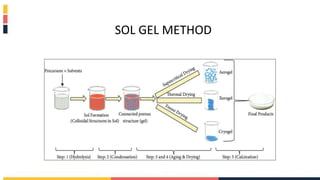
SOL GEL METHOD
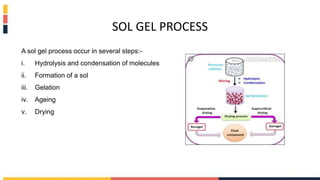
SOL GEL PROCESS
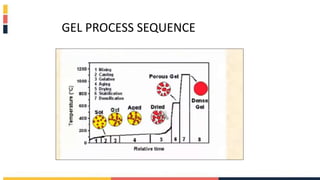
A sol gel process occur in several steps:-
i. Hydrolysis and condensation of molecules
ii. Formation of a sol
iii. Gelation
iv. Ageing
v. Drying
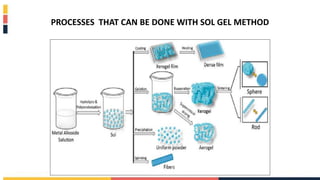
PROCESSES THAT CAN BE DONE WITH SOL GEL METHOD
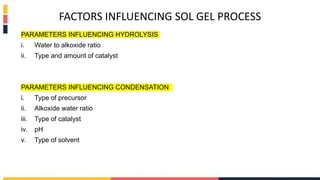
FACTORS INFLUENCING SOL GEL PROCESS
PARAMETERS INFLUENCING HYDROLYSIS
i. Water to alkoxide ratio
ii. Type and amount of catalyst
PARAMETERS INFLUENCING CONDENSATION
i. Type of precursor
ii. Alkoxide water ratio
iii. Type of catalyst
iv. pH
v. Type of solvent
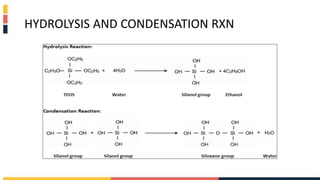
HYDROLYSIS AND CONDENSATION RXN
GEL PROCESS SEQUENCE
APPLICATIONS OF SOL GEL METHOD
 Optical and photonic applications
 Mechanical applications
 Biomedical applications
 Bioreactors
 Chemical applications
 Electronics
 Thermal
ADVANTAGES
 SIMPLICITY OF THE PROCESS
 PREPARATION OF HIGH PURITY PRODUCTS
 VERY HIGH PRODUCTION EFFICIENCY
 PRODUCTION OF OPTICAL COMPONENTS WITH COMPLEX SHAPES
 SYNTHESIS OF UNIFORM COMPOUNDS IN THE FORM OF COMPOSITE OXIDES
ADVANTAGES
 Ability of using the product with special shapes such as fibers and aerogels surface coverage.
 Ability of using this process to synthesize amorphous materials in thin layers.
 Production of materials with modified physical.
 Properties, such as low thermal expansion coefficient, low UV absorption, and high optical
transparency.
 Production of porous and rich materials with organic and polymeric compounds.
 High chemical reactivity of precursors due to process in solution phase.
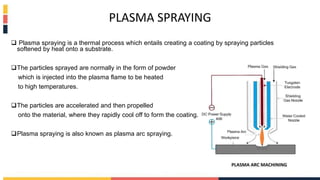
PLASMA SPRAYING
 Plasma spraying is a thermal process which entails creating a coating by spraying particles
softened by heat onto a substrate.
The particles sprayed are normally in the form of powder
which is injected into the plasma flame to be heated
to high temperatures.
The particles are accelerated and then propelled
onto the material, where they rapidly cool off to form the coating.
Plasma spraying is also known as plasma arc spraying.
BENEFITS
Plasma spraying strives to prevent damage and corrosion. It makes the components of any
sprayed material last longer, even if regularly exposed to high temperatures or combustible
gases.
The Benefits of this thermal process are:-
 Prevention of corrosion in materials
 Wear resistance
 Electrical conductivity
 Electrical resistance
 Oxidation and heat resistance
 Management of high temperatures
 Plasma spraying uses an arc that consists of either a combination of argon and hydrogen or
argon and helium.
 The arc has high temperatures of up to 20,000 K, while the plasma jet is 10,000 K.
 The arc heats up the plasma gas, which then causes it to accelerate to the material being
coated.
 It can be used to coat ceramic oxides, tungsten, and tantalum refractory materials.
 It can be applicable in automotive, medical, agriculture or aerospace industries.
 Jet engines are a typical example of the application of this form of thermal spraying.
BORON NITRIDE BASED HYDROGELS
 Hydrogels are 3D networks of hydrophilic polymers that can absorb and retain large amounts of
water due to physical or chemical cross-linking of individual polymer chains.
 However, poor mechanical strength and thermal conductivity often limit their practical use.
 An emerging solution is reinforcing hydrogels with nanoparticles to form nanocomposite hydrogels.
 In particular, incorporating boron nitride creates a unique class of mechanically robust and thermally
conductive hydrogels with self-healing capabilities.
 Hexagonal boron nitride nanosheets often regarded as structural and isoelectronic analogs of
graphene, boast exceptional thermal and chemical stability and impressive mechanical strength.
 This integration enhances thermal conductivity, young's modulus, mechanical strength, and self-
healing capacity, addressing the limitations of conventional hydrogels.
 Bn-based nanocomposite hydrogels are synthesized by blending aqueous bn nanoparticle
dispersions with monomers or polymeric chains typically dissolved in water or in some instances
ethanol.
 These nanocomposite hydrogels find applications in various domains including drug delivery,
water treatment, tissue engineering, thermal interface materials, soft robotics and micro lenses.
BORON NITRIDE BASED HYDROGELS
APPLICATIONS OF BORON NITRIDE BASED
HYDROGELS
 Biomedical and drug delivery applications.
 Heat management in electronics.
 Soft actuators and wearable devices.
 Microwave electromagnetic absorption.
REFERENCES
i. www.google.com
ii. www.science direct.com
iii. Wikipedia
iv. Few review articles
sol gel method by  Mr AMAN PATHANIApptx

sol gel method by Mr AMAN PATHANIApptx

  • 1.
    SOL GEL METHOD, THERMALAND PLASMA SPRAYING PRESENTED BY:- AMAN PATHANIA
  • 2.
    HISTORICAL BACKGROUND Sols andgels are among many naturally occurring matters not only in biological system where they consist of the blood, serum but also in clay and silica gels in materials science. In 1861, Graham found the colloidal material science although Faraday made the oldest sol from gold colloidal particles in a laboratory in 1853. The following century, a tremendously huge variety of oxides, complex mixed oxide and some non-oxides compositions were produced by sol–gel technology. Silicates were the most studied among all other compositions.
  • 3.
    SOL GEL METHOD Inmaterial science the sol–gel process is a method for producing solid materials from small molecules. The method is used for the fabrication of metal oxides especially the oxides of silicon (Si) and titanium (Ti). The process involves conversion of monomers into a colloidal solution (sol) that acts as the precursor for an integrated network (gel) of either discrete particles or network polymers. Typical precursors are metal alkoxides. Sol-gel process is used to produce ceramic nanoparticles.
  • 4.
    SOL GEL A solis a stable dispersion of particles or polymers in a solvent . The particle may be amorphous and crystalline. A gel consist of three dimensional continuous network ,which encloses A liquid phase.
  • 5.
  • 6.
    SOL GEL PROCESS Asol gel process occur in several steps:- i. Hydrolysis and condensation of molecules ii. Formation of a sol iii. Gelation iv. Ageing v. Drying
  • 7.
    PROCESSES THAT CANBE DONE WITH SOL GEL METHOD
  • 8.
    FACTORS INFLUENCING SOLGEL PROCESS PARAMETERS INFLUENCING HYDROLYSIS i. Water to alkoxide ratio ii. Type and amount of catalyst PARAMETERS INFLUENCING CONDENSATION i. Type of precursor ii. Alkoxide water ratio iii. Type of catalyst iv. pH v. Type of solvent
  • 9.
  • 10.
  • 11.
    APPLICATIONS OF SOLGEL METHOD  Optical and photonic applications  Mechanical applications  Biomedical applications  Bioreactors  Chemical applications  Electronics  Thermal
  • 12.
    ADVANTAGES  SIMPLICITY OFTHE PROCESS  PREPARATION OF HIGH PURITY PRODUCTS  VERY HIGH PRODUCTION EFFICIENCY  PRODUCTION OF OPTICAL COMPONENTS WITH COMPLEX SHAPES  SYNTHESIS OF UNIFORM COMPOUNDS IN THE FORM OF COMPOSITE OXIDES
  • 13.
    ADVANTAGES  Ability ofusing the product with special shapes such as fibers and aerogels surface coverage.  Ability of using this process to synthesize amorphous materials in thin layers.  Production of materials with modified physical.  Properties, such as low thermal expansion coefficient, low UV absorption, and high optical transparency.  Production of porous and rich materials with organic and polymeric compounds.  High chemical reactivity of precursors due to process in solution phase.
  • 14.
    PLASMA SPRAYING  Plasmaspraying is a thermal process which entails creating a coating by spraying particles softened by heat onto a substrate. The particles sprayed are normally in the form of powder which is injected into the plasma flame to be heated to high temperatures. The particles are accelerated and then propelled onto the material, where they rapidly cool off to form the coating. Plasma spraying is also known as plasma arc spraying.
  • 15.
    BENEFITS Plasma spraying strivesto prevent damage and corrosion. It makes the components of any sprayed material last longer, even if regularly exposed to high temperatures or combustible gases. The Benefits of this thermal process are:-  Prevention of corrosion in materials  Wear resistance  Electrical conductivity  Electrical resistance  Oxidation and heat resistance  Management of high temperatures
  • 16.
     Plasma sprayinguses an arc that consists of either a combination of argon and hydrogen or argon and helium.  The arc has high temperatures of up to 20,000 K, while the plasma jet is 10,000 K.  The arc heats up the plasma gas, which then causes it to accelerate to the material being coated.  It can be used to coat ceramic oxides, tungsten, and tantalum refractory materials.  It can be applicable in automotive, medical, agriculture or aerospace industries.  Jet engines are a typical example of the application of this form of thermal spraying.
  • 17.
    BORON NITRIDE BASEDHYDROGELS  Hydrogels are 3D networks of hydrophilic polymers that can absorb and retain large amounts of water due to physical or chemical cross-linking of individual polymer chains.  However, poor mechanical strength and thermal conductivity often limit their practical use.  An emerging solution is reinforcing hydrogels with nanoparticles to form nanocomposite hydrogels.  In particular, incorporating boron nitride creates a unique class of mechanically robust and thermally conductive hydrogels with self-healing capabilities.  Hexagonal boron nitride nanosheets often regarded as structural and isoelectronic analogs of graphene, boast exceptional thermal and chemical stability and impressive mechanical strength.
  • 18.
     This integrationenhances thermal conductivity, young's modulus, mechanical strength, and self- healing capacity, addressing the limitations of conventional hydrogels.  Bn-based nanocomposite hydrogels are synthesized by blending aqueous bn nanoparticle dispersions with monomers or polymeric chains typically dissolved in water or in some instances ethanol.  These nanocomposite hydrogels find applications in various domains including drug delivery, water treatment, tissue engineering, thermal interface materials, soft robotics and micro lenses. BORON NITRIDE BASED HYDROGELS
  • 19.
    APPLICATIONS OF BORONNITRIDE BASED HYDROGELS  Biomedical and drug delivery applications.  Heat management in electronics.  Soft actuators and wearable devices.  Microwave electromagnetic absorption.
  • 20.
    REFERENCES i. www.google.com ii. www.sciencedirect.com iii. Wikipedia iv. Few review articles