A TECHNICAL SEMINAR ON
Solar Mobile Charger
Presented By,
NAME: Chetan P
USN: 4JN22EE405
UNDER THE GUIDANCE OF
Mrs.M.G.Manjula M.Tech., MISTE
Assistant Professor
DEPARTMENT OF ELECTRICAL AND
ELECTRONICS
JNNCE
SHIVAMOGGA
INDEX
 Abstract
 Introduction
 More about the topic
 Analysis/Design
 Discussion on results
 Motivation behind the topic
 Conclusion
 References
Abstract:
• Solar energy is the energy produced directly by the sun and collected elsewhere,
normally the Earth. The sun creates its energy through a thermonuclear process.
The process creates heat and electromagnetic radiation. Only a very small
fraction of the total radiation produced reaches the Earth.
• The radiation that does reach the Earth is the indirect source of nearly every type
of energy used today. The exceptions are geothermal energy, and nuclear fission
and fusion. Even fossil fuels owe their origins to the sun.
• We have come a long way in developing solar cells which are the devices
powering our future, converting sun’s energy into electricity. This work is about
using non conventional energy.
• solar energy for mobile battery charging. Solar chargers are simple, portable and
ready to use devices which can be used by anyone especially in rural areas.
• Solar panels don’t supply regulated voltage while batteries need so for charging.
Hence, an external adjustable voltage regulator is used to have the desired
constant voltage.
INTRODUCTION:
• The sun is a star made up of hydrogen and helium gas and it radiates an enormous
amount of energy every second.
• A Solar mobile charger is a cost effective small scale generator used to charge
mobile Phone with the help of solar energy.
• The small solar panel are installed inside the solar charger. These solar cells are
made up of silicon.
• A solar cell which forms a primary part of the solar mobile charger works on the
principle of photovoltaic effect.
• It is made up of packets of energy called “Photons”. These photons contain various
amount of energy corresponding to the different wavelengths of light.
• When a photon is absorbed, the energy of the photon is transferred to an electron in
an atom of the cell.
• Given the current energy crisis the need of a more sustainable energy is required
which is provided by solar energy.
More about the topic :
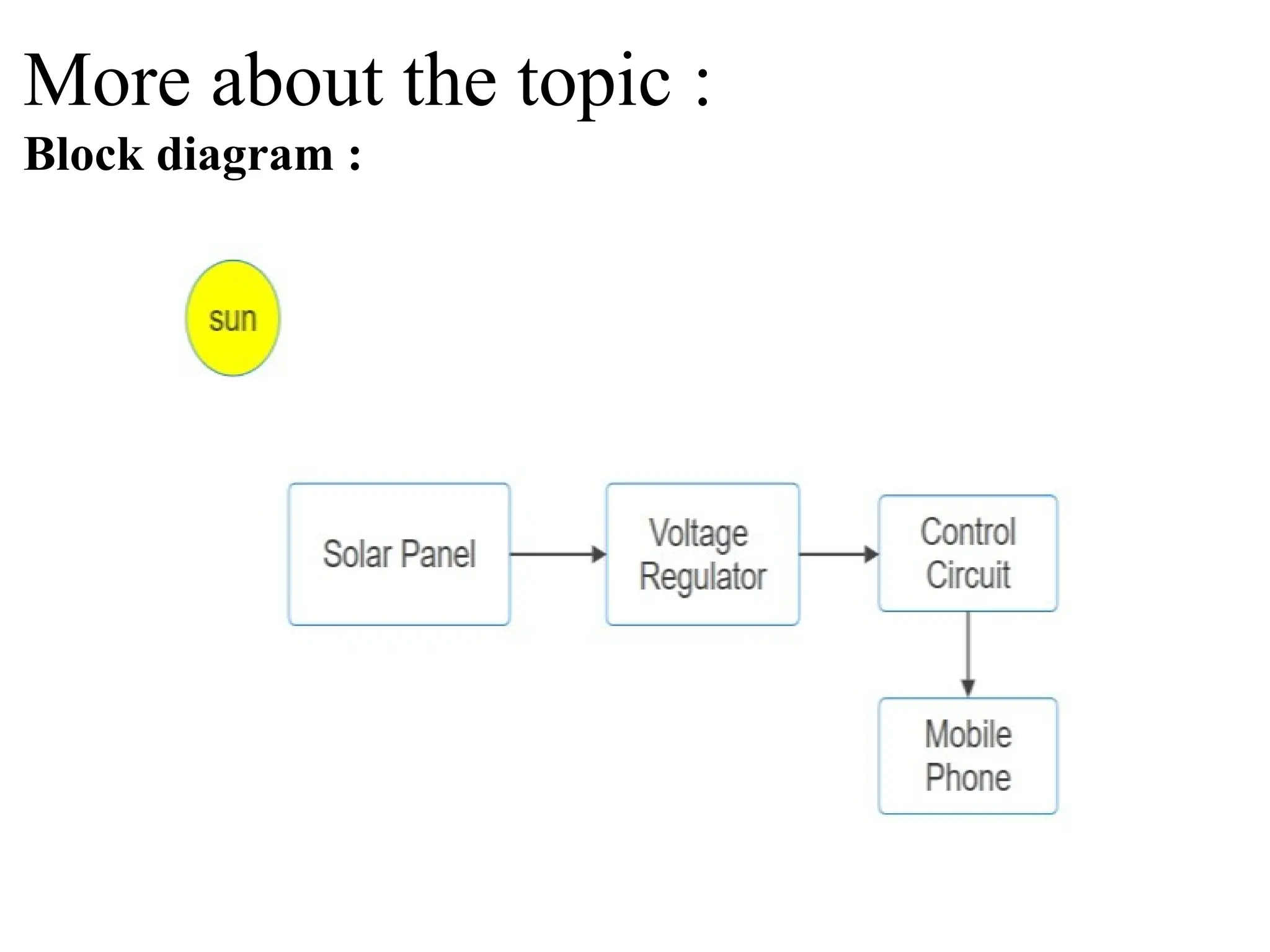
Block diagram :
• Solar Panel: Solar panels capture sunlight to generate electricity. The principle used
to generate electricity from the solar panels is the photovoltaic effect.
• Voltage Regulator: Its purpose is to automatically maintain a constant voltage level.
A voltage regulator can be a simple feed-forward design or incorporate negative
feedback. It may utilize an electromechanical mechanism or electronic components.
Depending on its design, it can regulate one or more AC or DC voltages.
• Control Circuit: The control circuit regulates the flow of electric current from the solar
panel to the battery, Ensuring safe and efficient charging.
• Mobile phone: It is used in this context for charging purposes.
Application:
• It is use to charge phone while travelling without depending on electricity.
• It is used in rural areas.
• Solar chargers available for public use, installed permanently in public areas
like parks, plazas, and streets, accessible to everyone at no cost.
Advantage:
• Solar mobile charger is Environment friendly.
• Solar mobile phone chargers are compact in size and easy to carry around.
• It does not require electric power.
Disadvantage:
• Solar charger needs light to work
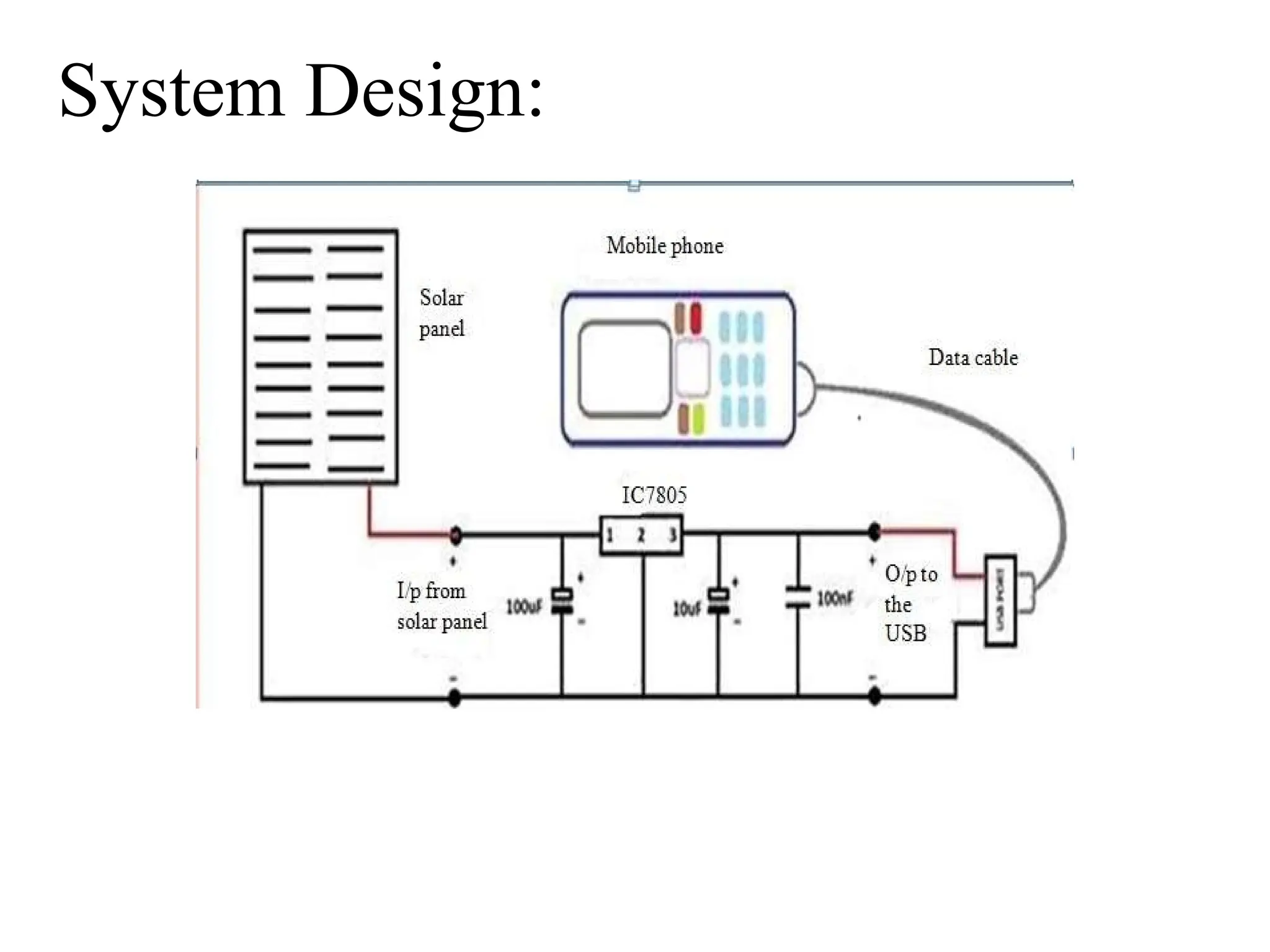
System Design:
Motivation of the project:
• The primary motivation behind the solar mobile charger topic is the desire for
convenient, portable, and sustainable charging solutions for mobile devices. Solar
mobile chargers offer an eco-friendly alternative to traditional chargers by
harnessing renewable solar energy, reducing reliance on fossil fuels and carbon
emissions. Additionally, they provide a readily available charging option in areas
without reliable electricity grids or during travel and outdoor activities
• Another key motivation is the Solar energy is a clean, renewable resource. By using
solar energy to charge mobile devices, the project reduces reliance on fossil fuels,
which are a major contributor to climate change and environmental degradation.
• Solar chargers are lightweight and portable, allowing users to charge their devices
anywhere with sunlight, eliminating the need for wall outlets.
• It can be used in various applications and has a lot of features.
• Relatively small size and can be used anywhere(portability).
• Requires no electrical start-up power.
• Higher efficiency than photovoltaic systems of the same size.
• Low maintenance, emission free and environment friendly.
• But one of the major factors that needs to be discussed is about the cost.
• Solar charger is again like all other solar energy gadgets.
• It is not cost effective and way more expensive.
• The charging rate of a solar charger can be much slower than that of a normal
charger.
• These are the few points that are to be discussed so that solar charger can be used
without any disadvantages.
Result:
CONCLUSION:
Solar Mobile chargers offer an eco-friendly and sustainable way to power your
devices, especially in area with abundant sunlight. They harness renewable energy
from the sun, reducing reliance on traditional electricity sources and minimizing
environmental impact. While their efficiency can be affected by weather condition
and solar intensity, their portability and ability to change devices off-grid make
them a valuable tool for outdoor enthusiasts, travelers, and those in remote
locations. As technology advances, solar mobile chargers are expected to become
more efficient, affordable, and widely accessible, contributing to the global shift
toward greener energy solutions.
REFERENCES:
 DR. A. S. Telang, Bhavana Zatale, Supriya Marodkar, Ishwari Wankhande,
SrushtiAtram Navin Vanjari “Solar Mobile Charger” Journal of Emerging
Technologies and Innovative Research (JETIR), Volume 11, Issue 4, April 2024
 K Phanikanth, K Kiran Kumar, K Ananth Sai, K Abhinav Vighnesh, Kuntimaddi
Viney “Solar Powered Mobile Charging” Researchgate
DOI:10.13140/RG.2.2.27562.02246, April 2024.
 Prof. S.K. Raut, Prajwal R. Thakare, Atharava Thakare, Aniket Tumsare, Ketan
Alone, Yash Bhoyar, Prajwal Meshram “Design and Development of Portable
Mobile Solar Charger” International Research Journal of Modernization in
Engineering Technology and Science , Volume 5, Issue 5, May 2023
 Vinay Sapkal, Mrunmayee Naik, Meet Nahar, Yash Nagrale, Kripa Naik, Sakshi
Naik, Mital Nakawal “The Design and Development of Solar Mobile Chargers as a
Commercial Product” International Journal of Innovative Research in Technology,
Volume 10, Issue 6, November 2023
THANK YOU

Chetan Technical seminar PPT.pptxxxxxxxx.

  • 1.
    A TECHNICAL SEMINARON Solar Mobile Charger Presented By, NAME: Chetan P USN: 4JN22EE405 UNDER THE GUIDANCE OF Mrs.M.G.Manjula M.Tech., MISTE Assistant Professor DEPARTMENT OF ELECTRICAL AND ELECTRONICS JNNCE SHIVAMOGGA
  • 2.
    INDEX  Abstract  Introduction More about the topic  Analysis/Design  Discussion on results  Motivation behind the topic  Conclusion  References
  • 3.
    Abstract: • Solar energyis the energy produced directly by the sun and collected elsewhere, normally the Earth. The sun creates its energy through a thermonuclear process. The process creates heat and electromagnetic radiation. Only a very small fraction of the total radiation produced reaches the Earth. • The radiation that does reach the Earth is the indirect source of nearly every type of energy used today. The exceptions are geothermal energy, and nuclear fission and fusion. Even fossil fuels owe their origins to the sun. • We have come a long way in developing solar cells which are the devices powering our future, converting sun’s energy into electricity. This work is about using non conventional energy. • solar energy for mobile battery charging. Solar chargers are simple, portable and ready to use devices which can be used by anyone especially in rural areas. • Solar panels don’t supply regulated voltage while batteries need so for charging. Hence, an external adjustable voltage regulator is used to have the desired constant voltage.
  • 4.
    INTRODUCTION: • The sunis a star made up of hydrogen and helium gas and it radiates an enormous amount of energy every second. • A Solar mobile charger is a cost effective small scale generator used to charge mobile Phone with the help of solar energy. • The small solar panel are installed inside the solar charger. These solar cells are made up of silicon. • A solar cell which forms a primary part of the solar mobile charger works on the principle of photovoltaic effect. • It is made up of packets of energy called “Photons”. These photons contain various amount of energy corresponding to the different wavelengths of light.
  • 5.
    • When aphoton is absorbed, the energy of the photon is transferred to an electron in an atom of the cell. • Given the current energy crisis the need of a more sustainable energy is required which is provided by solar energy.
  • 6.
    More about thetopic : Block diagram :
  • 7.
    • Solar Panel:Solar panels capture sunlight to generate electricity. The principle used to generate electricity from the solar panels is the photovoltaic effect. • Voltage Regulator: Its purpose is to automatically maintain a constant voltage level. A voltage regulator can be a simple feed-forward design or incorporate negative feedback. It may utilize an electromechanical mechanism or electronic components. Depending on its design, it can regulate one or more AC or DC voltages. • Control Circuit: The control circuit regulates the flow of electric current from the solar panel to the battery, Ensuring safe and efficient charging. • Mobile phone: It is used in this context for charging purposes.
  • 8.
    Application: • It isuse to charge phone while travelling without depending on electricity. • It is used in rural areas. • Solar chargers available for public use, installed permanently in public areas like parks, plazas, and streets, accessible to everyone at no cost. Advantage: • Solar mobile charger is Environment friendly. • Solar mobile phone chargers are compact in size and easy to carry around. • It does not require electric power. Disadvantage: • Solar charger needs light to work
  • 9.
  • 10.
    Motivation of theproject: • The primary motivation behind the solar mobile charger topic is the desire for convenient, portable, and sustainable charging solutions for mobile devices. Solar mobile chargers offer an eco-friendly alternative to traditional chargers by harnessing renewable solar energy, reducing reliance on fossil fuels and carbon emissions. Additionally, they provide a readily available charging option in areas without reliable electricity grids or during travel and outdoor activities • Another key motivation is the Solar energy is a clean, renewable resource. By using solar energy to charge mobile devices, the project reduces reliance on fossil fuels, which are a major contributor to climate change and environmental degradation. • Solar chargers are lightweight and portable, allowing users to charge their devices anywhere with sunlight, eliminating the need for wall outlets.
  • 11.
    • It canbe used in various applications and has a lot of features. • Relatively small size and can be used anywhere(portability). • Requires no electrical start-up power. • Higher efficiency than photovoltaic systems of the same size. • Low maintenance, emission free and environment friendly. • But one of the major factors that needs to be discussed is about the cost. • Solar charger is again like all other solar energy gadgets. • It is not cost effective and way more expensive. • The charging rate of a solar charger can be much slower than that of a normal charger. • These are the few points that are to be discussed so that solar charger can be used without any disadvantages. Result:
  • 12.
    CONCLUSION: Solar Mobile chargersoffer an eco-friendly and sustainable way to power your devices, especially in area with abundant sunlight. They harness renewable energy from the sun, reducing reliance on traditional electricity sources and minimizing environmental impact. While their efficiency can be affected by weather condition and solar intensity, their portability and ability to change devices off-grid make them a valuable tool for outdoor enthusiasts, travelers, and those in remote locations. As technology advances, solar mobile chargers are expected to become more efficient, affordable, and widely accessible, contributing to the global shift toward greener energy solutions.
  • 13.
    REFERENCES:  DR. A.S. Telang, Bhavana Zatale, Supriya Marodkar, Ishwari Wankhande, SrushtiAtram Navin Vanjari “Solar Mobile Charger” Journal of Emerging Technologies and Innovative Research (JETIR), Volume 11, Issue 4, April 2024  K Phanikanth, K Kiran Kumar, K Ananth Sai, K Abhinav Vighnesh, Kuntimaddi Viney “Solar Powered Mobile Charging” Researchgate DOI:10.13140/RG.2.2.27562.02246, April 2024.  Prof. S.K. Raut, Prajwal R. Thakare, Atharava Thakare, Aniket Tumsare, Ketan Alone, Yash Bhoyar, Prajwal Meshram “Design and Development of Portable Mobile Solar Charger” International Research Journal of Modernization in Engineering Technology and Science , Volume 5, Issue 5, May 2023  Vinay Sapkal, Mrunmayee Naik, Meet Nahar, Yash Nagrale, Kripa Naik, Sakshi Naik, Mital Nakawal “The Design and Development of Solar Mobile Chargers as a Commercial Product” International Journal of Innovative Research in Technology, Volume 10, Issue 6, November 2023

  • 14.