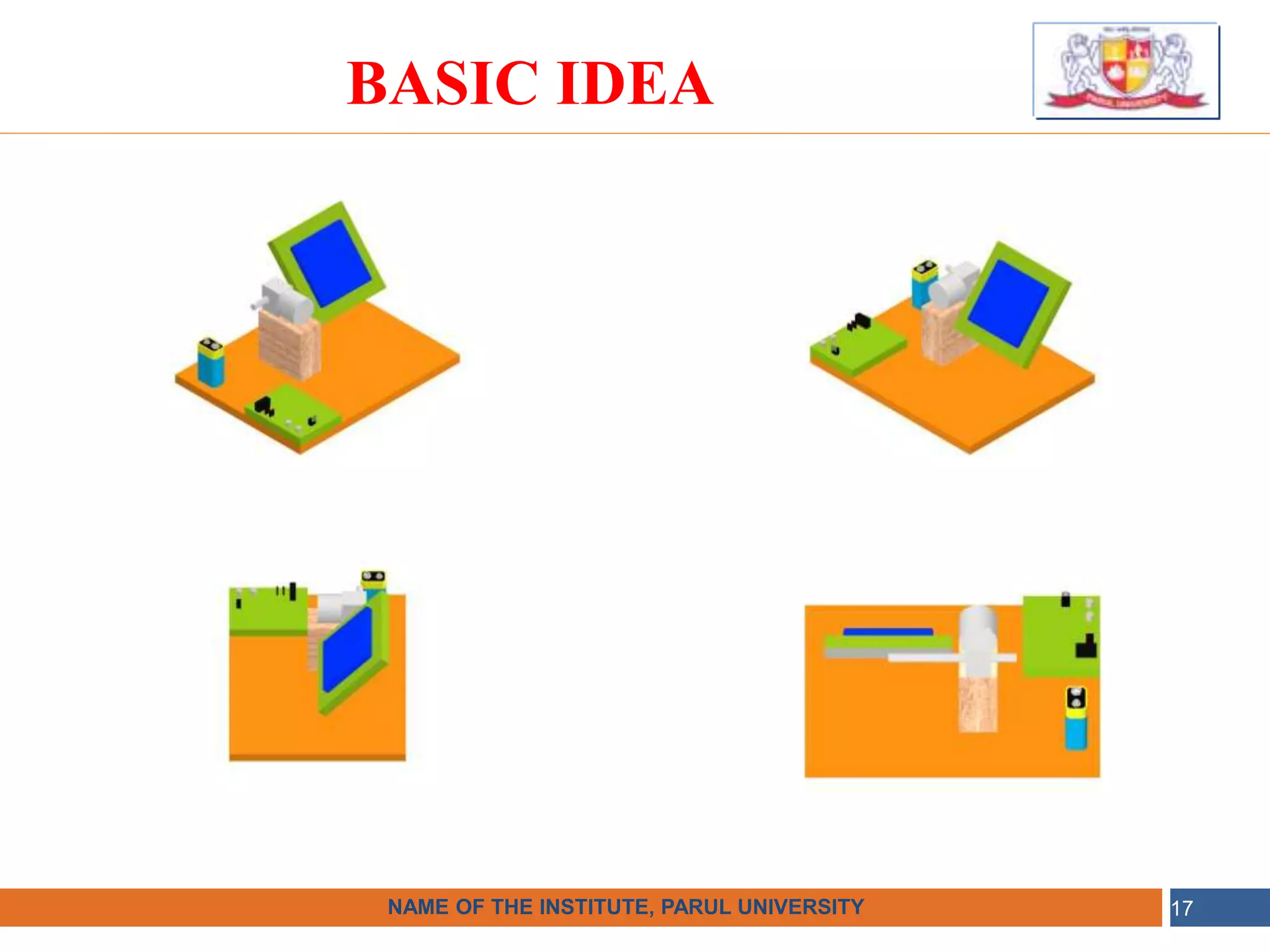
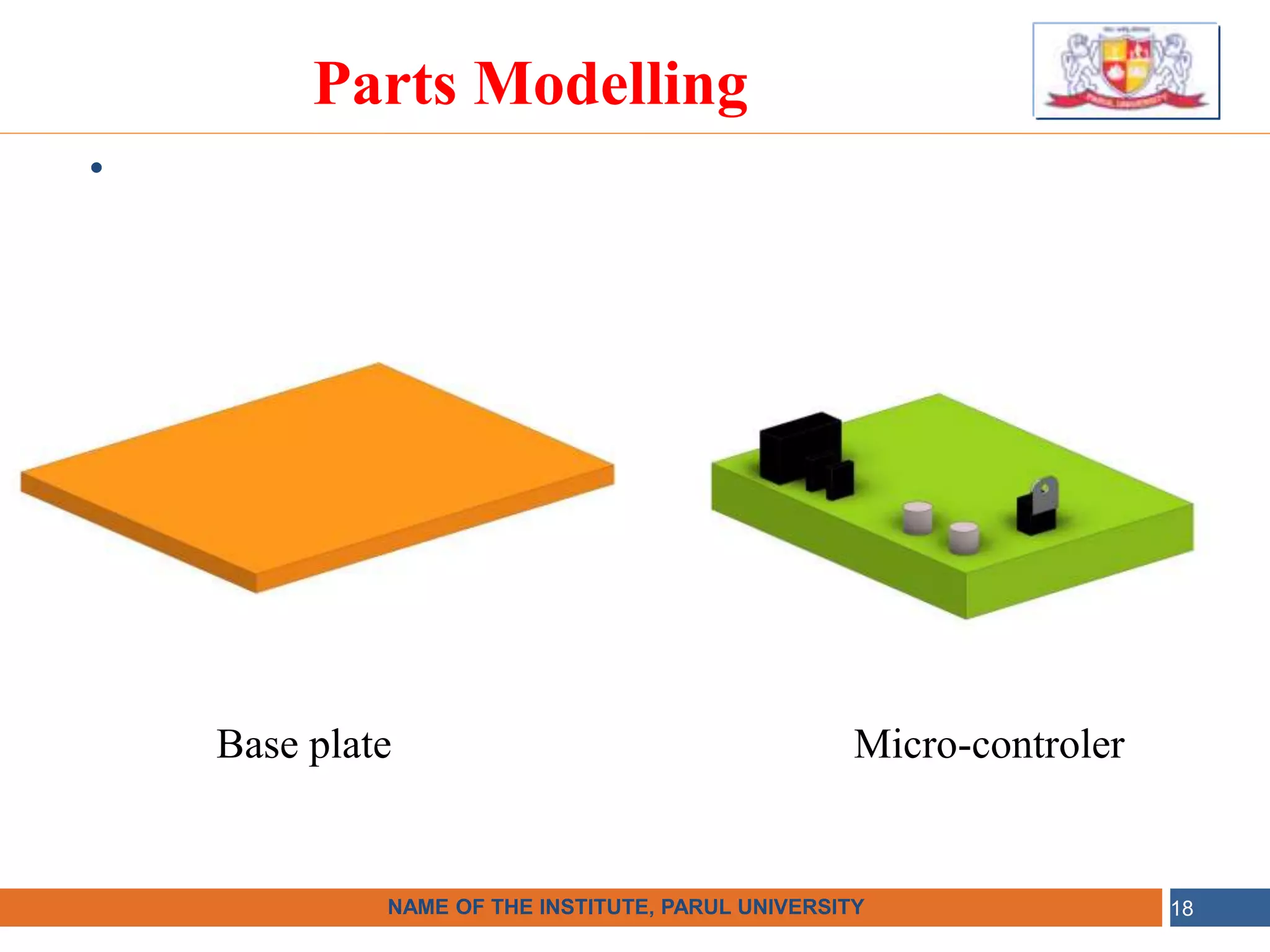
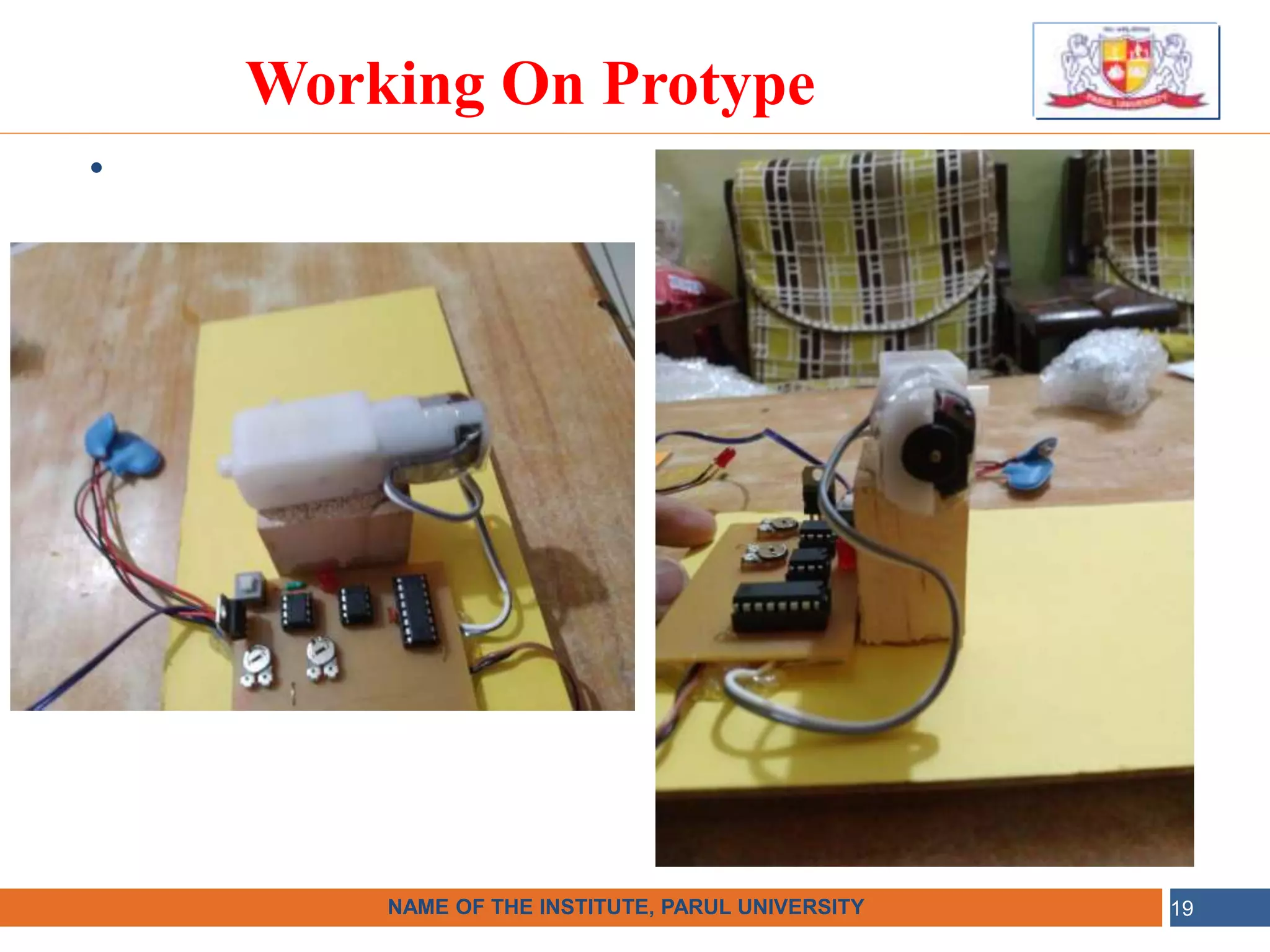
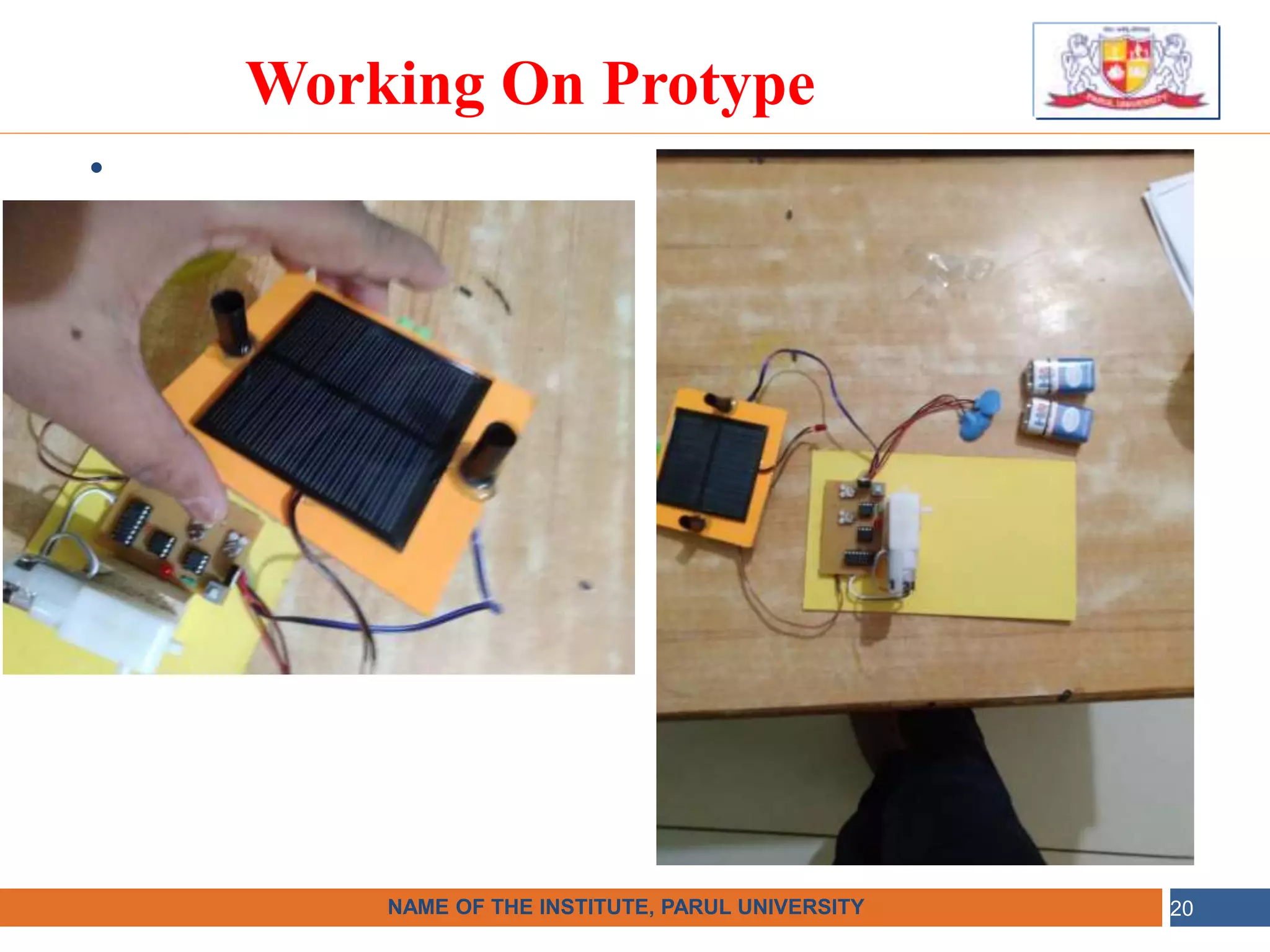
•
NAME OF THE INSTITUTE, PARUL UNIVERSITY
PARUL INSTITUTE OF TECHNOLOGY, PARUL UNIVERSITY 1
B .Tech 6th Semester Mid Sem Presentation
“SOLAR PV TRACKER”
Presented by:
VISHAL KUSHWAHA -190305109720
PARTH PANDYA -190305109724
RHYTHM PATEL -190305109736
TIRTH SONI -190305109753
ZEAL VYAS -190305109757
Supervisors : Mr. Chintan Patel
•
NAME OF THE INSTITUTE, PARUL UNIVERSITY
PARUL INSTITUTE OF TECHNOLOGY, PARUL UNIVERSITY 2
Index
• Definition of problem
• Market Solution
• Introduction
• Block diagram
• Working
• Circuit diagram
• Components
• Basic Idea
• Part Modelling
• Working On Protype
• Main Modelling
• Approximate Budget
• Work Plan
• Limitations
• Application
• Future enhancement
• Conclusion
• Reference
•
NAME OF THE INSTITUTE, PARUL UNIVERSITY
PARUL INSTITUTE OF TECHNOLOGY, PARUL UNIVERSITY 3
Problem Justification
• Today’s time solar cells are becoming extremely popular for
utilizing solar energy to use in different ways such as
producing electricity, transportation,cooking etc .
• So many solar panels have been installed all over the world
and most of them are stable. They are installed in the
direction of maximum radiation of sunlight.
• Now the problem arises that the sun is moving .So we cannot
use maximum radiation of sun all the time. The position of
maximum radiation receiving position only comes once in 24
hours.
•
NAME OF THE INSTITUTE, PARUL UNIVERSITY
PARUL INSTITUTE OF TECHNOLOGY, PARUL UNIVERSITY 4
Market Solution
• Solar tracker is the best solution for receiving maximum
radiation.
• By moving the solar panel according to the movement of sun
we can always receive the maximum radiation
•
NAME OF THE INSTITUTE, PARUL UNIVERSITY
PARUL INSTITUTE OF TECHNOLOGY, PARUL UNIVERSITY 5
Introduction
• The earth receives 16 x 1018 units of energy from the sun
annually, which is 20,000 times the requirement of
mankind on the Earth.
• Solar panels are used to convert light energy into
electrical energy.
• Efficient Solar Power generation System using moving
panel is a efficientpower generating system using sun
light.
• Two sensors in two directions to sense the direction of
maximum intensity of light. The difference between the
outputs of the sensors is given to the microcontroller unit.
•
NAME OF THE INSTITUTE, PARUL UNIVERSITY
PARUL INSTITUTE OF TECHNOLOGY, PARUL UNIVERSITY 6
Introduction
•
NAME OF THE INSTITUTE, PARUL UNIVERSITY
PARUL INSTITUTE OF TECHNOLOGY, PARUL UNIVERSITY 7
Introduction
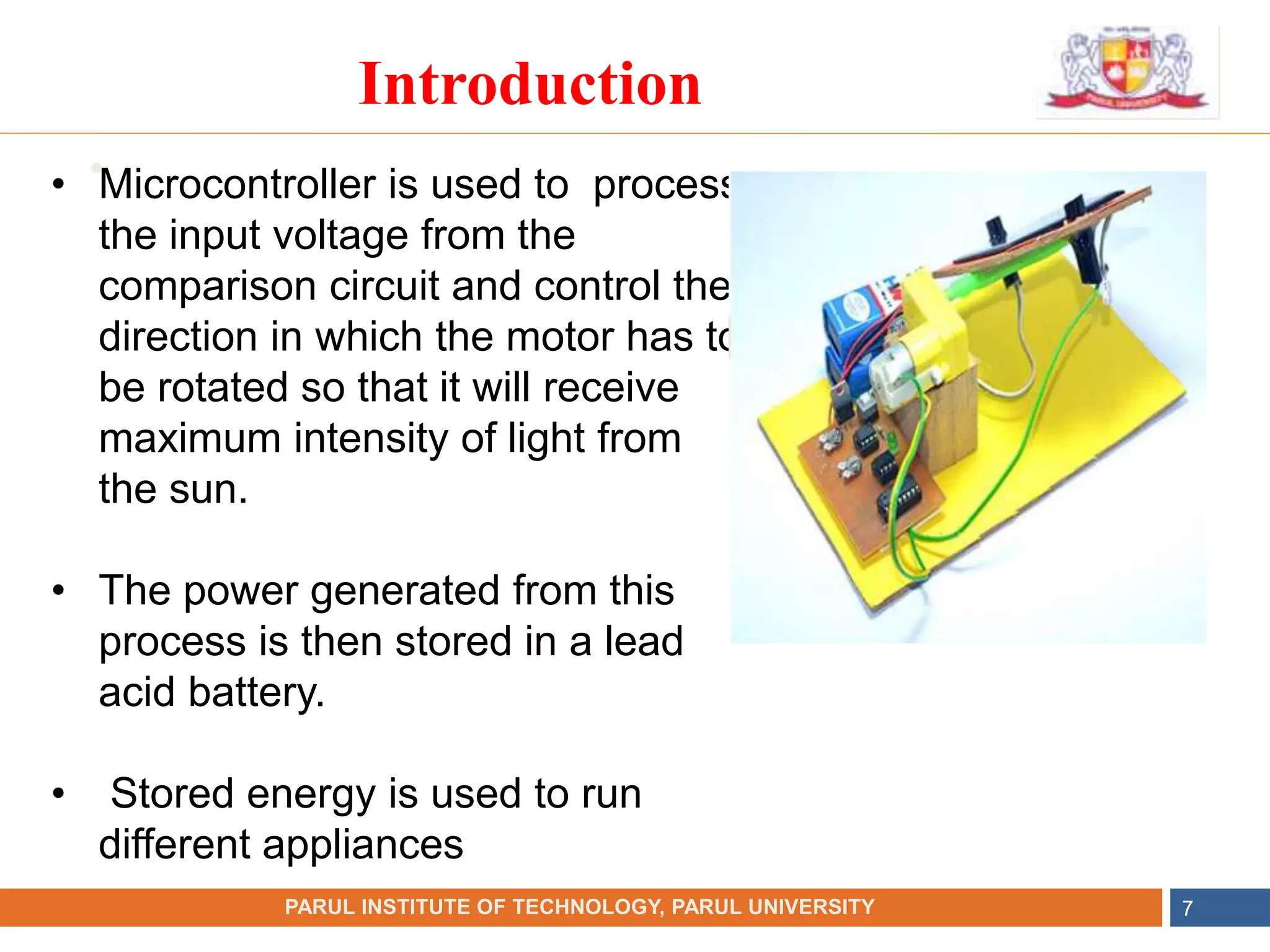
• Microcontroller is used to process
the input voltage from the
comparison circuit and control the
direction in which the motor has to
be rotated so that it will receive
maximum intensity of light from
the sun.
• The power generated from this
process is then stored in a lead
acid battery.
• Stored energy is used to run
different appliances
•
NAME OF THE INSTITUTE, PARUL UNIVERSITY
PARUL INSTITUTE OF TECHNOLOGY, PARUL UNIVERSITY 8
Block Diagram
•
NAME OF THE INSTITUTE, PARUL UNIVERSITY
PARUL INSTITUTE OF TECHNOLOGY, PARUL UNIVERSITY 9
Working
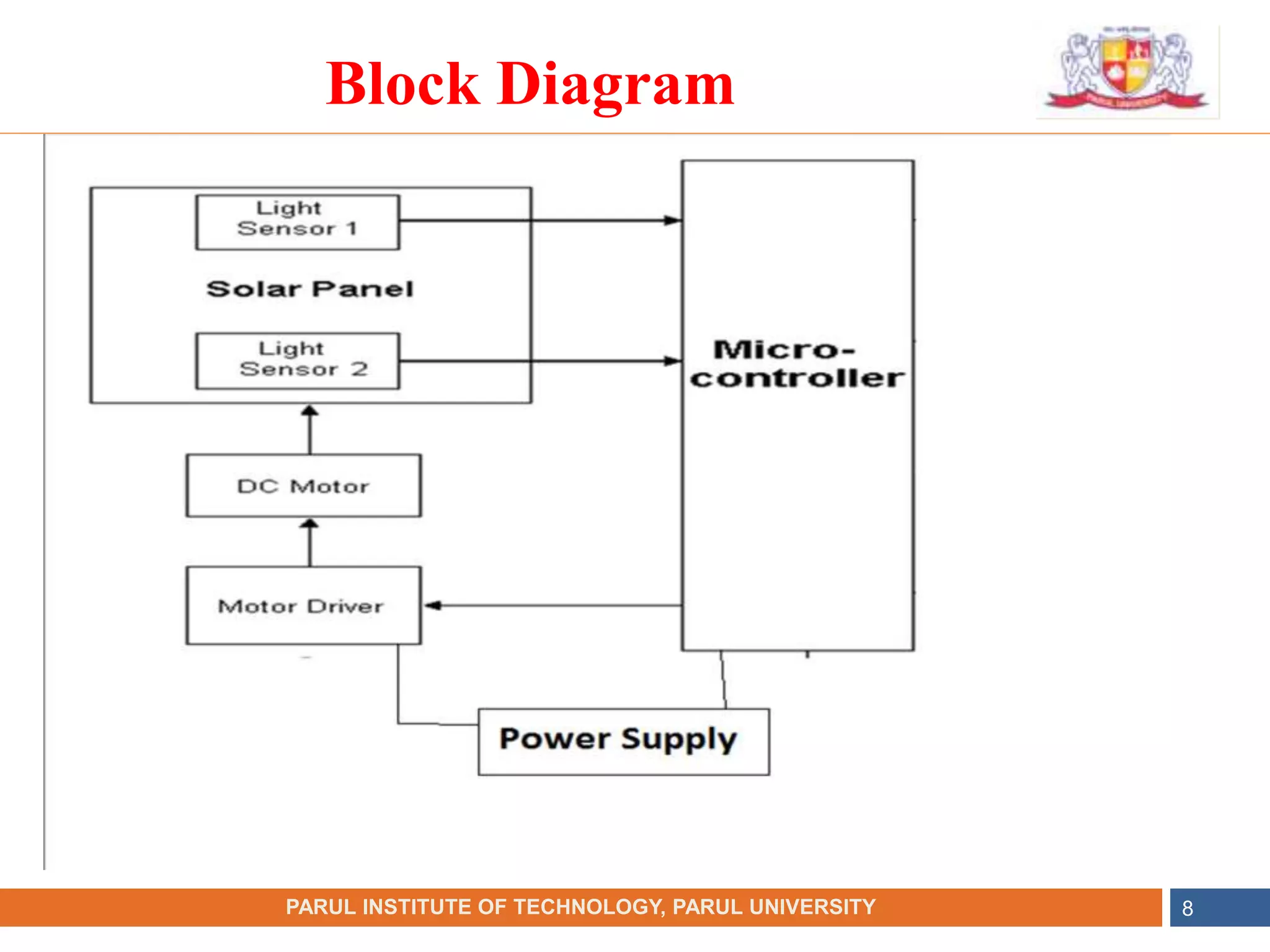
• It consist of a LDR sensor senses max solar power which
is being given to the Microcontroller through the ADC
which digitizes the LDR output.
• Controller then takes the decision according to then
algorithm and tilts the panel towards the direction of the
max energy given by LDR with the help of DC Motor .
• The Motor is used to rotate the LDR to sense the max
solar power.
•
NAME OF THE INSTITUTE, PARUL UNIVERSITY
PARUL INSTITUTE OF TECHNOLOGY, PARUL UNIVERSITY 10
Working Cont..
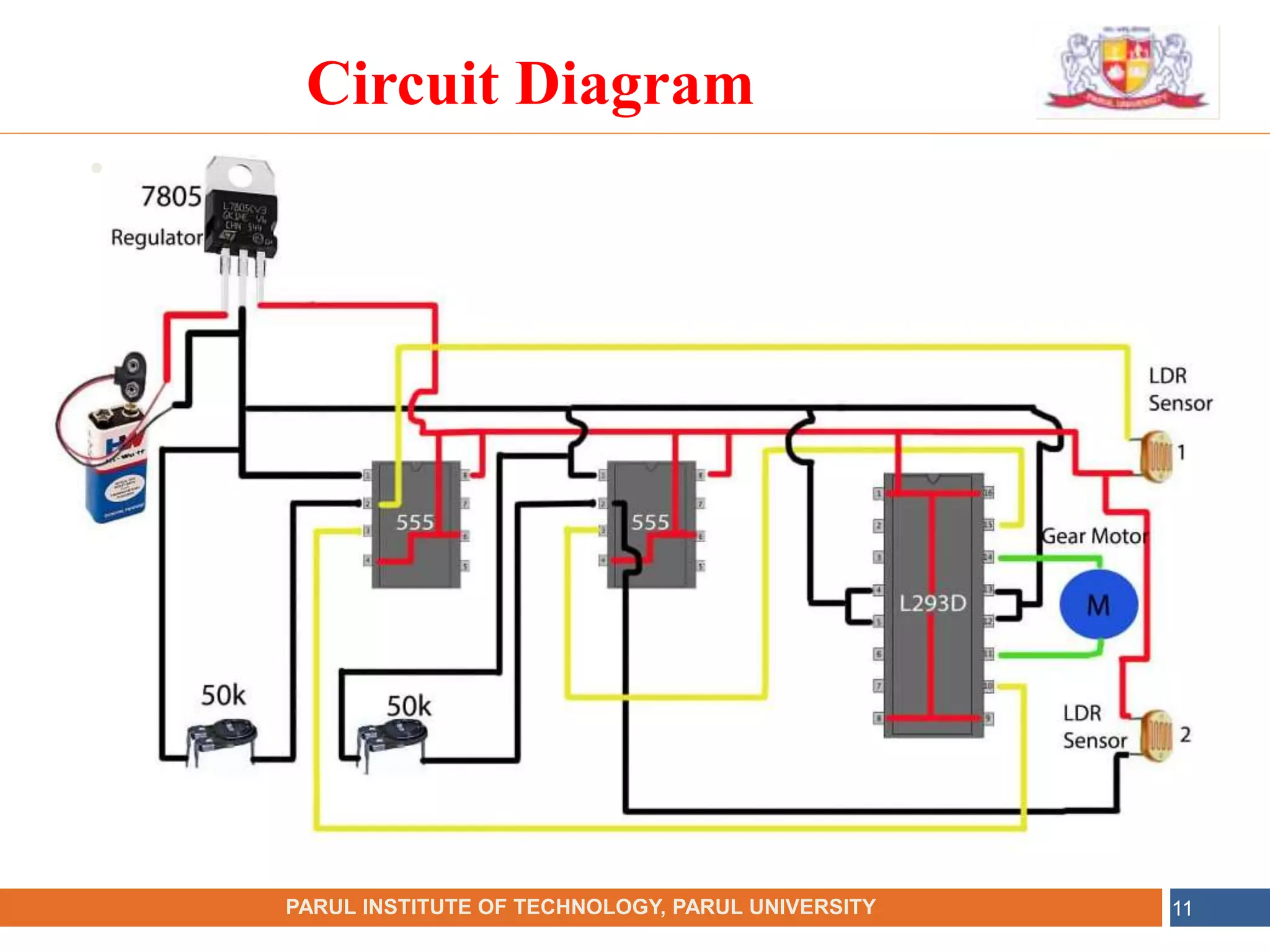
• Microcontroller receive signal from LDR output in
digitized form with the help of 555 timer IC.
• It responds back to the input by sending signal to the
motor driver so that motor driver rotate the panel in the
direction where more intensity of light is falling by
minimizing the difference of resistance produced b/w two
sensors to zero
•
NAME OF THE INSTITUTE, PARUL UNIVERSITY
PARUL INSTITUTE OF TECHNOLOGY, PARUL UNIVERSITY 11
Circuit Diagram
•
NAME OF THE INSTITUTE, PARUL UNIVERSITY
PARUL INSTITUTE OF TECHNOLOGY, PARUL UNIVERSITY 12
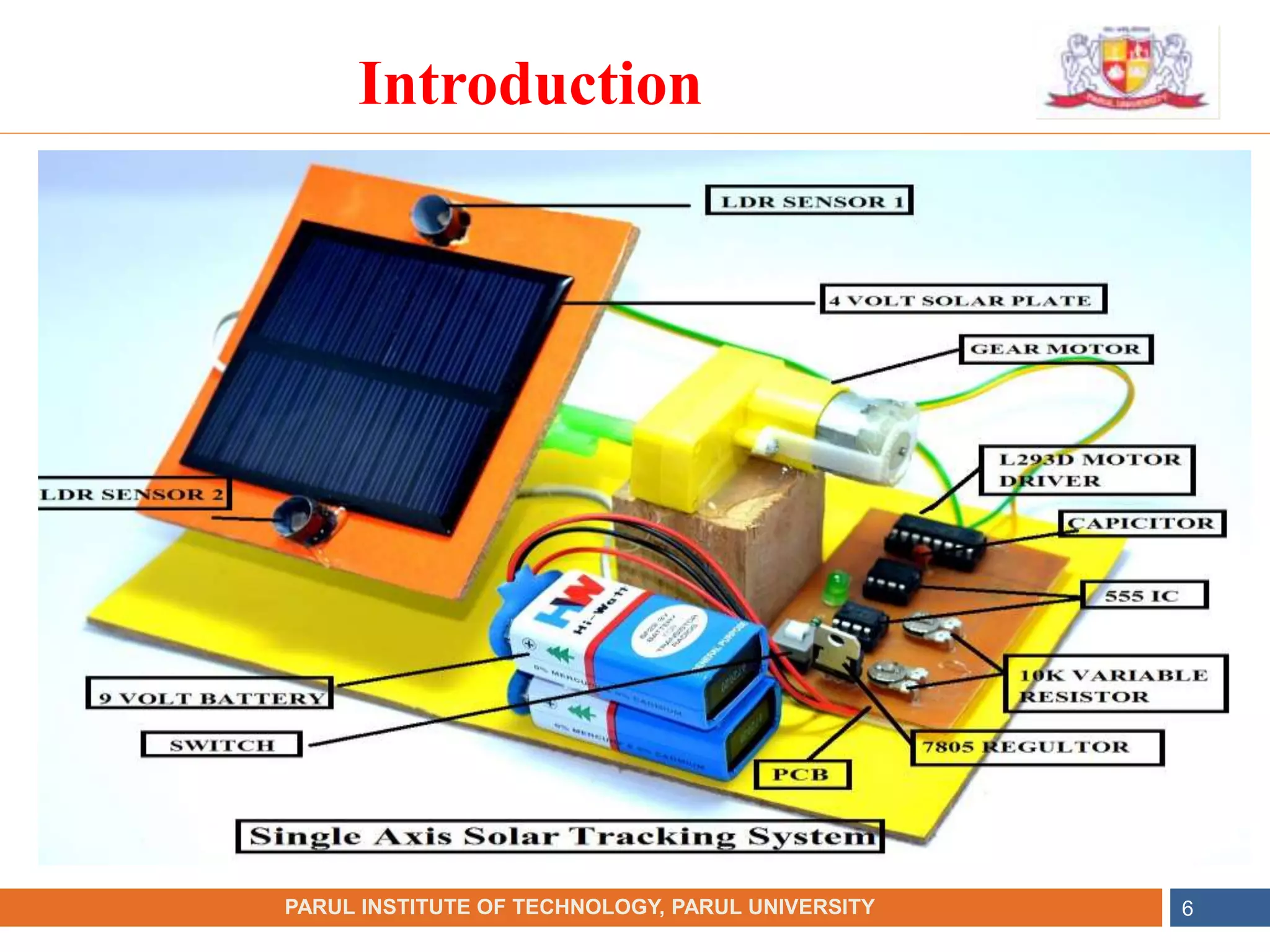
Components
1) Microcontroller (8051)
2) 555 IC
3) Gear motor.
4) Battery (9 V)
5) Solar panel
6) Capicitor
7) 16k Variable Resistor
8) LDR Sensor
9)PCB
•
NAME OF THE INSTITUTE, PARUL UNIVERSITY
PARUL INSTITUTE OF TECHNOLOGY, PARUL UNIVERSITY 13
Components Description
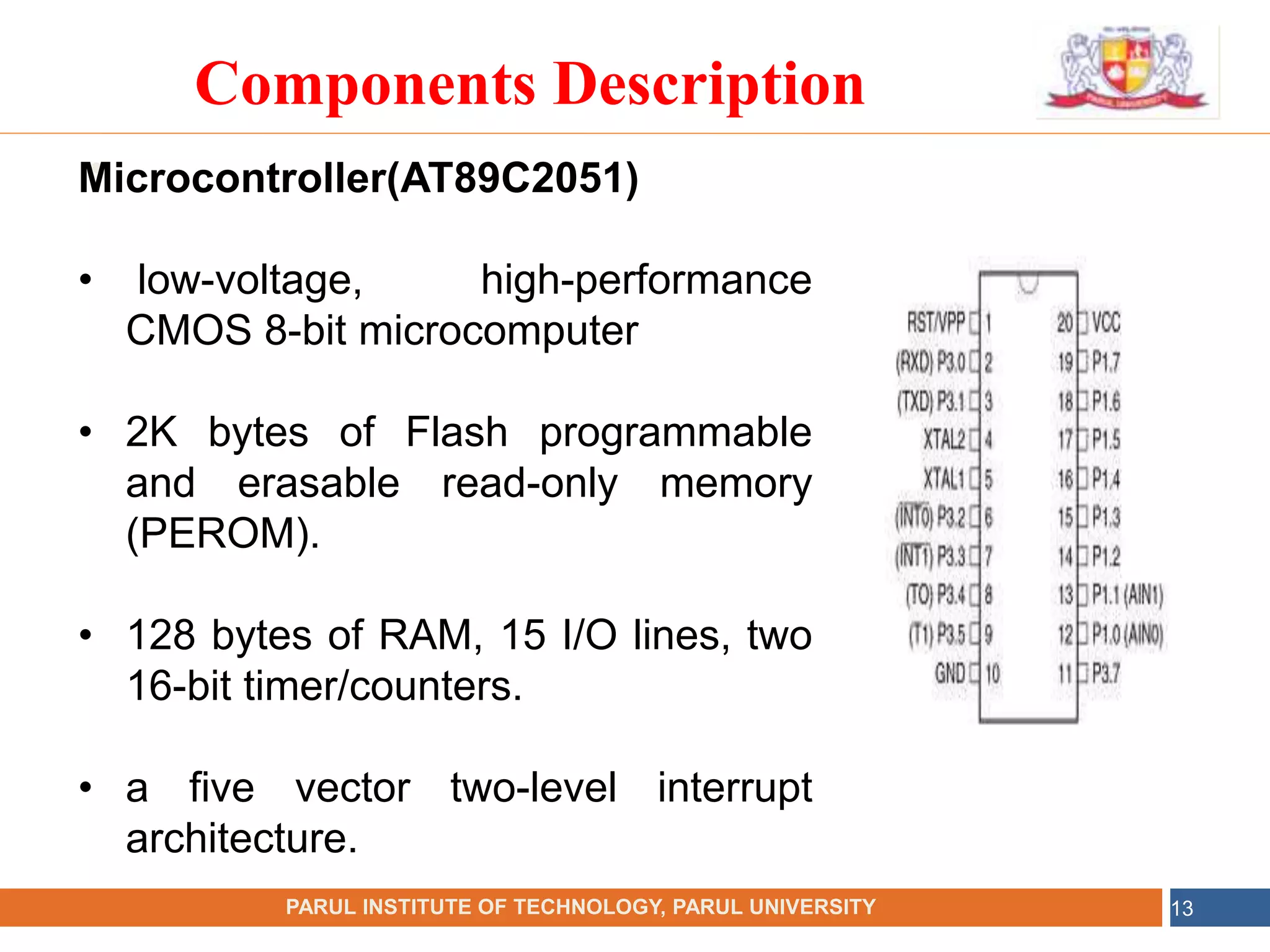
Microcontroller(AT89C2051)
• low-voltage, high-performance
CMOS 8-bit microcomputer
• 2K bytes of Flash programmable
and erasable read-only memory
(PEROM).
• 128 bytes of RAM, 15 I/O lines, two
16-bit timer/counters.
• a five vector two-level interrupt
architecture.
•
NAME OF THE INSTITUTE, PARUL UNIVERSITY
PARUL INSTITUTE OF TECHNOLOGY, PARUL UNIVERSITY 14
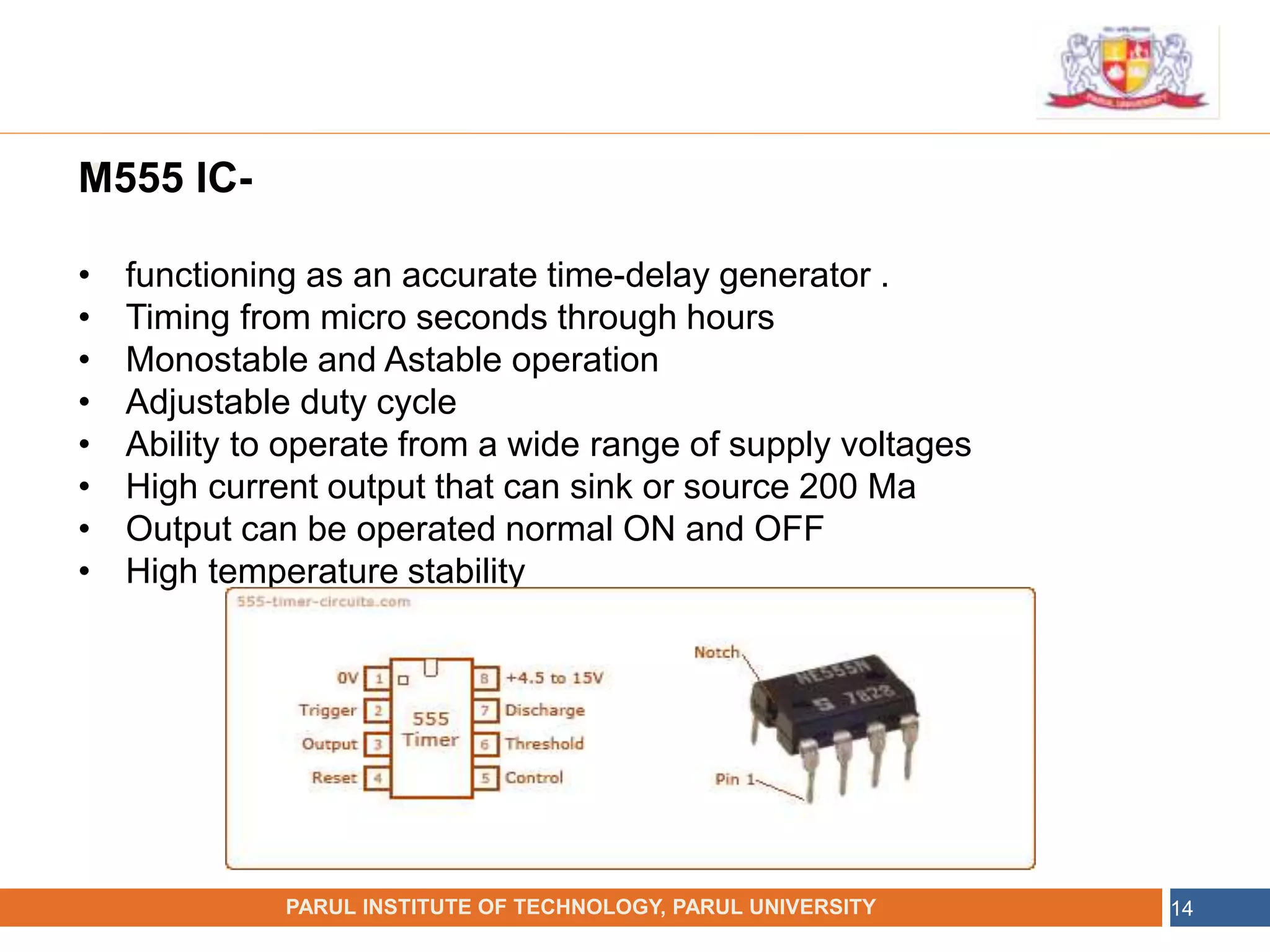
M555 IC-
• functioning as an accurate time-delay generator .
• Timing from micro seconds through hours
• Monostable and Astable operation
• Adjustable duty cycle
• Ability to operate from a wide range of supply voltages
• High current output that can sink or source 200 Ma
• Output can be operated normal ON and OFF
• High temperature stability
•
NAME OF THE INSTITUTE, PARUL UNIVERSITY
PARUL INSTITUTE OF TECHNOLOGY, PARUL UNIVERSITY 15
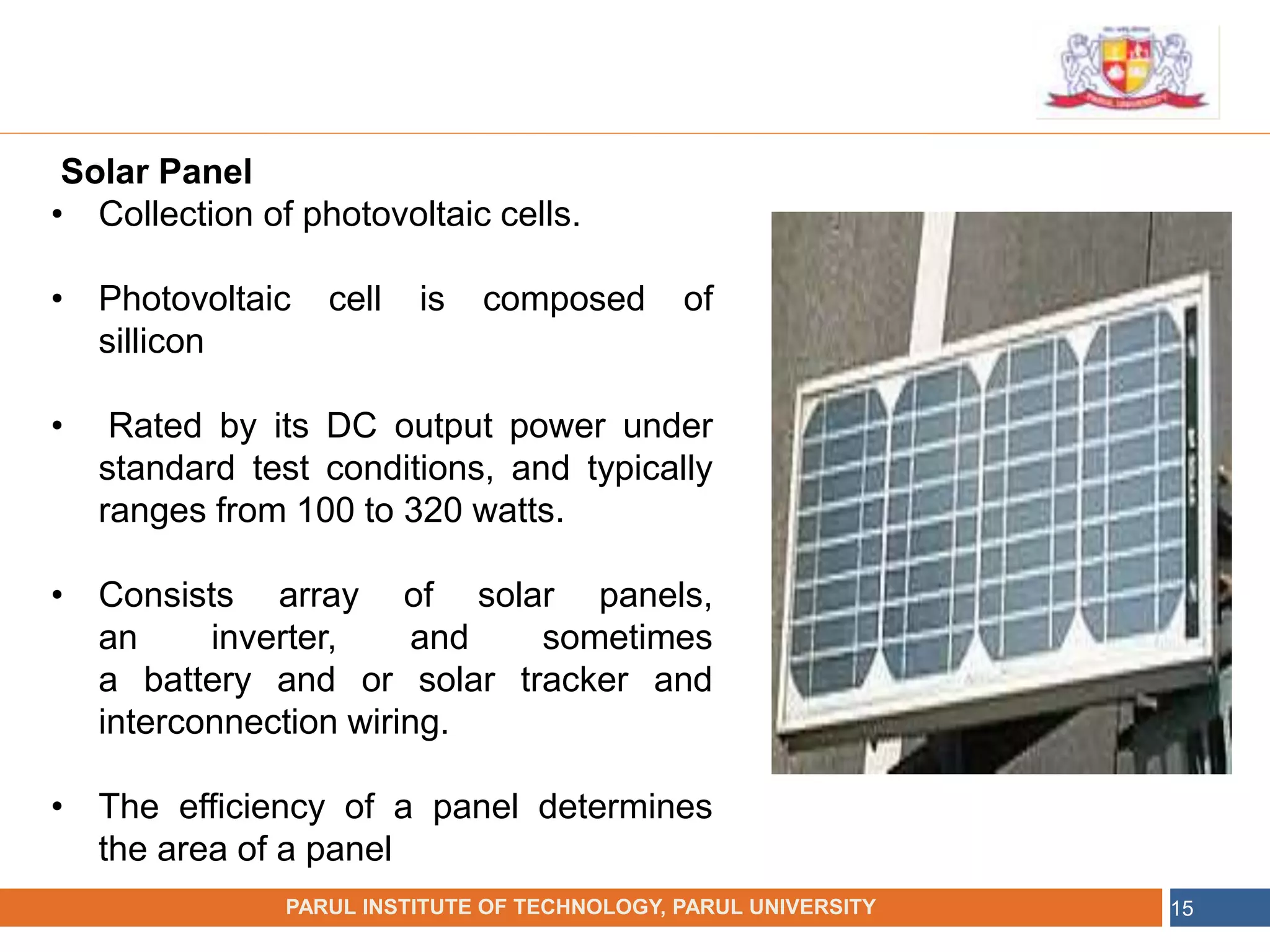
Solar Panel
• Collection of photovoltaic cells.
• Photovoltaic cell is composed of
sillicon
• Rated by its DC output power under
standard test conditions, and typically
ranges from 100 to 320 watts.
• Consists array of solar panels,
an inverter, and sometimes
a battery and or solar tracker and
interconnection wiring.
• The efficiency of a panel determines
the area of a panel
•
NAME OF THE INSTITUTE, PARUL UNIVERSITY
PARUL INSTITUTE OF TECHNOLOGY, PARUL UNIVERSITY 16
Gear Motor :
• electromechanical device which converts electrical pulses into
discrete mechanical movements. The speed of the motor shafts
rotation is directly related to the frequency of the input pulses and the
• length of rotation is directly related to the number of input pulses
applied.
Battery 9V
• An electric battery is a device consisting of one or more
electrochemical cells with external connections provided to power
electrical devices such as flashlights, and electric cars. When a
battery is supplying electric power, its positive terminal is the cathode
and its negative terminal is the anode.
•
NAME OF THE INSTITUTE, PARUL UNIVERSITY
NAME OF THE INSTITUTE, PARUL UNIVERSITY 17
BASIC IDEA
•
NAME OF THE INSTITUTE, PARUL UNIVERSITY
NAME OF THE INSTITUTE, PARUL UNIVERSITY 18
Parts Modelling
Base plate Micro-controler
•
NAME OF THE INSTITUTE, PARUL UNIVERSITY
NAME OF THE INSTITUTE, PARUL UNIVERSITY 19
Working On Protype
•
NAME OF THE INSTITUTE, PARUL UNIVERSITY
NAME OF THE INSTITUTE, PARUL UNIVERSITY 20
Working On Protype
•
NAME OF THE INSTITUTE, PARUL UNIVERSITY
NAME OF THE INSTITUTE, PARUL UNIVERSITY 21
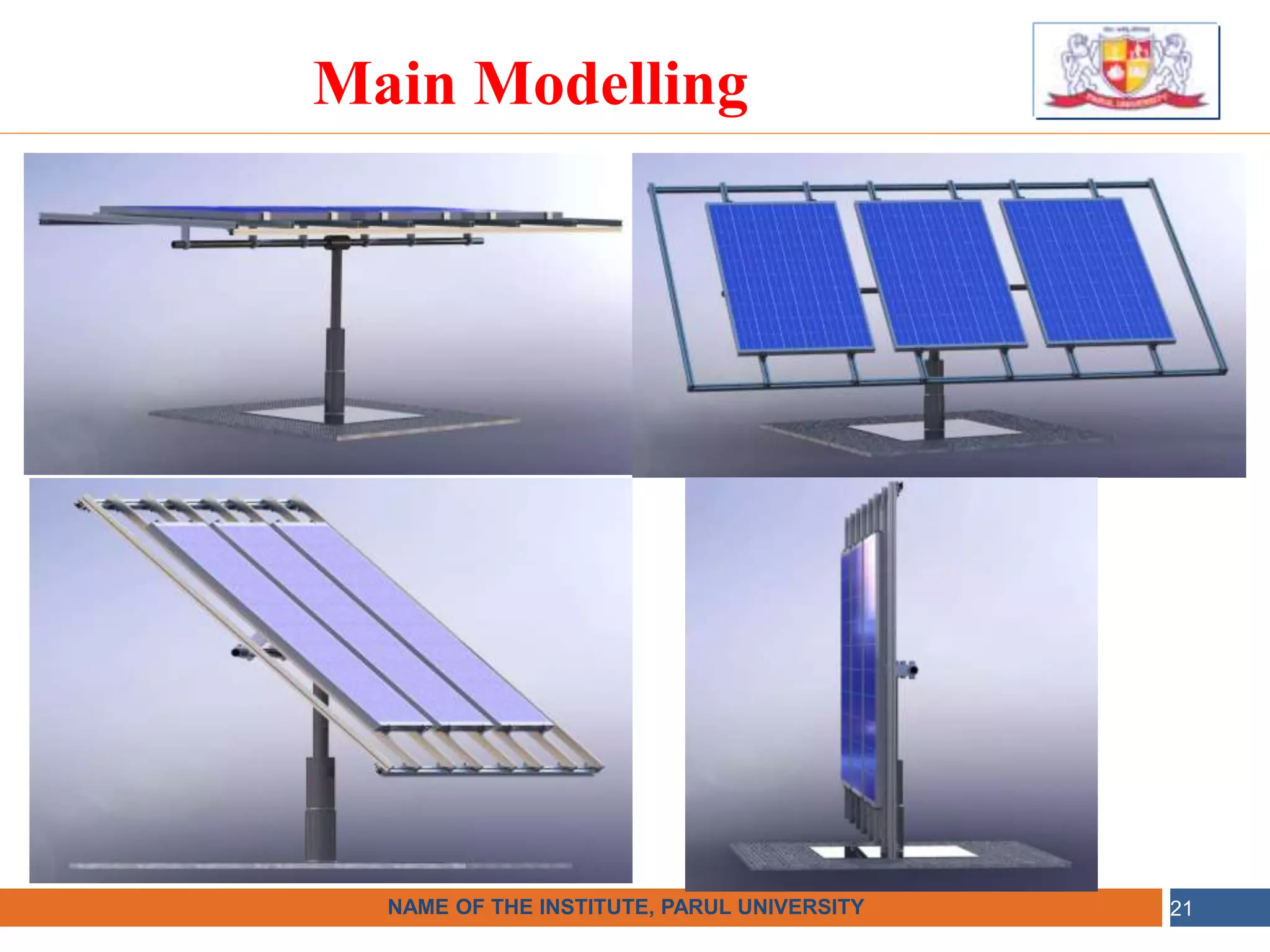
Main Modelling
•
NAME OF THE INSTITUTE, PARUL UNIVERSITY
NAME OF THE INSTITUTE, PARUL UNIVERSITY 22
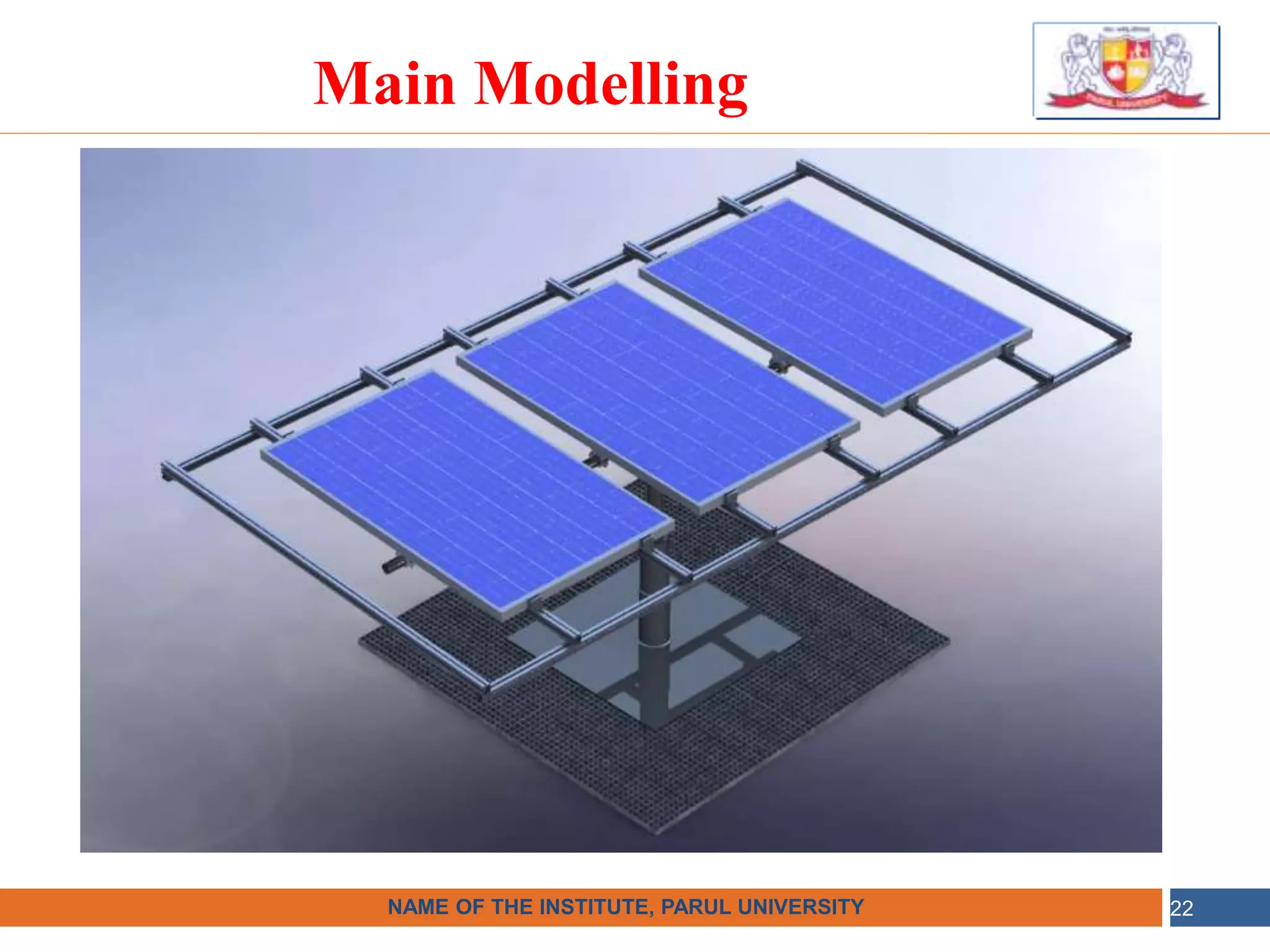
Main Modelling
23
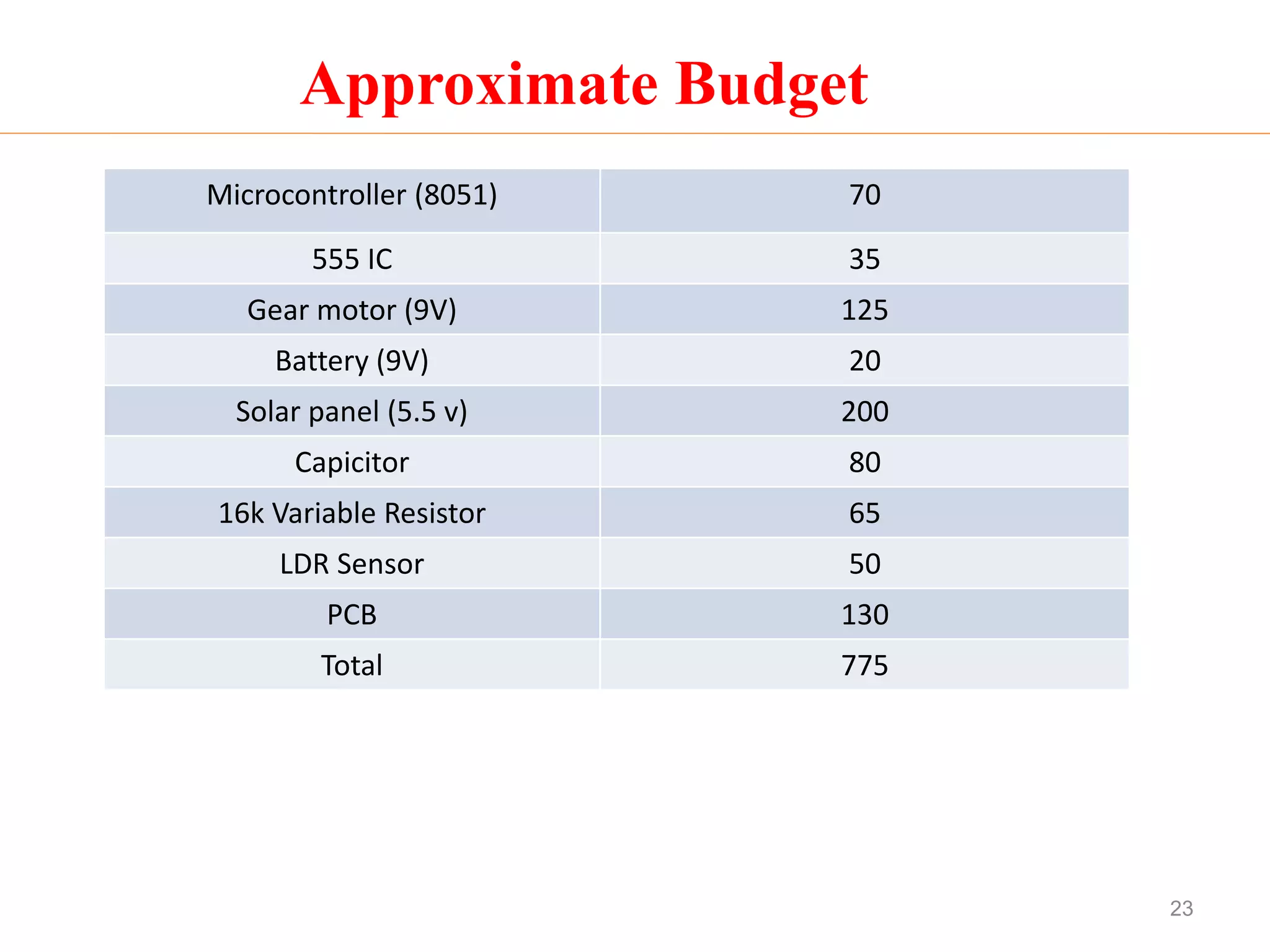
Approximate Budget
Microcontroller (8051) 70
555 IC 35
Gear motor (9V) 125
Battery (9V) 20
Solar panel (5.5 v) 200
Capicitor 80
16k Variable Resistor 65
LDR Sensor 50
PCB 130
Total 775
•
NAME OF THE INSTITUTE, PARUL UNIVERSITY
NAME OF THE INSTITUTE, PARUL UNIVERSITY 24
Work Plan
MONTH/
ACTIVITY
August September October November December January February
Initial
stage
of project
Data collec
ting and es
timating
Design on
software-1
Design on software-2
Aim Market and cost survey
Starting of
project
Buying
materials and
processing on
raw
material
Trial and
error meth
od
Prototype of model with trial a
nd error method
Report
Writing
Report
And
PPT
Writing
Final mode
l
Final model ready with
paperwork and model
•
NAME OF THE INSTITUTE, PARUL UNIVERSITY
PARUL INSTITUTE OF TECHNOLOGY, PARUL UNIVERSITY 25
Limitations
• By adding moving equipment and gears it increase the cost
approximately 25% as compare to simple solar system
• It require regular repairs and maintenance
•
NAME OF THE INSTITUTE, PARUL UNIVERSITY
PARUL INSTITUTE OF TECHNOLOGY, PARUL UNIVERSITY 26
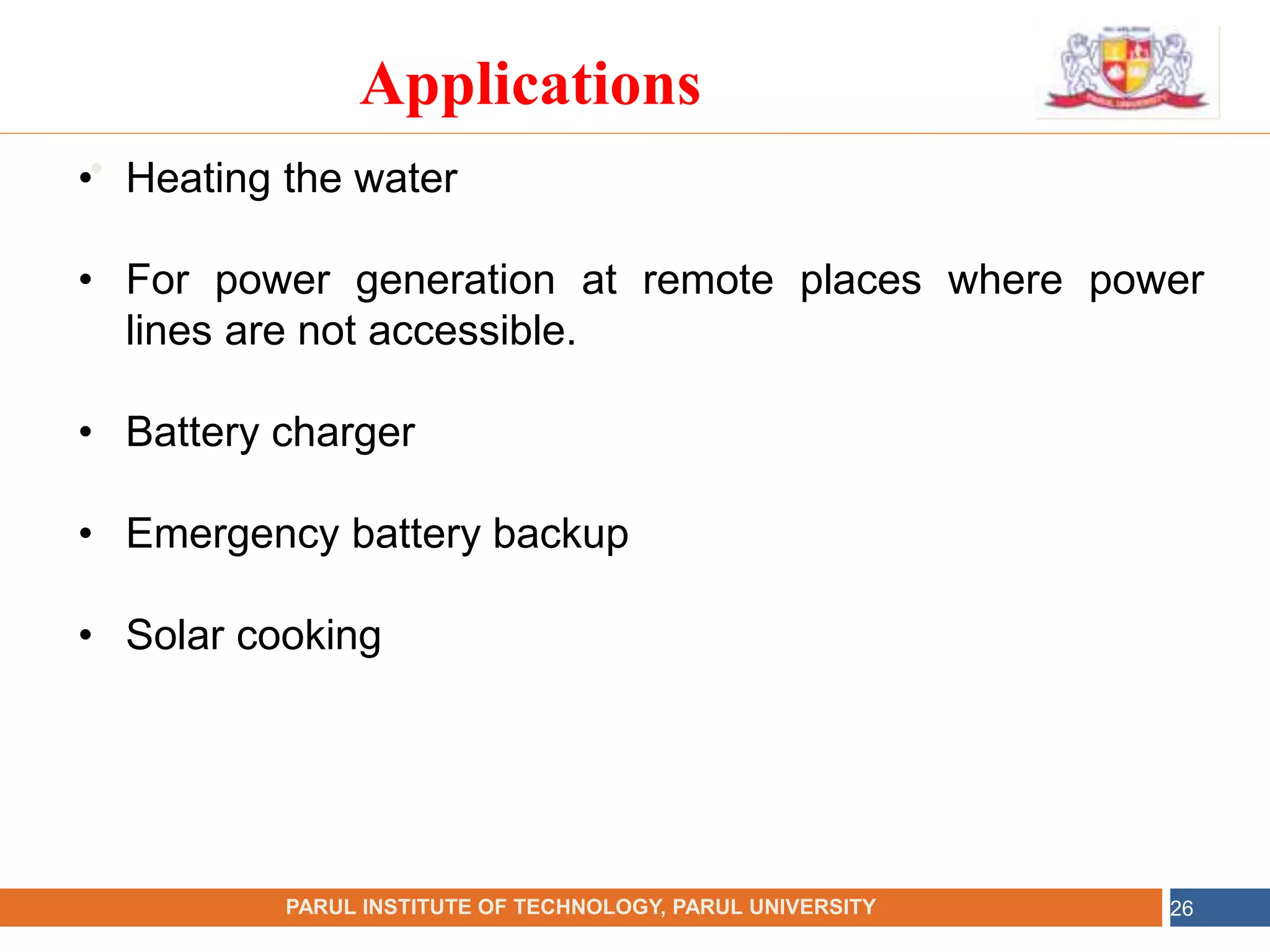
Applications
• Heating the water
• For power generation at remote places where power
lines are not accessible.
• Battery charger
• Emergency battery backup
• Solar cooking
•
NAME OF THE INSTITUTE, PARUL UNIVERSITY
PARUL INSTITUTE OF TECHNOLOGY, PARUL UNIVERSITY 27
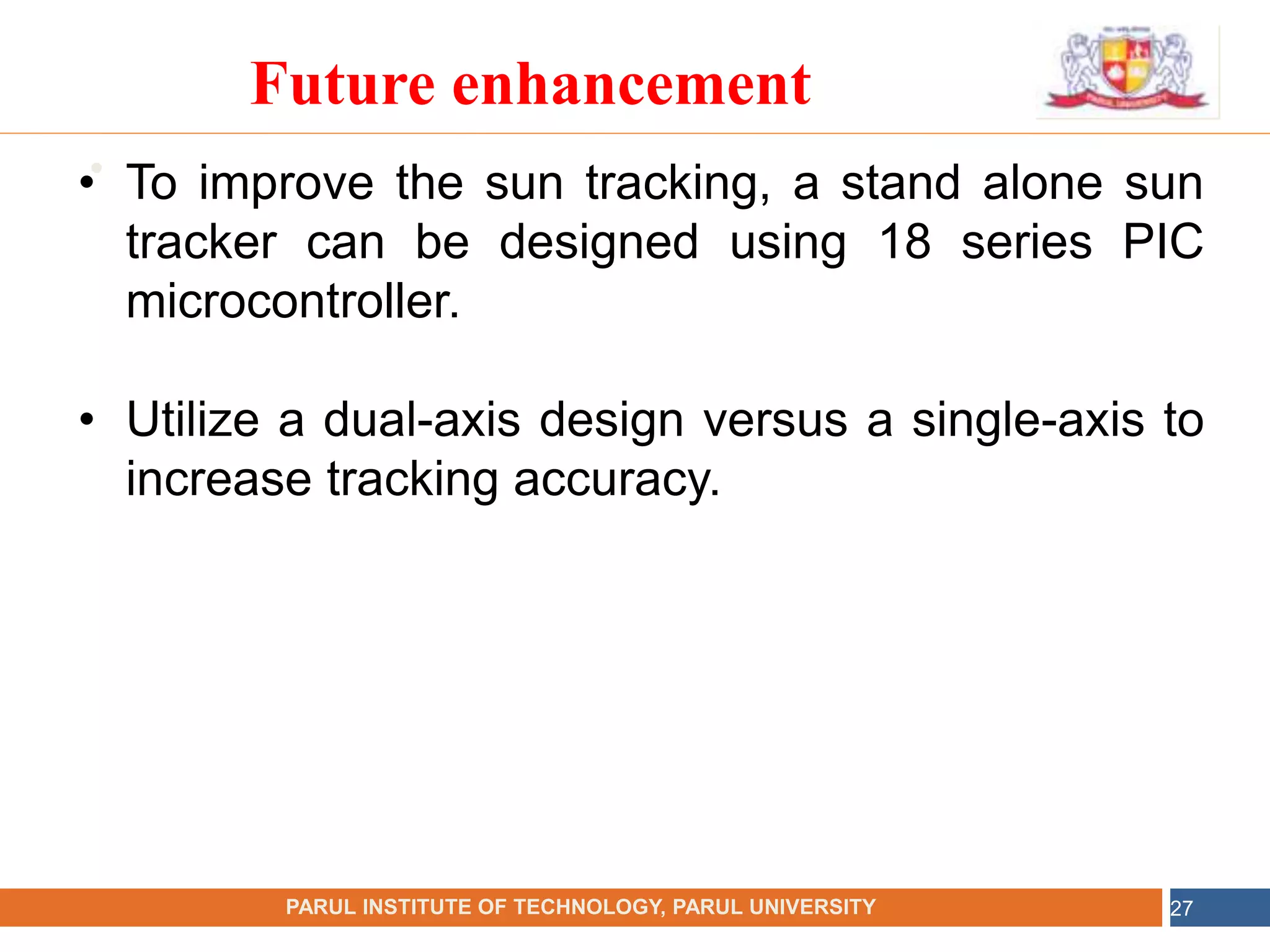
Future enhancement
• To improve the sun tracking, a stand alone sun
tracker can be designed using 18 series PIC
microcontroller.
• Utilize a dual-axis design versus a single-axis to
increase tracking accuracy.
•
NAME OF THE INSTITUTE, PARUL UNIVERSITY
PARUL INSTITUTE OF TECHNOLOGY, PARUL UNIVERSITY 28
Conclusion
• A modeling and optimization method from a new point
of view is proposed.
• More factors can be taken into consideration in the
future modeling and optimization, such as the
sensitivity range of the controlling system which
determines when the solar tracker should operate to
generate more power or stay still to save energy.
• The research provides references for solar tracking
system designing, and the modeling and optimization
method can be modified and applied in other
mechanical and electronic systems.
REFERENCES
• " Solar Tracker Robot using Microcontroller" by A.B. Afarulrazi,
W. M.Utomo,K.L. Liew and M. Zarafi published in 2011
International Conference on Business, Engineering and
Industrial Applications
• " Design and Construction of an Automatic Solar Tracking
System by Md. Tanvir Arafat Khan, S.M. ShahrearTanzil, Rifat
Rahman, S M Shafiul Alam published in 6th International
Conference on Electrical and Computer Engineering ICECE
2010, 18-20 December 2010, Dhaka,Bangladesh
• " Microcontroller Based Solar Tracking System" by Aleksandar
Stjepanovic, Sladjana Stjepanovic, Ferid Softic, Zlatko Bundalo
published in Serbia,Nis,October 7-9,2009
29 11
PARUL INSTITUTE OF TECHONOLOGY,PARUL UNIVERSITY
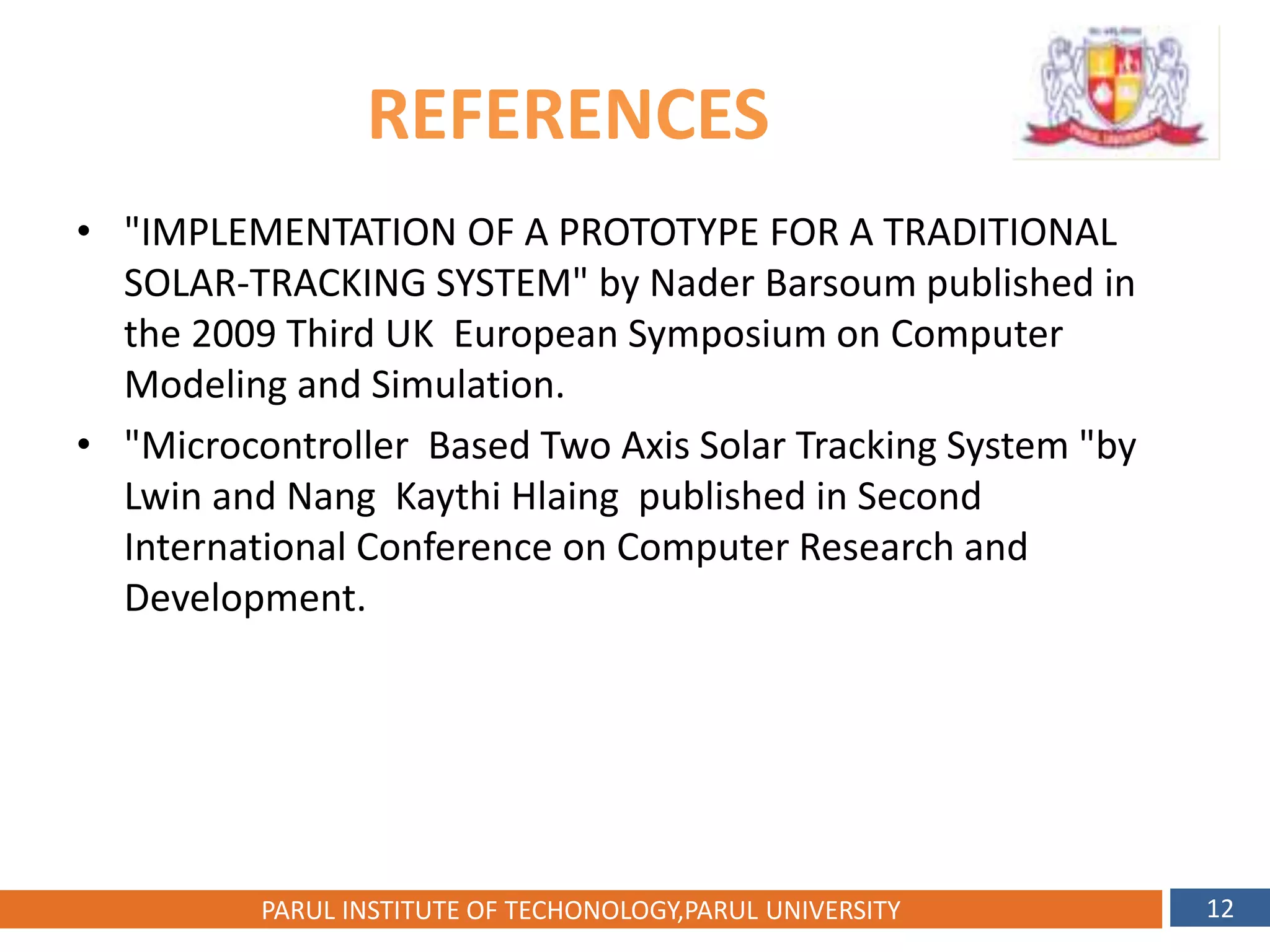
REFERENCES
• "IMPLEMENTATION OF A PROTOTYPE FOR A TRADITIONAL
SOLAR-TRACKING SYSTEM" by Nader Barsoum published in
the 2009 Third UK European Symposium on Computer
Modeling and Simulation.
• "Microcontroller Based Two Axis Solar Tracking System "by
Lwin and Nang Kaythi Hlaing published in Second
International Conference on Computer Research and
Development.
30
PARUL INSTITUTE OF TECHONOLOGY,PARUL UNIVERSITY 12

Solar pv tracker

  • 1.
    • NAME OF THEINSTITUTE, PARUL UNIVERSITY PARUL INSTITUTE OF TECHNOLOGY, PARUL UNIVERSITY 1 B .Tech 6th Semester Mid Sem Presentation “SOLAR PV TRACKER” Presented by: VISHAL KUSHWAHA -190305109720 PARTH PANDYA -190305109724 RHYTHM PATEL -190305109736 TIRTH SONI -190305109753 ZEAL VYAS -190305109757 Supervisors : Mr. Chintan Patel
  • 2.
    • NAME OF THEINSTITUTE, PARUL UNIVERSITY PARUL INSTITUTE OF TECHNOLOGY, PARUL UNIVERSITY 2 Index • Definition of problem • Market Solution • Introduction • Block diagram • Working • Circuit diagram • Components • Basic Idea • Part Modelling • Working On Protype • Main Modelling • Approximate Budget • Work Plan • Limitations • Application • Future enhancement • Conclusion • Reference
  • 3.
    • NAME OF THEINSTITUTE, PARUL UNIVERSITY PARUL INSTITUTE OF TECHNOLOGY, PARUL UNIVERSITY 3 Problem Justification • Today’s time solar cells are becoming extremely popular for utilizing solar energy to use in different ways such as producing electricity, transportation,cooking etc . • So many solar panels have been installed all over the world and most of them are stable. They are installed in the direction of maximum radiation of sunlight. • Now the problem arises that the sun is moving .So we cannot use maximum radiation of sun all the time. The position of maximum radiation receiving position only comes once in 24 hours.
  • 4.
    • NAME OF THEINSTITUTE, PARUL UNIVERSITY PARUL INSTITUTE OF TECHNOLOGY, PARUL UNIVERSITY 4 Market Solution • Solar tracker is the best solution for receiving maximum radiation. • By moving the solar panel according to the movement of sun we can always receive the maximum radiation
  • 5.
    • NAME OF THEINSTITUTE, PARUL UNIVERSITY PARUL INSTITUTE OF TECHNOLOGY, PARUL UNIVERSITY 5 Introduction • The earth receives 16 x 1018 units of energy from the sun annually, which is 20,000 times the requirement of mankind on the Earth. • Solar panels are used to convert light energy into electrical energy. • Efficient Solar Power generation System using moving panel is a efficientpower generating system using sun light. • Two sensors in two directions to sense the direction of maximum intensity of light. The difference between the outputs of the sensors is given to the microcontroller unit.
  • 6.
    • NAME OF THEINSTITUTE, PARUL UNIVERSITY PARUL INSTITUTE OF TECHNOLOGY, PARUL UNIVERSITY 6 Introduction
  • 7.
    • NAME OF THEINSTITUTE, PARUL UNIVERSITY PARUL INSTITUTE OF TECHNOLOGY, PARUL UNIVERSITY 7 Introduction • Microcontroller is used to process the input voltage from the comparison circuit and control the direction in which the motor has to be rotated so that it will receive maximum intensity of light from the sun. • The power generated from this process is then stored in a lead acid battery. • Stored energy is used to run different appliances
  • 8.
    • NAME OF THEINSTITUTE, PARUL UNIVERSITY PARUL INSTITUTE OF TECHNOLOGY, PARUL UNIVERSITY 8 Block Diagram
  • 9.
    • NAME OF THEINSTITUTE, PARUL UNIVERSITY PARUL INSTITUTE OF TECHNOLOGY, PARUL UNIVERSITY 9 Working • It consist of a LDR sensor senses max solar power which is being given to the Microcontroller through the ADC which digitizes the LDR output. • Controller then takes the decision according to then algorithm and tilts the panel towards the direction of the max energy given by LDR with the help of DC Motor . • The Motor is used to rotate the LDR to sense the max solar power.
  • 10.
    • NAME OF THEINSTITUTE, PARUL UNIVERSITY PARUL INSTITUTE OF TECHNOLOGY, PARUL UNIVERSITY 10 Working Cont.. • Microcontroller receive signal from LDR output in digitized form with the help of 555 timer IC. • It responds back to the input by sending signal to the motor driver so that motor driver rotate the panel in the direction where more intensity of light is falling by minimizing the difference of resistance produced b/w two sensors to zero
  • 11.
    • NAME OF THEINSTITUTE, PARUL UNIVERSITY PARUL INSTITUTE OF TECHNOLOGY, PARUL UNIVERSITY 11 Circuit Diagram
  • 12.
    • NAME OF THEINSTITUTE, PARUL UNIVERSITY PARUL INSTITUTE OF TECHNOLOGY, PARUL UNIVERSITY 12 Components 1) Microcontroller (8051) 2) 555 IC 3) Gear motor. 4) Battery (9 V) 5) Solar panel 6) Capicitor 7) 16k Variable Resistor 8) LDR Sensor 9)PCB
  • 13.
    • NAME OF THEINSTITUTE, PARUL UNIVERSITY PARUL INSTITUTE OF TECHNOLOGY, PARUL UNIVERSITY 13 Components Description Microcontroller(AT89C2051) • low-voltage, high-performance CMOS 8-bit microcomputer • 2K bytes of Flash programmable and erasable read-only memory (PEROM). • 128 bytes of RAM, 15 I/O lines, two 16-bit timer/counters. • a five vector two-level interrupt architecture.
  • 14.
    • NAME OF THEINSTITUTE, PARUL UNIVERSITY PARUL INSTITUTE OF TECHNOLOGY, PARUL UNIVERSITY 14 M555 IC- • functioning as an accurate time-delay generator . • Timing from micro seconds through hours • Monostable and Astable operation • Adjustable duty cycle • Ability to operate from a wide range of supply voltages • High current output that can sink or source 200 Ma • Output can be operated normal ON and OFF • High temperature stability
  • 15.
    • NAME OF THEINSTITUTE, PARUL UNIVERSITY PARUL INSTITUTE OF TECHNOLOGY, PARUL UNIVERSITY 15 Solar Panel • Collection of photovoltaic cells. • Photovoltaic cell is composed of sillicon • Rated by its DC output power under standard test conditions, and typically ranges from 100 to 320 watts. • Consists array of solar panels, an inverter, and sometimes a battery and or solar tracker and interconnection wiring. • The efficiency of a panel determines the area of a panel
  • 16.
    • NAME OF THEINSTITUTE, PARUL UNIVERSITY PARUL INSTITUTE OF TECHNOLOGY, PARUL UNIVERSITY 16 Gear Motor : • electromechanical device which converts electrical pulses into discrete mechanical movements. The speed of the motor shafts rotation is directly related to the frequency of the input pulses and the • length of rotation is directly related to the number of input pulses applied. Battery 9V • An electric battery is a device consisting of one or more electrochemical cells with external connections provided to power electrical devices such as flashlights, and electric cars. When a battery is supplying electric power, its positive terminal is the cathode and its negative terminal is the anode.
  • 17.
    • NAME OF THEINSTITUTE, PARUL UNIVERSITY NAME OF THE INSTITUTE, PARUL UNIVERSITY 17 BASIC IDEA
  • 18.
    • NAME OF THEINSTITUTE, PARUL UNIVERSITY NAME OF THE INSTITUTE, PARUL UNIVERSITY 18 Parts Modelling Base plate Micro-controler
  • 19.
    • NAME OF THEINSTITUTE, PARUL UNIVERSITY NAME OF THE INSTITUTE, PARUL UNIVERSITY 19 Working On Protype
  • 20.
    • NAME OF THEINSTITUTE, PARUL UNIVERSITY NAME OF THE INSTITUTE, PARUL UNIVERSITY 20 Working On Protype
  • 21.
    • NAME OF THEINSTITUTE, PARUL UNIVERSITY NAME OF THE INSTITUTE, PARUL UNIVERSITY 21 Main Modelling
  • 22.
    • NAME OF THEINSTITUTE, PARUL UNIVERSITY NAME OF THE INSTITUTE, PARUL UNIVERSITY 22 Main Modelling
  • 23.
    23 Approximate Budget Microcontroller (8051)70 555 IC 35 Gear motor (9V) 125 Battery (9V) 20 Solar panel (5.5 v) 200 Capicitor 80 16k Variable Resistor 65 LDR Sensor 50 PCB 130 Total 775
  • 24.
    • NAME OF THEINSTITUTE, PARUL UNIVERSITY NAME OF THE INSTITUTE, PARUL UNIVERSITY 24 Work Plan MONTH/ ACTIVITY August September October November December January February Initial stage of project Data collec ting and es timating Design on software-1 Design on software-2 Aim Market and cost survey Starting of project Buying materials and processing on raw material Trial and error meth od Prototype of model with trial a nd error method Report Writing Report And PPT Writing Final mode l Final model ready with paperwork and model
  • 25.
    • NAME OF THEINSTITUTE, PARUL UNIVERSITY PARUL INSTITUTE OF TECHNOLOGY, PARUL UNIVERSITY 25 Limitations • By adding moving equipment and gears it increase the cost approximately 25% as compare to simple solar system • It require regular repairs and maintenance
  • 26.
    • NAME OF THEINSTITUTE, PARUL UNIVERSITY PARUL INSTITUTE OF TECHNOLOGY, PARUL UNIVERSITY 26 Applications • Heating the water • For power generation at remote places where power lines are not accessible. • Battery charger • Emergency battery backup • Solar cooking
  • 27.
    • NAME OF THEINSTITUTE, PARUL UNIVERSITY PARUL INSTITUTE OF TECHNOLOGY, PARUL UNIVERSITY 27 Future enhancement • To improve the sun tracking, a stand alone sun tracker can be designed using 18 series PIC microcontroller. • Utilize a dual-axis design versus a single-axis to increase tracking accuracy.
  • 28.
    • NAME OF THEINSTITUTE, PARUL UNIVERSITY PARUL INSTITUTE OF TECHNOLOGY, PARUL UNIVERSITY 28 Conclusion • A modeling and optimization method from a new point of view is proposed. • More factors can be taken into consideration in the future modeling and optimization, such as the sensitivity range of the controlling system which determines when the solar tracker should operate to generate more power or stay still to save energy. • The research provides references for solar tracking system designing, and the modeling and optimization method can be modified and applied in other mechanical and electronic systems.
  • 29.
    REFERENCES • " SolarTracker Robot using Microcontroller" by A.B. Afarulrazi, W. M.Utomo,K.L. Liew and M. Zarafi published in 2011 International Conference on Business, Engineering and Industrial Applications • " Design and Construction of an Automatic Solar Tracking System by Md. Tanvir Arafat Khan, S.M. ShahrearTanzil, Rifat Rahman, S M Shafiul Alam published in 6th International Conference on Electrical and Computer Engineering ICECE 2010, 18-20 December 2010, Dhaka,Bangladesh • " Microcontroller Based Solar Tracking System" by Aleksandar Stjepanovic, Sladjana Stjepanovic, Ferid Softic, Zlatko Bundalo published in Serbia,Nis,October 7-9,2009 29 11 PARUL INSTITUTE OF TECHONOLOGY,PARUL UNIVERSITY
  • 30.
    REFERENCES • "IMPLEMENTATION OFA PROTOTYPE FOR A TRADITIONAL SOLAR-TRACKING SYSTEM" by Nader Barsoum published in the 2009 Third UK European Symposium on Computer Modeling and Simulation. • "Microcontroller Based Two Axis Solar Tracking System "by Lwin and Nang Kaythi Hlaing published in Second International Conference on Computer Research and Development. 30 PARUL INSTITUTE OF TECHONOLOGY,PARUL UNIVERSITY 12