SOLAR INSTALLATION AND DESIGN: THE DOS AND DON’TS
POWER NIGERIA 2017
Engr. Tajudeen Humble Sikiru (PhD)
Electrical Engineering Department, Ahmadu Bello University, Zaria.
Rana World Tech Shop Limited, Kaduna, Nigeria
1
8-Sep-17 2
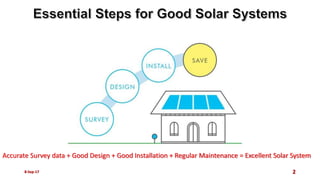
Accurate Survey data + Good Design + Good Installation + Regular Maintenance = Excellent Solar System
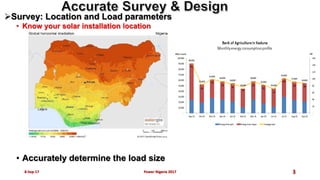
Survey: Location and Load parameters
• Know your solar installation location
• Accurately determine the load size
8-Sep-17 Power Nigeria 2017 3
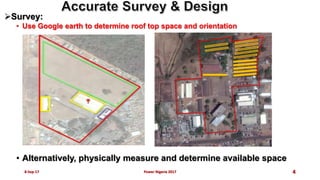
Survey:
• Use Google earth to determine roof top space and orientation
• Alternatively, physically measure and determine available space
8-Sep-17 Power Nigeria 2017 4
8-Sep-17 5
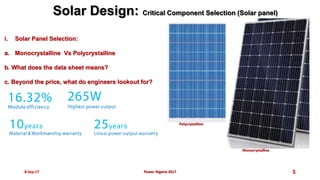
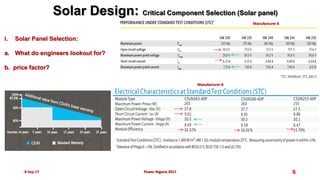
Solar Design: Critical Component Selection (Solar panel)
i. Solar Panel Selection:
a. Monocrystalline Vs Polycrystalline
b. What does the data sheet means?
c. Beyond the price, what do engineers lookout for?
Power Nigeria 2017
Polycrystalline
Monocrystalline
8-Sep-17 6
i. Solar Panel Selection:
a. What do engineers lookout for?
b. price factor?
Power Nigeria 2017
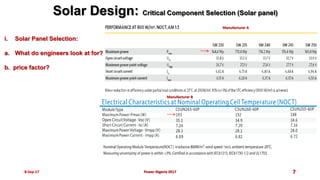
Solar Design: Critical Component Selection (Solar panel)
Manufacturer A
Manufacturer B
8-Sep-17 7
i. Solar Panel Selection:
a. What do engineers look at for?
b. price factor?
Power Nigeria 2017
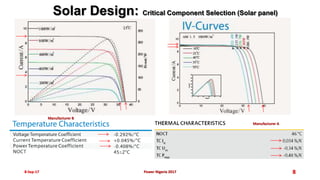
Solar Design: Critical Component Selection (Solar panel)
Manufacturer A
Manufacturer B
8-Sep-17 8Power Nigeria 2017
Solar Design: Critical Component Selection (Solar panel)
Manufacturer B
Manufacturer A
8-Sep-17 9
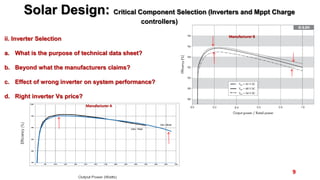
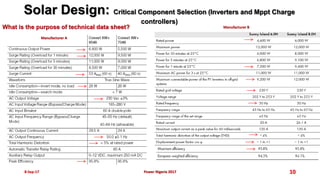
ii. Inverter Selection
a. What is the purpose of technical data sheet?
b. Beyond what the manufacturers claims?
c. Effect of wrong inverter on system performance?
d. Right inverter Vs price?
Solar Design: Critical Component Selection (Inverters and Mppt Charge
controllers)
Power Nigeria 2017
Manufacturer A
Manufacturer B
8-Sep-17 10
What is the purpose of technical data sheet?
Solar Design: Critical Component Selection (Inverters and Mppt Charge
controllers)
Power Nigeria 2017
Manufacturer A
Manufacturer B
8-Sep-17 11
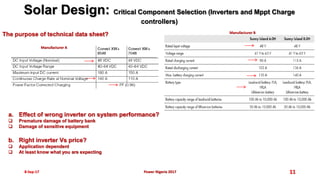
The purpose of technical data sheet?
Solar Design: Critical Component Selection (Inverters and Mppt Charge
controllers)
Power Nigeria 2017
Manufacturer A
Manufacturer B
a. Effect of wrong inverter on system performance?
 Premature damage of battery bank
 Damage of sensitive equipment
b. Right inverter Vs price?
 Application dependent
 At least know what you are expecting
8-Sep-17 12
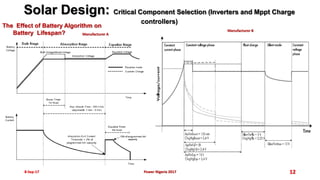
The Effect of Battery Algorithm on
Battery Lifespan?
Solar Design: Critical Component Selection (Inverters and Mppt Charge
controllers)
Power Nigeria 2017
Manufacturer A
Manufacturer B
8-Sep-17 13
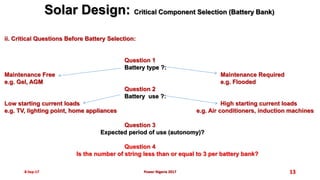
ii. Critical Questions Before Battery Selection:
Question 1
Battery type ?:
Maintenance Free Maintenance Required
e.g. Gel, AGM e.g. Flooded
Question 2
Battery use ?:
Low starting current loads High starting current loads
e.g. TV, lighting point, home appliances e.g. Air conditioners, induction machines
Question 3
Expected period of use (autonomy)?
Question 4
Is the number of string less than or equal to 3 per battery bank?
Solar Design: Critical Component Selection (Battery Bank)
Power Nigeria 2017
8-Sep-17 14
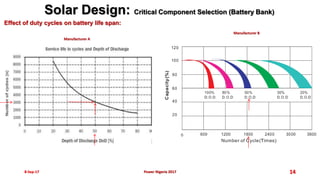
Effect of duty cycles on battery life span:
Solar Design: Critical Component Selection (Battery Bank)
Power Nigeria 2017
Manufacturer A
Manufacturer B
8-Sep-17 15
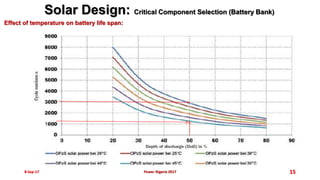
Effect of temperature on battery life span:
Solar Design: Critical Component Selection (Battery Bank)
Power Nigeria 2017
8-Sep-17 16
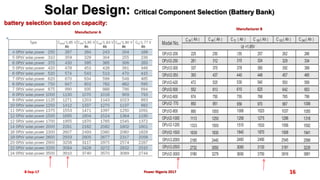
battery selection based on capacity:
Solar Design: Critical Component Selection (Battery Bank)
Power Nigeria 2017
Manufacturer A
Manufacturer B
8-Sep-17 17
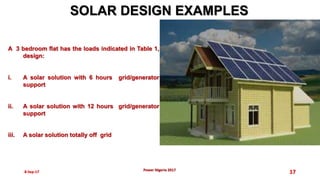
SOLAR DESIGN EXAMPLES
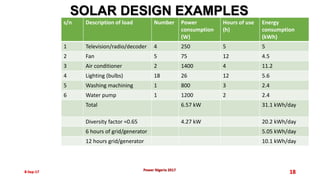
A 3 bedroom flat has the loads indicated in Table 1,
design:
i. A solar solution with 6 hours grid/generator
support
ii. A solar solution with 12 hours grid/generator
support
iii. A solar solution totally off grid
Power Nigeria 2017
8-Sep-17 18
SOLAR DESIGN EXAMPLES
Power Nigeria 2017
s/n Description of load Number Power
consumption
(W)
Hours of use
(h)
Energy
consumption
(kWh)
1 Television/radio/decoder 4 250 5 5
2 Fan 5 75 12 4.5
3 Air conditioner 2 1400 4 11.2
4 Lighting (bulbs) 18 26 12 5.6
5 Washing machining 1 800 3 2.4
6 Water pump 1 1200 2 2.4
Total 6.57 kW 31.1 kWh/day
Diversity factor =0.65 4.27 kW 20.2 kWh/day
6 hours of grid/generator 5.05 kWh/day
12 hours grid/generator 10.1 kWh/day
8-Sep-17 19
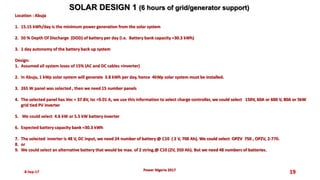
SOLAR DESIGN 1 (6 hours of grid/generator support)
Power Nigeria 2017
Location : Abuja
1. 15.15 kWh/day is the minimum power generation from the solar system
2. 50 % Depth Of Discharge (DOD) of battery per day (i.e. Battery bank capacity =30.3 kWh)
3. 1 day autonomy of the battery back up system
Design:
1. Assumed all system loses of 15% (AC and DC cables +inverter)
2. In Abuja, 1 kWp solar system will generate 3.8 kWh per day, hence 4kWp solar system must be installed.
3. 265 W panel was selected , then we need 15 number panels
4. The selected panel has Voc = 37.8V, Isc =9.01 A, we use this information to select charge controller, we could select 150V, 60A or 600 V, 80A or 5kW
grid tied PV inverter
5. We could select 4.6 kW or 5.5 kW battery inverter
6. Expected battery capacity bank =30.3 kWh
7. The selected inverter is 48 V, DC input, we need 24 number of battery @ C10 ( 2 V, 700 Ah). We could select OPZV 750 , OPZV, 2-770.
8. or
9. We could select an alternative battery that would be max. of 2 string.@ C10 (2V, 350 Ah). But we need 48 numbers of batteries.
8-Sep-17 20
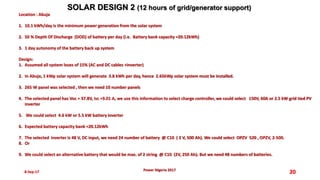
SOLAR DESIGN 2 (12 hours of grid/generator support)
Power Nigeria 2017
Location : Abuja
1. 10.1 kWh/day is the minimum power generation from the solar system
2. 50 % Depth Of Discharge (DOD) of battery per day (i.e. Battery bank capacity =20.12kWh)
3. 1 day autonomy of the battery back up system
Design:
1. Assumed all system loses of 15% (AC and DC cables +inverter)
2. In Abuja, 1 kWp solar system will generate 3.8 kWh per day, hence 2.65kWp solar system must be installed.
3. 265 W panel was selected , then we need 10 number panels
4. The selected panel has Voc = 37.8V, Isc =9.01 A, we use this information to select charge controller, we could select 150V, 60A or 2.5 kW grid tied PV
inverter
5. We could select 4.6 kW or 5.5 kW battery inverter
6. Expected battery capacity bank =20.12kWh
7. The selected inverter is 48 V, DC input, we need 24 number of battery @ C10 ( 2 V, 500 Ah). We could select OPZV 520 , OPZV, 2-500.
8. Or
9. We could select an alternative battery that would be max. of 2 string @ C10 (2V, 250 Ah). But we need 48 numbers of batteries.
8-Sep-17 21
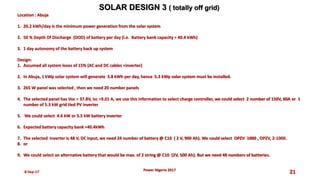
SOLAR DESIGN 3 ( totally off grid)
Power Nigeria 2017
Location : Abuja
1. 20.2 kWh/day is the minimum power generation from the solar system
2. 50 % Depth Of Discharge (DOD) of battery per day (i.e. Battery bank capacity = 40.4 kWh)
3. 1 day autonomy of the battery back up system
Design:
1. Assumed all system loses of 15% (AC and DC cables +inverter)
2. In Abuja, 1 kWp solar system will generate 3.8 kWh per day, hence 5.3 kWp solar system must be installed.
3. 265 W panel was selected , then we need 20 number panels
4. The selected panel has Voc = 37.8V, Isc =9.01 A, we use this information to select charge controller, we could select 2 number of 150V, 60A or 1
number of 5.3 kW grid tied PV inverter
5. We could select 4.6 kW or 5.5 kW battery inverter
6. Expected battery capacity bank =40.4kWh
7. The selected inverter is 48 V, DC input, we need 24 number of battery @ C10 ( 2 V, 900 Ah). We could select OPZV 1000 , OPZV, 2-1000.
8. or
9. We could select an alternative battery that would be max. of 2 string @ C10 (2V, 500 Ah). But we need 48 numbers of batteries.
Personal Protective Equipment (PPE)
• Your Safety is Your Responsibility
• Safety is Everyone’s Responsibility on Site
8-Sep-17 Power Nigeria 2017 22
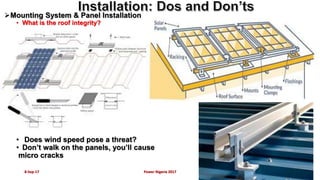
Mounting System & Panel Installation
• What is the roof integrity?
What is the orientation and nature of the roof ?
• Does wind speed pose a threat?
• Don’t walk on the panels, you’ll cause
micro cracks
8-Sep-17 Power Nigeria 2017 23
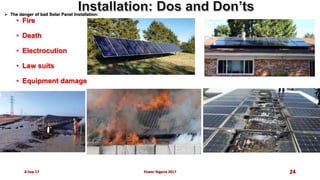
 The danger of bad Solar Panel Installation:
• Fire
• Death
• Electrocution
• Law suits
• Equipment damage
8-Sep-17 Power Nigeria 2017 24
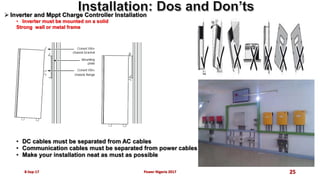
 Inverter and Mppt Charge Controller Installation
• Inverter must be mounted on a solid
Strong wall or metal frame
•
• DC cables must be separated from AC cables
• Communication cables must be separated from power cables
• Make your installation neat as must as possible
8-Sep-17 Power Nigeria 2017 25
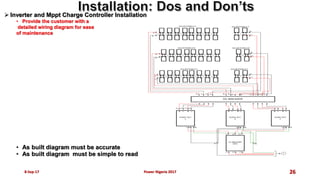
 Inverter and Mppt Charge Controller Installation
• Provide the customer with a
detailed wiring diagram for ease
of maintenance
• As built diagram must be accurate
• As built diagram must be simple to read
8-Sep-17 Power Nigeria 2017 26
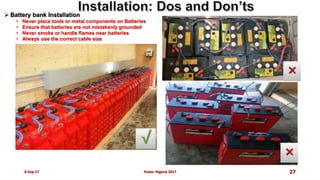
 Battery bank Installation
• Never place tools or metal components on Batteries
• Ensure that batteries are not mistakenly grounded
• Never smoke or handle flames near batteries
• Always use the correct cable size
8-Sep-17 Power Nigeria 2017 27
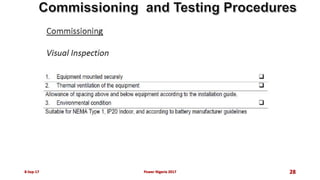
8-Sep-17 Power Nigeria 2017 28
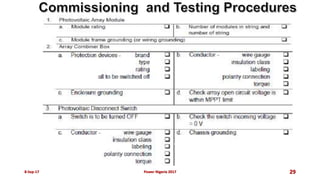
8-Sep-17 Power Nigeria 2017 29
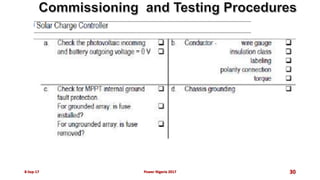
8-Sep-17 Power Nigeria 2017 30
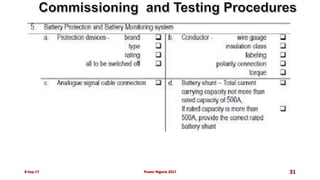
8-Sep-17 Power Nigeria 2017 31
SOLAR INSTALLATION AND DESIGN: THE DOS AND DON’TS
THANK YOU FOR LISTENING
POWER NIGERIA 2017
Engr. Tajudeen Humble Sikiru (PhD)
Electrical Engineering Department, Ahmadu Bello University, Zaria.
Rana World Tech Shop Limited, Kaduna, Nigeria
32

Solar Installation and Design: Dos and Don'ts

  • 1.
    SOLAR INSTALLATION ANDDESIGN: THE DOS AND DON’TS POWER NIGERIA 2017 Engr. Tajudeen Humble Sikiru (PhD) Electrical Engineering Department, Ahmadu Bello University, Zaria. Rana World Tech Shop Limited, Kaduna, Nigeria 1
  • 2.
    8-Sep-17 2 Accurate Surveydata + Good Design + Good Installation + Regular Maintenance = Excellent Solar System
  • 3.
    Survey: Location andLoad parameters • Know your solar installation location • Accurately determine the load size 8-Sep-17 Power Nigeria 2017 3
  • 4.
    Survey: • Use Googleearth to determine roof top space and orientation • Alternatively, physically measure and determine available space 8-Sep-17 Power Nigeria 2017 4
  • 5.
    8-Sep-17 5 Solar Design:Critical Component Selection (Solar panel) i. Solar Panel Selection: a. Monocrystalline Vs Polycrystalline b. What does the data sheet means? c. Beyond the price, what do engineers lookout for? Power Nigeria 2017 Polycrystalline Monocrystalline
  • 6.
    8-Sep-17 6 i. SolarPanel Selection: a. What do engineers lookout for? b. price factor? Power Nigeria 2017 Solar Design: Critical Component Selection (Solar panel) Manufacturer A Manufacturer B
  • 7.
    8-Sep-17 7 i. SolarPanel Selection: a. What do engineers look at for? b. price factor? Power Nigeria 2017 Solar Design: Critical Component Selection (Solar panel) Manufacturer A Manufacturer B
  • 8.
    8-Sep-17 8Power Nigeria2017 Solar Design: Critical Component Selection (Solar panel) Manufacturer B Manufacturer A
  • 9.
    8-Sep-17 9 ii. InverterSelection a. What is the purpose of technical data sheet? b. Beyond what the manufacturers claims? c. Effect of wrong inverter on system performance? d. Right inverter Vs price? Solar Design: Critical Component Selection (Inverters and Mppt Charge controllers) Power Nigeria 2017 Manufacturer A Manufacturer B
  • 10.
    8-Sep-17 10 What isthe purpose of technical data sheet? Solar Design: Critical Component Selection (Inverters and Mppt Charge controllers) Power Nigeria 2017 Manufacturer A Manufacturer B
  • 11.
    8-Sep-17 11 The purposeof technical data sheet? Solar Design: Critical Component Selection (Inverters and Mppt Charge controllers) Power Nigeria 2017 Manufacturer A Manufacturer B a. Effect of wrong inverter on system performance?  Premature damage of battery bank  Damage of sensitive equipment b. Right inverter Vs price?  Application dependent  At least know what you are expecting
  • 12.
    8-Sep-17 12 The Effectof Battery Algorithm on Battery Lifespan? Solar Design: Critical Component Selection (Inverters and Mppt Charge controllers) Power Nigeria 2017 Manufacturer A Manufacturer B
  • 13.
    8-Sep-17 13 ii. CriticalQuestions Before Battery Selection: Question 1 Battery type ?: Maintenance Free Maintenance Required e.g. Gel, AGM e.g. Flooded Question 2 Battery use ?: Low starting current loads High starting current loads e.g. TV, lighting point, home appliances e.g. Air conditioners, induction machines Question 3 Expected period of use (autonomy)? Question 4 Is the number of string less than or equal to 3 per battery bank? Solar Design: Critical Component Selection (Battery Bank) Power Nigeria 2017
  • 14.
    8-Sep-17 14 Effect ofduty cycles on battery life span: Solar Design: Critical Component Selection (Battery Bank) Power Nigeria 2017 Manufacturer A Manufacturer B
  • 15.
    8-Sep-17 15 Effect oftemperature on battery life span: Solar Design: Critical Component Selection (Battery Bank) Power Nigeria 2017
  • 16.
    8-Sep-17 16 battery selectionbased on capacity: Solar Design: Critical Component Selection (Battery Bank) Power Nigeria 2017 Manufacturer A Manufacturer B
  • 17.
    8-Sep-17 17 SOLAR DESIGNEXAMPLES A 3 bedroom flat has the loads indicated in Table 1, design: i. A solar solution with 6 hours grid/generator support ii. A solar solution with 12 hours grid/generator support iii. A solar solution totally off grid Power Nigeria 2017
  • 18.
    8-Sep-17 18 SOLAR DESIGNEXAMPLES Power Nigeria 2017 s/n Description of load Number Power consumption (W) Hours of use (h) Energy consumption (kWh) 1 Television/radio/decoder 4 250 5 5 2 Fan 5 75 12 4.5 3 Air conditioner 2 1400 4 11.2 4 Lighting (bulbs) 18 26 12 5.6 5 Washing machining 1 800 3 2.4 6 Water pump 1 1200 2 2.4 Total 6.57 kW 31.1 kWh/day Diversity factor =0.65 4.27 kW 20.2 kWh/day 6 hours of grid/generator 5.05 kWh/day 12 hours grid/generator 10.1 kWh/day
  • 19.
    8-Sep-17 19 SOLAR DESIGN1 (6 hours of grid/generator support) Power Nigeria 2017 Location : Abuja 1. 15.15 kWh/day is the minimum power generation from the solar system 2. 50 % Depth Of Discharge (DOD) of battery per day (i.e. Battery bank capacity =30.3 kWh) 3. 1 day autonomy of the battery back up system Design: 1. Assumed all system loses of 15% (AC and DC cables +inverter) 2. In Abuja, 1 kWp solar system will generate 3.8 kWh per day, hence 4kWp solar system must be installed. 3. 265 W panel was selected , then we need 15 number panels 4. The selected panel has Voc = 37.8V, Isc =9.01 A, we use this information to select charge controller, we could select 150V, 60A or 600 V, 80A or 5kW grid tied PV inverter 5. We could select 4.6 kW or 5.5 kW battery inverter 6. Expected battery capacity bank =30.3 kWh 7. The selected inverter is 48 V, DC input, we need 24 number of battery @ C10 ( 2 V, 700 Ah). We could select OPZV 750 , OPZV, 2-770. 8. or 9. We could select an alternative battery that would be max. of 2 string.@ C10 (2V, 350 Ah). But we need 48 numbers of batteries.
  • 20.
    8-Sep-17 20 SOLAR DESIGN2 (12 hours of grid/generator support) Power Nigeria 2017 Location : Abuja 1. 10.1 kWh/day is the minimum power generation from the solar system 2. 50 % Depth Of Discharge (DOD) of battery per day (i.e. Battery bank capacity =20.12kWh) 3. 1 day autonomy of the battery back up system Design: 1. Assumed all system loses of 15% (AC and DC cables +inverter) 2. In Abuja, 1 kWp solar system will generate 3.8 kWh per day, hence 2.65kWp solar system must be installed. 3. 265 W panel was selected , then we need 10 number panels 4. The selected panel has Voc = 37.8V, Isc =9.01 A, we use this information to select charge controller, we could select 150V, 60A or 2.5 kW grid tied PV inverter 5. We could select 4.6 kW or 5.5 kW battery inverter 6. Expected battery capacity bank =20.12kWh 7. The selected inverter is 48 V, DC input, we need 24 number of battery @ C10 ( 2 V, 500 Ah). We could select OPZV 520 , OPZV, 2-500. 8. Or 9. We could select an alternative battery that would be max. of 2 string @ C10 (2V, 250 Ah). But we need 48 numbers of batteries.
  • 21.
    8-Sep-17 21 SOLAR DESIGN3 ( totally off grid) Power Nigeria 2017 Location : Abuja 1. 20.2 kWh/day is the minimum power generation from the solar system 2. 50 % Depth Of Discharge (DOD) of battery per day (i.e. Battery bank capacity = 40.4 kWh) 3. 1 day autonomy of the battery back up system Design: 1. Assumed all system loses of 15% (AC and DC cables +inverter) 2. In Abuja, 1 kWp solar system will generate 3.8 kWh per day, hence 5.3 kWp solar system must be installed. 3. 265 W panel was selected , then we need 20 number panels 4. The selected panel has Voc = 37.8V, Isc =9.01 A, we use this information to select charge controller, we could select 2 number of 150V, 60A or 1 number of 5.3 kW grid tied PV inverter 5. We could select 4.6 kW or 5.5 kW battery inverter 6. Expected battery capacity bank =40.4kWh 7. The selected inverter is 48 V, DC input, we need 24 number of battery @ C10 ( 2 V, 900 Ah). We could select OPZV 1000 , OPZV, 2-1000. 8. or 9. We could select an alternative battery that would be max. of 2 string @ C10 (2V, 500 Ah). But we need 48 numbers of batteries.
  • 22.
    Personal Protective Equipment(PPE) • Your Safety is Your Responsibility • Safety is Everyone’s Responsibility on Site 8-Sep-17 Power Nigeria 2017 22
  • 23.
    Mounting System &Panel Installation • What is the roof integrity? What is the orientation and nature of the roof ? • Does wind speed pose a threat? • Don’t walk on the panels, you’ll cause micro cracks 8-Sep-17 Power Nigeria 2017 23
  • 24.
     The dangerof bad Solar Panel Installation: • Fire • Death • Electrocution • Law suits • Equipment damage 8-Sep-17 Power Nigeria 2017 24
  • 25.
     Inverter andMppt Charge Controller Installation • Inverter must be mounted on a solid Strong wall or metal frame • • DC cables must be separated from AC cables • Communication cables must be separated from power cables • Make your installation neat as must as possible 8-Sep-17 Power Nigeria 2017 25
  • 26.
     Inverter andMppt Charge Controller Installation • Provide the customer with a detailed wiring diagram for ease of maintenance • As built diagram must be accurate • As built diagram must be simple to read 8-Sep-17 Power Nigeria 2017 26
  • 27.
     Battery bankInstallation • Never place tools or metal components on Batteries • Ensure that batteries are not mistakenly grounded • Never smoke or handle flames near batteries • Always use the correct cable size 8-Sep-17 Power Nigeria 2017 27
  • 28.
  • 29.
  • 30.
  • 31.
  • 32.
    SOLAR INSTALLATION ANDDESIGN: THE DOS AND DON’TS THANK YOU FOR LISTENING POWER NIGERIA 2017 Engr. Tajudeen Humble Sikiru (PhD) Electrical Engineering Department, Ahmadu Bello University, Zaria. Rana World Tech Shop Limited, Kaduna, Nigeria 32