Maintenance and troubleshooting in a Solar PV system
1.
Sustainable solution toNigeria’s power industry www.peemadi.gov.ng
Sustainable solution to Nigeria’s power industry www.peemadi.gov.ng
Solar PV System
Solar PV System
Maintenance &
Maintenance &
Troubleshooting
Troubleshooting
A practical training guide presented at the ongoing NYESAF training
A practical training guide presented at the ongoing NYESAF training
held at
Power Equipment And Electrical Machinery Development
Institute (PEEMADI), Okene, Kogi state
by
Engr. Abdulazeez Muhammad Sanni
June, 2025.
2.
Sustainable solution toNigeria’s power industry www.peemadi.gov.ng
Sustainable solution to Nigeria’s power industry www.peemadi.gov.ng
Learning Objectives
1. Identify and diagnose common solar system faults
2. Learn inspection techniques
3. Understand maintenance schedule
4. Perform preventive maintenance tasks
5. Use test tools to assess system efficiency
6. Safely replace faulty components
2
3.
Sustainable solution toNigeria’s power industry www.peemadi.gov.ng
Sustainable solution to Nigeria’s power industry www.peemadi.gov.ng
Introduction
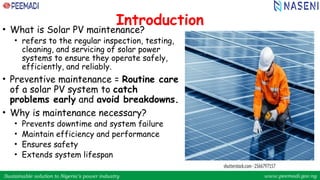
• What is Solar PV maintenance?
• refers to the regular inspection, testing,
cleaning, and servicing of solar power
systems to ensure they operate safely,
efficiently, and reliably.
• Preventive maintenance = Routine care
of a solar PV system to catch
problems early and avoid breakdowns.
• Why is maintenance necessary?
• Prevents downtime and system failure
• Maintain efficiency and performance
• Ensures safety
• Extends system lifespan
4.
Sustainable solution toNigeria’s power industry www.peemadi.gov.ng
Sustainable solution to Nigeria’s power industry www.peemadi.gov.ng
Maintenance Schedule
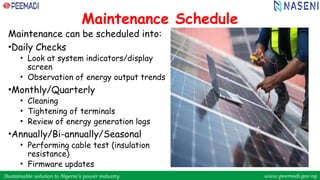
Maintenance can be scheduled into:
•Daily Checks
• Look at system indicators/display
screen
• Observation of energy output trends
•Monthly/Quarterly
• Cleaning
• Tightening of terminals
• Review of energy generation logs
•Annually/Bi-annually/Seasonal
• Performing cable test (insulation
resistance)
• Firmware updates
5.
Sustainable solution toNigeria’s power industry www.peemadi.gov.ng
Sustainable solution to Nigeria’s power industry www.peemadi.gov.ng
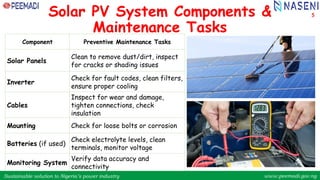
Solar PV System Components &
Maintenance Tasks
Component Preventive Maintenance Tasks
Solar Panels
Clean to remove dust/dirt, inspect
for cracks or shading issues
Inverter
Check for fault codes, clean filters,
ensure proper cooling
Cables
Inspect for wear and damage,
tighten connections, check
insulation
Mounting Check for loose bolts or corrosion
Batteries (if used)
Check electrolyte levels, clean
terminals, monitor voltage
Monitoring System
Verify data accuracy and
connectivity
5
6.
Sustainable solution toNigeria’s power industry www.peemadi.gov.ng
Sustainable solution to Nigeria’s power industry www.peemadi.gov.ng
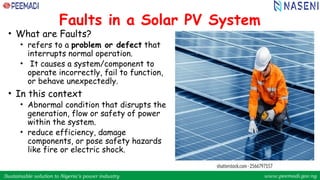
Faults in a Solar PV System
• What are Faults?
• refers to a problem or defect that
interrupts normal operation.
• It causes a system/component to
operate incorrectly, fail to function,
or behave unexpectedly.
• In this context
• Abnormal condition that disrupts the
generation, flow or safety of power
within the system.
• reduce efficiency, damage
components, or pose safety hazards
like fire or electric shock.
7.
Sustainable solution toNigeria’s power industry www.peemadi.gov.ng
Sustainable solution to Nigeria’s power industry www.peemadi.gov.ng
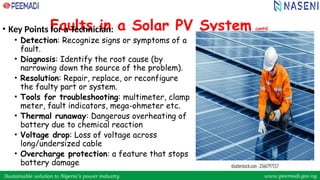
Faults in a Solar PV System contd.
• Key Points for a Technician:
• Detection: Recognize signs or symptoms of a
fault.
• Diagnosis: Identify the root cause (by
narrowing down the source of the problem).
• Resolution: Repair, replace, or reconfigure
the faulty part or system.
• Tools for troubleshooting: multimeter, clamp
meter, fault indicators, mega-ohmeter etc.
• Thermal runaway: Dangerous overheating of
battery due to chemical reaction
• Voltage drop: Loss of voltage across
long/undersized cable
• Overcharge protection: a feature that stops
battery damage
8.
Sustainable solution toNigeria’s power industry www.peemadi.gov.ng
Sustainable solution to Nigeria’s power industry www.peemadi.gov.ng
Causes of Faults in a Solar PV
System
8
• Environmental: moisture, dust,
dirt, lightning strikes, shading
• Mechanical: physical damages,
loose mounting structures
• Electrical: Loose connections,
insulation degradation, reverse
polarity, undersized cable
• Component failure: faulty
fuses, inverter malfunction
• Installation errors: improper
wiring, incorrect sizing, poor
termination
• Ageing & wearing:
degradation of modules,
battery ageing, damage to
plastics due to exposure
• Animal/ Human intervention:
rodents chewing cables,
panels, vandalism, maintenance
by untrained personnel
9.
Sustainable solution toNigeria’s power industry www.peemadi.gov.ng
Sustainable solution to Nigeria’s power industry www.peemadi.gov.ng
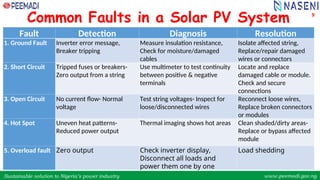
Common Faults in a Solar PV System
Fault Detection Diagnosis Resolution
1. Ground Fault Inverter error message,
Breaker tripping
Measure insulation resistance,
Check for moisture/damaged
cables
Isolate affected string,
Replace/repair damaged
wires or connectors
2. Short Circuit Tripped fuses or breakers-
Zero output from a string
Use multimeter to test continuity
between positive & negative
terminals
Locate and replace
damaged cable or module.
Check and secure
connections
3. Open Circuit No current flow- Normal
voltage
Test string voltages- Inspect for
loose/disconnected wires
Reconnect loose wires,
Replace broken connectors
or modules
4. Hot Spot Uneven heat patterns-
Reduced power output
Thermal imaging shows hot areas Clean shaded/dirty areas-
Replace or bypass affected
module
5. Overload fault Zero output Check inverter display,
Disconnect all loads and
power them one by one
Load shedding
9
10.
Sustainable solution toNigeria’s power industry www.peemadi.gov.ng
Sustainable solution to Nigeria’s power industry www.peemadi.gov.ng
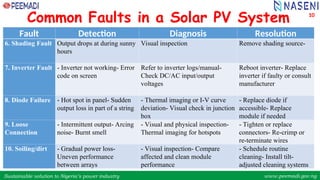
Common Faults in a Solar PV System
Fault Detection Diagnosis Resolution
6. Shading Fault Output drops at during sunny
hours
Visual inspection Remove shading source-
7. Inverter Fault - Inverter not working- Error
code on screen
Refer to inverter logs/manual-
Check DC/AC input/output
voltages
Reboot inverter- Replace
inverter if faulty or consult
manufacturer
8. Diode Failure - Hot spot in panel- Sudden
output loss in part of a string
- Thermal imaging or I-V curve
deviation- Visual check in junction
box
- Replace diode if
accessible- Replace
module if needed
9. Loose
Connection
- Intermittent output- Arcing
noise- Burnt smell
- Visual and physical inspection-
Thermal imaging for hotspots
- Tighten or replace
connectors- Re-crimp or
re-terminate wires
10. Soiling/dirt - Gradual power loss-
Uneven performance
between arrays
- Visual inspection- Compare
affected and clean module
performance
- Schedule routine
cleaning- Install tilt-
adjusted cleaning systems
10
11.
Sustainable solution toNigeria’s power industry www.peemadi.gov.ng
Sustainable solution to Nigeria’s power industry www.peemadi.gov.ng
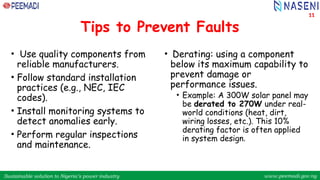
Tips to Prevent Faults
• Use quality components from
reliable manufacturers.
• Follow standard installation
practices (e.g., NEC, IEC
codes).
• Install monitoring systems to
detect anomalies early.
• Perform regular inspections
and maintenance.
• Derating: using a component
below its maximum capability to
prevent damage or
performance issues.
• Example: A 300W solar panel may
be derated to 270W under real-
world conditions (heat, dirt,
wiring losses, etc.). This 10%
derating factor is often applied
in system design.
11
12.
Sustainable solution toNigeria’s power industry www.peemadi.gov.ng
Sustainable solution to Nigeria’s power industry www.peemadi.gov.ng
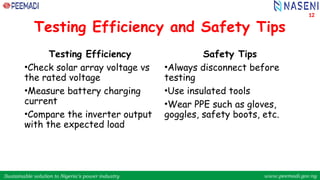
Testing Efficiency and Safety Tips
Testing Efficiency
•Check solar array voltage vs
the rated voltage
•Measure battery charging
current
•Compare the inverter output
with the expected load
Safety Tips
•Always disconnect before
testing
•Use insulated tools
•Wear PPE such as gloves,
goggles, safety boots, etc.
12
13.
Sustainable solution toNigeria’s power industry www.peemadi.gov.ng
Sustainable solution to Nigeria’s power industry www.peemadi.gov.ng
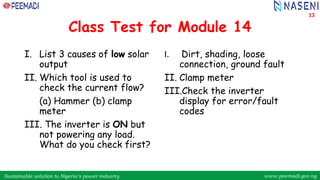
Class Test for Module 14
I. List 3 causes of low solar
output
II. Which tool is used to
check the current flow?
(a) Hammer (b) clamp
meter
III. The inverter is ON but
not powering any load.
What do you check first?
I. Dirt, shading, loose
connection, ground fault
II. Clamp meter
III.Check the inverter
display for error/fault
codes
13
14.
Sustainable solution toNigeria’s power industry www.peemadi.gov.ng
Sustainable solution to Nigeria’s power industry www.peemadi.gov.ng
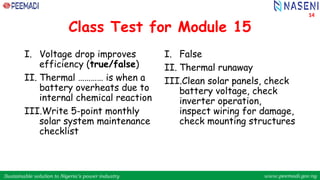
Class Test for Module 15
I. Voltage drop improves
efficiency (true/false)
II. Thermal ………… is when a
battery overheats due to
internal chemical reaction
III.Write 5-point monthly
solar system maintenance
checklist
I. False
II. Thermal runaway
III.Clean solar panels, check
battery voltage, check
inverter operation,
inspect wiring for damage,
check mounting structures
14
15.
Sustainable solution toNigeria’s power industry www.peemadi.gov.ng
Sustainable solution to Nigeria’s power industry www.peemadi.gov.ng
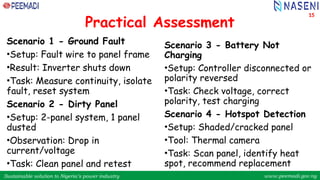
Practical Assessment
Scenario 1 - Ground Fault
•Setup: Fault wire to panel frame
•Result: Inverter shuts down
•Task: Measure continuity, isolate
fault, reset system
Scenario 2 - Dirty Panel
•Setup: 2-panel system, 1 panel
dusted
•Observation: Drop in
current/voltage
•Task: Clean panel and retest
Scenario 3 - Battery Not
Charging
•Setup: Controller disconnected or
polarity reversed
•Task: Check voltage, correct
polarity, test charging
Scenario 4 - Hotspot Detection
•Setup: Shaded/cracked panel
•Tool: Thermal camera
•Task: Scan panel, identify heat
spot, recommend replacement
15
16.
Sustainable solution toNigeria’s power industry www.peemadi.gov.ng
Sustainable solution to Nigeria’s power industry www.peemadi.gov.ng
Thank you for listening
16
Editor's Notes
#3 Maintenance means taking care of something so it keeps working properly and doesn’t break down.
#6 Maintenance means taking care of something so it keeps working properly and doesn’t break down.