Solar Powered Pump Drives
Water pumps are of two types :
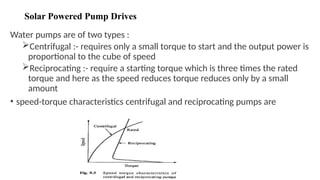
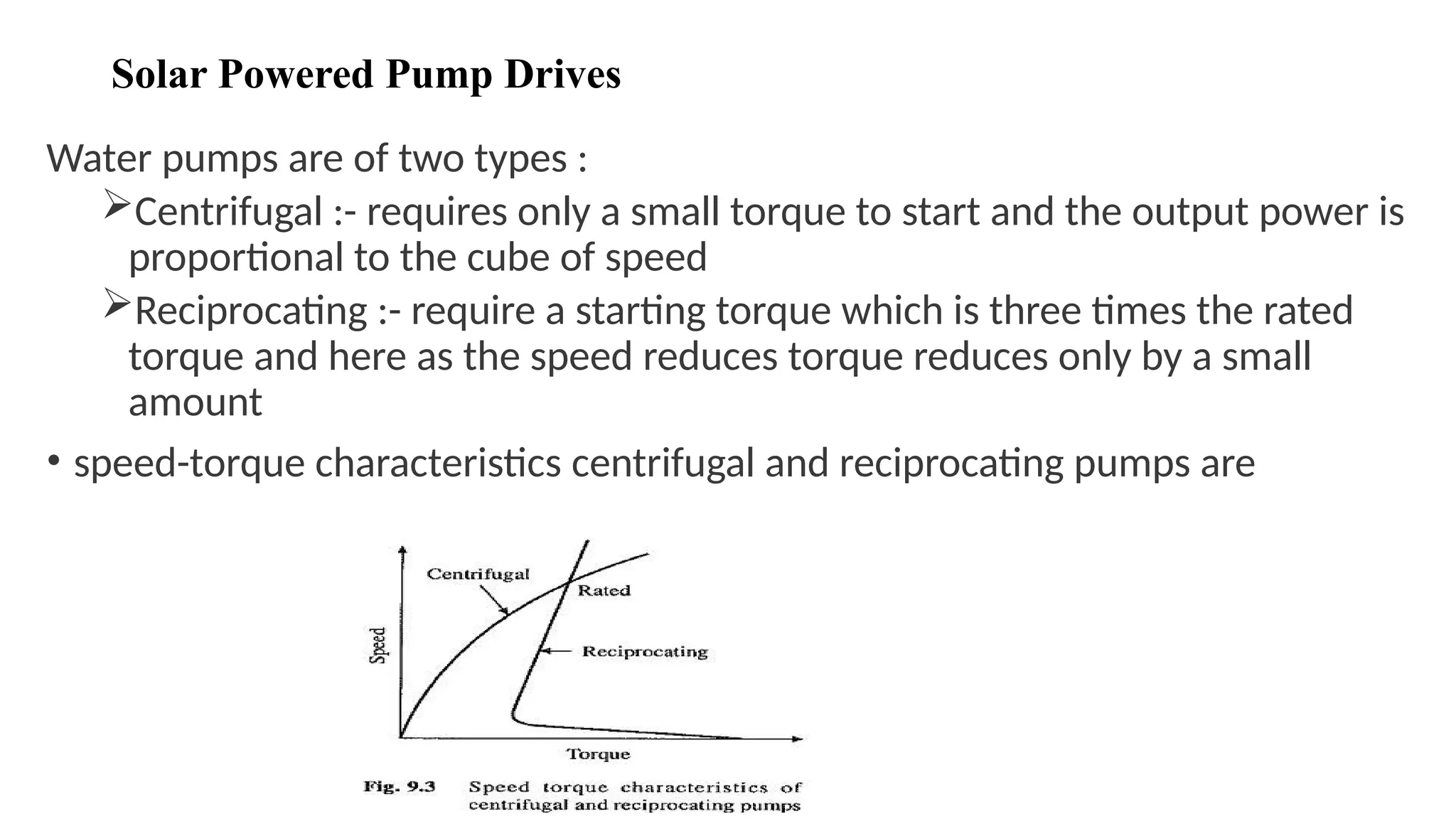
Centrifugal :- requires only a small torque to start and the output power is
proportional to the cube of speed
Reciprocating :- require a starting torque which is three times the rated
torque and here as the speed reduces torque reduces only by a small
amount
• speed-torque characteristics centrifugal and reciprocating pumps are
MOTOR SUITABLE FOR PUMP DRIVES
• For low power applications (< 1 kW) permanent magnet de motor is used because
of high load efficiency.
• A motor rated around 400W have full load efficiency in the range of 77-86% and
half-load efficiency in 68-86%.
• induction motors of similar power ratings have efficiencies in the range of 25-65%.
• Because of high efficiency of dc motors, the solar panel have smaller power rating
• the dc drive has lower cost compared to the induction motor drive.
• The main problem with dc motor is that it requires the change of brushes after
200 to 400hrs
• For ratings higher than 1 kW three-phase squired-cage induction motor is
preferred because of high efficiency, maintenance free operation and long life.
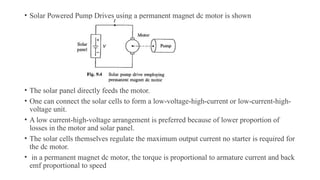
• Solar Powered Pump Drives using a permanent magnet dc motor is shown
• The solar panel directly feeds the motor.
• One can connect the solar cells to form a low-voltage-high-current or low-current-high-
voltage unit.
• A low current-high-voltage arrangement is preferred because of lower proportion of
losses in the motor and solar panel.
• The solar cells themselves regulate the maximum output current no starter is required for
the dc motor.
• in a permanent magnet dc motor, the torque is proportional to armature current and back
emf proportional to speed
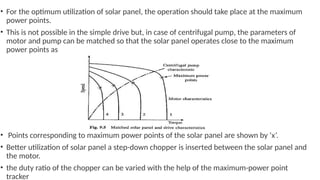
• For the optimum utilization of solar panel, the operation should take place at the maximum
power points.
• This is not possible in the simple drive but, in case of centrifugal pump, the parameters of
motor and pump can be matched so that the solar panel operates close to the maximum
power points as
• Points corresponding to maximum power points of the solar panel are shown by ‘x’.
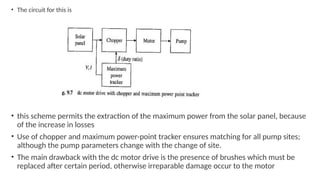
• Better utilization of solar panel a step-down chopper is inserted between the solar panel and
the motor.
• the duty ratio of the chopper can be varied with the help of the maximum-power point
tracker
• The circuit for this is
• this scheme permits the extraction of the maximum power from the solar panel, because
of the increase in losses
• Use of chopper and maximum power-point tracker ensures matching for all pump sites;
although the pump parameters change with the change of site.
• The main drawback with the dc motor drive is the presence of brushes which must be
replaced after certain period, otherwise irreparable damage occur to the motor
SOLAR PUMP DRIVE USING INDUCTION MOTOR
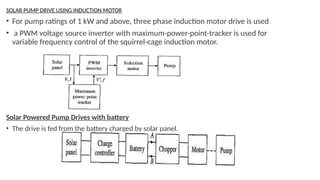
• For pump ratings of 1 kW and above, three phase induction motor drive is used
• a PWM voltage source inverter with maximum-power-point-tracker is used for
variable frequency control of the squirrel-cage induction motor.
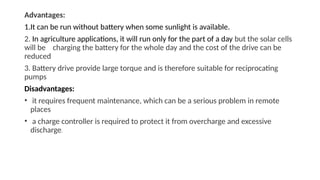
Solar Powered Pump Drives with battery
• The drive is fed from the battery charged by solar panel.
Advantages:
1.It can be run without battery when some sunlight is available.
2. In agriculture applications, it will run only for the part of a day but the solar cells
will be charging the battery for the whole day and the cost of the drive can be
reduced
3. Battery drive provide large torque and is therefore suitable for reciprocating
pumps
Disadvantages:
• it requires frequent maintenance, which can be a serious problem in remote
places
• a charge controller is required to protect it from overcharge and excessive
discharge.
Battery Powered Vehicles
• These are popularly known as electric vehicles and are generally powered by lead
acid batteries.
• Series and separately excited dc motors, permanent magnet dc motor, brushless dc
motor and induction motor have been used in electric vehicles.
• The advantages of electric vehicles (EV) over the internal combustion vehicles (ICV)
are:
 Less pollution.
Quieter operation.
 Less maintenance
More reliable
• The disadvantage are:
 More expensive.
 EV cannot go so far on a single charge as comparable ICV can go in a tank of
fuel.
It takes much longer to recharge electric vehicle’s battery than it does to fill a
petrol tank.
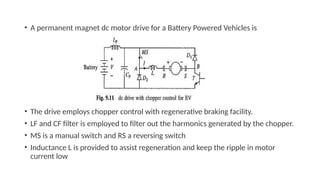
• A permanent magnet dc motor drive for a Battery Powered Vehicles is
• The drive employs chopper control with regenerative braking facility.
• LF and CF filter is employed to filter out the harmonics generated by the chopper.
• MS is a manual switch and RS a reversing switch
• Inductance L is provided to assist regeneration and keep the ripple in motor
current low
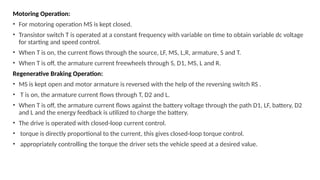
Motoring Operation:
• For motoring operation MS is kept closed.
• Transistor switch T is operated at a constant frequency with variable on time to obtain variable dc voltage
for starting and speed control.
• When T is on, the current flows through the source, LF, MS, L,R, armature, S and T.
• When T is off, the armature current freewheels through S, D1, MS, L and R.
Regenerative Braking Operation:
• MS is kept open and motor armature is reversed with the help of the reversing switch RS .
• T is on, the armature current flows through T, D2 and L.
• When T is off, the armature current flows against the battery voltage through the path D1, LF, battery, D2
and L and the energy feedback is utilized to charge the battery.
• The drive is operated with closed-loop current control.
• torque is directly proportional to the current, this gives closed-loop torque control.
• appropriately controlling the torque the driver sets the vehicle speed at a desired value.
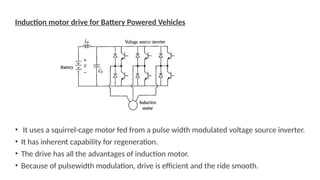
Induction motor drive for Battery Powered Vehicles
• It uses a squirrel-cage motor fed from a pulse width modulated voltage source inverter.
• It has inherent capability for regeneration.
• The drive has all the advantages of induction motor.
• Because of pulsewidth modulation, drive is efficient and the ride smooth.

Solar energy Powered working Pump Drives.pptx

  • 1.
    Solar Powered PumpDrives Water pumps are of two types : Centrifugal :- requires only a small torque to start and the output power is proportional to the cube of speed Reciprocating :- require a starting torque which is three times the rated torque and here as the speed reduces torque reduces only by a small amount • speed-torque characteristics centrifugal and reciprocating pumps are
  • 2.
    MOTOR SUITABLE FORPUMP DRIVES • For low power applications (< 1 kW) permanent magnet de motor is used because of high load efficiency. • A motor rated around 400W have full load efficiency in the range of 77-86% and half-load efficiency in 68-86%. • induction motors of similar power ratings have efficiencies in the range of 25-65%. • Because of high efficiency of dc motors, the solar panel have smaller power rating • the dc drive has lower cost compared to the induction motor drive. • The main problem with dc motor is that it requires the change of brushes after 200 to 400hrs • For ratings higher than 1 kW three-phase squired-cage induction motor is preferred because of high efficiency, maintenance free operation and long life.
  • 3.
    • Solar PoweredPump Drives using a permanent magnet dc motor is shown • The solar panel directly feeds the motor. • One can connect the solar cells to form a low-voltage-high-current or low-current-high- voltage unit. • A low current-high-voltage arrangement is preferred because of lower proportion of losses in the motor and solar panel. • The solar cells themselves regulate the maximum output current no starter is required for the dc motor. • in a permanent magnet dc motor, the torque is proportional to armature current and back emf proportional to speed
  • 4.
    • For theoptimum utilization of solar panel, the operation should take place at the maximum power points. • This is not possible in the simple drive but, in case of centrifugal pump, the parameters of motor and pump can be matched so that the solar panel operates close to the maximum power points as • Points corresponding to maximum power points of the solar panel are shown by ‘x’. • Better utilization of solar panel a step-down chopper is inserted between the solar panel and the motor. • the duty ratio of the chopper can be varied with the help of the maximum-power point tracker
  • 5.
    • The circuitfor this is • this scheme permits the extraction of the maximum power from the solar panel, because of the increase in losses • Use of chopper and maximum power-point tracker ensures matching for all pump sites; although the pump parameters change with the change of site. • The main drawback with the dc motor drive is the presence of brushes which must be replaced after certain period, otherwise irreparable damage occur to the motor
  • 6.
    SOLAR PUMP DRIVEUSING INDUCTION MOTOR • For pump ratings of 1 kW and above, three phase induction motor drive is used • a PWM voltage source inverter with maximum-power-point-tracker is used for variable frequency control of the squirrel-cage induction motor. Solar Powered Pump Drives with battery • The drive is fed from the battery charged by solar panel.
  • 7.
    Advantages: 1.It can berun without battery when some sunlight is available. 2. In agriculture applications, it will run only for the part of a day but the solar cells will be charging the battery for the whole day and the cost of the drive can be reduced 3. Battery drive provide large torque and is therefore suitable for reciprocating pumps Disadvantages: • it requires frequent maintenance, which can be a serious problem in remote places • a charge controller is required to protect it from overcharge and excessive discharge.
  • 8.
    Battery Powered Vehicles •These are popularly known as electric vehicles and are generally powered by lead acid batteries. • Series and separately excited dc motors, permanent magnet dc motor, brushless dc motor and induction motor have been used in electric vehicles. • The advantages of electric vehicles (EV) over the internal combustion vehicles (ICV) are:  Less pollution. Quieter operation.  Less maintenance More reliable • The disadvantage are:  More expensive.  EV cannot go so far on a single charge as comparable ICV can go in a tank of fuel. It takes much longer to recharge electric vehicle’s battery than it does to fill a petrol tank.
  • 9.
    • A permanentmagnet dc motor drive for a Battery Powered Vehicles is • The drive employs chopper control with regenerative braking facility. • LF and CF filter is employed to filter out the harmonics generated by the chopper. • MS is a manual switch and RS a reversing switch • Inductance L is provided to assist regeneration and keep the ripple in motor current low
  • 10.
    Motoring Operation: • Formotoring operation MS is kept closed. • Transistor switch T is operated at a constant frequency with variable on time to obtain variable dc voltage for starting and speed control. • When T is on, the current flows through the source, LF, MS, L,R, armature, S and T. • When T is off, the armature current freewheels through S, D1, MS, L and R. Regenerative Braking Operation: • MS is kept open and motor armature is reversed with the help of the reversing switch RS . • T is on, the armature current flows through T, D2 and L. • When T is off, the armature current flows against the battery voltage through the path D1, LF, battery, D2 and L and the energy feedback is utilized to charge the battery. • The drive is operated with closed-loop current control. • torque is directly proportional to the current, this gives closed-loop torque control. • appropriately controlling the torque the driver sets the vehicle speed at a desired value.
  • 11.
    Induction motor drivefor Battery Powered Vehicles • It uses a squirrel-cage motor fed from a pulse width modulated voltage source inverter. • It has inherent capability for regeneration. • The drive has all the advantages of induction motor. • Because of pulsewidth modulation, drive is efficient and the ride smooth.