Project


          BY:
Overview
History of Photovoltaics
Photovoltaic effect vs. Photoelectric effect
Semiconductor production
P-N junction
Different types of PV cells and the efficiencies
A brief look at the future of solar energy
What is Solar Energy
    and How is it used?
    Radiation from sun
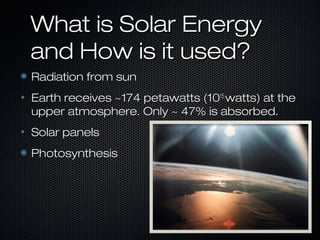
•   Earth receives ~174 petawatts (1015 watts) at the
    upper atmosphere. Only ~ 47% is absorbed.
•   Solar panels
    Photosynthesis
History of Photovoltaics
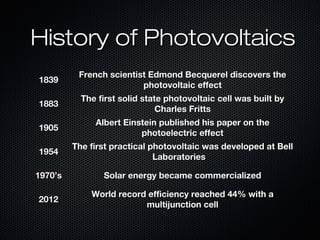
          French scientist Edmond Becquerel discovers the
1839
                            photovoltaic effect
           The first solid state photovoltaic cell was built by
1883
                               Charles Fritts
               Albert Einstein published his paper on the
1905
                           photoelectric effect
         The first practical photovoltaic was developed at Bell
1954
                              Laboratories

1970’s          Solar energy became commercialized

             World record efficiency reached 44% with a
2012
                         multijunction cell
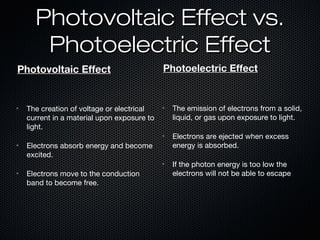
Photovoltaic Effect vs.
       Photoelectric Effect
Photovoltaic Effect                          Photoelectric Effect


•   The creation of voltage or electrical    •   The emission of electrons from a solid,
    current in a material upon exposure to       liquid, or gas upon exposure to light.
    light.
                                             •   Electrons are ejected when excess
•   Electrons absorb energy and become           energy is absorbed.
    excited.
                                             •   If the photon energy is too low the
•   Electrons move to the conduction             electrons will not be able to escape
    band to become free.
Doping
•   A process first developed by John Robert
    Woodyard
•   Doping intentionally introduces impurities into a
    pure semiconductor for the purpose of
    modulating its electrical properties
•   Group IV semiconductors such as Silicon are
    used
•   By doping semiconductors the we are able to
    form P-type and N-type semiconductors
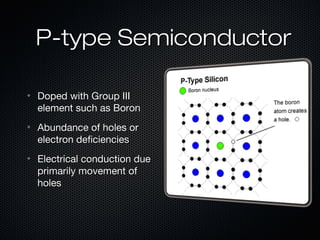
P-type Semiconductor

•   Doped with Group III
    element such as Boron
•   Abundance of holes or
    electron deficiencies
•   Electrical conduction due
    primarily movement of
    holes
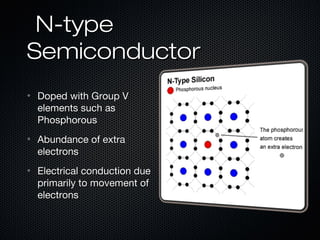
N-type
Semiconductor
•   Doped with Group V
    elements such as
    Phosphorous
•   Abundance of extra
    electrons
•   Electrical conduction due
    primarily to movement of
    electrons
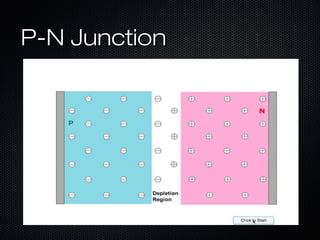
P-N Junction
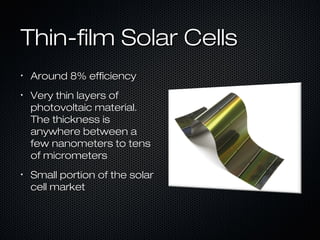
Thin-film Solar Cells
•
    Around 8% efficiency
•
    Very thin layers of
    photovoltaic material.
    The thickness is
    anywhere between a
    few nanometers to tens
    of micrometers
•
    Small portion of the solar
    cell market
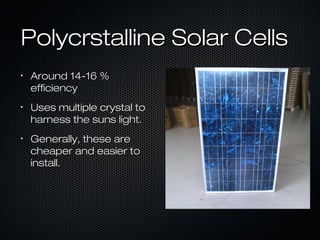
Polycrstalline Solar Cells
•
    Around 14-16 %
    efficiency
•
    Uses multiple crystal to
    harness the suns light.
•
    Generally, these are
    cheaper and easier to
    install.
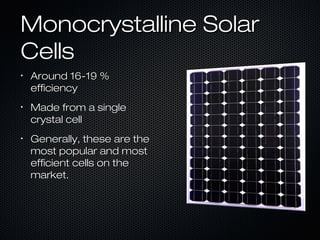
Monocrystalline Solar
Cells
•
    Around 16-19 %
    efficiency
•
    Made from a single
    crystal cell
•
    Generally, these are the
    most popular and most
    efficient cells on the
    market.
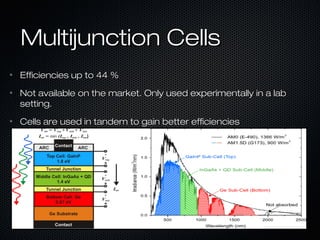
Multijunction Cells
•   Efficiencies up to 44 %
•   Not available on the market. Only used experimentally in a lab
    setting.
•   Cells are used in tandem to gain better efficiencies
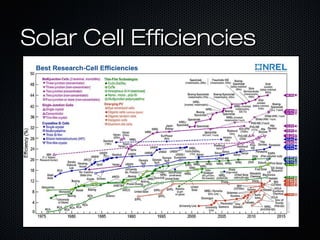
Solar Cell Efficiencies
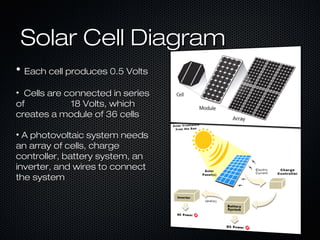
Solar Cell Diagram
• Each cell produces 0.5 Volts
• Cells are connected in series
of           18 Volts, which
creates a module of 36 cells

• A photovoltaic system needs
an array of cells, charge
controller, battery system, an
inverter, and wires to connect
the system
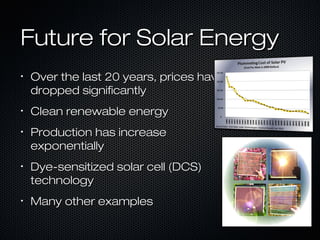
Future for Solar Energy
•
    Over the last 20 years, prices have
    dropped significantly
•
    Clean renewable energy
•
    Production has increase
    exponentially
•   Dye-sensitized solar cell (DCS)
    technology
•   Many other examples
References
“Brown,   Eric W. "An Introduction to Solar Energy." N.p., n.d. Web. 6 Apr. 2013.

Future Energy.” – Concepts for Future Electricity Generation. Web. 12 Apr. 2013.

Honsburg, Christiana, and Stuart Bowden. "The Photovoltaic Effect." PVEducation. N.p., n.d. Web.
   11 Apr. 2013.

“How Does Solar Power Work?” Solar Power. Web. 2 Apr. 2013

Marti, Antonio, and A. Luque. "Thermodynamics of Solar Energy Conversion.” Next Generation
  Photovoltaics: High Efficiency through Full Spectrum        Utilization. Bristol: Institute of
  Physics, 2004. SciFinder. Web. 19 Mar. 2013.

Miessler, Gary L., and Donald A. Tarr. “The Crystalline Solid State.” Inorganic Chemistry. 4th ed.
   Upper Saddle River, NJ: Pearson Prentice Hall, 2011. 238-239. Print.

Moore, Taylor; "Opening the Door for Utility Photovoltaics", EPRI Journal, Jan./Feb. 1987; Palo Alto,
  CA; 1987

"Solar Cell Efficiency." NREL. National Renewable Energy Laboratory, n.d. Web. 02 Apr. 2013.

"Types of Solar Panels." Sun Connect. N.p., n.d. Web. 05 Apr. 2013.

Zyga, Lisa. “Solar Thermal Process Produces Cement with No Carbon Dioxide Emissions.” Science
   News, Technology, Physics, Nanotechnology, Space Science, Earth Science, Medicine.
   Phys.Org, 10 Apr. 2012. Web. 2 Apr. 2013

.

Solar energy

  • 1.
  • 2.
    Overview History of Photovoltaics Photovoltaiceffect vs. Photoelectric effect Semiconductor production P-N junction Different types of PV cells and the efficiencies A brief look at the future of solar energy
  • 3.
    What is SolarEnergy and How is it used? Radiation from sun • Earth receives ~174 petawatts (1015 watts) at the upper atmosphere. Only ~ 47% is absorbed. • Solar panels Photosynthesis
  • 4.
    History of Photovoltaics French scientist Edmond Becquerel discovers the 1839 photovoltaic effect The first solid state photovoltaic cell was built by 1883 Charles Fritts Albert Einstein published his paper on the 1905 photoelectric effect The first practical photovoltaic was developed at Bell 1954 Laboratories 1970’s Solar energy became commercialized World record efficiency reached 44% with a 2012 multijunction cell
  • 5.
    Photovoltaic Effect vs. Photoelectric Effect Photovoltaic Effect Photoelectric Effect • The creation of voltage or electrical • The emission of electrons from a solid, current in a material upon exposure to liquid, or gas upon exposure to light. light. • Electrons are ejected when excess • Electrons absorb energy and become energy is absorbed. excited. • If the photon energy is too low the • Electrons move to the conduction electrons will not be able to escape band to become free.
  • 6.
    Doping • A process first developed by John Robert Woodyard • Doping intentionally introduces impurities into a pure semiconductor for the purpose of modulating its electrical properties • Group IV semiconductors such as Silicon are used • By doping semiconductors the we are able to form P-type and N-type semiconductors
  • 7.
    P-type Semiconductor • Doped with Group III element such as Boron • Abundance of holes or electron deficiencies • Electrical conduction due primarily movement of holes
  • 8.
    N-type Semiconductor • Doped with Group V elements such as Phosphorous • Abundance of extra electrons • Electrical conduction due primarily to movement of electrons
  • 9.
  • 10.
    Thin-film Solar Cells • Around 8% efficiency • Very thin layers of photovoltaic material. The thickness is anywhere between a few nanometers to tens of micrometers • Small portion of the solar cell market
  • 11.
    Polycrstalline Solar Cells • Around 14-16 % efficiency • Uses multiple crystal to harness the suns light. • Generally, these are cheaper and easier to install.
  • 12.
    Monocrystalline Solar Cells • Around 16-19 % efficiency • Made from a single crystal cell • Generally, these are the most popular and most efficient cells on the market.
  • 13.
    Multijunction Cells • Efficiencies up to 44 % • Not available on the market. Only used experimentally in a lab setting. • Cells are used in tandem to gain better efficiencies
  • 14.
  • 15.
    Solar Cell Diagram •Each cell produces 0.5 Volts • Cells are connected in series of 18 Volts, which creates a module of 36 cells • A photovoltaic system needs an array of cells, charge controller, battery system, an inverter, and wires to connect the system
  • 16.
    Future for SolarEnergy • Over the last 20 years, prices have dropped significantly • Clean renewable energy • Production has increase exponentially • Dye-sensitized solar cell (DCS) technology • Many other examples
  • 17.
    References “Brown, Eric W. "An Introduction to Solar Energy." N.p., n.d. Web. 6 Apr. 2013. Future Energy.” – Concepts for Future Electricity Generation. Web. 12 Apr. 2013. Honsburg, Christiana, and Stuart Bowden. "The Photovoltaic Effect." PVEducation. N.p., n.d. Web. 11 Apr. 2013. “How Does Solar Power Work?” Solar Power. Web. 2 Apr. 2013 Marti, Antonio, and A. Luque. "Thermodynamics of Solar Energy Conversion.” Next Generation Photovoltaics: High Efficiency through Full Spectrum Utilization. Bristol: Institute of Physics, 2004. SciFinder. Web. 19 Mar. 2013. Miessler, Gary L., and Donald A. Tarr. “The Crystalline Solid State.” Inorganic Chemistry. 4th ed. Upper Saddle River, NJ: Pearson Prentice Hall, 2011. 238-239. Print. Moore, Taylor; "Opening the Door for Utility Photovoltaics", EPRI Journal, Jan./Feb. 1987; Palo Alto, CA; 1987 "Solar Cell Efficiency." NREL. National Renewable Energy Laboratory, n.d. Web. 02 Apr. 2013. "Types of Solar Panels." Sun Connect. N.p., n.d. Web. 05 Apr. 2013. Zyga, Lisa. “Solar Thermal Process Produces Cement with No Carbon Dioxide Emissions.” Science News, Technology, Physics, Nanotechnology, Space Science, Earth Science, Medicine. Phys.Org, 10 Apr. 2012. Web. 2 Apr. 2013 .