Soil, It’s Alive!
Adam Hayes, Soil Management Specialist
Jake Munroe, Soil Fertility Specialist
OMAFRA
Eastern Ontario Crop Conference
February 18, 2016
2
Outline
• Types of soil life
• Abundance of soil life
• Functions of soil life
• Measuring soil life
• Soil management
• Principles of soil health
3
4
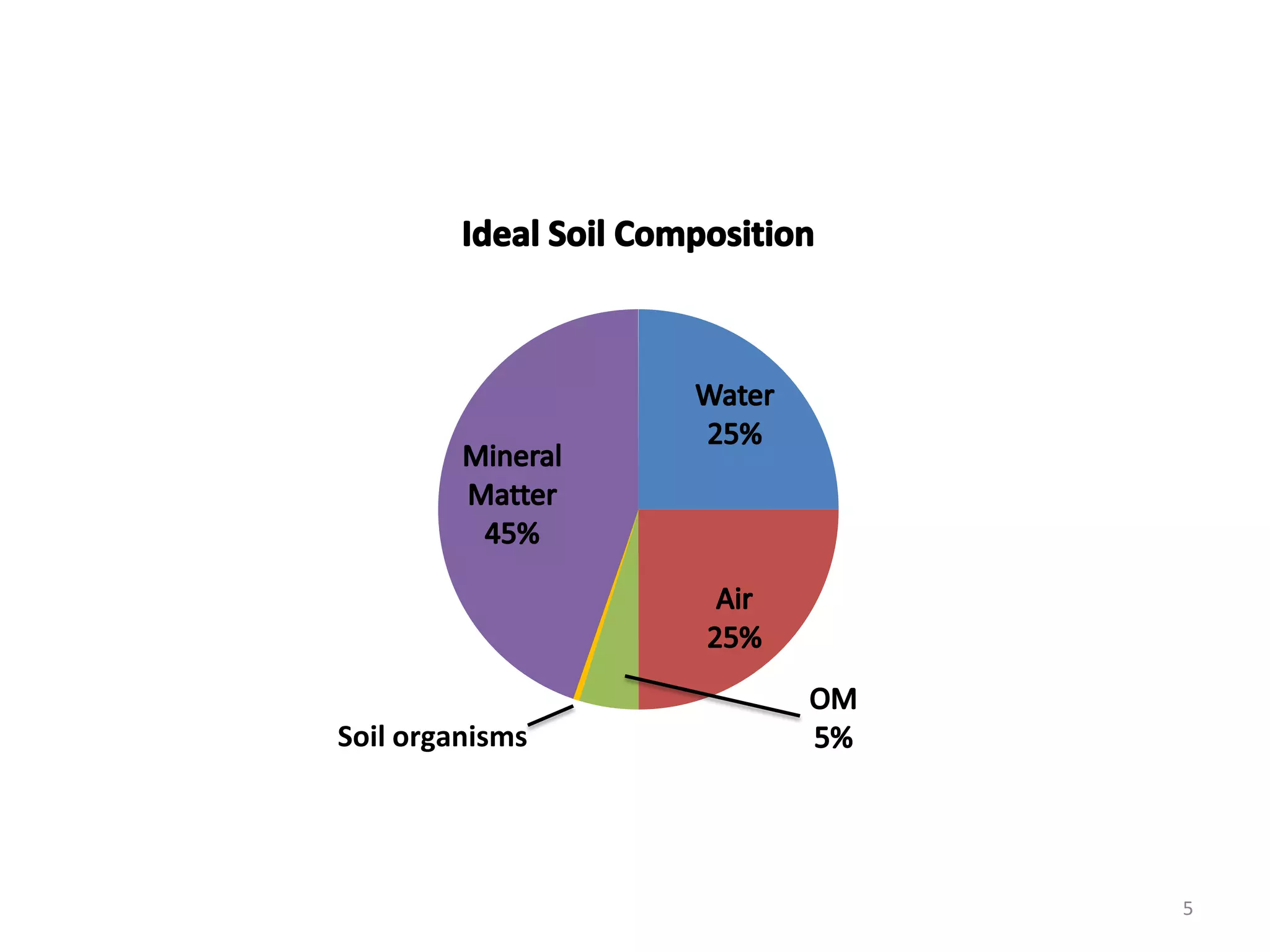
5
Soil organisms
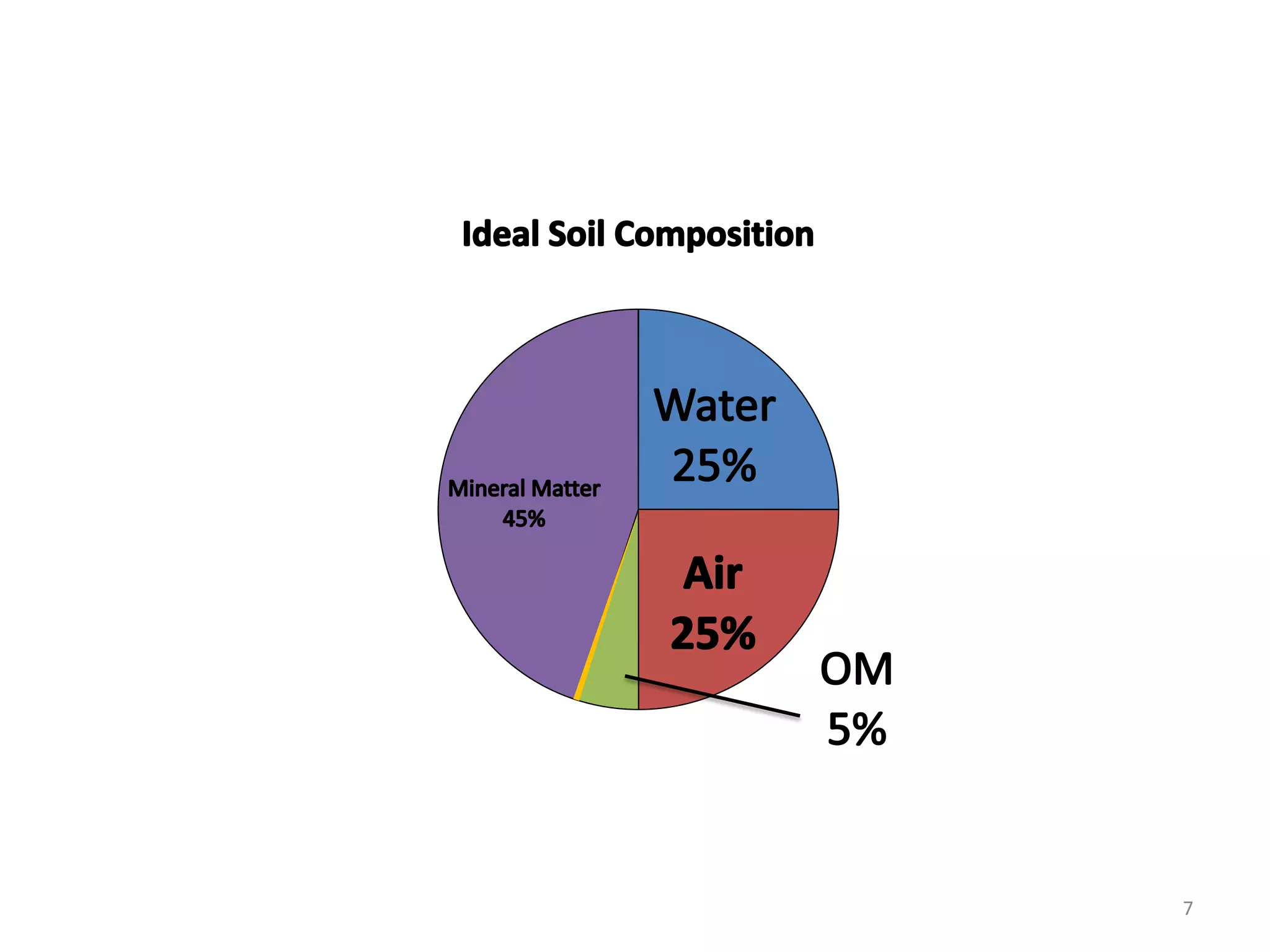
Soil life represents <0.5% of total soil volume
However, it drives the functions we ask of
our soils
6
7
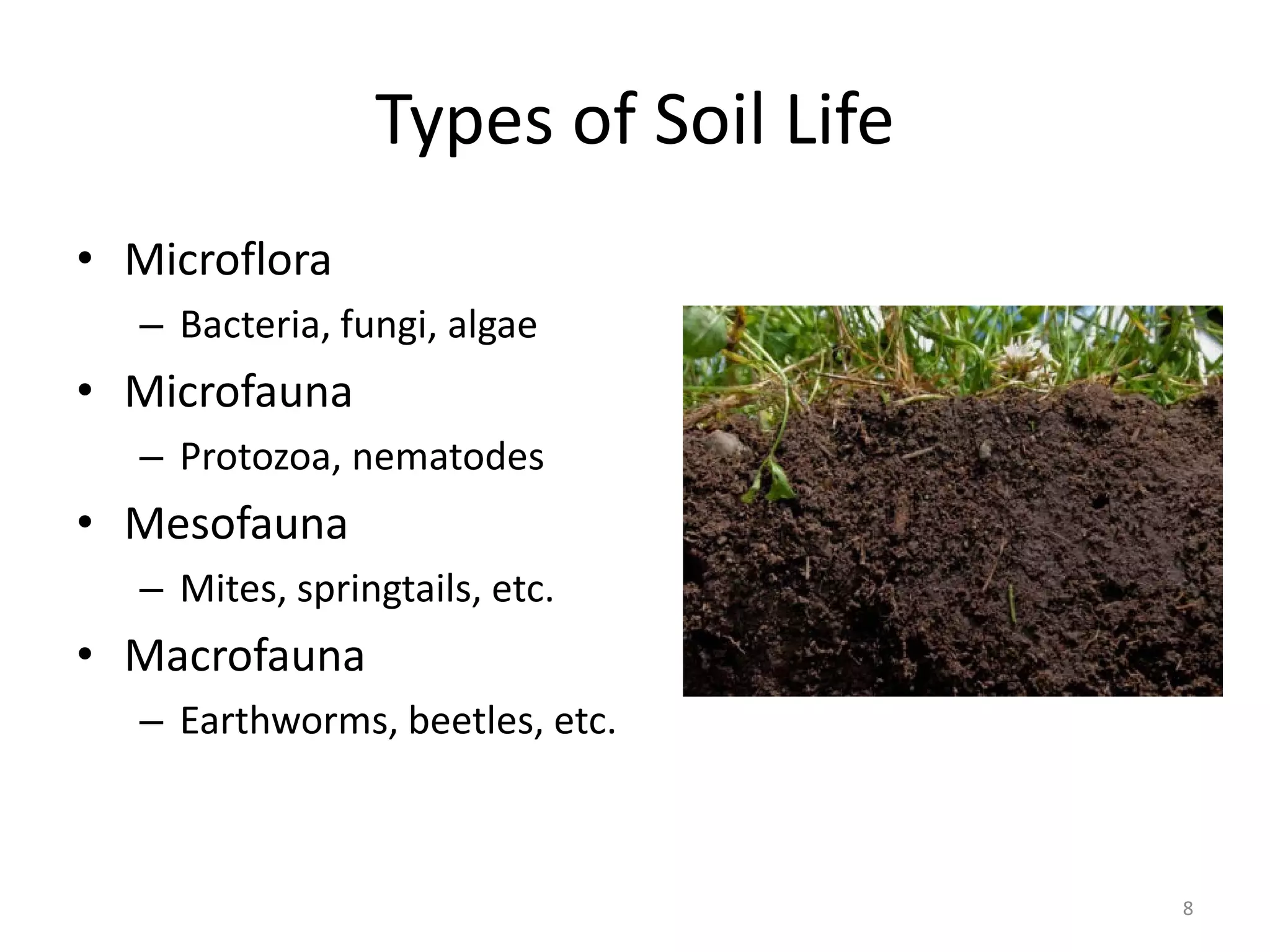
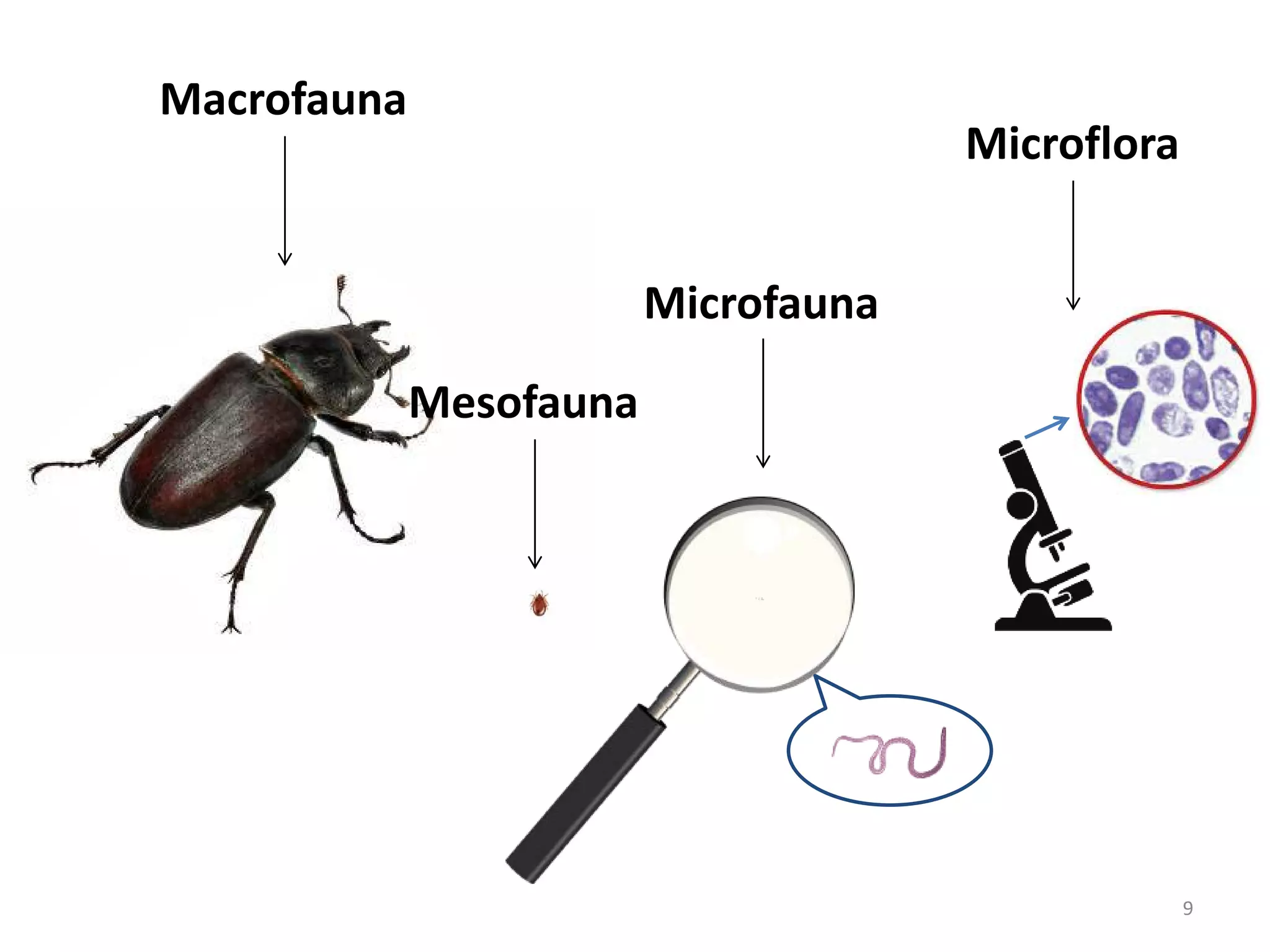
Types of Soil Life
• Microflora
– Bacteria, fungi, algae
• Microfauna
– Protozoa, nematodes
• Mesofauna
– Mites, springtails, etc.
• Macrofauna
– Earthworms, beetles, etc.
8
9
Macrofauna
Microfauna
Microflora
Mesofauna
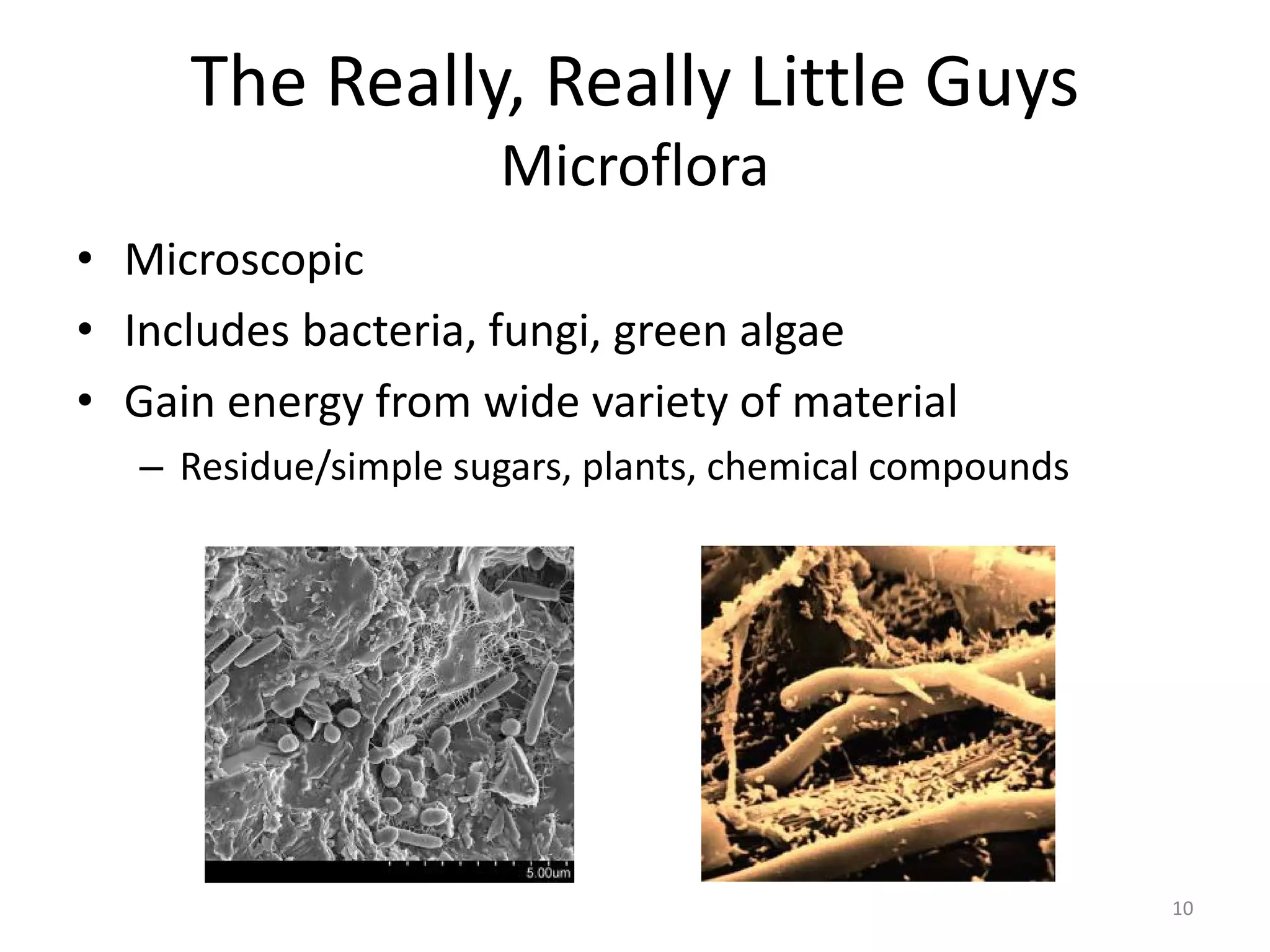
The Really, Really Little Guys
Microflora
• Microscopic
• Includes bacteria, fungi, green algae
• Gain energy from wide variety of material
– Residue/simple sugars, plants, chemical compounds
10
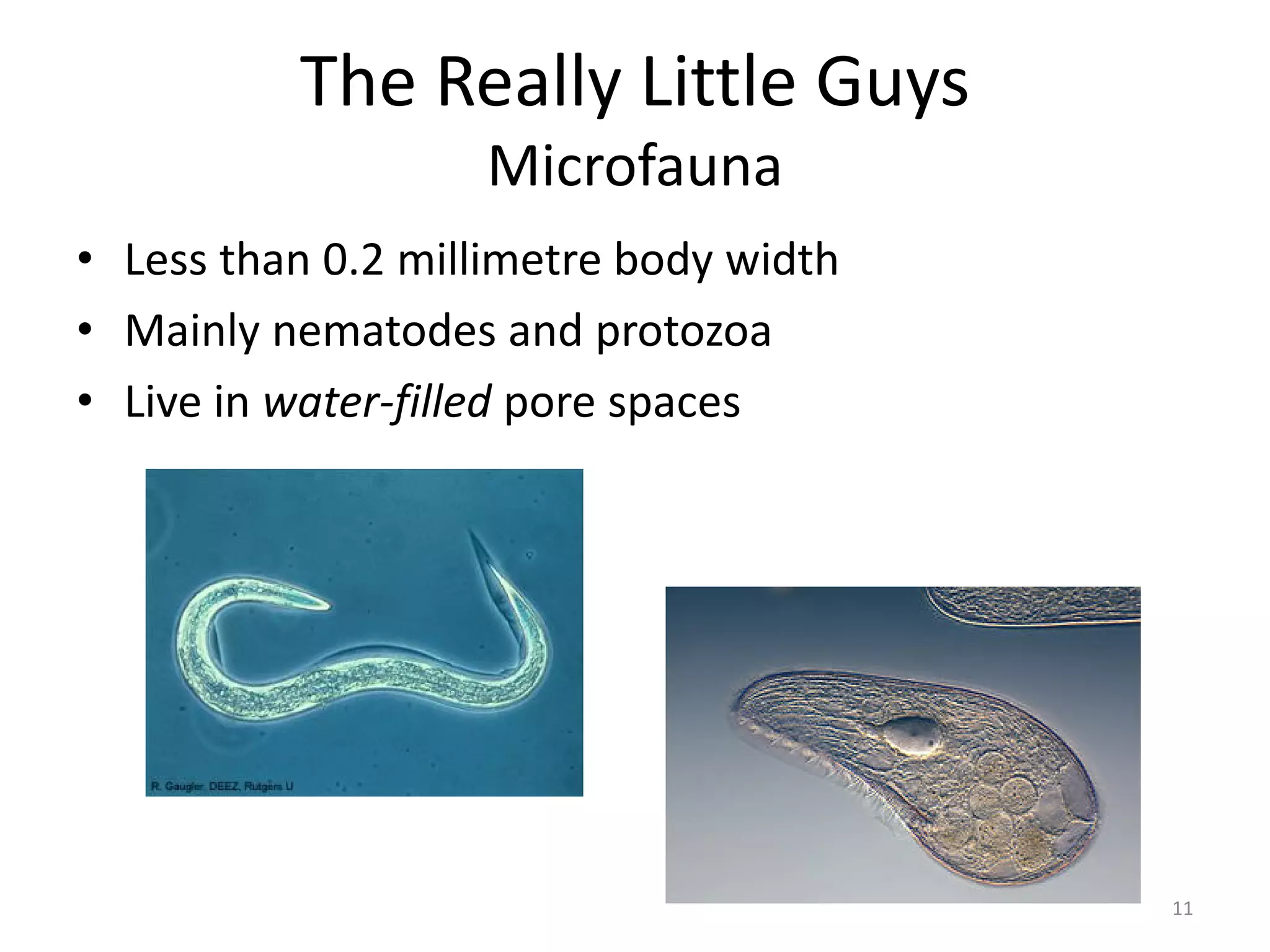
The Really Little Guys
Microfauna
• Less than 0.2 millimetre body width
• Mainly nematodes and protozoa
• Live in water-filled pore spaces
11
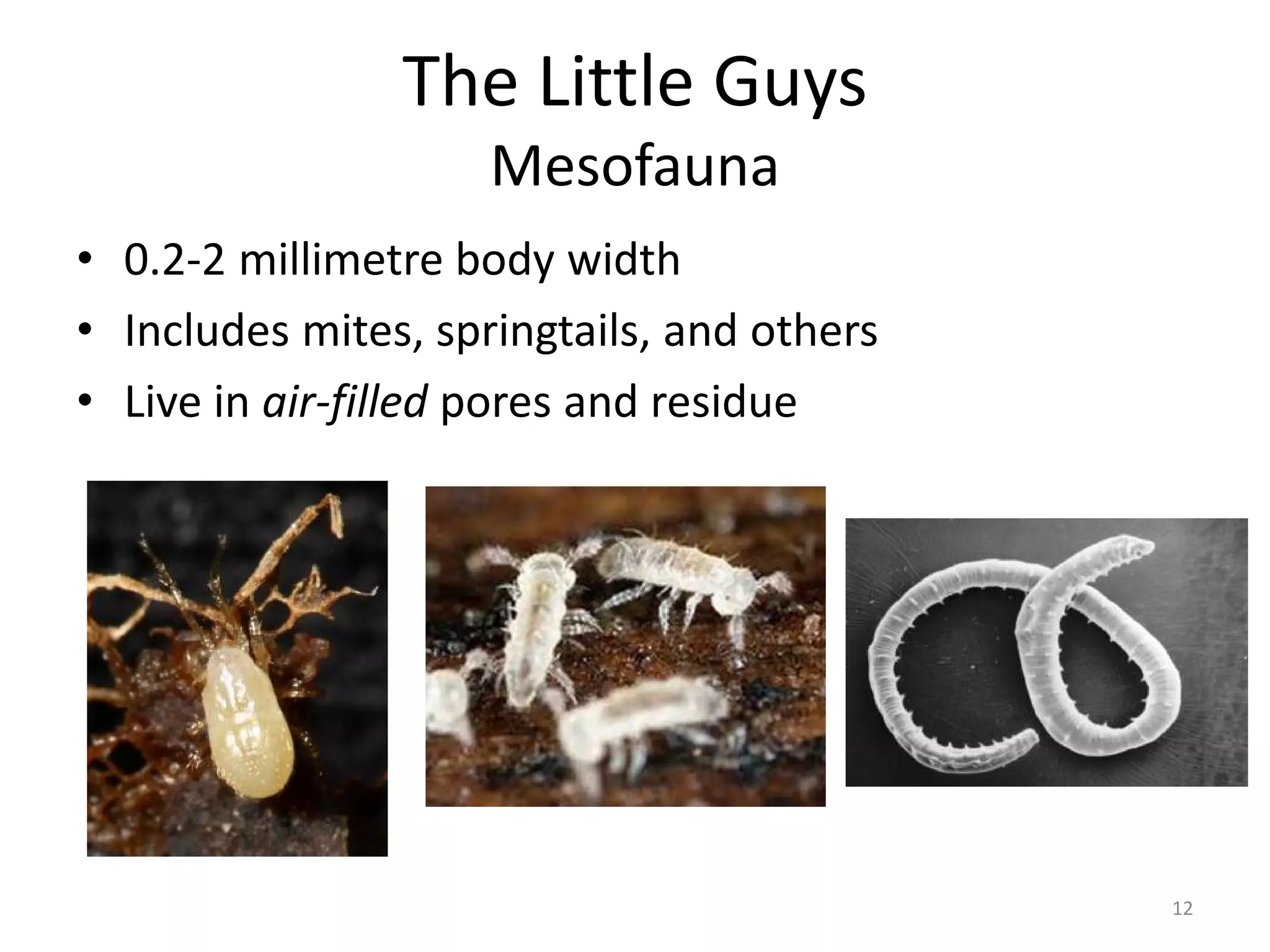
The Little Guys
Mesofauna
• 0.2-2 millimetre body width
• Includes mites, springtails, and others
• Live in air-filled pores and residue
12
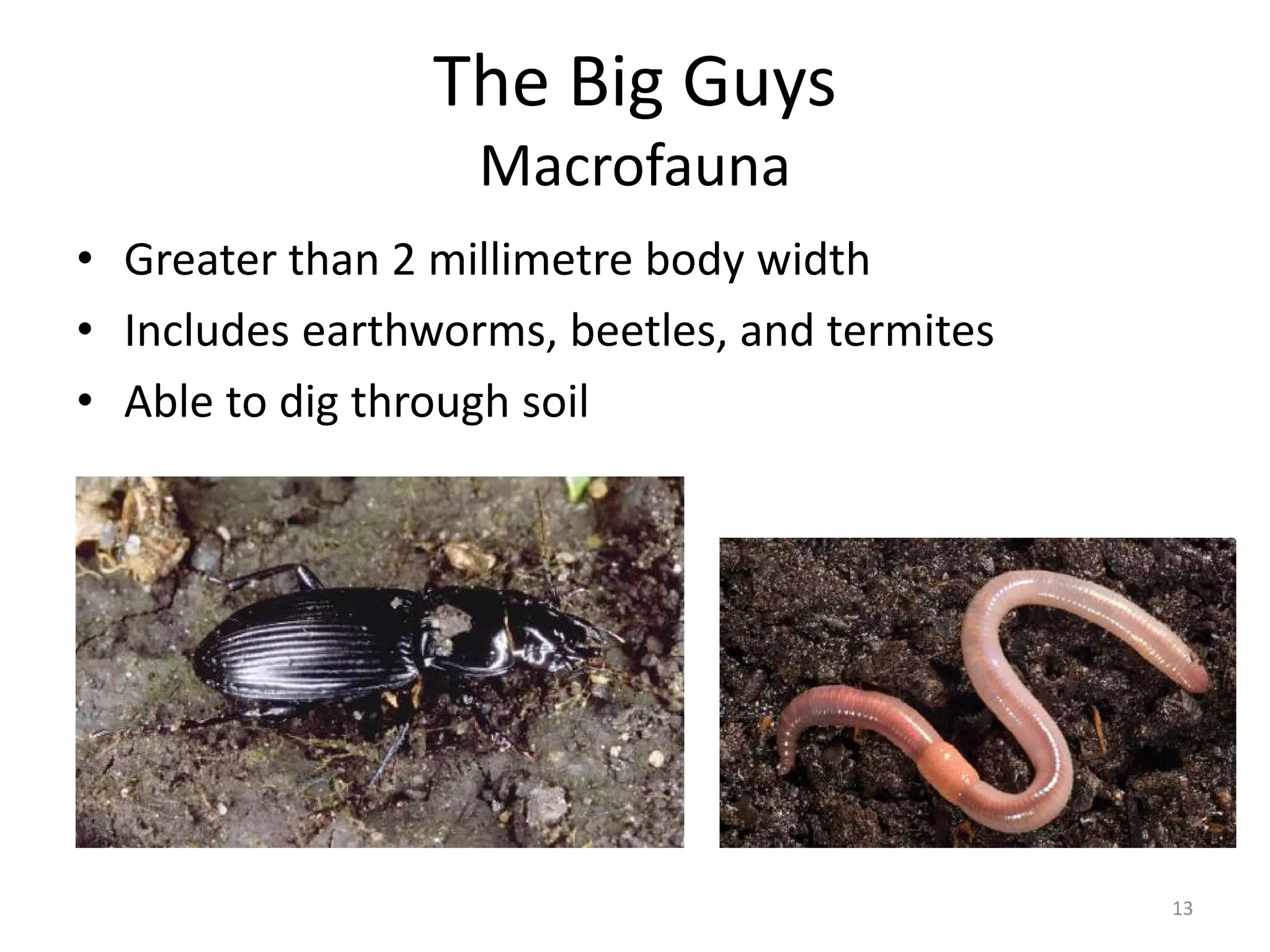
The Big Guys
Macrofauna
• Greater than 2 millimetre body width
• Includes earthworms, beetles, and termites
• Able to dig through soil
13
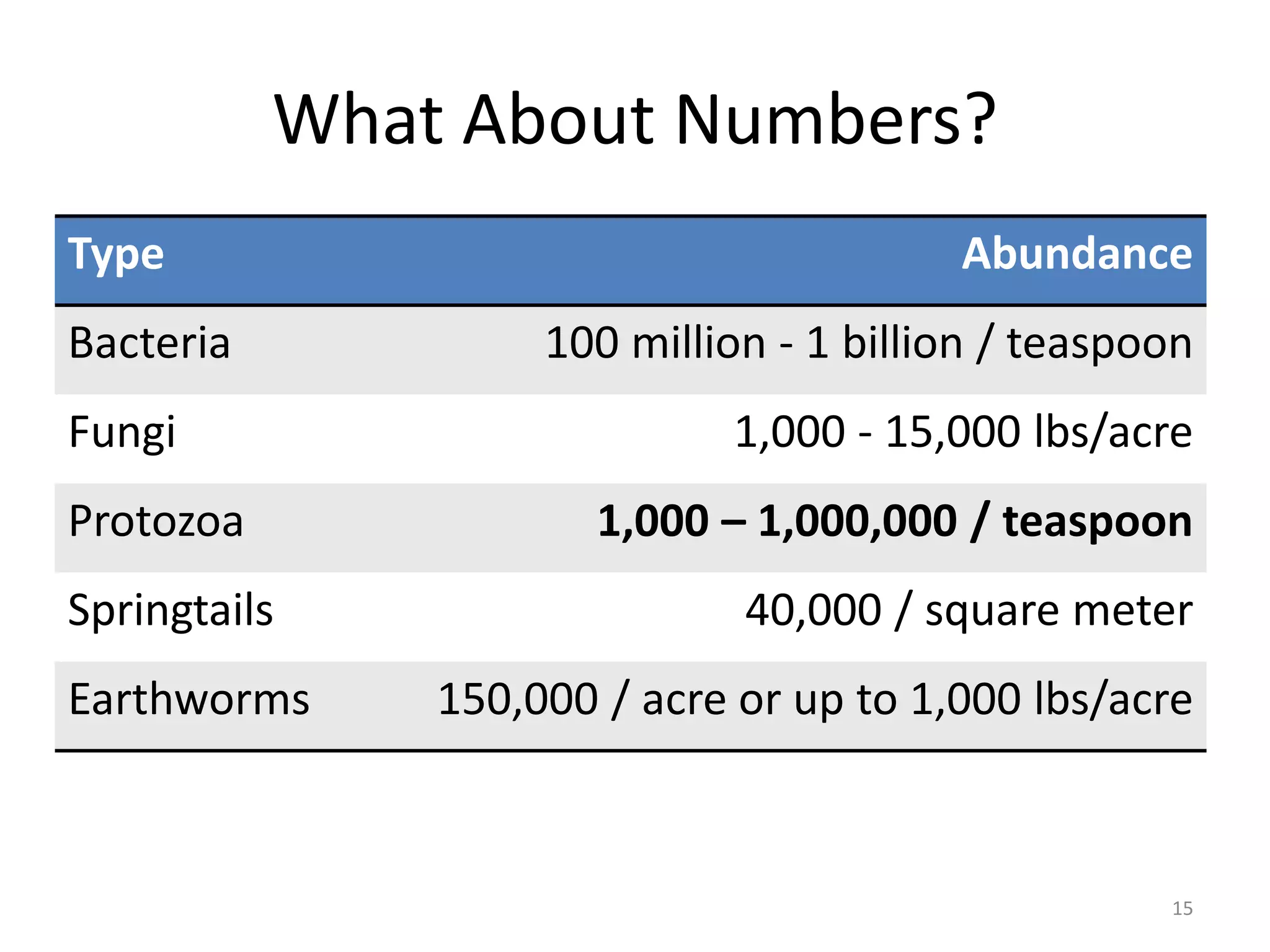
What About Numbers?
Type Abundance
Bacteria 100 million - 1 billion / teaspoon
Fungi 1,000 - 15,000 lbs/acre
Protozoa 1,000 – 1,000,000 / teaspoon
Springtails 40,000 / square meter
Earthworms 150,000 / acre or up to 1,000 lbs/acre
14
What About Numbers?
Type Abundance
Bacteria 100 million - 1 billion / teaspoon
Fungi 1,000 - 15,000 lbs/acre
Protozoa 1,000 – 1,000,000 / teaspoon
Springtails 40,000 / square meter
Earthworms 150,000 / acre or up to 1,000 lbs/acre
15
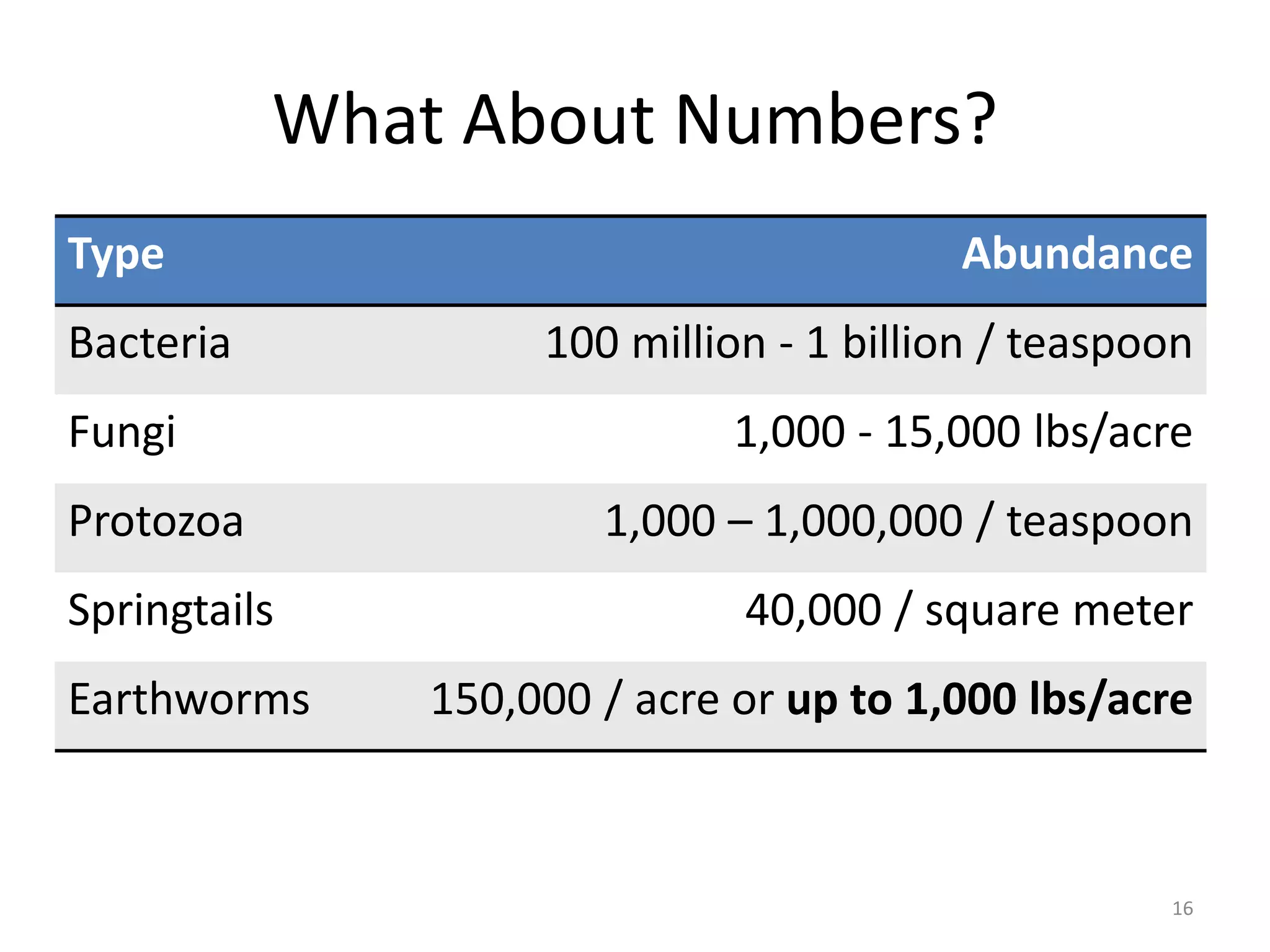
What About Numbers?
Type Abundance
Bacteria 100 million - 1 billion / teaspoon
Fungi 1,000 - 15,000 lbs/acre
Protozoa 1,000 – 1,000,000 / teaspoon
Springtails 40,000 / square meter
Earthworms 150,000 / acre or up to 1,000 lbs/acre
16
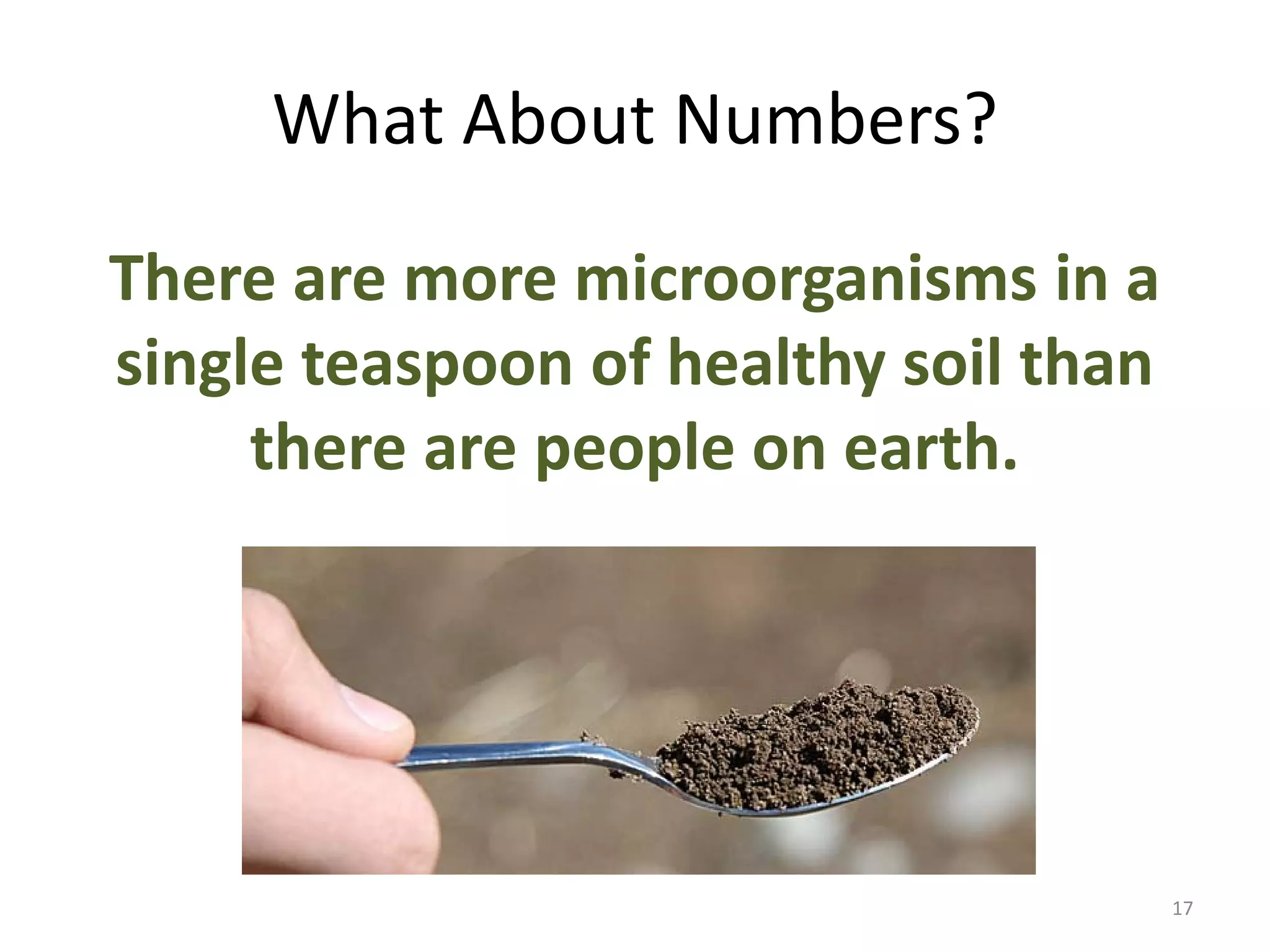
What About Numbers?
There are more microorganisms in a
single teaspoon of healthy soil than
there are people on earth.
17
What About Numbers?
In just the top 6 inches, all the organisms in an
average soil weigh somewhere between
2,500 and 5,000 lbs/acre
No wonder some experts refer to soil life as an
“underground herd”
18
19
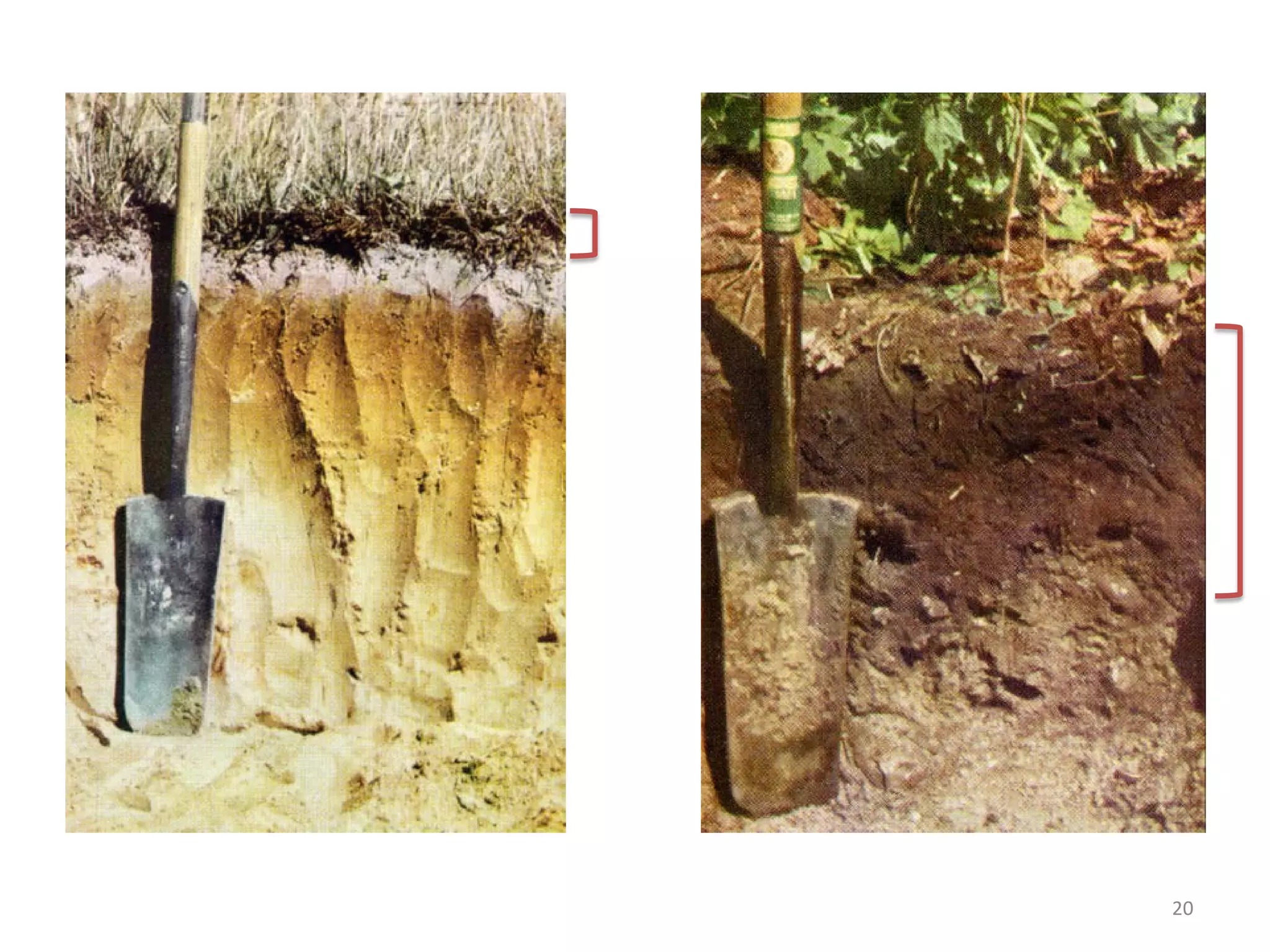
Topsoil represents area of
greatest abundance and
diversity of soil life
20
And Diversity?
Soil is one of the most diverse ecosystem on the planet.
• 1 gram of soil: thousands of species of bacteria
• Up to 3,000 species of fungi exist in soil
• Multiple species of earthworms in every acre
Diversity  redundancy  resilience
21
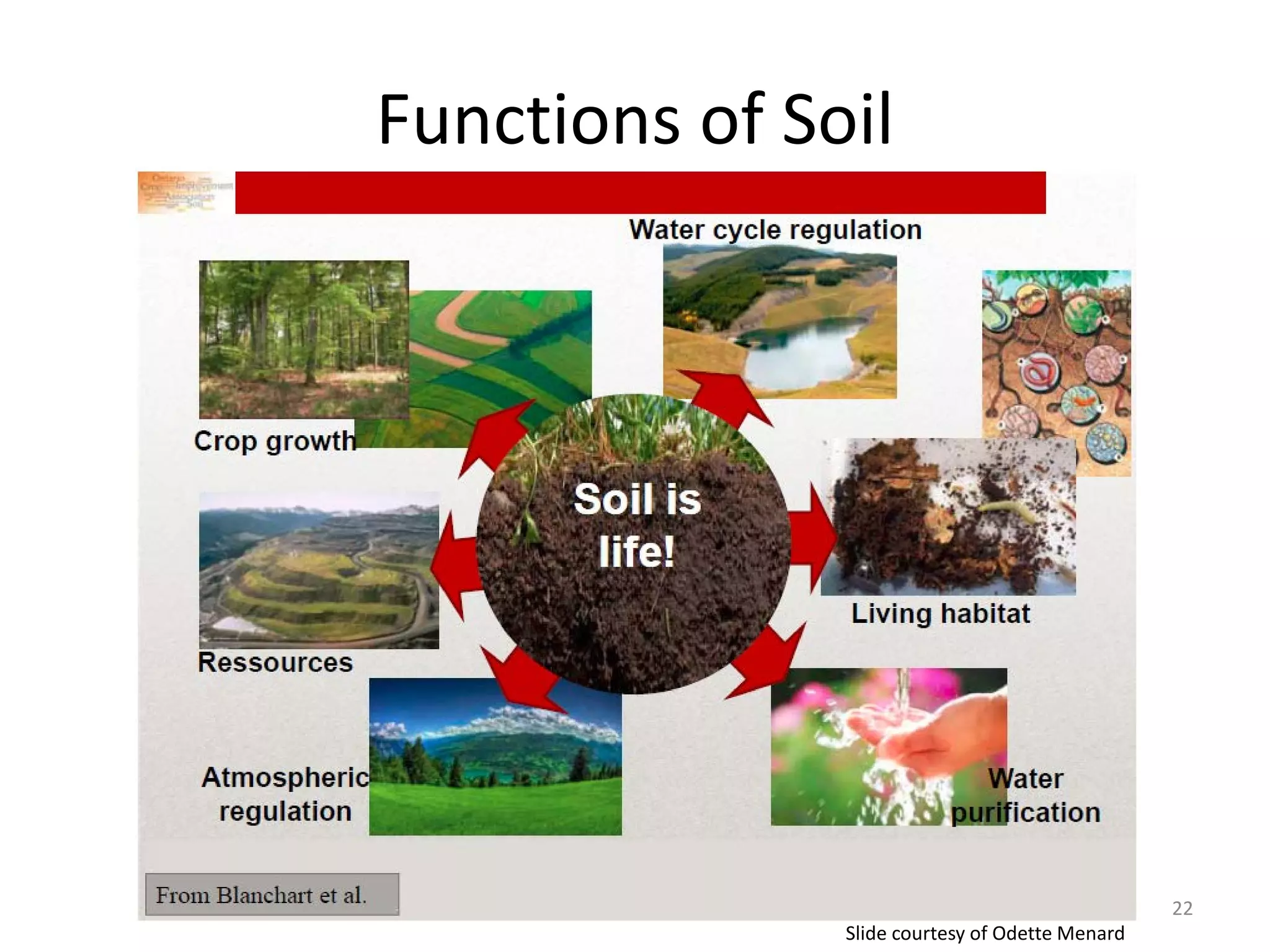
Functions of Soil
22
Slide courtesy of Odette Menard
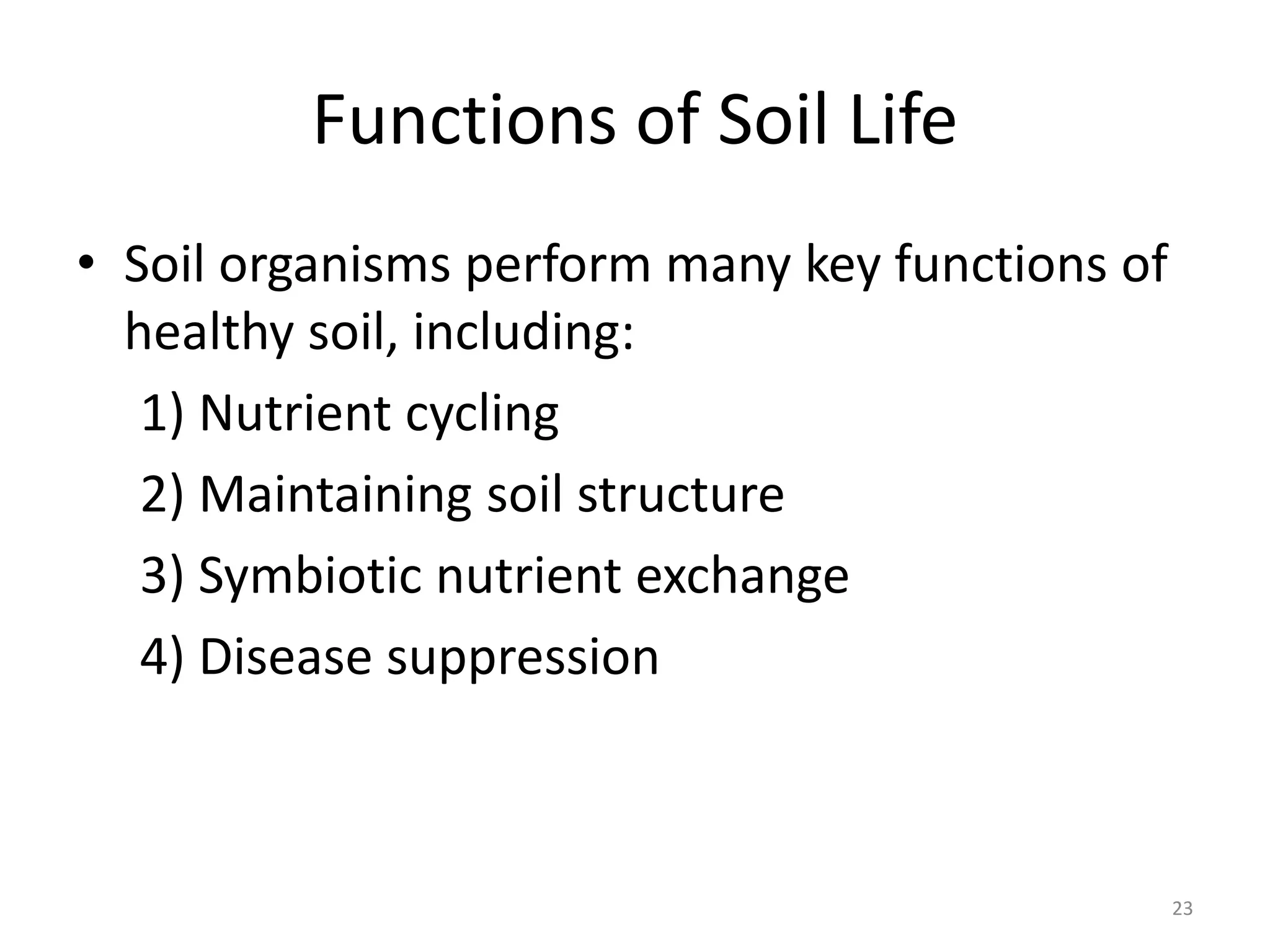
Functions of Soil Life
• Soil organisms perform many key functions of
healthy soil, including:
1) Nutrient cycling
2) Maintaining soil structure
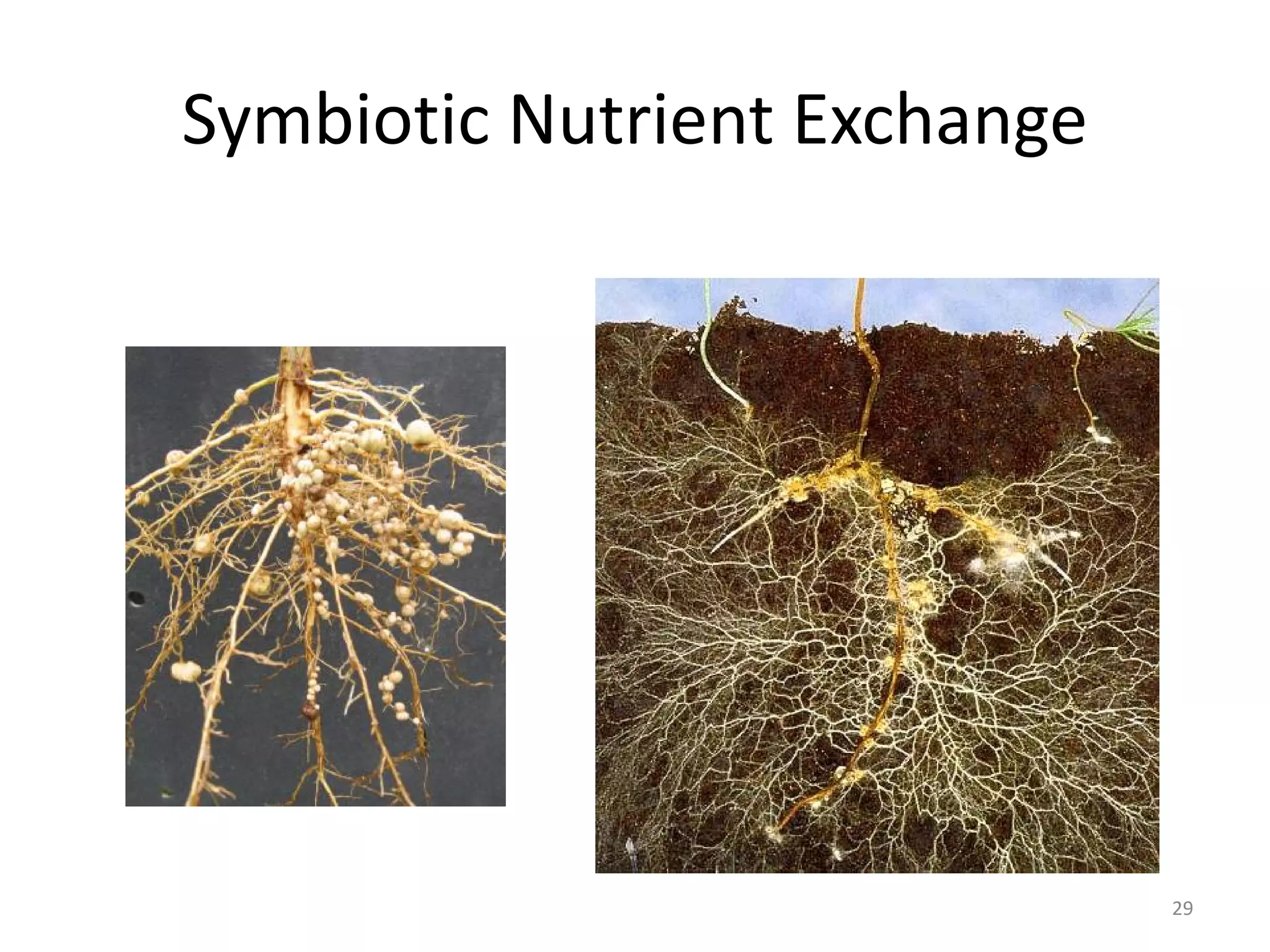
3) Symbiotic nutrient exchange
4) Disease suppression
23
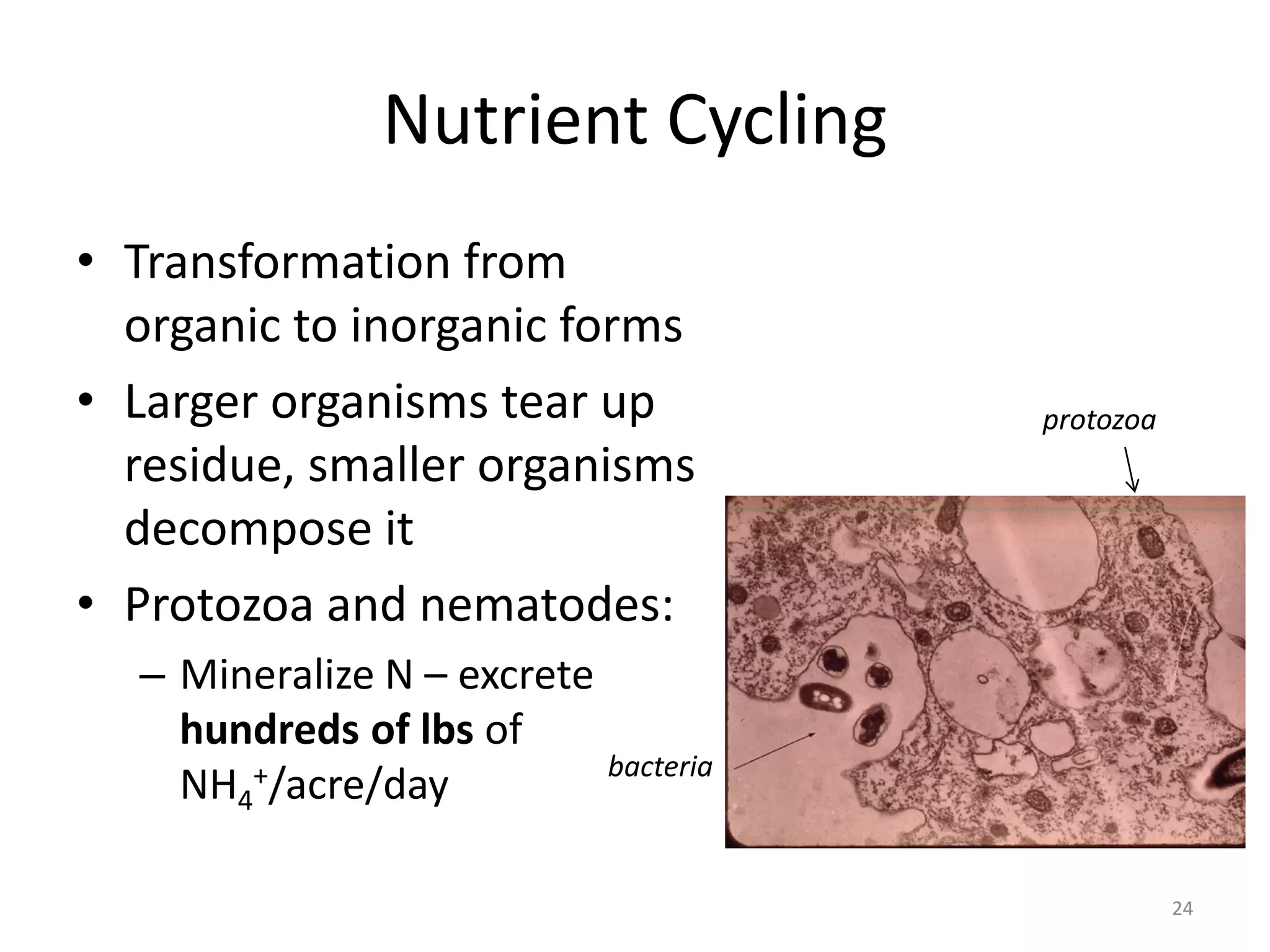
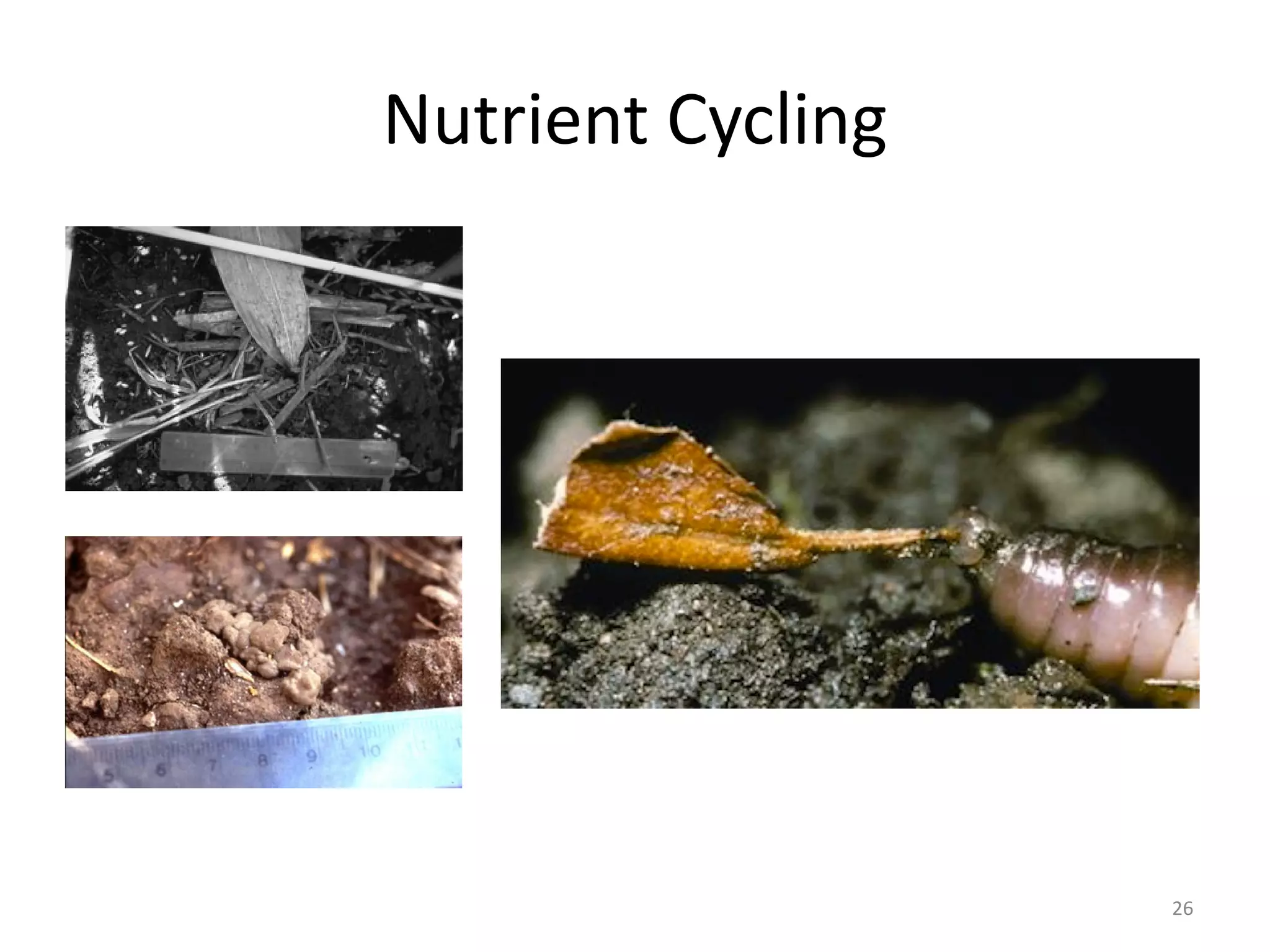
Nutrient Cycling
• Transformation from
organic to inorganic forms
• Larger organisms tear up
residue, smaller organisms
decompose it
• Protozoa and nematodes:
– Mineralize N – excrete
hundreds of lbs of
NH4
+/acre/day
24
bacteria
protozoa
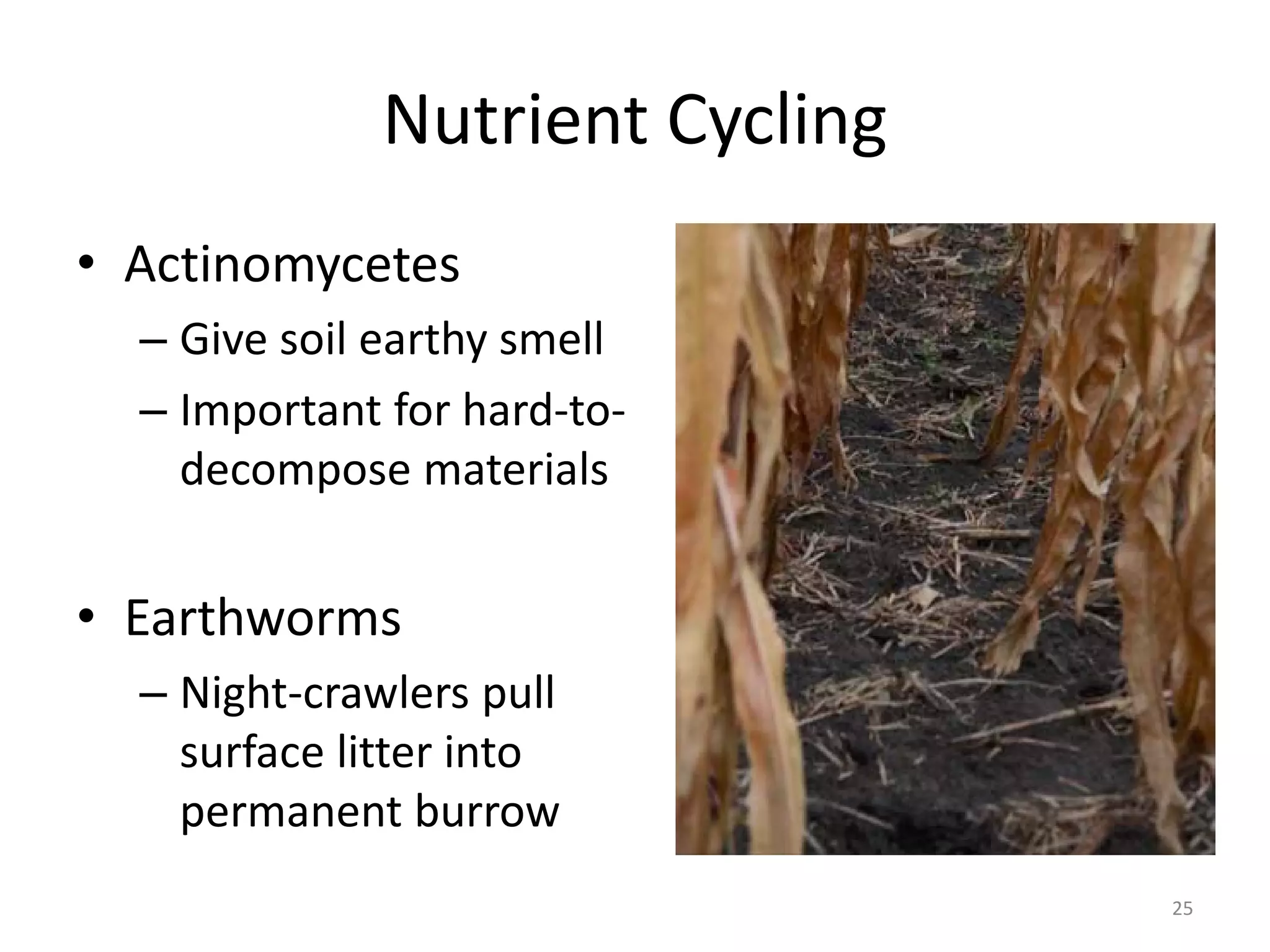
Nutrient Cycling
• Actinomycetes
– Give soil earthy smell
– Important for hard-to-
decompose materials
• Earthworms
– Night-crawlers pull
surface litter into
permanent burrow
25
Nutrient Cycling
26
Soil Structure
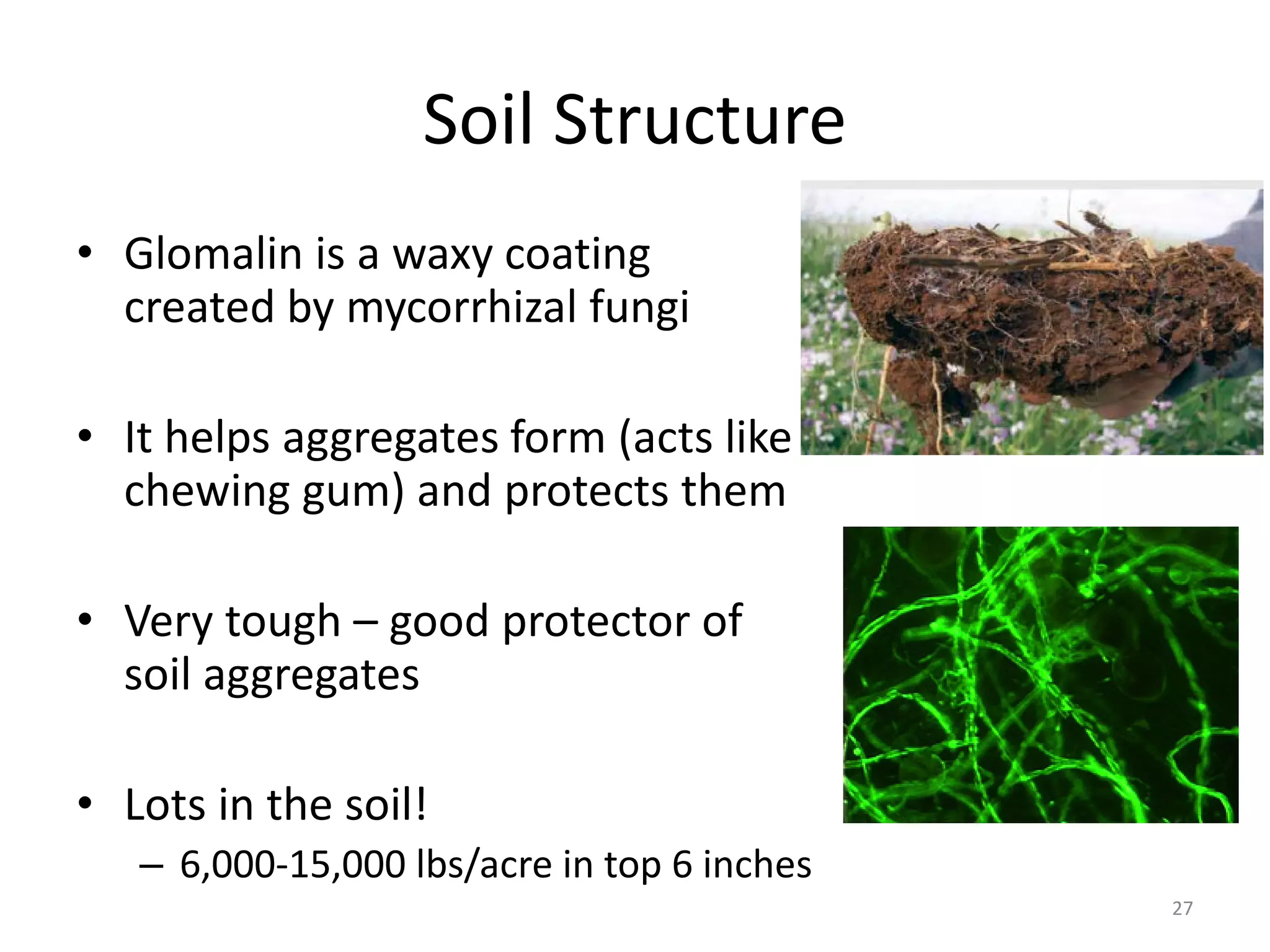
• Glomalin is a waxy coating
created by mycorrhizal fungi
• It helps aggregates form (acts like
chewing gum) and protects them
• Very tough – good protector of
soil aggregates
• Lots in the soil!
– 6,000-15,000 lbs/acre in top 6 inches
27
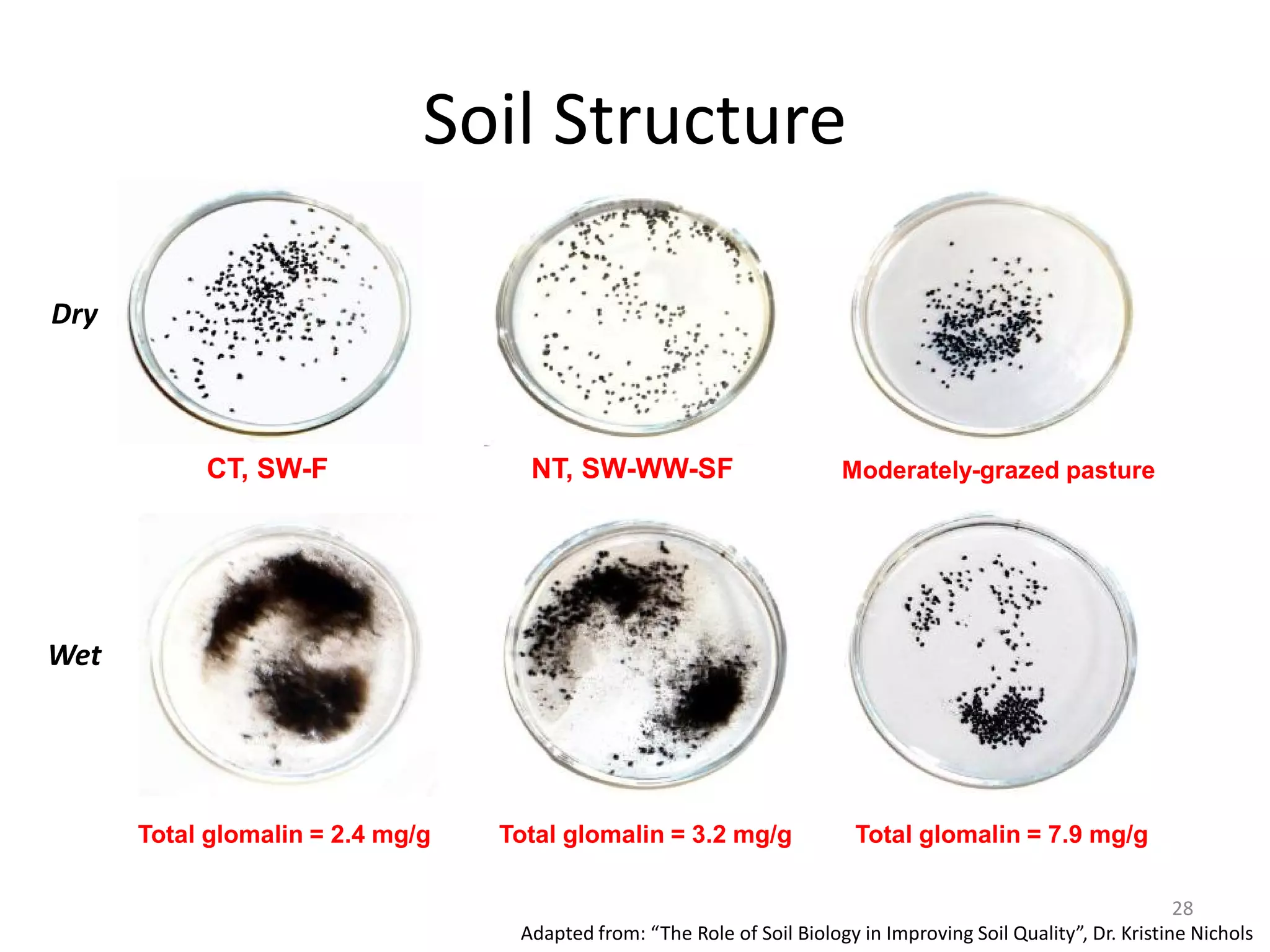
CT, SW-F NT, SW-WW-SF Moderately-grazed pasture
WSA = 14%
Total glomalin = 2.4 mg/g
WSA = 47%
Total glomalin = 3.2 mg/g
WSA = 93%
Total glomalin = 7.9 mg/g
Soil Structure
Adapted from: “The Role of Soil Biology in Improving Soil Quality”, Dr. Kristine Nichols
Dry
Wet
28
Symbiotic Nutrient Exchange
29
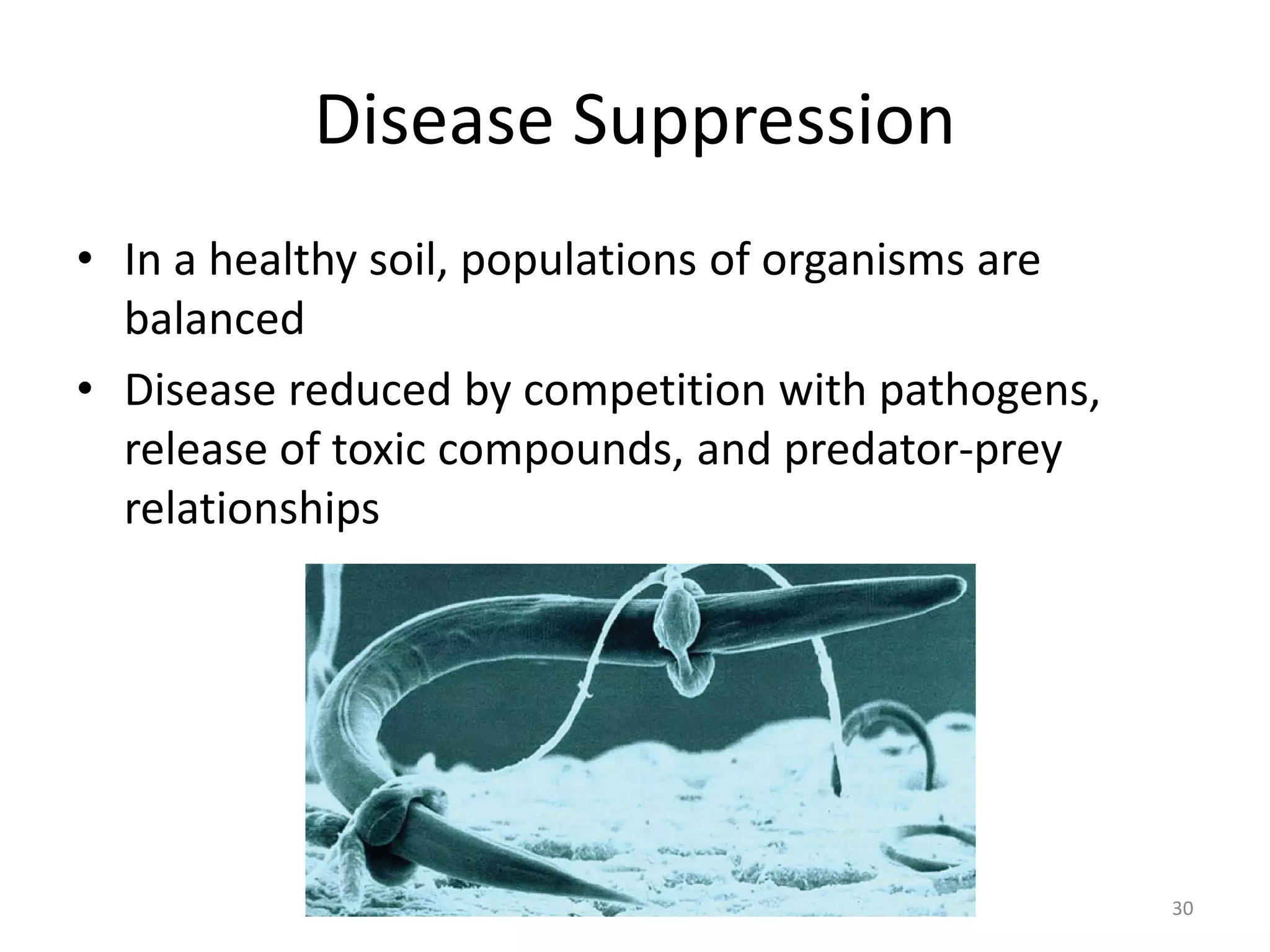
Disease Suppression
• In a healthy soil, populations of organisms are
balanced
• Disease reduced by competition with pathogens,
release of toxic compounds, and predator-prey
relationships
30
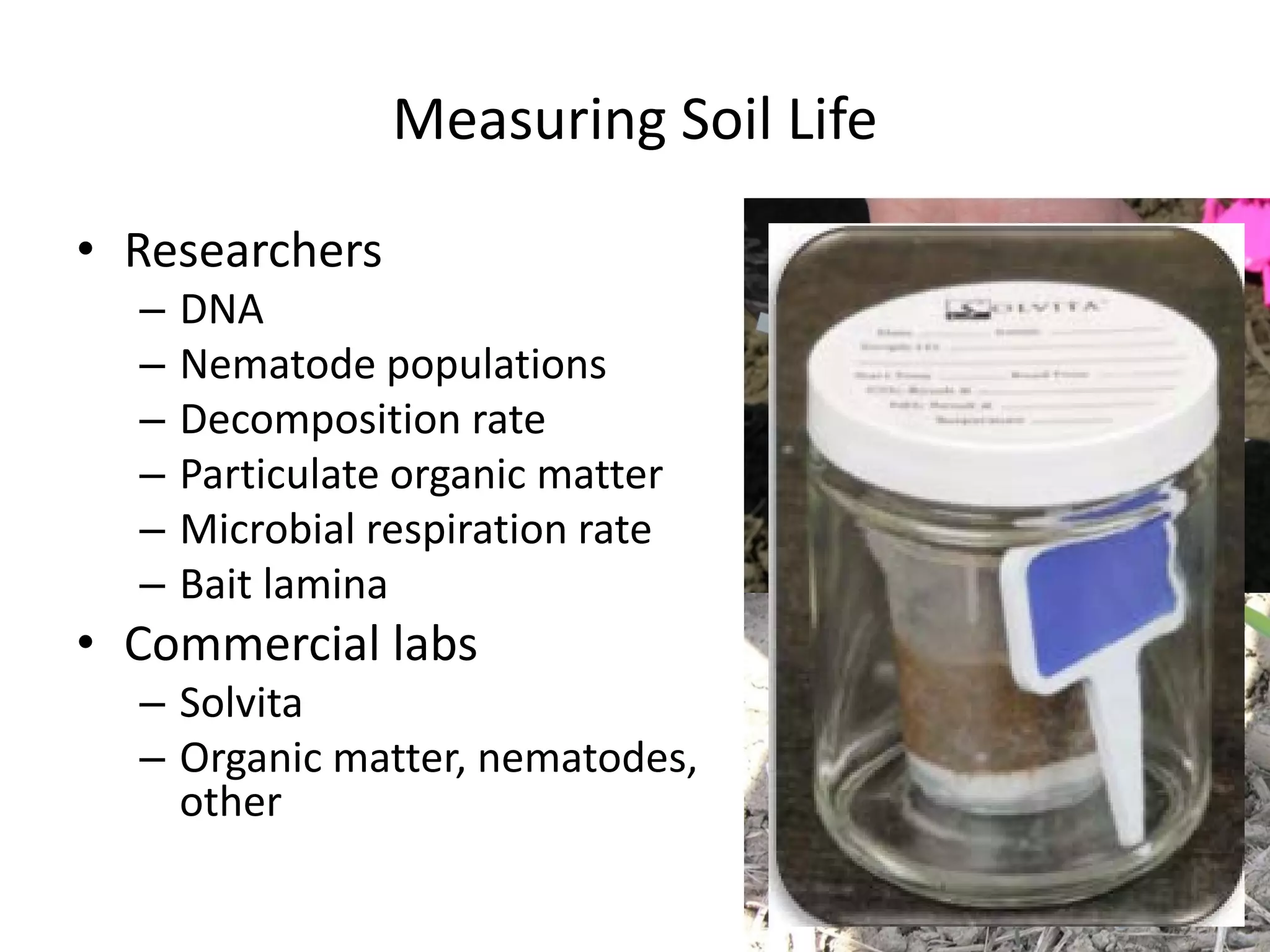
Measuring Soil Life
• Researchers
– DNA
– Nematode populations
– Decomposition rate
– Particulate organic matter
– Microbial respiration rate
– Bait lamina
• Commercial labs
– Solvita
– Organic matter, nematodes,
other
Field Measurements
• Cornell Soil Health Assessment
– Organic matter
– Active carbon
– Soil Respiration
– Soil Protein
– Potentially mineralizable nitrogen (PMN)
• Haney
– Total N, inorganic N, phosphate, Solvita C02-C, water
extractable organic C, water extractable organic N
Ontario Research
33
• Over the long-term, no-till and more complex
rotations resulted in higher soil health scores
• Three factors showed the greatest differences
between tillage systems and crop rotations:
1) Aggregate stability
2) Percent soil organic matter
3) Potentially mineralizable nitrogen
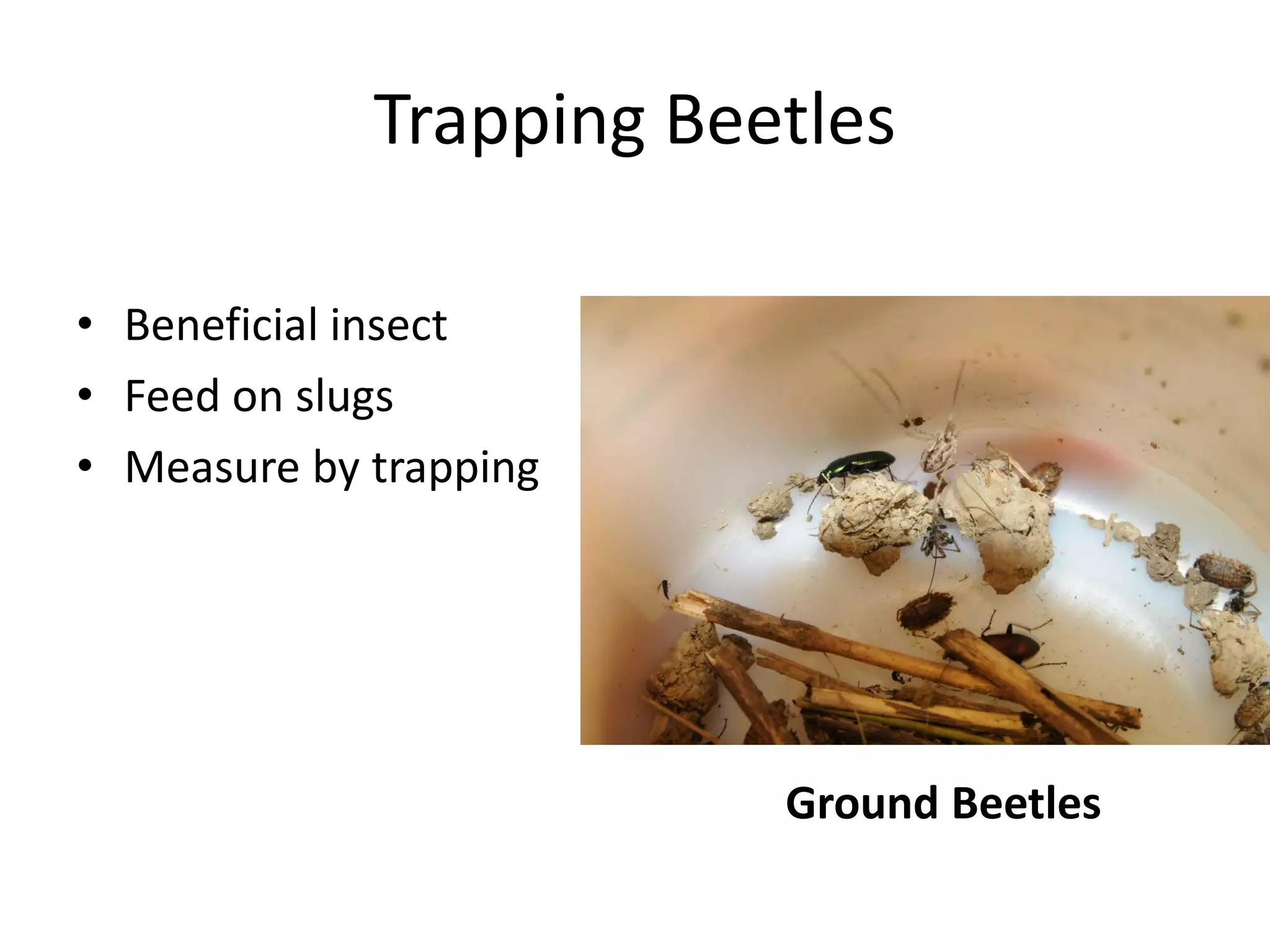
Trapping Beetles
• Beneficial insect
• Feed on slugs
• Measure by trapping
Ground Beetles
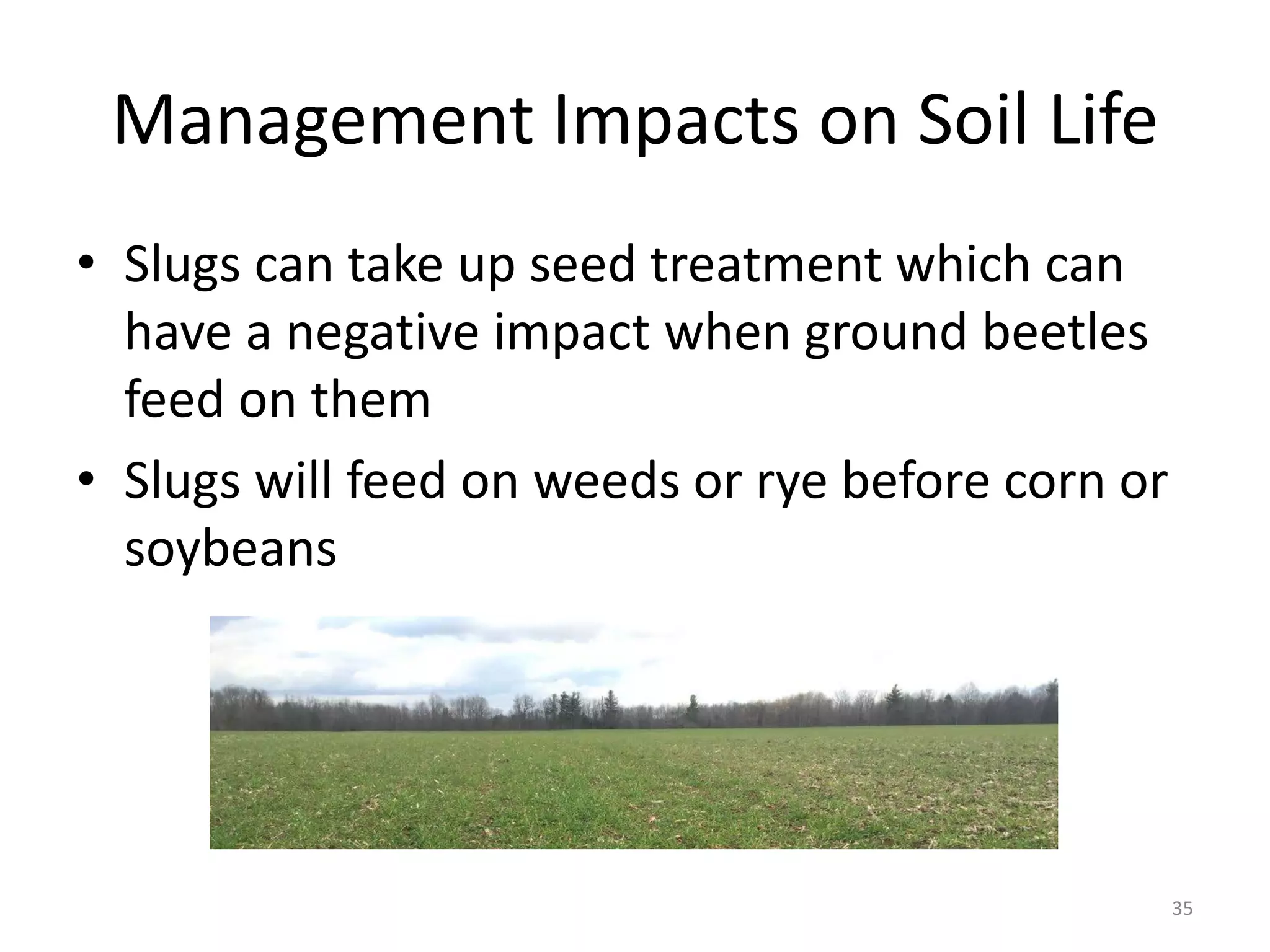
Management Impacts on Soil Life
• Slugs can take up seed treatment which can
have a negative impact when ground beetles
feed on them
• Slugs will feed on weeds or rye before corn or
soybeans
35
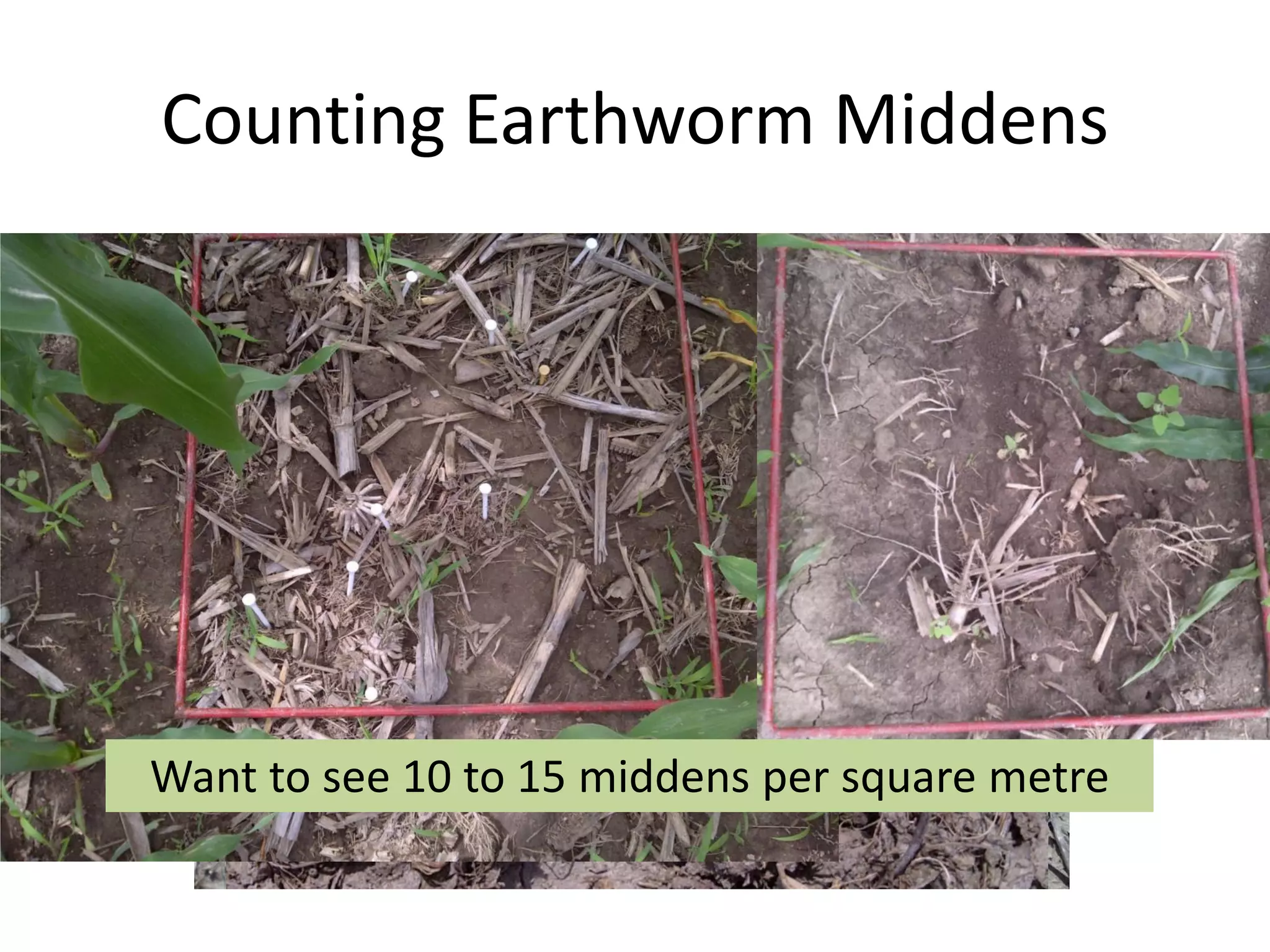
Counting Earthworm Middens
Want to see 10 to 15 middens per square metre
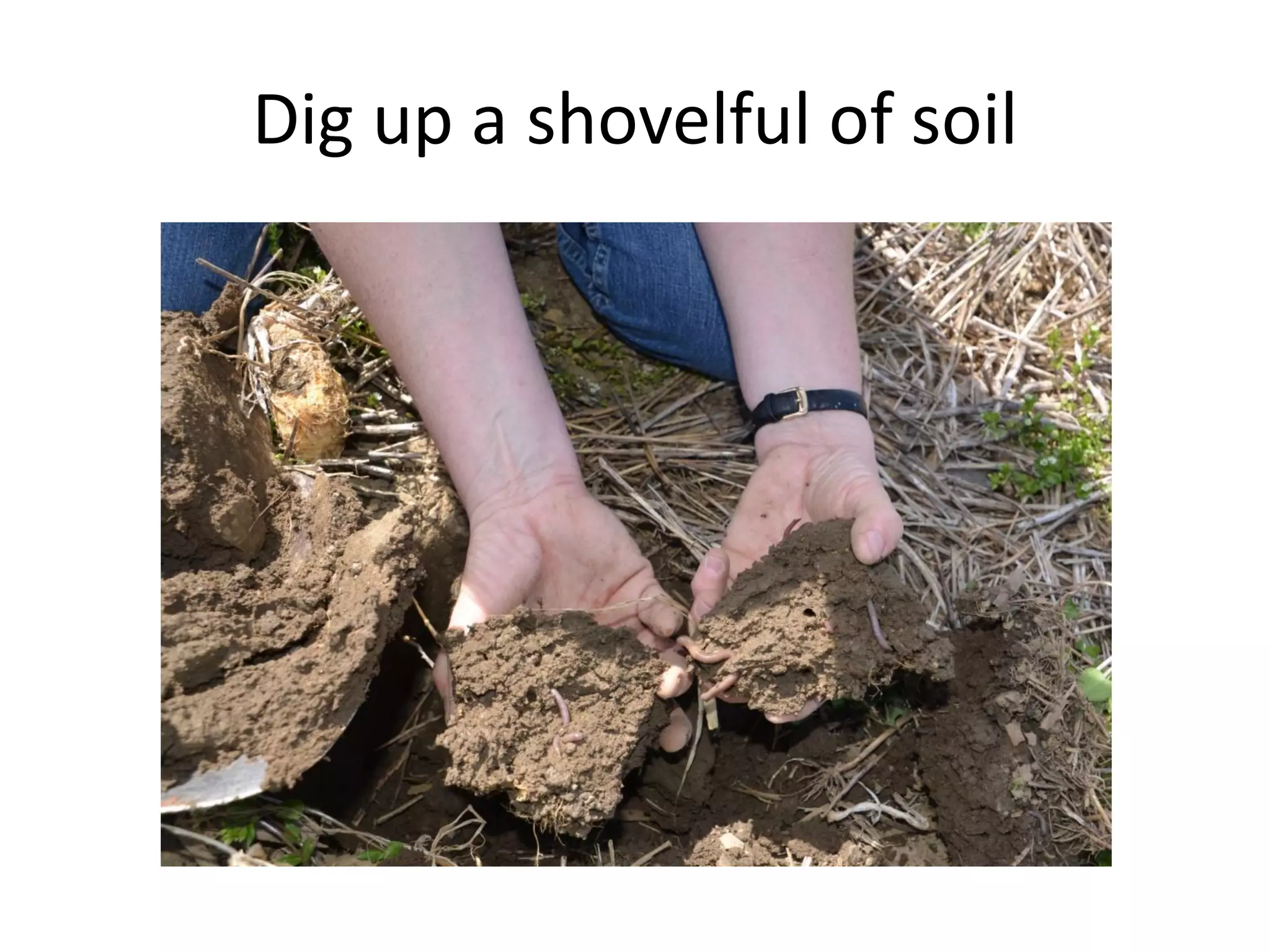
Dig up a shovelful of soil
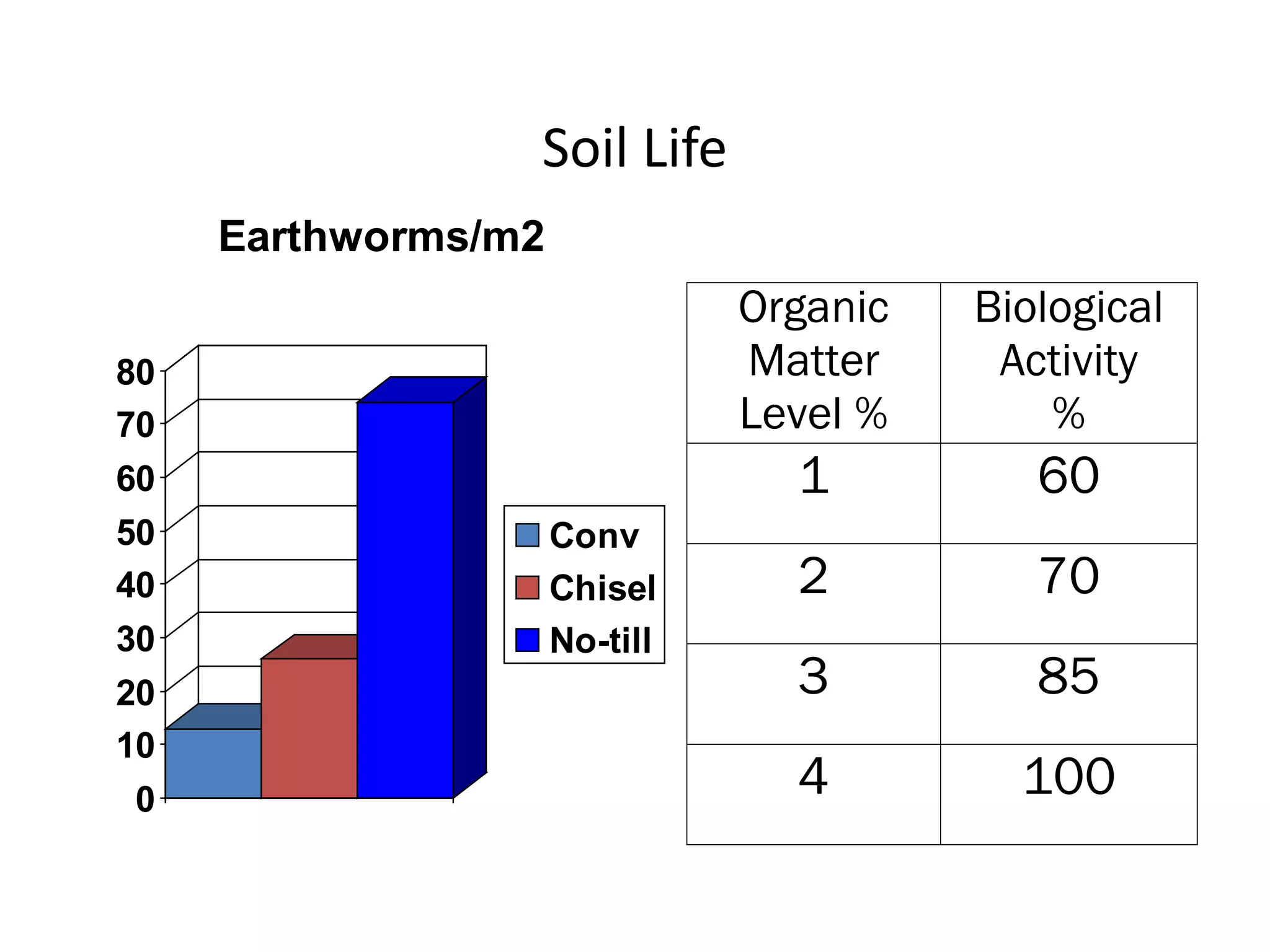
Soil Life
0
10
20
30
40
50
60
70
80
Earthworms/m2
Conv
Chisel
No-till
Organic
Matter
Level %
Biological
Activity
%
1 60
2 70
3 85
4 100
Complex Crop Rotations Improve Soil Life
• In general, more diverse rotations result in
more diverse soil life
• A greater proportion of time with live roots in
the soil means enhanced soil life and activity:
– Corn-soybean rotation: 38% (~9/24 months with
live roots)
– Corn-soybean-wheat: 53% (~19/36 months)
– Corn-soybean-wheat (red clover): 61% (~22/36
months)
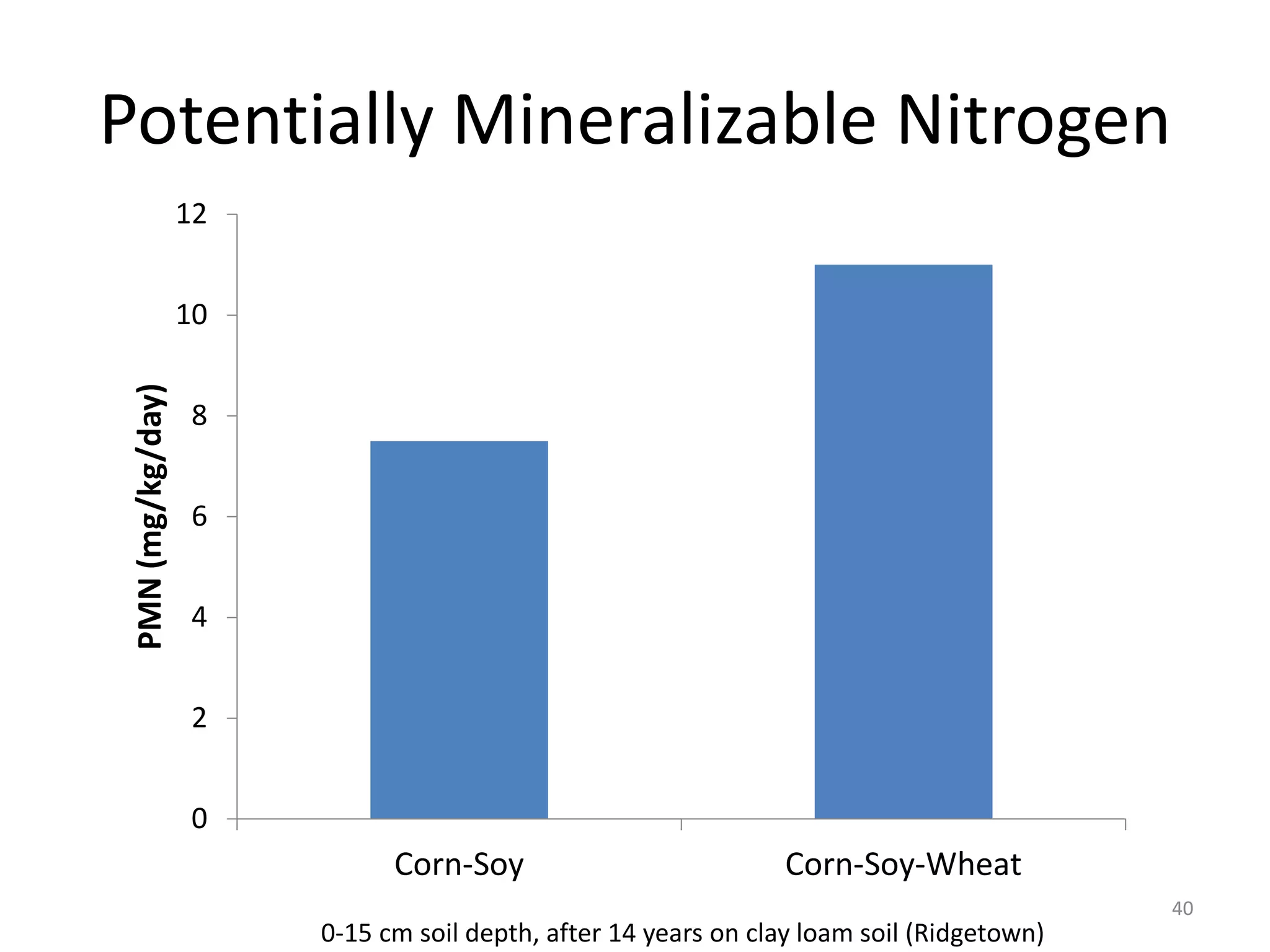
Potentially Mineralizable Nitrogen
40
0
2
4
6
8
10
12
Corn-Soy Corn-Soy-Wheat
PMN(mg/kg/day)
0-15 cm soil depth, after 14 years on clay loam soil (Ridgetown)
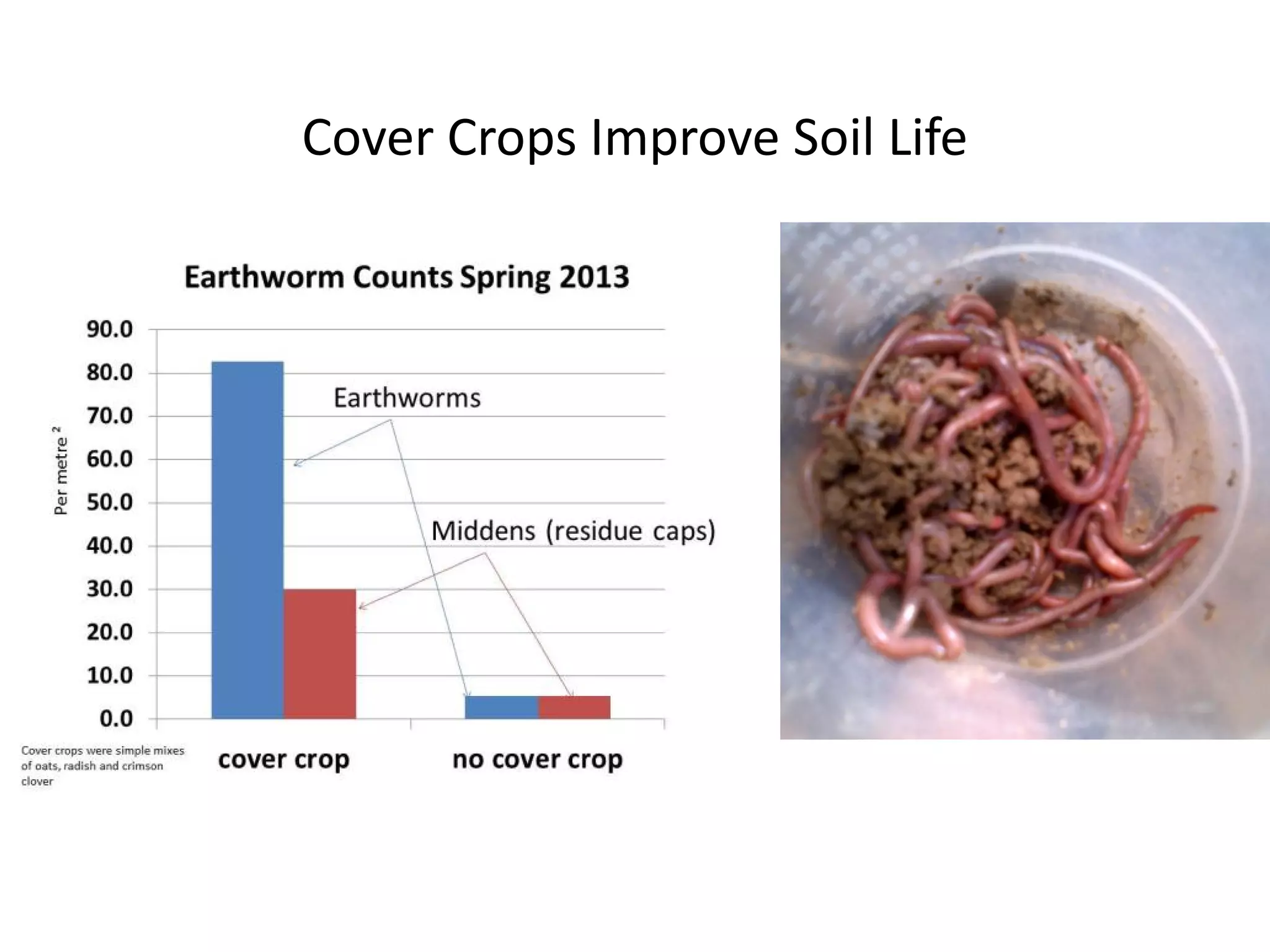
Cover Crops Improve Soil Life
The Cotton Test
• Bury men's cotton briefs for 60 days (wash
new ones first)
• Leave the waistband showing so they can be
easily found
• Dig up to see how much has been eaten
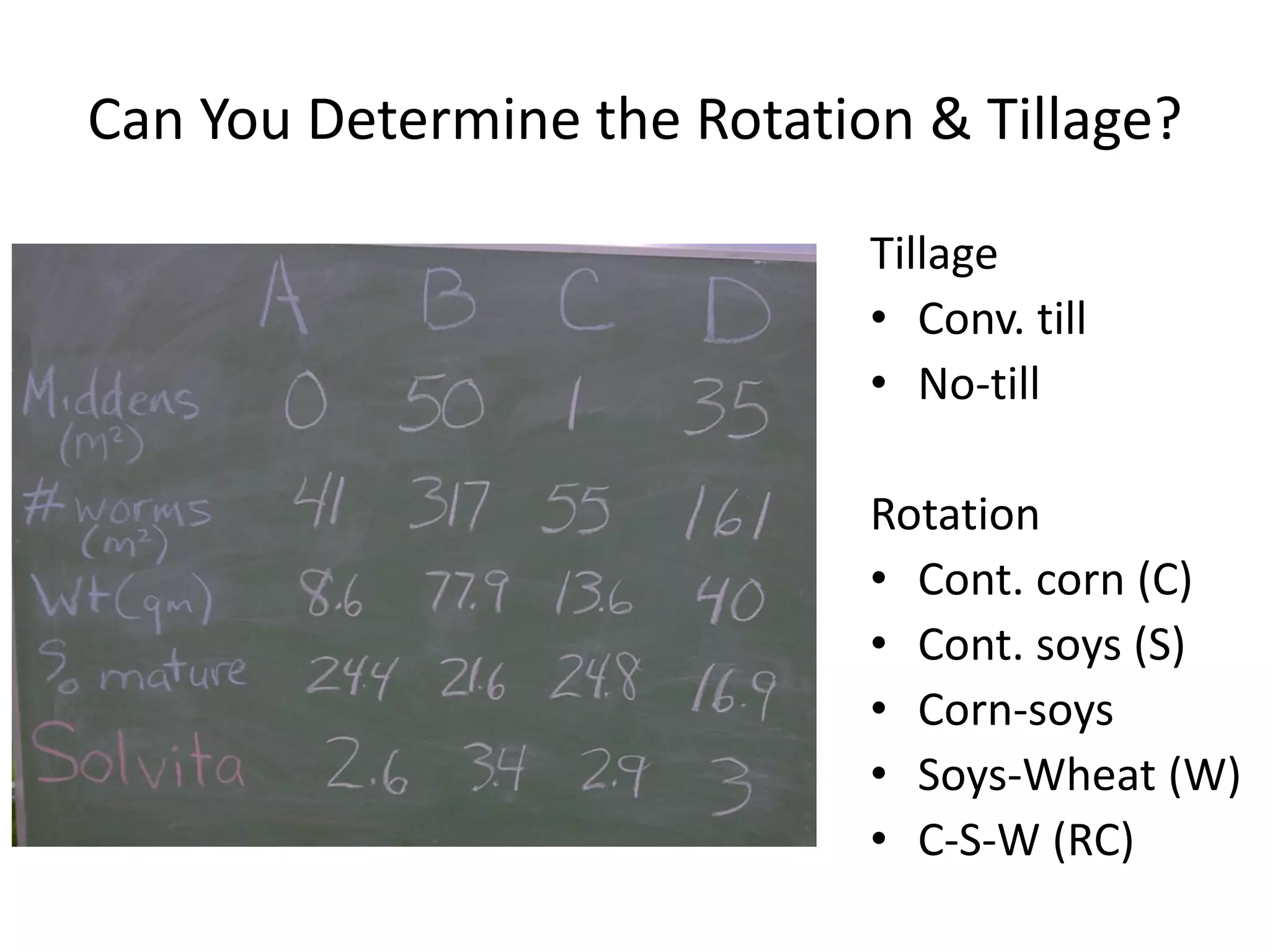
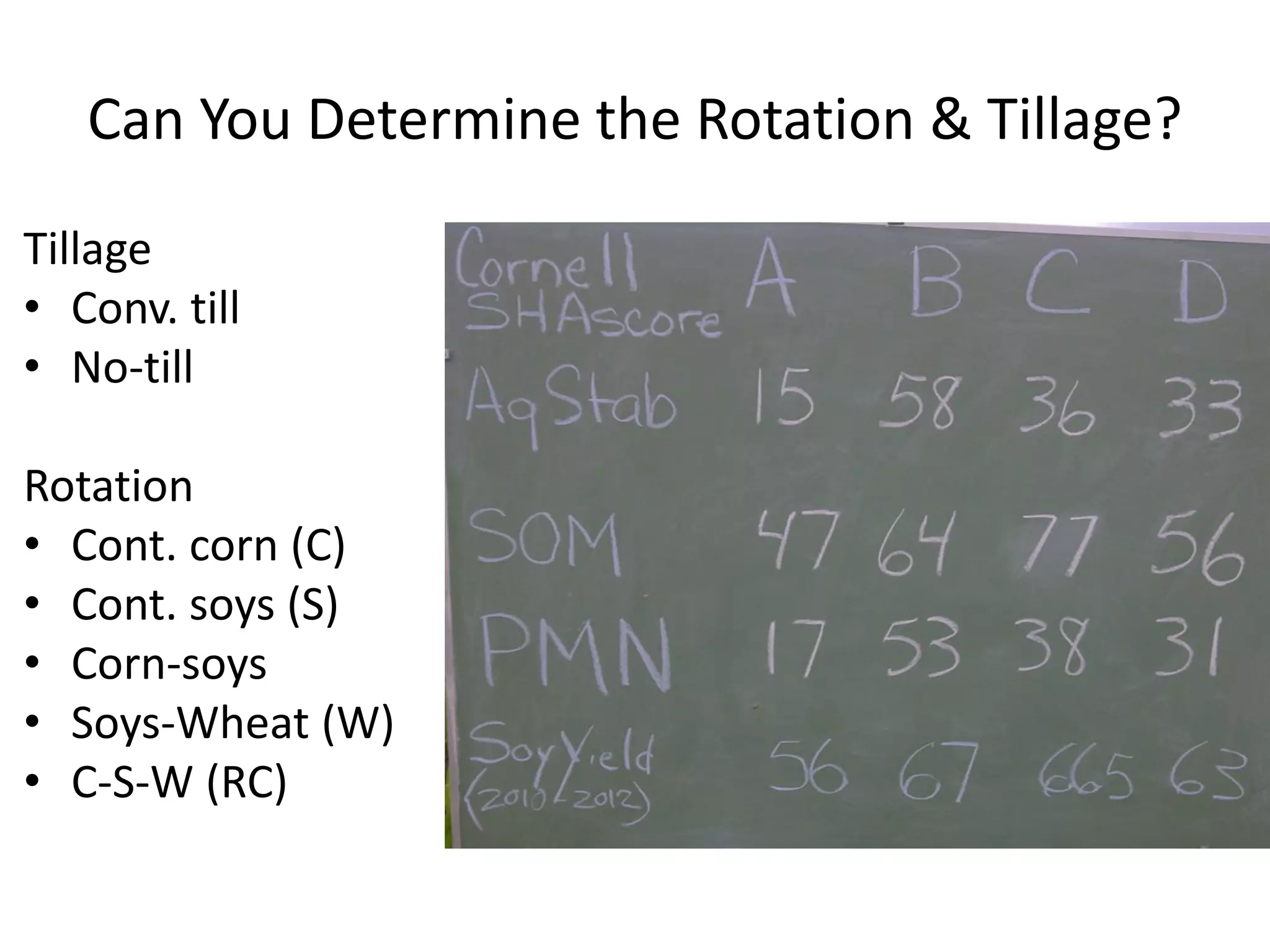
Can You Determine the Rotation & Tillage?
Tillage
• Conv. till
• No-till
Rotation
• Cont. corn (C)
• Cont. soys (S)
• Corn-soys
• Soys-Wheat (W)
• C-S-W (RC)
Can You Determine the Rotation & Tillage?
Tillage
• Conv. till
• No-till
Rotation
• Cont. corn (C)
• Cont. soys (S)
• Corn-soys
• Soys-Wheat (W)
• C-S-W (RC)
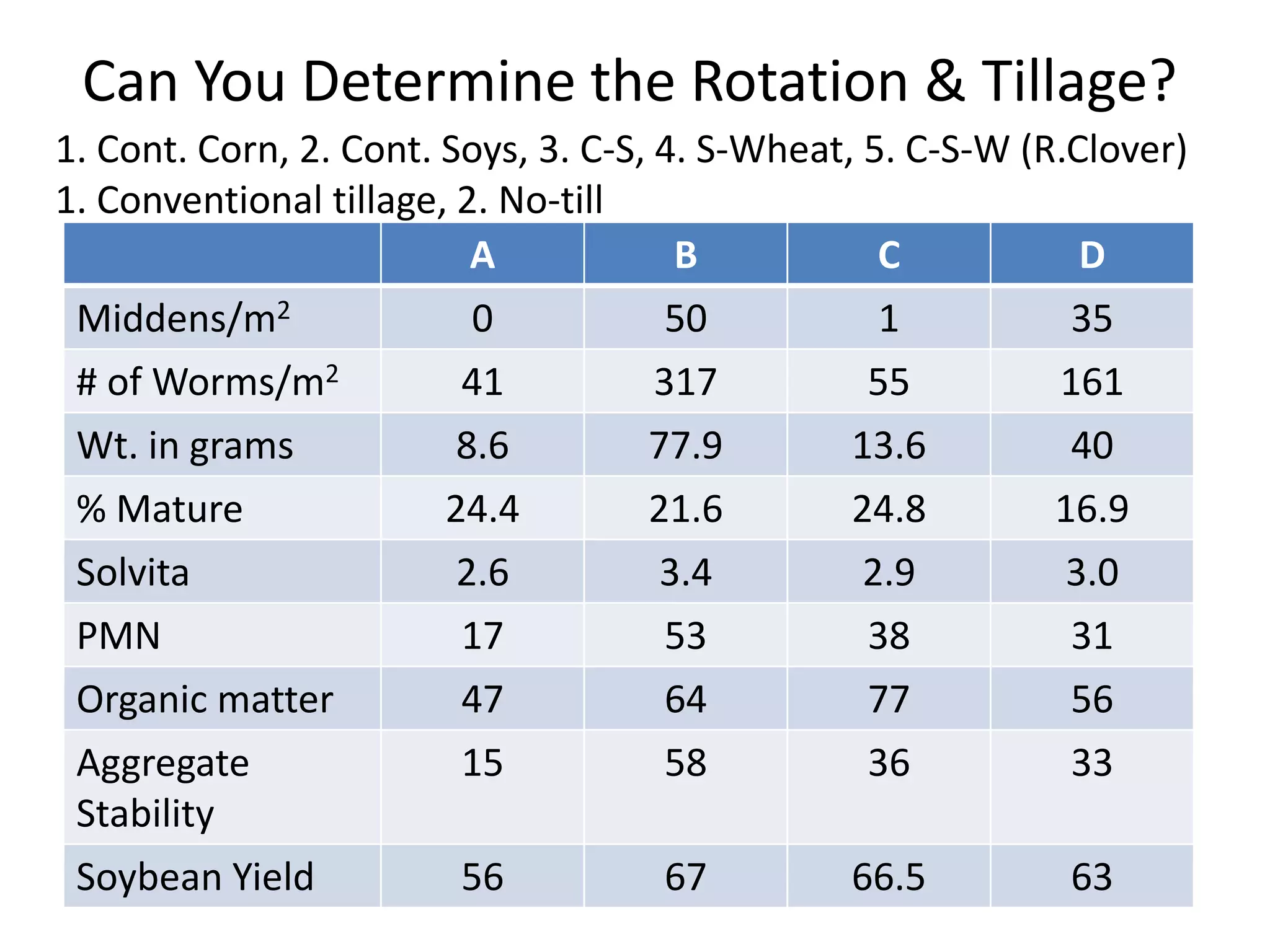
Can You Determine the Rotation & Tillage?
A B C D
Middens/m2 0 50 1 35
# of Worms/m2 41 317 55 161
Wt. in grams 8.6 77.9 13.6 40
% Mature 24.4 21.6 24.8 16.9
Solvita 2.6 3.4 2.9 3.0
PMN 17 53 38 31
Organic matter 47 64 77 56
Aggregate
Stability
15 58 36 33
Soybean Yield 56 67 66.5 63
1. Cont. Corn, 2. Cont. Soys, 3. C-S, 4. S-Wheat, 5. C-S-W (R.Clover)
1. Conventional tillage, 2. No-till
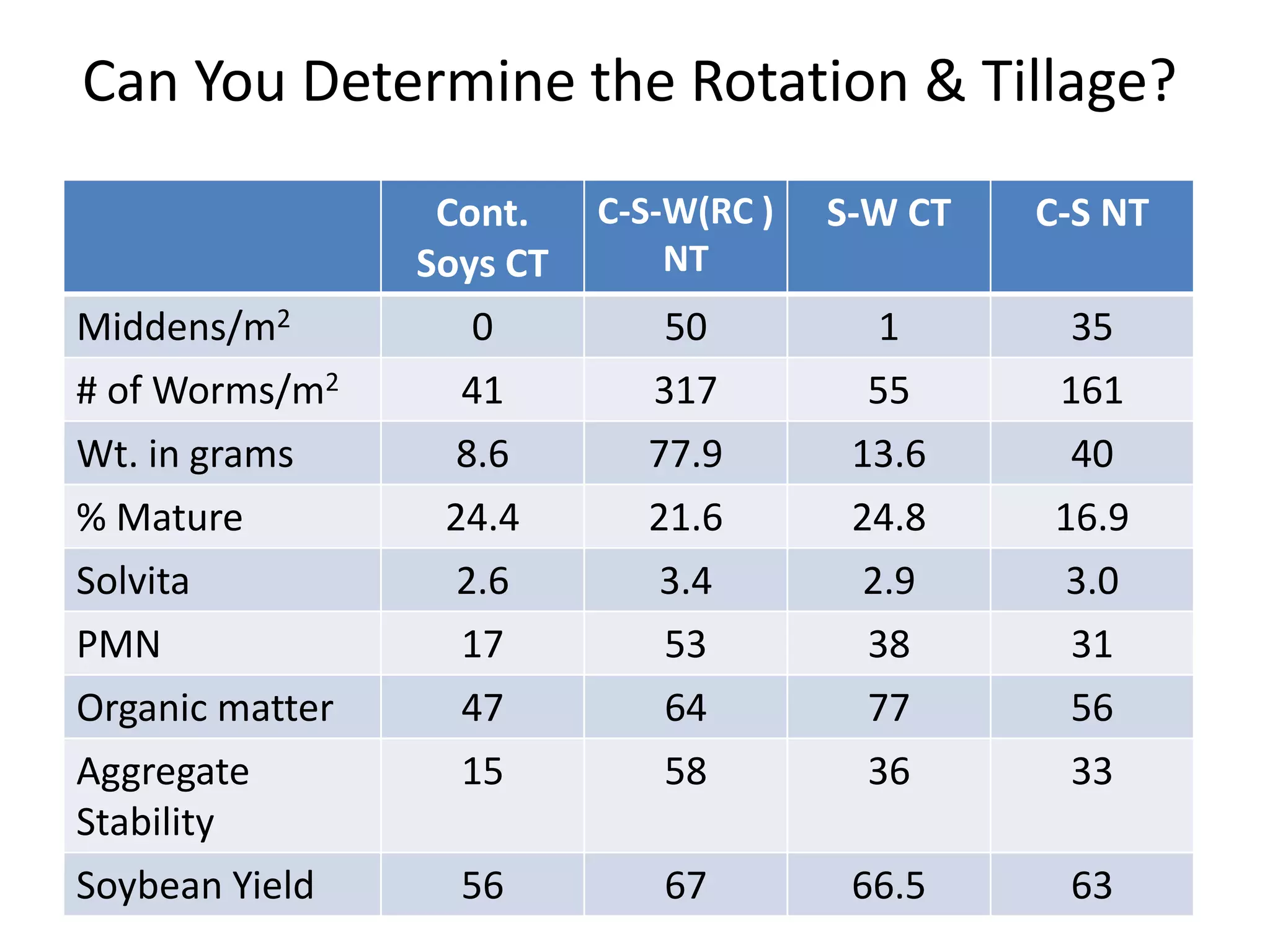
Can You Determine the Rotation & Tillage?
Cont.
Soys CT
C-S-W(RC )
NT
S-W CT C-S NT
Middens/m2 0 50 1 35
# of Worms/m2 41 317 55 161
Wt. in grams 8.6 77.9 13.6 40
% Mature 24.4 21.6 24.8 16.9
Solvita 2.6 3.4 2.9 3.0
PMN 17 53 38 31
Organic matter 47 64 77 56
Aggregate
Stability
15 58 36 33
Soybean Yield 56 67 66.5 63
Putting It All Together
• Manage with the “underground herd” in mind
• Diverse crop rotation + organic amendments =
diverse foods
• Continuous cover = consistent food source
• Stable aggregates = habitat
Soil life drives soil function. Put your soil life to work
to increase productivity and resilience of your soils.
47
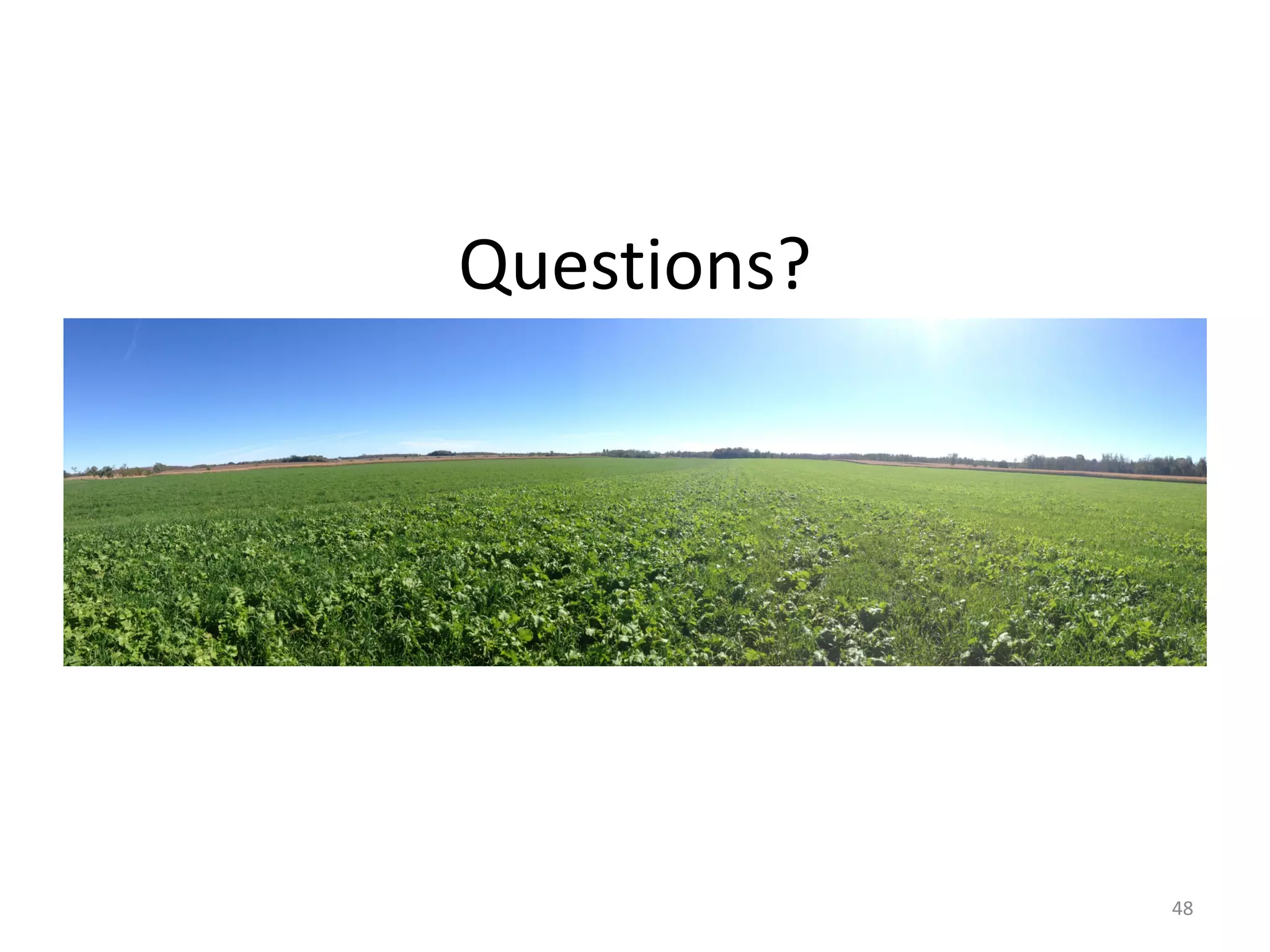
Questions?
48

Soil, it’s alive! hayes and munroe

  • 1.
    Soil, It’s Alive! AdamHayes, Soil Management Specialist Jake Munroe, Soil Fertility Specialist OMAFRA Eastern Ontario Crop Conference February 18, 2016
  • 2.
  • 3.
    Outline • Types ofsoil life • Abundance of soil life • Functions of soil life • Measuring soil life • Soil management • Principles of soil health 3
  • 4.
  • 5.
  • 6.
    Soil life represents<0.5% of total soil volume However, it drives the functions we ask of our soils 6
  • 7.
  • 8.
    Types of SoilLife • Microflora – Bacteria, fungi, algae • Microfauna – Protozoa, nematodes • Mesofauna – Mites, springtails, etc. • Macrofauna – Earthworms, beetles, etc. 8
  • 9.
  • 10.
    The Really, ReallyLittle Guys Microflora • Microscopic • Includes bacteria, fungi, green algae • Gain energy from wide variety of material – Residue/simple sugars, plants, chemical compounds 10
  • 11.
    The Really LittleGuys Microfauna • Less than 0.2 millimetre body width • Mainly nematodes and protozoa • Live in water-filled pore spaces 11
  • 12.
    The Little Guys Mesofauna •0.2-2 millimetre body width • Includes mites, springtails, and others • Live in air-filled pores and residue 12
  • 13.
    The Big Guys Macrofauna •Greater than 2 millimetre body width • Includes earthworms, beetles, and termites • Able to dig through soil 13
  • 14.
    What About Numbers? TypeAbundance Bacteria 100 million - 1 billion / teaspoon Fungi 1,000 - 15,000 lbs/acre Protozoa 1,000 – 1,000,000 / teaspoon Springtails 40,000 / square meter Earthworms 150,000 / acre or up to 1,000 lbs/acre 14
  • 15.
    What About Numbers? TypeAbundance Bacteria 100 million - 1 billion / teaspoon Fungi 1,000 - 15,000 lbs/acre Protozoa 1,000 – 1,000,000 / teaspoon Springtails 40,000 / square meter Earthworms 150,000 / acre or up to 1,000 lbs/acre 15
  • 16.
    What About Numbers? TypeAbundance Bacteria 100 million - 1 billion / teaspoon Fungi 1,000 - 15,000 lbs/acre Protozoa 1,000 – 1,000,000 / teaspoon Springtails 40,000 / square meter Earthworms 150,000 / acre or up to 1,000 lbs/acre 16
  • 17.
    What About Numbers? Thereare more microorganisms in a single teaspoon of healthy soil than there are people on earth. 17
  • 18.
    What About Numbers? Injust the top 6 inches, all the organisms in an average soil weigh somewhere between 2,500 and 5,000 lbs/acre No wonder some experts refer to soil life as an “underground herd” 18
  • 19.
    19 Topsoil represents areaof greatest abundance and diversity of soil life
  • 20.
  • 21.
    And Diversity? Soil isone of the most diverse ecosystem on the planet. • 1 gram of soil: thousands of species of bacteria • Up to 3,000 species of fungi exist in soil • Multiple species of earthworms in every acre Diversity  redundancy  resilience 21
  • 22.
    Functions of Soil 22 Slidecourtesy of Odette Menard
  • 23.
    Functions of SoilLife • Soil organisms perform many key functions of healthy soil, including: 1) Nutrient cycling 2) Maintaining soil structure 3) Symbiotic nutrient exchange 4) Disease suppression 23
  • 24.
    Nutrient Cycling • Transformationfrom organic to inorganic forms • Larger organisms tear up residue, smaller organisms decompose it • Protozoa and nematodes: – Mineralize N – excrete hundreds of lbs of NH4 +/acre/day 24 bacteria protozoa
  • 25.
    Nutrient Cycling • Actinomycetes –Give soil earthy smell – Important for hard-to- decompose materials • Earthworms – Night-crawlers pull surface litter into permanent burrow 25
  • 26.
  • 27.
    Soil Structure • Glomalinis a waxy coating created by mycorrhizal fungi • It helps aggregates form (acts like chewing gum) and protects them • Very tough – good protector of soil aggregates • Lots in the soil! – 6,000-15,000 lbs/acre in top 6 inches 27
  • 28.
    CT, SW-F NT,SW-WW-SF Moderately-grazed pasture WSA = 14% Total glomalin = 2.4 mg/g WSA = 47% Total glomalin = 3.2 mg/g WSA = 93% Total glomalin = 7.9 mg/g Soil Structure Adapted from: “The Role of Soil Biology in Improving Soil Quality”, Dr. Kristine Nichols Dry Wet 28
  • 29.
  • 30.
    Disease Suppression • Ina healthy soil, populations of organisms are balanced • Disease reduced by competition with pathogens, release of toxic compounds, and predator-prey relationships 30
  • 31.
    Measuring Soil Life •Researchers – DNA – Nematode populations – Decomposition rate – Particulate organic matter – Microbial respiration rate – Bait lamina • Commercial labs – Solvita – Organic matter, nematodes, other
  • 32.
    Field Measurements • CornellSoil Health Assessment – Organic matter – Active carbon – Soil Respiration – Soil Protein – Potentially mineralizable nitrogen (PMN) • Haney – Total N, inorganic N, phosphate, Solvita C02-C, water extractable organic C, water extractable organic N
  • 33.
    Ontario Research 33 • Overthe long-term, no-till and more complex rotations resulted in higher soil health scores • Three factors showed the greatest differences between tillage systems and crop rotations: 1) Aggregate stability 2) Percent soil organic matter 3) Potentially mineralizable nitrogen
  • 34.
    Trapping Beetles • Beneficialinsect • Feed on slugs • Measure by trapping Ground Beetles
  • 35.
    Management Impacts onSoil Life • Slugs can take up seed treatment which can have a negative impact when ground beetles feed on them • Slugs will feed on weeds or rye before corn or soybeans 35
  • 36.
    Counting Earthworm Middens Wantto see 10 to 15 middens per square metre
  • 37.
    Dig up ashovelful of soil
  • 38.
  • 39.
    Complex Crop RotationsImprove Soil Life • In general, more diverse rotations result in more diverse soil life • A greater proportion of time with live roots in the soil means enhanced soil life and activity: – Corn-soybean rotation: 38% (~9/24 months with live roots) – Corn-soybean-wheat: 53% (~19/36 months) – Corn-soybean-wheat (red clover): 61% (~22/36 months)
  • 40.
    Potentially Mineralizable Nitrogen 40 0 2 4 6 8 10 12 Corn-SoyCorn-Soy-Wheat PMN(mg/kg/day) 0-15 cm soil depth, after 14 years on clay loam soil (Ridgetown)
  • 41.
  • 42.
    The Cotton Test •Bury men's cotton briefs for 60 days (wash new ones first) • Leave the waistband showing so they can be easily found • Dig up to see how much has been eaten
  • 43.
    Can You Determinethe Rotation & Tillage? Tillage • Conv. till • No-till Rotation • Cont. corn (C) • Cont. soys (S) • Corn-soys • Soys-Wheat (W) • C-S-W (RC)
  • 44.
    Can You Determinethe Rotation & Tillage? Tillage • Conv. till • No-till Rotation • Cont. corn (C) • Cont. soys (S) • Corn-soys • Soys-Wheat (W) • C-S-W (RC)
  • 45.
    Can You Determinethe Rotation & Tillage? A B C D Middens/m2 0 50 1 35 # of Worms/m2 41 317 55 161 Wt. in grams 8.6 77.9 13.6 40 % Mature 24.4 21.6 24.8 16.9 Solvita 2.6 3.4 2.9 3.0 PMN 17 53 38 31 Organic matter 47 64 77 56 Aggregate Stability 15 58 36 33 Soybean Yield 56 67 66.5 63 1. Cont. Corn, 2. Cont. Soys, 3. C-S, 4. S-Wheat, 5. C-S-W (R.Clover) 1. Conventional tillage, 2. No-till
  • 46.
    Can You Determinethe Rotation & Tillage? Cont. Soys CT C-S-W(RC ) NT S-W CT C-S NT Middens/m2 0 50 1 35 # of Worms/m2 41 317 55 161 Wt. in grams 8.6 77.9 13.6 40 % Mature 24.4 21.6 24.8 16.9 Solvita 2.6 3.4 2.9 3.0 PMN 17 53 38 31 Organic matter 47 64 77 56 Aggregate Stability 15 58 36 33 Soybean Yield 56 67 66.5 63
  • 47.
    Putting It AllTogether • Manage with the “underground herd” in mind • Diverse crop rotation + organic amendments = diverse foods • Continuous cover = consistent food source • Stable aggregates = habitat Soil life drives soil function. Put your soil life to work to increase productivity and resilience of your soils. 47
  • 48.