2.2. 2COMPACTIONCOMPACTION FOR BEGINEERS TO UNDERSTAND 1
2.2. 2COMPACTIONCOMPACTION FOR BEGINEERS TO UNDERSTAND 12.2. 2COMPACTIONCOMPACTION FOR BEGINEERS TO UNDERSTAND 12.2. 2COMPACTIONCOMPACTION FOR BEGINEERS TO UNDERSTAND 12.2. 2COMPACTIONCOMPACTION FOR BEGINEERS TO UNDERSTAND 1
Factors affecting Compaction
Water Content
Amount of Compaction
Method of Compaction
Type of Soil
Addition of Admixtures
4.
Effect of WaterContent
With increase in water content, compacted
density increases up to a stage, beyond which
compacted density decreases.
At lower water contents than OMC, soil particles
are held by electrical forces that prevents the
development of diffused double layer leading to low
inter-particle repulsion.
5.
Increase inwater results in expansion of double
layer and reduction in net attractive force between
particles. Water replaces air in void space
Particles slide over each other easily increasing
lubrication, helping in dense packing.
After OMC is reached, air voids remain constant.
Further increase in water, increases the void
space, thereby decreasing dry density
6.
Method of Compaction
Weight of compacting equipment
Type of compaction Impact, Kneading, Rolling, Static
Pressure
Area of contact of compacting equipment with soil
Time of exposure
Each of these approaches will yield different
compactive effort Further, suitability of a particular
method depends on type of soil.
7.
Influence of compactionon soil properties
Soil Structure
Density
Shear strength
Permeability
Bearing Capacity
Settlement
Stress Strain characteristics
Swelling & Shrinkage
At low watercontents, attractive forces between
clay particles predominate, creating a more or less
random orientation of plate like particles. (results in
low density)
The addition of water increases repulsion between
more parallel
particles leading them to
assume orientation near OMC.
If compacted wet of optimum
parallel
orientation is
is described
as
further increased leading to
what dispersed structure.
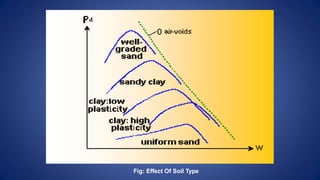
Soil type,grain size, shape of the soil
grains, amount and type of clay minerals
present and the the γd
Gs of soil solids, have a great influence
on and OMC.
In poorly graded sands γd initially decreases as the
moisture content increases, and then increases to a
maximum value with further increase in moisture.
At lower moisture contents, the capillary tension
inhibits the tendency of the soil particles to move
around and be compacted.
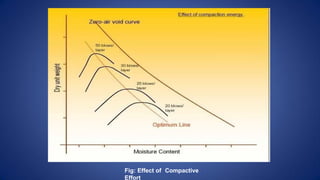
Applying moreenergy to a soil will reduce the air
voids content further and increase the dry unit
weight.
More compaction energy can be beneficial
especially for soils dry of OMC If a soil is
already moist, weaker and above OMC then
applying more energy is wasteful since air can
quickly be removed.
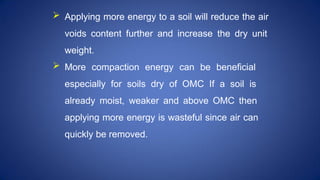
Permeability at
decreases
with
constant
compactiveincreasing
watercontent
effort
and
reaches a minimum at about the optimum.
If compactive effort is increased, the permeability
decreases because the void ratio decreases.
17.
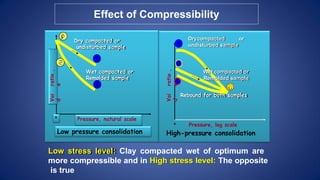
Voi
d
ratio
,
e
0
Pressure, natural scale
Lowpressure consolidation
Pressure, log scale
Voi
d
ratio
,
e
0
High-pressure consolidation
Dry compacted or
undisturbed sample
Low stress level: Clay compacted wet of optimum are
more compressible and in High stress level: The opposite
is true
Effect of Compressibility
or
Drycompacted
undisturbed sample
Rebound for both samples
Wet compacted or
Remolded sample
Wet compacted or
Remolded sample
SWELLING
Due toa higher water deficiency and partially
developed water films in the dry side, when given
access to water, the soil will soak in much more
water and then swell more.
Swelling of compacted clays is greater for those
compacted dry of optimum.
They have a relatively greater deficiency of water
and therefore have a greater tendency to adsorb
water and thus swell more.
20.
Field compactioncontrol depends on Placement
water content, Type of equipment for compaction,
lift thickness and Number of passes based on soil
type & degree of compaction desired.
Placement water content is the water content at
which the ground is
compacted in the field. It is desirable to compact at
or close to optimum moisture content achieved in
laboratory so as to increase the efficiency of
compaction.
Field Compaction Control







![Geotechnical Engineering-I [Lec #13: Soil Compaction]](https://cdn.slidesharecdn.com/ss_thumbnails/13-180923184035-thumbnail.jpg?width=640&height=640&fit=bounds)


